




Abstract
Psychology is concerned with both general laws of psychological functioning and with the individual person. The debate surrounding nomothetics and idiographics has been brought up repeatedly, but it has never been completely resolved. We therefore aim to provide conceptual clarity on how the terms “idiographic” and “nomothetic” are used and how conflating these with other concepts negatively impacts research. By differentiating distinct inferential goals and research approaches, we disentangle these confounding concepts. We demonstrate that the nomothetic–idiographic distinction alone is insufficient for categorizing research approaches in personality science. Specifically, we present a categorization of research approaches based on (a) the focal entity (person(s) versus population(s)) and (b) the type of generalization (no vs. entity-specific vs. cross-entity) resulting in a 2 × 3 matrix of research approaches. Finally, we propose a framework of 25 polytomous criteria to extend upon these distinctions. This framework can be mapped onto the generic empirical research process and may help researchers to make decisions in the research process more explicit.
Plain language summary
Psychology looks at both general psychological patterns and individual people. There is an ongoing discussion in our field about nomothetics and idiographics, and it has never been fully settled. We aim to clarify how the terms “idiographic” and “nomothetic” are used, and how mixing them up with other ideas can negatively impact research. By separating different research approaches, we untangle ideas that have been mixed up. We show that the idiographic–nomothetic distinction by itself is not enough to classify research approaches in personality science. Instead, we propose a new way to categorize research based on (a) whether the focus is on persons or populations, and (b) the type of generalization (none, specific to the entity, or across entities), leading to a 2 × 3 matrix of research approaches. Finally, we introduce a framework with 25 criteria to expand on these distinctions. This framework can help researchers make clearer decisions during the research process.
Every [person] is in certain respects like all [persons], like some other [persons] and like no other [person]. (Kluckhohn & Murray, 1953, p. 53) […I]t [is] abundantly clear that both [persons] in general and [the person] in particular are the objects of our concern. (Allport, 1962, p. 405)
The quotes above reflect a key distinction regarding the knowledge we seek in personality psychology: knowledge about all people, some people, or a single, specific individual. In the past, the terms “nomothetic” and “idiographic” have become associated or even used synonymously with research approaches that focus on people in general or the individual, respectively. The definitions of these terms as well as the usefulness of these concepts have been repeatedly and intensively discussed and critiqued since psychology has emerged as a scientific discipline (e.g., Allport, 1962; Du Mas, 1955; Eysenck, 1954; Falk, 1956; Franck, 1982; Holt, 1962; Lamiell, 1998; Nunnally, 1967; Salvatore & Valsiner, 2010). Nonetheless, different researchers have interpreted and applied this distinction in various ways in the literature (Robinson, 2011). Nomothetic has often been confounded or even equated with between-person, static, structure, quantitative, variable-centered, or variable-oriented, and idiographic with within-person, dynamic, process, qualitative, person-centered, person-oriented, or person-specific. This alerts us to the fact that the concepts behind the terms may simply not be well defined—which is problematic as a clear definition of concepts is a key aspect of scientific research. To build towards an effective and useful common agenda for personality science, clarity about the knowledge we are seeking, the methods and resulting data we are using to achieve our research goals, and the interpretation of our findings is needed.
In this article, we do not aim to add new conceptualizations of nomothetics and idiographics to this long-standing debate. Instead, we seek to provide conceptual clarity on how the terms “idiographic” and “nomothetic” are used and how conflating these with other concepts negatively impacts research. By differentiating distinct inferential goals and research approaches, we disentangle these confounding concepts. We demonstrate that the nomothetic–idiographic distinction is insufficient for categorizing research approaches in personality science, and we promote the use of explicit and specific decisions within research approaches to avoid further conceptual confusions. The article is structured as follows. First, we provide a brief overview of the historical origins of the terms “nomothetic” and “idiographic” and their use in the personality psychological literature. We then argue that both terms carry multiple meanings, often resulting in a conflation of distinct concepts and, as a consequence, the risk of obscuring inferences. We further make the case that focal entities (persons or populations 1 ) and types of generalizations (none vs. entity-specific vs. across entities) as broad concepts lie at the heart of the confusion surrounding the nomothetic–idiographic distinction. To address this problem, we offer an overarching framework to (a) disentangle different meanings of “nomothetic” and “idiographic” and to (b) categorize broad research approaches within personality science based on different combinations of focal entities and generalization types. To enhance inferential accuracy, we propose a set of polytomous (i.e., multicategorical) criteria that help describe and distinguish different research approaches on a meta-level. These criteria can help researchers to clarify key decisions during the research process and to evaluate the alignment between research questions, methods, and inferences (see Kuper et al., 2024). Finally, we highlight the importance of clearly communicating generalization intentions and other decisions surrounding rationales, concepts, and methodology in (personality) psychological research, and offer recommendations for improving epistemological clarity. Although this article focuses on personality psychology, most arguments apply broadly to psychology.
The nomothetic–idiographic distinction in (personality) psychology
Since the inception of personality psychology, the concepts of “nomothetic” and “idiographic” research have played a crucial role in defining the field’s scope and direction. Originally coined by the German philosopher Wilhelm Windelband (1894/1998), the nomothetic–idiographic distinction was intended as a description of the nature of intended knowledge (i.e., principal inferential goals) typically sought by different scientific disciplines. Nomothetic sciences are those that seek generalizable laws (i.e., generalizable inferences), while idiographic sciences are interested in the particular (i.e., inferences about specific instances or unique phenomena; Krauss, 2008; Lamiell, 1986, 1998). The distinction was first introduced and adapted into personality psychology by William Stern (1911). Sternian nomothetics correspond to variable-centered, between-person analyses that examine how particular attributes vary and covary across many individuals 2 , producing knowledge about populations as aggregated wholes. Sternian idiographics, on the other hand, concern person-centered approaches that characterize and compare particular individuals in terms of many attributes and their configurations (i.e., psychographic and comparative research). Gordon Allport (1937, 1961), influenced by both Stern and Windelband, popularized the nomothetic–idiographic distinction in the Anglo-American personality-psychological literature (Hermans, 1988; Krauss, 2008; Robinson, 2011). However, Allport was inconsistent in how he conceptualized nomothetics and idiographics (Krauss, 2008), and he stopped using these terms altogether in his later work. At times, Allport used nomothetic to mean universal, uniform, or “common to all individuals” (1937, p. 248), which corresponds to Windelband’s (1894/1998) original conceptualization. However, like Stern (1911), Allport mostly equated nomothetic research with between-person, population-level analysis (Robinson, 2011), and idiographic research with the study of the specific individual. That is, Allport interpreted “nomothetic” knowledge about people in general to mean knowledge about people in the aggregate rather than about human nature or every person (Lamiell, 1998). Also, like Stern before him, Allport equated the particular in idiographic psychological research with the individual person rather than any unique instance or phenomenon (e.g., individual, group, event, and trend; Krauss, 2008). However, Allport (1937, 1961) considered psychography to be insufficient for idiographic research as individuality could not be reduced to the total sum of a person’s attributes. Instead, he called for the in-depth study of the individual person that would do justice to the dynamic organizations within them and capture lawful regularities in their psychological systems (Lundh, 2015) 3 . By including the search for lawfulness at the level of the individual person in his conceptualization of the idiographic approach, Allport further blurred the lines of Windelband’s (1894/1998) separation between the nomothetic disciplines seeking general laws and the idiographic disciplines aimed at understanding particular occurrences.
Non-exhaustive Overview of Different Interpretations of Nomothetics and Idiographics.
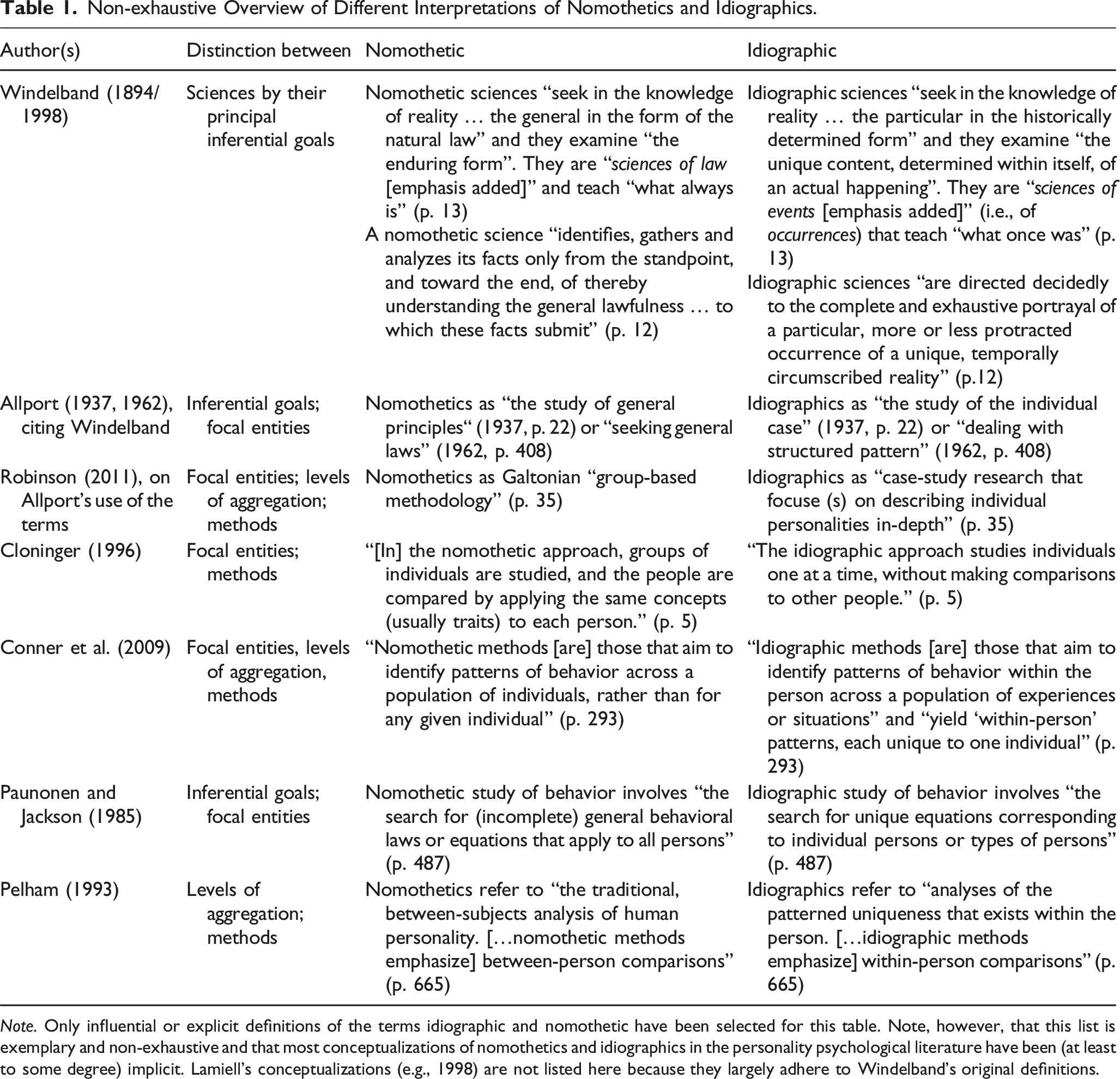
Note. Only influential or explicit definitions of the terms idiographic and nomothetic have been selected for this table. Note, however, that this list is exemplary and non-exhaustive and that most conceptualizations of nomothetics and idiographics in the personality psychological literature have been (at least to some degree) implicit. Lamiell’s conceptualizations (e.g., 1998) are not listed here because they largely adhere to Windelband’s original definitions.
Disentangling the conceptual meanings of the nomothetic–idiographic distinction
Despite the different meanings outlined in the previous paragraph, the nomothetic–idiographic distinction has been persistently used at least to differentiate between the study of populations and the study of the individual person, respectively (see Table 1: e.g., Allport, 1937, 1961; Cloninger, 1996; Conner et al., 2009; Pelham, 1993). We refer to this usage as a distinction between different focal entities of psychological research, that is, the primary subject about which knowledge is produced or to which existing knowledge can be applied. While most definitions of nomothetics and idiographics in psychology concern focal entities (see also “Distinction between” column in Table 1), the distinction is also closely associated with different types of generalizations, namely generalizations about or across persons and populations. Arguably, the confounding of focal entities and generalizations in psychology is a main reason why the nomothetic–idiographic distinction continues to be reinterpreted and potentially misunderstood. Most prominently, nomothetic psychological research is not only commonly conceptualized as the study of populations but is also sometimes understood as seeking general laws that apply to all individuals (e.g., Lamiell, 1998; Paunonen & Jackson, 1985). This ambiguity can be traced all the way back to Allport (see earlier) and has persisted to this day (see Table 1). Crucially however, the search for lawfulness across each and every individual person is different from the analysis of between-person patterns (e.g., Hamaker, 2012). The former seeks generalizations across (all) persons while the latter typically involves generalizations from a sample to the larger population. Yet, one might consider both approaches nomothetic in the Windelbandian sense as both aim to establish generalizations, applying either to persons or to populations. The crux of this conflation of concepts is that different combinations of focal entities and generalization intentions lead to distinct types of inferences that can be obscured by subsuming them under the nomothetic–idiographic dichotomy.
Focal entities of (personality) psychological research: Person(s) and population(s)
Psychologists study people, either individually or in the aggregate. Relatedly, nomothetic research is often—explicitly or implicitly—associated with a between-person perspective in which phenomena are examined across individuals within a group or population, and idiographic research is associated with a within-person perspective, examining phenomena within single or multiple individuals across time or situations. This distinction concerning the level of aggregation is also linked to methodological decisions regarding data structure, orientation of analysis, data types, and, most importantly, analytical strategies (collectively referred to as “methods” in Table 1; see also Kuper et al., 2024 for details). Specifying a population as the entity of interest in nomothetic research and the individual person as the focal entity of idiographic research is just one possible, albeit the most common application of these terms in personality science (Lamiell, 1998). Of course, person(s) and population(s) are not the only entities that psychologists study. One might even assert that psychological research primarily seeks knowledge about psychological constructs and processes rather than about specific persons or populations. However, we argue that psychological phenomena are always theoretically nested within individuals or populations. That is, any psychological variable represents something that exists or unfolds either within individuals (i.e., psychological functioning is necessarily a property of the individual person, e.g., Speelman & McGann, 2020) or across/between persons within a group or population (e.g., individual differences; e.g., Revelle et al., 2011). Knowledge or inferences may apply to different focal entities, depending on the type of generalization that is used (see also Figure 1 and later). Central Focal Entities in Psychological Research. Note. Specification of central focal entities about which knowledge can be produced within psychological research. Further focal entities may be relevant depending on the specific research question.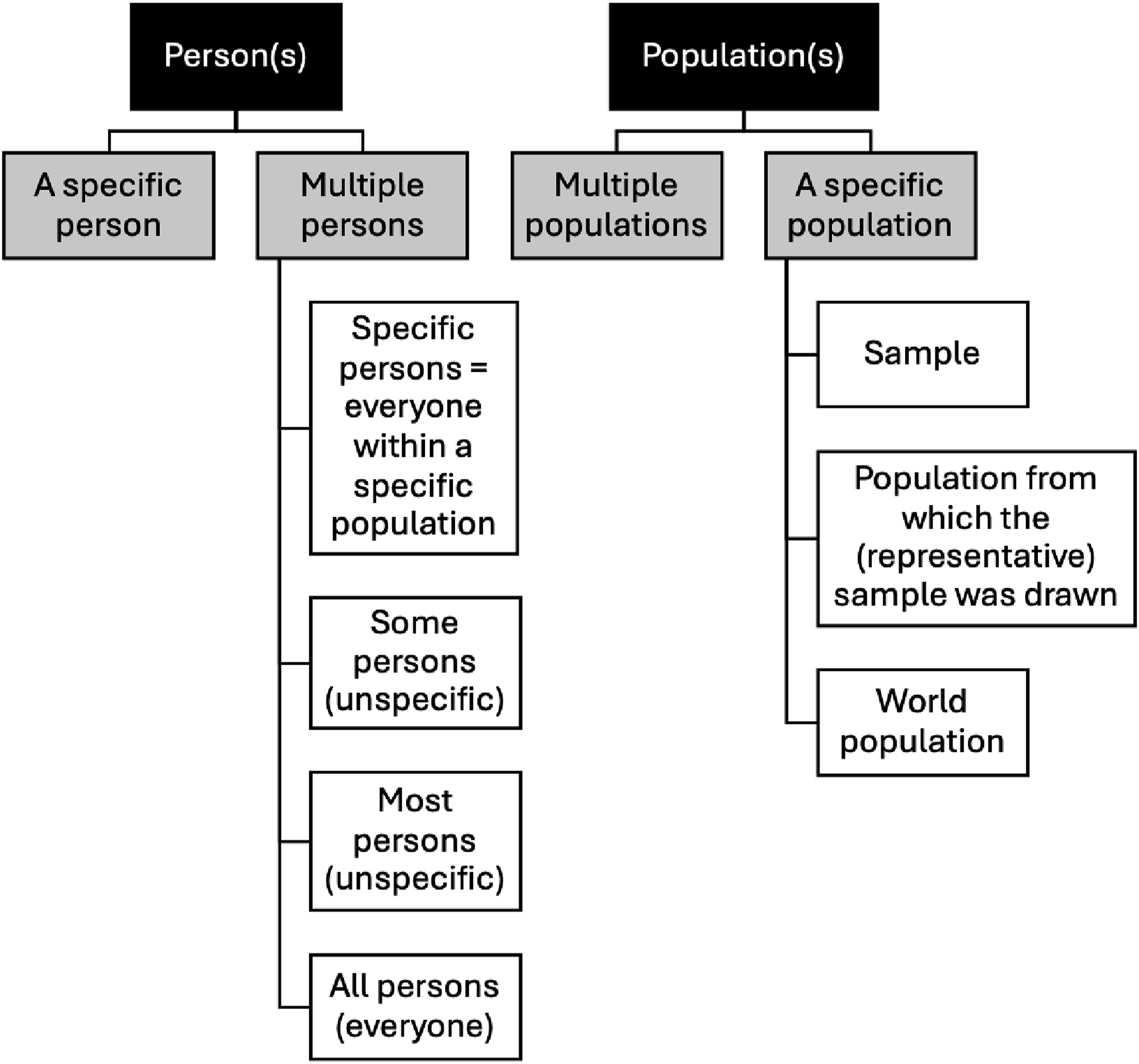
Person(s) are the focal entity whenever the phenomenon of interest is examined and interpreted at the individual level. Research approaches that focus on individual persons have also been referred to as person-oriented, person-centered, person-specific, or N = 1 approaches. These include case studies (e.g., Allport, 1937, 1961; Robinson, 2011) but are more commonly focused on person-specific within-person patterns in modern personality psychology (e.g., Beck & Jackson, 2020a, 2020b; Conner et al., 2009; Paunonen & Jackson, 1985; Pelham, 1993). The study of the specific person offers insights into their individuality or about their uniqueness 4 . Arguably however, most psychological research seeks knowledge that applies to multiple—specified or unspecified—persons, or even to all humans. Research that aims to discover general laws of psychological phenomena which hold true for everyone adheres closely to the Windelbandian definition of nomothetics (Lamiell, 1998; see also later). Alternatively, we might be interested in producing knowledge that applies (without exceptions) to all persons from a specific (sub-) population instead of the entire human population (e.g., every person without brain lesions; every left-handed person; every psychology student at University X). Importantly, this kind of knowledge can typically not be gained from inter-individual population-based statistical analyses since this would only be possible under the very strict conditions of ergodicity that virtually never apply to psychological phenomena (e.g., Molenaar, 2004; Molenaar & Campbell, 2009; Richters, 2021; Speelman & McGann, 2020).
Population(s) are deemed the focal entity if the knowledge that is produced applies to the population as a whole rather than to any individual person. Across psychological research fields, talking about “the population” often means talking about a hypothetical average person representing a central tendency within the population, usually estimated by the sample mean. In addition, personality psychology is interested in individual differences representing variation within the population, estimated by between-person 5 sample variance. As for research focusing on person(s), population(s) research can be targeted either at a specific population or at multiple populations (of persons). In some rare cases, the entire population of interest can be examined (i.e., total population sampling). This implies that the sample is the same as the target population about which knowledge is sought. Usually however, the focal entity is a specific population that cannot be exhaustively assessed, and generalizations are made from a representative sample to the larger population using inferential statistics. Knowledge that applies equally to multiple populations (as aggregated wholes) is also sometimes produced by psychological research, e.g., in cross-cultural approaches.
To further demonstrate the relevance of specifying the focal entity, take the statement “People have the need to believe in a just world”. This statement implies multiple persons as the focal entity (i.e., “people”), but based on the distinctions outlined above, it can have several meanings. First, it might refer to all people which would require that each and every person around the world possesses this need. Second, it might refer only to certain people who can be clearly identified. Consequently, a (sub-)population can be specified for which the statement holds true (i.e., “All people who … have the need to believe in a just world.”). Third, the statement can be about most people (i.e., a majority; e.g., >50%; or almost everyone, with rare exceptions), either across all of humanity or from a specified population. Fourth, the statement might refer only to some people, meaning that it could be true for only a few individuals or for a substantial minority of the population. Finally, this statement can be about “the average person” (even if that person does not actually exist in the population), that is, the population mean. In this case we cannot readily conclude to whom or for what proportion of persons the statement applies. Without further specification, a stated fact about “people” is highly ambiguous with regard to the focal entity. Such statements lack specificity and obscure what knowledge has actually been gained.
Generalizations in (personality-)psychological research
According to Windelband (1894/1998), generalization intentions, specifically the search for general laws, define the nomothetic sciences, while idiographic research examines unique phenomena without generalizing. A general law, also commonly referred to as a scientific law, is “a descriptive generalization [i.e. a pattern] about how some aspect of the natural world behaves under stated circumstances” (National Academy of Sciences, 1998, p. 5) 6 . Arguably, research focusing on general laws (“nomothetic”) is the dominant modus operandi in mainstream psychological science. Though the term “law” is rarely used and very few laws have been proposed within psychology (Teigen, 2002), most psychological research makes claims to generalizability 7 . Before taking a closer look at the types of generalizations commonly pursued in the study of personality and individual differences, we want to briefly outline what the search for general laws of psychology entails. That is, we explore what is required for psychological research to be regarded as nomothetic in the Windelbandian sense.
General laws and generalizable patterns
Psychological laws, like laws of biology (Mitchell, 2000), differ from those of the formal and physical sciences in several important ways. First, a certain degree of abstraction is required to arrive at general laws because each particular focal entity in psychological theory and research is inherently and necessarily unique given a high enough resolution (Mitchell, 2000; Salvatore & Valsiner, 2010). Generalizable patterns can therefore only be found if certain details are ignored. Second, psychological laws are typically probabilistic rather than deterministic. That is, laws are rarely universally applicable, and we expect to find exceptions. For a given case (e.g., a specific individual or for a specific population), we may not know for certain whether the law applies, but the relative frequency of cases for which the law holds true provides a weighted posit (or wager) denoting the strength of the law (or predictional value; Reichenbach, 1938). Third, psychological laws may often be contingent upon conditions that are less stable across time and space (e.g., cultural or historical contexts; Lamiell, 1998). To interpret and use a law of psychology, we need information about the conditions under which the law has already applied and when the dependency between conditions and law has been stable (Mitchell, 2000). That is, we must identify the population-/person-, time-, context-, and method-specific boundary conditions that limit the generalizability of our findings (Gollwitzer & Schwabe, 2022; Moeller et al., 2022) 8 .
As mentioned earlier, different types of generalizations have been entangled in the nomothetic–idiographic distinction. Nomothetic approaches may aim for generalizations about specific populations as aggregated wholes or generalizations across individuals. Moreover, generalization intentions are not unique to conceptualizations of nomothetic research since the idiographic approach in (personality) psychology has also been defined as seeking lawfulness in the form of person-specific patterns or equations (e.g., Allport, 1937, 1961; Conner et al., 2009; Paunonen & Jackson, 1985). We propose that two broad generalization types are central to personality and differential psychological research and the nomothetics–idiographics debate: entity-specific generalizations and generalizations across entities. An entity-specific generalization concerns a lawful regularity that—under certain conditions—applies to a particular focal entity (i.e., a particular person or population). Entity-specific generalizations are established by identifying patterns or regularities across a sample of lower-level entities nested within the focal entity (e.g., persons within populations, occasions within persons), and then generalizing to the focal entity at large. They could in principle be formalized in entity-specific equations. Cross-entity generalization, by contrast, concerns a law that applies to (all or certain) entities at the same level (i.e., all persons or all populations) given its boundary conditions. Generalizations are made from entity to entity. Here, the focal entity refers to each entity at a given level rather than to any single particular case. To sum up, in this section, we have identified two focal entities and two types of generalizations that we deem relevant for conceptually separating different meanings of nomothetics and idiographics in psychological research. Next, we combine these in a systematic manner and examine the resulting research approaches and types of inferences.
Not two but six: Distinguishing broad approaches to studying persons and populations
Broad Research Approaches in the Psychological Study of Individual Persons and Populations.
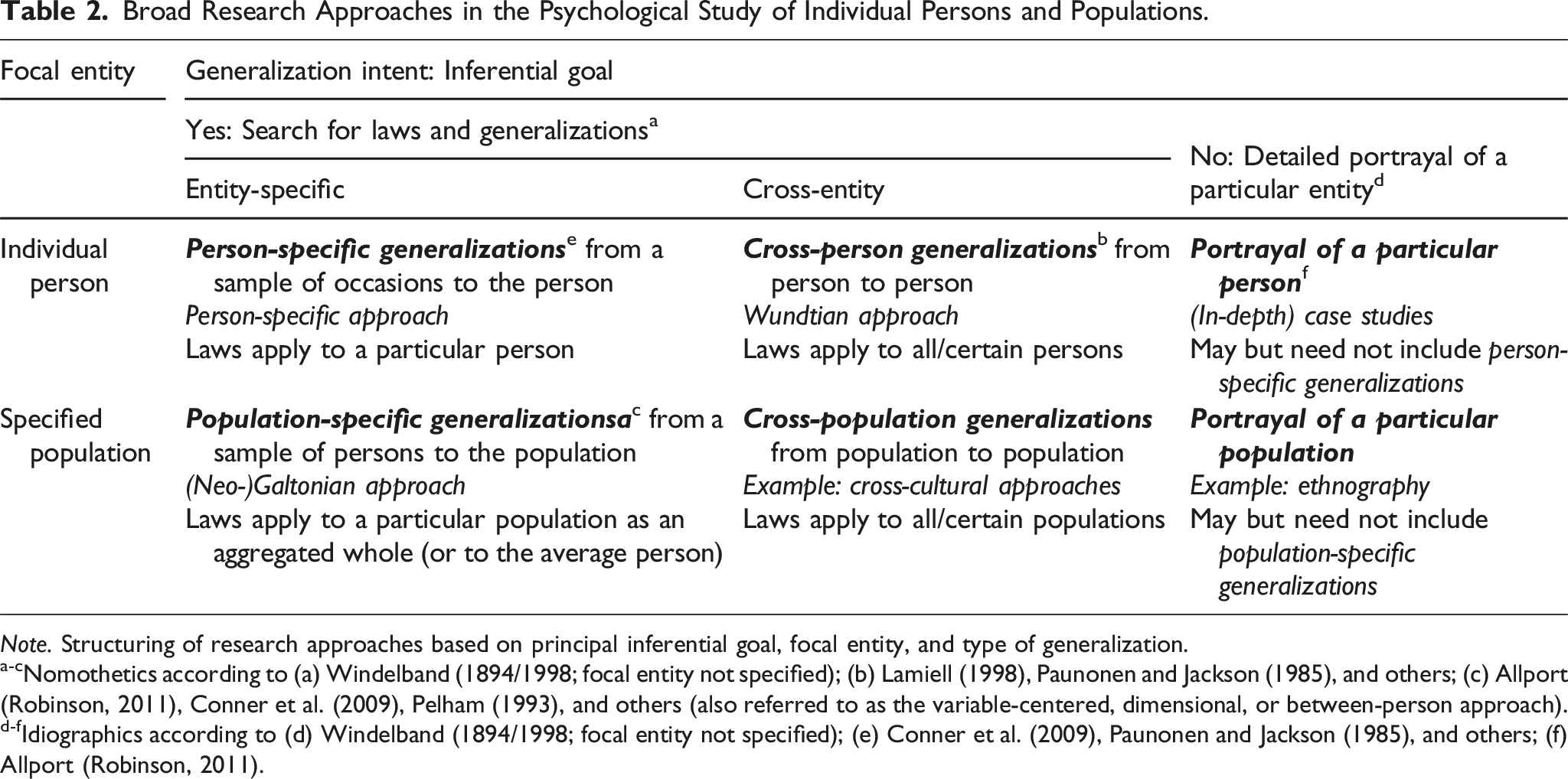
Note. Structuring of research approaches based on principal inferential goal, focal entity, and type of generalization.
a-cNomothetics according to (a) Windelband (1894/1998; focal entity not specified); (b) Lamiell (1998), Paunonen and Jackson (1985), and others; (c) Allport (Robinson, 2011), Conner et al. (2009), Pelham (1993), and others (also referred to as the variable-centered, dimensional, or between-person approach).
d-fIdiographics according to (d) Windelband (1894/1998; focal entity not specified); (e) Conner et al. (2009), Paunonen and Jackson (1985), and others; (f) Allport (Robinson, 2011).
Person-specific generalizations
Person-specific generalizations concern lawful regularities within an individual person, that is, a generalization that holds true for a particular person given certain boundary conditions. These lawful regularities can be within-person generalizations such as factor structures (Borkenau & Ostendorf, 1998), state distributions (Fleeson, 2001), contingencies (Beckmann et al., 2010; Fleeson, 2007; Kuper et al., 2022; Minbashian et al., 2010), networks and their consistencies (Beck & Jackson, 2020a, 2020b; Quirin et al., 2023), and models of psychopathology (Wright & Woods, 2020). Person-specific generalizations are relevant when we want to investigate phenomena within a person that involve some kind of organization over time and contexts or concern characteristics that are relatively stable over time such as dispositions (Lundh, 2015). Most research that is labeled idiographic within personality science refers to the search for person-specific patterns or laws (see Table 1). This understanding corresponds to Allport’s morphogenic approach (Allport, 1962) and represents the common interpretation of the idiographic approach within personality psychology (see also Kuper et al., 2024).
To establish a person-specific generalization, a researcher may observe the person of interest at several occasions (i.e., repeated measurements over time are required), discover a within-person pattern, and claim that the observed pattern reflects lawfulness in that person’s life. This can be realized, for example, via intensive longitudinal data from a single person (Wright & Woods, 2020). How occasions (e.g., situations or time points) should be sampled and what data (e.g. with regard to the ABCDs of personality, Wilt & Revelle, 2015) should be collected depends on the specific research question—and must then be considered with regard to the generalizability of the results or the proposed law. To examine person-specific within-person phenomena and to establish person-specific generalizations, N = 1 study designs (i.e., suitable to test hypotheses within persons using repeated measurements over time; McDonald et al., 2017) and person-specific analytical methods (i.e., models using data from a single person; Kuper et al., 2024) can be applied.
Importantly, person-specific generalizations are not made from one person to another but from one occasion or a sample of occasions to a population of occasions within a person’s life. Occasions can simply be measurement points, but also contexts, situations, roles, events, and so on. For example, if we consider Maria, a specific individual, as a focal entity, we might be interested in examining how stressful work situations affect her momentary well-being, and we might want to identify the factors that potentially affect Maria negatively. To answer our research question, we could assess Maria’s level of momentary well-being at the end of every workday, her eating and sleeping behaviors, as well as a series of potential work-related stressors for a period of three months. We find that her well-being consistently decreases after work situations involving time pressure, public speaking, and after interactions with a specific supervisor. We further find that the negative effect of time pressure on Maria’s well-being is amplified on days where she has skipped lunch. Also, public speaking at work is only negatively associated with her well-being when she did not get enough sleep the night before. What we propose here, is an extension of Mischel and Shoda's (1995) idiographic if-then-behavior-profiles to if-then-ABCD-profiles (e.g., Minbashian et al., 2010, 2018), where ABCD (Wilt & Revelle, 2015) refers to affects, behaviors, cognitions, and desires (see also Renner et al., 2020).
Cross-person generalizations—The Wundtian approach
Person-to-person(s) generalization corresponds to the Wundtian approach 9 (Danziger, 1987, 1990) and is conceptually similar to the Windelbandian definition of nomothetics (Lamiell, 1998). In this approach, individuals are analyzed separately (i.e., N = 1 case by case) and a phenomenon is considered generalizable if (or as long as) the same or similar effects are found for all individuals studied (Danziger, 1990; Robinson, 2011). Here, the objective is to establish what is common for all individuals in a population (i.e., establishing within-person phenomena for each individual within the population; Lamiell, 2003; Robinson, 2011). Arguably, this approach adheres closest to customary understandings of psychological laws and the definition laid out earlier. Specifically, cross-person generalizations would allow for the explanation of the occurrence of specific instances because the law is applicable to all cases.
As an example, using this approach we might be able to find out whether within-person contingencies between friendly social interactions and positive affect generalize across persons. To do this, we could assess the degree to which a social interaction has been perceived as friendly and the level of momentary positive affect across multiple occasions for each person in our sample. We may then estimate person-specific contingencies and determine whether the same pattern can be observed for each and every individual. Contrary to population-based approaches, we would know the extent to which the effect holds for each person and not only for the “average” person. Perhaps the most well-known historic example of this approach (albeit not concerning humans) is Pavlov’s work on classical conditioning in dogs (Pavlov, 1927). Similarly, Lamiell’s (1981) so-called idiothetic approach can also be seen as a cross-person generalization approach in which the personality of single individuals is descriptively studied over time (without comparison to others) to arrive at developmental trajectories. These within-person developmental trajectories are then compared across persons with the goal to establish general laws (or at least generalizable regularities for certain subpopulations) of personality development.
Person-level generalizations can apply to a specified population of persons or to all humans. However, it should be expected that most person-level generalizations will only apply to certain (sub-)populations (e.g., due to culture-specificity; Brown, 2004) and will have some boundary conditions because of the complex and dynamic nature of human beings and lives. Further, while the (ultimate) goal of Wundtian generalization is to establish general laws for a whole population, it should be noted that a case-by-case approach comprising a whole population is only possible for relatively small groups. A generalization from the sample to the population, as in inferential statistical approaches, is not explicitly intended. However, the larger the number of individuals sampled from the target (sub-)population for whom an effect can be found and the more representative the sample, the more evidence accumulates indicating that the effect is present across the specified (sub-)population.
For a phenomenon to be considered a general law, a strict application of person-to-person generalization would require all studied individuals to show the targeted phenomenon under the same boundary conditions (or sets of boundary conditions). This requires a precise, detailed, and theoretically well-founded specification of the target population 10 (ruling out a lack of generalization due to unwanted person-specificity) as well as a comprehensive identification of other relevant boundary conditions upon which the phenomenon is dependent. In this case, even one single individual who deviates from the postulated general law requires either a reassessment of the law or a respecification of its boundary conditions. A less strict application of person-to-person generalizations would allow for general laws that apply for most rather than for all individuals of the specified population, indicating a certain probability. Here, we can also account for a potentially insufficient specification of the target population (i.e., introducing unwanted person-specificity; e.g., Moeller et al., 2022). This less strict application seems more practically feasible because it is not possible to identify and comprehensively model every possible moderator for each person (Salvatore & Valsiner, 2010). Furthermore, it corresponds more closely to the complexity, dynamic nature, and messiness of the real world in which our phenomena of interest occur, and it takes into account the measurement challenges inherent to latent psychological phenomena as well as the entanglement of psychological researchers with their studied phenomena (see Uher, 2022). However, a less strict application also results in less credible and robust general laws than the stricter application. Nevertheless, a less strict application can still generate useful laws albeit probabilistic rather than deterministic. It should be noted that there are now methodological advances that allow for the bottom-up integration of person-specific models to derive population-level paths shared by the majority of individuals (e.g., GIMME: Gates & Molenaar, 2012; see also Kuper et al., 2024). Importantly, both person-specific generalization and cross-person generalization approaches circumvent the main critique of Allportian nomothetics that persons are studied in the aggregate, resulting in inferences about populations and not individuals.
Population-specific generalizations—The (Neo-)Galtonian Approach
Population-specific generalizations concern patterns or regularities that hold true for a specified population as a whole (under certain boundary conditions) rather than for each or any individual person. This approach is also referred to as the (Neo-)Galtonian Approach (Danziger, 1987, 1990) 11 . As total population sampling is rarely possible or feasible, generalizations are usually made from a sample to the entire target population from which the sample was drawn (i.e., sample-to-population generalization). The target population can be any theoretically defined group of people, such as a certain social, cultural, or socio-demographic group, or even the entire human population 12 .
The Galtonian approach (Danziger, 1987, 1990) uses statistical methods that yield parameters characterizing populations (e.g., means, variances, between-person correlations, factor analyses, regression analyses, generalized linear models). In personality psychology, Galtonian methodology is commonly used for interindividual differences research where between-person patterns observed in a sample are generalized to the larger population. For example, if the Big Five factor structure emerges repeatedly from (representative) samples of the German population, we can consider this structure a population-specific generalization. Galtonian population-specific generalizations are often considered to be nomothetic in the personality-psychological literature (see earlier and Table 1). The Neo-Galtonian approach (Danziger, 1987, 1990) focuses on average effects of experimental manipulations (e.g., differences between treatment and control groups). (Neo-)Galtonian methodology subsumes a family of statistical analyses that aggregate across individuals to test hypotheses about populations. This is the standard quantitative approach in mainstream modern psychology (Robinson, 2011; Toomela & Valsiner, 2010). Importantly however, as the (Neo-)Galtonian approach is based on population parameters, it can only produce knowledge about populations and not individuals 13 (Drobisch, 1863; Lamiell, 2018). Consequently, a common critique of the approach is that it is often unclear if and how its findings can be applied at the person level (Molenaar, 2004; Molenaar & Campbell, 2009; Speelman & McGann, 2020). Similarly, average within-person phenomena can be seen as characterizing populations rather than individuals, especially when individual differences are ignored (e.g., Hamaker, 2012). Even though the (Neo-)Galtonian approach is currently most prevalent in psychology research, this does not mean that this approach is always the most adequate one. Arguably, the popularity of population-based statistical analyses can be traced back to historical trends, their wide-spread availability, easy implementation, and their seemingly easy applicability and versatility (Robinson, 2011). In personality psychology, the (Neo-)Galtonian approach is often implicitly accompanied by a conflation between interindividual differences (i.e., characterizing between-person variations across a population) and individuality (i.e., characterizing the individual and their uniqueness; American Psychological Association; Uher, 2022). In the study of persons, (Neo-)Galtonian methodology cannot be considered nomothetic in the Windelbandian sense because it is ill-suited to produce general laws that are “common to all” entities—it rather gives insight into what might be “on average true” across entities (Lamiell, 1998; Windelband, 1894/1998) 14 .
The population-to-individual problem and the ergodic fallacy
Therefore, we want to draw the readers’ attention to the population-to-individual problem, that is, the issue of translating population-specific generalizations to knowledge about individuals within the population (i.e., particularization). This problem is also related to the ergodic or ecological fallacy (e.g., Fisher et al., 2018; Molenaar, 2004; Speelman & McGann, 2020). Of course, research questions and purposes exist that do not rely on person-level inferences. For example, a health insurance agency might be interested in the degree to which a new intervention can prevent work-induced backaches and, thus, reduces the prevalence of early retirements. For the insurance agency, it is irrelevant whether the intervention is (equally) effective for each client. Rather, they are interested in the average effect of the intervention and consequent average cost reduction that it causes.
Psychology, however, is more concerned with persons than with populations. Arguably, the behavioral phenomena and phenomena of the mind that interest psychologists generally occur at the person level (see also Modersitzki et al., 2024), which is also implied by the phrasing of research questions and conclusions in the psychological literature (Speelman & McGann, 2020). While most psychological research ultimately aims at understanding processes theorized to unfold within individuals (e.g., behavioral, cognitive, motivational, or affective processes), many studies only report sample-level statistics and arrive at sample-to-population generalizations permitting inferences about people in the aggregate (Lamiell, 2018) 15 . Crucially, knowledge and theory about the hypothetical average person are about populations rather than about (all, most, some, or specific) actual persons. Thus, sample-level statistics and sample-to-population generalizations provide little insight into psychological functioning, and they cannot be interpreted at the individual level. To illustrate, fictitious, but typical verbal interpretations of population estimates might be that (a) “engagement in more social interactions is associated with experiences of higher levels of well-being” (for a between-person correlation); (b) “increasing the number of social interactions leads to higher well-being” (for a between-groups difference in an experimental outcome); or (c) “higher well-being is experienced following social interactions” (for a sample average within-person effect). All of the above are statements relating to descriptive findings about populations (based on sample-to-population generalizations) rather than about persons. Psychological processes and mechanisms that functionally link the behavior of engaging in social interactions and the experience of well-being within (all, most, some, or specific) individuals are not revealed by and cannot be inferred from sample statistics. Between-person results and population-specific generalizations are often interpreted at the individual level, although this is very rarely justified for typical research findings (Mõttus, 2022). Therefore, we may ask ourselves how valid it is to transfer a sample- or population-level association to a given individual or for how many persons in the population it applies.
The conditions under which it is possible to particularize from a sample as a whole to a member of the sample are described under the ergodic theorem (Birkhoff, 1931; Molenaar, 2004; Molenaar & Campbell, 2009). Conditions for ergodicity (homogeneity, stationarity) are strict and practically never fulfilled in psychological research. The first condition is homogeneity of the population, that is, a specified model must be valid for each member of the population (Molenaar & Campbell, 2009), which implies that members of the population are essentially interchangeable (Speelman & McGann, 2020). The second condition is stationarity, meaning that phenomena should be time-invariant (i.e., the validity of a model does not change over time; Molenaar & Campbell, 2009). It is very difficult to fulfill these conditions in psychological research because human beings and their dynamic psychological systems are inherently non-ergodic. In many cases, we must recognize that findings at the sample or population level usually cannot be directly applied to individuals (e.g., Molenaar & Campbell, 2009). Any study that uses analytical strategies based on population-based parameters and interprets the findings as concerning the psychological functioning of individuals falls prey to the ergodic fallacy (Speelman & McGann, 2020). In fact, in certain extreme instances, what is true for the prototypical (statistical) average person might not apply to a single individual in the population.
Nevertheless, it is possible that a sample- or population-level effect can be found for some or even most individuals within the sample. It is therefore worthwhile exploring additional avenues to gain insight into the degree to which population-specific generalizations apply to the individual. For example, researchers can examine and report the person-level prevalence of within-person effects found at the sample-level. McManus et al. (2023) describe several analytical strategies to assess person-level prevalence of experimental effects for cases when sample-to-population generalization is intended and when it is not, and they lay out the respective advantages and disadvantages.
To sum up, the (Neo-)Galtonian approach is suitable to produce population-specific inferences. However, it does not allow for inferences at the level of the individual or does so only under very restrictive conditions (e.g., Molenaar, 2004). This is an important consideration if the phenomenon of interest concerns psychological functioning (e.g., personality as an individual psychological dynamic system in the Allportian sense) which is necessarily located at the level of the individual (e.g., Lamiell, 1998) 16 .
Cross-population generalizations
Population-to-population(s) generalizations are made at the population-level. This corresponds to the Wundtian approach, but instead of persons, here the focal entities are populations. An example for a cross-population generalization is cross-cultural Big Five research where the between-person personality trait structure is determined for each culture, separately. Using, for example, multi-group confirmatory factor analyses, the factor structure of a Big Five instrument from different cultures can be compared (Brown et al., 2015; Fischer & Karl, 2019). If all cultures exhibit the same or similar factor structures, the determined between-person personality trait structure can be seen as a cross-population generalization of the instrument. Similarly, if the lexical approach were to be applied in each culture, a cross-population generalization could be assumed if the resulting factors were the same or similar in structure and content.
Entity-specific portrayals
In the previous sections, we focused on research approaches that involve some kind of generalization (i.e., that might be considered nomothetic in the Windelbandian sense). In this section, we want to highlight that idiographic goals in the Windelbandian sense are similarly valuable and can serve purposes distinct from the previously discussed research endeavors. As mentioned earlier, in its original sense, idiographic inferences pertain to knowledge about singular, unique entities (or occurrences). This entails that there is no immediate intent to generalize as well as a focus on entity-specific phenomena. To avoid misunderstandings (and especially a confusion with person-specific generalizations), we refer to approaches that aim to produce this type of knowledge as entity-specific portrayals rather than idiographics.
In psychology, entity-specific portrayals could be especially relevant for practical applications, such as in therapy (e.g., if we want to understand the factors contributing to a specific individual’s psychopathology), educational settings (e.g., if we want to develop tailored lessons to improve a specific student’s learning success), organizational settings (e.g., if we want to tailor a cultural change initiative to a specific organization), or policy decisions (e.g., if we want to identify concrete safety measures for a specific population during a specific pandemic).
Usually, in psychological research, entity-specific portrayals concern particular individuals (e.g., in the form of case studies). Yet, the focal entity to be portrayed can also be an occurrence nested within a person (e.g., a particular event, situation, or time period in their life), a group of persons (dyad, family, friend group, etc.), an institution (firm, organization, association, etc.), or even an entire culture (nation, ethnicity, etc.). These types of portrayals exist in the psychological literature (e.g., in cultural psychology; Miller, 1999; Shweder, 1990), but also, and maybe more frequently, in other fields such as sociology, anthropology, and history. In the following, we will focus on person-specific portrayals as the individual person is the most common focal entity within idiographic endeavors (in the Windelbandian sense) in personality psychology.
It is important to note that person-specific portrayals are to some extent always informed by generalizations (e.g., general psychological laws or person-specific regularities). Further, knowledge obtained through these portrayals can inform research that aims for generalizations, either as a starting point to observe phenomena for induction or to identify possibly generalizable phenomena by distinguishing common and unique aspects in phenomena between persons (e.g., for personalization; this requires etic assessment and phenomena common across persons). The main advantage of person-specific portrayals, however, is that they allow capturing the uniqueness of a phenomenon or individual more fully, concretely, and in-depth (Allport, 1937) than inquiries aiming for generalizations could (e.g., using person-specific or emic assessment 17 ) because generalizations usually require some degree of abstraction to arrive at commonalities (Mitchell, 2000). This represents a more complete and integrative perspective allowing for a more tailored approach to describing, explaining, and understanding the person. It should be noted that person-specific portrayals may—but need not—contain lawful person-specific generalizations, (micro-, meso-, and macro-level) contextual information, or comparisons to other persons. Of course, a less detailed description of a person (e.g., a Big Five profile or the mere description of a single event in the life of this person) could also count as a person-specific portrayal in the sense that it concerns the particular individual with no generalization intention. However, the strength of the Windelbandian idiographic perspective in person-specific portrayals lies in its potential to integrate detailed and exhaustive information to arrive at a truly holistic perspective 18 .
As an example, let us consider Maria again as our focal entity of interest. Maria’s personality and life can be portrayed in numerous ways. A detailed personality-psychological characterization of Maria might comprise broad personality traits, characteristic adaptations, and life narratives (McAdams & Pals, 2006). Traits and characteristic adaptations describe within-person regularities or lawfulness over time and contexts, and thus represent person-specific generalizations. Trait expressions, characteristic adaptations, and life narratives are further influenced by context. We can thus take into account the culture and the region in which Maria lives, her vocational environment, her social network, her family and romantic partner, and so on. Finally, we could compare Maria’s trait levels, characteristic adaptations, and life narratives to others in her social group or to normative profiles. This would result in a detailed portrayal of Maria. Of course, this is only an example, and there are other approaches to arrive at even more detailed, concrete, and rich portrayals of individuals.
A notable example would be Allport’s in-depth case study (1965) Letters from Jenny. 19 In this case study, Allport analyzed Jenny’s personality based on letters sent from her (a 58-year-old widow at the beginning of the correspondence) to her son’s college roommate and his wife over the course of 11 years. Another example is the case study of Samantha where her narrative identity as a person with disability is explored using Life Story Interviews (Adler, 2018). Lastly, and most impressively, there are the two in-depth multi-method collaborative case studies portraying Madeline G (Hopwood & Waugh, 2020; Wiggins, 2003). In these case studies (set almost two decades apart), Madeline G underwent a series of assessments stemming from five major personality assessment paradigms: personological, psychodynamic, interpersonal, multivariate, and empirical. The results were then independently interpreted by experts of each paradigm. These case studies demonstrate the strengths and weaknesses of different assessment approaches and highlight that each approach can provide unique and valuable information about a person. What can be further gathered from these case studies is that both standardized (e.g., the NEO PI-R as the multivariate approach in Madeline G’s case) and tailored approaches (e.g., emic generation of relevant trait adjectives in Allport’s analysis of Jenny’s personality) can be used for detailed portrayals of entities. Tailoring, or personalization, can be a powerful tool to provide assessments, study designs, and statistical models that are more suitable for the specific person of interest and the research question at hand (e.g., Matz et al., 2023; for an overview see also Modersitzki et al., 2024).
To sum up, there is inherent value and unique information in describing, explaining, and understanding a specific entity without the need or claim to generalize. These entities may be specific persons but also events, groups/populations, or institutions. Portrayals of specific entities may entail either emic or etic assessments (or both) and standardized or personalized strategies. Furthermore, multi-method approaches can be applied to gain multiple and distinct perspectives. The more tailored and detailed such approaches are, the more they can serve to arrive at a complete and better understanding of the entity of interest.
A more fine-grained systematization of research approaches: Polytomies and the research process
In the previous sections, we proposed structuring different research approaches based on (a) their generalization intent, (b) their focal entities, and (c) their type of generalization (if generalization is intended) to resolve some misconceptions surrounding the terms “nomothetic” and “idiographic” and to sharpen the distinction between approaches. These criteria represent, however, only some of the decisions researchers have to make to clearly define the goals and purposes of their research question. To avoid erroneous conflations, we propose that personality psychology could benefit from a more detailed and particularized perspective when structuring research approaches. We further argue that, in order to be able to clearly interpret results and arrive at valid inferences, all decisions concerning research goals (including generalization intention) should be made as explicit as possible and that all subsequent decisions concerning design, analysis, and interpretation should be based thereupon (e.g., Hamaker et al., 2020; Hopwood et al., 2022; Magnusson, 1992). Moreover, if these decisions are made clearly and explicitly, this could help researchers make better-defined scientific claims (Scheel, 2022), facilitate communication within the field, and cumulative science. Therefore, we will provide a set of criteria—henceforth termed polytomies—in the following section and map them onto a generic empirical research process. These polytomies are meant as a checklist to help researchers make as many decisions within the research process as explicit as possible. The polytomies go beyond decisions concerning the generalization intention, types of generalization, and focal entities and thus allow for a more fine-grained and explicit description of a given study. Another key advantage of the polytomies is that they might help us evaluate the alignment between inferences (the knowledge gained) and research questions (the knowledge sought). When this alignment is weak, inferences should be treated cautiously (Magnusson, 1992). This alignment also reflects the scientific quality of the work. Research questions should be grounded in established theories or, if unavailable, in well-observed phenomena or logical reasoning. These questions should then guide the research design, data collection, and analysis. Psychology has been criticized for methodological rigidity and a hierarchy of methods (Lundh, 2015; Magnusson, 1992), but as Magnusson (1992, p. 8) stated, “No method is more scientific than any other per se.” Thus, research findings should be evaluated based on their alignment with the research question, not the perceived sophistication of the method.
Overview of Polytomous Criteria.
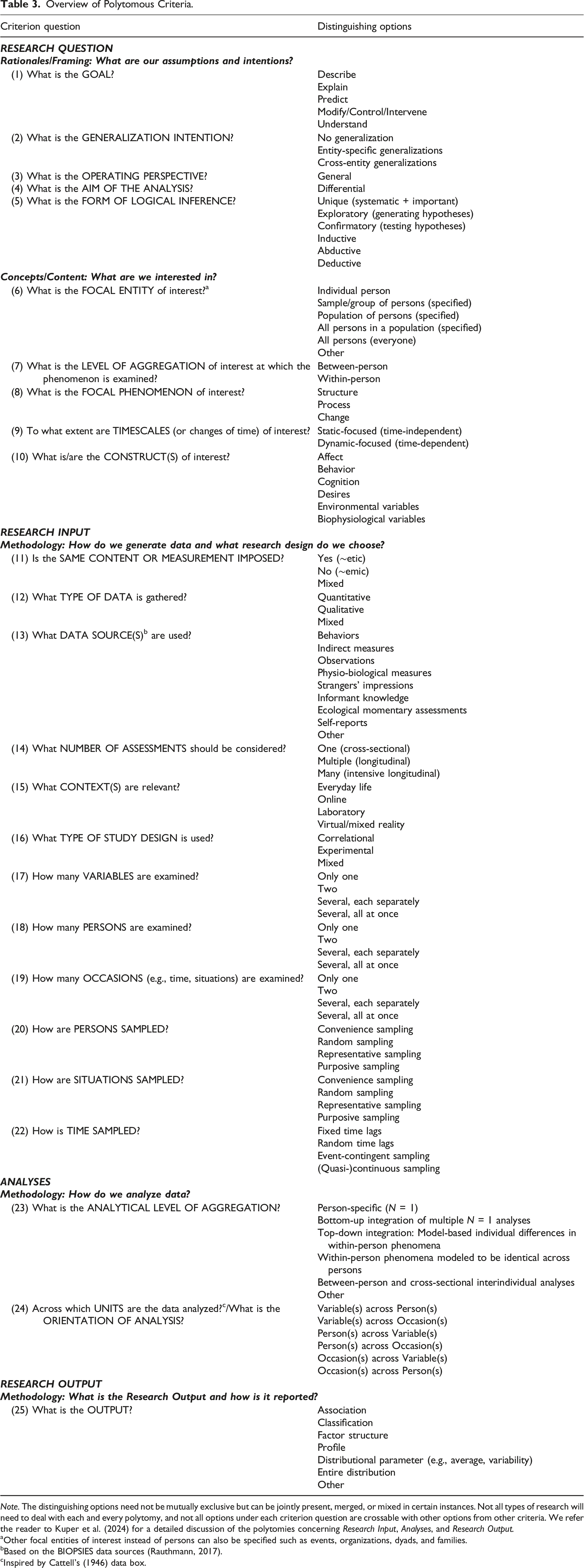
Note. The distinguishing options need not be mutually exclusive but can be jointly present, merged, or mixed in certain instances. Not all types of research will need to deal with each and every polytomy, and not all options under each criterion question are crossable with other options from other criteria. We refer the reader to Kuper et al. (2024) for a detailed discussion of the polytomies concerning Research Input, Analyses, and Research Output.
aOther focal entities of interest instead of persons can also be specified such as events, organizations, dyads, and families.
bBased on the BIOPSIES data sources (Rauthmann, 2017).
cInspired by Cattell’s (1946) data box.
We hope that the polytomies laid out here can be used as a practical tool to make relevant though often implicit decisions during the research process explicit. This could help us to (a) point out possible inconsistencies of decisions when planning an empirical study; (b) evaluate the correspondence between research questions, methodological decisions, and inferences; and thus (c) serve as a tool to assess research quality, (d) help researchers to clearly structure different research approaches, and (e) foster transparency and reproducibility of research endeavors. Of course, the polytomies are not exhaustive, and not all criteria are applicable to all types of research. However, they are intended to be extended flexibly to accommodate different studies’ configurations and requirements and to be adjusted to better align with theoretical and methodological advances.
An overview of the polytomous criteria
The polytomies are structured along a generic empirical research process, which consists of consecutive steps that need to be sequentially based on each other to result in a correspondence between research goals and inferences. The steps are (a) the research question, (b) research input, (c) analyses, (d) research output, and (e) inferences (Figure 2). The Research Question defines the intentions and assumptions for our research endeavor as well as the focal entities and phenomena we want to study. Research Input concerns the data that are subsequently inserted in the analyses. The relevant questions here include all decisions that are made regarding research design, operationalization and measurement, data sources, data generation, and data processing. Analyses concerns how the resulting data are analyzed. Naturally, the analyses depend on the data that have been gathered and can only be evaluated in conjunction. Analyses are followed by Research Output, which concerns the actual results that are produced and how they are reported. Lastly, these results are the basis for Inferences constituting the interpretation of results and their integration in the existing literature. Generic Research Process and Mapping of Respective Polytomies. Note. All polytomous criteria must be evaluated holistically to determine the congruence between the intended knowledge (i.e., research objective) and the actual produced knowledge (i.e., inferred conclusions). Note that all criterion questions pertaining to the first four steps “Research Question → Research Input → Analyses → Research Output” should ideally be answered prior to conducting the study.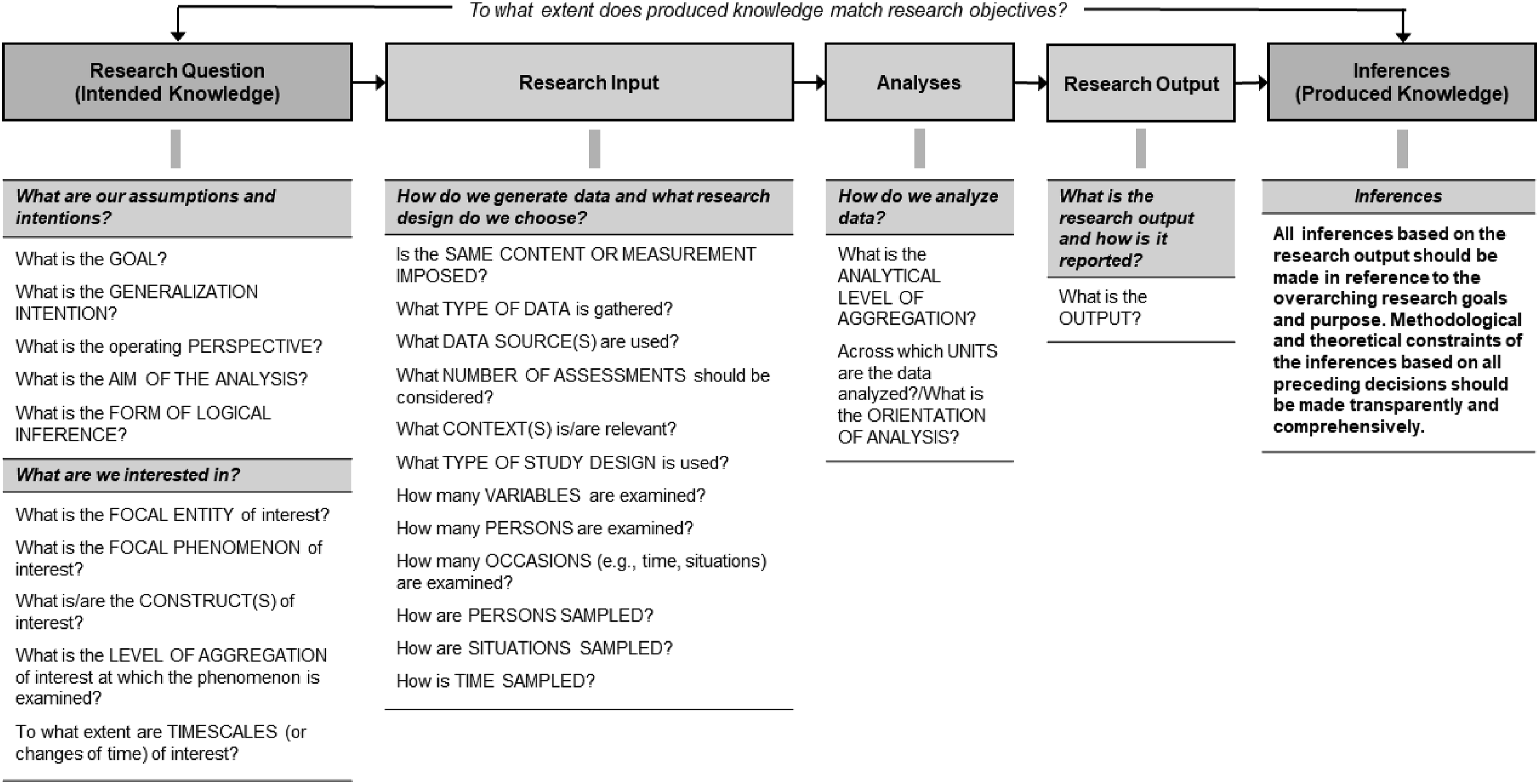
In the following, we primarily focus on the criteria surrounding the Research Question as they represent or are closely related to the epistemological assumptions that we make for a specific research endeavor. We will then also briefly describe the criteria for the Research Input, Analyses, and Research Output. However, due to the methodological focus of these criteria, we refer to Kuper et al. (2024) for an in-depth discussion. An overview of all criteria can be found in Table 3.
Step 1: Research question
In the first step of the generic research process, the Research Question, the rationale, as well central concepts and contents are defined. Here, the criteria concerning the rationale are (1) goals, (2) generalization intention, (3) operating perspective, (4) aim of the analysis, and (5) logical inference.
The (1) goals reflect broad goals of (personality) psychology of description (i.e., the exhaustive exploration of associations between variables/constructs; Mõttus et al., 2020), explanation (i.e., the identification of causal relationships and processes; Mõttus et al., 2020), prediction (i.e., the maximization of out-of-sample predictions; Mõttus et al., 2020), modification (i.e., changing phenomena or a targeted outcome; e.g., Renner et al., 2020), and understanding (i.e., arriving at a holistic, integrative, and non-reductionist understanding of a person; Dilthey, 2003; Gantt & Williams, 2016; Stern, 1923). A single study can pursue one or multiple of these goals simultaneously.
The (2) generalization intention corresponds to the Windelbandian meaning of nomothetic and idiographic. However, while the nomothetic–idiographic distinction only provides two options (i.e., intention vs. no intention to generalize), we have expanded the options to include the different types of generalization laid out in Table 2: generalizations can be entity-specific (e.g., establishing laws applying to a specific person or a specific population as a whole) or can be made across entities (i.e., cross-entity generalization corresponding to the Wundtian approach).
Next, the (3) operating perspective is closely related to multiple other decisions. A general perspective implies the search for general laws that are true for all humans (or specified sub-populations). This aligns with person-to-person generalization (i.e., across persons; Wundtian approach). A differential perspective implies the examination of individual differences phenomena and that the focal entity is a population of persons. The aggregation thus occurs at the between-person level. Lastly, the unique perspective corresponds to the detailed portrayals described earlier (see Entity-Specific Portrayals). Importantly, these detailed portrayals provide relevant and unique information, enabling holistic and integrative perspectives in a systematic fashion (corresponding to the goal of understanding).
The (4) aim of the analysis and (5) the form of logical inference are likewise closely related. These criteria can be understood in the context of the “empirical cycle”—a model depicting the process of cumulative, scientific knowledge production (De Groot & Spiekerman, 1969; Van Lissa, 2022). In the exploratory phase, hypotheses are generated inductively (i.e., making inferences based on careful empirical observations) or abductively (i.e., drawing probable conclusions from what is known). These hypotheses are then tested in the confirmatory phase in a hypothetico-deductive fashion (i.e., falsification of hypotheses). The cycle undergoes reiterations during which hypotheses are continuously improved, modified, or dropped based on new empirical insights until researchers arrive at an established general law or theory.
Next, the criteria concerning the concepts and contents of interest are the (6) focal entity, (7) level of aggregation, (8) focal phenomenon, (9) timescales, and (10) construct(s). The (6) focal entity is the entity about which knowledge is produced and to which knowledge can be applied. This may be, for example, the individual person; specified populations of persons; other entities such as organizations, dyads, families, and so on; variables; occasions (e.g., events); and even relations between persons and occasions.
The focal entity is linked to the (7) level of aggregation which can be between-person and/or within-person. If the focal entity is the individual person, within-person phenomena and thus aggregation at the level of the person are of interest. If populations as a whole are the focal entity of interest, phenomena aggregated between-person (potentially including average within-person effects) are of interest.
The (8) focal phenomenon of interest can be either a structure (i.e., a relatively stable organization of elements within an integrated whole; American Psychological Association, Definition 1), a process (i.e., series of steps through which a phenomenon takes place over time; Baumert et al., 2017; Kuper et al., 2021; Quirin et al., 2020; Quirin et al., 2023), or a change (i.e., difference in a variable from one time point to another or development as a series of changes; Kuper et al., 2021).
The (8) focal phenomenon, in turn, is then linked to (9) timescales, denoting whether changes of time are of interest. Specifically, the options here are whether we assume that the phenomenon of interest is static (i.e., time-independent)—corresponding to structural phenomena—or whether the phenomenon of interest is dynamic (i.e., time-dependent)—corresponding to processes and changes. If phenomena are assumed to be dynamic, time should be explicitly accounted for in the data and analysis (Wilt & Revelle, 2022).
The last criterion concerns the (10) construct(s) of interest. The options here are deliberately on an abstract level to cover a wide range of constructs. We have chosen affect, behavior, cognition, and desire following Wilt and Revelle’s (2015) ABCD categorization. Further, we included environmental variables to account for situational and contextual constructs (Renner et al., 2020) as well as biophysiological variables to include psychologically relevant constructs related to brain functions (e.g., action potentials, brain structures, neural activity) and the body in general (e.g., electrodermal, cardiovascular, and muscle activity).
The criteria concerning the Research Question should be chosen deliberately in alignment with the purpose of the research endeavor and be well-grounded in theory, based on careful empirical observation, or on rigorous logical reasoning. All subsequent decisions regarding the research input (i.e., study design, operationalization, measurement), analyses, and research output (i.e., resulting parameters, presentation of results) should be based on the decisions that have been made in this first step of the generic research process.
Step 2: Research input
The criteria concerning the Research Input revolve around methodological decisions related to how data is generated and which study design is chosen. The criteria related to data generation and measurement are (11) whether content/measurement is imposed (i.e., etic, emic, or mixed approach), (12) what type of data is gathered (i.e., quantitative, qualitative, or mixed approach), and (13) what data sources are used (i.e., behaviors, indirect measures, observations, physio-biological measures, stranger’s impressions, informant knowledge, experience sampling, self-reports, or other; based on the BIOPSIES data sources: Rauthmann, 2017).
The criteria related to study design are the (14) number of assessments that are considered (i.e., one—cross-sectional, multiple—longitudinal, many—intensive longitudinal; directly related to (8) focal phenomenon and (9) time scale), (15) relevant context(s) (i.e., everyday life, online, laboratory or virtual/mixed reality), and the (16) type of study design (i.e., correlational vs. experimental). Also related to study design and based on Cattell’s (1946) data box are the decisions concerning how many (17) variables, (18) persons, and (19) occasions (e.g., time points, situations) are examined (i.e., only one, two, several separately, or several all at once). These decisions determine the data structure. Directly linked to these decisions are the criteria related to how (20) persons and (21) situations are sampled (i.e., convenience, random, representative, or purposive sampling for both criteria), and how (22) time is sampled (i.e., fixed time lags, random time lags, event-contingent sampling, or (quasi-)continuous sampling). All these decisions are consequential for the choice of analysis.
Step 3: Analyses
Next, the criteria concerning Analyses are the (23) analytical level of aggregation and the (24) orientation of the analysis. The (23) analytical level of aggregation is linked to the different research approaches depicted earlier (see A Broad Categorization of Research Approaches). Person-specific refers to N = 1 analyses that can be applied to person-specific generalizations but also portrayals of particular persons. Bottom-up integration of multiple N = 1 analyses refers to the estimation of a (large) number of person-specific models, which are then compared for similarity (Kuper et al., 2024). This approach is closely related to Wundtian generalization (i.e., cross-entity generalization). Top-down integration refers to approaches where all individuals are simultaneously modeled in a population model (Kuper et al., 2024). Here, individual differences in within-person phenomena are accounted for in the models. Within-person phenomena modeled to be identical across persons (i.e., resulting in average within-person estimates on the population-level), and between-person (i.e., requiring multiple data points) and cross-sectional (i.e., based on a single assessment) interindividual analyses are related to the (Neo-)Galtonian approach and produce population-specific generalizations (Kuper et al., 2024).
The (24) orientation of the analysis refers to the decisions regarding the focal unit towards which the analysis is oriented and the units across which the focal unit is then analyzed (Kuper et al., 2024). For example, variables are the focal unit in variable-centered approaches such as cross-sectional correlations of variables, which are analyzed across persons (R-technique), or persons can be the focal unit in person-centered approaches such as profile correlations, which are analyzed across variables (Q-technique; Kuper et al., 2024).
Step 4: Research output
Lastly, the Research Output concerns the decision regarding the (25) output of the analyses. Here, a wide array of options is possible including associations, classifications, factor structures, profiles, distribution parameters, entire distributions, and many more. These are some of the most common options, but they are by no means exhaustive. The research outputs that are chosen to be reported and presented directly affect the interpretation of the results and thus inferences. Importantly, any methodological constraints should be transparently disclosed and taken into account, and the degree to which the inferences match the research question should be clearly demonstrated. For a deeper discussion of these issues, we refer to Kuper et al. (2024).
To sum up, the polytomies provide a range of relevant criteria that can help researchers make important decisions in the research process as explicit as possible. This entails being aware of and explicit about the kind of knowledge that we want to produce (including whether we intend to generalize and the type of generalization, and the focal entities, to which the knowledge applies), which in turn might facilitate choosing adequate methodological strategies concerning data, design, and analysis. Furthermore, the polytomies might be used as a tool to evaluate the correspondence between research goals and inferences.
We further argue that the polytomies can be useful to characterize different research approaches in detail because they go beyond the Windelbandian notion of nomothetics and idiographics (as well as other common understandings of the terms). However, we are aware that the application of the polytomies is not trivial as numerous unique combinations are theoretically possible (while some options may be mutually exclusive). Of course, many of these are not found in the literature (yet), and indeed it remains an open question what the relative prevalence of certain patterns in the literature is. More frequent or typical patterns may (erroneously) be deemed more important or valuable, but they could also just be easier to conduct, more easily publishable, historically more rewarded, or more frequently used for other reasons. An analysis of the prevalence of different combinations of the polytomies within personality psychological research alongside a systematic stocktaking of the different types of knowledge that have resulted from these combinations could be very fruitful to evaluate the state of the field. Such an analysis should be linked to how “nomothetic” and “idiographic” work is deemed because some options from the polytomies could be normatively considered more (or less) nomothetic or idiographic, respectively. Understanding better what our implicit meaning systems are can help avoid further confusions and conflations. As a first remedy, we here sought to disentangle the most prevalent meanings of nomothetics and idiographics (Table 1), organize them in a framework (Table 2), and then provide aids to make decisions explicit that are connected to the nomothetics–idiographics spectrum (Figure 2 and Table 3).
Discussion
The goal of this article was to provide conceptual clarity concerning the nomothetic–idiographic distinction and to disentangle these terms from other confounding concepts. To achieve this, we offered a brief overview of the historical origins of these terms and their applications in the personality psychological literature. We demonstrated that both terms are associated with a plurality of meanings, resulting in the conflation of distinct concepts and introducing the risk of obscuring inferences. We identified (a) the focal entity level (person or population), (b) the principal inferential goal (generalization intent: yes or no), and (c) the type of generalization (if any; focal entity-specific or cross-entity) as the primary basic concepts entangled with nomothetics and idiographics. Based on these considerations, we tried to clearly distinguish between confounded concepts and proposed a systematization of broad research approaches (see Table 2) by crossing the focal entities with the types of generalization, resulting in a 2 × 3 matrix. We then elaborated on each approach, highlighting the type of knowledge they typically produce and discussing their respective strengths, limitations, and associated methodology. Specifically, we discussed (a) person-specific generalizations, (b) cross-person generalizations, (c) population-specific generalizations, (d) cross-population generalizations, and (e) detailed portrayals of a particular entity, focusing on the person. A key insight from this discussion is that population-specific generalizations, that is, the (Neo-)Galtonian approach as the most common approach in psychology, neither produces knowledge about individual persons nor laws common to all persons. Even though Allport and many others have labeled this approach as nomothetic, it might actually and ironically be considered as an instantiation of idiographics in the sense of producing knowledge about a specific population with neither generalizations to other populations nor the individuals that constitute the population. While the study of populations has its value, we maintain that person-specific and cross-person generalizations are needed to draw inferences at the level of the individual. The (Neo-)Galtonian approach has for too long dominated personality research, resulting in a large body of inferential knowledge about populations in the sense of “the average person”—a hypothetical entity—but not necessarily about real persons (McManus et al., 2023). We therefore advocate for bringing back the person into personality science and finally doing the individual justice through a stronger and more widespread focus on person-specific phenomena (Molenaar, 2004; Quirin et al., 2020, 2023; Renner et al., 2020). Lastly, we introduced the polytomies (Table 3) as a tool to help researchers explicitly align their research decisions with goals, enabling a clearer evaluation of research quality by linking inferences to methodological strategies.
The nomothetic–idiographic distinction as it is commonly used in the psychological literature—hitherto muddled and confounded with other concepts—is not a useful dichotomy of research approaches. Even when used in its original sense as a distinction between principal inferential goals (i.e., generalization intended as the search for laws vs. no generalization intended as portrayals of particular entities), nomothetics and idiographics are ambiguous and not sufficient for structuring and systematizing the rich landscape of personality psychology’s research goals and approaches. Principal inferential goals must be regarded in conjunction with other intentions and assumptions and, beyond that, must be aligned with the overall purpose of the research endeavor. To this end, we must be explicit about the knowledge we aim to produce in our research and about the inferences that we can make from our findings. With these considerations carefully reflected and made explicit, we believe that choosing adequate methodological strategies or evaluating the correspondence between research goal and inference in any given study will be facilitated, potentially leading to more robust and credible inferences and useful knowledge within personality science. This is crucial because (personality) psychology’s credibility has not only suffered from replicability issues (Anvari & Lakens, 2018), but in recent years more and more critical voices have been drawing attention to generalizability issues within psychology (e.g., Moeller et al., 2022; Yarkoni, 2022).
We therefore invite researchers to adopt the polytomies as a tool to address these issues and we do hope that our systematization of research approaches will provide some conceptual clarity. To move forward as a field, we believe that it is important that we can talk about the flaws of our standard research practices and to bring along a differentiated perspective where we think critically about our phenomena of interest and research questions and are able to discuss the larger issues laid out in this paper. Such a cultural change will require bringing these discussions into mainstream personality psychology (and even psychology in general) and a concerted effort and willingness to improve the standards of evidence in our field to mature as a scientific discipline.
Footnotes
Author’s note
The first three authors and the last author formed the core writing team and are named in order of their relative contributions; the other authors are named in alphabetical order.
Declaration of conflicting interests
The author(s) declared no potential conflicts of interest with respect to the research, authorship, and/or publication of this article.
Funding
The author(s) disclosed receipt of the following financial support for the research, authorship, and/or publication of this article: This article is one of three articles that resulted from an expert meeting on “Dynamics of Personality: Integrating Nomothetic and Idiographic Approaches in one Conceptual Framework” sponsored by the European Association of Personality Psychology (EAPP).
CRediT roles
Conceptualization: LVP, NM, NK, NB, MF, MG, KTH, MQ, KHR, AGW, and JFR. Writing—original draft: LVP. Writing—review and editing: LVP, NM, NK, NB, MF, MG, KTH, MQ, KHR, AGW, and JFR. Visualization: LVP.
