



Abstract
The field of comparative education traditionally compares nations and cultures to gain a deeper understanding of educational phenomena. The nation-state often functions as the only unit of comparison, which increases methodological nationalism. It is dangerous to draw simplistic conclusions because they focus on national particularities alone and make use of negative points of reference. Therefore, analytical frameworks that concentrate on other criteria are needed. The article analyses how methodological frameworks influence the outcome and perception of educational phenomena and considers what challenges arise while conducting research. It is illustrated by studies on governance.
Keywords
Introduction
Studies in comparative education are closely connected with the motives of those who are comparing. Often, authors want to find out more about a phenomenon in another country and use the country they live in as a reflector (Adick, 2008). When contrasting one phenomenon in one context with a phenomenon in another context there is the danger that authors highlight national particularities they are familiar with and how they can be interpreted in relation to the history of their own nation. 1 However, processes of globalisation and internationalisation have led to discussions about adequate modes of comparison because the nation-state as the main unit of analysis has been questioned. What does that imply for a methodological framework and the outcomes of a study?
The article addresses this issue by more closely examining the phenomenon of methodological nationalism and its continuing relevance in the field of comparative education. The challenge of finding an adequate mode of comparison is illustrated by studies relating to the effects of neoliberal reform policies. These policies, which affect many countries worldwide, involve elements such as large-scale assessments, output orientation, implementation of market structures and privatisation. Often, the term Global Education Reform Movement (GERM), coined by Sahlberg, is used to describe these global policies (Sahlberg, 2012). Methodological challenges in terms of methodological nationalism are discussed by analysing empirical frameworks and their focuses. The findings of an empirical study on the effects of neoliberal reform policies on teachers’ self-perceptions are then used to illustrate the advantages and disadvantages of these approaches.
The role of the nation in the field of comparative education
Methodological nationalism
Methodological nationalism has accompanied the discipline of comparative education since its inception. Drawings from ancient times already offer hints of the ways in which foreign cultures and nations were perceived even though those sources did not yet have methodological implications (Allemann-Ghionda, 2004). A systematic methodological approach was established at the end of the 19th century. This approach was shaped by sociologists and educationalists such as Durkheim and Sadler. Sadler’s reports about international education systems were also widely distributed (Phillips and Schweisfurth, 2014: 18). His well-known lecture, ‘How can we learn anything of practical value from the study of foreign systems of education?’ summarises the central idea of this time: education systems and traditions have a national character. The society of a nation was, thereby, seen as coextensive with the territory of the nation-state (Sobe, 2016: 151). Waterkamp (2006) discusses a ‘problematic inheritance’ for the discipline of comparative education because the nation has often been perceived as the key to its interpretation. This often implied a ‘meliorist’ strand of explaining results in the form of lesson learning. Methodological nationalism describes the unquestioned assumption that the nation-state builds a naturalistic unit that forms the basis of comparison in the social sciences. Dale and Robertson mention the role of ‘isms’ in this context and distinguish between three forms: methodological nationalism, statism and educationism. Methodological nationalism implies that comparing societies is equivalent to comparing nation-states (Dale and Robertson, 2009: 113). The extent to which the nation is used as an ‘explanandum’ varies between studies, but there is always the danger of concentrating on the nation when trying to find explanations for findings and, thereby, highlighting particularities of the nation-state. For instance, the way the Programme for International Student Assessment (PISA) gathers and presents its data directs attention to the nation and its particularities instead of focusing on commonalities of what 15-year-old students can achieve.
One aspect of methodological nationalism lies in the role of negative points of reference because they might enhance the perception of unique phenomena in a nation.
Negative points of reference
When people compare, they make use of stereotypes. A stereotype is ‘a social shared set of beliefs about traits that are characteristic of members of a social category’ (Greenwald, 1995: 15). Thus, these types of classifications, such as the nation-state, represent a form of social categorisation. Stereotypes are used to reduce complexity and function as a form of generalisation used to implement a comparison. However, stereotypes can become problematic if they are used as an exaggerated picture. Waldow (2016: 406–415, translated) establishes five hypotheses addressing the usage of stereotypes:
National stereotypes play an important role by choosing and constructing negative (and positive) points of reference.
Negative points of reference support the illustration of (negative) developments of education policy and the dismissal of agendas in education policy.
Knowledge about the assumed origin of educational agendas replaces knowledge about the agenda itself.
Negative and positive points of reference can stabilise or enhance each other.
Perceived negative aspects of the education sector in the home country are projected to offer negative points of reference.
Studies in comparative education might use negative points of reference implicitly or explicitly, especially if the nation is used as the main unit of comparison. However, distinctions need to be made between the actors and arenas (e.g. mass media) that shape the notion of methodological nationalism and negative points of reference.
For example, Klemm explains this concept by investigating the relationship between research, politics and journalism in terms of the presentation and interpretation of results from PISA. He noted the ‘ritual’ of the media asking for preliminary results before the publication date, which then dominated public perception. The preliminary results tended to focus on particularities and supported the development of non-reflected stereotypes. This is due to the different interests and contexts of the three areas as the media are interested in particularities and simplified representations to attract readers whereas researchers are more interested in explanations and reasons for certain results (Klemm, 2016: 163–177).
Researchers in the field of comparative education are limited in the way they can regulate the interpretation of their findings. Therefore, this article mainly focuses on the methodological design in order to reduce the perception of methodological nationalism and risks the danger of negative points of reference.
Methodological nationalism and globalisation
During the era of globalisation, the object domain and the defining methods of the comparative social sciences have been continuously questioned as international interdependence becomes increasingly important (Giddens, 1995). The aim of this article is not to provide a final definition for the concept of globalisation, but instead to describe the impact of the discussion concerning globalisation on analytical approaches within the field of comparative education (Dale, 2000: 87–109). The term globalisation is used collectively to describe worldwide transformations, such as the relationship between global processes and the nation-state, and to address questions of power, context and culture as existing ‘fixed’ barriers become fluid (Parreira do Amaral, 2014: 121).
The field of comparative education led to the question of how to define adequate units of analysis or, in the words of Beck, there was a necessity to ‘rethink our standard notions of units of analysis’ (Beck, 2012: 19). Consequently, the nation-state as the main unit of comparison was continuously questioned:
Traditionally, comparative education has compared educational policies and systems on the basis of nation states. But with the [worldwide] growth in privatization and marketization within education […] how reliable is the nation state as a unit for comparison? (Watson, 2001: 21)
With the reliability of the nation-state being scrutinised, a reconceptualisation of the field was needed:
Indeed, for these reasons, it is argued that a reconceptualised field of comparative and international education will be especially well placed for the future study of issues relating to globalisation, culture and identity, and of the continued emergence and impact of international educational agendas. To some extent, this further challenges the nation state as the primary unit of analysis without, as demonstrated by Green (1997), denying its continued relevance. A case is therefore made for the reconceptualised field to be more explicitly associated with the sociocultural study of education in this context. This reaffirms the principle that context matters; but repositions the field to study education in all its varied and new forms, with regard to contextual factors operating at all levels, ranging from the organisational to the global. (Crossley, 2001: 61)
GERM and its impact on schools and teachers
Worldwide transformations also affect the education sector. GERM summarises the impact of a globalised government policy on the education sector. Sahlberg (2012) identifies five central features of education reform that have emerged since the 1980s and are found throughout the world:
a standardisation of education;
a focus on core subjects;
the search for low-risk ways to reach learning goals;
the use of corporate management models (involving education policies and ideas borrowed from the business world);
test-based accountability strategies.
Although England and Germany, which are used for illustration here, have different histories, both share similar characteristics in relation to GERM. For example, both systems feature a combination of instruments focusing on output orientation (e.g. comparative tests and school inspections) and those concentrating on competition (e.g. choice of schools) (Bellmann et al., 2016a).
Reform initiatives and forms of governance in Germany
Because of Germany’s federalist structure and the differences between its states, this study focuses on developments in North Rhine-Westphalia as the most populous of the German states (Schulministerium Nordrhein-Westfalen, 2016). The German school system traditionally focused on an input orientation with regard to the governance of schools. However, Germany’s participation in the Trends in International Mathematics and Science Study (TIMSS) in 1995 indicated major weaknesses in its education system (Moser et al., 1997). The study had a catalytic effect on the German education sector as it highlighted aspects that had been criticised before. As a result, the Kultusministerkonferenz (Kultusministerkonferenz, 1997) introduced a change in the ‘governing idea’ with the ‘Constance Decision’ (Konstanzer Beschluss). This resolution contained general suggestions regarding how to introduce comparative tests into the education system, and it provided an impetus for a move to evaluation outputs, focusing on subject competence and increasing school diversity (Kultusministerkonferenz, 1997). The overall objective of the reform was to enhance transparency in order to increase and compare the performance within the country. PISA studies and the publication of the results, which were followed by ‘PISA shock’ in Germany, intensified the public debate. ‘PISA shock’ refers to the disappointing results of the PISA report, where it was revealed that the country was below the OECD average in maths, reading and science.
In 2006, an overall strategy for monitoring education was introduced. This strategy built on the Konstanzer Beschluss to develop a system that is still present today.
These reforms involved the decentralisation of education administration and concentrated on output instead of input control. For example, standards were implemented in core subjects, such as mathematics, English and German. Inspections and central testing also became a part of the German education sector to allow it to compete in the international field of education (Kneuper and Tillmann, 2008: 381). Teacher training also underwent profound changes in Germany. Recommendations for teacher education were approved in 1998 (Empfehlungen zur Lehrerbildung), and four fields of competence were implemented in 2004 (Kultusministerkonferenz, 2004). Many German states (Länder) decided to change their teacher training systems and introduced reforms, including bringing in practical elements at an early stage of study. For example, North Rhine-Westphalia introduced longer practical elements at university level (Von Bargen, 2014). These school-based placements are part of the ‘Reform of Teacher Training in North Rhine-Westphalia’ (Reform der Lehrerausbildung in Nordrhein-Westfalen), which was passed by the state government in 2009 to create a closer link between universities and schools (Schulministerium Nordrhein-Westfalen, 2009). Kussau and Brüsemeister (2007: 17) describe these overall changes as a restructuring of the German-speaking education system.
Studies conducted in Germany on the effects of these reforms usually concentrate on specific measures that were implemented and their intended effects. Bellman et al. illustrate this by discussing the central test in Year 8, VERA 8 (Vergleichsarbeiten 8), focusing on the question of how teachers use the feedback from these tests to improve their own teaching (Bellmann et al., 2016a; Meier et al., 2013: 74–96). Explanations as to why these measures do not have the intended effects consider the length of implementation and the absence of high stakes in testing. As many measures were introduced in response to ‘PISA shock’ and have been in use for more than a decade, the length of implementation is not a satisfactory explanation (Dedering, 2016). Germany’s approach to reform initiatives is a no-stakes or low-stakes approach, meaning that teachers do not have to face the test results that do not meet expectations. In this case there is no pressure to ‘teach to the test’. The results are then often explained in terms of the absence of those ‘negative aspects of accountability’ that are perceived in Germany but can actually be found in the USA and United Kingdom (Bellmann et al., 2016a).
Further explanations in terms of reform policies, apart from the aforementioned length of implementation and accountability stakes, are largely ignored. Bellmann et al. (2016b) identify this issue as a research gap and address it in their project on the unintended consequences of education reform policies in Germany. They indicate that the reform effects in Germany cannot be solely explained in terms of the aspects mentioned above. Instead, they find similarities to countries with high-stakes testing.
Reform initiatives and forms of governance in England
Due to the variations within the UK (England, Wales, Northern Ireland and Scotland), the focus of this study is on England. Reform policies are therefore explained in this context.
Neoliberal reform processes can be found in England from the Thatcher era (1979–1990) onwards. With regard to education and schools the 1988 Education Reform Act can be considered the most influential since 1944, as many neoliberal reforms that were introduced are still in place and are taken for granted in the current system (Harris and Gorrard, 2010: 3). For many teachers, the Education Reform Act meant a transformation of the system with an increase in accountability in many areas. In 1997, after the end of the Conservative governments, New Labour continued the neoliberal philosophy and the market idea has been a common feature of each government, Labour and Conservative, ever since (Ball, 2008: 18).
Elements of neoliberal governance are strongly linked with the education sector. For example, tests and examination results are made public (league tables), functioning as an indicator for parents when seeking to choose the best-performing school for their child. The current league tables present recent SAT (Standard Attainment Test) results and the outcome of Ofsted (Office for Standards in Education, Children’s Services and Skills) inspections, both of which operate as indicators of the success of a school. Recently, competition within the education sector has come under greater scrutiny as SATs have become associated with the effectiveness of teaching. These developments, especially those regarding regulation, have been critically addressed by researchers in the UK, who have also focused on the high level of accountability accompanying those measures (Ball, 2008; Chapman and Gunter, 2009; Gewirtz et al., 2009). Ball (2008: 42) describes the developments as an overturning of what was important before changes were implemented:
Targets, accountability, competition and choice, leadership, entrepreneurism, performance-related pay and privatisation articulate new ways of thinking about what we do, what we value and what our purposes are. […] They change what is important and valuable and necessary.
Reform policies in England and Germany
The level of accountability in both countries plays a significant or even predominant role in explaining the effects of the different neoliberal reform policies on teachers and schools. This level of accountability often leads to the conclusion that the impact is different in each country. In addition, England is often used as a negative point of reference by German-speaking countries, who warn society about ‘teaching to the test’ or ‘stressing the children’. Articles on the English school system in German newspapers address the consequences of high-stakes testing. A recent headline in a German newspaper read: ‘English students are skipping school to escape performance pressure’ (Meurer, 2016). The article focused on the situation with regard to English parents who were keeping their children off school during testing as a protest against the high level of stress to which the children were being exposed. This media coverage exemplifies the perception of particularities in the English and German education systems.
(Comparative) studies on (neoliberal) reform policies concentrate on the high stakes, low stakes or no stakes of testing and, in many cases, results are used by the media to enhance the perception of existing particularities of the nation-state.
As GERM is a global phenomenon, which shares similar characteristics in different countries, its impact on and possible commonalities between states have to be more closely examined. As argued above, comparative education seeks to rethink our standard ways of comparison in an era of globalisation. Therefore, a methodological framework that focuses on the commonalities between nations is strongly needed as other studies have shown us in the past (e.g. Meyer et al., 1997). In particular, small-scale studies that focus on two countries, for instance, should look at commonalities because it seems obvious to contrast one set category (nation) with another.
This opens the following questions in the design of a methodological framework:
What difference does a focus on commonalities make, compared to a focus on particularities?
How can this type of methodological framework be designed without ignoring existing particularities?
The following section tries to answer these questions using an empirical study on teachers’ self-perceptions with regard to neoliberal reform policies in England and Germany (Von Bargen, 2014)
Methodological implications of comparing teachers’ self-perceptions in England and Germany
It was demonstrated that studies related to GERM have a tendency to focus on particularities instead of finding commonalities, which opens up the question as to what impact the methodological framework has on the outcome of a study. Two different approaches will be presented and analysed regarding the ways in which they react to the developments of GERM.
Methodological framework
Methodological approach with a focus on national particularities
As described above, a framework with a focus on national particularities presents the ‘classical’ form of analysis in the field of comparative education. The challenge of this approach lies in the danger of overemphasising national particularities.
The research process of this comparative study focusing on English and German teachers is used as a demonstration and details will be outlined in the following paragraph. Figure 1 outlines the simplified steps of the research process focusing on national particularities. This is later contrasted with the simplified steps of the research process focusing on commonalities (Figure 2).
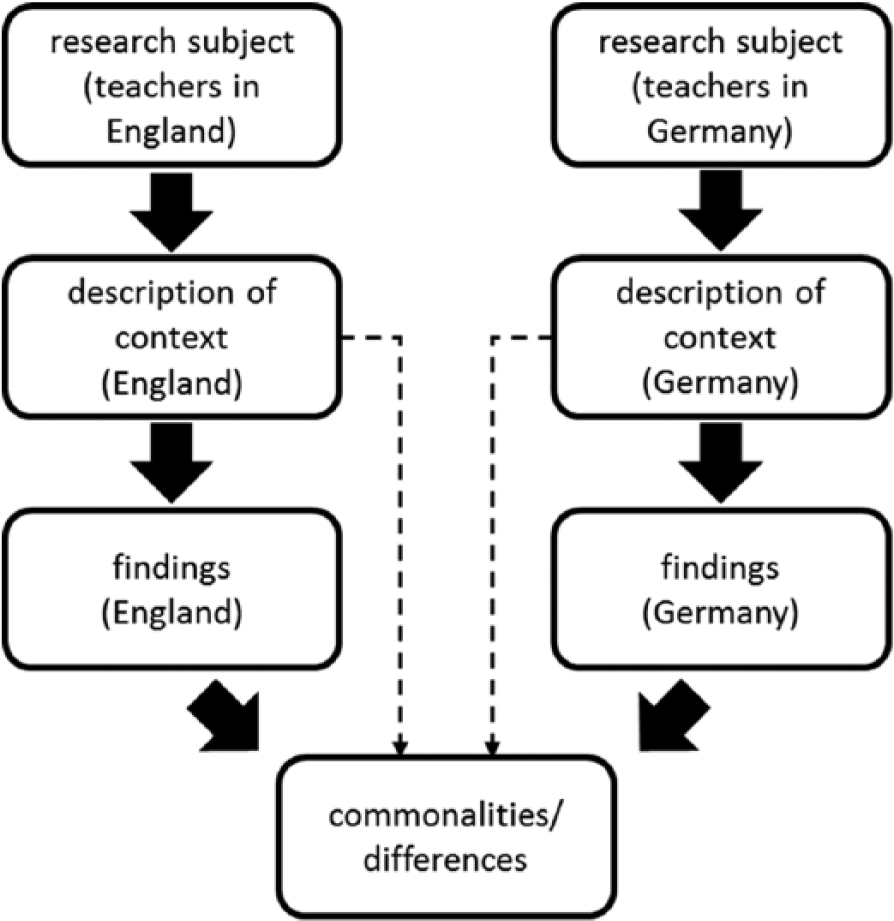
Methodological approach focusing on national particularities.
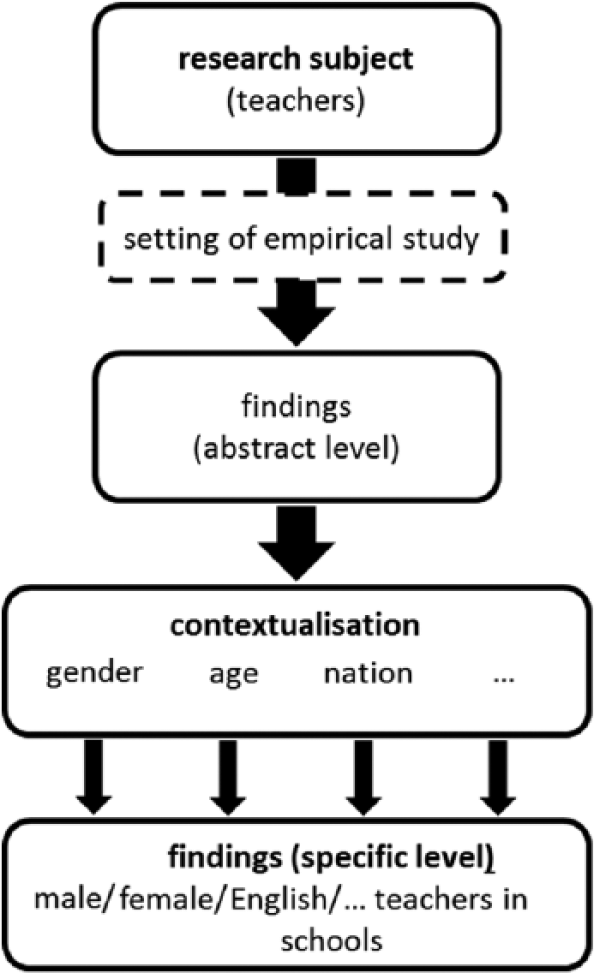
Methodological approach focusing on commonalities.
After the formulation of one or more research questions, the research subject(s) form the basis of a study (teachers in England and teachers in Germany). The researcher then describes the context in each country regarding the research questions (description of context). In this case, the context is the situation of teachers in England and Germany and their experiences with education governance and neoliberal government policy. Based upon these results, data is collected and analysed. Outcomes are presented concerning the specific context of the country (findings). Finally, these central findings are compared with each other to identify commonalities and particularities between the nations.
This approach allows for the identification of particularities and commonalities. However, challenges arise that influence the interpretation process and might lead to an overemphasis on the national particularities mentioned. First, the methodological framework follows two separate research processes: teachers in England and teachers in Germany. This supports the uniqueness of each context because combining them during the course of the study is difficult. Findings in England and Germany are presented individually by referring to the specific situation. Referring back to the studies of education governance mentioned above, the tendency to analyse the results in relation to the stakes of testing becomes apparent. A prominent feature of the English context is the dominance of high-stakes testing, this being absent in the German context. Descriptions of the context in each country are most likely to highlight these particularities and to focus on these elements when analysing the data.
The last step in the research process is to compare the findings of the two countries to identify the commonalities and differences mentioned. The specific contexts play a minor role here, as the focus is on the comparison. However, the differences are easier to identify because they are more obvious to the researcher. These differences are explained by taking the specific context of the countries into account, which leads to the emphasis on the particularities of each nation.
This approach lacks other motives of interpretation. For instance, commonalities between the nations might be stronger than the particularities mentioned. Factors that might have an impact, such as the age or professional experience of teachers, are not considered to the same extent. The nation is the dominant line of argument. This type of approach becomes problematic in times of globalisation because the similarity of globalisation impacts on different nations is not sufficiently considered from the outset due to the aforementioned division.
This lack of consideration does not mean that the findings lose their relevance, but rather that other methods of explanation do not receive the same significance. This approach enhances the danger of methodological nationalism and makes use of negative points of reference, as was outlined in relation to the stakes of testing. Therefore, another methodological framework is introduced that is intended to minimise this danger of emphasising national characteristics.
Methodological framework with a focus on commonalities
A methodological framework that focuses on commonalities means that the nation functions as one factor among others. Therefore, an adequate unit of comparison needs to be found to respond to the consequences of GERM.
This approach can be realised in different ways. Authors, for instance, argue for multilevel approaches or for those that establish a unit below the national level, such as an individual actor (Parreira do Amaral, 2014; Schweisfurth, 2001). Figure 2 outlines the simplified steps of the research process.
In this case, the individual teacher functions as the level of comparison (teachers). This means that no difference exists in relation to the national context from the outset. Instead, the setting of the empirical study and information about the research subject are outlined in a more general form of presentation. Thus, the findings are interpreted on an abstract level, e.g. by describing commonalities among all teachers. These outcomes need to be contextualised and analysed on a deeper level by investigating the results in terms of factors, such as nation, gender or professional experience. The nation and national particularities are only two factors among many others. As a final step, the outcomes can be presented on a specific level, distinguishing between their importance as a way of explanation. For example, findings that refer to national particularities (e.g. English teacher) might be one central result of the study. Alternatively, gender could be more important than national particularities. The advantage of this approach is that the focus is placed on commonalities, which decreases the danger of methodological nationalism and use of negative points of reference.
Challenges can also arise in this methodological approach. While the overemphasising of particularities was addressed in the former approach, the danger here lies in underemphasising their existence. The researcher needs to determine methods of collecting data without distinguishing results because of apparent barriers, such as the use of different languages in interviews. 2 . Therefore, tools and methods to overcome these barriers need to be incorporated into the research process. The following section illustrates these theoretical implications with the findings from the qualitative study mentioned (Von Bargen, 2014).
Commonalities among the nations: The effects of neoliberal reform policies on teachers’ self-perceptions in England and Germany
Study background
The findings presented here are taken from the study on the effects of neoliberal reform policies on teachers’ self-perceptions in England and Germany by Von Bargen (2014). The research question behind the study was how teachers perceive themselves and in what way they are influenced by the features of these reforms. A methodological approach focusing on commonalities was applied to minimise methodological nationalism (Figure 2) (Weiss and Nohl, 2012).
Individual teachers and their perceptions of (neoliberal) reform policies were the main unit of analysis (research subject). The setting of the study included the state of research in both countries on teachers’ perceptions, neoliberal reforms and the role of governance. A total of 26 teachers were interviewed. The sampling was based upon maximal contrasts concerning the type of school, gender, age, subjects and years in service. The topics addressed in the interview covered areas that were assumed to influence teachers’ self-perceptions and were identified via document analysis. The construct of ‘teachers’ self-perceptions’ was identified as the unit of analysis after examining different concepts (e.g. working ethos, self-concept) and their meaning. Teachers’ self-perceptions seek to find out how teachers perceive themselves in relation to their professional development.
Through the adaptation of qualitative content analysis, central themes were identified based upon all interviews, thereby avoiding separation between countries (abstract level) (Kuckartz, 2014; Schreier, 2012). The themes identified established the basis for the following typology, based on Kelle and Kluge (2010) and Kluge (1999) for a contextualisation of the interview material. Interpreting the findings in relation to different criteria, such as nation and gender, then became possible. During all stages of the research, ideas, reflections and changes were collected in a research journal and discussed in an interdisciplinary research group (Breuer and Muckel, 2016). This group functioned as a reflector as all members needed to be more open to interpretations. While discussing possible categories, implicit assumptions were very often questioned; this reduced the danger of an unconscious bias. As a final step, not only could the effects of education governance, which all teachers shared, be identified but so, too, could the reasons why certain teachers handled them differently. In addition, findings were also presented that only applied to a certain group of teachers (e.g. the German teachers).
Central finding: Insecurity resulting from different test criteria
Overall, commonalities between all teachers became apparent; for instance, all articulated a sense of de-professionalisation due to the implementation of (neoliberal) reform policies. This de-professionalisation consisted of an expressed lack of autonomy in certain areas of their profession as well as a perception that the government was increasing influence on the profession, both of which put the teachers under strain. Overall, teachers expressed an increasingly negative view of their profession due to developments in the education sector and, especially, the (neoliberal) reform policies mentioned. One central finding was a feeling of insecurity that resulted from a change of marking criteria. Teachers identified a constant change in the standards of marking tests and exams and complained about a loss of autonomy because of the importance attached to tests by head teachers and the government. Overall, teachers experienced a sensation of insecurity, as the following quotation illustrates:
B: I don’t think, now this is controversial here, that […] some qualifications are worth what they used to be. Worth what they used to be worth. And there’s some qualifications, for example, that are meant to be the equivalent of GCSEs, and people leave with, for example, 10 GCSEs and nobody sor-, sort of knows what that’s really worth. Cause I think everybody is expected to pass these days. And I think nobody’s allowed to fail anymore. (Nick, Abs. 199, 2)
In this passage, Nick, an IT teacher, complains about the increased obscurity of qualifications. Other teachers explained that they did not know why students now received a B in exams when they would have received a C for the same performance the year before.
This feeling of insecurity was found throughout all interviews regardless of where the teachers were teaching (type of school) or how long they had been in service, which was surprising. The assumed influences of the stakes of testing could not be confirmed, which means that teachers expressed the same feelings no matter whether they lived in a country with a high-stakes approach to testing and a long history in neoliberal reform policies (England) or in one with a low- or no-stakes approach to testing. Having identified this central phenomenon it was then analysed at the specific level, i.e. how teachers dealt with the feeling of insecurity established above and the factors on which this depended. Male teachers in the second part of their career had the tendency to address this feeling in a cynical way. It led to an oppositional attitude towards the government and, in particular, towards the policies introduced at the school level, which they could not immediately see the benefit of.
Other teachers, especially those in the early stages of their careers and who were happy with the school in which they were teaching, also experienced a feeling of insecurity, but this did not negatively influence their general attitude towards school and teaching. These teachers continuously expressed how much they enjoyed their profession and affirmed that positive feedback from the students outweighed the negative effects provoked by neoliberal reforms.
Further commonalities were identified: (1) the challenge of combining family and professional life. In the past, the teaching profession was perceived as one with a good work–life balance, but here it was represented as a highly demanding occupation that particularly discouraged women from entering the profession; and (2) the relevance of job security. This appears contradictory because many teachers in England leave the profession after only a few years of service. The assumption that teachers in Germany have a stronger feeling of job security because of their status as civil servants thus proved to be false in the context of this study (Von Bargen, 2014: 226).
The methodological approach, which focused on commonalities, made it possible to identify not only elements that all teachers shared but also those that were specific to one group of teachers or that represented national particularities. For example, teachers’ unions played an important role as far as the English teachers taking part in this study were concerned. The unions counterbalanced the hierarchical structure of the school system, with teachers explaining that their union represented a form of protection, such as when head teachers questioned their work. Furthermore, teachers are drawn to their unions because they critically comment on developments such as certain neoliberal reforms (National Union of Teachers, 2017). Another particularity for German teachers taking part in this study was the identification of a ‘diffuse’ role concerning the position and responsibilities of a teacher. Teachers in Germany devote substantial time to advising and counselling, whereas English teachers have strict procedures on how to address these issues. These findings correspond to a study by Bruder et al. (2011), who criticise the diffusion of the role and responsibilities of teachers and suggest a clear definition of their tasks.
This methodological framework demonstrates that the effects of (neoliberal) reform policies cannot be automatically associated with national particularities and the stakes of testing. This methodological design enabled a changing of perspective or, consistent with Crossley and Watson (2003), ‘a jostling of different perspectives’, and avoided an often implied, implicit division between the two countries without denying the continued relevance of that division (Green, 1997). Similarities among all countries became apparent, and these underline Bellmann’s argument not to focus on assumed differences between different nations (e.g. high and low or no stakes of testing) from the outset (Bellmann et al., 2016a).
A methodological framework that focused only on particularities would have had substantially different effects, especially when analysing at the specific level. The quotation (Nick), for instance, could be interpreted in relation to particularities of the nation-state, for example, the league tables in England, which introduces the assumption that English teachers have a stronger feeling of insecurity compared to their German counterparts.
Outlook: Methodological nationalism and negative points of reference in comparative education
This article discussed the role of methodological nationalism and the use of negative points of reference in comparative research relating to education reforms in the context of GERM. The results are often interpreted in relation to high-, low- and no-stakes testing (Bellmann et al., 2016a). A framework that focuses on national particularities increases the danger of methodological nationalism and the use of negative points of reference (Waldow, 2016). The latter enhances the positive/negative view of one country and fails to offer a comprehensive understanding of the topic.
Comparative education should seek criteria apart from the nation. Particularities continue to exist and are an important part of the field of comparative education. We should not deny their continuing relevance; however, we should also not overemphasise them. Therefore, the methodological framework adapted for a study and the motives for comparison need to be addressed critically. The researcher should question his/her motives for introducing a comparison and determine the feasibility of different methodological approaches because worldwide developments such as GERM have a stronger impact in an era of globalisation. This reduces the number of simplistic conclusions about educational phenomena that do not provide a sufficient basis for explanation.
The field of comparative education is becoming more complex as seemingly fixed criteria are becoming fluid. This proves that the discipline is in transition and is reacting to these challenges, presenting new perspectives on educational phenomena.
Footnotes
Declaration of Conflicting Interests
The author(s) declared no potential conflicts of interest with respect to the research, authorship, and/or publication of this article.
Funding
The author(s) received no financial support for the research, authorship, and/or publication of this article.