



Abstract
Teacher accountability reforms implemented around the globe have heightened a sense that teachers are losing the support of policymakers and the general public. To examine the global pattern in teachers’ perception of occupational value and identify possible outcomes and predictors, we analyzed the 2018 Teaching and Learning International Survey (TALIS) data. We found an overwhelming majority of teachers feel undervalued in almost all OECD countries. In addition, teachers who feel undervalued reported less collective teacher effort for school improvement and job dissatisfaction consistently in four countries of comparison with different policy contexts—the United States, Australia, Finland, and Korea. However, the relationships between three working conditions impacted by accountability reforms—compensation, classroom autonomy, and involvement in school decision-making—and perceived occupational value varied across these four countries. Specifically, these working conditions seem to matter more in the United States, where the teacher policy context produces greater disparities across schools in teacher qualifications, distribution of qualified teachers, and degree of professional control.
Keywords
Introduction
The professional status of teaching has long been a focus of research in the United States (Hargreaves, 2009; Ingersoll & Collins, 2017, 2018; Rowan, 1994), and previous studies have shown that the complexity of teaching often goes unrecognized and unrewarded (Ingersoll & Collins, 2018; Rowan, 1994). More recently, the policy climate focusing on test-based accountability during the last two decades starting from the No Child Left Behind Act of 2001 and strengthened in the Race to the Top program in 2010 and the most recent 2015 reauthorization of the Every Student Succeeds Act in the United States seems to have heightened a sense that teachers are further losing the respect and support of policymakers and the general public to perform the complex and challenging responsibility of educating the future citizens (Ingersoll & Collins, 2017; Rentner et al., 2016; Wills & Sandholtz, 2009).
This trend is indeed global as many countries have implemented various teacher accountability reforms with a goal of improving teacher quality ranging from teacher education and certification reforms to teacher evaluation and compensation reforms (Müller & Hernández, 2010; Osborn, 2006; Price & Weatherby, 2018). Scholars have argued that many of these policies were developed under an assumption that teachers are the main cause of disappointing student learning outcomes and holding teachers and teacher education institutions accountable will improve teaching quality and student learning (Akiba, 2017; Akiba & LeTendre, 2018; Paine & Zeichner, 2012; Tatto, 2007). In this global policy climate, it is not surprising to see in a recent OECD report that teachers are feeling severely undervalued in many countries (OECD, 2020).
What is not yet fully understood is the possible consequences of teachers feeling undervalued. Previous studies showed that teachers’ social status is positively associated with students’ aspiration to become teachers (Han et al., 2018; Park & Byun, 2015; Schleicher, 2011), impacting the recruitment of a young generation of qualified individuals into the teaching profession. However, only one international study (i.e., Price & Weatherby, 2018) examined how teachers’ perception of occupational value is associated with their job satisfaction—an important factor that influences teacher retention (Borman & Dowling, 2008; Ingersoll, 2001; Nguyen et al., 2020; Renzulli et al., 2011; Ronfeldt et al., 2013; Wang et al., 2015). In addition, no previous studies examined how such perception is associated with teachers’ collective effort for improvement, which influences school climate and effectiveness (Bryk et al., 1999; Goddard et al., 2015; Louis & Marks, 1998; Sebastian et al., 2017; Strahan, 2003).
Furthermore, limited knowledge exists about what predicts teachers’ perception of occupational value, especially with teachers’ working conditions that are likely impacted by the global trend on accountability reforms (an exception is the empirical study by Price & Weatherby, 2018). Previous empirical research on the professional status of teaching in the United States (Hargreaves, 2009; Ingersoll & Collins, 2018; Rowan, 1994) as well as in other countries (Dolton et al., 2018; Ikoma, 2018; OECD, 2020; Price & Weatherby, 2018; Schleicher, 2011) indicates that three working conditions promoting professionalization may influence teachers’ perception of occupational value: (a) compensation, (b) classroom autonomy, and (c) involvement in school decision-making. While teachers’ interactions with and perceptions of external actors, including policymakers, the media, and the general public, would shape their feeling of how others value the teaching profession, it is also likely that their feeling is influenced by the immediate school environment. Teachers’ working conditions regarding how their work is compensated and controlled reflect the societal value of the teaching profession, and focusing on these working conditions under the control of district and school administrators would inform them in their effort to support teachers and make them feel valued (Bascia & Rottmann, 2011; Ingersoll, 2018; Kennedy, 2010; Little & Bartlett, 2010).
Using survey data from the 2018 Teaching and Learning International Survey (TALIS) gathered from nationally representative samples of lower secondary school teachers and principals in 28 OECD countries including the United States, we explore the global pattern in teachers’ perception of occupational value and factors associated with it. Specifically, we addressed the following research questions:
How does the level of occupational value perceived by teachers differ across 28 OECD countries?
How is the perceived occupation value of teachers associated with their collective improvement effort and job satisfaction in the United States, Australia, Finland, and Korea with different teacher policy contexts?
How are teachers’ working conditions likely impacted by accountability reforms—compensation, classroom autonomy, and involvement in school decision-making—associated with teacher perception of occupational value in these four countries?
We first explore the perceived level of occupational value focusing on 28 OECD countries. We focus on OECD countries in this study for two reasons: (a) These high-income countries tend to have more comparable working conditions for teachers than low-income countries, which serves as a baseline for a comparison of perceived occupational value; and (b) these countries are more likely to be impacted by the global trend on accountability reforms, which likely impact the professionalization of teaching.
We then examine possible consequences and predictors of perceived occupational value in four countries with different teacher policy contexts—the United States, Australia, Finland, and Korea. We adopt the typology of the regulation of the teaching profession developed by Voisin and Dumay (2020) as three teacher policy dimensions—teacher education, labor market, and accountability—and explain how these countries vary in these dimensions as a basis for developing our hypotheses on within-nation variations in occupational value and working conditions, and the relationship between them. By comparing these four countries and identifying similarities and differences, we will be able to understand whether the possible outcomes and predictors of teachers’ perception of occupational value are unique to the national teacher policy context or cross-nationally applicable.
In the next background section, we first conceptualize occupational value of the teaching profession based on sociological studies of occupational status and professionalism and synthesize empirical research on teachers’ social status in the United States and other countries. Second, we discuss the importance of considering teacher policy context in examining teachers’ perception of occupational value based on Voisin and Dumay’s (2020) typology; explain the differences in the teacher policy context among the United States, Australia, Finland, and Korea; and present our hypotheses based on the relevant literature. Third, we discuss two teacher outcomes—collective improvement effort and job satisfaction—as possible consequences of teachers feeling undervalued. Finally, we review the relevant literature on three working conditions likely impacted by accountability reforms—compensation, classroom autonomy, and involvement in school decision-making—to rationalize our focus on these dimensions of working conditions as potential predictors associated with teachers’ perception of occupational value.
Background
Conceptualizing Occupational Value of the Teaching Profession
The societal value of the teaching profession is determined by a complex web of social relations regarding occupational organization and control. Sociologists see occupations as a social enterprise and highlight the importance of understanding the way that occupations are organized and controlled (Abbott, 1988; Evetts, 2013; Freidson, 2001). The degree and kind of specialization required by an occupation in relation to other occupations in the social hierarchy are used to establish their social, symbolic, and economic value, and justify the privilege and trust from the general public (Freidson, 2001).
According to Ingersoll and Collins (2018), professionalization is “degree to which occupations exhibit the structural or sociological attributes, characteristics, and criteria identified with the professional model”; and professionalism is “attitudinal or psychological attributes of those who are considered to be, or aspire to be considered as, professionals” such as “commitment to a career and to public service” (p. 201). 1 Professionalism, as studied by sociologists, represents a distinctive form of decentralized occupational control and regulation (Evetts, 2013). Professionalism characterizes the profession—knowledge-based service occupations with “discretionary specialization” that requires a body of working knowledge (practical knowledge) and formal knowledge (discipline-based theories and concepts) obtained through tertiary education, vocational training, and experience (Freidson, 2001). The normative value system of professionalism in an occupation—how to think and act—is reproduced at the micro level in individual practitioners and in their workplaces through social interactions (Abbott, 1988).
Educational researchers have examined the professional status of teaching based on the level of complexity of work and knowledge required (Rowan, 1994), organization of teachers’ work (Ingersoll & Collins, 2018), and public perception of the occupation (Dolton et al., 2018, Hargreaves, 2009; Ingersoll & Collins, 2018). These studies point to the “semiprofessional” status of teachers in the United States as well as in other countries. For instance, Rowan (1994) used the data from the Dictionary of Occupational Title by the U.S. Department of Labor and concluded that teaching in the United States is a relatively complex work in relation to data and people, but less complex overall compared to other professions such as physicians, lawyers, and judges. The uneven degree of complexity across various dimensions of teaching characterizes teachers as “semiprofessionals.” Accordingly, Rowan (1994) argued that making teachers’ work more complex helps professionalize teaching and increases its occupational prestige and earning. In addition, Ingersoll and Collins (2018) examined the occupational status of teaching in the United States using the 2011-12 Staffing and School Survey (SASS) data and concluded that teachers generally fall into a category of “semiprofessionals” because they receive limited funding for professional development, their authority over teacher hiring and teacher evaluation is limited, and their salary level and salary increase over time are far less than other occupations.
Finally, researchers used public surveys to measure the prestige of teaching compared to other occupations. For example, Hargreaves (2009) compiled the data from the 1977 and 1996 Standard International Occupational Prestige Scales on 17 occupations using pooled data from multiple countries and reported that teachers ranked in the middle, and their prestige changed little from 1977 to 1996. The similar finding was reported by Ingersoll and Collins (2018), who used the general survey data in 1972 and 1989 from the National Opinion Research Center in the United States. Most recently, Dolton et al. (2018) created the Global Teacher Status Index (GTSI) based on a public poll of 1,000 individuals in 35 countries and reported the average status of teachers across the 35 countries was 7th out of 14 professions—similar to the status of social workers and librarians. At the same time, they reported a major cross-national variation in the status ranging from over 90 in China and Malaysia to less than 10 in Brazil and Israel on the GTSI scale ranging from 0 to 100. U.S. teachers’ status was reported to be 40, similar to the international average. 2 OECD (2020) further reported a moderate positive correlation (r = .64) between GTSI and the percentage of teachers who reported that their profession is valued in society generated from the 2018 TALIS data (p. 83). This seems to support that teachers’ perception of occupational value is generally aligned with the perception of the larger society.
While these previous studies have revealed the overall semiprofessional status of teaching based on various measures, they did not examine how national teacher policy context interacts with the perceived value of the teaching profession. A recent study conducted by Voisin and Dumay (2020) is the only study that paid attention to a system-level regulation of the teaching profession by examining available data to categorize countries.
Considering the major variation in the social status of teachers across countries (Dolton et al., 2018), it is important to consider how certain aspects of teacher policy context may influence teachers’ perception of occupational value, their working conditions, as well as relationships between them.
Teacher Policy Context
In this study, we compare four countries—the United States, Australia, Finland, and Korea with different teacher policy contexts along three major teacher policy dimensions adopted from Voisin and Dumay’s (2020) typology as presented in Table 1. A comparison of general background characteristics, national mean student achievement, and mean teacher salary in these four countries are presented in Appendix A in the online version of the journal.
Teacher Policy Context, Policy Outcomes, and Within-Nation Variations in the United States, Australia, Finland, and Korea


These three dimensions are adopted from Voisin and Dumay’s (2020) typology of institutional variations in the regulation of the teaching profession.
Local Education Office (LEO) under the Korean Ministry of Education.
Voisin and Dumay (2020) developed a typology of institutional variations in the regulation of the teaching profession with three dimensions: teacher education, labor market regulation, and division of labor (teacher autonomy and accountability) (p. 3). Using the 2013 TALIS data from 16 countries, reports and websites of national governments and agencies and international organizations in these countries, and empirical literature, Voisin and Dumay (2020) grouped 16 countries into one of the four models of regulation—market, rules, training, and professional skills models—and discussed how these models influence the regulation of the teachers’ work.
We adopted Voisin and Dumay’s (2020) typology of teacher education, labor market, and accountability as teacher policy dimensions, focusing on four countries—the United States, Australia, Finland, and Korea. By paying attention to within-nation variations in teachers’ perception of occupational value and their working conditions, we identified three policy outcomes of these policy dimensions—(a) teacher candidate qualifications, (b) distribution of qualified teachers, and (c) degree of professional control—and placed these countries along the dichotomy of “disparity versus consistency” as shown in Table 1. Thus, our work builds on and extends the work of Voisin and Dumay by paying attention to the within-country variations (disparity vs. consistency) and offering more in-depth conceptualization of the relationships among teacher policy contexts, teachers’ working conditions, and their perception of occupational value. We further test our hypotheses (presented below) on these relationships using the latest TALIS 2018 data.
Previous comparative studies on teacher policy have identified the United States, Australia, Finland, and Korea as having distinct policy contexts along the three dimensions of teacher education, labor market, and accountability (e.g., Akiba & LeTendre, 2009; McKinsey & Company, 2007, 2010; Voisin & Dumay, 2020). First, the degree of regulation over teacher education programs impacts the consistency in teacher candidates’ qualifications and knowledge required for professionalization (Ingvarson & Rowen, 2017). In the United States and Australia, multiple pathways into teacher education including shorter alternative certification routes (Voisin & Dumay, 2020) create a major variation in the quality of teacher preparation across pathways, which likely results in disparities in teacher candidates’ preparedness and qualifications across programs. On the other hand, in Korea and Finland, which offer university-based training with highly selective entry criteria to choose the top 5% and top 10% to 20% of graduates respectively (McKinsey & Company, 2007, 2010), they can ensure only academically talented and highly motivated individuals to enter teaching (Sahlberg, 2007, 2011a). As a result, we can observe consistently high levels of preparation and qualifications among teacher candidates who demonstrate knowledge necessary for professionalized occupational status.
Second, the nature of teacher labor market influences whether all schools, regardless of the poverty-level, are evenly staffed with qualified teachers. Uneven distribution of qualified teachers across schools creates further disparity in knowledge and practice of teachers, affecting the professionalization of teaching. In the United States, where teachers are hired locally by school districts or schools that compete for the best candidates in open hiring processes (Bastian & Henry, 2015; Loeb et al., 2012), disparity or inequity in students’ access to qualified teachers across schools based on poverty level is greater than many other countries (Akiba et al., 2007; Akiba & Liang, 2014). In Australia, state and territory departments of education use centralized employment systems to match the applicants to position vacancies in public schools throughout the state or territory considering the applicants’ preference for a region or specific schools, resulting in a smaller disparity in teacher qualifications based on school poverty level than the United States (Akiba & LeTendre, 2009).
In Finland, although schools exercise full autonomy in hiring teachers (Voisin & Dumay, 2020), most candidates go through an intensive screening process including spending a few days in a school, teaching sample lessons, and meeting with teachers and parents. There is little competition for securing the teaching positions because only a small proportion of candidates can enter the teacher education program, and the teacher supply is matched with the demand (McKinsey & Company, 2010). As a result, schools are consistently staffed with qualified teachers. In Korea, teacher hiring occurs centrally in which Korean teachers, who passed a competitive national exam and a series of screening process including an interview and teaching performance demonstration, are assigned to schools by the Local Education Offices (LEO) (Luschei et al., 2013). Public school teachers are also required to rotate to a new school every 5 years, with strong incentives provided to teachers who are assigned to teach disadvantaged student populations (Kang & Hong, 2008). These policies help to distribute teachers more equitably across schools. Indeed, empirical research by Akiba et al. (2007) showed that economically disadvantaged schools are staffed with more qualified teachers in Korea.
Finally, accountability mechanisms create disparity in the degree of professional control afforded to teachers across schools, which likely impacts the overall professionalization. In the United States and Australia, where teachers are held accountable for student learning growth based on test scores that are considered part of teacher evaluation criteria (Voisin & Dumay, 2020), teachers in low-performing schools tend to have limited professional autonomy and control by facing multiple interventions aimed at improving student achievement compared to their counterparts in high-performing schools (Bloomfield Cucchiara et al., 2015; Gleeson et al., 2020; Wall, 2017). This creates a disparity in the degree of professional control between low-performing schools and high-performing schools.
In Finland, on the other hand, teachers exercise a great level of autonomy in using their own teaching approaches, materials, and assessments based on their professional judgment, which is supported by trust of parents and principals (Erss, 2018; Erss et al., 2016; Paulsrud & Wermke, 2020; Sahlberg, 2007, 2011a, 2011b). The only standardized test is the matriculation exam at the end of secondary school (Sahlberg, 2007) and its results are not used for teacher evaluation by the principals. Indeed, Finland stayed away from the global accountability reform trend (Sahlberg, 2011b), and there is no performance evaluation or performance-based pay as teachers are expected to drive their own development (McKinsey & Company, 2010). Accordingly, Voisin and Dumay (2020) identified Finland among countries where teachers are given “professional autonomy” (p. 7).
In Korea, revised teacher evaluation system implemented since 2011 focuses on professional development (Kang, 2018). Teachers are evaluated by a committee of teachers, administrators, and parents using a peer teacher survey of strengths and weaknesses and parent and student satisfaction surveys. A negative result will require teachers to participate in professional development programs provided by LEO, whereas a positive result will lead to a year-long paid sabbatical (Kang, 2018). No student test results are used for teacher evaluation. Shared expectations for continuous development of expertise through on-the-job professional development and a culture of professional learning combined with social expectation for teachers as civil servants constitute “professional accountability” (Voisin & Dumay, 2020, p.7). As a result, in both Finland and Korea, there is a consistent level of professional control exercised across schools that maintains the professional status of teaching.
In summary, we believe that these three dimensions of teacher policy context—teacher education, labor market, and accountability mechanism—can influence professionalization by creating disparity or consistency in teacher candidate qualifications, distribution of qualified teachers, and degree of professional control. If so, we can expect to observe greater variations in teachers’ perception of occupational value and their working conditions in the United States and Australia than Finland and Korea. In addition, we can expect that the within-country relationships between working conditions and perceived occupational value could be more positive in the United States and Australia than Finland and Korea because of the disparity in teacher qualifications and knowledge created by the teacher policy context. Accordingly, we pose two specific hypotheses on the relationship among teacher policy dimensions, occupational value and working conditions:
Current Study
In this study, we focus on teachers’ own perception of occupational value which likely impacts their sense of pride, confidence, and motivation in teaching. Subjective status or self-perception of prestige of teaching was identified as important by Hargreaves (2009) especially in the social context where social mobility and social and economic achievement are valued and promoted. In the current global context of test-based accountability reforms where teachers are constantly scrutinized and criticized by policymakers as the main cause of less-than-ideal student learning outcomes (Ingersoll & Collins, 2017; Müller & Hernández, 2010; Osborn, 2006; Price & Weatherby, 2018; Rentner et al., 2016), it is important to examine the global pattern regarding to what extent teachers are feeling valued by the policymakers, the media, and in society in general and being able to influence educational policy.
Among all the studies that examined teachers’ social status or occupational value, only one study conducted by Price and Weatherby (2018) empirically examined the factors associated with teachers’ perception of esteem of the teaching profession. They identified four major dimensions of knowledge-worker profession—professional benchmarks, room for promotion, professional discretion, and workplace conditions—as predictors of perceived esteem of the teaching profession. Using the pooled 2013 TALIS data from 30 countries, they found that the amount of professional development, participation in school decision, pay raises tied to evaluation, and job satisfaction were positively associated with greater esteem of teaching as perceived by teachers.
Building on this first empirical study and adopting the aforementioned typology developed by Voisin and Dumay (2020), we designed our study to examine the level of occupational value in 28 OECD countries first (Research Question 1), followed by investigations of both potential outcomes (Research Question 2) and predictors (Research Question 3) of teacher perception of occupational value in four select countries with different teacher policy contexts as shown in our conceptual and analytical model in Figure 1. In the analyses, we tested two hypotheses on the relationships among teacher policy contexts, teachers’ perception of occupational value, and working conditions as specified in Table 1.

Conceptual and Analytical Model.
This study contributes to expanding the existing knowledge in three ways. First, we examine the relationships within four countries with different teacher policy contexts, instead of a pooled data from all countries so that the findings are applicable to the specific national context and offer useful information for guiding country-specific policy and practice for improving teachers’ perception of occupational value. 3 A comparison of four countries also allows us to test the hypotheses on how three dimensions of national teacher policy contexts—teacher education, labor market, and accountability mechanisms adopted from Voisin and Dumay’s (2020) typology may lead to greater variations in teachers’ perception of occupational value and their working conditions as well as more positive relationships between these factors.
Second, we use an improved measure of perceived occupational value using four items available from the 2018 TALIS dataset compared to a single item measure available in the 2013 TALIS dataset. Finally, we examine both the potential outcomes of perceived occupational value (collective improvement effort and job satisfaction) and predictors—three working conditions promoting professionalization that are likely influenced by the global trend on accountability reforms. In the following sections, we rationalize the focus on two outcomes and three working conditions as potential factors associated with perceived occupational value based on previous studies.
Occupational Value, Collective Improvement Effort, and Job Satisfaction
Teachers’ perception of occupational value would likely impact how they engage in their work. Among others, teachers’ collective effort for improvement and job satisfaction are two important indicators of human capital (Spillane & Thompson, 1997), which are central to school capacity for supporting student learning. However, no previous studies examined how occupational value perceived by teachers is associated with their collective improvement effort. One notable exception is a study by Price and Weatherby (2018), where they found a positive relationship between teachers’ perception of occupational value and job satisfaction using the TALIS 2013 data.
Teachers’ collective improvement effort is especially important as the current instructional reforms in the United States (Coburn et al., 2016; Marrongelle et al., 2013) and many other countries (Akyeampong, 2017; Vavrus & Bartlett, 2012) emphasize a new vision of teaching for understanding and learning as coconstruction of knowledge through learner-centered instruction. Collective effort to transform traditional instruction to student-centered, inquiry-based instruction is essential for the success of instructional reform and influencing school climate to serve the needs of all students (Bryk et al., 1999; Goddard et al., 2015; Louis & Marks, 1998; Sebastian et al., 2017; Strahan, 2003). In addition, job satisfaction among teachers is important because teachers’ dissatisfaction with their job leads to high attrition and instability of the teacher workforce, affecting students’ opportunity to learn (Borman & Dowling, 2008; Ingersoll, 2001; Nguyen et al., 2020; Renzulli et al., 2011; Ronfeldt et al., 2013; Wang et al., 2015).
Teachers’ Working Conditions and Occupational Value
Based on previous research on professional status of teaching in the United States (Hargreaves, 2009; Ingersoll & Collins, 2018; Rowan, 1994) as well as other countries (Dolton et al., 2018; Ikoma, 2018; Price & Weatherby, 2018; Schleicher, 2011; Voisin & Dumay, 2020), we focus on three working conditions of teachers that are considered to promote professionalization and hypothesized to influence teachers’ perception of occupational value. Specifically, we examine teachers’ perception of their compensation as a measure of financial status, as well as two measures of professional control: classroom autonomy and involvement in school decision-making. We focus on these conditions because they seem to have been affected by the current accountability climate (Ingersoll & Collins, 2017; 2018; Wills & Sandholtz, 2009) yet continue to be key policy levers for improving teachers’ occupational status.
First, the level of compensation is one important indicator of the professional status of any occupation (OECD, 2005, 2018). Yet accountability reforms may limit the compensation of many teachers by introducing a merit or performance-based pay system that reallocates funding to increase salaries of a small group of high-performing teachers (Checchi & Mattei, 2021; La Londe, 2017) instead of uniformly distributing salary raises based on experience using a salary schedule. A previous comparative study of 30 OECD countries revealed that the countries that invest in experienced teachers’ salaries are more likely to have a higher national achievement (Akiba et al., 2012). In addition, teachers’ relative salary level compared to other occupations was also found to be associated with high school students’ aspirations of becoming teachers in a cross-national study of 23 OECD countries (Park & Byun, 2015). In relation to teachers’ perception of occupational value, how teachers feel about their own salary is important. Therefore, we examine if the teachers who are satisfied with their salary are more likely to report that they feel valued. 4
Second, previous empirical studies have argued that accountability reforms promoted standardization through centralized curriculum and prescribed instructional strategies, limiting teachers’ autonomy and control over classroom practice (Ingersoll & Collins, 2017; Wills & Sandholtz, 2009). This constraint on teacher autonomy was also reported by Shalem et al. (2018), who examined the impacts of standardized curriculum materials in South Africa. A nationally representative survey of U.S. teachers in SASS further showed that the level of classroom autonomy declined from 2003–2004 to 2011–2012 (Sparks & Malkus, 2015). A decreased level of classroom autonomy as perceived by teachers will likely influence how they feel about the value of their occupation.
Finally, accountability reforms also tend to limit teachers’ decision-making power in important school functions based on problematization of teachers as low quality (Ingersoll & Collins, 2017; Rentner et al., 2016). Teachers’ involvement in school decision-making has been studied as an important aspect of an effective school organization in many countries including China (Wong, 2006), Israel (Da’as, 2019), Egypt (Hammad, 2010), Greece (Sarafidou & Chatziioannidis, 2013), and Zimbabwe (Wadesango, 2010). OECD (2020) reported using the 2018 TALIS principal survey data that teachers’ participation is limited in the areas of budget, staffing (e.g., teacher hiring, dismissal), and school policies, with less than 40% of teachers being involved on average across 47 educational systems.
Price and Weatherby (2018) analyzed 2013 TALIS data pooled from 30 countries and found that teacher participation in school decisions was significantly associated with teachers’ feeling of being valued in society. Their measures of teacher perception of occupational value and participation in school decisions, however, were limited to only a single survey item that was available in 2013 TALIS data.
In the current study, we address these methodological limitations by using multiple items to increase reliability and validity and validity of the measures of teacher perception of occupational value and teacher involvement in school decision-making, and conducting the analysis separately for four countries of focus. Specifically, we use more detailed principal survey data from the most recent 2018 TALIS on three areas of school decision-making: (a) human resource functions including teacher hiring, dismissing, and compensation; (b) organizational functions such as budget and school policies; and (c) curriculum functions including teaching content and materials.
Methods
Data and Sample
We used data from the 2018 TALIS administered by OECD. Since 2008, OECD has collected survey data on teachers in mainstream schools in OECD member countries, including the United States, as well as other partner countries every 5 years in order to help countries develop teacher-related policies for promoting high-quality teaching and learning. The TALIS database contains rich information about teachers’ training and professional development, working conditions, autonomy, decision-making, classroom and school climate, and job satisfaction and collective improvement effort.
A two-stage stratified cluster sampling procedure was used for data collection in the TALIS within each education system (OECD, 2019a). The target populations of TALIS are teachers and principals in lower secondary schools in each jurisdiction. 5 Schools were first stratified and selected with probability proportional to size. A random sample of teachers was then drawn from each school. The target sample size is 200 schools per country, with about 20 teachers and a principal from each school completing the teacher and school surveys, respectively. In this study, we focused on 28 OECD countries for the purpose of comparing data from high-income countries with comparable working conditions of teachers that are likely more impacted by the global accountability reforms.
Variables
All the key variables, survey questions and items from 2018 TALIS, and coding are explained in online Appendix B. All the key variables were created from the teacher survey data except the variables on teachers’ participation in school decision-making, which were measured using principal survey data.
Teacher perception of occupational value was measured with four survey items asking teachers to indicate the level of agreement on the statements that teachers are valued in society, by the media, and by policymakers; and that teachers can influence educational policy with responses ranging from 1 = strongly disagree to 4 = strongly agree. Cronbach’s alpha reliability index ranged from .66 to .84 across the 28 OECD countries with a mean of .77. We initially focused on three items on being valued, but including the item on teachers’ perceived influence on educational policy increased the reliability of the composite variable from .73 to .77 on average across these countries. Therefore, we decided to use these four items to create an index of teacher perception of occupational value. 6 Cronbach’s alpha for these four items was .83 in the United States, .83 in Australia, .80 in Finland, and .79 in Korea.
Three types of measures of occupational value were created for three different purposes: (a) percentages of teachers who agreed or strongly agreed to the four statements listed above, (b) a factor score based on a principal component analysis (PCA) with a mean of 0 and standard deviation of 1, and (c) mean of the four items with the original coding ranging from 1 = strongly disagree to 4 = strongly agree. For the first research question on the perceived level of occupational value in 28 OECD countries, the first type of variables was used for a straightforward interpretation of the meaning of percentages. For the second and third research questions on the relationships between occupational value and teacher outcomes and predictors, we used the second type of index—a factor score generated from a PCA, which is suitable for a comparative analysis as it standardizes the value within each country with a mean of 0 and the standard deviation of 1 and takes into account the uniquely weighted contribution of the items to the construct of perceived occupational value. Finally, the third type of index based on the original coding was used to test the degree of variations in occupational value and working conditions to test Hypothesis 1.
Two teacher outcome variables—collective improvement effort and job satisfaction—were measured based on the level of agreement (ranging from 1 = strongly disagree to 4 = strongly agree) on four items describing their colleagues’ effort for improvement and five items describing their satisfaction with their job, respectively. 7 Cronbach’s alpha for the four items on collective improvement effort was .89 in the United States, .89 in Australia, .88 in Finland, and .92 in Korea. For job satisfaction, Cronbach’s alpha was .87, .85, .86, and .86, respectively.
Classroom autonomy was measured with the five areas of planning and teaching where teachers have control over in their classrooms—course content, teaching methods, assessment, disciplining, and homework. Cronbach’s alpha was .83 in the United States, .79 in Australia, .84 in Finland, and .91 in Korea.
For teacher participation in school decision-making, principal survey data were used to create three composite variables for measuring three areas of decision-making that involve teachers: (a) human resources (four items), (b) budget and policy (four items), and (c) curriculum (three items). Principals were asked who has a significant responsibility for each of 11 items, and their responses were coded as 1 = teachers and 0 = others. The number of items for which teachers have a significant responsibility was computed for each dimension within each school. The index for human resources ranged from 0 to 1 as only one principal in the United States, Australia, and Finland selected two items and no principal in Korea chose two items. All the other schools in these countries did not select any item or selected only one item as a task for which teachers have a significant responsibility. Therefore, their responses that originally ranged from 0 to 2 were recoded as 1 = selected one or more items as areas for a significant teacher responsibility and 0 = teachers have no significant responsibility in any of these human resource items. For budget/policy and curriculum, the responses ranged from 0 to 4 and 0 to 3, respectively, depending on the number of items the principals selected. Online Appendix C presents the national levels of three working conditions—satisfaction with salary, classroom autonomy, and teacher involvement in school decision-making—in the United States, Australia, Finland, and Korea in comparison to the other OECD countries.
Five control variables on teacher background characteristics—female (1 or 0), graduate degree (1 or 0), teaching experience, tenure status measured by permanent employment status (1 or 0), and classroom achievement level—were created from the teacher survey data; and two control variables on school background characteristics—city (1 or 0) and poverty level—were created using the principal survey data. Teaching experience was coded as 1 = 0 to 5 years, 2 = 6 to 15 years, 3 = 16 to 30 years, and 4 = more than 30 years. The percentage of low achievers in the classroom was coded as 1 = 0% to 10%, 2 = 11% to 30%, 3 = 31% to 60%, and 4 = more than 60% based on the teacher report of the percentage of low academic achievers in their classrooms. School poverty level was coded as 1 = 0% to 10%, 2 = 11% to 30%, 3 = 31% to 60%, and 4 = more than 60% based on the principal report of the percentage of students from socioeconomically disadvantaged homes.
Statistical Analysis
To address the first research question, we computed and compared the percentage of teachers who agreed or strongly agreed with the four aspects of occupational value in 28 OECD countries. In addition, the mean of the percentages based on the four aspects was computed as an overall measure of teacher perception of occupational value for each country.
For the second and third research questions, we used two-level hierarchical linear modeling (HLM) (Raudenbush & Bryk, 2002) to analyze the teacher and school-level data including teacher- and school-level control variables using the intercept-as-outcome model. 8 Variance components for the unconditional model and fully conditional model and the percentage of variance explained by independent and control variables at each level were computed for each analysis, and all the analyses were conducted using a teacher weight (TCHWGT) that compensates for the disproportional selection probabilities of the schools and teachers to produce unbiased estimates (OECD, 2019b).
The dependent variables for the second question were teachers’ collective improvement effort and job satisfaction, and the independent variable was teacher perception of occupational value. For the third question, on the other hand, the dependent variable was teacher perception of occupational value, and the independent variables were satisfaction with salary and classroom autonomy at the teacher level, as well as three areas of teacher participation in school decision-making (human resources, budget and policy, and curriculum) at the school level. The standardized composite scores (i.e., M = 0, SD =1) were created for each country using PCA 9 to measure occupational value, autonomy, teachers’ collective improvement effort, and job satisfaction and used in HLM analyses in order to address the second and third research questions.
Results
This section introduces the findings for our three research questions: (a) How does the level of occupational value perceived by teachers differ across 28 OECD countries? (b) How is the perceived occupational value of teachers associated with their collective improvement effort and job satisfaction in the United States, Australia, Finland, and Korea with different teacher policy contexts? and (c) How are teachers’ working conditions likely impacted by accountability reforms—compensation, classroom autonomy, and involvement in school decision-making—associated with teacher perception of occupational value in these four countries?
In addition, we tested two hypotheses on the potential influence of teacher policy contexts: (H1) In the United States and Australia, whose teacher policies produce disparities in teacher candidates’ qualifications, distribution of qualified teachers, and degree of professional control, there are greater variations in perceived occupational value and working conditions than in Finland and Korea, whose teacher policies produce consistency in these three policy outcomes; and (H2) In the United States and Australia, with greater variations in occupational value and working conditions, there are more positive relationships between working conditions and perceived occupational value than in Finland and Korea.
Teacher Perception of Occupational Value
Table 2 presents the percentage of teachers in each of 28 countries who agreed or strongly agreed with the statements that teachers are valued in society, by the media, and by policymakers, and that teachers can influence educational policy in this country or region, which were used as measures of teacher perception of occupational value. The countries are listed from the highest percentage to the lowest percentage for each measure, and the mean percentages of four measures are also presented in the last column as the overall measure of occupational value as perceived by teachers. 10
Percentage of Teachers Who Agreed or Strongly Agreed With Four Aspects of Occupational Value and Overall Measurea

Figure II.2.1 in TALIS 2018 Volume 2 Report (OECD 2020) and online link to Table II.5.47 on page 78 present the data from all 48 educational systems including cities and states.
The international means for these four measures show that on average in the 28 OECD countries, only one in four teachers (24.5%) reported feeling valued in society, only 18.4% by the media, and only 13.3% by policymakers. When it comes to their influence, only 22.5% reported that they can influence educational policy. These numbers portray a dismal picture of teacher perceptions of their occupational value and influence as of 2018. This global pattern is disconcerting, considering the important and complex role that teachers play in educating future citizens.
The data also show, however, major cross-national variations across all survey items as well as in the overall measure of occupational value perceived by teachers. The level of occupational value in society in general ranged from only 4.5% in Slovak Republic to 67.0% in Korea. Likewise, teacher perception of being valued by the media and policymakers ranged from 6.5% in Slovenia to 49.6% in Finland and from 2.9% in Slovenia to 28.7% in Australia, respectively. The perceived influence on educational policy also varied, ranging from 8.0% in France to 48.9% in Mexico.
The overall mean percentages show that on average, across these four measures of occupational value, greater proportions of teachers in Finland, Australia, the United States, and Korea, compared to other countries, reported that they are valued in society, by the media, and by policymakers and that they can influence educational policy. However, it is important to note that even in these countries with the highest perceived level of occupational value, only 30% to 40% of teachers reported that they are valued and influential. Therefore, an overwhelming majority of teachers are feeling undervalued in almost all OECD countries. What could be the possible consequences of most teachers feeling undervalued? The next section explores this question by examining the relationship between occupational value and teacher outcomes in the United States, Australia, Finland, and Korea.
Occupational Value and Teachers’ Collective Improvement Effort and Job Satisfaction
Table 3 presents the HLM results on the relationship between teacher perception of occupational value and two teacher outcomes—collective improvement effort and job satisfaction—in four countries of comparison. Both teacher and school-level control variables are included in the model, and sample sizes, variance component, and the percentages of variances explained at Level 1 (teacher) and Level 2 (school) are also reported in the table.
Between Teacher Perception of Occupational Value and Teacher Outcomes

The original values ranging from1 through 4 in occupational value (four items), collective improvement effort (four items), and job satisfaction (five items) were converted into factor scores based on principal component analyses in these HLM analyses, all of which have a mean of 0 and standard deviation of 1 within each country.
p < .01, **p < .05, ***p < .01, ****p < .001 (two-tailed tests).
The results show that in all four countries, teacher perception of occupational value is significantly and positively associated with collective improvement effort and job satisfaction with a significance level of p <. 001, even after controlling for teacher and school background characteristics as listed in Table 3. With other things being equal, teachers who feel valued and influential are more likely to report that most teachers in their schools are open to change, search for new ways and idea to solve problems, and support each other to apply new ideas for improvement than teachers who feel undervalued and not influential. These teachers are also more likely to see the benefit of teaching and satisfied with their job than other teachers. 11
These consistently positive relationships with a statistical significance across the four countries with different teacher policy contexts may indicate the global importance of paying attention to teachers’ perception of occupational value in relation to teachers’ improvement effort and job satisfaction. Given the importance of teachers’ perception of occupational value, there is a need to identify which aspects of teachers’ working conditions within the control of educational leaders are associated with their perception.
Working Conditions Promoting Professionalization and Occupational Value
Before examining the relationships between three working conditions and teachers’ perception of occupational value, to test the first hypothesis, we examined if there are greater variations in perceived occupational value and working conditions in the United States and Australia than in Finland and Korea by computing the variance of the original variables along with the mean, as presented in Table 4.
Descriptive Statistics of Perceived Occupational Value and Working Conditions
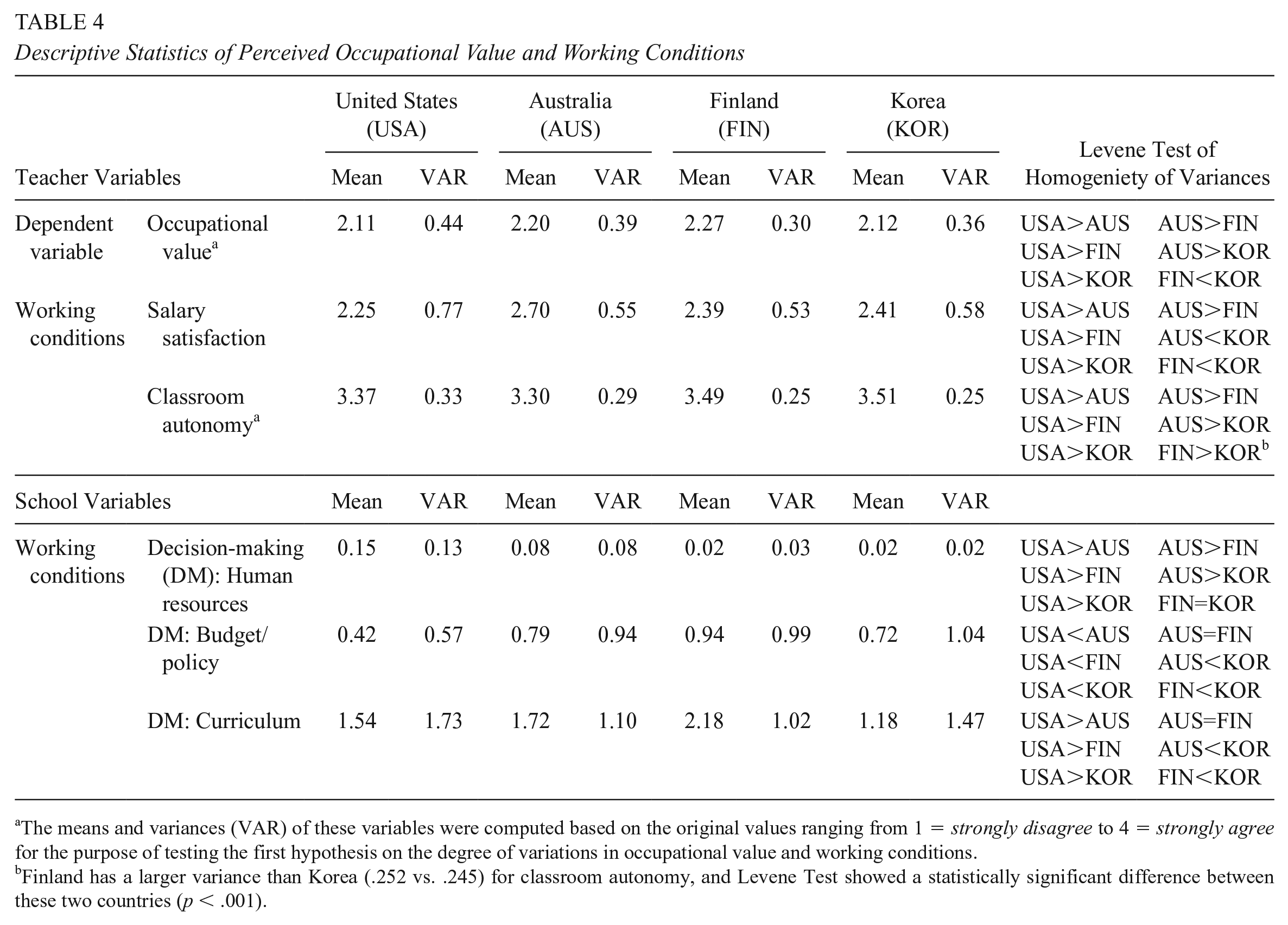
The means and variances (VAR) of these variables were computed based on the original values ranging from 1 = strongly disagree to 4 = strongly agree for the purpose of testing the first hypothesis on the degree of variations in occupational value and working conditions.
Finland has a larger variance than Korea (.252 vs. .245) for classroom autonomy, and Levene Test showed a statistically significant difference between these two countries (p < .001).
Our data support that this is indeed the case as shown in generally larger variance values for perceived occupational value and three working conditions (salary satisfaction, classroom autonomy, and involvement in school decision-making) in the United States and Australia compared to those of Finland and Korea and statistically significant differences, as shown in the Levene Test of Homogeneity of Variances. An exception for this pattern was the budget and policy dimension of decision-making, where the United States and Australia had significantly smaller variance values than Finland and Korea. It is notable that the United States had the largest variance values among the four countries, except for the budget/policy dimension of decision-making, showing the largest disparities across teachers and schools in teachers’ feeling of being valued and their reports of working conditions. These data supported our first hypothesis.
We also hypothesized the relationships between working conditions and perceived occupational value to be more positive in the United States and Australia than in Finland and Korea (Hypothesis 2). Table 5 presents the HLM results on the relationships, including control variables. The results seem to generally support this hypothesis, as all three working conditions were positively and significantly associated with the perceived occupational value in the United States and Australia. In Finland, salary satisfaction and classroom autonomy were positively and significantly associated with perceived occupational value, but teacher involvement in decision-making was not statistically significant. In Korea, the only positive and significant relationship was with salary satisfaction, and we observed negative relationships between classroom autonomy and curriculum dimension of decision-making and perceived occupational value. However, because of the small differences in the findings among the United States, Australia, and Finland, we can say that this hypothesis was only weakly supported.
Relationships Between Working Conditions Promoting Professionalization and Perceived Occupational Value

The index for human resources was recoded as 1=selected one or more items as areas for a significant teacher responsibility, and 0=teachers have no significant responsibility in any of these human resource items because only one principal in the United States, Australia, and Finland selected two items and no principal in Korea chose two items.
p < .10, **p < .05, ***p < .01, ****p < .001 (two-tailed tests).
Overall, unlike the consistent and significant relationships between occupational value and teacher outcomes reported in the previous section, we can see both cross-national similarities and differences across these four countries. First, teachers’ satisfaction with salary is consistently and positively associated with a higher level of perceived occupational value, with a significance level of p < .001 in all four countries. Teachers who are satisfied with their salaries are more likely to report that they feel valued and influential. This may indicate the importance of paying attention to how teachers feel about their salary as a potential predictor of their perception of occupational value.
The relationship between classroom autonomy and perceived occupational value is positive and statistically significant in the United States, Australia, and Finland. However, this relationship is negative and significant in Korea, suggesting that the teachers who reported a higher level of classroom autonomy were less likely to feel valued and influential. More research is needed to understand this finding for Korea. Yet one possible explanation may be related to the nationally standardized textbooks aligned with the centralized content standards (Byun et al., 2012; Park, 2013), which do not exist in the three other countries. In other words, while Korean teachers reported, on average, a higher level of autonomy than the other three countries (see online Appendix C), the existence of national textbooks may limit the actual autonomy they can exercise. Those teachers with expert knowledge who experience more classroom autonomy for innovation may feel especially undervalued because they may have a more critical perspective on national textbooks as limiting their innovative practice. 12
Meanwhile, we observed the largest difference across these four countries in the relationships between principal reports of teacher involvement in three dimensions of school decision-making and teachers’ perception of occupational value. As shown in Table 5, U.S. teachers whose principals reported that teachers are involved in budget and policy-related decision-making such as deciding on budget allocation, disciplinary policies, assessment policies, and student admission were more likely to report that they feel valued. In Australia, teachers who are involved in human resource decisions such as appointing, hiring, and dismissing teachers and establishing salary level and increases are more likely to feel valued. However, none of the three areas of school decision-making was significantly associated with the perceived level of occupational value in Finland.
In Korea, teachers who are involved in curriculum decisions such as choosing materials, content, and course offering are less likely to report that they are valued and influential. Again, those who are involved in these curriculum decisions may feel restricted due to the standardized national textbooks and content standards. They may experience that they are undervalued due to the lack of actual influence they can have in shaping the curriculum. This is consistent with the negative experience among teachers regarding the recent reform to give more autonomy to schools in deciding the course content and offering, despite the continued use of national textbooks and centralized hiring process that leaves little room for flexibility in curriculum content and offering (Hong & Youngs, 2016). Despite these differences across the countries, however, the relationship between principal report of teachers’ participation in school decision-making and teachers’ perception of occupational value is relatively weak and only marginally significant, with the level of p < .10 in the United States, Australia, and Korea.
In summary, a comparison of 28 OECD countries showed that, globally, an overwhelming majority of teachers are feeling undervalued in society and by the media and policymakers and feel that they have limited influence on educational policy. Our comparative analysis showed the importance of teachers’ perception of occupational value because those who feel valued are more likely to report collective effort to educational improvement and to be satisfied with their job consistently across four countries of comparison with different teacher policy contexts. The relationships between working conditions promoting professionalization and perceived occupational value varied across countries, indicating the importance of considering the unique teacher policy context in each country. Specifically, in the United States and Australia, where educational policy context produces disparities in teacher qualifications, distribution of qualified teachers, and degree of professional control, three working conditions seem to matter more for teachers’ perception of occupational value than in Finland and Korea, where we see greater consistency in these policy outcomes.
Conclusions and Discussion
With a global focus on accountability-based teacher reforms, previous research has documented that teachers may be losing the respect and support of policymakers and the general public in the United States (Ingersoll & Collins, 2017; Rentner et al., 2016; Wills & Sandholtz, 2009) as well as internationally (Müller & Hernández, 2010; OECD, 2020; Osborn, 2006; Price & Weatherby, 2018). The 2018 TALIS gathered, for the first time, a nationally representative data from lower secondary school teachers on multiple aspects of teachers’ perception of occupational value—feeling valued by the media, policymakers, and in society in general and being able to influence educational policy. This international dataset allowed us to empirically examine how teachers are feeling about their occupation around the globe as well as to explore potential outcomes and predictors of their perception of occupational value. It further allowed us to explore a potential role of teacher policy contexts with three dimensions of teacher education, labor market, and accountability in influencing the positive relationship between teachers’ perception of occupational value and their working conditions likely impacted by accountability reforms through a comparison of four countries with different teacher policy contexts.
Across the 28 OECD countries, we found that an overwhelming majority of teachers are feeling undervalued. Only one in four teachers (24.5%) feel valued in society, and only one in five teachers (18.4%) feel valued by the media. Their perception of value by policymakers is even lower, with only 13.3% reporting that they feel valued on average. They also feel that they have limited influence on educational policy, with only 22.5% reporting they have such influence. These numbers are disconcerting and require attention. With the global COVID pandemic that likely increased teachers’ workload and burnout (Pressley, 2021) due to remote and hybrid teaching and limited resources and, most recently, post-COVID challenges with student behaviors and widened learning gaps, there is a possibility that teachers are feeling further undervalued. In other words, likely deteriorated working conditions resulting from the COVID pandemic as well as continued accountability measures may further affect teachers’ sense of occupational value, which may in turn lead to the major teacher shortage currently reported in many countries around the globe (Diliberti et al., 2021; UNESCO, 2022). We will be able to test if this is indeed the case using the post-COVID data from the TALIS 2024 when they are released in the future.
From sociological perspectives, teachers’ negative perception of occupational value may reflect how teachers’ work is organized and controlled (Abbott, 1988; Evetts, 2013; Freidson, 2001). The negative teacher perception regarding their occupational value indicates that the degree and kind of specialization required for teaching may be unrecognized, especially by policymakers who focus on holding teachers accountable based on test-based student learning outcomes in many countries (Dunn, 2020). The previous research on teachers’ social status showed that the teaching profession is ranked somewhere in the middle across various occupations in many countries (Dolton et al., 2018; Hargreaves, 2009; Ingersoll & Collins, 2018). Yet teachers’ perception of their occupation value seems to be more negative than the public perception because we found that only 10% to 25% of teachers on average across 28 OECD countries reported that their occupation is valued and influential.
Our analysis showed that teachers who feel undervalued are less likely to report that their peer teachers in the same school are engaging in improvement effort and that they are satisfied with their teaching jobs. 13 These statistically significant relationships were found in all four countries, indicating that the negative consequences of teachers feeling undervalued apply consistently across countries regardless of the teacher policy context. This is consistent with the finding on job satisfaction by Price and Weatherby (2018) that used pooled data from 30 countries. The new finding that collective improvement effort is associated with perceived occupational value warrants attention. This is because such effort is critical for success of instructional reforms that emphasize a new vision of teaching for understanding and learning as coconstruction of knowledge through learner-centered instruction both in the United States (Coburn et al., 2016; Marrongelle et al., 2013) and many other countries (Akyeampong, 2017; Vavrus & Bartlett, 2012). This finding points to the importance of identifying the conditions that are associated with teachers’ perception of occupational value.
A comparison of the United States, Australia, Finland, and Korea revealed both similarities and differences in the conditions associated with teachers’ perception of occupational value. On the one hand, teachers’ satisfaction with salary was a consistent predictor of perceived occupational value. Previous cross-national studies identified the importance of teacher salary for positive outcomes such as higher national achievement (Akiba et al., 2012) and students’ aspiration of becoming teachers (Park & Byun, 2015). Perceived occupational value may be an important mediator linking teacher salary and various student outcomes, which may be applicable to many national contexts.
On the other hand, the ways in which both classroom autonomy and teacher participation in school decision-making are related to occupational value differed, depending on the teacher policy context. Previous studies have identified the importance of teacher autonomy (Shalem et al., 2018; Sparks & Malkus, 2015; Wills & Sandholtz, 2009) and teacher involvement in school decision-making in various national contexts (Da’as, 2019; Hammad, 2010; Ingersoll & Collins, 2017; Rentner et al., 2016; Sarafidou & Chatziioannidis, 2013; Wadesango, 2010; Wong, 2006). While teacher autonomy and involvement in school decision-making are measures of professional control, our finding of the varying relationships across four countries indicates the importance of paying attention to the role of different teacher policy contexts in these four countries (Voisin & Dumay, 2020).
Specifically, we found that in the United States and Australia, where three dimensions of teacher policy context—teacher education, labor market, and accountability based on the typology of Voisin and Dumay (2020) produce disparities in teacher candidate qualifications, distribution of qualified teachers, and degree or professional control, there are greater variations overall in teachers’ perception of occupational value and working conditions (salary satisfaction, classroom autonomy, and involvement in school decision-making) than Finland and Korea whose teacher policy produces consistency in teacher qualifications, distribution, and professional control. Furthermore, all of these three working conditions promoting professionalization were positively associated with a higher level of perceived occupational value in the United States and Australia, while such relationships were either nonsignificant or negative in at least one of the working conditions in Finland and Korea.
These findings highlight the importance of considering the teacher policy context along three dimensions of teacher education, labor market, and accountability in understanding within-nation variations in teachers’ perception of occupational value. Previous sociological work (Abbott, 1988; Evetts, 2013; Freidson, 2001; Voisin & Dumay, 2020) as well as empirical work in the United States (Hargreaves, 2009; Ingersoll & Collins, 2018; Rowan, 1994) and cross-national comparisons (Dolton et al., 2018; Voisin & Dumay, 2020) tended to focus on a relatively static view of the organization and control of the teaching profession for each country. Our empirical findings based on these four countries with different teacher policy contexts indeed showed differences in within-nation variations in perceived occupational value as well as their working conditions, indicating the control of the teaching profession may be a more dynamic process in some countries than others. This may result from how each country differently responds to the global accountability trend and implements a teacher policy that influences teachers’ working conditions based on local contexts (Akiba, 2017).
This study further expanded our understanding of the organization and control of the teaching profession by empirically testing our hypotheses that in the United States and Australia, where multiple pathways into teaching are offered, qualified teachers are not evenly distributed, and degree of professional control varies due to a test-based accountability system, there are greater variations in how teachers feel about their occupational value and their working conditions, and more positive relationships between their working conditions and teacher perception of occupational value, than in Finland and Korea. On the one hand, these disparities in perceived occupational value and working conditions pose a challenge in establishing a coherent social status of the teaching profession. On the other hand, it offers an opportunity to potentially raise the status by reforming teachers’ working conditions that are positively associated with teachers’ perception of occupational value because the control of the teaching profession is more dynamic in these countries.
In the United States, the teachers who are satisfied with their salary, who are given more classroom autonomy, and who are involved in school budget and policy-related decision-making such as budget allocation, disciplinary policies, assessment policies, and student admission, are more likely to report that they are valued and influential. This finding is consistent with the previous studies that showed that these conditions are important for professionalization of teaching (Hargreaves, 2009; Ingersoll & Collins, 2018) and, thus, likely influence their perception of occupational value. Teacher compensation, especially the degree to which teachers are satisfied with their salaries, is a strong predictor of their perception of occupational value in the United States as well as in the other countries. In summary, these findings may suggest that improving teacher salary, providing more classroom autonomy to teachers and involving them in resource and policy-related school decision-making can be effective strategies that educational leaders in the United States can use to make teachers feel more valued and eventually raise the status of the teaching profession. These approaches may be especially promising in the United States, given the greater variations in working conditions compared to other countries.
While our data showed that the United States and Australia have greater variations in both teachers’ perception of occupational value and their working conditions than in Finland and Korea except for budget and policy dimension of decision-making, supporting our first hypothesis, our second hypothesis on the positive relationships between working conditions and occupational value was only weakly supported. The findings on the United States, Australia, and Finland were generally similar, while Korea showed a different pattern with negative relationships between autonomy and decision-making and occupational value. Future studies involving more countries may reveal the differences and similarities in these relationships more clearly.
Before concluding, it is important to discuss the study limitations. First of all, although the 2018 TALIS data provided two important teacher outcome data—collective improvement effort and job satisfaction—other important outcomes such as instructional quality and student achievement were not available. Future studies should examine these other important teacher and student outcome measures. Second, the cross-sectional nature of TALIS data does not allow us to draw causal inferences. Longitudinal data are necessary to better address both the changes in perceived occupational value and the causal relationships between school conditions and teacher perception of occupational value using quasi-experimental methods. Finally, future studies should explore the complex relationship between global accountability reforms and teachers’ professional status or perceived occupational value. Specifically, it is important to examine the nature of teacher policy contexts that are influenced both by the global forces and local contexts (Akiba, 2017) and how teacher policy contexts shape the organization and control of teachers’ work in various aspects beyond the conditions examined in this study. A comparative study of a small number of countries, ideally capitalizing on both quantitative and qualitative data, would be most suitable to uncover the complex relationships between global accountability reforms, national teacher policy context, control of teachers’ work, and teacher perception of occupational value.
Despite these limitations, this comparative study provided important empirical evidence on the global pattern as well as cross-national differences in teachers’ perception of occupational value. In addition, the current study demonstrated that working conditions associated with perceived occupational value varied across countries with different teacher policy contexts, highlighting the importance of identifying county-specific conditions that could be targeted in an effort to improve teachers’ perception of occupational value. Specifically, in countries whose teacher policy produces disparities in teacher candidates’ qualifications, distribution of qualified teachers, and professional control, what district and school leaders can do to support teachers makes a difference in how teachers feel valued.
As teaching is one of the largest occupations in most countries and teachers’ influence on future citizens is significant, understanding their experience and perception related to how they feel valued should be an important policy focus. Unfortunately, most teachers are feeling undervalued around the globe, and this global pattern requires serious policy attention if we expect our teachers to stay in the profession and continue to improve teaching practice to educate our children to their full potentials as future citizens. Paying attention to and ameliorating inequitable working conditions for teachers, which exist along the line of poverty and racial/ethnic diversity in U.S. schools, is especially promising and important for supporting teachers and making them feel valued.
Supplemental Material
sj-docx-1-ero-10.1177_23328584231179184 – Supplemental material for Do Teachers Feel Valued in Society? Occupational Value of the Teaching Profession in OECD Countries
Supplemental material, sj-docx-1-ero-10.1177_23328584231179184 for Do Teachers Feel Valued in Society? Occupational Value of the Teaching Profession in OECD Countries by Motoko Akiba, Soo-yong Byun, Xiaonan Jiang, Kyeongwon Kim and Alex J. Moran in AERA Open
Footnotes
Declaration of Conflicting Interests
The authors declared no potential conflicts of interest with respect to the research, authorship, and/or publication of this article.
Funding
The author(s) disclosed receipt of the following financial support for the research, authorship, and/or publication of this article: Soo-yong Byun acknowledges support by the Ministry of Education of the Republic of Korea and the National Research Foundation of Korea (NRF-2020S1A3A2A02091529).
1.
We used “professionalization” throughout the article when referring to working conditions in relation to teacher perception of occupational value because these conditions exhibit the organizational structures for supporting professionalization of teaching, instead of individual characteristics that exhibit professionalism.
2.
3.
We decided not to conduct an analysis on pooled TALIS data from all 28 OECD countries using a country fixed-effects model, which is useful when we study a global or universal relationship between teachers’ perception of occupational value and teacher outcomes or predictors by controlling for observed and unobserved heterogeneity associated with countries. This decision was made because our research aim is to uncover (rather than control) national policy contexts that differently (rather than similarly) shape teachers’ perception of occupational value and its relationship with working conditions.
4.
Benefits are another important aspect of teacher compensation that could be targeted in accountability reforms. However, we could not examine benefits because of the limited nature of the TALIS item on benefits. The item, “Apart from my salary, I am satisfied with the terms of my teaching <contract/employment> (e.g. benefits, work schedule)” measures a broader construct beyond benefits that can be interpreted in many different ways and may not be comparable among the four countries of comparison.
5.
The grade levels of lower secondary schools are 7th, 8th, and/or 9th in the United States; 7th, 8th, 9th, and/or 10th in Australia and Finland; and 7th, 8th, and 9th in Korea (OECD, 2019b).
6.
The OECD created a composite variable on “Perceptions of value and policy influence” using three items: (a) teachers are valued by the media in this country/region, (b) teachers’ views are valued by policymakers in this country/region, and (c) teachers can influence educational policy in this country/region. As we believe that an additional item, “I think the teaching profession is valued in society,” is an important item for occupational value, we used these four items.
7.
The 2018 TALIS Technical Report (OECD, 2019a) describes the composite variable of “team innovativeness,” which used the same four items we used for “collective improvement efforts” (p. 350). We interpreted these items as “collective improvement efforts” as they measure their colleagues’ efforts or orientation for changes and improvement by using new ideas and methods. This report also describes three job satisfaction composites (p. 302). For the composite of “job satisfaction with profession,” which aligns well with our construct, OECD used four items instead of five items. We believe the additional item, “All in all, I am satisfied with my job,” can be part of this construct. Although these available composite measures in the TALIS 2018 database are fully tested and validated by OECD, we decided to use our own measures using a PCA that generates factor scores with a mean of 0 and standard deviation of 1 because we wanted to use a consistent method for all four composite variables (occupational value, collective improvement effort, job satisfaction, and autonomy) in this study. These factor scores were created within country to allow different factor loadings from items to create suitable composite variables for each country. By using factor scores, we can compare the coefficients in relation to the outcomes for addressing our second and third research questions (see Note 9 below). High reliability and literature-based validity indicate that our composite variables meet the quality standards.
8.
We chose to use HLM instead of multilevel structural equation model (SEM) because SEM (a) requires strong and well-established causal assumptions among independent variables of interest, mediators, and outcome variables; and (b) thus, ideally, needs longitudinal data to better test mediation models (Maxwell & Cole, 2007; Maxwell et al., 2011). Unfortunately, as for our study, we were unable to draw strong assumptions about the causal relationships between variables. More importantly, the cross-sectional nature of TALIS does not permit us to test the intermediary effect of occupational value using multilevel SEM. An HLM analysis is aligned with our research questions that first test the possible outcomes of perceived occupational value, followed by identification of working conditions associated with occupational value. These staged analyses allowed us to compare possible outcomes and predictors among four countries to address our research questions.
9.
A PCA was conducted for four items for occupational value, five items for autonomy, four items for collective improvement effort, and five items for job satisfaction for each country. In all four countries, teachers’ responses represented a single unidimensional factor for each of the four survey constructs with high reliability. Therefore, we computed a factor score for each variable for each country with a mean of 0 and standard deviation of 1, which is useful for cross-national comparisons of the relationships between occupational value and its outcome and predictor variables for our second and third research questions.
10.
Readers may also review Figure II.2.1 (p. 78) in the TALIS 2018 Volume 2 Report (OECD, 2020) that presented data on Item 1 from all 48 educational systems (including cities and states) that participated in 2018 TALIS and the difference by teacher gender, age, and experience. They can also review Table II.5.47 from OECD available online (at http://dx.doi.org/10.1787/888934084342) to see how the percentages of teachers for Items 2, 3, and 4 in  differ by teaching experience in all 48 educational systems (including cities and states) that participated in 2018 TALIS.
11.
OECD (2020) reports a supplemental analysis on the relationship between occupational value and job satisfaction in 48 educational systems and presented in Table II.2.7 (available at ). In this analysis, OECD used one item measure of occupational value, “I think the teaching profession is valued in society,” and examined the relationship between this measure and overall job satisfaction created from job satisfaction with work environment (four items) and job satisfaction with profession (four items), controlling for teachers’ gender, age, experience, and full-time status; and percentages of low achievers, socioeconomically disadvantaged students, and students with behavioral problems. This analysis shows that in all 48 educational systems including the United States, Australia, Finland, and Korea, except one city (Buenos Aires), there was a statistically significant and positive relationship between occupational value and job satisfaction, controlling for teacher and classroom background characteristics.
12.
Readers may wonder if Korean teachers value collaboration more than autonomy, which may explain the negative relationship between autonomy and perceived occupational value. However, reported using 2018 TALIS data that the level of collaboration among Korean teachers is among the lowest compared to other countries. Therefore, it is important to explore other possible reasons in future studies.
13.
Using TALIS 2018 data, examined school innovativeness using the same items as our measure of collective improvement effort and found that school innovativeness was significantly associated with job satisfaction with work environment in 44 out of 48 countries examined. Although this study did not examine teachers’ perception of occupational value, their finding supports these two outcomes (collective improvement effort and job satisfaction) examined in the current study are interrelated and points to the importance of examining other important outcomes of teacher’s perceptions of occupational value.
Authors
MOTOKO AKIBA is a professor in the Department of Educational Leadership and Policy Studies at Florida State University, 1209 Stone Building, 1114 W. Call St., Tallahassee, FL32306-4450;
SOO-YONG BYUN is a professor in the Department of Education Policy Studies at the Pennsylvania State University and a visiting professor in the Department of Education at Ewha Womans University, 310D Rackley Building University Park, PA 16802;
XIAONAN JIANG is a PhD student in the Department of Educational Leadership and Policy Studies at Florida State University, 1209 Stone Building, 1114 W. Call St., Tallahassee, FL32306-4450;
KYEONGWON KIM is a PhD student in the Department of Educational Leadership and Policy Studies at Florida State University, 1209 Stone Building, 1114 W. Call St., Tallahassee, FL32306-4450;
ALEX J. MORAN is a PhD student in the Department of Educational Leadership and Policy Studies at Florida State University, 1209 Stone Building, 1114 W. Call St., Tallahassee, FL32306-4450;
References
Supplementary Material
Please find the following supplemental material available below.
For Open Access articles published under a Creative Commons License, all supplemental material carries the same license as the article it is associated with.
For non-Open Access articles published, all supplemental material carries a non-exclusive license, and permission requests for re-use of supplemental material or any part of supplemental material shall be sent directly to the copyright owner as specified in the copyright notice associated with the article.
