



Abstract
Working conditions in academia are generally considered to be deteriorating. Data from surveys which look at the job satisfaction of academics, however, do not clearly support this notion. This appears to be especially true for the case of Japan. Much of the recent literature on academics’ job satisfaction globally relies on the comparison of two large-scale international surveys from 1992 and 2007, despite significant shortcomings of such an approach. In the case of Japan, where a third survey - also from 2007 - is available, these shortcomings become particularly apparent. After presenting an overview of how the working conditions of Japanese academics have changed in the twenty-five years between these surveys, the present paper identifies some of the inconsistencies and problems involved in such surveys and then explores the ‘paradox’ of rising levels of job satisfaction in Japan despite the objective worsening work conditions over the same period.
Introduction
This article explores some of the issues involved in measuring the satisfaction levels of academics, specifically academics in Japan, in both a synchronic and a diachronic manner. How can we measure if Japanese academics are happier than those in other professions in Japan today and how have their levels of satisfaction changed compared to 25 years ago?
Jürgen Enders (2006: 12–13) has suggested that academics worldwide are becoming less satisfied with their jobs: The academic profession has frequently been characterized by its high degree of job satisfaction […]. But it is generally assumed that external changes in the conditions of service as well as the growing differentiation of status groups within the profession might have changed the picture.
This statement would appear to be supported by an article by Shima (2012) which states that while the salaries of Japanese professors are viable and competitive against other sectors (1.67 times those of the national average, a ratio that has not changed for 30 years), hours of work, job stability and access to jobs have all markedly deteriorated, which has made the academic profession less attractive.
The recent and ongoing publication of the results of a major global survey of academia known as the Changing Academic Profession survey (CAP survey), which was carried out in the mid-2000s, has given us the chance to test both Enders’ and Shima’s statements (see Arimoto et al., 2015; Bentley et al., 2013a; Teichler et al., 2013; see also several other volumes edited by Shin, Arimoto, Cummings and Teichler and published by Springer since 2013). The data from the CAP survey are particularly interesting because the project was designed to allow its results to be compared with those of the first large-scale global survey on higher education, the International Survey of the Academic Profession (henceforth the Carnegie survey), which was undertaken by the Carnegie Foundation for the Advancement of Teaching almost exactly 15 years earlier in 1992. Despite the attempts made by many of the publications listed above, it has proved much more difficult than the architects of the CAP survey had hoped to be able to compare the two projects. This article sets out to explore the source of some of these problems and to suggest how they might be avoided in the future.
In the conclusion of their book Job Satisfaction Around the Academic World, which sets out to analyse and compare the CAP and Carnegie surveys, Bentley et al. (2013b: 259) acknowledge that the results for what factors are associated with job satisfaction remain ambiguous. […] It is difficult to devise a reliable, multi-item composite measure of academic job satisfaction which is internationally consistent because cultural differences influence the degree of satisfaction one derives from different elements of academic work and the environment.
In particular, Bentley et al. noted a paradox that appeared in several chapters of their book and held true for many of the national samples included. This paradox was that while academics rated many aspects of their working environment in 2007 much more poorly than in 1992 and expressed dissatisfaction across a much wider range of subjects, overall they still appeared to report being more satisfied with their jobs than they had been 15 years earlier. Akira Arimoto (2011a: 316), for example, in his work on Japanese academics’ job satisfaction, describes it as ‘an interesting paradox […] that under these kinds of worsening academic working conditions, academics’ satisfaction with their current job remains significantly high’. In the very last lines of their book, Bentley et al. (2013b: 259) suggest an explanation for this apparent paradox: Unlike other organisations, where job satisfaction may be reflected through absenteeism or staff turnover as dissatisfied workers move on to better alternatives, universities offer unique and rewarding careers where, given their time over, most academics would readily sign up to again.
In this article, we suggest that, actually, the paradox may not be due to the special nature of the academic workplace but due to the limitations of the surveys themselves. Indeed, it may not exist at all. In order to explore this point in more depth, we will focus on the data related to the happiness and satisfaction levels of Japanese academics. We have chosen Japan for a number of reasons.
First, Japan serves as an excellent example because the three chief architects of the CAP survey (Ulrich Teichler, 1 William K. Cummings 2 and Arimoto Akira 3 ) are themselves all experts on Japanese higher education. They have between them published many of the most important works on Japanese university culture and history over the past four decades and, as such, can be considered to have been particularly sensitive to the appropriateness of the survey to the Japanese context.
Second, Japanese higher education, along with that of many other countries, of course, has undergone fundamental changes in the past two decades which might be expected to have had a major impact on job satisfaction.
Third, in the case of Japan, we have access to another dataset that allows us to triangulate some of the findings of the Carnegie and CAP surveys. In what Teichler calls a ‘bold and luxurious decision’ (2015: 227), this third survey (henceforth referred to as the ‘AP survey’) was conducted by the Japanese CAP team simultaneously with the international survey (see Arimoto 2011b: 15). As we shall see, the AP survey, unlike the CAP survey, was specifically modelled after the Carnegie questionnaire of 1992 and used an explicit multiple-item approach to measure job satisfaction and, thus, offers a higher degree of comparability to the earlier survey.
The first part of the article looks briefly at how the experience of academics in Japan has changed between 1992 and 2007, the dates of the two surveys. In the second part of the article, we examine three dimensions of the research process: the theoretical approach of the CAP survey and how it led to the inclusion and exclusion of certain variables affecting job satisfaction; the methods of the surveys, in particular the suitability of using a single (explicit) item measurement in relation to a psychometric perspective; and some issues related to the sample itself and their possible effects on the analysis. Finally, we discuss the ‘paradox’ of worsening work conditions and rising levels of job satisfaction and consider if it is one that can be resolved and, if so, what direction attempts to do so should take.
Japanese faculty at the time of the 1992 Carnegie survey
In 1979, one of the leading architects of the 2007 CAP survey, William K. Cummings, co-authored an article with Ikuo Amano entitled ‘The changing role of the Japanese professor’ (Cummings and Amano, 1979). They picked out the following features for particular note:
(a) Since the establishment of modern higher education in Japan in the 1870s, university professors have enjoyed great respect and status, not only when teaching but more generally. Professors were influential in the lives of their students far beyond the classroom and long after they had left their institutions.
(b) Professors were rewarded for loyalty to their institution through a salary system that recognised length of service, known as the nenkō joretsusei (or seniority promotion system). Tenure was secured from initial appointment, often at an early age by global standards. Those who took their services elsewhere would often suffer severe financial penalties as a result. All of this, of course, led to a very immobile academic workforce.
(c) The ‘chair’ (kōza) system, which has an equal number of senior and junior positions, virtually guaranteed promotion for all those employed by universities. The fact that almost all senior management positions, such as that of dean, were chosen from within the university also meant that many could aspire to such positions. The converse of these ‘benefits’ (as the authors called them) is that institutions became excessively, in some cases almost completely, inbred, since it was believed that only those who had been fully socialised into the institution could understand its distinctive features and character.
(d) Even publication became focused internally. Academics were able (and indeed were sometimes financially encouraged) to publish their work, without peer or external review, in faculty journals known as daigaku kiyō. Very few professional journals developed outside individual universities and very few scholars published in the journals of other institutions.
All of these features, as Cummings and Amano (1979: 131) pointed out, ‘tended to channel the energies of professors towards their universities’. Professors had little concept of themselves as part of a wider group of specialists in a particular arena, such as law, medicine, chemistry or economics.
All of the features identified by Cummings and Amano at the end of the 1970s still exist in Japan today, although to a lesser degree. Perhaps the most important feature that they identified, however, was the development of a research orientation among Japanese professors. Surveys in 1967 and in 1973 both showed that nearly half of all Japanese professors in that era viewed research as their most important activity (Cummings and Amano, 1979: 139). What was meant by research, of course, varied enormously and could extend from serious use of primary sources to the quick and easy production of popular articles. Cummings and Amano (1979: 147) suggested that the successful academic was likely to go through several stages ‘from being a serious and committed researcher in his early years to becoming a quasi-popular writer by his late thirties and a public speaker and consultant in his fifties’.
Drawing on the Carnegie survey, which had 14 target countries, including Japan, and 20,000 participants, Takekazu Ehara (1998) argued that Japanese professors’ views of teaching and research fitted centrally into the ‘German model’, where the number of teaching-oriented faculty members is extremely low. 4 A very high proportion of Japanese academics perceived their research activity as exerting a positive influence on their teaching, while they regarded their teaching activity as impinging negatively on their research.
The very strong research orientation of academics in Japanese universities in the post-war period was not reflected by either governmental or industrial investment in the university as a site for research. In Japan, not only most applied but also most blue-skies research took place in non-academic and corporate research institutions. Government research support for universities was particularly harshly curtailed in the 1980s, and by the early 1990s, the amount of money available to purchase equipment per university scientist was roughly 20% of that available for their peers in non-university government research institutions and 25% of that available in corporate laboratories (Yamamoto, 1995: 27). The share of national R&D spend in universities slipped from 18.2% in 1970 to 11.6% in 1990 (Yamamoto, 1995: 34).
The lack of research funding in universities in the early 1990s highlighted a number of problems with the organisation of Japanese universities at that time and these began to be tackled during the latter half of the decade. The problems were reflected differently by the two main models for university governance and administration that existed in Japan: the kyōjukai shihai model and the rijikai shihai model. The kyōjukai shihai model (control by professors’ councils) was the norm in all national, public and many private universities, while the rijikai shihai model (control by university board or president) was only found in private institutions.
The faculty in kyōjukai shihai universities
In national universities, there was an almost complete separation between financial and academic decision-making. In these institutions, the Ministry of Education controlled budgets and national policy, while the professors’ councils (kyōjukai) within the university kept tight control over admissions, curricula, examinations and student affairs. The two processes went along in parallel almost without interaction and, as Yamamoto (1995: 30) says: ‘Under such circumstances, it is not surprising that available resources, including research funds, [were] allocated equally despite the differential needs of researchers and faculties.’ In 1992, 75% of government research funds were allocated without the need to write any research proposal.
It was largely to tackle the perceived malaise in research in the formerly elite national university sector that major reforms were introduced in April 2004 under what was known as the dokuritsu gyōsei hōjinka 5 process. After 1 April 2004, national university professors no longer enjoyed either the employment status or security that they had previously as national civil servants.
While some academics in the leading national universities embraced the new culture and, in particular, the increased research funding available through open competition, the new trends that began to develop in national universities were not to the liking of many of the staff. They disliked the new audit culture that the government introduced and which meant that universities had to put forward six-year plans that could be assessed and judged by external bodies and would determine future funding. 6 They also disliked the new consumer culture, which meant that teachers needed to be responsive to student demands, and the new entrepreneurial culture, which meant that research funds had to be competed for. Although it could not be called a mass exodus, in the two or three years following the 2004 reform a noticeable trickle of senior academics below retirement age moving from some of the top national to private universities of supposedly lower academic status developed.
Faculty in rijikai shihai universities
Private universities, which constituted 94% of two-year colleges and 77% of four-year institutions, also came under severe pressure to reform their management in the 1990s, but this emanated from a different direction from that which affected the national sector since most private universities focused only on education and not research. Demographic decline meant that there were no longer enough 18-year-olds in the population to provide the student intake that had been the staple and stable source of income for private universities over the past half-century. By 2006, around 40% of private universities were officially teiin ware (taking below the quota of students set by the government for them to qualify for public subsidy) and many of these were presumed to be in severe financial difficulties. In the rijikai shihai model of management, in general, professors had very little say in the running of their institutions. Instead, management was undertaken by a small group of individuals who were often related to each other, since many of these institutions were part of family-run educational conglomerates known as dōzoku keiei gakkō hōjin (family-run school conglomerations).
The Japanese faculty since 2000
The Japanese university, of course, has always been in a state of flux, but the confluence of demographic, political and economic pressures combined with the effects of globalisation have meant that Japanese universities have been placed under a set of particularly severe constraints during the past two decades. One of the results of this pressure has been a serious cutback in recruitment, which has led, in turn, to the ageing of the profession (Hasegawa and Ogata 2009: 274).
While the proportion of women teaching in higher education has almost doubled since structural reforms – in particular, the abolition of the faculties of liberal arts and sciences in almost all universities and the relaxation of the University Accreditation Standard – were introduced into Japanese universities in 1991, Japan still has the lowest female participation rates in the OECD. Its figure of 18.2% female staff was half the OECD average when the CAP survey was undertaken in 2007 (Arimoto and Daizen 2013: 147–148). The figures also continue to disguise huge discrepancies with regard to where changes have taken place. The proportion of women, especially those above junior ranks, who are teaching in what remains of the elite former imperial universities, for example, is less than half of the already low Japanese average.
A number of policy changes and social trends have also combined to make academic appointments – especially permanent appointments – increasingly hard to secure: government pressure on national universities to reduce the number of permanent appointments; the apparent desire of national universities themselves to ensure job security for senior staff by reducing the number of new junior recruitments; the huge increase of graduates from PhD programmes from 4358 in 1985 to 8019 in 1995 to 16,445 in 2013; and the similar increase in postdoctoral positions from 6224 in 1996 to 15,220 in 2011. The results of these trends are, first, a huge growth in junior academics in non-secure fixed-term posts 7 providing much of the teaching and research in universities (a group described by Minazuki (2007) as the ‘highly qualified working poor’ [kogakureki waakingu pua]) and, second, a continuation of the practice of academic inbreeding despite the attempts by government to try to make the academic recruitment process more transparent and competitive (see Horta et al., 2011). The terms and conditions that new academics are offered are very different from those of their predecessors. In medicine and the hard sciences, particularly, young academics are increasingly likely to be employed on short-term contracts, often linked to specific projects. 8 At the leading research-intensive universities, it may not be long before the majority of staff are, indeed, on such contracts (as has happened, for example, in the UK and the US), although in the teaching-only universities it is likely that the majority of staff will continue to be employed on full-time contracts. 9 Perhaps most significant, given the importance Japanese academics attach to research, is the fact that both the Carnegie and CAP surveys suggest a substantial increase in the amount of time Japanese academics need to devote to teaching and administration (both activities increased by two hours a week on average) and a consequent substantial decrease in the time they should make available for research (down by four hours a week (or almost 20%) from 21.6 to 17.6 hours) (Shima 2012: 189). 10 Puzo (2016: 85), writing in 2016, summarises the situation thus, ‘[W]hile scientists have come to be seen as crucial to the country’s socioeconomic and environmental preservation, their work conditions are becoming increasingly insecure’.
The surveys on Japanese academia and their relation to job satisfaction
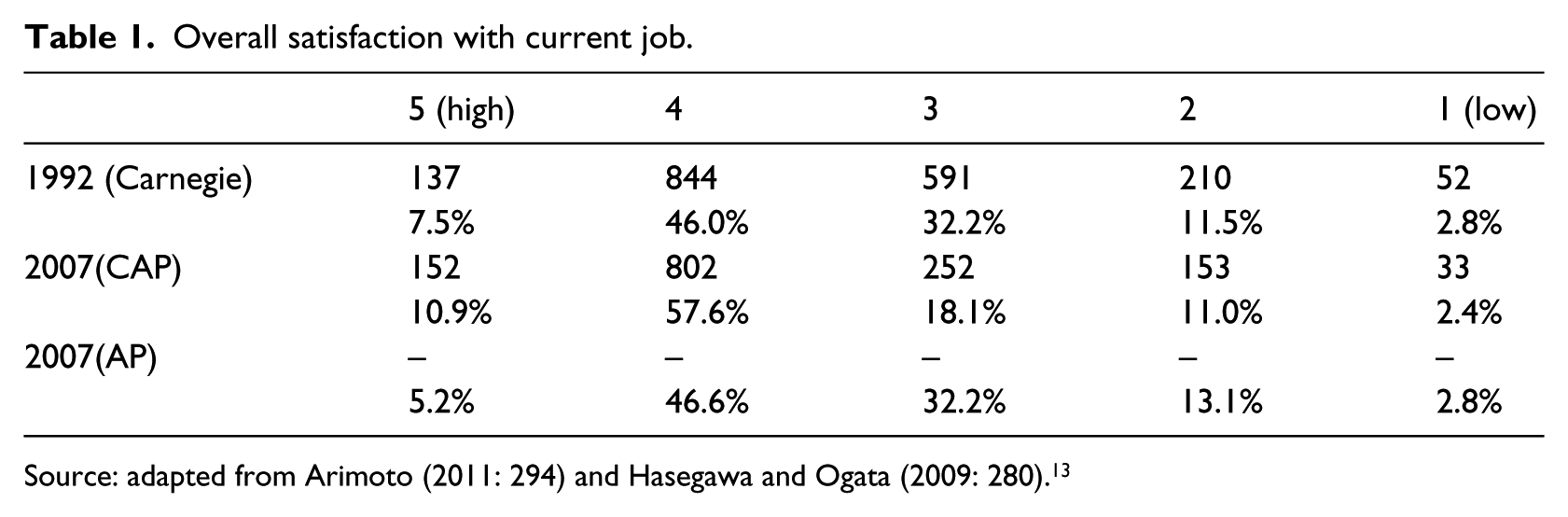
Even though it might be expected that the changes described above would have a detrimental effect on Japanese academics’ satisfaction, based on results of the CAP survey ‘Japan belongs to the group of countries expressing average levels of high satisfaction with their current job [in academia]’ (Arimoto 2011a: 294), with 69% of faculty members indicating that they were very or somewhat satisfied as opposed to an international average of 65%. 11 When comparing this data to the results of the 1992 Carnegie survey, as Arimoto and other researchers have done, interestingly, it appears that Japanese academics’ job satisfaction has substantially increased in the 15 years between 1992 and 2007 (see Table 1). The question arises as to how this conundrum (which is not considered as applying only to Japan) can be solved, considering the profound changes within academia shown in the previous section of this article. As stated in the introduction, we suggest that the surveys which served as the foundation for the formulation of this paradox are subject to certain theoretical and methodological limitations when it comes to measuring job satisfaction, not least due to the fact that they were not primarily designed for that purpose. With the AP survey we will also present data that actually appear to contradict the statement that Japanese academics are happier with their job situation overall. 12
Overall satisfaction with current job.
Source: adapted from Arimoto (2011: 294) and Hasegawa and Ogata (2009: 280). 13
Job satisfaction in the Carnegie and CAP surveys
Based on a previous survey conducted solely in the US, the Carnegie survey was carried out between 1991 and 1993. 14 In relation to job satisfaction, a multi-item approach was used, with a total of seven explicit and three implicit items 15 used to investigate respondents’ satisfaction with certain aspects of their workplace. Of the Japanese respondents surveyed in 1992, 53.5% (scores 4 and 5 on a 5-point scale) stated that they were satisfied with their overall job situation (see Table 1) (Arimoto 2011a: 294), while only a comparatively small proportion (14.3%) (scores 1 and 2 on a 5-point scale) stated that they were dissatisfied.
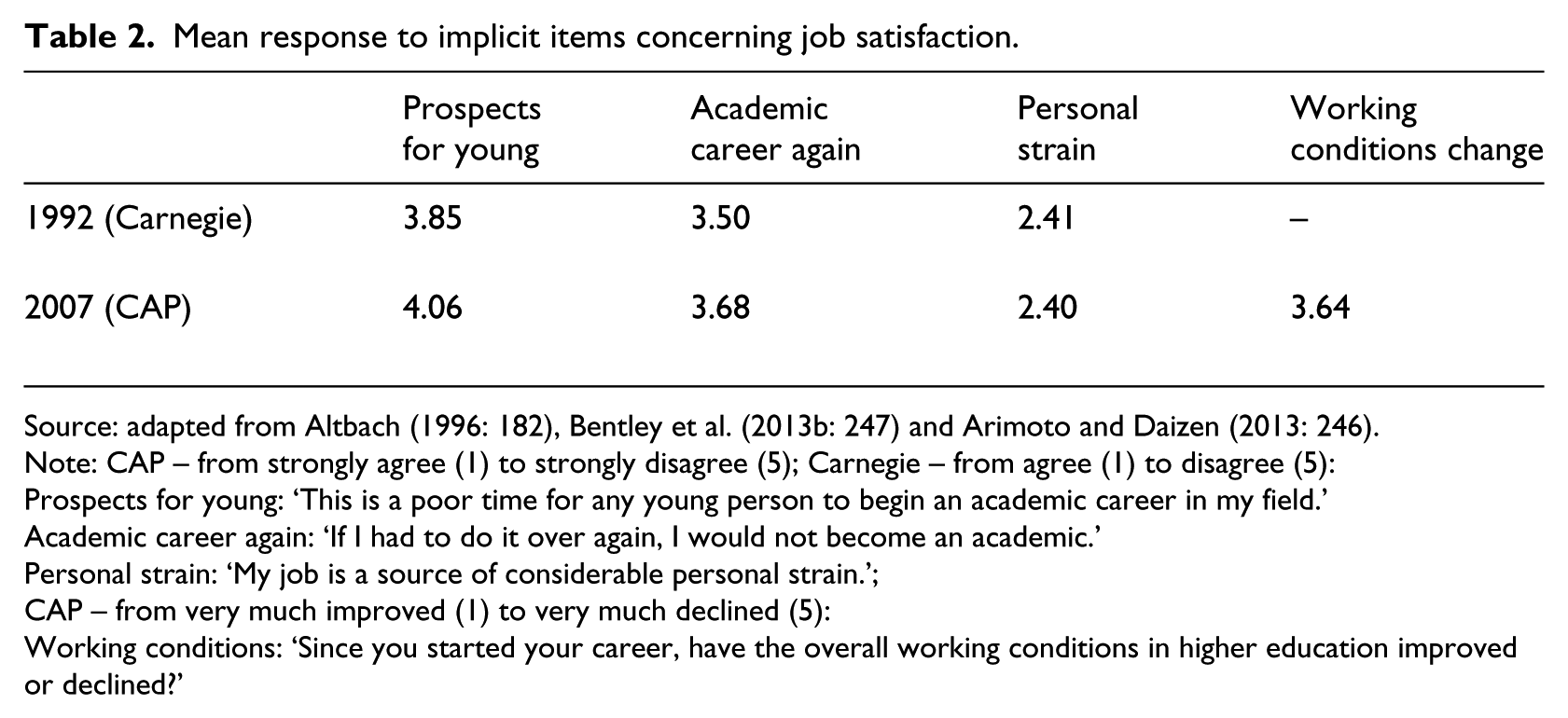
Even in 1992, however, these results appeared counterintuitive to a certain extent when related to other questions, the answers to which would implicitly express a person’s satisfaction with his/her profession (see Table 2). In none of the other countries surveyed at the time, for example, were academics as stressed as in Japan, with 56% of the respondents stating that their job was a source of considerable personal strain and 22% of all respondents choosing the highest category (1) related to personal stress (Arimoto 1996: 184). As Arimoto (1996: 189) put it at the time, Japanese academics ‘complain intensely about problems concerning facilities, equipment, salaries, administration, and even the quality of students’. Thus, when it came to job satisfaction, the 1992 Carnegie survey was already hard to interpret. What about the CAP survey undertaken 15 years later?
Mean response to implicit items concerning job satisfaction.
Source: adapted from Altbach (1996: 182), Bentley et al. (2013b: 247) and Arimoto and Daizen (2013: 246).
Note: CAP – from strongly agree (1) to strongly disagree (5); Carnegie – from agree (1) to disagree (5):
Prospects for young: ‘This is a poor time for any young person to begin an academic career in my field.’
Academic career again: ‘If I had to do it over again, I would not become an academic.’
Personal strain: ‘My job is a source of considerable personal strain.’;
CAP – from very much improved (1) to very much declined (5):
Working conditions: ‘Since you started your career, have the overall working conditions in higher education improved or declined?’
Eight of the seventeen participating countries in the CAP had already participated in the Carnegie survey of 1992. The CAP survey, however, did not set out to directly replicate the Carnegie survey. As its name indicates, it was more interested in measuring how the academic profession was changing and it set itself ‘three key challenges’ (Höhle and Teichler 2013: 29–30) that had not been specific points of focus in the Carnegie survey: the role of the academy in the knowledge society; internationalisation as a major factor defining and shaping academic practice; and new forms of management entailing a change in distribution of power, evaluation processes, supervision and support. It is important to point out, therefore, that job satisfaction was not at the core of the survey. Yet, the data have been used extensively to discuss academics’ job satisfaction, and one of the major publications resulting from the analysis of the CAP survey (Bentley et al., 2013a) is devoted solely to this topic.
When looking at the 1992 Carnegie survey and the 2007 CAP survey it can be noted that overall satisfaction with work among Japanese academics appears to have increased over the 15 years between the two surveys: The proportion of academics who stated that they were (very) satisfied with their current job overall had risen from 53.5% to 68.5% (scores 5 and 4 combined), as shown in Table 1. In Table 2 we also see that in 2007 Japanese academics seem to have evaluated prospects for the young less negatively than in 1992 and that they would enter into academia more readily if they had to do it all over again.
At the same time, the mean response to the question whether working conditions are changing for the better or worse indicates that many academics feel conditions to be declining rather than improving. Arimoto (2011a: 316) states that in 2007 only 13% of respondents replied that work conditions had improved since they started to work in academia and Teichler (2009: 68) notes that 66% of academics in research universities rate their working conditions as having deteriorated.
Interestingly, the item on personal strain, which might be presumed to have a considerable impact on job satisfaction, showed almost no change between 1992 and 2007, with only a negligible increase of respondents (56% to 57%) agreeing that their job was a considerable source of personal strain. The CAP data suggested ‘that academics may be highly critical of various aspects of their jobs but still report being satisfied overall’ (Bentley, 2013b: 259). In the following sections, we suggest that in order to solve this paradox it is necessary to look at the measuring instrument itself and especially at the CAP survey and the analysis of it.
Theoretical issues – key variables
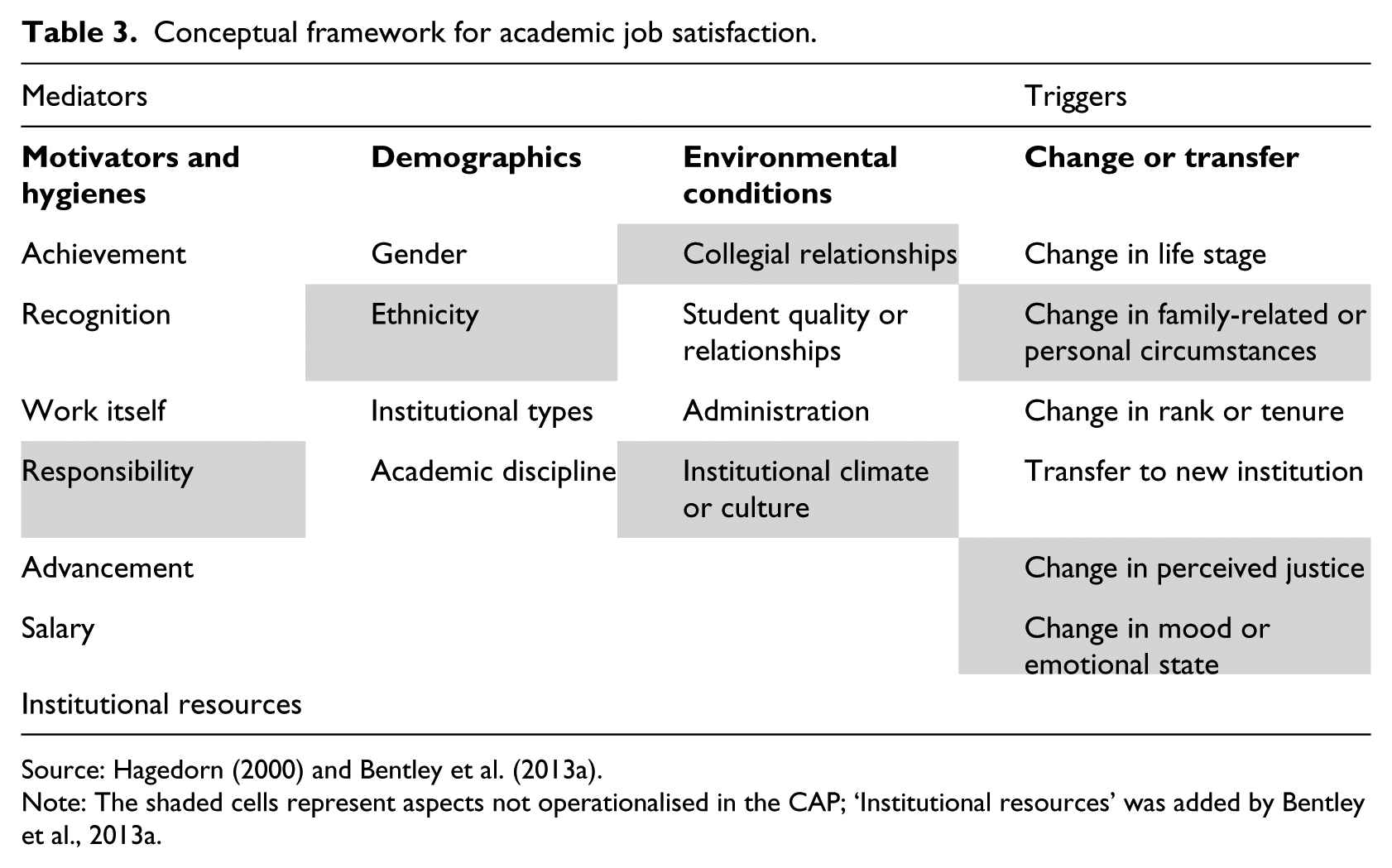
In the seventh volume of the series The Changing Academy – The Changing Academic Profession in International Comparative Perspective (Bentley et al., 2013a), the authors of the book draw on Linda Hagedorn’s modification of Frederick Herzberg’s two-factor model, developed specially for the higher education sector. It divides factors contributing to job satisfaction into ‘mediators’, meaning variables influencing relationships to other variables, producing interaction effects, and ‘triggers’, which refer to life events and changes (see Table 3).
Conceptual framework for academic job satisfaction.
Source: Hagedorn (2000) and Bentley et al. (2013a).
Note: The shaded cells represent aspects not operationalised in the CAP; ‘Institutional resources’ was added by Bentley et al., 2013a.
Hagedorn’s (2000: 6) model – despite serving as a foundation for the analysis of Bentley and his colleagues – does not appear to have been considered in the design of the CAP survey. At least some of the factors and variables outlined by Hagedorn were not included at all, such as those related to collegial relationships and institutional climate and culture. We believe that this is significant because Hagedorn, among many others, has demonstrated that the workplace environment and, most importantly, relationships between co-workers, is a significant indicator for job satisfaction in academia (Awang et al., 2010; Hagedorn, 1996; Hagedorn, 2000; Noraani, 2013). As Lacy and Sheehan (1997: 309) point out: ‘[…] factors related to the environment in which academics work, including university atmosphere, morale, sense of community and relationships with colleagues are the greatest predictors of job satisfaction’. Hill (1987), while applying Herzberg’s theory to academics in a different setting, also concludes that relationships with colleagues are one of the major extrinsic factors leading to (dis)satisfaction. Other potentially significant factors within the social workplace, such as teamwork and mutual support (see, for example, Al Hinai, 2013; Faleh and As’ad, 2011), are also not explored by the questions in the CAP survey. In fact, it offers even fewer items on interpersonal matters than the Carnegie survey of 1992.
This is one of the reasons why we think the AP survey of 2007 is so useful for understanding some of the CAP survey findings. It was explicitly modelled on the Carnegie questionnaire of 1992 and uses an explicit multi-item approach to measure job satisfaction. While some of the data from the AP survey are analysed in the Research Institute for Higher Education’s publications (e.g. RIHE, 2011), the most recent work using the AP results is The Changing Academic Profession in Japan (Arimoto et al., 2015). This book is the eleventh volume in the series The Changing Academy – The Changing Academic Profession in International Comparative Perspective and summarises as well as elaborates on many of the previous RIHE publications.
In the AP survey, some information on interpersonal relationships can be gleaned from the data presented. In particular, the survey contains an item on overall satisfaction with collegial relationships. While in the 1992 Carnegie survey 51.3% of men and 51.4% of women were satisfied with the collegial relationships at their workplace, in the 2007 AP survey those percentages were 57.1% and 61.0%, respectively. The percentage of those dissatisfied, however, remained rather constant between 10.2% and 13.4% (Kimoto, 2015: 99), suggesting that, overall, collegial relationships had improved in the years during that period. This would seem to correspond better with the increase in job satisfaction discussed above. 16
Another important area when considering job satisfaction is the intersection of life and work or, more specifically, overall work-life balance. While some earlier studies did emphasise the importance of both work and nonwork-related factors for job satisfaction (e.g. Near et al., 1983, 1984; Near and Sorcinelli, 1986; Rice and Hunt, 1979) this shortcoming in Hagedorn’s framework was only addressed by Rosser in 2005, who modified her model by adding a work-life variable (Rosser, 2005). Mukthar (2012: 71) also shows that ‘there is a significant relationship […] between work life balance and job satisfaction’ but the lack of any analysis of this relationship in the CAP survey suggests another possible explanation for the ‘paradox’ of Japanese academics’ job satisfaction.
Another missing factor from Hagedorn’s framework is personal mood. Studies investigating the affective component of job satisfaction have shown that individual personality and mood have a high influence on the perception of work (Fisher, 1998; Ilies and Judge, 2002; Ilies and Judge, 2004). We will look deeper into how these elements could be integrated into a study on job satisfaction in the next section.
Studies of Japanese academics’ work satisfaction depend heavily on the CAP data and ‘Western models’ in general. Studies originating in Asia might emphasise different factors. An elaborate example of such a framework has been created by Chen et al. (2006) in their study on Taiwanese universities, which examined areas such as ‘organisation vision’ and included items such as ‘university reputation’ or ‘participation in local culture and welfare’, as well as ‘mutual respect among teachers’. This study suggests that various additional components, such as social support and respect (between faculty members as well as between faculty and students) as well as prestige and social values, might be crucial for a full understanding of job satisfaction in Asian academia.
Methodological issues
While examining the theoretical framework of the surveys helps us to understand the connection between job satisfaction and the variables contributing to and influencing it, we also need to explore the question of how to actually measure satisfaction. Single- and multi-item approaches have already been mentioned with regard to this issue. In a very insightful article, Oshagbemi (1999) examines the advantages and disadvantages of these types of measurements and concludes that a tailor-made, multi-item approach provides the most detailed results for comparisons within one and the same profession. 17 This is what was done, to some extent, in the AP survey undertaken in 2007.
The AP survey took a multi-item approach (like the 1992 Carnegie survey) and, interestingly, produced results that are, in fact, very close to those of the Carnegie survey, and conspicuously different from the results of the CAP survey. 18 This begs the questions of why there was such a difference between two surveys carried out in the same year and with academics in the same country.
In contrast to the CAP survey, the architects of the AP survey used the same questions as the 1992 Carnegie survey and the questionnaire was sent to the same universities as in 1992 (Hasegawa and Ogata 2009: 276–277). This allows for a different degree of comparability, especially when it comes to the item on overall job satisfaction. We suggest that its position within the questionnaire may have been crucial.
In psychometrics, the influence of so-called ‘context effects’ on respondents’ evaluation of certain items has been widely discussed. 19 Put simply, each of the steps in the process of filling out a questionnaire is considered to be influenced by previous items, from which the respondents derive information that they either assimilate or contrast with their answer to following items (Siminski, 2008: 478–479). In this context, when looking at the positioning of the item on overall job satisfaction in the CAP and the Carnegie surveys, we notice a striking difference. In the Carnegie, as well as in the AP questionnaire, respondents were confronted with a battery of questions in which they had to state their satisfaction with six separate factors, including satisfaction with courses they teach, relationships with colleagues and job security (scored on a scale of 1–5), with the last item being their view of their job situation as a whole. In the CAP questionnaire, on the other hand, the question on job satisfaction is not included in a battery of questions, but stands separately. It is, however, preceded by a battery of items including statements such as ‘This is a poor time for any young person to begin an academic career in my field’ and ‘My job is a source of considerable strain’ (see Table 2).
Since the design and wording of the AP survey are like those of the Carnegie questionnaire in this respect, respondents were reflecting on their overall work satisfaction in a similar way when giving their answers – and in an arguably very different way from the respondents to the CAP survey. This is likely to have had a significant impact on individual responses and could partially explain the congruent results of the Carnegie and AP surveys seen in Table 1. Simultaneously, it sheds some doubt on the comparability of the Carnegie survey with the CAP survey when it comes to overall job satisfaction. In addition, although the wording was very similar, scale anchors differed slightly, as did the overall wording of the questions. All in all, it can be hypothesised that specifics of the measuring instrument had some significant influence on the overall results.
Given our concerns about the comparability of the Carnegie and the CAP surveys, what should we do with the contention of Arimoto and others that Japanese academics became more satisfied with their work between 1992 and 2007? We suggest that using different and additional means to acquire further data is necessary to answer this question.
While the explicit multi-item approach used in both the Carnegie and AP surveys seems to offer comparable results, it is important to remember that it is still a so-called ‘single-shot’ measure. Ilies and Judge (2002) have published a study that attempts to understand the connection between personality, mood and job satisfaction using a measuring instrument that differs substantially from the one employed in the Carnegie, CAP or AP surveys. They (2002: 1120) propose that the ‘single-shot measure’ approach ‘ignores the distinct possibility that much of the variation in job satisfaction across time is not stochastic error, but corresponds to substantive changes in feelings related to the job’ and suggest that using ‘single-shot’ measures ‘will prevent researchers from identifying patterns of job satisfaction changes and their causes’. In order to measure these factors over a longer period of time, they employed instead an Experience Sampling Method (ESM) developed by Larson and Csikszentmihalyi (1983), where participants report their present subjective emotional states multiple times over a longer time period, eliminating the processes of recall and summarisation, which can be biased due to selective memory. Their study was, as should be noted, conducted in a different cultural setting and on a different profession but they conclude that ‘not only is the level of job satisfaction influenced by mood, the variability in satisfaction is affected by mood as well’ (Ilies and Judge, 2002: 1133). These findings imply that in order to understand the level of job satisfaction among academics we need a methodological approach more sophisticated than that permitted by the design of the Carnegie, CAP or AP surveys.
Sample and analysis
When looking at the CAP sample, we can identify a number of sampling issues that might contribute to a possible distortion of the picture of job satisfaction among Japanese academics. One crucial point is age, a factor closely linked to an academic’s career, sense of job security and future job perspectives. Japanese academics’ job satisfaction seems to increase with age (Arimoto and Daizen 2013: 148), with the group aged 60–69 having the highest satisfaction scores (3.80), followed closely by the 50–59 age group (3.70).
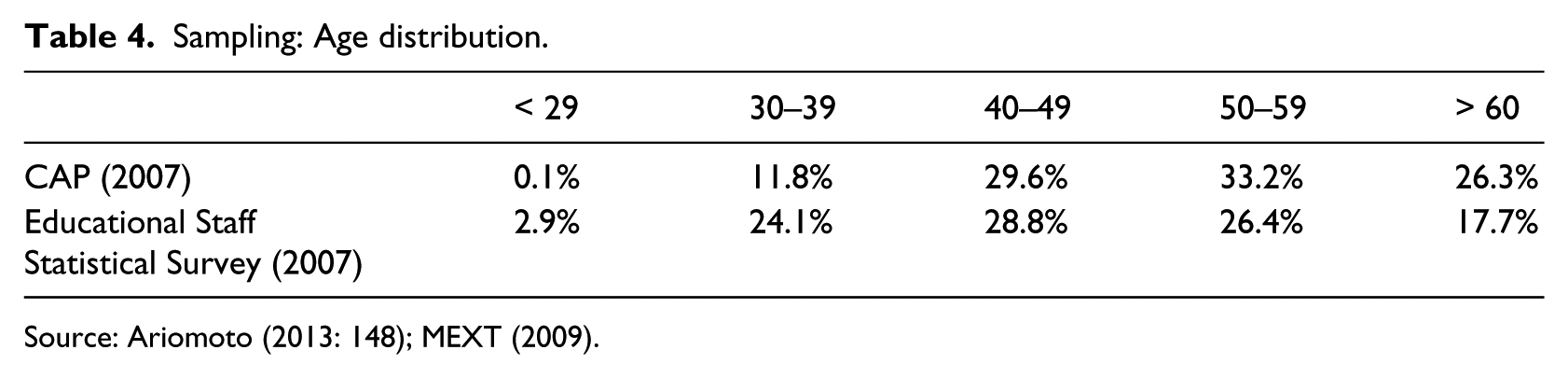
The sample of the CAP survey, however, did not reflect the actual age distribution in Japanese academia at the time it was conducted in 2007. As shown in Table 4, about 27% of Japanese academics were 39 or younger at that time, while in the CAP sample this cohort accounted for slightly less than 12%. The high percentages in the two oldest age groups exceed their actual distribution by over 15 percentage points. The AP sample shows a very similar age distribution, with only 0.5% being under 30 and 9.7% being in the 30–39 age group. Those respondents over 50 account for more than half of the sample here as well (Kimoto 2015: 92). As older academics express greater job satisfaction than their younger colleagues – which is not hard to believe if the working conditions described in the first part of the article are borne in mind – this skewing in the sample might mean that the overall level of job satisfaction among academics in Japan did not increase in the way that has been suggested.
Sampling: Age distribution.
Source: Ariomoto (2013: 148); MEXT (2009).
Another example where sampling – and most notably the way it is handled in the analysis of the CAP survey – can be seen as incongruent relates to female academics. As discussed earlier, the participation of women in Japanese academia has always been low with only a gradual increase between 1955, when only about 5% of faculty were female, and 1992 when this rose to 9.2% (Arimoto 1996: 154–155). Between 1992 and 2007, the rate of increase accelerated, and when the CAP survey was conducted in 2007 just over 18% of positions within the academic profession were occupied by women. 20 In the CAP survey, however, still only 9% of the respondents were women, which is significant since, according to Fukudome and Kimoto (2010: 153–154) ‘the level of dissatisfaction among women [employed in Japanese academia] is about double the international average at 20.2% and the highest overall’. Indeed, even the very small number of women considered in the Carnegie survey in 1992 reported that they were less satisfied with their overall job situation than their male counterparts (Arimoto and Ehara, 1996: 217).
Arimoto and Daizen (2013: 148–149) suggest that the lower satisfaction rate among female academics can be explained by the fact that women in the Japanese academic profession are still more often confined in lower-status positions. It is true that the professoriate in Japan is still dominated by male faculty members and it also seems that rank within the system of academia correlates strongly with overall job satisfaction (2013: 148–149). Nevertheless, we should refrain from the assumption that the difference in male and female employees’ job satisfaction can be fully explained by status within the academic community. In order to arrive at such a conclusion, other factors would first have to be ruled out, including circumstances that apply more strongly to women, such as discrimination based on gender or work-life balance issues. Fukudome and Kimoto (2010: 154) list further gender-based differences that may influence the satisfaction of female faculty, including the following: women spend more time teaching when classes are in session than men; more women than men perceive teaching and research to be incompatible; and more female academics feel that the pressure to raise external funds has risen in the past years. Due to the insufficient female response rate, further correlations within the most dissatisfied groups (n = 25) that would shed light on important factors for women’s dissatisfaction are hard to undertake using the CAP data. Nevertheless, as with age distribution, one might hypothesise that had the gender representation been more accurate in the survey, general Japanese job satisfaction figures would have been lower than those reported.
All three of the surveys are to be treated with caution when taking into account academic rank. In Japan, the main types of employment for full-time academic staff are professor (kyōju), associate professor (jokyōju), lecturer (kōshi) and assistant (joshu). However, all of the surveys actually leave out the category of assistant, which accounts for about 25% of all positions in the years considered. This means that we are constantly dealing with samples which exclude about a quarter of all academic staff when working with the Japanese data. Consequentially, full professors – who amounted to 36.5% and 40.4% of academic staff in 1992 and 2007 respectively (MEXT 2004, 2009) – are highly overrepresented in all of the samples, with 55.5% in the Carnegie survey of 1992, 55.1% in the CAP survey of 2007 and 57.8% in the AP survey of the same year (see Daizen and Yamanoi, 2008: 308). This is also true for associate professors, who in the three surveys account for 31.6–34.5%, while the real percentages in 1992 and 2007 were about 23–24%. Only the numbers for lecturers are close to reflecting the real distribution, with percentages of 10–11.7% in the survey samples and actual percentages of 12.1–12.9% in the years when the surveys were carried out (MEXT 2004, 2009). These issues correspond with the comparatively high mean age of the samples and impose yet another limitation on our understanding of Japanese academics’ job satisfaction.
Conclusion
In this article we have tried to untangle the paradox of Japanese academics’ high – possibly even rising – job satisfaction in times of increasing uncertainty and worsening working conditions. Rather than seeking an answer to this paradox (if indeed it actually exists) in the available data, we instead examine some of the shortcomings in the way the data were generated.
We are confident that working conditions for Japanese academics have changed a great deal in recent decades and set out to show this in the first part of this article, focusing on reduced (research) funding, growing competition, precarious employment conditions and a perceptible shift from a focus on research towards the satisfaction of students, as key concerns for all academics. Some of the effects of these developments on kyōjukai shihai as well as rijikai shihai universities can be observed in the decrease in academic self-governance and reduction in funding due to the declining number of university students, and government cutbacks in research funding. This worsening in working conditions is indeed reflected in the overall evaluation of the academic field by Japanese university staff in the Carnegie, CAP and AP surveys.
It is important to remember that these surveys were developed to capture a wide range of work-related factors within Japanese academia and elsewhere. We do not want to deny their value for the field of higher education research in general and for each individual country in particular. What we do want to propose, however, is that we need to be very cautious when using any of the surveys for painting a picture of overall job satisfaction and that we need to be particularly careful when using the surveys to look at differences and changes in job satisfaction in academia either across countries or over time. We have identified several areas that we believe need to be taken into account when looking at those analyses of the surveys which have attempted to do this, in particular:
(a) the limitation of a single-item approach;
(b) the lack of some key variables significant for job satisfaction (such as collegial relationships or work-life balance);
(c) the use of ‘single-shot’ measurements, which make it difficult to control for variability due to mood, for example, when responding to the surveys;
(d) the problem of a sample that does not reflect actual age, rank and gender distribution;
(e) and, finally, the difficulty of applying a culturally sensitive approach in a multi-country study.
The existence of the apparent paradox between worsening work conditions and improving job satisfaction is undermined further by the results of the lesser-known AP survey, which is much more in line with the 1992 Carnegie survey and does not show any signs of increasing job satisfaction among Japanese academics. The AP survey itself, of course, is not exempt from many of the abovementioned limitations which suggests that we are still far from understanding the real state of job satisfaction in Japanese academia (and we expect by association elsewhere) and how it has changed over time.
We end our article with three proposals for ways to deal with these issues in future research. First, an explicit multi-item approach combined with longitudinal measurements should be used to acquire the quantitative data initially. Second, a qualitative approach (participant observation, extended interviews, review of documents) to the topic should be incorporated alongside the use of quantitative methods (see Ambrose et al., 2005). Third, greater attention needs to be paid to cultural differences, such as variations in social norms and values or definitions of job satisfaction, not only in the subsequent analysis but in the drafting of the research instrument. We believe that research which followed such an approach might collect data of sufficiently high quality to fully explain job satisfaction in Japanese academia and elsewhere.
Footnotes
Declaration of Conflicting Interests
The author(s) declared no potential conflicts of interest with respect to the research, authorship, and/or publication of this article.
Funding
The author(s) received no financial support for the research, authorship, and/or publication of this article.