



Abstract
This paper focuses upon the micro level of the pre-school classroom, taking the example of the Indian Integrated Child Development Service (ICDS), and the discourse of ‘child-centred’ pedagogy that is often associated with quality pre-schooling. Through an analysis of visual data, semi-structured and film elicitation interviews drawn from a pilot study of six ICDS settings (anganwadis) within two Mumbai slums, Bernstein’s ideas about social relations of pedagogy are used to explore modalities of pedagogic practice. The paper argues that the forms of pedagogy that were observed are not yet reconciled with current notions of quality pedagogy that underpin the pre-school education component of the ICDS, but that there is scope for a weakened framing that may allow for a more contextualised version of child-centred pedagogic discourse.
Keywords
Introduction
The case for providing quality early childhood care and education (ECCE) is strong on the international agenda. Goal 1 of the six internationally agreed ‘Education for All’ (EFA) goals enshrined in the Dakar Framework (UNESCO, 1990, 2000) urged for its expansion, aiming for:
Expanding and improving comprehensive early childhood care and education, especially for the most vulnerable and disadvantaged children. (EFA Goal 1; UNESCO, 2000)
Global Monitoring Reports (GMRs) now consistently focus on ‘quality’ (UNESCO, 2007), not just expansion, one of the most recent being ‘Teaching and Learning: Achieving Quality Education for All’ (UNESCO, 2014). Research evidence supports the position, demonstrating a positive correlation between quality early intervention programmes to later social, emotional and cognitive outcomes (Schweinhart and Weikhart, 1997; Schweinhart et al., 1986, Sylva et al., 2004; Siraj-Blatchford et al., 2007), recognising how such interventions have a greater impact on the well-being of the poorest in society when compared to higher levels of education (OECD, 2006; UNESCO, 2014; UNESCO and UNICEF, 2012). There is, therefore, a well-supported case for recognising the value of quality ECCE and how it can improve life chances for the vulnerable and disadvantaged because it is a way of equalising their opportunities early in life (UNESCO, 2011).
In reality, however, although participation in pre-primary education is increasing, it has yet to be realised for the most disadvantaged. Global pre-primary gross enrolment ratios (GERs) may have risen from 33% in 1999 to 50% in 2011
1
(UNESCO, 2014: 2), but the expanded programmes largely benefit urban and more socio-economic privileged groups (Chawla-Duggan et al., 2013; Chawla-Duggan and Lowe, 2009; UNESCO, 2010, 2014). In this respect:
The important parenthetical part of this (Goal 1) goal, ‘especially for the most vulnerable and disadvantaged children’, has been less successfully met. (UNESCO, 2011: 6)
As a result, UNESCO warns that the widening gaps in school readiness, between rich and poor children and between urban and rural populations, are likely to increase (UNESCO, 2011: 6).
Whilst one response has been for national policies to expand their pre-school provision, with quality (see, for example, Chawla-Duggan et al., 2013), there is no consensus on the meaning of quality, and this in turn may condition the extent to which programmes will help the most vulnerable to engage meaningfully with pre-school provision. More often than not research studies use an evaluative definition, where quality has an ‘evaluative function’, measured against other things (Nikel and Lowe, 2010). Existing discontent is not with the evaluative scales as such, but rather with the fundamental paradigm presented by the search for a universal measure of quality with which to assess a diversity of values, philosophy and service provision in the ECCE sector (Douglas, 2005). The paradigm has little acknowledgment of context (Moss and Pence, 1994; Myers, 2006; Penn, 2005; Viruru, 2001), and is one in which researchers too often assume that the characteristics of children observed in one situated study are universal (Penn, 2005). Recognising this dissatisfaction, this paper steers away from an evaluative framework towards a framework of quality that draws attention to context (Tikly and Barrett, 2013). Whilst this paper’s broader significance lies in the provision of quality pre-school education (PSE), its analytic focus is upon Bernstein’s structure of pedagogic relations. This is carried out within the pre-school context of Indian 2 slum school settings, taking the example of the Indian Integrated Child Development Service (ICDS).
The ICDS, also known as the anganwadi system, caters for approximately 13% of India’s population who are children under 6 (Government of India, 2011a), some of whom are living in economic and social environments that impede their physical and mental development. Such children live in urban slums, rural and tribal areas and communities. The current ICDS policy works towards universalisation, with quality (Government of India, 2012; Kaul and Sankar, 2009), throughout India, in line with global recommendations (UNESCO, 2000, 2007).
The pilot research discussed here uses Bernstein’s theory of codes and modalities to ask questions about pedagogic practices in the pre-school classroom, where the explanation is rooted in an analysis of the social relations within pedagogic discourse (Bernstein, 1981, 1990/2003). Whilst the body of the paper is concerned with reflecting upon pedagogic practices in the pre-school, the paper also demonstrates the use of the visual as a method of data collection in the way it generates theoretical insights that inform narrative accounts of pedagogic discourse in early childhood settings.
The paper is divided into three parts. Part 1 provides the background, that is, PSE in the ICDS, the conceptual framework used and methods of data collection and analysis. Part 2 presents the data and the analysis of pedagogic practice through examining the structure of relations between three rules – hierarchy, sequencing and criteria (Moore, 2013) in relation to Bernstein’s codes of classification and framing. It also discusses invisible and visible pedagogies in relation to the data analysed. Part 3 discusses the dominant pedagogy found within the slum schools that were observed and it raises conceptual questions between the structure of social relations in the settings, the structure of social relations in wider Indian society and the aims of PSE written within ICDS documentation. In the conclusion, the paper makes the central point that the forms of pedagogy observed in this pilot study are not yet reconciled with current notions of quality pedagogy espoused in the PSE component of the ICDS, but that there is scope for a weakened framing that may allow for a more contextualised version of child-centred pedagogy.
Context, theory and method
Child-centred pedagogy and PSE in the Indian ICDS
Initiated in 1975, the ICDS was conceptualised in response to India’s 1974 National Policy for Children (Government of India, 2011b), which maintained that focused, child-centred interventions would address the inter-related needs of children and women from disadvantaged communities. To date the objectives for the ICDS, established in the 1970s, remain the same (with a later provision for adolescent girls in 2000–2001). They are as follows:
to improve the nutritional and health status of children in the age group of 0–6 years;
to lay the foundations for proper psychological, physical and social development of the child;
to reduce the incidence of mortality, morbidity, malnutrition and school drop-out;
to achieve effective co-ordination of policy and implementation amongst the various departments to promote child development;
to enhance the capability of the mother to look after the normal health and nutritional needs of the child through proper nutrition and health education (Government of India, 2011b: 1).
Within the ICDS, it is the PSE component that is central to locating its educational discourse. The official policy-related text describes the function of PSE in the following way:
Pre-School Education contributes to the universalisation of primary education, by providing to the child the necessary preparation for primary schooling…. (Government of India, 2011c: 26)
The PSE component is also central to locating the kinds of criteria used for evaluating a child’s performance to judge whether they are ready for school:
The activities which are undertaken as part of PSE include storytelling, counting numbers, free conversations to speak freely and apply their mind in order to organise small activities, painting, drawing, threading and matching colour related to fine muscle coordination and development, reading simple words, writing alphabets words, distinguish objects, recognise pictures etc. The constitution of the PSE kit may vary within a state/UT keeping in view the specific local needs and resources…. (Government of India, 2011c)
and the pedagogic discourse associated with this [pre]schooling is ‘child centred’:
Under this, child centred play way activities, which is built on local culture and practices, using local support materials and developed by Anganwadi workers through enrichment training are promoted. It is considered the most joyous daily activity of the ICDS programme, which is visibly sustained for three hours a day…. (Government of India, 2011c)
Certainly ‘child-centred’ education is a well-cited pedagogic practice associated with ‘quality’ early childhood intervention programmes in the past. Seminal studies to support its value that are frequently cited include, for example, the longitudinal ‘High/Scope Preschool Curriculum Comparison study’ (Schweinhart, 2004; Schweinhart and Weikhart, 1997; Schweinhart et al., 2005), which involved young children living in poverty and at high risk of school failure. Carried out in the USA, Michigan, in the 1970s, it continues to date, and findings continue to support the conclusion that both the traditional Nursery and the High Scope models offer a powerful justification for high-quality PSE, with statistically significant advantages in the long term over DISTAR (direct instruction model) on 17 variables (Schweinhart and Weikart, 1997). Of relevance is the fact that the successful models cited encompass a notion of child-centredness described (at that time) in the following way:
Within a permissive atmosphere, teachers expected children to show good manners, cooperate, and observe limits. Children had freedom to choose activities, move from one activity to another, and interact with adults and peers. The emphasis was on developing social skills rather than intellectual skills. (Schweinhart and Weikart, 1997: 121)
In India, there is a strong espoused commitment to child-centred ideals within primary education (Alexander, 2001; Sriprakash, 2010), and child-centred intervention is positioned by education policy discourse as a way of addressing problems of pupil retention and achievement in rural government primary schools, serving the country’s majority poor (Sriprakash, 2010: 297). In this respect, a notion of ‘child centred’ is central to both the early childhood and primary education discourses for vulnerable children in India.
The commitment to notions of child-centredness in the Indian system of education is not without criticism. In fact, critics argue that the commitment bears no relation to practice or to established Indian pedagogic culture:
There the espoused theory of teaching was strongly developmental, and Piaget featured fairly frequently in the teacher interviews. More common, however, were unattributed references, of a generally progressive kind, to ‘discover’, ‘activity’ and ‘enquiry’ methods. … (Alexander, 2001: 546)
Critics of early education provision call the ICDS non-functional and uneven (Dreze, 2006; Government of India, 2011c; Gragnolati et al., 2005), but there is evidence to counteract this position (Datta, 2005; Dreze, 2006), although the PSE (for 3–6 year olds) component of the ICDS remains weak (Datta, 2005; Dreze, 2006). The use of ICDS services in urban areas such as Mumbai (where the fieldwork for this pilot study was conducted) is also affected by wider options that are available to parents (Datta, 2001, 2005); for example, private, unregulated fee paying pre-schools. So, whilst there is provision for vulnerable children, there is poor uptake of the programme within the urban context, and the private sector is considered preferable to the public sector by many parents (Chawla-Duggan et al., 2013).
It is, however, the broader progressive discourse termed ‘child-centred’ that frames this discussion of pedagogic practice in the ICDS. The paper addresses the general research question: ‘how is the child-centred discourse identified in the PSE documentation of the ICDS recontextualised within the existing pedagogic practice in a sample of pre-school slum settings in Mumbai?’ The analysis developed in this paper examines the pilot data through the Bernsteinian lens outlined below.
Conceptual framework – Bernstein and pedagogic discourse
The key ideas from Bernstein that this paper uses are discourse, classification and frame. His theory of pedagogic discourse (Bernstein, 1990/2003) is used to generate concepts necessary for understanding how teachers/practitioners interpret and practice learner-centred pedagogy (Nyambe and Wilmot, 2008).
Bernstein maintained that pedagogic discourse consists of the relationship between two discourses: a discourse of skills of various kinds and their relation to each other, and a discourse of social order (Bernstein, 2000: 31-32). Bernstein termed the discourse that creates specialised skills and instructional discourse (it relates to the selection, sequencing, pacing and evaluation criteria of the knowledge to be acquired). The discourse defining social conduct was termed the regulative (it relates to norms of social conduct and relationships). He also maintained that the regulative is the dominant discourse, always embedding the instructional (Bernstein, 1990/2003). Furthermore, he stated that a set of internal rules underpins both discourses. The instructional discourse is underpinned by discursive rules (meaning the rules of selection, sequencing, pacing and evaluation); the regulative discourse is underpinned by the rules of hierarchy:
The internal logic of any pedagogic relation consists of hierarchical rules, sequencing rule/pacing rules, criteria rules.….the hierarchical rules will be called the regulative rules and the other rules of sequence/pacing criteria will be called instructional or discursive rules. The fundamental rule is the regulative one. (Bernstein 1990/2003: 66 cited in Moore, 2013: 160)
He identified a third set of rules underpinning the two discourses, namely rules of criteria (evaluation), which define what is regarded as legitimate or illegitimate learning in the pedagogic relation. Bernstein (1990/2003: 63) argued that the inner logic of any pedagogic practice consists of the relationship essentially between these three fundamental rules, and that all modalities of pedagogic practice are generated from the same set of fundamental rules, which vary according to their classification and framing values (Nyambe and Wilmot, 2008: 5).
Classification and framing
The principle of classification is concerned with the strength of the boundaries or the degree of insulation between categories, for example, between times, between spaces, between discourses, between agents and so on (Bernstein, 2000: 6). If we take the category of knowledge, it may be configured quite differently to suit what are believed to be the needs of pre-school children, to when they are older. Strong classification assumes different kinds of knowledge must be kept apart; it refers to a curriculum that is highly differentiated and separated into traditional subjects (Sadovnik, 2001: 3). Weak classification assumes they must be brought together. If classification is weak, boundaries between contents are blurred:
Classification thus refers to the degree of boundary maintenance between contents. (Bernstein, 1975: 88)
While classification essentially translates power relations, framing is underpinned by the principle of control that regulates social relations within a context.
According to Bernstein, in any pedagogic relation there will be an acquirer and transmitter. Framing is the concept used to describe relations between the ‘acquirer’ and ‘transmitter’, is related to the strength of boundary and ‘refers to the locus of control over the interactional and locationary features’ (Daniels, 1989: 125), which can be applied to any encounter considered in terms of relationships and communication and power:
It can refer to the relations between parents and children, between teachers and pupils and between teachers and parents. Strong framing is where the transmitter has explicit control over the communication; weak framing gives the acquirer more apparent control over the communication. (Power and Whitty, 2008: 4)
It therefore refers to that strength of the boundary between what may be transmitted and what may not be transmitted in the pedagogic relationship (Bernstein, 1975: 88):
Frame refers to the degree of control teacher and pupil possess over the selection, organisation and pacing of the knowledge transmitted and received in the pedagogical relationship. (Bernstein, 1975: 89)
Where framing is strong, the range of options and freedoms is limited. Where it is weak, more degrees of freedom are available to the participants (Atkinson, 1985: 135). In general, where framing is strong there is visible (explicit) pedagogic practice, the rules of instructional and regulative discourse are explicit and the transmitter has explicit control over the selection, pacing and criteria. Where framing is weak, pedagogic practice is likely to be invisible and the acquirer has more apparent control and the rules of regulative and instructional discourse are implicit and largely unknown to the acquirer. In distinguishing between that which is visible and that which is not, visible pedagogy always emphasises the child’s performance; in invisible pedagogy, the acquirer fills the space rather than the transmitter (Bernstein, 1990/2003: 70-71).
Drawing on the above concepts, the study uses the set of internal rules (discursive, hierarchy and criteria) together with their classification and framing relations to explicate the modalities of pedagogic practice that are generated from the rules and framing values. On the basis of this analysis it discusses to what extent the child-centred discourse identified in the PSE component of the ICDS is realised within the pedagogic practice of the sample of pre-school settings. The study does not aim to make normative judgements upon the pre-school pedagogy in the Mumbai slums that were visited, but to show the structure of the internal pedagogy within the pre-school provision. Researcher-generated visual data is used to conduct the analysis of pedagogic practice.
Visual data collection, analysis and ethics: researcher relationship with context
The paper uses visual data to explore the signs that make up the modality of pre-school pedagogic practice. Such data might be of particular interest in understanding pre-school pedagogy, because pre-school activities do not always look like organised pedagogy, as Bernstein’s (1975) term ‘invisible’ implies. For example, when examining productions of ‘progressive’ pedagogic practices that lead to learning, Bernstein located the kinds of messages existing in the child-centred discourse of English primary schools in the 1960s by examining 36 photographs from the influential Plowden Report (an illustration of child-centred progressive schooling for that time) (Bernstein, 1990/2003). In the photographs:
…there are children playing creatively by themselves: individual, productive play. There are pictures of children playing in groups, there are children in the school corridors and in the gardens surrounding the school, but it is difficult to find a teacher .(Bernstein, 1990/2003: 67)
The point Bernstein (1990/2003) illustrates is that whilst there may not be an explicitly visible hierarchy between teacher and pupil, there is an implicit one in operation that has created the context that is described. In this respect, he argues that the photographs serve to show a desired culture of teaching and learning where the teacher’s power acts directly on the context of learning rather than upon the students themselves. Critiques of his conception of invisible pedagogy argue that because the rules and criteria are implicit (invisible), they are not available to all pupils and their families in the same way (Moore, 2004: 141; see also the work of Morais and Neves, 2001), laying the groundwork for widening the gap in inequality.
This pilot study is based on the analysis of photographs of blackboards, poster displays and films of interaction and activities in six anganwadis. The selection of anganwadis represents examples of ‘good practice’ that I was shown when visiting two major slums in Mumbai, and were selected by the ‘Child development project officer’ (CDPO) responsible for those slum areas. With permission from the CDPO and practitioners, both myself and the Indian field officer who accompanied me took photographs and video clips of the practitioners and children in their everyday activities alongside the learning environment within the anganwadis. Permission was first sought verbally through the local field officer (who spoke the local language, Marathi). He explained to the CDPO and the practitioners how I was researching pre-school settings, that the research involved taking visual images of activities and the environment and that the findings and images would be used in presentations and writing about quality PSE. I then followed up the explanation in Hindi (a language also spoken by the participants), and assured them that the photographs and footage were to be used for presenting research, and that if they did not wish me to use images and footage, then I would not do so. One teacher objected to being filmed, and so was not included in the footage. Practitioners gave permission to film the children in their classes.
I observed each of the six anganwadis on one occasion as part of a morning’s delivery recorded through the use of field notes, video and photographs where, as a source of visual data (Pole, 2004), the camera was usually pointed at the interaction between the teacher/practitioners and children. Visual data collection was followed by eight semi-structured interviews that I conducted in Hindi. They were with the CDPO, six of the anganwadi practitioners and two supervisors, who together provided their perspective on the activities that were filmed and photographed. In addition, an Indian field assistant provided contextual data about the slum areas and their demographics, and I conducted film and photo elicitation interviews (Banks, 2007) in Hindi with an Indian co-field researcher who was familiar with the settings. The film and photo elicitation interviews allowed information that was necessary beyond that available in the frame of the video film and photographs, in order to understand contextual and structural issues informing the provision (Becker, 1974). I conducted two semi-structured interviews in English at the local and national level with key officials associated with the Ministry of Women and Child Development and worked with a Professor whose expertise lay in ICDS provision in Mumbai. My own positioning as both insider and outsider (McNess et al., 2015; Milligan, 2016) helped to facilitate my interactions with participants and in the subsequent kinds of data that was yielded. The rationale for the research came from being involved in a Department for International Development (DfID) funded study on quality education, expertise in early childhood, the ability to speak Hindi and research familiarity (during the preceding 16 years) with parts of India and some of its schooling, having begun by conducting a 4-year ethnographic study of children and their home and school lives (Chawla-Duggan, 2007). However, my positioning in relation to the research experience was not as an insider, as I am British born of Indian parentage, and therefore represent many of the outsider traits when being in India. In a similar vein to Milligan’s (2016) account in Africa, I am in the position of having some in-depth knowledge, experience and relationships in the Indian community, whilst also being an outsider. This positioning, however, helped to develop a deeper familiarity and understanding of the ICDS in Mumbai settings, as I reflected on the visual data and asked questions of colleagues.
Data from interview and field note material were triangulated with documentary evidence about PSE in the ICDS, and the image analysis. The image analysis used an adapted instrument incorporating Bernstein’s concepts:
The instrument includes indicators, in the form of two- and four-degree scales of classification and framing, ranging from very strong to very weak (C+, C-, F++, F+, F-, F’), for various characteristics of pedagogic practice in the instructional and regulative contexts. The number and type of indicators for each characteristic vary according to the context under analysis. The instructional context includes discursive rules (selection, sequence, pacing, evaluation criteria) and relations (inter- and intra-disciplinary, academic….between discourses. The regulative context includes hierarchical rules (teacher-student and student-student relations) and relations between spaces (teacher-student space and student-student). (Barrett, 2014: 8-9)
I adapted the instrument to include the function of body positioning and body gestures in relation to space and sequencing. This is because the activities involved in teaching young children may often include non-verbal communication. In addition, I segmented the film analysis into the order of sequences occurring as the session progressed. Whilst my analytic focus is on the ‘internal narrative’, that is, it addresses the question ‘what is this image of?’, it is important to look beyond the frame (Becker, 1974) to explain the external narrative (Banks, 2007) that addresses questions of context gleaned from photo and film elicitation interview material. The images and their internal analysis are therefore considered in the network of social relationships, which in turn expands the ‘metaphorical’ frame (Banks, 2007) by including wider understandings of place and time.
The findings focus especially on the structure of adult–child relations as a characteristic of PSE pedagogic practice in the Indian ICDS context.
Findings and summary of visual data analysis
The six anganwadis and their localities
What follows is an account of the six anganwadis and their locations within the two main areas of Govandi and Mankhurd in Mumbai.
Project ‘Govandi’, located in Govandi’s slum areas of Ghatla and Nimoni Bhag, has a range of objectives related to health, nutrition and pre-school education. They include ‘decreasing school drop out, malnutrition, readiness for school, overall development’ (CDPO interview). There are 350 anganwadis in the Govandi project. One anganwadi usually includes 200 households (a people population of approximately 800). National policy stipulates that one supervisor is responsible for approximately 25 anganwadis but, in reality, it is more. The supervisor I met had 80 anganwadis under her jurisdiction. This affects what it is possible to do in terms of visiting all anganwadis to offer advice.
Anganwadi 1 in Govandi:
The anganwadi occupies a room of approx. 3x3m. When we arrive the anganwadi worker (AWW) and co-worker are saying prayers with the children who are all dressed in pink uniforms. There are between 20-30 children present, who are between the ages of 3-5; but look much smaller (they look about my son’s age - who is 18 months old). They do a minute of meditation and yogic exercise as part of their morning routine. There’s a black board and displays are on the wall. They sing nursery rhymes; first teacher initiated and then class initiated followed by individual child contributions, initiated by the teacher. All the children clap after each child’s presentation. The activity changes. The children are all given small slates and the practitioner tells me that they will now do numbers. (Field notes. Anganwadi 1 in Govandi)
The visual data for anganwadi one: Strong framing and classification
In scene 1, entitled ‘Munni behta’ (a Hindi nursery rhyme), two practitioners model (Bandura, 1977) what and how the Hindi poem should be recited, with all children following the practitioners’ gestures and rhyme (See Figure 1). The practitioners, as transmitters, demonstrate complete control in terms of gestures (hand movements), pace, rhythm, tone and sequence. The children, as receivers, clearly know what they are expected to do and therefore the criteria for performing well. They observe and model as they hear and copy the rhyme in chorus, and the direction of the communication is from the adult to the child. There appears to be strong framing in the interactional context of practice, where the rules of selection, sequencing, pace and criteria by which performance is judged is made explicit by the practitioners for children to realise. The direction is then reversed as two children are asked to recite a rhyme on their own and practitioners share a space with the other children (see Figure 2). Children are therefore shown to contribute to the selection of content.
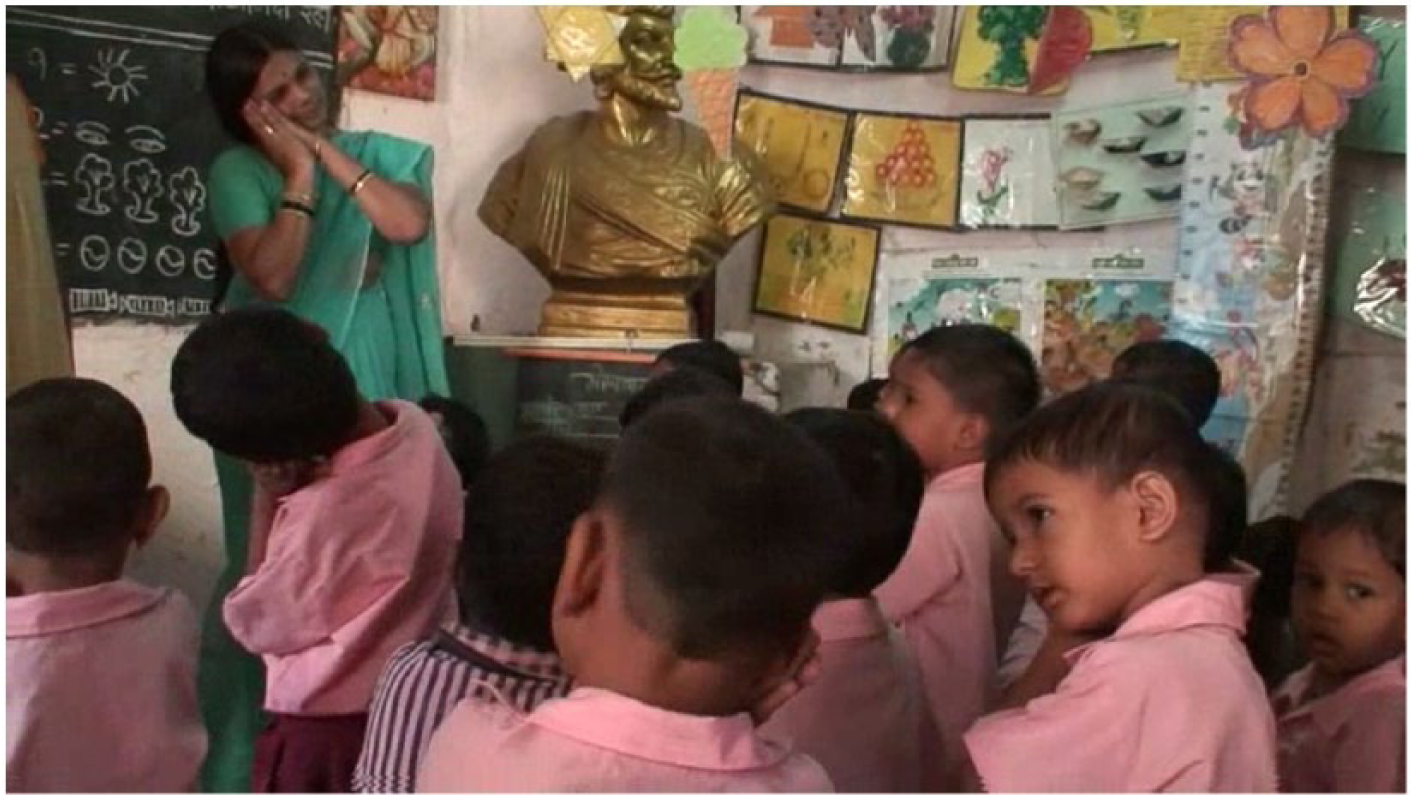
Anganwadi 1: Scene 1 – Reciting rhyme: Munni Behta illustrating strong discursive rules.
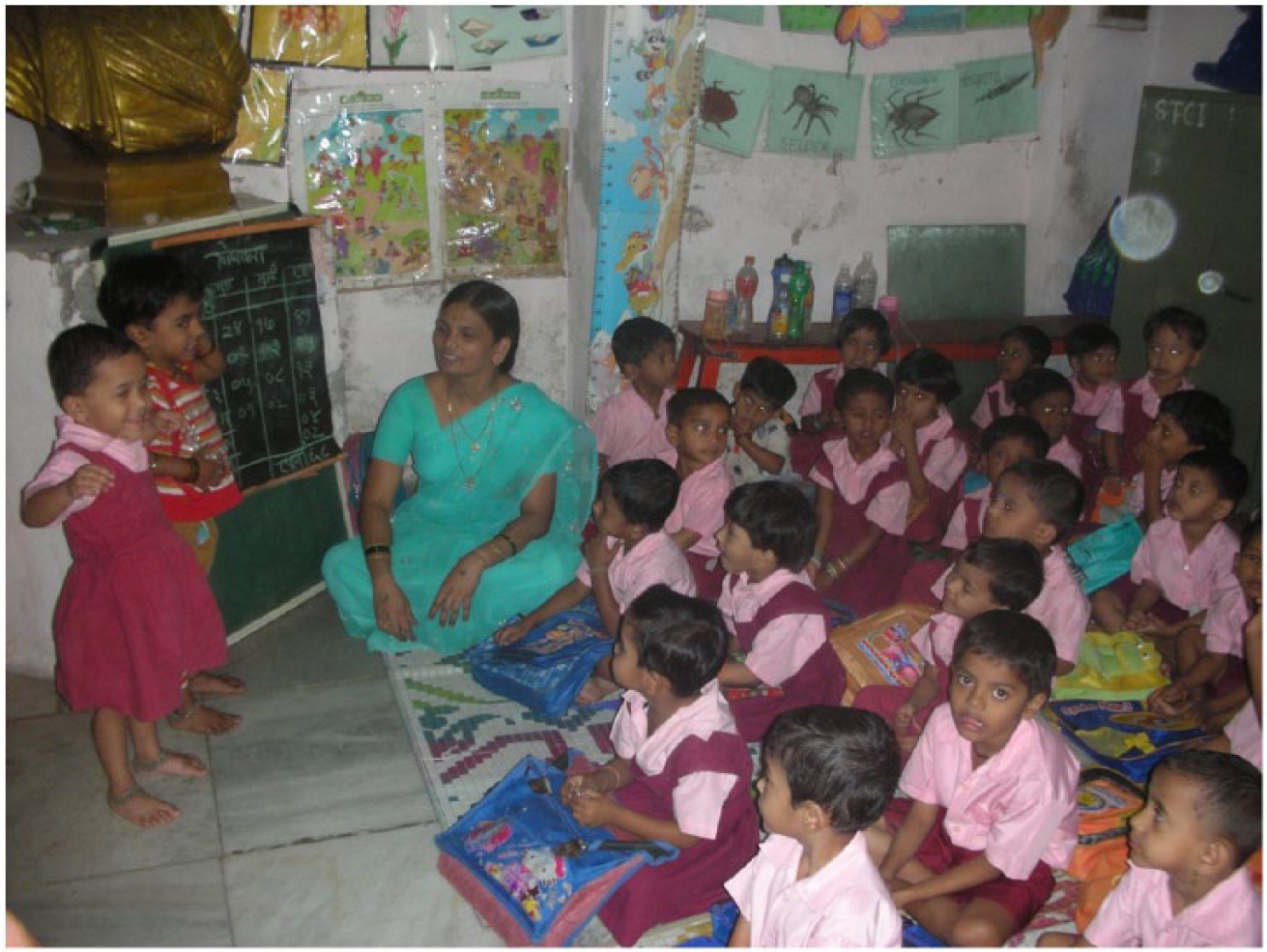
Anganwadi 1: Scene 1 – Reciting rhyme illustrating weak classification of space and children’s contribution to content selection.
In scene 2, ‘Tell a story – Marathi’ (See Figure 3), control again begins with the practitioner and this is followed by one child being asked to recite a story (Figure 3). It is unclear as to who selected the story but the child is congratulated at the end, indicating that she realised what was required of her as criteria for performing well. For most of the session the selection, sequencing and pace is controlled by the anganwadi worker (AWW).
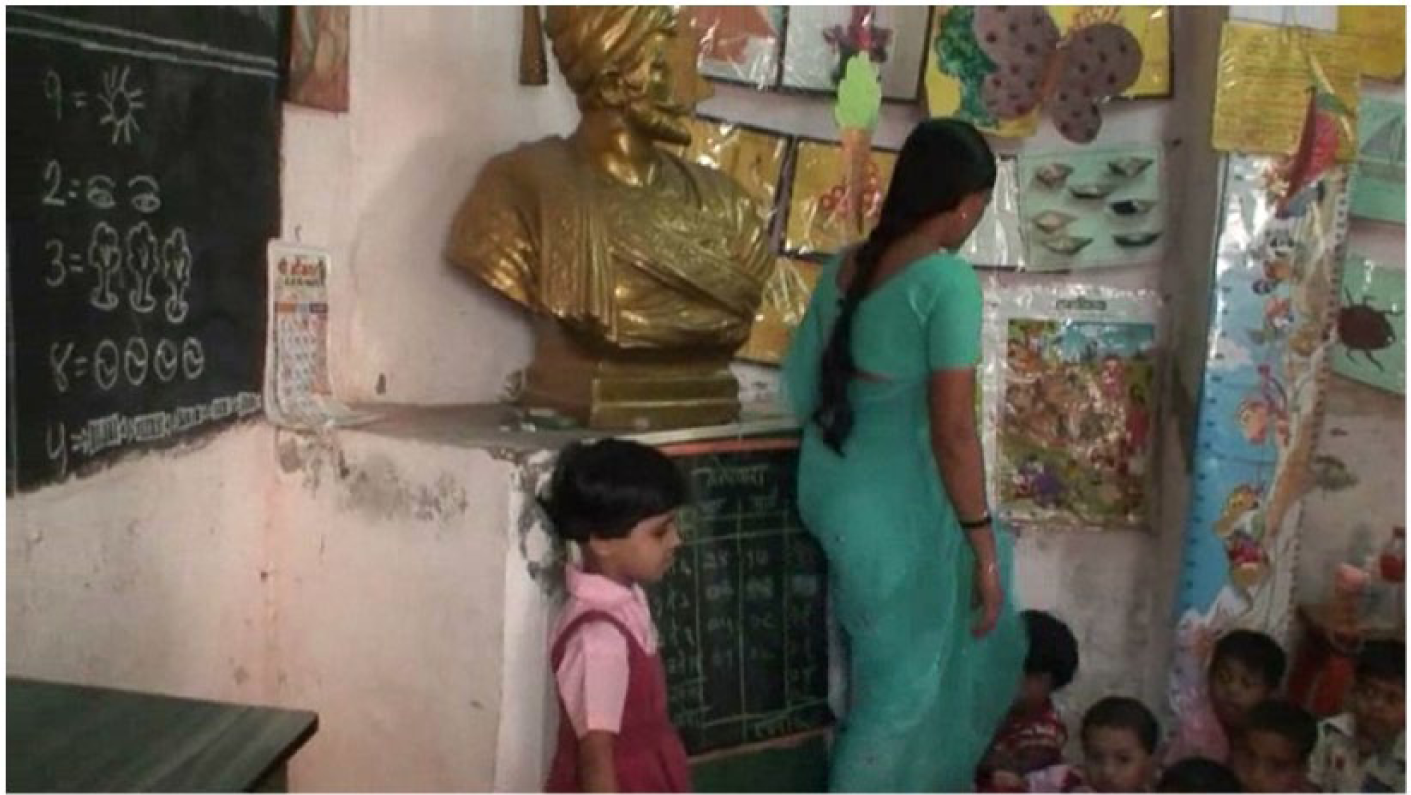
Anganwadi 1: Scene 2 – Tell a story: Marathi.
The two scenes from anganwadi 1 (See Figures 1, 2 and 3) suggest that framing is strong generally because the boundary between what might be transmitted is fixed (indicated through the discursive rules of the instructional context). There is some agency on the part of certain pupils and for those children the frame weakens, because they can control the transmission of knowledge to other children. They can recite a story and a rhyme (that has not been recited in this session). The remaining class does not have a choice in what is received.
Within this strong framing, the visual data showing learning objects for anganwadi 1 (See Figures 1, 2 and 3) suggest the strength of the boundary between curriculum content is strongly classified, in that there are mathematics/numeracy development (numbers on the blackboard and slate activity), language development (rhymes in scene 1) and scientific knowledge (science posters), the first two being acquired through the skills of listening to the practitioners in the first instance. The strong classification and strongly framed instructional and regulative discourse are signs of a visible pedagogy. The availability of limited space affects its use as a shared space between practitioners and children, and children and their peers, producing a weakened boundary maintenance.
Anganwadi 2 in Govandi:
This anganwadi is a similar size room to the last one. Again, there are two practitioners present, the child worker and her assistant, with the child worker being the lead practitioner, leading the children’s activities. The children are not in uniform this time, but what is striking is that the practitioners combine English and Marathi. The rhymes they sing are in English and Marathi/or Hindi as are the displays on the wall – English (mainly) combined with key figures from Indian politics. The children do an activity where they name parts of the body in Marathi. I am given a written set menu for the children’s food and today the children are to be given ‘labsi’. It is made of wheat and sugar and it will also be distributed to the homes in tiffins, says the AWW. (Anganwadi 2: Field notes and interview AWW)
In scenes 1 and 2, entitled ‘Twinkle, Twinkle’, from anganwadi 2, the pedagogy is once again strongly framed towards the practitioners and the content is an English language nursery rhyme. Similarly, in scene 3, entitled ‘1, 2, 3, 4’, the pedagogy is strongly framed. Practitioners direct, select the content, the pace, when, what and how numbers are said and gestured. This indicates strong framing of discursive rules. All the children observe and model the same content with the same gestures and, in this respect, the realisation of the tasks follow a rigid order determined by the practitioner. The strength of the boundary between content indicates a strong classification: English rhymes and numbers in English (See Figure 4). Similarly, in scene 4, ‘Watch the pointer (See Figure 5): both the hierarchal relation and discursive rules are strongly framed, as practitioners direct, select the content, the pace, when, what and how alphabetical letters are said and gestured. This once again indicates strong framing of the instructional context, and what the children are expected to learn. The evaluation criteria are made explicit as children model exactly what is made public in the realisation of tasks determined by the practitioner.
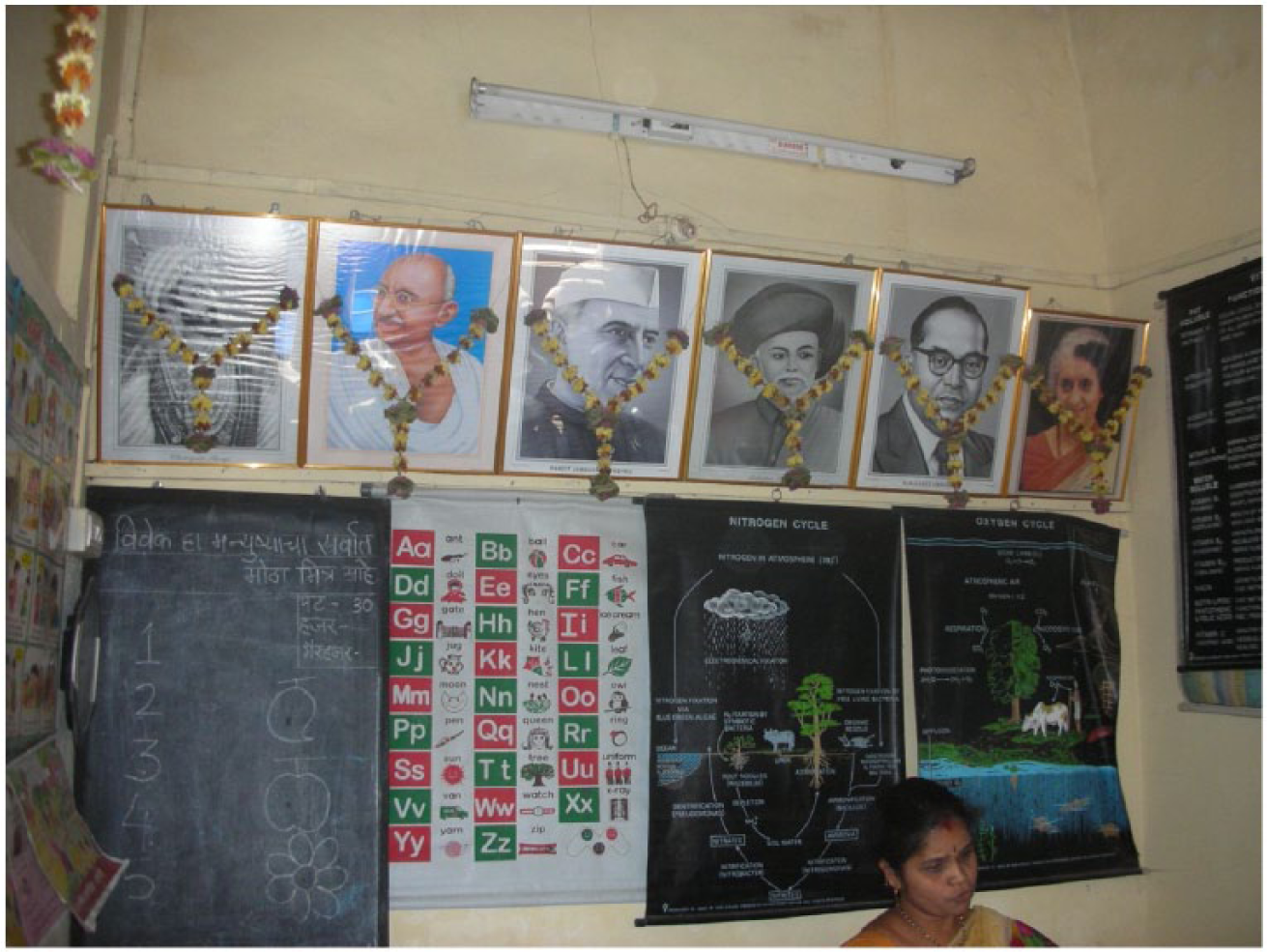
Anganwadi 2: Wall displays illustrating a strong classification between subject knowledge.
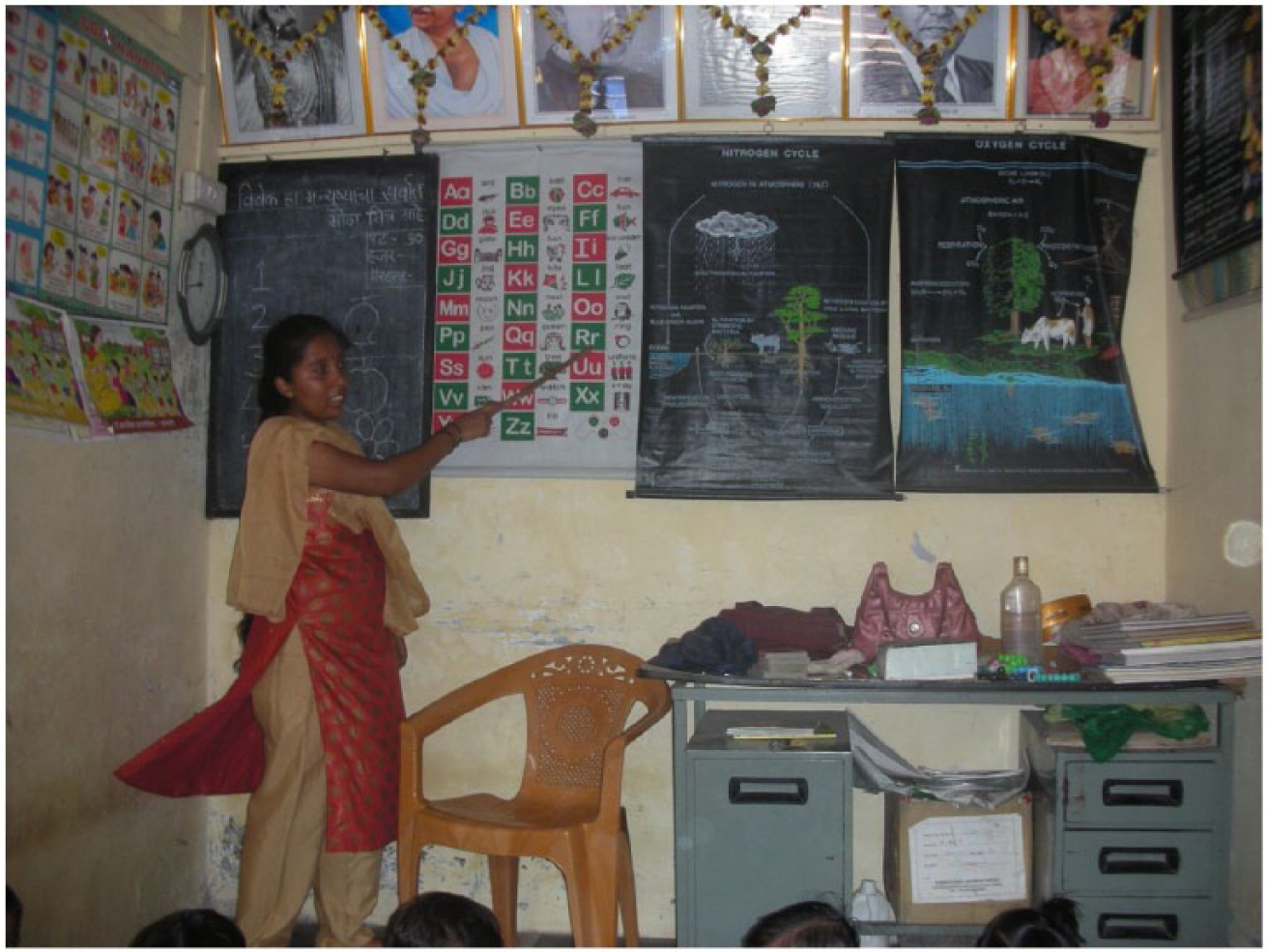
Anganwadi 2: ‘Scene 4 – Watch the pointer’ – illustrating strong control of content, explicit rules of evaluation for successful learning and the boundary strength of subject knowledge.
English is a very strong part of what is taught and displayed in anganwadi 2 (see Figure 4). Whilst the instructions are given in Marathi in all the scenes recorded, the content of what is to be learnt is in English. The sequence of communication also implies that the children have always to listen first. Listening therefore becomes an important part of learning content (Wedin, 2010) in terms of being able to recite what is to be said, its pace and its rhythm, all of which is practitioner directed. The child as learner seems to be learning to acquire a role as a listener. A similar pattern arises in anganwadi 3 (See Figures 6 (a) and (b)), where the children are predominantly receivers and adults are transmitters, although there are once again examples where individual children recite to the class, indicating a weakening of framing between child–child relations.
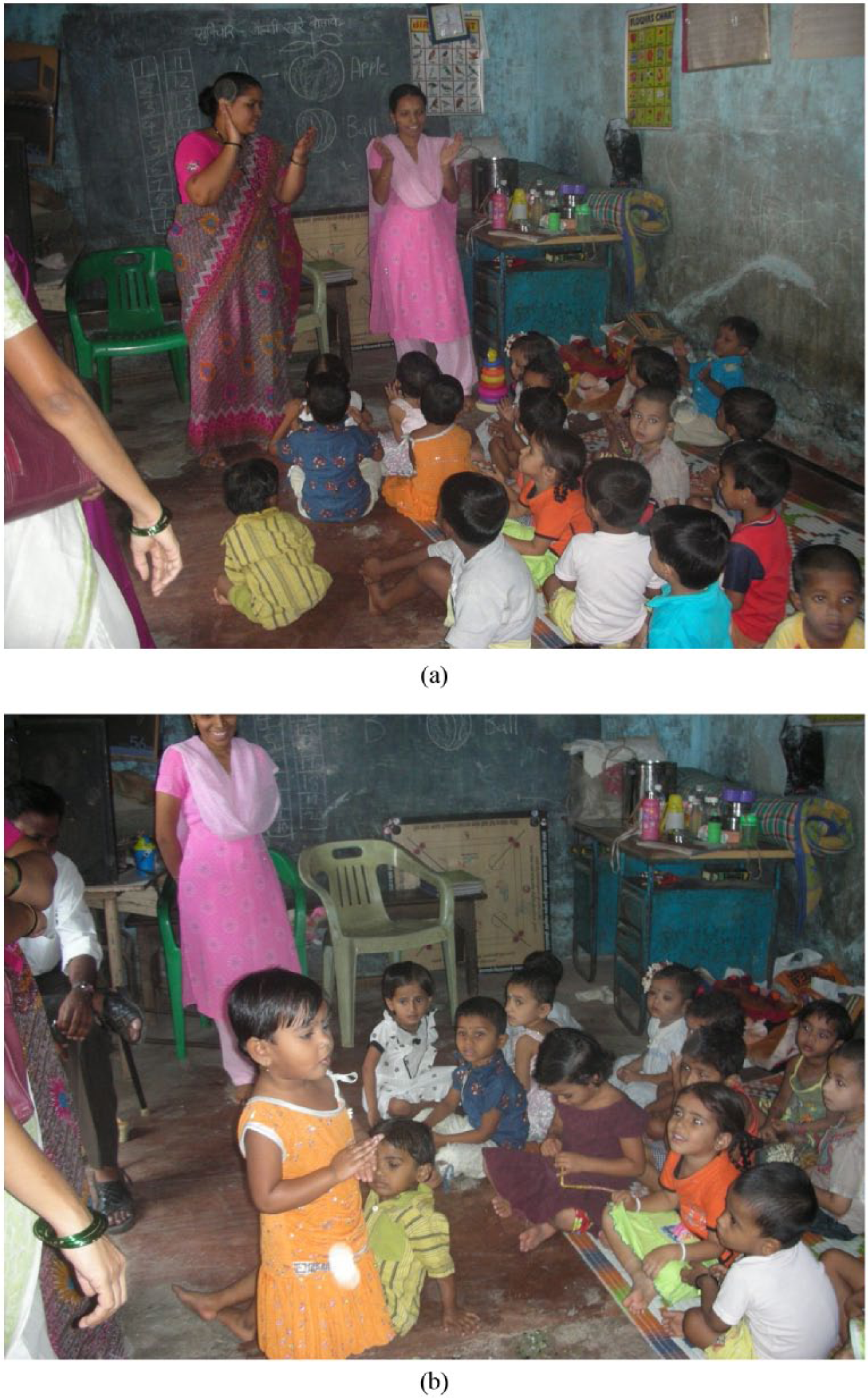
Anganwadi 3 – Reciting rhymes illustrating a weakening of framing as the session progresses.
The second area that I visit is Mankhurd. There are approximately 272 anganwadis in Mankhurd and it houses a mixed population of Muslim, Hindu backward classes
3
and some members of the Catholic community. Within Mankhurd I visit the slum Shivneri Nagar, which has a population of approximately 3500 people and sanitation problems, as the CPDO explained:
CPDO: the area has a lack of infrastructure facilities; with a number of problems associated with the availability of clean drinking water. Water is currently provided by tankers brought in. Some of the roads are not concrete. There is an open drainage system… so the guttering is all open, giving rise to risk of water related infections such as diphtheria. (Interview: CPDO. Shivneri Nagar, Mankhurd)
I visit three anganwadis in Shivneri Nagar. The first one (anganwadi 4) is a rented room in a house, let out to AWW workers for Rs500 per month.
Anganwadi 4 When we arrive at the house the children are singing nursery rhymes and doing the actions of various animals as instructed by the child care worker and teacher. Researcher: so what’s your usual routine? AWW: well first we sit them down and pray, then we sing songs; we’ll do rhymes and actions like being an elephant, being an animal in water; how the animals walk, being a monkey. Then we’ll have lunch and we’ll end with a prayer. For homework I ask them to practice what we’ve done and tell mummy what they’ve done…. The purpose of this is for practice and so they are to tell their mummy about it. (Interview: AWW; anganwadi 4)
In anganwadi 4, within the scene ‘Pretend to be animals – Representation, gesture and space’, the lead AWW directs two children to represent two animals. The AWW directs the children in terms of which animal, how to portray the animal with their bodies, that is, where their arms should be, whether they should be crawling and which space should be used.
Anganwadi 5 The fifth anganwadi we visit is a room with a shop at the front of it. It is very ‘snug’ and the children have to be quite ordered in such a small space in order to take part in the throwing game that they are playing (See Figure 7). Nonetheless they are encouraged by the AWW and her assistant to knock over the tower that stands on a stool by throwing a soft ball towards it; even the children who are unsuccessful are encouraged. (Field notes: Anganwadi 5)
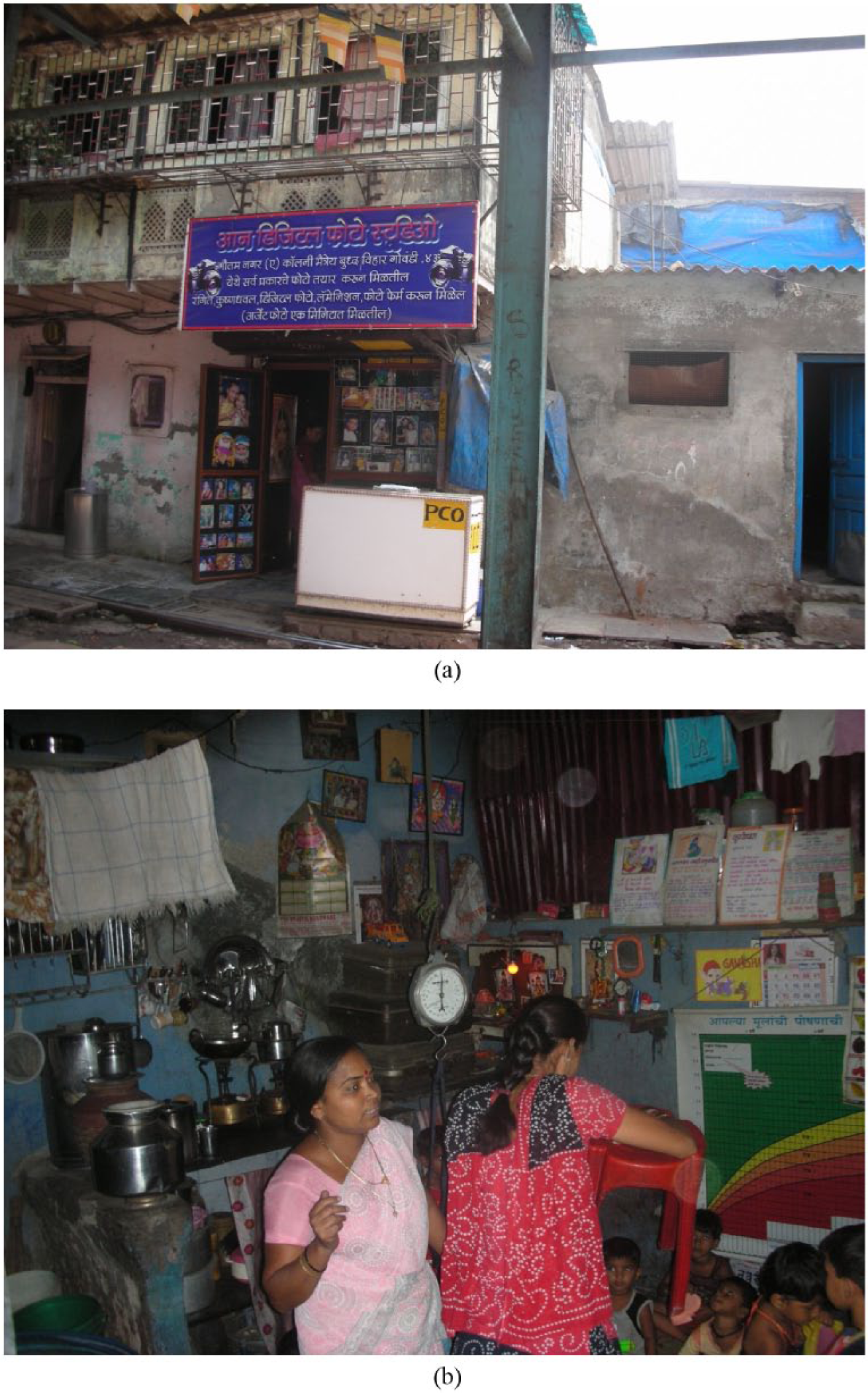
Anganwadi 5 – Outside and inside the setting.
In anganwadi 5, the scene entitled ‘stacking cups’ (see Figure 8), suggests that children are being shown the development of hand–eye co-ordination as a skill. It is not linked to anything else being taught so it is a strong boundary in terms of it being the development of a particular skill through an enjoyable activity. The transmission is highly regulated in terms of who controls the sequence of how the learning progresses and overwhelmingly in this sequence is a strong framing of an instructional context. The adult selects the child, the adult hands the equipment to the child, the adult prepares the child by standing him/her up. In short, the adult organises who does what and when, that is, the selection and sequence; the adult initiates the clapping, when the child attempts the requirements of the task (to knock over the stacking cups). The choices transmitted and received for the child are given and there is little room for manoeuvre in terms of what the child is told, and when and where. The only choice seems to be how the ball is thrown as it is not modelled. Having said that, what is interesting to observe is that, because the children are actively participating in the activity on an individual basis, there is a weakened framing in which more interaction could potentially occur between the practitioner and the individual children.
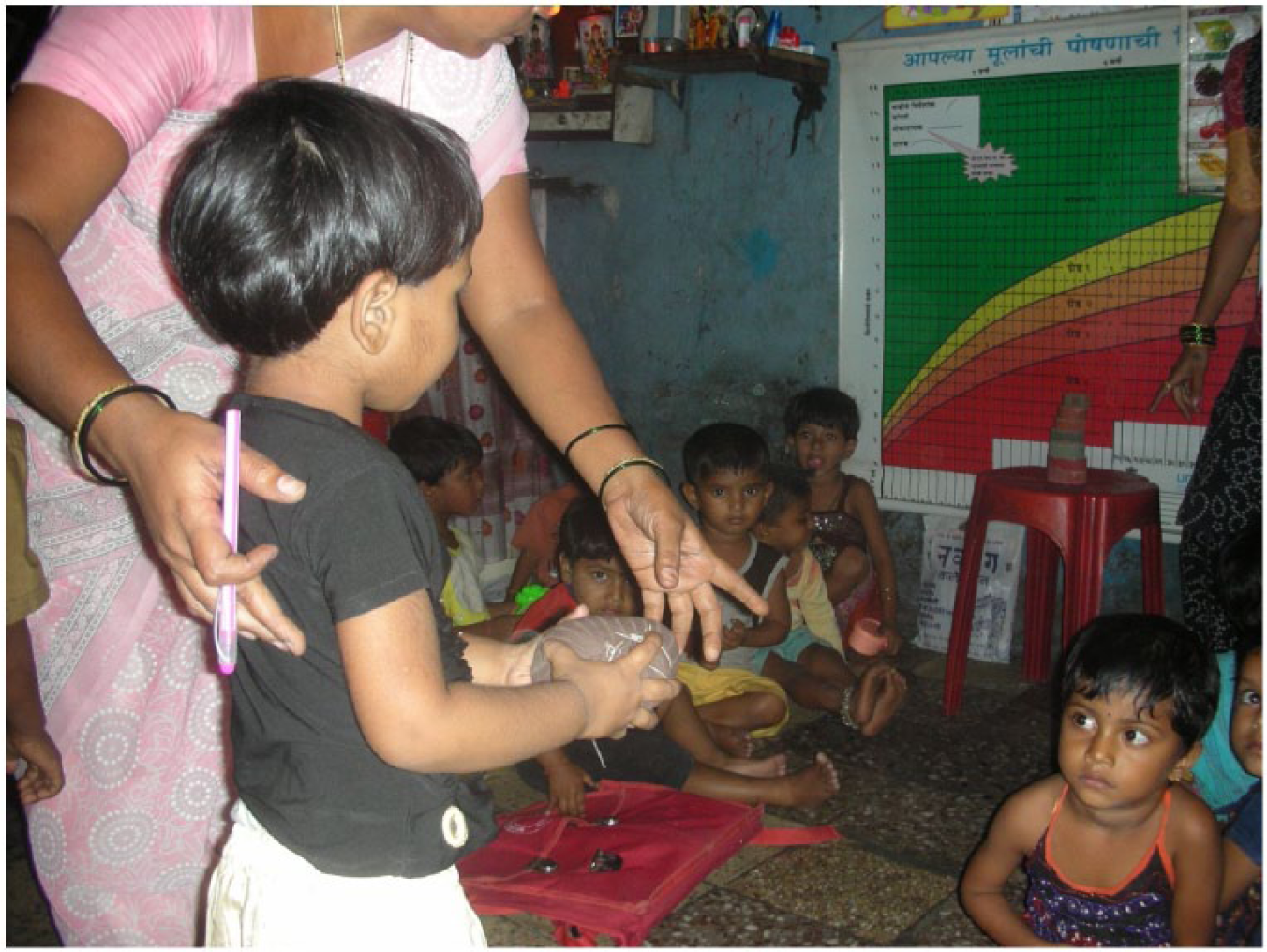
Anganwadi 5 – Scene – Stacking cups illustrating strong forms of selection, sequence and pacing but a potential weakened framing between the practitioner and the individual children.
I ask the practitioner (AWW) to expand on her work in delivering the PSE component of ICDS:
AWW: .…. Today we have been putting in their minds what they should learn before going to school, what is needed before going to school. That’s related to their surroundings, the names of the things around them so that they are aware of their environment; poems; how they should wash. The habits are formed .…. If the children don’t come here, we go and get them. They don’t have the habit so we bring them and we show them the charts (points to fruit and vegetables). We make them aware of the sounds and things around them, the animals and where they live.…. I am responsible for about 100 children….They don’t eat at set times at home, but they do here and then its gets supplemented at home. (Interview with AWW: Anganwadi 5- Shivneri Nagar)
Anganwadi 6:
When we arrive at the last anganwadi, the children are about to eat lunch. The wall displays are of published charts written in Hindi. The practitioner tells me about her routine:
AWW: We arrive at around 10am and clean up the place before the children arrive at around 10.30 and we sit them down. We begin with prayers. Then I might ask the children about anything special that’s happening at home, or if they’re wearing new clothes whether they are going somewhere special. Then we might do naming of body parts, some nursery rhymes, and words and actions. (Interview: AWW anganwadi 6, Shivneri Nagar)
The scenes for anganwadi 6 introduce the health-related element of the programme where a nutritious food supplement is distributed. Strong framing of the regulative context is demonstrated where adult practitioners control where eating occurs, and the children sit in their spaces free to determine whether they wish to eat or not (see Figure 9).
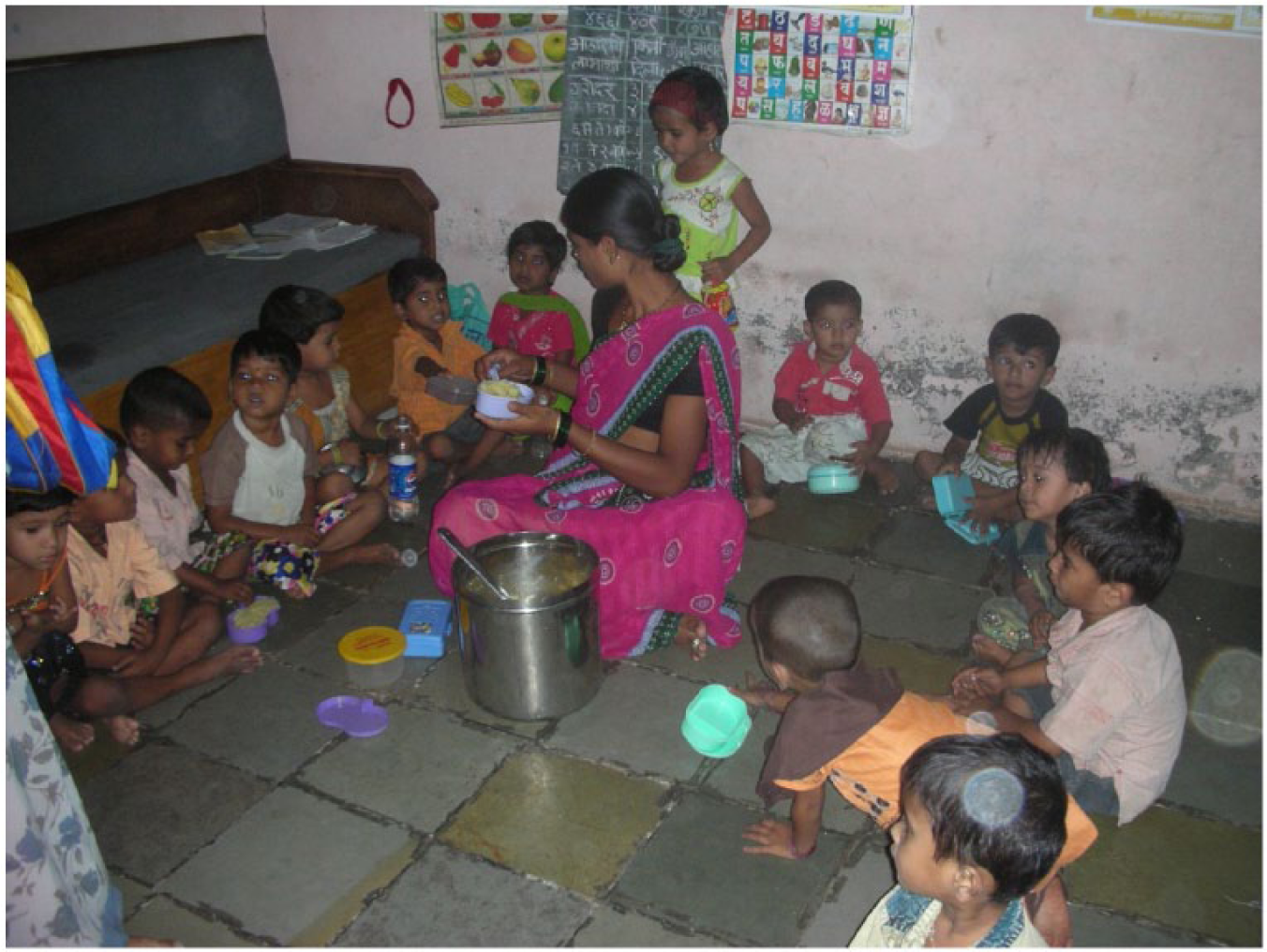
Anganwadi 6 – Setting up to eat together illustrating the relationship between space and meal times.
Summary of six anganwadis
The observations through the Bernsteinian lens indicate strongly framed discursive rules governing the selection, sequencing and evaluation of content and children’s performances in the instructional context, and a strong framing in the regulative context. In this strongly framed regulative context, practitioners are mostly authoritative rather than facilitative. It is accompanied by the strongly framed instructional discourse to produce a visible pedagogy.
Strong framing in the regulative context
Overall the control over that is expected is high in all anganwadis visited in terms of what is taught and the resources used. Whilst on the one hand the use of the space is weakly classified in the sense that the same space is shared for lesson and food distribution, I mostly observed a clear separation between the physical positioning of adults and children in the space used, suggesting clear boundaries between the spaces of practitioners and children. Knowledge of children’s learning relies on a behaviourist perspective, where pedagogical relationships are hierarchal, and mostly privilege a vertical unidirectional relation of communication (where modelling is prevalent and where there is much adult initiation and little child initiation). The pedagogy is strongly classified and strongly framed. There was, however, some indication of a weakening of framing when the children were asked to contribute to classroom activities, and also in anganwadi 5 ‘stacking cups’ (See Figure 8), where individual attention given by the practitioners to the child potentially allowed for more interaction between them.
Strong framing in the instructional context (discursive rules)
Sessions visibly concentrated on academic achievement, whether it be English, number work, language development or skill development, underpinned by strongly framed discursive rules of selection, sequence and evaluation. The learning objects illustrated in the classroom decor also signalled the fostering of the importance of particular subject knowledge in areas of science, mathematics and language development, including English. Practitioners indicated to children that responses were right or wrong, referring directly to the criteria for performance in the instructional context. In almost all instances the practitioners expressed the need to select and present the content they considered to be most important. The strongly framed hierarchical relations between practitioner and child ensured that practitioners passed on that content to children. In this way the children may have started to acquire the recognition and realisation rules appropriate to their particular context (Morais et al., 2005). The pre-school content selected by the practitioners was recognisable to children and adults as preparation for school, and practitioners were explicit about what children were being asked to do. In this respect, ‘correct’ performance was made visible to the children.
Discussion
School readiness and child-centred discourses
The ICDS PSE proposed a child-centred discourse (Government of India, 2011b). This is problematic when set against the more academic (school readiness) visible pedagogy that was observed in the pilot settings. According to Bernstein and a number of Bernsteinian researchers, the child-centred discourse is associated with the more ‘progressive agenda’ and its emphasis is upon ‘everyday knowledge’ rather than the ‘academic’. It has, in the past, been aimed in England, at (apparently) empowering marginal groups in order to facilitate their access to academic knowledge. However, Bernsteinian researchers (e.g. Hoadley, 2006; Morais and Neves, 2011) have expressed the need for the classifications of everyday and school knowledge to be strong, due to the higher status of the latter. What is interesting in the Indian context is that the academic knowledge is made visible to those young disadvantaged children.
Visible pedagogy and the view of the young child as learner in the Indian cultural context
One of the rationales for a visible pedagogy put forward by those involved in the ICDS provision is that unless the children have mastered the basics in terms of knowledge, skills and attitudes they will not able to be able to engage with the primary stage of education, as the CDPO explained:
CDPO: It was pre-school education and school readiness. The activities (in the anganwadis) were nursery rhymes, number work and learning about parts of the body. …the workers usually spend the first hour and a half on numbers and language work so that they are prepared for school, for example, so they are able to identify numbers. They are also forming habits – sitting properly. Finally, they are given supportive nutrients and learn habits related to cleanliness. (Interview with CDPO)
Mastering the basics is therefore crucial in this pre-school context, and explains its presence in the visible pedagogy of the slum schools that were observed. Indeed, it is essential for the visible pedagogy in this context because, from the perspective of those involved in teaching the children, mastering the basics allows them to be able to engage with their future as a pupil (both in terms of what to know and how to behave). In this respect the content for ‘school readiness’ seems crucial to justifying the use of a ‘visible’ pedagogy in the pre-school slums that were observed. A social constructivist framework did not underpin the model of a young learner and how they learn, where young children tend to understand simple ideas when they recognise a framework into which they fit, that is, a context that is embedded in an invisible pedagogy. Instead, the framework used is from a behaviourist tradition, superimposed by a model in which students ‘should’ know certain facts and ways of behaving. Such performance-oriented pedagogies are not concerned with the specific nature of individual students, are explicit about what students are expected to know and what they do not know, and the control of teaching and learning is explicit (Bernstein, 2000). The ‘visible’ Bernstein maintains, might be theories that are more conservative depending on whether the transmission assumes learning is based on intra individual learning (within the individual) or inter learning (with individuals). The pedagogy is often underpinned by theories from behavioural and cognitive psychology, where ‘….intra individual transmission is likely to select behaviourist theories of instruction…(and) are often regarded as conservative’ (Bernstein, 1990/2003: 73).
In the ICDS settings that were video filmed, the perhaps more Eurocentric view of the young learner as curious with an ability to direct his/her own learning, to be facilitated by the adult, is a stark contrast then to the pedagogy that was observed. In the pilot study, the predominant view of the young learner is of being a listener who acquires certain knowledge and way of behaving, to be transmitted by the adult practitioner, and this is all developed in a strongly regulated context. Of course, this view of the young learner requires a cultural context. Sarangapani (2004) examines learners who attend the middle stages of Indian schooling in order to understand teacher–pupil relationships. In demonstrating a framework for the key features of Indian schools – namely teacher authority and discipline, Sarangapani (2004) argues that whilst authority and discipline are seen as natural and central to school and learning in India, they are not total institutions (Goffman, 1961) in which children simply accept the norm. Rather, these characteristics have a deep-rooted bias that lies outside of the school institution but is a part of everyday life. Thus, the local view of childhood and education has a framework that maps onto these practices, and both children and teachers are able to use this as a point of reference from which to reproduce the framing of social relations in schools. Authority is seen as natural and is used to maintain the moral order through behaviour and discipline that constructs how teachers and pupils are seen by one another. Non-institutionalised relationships, whether adult–child or parent–offspring, that children experience before entering into the institution act as a basis of their relationships with adults – and by extension, relations between non-institutional and institutional underpin pedagogic transmission. This is essentially how Indian slum children come to learn their role in the social expectations of the particular relationship. For Sarangapani (2004), the rational framework for modern education has not penetrated this framework of beliefs in the slum or village context and, at the same time, current discourse on childhood and education does not acknowledge these values and beliefs. When considering young children, families and AWW practitioners in the ICDS, we might therefore ask, ‘how can a child-centred discourse associated with pre-school pedagogy acknowledge their framework of beliefs and respond in a language that they understand for the development of quality pre-school provision?’
The potential of mixed pedagogic practices and creating a boundary space for new meanings
From a Bernsteinian perspective one response to this question might be to consider the scope for a particular regulatory discourse that is suggestive of a more open relation between practitioner and child. According to a number of Bernsteinian researchers, weakened classification and framing is called for most consistently in the realm of ‘hierarchical rules’ (Bernstein, 1990/2003: 65) that govern classroom power relations, particularly in terms of ‘communicative relations between teachers and children and children themselves’ (Morais et al., 2004: 77); that is, students’ engagement and motivation are held to be best supported by an ‘open’ relationship with their teachers and with their classmates (Morais and Neves, 2011: 214), often in a context of weakly classified classroom space. Certainly there were ‘glimpses’ in observations that indicated a more weakened framing between practitioner and children, where the unidirectional communication was reversed, although there remained a vertical relationship. It was also evident when practitioners worked with individual children, allowing the space for more interaction to potentially occur between them. The practitioner’s role is therefore crucial to structuring the relationship between discourses (Barrett, 2014) for the development of child-centred activity; this presents a challenge in the Indian government setting context, where continuities of rote learning of basic reading and writing skills is still dominant practice (Gupta, 2006: 190).
A number of early childhood scholars have used postcolonial theory to explain such continuities to classroom practices and questioned attitudes and practices, to show how early childhood education worldwide has been heavily influenced by dominant Western discourses about young children and how they learn (Canella and Viruru, 2004; Viruru, 2005). Gupta (2006) identifies three discourses she observed in an Indian private early childhood setting. They were as follows:
the discourse of Indian philosophy and culture – this influenced both the content of the curriculum and methodology in the hidden curriculum and informal teaching and learning that happened in the classroom;
the discourse of British Colonialism – this also influenced content and methodology and manifested in rigidly structured curriculum and drilling; and, finally,
the discourse of American progressive education – this appeared sporadically in the form of activity-based teaching, child-centred classrooms (Gupta, 2006: 232).
For teachers in Gupta’s (2006) study there was a gradual realisation that whilst the dominant discourse of progressive education was the standard in the west, it could not work in the Indian situation, and that it would have to be modified for the cultural, emotional, physical and academic climate of the Indian classroom. This, she says, ‘was a good example of how the post colonial situation is reflected in the manner in which the teachers as individuals negotiate between Western and Indian ideas’ (Gupta, 2006: 233). The question is, then, if practitioners in government anganwadi settings are exposed to other practices within their own context (for example in the private sector, such as those in Gupta’s (2006) study), how will they make sense of it in terms of their current practice and will it create a mixture of different discourses, a ‘cultural hybridity’ (Bhabha, 1994) which offers a weakened boundary space between early childhood curriculum discourses; which is one that can be used for negotiation and meaning and representation?
Conclusion
The central point that emerges from the theoretical analysis of pedagogic transmission is that the forms of pedagogy observed does not map onto the espoused ‘child-centred’ pedagogy associated with weakly framed regulative orders; in this respect, it does not fit with the discourse of quality ECCE highlighted in the ICDS documentation relating to PSE. This raises questions about the possibility of shifting the meaning of child-centred pedagogy for the participants taking part in those settings so that it is more context oriented. It also raises questions about the scope for more weakly framed relations between practitioner–child and child–child relations within the Indian pre-school context and a suggestion for a mixed pedagogic practice of weak and strong classifications and framings. Gupta’s (2006) example is a model for a more hybrid development of early childhood discourses in the Indian context. There are also models of apprenticeship existing in Indian culture (see Alexander, 2001) with weakened framing that might be helpful in considering a non-western version of child-centred education; one in which what it is to be a learner, a teacher and the relations between the two, which are used to construct a particular view of the young learner, acknowledges the beliefs of those participating in the anganwadi settings (the children, families and AWW practitioners):
…the true alternative to rote in the Indian context was…apprenticeship…Now this form of pedagogy, and its assumptions about the learner and the learner – teacher relationship, have central place in Indian culture…Although it is predicated on teacher authority, it is not the same as the Brahmanic ashram education that Kumar claims has degenerated into modern day rote learning, for its form on initiation develops skills which can allow the novice eventually to disengage from, and perhaps surpass – rather than merely copy – the expert. (Alexander, 2001: 559)
For Alexander, the apprenticeship approach is a sophisticated counterpart to Bruner’s theory of imitative learning, seen in the teaching of classical dance and music in India. It combines imitation with dialogue and knowledge transformation.
The analytic focus of this paper has been upon the structure of pedagogic relations, but through its attention to context exhibited in the interpretation of findings, the article meets current quality frameworks (Tikly and Barrett, 2013) and, as such, contributes to developing further understanding for quality pre-schooling. Creating a good-quality education involves paying attention to the interface between environments (such as policy, pre-school and family) and ensuring that enabling inputs (such as practitioners) and processes have the effect of closing the gaps that often exist between them (Tickly and Barrett, 2013). So the question is, ‘how might practitioners re-structure pedagogic-child relations to enable a child-centred engagement with learning that is more in line with the Indian cultural context?’
The visual data used in this pilot study has been a way of gaining orientation into the culture of slum school settings. Capturing a sense of ‘invisible/visible pedagogy’ through the examination of photographs and videos taken in pre-school settings offers a new theoretically informed methodology for other researchers in the field to consider. In addition, the analysis through a Bernsteinian lens has helped to inform conceptually led questions that are central to steering away from an evaluative discourse of quality PSE to one that is contextually grounded. Theoretically, Bernstein’s concept of boundary and related notions of classification and framing provide a framework for exploring the positioning of early childhood discourses, and in highlighting which discourse is heard, raising questions about which ones might be marginalised, and indeed how they might be transformed. The potential of Bernstein’s ideas are that they provide a particular theoretical orientation to the internal analysis of pedagogy at the micro level (see, for example, Morais and Neves, 2011); this then becomes a platform for raising questions about comparing and transforming social contexts for learning, and consequently a way forward for equalising young children’s opportunities early in life. Bernstein thus offers us a conceptual framework for researching and developing pedagogy aimed at promoting more equitable educational outcomes (Barrett, 2014). In this respect the pilot study provides a unique insight from a Bernsteinian lens and a platform for further research into pedagogic discourses in anganwadi settings.
Footnotes
Acknowledgements
I am grateful to Professor Vrinda Datta from the Tata Institute of Social Sciences, Mumbai, for arranging access to key officials and data collection sites and for our many discussions about context, quality PSE and the ICDS. Thank you also to Mr Patan for his invaluable assistance during the field work.
Declaration of Conflicting Interests
The author(s) declared no potential conflicts of interest with respect to the research, authorship, and/or publication of this article.
Funding
The author(s) disclosed receipt of the following financial support for the research, authorship, and/or publication of this article: The fieldwork for this pilot work was supported by the EdQual RPC (research project consortium) (2005–2010) and my university.