




Abstract
The role of pre-vocational education in general compulsory education has become increasingly relevant over recent years, with the international debate focussing particularly on its importance in school-to-work transitions. This study considers curriculum design and the implementation of pre-vocational education in four countries with radically different cultures: India, China, Germany and the USA. Using a theoretically framed concept of relevance to inform curriculum analysis, it compares the widely divergent content of curricula. In addition to this, interviews with teachers in all four countries flesh out how the curriculum is implemented in practice. The study, which is based on the ‘prescribed curriculum’ and ‘enacted curriculum’ approach, demonstrates that a range of factors means implementation varies widely from country to country but that teachers in all four countries focus in pre-vocational education on equipping students with life-skills.
Keywords
Introduction
As the economic and business environment becomes more complex, citizens around the world need extended knowledge and understanding to make rational decisions as both consumers and workers (Nelson, 2010; Seikkula-Leino, 2011). Specialised knowledge of the economic and employment environments is a key factor in individual career choices (Barabasch and Dykeman, 2012). Issues of school-to-work transition are also increasingly important in many countries where youth unemployment is high (Shavit and Müller, 2000).
All these factors suggest that education systems – and particularly pre-vocational education – need to tackle these challenges. For example, Howieson and Raffe (2007) stress that pre-vocational programmes can promote learners’ horizontal and vertical progression, prevent dropping-out and develop employability skills that facilitate the transition to employment.
An intensive debate requires, however, a more accurate definition of ‘pre-vocational education’. Different countries have partly overlapping but sometimes also divergent models and frequently use different terminology. In order to illustrate and compare the diversity of approaches in various countries, we use a relatively broad concept of pre-vocational education that has been adopted by a number of international organisations (including UNESCO, 2006: 26): Pre-vocational education is mainly designed to introduce participants to the world of work and to prepare them for entry into further vocational or technical programmes. Successful completion of such programmes does not lead to a labour market-relevant vocational or technical qualification. (OECD, 2002)
We refine this concept further in the interests of differentiation. In definition terms, we focus on the last two years of compulsory education (roughly ages between 13 and 16) as the immediate pre-transition period, to make findings comparable and to exclude specific features, such as private and purely vocational education or provision for adults.
There is no comparative international research specifically on pre-vocational education. Although the OECD, the World Bank and the European Centre for the Development of Vocational Training (CEDEFOP) carried out a large-scale joint project comparing guidance and counselling in a range of countries (Sultana, 2004; inter alia), it focuses solely on these areas and is, therefore, of limited relevance to pre-vocational education more generally. Only the study by Pilz et al. (2012, 2014) on the design and implementation of pre-vocational education in seven European countries covers this area.
Research question and methodology
To tackle this gap in research, we focus on the central question of how pre-vocational education is designed and taught in selected large countries around the world. We concentrate on two levels: scrutiny of the relevant curricula for content and competencies, and discovering what teachers think of curriculum implementation in teaching practice. By doing so, we followed an interpretative study approach in the field of comparative education research (Adamson and Morris, 2007: 274–278).
The following questions informed our research:
(1) Which content and competencies are contained in the pre-vocational education curriculum?
(2) How do teachers interpret this curriculum?
(3) How do teachers implement the curriculum in practice, and why?
(4) What conclusions can be drawn from comparing individual country findings?
Countries were selected to include those with large populations around the world, to give the findings wide validity. The interdependence of pre-vocational education and the labour market also dictated the selection of countries from both developed and developing countries. India, China, Germany and the USA were selected.
The first research question was approached by means of a curriculum analysis (Posner, 2004) along traditional curriculum theory lines (Kelly, 2009). The theoretical basis for the deductive determination of the analytical category system was Reetz’s (2003) curriculum-development theory, adapted for an international framework. Reetz’s theory is also in line with other international approaches of curriculum development (e.g. Schiro, 2008). This theory, which utilises three explanations or principles of curriculum relevance, was used to define the analytical category system, generating sociologically constructed and theory-driven codes derived from existing theories and concepts to underpin empirical data analysis (Coffey and Atkinson, 1996). The weighting of the principles then enables statements to be made about the content, structure and learning outcomes of the curriculum documents identified. In concrete terms, the three principles were differentiated as follows.
Orientation to the reference discipline: the ‘discipline principle’
In the ‘discipline principle’, the selection of content and learning outcomes follows one or more reference disciplines. Scrutiny of international curricula shows that the relevant disciplines are economics, business studies and technology (Pilz et al., 2014). Categories were formulated using a similarity analysis of internationally recognised academic textbooks of these three disciplines. The categories, generated in English, include, for example: ‘basic principles of economics’, ‘market forms’ and ‘indicators of economy’ (economics); ‘nature of management’, ‘marketing’ and ‘human resource management’ (business studies); and ‘agriculture’, ‘computers’ and ‘environment’ (technology). In total, 41 criteria were derived, 12 for economics, 10 for the business studies and 19 for the technology area (examples are given below).
Orientation to the world of work: the ‘situation principle’
The ‘life situations’ to which curriculum content refers are derived from a functional understanding and interpreted ‘primarily as objective […] conditions and challenges imposed by society/the economy’ (Reetz, 2003: 117; authors’ translation). With regard to pre-vocational education, the world of work is the key future life situation underpinning curricula.
However, the selection of appropriate categories had to reflect country-specific features, such as labour market characteristics. For China, therefore, the criteria system was based on the investigation and comparison of employee regulations by numerous companies in different sectors, as well as collaborative research on employers’ views of employee skills carried out by Venter et al. (2002). For India, the categories were derived from a series of reports by the National Skill Development Corporation (NSDC, 2011). In the German context, these demands and requirements are best reflected in the concept of ‘apprenticeship entry maturity’ (Bundesagentur für Arbeit, 2008). Finally, the American approach to the skills that are required for transition to the labour market is based on research by Murnane and Levy (1996) and the findings of the STAMP another project (Handel, 2007).
The majority of the average 30 categories used were formulated equally for all countries. ‘Situation principle’ categories relevant to all countries include ‘compliance with rules and regulations’, ‘a sense of duty’, ‘operating strictly according to the procedures’ and ‘accomplishing the task on time’.
Orientation to the individual: the ‘personality principle’
Selection of the ‘personality principle’ categories was based on the second variant of Reetz’s (2003: 101) ‘personality principle’, with particular emphasis on the acquisition of key skills. Reetz understands the concept of key skills or competencies as ‘the personal and general ability to carry out specific activities (doing, speaking and thinking) appropriately in new situations’ (Reetz, 2003: 116; authors’ translation). Given the international framework of the research, categories for this principle were designed to be internationally compatible with the key skills laid down in the OECD’s Definition and Selection of Competencies (DeSeCo) (OECD, 2005). The nine categories include ‘the ability to use language’, ‘symbols and text interactively’, ‘the ability to cooperate’, ‘the ability to use technology interactively’ and ‘the ability to use knowledge and information interactively’.
Due to wide regional differences, our research design had to focus on individual curricula regarded as being particularly relevant. In line with the rules of qualitative content analysis, relevant curriculum text passages were coded.
After the curriculum analysis, practising teachers were interviewed with the primary aim of assessing how far these curricula were being implemented (research questions 2 and 3). Theories relating to the ‘prescribed curriculum’ and the ‘enacted curriculum’ (Bloomer, 1997; Edwards et al., 2009) formed the theoretical basis of this process. To conduct the research, we developed semi-structured interview guidelines to reflect the fact that a more open-ended instrument would best capture the various factors influencing teachers’ comments and assessments (Kirk and Macdonald, 2001).
We also sought to clarify the precise extent to which teachers actually implemented the curriculum in their teaching (research question 3) using O’Donnell’s (2008) five criteria: adherence, duration, quality of delivery, participant responsiveness and programme differentiation. To identify the factors influencing implementation, we used Posner’s (2004: 201) seven factors: temporal, physical, political-legal, organisational, personal, economic and cultural.
The central interview guide, initially formulated in English, was translated into the relevant languages in cooperation with national education experts and modified to reflect country-specific characteristics. A pilot in each county validated reliability. Interviews were recorded and partly transcribed to serve as the basis for analysis. The analysis was undertaken using the standard procedure of content analysis (Krippendorff, 2007: 83–85) with sub-categories and anchor examples.
Due to the aforementioned regional differences, interviewees were selected only from those areas in each country in which the analysed curricula were applied. Teachers were recruited in a range of schools and were actively involved in implementing the curriculum. Schools met the criteria set out above.
Findings of curriculum analysis and teacher interviews
The findings of the curriculum analysis detailed below address research question 1 and those of the teacher interviews address research questions 2 and 3. The findings are reported by country for a better overview.
Findings for India
Findings from curriculum analysis
In India, analysis was based on the Secondary School Curriculum 2013 published by the Central Board of Secondary Education (CBSE, 2011) and the Syllabus for the Indian Certificate of Secondary Education (ICSE) 2013 formulated by the Council for Indian School Certificate Examinations (CISCE, 2012), which are used across regions in many lower secondary schools (Pilz, 2016). The selection of subjects includes ‘social science’, ‘work education’ and ‘commerce’ from the CBSE curriculum, and ‘socially useful productive work and community service’, ‘economics’, ‘commercial studies’ and the subject cluster ‘history, civics and geography’ from the CISCE curriculum.
Analysis of the data shows that the ‘discipline principle’ dominates the curricula (see Table 1). The ‘personality principle’ and especially the ‘situation principle’ played only a subordinate role.
Number of codings for each principle in India (in absolute and proportional terms).
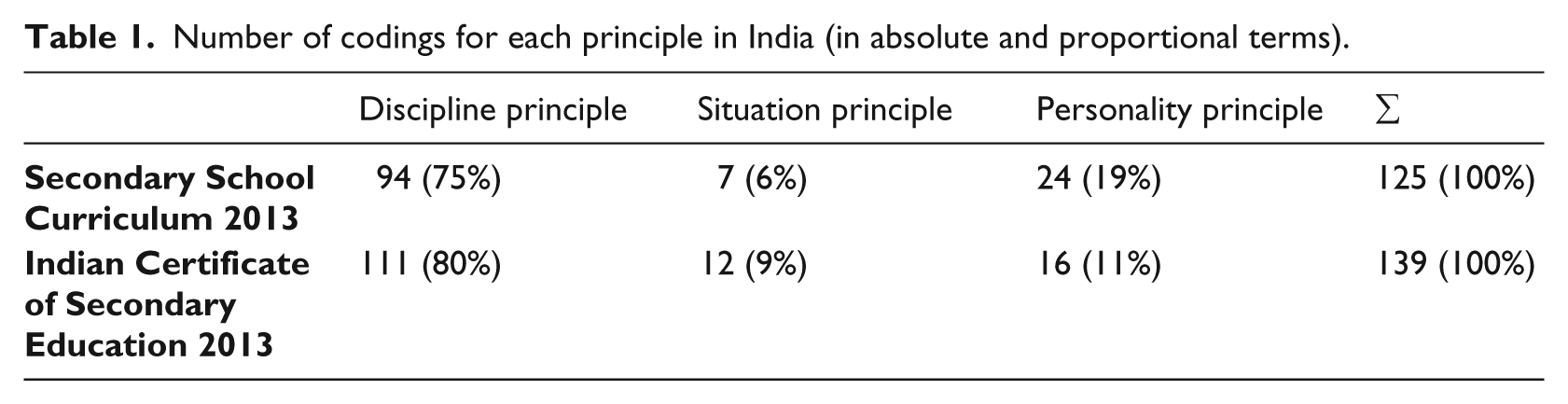
Within the ‘discipline principle’, the economics area dominates both curricula because it is one of the subjects in the social science cluster, which makes up the majority of codings. Beside ‘government policies and their influences’, which is heavily represented in both curricula (14 codings each), there is considerable emphasis on ‘trade and globalisation’, particularly in the CBSE curriculum (nine codings). Additionally, ‘labour market’ has a total of 11 codings. Concerning the business studies area code, ‘production and operation management’ is the most prominent category (16 codings). ‘Food and agriculture’ and ‘environment’, both belonging to the technology area, are also important in both curricula (21 codings each).
The ‘situation principle’ does not play a particular role in the curriculum as a whole. In individual subject areas in the ISCE curriculum, the focus is on practical experience and giving students initial work experience in various aspects of employment. This applies particularly to ‘socially useful productive work and community service’, ‘economics’ and ‘commercial studies’, where the emphasis is also on ‘stamina and tolerance of frustration’ and ‘sense of responsibility’, as well as on the ‘ability to operate strictly according to the procedures’ and ‘accomplishing the task on time’.
There were also relatively few codings belonging to the ‘personality principle’, which is taught almost exclusively within social sciences. Here, the focus is on developing the key ability to ‘relate well to others’. Additionally, skills are emphasised that aim to give students ‘the ability to act within the big picture’ and ‘the ability to assert rights, interests, limits and needs’.
Findings from teacher interviews
Because research resources were limited, the study was restricted to Tamil Nadu, a state with modern urban and also under developed rural areas, where both curricula are taught. Eleven teachers were interviewed; a few said they did not really know the curriculum.
Most interviewees saw secondary education as a stepping-stone to tertiary education, and none mentioned direct transition to the labour market. Students’ future role as employees, therefore, played virtually no role in the daily teaching practice of these teachers: as one summed up pithily, ‘Occupational knowledge is not taught’.
According to most teachers, vocational orientation happens as students prepare for higher levels of education, although the only occupations mentioned are those that require a degree and offer a good standard of living. For instance, one teacher said specifically that he wanted his students (predominantly from lower socio-economic classes) to become engineers because of the high salaries that engineering and comparable academic jobs offered.
Secondary education aims to develop skills relevant to students’ current and future situations as citizens, like one teacher said: The job what they take definitely cannot [be chosen in lower secondary], now they cannot decide. Normally […] in India […] whatever course they have taken in the higher secondary alone is going to help. But till 10th standard all this must help for one to live in this society.
When the respondents stated that the subject supported personal development and that the latter was the focus of their teaching, they mostly added that their personal aim, as well as that of the curriculum, was to produce good citizens: ‘The most important aspect is the development of personality, because only that makes them a better citizen.’
Although they all agreed that personal development was important, most interviewees thought that the crucial aim of the curriculum was academic content for the final examination, which was their focus accordingly. As one teacher stated, ‘50% will be just concentrated on teaching our subject knowledge and another 50[%] maybe for the economic development and the personality development for their future career.’ Asked which learning outcome she thought was most significant, another teacher told us, ‘The three aspects are given […] but we are not able to provide these activities. […] They [the government and the students] want to get marks alone.’ Teachers were critical of the fact that both the authorities and students valued only final examination grades, which made it more difficult to focus on areas other than academic knowledge.
The interviews showed clearly that the ‘discipline principle’ is considered by far the most important. However, within this principle, only a few interviewees cited content from economics, business studies or technology. The most important sub-discipline in social science and, hence, pre-vocational education was history, which can be explained in particular by teacher training. Geography and politics were mostly regarded as having the same importance, while content from economics, business studies and technology were viewed as less important in pre-vocational education. One interviewee commented that while students would be interested in and motivated by these areas, most teachers knew very little about them.
‘The curriculum is completely taught.’ This short but important statement shows that most interviewees regarded the curriculum as being fully implemented. Some mentioned pressure to do this: We have to finish the curriculum. It is very difficult but we have to teach as the government rules. […] If you have not completed the curriculum […] there are some officers asking questions and sometimes they are inspecting […] we don’t know when they will come, so we are alert.
Despite this pressure, even schools with good financial and teaching resources do not offer subjects such as ‘work education’. As well as the heavy emphasis on general subjects, further influences have an impact on implementation of the curriculum and how teaching is designed and delivered. Some teachers said that poor equipment in state schools had a negative impact on teaching but did not believe that this jeopardised implementation of the theory-based curriculum content, which was generally taught using textbooks.
Findings for China
Findings from curriculum analysis
Since there are major regional differences within China, the curricula of two very different regions were selected for this country. These were the curricula for the Shanghai province (Shanghai Municipal Education Commission, 2004) and the Hubei province (Ministry of Education China, 2002). It should be noted that the curriculum implemented in Hubei applies across China and will here be referred to as the ‘China curriculum’. Analysis shows that there are greater differences between the two curricula compared to those found in India (see Table 2).
Number of codings for each principle in China (in absolute and proportional terms).
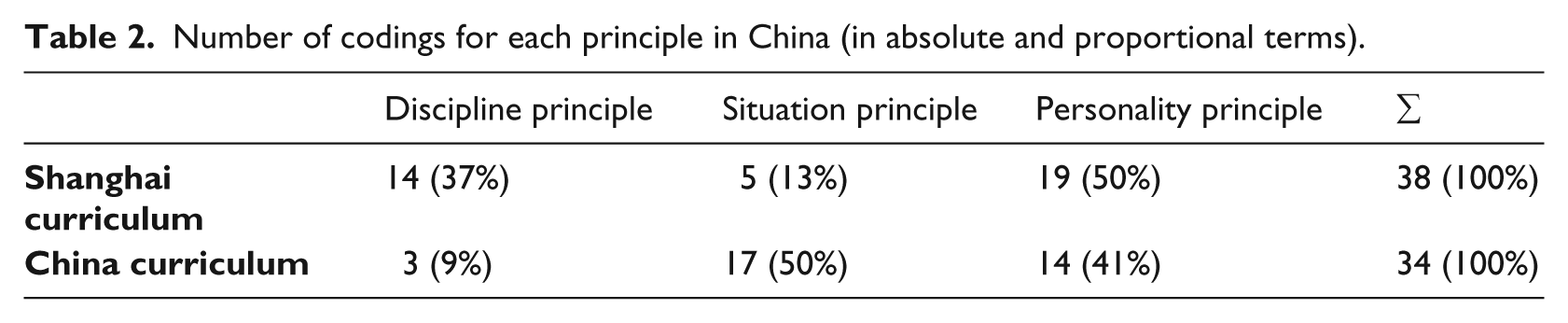
The data show that the ‘personality principle’ clearly dominates in the Shanghai curriculum but is less marked in the Hubei curriculum. In both curricula, however, there were particularly frequent codings for the criteria ‘ability to use knowledge and information interactively’ and ‘ability to use technology interactively’. In the China curriculum, the ‘situation principle’ dominated with around half of all codings. Here, the ‘capability of long-term concentration’ criterion was particularly frequent (five codings). The Shanghai curriculum attributes only marginal significance to the ‘situation principle’ but greater importance to the ‘discipline principle’ than the China curriculum. The ‘production and operation management’ criterion alone represented seven codings, while in the China curriculum it was only represented with three codings (the only criterion from the ‘discipline principle’ that could be identified in the China curriculum). In both curricula it was striking that no criterion from the economics area could be coded within the ‘discipline principle’.
Findings from teacher interviews
Nine teachers in Shanghai and eight in Hubei were interviewed. There were differences in the responses, in particular concerning the introduction and implementation of the relevant curriculum in teaching practice. In Shanghai, the curriculum has been fully implemented in at least some schools, whereas in Hubei the China curriculum is barely taught at all.
Therefore, two strands of argument need to be distinguished. In both regions, teachers mentioned the relevance of the topics and obstacles of applying the curriculum in teaching practice, but only those in Shanghai gave specific details about curriculum implementation.
In Shanghai, teachers think that the curriculum attaches greater importance to the promotion of certain characteristics and personality features in students than to knowledge teaching, in line with the findings of the curriculum analysis. As one teacher said, ‘the course mainly fosters pupils’ ability to use hand, to operate, and to practice; learning to do is the major focus, theory is in the second place.’ A teacher who formerly taught politics believes that ‘the major objective of the curriculum is to teach pupils employment skills and operating methods, so that pupils can develop their technical and aesthetic abilities.’ Besides obtaining skills, learning in an affective domain, such as attitude-formation, and learning personality characteristics was repeatedly mentioned by the teachers from Shanghai interviewed.
Several teachers in Shanghai think that because pre-vocational education is not examined, it actually offers an alternative to pupils’ otherwise boring ‘learning life’ in school. One teacher said, […] the process of skill learning is helpful, it can contribute to change their learning attitude and to enhance their ability of self-control. I do not expect their products to be perfect, but just hope that they can do their best. I always tell them that ‘your mentality and attitude will decide where you will be heading in the future’. In doing these projects they may get tired and encounter some difficulties, and I will encourage them to hold on and tell them ‘after finishing this thing you will change your mind’. I try to strengthen their consciousness of holding on, and let them persist accomplishing one thing.
Failure to follow content in the crucial final examinations may also, however, have negative consequences and is cited as a particularly serious problem in both regions, as the following comment by a teacher in Hubei shows: The implementation of the course? We’d just arrange a couple of classes per semester and assign the pupils some work. As for the quality of their accomplishments, it is another topic. Labour and technical course is just for the inspections from above. Big schools would be more serious on this, because the inspections are more rigid for them, so they have to.
Further factors hampering curriculum implementation were the same in both regions; for example, inadequate time to teach the specified material. Some teachers also mentioned the constraints represented by the inflexible teaching time frame: ‘To have the two courses in a block will facilitate the accomplishment of the tasks, but that is not very possible. The consequence [of not being able to have a block] is that the teaching lacks continuity.
While physical equipment in schools does not seem to be a problem in Shanghai, it is a major obstacle in rural Hubei. One teacher from Hubei emphatically mentioned the differences between conditions in small and large schools: We surely have difficulties in places and space [to carry out the curriculum]. The good schools can charge extra-paid fees/sponsorship fees. But this school is such a school just for those, whose parents are from rural areas but temporarily working near the city suburbs. Most of the kids here are the so-called unattended children [home-alone children or even left-over children], whose families are not as wealthy as those in the city centre.
A further major problem is appropriate teacher training with regard to the analysed subjects. However, a number of teachers told us that the shortage of well-trained teachers is not only caused by the absence of teacher training institutions but also, and in particular, in the low status that pre-vocational education enjoys. Many teachers want to teach only ‘prestigious’ subjects, such as maths or science.
In our interviews in China, the low status of pre-vocational education cropped up again and again and was projected on to students: all the interviewees categorised both students and their parents as having little interest in pre-vocational courses or, in some cases, even feel contempt for them.
Findings for Germany
Findings from curriculum analysis
Germany does not have a national curriculum, so curricula from the two largest federal states, North Rhine-Westphalia (NRW) (Kultusministerium des Landes Nordrhein-Westfalen, 1989) and Baden-Württemberg (BW) (Ministerium für Kultus, Jugend und Sport Baden-Württemberg, 2004), were analysed. Compulsory education in Germany is currently mostly structured in three tracks (Lohmar and Eckhardt, 2013), giving rise to issues of comparability with other countries. Therefore, we selected the Hauptschule for comparison: it provides basic general education and the minimal basis for both educational qualifications and transition to vocational training (Lohmar and Eckhardt, 2013), quite similar to all other countries.
As measured by the frequency of codings, both German curricula place particular emphasis on an understanding of ‘market players’ and ‘production and operation management’ under the ‘discipline principle’, and on ‘vocational maturity’ under the ‘situation principle’.
While both curricula can generally be said to be largely knowledge-oriented, that is, focusing on the ‘discipline principle’ (Table 3), the NRW curriculum has clearly more learning outcomes coded under the ‘discipline principle’ than the BW curriculum. Thereby, the criterion ‘government policies and their influences’ of the economics enjoys particular importance in the NRW curriculum (25 codings).
Number of codings for each principle in Germany (in absolute and proportional terms).

The BW curriculum, on the other hand, places more emphasis on the ‘personality principle’, with particularly frequent reference to the criteria ‘the ability to use knowledge and information interactively’ and ‘the ability to form and conduct life plans and personal projects’ (six codings each).
Overall, there is a striking difference in the number of coded items, which is attributable to the fact that the curricula were designed at different times: the NRW curriculum dates back more than 25 years and focuses on traditional learning outcomes described in detail, whereas the more recent BW curriculum places greater emphasis on competencies with rather short and open descriptions.
Findings from teacher interviews
Eight teachers were interviewed in each federal state. Comments by teachers in NRW and BW differed little. The extensive implementation of the curriculum was confirmed, along with the dominance of the ‘discipline principle’.
Quite a few teachers mentioned the importance of teaching economic and business knowledge. One of the teachers said that the general aim of the curriculum was to let the pupils ‘know the basic concepts of the economic life and to be able to use them … how the market economy works, supply and demand, price, how prices are formed, the mechanism, this is the basic knowledge that [is] taught.’
One teacher explained the aim of the curriculum as teaching knowledge as well as the logic behind it, saying that […] the teaching of economics has the intention to prepare the pupils for their social roles as consumers and employees. One can teach this subject knowledge, not only in terms of theoretical content, but also in terms of simulations. Not only cognitive, but also as something that can be experienced.
Many teachers addressing the significance of teaching subject knowledge also stressed the equal importance of linking this knowledge to the vocational choices that students will make in the near future. One teacher raised the importance of preparation for life situations compared to knowledge learning: We want to prepare [pupils] for life through this course. It is very important, today even more than many years ago, that after school, how it goes on further. Whether to visit other schools, whether they enter training directly. Some no longer have anything to do with school, they work directly.
The interviews also offered particularly rich data on the status of pre-vocational courses, which are deemed important by both teachers and students as well as their parents: The parents are standing behind us. They justify this due to the reason that their kids would otherwise not be in the Hauptschule. They have academic, orthography or arithmetic weaknesses. […] We try to promote the pupils’ strengths, which are very often in the practical domain. Therefore, the parents support us. They often praise the internship and say that their kids are totally different during internships.
Particular importance was attributed to career guidance: We give pupils cognitive knowledge based on the disciplines, but we also work together with [Germany’s national] employment agency. They have much knowledge about the profession and practical experience. One of our priorities is to offer the pupils as much individual practical experiences as possible. […] In the 9th and 10th grade the pupils do internships. The general principle is to lead the pupils to apprenticeship entry maturity. But we want the greatest possible individualization, namely that the pupils through the practical experience and the knowledge gained can make decisions on their own. Of course, personality development should come into that [process]. The student should say what he wants to do, not the teacher.
The only difficulty mentioned in implementing the curriculum in teaching practice was, in individual cases, inadequate practical relevance of the learning outcomes or skills and, in a few cases, criticism of cognitive overload on students with regard to the categories of the ‘discipline principle’. In contrast with the findings of Pilz et al. (2012) in German Realschulen, the teachers in Hauptschulen hardly criticised teacher-training quality.
Findings for the USA
Findings from curriculum analysis
For the USA, the Ohio Department of Education (ODE) curriculum for Economics and Financial Literacy (ODE, 2011) was analysed. Since 2010, all students entering ninth grade of High School have had to study minimum content from ‘Economics and Financial Literacy Standards’ (ODE, 2008: 3). The Amended Substitute House Bill 1 2007 gives schools freedom to choose the subject and the level at which curriculum content is integrated (ODE, 2012). Our study was restricted to the pre-vocational curriculum in one federal state for funding reasons; the state of Ohio was chosen because of its structural similarity with the USA as a whole.
Curriculum analysis of the Economics and Financial Literacy Standards produced codings for the ‘discipline principle’ and, less markedly, for the ‘personality principle’, while the ‘situation principle’ was cited just once (Table 4). The ‘discipline principle’ dominated, with more than two thirds of all codings.
Number of codings for each principle in the USA (in absolute and proportional terms).

The codings for the ‘discipline principle’ were generated solely in the economics area. However, the categories cover a wide range of content. ‘Basic principles of economics’ dominated with five codings. ‘The market forces of supply and demand’, ‘trade and globalisation’, ‘the monetary system’, ‘government policies and their influences’ and ‘indicators of economy’ were all represented by two codings.
Only one category was identified for the ‘situation principle’, that of ‘vocational maturity’ (a single coding). No other content was identified in this principle.
The ‘personality principle’ was dominated by ‘personal financial planning’, which is embedded in ‘financial literacy’; that is, individuals’ ability to make effective use of financial resources to live a financially independent life (Lusardi et al., 2010). The title ‘Economics and Financial Literacy’ already points to a high level of emphasis on financial literacy, which includes both private financial planning but also issues of qualifications and pay, the funding of post-secondary education and pension provision (NASBE, 2006: 6; Vitt et al., 2000: xiii). Other frequent categories of the ‘personality principle’ were ‘the ability to act within the big picture’ and ‘the ability to form and conduct life plans and personal projects’.
Findings from teacher interviews
Teacher interviews were restricted to the state of Ohio, partly for reasons of compatibility with the curriculum analysis findings and partly because of funding constraints. Ten teachers were interviewed at eight different schools. There was wide divergence in terms of the freedom of schools or school districts to organise pre-vocational education and a corresponding variety of practice in the classroom. Many teachers said that they were (still) teaching other standards. These standards overlap substantially with the curriculum for Economics and Financial Literacy (ODE, 2008: 7). One teacher pointed out: If we follow? Yes we follow those but we do a lot more. […] I don’t want get the impression that we’re just staring at those state standards every day: got that one, got it again, got it again. We could tie everything what we do back to these state standards, but there is an extension of those.
The teachers said that their over-arching aim is to equip students to manage their lives outside employment and that this requires the responsible management of economic skills: I think the objective of our Personal Finance course is to get the students a hand on money management, so they are good decision makers later in life. So they understand how to do some very basic things, budget their money. You know all the skills that we are teaching are very practical and they are transferable to real life and we bring so many connections from real life into the classroom as we are teaching the content. So I think what I want them to take from the course is to have the skills, that they will be problem solvers and be able to handle whatever comes their way financially.
The focus is, therefore, on preparing students for the financial and economic aspects of their future lives. Interpretation of the curriculum by teachers overlaps in many respects with the curriculum analysis findings. Teachers commented that the majority of the students want to go to college after high school instead of directly taking up employment. High school is seen primarily as a stepping-stone to college (Mupinga and Livesay, 2004: 261), so preparing students for non-vocational aspects of their future lives is the emphasis: ‘Preparation for the future, and not necessarily for vocational life, just preparation for the future: college life etc. – being prepared.
‘Vocational maturity’, the criterion identified under the ‘situation principle’, is also used in teaching. Many teachers refer to a range of occupations in their teaching, outlining what students have to do to take these up. This should not, however, be understood as direct guidance on access to specific employment but, rather, guidance on the choice of a subject of study and information about pay as well as the organisational aspects of being an employee (insurance, payment arrangements, pensions, etc.): We do career exploration throughout the course. So whatever career they are thinking at the time that’s what we really look at when we talk about taxes. That’s one of the first things we do is their paycheck, and breaking down how much they actually get paid and take home. So they do get to see okay at this career I make this much, while the person next to them may have picked a different career maybe they make more or maybe they make less. So we try to tie the career to it.
Emphasis on these organisational aspects is, in the view of many respondents, relevant to pre-vocational education in the USA because failure to have health insurance and to be faced with unpaid medical bills is a major factor in personal bankruptcies in the USA. Knowing about pensions and health insurance before they even begin work can help students avoid financial problems later in life, said several interviewees. Companies and other external institutions are involved in giving guest presentations or in developing curricula but do not host formal placements.
However, teachers explained that ‘financial literacy’ does not form part of the state-mandated tests (ODE, 2008: 6). Schools are free to develop a uniform district-level test on personal finance that students must take before graduation. Nevertheless, most of the teachers do not give relevance in the preparation for such an exam.
As indicated above, teachers see their main priority as developing students’ personalities. One commented, I hope any course any student takes in my department they are building twenty-first century skills. And to have those they need to be problem solvers, they need to have an understanding how the conducting search answers questions, finding search. I tell my students some of the curriculum in Personal Finance is like doing a darter on a moving target. Things change all the time. Income limits changes, tax law changes, policy changes. So I can teach them what this information means but for them to memorize these requirements, but they need to look up later in life what really matters.
Many teachers indicated that they were using various activities to promote personal development, but in many cases, their descriptions of specific activities remained vague or theoretical, and there were no exemplary approaches to implementing the curriculum.
Although many teachers showed work experience outside school, they did not take any use out of this experience, but rather, out of their personal experience which they had gained during their lives. One teacher states: ‘I went through all of this myself. So having that life knowledge and life experience have made me able to teach this curriculum much better – hands on – than any school could have done.’
Cross-country comparison and discussion
A comparison of the findings (research question 4) starts with the design of the curricula (Figure 1). In cases in which analysis comprised more than one curriculum per country, the respective curricula were aggregated; that is, codings were summarised.
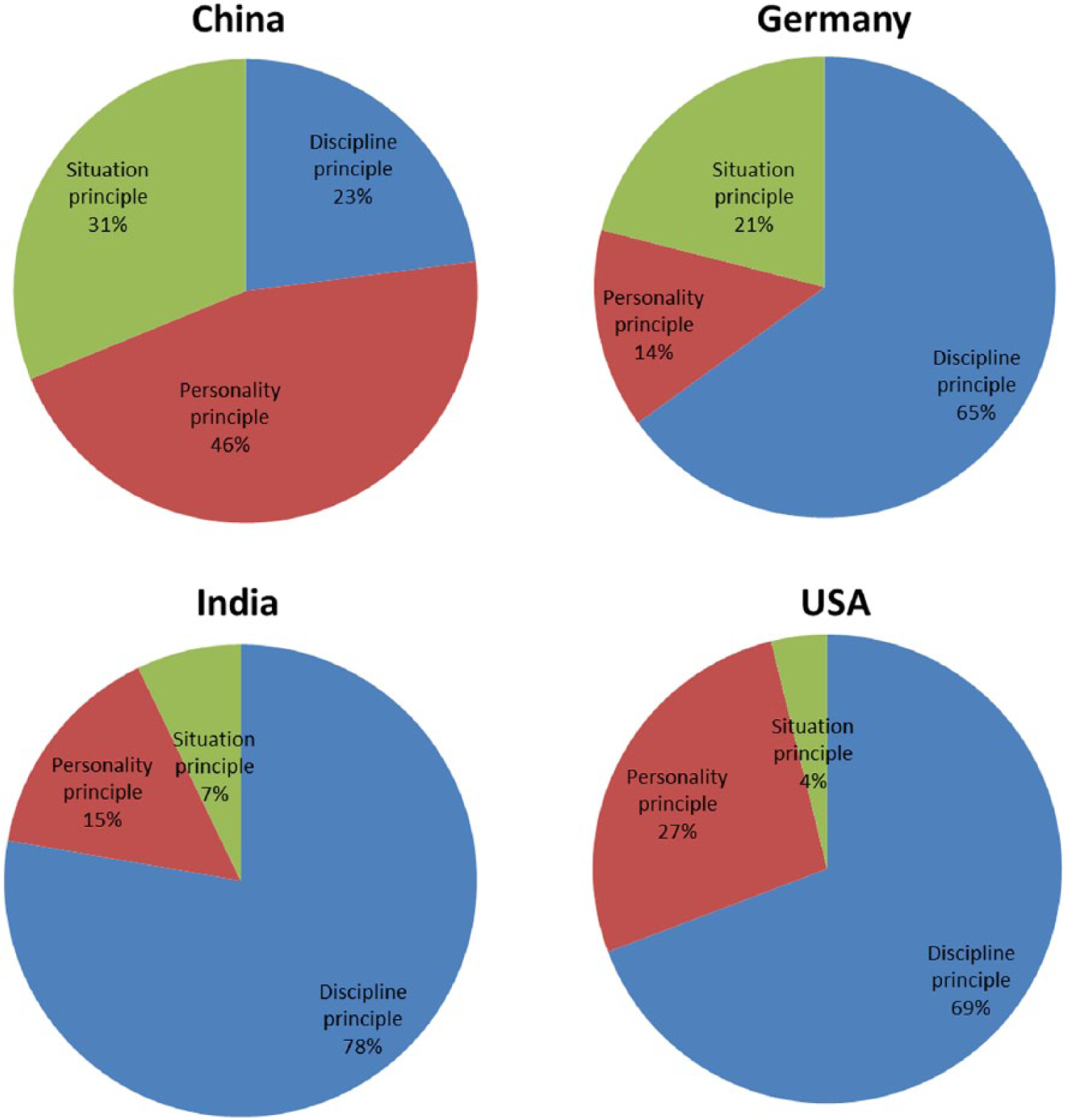
Overview of all four countries (curricula aggregated for each country).
The findings show clearly that the ‘discipline principle’ dominates in all countries except China. It is most prevalent in India, where more than three-fourths of all codings belong to this principle. However, also in Germany and the USA the ‘discipline principle’ attracts around two-thirds of all codings. Furthermore, it is striking that in China the ‘personality principle’ dominates in comparison with the other countries (though it is also an important dimension in the USA, with around one-quarter of all USA codings). The ‘situation principle’, by contrast, attracted just under one-third of all codings in China, followed by Germany, where this dimension makes up around one-fifth of the codings.
However, interpretation of these comparative findings requires caution since the link between findings and explanation is primarily hypothetical at this level. One reason for the dominance of the ‘discipline principle’ is undoubtedly the fact that input-oriented curricula were traditionally strongly shaped by content and learning outcomes in all the analysed countries and that these learning outcomes were oriented to specialist disciplines (CEDEFOP, 2012). At least two further factors play a role. First, the status of subjects/courses is legitimated worldwide in terms of their close link with a specific discipline. Second, even curricula that are more strongly competency-oriented are based on content relating to a specific discipline. For example, logical thinking (which forms part of the ‘situation principle’) is taught only in its domain-specific context. Moreover, subject-specific content can generally be measured more easily in schools than complex competencies that form part of the ‘situation principle’ and the ‘personality principle’ (Winther and Achtenhagen, 2009). The relatively low importance of the ‘discipline principle’ in China compared with the ‘personality principle’ can be explained by the state’s aim of using pre-vocational education to promote ‘multi-dimensional development of students through the acquisition of positive experiences at work and of good technical skills’ (Ministry of Education China, 2002). The logic and the aim are, therefore, to downplay pure knowledge transfer in order to achieve a balance between cognitive learning and the formation of attitudes and aptitudes. On the other hand, the relatively high importance of the ‘personality principle’ in the USA can be attributed to the fact that large sections of pre-vocational education curricula have been developed by experts on the basis of practice and pay particular attention to consumer protection and financial literacy (ODE, 2008: 3).
In the interests of a more in-depth interpretation, it is appropriate to consider the findings from the teacher interviews as well. Interpretations by teachers themselves (research question 2) were broadly similar. Teachers in all four countries said that they were very familiar with the relevant curriculum, something that was borne out in the examples and detailed statements given in the interviews. However, in all four countries, teachers perceive pre-vocational education as providing broad training and preparing for students’ entire future. They believe, therefore, that pre-vocational education should also prepare them for personal concerns, such as debt (USA) or career guidance (all four countries). Thus, the more specialist curricula are to some extent reinterpreted by teachers to cover everyday knowledge rather than more specialised knowledge.
In terms of implementation (research question 3), our interview findings show that the curricula are largely implemented in the USA and Germany, but only marginal in India and China. In this context, it should, however, be borne in mind that teachers have different degrees of freedom to set their curriculum: teachers in one school in the USA have, for instance, particularly great influence on what is taught, how and to what intensity.
The reasons for the varying degree of implementation intensity can be subsumed in four interdependent arguments.
First, the role of the school-type within the national school system is relevant. Unlike India, China and the USA, which have comprehensive schools, Germany still has a three-track school system, with the Hauptschule being the most practice-oriented and the least academic. As a result, as a central supplier of ‘dual system’ training, elements of the ‘situation principle’ and mostly of specialised pre-vocational knowledge are more important in this country than in the other countries. In India, China and the USA, by contrast, the emphasis is on general education and students’ (potential) access to higher-level school and university education. Consequently, pre-vocational education is downplayed or viewed as a ‘catch-all’ for the personal development skills and vocational orientation that does not form a major part of more general subject teaching.
The second strand of argument covers the value of pre-vocational education. In India and China, vocational training is often equated with manual or craft labour and as a shorthand for poorly paid, hard, dirty work (SCQF, 2008). This also contributes to the low status of pre-vocational and vocational education provision and a primary focus on academic training for white-collar jobs instead. To a lesser extent, this is also true of the USA (Zirkle and Martin, 2012). The situation in Germany is quite different: traditionally, vocational education is esteemed as highly as academic training, so pre-vocational education is not stigmatised but regarded as an important foundation for finding employment.
The third argument combines structural and cultural arguments, focussing on a further consequence. In India, China and the USA, pre-vocational education curricula do not form part of the school-leaving examination and thus marks do not count towards final grades. Since there is also a strong focus on academic content that will take the students on to further and higher education and requires high grades, pre-vocational education is further marginalised. In Germany, by contrast, students at the Hauptschule use their final grade to apply to training companies (Greinert, 2007) and their certificates also list their marks for pre-vocational education subjects or clusters.
The fourth explanatory argument focuses on teachers and physical equipment in schools. While teachers in Germany and the USA considered themselves to be well trained to teach pre-vocational courses, their counterparts in India in particular spoke of a significant lack of appropriate training. Teachers from other disciplines often found themselves teaching these classes and because pre-vocational education does not enjoy high status, these teachers were often demotivated and not the most highly skilled. These findings were also noted in China, albeit in a less marked form. They are in line with other teacher training research in the appropriate countries (cf. Grollmann and Rauner, 2006). In respect to adequate technical equipment in schools to enable teachers to teach the areas and learning outcomes laid down in the curriculum, there was evidence of major shortcomings in rural China and in India that were hampering or even preventing appropriate teaching. This finding is also supported by relevant statistical research (UNESCO, 2016).
Summary
This study demonstrates clearly that pre-vocational education plays a specific part in the analysed very diverse countries. Despite widely differing curriculum design, it is seen as playing a key part in a broad strategy to equip young people to tackle life’s challenges: in the USA, for example, there is a particular focus on consumer protection. Specialised economic and technical knowledge plays an important part in virtually all countries but is interpreted in practice as part of the broader national approach. Curricula are implemented to varying degrees of intensity: not at all in rural China, partly in India, but almost fully in Germany and the USA. Reasons for not implementing the curriculum may be structural or cultural, with the relevance of assessment being particularly significant. Teacher training and school equipment are further obstacles in India and China.
From a comparative perspective, it is clear that approaches to pre-vocational education differ in both theory and practice, since they fulfil very different roles in society and in the training system. Therefore, pre-vocational education will continue to develop only on a country-specific basis: attempts to learn solely from best practice in a ‘policy-borrowing’ approach (Phillips and Ochs, 2003) are unlikely to succeed. From a research perspective, it is surprising that that pre-vocational education has received so little attention in comparative studies, given that the findings are rich and generate plenty of material for the international training policy debate.
Footnotes
Acknowledgements
We wish to thank various people for their contribution to this project: Wei-Ping Shi (East China Normal University, Shanghai, China), J Karthikeyan (Vellore Institute of Technology, Vellore, India) and Christopher J Zirkle (Ohio State University, Columbus, USA).
Declaration of Conflicting Interests
The author(s) declared no potential conflicts of interest with respect to the research, authorship, and/or publication of this article.
Funding
The author(s) received no financial support for the research, authorship, and/or publication of this article.