




Abstract
An exploration is presented of how urban spaces, polarized by class and ethnicity, structure the basic conditions of emerging local school markets. The authors investigate how the distribution of symbolic capital, or ‘hot knowledge’ of the market, affects schools, the market, and the urban spaces themselves. The study is guided by theoretical notions involving lived local school markets, competitive spaces and symbolic capital. Methodologically, the study is based on ethnographic fieldwork at three compulsory schools in Stockholm. Analytically, the ways in which relations among urban spaces and school choice, and actors’ perceptions of these relations, affect the actors’ subsequent positioning in the local market, are illustrated. The authors’ main conclusion is that despite nationally defining principles mandating fairness, transparency and integration, school choice policy is being implemented on an uneven playing field, aggravating current patterns of segregation in education and even housing. Consequently, a call is made for an urgent reframing of some of the policy’s nationally defining principles.
Introduction
As the subtitle of this article indicates, our empirical and analytical interests involve three intertwined phenomena. The first is the socio-economically and ethnically polarized urban spaces that constitute the actual structural context of our research. Large cities in Sweden, such as Stockholm, Gothenburg and Malmö, in addition to many mid-sized communities, are currently pervaded by severe housing segregation based on the social and migration backgrounds of their populations (Andersson et al., 2007, 2009; Lilja, 2011). This segregation has affected the composition of the student body of local elementary schools through a catchment area principle of student allocation. For example, some schools do not have a single child who is a native speaker of Swedish. In addition, the over-representation of children from lower SES-families is apparent in the educational attainment statistics of some schools (Stockholm stad, 2015a).
Second, the school market as an outcome of school choice policy, universal vouchers and competition within the educational system has profoundly changed the ‘rules of the game’ for schools, their professionals, parents and students. We are generally interested in what happens when local school markets – conceived of as organizing structures that shape the student composition and operations of schools on a local level (Taylor, 2001, 2002) – develop in the context of a polarized urban space. What positions are assigned to various school providers? How do different schools compete for favorable positions in the market, gauged in terms of steady student enrollment, strong reputation, stable finances and high achievement? What is the impact of the ‘geography of school choice’ (Gulson and Symes, 2007; Taylor, 2007) on schools’ capabilities of being competitive in the market?
Third, to limit the scope of this article, we have chosen to focus on one organizing principle of local school markets and its relation to polarized urban space. The importance of symbolic capital (Bourdieu and Wacquant, 1992) – in this context defined as the reputation and status of local schools or, as Ball and Vincent (1998) label it, ‘hot knowledge’ – has proven to be one of the strongest and most persistent structuring forces of school markets (Bunar, 2009, 2010; Kallstenius, 2010). Why are some schools labeled as ‘good’ and others as ‘bad’? What do these labels really mean? What are the underlying reasons for and results of such classifications? How do they affect a school’s positioning in the local market? What are the schools’ options for overcoming a negative reputation?
The aim of this article is, first, to explore how urban spaces polarized by class and ethnicity structure the basic conditions of the emerging local school market and, second, to examine how the distribution of symbolic capital, or ‘hot knowledge’, throughout the market and through urban space, affects schools, the market and the urban space itself. Our empirical study was conducted in one local school market in the city of Stockholm. The focus was on three compulsory schools and their major actors: students, parents and school professionals (heads of local school authorities, principals, teachers and other support staff).
Defining principles of school choice in Sweden
During the past two decades the majority of industrialized countries have enacted policies introducing market forces into education. A number of different models have emerged as a result (Gewirtz et al., 1995; Karsten, 1994; Plank and Sykes, 2003; Maile, 2004; Ravitch, 2010). Reform of school choice in Sweden began almost 25 years ago, transforming Sweden’s educational system into one of the most decentralized in the world (Blomqvist and Rothstein, 2005). This reform was part of a broader decentralization initiative in the Swedish school system that occurred during the 1980s and 1990s, in which responsibility for schools was transferred from national to local authorities and in which ideology shifted from equality (jämlikhet) to equity (likvärdighet).
Sweden’s school choice policy is based on separating education providers (both public and private) and payers (the public) to increase efficiency, according to Friedman’s (1962) model. Such a policy opens school administration to organizations other than state and municipalities. Thus universal vouchers, administered by local municipalities, are distributed to parents of all children, regardless of whether they choose to attend a public or an independent (privately run) school. One criticism of this policy has focused on the possibility it offers owners of independent schools to collect profit (Sahlgren, 2010). In the last decade nearly all new independent schools have been established by for-profit companies (Lundahl et al., 2013; Lund, 2015). Currently, approximately 14% of students at compulsory level (ages 7–15) and approximately 26% at upper-secondary level (ages 16–19) attend independent schools (Skolverket, 2015). Catchment areas, or attendance zones, remain the primary means of student allocation, although increasing numbers of students, particularly in large cities (Stockholm stad, 2015b), are choosing not to attend their nearest school. The most active choosers are from the most deprived areas, clearly searching for something other than what their local schools have to offer (Bunar, 2010). Another consequence of Sweden’s reform, and one of its defining principles, is the opportunity for schools not only to establish their own pedagogical profiles to attract students and improve quality but also to increase the school’s perceived value in the market (Lund, 2015). However, research into these profiles is lacking. Specifically, we must learn more about how they are designed, how they are implemented, and how they affect school quality (Bunar, 2012).
Competition – between public and independent schools, as well as among them – is thought to be one of the strongest incentives for school improvement. The introduction of competition into Sweden’s school policy reform was accompanied by high expectations for improved performance. However, one of the major current concerns of school choice policy is segregation. Sweden’s socio-historical heritage has prioritized both integration and the reduction of social inequalities as education’s major tasks. These objectives have pervaded all education reforms, including reform of school choice. Currently, the main concern is whether school choice, vouchers and competition are actually leading to segregation in schools and to unjust outcomes. A number of scholars have identified school choice as a driving force behind increased school segregation (Gustafsson and Yang-Hansen, 2009; Östh et al., 2012), while others implicate housing segregation, lowered educational standards and weak pedagogical models as reasons for school segregation (Böhlmark and Lindahl, 2007; Edmark et al., 2014; Lindbom, 2007). Evaluating whether segregation has decreased or increased because of school choice has produced conflicting results (Bunar, 2009; Böhlmark and Holmlund, 2011). It is certainly possible to argue that school choice policy benefits some students, leaves a great number unaffected, and hurts others (Bunar, 2015). One confusing element in the debate has been the lack of empirical studies at the local level, where policy and its ambitions are shaping daily practices and thereby eliciting various reactions from school professionals. The current policy is also built on the perception that all individuals have nearly equal access to information, time and money in order to make informed school choices. This assumption has been criticized in both the international and Swedish literatures (see for example Ball, 2003; Bunar and Sernhede, 2013).
These general principles of Swedish school choice policy – from universal vouchers, independent schools, and competition to concerns over exacerbated segregation – provide an overall frame for actors at a local level to position themselves and their institutions in relation to school choice. The structures of local school markets and their underlying dynamics are situated, on the one hand, at the intersection of policy and its principles, and, on the other hand, in the social and symbolic structures of local spaces.
Lived local school markets and competitive spaces
To understand the operations and outcomes of local situations in the Swedish educational market, we must be cognizant not only of the market’s general defining principles but also of local conditions that frame their implementation. We call these conditions the market’s local organizing principles and, as previously argued by Bunar (2012), they refer mainly to:
Municipality size and type (urban–rural, commuting possibilities);
How the class and ethnic structures (especially housing segregation) of local communities affect the composition of local schools;
The distribution of symbolic capital (high- and low-status neighborhoods and schools);
Demographic changes (how many students at any given time live in the municipality);
Traditionally prevailing values (social democrats or liberal-conservatives in power);
The number and type of independent schools; and
How the school actors understand competition.
According to Taylor (2007) one of the most important qualities of geographical perspective on school choice is the lived context in which school choice occurs (see also Ball, 2003; Waslander and Thrupp, 1995); that is, the perception by families of the schools’ availability and ‘relationship between school reputations and the social and residential geography in which they are located’ (Taylor, 2007: 80). This is an important insight because one of the organizing principles of local markets is the reputations of schools in relation to the imagined quality of their geographical spaces in terms of ethnicity and class. Another important notion Taylor launched in his research (Taylor, 2001, 2002) is that of competitive spaces or, in the words of Glatter and Woods (1994), local competitive arenas consisting of two elements. The first element involves the interaction between schools in the market place in terms of physical proximity; and the second element is concerned with whether competition within the market place is on a level or uneven playing field (Taylor, 2001: 199). For local markets to emerge there must be, in most cases, a physical proximity between schools to provide clear alternatives for ‘consumers’ and a set of organizing principles that the schools can use as commodities to attract parents and students. In other words, without clear differences between schools, the market could hardly exist. However, some differences are more salient than others. This raises another point. Because the products of the schools (i.e. teaching methods and academic knowledge) are in effect strictly regulated by national educational policy and legislation, one of the principal ways that schools in the local market can build their reputations and establish their positions is through the symbolic and objective structures of their geographical spaces. Whilst we do not underestimate the impact of educational quality, teachers’ skills and engagement, or school profile and culture, as influencers of school attractiveness, it is evident from previous research by others (Ball et al., 1995; Gustafson, 2006; Kallstenius, 2010; Lindbäck and Sernhede, 2013; Trumberg, 2011), and our own (Bunar, 2009, 2010, 2012), that what seems to matter most to parents is the ethnic and social structure of a school, something that largely reflects the ethnic and social structure of the geographical space in which the school is located. In this sense, it could be argued that school competition is, largely, a matter of space competition.
The notion of symbolic capital summarizes succinctly this analytical link between schools and spaces. We use it in this article to illuminate how the lived contexts of school choice are understood, used and ultimately structured by its primary actors: students, parents and school professionals. We also explore how objective power relations in those particular urban spaces structure the spaces themselves. As discussed above, there are other organizing principles in local school markets, and these principles also provide links between schools and spaces, but we regard symbolic capital as one of the most important because of its ability to designate the value of certain conditions. According to Bourdieu’s theories of constructivist structuralism (Bourdieu, 1994), objective power relations tend to reproduce themselves in relations of symbolic power. In the struggle for production of common sense or for control over legitimate naming (‘good schools’ and ‘bad schools’ in our empirical example) the actors, according to Bourdieu (1994: 135), tend to put into action the symbolic capital they have acquired in previous struggles. Symbolic capital is thereby a social construction, it is a product of historical forces, and it is an outcome of unequal distribution of power in a society. In the words of Bourdieu:
Owing to the fact that symbolic capital is nothing other than economic or cultural capital when it is known and recognized, when it is known through the categories of perception that it imposes, symbolic relations of power tend to reproduce and to reinforce the power relations that constitute the structure of social space. (Bourdieu, 1994: 134–135)
Bourdieu’s view of legitimation is even more relevant for understanding the impact of symbolic capital on the structuring of power relations in our empirical context:
More concretely, legitimation of the social world is not, as some believe, the product of a deliberate and purposive action or propaganda or symbolic imposition; it results, rather, from the fact that agents apply to the objective structures of the social world structures of perception and appreciation which are issued out of these very structures and which tend to picture the world as evident. (Bourdieu, 1994: 135)
Symbolic capital, as distributed and put into action in a local school market, does not exist in a power vacuum. It is never solely a product of an effective public relations campaign trying to ‘sell’ a school as good and attractive. Symbolic capital is the power to recognize and perceive something (be it a school, a neighborhood, a language, an ethnic group) as desirable, as having high value and status, and as having a good reputation. This ultimately reflects and contributes to perpetuating objective power relations which, as Bourdieu says, constitute the structure of social space. Symbolic capital therefore has powerful social consequences, making it particularly interesting and applicable to our empirical research.
Choices are made, the ‘customers’ and the ‘service providers’ are positioned at the intersection of nationally defining and locally constructed organizing principles, where symbolic capital is one of the most important. In this article, we present how this system works in one local school market.
Method and material
The article is based on ethnographic data collected during the 2012–2013 academic year from three Stockholm compulsory schools and their immediate neighborhoods, which we refer to as Bridge Valley, Vilunda and Birch Valley. 1 The schools and their surrounding neighborhoods are in close physical proximity and in practice constitute one local school market, although there are additional schools present in the same market. These three schools were chosen because they exemplify three clear positions: Bridge Valley is losing students, Vilunda is oversubscribed and Birch Valley is academically profiled as having a cultural curriculum. Regarding school composition and achievement, differences are presented in Table 1.
Schools investigated in the empirical study.
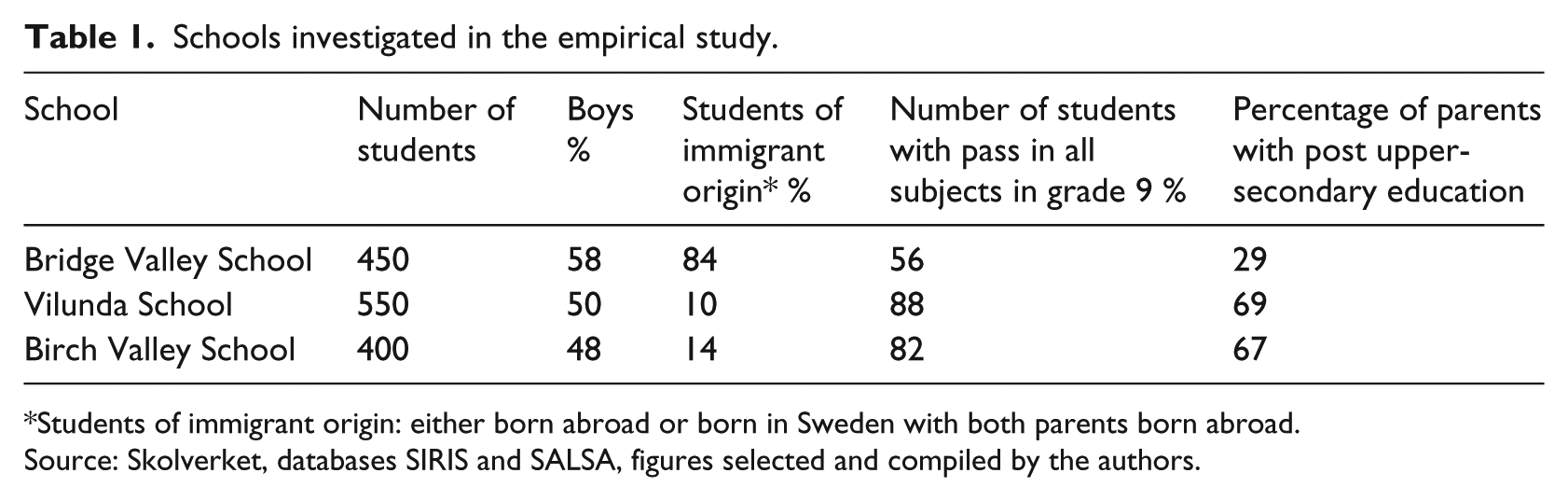
Students of immigrant origin: either born abroad or born in Sweden with both parents born abroad.
Source: Skolverket, databases SIRIS and SALSA, figures selected and compiled by the authors.
At each school, two classes (grades 7 and 9) were studied as they completed their everyday routines. Semi-structured interviews were conducted with students (aged 13–16 years), teachers, and other school professionals, as well as with parents living in the nearby area and parents from more distant areas who had enrolled their children at one of the three schools. In total 105 interviews were conducted: 53 with students, 40 with school staff and 12 with parents.
Fieldwork carried out by Anna Ambrose resulted in a collection of other materials, such as brochures, school web presentations, presentation folders, students’ work and extensive field notes. In this article, we have used only a small portion of that material: the voices of individuals, presented as quotations, represent the main pattern of responses identified in the data.
In our analysis, collected materials were organized into themes, such as:
Experiences at a specific school;
Rumors;
School reputations;
Experiences of being a student/teacher at a particular school;
Students’ own understandings of their achievements;
Teachers’ understandings of their students’ achievements; and
Future education and life expectations.
Themes were subsequently broken down into subsets, one of which was the relationship between schools, their urban spaces, and their reputations in the era of school choice. The results of this categorization are presented in the findings below.
Schools and urban spaces
Bridge Valley School is a public school serving students from age 6 to 15, located in the Bridge Valley area. This area was built in the 1960s as a part of the so-called ‘Million Program’, an initiative to build one million rental apartments in response to an urgent housing crisis in Sweden (Bunar, 2001; Ristilammi, 1994). Later, many of the new ‘Million Program’ areas, clustered at the outskirts of urban centers, would experience ‘white-flight’ (Wilson, 1997) of ethnic Swedes and the middle classes. As newly arrived immigrants and working-class people moved in, these areas became recognized as being segregated, deprived and dominated by immigrants. The objective structures of power relations between the residents of Bridge Valley and members of the surrounding society were thus reflected in the way the symbolic representation of the area had been constructed. The means for legitimate naming, as Bourdieu (1994) described it, are not in the hands of the local population. Today, more than 65% of Bridge Valley’s population has an immigrant background, compared with 30.7% in the city of Stockholm; moreover, approximately 35% of adults in Bridge Valley have a post upper-secondary education, compared with 56.4% in Stockholm. 2 The open unemployment rate is approximately 5%, compared with 3.1% in Stockholm.
When our informants were asked to describe Bridge Valley School, virtually all of them described Bridge Valley itself, citing poor neighborhood, a large number of immigrants, a large turnover of population and generally low status. These perceptions have profound consequences with regard to perceptions of the school (Bunar, 2001). The school’s status, achievement levels and finances have all been eroded by its poor reputation, its location, and the possibility of opting out through Sweden’s school choice policy. Ethnic Swedes and middle-class parents have almost completely abandoned the school. Families living in adjacent urban areas (having different social and ethnic profiles) who find themselves assigned to the Bridge Valley School through the catchment area principle use all means to avoid it. The principal of Bridge Valley School explains why:
There is a perception among many that this school, or generally schools in suburbs, where the number of Swedes is low…[some hesitation, our note]… there is a perception that ‘my children cannot go in a school like that’.
Catarina is a teacher at Bridge Valley School: she describes the school as follows.
Bridge Valley is a multicultural school with many great students and very dedicated teachers. Nice and polite, both teachers and students, everybody very social, socially competent, but there are many students with language difficulties. There are many languages, few Swedes, everything from newly arrived immigrant students to students born in Sweden – but with a non-Swedish background. Those born here with Swedish as their native language and a well functioning social situation, they go somewhere else. The great majority of those who are here with Swedish background, they are often from troubled families with social problems.
Vilunda School is an independent school serving students from age 6 to 15, and recruits the majority of its students from the surrounding area of Vilunda which was built in the 1940s to support local factories and their workers. Since the 1990s housing development has focused on building condominiums, which are mostly occupied by the middle class. This gentrification process (Bridge, 2001) effectively separated Vilunda from Bridge Valley, with the two areas objectively and symbolically developing in different directions. Vilunda is currently a middle-class area in which 70% of housing consists of privately owned condominiums. Approximately 20% of residents are immigrants and more than 60% of adults have a post upper-secondary education. The open unemployment rate is below 2%. According to our informants, Vilunda has a good reputation as a stable, Swedish and middle-class neighborhood; or as Ella, a 15 year-old living in Vilunda and a student at Vilunda School, expressed it: ‘It’s pretty nice here, not that much of a suburb, or not that kind of a suburb, it’s a nice suburb’.
When our informants described Vilunda School they often used words such as ‘traditional’, ‘quiet’ and ‘safe’. Rickard is a teacher at the school:
I believe that the average Joe has an image of this school as well taken care of, that it is orderly and tranquil, and that people are generally satisfied to have their children at this school.
During interviews with parents and students, the words ‘safe’ and ‘order’ were frequently used. Several of the students described the school as follows: ‘teachers do care and they want you to succeed with your studies’. Vilunda School is an oversubscribed school: not only are all places taken, but also there is a long waiting list (up to five years for some classes). Mårten is one of the school’s teachers; he ascribed this popularity to the structure of the school’s urban space.
What do you think are the reasons for such a long waiting list for this school?
It’s the catchment area. If you just go back a few years in time, there were not so many new residents here. It consisted mostly of parents 40 to 45 years old with small houses and kids of school age who needed a school and this school was here. They didn’t want to send their children to Bridge Valley.
Birch Valley School is a public school serving students from age 12 to 15, located in the Birch Valley area. Its history is similar to that of Vilunda: although it began as a dilapidated, working-class area it has become, over the last two decades, a stable middle-class neighborhood consisting of up to 75% privately owned condominiums. Approximately 21% of the residents have an immigrant background; in addition, 65% of adults have a post upper-secondary education and the open unemployment rate is approximately 2%.
Birch Valley School occupies a special position in the local school market. It is located at the outskirts of Stockholm’s upscale inner-city space, close to inner-city schools. Because it is accessible by public transportation, it is able to recruit students from a relatively broad geographical area. However, the school also faces relentless competition from many other public and independent schools. Thus, school professionals decided to position Birch Valley strategically in the local market by creating a special pedagogical profile oriented toward cultural activities. The school initiated an ambitious public relations campaign to inform prospective consumers – both locally and in their areas of Stockholm at large – about the special features of the school. Descriptions by our informants therefore mostly focused on the cultural curriculum. According to Maja, one of Birch Valley’s teachers, ‘you are allowed to be somehow different at this school’. The cultural profile means that art, music, film and creative work are included in the regular curriculum, permeating the learning of all subjects. Melanie, a teacher, describes the school as follows:
As a matter of fact, this is a pretty ordinary school in what can be called a white middle-class neighborhood. Now our catchment area is being extended more and more since both parents and students know they can apply to other schools.
Birch Valley School has, at various times, had a less favorable reputation, but this has been largely due to certain troublesome students and to questions about whether the artistic curriculum compromises the school’s academic rigor. Nova is 15 years old and a student at the school:
Birch Valley School has a reputation of being a school where the students just coast through (Swedish: lallarskola) – that’s what I heard anyway [laughs] and I can understand why. When I was about to start school, this school had quite a bad reputation. I think it has become a bit better, but it still has quite a bad reputation among teenagers.
So what are the rumors about?
I think it is because we are a school with a culture curriculum and people think we are doing shows and playing music all the time. When I started here, there was one class, a grade nine class, that was pretty rowdy. Many of those students had been in West School (Nova’s previous school) before, so I knew them and even I felt that if they were here I didn’t want to go here.
So it has the reputation of being a rowdy school?
I don’t know, but when I was out with the student council to promote Birch Valley School to other students in nearby schools, they thought that we had a lot of… Yeah, they thought we were growing hashish in school and so on [laughs], that you couldn’t walk past here without getting high [laughs]. I don’t know why, maybe it is because we have our special curriculum and are not seen as serious.
This brief discussion of the three schools and their urban spaces indicates that the objective structures of the local urban space condition the perceptions of schools in the local market. However, an important distinction must be made: the reputation of Bridge Valley School was almost completely dominated by perceptions of its urban space, while in the cases of the two other schools, middle-class and with largely Swedish populations, urban spaces were acknowledged as important but not definitive. In other words, urban spaces do not completely overshadow the schools’ internal practices, academics, and pedagogical profiles. It could be argued that Bridge Valley School and its internal practices have been rendered invisible by the symbolic weight of its urban space. What is it, therefore, that distinguishes Bridge Valley School from the other two schools in this study?
‘It’s all about immigrants’
I love Bridge Valley and I could live here for the rest of my life. People who live here, they are like my brothers, you get to know them all, if you are outdoors often. (Karim, 15 years old, student at Bridge Valley School)
Multicultural schools in socially deprived areas are often initially described in positive terms by their actors, including school professionals and students (Bunar, 2009, 2010; Schwartz, 2014). These actors often emphasize that the school itself, with its current student body, and in contrast to negative perceptions and rumors, is just another ordinary school. Bunar (2010) discussed these positive representations as a part of community discourse, firmly anchored in the positive relationships that the actors experience in their daily lives or daily work (Back, 1996), However, positive reports can also be a form of first-line defense (Sernhede, 2007), a preemptive reaction to the negative impressions that a visiting journalist or a researcher may already have. This is often related to the attitude of the surrounding society toward immigrants in general, which is assumed to be negative.
Rafya is 13 years old. She lives in Bridge Valley and is a student at Bridge Valley School:
This [is] a suburban school, not so many are coming that far, people graduate with good grades but because the school is located in a suburb, people think that it’s filled with suburban kids, who will never go anywhere. It’s only a matter of prejudice that we will not be able to go anywhere because we live in a suburb and because we are immigrants.
Dividing the population into two groups, Swedes and immigrants, might be dismissed as too general and too imprecise as an analytical instrument. Boundaries between these groups can be blurred. However, in lived local contexts such as Bridge Valley, Vilunda and Birch Valley, where physical proximity also entails lived and highly present multiculturalism and social diversity, there is a constant need for reinforcement of symbolic boundaries – or ‘borderwork’, as Thorne (1993) named it. In this context being labeled as a Swede or an immigrant is not just a matter of identity or ethnicity: it extends beyond that. These labels contain powerful narratives about what is required in a ‘good’ school, including acquisition of proper language, social norms, strong networks and good grades. Students of immigrant origin living in Bridge Valley who enroll in schools such as Vilunda and Birch Valley are recognized as ambitious; they are regarded as having parents who care and are generally ‘like us’ (Butler, 2003; Ladd et al., 2009). Those left behind are the subject of the negative discourses often applied to immigrants in general; they are seen as having poor language skills and low educational standards.
Zarah is 15 years old, living in Vilunda, and a student at Bridge Valley School. She confirmed that the basic division between schools is based on perceptions about Swedes and immigrants; schools with Swedes in the majority are rewarded with good reputations.
I mean if there is a school nearby that has lots of immigrant kids and that the newspapers are describing as chaotic – it’s not a bad school or anything but there are just many migrant kids there – then Swedes will send their kids somewhere else. Then, you wonder why Swedes go to one school and migrants to another. You can blame the school, but it is more the students. Or you can put it this way: my mother has lots of friends who say ‘it’s not that migrants are bad in any way, but if there are lots of them in a school, I wouldn’t send my daughter to that school’.
This sharp observation echoes statements made by parents who live in Bridge Valley but had decided to send their children to schools in other neighborhoods. Maggan is a mother of four, middle-class and of Swedish origin. She said in an interview: ‘And if I’ll be brutally honest, both Bridge Valley School and Sor Valley School here, they are simply not good enough’. What makes these schools ‘not good enough’ is something that caused Maggan to reflect. What she meant was that Bridge Valley School had many students with social difficulties and language deficiencies, as well as many newly arrived students.
It’s like I said, you come to the core dilemma here, ok, how is it supposed to be better in such a school when all who are Swedes or with good education, you know these parameters, if all those parents decide to put their kids somewhere else? And that problem, you realize, and you think it’s horrible actually, but you don’t want to sacrifice your children at that altar… And if, ok, that’s the point with school choice, in a way it aggravates school segregation and on the other hand it doesn’t, since you still have the possibility to live here. Had that opportunity not existed, more people would have moved out of these areas and then there would be more segregation.
In the school marketplace competition, Vilunda and Birch Valley Schools are winning and Bridge Valley School is losing. Following the establishment of the local school market, more than 50% of Bridge Valley’s students have opted out, enrolling in other public and independent schools; and grades and reputation have plummeted. Nonetheless, the school’s professionals are far from lacking in hope. They have been creating new pedagogical profiles (emulating more successful schools), forging networks with businesses (Dahlstedt and Hertzberg, 2011), and have been recognized for their work many times in local and national media. However, as is evident from the accounts above, it appears that this is not enough. Bridge Valley School – and its position in the local school market – are virtually chained (Gulson, 2011) to objective power relations between its geographical location and other parts of the city. The school and its reputation are also chained to symbolic power relations (distributions of symbolic capital) that define the location and the school as immigrant-dominated. This definition encompasses a negative narrative about immigrant children in education, portraying them as social misfits with disengaged parents and language deficiencies. The defining principles of school choice allow objective and symbolic relations to be driving forces in shaping the configuration of school markets, locally and nationally (Ball, 2008; Ball and Vincent, 1998). It is not surprising that these forces have combined to contribute to increased ethnic and social segregation, as shown in a number of other studies (Gustafsson and Yang-Hansen, 2009; Östh et al., 2012).
Choosing (the right) school
Schools, and especially perceptions of schools, are lively topics in the informal local discourses in all three neighborhoods. However, how is knowledge about schools acquired? Patrick is a parent who lives in a neighborhood with a high percentage of immigrants. He had decided his child will apply to Birch Valley School:
From newspapers and word-of-mouth, I believe. It’s like, you meet in the park or on the way to or from work, and you hear something negative about a school. It might be that three or four families don’t choose that school. It is not a scientific investigation or anything – much more arbitrary, actually.
Many of our informants mentioned media accounts and school rankings as sources of information, but others found these sources to be distorted and unreliable. The head of a local educational authority stated it thus:
Yes … the parents see the statistics in Expressen [daily tabloid], you know, ‘how good is your school’ … and they read the articles and yes … ‘That wasn’t good, and that wasn’t good.’ They do this because they don’t really have the energy or the expertise to look behind the figures.
Even among parents who claimed to make their school choices based on ‘cold knowledge’, information was often acquired secondhand, typically from superficial media accounts of school rankings or, in Patrick’s words,
Yes, but now, it doesn’t work like that. People don’t choose the school that is the best, they choose based on what the media writes about the school. Believe it or not, people actually look in the papers and read the grades and measurements: how schools are graded, and so on. That’s why Birch Valley School gets so many applicants – it is rated highly.
Maggan is another parent who decided her child would opt out of Bridge Valley School:
It’s funny. If you go to a party during one period of your life, the talk is all about, ‘Where do you live, and how did you get that apartment?’ And then you get kids and the talk about school starts. And that has just escalated. Every person I meet says something about ‘we have put our son on the waiting list for the English School’, and it could be kids who have barely started kindergarten. It has really intensified; people think about it a lot.
Some parents invested considerable time and energy in finding the right school. Tess, a parent with a child at Vilunda School, who also lives in Vilunda, explained how the need to stay informed had amplified, leading to more work and stress:
Yes, I thought about that at the time. I thought about how much time I spent altogether on all the conversations and communications with schools. I would say it was a total of around two full-time work weeks. I don’t think that is overestimating – if anything, it is an underestimate.
In interviews, parents described pressure to choose or at least to consider a school other than the one to which they are assigned. According to Butler and Hamnett (2007) (see also Taylor and Woolard, 2003), the notion of ‘good parenthood’ has changed in recent decades, demanding that parents expend more effort preparing their children for the future. Choosing the ‘right’ educational environment is seen as a requirement and also gives the parents a sense of being engaged and responsible. Today, good parents must not only observe the academic quality of their children’s school but also use formal and informal channels of information to learn about the school’s reputation and possible changes in the student body.
Reputation has a decisive influence on a school’s ability to uphold its position in the local market. At Bridge Valley and Birch Valley Schools, both principals argued that their reputations at the local grocery store helped determine how their schools were perceived. Roger, the vice principal of Bridge Valley School, explained:
We think we know, even if we aren’t sure, that much of the reason for students or parents choosing this school is based on what people say at the local supermarkets or corner stores.
Bosse is the principal of Birch Valley School, which has also occasionally struggled with a bad reputation. He cites the local grocery store as the place where the problem started:
There was some mother talking in the line at the supermarket, and then a whole bunch of students switched to a school in downtown. It was enough that someone said ‘it is rowdy at Birch Valley School, so you don’t want to go there’ and then people started to doubt the school.
It is interesting to note the fragile nature of a school’s reputation. Among the school professionals interviewed in our study, there was a strong feeling that a bad reputation, even if false, would spread more quickly than a good reputation. Moreover, it is extremely difficult for a school to shed a previously acquired bad reputation.
However, there is a difference between Birch Valley and Bridge Valley schools with regard to the sources and contents of their reputations and their abilities to improve public perceptions. While Birch Valley School’s reputation is strongly linked to certain occasions/students and even to its cultural curriculum – and from year to year, this reputation has varied from good to bad to good again – the reputation of Bridge Valley School is strongly linked to its neighborhood and its student body. Bridge Valley’s reputation has also been more or less constant for many years. The ability to ‘repair’ Bridge Valley’s reputation is completely dependent on the perceived quality of its community and location. Thus, Birch Valley was able to improve its reputation (even though its community is widespread, due to the broad geographic area from which it recruits students), but ‘immigrant dominated’ Bridge Valley was not. Stated simply, Birch Valley School has sometimes weathered a bad reputation, while Bridge Valley School is considered to be a bad school in the local market.
What, then, constitutes a good school?
To parents, a good school is an arena in which their child will have the opportunity to interact with children from socially strong and ethnically Swedish families on a daily basis. These two categories are perceived as providers of strong networks, correct cultural values, correct Swedish language and a strong internal school culture prioritizing learning and academic success (Bunar, 2009). Sara (living in Vilunda with children in Vilunda School) and Maggan, two parents, stated it as follows:
You want to give your kids the best opportunities in life and get them into the right networks. So it was that kind of decision that made us choose to create the right opportunities from the start.
I think that many parents think like I do, that you should create a good start for your kids, the right networks and so on. And it is really good to send your kids to a school where the kids are from the same background as yourself.
In parents’ discourses, choosing the right school is strongly linked to perceptions regarding which student populations will provide strong networks. It was rarely noted that parents’ efforts to place their children in schools with strong networks were influenced by the hope that their children would develop life-long friendships which, ultimately, might benefit them in the labor market. It was more about the parents’ perceptions of what constituted the right learning and socializing environment for their children; and this concern reflects society’s power relations and the dominance of certain discourses regarding right and wrong (language, social norms) and on the higher and lower statuses of particular ethnic groups and classes. Thus, the discourse about networks is nothing other than an empirical example of Bourdieu’s concept of misrecognition (Bourdieu, 1977), a notion that explains how certain things are taken for granted to conceal their true nature.
‘What if we don’t get a place in the right school?’ – stress and anxiety
It was apparent that there was a feeling of anxiety among parents, in particular those from Bridge Valley and its adjacent neighborhoods, about whether they would be able to enroll their children in the right schools, with the right students and good reputations. Reay et al. (2011) identified a similar pattern among middle-class parents in their empirical example from the UK, asserting that ‘the dominance of neoliberalism and the increased emphasis on educational credentialism has intensified parental anxieties about the consequences of not making educational choices for their children which might be seen as indicative of being a bad parent’ (Reay et al., 2011: 101).
The principal of Birch Valley School observed this dynamic in the relationship between Bridge Valley School and the Viken School. Viken is a neighborhood adjacent to Bridge Valley and is renowned as an upscale Swedish area with expensive villas.
Look at differences between the Viken School and Bridge Valley School. Although they are located maybe 600 meters from one another geographically, Bridge Valley School has 80 percent immigrants and Viken School 5 percent at most. And when parents from Viken neighborhood learn that they live within Bridge Valley School catchment area they become completely desperate and absolutely don’t want their children to go there.
Per lives in Bridge Valley and is the father of two school-aged daughters. He wanted his daughters to enroll in Viken School, but the local school authority assigned them to Bridge Valley School:
When they were about to start school, they had been in a kindergarten in the Viken so we really wanted them to start in the Viken School. It was partly because of their friends but also because we knew it was a good school. It ended up becoming a court case, because we said that the proximity principle should be applied in a different way. Even if we lived here in Bridge Valley, we are closer to Viken School than to Bridge Valley School. But they said that the proximity principle follows the district border and not the geographical distance.
Per used a different strategy to prevent his daughters from enrolling at Bridge Valley School. He enrolled them in one of the independent schools in the local market. Per’s interview is important for understanding the links between perception of an urban space and perception of the urban space’s local schools. Per argued that he was not in fact against Bridge Valley School but, rather, that he did not want his daughters in that (Bridge Valley) neighborhood. The invisible administrative boundaries drawn by local authorities are a source of constant anxiety for many parents, since very few know on which side of the boundary they live: the ‘right’ side or the ‘wrong’ side.
Sara, a parent with a child in the independent Vilunda School, explained what happened when her oldest son was about to start school.
We got on the waiting list, yes … but we were guaranteed a place because it was our local school. Other families who lived on the other side of the motorway weren’t guaranteed a place, so they were also on a waiting list, and there was a lot of talk about that. They were worried about not getting a place and it felt strange when we all went to the same kindergarten but all the children might not get to go to preschool class together like they wanted. They all got places in the end … I think they even did some sort of special arrangement so everyone could get in. They phoned up and spoke to the principal and applied some pressure.
This juncture is where the notion of good parenthood – combined with self-confidence and strong networks – is at its most powerful. Some parents have the ability to understand the ‘rules of the game’ (Bourdieu, 1994) and to negotiate directly with principals to secure places for their children in their desired schools (Gewirtz et al., 1995; Kallstenius, 2010; Reay, 2004). However, not all parents can exercise this form of agency or exploit fully their rights as citizens. This is particularly true for immigrant parents or those with limited education, and ultimately it leads to an uneven playing field in the local school market (Ball and Vincent, 1998; Taylor, 2001). Furthermore, parents in certain networks share informal knowledge regarding schools where negotiating for a place may be feasible. Tess, who lives in Vilunda, explained how this worked in her case, when she learned the most desired school could not grant her a place.
But at Linden School, they put me on a waiting list and he [the principal] promised us a place. We were VERY enthusiastic. We felt that our chances for Vilunda School were done, and we also thought that Linden School felt like the best and really the only alternative when we excluded all the others, based on Ellinor’s wishes and travel requirements. Then, I heard nothing, nothing. So I called and he said: ‘No, Nysatra School is taking up all the places’. So then I got worked up a bit [laughs] and said, ‘That is not fair, because you promised her a place. You said you could fix it’. After that, he got back to me and said ‘Yes, I have now fixed a place for her’. That didn’t really feel completely right, a bit ad-hoc. We didn’t get a place at Vilunda School – you hear rumors that you can nag your way into Vilunda, but I am not sure if I believe them. I don’t want to believe it, and I haven’t seen any evidence. I think it is a rumor among the children.
One of the defining principles of school choice is fairness: the admission process is supposed to be transparent and non-discriminatory. All parents and students are – in theory – granted the same right to choose a school, regardless of their economic status. Furthermore, the policy is based on the principle that all parents have equal access to information about their school options and about the mechanics of the choice itself. In practice, however, the choice is conditioned and framed by parents’ links to informal networks which share information about which schools are considered ‘good’ and which are considered ‘no-go-schools’ (schools that should be avoided even if the family lives in the catchment area). School choice – perceived as an investment in a child’s future and linked to changing notions of good parenthood – fuels middle-class anxiety and leads to mobilization of cultural and social capital (Ball et al., 1996; Reay et al., 2011). This capital takes the form of knowledge of the system and how it can be negotiated and ultimately it leads, in its practical consequences, to a pattern of increased school segregation. This is not because schools with a relatively large number of immigrant children are worse per se, but because these schools do not appear to be suitable environments (misrecognized by parents as networks) or stable structures for the reproduction of social, cultural and economic capital (Bourdieu and Passeron, 1977).
Concluding remarks
This article has sought to explore how urban spaces, polarized by class and ethnicity, structure the basic conditions for emerging local school markets. We have explored how the distribution of symbolic capital – ‘hot knowledge’ of the market – is distributed in urban space, and how it affects schools, the market and the urban space itself. Guided by theoretical approaches to lived local school markets, competitive spaces and symbolic capital – and based on thorough fieldwork in three compulsory schools (constituting a part of a local school market) in Stockholm – we have highlighted important relations between urban space, school choice, the main actors’ perceptions of these relations, and the actors’ subsequent positioning in the local market.
School choice policy, despite nationally defining principles mandating fairness, transparency and integration, is being implemented on an uneven playing field. Local school markets are constructed in mutually created and perpetuated social and symbolic structures within urban spaces in which positions have already been taken or acquired or assigned (Bourdieu, 1994). The Million Program, immigration, troubled Swedish families, bad reputations, and ‘white-flight’ neighborhoods were present well before the school choice policy became a real option, as were stable, middle-class, white, Swedish, neighborhoods with good reputations. Neighborhood borders and the student populations (i.e. networks) in local schools were already protected by high real estate prices. School choice was intended to be an additional instrument in student allocation, attempting, to a certain extent, to disconnect schools from their urban spaces. What has happened instead is that aggravated housing segregation and newly porous boundaries have increased the need for symbolic borderwork (Thorne, 1993). School choice policy has been captured and adapted to the objective and symbolic power relations between urban spaces and their schools (Gulson, 2011; Taylor, 2001). Thus, school competition in polarized urban spaces is not primarily about whether the curriculum emphasizes culture or sport, it is not about which school has better relations with businesses, and it is not even about the reputation of some of the schools’ students. It is ultimately a competition between locations and between social groups over the symbolic power of legitimate naming and labeling, as Bourdieu (1994) stated it; and it is a competition over the key instrument in the social and cultural reproduction of society, the school itself. In this context, it seems naïve to regard school choice as the freedom of each parent and student to choose the school which, pedagogically, best suits their interests. Much deeper issues are at stake and much stronger forces are defining the scope of individual possibilities. Many parents interviewed in our study explained that they avoided the ‘immigrant’ Bridge Valley School because it did not offer the right network(s) for their children. Being part of the right network, and what it represents, is recognized as preserving an environment in which certain social groups, and their culture, values, norms and aspirations are dominant (Ball and Vincent, 2007). If necessary, some families will exercise their school choice/exit option to find such an environment.
Segregation in housing and education in contemporary Swedish society is not a problem perpetuated by ethnic minorities. Minorities are not trying desperately to congregate in their own neighborhoods and schools. Rather, it is a white middle-class problem, fueled by desperate need and anxiety about living in the right neighborhoods and having one’s children in the right schools. Recently established independent schools, such as Vilunda, might consider these divisions when looking for new locations, building their reputations, and disseminating messages to parents which may – intentionally or otherwise – discourage some from even applying (Bunar, 2012). By solidifying their positions within the existing objective and symbolic power relations in urban spaces, independent schools have contributed to aggravating divisions between schools perceived as ‘good’ and ‘bad.’
How is this possible? At the individual level, parents adhere to the legitimate exercises and standards of ‘good parenthood’ that are grounded in the unacknowledged normality of the middle-classes (Savage, 2003). At the structural level, a wide-open school choice policy actually allows segregation to deepen. A more restrictive or controlled school choice policy with greater accountability may be able to ameliorate this situation in the future. This is an important lesson, calling for an urgent reframing of some of the current policy’s nationally defining principles.
Footnotes
Funding
The author(s) disclosed receipt of the following financial support for the research, authorship, and/or publication of this article: This research has received grant from Swedish Research Council dnr. 721-2010-2069.