




Abstract
Having been on the agenda in Finnish policy-making for a decade, tuition fees for students outside the European Union and the European Economic Area became reality in the beginning of 2016. Drawing on institutional theory the current article tracks this development through the analysis of documents and interviews on different levels. The argumentation on the top level more strongly reflects internationalisation as marketisation, whereas on the grassroots level the focus tends to be on internationalisation as the reorganisation of traditional academic activities. Similarly, whereas national-level discourse shows more concern about global competitiveness, departmental logic focuses on integration, academic communication, studying and the curriculum.
Introduction
On the national level, the discourse of internationalisation in Finnish higher-education policy has carried a strong marketisation message, suggesting that the main purpose of universities is to uphold national competitiveness in the global environment (Nokkala, 2007). Internationalisation has been a government aim since the 1980s, connected to the ideas of global competitiveness in the 1990s and marketisation in the 2000s (Kallunki et al., 2015). Our aim in this article is to further analyse how internationalisation is linked to marketisation at different operational levels. Our specific focus connecting these two aspects is the policy process leading to the Government Bill (77/2015) and the Law (1600/2015) that introduced a minimum of €1,500 tuition fee for international students coming to Finland from outside the European Union (EU) and the European Economic Area (EEA). Our analysis cuts across the different levels: policy-making; governance; university; and department. We, like Faist et al. (2010), are interested in the effects of transnational processes and national governance on institutional transformation. Our main focus is on the kind of changes that take place on these different levels and how they relate to each other.
Finland has been active in co-operating with international organisations. The relationships have tended to be more governance-pragmatic than political-ideological (Kauko, 2013). For instance, the Organisation for Economic Co-operation and Development (OECD) has been used for kite-flying purposes; in other words, as a device for externalising decision-making (Kallo, 2009; see Schriewer, 2000). In this sense Finland tries to be both a model and a model pupil (Naumanen and Rinne, 2008: 362). On the European level, the Ministry of Education portrays itself as being in active partnership with its European counterparts, whereas nationally it pays less heed to those working and studying in the universities (Saarinen, 2008). Indeed, recent reforms in Finnish higher education, like most reforms since the ‘globalisation shock’ (Välimaa, 2010) of the 1990s, have two things in common in the reasoning behind them: they are based on the notion of a higher-education market, and they seem to be guided by international examples and trends.
Regardless of the external impulses affecting higher education, some of which are internally incited, and of the Finnish marketisation discourse and the strong connections to international actors, proponents of neo-institutional theory suggest that the historical path-dependency (Pierson, 2000) or social conventions (March and Olsen, 1989) inside an organisation shape its reactions. It is posited in a study on Finnish education policy-making that university as an institution is closely linked to the state, and that education policy-making has been traditionally rather consensual (Kauko, 2013). In this context, universities assume the role of both an ‘instrument for national political agendas’ and an academic ‘community of scholars’ (Olsen, 2007: 30). The friction between these two roles is embedded in the basic university structure as a combination of top-down governance and bottom-up academic leadership; a gap that has become wider since the managerial reforms of the 1980s and 1990s (Fumasoli et al., 2014). In other words, the relation between politically motivated reforms and a bottom-heavy organisation (Clark, 1983) forms the core of the conflicts in the reformation of universities in Finland, as elsewhere (see Cerych and Sabatier, 1986).
This embedded conflict also has an effect on internationalisation, highlighting the limitations of the top-down approach. Knight (2004), for instance, understands internationalisation in terms of dynamic interaction between top-down national and bottom-up institutional levels. Another investigation into Nordic universities revealed structural similarities in political design, and differences in every-day practices on the grassroots level (Stensaker et al., 2008). Some of the implementation difficulties could be attributable to different understandings of internationalisation (Stier, 2004: 1), but in general there is not much research on the implementation process (Brandenburg and Federkeil, 2007).
The current research material was originally collected in connection with two independent projects and then analysed more specifically for the purpose of this article. One of the projects focused on the dynamics of higher-education politics in Finland based on policy-maker (university rectors, politicians, officials and different stakeholders) interviews conducted in 2008 and documentary material (see Kauko, 2011). Further documentary material was collected to bring this research up to date. The other project concerned the practical aspects of internationalisation in international Master’s programmes and was based on analyses of relevant documents and interviews (conducted in 2013–2014) with teachers and students on international Masters’ programmes, as well as field notes from events in which higher-education politics and planning were discussed. The project involved three universities from the capital region and other parts of Finland, all of which had an active internationalisation programme. The differences were in location, the numbers of international students and status. In addition, for this article we conducted a discourse analysis of recent university strategies and interviews focusing on conceptualisations of internationalisation and the context that is built around it. From the interviews we identified key themes related to internationalisation that spanned these two independently collected sets of research material. The research methods applied in the two separate projects are further elaborated in the original research reports, but for this article the analysis roughly followed the lines of critical discourse analysis: first separating the main focal areas, then contextualising this with other discourses and finally positioning it in larger societal themes (see Fairclough, 1992). It should also be noted that study participants were not asked to evaluate internationalisation performance and thus, the interviews cannot be directly linked to the assessment of internationalisation.
In the following we first examine internationalisation discourse on the national policy-making level, focusing especially on how it links to the ideas of globalisation and competition. Moving on to governance solutions, we point out how internationalisation has rather recently become tied more closely to financial solutions and indicators in the governance of universities. Then we turn our attention to the universities and their strategies, and the extent to which they adopt the idea of internationalisation as a means of succeeding in global competition on the policy-making level. Before presenting our conclusions we analyse department-level views on internationalisation and reflect on the capacity of these established practices to sustain further marketisation.
Global competition at the policy-making level
Quite out of the blue, at the turn of the 1990s, Finland was struck by the combined effect of an economic depression and the simultaneous collapse of the neighbouring Soviet Union, which had been an politically demanding but economically profitable partner. Fortunately for Finland, further opening up towards the West coincided with a foreign-trade-led economic boom fuelled by the rise of the information and communications technology industry in the late 1990s. Välimaa (2010) describes this rapid change as a ‘globalisation shock’ that was triggered by these external developments, affecting Finland’s international position and also signalling change in the higher-education system.
The first indications of the growing influence of this international interplay came to light in the late 1980s. The Ministry of Education (MinEd) and the Science and Technology Policy Council (STPC) both raised internationalisation as a major area of development in 1987, but thus far the emphasis was on research co-operation (Nokkala, 2007; STPC, 1987). Three years later, both organisations embraced the need for better competitiveness for the sake of the national economy (MinEd, 1991: 24; STPC, 1990: 18). The full force of the ‘globalisation shock’ was evident in documents compiled during the economic depression. Research aimed at improving economic competitiveness was emphasised at the same time as the budget was slashed: ‘The research in higher education institutions will be focused in a way that it will support efficiently the rise of internationally competitive industry in Finland’ (MinEd, 1993: 13). The economic depression started to ease after the mid-1990s and there was no need for further belt-tightening, but international competition in the globalised context remained firmly on the national agenda. The national plans for educational development followed this idea (MinEd, 1996: 8–11, 1998: 10), and it was eventually carved in stone when the new university law set the achievement of a high international level as a major objective for universities (Law 645/1997).
Finland strengthened its relationship with the OECD, whose information MinEd described as ‘state-of-the-art data in comparing education systems’ (MinEd, 1994: 4). Another significant change in organisational relations at the international level was the joining of the EU in 1995, which was perceived as a watershed according the interviews with policy-makers:
Well, it’s clear that European Union membership was a big change in many ways. Compared to the 1970s and even the 1980s – [when] we had the life of an idyllic nation state here. (Official) Then again this whole EU integration, going to the European markets. All this in a way created demand for all the [science and technology] supply that was built. (Politician)
Integration into European educational structures was further strengthened through the Bologna process. The Bologna declaration was signed in June, just before the Finnish EU presidency in the latter half of 1999. The interviewees reported how it was thought that the country about to assume the presidency could not opt out, more so because ‘everyone else had signed’ (Official).
In the wake of increasing international co-operation, national education policies reflected the international discourse of education governance, although with a strong sub-discourse of the imagined challenges of global competition. As above, this argument is evident in the national policy documents, often expressed in the positions of the policy-makers and administrators (Krejsler et al., 2014). The interviewees in 2008 shared a strong common discourse on the tightening international global competition, and on the important role of universities in this process (Kauko 2013; 2011). From the perspective of this research it is interesting that the national university elite – politicians, officials, stakeholders and rectors – shared a similar mind-set and language regarding the biggest challenges in education. One politician summarises the general discourse in the interviews from 2008:
I think globalisation is the number-one issue, it is not a new thing as such, but in its present form and connected to this information revolution, it has been the biggest and the leading factor, an implicit factor, but its influence has been massive. (Politician)
On the level of argumentation, as pointed out above, globalisation is constantly used as a way of showing the discrepancy between the national situation and international trends. Different university policy documents from the 2000s point out how ‘globalisation’ and global competition was used as an all-encompassing reason for many proposed, and later realised, reforms: establishing Aalto University (MinEd, 2007), reforming the legal status of universities (Government Bill 7/2009; Kallo, 2009; Kauko and Diogo, 2011), promoting innovation (Government, 2007) and amalgamating institutes of higher education (MinEd, 2006). More interestingly one of the key aspects of this change was the strengthening demand for university internationalisation (Kauko, 2011, 2013). We turn our focus in the next section to the reforms that were specifically linked to internationalisation and point out how they became part of the everyday governance of Finnish universities.
Governance tools: tuition fees and incentives
Recent structural reforms in Finnish higher education have extended the financial autonomy and responsibility of universities and highlighted indicators in national steering. However, Finnish universities receive most of their income from the state, which makes funding an important steering tool. Indeed, financial autonomy comes with the increased managerial control (De Boer, 2002: 44). In tandem with the discussion on global competition, internationalisation as marketisation has also become a more important concrete goal for Finnish universities. This has happened via two processes, both connected to university funding. The first process involved changing the funding formula to support more internationalisation, and the second concerned the imposition of tuition fees on students from outside the EU/EEA area, which was also eventually seen as compensating for budget cuts.
The importance of internationalisation had been emphasised for a long time before a concrete step was taken to enhance it in 2012 with the reform of university funding. The memo ‘High-quality, profilised and effective international university’, written by a group of ministry officials and university vice-rectors and officials, drafted a new funding formula. The authors saw the lack of internationalisation as a weakness in Finnish universities. Together with effectiveness and quality, internationalisation was among the three main pillars of the new funding model (MinEd, 2011).
The change was visible in that the 2009 university funding formula indicators related to internationalisation would cover 4.1 per cent of the total funding, including teaching-related indicators such as exchange-student periods, the inclusion of study credits for courses taken in a foreign language or abroad, and the numbers of foreign degree students. On the research level, the indicators covered international refereed publications, and acquired international funding and staff mobility. In 2012 the indicators related to international activities amounted to 18 per cent of the total amount, but quickly fell back to nine per cent in 2014. This sudden change is related to research-based indicators. In the 2012 model the number of international refereed publications would attract nine per cent of the total funding, whereas other publications would have a four per cent share. These two categories were amalgamated in the 2014 model, and the push for international research publications became implicit. The rest of the research-based indicators in the 2012 and 2014 models focused on acquired international funding, numbers of foreign teaching and research staff, and the number of foreigners finalising a PhD degree. The teaching part would have the same element as in 2009 focusing on exchange students, and a new element related to the number of Master’s degrees awarded to foreign nationals studying in Finland (Table 1).
The influence of internationalisation indicators on universities’ basic funding (per cent per year).
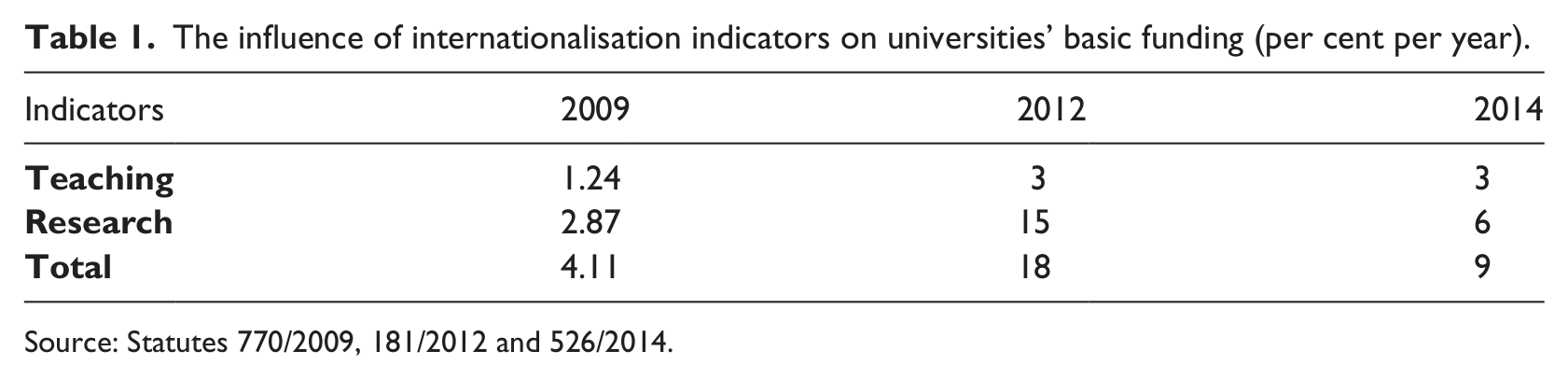
Source: Statutes 770/2009, 181/2012 and 526/2014.
As indicated in Table 1, the bigger change towards incentivising international co-operation in the university-funding formula is through research. This is enhanced by the fact that some highly ranked international journals are emphasised in the formula. With regard to teaching, one of the key means with which the current centre-right government (2015–) plans to support marketisation is via the introduction of tuition fees for students from outside the EU and the EEA. The historical roots of this decision go further back, but the marketisation connection started in the new millennium (Kallunki et al., 2015).
It was suggested in an evaluation of the Finnish education system carried out by an expert group in 2002 (Temmes et al., 2002: 38) that tuition fees be introduced for international higher-education students if the universities became more autonomous, although it was noted that the majority of people interviewed for the report did not approve of this on ideological grounds, for instance (Temmes et al., 2002: 52). 1 A similar phenomenon was observed in a recent study: the basic argumentation on the tuition fee question was between economics and equality, and in both groups there was strong reasoning for and against (Pulkkinen, 2014). A little later on, a working group comprising ministry officials, and university rectors and officials proposed the imposition of tuition fees for students from outside the EU and the EEA (MinEd, 2005). Without further elaboration, the report describes the opportunity to introduce fees as an incentive for higher-education institutions to enter international markets (MinEd, 2005: 28). The same idea of incentives is reflected in a reference to an earlier OECD report (MinEd, 2005: 25). It was also pointed out that tuition fees might result in the cutting of higher-education budgetary funding and it was stressed that this should not be the case (MinEd, 2005: 28, 30).
The time was not yet right. Promoters of tuition fees for all students refer in the interview data from 2008 to the ‘world-class universities’ that have them. However, various interviewees shared the view that tuition fees remained a sensitive subject, almost a taboo to politicians, given the influence of the strong and politically connected student union and the opposing public opinion. One of the interviewed politicians felt the pressure from the student union: ‘They’re on to you like hornets, but you understand because the issue [of tuition fees] came up’ (Politician). In any case, the question has assumed increasing importance on the policy-making agenda since the 2008 interviews.
One contribution to this heated debate came from the OECD, supporting Kallo’s (2009) argument of using international organisations as a means of externalising decision-making on flammable issues: ‘Finland has been evaluated many times by the OECD. I’ve been participating in those country reviews as well. And they’ve given advice. Usually Finland has followed it, except for one thing: tuition fees’ (university rector). In the light of the above quotation, the effect of the OECD on Finland remains open to question, but it is evident that legislative reforms in Finnish higher education have followed an OECD country or thematic review (Kallo, 2009). The introduction of tuition fees for students from outside the EU and the EEA followed the same pattern.
An OECD review team visited Finland in 2005 and recommended the introduction of tuition fees for international students. In its 2009 report the team concluded that Finland would not be a major player in global markets due to ‘location, weather and language’, but that the universities and polytechnics would gain ‘stronger inducements and more substantial resources with which to engage in the targeted and selective recruitment of non-EU/EEA students and assisting funding other activities at the university through cross-subsidy’ (OECD, 2009: 87). This view is very close to the one put forward in the MinEd report from 2005 (MinEd, 2005). In 2009 the MinEd launched a four-year ‘pilot project’ for collecting tuition fees from these students (Law 558/2009; Statute 1307/2010. The reasoning behind the project is fairly similar to that in the OECD report: ‘The purpose is to enhance the internationalisation of the institutions and create new opportunities for international action’ (MinEd, 2014a). A politician interviewed in 2008 used almost identical language, describing tuition fees as an incentive for the further development of the higher-education system:
And if I think of this internationalisation, I have become more and more confident that a tuition-fee system built up in a smart way would be a very good thing. … The most important thing is not collecting the money, but creating incentives, which the university system desperately needs: incentives for getting foreign students to Finland and incentives to do degrees at a fast pace. (Politician)
A government education-export strategy was incorporated into a working-group memo indicating that tuition fees would lead to increased opportunities for educational export and enhanced higher-education resources, for instance (MinEd, 2010: 27). It was further argued in a MinEd memo (MinEd, 2013: 13) written by a three-person group (an MP, a university official and a high ministry official), International education markets and Finland, that the current fee-free system could not support the growing number of foreign students in an environment of cuts in public funding. Instead of seeing tuition fees for students from outside the EU and the EEA as a route to internationalisation, it refers to their banning as a home-built obstacle to entering education markets. The memo stresses the need for long-term commitment to building a role in international educational markets. In addition to addressing questions of competence and co-operation in and between higher-education institutions, the memo notes the inadequate separation of normal and business operations in educational institutions.
According to the 2014 MinEd evaluation of the pilot project, 43 degree programmes, compared to 27 in 2011, participated in the tuition fee trial, collecting fees of between €5000 and €12,000. Most of the income was reportedly used for implementing and developing education. The effects in terms of internationalisation were considered rather minimal, focusing especially on marketing, quality and education as business (MinEd, 2014b: 30). The higher-education institutions reported little financial effect (MinEd, 2014b: 23). With limited data, the report was careful in drawing definite conclusions, but put forward a general view of the perks of the tuition fee trial as ‘pondering and developing many aspects important for international programmes’ (MinEd, 2014a: 30).
The OECD and Finnish politicians share a strikingly similar mind-set on the question of tuition fees for students outside the EU and the EEA. Their introduction is seen in this discourse as a good way of supporting internationalisation. The internationalisation discourse is also economically biased in the assumption that charging a fee would make the studies more attractive, and that the proceeds would provide more resources for attracting students. The MinEd’s memorandums after 2005 bring out a more nuanced picture in pointing out that the tuition fees would probably not show a profit for many years, and do not suggest that the fees as such would act as an incentive for coming to Finland.
The six-party coalition government withdrew its bill (Government Bill 308/2014) on the imposition of tuition fees for international students. One of the secretaries of state pointed out in public that the government was divided internally on the matter (Yle, 2014). The situation changed in the hands of the new centre-right government, formed after the 2015 elections, which described Finland as being in a ‘spiral of decline’: ‘competitiveness has deteriorated and is 10–15 per cent weaker than of our key competitor countries’ (Government, 2015b: 8). As part of the public-sector cuts, higher education also faced budgetary cuts of around €300m. In this context tuition fees were seen as one way of generating income for the universities (Government Bill 77/2015). However, the Government Bill 77/2015 follows the same reasoning as that of MinEd, seeing the law as dismantling obstacles to marketisation but also foreseeing possible difficulties in attracting students in the early stages, and even seeing difficulties in the internationalisation of universities that already have many students from outside the EU and the EEA.
Interestingly, tuition fees were discussed under migration policy in the original government programme, the emphasis being on encouraging students to stay in Finland (Government, 2015b: 41), whereas it is now one goal in one of the 26 key projects in the education sector: ‘Cooperation between higher education institutions and business life will be strengthened to bring innovations to the market’ (Government, 2015a). Within this programme, tuition fees are not mentioned in connection with internationalisation, but only in terms of dismantling export obstacles (Government, 2015c).
In sum, with regard to the policy-making and governance-level analysis, the market argument is prevalent in the internationalisation debate, positing, for instance, that the key to succeeding in international co-operation lies in drawing up long-lasting policy programmes focusing on profiling and larger institutional entities (see Kauko, 2013). The overarching reason for more internationalisation is the increasing global competition, but the argumentation has slightly changed. Whereas the reasoning during the tuition fee trials focused on making Finnish higher education more interesting for foreign students, afterwards it was perceived as a means of compensating for the reduced government funding. It is fair to argue that the need to cut public-sector spending was also an opportunity (Kauko, 2014) to introduce change with regard to tuition fees.
We allocate the following section to university- and department-level experiences – the conditions that determine internationalisation development in practice. We focus on the impact of the national indicators on the administrative set up, and point out the complexity of the tuition fee question in contrast to the simplicity of the political ideas. As budgetary pressures have intensified, internationalisation has turned into a strategy for increasing funding. Below we analyse the extent to which university management shares this view, whereas academic staff and students might have a different perspective, given that their experiences of internationalisation happen in the context of research and studying, rather than financial or administrative management.
Externally driven internationalisation
Universities vary in their strategies related to internationalisation and its connection with marketisation, which could be related to their varying opportunities to internationalise. Aspects such as regional differences and ranking position affect the number of international applications for student places. Some institutions, such as the University of Helsinki, are trying to be more competitive and to maintain a world-class image. The language of competition is adopted throughout its strategic plan. The target of its appeals is the world: ‘By referring to the 50 leading universities in the world, we are indicating the group to which we can and want to belong’ (University of Helsinki, 2013: 12). Others, such as the University of Tampere, focus more strongly on traditional academic values, thereby appealing to Finnish society in which the university has a bigger role: ‘Through this strategy, the university positions itself in Finnish society and in the changing world of international science and education. To the students and staff, this strategy will point the way towards building a new, independent university’ (University of Tampere, 2010: 4). The strategy of the University of Turku (2012) strongly emphasises the international academic community, valuing ‘diverse and close connections’, and ‘international experience and cooperation as well as participation in societal interaction’: internationality should improve the ‘university’s public image, reputation and attractiveness’ (University of Turku, 2012: 12). The strategy lists in some detail various ways of pursuing internationality, ranging from recruiting Master’s-degree students and teaching Finnish to international students and faculty, to exploiting international networks in the recruitment of doctoral students and including an international element in every degree conferred by the university (University of Turku, 2012: 9). Competitiveness and the market rationale of internationalisation are given less attention in this strategy. The University of Oulu, on the other hand, prioritises a strong scientific profile, aiming to ‘build centers of excellence and acquire vast amount of supplementary funding’ (University of Oulu, 2012). All in all, we could not identify an overarching theme combining internationalisation with marketisation in the university strategies at the policy-making level.
However, the ways in which the terms ‘international’ and ‘internationalisation’ are used in the university policies show an interesting tendency to externalise this phenomenon. The University of Tampere, for example, ‘positions itself in Finnish society and in the changing world of international science and education’ (University of Tampere, 2010: 4). The primary reference is to Finland, and ‘the changing world of international science and education’ is an external process in which the university aims to participate. In another instance, the obligation ‘to educate students to become responsible academic citizens’ is mentioned, which strengthens the university’s identification within national boundaries (University of Tampere, 2010: 10). The university aims to provide students with opportunities for research and internationalisation (University of Tampere, 2010: 3). In this sense, it seems more like a service offered by the university to the academic community, rather than a horizontal process incorporating integration and communication. In other senses, ‘international’ refers to the ‘international record’ of the university (p.8), a benchmark of success, and the ‘internationalisation and technologisation’ (p.4) of societies, necessitating university services and knowledge. From this perspective, internationalisation seems to be a phenomenon that is external to the university, rather than a process developed within higher-education institutions, and is common to several universities regardless of how competition-oriented they are. The notion of internationality at the University of Helsinki is closely linked to international rankings and international acknowledgement (University of Helsinki, 2013). Meanwhile, international students and staff are dealt with in a separate section:
International staff and student exchange will be increased through financial incentives and language training. The quality of international degree programmes will be ensured and the number of foreign degree students will increase. International flagship programmes will be offered in the areas of strength and in cross-disciplinary contexts. Furthermore, a centre for international education will be established at the university to coordinate all international education. (University of Tampere, 2010: 8)
This approach to internationalisation is quite formal and excludes the communicative and integrative aspects. The University of Helsinki also concentrates on attracting the best international students and scholars. Although it refers to itself as an ‘international meeting place’, which suggests a greater focus on diversity, the overall need for internationalisation is justified with reference to the external environment: ‘The University’s international operating environment is changing in rapid and partly unpredictable ways. East Asian countries have asserted their position in international politics’ (University of Helsinki, 2013: 7). On the level of university strategy, internationalisation appears more like an externally driven tendency, and less strongly grounded in the perspectives of the academic community. In the following we consider how this affects the internal splits and gaps in universities.
Internal gaps in universities
Recent changes in legal status and governance modes have opened up new opportunities for marketisation in universities. The Finnish Universities Act granted institutions of higher education a new legal status as either corporations subject to public law, or foundations subject to private law (Law 558/2009). The new legislation also changed the internal dynamics in making it possible to impose managerial rather than collective governance, effecting a shift from academic to more instrumental, top-down governance (Mathies and Välimaa, 2013; see Olsen, 2007). This new governance system was criticised by university staff (Aarrevaara, 2012: 91; Salmela-Mattila, 2014: 54). Despite the increased reliance on managerial steering, however, we found divergences and gaps in opinion inside and between the universities on the subject of internationalisation. Our main observation is unsurprising: closer to the grassroots level the dimensions of internationalisation become more complex.
In addition to the differences in views between the academic staff and the university management pointed out in the introduction, in the case of tuition fees there is a clear split inside the universities. In the official statements commenting on the Government Bill 77/2015 introducing tuition fees for students from outside the EU and the EEA, all student organisations (11) were strongly opposed, and all higher-education institutions supported the new law fully (19) or partially (8) – four statements were missing (Valtioneuvosto, 2015). It has been suggested that top management, the level deciding the university’s stand, is generally in favour of the university reforms (Salmela-Mattila, 2014: 54), which leads us to believe that reactions inside the university might be quite diverse. As pointed out in some of the statements, internationalisation implies the obligation to admit more students, which in turn implies the need for more resources to meet these new needs. Meanwhile, the budget for teaching and administration is quite tight. This means that the university is also under pressure ‘to do more with less’ (Aarrevaara and Dobson, 2015: 212). Therefore, despite acknowledging the developmental benefits of internationalisation, the universities may not be able to exploit them fully.
All in all, even if internationalisation on the institutional level is expressed mainly through university policies, this is not the full story. The intersection of administrative planning and practice reveals a different side of internationalisation on the grassroots level of the university than on a national level and in documents issued by the university’s central administration. The interviews we carried out with students (28) and faculty staff (12) in our three case universities illustrate some of the challenges connected with internationalisation, and also point out possible objections to the introduction of tuition fees.
The governance of the internationalisation policy at the departmental level is manifest in a set of performance indicators, as pointed out above: performance is evaluated on the basis of international student numbers, their graduation rates, and the numbers of international scholars and publications. However, department-level administrators criticise the implementation process for the lack of organisational and financial support. Viable funding is one of the biggest concerns on the practical level: ‘Good organisation of studies is impossible without financial sustainability’ (T1). Sometimes the lack of additional resources compromises the efforts of the administrators, who ‘lose networks, applicants and a well-defined focus of a successful international programme’; in other words, due to the lack of funding (T15). The merger of two Master’s programmes into one and its discontinuation after two or three years was brought up as an example of this kind of situation. From the perspective of the faculty, top-down decisions can foster unpredictability in the university environment. The sustainability concerns pointed out by the department-level administrators could be detrimental to the faculty’s achievements in the organisation of studies. In sum, numerical indicators concentrate on internationalisation outputs, namely what it brings into the university. Meanwhile, the inputs that drive the development, which are more relevant to the departments, are ignored in the funding formula. The numbers of international students as a numerical indicator were seen from a different perspective on the departmental level rather than on the national level. One of the major problems pointed out repeatedly in the interviews was the insufficient intake of international students. In this case, the ‘minimum requirement’ for the programme to be described as international was not met (T2). This problem affects universities and degree programmes differently, study focus and location being among the few influencing factors. The teachers acknowledged the value generated by student diversity: ‘I think it’s important, it somehow justifies this programme because it was created to attract different people’ (T13). The setup of the international classroom seems to be a key issue (S35; S30). The actual numbers come up in the context of the rights of international students, however, and there is discussion about the quality of the university services available to them: ‘It’s easier to integrate in the university community when there are many international students. The university is more reflective of international students’ needs’ (S12).
In terms of every-day institutional work practices, students on international Master’s programmes were seen as separate from the other students. According to one of the respondents, international students only ‘technically’ make the education international (S31). In other words, it is a necessary but not sufficient condition for international studies. From the departmental perspective, in practice, interaction between students does not happen just because there are international students on campus. The university should offer ‘the opportunities for Finnish students and international students to interact with one another through language exchange, or tutoring… maybe something else…’ (S29). Many students admitted that they consciously sought such opportunities throughout their studies, through helping with the orientation for international students, for example. The university cannot guarantee intercultural skills, but it can foster communication and exposure to diverse experiences. As one of the students mentioned: ‘this is not part of the curriculum, but it should go together with the Master’s studies’ (S27). When resources and administrative support are limited there is less of an incentive for the faculty to engage in the creation of an international space, and it is unclear whose responsibility the international students are: ‘when we know that the university infrastructure does not support international students… That’s why professors have to support and tutor them’ (T6). The teachers mentioned the courses conducted separately for international students as a problem. As one of the academics explained: ‘to get the benefits of that [internationalisation], to get it more integrated into the general teaching… I think it would take quite a lot of time, it could also be a new generation of teachers who have grown up in a bilingual [first language and English] academic environment’ (T34). Another practical concern was the integration of the international teaching staff into the working environment, and faculty participation in the internationalisation was not always in evidence. When meetings and information sessions are in Finnish, international scholars are excluded from university work (T5; T6; T13). In this sense, institutional differentiation based largely on language does not support the internationalisation goal.
The practical aspects of international teaching, however, are bound to resources and organisational efforts. Students mentioned finding relevant instruction in English as a burning issue (S15). The lack of administrative attention to teaching sometimes results in courses based on the teacher’s research without sufficient framing of the study field. Students did not regard this kind of course very highly. The study focus also proved to be a highly controversial topic. The students did not consider the curriculum international enough if it did not include perspectives from different parts of the world, focusing on examples from a certain area such as the Nordic countries or Europe, for instance (S10). Approaches centred on Finland were also criticised for the lack of international components (S14). This problem was attributable in part to the material presentation, such as when international students were given an overly simplified picture of Finland. On the other hand, ‘isolation from the Finnish context’, in other words a focus solely on international materials without any regard for the national environment, was also a problem (S32; S34). This indicates a need for proportionate consideration of the local and the national context in the course of the studies: internationalisation stems from focusing on what is equally interesting and valuable to international and Finnish students. Consequently, the content of the studies could be a limiting factor. A degree programme with an international focus does not guarantee a balanced selection of courses.
On the departmental level the practical integration of students is a prerequisite for internationalisation. The institution should ‘have services to locate the international student’(S19), and ‘knowledge of a wide variety of issues from immigration to housing’ (S20). In this sense international students have a stronger dependence on the university than local students. Many of the practicalities necessary for integration, such as transportation, taxation and medical services, are located outside of the university, yet the university is a central reference point for international students: ‘When you travel halfway across the world, you need some support’ (S17). In practice, therefore, internationalisation is about integrating diverse people quickly into the university, both academically in terms of the focus and language, and practically in terms of offering services to assist with everyday issues. Integration into the academic community is another concern: some students mentioned the boundary between international and local students, which does not enhance internationalisation. When international students remain isolated as a group there is still some positive impact on the studies: ‘when there are only international people, this unites, creates shared internationality’, although this is a limited perspective and does not qualify as being fully international (S32). The tackling of integration issues is not extensively covered in internationalisation policies, even though it has a strong effect on university life on the practical level.
Views on the attractiveness of Finland and the role of the tuition fee in this were as mixed as in the state-level documents. Currently the free tuition and the means of participation in university life seem to be interconnected. The students recognised the value of free education, both as socially important in itself and as a sense of membership in the university community: ‘education fails when it comes to different passports’ (S4). They also mentioned the flexibility of the study programmes and further educational opportunities facilitated by free tuition. Finally, the majority of students acknowledged that they would not be able to study in Finland if they had to pay tuition fees. The teachers also noted that the introduction of fees would change the study set-up, and bring the relationship between professors and students closer to a market relationship. However, free tuition was not the only criterion in the choice of education among the students. The overall reputation of the educational system in the Nordic countries was a leading argument for quality. The majority of students mentioned having quite a strong interest in the study focus and the further opportunities it offered. They did not always know about the reputation of the particular programme, free tuition driving their initial interest in their desired area of study.
The ability to attract international students – in other words, the position of the institution in international mobility flows – seriously affects the kind of internationalisation taking place at the university level. On the one hand, only by receiving international scholars and students is the university able to initiate and develop internationalisation, but on the other hand this is a benchmark of success for its activities, showing whether an institution is able to offer something to attract international audiences. Internationalisation on the practical level comprises policy influences, an institutional framework and department-level dynamics. In contrast to the policy-level priority of competitiveness, the different nuances of the international space are present on the departmental level.
Conclusion: different levels of marketisation and internationalisation
Our research highlights the differences in the understanding of internationalisation between various levels of action. The discourse of globalisation and the requirement for stronger national competitiveness is shared among national-level policy-makers. In the case of tuition fees, the strongest belief in its attractiveness for students is presented in the OECD country review. The attitude was somewhat milder among the national-level interviewees, and even more so in the MinEd memorandums. After 2005 (MinEd, 2005), MinEd dropped the argument belonging to the OECD review group that having tuition fees as such would bring an influx of students. In fact, although one could claim that the tuition fee suggestion was externalised to the OECD, the arguments in favour of imposing fees on international students followed a more national rationale. There were also some discrepancies in the university strategies, which on one hand had internalised the need for competing, but on the other hand did not refer to marketing potential. Internationalisation also seemed to be an external demand.
The reasoning behind the introduction of tuition fees as part of the internationalisation process is inconsistent if all parts of the puzzle are taken into account. The Finnish government made the decision in connection with budget cuts. At the same time, in the view of MinEd, imposing tuition fees would even be counter-productive for internationalisation, at least in the short term, given that the number of international students might drop as a consequence. The department-level effect of the policy is not yet clear. There were reservations that tuition fees would be able to compensate a substantial part of the budget for the educational system, a major worry being how to cope with the probable decline in international applications. All in all, the government aim to dismantle the obstacles to the export of education, in other words, marketisation, is far more descriptive of the tuition fee process than of internationalisation.
We could also observe the dual role of universities as a community of scholars and an instrument for government policy (Olsen, 2007). The division between the bottom-up departmental and top-down state and university governance is exemplified in how internationalisation is very differently understood on the various levels of administration. Unsurprisingly, top-down higher-education governance is limited to large-scale planning and observance through statistical indicators. This does not fit flawlessly into the everyday life of the university department. The issues raised by department-level respondents concerning internationalisation represent a transnational education discourse on the individual level that concerns questions of integration, academic communication, study focus and curriculum content. For instance, integrating international students into university life is a challenge for a university operating in a language other than English. While it is fair to say that a major educational value of internationalisation is the facilitation of communication among diverse students and scholars, international students admitted to English-medium programmes can easily become isolated; they are restricted in their choice of courses and are unable to participate fully in university life.
In this article we have analysed the extent to which internationalisation is marketisation in Finnish higher education across different levels. We have followed the assumption that the only way of capturing the meaning of internationalisation would be to delve into its implementation and practices, and to analyse it as one aspect in different areas of university life, governance and politics. In doing this we came to a somewhat more nuanced view than that of Knight, for instance, who conceptualises the national approach as a ‘top-down’ process, and the institutional level as a ‘bottom-up’ perspective (Knight, 2004). As in earlier contributions to institutional theory in the context of higher education (e.g. Fumasoli et al., 2014; Olsen, 2007) and generally (March and Olsen, 1989; Pierson, 2000), we argue that the top-down and bottom-up divisions are inside the university. Top-down national governance was channelled on the university level only to some extent in that internationalisation was seen as an external process imposed on and implemented inside the universities, without emphasising the bottom-up effects. Another divide was the one between management and faculty academic practices, which makes decision-making policy-driven rather than based on the everyday practices of university life. With regard to our research question of internationalisation as marketisation, the answer depends not only on the level but also on the rationale (academic or managerial).
The tuition fee issue has been on the Finnish policy-making agenda for a long time and there were several occasions when it was successfully delayed in the political process. This is indicative of the ideological splits inside the debate (Pulkkinen 2014). An interesting question is whether tuition fees are incompatible with the overall design of the education system based on a universal model of welfare. This question is close to the different perspective observed on the department level. Our department-level analysis is not exhaustive in that it is not based on a sample that is representative of all Finnish universities. However, we have enough evidence to argue that those who plan and those who implement internationalisation are different groups with insufficient communication between them. For instance, output indicators are not balanced with the input of resources to develop internationalisation at the university level. In times of economic constraints, the market-driven question in the case of internationalisation via tuition fees in Finnish higher education is whether to play safe and expand markets with lessening resources or invest in marketisation and take the economic risk in the global competition.
Footnotes
Acknowledgements
We would like to thank Jarmo Kallunki (University of Helsinki) and Saija Volmari (University of Helsinki) for their comments on an earlier draft of this paper.
Funding
The author(s) disclosed receipt of the following financial support for the research, authorship, and/or publication of this article: This work was supported by the Academy of Finland (grant number 257120) and the Kone Foundation.