




Abstract
The last 25 years have seen a dramatic shift in tuition fee policy in England. This paper uses Critical Discourse Analysis to understand the motivations behind policy setting, comparing the pivotal reviews undertaken by Dearing, Browne and Augar. It concludes that four themes may have influenced tuition fee policy making: national politics and political narrative; the marketisation and neoliberalisation of HE; the link between the costs and benefits of education; and the pressures of the economic environment.
Introduction
Nearly three years after its publication, the UK Government published its response to the Augar Review in February 2022, including freezing home undergraduate tuition fees until 2024/25 (DfE, 2022). This paper analyses the drivers of change in English undergraduate tuition fee policies over the past 25 years. It uses Critical Discourse Analysis (CDA) to interrogate the possible motivations behind policy setting, focusing on three publications: the 1997 Dearing Report, the 2010 Browne Review and the 2019 Augar Review. Each was presented in different ways, using varying language and methods amidst distinctive political, economic and social conditions. The importance of discourse is assessed, drawing on key supporting works, reports, speeches and both academic and grey literature.
Theoretical context
Marcucci and Johnstone (2007, 26) define a tuition fee as ‘a mandatory charge levied upon all students (and/or their parents) covering some portion of the general underlying costs of instruction’. In considering fee policy, Governments must balance competing economic forces: first the need to control public finances and second, the desire to increase the skills and knowledge base of the population (Miller, 2010). Having long been a feature of the US system, the massification of HE globally in the 1980s and 1990s meant that tuition fees became part of wider public policy considerations in much of Western Europe (Chevaillier and Eicher, 2002). With a seven-fold increase in global HE enrolment between 1970 and 2014 leading to a rapid fall in funding per student (Dohman, 2018), the challenge has been finding a balance between direct government support and private fees, whilst limiting any discouraging impact on participation, especially from poorer and underrepresented groups, and on the competitiveness of national systems. In parallel lies the debate on who benefits most from HE and therefore who should pay. Barr (2003) outlines that students should contribute towards the cost of their degrees because although HE creates benefits beyond the individual, such as growth, value transmission and knowledge for its own sake, students also receive private benefits through an earnings premium. As will be discussed in detail, some empirical studies have reinforced this view, including Steel and Sausman (1997), Blundell et al. (2000) and Greenaway and Haynes (2000), whilst others have challenged it, claiming that public and social returns take primacy (Barro, 1998; Bassanini and Scarparento, 2001).
Method
The attraction of using CDA here is that it reflects the complexity of the policy process in relation to tuition fees, and the concept of power and its linguistic manifestations (Wodak and Meyer 2009). The form of CDA used in this study is based on Fairclough (1989, 1995), tied to three interrelated dimensions of discourse: first, the object of the analysis (Dearing, Browne and Augar); second, the processes by which the object is produced and received; and third, the socio-historical conditions that govern these processes. These require three sets of analyses on each policy document, a text analysis (description), a process analysis (interpretation) and a social analysis (explanation). Using Fairclough’s model, this paper is guided by the process discussed by Mullet (2018).
Tuition fees in England
At the time of the Education Act (1962) and associated Robbins Report (1963) there were 216,000 full time and 117,000 part time students in the UK (Bill, 1998). The Act exempted the majority of home full time students from fees, with means-testing continuing until 1977, and introduced means-tested maintenance grants and improved social security (Andrews, 2021; Callender, 2006). Aside from a period of stagnation in the 1970s, this system saw HE participation grow steadily from a starting point of 5% in the early 1960s through to the late 1980s (Andrews, 2021). Participation rates in the UK hit 30% by 1996, as the number of universities continued to grow, but despite the introduction of income-contingent student loans in the 1990s, public funding of the sector almost halved on a per student basis during the 1979–1997 Conservative Governments (Greenaway and Haynes, 2003). No major review took place until a National Committee of Inquiry into HE was established in February 1996. Led by Sir Ron Dearing, this committee reported to the new Labour Government in Summer 1997, recommending flat rate tuition fees be introduced, with means-testing for fee loans on a deferred, income-contingent repayment basis. The Teaching and Higher Education Act (1998) followed the publication of the Dearing Report, announcing up-front fees of £1000 per year and contrary to recommendations, the abolition of the means-tested grant.
Following calls from the sector but despite a commitment not to do so in the Labour 2001 manifesto, a white paper in January 2003 led to the Higher Education Act (2004). This introduced variable annual tuition fees capped at £3,000 from 2006, increasing each year with inflation, which could be covered by income-contingent loans only repayable when a graduate’s salary reached £15,000. A range of bursaries were also established, and the Office for Fair Access created to promote access to HE.
Fulfilling a 2004 commitment, Business Secretary Peter Mandelson launched a further review and funding in England, to be led by House of Lords crossbencher John Browne, in November 2009 (Carraso and Gunn, 2015). This reported to the new Conservative/Liberal Democrat Coalition Government in October 2010. Browne found that the introduction of fees had not deterred students from entering HE, rejected the concept of a graduate tax, recommended removing the existing cap on the annual fee levels, and concluded that there should be no fee upper limit but that a levy should be charged on fees over £6000. He also proposed that upfront loans should be made available to cover tuition fees and living costs, repayable on a contingent basis when income reaches £21,000, with means-tested grants available for students from lower income families (Browne, 2010). A white paper Students at the Heart of the System was published in June 2011 and subsequent bill adopted. The Coalition Government considered, however, that an unlimited fee cap was unacceptable, and a cap of £9000 per annum from October 2012 was introduced (BIS, 2011). Despite a statement by Minister for Universities, David Willetts, suggesting that only in ‘exceptional circumstances’ would universities charge the upper fee limit, by this time it was known that at least two thirds of English universities would charge the maximum fee (Sugden and Forfar, 2011; Willetts, 2010). Willetts, himself, has since maintained that the introduction of fees at this level has promoted real sector competitiveness, with more resources available, but has conceded that competition between institutions has rarely been founded on the fee levels set (Willetts, 2017). Organisation for Economic Co-operation and Development figures suggested that average public university fee levels in England were likely to be the highest in the developed world (Hubble and Bolton, 2019a).
2010–15 saw rapid growth in HE in England, with student numbers reaching 2.5m (Temple, 2015). The 2015 Budget removed the cap on student numbers, tuition fees increased in line with inflation to £9250 and maintenance grants were scrapped from September 2016. The tuition fee cap has remained fixed since 2017–18. Following the 2017 General Election, Prime Minister Theresa May announced a Post-18 Education and Funding Review in England, which reported in May 2019 and recommended, amongst a raft of other measures, a reduction in the fees cap to £7500 per annum, an extension in the repayment period for loans from 30 to 40 years, the reintroduction of some maintenance grants and the lowering of the post-study repayment threshold (Augar, 2019). The Government’s response to Augar was finally published in February 2022, fixing fees at £9250 until 2024/25 whilst reducing loan repayment interest rates and reducing the loan repayment threshold (DfE, 2022).
Dearing, Browne and Augar: A CDA
Dearing Report
The National Committee of Inquiry into Higher Education was commissioned by Conservative Education Secretary Gillian Shepherd in 1996. By the time it reported on 23 July 1997, a new Labour Government had been elected. The report contained 93 recommendations including a series on how HE in the UK should be funded. In the context of an aim to create a ‘World Class’ HE system, the report concludes that the costs of such a system would exceed the level of funding for the sector, and the authors were unconvinced that this gap could be bridged via university efficiency measures alone. It placed the funding gap at £350m in 1998–99 and a further £565m in 1999–2000 (BBC, 1997). It proposed a compact between society, students and families, employers and universities whereby each plays its part and the costs of HE is more fairly allocated to those that benefit from it. For the first time, it linked participation in HE and higher employment rates, salaries and private and public rates of return of 11–14% and 7–9%, respectively. It also reinforced the view that participation in HE did not reflect the socio-economic composition of the population.
Text analysis
With 14 individual volumes, five annexes, six explanatory appendices, and dozens of tables and charts, the Dearing Report has been described as a ‘monster’ (Scott, 1998) and was significantly larger than its predecessor Robbins Review. In total, it weighed over 2kg in hard copy, with over 1500 pages (Birch, 2017). The main report alone measures at 369 pages and 190,000 words. Views on the length of the document are mixed. Remuzzi and Schiepatti (1999) considered that it reached the heart of the major issues of the time, was forward looking and placed HE as a top Government priority. Conversely Scott (1998) thought it lacked a ‘big idea’, was devoid of ‘magic’ and represented purely an aggregation of detailed recommendations.
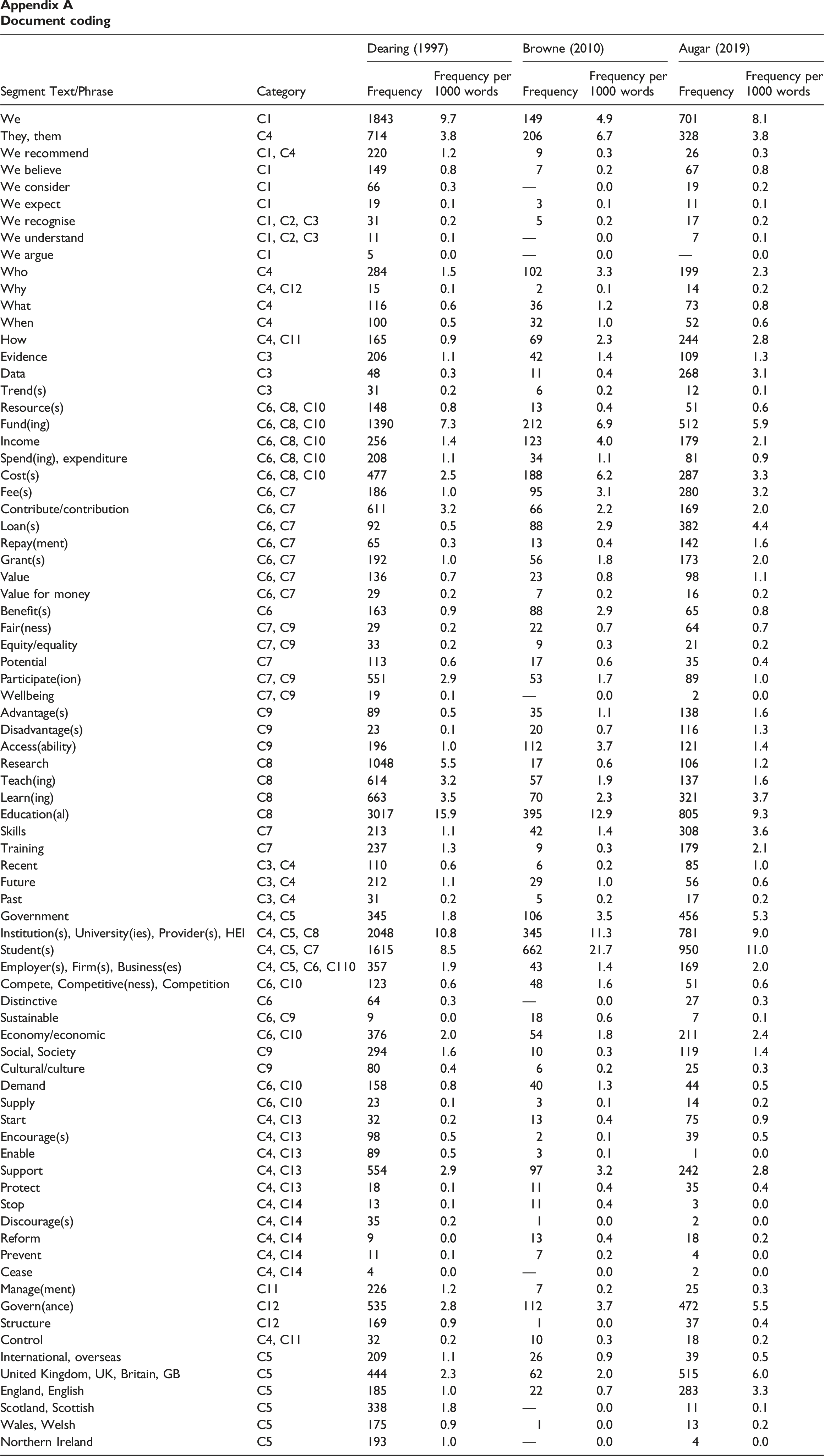
A linguistic review of the Report suggests a high level of words such as ‘funding’, ‘research’, ‘education’, ‘universities’, ‘students’, and ‘participation’, giving an impression as to the focus of the document. The categorisation of coded phrases in Appendix A suggests a focus on institutional considerations, direction and framing. It uses more ownership orientated language than the subsequent Browne and Augar Reviews, but fewer evidence-related phrases.
The Report is directional: there are significantly more recommendations than in either subsequent report, less dense use of the term ‘how’ and higher use of ‘enable’ than the two other reports suggesting an outcome rather than operations orientated approach. Conversely the Dearing Report uses ‘manage’ and ‘management’ far more than subsequent reviews, where ‘govern’ or ‘governance’ is used significantly more. Scott (1998) criticises the Dearing document in this respect, suggesting that many recommendations are made individually, but together place greater bureaucratic burden on universities, and that despite the mass of detail, on some subjects it is near operational (e.g. information technology, course structures) and in others vague (e.g. virtual universities, institutional organisation). The term ‘structure’ is used 169 times in the Dearing Report but rarely in subsequent reports, whilst ‘international’ or ‘overseas’ was used over 200 times, decreasing in Browne and Augar.
It is interesting to see a higher use of ‘contribute’ or ‘contribution’ but lower use of ‘fees’ and ‘loans’ than in later documents, suggesting that neoliberal economics in HE was perhaps in its infancy. The awareness of inequality in access to education is reflected in high density of ‘participate’ and ‘participation’ which then become less used in Browne and Augar. ‘Research’ is used over 1000 times within the Dearing Report, and this density drops dramatically in subsequent works, perhaps illustrating that Dearing had a broader focus and considered HE from a range of perspectives. ‘Research’ is used almost as much as ‘teaching’ and ‘learning’ combined in the Dearing Report, whilst the other reports use ‘teaching’ and ‘learning’ 4–7 times more densely. Shattock (1999) commented that the title of the document ‘HE in a learning society’ is rarely discussed or mentioned.
Process analysis
The Report was led by Sir Ron Dearing, a senior civil servant, and supported by a National Committee composed of six VCs of UK universities and five senior business leaders. Dearing’s brief was to examine ‘how the purposes, shape, structure, size and funding of higher education, including support for students, should develop to meet the needs of the United Kingdom over the next 25 years’ (Dearing, 1997, 3). This included a consideration of nine principles and 17 aspects of the changing context. In effect this incorporated a review of short-term problems (e.g. funding issues) and long-term developments (e.g. the role of technology) but was expected to deliver this less than half of the time taken by previous enquiries, including Robbins which took two and a half years to complete (Parry, 1999). Indeed, the report itself includes a caveat around the measure of the enterprise, the short time available and importance of timely delivery dictated by Government.
The development process included extensive consultation and data collection, with 90 working group meetings held across the sector and with businesses, 445 papers considered, 13,000+ documents prepared, 33 visits to UK universities, eight overseas visits, and 840 people submitting written evidence (Dearing, 1997). Dearing commissioned major surveys of 1270 students studying in HE at the time, and of 809 academic staff across the country. The Committee also facilitated small focus group discussions with other staff in HE outside of academia. The Report leveraged existing studies of graduates, joining forces with them rather than duplicating their work. In total, nearly 700 texts were listed in the reference section, principally policy documents, evaluation studies and items of research. Parry (1999) noted the lack of academic scholarly works in this list.
Of the recommendations, 51 for were aimed at Government, 26 at universities, 21 at funders, ten at representative bodies, and 19 at other organisations. This, the size of the report as previously discussed and its cost in printed format or CD-ROM (£135) suggests that it was aimed at the knowledgeable reader (Scott, 1998). Whilst it was later made available online, with the internet in its infancy, it is most likely that it was consumed by the public via the printed media. The BBC at the time picked out five headlines: tuition fees; widening access to HE; the professionalisation of teaching; quality and standards; and the impact of the ‘future’ (BBC, 1997).
Social analysis
The social context around Dearing is dominated by politics. New Labour came to power in the UK in May 1997 with a landslide victory and an air of optimism across the country. Future Prime Minister Tony Blair had listed education as his main priority and pre-election talked about ‘brain drain’ under the Tories (Blair, 1995). Following the 1997 victory, Blair then proclaimed that ‘universities in Britain had their funding cut by 40% per student under the Tories’ and that ‘all students will repay only when they can afford to’ but that ‘an extra 500,000 people would enter Higher and Further Education by 2002’ (Blair, 1997). Although both main parties ahead of the 1997 election were evasive on their official stance on fees (Bratberg, 2011), and its delay in reporting may have been a sign that the Conservatives wanted to keep the subject of tuition fees off the election agenda, these statements paved the way for the Dearing Report to lead to changes in the way HE was funded.
The rationale for a root and branch review of HE in the UK was well documented following funding cuts within HE under the Conservative Government between 1979 and 1997, where institutional income had not kept up with operating costs and public policy had oscillated between contracting the number of students and increasing them (Crace and Shepherd, 2007). This context meant the Dearing Report had support from the sector, and the recommendations were welcomed, as acknowledged later by Dearing himself (Hattersley, 2009). There were dissenting voices, however, with concern that Dearing surrendered the principles that HE should be available to those that can benefit not those who can pay (Scott, 1998), that tuition fees would deter poorer students from going to university, and that universities were no better off because none of the fees were collected directly (Toyne, 1998).
The narrative growing in the 1990s around the private returns to be generated from HE led to some support amongst the public for some element of tuition fees (Sutherland, 2008), with figures at the time ranging from 11% to 28% depending on the source (Blundell et al., 2000; Steel and Sausman, 1997) against a social rate of return of 9–11% (Dutta et al., 1999; Layard et al., 2002). Some academics even called for a combination of higher fees, lower taxpayer input and price differentiation between universities (Barr and Crawford, 1998), and others for institution-led fee levels and more sophisticated and progressive loan finance systems (Barr, 2003; Greenaway and Haynes, 2003). It was perhaps not until the 2001 General Election that the level of public hostility to the introduction of tuition fees became fully known (Crace and Shepherd, 2007).
Browne Review
The Browne Review, or specifically the Independent Review of Higher Education and Student Finance, was commissioned by Business Secretary Lord Mandelson in November 2009. It led to a report published on 12 October 2010 entitled Securing a Sustainable Future for Higher Education, and was submitted to the Conservative/Liberal Democrat coalition Government, which had been formed following the general election earlier that year. The report contained six principles, concluding that: more investment should be made in HE; student choice should be increased; everyone with potential should access HE; fee repayments should be contingency on work; payments should be affordable; and part time students should be treated like full time students for fee purposes. These six principles led to 29 recommendations, including the removal of a cap on the fees an institution could charge for an undergraduate course, and to support this with an improved and simplified income-contingent loan system that would activate when graduate income exceeded £21,000. It also made proposals to expand the number of university places and make better quality information, advice and guidance available.
Text analysis
There is a stark contrast between the document produced by Browne and the earlier Dearing Report. At 31,000 words, 64 pages, and supported by colourful graphics, the document feels more user-friendly and digestible to a far wider audience. As in Dearing the words ‘Funding’, ‘Education’, ‘Universities’ and ‘Students’ are heavily used (Appendix A), but ‘Research’ is largely absent. The categorisation of coded phrases suggests a strong directing and framing tone, a focus on student and institutional considerations and increased use of financial and economic language, compared to Dearing (1997). There is linguistic evidence that Browne is more market-based and neoliberal in its tone, compared to Dearing. There is higher density of terms like ‘income’, ‘cost’ and ‘fees’, whilst frequent use of ‘access’ and ‘accessibility’ reflects the ongoing importance of widening engagement with HE. Thompson and Bethradnia (2011) suggest that the language used by Browne is underpinned by a philosophy of relying increasingly on competition between universities, increasing choice for students and diversifying institutions, which would then determine the level of fees and lead to greater social equity and mobility.
The term ‘we’ is used approximately half as densely as in either the earlier Dearing and later Augar documents, but ‘they’ or ‘them’ is used more. This indicates a more directional than personal ownership narrative. In particular, the use of the term ‘we believe’ features only seven times in Browne, versus 149 times in Dearing. The higher density of the terms ‘who’, ‘what’ and ‘when’ suggests a more prescriptive and practical approach.
Perhaps most interestingly, ‘student’ or ‘students’ is used over twice as densely in Browne as in the Dearing or Augar documents, and ‘social’ or ‘society’ used far less, providing good grounds to suggest that the principle focus of the document were intended or considering HE.
Process analysis
The Review was authored by Lord Browne of Madingley, a House of Lords cross bencher who was Chief Executive of the energy company BP between 1995 and 2007, and a member of the boards of Goldman Sachs, Intel and Daimler Benz. Lord Mandelson’s specific brief to Browne was to consider the ‘balance of the contribution between taxpayers, students, graduates and employers’ with an appraisal on how much students should be charged and how participation could be enhanced, rather to examine in detail the quantum of funding required to maintain a high-quality system (BBC, 2009; Porter, 2020).
Browne was supported by a review group of six members: two existing university VCs, three private sector representatives and a former Government advisor on Education. There was some criticism at the time as to whether this panel was independent, with allegations that Browne was a favourite of the Labour party, that the VCs had vested interests in seeing fees increase, the Government adviser had been an architect of the previous fee regime and that student representation was absent (Paton, 2009).
The scale of evidence gathering for the Browne Review appears less significant than Dearing. The Review Panel assembled an Advisory Forum made up of 22 groups representing the interests of students, school leavers, graduate recruiters, institutions, academics and business. The Review received 90 submissions to a Call for Evidence and 65 submissions to a Call for Proposals (from academics, universities, colleges, student groups and businesses). It also held four days of public hearings to cross examine evidence from 36 expert witnesses about the strengths and weaknesses of the current higher education system, and visited 13 universities. A criticism of the process for the development of the review was the ‘astonishingly low’ sum of £68,000 spent on an opinion survey of just 80 potential students to determine what entrants would be prepared to pay for a degree (Morgan, 2011).
Of the 29 recommendations aligned to six principles, 19 were aimed at Government, eight at universities and two elsewhere. The user-friendly nature of the report, available immediately online, suggests that it would be easily accessible to a range of readers, including those within the sector but also students and their parents.
Social analysis
The economic, political, and social context within the UK was significantly different at the time of Browne compared to Dearing. Following 13 years of Labour Government, a Coalition Government was installed in 2010 to receive the Browne Review. It was embarking on a period of austerity following the 2007-08 global economic crisis, and would introduce reforms to reduce annual public spending on universities by £3bn between 2010 and 2015 (Hillman, 2016).
The politics of education policy were complex at the time of Browne with the new Coalition partners entering an administration with opposing viewpoints. The Conservative manifesto (2010, 17) was non-committal saying that they would ‘consider carefully the results of Browne’s review into the future of funding so that we can unlock the potential of universities and transform the economy’. Some of the accompanying narrative though, left no ambiguity, including a speech from future Education Secretary Michael Gove suggesting that ‘someone who is working as a postman should not subsidise those who go on to become millionaires’ (Shepherd and Stratton, 2010). The Liberal Democrats had made a commitment to ‘scrap unfair tuition fees for all students taking their first degree’ (Liberal Democrat Manifesto 2010, 39) with all but one of the subsequently elected MPs signing a highly visible pledge (NUS, 2010). Tuition fees became a challenging subject in the process of forming the Coalition Agreement, with difficult wording being agreed including that ‘If the response of the Government to Lord Browne’s report is one that Liberal Democrats cannot accept then arrangements will be made to enable Liberal Democrat MPs to abstain from any vote’ (HM Government, 2010, 32). In strong contrast to the Party’s starting position months earlier, new Liberal Democrat Business Secretary, Vince Cable geared up for the outcomes of Browne in his speech, A New Era for Universities, outlining that the UK is a ‘tangibly a poorer country now that two years ago with a 6% loss of income’, that ‘we don’t know much about the marginal costs and benefits of HE participation’ and that a model is needed that balances ‘funding for HE in England that combines less public support and more private investment from those who benefit from it most’ (Cable, 2010). Even though some of the main recommendations were rejected, including the proposals for uncapped fee levels being replaced with a ceiling price, many Liberal Democrat MPs (e.g. Leech, 2010) remained unhappy (Ashton, 2010; Quinn et al., 2011). Several years later, interviews with some of the main actors suggest that Cable, and party leader Nick Clegg, did not consider tuition fees a priority, believing that most voters would think it a reasonable price to pay for stable Government (Butler, 2020).
With the Coalition set on a course towards higher fees post-Browne, it appears there was little substance from the official opposition. Not only had Labour left a weakened and inexperienced set of policy makers within the rebranded Department for Business, Innovation and Skills, which has been recast several times in three years (Hillman, 2016), but its role in introducing and then increasing fees, and instigating a further review, meant any opposition would be tokenistic (McGettigan, 2015). In his memoirs, Mandelson himself claimed that Labour would have doubled fees had they won the 2010 General Election (Mandelson, 2011), and as was the case with Dearing, the delay in Browne reporting in 2010 was possibly driven by the Labour Party’s desire to keep tuition fees off the election agenda.
Within HE, the Higher Education Policy Institute (HEPI) (2009) report Changing Landscapes, clearly set out the expectation that increased tuition fees post-Browne would have little impact on the level of demand for HE. David Willetts referenced this and a report from the IFS on the impact of fee reform, suggesting that an increase in fees results in a 4.4% drop in university participation, but this is more than offset by the increases in participation resulting from the provision of loans and grants (3.2% up and 2.1% up respectively) (Carasso and Gunn, 2015). The academic community was not, however, united behind the reforms suggested by Browne. VCs and other senior leaders tended to be supportive, recalling memories of the underfunding pre-1997, but there were mixed levels of support elsewhere and concerns over loss of students (Smith, 2010). A Council for the Defence of British Universities comprised of current and retired academics was established to formalise these issues, but it ultimately lacked a mandate (McGettigan, 2015). There were National Union of Students and University and College Union protests after the Browne recommendations, including an invasion of the Conservative Party HQ and attack on Prince Charles’ car, but some commentators at the time noted that these were seen as middle-class protesters supporting a public subsidy for better off people on the way to well-paid careers (Jones, 2010).
Press opinion on the publication of Browne (2010) did not follow the normal left-right split often seen in the UK. On its announcement, the Guardian declared that ‘Labour has been seduced into sentimental, sloppy thinking that defends the interests of the affluent, not the poor’ Wilby (2010). Charles Moore (2011), writing in the Daily Telegraph suggested that loans were being presented as a tax on the rich to pay for social mobility. Kate Devlin (2010), for the same newspaper, highlighted the huge debt placed on medical students, suggesting that it would become unmanageable for low income families.
Augar Review
The Augar Review of Post-18 Education and Funding was announced in February 2018 by then Conservative Prime Minister Teresa May. The final report was published on 30 May 2019, guided by eight principles relating to: the beneficiaries of HE; equality of access; breadth of provision; balance of costs; organisational accountability; Government responsibility; the role of market forces; and the future (Augar, 2019). Nine sets of proposals, and 53 specific recommendations, were made. In relation to tuition fees, proposals included a reduction in the upper cap on annual tuition fees from £9250 to £7500 (frozen for three years and then inflation-linked), adjustments to the Government teaching grant to reflect the costs of delivering subjects and their value to students and the taxpayer, the introduction of minimum entry thresholds for courses demonstrating poor retention or graduate employability and/or salary rates and the withdrawal of foundation year loans.
Text analysis
At 86,000 words over 216 pages, Augar is a larger and more detailed report than Browne. The narrative represents a shift, with coded phrases in Appendix A suggesting a strong use of evidence to support recommendations, a tone that focuses on student considerations, and an emphasis more critical of institutions. This is reinforced by commentators on the report at the time of its release, noting the depth of evidence and balance (McVitty, 2019). There is a return to the strategic language in common with Dearing, but the layout and use of clear diagrams and summaries is more akin to Browne. Overall, the document feels accessible to both a sector expert and the lay-reader, perhaps supported by the significant content focused on context and explanation of the sector and its workings, strengths and weaknesses, as well as quotes and case studies (McVitty, 2019). The word ‘data’ is now more common than previously, reflecting an emphasis on backing up statements with evidence. In addition to a high use of ‘funding’ and ‘cost’, the terms ‘fees’, ‘loans’ and ‘repayment’ are far more prevalent than in Dearing and Browne, an indication that the neoliberal view of HE is now prominent. The phrases ‘skills’ and ‘training’ are used 2.5–3 times as densely as in previous reports, perhaps indicating an emphasis on jobs and learning outcomes. To offset this there is also increased use of ‘fairness’, ‘social mobility’, ‘widening participation’ and ‘advantages’ or ‘disadvantages’, and ‘Government’ is used three times as densely in Augar as in Dearing. These would indicate that the report extends beyond a simplistic marketised view of HE, and indeed the document retains a common theme around equality in access to education but also fairness from a funding perspective between those who do and do not access HE.
Process analysis
Philip Augar, a former equities broker, was asked by Theresa May to chair an independent panel, comprising of five experts in HE and FE, to author the report in 2018. This has been seen as contentious by some, with an expert panel having replaced committees as the main method of advising Government on policy (Parry, 2019), but supported by others, highlighting the experience of those involved (Hillman, 2019). The aim of the report was to create a ‘joined up post-18 education system supported by a funding system that worked for students and taxpayers’ (Hubble and Bolton, 2019b, 5). A call for evidence ran in Spring 2018 to seek student, university and public views and collect evidence. This elicited 375 responses which were summarised in parallel to the main report. In addition, 330 meetings were held with experts and sector representatives in fields relevant to the remit of the review. Superficially, this level of primary data collection appears slimmer than for Browne, and significantly less than for Dearing. It should be noted, however, that the level of data available within HE by this point was significantly larger, with, for example, the National Student Survey (NSS) and Destination of Leavers from Higher Education (DLHE) data now being used.
Of the 53 recommendations made, 51 are aimed at Government (including those related to tuition fees) and only two at universities, suggesting that whilst written in an accessible format, this was directed at the sitting Conservative administration. The way that evidence is presented as a rationale for the recommendations in the document has been criticised by some as selective (e.g. Walker, 2019a; Parry, 2019). Examples are evident to support this view. For example, a HEPI survey is referenced suggesting 38% student positivity (p86), rather than using the much larger NSS, which would have placed this measure at over 80% in 2018 (NSS, 2018). Similarly, a reference is made that ‘15% of all students attended universities that had either significantly negative or statistically negligible earnings returns’ (Augar, 2019, 88) rather than focusing on the 85% that have a positive premium. The tuition fee narrative portrays universities that have benefited from increased resources and a sector that is in reasonable financial health, performance that varies at institutional level, costs to students that exceed the level expected by Government in 2010 and students and taxpayers that deserve better value for money. Some have described this as misleading and overly simplistic (Smith et al., 2019) and ignorant to the wider civic role of universities (Mayo, 2019).
Social analysis
The political environment had shifted by the time of the Augar Review. The UK voted to leave the European Union in 2016, and the process to execute that decision was advancing. In 2017, the Conservative Government had been voted the largest party at the general election, but had lost an overall majority. In 2019 they would change leader and then win a convincing majority, to go on and exit the UK from Europe. On the horizon was the coronavirus outbreak in early 2020 and the deviation of much political energy and financial resources to tackling that crisis. Ahead of election victory, the Conservatives pledged to consider the ‘thoughtful’ recommendations of Augar on English university funding, to explore ways to ‘tackle the problem of low-quality courses’ (Conservative Manifesto, 2019, 37). It was not until January 2021 that the Government issued its interim conclusion on the Augar Review, citing the coronavirus pandemic for the delay (DfE, 2021). This response contained no reference to the tuition fee recommendations, and gave no indication on how increasing system costs would be managed (Morgan, 2021). In February 2022, a full response was published, fixing fees at £9250 until 2024/25, reducing loan repayment interest rates and reducing the loan repayment threshold, whilst at the same time launching consultations on student number controls and minimum eligibility requirements (DfE, 2022).
The narrative around low-quality courses emerges for the first time in Augar, having been absent in Dearing and Browne, but was criticised for using earnings to define value (Ahlburg, 2019). In a significant shift from the earlier reviews, the Labour party, under Jeremy Corbyn, were now wedded to a completely different university funding model, with no fees, and treated Augar in a partisan manner (Hillman, 2019).
Much of the social discourse at the time of the publication of the Review has been summarised by the author. In the House of Lords, Augar talked about giving students a fair deal after ‘windfall’ years and that universities in financial trouble are guilty of ‘bad management’ (Walker, 2019b). More recently he has said that English HE is at a ‘turning point’ and about to move ‘from the age of 50 per cent to the age of everyone’ at an event held by the Lifelong Education Commission (Morgan, 2021). These illustrate the change in narrative between Browne and Augar from a focus on higher fees payable by those who benefit, to lower fees for courses that do not provide strong outcomes, and a focus on more efficient universities. It has also been commented that the Augar Review was unduly biased by the wider political narrative around ‘levelling up’ (Morgan, 2021). The cost of unpaid loans also emerges significantly in the discourse around Augar, and it is clear from the announcements made in 2022 around debt arrangements that this has been a key consideration (DfE, 2022).
The external reception to the Review was mixed. HEPI ran a student poll in 2019 that showed little preference for the reduced fee, with 40% preferring the current system of £9250 paid back over 30 years, 41% Augar’s approach of £7500 paid off over 40 years, and 18% having no preference between the two (Hewitt, 2019). This has been supported by a later study by Mazhari and Atherton (2021), based on focus groups with students, which established that concerns around living costs and the criteria for maintenance loans featured far higher than tuition fees in terms of areas of concern. UUK commissioned an independent assessment of the Augar Review, which highlighted that the fee cap reduction would lead to a 36% fall in fee income to universities, which would cost the UK taxpayer £1.8bn to replace (Conlon and Halterback, 2019). It also flagged concerns that the changes in repayment terms would benefit better off graduates at the expense of lower earners.
Discussion
Four interrelated themes summarising how discourse may have influenced policy evolution have been identified from the analysis outlined above. First, the inexorable link between politics and policy making in relation to HE and tuition fees. The Tony Blair-led Labour Government from 1997 had been elected on a mandate focusing on education, including highlighted long-term underfunding of HE and generating large scale support for the introduction of tuition fees for progressive reasons. By the time the Coalition Government received the Browne Review, the political narrative had changed to austerity post-recession, and increased tuition fees were therefore sold as a way of continuing sector expansion, including widening access, and further enhancing competitiveness, without increasing the costs to the public purse. Most recently the political narrative has shifted again, towards ‘levelling up’, considering more those that are not able or do not want to access HE, and the exploration of new forms of training and education, including the introduction of apprenticeships and a broader role for FE. This, and the value for money agenda, supports a proposal for lower fees and focus on universities to be more efficient. In each case, HE tuition fee policy has mirrored the political narrative of its time, from investment to growth to popularist ideologies. It is also of note that all three of the policy documents were received by a different administration than had commissioned it, and in the case of Dearing and Browne, by a different political party. Perhaps this has made it easier for significant changes to tuition fee arrangements to be implemented, with greater ability to demonstrate independence and potentially easier cross-party support with more than one playing a lead part in the process. The changes over the last 25 years, led by different Governments, gives support to the view of Bratberg (2011) that political ideology does not follow conventional left/right divisions around tuition fees.
Second, is the increasing discourse around the marketisation of HE and the trend towards sector neoliberalisation. The language from Dearing to Browne to Augar demonstrates a change from a focus on ‘funding’ and ‘research’ to ‘fees’ and ‘access’ to ‘loans’ and ‘outcomes’, with an increasing emphasis on competition between universities and students as consumers. Each of the three reviews have become more student orientated, in terms of the language, length, use of graphics and case studies, and overall narrative. The introduction of fees in this context was justified by Dearing partially to boost sector competitiveness in a competitive global market. Browne recommended fee increases, supported by positivity from within HE, with a stated goal to create a marketised system (Riddell, 2016), in parallel with a widening participation agenda, using evidence that higher fees do not materially impact participation levels and diversity but does drive capacity and student earnings. These findings have since been shown to be justified by Wilkins et al. (2013), Wakeling and Jefferies (2013) and Ainsworth et al. (2016). Browne also recommended far more autonomy for fee setting from universities, to boost competition (with a view that this would improve quality) and allow institutions to differentiate their degrees through price. The latter theory has been somewhat disproven, however, with almost all universities simultaneously moving the maximum fee cap when it was increased to £3000 and then £9000 in a manner that has been compared with a cartel, and amongst a fear that a lower-than-cap cost would be associated with an inferior quality (Riddell, 2016). A proposed reduction in fees by Augar, focused on Government as the decision maker and portraying universities as actors of varying quality and efficiency, uses the value for money argument on the part of students, emphasising the employment outcomes of HE and how they differ across programmes, institutions and between genders (Britton et al., 2016). Unsurprisingly, it has been the last of the three reviews that has led to the most negative discourse within the sector.
Also linked to neoliberalisation is the third theme, the argument around who benefits most from HE and who should pay. Dearing’s balanced view in 1997, which incorporated the principles of moral and political sustainability, which was supported by the political and public narrative at the time, was that society and students both benefit and therefore the burden on payment should be shared (Rothstein, 1998). Its language suggests that Dearing was also aimed at a range of actors in the sector. This had shifted by Browne, which as discussed by Greenaway and Haynes (2000), Barr (2003) and others earlier, emphasised that private returns exceeded public returns, and therefore tuition fees should rise accordingly. By now the document appears to be aimed at students. The tone by Augar, with targeted language, explicit use of extended narrative and evidence on the need for efficient universities, new ways of learning and better value for money for students, led to proposals for lower fees. This appears to have Government as a new clear audience.
Fourth, the economic context, within the sector and the country, has clearly been a key driver for tuition fees in England, particularly since Browne. Whilst Dearing was commissioned to undertake a holistic review, this was not the case for Browne and Augar, who were asked to focus predominantly on fees and sustainable funding and set out more concise documents. Underfunding of the HE sector was a concern within the Dearing Report and is supported with dozens of pages of evidence and appendices, whilst the language used in Browne and, to an extent, Augar suggests that reducing the weight of public expenditure was a key consideration, including in relation to the impact of unpaid loans. The economic impact of the global economic crisis of 2007-8, and the austerity that followed, may well have played to the discourse around Browne, whilst the UK’s departure of Europe, and subsequently the coronavirus pandemic, has almost certainly impacted the most recent announcement post-Augar. It is interesting, though, that the economic narrative, and the text discourse, between Browne and Augar, has certainly been one that has moved from a focus on private student investment in the shape of fees, to the role of Government and universities in improving educational outcomes and value for money.
There are other trends worth noting. Over the period of the three reviews, it there has been a reduction in the size of the overseeing committee or panel, the level of consultation undertaken, and the scale and breadth of materials collected to inform their production. Whilst this has been criticised by some as noted above, it is difficult to make any firm conclusions as to why this has been the case, other than perhaps the general move towards thinking about the student as a consumer and the need to simplify policy and broaden its reach. This merits further research.
Conclusions
This paper has charted tuition fee change in England and reviewed three important policy documents, illustrating significant shifts in the way that policy is documented, communicated and synthesised within society. It has identified four themes emerging from the discourse that may have influenced tuition fee policy making: national politics and political narrative; the marketisation and neoliberalisation of HE; the link between the costs and benefits of education; and the pressures of the economic environment.
The approach used has been limited to only three documents, and associated academic literature, media and dialogue. It is acknowledged that other policies and discourses, including for example the 2003 White Paper on the future of HE which introduced income-contingent loans for the first time, will have influenced the evolution of tuition fees in England. It is also the case that the target audiences of the three documents have shifted, as has the regulatory regime for HE. Furthermore, this document has focused on the drivers and motivations for tuition fee policies, and not specifically on their success measures, or the extent to which they have been implemented and what the result has been. Clearly these will have influenced policy evolution, as in many ways each policy document has built on its predecessor. Whilst the use of loans to fund tuition fees are explored in summary, more work is required in this respect.
Disclosure statement
No potential conflict of interest was reported by the author.
Footnotes
Declaration of Conflicting Interests
The author(s) declared no potential conflicts of interest with respect to the research, authorship, and/or publication of this article.
Funding
The author(s) received no financial support for the research, authorship, and/or publication of this article.

Author biography
Dearing (1997)
Browne (2010)
Augar (2019)
Segment Text/Phrase
Category
Frequency
Frequency per 1000 words
Frequency
Frequency per 1000 words
Frequency
Frequency per 1000 words
We
C1
1843
9.7
149
4.9
701
8.1
They, them
C4
714
3.8
206
6.7
328
3.8
We recommend
C1, C4
220
1.2
9
0.3
26
0.3
We believe
C1
149
0.8
7
0.2
67
0.8
We consider
C1
66
0.3
—
0.0
19
0.2
We expect
C1
19
0.1
3
0.1
11
0.1
We recognise
C1, C2, C3
31
0.2
5
0.2
17
0.2
We understand
C1, C2, C3
11
0.1
—
0.0
7
0.1
We argue
C1
5
0.0
—
0.0
—
0.0
Who
C4
284
1.5
102
3.3
199
2.3
Why
C4, C12
15
0.1
2
0.1
14
0.2
What
C4
116
0.6
36
1.2
73
0.8
When
C4
100
0.5
32
1.0
52
0.6
How
C4, C11
165
0.9
69
2.3
244
2.8
Evidence
C3
206
1.1
42
1.4
109
1.3
Data
C3
48
0.3
11
0.4
268
3.1
Trend(s)
C3
31
0.2
6
0.2
12
0.1
Resource(s)
C6, C8, C10
148
0.8
13
0.4
51
0.6
Fund(ing)
C6, C8, C10
1390
7.3
212
6.9
512
5.9
Income
C6, C8, C10
256
1.4
123
4.0
179
2.1
Spend(ing), expenditure
C6, C8, C10
208
1.1
34
1.1
81
0.9
Cost(s)
C6, C8, C10
477
2.5
188
6.2
287
3.3
Fee(s)
C6, C7
186
1.0
95
3.1
280
3.2
Contribute/contribution
C6, C7
611
3.2
66
2.2
169
2.0
Loan(s)
C6, C7
92
0.5
88
2.9
382
4.4
Repay(ment)
C6, C7
65
0.3
13
0.4
142
1.6
Grant(s)
C6, C7
192
1.0
56
1.8
173
2.0
Value
C6, C7
136
0.7
23
0.8
98
1.1
Value for money
C6, C7
29
0.2
7
0.2
16
0.2
Benefit(s)
C6
163
0.9
88
2.9
65
0.8
Fair(ness)
C7, C9
29
0.2
22
0.7
64
0.7
Equity/equality
C7, C9
33
0.2
9
0.3
21
0.2
Potential
C7
113
0.6
17
0.6
35
0.4
Participate(ion)
C7, C9
551
2.9
53
1.7
89
1.0
Wellbeing
C7, C9
19
0.1
—
0.0
2
0.0
Advantage(s)
C9
89
0.5
35
1.1
138
1.6
Disadvantage(s)
C9
23
0.1
20
0.7
116
1.3
Access(ability)
C9
196
1.0
112
3.7
121
1.4
Research
C8
1048
5.5
17
0.6
106
1.2
Teach(ing)
C8
614
3.2
57
1.9
137
1.6
Learn(ing)
C8
663
3.5
70
2.3
321
3.7
Education(al)
C8
3017
15.9
395
12.9
805
9.3
Skills
C7
213
1.1
42
1.4
308
3.6
Training
C7
237
1.3
9
0.3
179
2.1
Recent
C3, C4
110
0.6
6
0.2
85
1.0
Future
C3, C4
212
1.1
29
1.0
56
0.6
Past
C3, C4
31
0.2
5
0.2
17
0.2
Government
C4, C5
345
1.8
106
3.5
456
5.3
Institution(s), University(ies), Provider(s), HEI
C4, C5, C8
2048
10.8
345
11.3
781
9.0
Student(s)
C4, C5, C7
1615
8.5
662
21.7
950
11.0
Employer(s), Firm(s), Business(es)
C4, C5, C6, C110
357
1.9
43
1.4
169
2.0
Compete, Competitive(ness), Competition
C6, C10
123
0.6
48
1.6
51
0.6
Distinctive
C6
64
0.3
—
0.0
27
0.3
Sustainable
C6, C9
9
0.0
18
0.6
7
0.1
Economy/economic
C6, C10
376
2.0
54
1.8
211
2.4
Social, Society
C9
294
1.6
10
0.3
119
1.4
Cultural/culture
C9
80
0.4
6
0.2
25
0.3
Demand
C6, C10
158
0.8
40
1.3
44
0.5
Supply
C6, C10
23
0.1
3
0.1
14
0.2
Start
C4, C13
32
0.2
13
0.4
75
0.9
Encourage(s)
C4, C13
98
0.5
2
0.1
39
0.5
Enable
C4, C13
89
0.5
3
0.1
1
0.0
Support
C4, C13
554
2.9
97
3.2
242
2.8
Protect
C4, C13
18
0.1
11
0.4
35
0.4
Stop
C4, C14
13
0.1
11
0.4
3
0.0
Discourage(s)
C4, C14
35
0.2
1
0.0
2
0.0
Reform
C4, C14
9
0.0
13
0.4
18
0.2
Prevent
C4, C14
11
0.1
7
0.2
4
0.0
Cease
C4, C14
4
0.0
—
0.0
2
0.0
Manage(ment)
C11
226
1.2
7
0.2
25
0.3
Govern(ance)
C12
535
2.8
112
3.7
472
5.5
Structure
C12
169
0.9
1
0.0
37
0.4
Control
C4, C11
32
0.2
10
0.3
18
0.2
International, overseas
C5
209
1.1
26
0.9
39
0.5
United Kingdom, UK, Britain, GB
C5
444
2.3
62
2.0
515
6.0
England, English
C5
185
1.0
22
0.7
283
3.3
Scotland, Scottish
C5
338
1.8
—
0.0
11
0.1
Wales, Welsh
C5
175
0.9
1
0.0
13
0.2
Northern Ireland
C5
193
1.0
—
0.0
4
0.0