



Abstract
This chapter discusses the relationship between the labour market and vocational education and training in England. For decades British governments have emphasised the need for more people to stay longer in the formal education system and at the same time have attempted to improve work-based training. They have also emphasised the centrality of vocational education and training in improving national productivity and growth and in alleviating distributional problems. We argue that education and training have made a more limited contribution to these objectives than governments might have hoped. This is because of a very imperfect match between the requirements of the labour market and what the vocational education and training system has produced. We suggest that a greater integration of industrial strategy and education and training policy is needed. More emphasis needs to be placed on apprenticeships and on lower level post-compulsory education rather than on higher education. Greater support is needed for educational interventions in early years in an attempt to reduce class bias in attainment and consequently in labour market opportunities. An overarching problem is that, whilst employer engagement has been a central theme of government policies, the extent of employer buy-in to these policies is unclear.
Introduction
In any economy the relationship between the vocational education and training (VET) system and the labour market is a two-way one. The characteristics of the labour market, for example the sectoral and occupational distribution of employment, help to determine the sort of VET provided. At the same time the VET system itself affects labour market outcomes, for instance in ensuring (or not) that employers have the mix of skills that they need. There will never be a perfect match between the two – too many other forces are at work. However, governments are concerned to make that match as good as possible. In this sense the VET system needs to be fit for purpose. Governments impose two broad requirements upon it. The first is that it contributes to successful economic performance and the second is that it contributes to the fulfilment of its distributional objectives. We will suggest that it has been fairly unsuccessful in meeting these requirements and will discuss how it might be improved. First, however, we describe some recent developments in the English VET system.
Some post-16 developments in VET in England
Successive UK governments, with particular force since the Blair Premiership, have given an absolutely central role to VET in the achievement of national economic and distributional objectives. As Matthew Hancock, the coalition government’s Minister for Skills (Department for Business, Innovation and Skills (BIS) and Skills Funding Agency, 2012), wrote: … to support employers in ensuring they have the workforces they will need to grow in a global and fiercely competitive marketplace. To equip young people and adults with the knowledge and skills necessary to succeed and thrive. And to ensure that no one is left behind. (p. 1)
Thus we have seen concern to encourage young people to stay in compulsory education for longer, to obtain more educational qualifications and especially to enter higher education. And indeed there has been some success in achieving these objectives.
The work-based route has proved to be a more difficult nut to crack. By the mid 1980s there was considerable concern being expressed about the UK’s comparative performance in this respect. Too few school leavers were going into jobs that offered any substantive training. The old apprenticeship system, itself patchy in quality, was largely a feature of manufacturing which was in secular decline. The institutional architecture that was associated with apprenticeships – the corporatist Manpower Services Commission and the industrial training boards – was in the process of being dismantled by the Thatcher government. In its place a voluntarist employer-led system was established. In subsequent years there was some increase in training episodes and in the number of vocational qualifications awarded. But there were doubts about the true quality of many of these qualifications, whilst since the late 1990s any significant increase in the amount of employer-based trained has stalled. There was also scepticism expressed about the true worth of many apprenticeships funded by government subsidy (Edge Foundation, 2013). Perhaps most important of all, some commentators voiced doubts about the role of employers – it was argued that the commitment of many of them to raising volume and quality was doubtful (Keep and Mayhew, 2014).
Against this background, the last coalition government and the new Conservative government have been anxious to strengthen the vocational route in formal education and to encourage high quality apprenticeships. There have been a number of government-initiated reviews of VET to identify the strengths and weaknesses of the system (Wolf, 2011). Following the acceptance of all 27 recommendations of the Wolf Review, the government has outlined, in its latest progress report, how the landscape of 16–19 education will be reshaped (Department for Education, 2015). Offering learners ‘all-in-one’ programmes (that includes both academic and vocational qualifications) has been a reoccurring complex aim of recent and current reforms. The new vocational qualifications within the study programmes are for full-time 16–19 learners and aim at improving formal education provision and at providing more effective pathways to further education, training or employment. This begs the question as to whether these new qualifications will offer an improved fit with the labour market. We will have to wait for a couple more years to answer this question.
The Richard Review of Apprenticeships (Richard, 2012) formed the basis of recent policy reforms in relation to apprenticeships that aimed at ‘ensuring Apprenticeships in England became more rigorous and more responsive to the needs of employers’ (BIS, 2014a). In order to achieve this, the government continued to place employers at the heart of the system. In the latest implementation plan (BIS, 2013) employers will largely have control over design, assessment and funding – in the case of funding, either through the current pay-as-you-earn system or a new system of credits. As officials put it: ‘Giving employers direct control of apprenticeship funding remains a core and non-negotiable part of our reforms’ (BIS and National Apprenticeship Service (NAS), 2015: 3). Simultaneously, in order to drive up quality, it is envisaged that the government will set some criteria that all apprenticeship standards have to meet. Other quality enhancing elements in the plan include: the development of independent and rigorous assessment approaches; the grading of apprenticeships; and some elements (off-the-job training, maths and English) of apprenticeships being made compulsory.
Huddleston and Laczik (2015) argue that the recent 16–19 reforms yet again are about qualifications rather than, for example, about broad curriculum, pedagogy and the capacity of providers (institutions). From the perspective of government, qualifications stand as proxies for skills (Stasz, 2011); therefore they are seen as central to achieving up-skilling. However, Evans (2014) argues that, on its own, qualifications reform will make only a limited contribution, writing that: There has to be a system of learning that has a clear purpose and also provides clear pathways. Such a system is complemented by an institutional structure which bridges the relationship between education and employers and ensures that the qualifications and skills which are being developed are relevant and in demand. (Evans, 2014: 7)
Osborne’s Summer Budget (HM Treasury, 2015) declared a further commitment to increase the number of apprenticeships to three million in England. He also announced the possible introduction of a levy on large companies to fund new apprenticeships, again putting control of funding in the hands of employers.
At the same time as successive governments have experienced difficulties in increasing the volume and quality of work-based training and of vocational education generally, higher education has experienced a significant expansion, as illustrated in Figure 1.
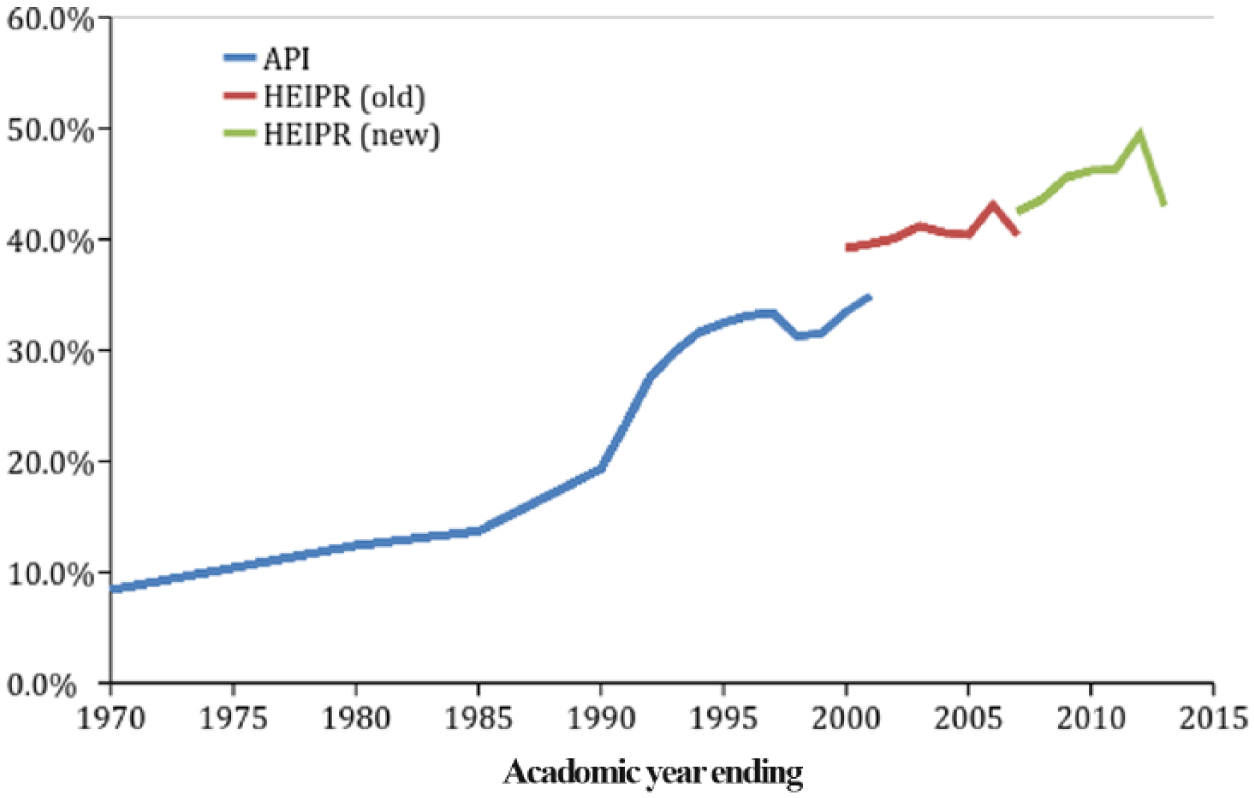
Participation rates in Higher Education in the UK, 1970–2013. 1
The expansion was particularly rapid in the early 1990s, continued at a more modest pace thereafter and, in the last few years, participation has been pretty stable in the high 40%s. This expansion has been accompanied by a reduction in funding for students. In the late 1960s, for instance, students had their fees paid directly by government and received a maintenance grant calibrated against parental income. The relative value of the maintenance grant was eroded over the years and from 1998 students were obliged to make a contribution to fees. Finally in 2012/2013 the full fee burden was transferred to students. The Student Loan Company provides loans to cover fees and a proportion of students’ living expenses (see Parry in this issue).
The expansion of higher education was uneven in its impact on different social groups. Young people, particularly white men, from less advantaged families remain significantly under-represented. Moreover, the working class students who do enter higher education tend not to go to the elite universities and therefore miss out on blue chip employment opportunities (see the Appendix table). This has become a matter of concern for successive governments and in 2004 the Office of Fair Access was established in an attempt to remedy the situation.
Meanwhile in recent years, policy has been compromised by the fiscal austerity regimes of both the coalition and Conservative governments. Whilst spending on schools was ring-fenced, the rest of the post-compulsory system faced severe constraints (see Keep in this issue). The funding position of further education colleges is a matter of especial concern.
Human capital and economic growth
In recent decades, countless UK government documents have pronounced on the importance of education and training as contributors to economic growth. In 2010, for example, the then Secretary of State for BIS, Vince Cable, and the Minister of State for Further Education, Skills and Lifelong Learning, John Hayes, wrote: ‘Skills are vital to our future and improving skills is essential to building sustainable growth and stronger communities. A skilled workforce is necessary to stimulate the private-sector growth that will bring new jobs and new prosperity for people all over this country’ (BIS, 2010).
Economic growth is achieved by: (a) increasing the quantity of factors of production (labour, capital and land); and (b) increasing the efficiency with which they are used – productivity. Improving education and training improves the ‘quality’ of each worker and so potentially that worker’s productivity. There is a lingering belief in official circles that good jobs follow good skills. In other words, there has been a belief that supply creates its own demand. Such views continue to hold sway not just in the UK but also in other developed countries, although in recent years there has been some growing realisation that the demand for skills also matters (see, for example, the Organisation for Economic Co-operation and Development (OECD), 2012).
Yet the evidence is not as clear-cut as is often thought. In a recent paper, Holmes (2013) considered a number of types of macroeconomic growth models including neoclassical growth theory and a variety of endogenous growth models, and developed a series of estimating equations, where gross domestic product (GDP) per capita was the dependent variable, to be consistent with each of these models. In his regressions he distinguished between years of primary schooling, years of secondary schooling and years of tertiary schooling. He also attempted to correct for quality of education, though was the first to admit that, given the data, such corrections were at best crude. He estimated his regressions for the OECD countries over the 1966–2006 period and then for a broader sample of 91 countries over the same period. His experimentation failed to find a significant effect for tertiary education. He did, however, find some for primary and secondary education. Holmes stressed that results were highly sensitive to different specifications, to the inclusion or exclusion of particular countries and to the time periods for selected for estimation, whilst he made no distinction between vocational and general programmes.
So why is the link between human capital and growth so ill determined? To understand this we have to delve into an old debate. This is the debate about the high value added vision. In the 1980s and early 1990s economists in the US, such as Thurow and Reich, were asking the following question: how could a wealthy economy like America continue to flourish in an increasingly competitive world, where emerging economies were becoming major players in world trade? Think of a well-defined product – white kitchen furniture or retail banking, for example. Its producer has an initial strategic choice to make. That is its specification (or spec). A product becomes more highly specified the more characteristics it embodies, the more readily it is customised for different customer tastes and needs, and the more frequently its characteristics are changed. The Model T Ford is the classically cited example of the low spec product – ‘any colour you like as long as it’s black’. The point that Thurow and Reich stressed was that US producers would find it ever more difficult to compete at the low spec end of the market, where competitive advantage could be gained only through price or, in other words, through unit labour costs. Producers in emerging economics would easily beat US producers at this end of the market. They could achieve at least the same productivity and had significantly lower labour costs. Thus American producers were likely to be squeezed out of low spec production; or, if they were not, the implications for their workforces were unpalatable. So, it was argued, as many as possible of them should move up-market and aim to produce higher spec products. Here, although of course price and relative unit labour costs had a role to play, they were not so tightly constraining. Producers could compete on the very nature of their products – in old- fashioned industrial organisation terminology, on product niche. This high valued added vision was espoused by all OECD economies. So far, so good. The problems started to emerge when the implications for skill were added to the argument. Still thinking in terms of a single well-defined product, conventionally it had long been argued that, as production of it moved to higher spec, the skill intensity of the production process increased. Producing at the low spec end, employers had the opportunity to design the skill out of many of the jobs involved – the routine, repeat 90 second operations on the car assembly line often being cited as the typical example of this. Because the precise nature of the high spec product was less constant, this option was not available to employers. Thus the demand for skill increased and so the terminology of the high value added vision transformed into the terminology of the high skills vision.
In other words, to move production up-market an increase in human capital was a necessary condition. However, as we have suggested earlier, it seems that in the eyes of many policy makers in many countries it became a sufficient condition. Indeed, writing in 1993, David Soskice gave some academic backing for this. He argued that an exogenous increase in human capital could be the lever that engineered the move up-market. In an article published five years earlier, he and David Finegold had suggested that much of the UK economy was trapped in a low skills/low quality (in our terms, low spec) equilibrium. It was difficult, they argued, to break out of this. This was because efficient low-end producers had evolved systems and approaches to allow them to thrive at this end of the market. Their style of management and human resources systems, their financing models, their training structures, their marketing strategies, their planning systems and horizons and their relationships with other companies were all set up to achieve this goal. Altering one incentive or removing one constraint would be insufficient to move them away from this low spec equilibrium. Nevertheless, in his 1993 article Soskice picked up on the recent massive and unexpected expansion of participation in higher education that had happened in the UK in the three years from 1989. He believed that this represented a real opportunity to escape the low skills/low quality equilibrium. The availability of more educated and qualified labour could transform the situation in two ways. First, it would remove a constraint that had been preventing employers from moving production up-market. Second, these better qualified workers would themselves demand better jobs. Soskice had given up on the work-based training route ever achieving this escape – it was too difficult to persuade employers to take the necessary actions themselves. Exploiting higher education expansion was the solution and Soskice constructed a theoretical model to demonstrate the conditions under which this was a possible outcome. However, it was also possible that employers would do nothing to alter their product offer or their production process, with the consequence that this extra skill would be under-utilised.
The under-utilisation of skill
Going back many years some academics had voiced concern about under-utilisation. To give two examples, as long ago as 1976 Richard Freeman wrote about the ‘over-educated American’ with respect to the labour market consequences of mass higher education in that country. Livingstone was writing about this in 1999. Yet, until recently, policy makers have been slow or reluctant to face up to such challenges. There is a challenge also for researchers. Conclusions about people being over-skilled or under-skilled in a particular job have typically been derived from indirect evidence. Most often this involves either using employee self-reporting in surveys or comparing the wages (assuming that wages reflect productivity) of workers with and without a particular level of schooling or training. Direct evidence on the jobs that people do is much more difficult to come by. There are a limited number of case studies (for example, Mason, 1995, 1996, 2002) but these are relatively few in number and cannot be generalised. Against this background, we first consider the under-utilisation of graduates before discussing the phenomenon more generally. Although the evidence is mixed, there is a strong suspicion that at least a significant proportion of UK graduates are not utilising their skills or, perhaps worse, could have acquired their skills more cost-effectively elsewhere than in higher education. Holmes and Mayhew (2015) survey the variety of methods used to explore the issues, showing why all of them are inevitably indecisive (as outlined above). Therefore they and Luchinskaya et al. (forthcoming, 2015) have used Workplace Employment Relations Survey to experiment with an alternative methodology that attempts to examine directly the nature of the jobs that people do. Essentially, their approach involves using measures of job influence/discretion as a proxy for job quality. They then investigate whether job quality has been upgraded in those occupations that have become ‘graduatised’. Some occupations (for example, managers in health care and media associate professionals) do appear to have been up-graded as more graduates entered them but more (for example, office managers and senior public administrators) have not.
Considering the labour force as a whole and not just graduates, again there is evidence of many low quality jobs. The OECD’s Programme for the International Assessment of Adult Competencies (PIAAC) of 2013 shows that, of the 22 countries covered, only Spanish employers had a higher demand for those with only compulsory schooling. The same survey tells us that 14 out of 22 countries had close to 20% of their workers ‘over-qualified for their current job’, and another six had at least one in four. The figure for England and Northern Ireland was 30%, a figure exceeded only by Japan. One significant clue is also given by the difficulties, outlined earlier in this article, successive UK governments have experienced in introducing high quality work-based apprenticeship schemes. Level 3 apprenticeships (the equivalent of A levels) were particularly problematic. Level 2 (the equivalent of GCSEs) seemed easier but there is little doubt that the quality of even many of these was much lower than officialdom was often prepared to admit. In other words, the suggestion is that government attempts to create ‘quality’ apprenticeships have been frustrated by employers who appear not to need them (Keep, 2012). Successive governments have faced real difficulties in attracting the buy-in of the employer community. The disappointing results of the recent evaluations of the employer ownership pilots are a recent example of this (BIS, 2015). It is too early to tell whether the coalition and present governments’ attempts to re-create a high quality apprenticeship route, supplemented by lower level trainee schemes (see HM Government, 2015), will significantly improve this situation.
The real labour market and the knowledge driven economy
Perhaps the failure of officials to talk truth to themselves is because their vision of the knowledge driven economy is in conflict with the reality of our labour market. There are still many who believe in this vision – that responses to the challenges of globalisation, as well as technological change, will continue to increase the proportion of high skilled occupations in an economy like the UK’s and even increase the skill intensity of many lower end occupations. International consultants are influential in peddling this, as are a number of employers’ associations, not least the Confederation of British Industry (CBI). However, in recent years, although there has been much growth in jobs towards the top end of the occupational ladder, there has also been much at the bottom, as demonstrated by the work of Goos and Manning (2007) on the emergence of the hourglass labour market. There is also some doubt about what is happening towards the top of the labour market. Coining the term ‘digital Taylorism’, Brown et al. (2011) have suggested that information and communications technology (ICT) developments are routinising a swathe of jobs in higher end occupations, thus reducing the proportion of even these where creative thinking is necessary. Furthermore, the whole concept of routinisation could be changing in front of our eyes. Certainly any categorisation of jobs between the routine and non-routine is moving fast in the face of technical progress. It even calls into question a fundamental proposition of the high skills vision – that as we move up-market the production process will become more skill intensive. Perhaps, as products become higher spec, the production process will not necessarily require more skill. Research on the future of robotics (see, for example, Frey and Osborne, 2013) suggests the possibility that it is not just ‘routine’ tasks that are being, and will be, taken over by robots but that tasks currently regarded as ‘non-routine’ may suffer a similar fate – on the basis that it might well prove easier to programme robots than to train employees to work flexibly.
The rather frightening future that this suggests is that even if an economy moves to higher spec production, this will not necessarily increase the overall demand for skill. Such speculation is for the future. What is clear, however, is that historically skills and education policy have paid insufficient regard to the demand for labour as it currently exists. There is some dawning realisation of this in policy circles and, with that realisation, a recognition that skills policies need to be integrated into broader economic development policies. Meanwhile, aspirations for the future should not blind us to the realities of the present.
Keep (forthcoming) argues that this dawning realisation can be detected in the 2012 OECD skills strategy publications and in European commission attitudes towards industrial policy. He suggests that countries fall into five groups in terms of the extent to which they have confronted this challenge. He labels the groups as follows:
early adopters;
experimenters;
discouraged experimenters;
the undecided;
the unready.
He suggests that only a small number of countries fall into group 1 – Singapore and the Nordic countries. Various OECD and European Union (EU) initiatives encourage member countries to experiment with integration. The European Commission’s (2015) smart specialisation strategies are one example of this. The commission defines smart specialisation as follows: ‘Smart specialisation is a new innovation policy concept designed to promote the efficient and effective use of public investment in research. Its goal is to boost regional innovation in order to achieve economic growth and prosperity, by enabling regions to focus on their strengths’. The key point for our purposes is that such strategies, at least in theory, require some integration of industrial policy and skills planning. Overall, however, progress is halting. Keep places Australia in the third group, citing disillusion there with experiments in skill eco-systems. He places England in the fourth group, arguing that whilst some government rhetoric appears to be in line with new thinking, policy still often displays reliance simply on supply policies.
This raises the interesting question as to whether different national vocational training systems are able to cope more or less effectively with this challenge. There is a huge comparative literature on the origins and nature of such systems. Conventionally a distinction is drawn between those that rely largely on the formal secondary schooling system to provide a general education prior to entry into the workforce and those that rely more heavily on vocational schools and apprenticeship programmes to produce vocational skills. Cathy Martin (forthcoming) suggests that we can think of four categories:
Countries where apprenticeship is the dominant institution for producing skilled workers and where schools play a supplementary role; and which produce certified portable skills.
Countries where apprenticeship is the dominant institution for producing skilled workers and where schools play a supplementary role; and which produce non-certified, non-portable skills.
Countries where schools are the dominant location for initial vocational training and where apprenticeships play a supplementary role; and which produce certified portable skills.
Countries where schools are the dominant location for initial vocational training and where apprenticeships play a supplementary role; and which produce non-certified, non-portable skills.
For example, she places Germany and Switzerland in category 1 and Japan in category 2. France and Sweden she places in category 3 and the US and UK in category 4. Denmark and Austria ‘hug the line between the industrial school and dual system models’. Martin argues that those countries that have relied heavily on work-based apprenticeship programmes are finding it more difficult to adjust to the post-industrial world than countries that relied more heavily on vocational schools. In part, this is because in the former group of countries the depth and extent of apprenticeship programmes is at the mercy of compositional changes in national production – the secular decline of manufacturing (the heartland of traditional apprenticeships) is a prominent concern here. In some senses, therefore, the UK is in a better position to meet changing economic structures than some other countries are. However, perhaps the key point for our purposes is the emphasis Martin places on vocational schools rather than simply schools. We shall return to this point later. First, we turn to distributional matters.
What has the UK system delivered in distributional terms?
Despite massive increases in staying on rates at education, there is still concern about a substantial tail of young people leaving the system with inadequate standards of literacy and numeracy. Whilst there was great debate about the significance and reliability of the 2012 Programme for International Student Assessment (PISA) results and where they placed the UK average on an international scale, perhaps more worrying is our performance at the bottom end. In 2012, 44% of UK pupils failed to obtain a GCSE pass in Maths and English by the age of 16. At least half of these did not continue to study these subjects thereafter. This echoes the alarming findings of PIAAC, where England and Northern Ireland were unique among the 24 countries involved in demonstrating lower levels of literacy and numeracy among young people (16–24 years of age) than older people (55–65 years of age).
Moreover, there is significant class bias in educational attainment at school. For example, in England in 2010/2011 33.8% of disadvantaged pupils (pupils eligible for free school meals or looked-after children) achieved five or more A* to C grades at GCSE or equivalent including English and mathematics, compared to 62.3% of all other pupils (HM Government, 2012).
In reporting the PIAAC results the OECD highlighted the social inequalities in literacy and numeracy in England and Northern Ireland.
Although the absolute number of working class young people going to university is higher than it used to be, the proportion of university students coming from working class families is much the same as it was 40 years ago. Moreover, they tend not to go to the elite universities (see Appendix table). The failure of working class students to penetrate the top universities is important for their labour market prospects. Blue chip jobs go largely to the graduates of the elite universities. In this context, the distributional dimension of graduate under-utilisation is an area that needs further research. Specifically is there a systematic relationship between the social origins of graduates and under-utilisation? Certainly some of the less prestigious universities provide highly specific courses, often in collaboration with employers, where we would expect to see relatively little under utilisation – though there are questions about the cost effectiveness of this particular route to the acquisition of these skills. Our suspicion is that it is the mid-ranking universities offering general ‘academic’ courses where the problem mainly lies. At the moment, however, we do not have the information to be certain about this.
Successive governments in the UK have placed great emphasis on subsidising work-based training to help those in low end jobs improve their labour market fortunes. This was the initial motivation behind the last Labour Government’s Train to Gain policy. Unfortunately the level 1 and level 2 qualifications that were obtained by such workers had low returns both in terms of extra pay and in terms of mobility to better jobs. Lloyd and Mayhew (2010) explored the prospects of training leading to upward mobility for low paid workers in hotels, retail, call centres, food processing and hospitals and again found little that was encouraging. Their conclusion was that remedial work-based training has limited impact in improving people’s chance of escaping the low end of the labour market.
The lessons
So what are the lessons for UK policy? We are where we are now. Even if it transpires that the institutional framework is not ideal, it is something that is very difficult to alter quickly. The power of vested interest in the formal education system is self-evident. It may not be so immediately obvious in the field of work-based training, but it is also very real. Decades of government subsidies have spawned an industry – the private training providers – intent on making profit from these subsidies, whilst many employers seem to require government subsidies to undertake substantive training. Much of what we suggest therefore may be difficult to achieve.
The first requirement is for a genuine integration of industrial strategy and education and training policy. Skills are a function of purpose and it is essential that the appropriate skills are provided for current needs. This requires considerable realism. For example, it may be that these skill requirements are quite modest and that money is better spent in increasing the number of apprenticeships, or improving lower level post-compulsory education and training, rather than in funding any further expansion of higher education. The mistake made by UK governments is that they have in effect tried to produce skills for the future whilst doing little to ensure that this future actually occurs. It is not enough to hope for a ‘better’ mix of production in (say) 10 years’ time. There has to be a reasonably clear view of what this would look like and some realistic prospect of it actually happening. Although the buzzwords in England have been employer ownership, it is far from obvious how widespread and enthusiastic employer involvement has been. An interesting development, however, is the re-emergence of industrial policy in England. A central element of this policy is the establishment of catapult centres in, for example, high value manufacturing, offshore renewable energy and transport systems, as well as the establishment of strategic partnerships in several sectors. The mission statements of these ventures make the strategic planning of skill developments central. This chimes with the arguments of experts like Tim Oates (2013) who have argued strongly and persuasively that the integration being suggested can only be achieved on an industry by industry basis – there is no single nostrum when it comes to appropriate types and levels of training. What will actually happen has yet to be seen.
Where should the education and training take place and at what level? Our own view is that too much stress has been put on higher education establishments and on bachelors’ degrees. Even for bachelors’ degrees there are cost issues. Some further education colleges also offer bachelors’ qualifications and, according to Parry et al. (2012), although detailed cost comparisons between further education and higher education are difficult, on the basis of their research they claim that: … the former is widely regarded as (certainly) highly competitive in terms of cost and (probably) significantly cheaper. The major evidence offered is (a) flatter management structures with fewer layers of intermediate managers; (b) lower overall staff costs (mainly because FECs [Further Education Colleges] had many fewer promoted posts); and (c) more flexible staff contracts with substantially higher teaching commitments in terms of hours-per-week/year. (p. 91)
But a more vital question concerns the mix of qualifications that universities are offering. Is the vocational/academic mix appropriate? To the extent that the qualifications are vocational, are they at the appropriate level or of the appropriate duration? Do some HE institutions need to change their own product strategy to more closely resemble what the polytechnics and technical colleges once offered?
In a world of scarce public resources, one has to think in terms of priorities. Perhaps the dominant priority for the formal education system lies in the early years – particularly since class bias in attainment starts to emerge at this stage (see, for example, Serafino and Tonkin, 2014). It is to improve basic standards of literacy and numeracy. It is extraordinary that, despite one policy initiative after another and huge public resources being devoted to our school system, that we still have such problems today. Progress here would at least go some way towards levelling the playing field for a group whose low achievements can paralyse their future chances in the world of work. It would give better opportunities to compete for the better jobs in the short run whilst we wait for integrated industrial policy and education and training policy to generate a significant improvement in the overall quality of jobs.
How much should be left to individual employers? There seems to have been a tendency in Whitehall to think too readily that employers are incapable of making privately optimal training decisions, whilst at the same time putting them at the centre of training policy. At first sight, there might appear to be some justification for this view. Remarkably, given the efforts of officialdom, the volume of employer training has actually fallen in recent years – as Tim Oates puts it, ‘low level, short duration training has displaced higher level long-duration training’ (Oates, 2015). Nevertheless, it seems to us implausible that employers are not acting rationally in their own self-interest and one has to be careful in thinking about when subsidies are appropriate. It seems wrong to direct subsidies, as seems to have happened in England, to employers in the belief that they are not acting privately optimally or in the belief that they would need more skill if only they were producing higher spec products. The standard market failure argument still does apply but it is important to be aware that no one has actually proved that poaching is a serious problem. To the extent that it is, an integrated industrial strategy and skills policy may reduce its severity if this integrated approach involves cooperative clusters of employers in specific sectors. All of this would imply a parsimonious attitude to employer subsidies but encouraging employer participation in the new industrial strategy.
The challenge that many economies face is that as they move to a more service orientated economy, many employers will simply not need high skill levels and therefore will quite rationally not be interested in high level training. We have already noted that this is a problem faced by countries like Germany that have historically had firm-centred vocational training. Their dual system may well be producing their own version of a dual labour market. Those countries that have a more school-based system may be better positioned to deal with this challenge. The case of Dutch vocational schooling is an interesting case in point. This schooling starts as early as 12 (the VMBO) and can extend well into adulthood (MBO). Some of these schools are independent of employers, others are quite closely attached to them. There is debate in the Netherlands about the appropriate mix of training in generic or technical (field-specific) skills that these schools should offer. Unsurprisingly, graduates from those schools that emphasise the latter appear to have better immediate employment prospects. But there is a view that longer-term prospects in a fast changing labour market may well be better served by a strong emphasis on the generic.
If we want to give a significant proportion of young people reasonably high quality, but realistic, preparation for the labour market then it is likely that we have something to learn from such vocational schools. At the moment, neither our schools nor colleges nor universities are set up to deliver what such vocational schools appear to be delivering in countries like the Netherlands. Perhaps the most useful thing that can be done for a large percentage of our young people is to try to re-focus the system to deliver this sort of preparation. Without neglecting field-specific and technical skills, there should also be a concentration on the broader generic competencies. Soft skills, we would argue, are less the business of the formal system.
Again, progress in this sphere would probably give a larger number of young people decent chances in the labour market than relying simply on employer work-based training. However, policy makers still have to face up to the simple fact that the training that employers themselves undertake, as well as their utilisation of the skills produced by the formal education system, will depend on the products they produce and the production methods they deploy. Our suggestions are designed:
(a) to give young people the best preparation to compete in the labour market as it presently is configured and to increase their ability to adapt to a rapidly changing world;
(b) to make the production of skills more efficiently aligned to that changing world;
(c) to do more to help those from relatively disadvantaged backgrounds and to increase their ability to compete for the better jobs.
Footnotes
Appendix
Participation of under-represented groups in higher education: UK domiciled young full-time first degree entrants 2013/2014

| From state schools or colleges |
||||
|---|---|---|---|---|
| Total full-time first degree entrants | Number with known data | Number from NS-SEC classes 4, 5, 6 and 7 | Percentage from NS-SEC classes 4, 5, 6 and 7 | |
|
|
381,690 | 293,030 | 80,980 | 32.6 |
|
|
318,150 | 244,915 | 68,840 | 33.1 |
| The University of Bradford | 2430 | 1800 | 865 | 56.2 |
| Middlesex University | 3755 | 2440 | 945 | 55.9 |
| The University of Greenwich | 4480 | 2660 | 1245 | 55.8 |
| Newman University | 630 | 410 | 185 | 55.8 |
| University College Birmingham | 740 | 445 | 220 | 54.2 |
| The University of East London | 3175 | 1580 | 560 | 53.6 |
| The University of Bolton | 1075 | 460 | 240 | 53.5 |
| London Metropolitan University | 3335 | 1350 | 615 | 53.2 |
| The University of Wolverhampton | 4175 | 2215 | 935 | 53.1 |
| London South Bank University | 3180 | 1335 | 510 | 51.0 |
| University of Bedfordshire | 3060 | 1700 | 725 | 50.8 |
| The University of Westminster | 3755 | 2960 | 1135 | 50.4 |
| Teesside University | 2990 | 1870 | 770 | 48.1 |
| Harper Adams University | 465 | 410 | 175 | 47.6 |
| The University of West London | 1960 | 1060 | 380 | 47.5 |
| The University of Huddersfield | 3640 | 2540 | 985 | 46.6 |
| The City University | 1955 | 1365 | 530 | 46.2 |
| University Campus Suffolk | 1120 | 400 | 195 | 45.5 |
| Birmingham City University | 5385 | 3355 | 1510 | 45.2 |
| The University of Sunderland | 2670 | 1895 | 795 | 44.8 |
| Roehampton University | 1905 | 1530 | 515 | 44.3 |
| Oxford Brookes University | 3295 | 2520 | 1025 | 44.0 |
| Aston University | 2075 | 1870 | 660 | 43.9 |
| The University of Central Lancashire | 4620 | 3150 | 1040 | 43.9 |
| The University of Salford | 4125 | 2470 | 840 | 43.9 |
| University of Cumbria | 1715 | 1110 | 365 | 42.3 |
| Brunel University London | 2545 | 2170 | 830 | 42.1 |
| De Montfort University | 4080 | 3260 | 1220 | 42.1 |
| Buckinghamshire New University | 1875 | 1235 | 405 | 42.0 |
| Kingston University | 4420 | 2615 | 980 | 42.0 |
| University of Hertfordshire | 4310 | 3320 | 1055 | 41.9 |
| Staffordshire University | 3035 | 1930 | 750 | 41.9 |
| Liverpool Hope University | 1235 | 990 | 375 | 41.8 |
| Liverpool John Moores University | 5375 | 4250 | 1690 | 41.8 |
| Norwich University of the Arts | 580 | 450 | 170 | 41.7 |
| University for the Creative Arts | 1445 | 1145 | 415 | 41.5 |
| Leeds Trinity University | 955 | 820 | 280 | 41.4 |
| Writtle College | 180 | 110 | 40 | 41.0 |
| Coventry University | 4400 | 3540 | 1130 | 40.9 |
| The University of Northampton | 2825 | 1875 | 605 | 40.6 |
| Edge Hill University | 3370 | 2490 | 780 | 40.3 |
| University of St Mark and St John | 755 | 515 | 175 | 39.8 |
| Birkbeck College | 835 | 170 | 55 | 39.7 |
| Leeds College of Art | 410 | 360 | 130 | 39.5 |
| The Manchester Metropolitan University | 8135 | 6585 | 2045 | 39.2 |
| Sheffield Hallam University | 6230 | 5130 | 1845 | 38.7 |
| Ravensbourne | 740 | 605 | 190 | 37.9 |
| Bishop Grosseteste University | 560 | 380 | 120 | 37.5 |
| St Mary’s University, Twickenham | 1145 | 910 | 310 | 37.5 |
| York St John University | 1710 | 1490 | 460 | 37.4 |
| Canterbury Christ Church University | 3275 | 2245 | 765 | 37.3 |
| University of Derby | 3230 | 2255 | 750 | 37.1 |
| Southampton Solent University | 2850 | 2210 | 765 | 36.8 |
| University of Chester | 2995 | 2345 | 820 | 36.7 |
| The University of Essex | 2110 | 1690 | 495 | 36.2 |
| University of Worcester | 2200 | 1485 | 510 | 35.8 |
| Leeds Beckett University | 6190 | 4985 | 1470 | 35.7 |
| The University of Lincoln | 3105 | 2760 | 810 | 35.7 |
| Royal Agricultural University | 230 | 185 | 55 | 35.0 |
| Queen Mary University of London | 2715 | 2285 | 640 | 34.7 |
| Bath Spa University | 1650 | 1310 | 380 | 34.6 |
| The University of Hull | 3350 | 2425 | 670 | 34.2 |
| Trinity Laban Conservatoire of Music and Dance | 155 | 135 | 40 | 34.2 |
| The Nottingham Trent University | 6175 | 5350 | 1485 | 34.1 |
| University of Northumbria at Newcastle | 5870 | 4420 | 1520 | 33.8 |
| University of Gloucestershire | 1875 | 1280 | 410 | 33.6 |
| The University of Chichester | 1365 | 1135 | 315 | 33.2 |
| Goldsmiths College | 1395 | 995 | 250 | 32.9 |
| The University of Portsmouth | 4400 | 3730 | 1005 | 32.7 |
| University of the Arts, London | 2405 | 1860 | 500 | 32.4 |
| The University of Winchester | 1765 | 1505 | 400 | 31.8 |
| The Arts University Bournemouth | 900 | 800 | 205 | 31.5 |
| Heythrop College | 125 | 95 | 25 | 31.3 |
| The University of Surrey | 2240 | 1695 | 490 | 31.3 |
| The School of Oriental and African Studies | 620 | 470 | 115 | 30.6 |
| The University of Brighton | 4155 | 2805 | 695 | 30.3 |
| Bournemouth University | 3600 | 2740 | 695 | 30.1 |
| The University of Buckingham | 175 | 110 | 20 | 30.0 |
| The University of Kent | 3855 | 3335 | 805 | 30.0 |
| University of Plymouth | 5770 | 3750 | 925 | 30.0 |
| University of the West of England, Bristol | 5415 | 3840 | 975 | 29.6 |
| Falmouth University | 1235 | 1045 | 245 | 28.8 |
| St George’s Hospital Medical School | 555 | 355 | 85 | 28.4 |
| The University of Keele | 1755 | 1500 | 345 | 28.3 |
| The Liverpool Institute for Performing Arts | 190 | 160 | 45 | 27.8 |
| The University of Leicester | 2420 | 2075 | 495 | 27.6 |
| Royal Holloway and Bedford New College | 1615 | 1480 | 320 | 26.3 |
| Rose Bruford College | 185 | 155 | 30 | 26.1 |
| King’s College London | 3080 | 2345 | 560 | 25.9 |
| The University of East Anglia | 2645 | 2115 | 460 | 25.7 |
| The University of Lancaster | 2300 | 2110 | 445 | 25.2 |
| The University of Reading | 2455 | 2180 | 490 | 25.2 |
| The University of Sussex | 2360 | 2070 | 425 | 24.2 |
| Royal Academy of Music | 55 | 55 | 10 | 24.0 |
| The University of Liverpool | 3695 | 3260 | 665 | 23.8 |
| The University of Manchester | 6025 | 5375 | 1085 | 23.8 |
| The University of Birmingham | 5075 | 4650 | 935 | 23.5 |
| The Royal Veterinary College | 265 | 235 | 50 | 23.3 |
| The University of Southampton | 4190 | 3690 | 710 | 22.5 |
| Loughborough University | 3555 | 3380 | 625 | 21.9 |
| University of Newcastle-upon-Tyne | 4250 | 3915 | 735 | 21.8 |
| The University of Leeds | 5820 | 5305 | 945 | 21.0 |
| The University of Sheffield | 4270 | 3960 | 700 | 20.7 |
| The University of York | 3350 | 2910 | 510 | 20.1 |
| University of Nottingham | 5655 | 5070 | 850 | 19.7 |
| Central School of Speech and Drama | 185 | 140 | 25 | 19.0 |
| University College London | 2865 | 2605 | 415 | 18.9 |
| The University of Warwick | 2945 | 2585 | 420 | 18.8 |
| London School of Economics and Political Science | 730 | 700 | 110 | 17.9 |
| The University of Bath | 2375 | 2195 | 330 | 17.3 |
| Royal Northern College of Music | 155 | 130 | 20 | 16.5 |
| The University of Exeter | 4270 | 3965 | 550 | 16.3 |
| Imperial College of Science, Technology and Medicine | 1320 | 1155 | 165 | 16.3 |
| University of Durham | 3300 | 3095 | 380 | 14.2 |
| The University of Bristol | 3825 | 3525 | 415 | 13.7 |
| Courtauld Institute of Art | 40 | 40 | 5 | 12.1 |
| The University of Cambridge | 2705 | 2580 | 235 | 10.8 |
| The University of Oxford | 2670 | 2580 | 235 | 10.6 |
| Royal College of Music | 65 | 60 | 0 | 7.7 |
|
|
20,725 | 16,000 | 4005 | 30.2 |
| Glyndŵr University | 1040 | 395 | 125 | 47.0 |
| University of Wales Trinity Saint David | 1745 | 1130 | 370 | 43.7 |
| University of South Wales | 3690 | 2675 | 785 | 37.8 |
| Cardiff Metropolitan University | 2355 | 1825 | 530 | 33.1 |
| Bangor University | 2120 | 1680 | 450 | 32.7 |
| Aberystwyth University | 1965 | 1735 | 455 | 32.1 |
| Swansea University | 3075 | 2370 | 550 | 26.9 |
| Cardiff University | 4735 | 4200 | 740 | 20.4 |
|
|
32,945 | 24,325 | 5525 | 26.8 |
| SRUC | 230 | 165 | 65 | 45.1 |
| The University of the West of Scotland | 3590 | 1860 | 565 | 39.8 |
| University of the Highlands and Islands | 550 | 250 | 100 | 39.5 |
| Glasgow Caledonian University | 3445 | 2255 | 725 | 35.1 |
| University of Abertay Dundee | 1035 | 620 | 185 | 33.8 |
| Queen Margaret University, Edinburgh | 755 | 540 | 135 | 31.8 |
| Edinburgh Napier University | 2310 | 1335 | 345 | 31.0 |
| The Robert Gordon University | 2070 | 1585 | 380 | 30.4 |
| The University of Stirling | 2035 | 1540 | 385 | 29.3 |
| Royal Conservatoire of Scotland | 170 | 140 | 25 | 29.1 |
| The University of Dundee | 2000 | 1455 | 330 | 27.3 |
| Glasgow School of Art | 240 | 190 | 45 | 27.0 |
| The University of Strathclyde | 2855 | 2440 | 500 | 25.2 |
| The University of Aberdeen | 1385 | 1165 | 285 | 25.1 |
| Heriot-Watt University | 1740 | 1415 | 280 | 24.5 |
| The University of Glasgow | 3750 | 3090 | 545 | 21.0 |
| The University of Edinburgh | 3705 | 3250 | 500 | 17.5 |
| The University of St Andrews | 1075 | 1025 | 130 | 14.9 |
|
|
9870 | 7785 | 2615 | 39.5 |
| University of Ulster | 5170 | 3890 | 1490 | 45.8 |
| St Mary’s University College | 250 | 240 | 95 | 44.7 |
| Stranmillis University College | 245 | 210 | 60 | 34.1 |
| The Queen’s University of Belfast | 4200 | 3445 | 970 | 32.5 |
Source: HESA, 2015.
Funding
This research received no specific grant from any funding agency in the public, commercial, or not-for-profit sectors.