



Abstract
Distinctions between academic, vocational and professional education inform but do not define the divisions of English higher education. Nevertheless, there are zones where courses, qualifications and institutions are specifically oriented to the world of work. These include most short-cycle higher education, large parts of undergraduate and postgraduate education and the higher level education and training undertaken in the workplace. Since the 1990s, government policies for higher education in England have sought to increase demand for work-focused qualifications while expecting universities and colleges to enhance the skills and employability of all their students. Measures targeted at sub-bachelor vocational education have been among the most radical, but with limited success in changing the balance of provision and participation. On the one side, these efforts confront ever-popular demand – domestic and international – for the bachelor degree and a legacy of ambivalence about the place of the vocational, technical and practical in higher education. On the other, these policies seek to establish ‘higher vocational education’ as a mission for institutions on both sides of the two-sector structure of higher and further education, despite a system architecture designed to reserve one sector for higher education and a further education sector for lower level programmes and qualifications.
Keywords
Introduction
Courses of higher education with a vocational or professional orientation are offered at all levels of undergraduate and postgraduate education in England. They are taught by the older and newer public universities as well as by further education colleges and by private providers. Some programmes are undertaken in partnership with employers and some are provided independently by businesses for their employees. However, there is no formal categorisation of programmes, subjects and institutions according to their academic, vocational or professional character. Rather, there is a spectrum of vocational provision, with large parts of undergraduate and postgraduate education concerned with professional formation, advanced vocational training and the continuing education and development of the workforce.
In this synoptic account, the contemporary zones of English vocational higher education are sketched. Their forms, levels and locations are reviewed; their patterns of development are traced; and their relationships to other parts of post-school education and training are considered. These zones are more easily mapped where specific types of qualification are designed to meet the needs of the workplace or an occupation. More difficult to identify are the vocational orientations of courses leading to more general qualifications, such as the bachelor degree, where the subject of study is sometimes a poor guide to their content and purpose.
Some of these zones have been the target of major policy interventions. Alongside efforts to enhance the skills and employability of students enrolled in all kinds of higher education have been measures to increase the scale, scope and accessibility of vocational courses and qualifications. Those targeted at sub-bachelor higher education have been among the most radical, notably the invention of a new short-cycle work-focused qualification aimed at changing the pattern of demand for, and supply of, undergraduate education. The character of these reforms is examined and, drawing on the evidence of administrative data, their impacts and outcomes are appraised. Before that, there is a reminder of the extent to which current configurations of academic and vocational higher education bear the imprint of earlier policies, structures and divisions.
From binary to post-binary sectors of higher and further education
The present-day shapes assumed by vocational higher education reflect the paths taken by English post-school education over the last 50 years: firstly, under binary arrangements for university and for local authority higher and further education, and then within dual sectors of higher and further education. Where once a distinction between the academic and the vocational served to define, however crudely, the main divisions of English higher education, there is now crossover and pluralism in the disciplines, subjects and fields taught by the major publicly funded institutions. The opposite is typically the case in the private and further education sectors, where a large number of small and specialist providers offer higher education courses in a narrow range of professional, vocational and technical subjects.
Over this half-century, higher education became a popular undertaking. A seven-fold increase in the student population and a quadrupling of the participation rate for young people took England to mass scales of higher education. While new professional and ‘applied’ subjects entered the curriculum, the pattern of major institutions established in the 1960s is similar to that of today, save for changed titles. Moreover, throughout this period the majority of entrants came with academic (A-level) qualifications studied in secondary schools, with a minority obtaining the same qualifications or their ‘vocational equivalents’ in post-school establishments.
Binary and unified sectors of higher education
At the beginning of this period, it was among local authority institutions that a vocational mission was customary. With their roots in technical education, these establishments exercised responsibilities towards local industry and commerce and they provided opportunities for local people to pursue part-time courses below the level of the bachelor degree. The self-governing universities, on the other hand, were ‘cautious in their definition of vocational purposes’ (Halsey, 1992: 112). Their courses led either to bachelor or postgraduate degrees, almost always undertaken on a full-time basis.
Whereas the universities awarded their own degrees and were funded by central government for both teaching and research, the local authority colleges were owned and controlled by, and funded through, local government. They were part of a larger further education system in which advanced (higher education) and non-advanced courses were often taught in the same establishment. Many of their qualifications and all their degrees were awarded by external bodies (Cantor and Roberts, 1972).
In the belief that the universities were unlikely (or unwilling) to meet the increasing need for vocational, professional and industrial-based courses, a binary policy was enunciated in 1965 that accorded an expanded role in higher education to local authority colleges. With that, a new set of institutions – the polytechnics – were designated to implement this policy. The polytechnics were to be comprehensive institutions, their courses providing for full-time students (including those on sandwich degrees containing a work placement), for part-time students and for those studying at the sub-bachelor levels (Pratt, 1997).
The binary policy formed the basis of planning in higher education for all governments until 1992. In expanding faster than the universities, the polytechnics not only eventually catered for larger numbers of students, they also came to offer all the major subjects except for medicine. In so doing, they shed some of their part-time and sub-bachelor higher education. Despite this academic drift, an emphasis on vocational studies was maintained. In recognition of their institutional maturity and strong national role, the polytechnics and other higher education colleges were removed from local government in 1989. Following abolition of the binary divide in 1992, the polytechnics acquired degree-awarding powers, gained university status and joined the older universities in a unified sector of higher education. The variety of subjects and fields represented across these establishments reflected a long-term convergence during the binary years: a process that disguised the actual diversity of these institutions (Scott, 1995).
Into the new century, domestic demand for the bachelor degree remained strong, despite the introduction and then trebling of tuition fees payable by full-time undergraduate students. From 2012, fees were tripled again, this time payable through a system of state-subsidised fee-loans whereby most of the funding of teaching in institutions would follow the choices of students. At the same time, the premium fees paid by growing numbers of international students provided a major additional income stream to support both teaching and research. Here was, formally at least, a high-performing sector and an internationally competitive brand of demand-led higher education in which employment rates and average earnings returns remained significantly higher for graduates than for non-graduates.
Old and new sectors of further education
By contrast, the general standing, organisational coherence and operational effectiveness of the rest of post-school education and training have been a matter of mounting concern for governments. Situated between secondary and higher education, with overlaps in both, the work of the further education colleges, the training providers and the community learning centres is not well known or widely understood. Except for the colleges (or parts of colleges) devoted to A-level qualifications and the few remaining outposts of liberal adult education, these institutions are positioned at the lower end of a reputational range of tertiary establishments. Compared to higher education institutions, they draw students from a broader range of social and economic backgrounds; their catchments are largely local or regional; and their vocational, training and work-related programmes usually offer fewer opportunities for progression in education and employment.
Outside the university or higher education sector, further education colleges were the most important (and visible) of the institutions in the post-school system. Until recent reorganisations, they were located in their own system or sector of further education. Apart from the lexical confusion induced by the word ‘further’, the term further education has also been used as a shorthand for all post-school providers, excluding the universities. Historically, the world of further education has functioned as an alternative route into education and training, including higher education, for people who left school with few or no formal qualifications. That role has continued, albeit with competing pressures on colleges to pursue comprehensive or more specialist vocational missions.
Along with the polytechnics, the further education colleges were once administered by individual local authorities. The extent to which advanced and non-advanced further education resembled ‘a seamless robe’ varied from authority to authority. As a result of economic recession in the 1970s and a subsequent decline in manufacturing, the flow of apprentices and technicians into advanced and non-advanced courses was severely reduced. Thereafter, many technical colleges, as they were then styled, diversified their provision and turned themselves into general further education colleges. In later years, these colleges began to compete more openly with schools in local markets for upper secondary education (Cantor and Roberts, 1983).
When the polytechnics and universities were brought into a single sector of higher education, the colleges solely or predominantly concerned with non-advanced further education were themselves removed from local government and established in a new sector of further education. The same reform brought sixth form colleges – primarily providers of A-level qualifications for young people and previously under schools regulations – into the further education sector. The general, sixth form and specialist further education colleges were supported by their own funding body and the quality of their teaching was monitored by their own inspectorate (Smithers and Robinson, 2000).
These arrangements came to end in 2001 when the colleges joined a new and enlarged learning and skills sector, under a national council and a different inspectorate. Also joining the new sector were the organisations previously funded by government for training and workforce development; the upper secondary (sixth form) sections of schools; and the centres of adult and community learning. Underneath the national council were 47 local branches. Standing proxy for the employer interest were sector skills councils, one for each of the main occupational areas in the economy and providing the national council with a list of approved qualifications for public funding. The turbulent history of the national council included a shift in approach from area-based planning to a more marketised demand-led system aiming to give employers more say over training (Coffield et al., 2008).
The national council was abolished in 2008. Further education colleges then came under two funding bodies: one for ‘skills training’ in post-19 further education and another for state-provided education for 16–19 year-olds for the compulsory and early years. Under the former, they competed with training providers and employers for a share of the adult skills budget. This included funding for apprenticeships. Once seen as outdated and inefficient, apprenticeships were in vogue again. Under the education funding body for young people and children, the colleges competed with school sixth forms for the funding of upper secondary qualifications, and A-levels in particular.
Today, the larger part of the funding of general further education colleges is from the education budget for young people. About one-third of the adult skills budget is allocated to a very large number of ‘other’ training and education providers, some for-profit and some not-for-profit. From 2013, fee-loans were introduced into further education for those aged 24 and over, but on a very limited basis. Whereas fee-loans in higher education shielded this sector from the worst effects of the austerity policies that followed the global financial crisis in 2008, no such protection was extended to further education where adult provision was cut across the board (Hodgson, 2015).
Such were the changing structures, shifting policies and funding complexities experienced by providers of further education and training in the modern era. Although formally independent after 1992, the further education colleges were subject to much more direction by central government than the universities. They were periodically favoured or found wanting: praised for their responsiveness or criticised for their student success rates. Where one inquiry into further education applauded their role in widening participation and social justice (FEFC, 1997), another insisted their primary purpose was to improve employability and skills (Foster, 2005).
Dual sectors of further and higher education
With no vocational or unified set of academic and vocational qualifications to rival the long-standing academic route into higher education, and with no technical or vocational alternatives to match the economic and social benefits of university degrees, further education and higher education were divided and discordant sectors: ‘rarely discussed as an entity, or as an interlocking system, even in the context of labour market demands for skills’ (Wolf, 2015: 2) (for the German comparison see Wolter and Kerst in this issue).
In the further education sector, over four million students were undertaking publicly funded programmes in more than 1000 organisations (SFA, 2015). Most of these students (2.4 million or 57 per cent) were enrolled in further education colleges, the great majority in around 300 general further education colleges. The remainder were recruited by over 90 sixth form colleges and another 30 specialist colleges. Outside the college segment of the further education sector, the majority of students were registered with private providers. In the higher education sector, close to two million students were studying for undergraduate and postgraduate qualifications at some 150 public institutions, mostly at large, multi-faculty, multipurpose universities (HESA, 2015). Although further education was the larger sector, the financial gap between the two was large and, especially after 2010, widening (Wolf, 2015).
Arguably, these lop-sided paths and patterns of development have made it more difficult to build a cohesive and articulated system of tertiary education and training. Nor were these strong, stable and secure conditions to recover a normal and necessary role for further education colleges in higher education. Nevertheless, their mix of academic and vocational programmes, their assumed lower costs and their relationships to local labour markets and employers made the colleges potentially attractive settings for the types of vocational higher education which the universities, it was claimed, were less suited or less disposed to provide.
Four zones of vocational higher education
Given no formal classification of courses in terms of their academic, vocational or professional attributes, the main zones of vocationally oriented higher education are derived in this account from the declared purposes of specific types of qualifications or courses; from the accreditation carried by individual programmes; and from the locations of the ‘delivery’ of courses.
Four zones or clusters are described, some more fully than others given the focus of particular government policies and the scope of national data collections.
Professional-vocational bachelor and postgraduate degrees
The least well-defined but probably the largest of these zones is represented by bachelor and postgraduate degrees, which prepare students for the professions (established and new) or other specific types of occupation. Bachelor degrees have long been a near-monopoly of publicly funded higher education institutions, including those taught through distance education at the Open University. Further education colleges and private providers supply the rest. Today, bachelor courses account for nearly 60 per cent of the total student population in higher education (Table 1).
Higher education students taught at higher education institutions and further education colleges in England and registered at private providers in UK by level of qualification, all domiciles, 2011/2012. Thousands.
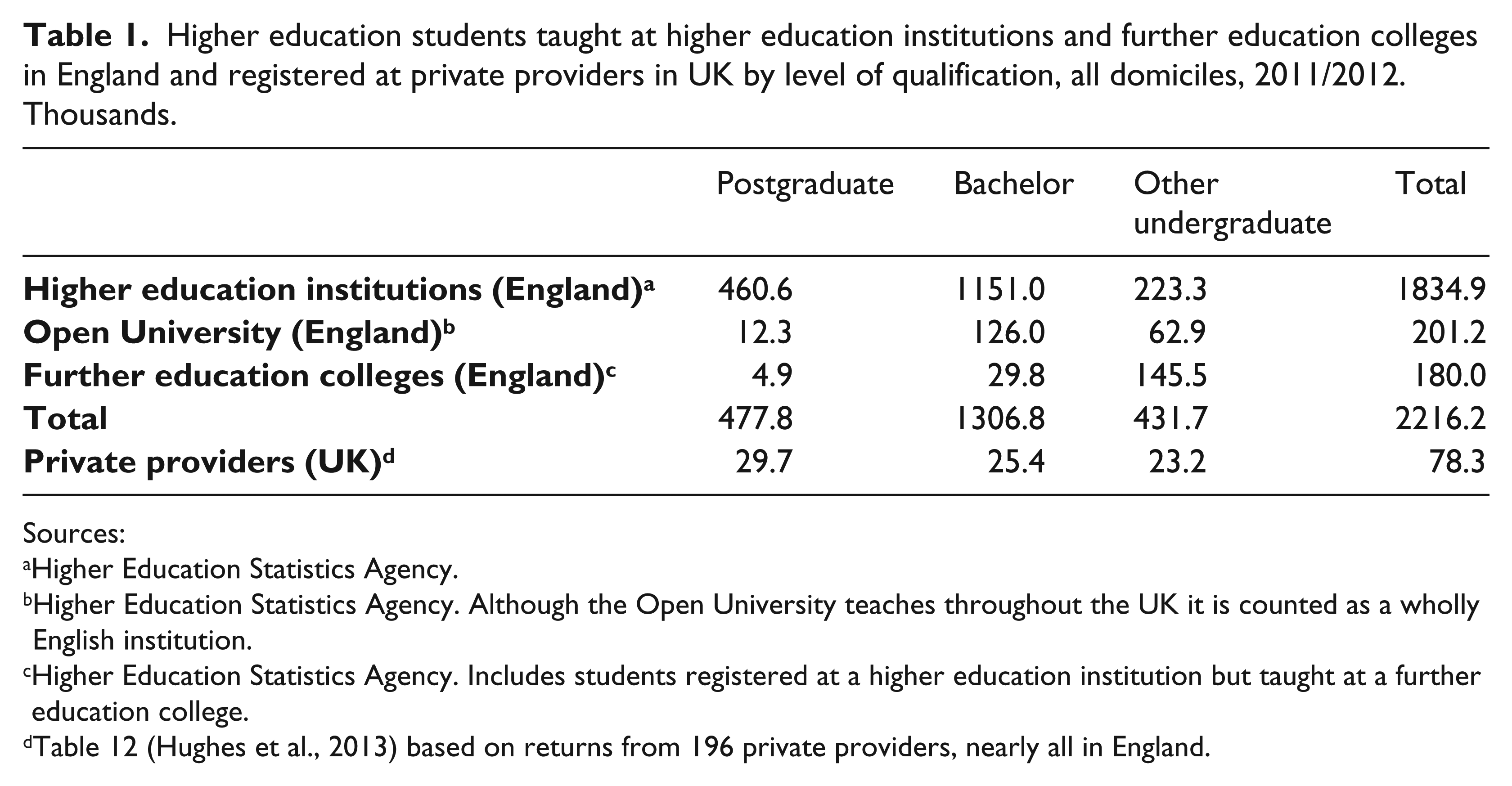
Sources:
Higher Education Statistics Agency.
Higher Education Statistics Agency. Although the Open University teaches throughout the UK it is counted as a wholly English institution.
Higher Education Statistics Agency. Includes students registered at a higher education institution but taught at a further education college.
Table 12 (Hughes et al., 2013) based on returns from 196 private providers, nearly all in England.
Nearly half of bachelor students and around one-third of taught postgraduate students are studying for science and science-related subjects (HESA, 2014b). At both levels, the most popular individual subject area is business studies, attracting one in eight bachelor students and close to one in three taught postgraduates. This is also the most popular subject area for international students. Other popular studies at the bachelor level are the subjects allied to medicine. At the postgraduate levels, the study of education is also prominent. Beyond that, little can be gauged about the vocational orientation of courses within and between standard subject groupings.
One marker of the professional and occupational orientation of bachelor degrees is their accreditation by professional, statutory and regulatory bodies (Table 2). One-quarter of these courses are recognised, endorsed or kitemarked by professional bodies as meeting their standards. Accredited courses might confer full membership of the profession or give partial exemption to its examinations.
Higher education courses accredited by professional, statutory and regulatory bodies in UK by level of study, 2014/2015. Percentage accredited in brackets.
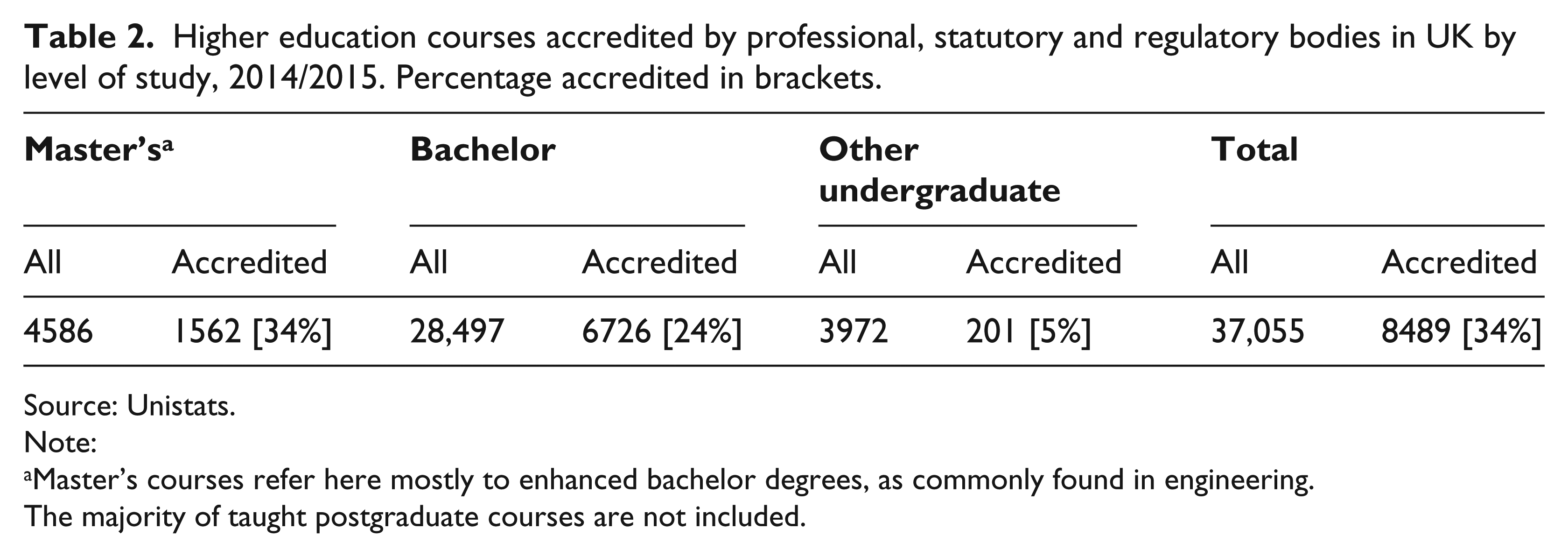
Source: Unistats.
Note:
Master’s courses refer here mostly to enhanced bachelor degrees, as commonly found in engineering.
The majority of taught postgraduate courses are not included.
Another work-related marker is the sandwich element in bachelor programmes. A ‘thick’ sandwich placement would normally add a further year to the length of a standard three-year full-time course. A ‘thin’ sandwich course might have shorter placements of three or four months. One in 10 full-time bachelor students were enrolled on sandwich courses, with the highest numbers in business studies and engineering and technology. Those completing sandwich degrees were also more likely to be employed six months after graduation than graduates of other full-time programmes (HESA, 2014a).
Graduate employment, notably the identification of graduate occupations, is another classificatory problem. While there was evidence of increasing dispersion in the returns to graduate-level education (Green and Zhu, 2010), the level of ‘overeducation’ (the employment of graduates in non-graduate occupations) was nevertheless stable at around 30 per cent. So-called overqualified graduates received lower wages compared with matched graduates but higher wages than other types of labour (Green and Henseke, 2014).
Short-cycle sub-bachelor qualifications
In English higher education, the most discrete and strongly vocational sets of qualifications are those offered at the sub-bachelor (‘other’) levels of undergraduate education. Most are two-year or one-year qualifications leading to foundation degrees or varieties of diplomas and certificates. In the higher education sector, they are offered mainly by the newer universities. Elsewhere, they are taught by the majority of colleges in the further education sector and, in recent years, by many private providers.
Except for those deemed to be studying at these levels at the Open University, nearly all sub-bachelor students are pursuing qualifications designed for, or geared to, the workplace. At close to 400,000 students they represent 18 per cent of those enrolled in the public system of higher education. Most study on a part-time basis and the majority are enrolled in the higher education sector (Parry et al., 2012).
In order of size, the main types of short-cycle qualification are the foundation degree (first introduced in 2001); the diploma and certificate of higher education (originally conceived as broad-based qualifications but now important vehicles for health-related education); and the higher national diploma and certificate (at one time the standard qualifications in business and technician education and now a copyrighted qualification accredited by Pearson, a for-profit multinational publishing and education organisation). Accompanying these major types is an assortment of higher level vocational, technical and professional qualifications (each usually serving a specialist or niche occupation) and programmes leading to the award of credits.
Foundation degrees are awarded by universities and, following legislation in 2007 giving colleges the right to apply for awarding powers for this qualification, by a handful of further education colleges (currently just four). The diploma and certificate of higher education are also awarded by universities but, unlike the foundation degree, they are predominantly taught in the higher education sector. When offered by universities, the higher national diploma and certificate are awarded under licence from Pearson. When provided by further education colleges, Pearson is the awarding organisation.
Most of the other higher level qualifications are awarded by (or through) individual professional and occupational organisations, except for competency-based national vocational qualifications. An initiative of central government in the late 1980s, the national vocational qualifications have mostly been awarded at the lower competency levels. Their impact on higher education has been minimal (Raggatt and Williams, 1999).
Private providers of undergraduate and postgraduate education
A third zone of vocational higher education is the postgraduate, bachelor and sub-bachelor qualifications offered by private providers. Except where students are in receipt of state-subsidised fee-loans, administrative data on private higher education is not available. Instead, reliance has to be made (as here) on the most recent survey of private providers carried out for the responsible government ministry, the Department for Business, Innovation and Skills (Hughes et al., 2013).
This study identified a total of 674 named privately funded providers and an estimated student population of 160,000. Around three in five were studying full-time. The rest were attending as part-time students or undertaking their courses through distance learning. Just under half were international students, most originating from outside the European Union. Most private providers enrolled small numbers. At 217 out of the 674 providers there were fewer than 100 students. Only 35 had over 1000 students, with five registering more than 5000 students.
In the main, these were specialist providers. Only around one-third of private providers offered a range of subject areas. The remainder specialised in business, management, accountancy and information technology or were spread over other specialist areas. Some were religious colleges and others were arts-focused, technology-based (engineering, aviation and science subjects) or devoted to alternative and complementary medicine. Similar proportions of students appeared to be enrolled at the postgraduate, bachelor and other undergraduate levels, with just over half of providers teaching postgraduate programmes.
In-company courses of higher level education and training
Finally, there are courses, usually of short duration, which are provided in-house by businesses for their employees. These do not normally appear in official statistics or labour market surveys unless the programmes lead to recognised qualifications or the award of credits, in which case they feature in the standard data returns of universities and colleges.
Where certification is neither sought nor appropriate, businesses might still look to university departments to provide the specialist expertise and advanced training matched to their needs. Alternatively, the continuing professional development of the workforce might better be met by consultancy firms and commercial training organisations or, in the case of large enterprises, from within their own ranks and networks. In general, activity in this zone of vocational higher education is encouraged by governments through their policies for research, innovation and knowledge exchange (HM Treasury, 2003).
In the post-binary period, all four zones have featured in strategies to bring higher education and employment into closer relationship. These were years of renewed expansion in English higher education. While growth still largely followed individual and social demand, concerted attempts were made by the state and its agencies to influence the supply of provision and have work-focused higher education take an increasing share of the new expansion.
Three policy interventions
Under consecutive Labour governments between 1997 and 2010, policies to expand higher education held centre stage. In their shadow were steps to recover a vocational mission for further education and improve the performance of further education colleges. A crossover between these lines of policy was occasioned by three interventions in the name of vocational higher education, each involving colleges in a drive to expand and widen participation in higher education.
The first of these had its origins in the recommendations of a national inquiry into higher education (the Dearing committee, 1996–1997). Beyond asking universities to equip students with ‘key skills’ and persuading employers to provide more work experience opportunities, reference to the vocational came through the inquiry proposals on growth. In the belief that a major part of future demand in ‘the learning society’ would be for short-cycle courses, the committee proposed that priority be accorded to sub-bachelor qualifications. Equally controversial was the related recommendation that more of the provision of sub-bachelor higher education should take place in further education colleges (NCIHE, 1997). Both proposals were broadly accepted by the incoming government (DfEE, 1998).
A special mission for further education colleges
Although the polytechnics and other large higher education providers had been removed from the further education sector in 1989, some higher level work remained with many colleges. Except for 50 or so colleges where provision was sizeable, most were involved in small amounts of higher education, often involving partnerships with one or more universities for the purpose of franchising or validation. At the same time, local employers continued to recruit from neighbouring colleges or sponsor their employees to undertake higher education qualifications in these institutions.
The Dearing inquiry made no judgement as to whether some or all colleges should teach higher level courses. Their ‘special’ mission in higher education should, it was asserted, be directly funded (rather than dependent on franchising by universities). To curb academic drift, this mission was to focus on higher national diplomas and certificates. In the event, both recommendations soon fell victim to weak demand for sub-bachelor programmes. Franchise arrangements became the preferred funding route: the association with universities would, it was believed, stimulate demand for college-based courses. A number of colleges were able to provide their students with a ‘top-up’ year leading to a bachelor degree, so avoiding the need for transfer to a partner university.
Much less notice was taken of those college-taught programmes that led to a variety of higher level professional and technical qualifications, mainly because they were not included on the list of ‘prescribed’ courses able to be funded by the Higher Education Funding Council for England. Although some of these ‘non-prescribed’ programmes were eligible for support from the funding body for further education, most were full-cost courses paid for by students (or their employers).
A new short-cycle work-focused qualification
With little evidence of improved demand, ministers came to doubt the capacity of existing sub-bachelor qualifications to generate further expansion. To help meet an ambitious 50 per cent participation target set for the year 2010, a new two-year vocational qualification – the foundation degree – was launched at the opening of the new century in 2001 and upon which any future growth would be concentrated. This was the first new major qualification in English higher education since the introduction of the diploma of higher education in the 1970s. Significant again, it was the first time that a sub-bachelor qualification carried the title of ‘degree’.
The main purpose of the new two-year degree (and part-time equivalent) was to redress the historic ‘skills deficit’ at the intermediate levels of employment and the economy (DfEE, 2000). By involving employers in its design and operation, and by enabling students to apply their learning to workplace situations, the new flagship qualification would, it was hoped, raise the value of work-focused higher education. Over time, it was meant to subsume the higher national diploma and certificate. Taught in both the higher and further education sectors, the foundation degree would guarantee progression to a linked bachelor degree as well as function as a free-standing qualification.
By funding additional places for these courses in preference to traditional honours degrees, the next wave of growth was intended to come predominantly through this route. These incentives were necessary to ‘break the traditional pattern of demand’ and ‘meet the needs of a more diverse student body’ (DfES, 2003: 62).
Progression pathways for vocational students
The foundation degree was to be positioned at the upper end of ‘a new vocational ladder’ spanning secondary and post-secondary education. At the lower end, more vocational versions of secondary qualifications were to be introduced for 14–16-year-olds, which would open a pathway to more advanced programmes that were predominantly vocational or which combined academic and vocational study (Blunkett, 2001). Already the principal location for adults and young people undertaking qualifying programmes leading to short-cycle higher education, the further education sector was poised to supply qualifications at each of the main levels in the new vocational ladder.
To underpin a progression strategy supporting vocational students moving within and between colleges and universities, ‘lifelong learning networks’ were created across a city, region, area or subject to ‘bring greater clarity, coherence and certainty to progression opportunities’ (HEFCE & LSC, 2004: 1). Articulation agreements would bring more connectivity between higher and further education providers. Presented as a joint initiative between the two sectors, primary responsibility for the implementation of the networks rested with the Higher Education Funding Council for England.
The context for this intervention was near-saturation in respect of the conventional A-level route into higher education: about 90 per cent of students qualifying on the academic track entered this way. For those studying vocational qualifications at the same level, only 40–50 per cent did so. With an eye to the 50 per cent target, the lifelong learning networks were intended to combine the strengths of diverse institutions to increase the proportion of students entering higher education from vocational programmes and the workplace. Here also was another attempt to move beyond a distinction between ‘academic’ and ‘vocational’ types of education, one that had become increasingly outmoded yet ‘continues to bedevil post-compulsory education’ (Newby, 2005: 13).
Policy appraisal and an alternative reform programme
Together, these three measures were aimed at increasing the volume and share of work-focused higher education, primarily at the sub-bachelor levels (Parry, 2009). Their impact on the shape of English higher education is appraised by comparing linked administrative data on the students and qualifications taught in higher and further education institutions. The election of a new Conservative-led Coalition government in 2010 brought an end to interventions of these kinds. Even so, pressures on public funding had forced the previous government to withdraw its funding for lifelong learning networks, and for the national organisation it had established to promote foundation degrees and stimulate employer engagement.
From 2008, it also removed public funding for entrants to undergraduate courses who already held an equivalent or higher qualification. Although entrants to foundation degrees were exempt from this restriction, such a change ran counter to other government measures designed to promote professional updating, retraining and a mobile labour force.
Policy impacts: trends and patterns
In the 15 years between the Dearing report and another (shorter) review of higher education – the Browne inquiry, 2009–2010 (Independent Review of Higher Education Funding & Finance, 2010) – there was no increase in the total numbers recruited to short-cycle sub-bachelor education; and, as a consequence of growth elsewhere, its share of the total student population was considerably reduced (Table 3).
Higher education students taught in higher education institutions (excluding Open University) and further education colleges by level of qualification and mode of study, all domiciles, England. Thousands.
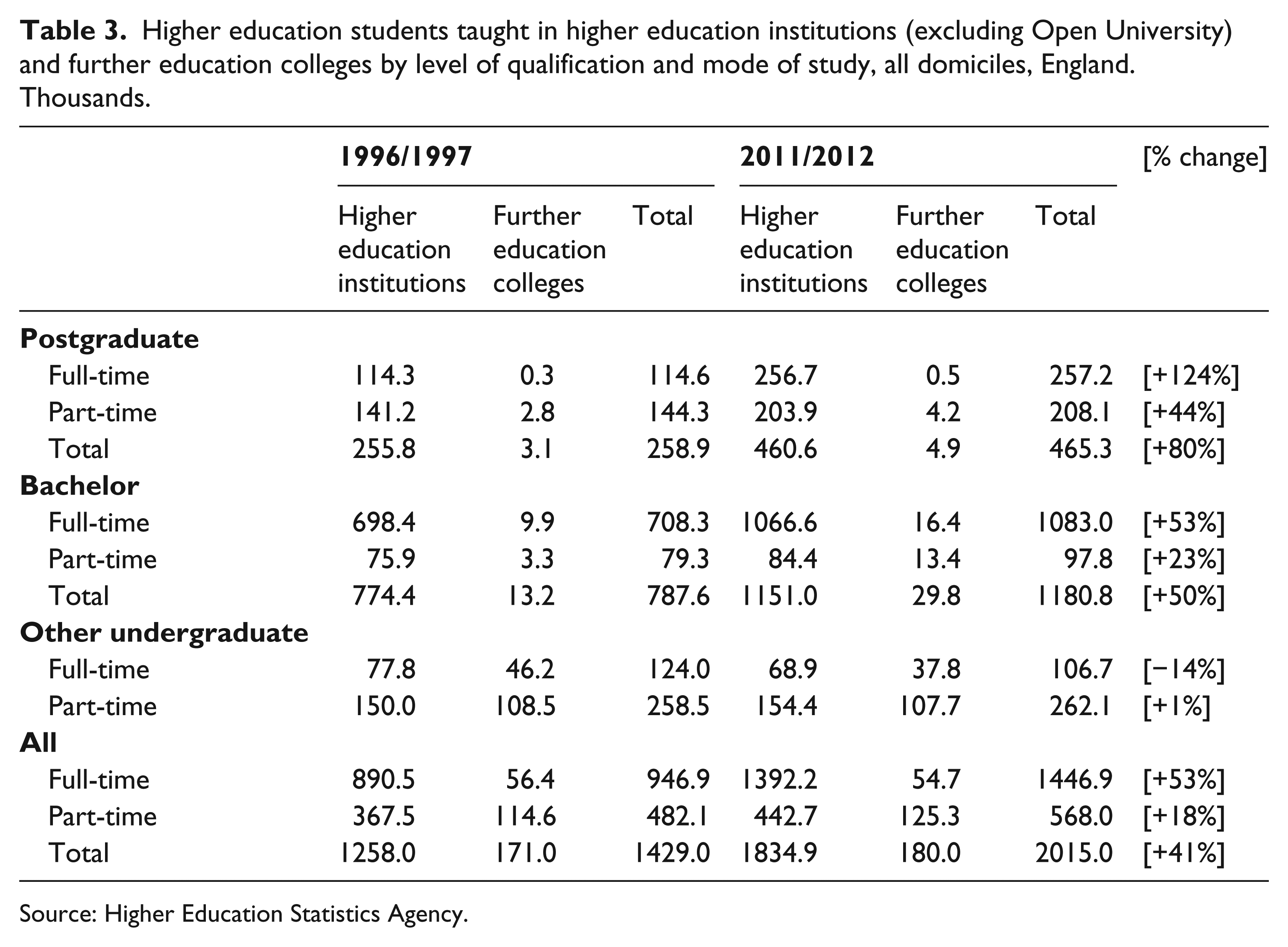
Source: Higher Education Statistics Agency.
Overall numbers at the other undergraduate levels remained flat, at under 400,000. As a result of the rapid expansion in bachelor and postgraduate education, the sub-bachelor proportion had contracted, from 27 per cent to just 18 per cent. Also with implications for workforce training and professional development was the slower rate of growth in part-time bachelor and postgraduate education, and hardly any change to part-time numbers in the sub-bachelor segment (where part-time students had always greatly outnumbered their full-time counterparts).
As indicated in Table 3, there had been a decline too in the numbers of higher education students taught in further education colleges, and a marked decrease in the college share of English higher education, from roughly one in eight at the time of the Dearing inquiry to one in seven at the time of the Browne review. One of the few areas of growth in colleges was for the bachelor degree where numbers had more than doubled, albeit from a low base. Less noticed were important locational changes in the pattern of individual qualifications. Behind the weakening position of short-cycle undergraduate education were decisions by higher education institutions to withdraw from qualifications leading to the higher national diploma and certificate. The collapse in numbers for these two qualifications is only partly explained by the substitution effects of the new foundation degree; or by the award of these qualifications under licence from Pearson; or by the introduction of variable tuition fees. The involvement of these same institutions in the diploma and certificate of higher education was also reduced, but these were qualifications taught by themselves (with hardly any franchising to colleges) and, in many cases, linked to large contracts with healthcare providers (Table 4).
Higher education students studying sub-bachelor qualifications and credits in higher education institutions (excluding the Open University) and as franchise students taught at further education colleges, all domiciles, England. Thousands.
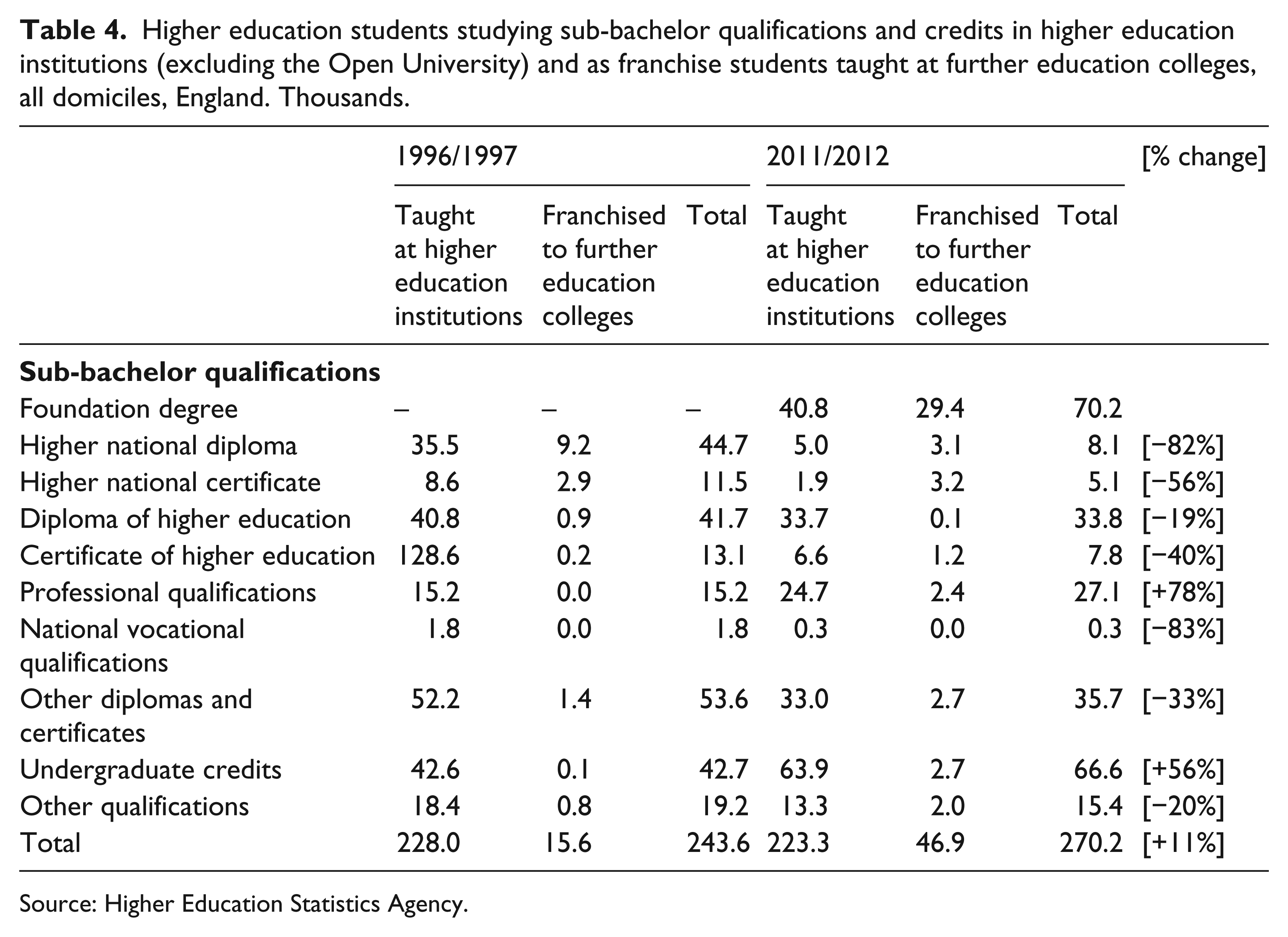
Source: Higher Education Statistics Agency.
One consequence of this withdrawal is that further education colleges became the chief providers of the higher national diploma and certificate (Parry et al., 2012). This had been another Dearing expectation, now achieved for reasons other than those anticipated by the inquiry. Other professional, vocational and technical qualifications at these levels continued to be taught in both sectors. To the disadvantage of colleges, only universities were able to assign and award credits for work not leading to a full qualification. Along with foundation degrees and credit-based programmes, these professional and related qualifications were the only areas of growth in the vocational zone of sub-bachelor education.
From the beginning, the work-focused foundation degree was intended to be offered by both universities and colleges. Although numbers were broadly similar in each sector, the college contribution included students registered with the universities but taught as franchise students in colleges. Approximately half those acquiring this qualification then proceeded to complete their studies at the bachelor level. Unlike the 50 per cent participation target set for all higher education, a government target to create 100,000 foundation degree places over 10 years was met (HEFCE, 2010). However, this volume and rate of growth was insufficient on its own to challenge the domestic and international demand expressed for the full-time bachelor degree (see Table 3).
Policy failures: explanations and dilemmas
That these interventions met with so limited success was a reminder of the strength of some enduring prejudices and hierarchies in English education. Whatever their actual realisations, the old polarities – education ‘or’ training, liberal ‘or’ vocational (Silver and Brennan, 1988) – found themselves reproduced in the preference for bachelor over other undergraduate qualifications; and echoed in the present-day dual regimes and relations of higher and further education.
The same legislation that removed the binary line between university and non-university higher education in 1992 replaced it with a two-sector division between higher and further education. Whereas the reasons for binary abolition were well-rehearsed, no such rationale was thought necessary for the new sector of further education and its boundary with higher education. The need in future for tertiary providers to be wholly or primarily engaged in higher education or further education – another polarity – was also largely taken for granted.
These presumptions and policies were reversed after 1997. Over three Labour administrations, ministers set about encouraging further education colleges to adopt mixed-sector missions, and to develop responsive, accessible and flexible forms of work-focused higher education (BIS, 2009; HEFCE, 2006). All this was to be achieved with no change to the system architecture put in place in 1992, a tertiary division of institutional labour designed to keep these domains apart. Here was an episode that revealed much about the asymmetries of power, prestige and influence between the two sectors and that – structurally, culturally, operationally – helped to explain the subsequent failure to fashion a vibrant zone of short-cycle vocational higher education.
One obvious illustration of this asymmetry was the lead responsibility given to the Higher Education Funding Council for England for policy development and funding in respect of college higher education. This had been another proposal in the Dearing report (NCIHE, 1997), one made by a committee on which the further education sector was neither represented nor openly consulted. The inquiry proposals on higher education outside the university circle were greeted with ambivalence (and hostility in some quarters). Equal scepticism surrounded the largely unevidenced claim that future demand would favour short-cycle and short-order higher education (Parry, 1999).
Driven by international as well as domestic demand, the brand of higher education represented by English universities and the bachelor degree accounted for nearly all the post-binary expansion in undergraduate education. Binary demarcations might have given way to more fluid categorisations of higher education institutions based on league tables and mission groups, yet differences in the standing of universities and further education colleges were deeply entrenched. Nor were such perceptions likely to have been altered by the mixed fortunes of further education colleges as independent institutions or by the lower earnings returns associated with foundation degrees and other short-cycle qualifications, compared to bachelor degrees (BIS, 2011c).
If the eclipse of short-cycle vocational provision by the bachelor degree was one legacy of the long development of English higher education, another was the failure to develop an alternative model of higher level vocational education and training, one not pulled into the standard shapes of undergraduate education. Notwithstanding the assumptive structures of post-binary higher and further education, it was always open to the further education funding bodies to take advantage of their funding responsibility for non-prescribed higher education.
That opportunity was never taken, despite statements from within these agencies that vocational higher education, prescribed and non-prescribed, was an integral part of further education provision (FEFC, 1996), and that non-prescribed courses were especially important for students who found it difficult to access the mainstream system (LSC, 2008). A year-on-year fall in the numbers enrolled on non-prescribed programmes still left some 40,000 studying for higher level professional qualifications, mostly in business and administration, followed by education and training, and by health, care and the public services (Saraswat et al., 2014). It was left to later governments to pinpoint this neglect and signal an alternative strategy and narrative.
Higher vocational education: the next narrative
After 2010, the goal of a more diverse higher education system, including more opportunities for higher level vocational study, has been sought through de-regulation, fee reform and the entry of new providers. Accompanying these market-led approaches have been austerity policies requiring major reductions in the spending of most government departments, including the ministry responsible for higher education. By trebling the maximum domestic fee for undergraduate education and by routing the funding of teaching through fee-loans, the government made additional funds available for higher education which (because of accounting conventions) was not counted as departmental expenditure.
These reforms were designed to put universities and colleges under competitive pressure to better respond to student demand, thereby – so the argument went – raising quality, enabling greater diversity and lowering costs. In this way, competition on price and quality, rather than state action, would shape the forms taken by vocational higher education. For the funding of strategic and high-cost subjects, nonetheless, a block grant was still paid to institutions by the Higher Education Funding Council for England. Otherwise, the power of this body to find and fund ways of expanding vocational and college higher education was weakened. In future, the funding council was expected to take on ‘a new role as consumer champion for students and promoter of a competitive system’. It would be made easier for new players – especially private (‘alternative’) providers – to enter the market. By ensuring ‘a level playing field’, further education colleges and alternative providers would be able to expand their provision. In turn: ‘This will further improve student choice by supporting a diverse sector, with more opportunities for part-time or accelerated courses, sandwich courses, distance learning and higher-level vocational study’ (BIS, 2011a: 5).
These were the aims and claims, this time without targets, against which the next policy experiment in English higher education would be judged. In further education, where the effects of austerity policies were singularly acute, there was the prospect of more responsibility being extended to this sector for its employer-focused and work-based higher education. The new narrative for this arena was ‘higher vocational education’. Soon after coming to power in 2010, the Coalition government announced its intention to ‘develop and promote the concept, identity and value’ of higher vocational education as a territory to be embraced by the further education sector (BIS, 2011b: 13).
Five years on, little progress had been made in defining or elaborating this concept, except through policies to expand apprenticeships as ‘the paradigm case of vocational education’ and specific efforts to foster higher apprenticeships. Since their introduction in 2010, just 18,000 out of a total of 850,000 publicly funded apprentices had embarked on a higher apprenticeship. It was not until the close of this government that another attempt was made to demarcate a zone of higher level vocational education and training, this time in light of an international report indicating (not for the first time) the poor comparative performance of England in equipping adults with vocational post-secondary qualifications (OECD, 2014).
In this latest formulation, what distinguished higher vocational education from the rest of higher education was not the length or type of programme, or in which sector it was located, but ‘the strength of employer leadership’ in ensuring ‘a direct line of sight to work’ (BIS, 2015: 22). This, according to a commission on adult vocational teaching and learning, was one of four distinctive characteristics of effective vocational training. In a ‘two-way street’ between providers and employers, there also needed to be ‘dual professional’ teachers and trainers who combined occupational and pedagogical expertise; access to industry-standard facilities and resources; and clear escalators to higher level vocational learning, ‘developing and combining deep knowledge and skills’ (CAVTL, 2013: 9).
That there had been little evidence of employer leadership or investment in education over the last 15 years, a period in which the volume of training per worker had declined by about one-half (Green et al., 2015), did not lend confidence to these declarations. Nor did the picture painted by a national audit report of a rapid decline in the financial health of further education sector since 2010; and, more than that, a sector in deficit for the first time (NAO, 2015). All this placed an extra responsibility on the higher education sector to remake its role in vocational higher education and on the further education sector to give substance and weight to a concept of higher vocational education. Their integration and coordination was a task for government, with or without the sector regimes that hitherto had blunted this endeavour.
Footnotes
Acknowledgements
The data presented in Table 2 were analysed and supplied by Matt Robinson at University Alliance. The author is grateful to University Alliance for permission to publish this material.
Funding
This research received no specific grant from any funding agency in the public, commercial or not-for-profit sectors.