




Abstract
I review the literature evaluating sub-baccalaureate career and technical education (CTE) at community colleges. The goal of this study is to review the evidence describing how earning these types of credentials affects students’ outcomes, as well as which program characteristics contribute to student success. The research suggests that, on average, there are significant labor-market returns to obtaining short, technical credentials, although the returns vary across locations and fields of study. Researchers examining career pathway programs, sectoral partnerships, and apprenticeships have found mixed effects of participating in these programs, although so far, the literature is largely limited to short-term outcomes. More research is needed that ties program characteristics to student outcomes to develop our understanding of how to increase the probability of success for students enrolling in postsecondary CTE. We also need more studies examining the long-term outcomes for students graduating from these programs.
Keywords
Rapid technological change and international trade have changed the labor market. There is now less demand for lower skilled workers performing repetitive tasks and more demand for “middle skilled” workers with some postsecondary training (Autor, 2014; Autor & Dorn, 2013; Holzer, 2015a, 2015b; Levy & Murnane, 1996). Community and technical colleges play an important role in providing access to postsecondary education, including the type of career and technical education (CTE) that could increase opportunities for disadvantaged workers.
The purpose of this review is to examine the evidence on the effect of participating in postsecondary CTE at public 2-year colleges on student outcomes. My goal is to present what we know about the effects of participating in CTE at community and technical colleges as well as evidence from programs that could inform the design of future public 2-year college credentials. This review comes at an ideal time, for improving CTE is one of the few policy issues that currently receives bipartisan support (Rosen et al., 2018). In addition, there are ongoing debates about extending Pell eligibility to programs that would provide short, non-credit career and technical credentials (Lederman, 2021). As well, the volume of research evaluating postsecondary CTE programs and credentials is large enough to support some key findings, while also suggesting several gaps. The research reviewed here can inform the work of policymakers and community college leaders aiming to improve the lives of workers and maintain this country’s economic competitiveness.
This review is guided by the following research questions. First, what is the effect of participating in postsecondary CTE at public 2-year colleges on student outcomes? Second, what does the extant literature suggest are best practices for postsecondary CTE? I find that not much literature addresses persistence and completion in CTE, despite the fact that these students may experience unique barriers to persistence. At the same time, my findings suggest that participating in postsecondary CTE has a positive effect on short-term earnings for students, in general, although there is heterogeneity across states, programs, fields of study, and student characteristics. Research reports evaluating career pathways and sectoral partnerships suggest that employer involvement is an important component of effective programs, although more research is needed to understand why some programs improve student outcomes while others don’t. Finally, we know little about how any of these programs, whether community college–based or not, affect medium- and long-term employment and earnings.
This review complements a recent review by Carruthers and Jepsen (2022) in the Routledge Handbook of the Economics of Education. Carruthers and Jepsen focused their review on the peer-reviewed economics literature, while my paper takes a broader look at the education policy literature, with the specific goal of informing policy and practice at public 2-year colleges. Although the majority of the studies I found are quantitative, my review incorporates alternative disciplinary and methodological approaches when available. Most importantly, the second half of this review focuses on reports from research firms and centers that evaluate current innovations in postsecondary CTE, including sectoral partnerships and apprenticeship programs. This literature starts to explore how program components and modes of delivery affect student outcomes.
In the next section, I provide the background and policy context motivating this review. I then review and analyze the literature examining the impact of CTE on student outcomes. The final section of this paper suggests directions for future research.
Background and Context
Community Colleges Provide Career and Technical Education
Community colleges play an important role in providing access to postsecondary education, including the type of vocational training that could increase opportunities for discouraged workers. In the 2016–2017 school year, almost 40% of undergraduates were enrolled in public 2-year colleges (National Center for Education Statistics [NCES], 2017), and the number of community college students completing vocational credentials has increased in recent years. 1 In the 2015–2016 school year, community colleges awarded 615,044 long- and short-term certificates, compared to 309,624 in 2000–2001 (NCES, 2017). The majority of these short credentials are in career and technical fields and are intended to provide students with direct access to local labor markets.
Table 1 displays the five fields of study in which the largest number of associate degrees as well as short- and long-term certificates were awarded in the 2015–2016 school year. Long-term certificates require at least 1 but less than 2 years of full-time study, while short-term certificates require less than 1 year of full-time study. Many associate degree programs are also in CTE fields, and these credentials require at least 2 years of full-time study. Across all three program lengths, the greatest number of credentials were awarded in “health professions and related programs.” For certificate earners, the number of credentials awarded in health-related fields was almost double that of the next most popular field of study. Programs of study may be distributed differently across the credential types in different states, but, for example, a student at Cuyahoga Community College might earn an Associate of Applied Science in Nursing, or they could start with a Practical Nursing Certificate. Other types of health-related certificates might include basic EMT, laboratory phlebotomy, or medical billing specialist (Cuyahoga Community College, 2021).
Most Common Fields of Study in Which Short Credentials Were Awarded by Public Institutions, 2015–2016

Note. Adapted from data provided in Tables 320.10 and 318.50 of the Digest of Education Statistics 2017 (NCES, 2019). The numbers reported here are not necessarily limited to 2-year colleges. Credentials awarded in “liberal arts” were excluded because that is not a CTE field.
After health-related areas of study, there is some variation across credential types in the most common fields. Business is also a common field of study across program lengths. Using programs at Cuyahoga as an example again, a student could earn an Associate Degree in Business or Business Technology that might include courses in math, writing, public speaking, and software programs, such as Microsoft Excel, or a student might study at the certificate level to become an administrative specialist and take a similar but shorter sequence of courses more focused on the use of common administrative software packages (Cuyahoga Community College, 2021). Other popular fields of study at the certificate level include mechanic and repair technologies and personal and culinary services. Some short credentials are also non-credit, although much of the research cited in this paper focuses on credit-bearing vocational credentials because these are more easily observable in the data researchers have used to study the effects of participating in these programs.
Students may be more likely to complete certificate programs, which require less time than traditional associate degrees and focus on marketable skills. Low completion rates are a problem across most sectors of higher education, and particularly so at public, 2-year colleges. Only about 32% of first-time, full-time students entering 2-year institutions graduate within 150% of the normal time frame (NCES, 2017). Research suggests that students’ academic outcomes improve when program materials are built around concrete skills for which students see direct utility (Wachen et al., 2011). However, short credentials, which signal training in a particular technical skill, may not be as durable in the face of economic fluctuations as is a bachelor’s degree, which is assumed to signal more general skills, such as the ability to think critically and solve problems (Hanushek et al., 2017).
Policy Context
Two pieces of federal legislation, the Workforce Innovation and Opportunity Act (WIOA), signed into law in 2014, and the Perkins Act, most recently reauthorized in 2018 (Perkins V), include provisions that shape CTE at community colleges. Although some federal funding for CTE may be focused on improving outcomes for particular populations, such as displaced workers, requirements put forth in WIOA and Perkins are likely to influence the design of programs, regardless of whether they serve particular populations. More than previous iterations of this legislation, such as the Workforce Investment Act (1998–2014) and the Job Training Partnership Act (1982–1998), WIOA emphasizes the use of evidence-based practices in the development and expansion of postsecondary CTE (Heinrich, 2015). Public 2-year colleges may be more involved in federally funded workforce training under the WIOA because it permits one-stop centers to contract directly with higher education institutions rather than connecting participants with training providers on an individual basis (Barnow & Smith, 2015). WIOA also incentivizes coordination across agencies in developing programs that meet local employers’ needs, emphasizing training that leads to industry-recognized credentials and in developing career pathways (Heinrich, 2015). Although the involvement of stakeholders, such as state policymakers and local industry, in the development and management of workforce training has the potential to benefit all involved, research suggests that the complexities of business involvement and state administrations are often difficult to manage (Barnow & Smith, 2015).
The purpose of the Carl D. Perkins Career and Technical Education Improvement Act of 2006 is to fund, 2 largely through a basic state grants program, the development of high-quality CTE. 3 States use this money to support CTE at high school and college levels, and the formulas for distribution of funds at the state level are designed to favor service providers with large populations of disadvantaged students (Dortch, 2012). To receive funding, the eligible state agency must convene stakeholders and develop a 4-year plan describing activities supported, career and technical programs, professional development, recruitment and retention strategies, efforts to transition sub-baccalaureate CTE students into baccalaureate programs, and academic benchmarks, all of which are intended to ensure that CTE programs are of the same quality as more traditional academic programs (Dortch, 2012). The focus on cross-sector collaborations and the labor-market alignment of programs remains in Perkins V (Carl D. Perkins Vocational and Applied Technology Education Act, 2018).
Some states, such as Tennessee, have also made large investments in improving and expanding workforce training. Like WIOA and Perkins V, legislation and programs in Tennessee tend to focus on credential pathways and employer involvement. In 2013, then-governor Bill Haslam established the Labor Education Alignment Program (LEAP) as the third prong of Drive to 55, along with Promise (free community college) and Reconnect (incentive for adults to return to college), to improve career technical education at the secondary and postsecondary levels. LEAP aimed to increase alignment between the programs offered by community and technical colleges and local industrial needs. To achieve this goal, “LEAP collaboratives” were formed that comprised high schools, community and/or technical colleges, industries, and local economic development agents or representatives from local municipalities. Although LEAP funding concluded in 2019, Governor Bill Lee’s Governor’s Investment in Vocational Education grant supports similar efforts, allocating another $25 million to fund 28 new collaboratively developed education workforce development proposals.
How Do Students Select Into Vocational Postsecondary Education?
This review does not explore how students select into postsecondary CTE, partly because few studies have addressed this question, although it has implications for equity. Ideally, students who would benefit most from participating in postsecondary CTE would also be the students who select into these programs. 4 Foote and Grosz (2017) found that industry closure increases community college enrollment, suggesting that displaced workers take advantage of these credentials. Bailey et al. (2003) used the 1999–2000 National Postsecondary Student Aid Survey to study the characteristics of students enrolled in certificate and associate degree programs. These authors concluded that the racial composition of certificate seekers implies tracking (“self-selection or guidance towards a lower credential”; 2003, p. 45), although this analysis needs to be replicated with newer data.
These studies are limited in that they focused on student characteristics. This is important for ensuring equitable access and also making sure that lower-performing students aren’t being pushed into postsecondary CTE. However, decision-makers who want to improve access to postsecondary CTE also need to understand barriers facing students who want to select into these courses and programs. Supply constraints on the college side and academic requirements may prevent students who would benefit from these programs from selecting into them.
Method
I identified articles for this review by searching databases, including Education Full Text, ERIC, and JSTOR. I made use of databases that include or focus on empirical education research because I wanted to determine the breadth of empirical research on postsecondary CTE and whether that evidence points to characteristics of successful programs. I searched by using multiple combinations of terms and always included the phrase community college, along with vocational, career technical education, vocational training, or occupational degree. For database searches, I limited searches to English-language articles in peer-reviewed journals published since 1998. 5 I limited my search to research published within approximately the last 20 years because my central question is about how current practices can inform future program design. I completed the last searches in 2021, although additional papers were added during the publication process. Alexander (2020) wrote that the quality of the research included in a review matters because ultimately one’s findings are relying on the assumption that the results reported in the underlying literature are valid. In this first stage of searching, I limited my searches to peer-reviewed articles because it is a widely accepted indicator of research quality.
Following Alexander (2020), Figure 1 displays my search process. The initial database searches yielded 592 unduplicated records. After reading through the titles of these sources, I discarded 107 because they described vocational education outside the United States. The system of higher education in the United States is unique, and findings in international contexts may not replicate here. Next, I read through the abstracts of all the remaining articles. At this stage, I discarded 394 articles that were not primarily about postsecondary vocational education and, as a result, did not help me answer my research questions. Examples include articles that were primarily about student athletes or study abroad. Appendix A provides a complete list of topics excluded at this stage. I read each of the remaining articles in full and excluded 57 that were not empirical (i.e., not based on transparent methods of data collection and analysis). Several of these articles were from such journals as the Community College Journal. The articles described innovative practices and were written by a journalist or practitioner. Although some of these articles provided more specific details about postsecondary vocational courses and programs of study than I was able to find in the empirical literature, I chose to exclude them because they did not include methods sections or describe their research process. As a result, I could not judge the quality of the research. Moreover, these articles did not examine the effects of course or program components on student outcomes.
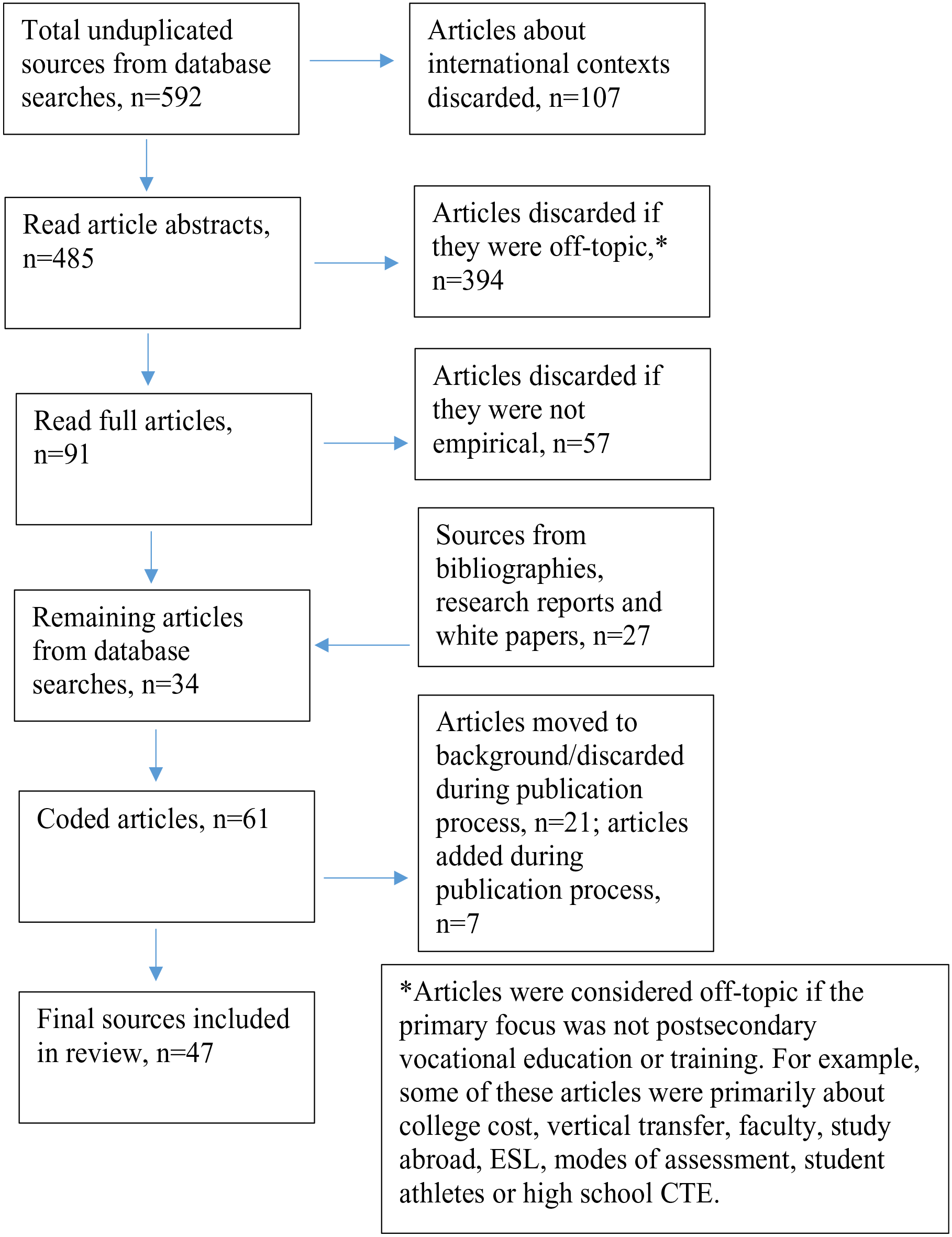
Diagram of search process. Total unduplicated sources from database searches, n=592.
At the end of this process, 34 articles remained. After examining this list, I expanded my sources by mining the bibliographies of these articles for additional pieces that would help me answer my research questions. In this way, I added an additional 16 sources to this review, for a total of 50 articles. At this stage, I also expanded my search to include non-peer-reviewed white papers and reports published by highly respected research centers or firms that produce research on postsecondary CTE. These additional sources were the Community College Research Center, the Rand Corporation, MDRC, American Institutes for Research, Mathematica, Westat, and Abt. I searched the websites of these organizations for papers that addressed my research question about the effect of participating in postsecondary CTE on student outcomes. This search resulted in 11 additional sources, which I added to this review.
I grouped articles by research question and then thematically coded the results and discussion sections. Initially, themes included “vocational student characteristic,” “labor market outcome,” and “program design.” However, additional themes, such as, “accountability,” “online learning,” and “transfer as outcome,” emerged through the process of coding. Finally, after coding, I determined that nine sources focused on the policy context surrounding postsecondary vocational education or the mission of community colleges belonged in the background and framing sections of this paper. An additional 12 sources were discarded during the publication process, and seven were added. This left me with 47 sources for the review.
How Does Participating in Postsecondary Vocational Education Affect Student Outcomes?
Persistence and Transfer
Chan and Wang (2016) used the community college survey of student engagement and administrative data to examine interactions among students in manufacturing programs. They found that interaction for broader educational purposes, which suggested campus engagement, was positively associated with students’ grade point averages. Nitecki (2011) used 13 faculty interviews, 21 student interviews, and classroom observations to examine practices at the program level in a large, urban community college that seemed to promote retention and graduation. She found that a shared culture of interest and program-level advising seemed to promote student success in the program. Similarly, Schmidtke (2016) interviewed 17 Native American students enrolled in technical college and found that a can-do attitude and the availability of help from administrators, peers, or professors were the main factors they identified as contributing to their success. Using data from interviews and websites, Van Noy et al. (2016) examined how program characteristics that may encourage persistence (e.g., advising) and structures that encourage integration (i.e., cohort models) varied across community and technical colleges in Washington State. Hirschy et al. (2011) reviewed existing models of student persistence in higher education and argued that because the students who selected into CTE programs had distinct characteristics, a new model of persistence needed to be developed for them.
Historically CTE credentials at community colleges have been considered primarily terminal programs and not intended to prepare students to transfer or go on to earn additional credentials. However this perspective is changing, as the reality of rapidly shifting technologies requires workers to be able to grow and shift with the labor market. Qi and Cole (2011) used data from the National Survey of Student Engagement to compare different types of 4-year students: those that transferred from CTE programs, those that transferred from regular community college (CC) programs, and non-transfer students. They found that the former CTE students were more academically engaged than their peers, spending more time studying and so forth, but they were less supported by the university and spent less time visiting professors or participating in co-curricular activities. They also found that the CTE students spent more time caring for dependents and working than their peers did. Two qualitative studies demonstrated the importance of accurate and consistent information for potential transfer students as well as encouragement and empowerment (Hioki et al., 2015; Karandjeff & Schiorring, 2011). Chase (2011) used critical policy analysis to examine transfer policies across four states (Ohio, Texas, Washington, Wisconsin) and explored whether state policies on vertical transfer prohibited transfer among students enrolled in technical programs in community colleges. She found that Washington seemed to do the best at potentially promoting vertical transfer among students enrolled in technical programs, but in general, her findings suggest that students in technical programs were going to lose more credit and have more trouble transferring than were students in academic programs.
This review of the available literature on persistence in postsecondary CTE suggests that we need more current studies that examine what contributes to student persistence in these programs. On the one hand, certificate and associate degree programs are shorter and so may not have the same issues with persistence that bachelor’s degree programs have. On the other hand, not all of these programs qualify for all sources of financial aid, which may create unique barriers to access and persistence in these programs. In addition, “nontraditional” students may be a large portion of the student population in CTE programs, and these students may face a unique set of challenges to persistence. Finally, some short credentials don’t articulate with other credentials, making vertical transfer or stacking credentials virtually impossible for some students.
Labor-Market Outcomes
A growing body of research has demonstrated that there are economic benefits for students who complete CTE-related credentials at community colleges, including shorter certificates or diplomas (Backes et al., 2015; Bahr et al., 2015; Belfield, 2015; Belfield et al., 2014; Carruthers & Sanford, 2018; Dadgar & Trimble, 2015; Gill & Leigh, 2003; Jacobson et al., 2005; Jepsen et al., 2014; Marcotte et al., 2005; Minaya & Scott-Clayton, 2022; Stevens et al., 2019; Turner, 2016; Xu & Trimble, 2016). Studies using national survey data have found economic returns to short credentials, although there is variation across credential levels (e.g., associate versus certificates), type (e.g., credit or non-credit), and institution sector (e.g., public or for-profit). Marcotte et al. (2005) estimated a 19% increase in hourly wages for females and a 15% increase for males earning associate degrees. These authors also found statistically significant returns for males earning certificates. Hester and Kitmitto (2020) used National Longitudinal Survey of Youth 97 data to compare credit-bearing and non-credit short credentials. They found that individuals completing credit-bearing credentials earned 17% higher wages, on average, than those completing non-credit-bearing credentials (see Albert [2020] for a recent review of the literature on non-credit short credentials). Cellini and Turner (2019) used administrative data from the Department of Education and the Internal Revenue Service to compare the economic return to short credentials earned at community versus for-profit colleges. They found that students completing their credentials at for-profit colleges had 11% lower earnings, on average, and that this pattern was consistent across gender subgroups and the top 10 most popular fields of study. However, studies estimating national averages missed variation in the design of credentials and the local economic conditions that affected the value of these credentials.
Although earlier studies relied on Ordinary Least Squares models that regressed earnings on years of education and experience, beginning with Jacobson et al. (2005), researchers started to make use of differences-in-differences models with individual fixed effects. The individual fixed effects control for non-time-varying characteristics of individuals, such as general aptitude, that may otherwise bias these models. The majority of the individual fixed effects studies compared the outcomes of credential completers with non-completers, although Carruthers and Sanford (2018) were also able to compare completers to those with no college. Researchers using models that compare completers to non-completers may have underestimated the return to credentials if there was some return to taking some courses in some fields.
More recent papers that made use of state longitudinal data and individual fixed effects models also presented evidence of positive returns, on average, for those completing associate degrees and short- and long-term certificates across areas of study defined by Classification of Instructional Programs codes (Backes et al., 2015; Bahr et al., 2015; Carruthers & Sanford, 2018; Dadgar & Trimble, 2015; Grosz, 2020; Jacobson et al., 2005; Jepsen et al., 2014; Marcotte et al., 2005; Minaya & Scott-Clayton, 2022; Stevens et al., 2019; Turner, 2016; Xu & Trimble, 2016). Appendix B summarizes the effects of earning an associate degree or certificate on students’ labor-market outcomes across national and state studies.
Although heterogeneity in the returns to postsecondary education across genders is well recognized, research using state data sets has demonstrated that there is heterogeneity across states in the returns to different types of credentials (i.e., short-term certificates, long-term certificates, and associate degrees) as well as variation in the returns across fields of study. Grosz (2020) used state administrative data from California and leveraged the random variation from an admissions lottery to estimate the return to nursing associate degrees. He found that individuals admitted to the program increased earnings by 44%, on average, compared to those not admitted, and that they were 19 percentage points more likely to be employed in the healthcare industry. Although most state studies have found robust returns to healthcare-related credentials, in some states, short-term healthcare-related certificates show little return, while in other states, they show a significant return. This discrepancy may be due to the ways different state systems have distributed programs of study across credential types. Alternatively, students following the same course of study may experience different returns in different state contexts due to the quality of programs or local labor-market demand, However, based on the data contained in these studies, it is not possible to understand which of these factors explains the variation in returns to different credentials across states.
Although healthcare-related credentials almost always provide returns across states and credential types, other fields of study demonstrate greater variation. For example, in Virginia, there were high returns to long-term certificates in welding, but this was not true in North Carolina (Xu & Trimble, 2016). Students in North Carolina earning short credentials in protective services experienced robust returns, whereas in Virginia, long-term certificates in this field yielded the highest returns (Xu & Trimble, 2016). In Michigan, the large positive returns for women completing long-term certificates were driven by the gains for women in nursing, a 115% increase (Bahr et al., 2015). Women completing other healthcare-related long-term certificates did not gain significant returns (Bahr et al., 2015). Men in Michigan experienced statistically significant, positive returns to additional fields beyond health, including IT, engineering technologies, and protective services, whereas outside healthcare, women only experienced statistically significant returns for associate degrees in personal and culinary services (Bahr et al, 2015).
The availability of education and training opportunities that provide robust labor-market returns may be particularly important for vulnerable populations, such as mothers who receive welfare or displaced workers who cannot afford the opportunity cost associated with a longer degree. Using administrative data from Colorado, Turner (2016) found that mothers who were current and former welfare recipients experienced large earnings gains from completing short credentials in healthcare-related fields, although she found earnings gains, on average, even for those in nontechnical fields. All credentials (short certificates, long certificates, and associate degrees in all fields of study) increased the probability of employment after completion (Turner, 2016). Workers who have been laid off also constitute a vulnerable population with the potential to benefit from shorter credentials that would allow an individual to change fields without a long absence from the labor force. Jacobson, Lalonde, and Sullivan (2005) found positive returns for displaced workers completing short credentials; however, they were more likely to be employed and to work more hours than to see any increase in wages. The authors also found returns for individuals who did not complete credentials, which suggests that individuals who take a set of courses to “upskill” experience benefits as well.
Most research ignores the nonpecuniary benefits associated with more stable employment that may result from earning a vocational credential. However, national survey data suggest that earning an associate degree or certificate is associated with increased job satisfaction and career relevance (Rosenbaum & Rosenbaum, 2013). Furthermore, the authors found that completion of an associate degree was associated with decreases in less desirable job characteristics, including long hours and physically demanding tasks (Rosenbaum & Rosenbaum, 2013).
Although research suggests that, on average, students benefit from completing short credentials, there are reasons to treat these findings with caution. First, these studies examined short-run outcomes. Although research suggests that the returns on a bachelor’s degree grow over time, there are not enough studies examining the long-term returns to short credentials. Minaya and Scott-Clayton (2022) were able to follow individuals in their sample for up to 11 years after they entered a community college. They found that long-term certificates and associate degrees provided returns directly after graduation. But in the longer term, the returns to associate degrees continued to grow, whereas the returns on long certificates flattened out after the initial increase (although the authors cautioned that they were estimating the returns to these credentials over the period of the Great Recession). Both types of credentials increased stability of employment (Minaya & Scott-Clayton, 2022).
In addition, the papers examining returns to community college credentials were not cost-benefit analyses—that is, they did not take into account the cost of a program or students’ forgone earnings. Turner (2016) pointed out that considering the costs as well as the benefits made the estimated returns for short credentials negative in some cases for the individuals in her sample. Moreover, other unexplored factors, such as variation in local licensing laws, may explain some of the differences in the returns to short credentials across states and credential types. Finally, although many of these studies disaggregated estimated returns by program Classification of Instructional Programs code, they described little about the design and content of different programs and how those factors affected student outcomes.
Evidence on Program Designs or Characteristics
Carruthers and Sanford (2018) used administrative data from Tennessee and an individual fixed effects approach to estimate the economic returns to students at Tennessee Colleges of Applied Technology (TCATs), a 27-campus network of public vocational training centers. TCATs offer certificates and diplomas similar to those of community colleges, in such fields as automotive technology, dental assisting, or machine tool technology. However, credit earned may not be transferable, and training is done in a setting more like a workplace and less like a classroom. A student chooses a program of study and whether they will attend part- or full-time; beyond that, the program is defined for them, so they do not choose individual courses. These schools offer two levels of credentials, but a certificate documents a skill, as opposed to signaling the completion of a program, as it does in other contexts. Students accumulate contact hours rather than credit hours.
On average, students at TCATs experience economic returns to enrolling in and completing programs. Unlike the aforementioned state data studies, which compared completers to non-completers, Carruthers and Sanford (2018) used Unemployment Insurance data to compare adults completing TCAT credentials to those who never enrolled in a TCAT and reported the returns to “some college.” They found that students who left programs even without a credential earned more than did students who never enrolled in a program but had similar earnings histories. The authors found that changing industries explained one-half of the returns to these programs and three-quarters of the wage gains. These findings for students enrolling in TCATs suggest that institutions offering clear pathways through credential programs, even if combined with a limited choice of areas of study, may yield positive outcomes for students.
Apprenticeships, in which the majority of training occurs in the workplace, form an important part of the current policy landscape and are another potential model for workforce development. These programs may be another way to ensure that students receive up-to-date training that will be valued in the labor market. In an apprenticeship, an individual becomes a salary-earning employee in a business or industry while receiving instruction in the classroom and through work-based training (Lerman, 2015). The Registered Apprenticeship Program (RAP), which is administered by the Department of Labor, “offers structured on-the-job training as well as technical instruction tailored to industry needs” (Lerman, 2015, executive summary). Oftentimes, community colleges provide the technical instruction in these programs, and the Department of Labor and State Apprenticeship Agencies issue certificates of completion to individuals participating in registered apprenticeships. Apprenticeships are offered in approximately 1,000 professions, the programs last between 1 and 6 years, and, in some cases, employers cover all program costs (Reed et al., 2012). Reed et al. (2012) examined apprenticeships in 10 states chosen for their variety of program features and labor-market characteristics and found that 9 years after enrollment, RAP participants earned an average of $5,839 more than did nonparticipants. RAP participants who completed their programs earned an average of $240,037 more over the course of their careers than did nonparticipants. Just under half of the participants in this study completed the apprenticeship.
Stackable Credentials
Dynamic labor markets may make short credentials a risky investment for students, but such approaches as stackable credentials, in which a series of short credentials build into a longer credential, such as an associate degree, could help students overcome some of these risks. Stackable credentials give students the opportunity to earn advanced credentials without leaving the labor market for long stretches at a time. They also may help individuals avoid perpetually retraining without ever advancing, if they are designed to provide a pathway through a series of advancing credentials. Bailey and Belfield (2017) used data from the National Student Clearinghouse, NLSY 97, and Survey of Income and Program Participation and administrative data from North Carolina and Virginia to explore the incidence of stacking. First, they developed a framework by defining three different approaches students take to stacking: progression (a shorter credential leads to a higher credential), supplemental (a terminal degree, such as a BA, is supplemented with a short credential), and independent (a series of short credentials does not add up to a higher credential). However, they estimated that only 3%–5% of the population had made use of stackable credentials.
Bohn et al. (2016) explored the prevalence of stacking among students completing healthcare pathways in California, using administrative records from 1993 to 2015. They found that students who stacked most commonly started with a long-term certificate in licensed vocational nursing or a short-term certificate in a certified nursing assistant, medical assistant, or emergency medical services program before eventually earning an associate degree in nursing. Returns to students who stacked these certificates were similar to those who worked toward the associate degree in nursing directly, suggesting that students were neither penalized for earning a longer credential piece by piece nor benefitted by having multiple credentials instead of a single, advanced credential. Between 2000 and 2009, only about 13% of those who earned an initial healthcare credential went on to earn an additional healthcare credential within 6 years (although this figure includes students who worked toward an associate degree in nursing from the start; Bohn et al., 2016). Excluding people whose first degree is an associate degree, 20% went on to earn a higher credential. However, a high proportion of underrepresented students entered short-term, low-return programs.
Daugherty and Anderson (2021) used administrative data from 2005 to 2019 to explore credential stacking in Ohio in the fields of healthcare, manufacturing, and IT. They found that the number of short certificate programs grew during this period, as did the number of certificate programs that articulated to other programs. Daugherty and Anderson (2021) reported higher rates of stacking than did Bailey and Belfield (2017) or Bohn et al. (2016), perhaps because they were examining data from a later period and from a state that has implemented several initiatives meant to increase credential stacking (Daugherty & Anderson, 2021).
Career Pathways and Sectoral Partnerships
Anecdotal evidence suggests that vocational programs at community and technical colleges may not be well aligned with local labor-market needs (Holzer, 2015a). To improve labor-market alignment, public funding for postsecondary CTE often requires employer involvement. Career pathway programs ideally involve local employers and are intended to meet the needs of students, who may not be willing to leave the labor market for long periods of time, and fluctuating labor markets by providing a series of interconnected programs that lead to credentials but also include multiple exit points for students who want to return to jobs. Returning to the example of Cuyahoga Community College, in a health professionals pathway, a student might start with a certificate in practical nursing, work for a few years, and then go on to earn an associate degree in nursing and became a registered nurse. This student could then transfer into a Bachelor of Science in Nursing program at the junior level and finish their degree in 2 years. Many of the career pathway programs that have been studied take a sectoral approach (Peck et al., 2021).
Sectoral partnerships are defined as “industry-specific training programs that prepare unemployed and underskilled workers for skilled positions and connect them to employers seeking to fill such vacancies” (Maguire et al., 2010, p. ii). Some of the sectoral partnerships that have been evaluated involved the collaboration of a nonprofit with local industry partners, while others involved local 2-year colleges in developing or offering training. They have been applauded for solving the labor-market alignment problem, and the research describing these programs may provide insight into what makes a successful workforce development program. Researchers have used randomized control trials to evaluate the short-term labor-market outcomes of students enrolled in training programs that are part of sectoral partnerships (Elliott & Roder, 2017; Hendra et al., 2016; Maguire et al., 2010; Peck et al., 2018; Roder & Elliott, 2014).
In general, researchers have found that sectoral partnerships have positive impacts on the short-term labor-market outcomes of participants, although WorkAdvance had mixed findings across sites, with newer programs showing no impacts. Maguire et al. (2010) identified several characteristics of the Wisconsin Regional Training Partnership, Jewish Vocational Service–Boston, and Per Scholas, all non-profit-based sectoral partnerships, that made these programs successful. Each had administrative flexibility and strong relationships with local employers. Students in these programs learned general skills that applied to the field they were preparing to enter, in addition to technical skills. Program administrators also provided students with any additional support they needed to finish the program and find a job. Like Xu and Trimble (2016), who studied the effects of participation in short credential programs in Virginia and North Carolina, Elliott and Roder (2017), in their study of Project Quest, a San Antonio–based partnership that includes local community colleges, reported the most positive impacts for individuals who were able to find employment in the sector that matched their program of study. Hendra et al. (2016), in their study of WorkAdvance, found that programs positively affected students who were trained in a sector with strong local employer demand and placed in targeted sector jobs that provided better wages and benefits than individuals could obtain on their own. This evaluation of WorkAdvance included four sites that varied in their use of local community and technical colleges for the training component of the partnership.
Internships and financial support may also be important components of successful programs. The Year Up program, which targets low-income youth ages 18–24, pays participants a stipend throughout training, provides them monetary incentives (for which they have to sign a contract), and coordinates internships with corporate partners (Roder & Elliott, 2014). Year Up participants also have the opportunity to earn college credit. The program invests $25,000 in each student, although corporate partners providing internships cover some portion of this cost. Peck et al. (2018), in their evaluation of the Health Profession Opportunity Grants (HPOG 1.0), used variation across program sites to make inferences about which program components were associated with larger impacts. They found that participants in programs that offered access to tuition and financial assistance, childcare, transportation, employment supports, and emergency assistance experienced the greatest impacts on education-related outcomes (Peck et al., 2018).
There are some reasons to question whether the findings from these sectoral partnership studies will hold in career pathway programs scaled up across public community colleges. Students in these programs were recruited and screened (Elliott & Roder, 2017; Kazis & Molina, 2016); thus, we cannot necessarily extrapolate to predict the success of similar programs at open-access institutions, such as community colleges. Project Quest, for example, seeks to enroll interested individuals who need some basic skills training before enrolling. Nearly half of the students in the sample studied by Elliott and Roder (2017) had signaled their abilities and interest in postsecondary training by attending some college, although they had not managed to earn a degree. Second, because some of these programs are run by nonprofits, they may be more flexible and able to adapt to local labor-market needs than are programs at public community colleges. Nonprofits may also be more easily able to maintain successful relationships with local industry if they have less bureaucracy or other hurdles to overcome than most public community colleges do.
The partnerships studied tended to include a suite of programs. However, the findings from many of these programs suggest that employer involvement, which is a key component of sectoral partnerships, may contribute to the success of students. Kazis and Molina (2016) wrote about the importance of real-time labor-market data, citing the employers themselves (and even a job search engine), for developing a successful sectoral training program. One organization used industry association meetings as a place to learn about changing labor markets and about employer recruiting and retention. Asking employers about their frustrations in the hiring process could help program developers identify “subsectors or niches where the regional pipeline is particularly ineffective” (Kazis & Molina, 2016, p. 2). Employers actively develop curriculum for WorkAdvance, which works to “engage employers early, on their terms, and consult with them regularly on key aspects of design and delivery” (Kazis & Molina, 2016, p. 3). A meta-analysis of 46 career pathway programs, some of which included a community or technical college as a key partner, found that students in pathway programs were more likely to complete credentials and to find work in the industry matching their field of study (Peck et al., 2021). However, across studies, students experienced small increases in short-term earnings and no meaningful increases in medium- or long-term earnings. Only 16 of the 46 evaluations included in the meta-analysis reported medium- or long-term earnings (Peck et al., 2021).
The Trade Adjustment Assistance Community College and Career Training Program
In response to the Great Recession, in 2009, the federal government developed the Trade Adjustment Assistance Community College and Career Training (TAACCCT) Program. Through TAACCCT, the government gave out grants totaling $1.9 billion over 4 years, from 2011–2014. The grants competition incentivized colleges to expand and improve vocational and technical training programs that followed the career pathway model, including “accelerated and enhanced learning strategies,” such as alternative credit programs, and integrating basic skills training (Scott et al., 2020). Having colleges collaborate with local employers to make sure that graduates would leave with skills that were tightly aligned with local labor markets was also a key piece of the TAACCCT strategy. In rounds 2–4, grant recipients were required to include a third-party evaluation. The implementation studies that were part of these evaluations provided important detail about the heterogeneity in program characteristics across colleges and consortia. For example, although all grant recipients were required to develop partnerships with local employers, findings from the implementation studies suggest that employer involvement varied from being deeply involved with the development of curricula to providing some internship opportunities (Scott et al., 2020).
Colleges and consortia awarded TAACCCT grants were supposed to target fields in which workers were in high, and hopefully growing, demand, but projects ranged across several different fields of study. For example, M-PATH at Valencia College in Florida aimed to expand and improve programs in advanced manufacturing. One of the project’s accomplishments was to build a career pathway that combined non-credit courses in continuing education with credit-bearing courses in advanced manufacturing (Swan et al., 2018). The Consortium for Bioscience Credentials, which included 12 different community colleges around the country, aimed to improve retention in bioscience credentials. Their accomplishments included expanding courses, programs, and credentials in biomanufacturing, medical devices, and lab skills (Alamprese et al., 2017).
Although all grant recipients from 2012 onward were required to include evaluations, only a handful used quasi-experimental methods. For example, in round 4, of the 72 grant recipients, only 25 used a comparison or control group in their evaluations (Scott et al., 2020). Of the 25 grantees who completed impact evaluations in round 4, only 6 found positive impacts on either credentials earned or employment, and only 8 grantees found positive impacts of grant activities on program completion (although not all impact studies used the same outcomes; Scott et al., 2020). In their round 4 synthesis report, Scott et al. (2020) suggested that, based on the impact reports, some promising practices included tying classroom instruction to completion of skills and competencies, instead of seat time; contextualizing learning by using such models as I-BEST; and including a dedicated staff person to support student success. Soliz and Ecton (2023) used the Integrated Postsecondary Education Data System to estimate the average effect of the TAACCCT grants. They found that grant recipients experienced statistically significant increases in credential completion in targeted fields and that these increases were driven by certificates. Blume et al. (2019) conducted a meta-analysis including more than 200 TAACCCT evaluation reports, not limited to those that used more rigorous, quasi-experimental methods. Their findings suggest that TAACCCT funded programs had consistently positive effects on credential completion but less positive effects on short-term wage outcomes (Blume et al., 2019).
Bozick et al. (2020) used administrative data from Stark State Community College and a differences-in-differences approach to examine the impact of receiving a TAACCCT grant on students’ labor-market outcomes in the ShaleNET consortium, which focused on developing training and credentials to serve the growing energy industry in the Ohio/Pennsylvania region. To understand whether training specifically tied to a local industry’s needs benefitted students above and beyond related, but less specific, training, the authors compared students in a new petroleum technology certificate program with students in the broader HVAC program. They found that individuals completing the petroleum technology credentials experienced the largest return, suggesting that credentials aligned with particular industries are more valuable (at least in the short term) than are more general credentials.
Discussion and Conclusion
The evidence reviewed here suggests that short CTE credentials have value in the labor market and can benefit students, although there is heterogeneity across field of study, credential level, and state context. It also matters whether students seeking short credentials enroll in public or for-profit institutions (Cellini & Turner, 2019). Studies using state longitudinal data to examine average economic returns to different types of short credentials showed heterogeneity across states, but these studies cannot tell us what explains variation in returns. Program quality, local labor-market needs, and occupational licensing laws, among other things, could all contribute to variation in the economic value of short credentials across credential type, field of study, and state. More research is needed to better understand which credentials have value for students and which do not.
The literature on sectoral partnerships examines a relatively small number of programs and provides more details about the components of these programs. These studies did not tell us whether any one program component was the key to success, but they did describe, in detail, some programs that had positive effects on students’ labor-market outcomes. These programs were characterized by administrative flexibility and robust relationships with local businesses. Establishing productive collaborations between colleges and local employers seems to be an important part of the process of developing high-quality credentials, although these partnerships may be difficult to develop and maintain (Soliz et al., 2023). Some research on sectoral partnerships suggests that having a third party facilitate the collaboration between an education agency and a local business may help the development of these relationships. Designating individuals and structures (e.g., quarterly meetings) responsible for building and maintaining collaborations may also help (Soliz et al., 2023). Having some business involvement in the development of vocational credentials is probably the most efficient way for college administrators and faculty to be sure that their programs are providing the most up-to-date training. Connections with local businesses may also allow students to access internships and to find jobs after graduation. To better understand why some credentials result in better economic outcomes for students than others do, more research is needed that combines rich program descriptions with quantitative evaluations of the impact of participating in these programs.
Vocational Education and the Equity Agenda
CTE may contribute to social stratification if these credentials relegate students to an endless cycle of training and retraining as their credentials become obsolete, or if the students selecting these programs are overrepresented in community colleges and underrepresented in other sectors of higher education. On the other hand, some students who would otherwise benefit from postsecondary CTE may face barriers that prevent them from participating, such as costs, lack of access to childcare, unnecessary prerequisites, or placement tests.
Theoretically, a student pursues postsecondary education if they perceive the future, discounted benefit of education to be greater than present costs, including indirect costs (e.g., forgone wages; Becker, 1993). Some students may choose to enroll in short credential programs over longer-term academic programs if they have a higher discount rate or if they believe that the concrete skills promised by CTE programs have more potential value in the labor market than does an academic credential. In this case, enrolling in CTE, rather than academic, programs may be a rational choice for some students and may promote economic mobility rather than exacerbating inequalities in the labor market. To understand whether all students who could benefit from postsecondary CTE have access, we need more studies describing how students select into these programs.
Although the research suggests that, on average, there are economic returns to short credentials, a bachelor’s degree may still be necessary for individuals to access significant social mobility. Many of the vocational training programs described here had an immediate positive impact on students’ academic outcomes, but how they affected students’ wage trajectories is less clear. Understanding better who these students are and the paths they follow through education and the workforce will help policymakers and program designers do a better job at meeting them halfway.
Footnotes
Appendices
Acknowledgements
I would like to thank Katie Kozicki, Hidahis Mesa, and Cara DeLoach for their excellent research assistance. I would also like to thank Harry Holzer, Alicia Dowd, Michal Kurlaender, and the three anonymous reviewers for their valuable feedback on this manuscript.

Notes
Author
ADELA SOLIZ is an assistant professor of higher education and public policy, Vanderbilt University, PMB414, 230 Appleton Place, Nashville, TN 37203; Email: