




Abstract
The role of a manager within any organisation is often complex and multifaceted. Overtime management theory has developed in an effort to appreciate these complexities and suggest frameworks from which managers should operate. However, should management and the role of a manager be considered generic? Or, instead should we appreciate the distinctions dependant on the context in which a manager is operating in? This paper focuses on education middle managers working in vocational education and training using the Further Education sector in England as a case study to investigate the role. Utilising systematic review the paper will discuss literature on management theory, competency theory and further education management. It considers a range of management theories such as scientific, human relations and open systems theory discussing how these have informed the development of competency theory and frameworks, highlighting the strengths and limitations of prior studies. Building from these studies, this paper creates a new way to develop management competency frameworks. This is illustrated by proposing a contextualised literature-informed competency framework for further education middle managers. Challenging the generic approach to management competency frameworks and providing a platform for empirical studies that develop frameworks contextualised to the external operating environment of the manager.
Keywords
Introduction
As highlighted in the OECD review of over 40 countries’ vocational education and training (VET) systems (OECD, 2015), further education (FE) is an important component of education globally. While systems and structures vary dependant on country, the education and training of the international workforce to possess technical skills and knowledge to operate effectively in the workplace are paralleled. As highlighted by Crossman and Cameron (2014), the contribution of FE to the global economy is significant, and therefore, it is important to gain a better understanding of how it is administered.
Operating as a FE middle manager (FEMM) within education is not without its challenge. Often those who occupy these roles have been teachers first and so go through a professional paradigm shift as they transition into a management role (Corbett, 2017). Unfortunately, literature indicates that expectations and training for FEMMs are applied inconsistently (Thompson and Wolstencroft, 2015) with, at times, a reliance on generic management standards that are not always applicable to an education context (Corbett, 2020; Dierdorff et al., 2009).
As this paper focuses on the role of education middle manager and the associated competencies, it will use both competency theory and FE research to define the elements, which should be considered to facilitate middle manager’s effectiveness within the role. This draws more predominantly on the functions of a FEMM, which, according to Bush (2008), is more management than leadership orientated. However, due to the complexity of the role, there are elements that go beyond the functional, which could be considered akin to leadership. This paper argues that the context in which any education middle manager operates is an important factor in determining the competencies required to be successful in the whole. Therefore, this paper will use the FE sector as the context and case study for the review of literature in education middle management. By doing so, it will demonstrate the value of context when constructing manager competency frameworks, providing a new approach to the development of such frameworks.
The English FE sector is considered a pertinent case study and point of reference as over time the FE sector in England has experienced an increased focus on performativity such as management of budgets, meeting key performance indicators and becoming ever more marketised. This paper compares the history of the English FE sector to experiences being endured internationally as well as in other education sectors in England. Internationally, the OECD (2015) reports issues with inconsistent funding and variable government policies and interventions. In England, examples include the academisation of schools or the broader commercialisation of higher education. While each country and sector are distinctive, there are comparable underlying challenges experienced by all. Therefore, it is intended that the conclusions drawn from this paper could be of benefit to not only the English FE sector but more widely.
There are several milestones within the FE sector's history. Many studies concur (Avis, 2005; Bathmaker and Avis, 2013; Lucas, 2013; Lucas et al., 2012; Simmons and Thompson, 2008) that the 1992 Further and Higher Education Act, referred to as post-incorporation, was a key turning point for the sector. Post-incorporation FE institutions became standalone institutions no longer administered by local government bodies. The newly formed freestanding FE institutions were responsible for managing their business functions. A new dawn of management practice immerged in the FE sector, with a greater focus on performativity.
Post-incorporation the FE sector’s levels of performance were inconsistent and action needed to be taken to improve the quality of the FE experience for students. FE institutions were no longer under local government control; however, they did need to adhere to external quality assurance audits conducted by government bodies, for example, Office for Standards in Education (Ofsted). The lower standards of performance led to the introduction of government-funded support bodies to enable the ‘professionalisation’ of the sector. Unfortunately, the initiatives introduced were subject to frequent changes. In 1999, professional standards for teachers and managers were introduced by the Further Education National Training Organisation (FENTO). This organisation was then replaced by Lifelong Learning United Kingdom (LLUK), which subsequently rewrote the standards for teachers in 2006. The management standards developed by FENTO were never redrafted. In 2011, LLUK closed and some of its responsibilities were passed to the Institute for Learning (IfL) and some went to the Learning Skills Improvement Service (LSIS). However, both of these bodies also became defunct and were subsequently replaced by the Education & Training Foundation (ETF) in 2014. The ETF has since published a new set of professional standards for FE teachers and trainers as well as creating the Society for Education and Training (SET) as a professional body which FE teachers can become members of (similar to the function of the IfL). No comparable standards or institution were created for middle managers.
This provides disparity and inequity whereby FE teachers are afforded an agreed set of professional standards, which become embedded into bespoke qualifications and monitored by Ofsted through quality assurance audits. In contrast, FEMMs have no such standards, or nationally agreed qualifications and/or training. Yet, a FEMM is expected to fulfil their role effectively and ensure students’ educational outcomes are high, budgets are managed and there is a smooth running of the organisational operations. Given the importance of this role, this paper sets out to develop a deeper understanding of the role and propose a contextualised literature-informed competency framework for FEMMs. The value of this framework is to inform the training and development needs of those assuming the FEMM role as well as affording current post holders the same support that is given to FE teachers in navigating the expectations of their role. Furthermore, the development of a contextualised literature-informed competency framework provides the foundations for further (empirical) study into the benefit in moving away from generic and towards contextualised management competencies.
Defining competency
In their research, Pukelis and Smetona (2012) attempt to distinguish between the terms competence and competency, arguing that while the two terms may be used interchangeably, they are subtly different. While their study is one of linguistics, it draws its findings from researching qualifications, professional body requirements and industry conceptualisations seeking to establish how each use the terms competence and competency. Pukelis and Smetona (2012) argue that competency is synonymous with skills, aptitude, ability, knowledge and understanding, and competence can be regarded as an output function, that is, the performance standards of a job role. As such, competencies are the factors required to ensure a task is performed well. As the focus of this study is to understand what FEMMs require to be effective, it will focus on skills, aptitude, ability, knowledge and understanding. These elements will be collated into a contextualised literature-informed competency framework, which is essentially a summation of the factors that will be required for a FEMM to perform the duties of their job successfully and efficiently. Therefore, for the purposes of this research, management competency references skills, aptitude, ability, knowledge and understanding required to undertake a management job role successfully and effectively.
Management competency models
Scholars have pursued many avenues of management theory including motivational theory, human resource theory, organisational theory, leadership theory and so on. Hosie and Nankervis (2016) highlight that despite the numerous studies that have taken place in the past century, management research is still somewhat limited in establishing definitive findings as to what constitutes effective management practice. This is articulated by Hosie and Nankervis’s (2016) frustration in their inability to source an agreed upon definition of management.
Pryor and Taneja's (2010) comparative study concluded that many of Fayol’s concepts are synonymous with other management theorists, such as Taylor, Mintzberg and Porter. McLean (2011) supports these findings and believes that Fayol’s theories have stood the test of time. Fayol’s concept of business activity separated an organisation (and manager’s role) into six functions, which include (McLean, 2011; Pryor and Taneja, 2010):
Technical activities (production, manufacture, adaptation). Commercial activities (buying, selling, exchange). Financial activities (search for and optimum use of capital). Security activities (protection of property and persons). Accounting activities (stocktaking, balance sheet, costs, statistics). Managerial activities (planning, organisation, command, coordination, control).
These activities resonate with Woods et al.’s (2012) study of school business managers who need to assume private sector skills for the improvement in performance of the public sector. However, the limitation of Fayol’s functions of management is that they are tied to the period and environment from which they were derived. While aspects of it can be seen within modern day management theory, it is only one of the layers. As a competency framework, it falls short as it only focuses on the work (technical) activities of the role, while the dimensions of a contemporary manager are more than the two-dimensional technical aspects. Following on from Fayol, several theories focus on the specific aspects of a manager’s function or disposition. For example, McGregor’s (1960) Theory X & Y considers how trusting are managers of their staff; Mintzberg’s (1973) Managers’ Roles categorises managers in terms of their behaviours in given situations; or Blake and Mouton’s (1964) Managerial Grid plots on a graph manager’s concern with staff and production output to formulate management types. While useful in their own respect, individually these theories do not enable an overall picture of what competencies are required to be an effective manager.
One of the first studies to adopt a comprehensive review of management competencies was Boyatzis’s (1982) Integrated Competency Model for Managers. The model developed is widely referenced as it acknowledges preceding studies and attempts to filter out their limitations. The competency model presents four clusters of management competence: Human Resource, Leadership, Goal and Action, and Directing Subordinates. This model provides more than just a meaningful overview of competencies. Within each cluster, it establishes skills levels that show threshold competencies, that is, absences of these will result in an incompetent manager. Furthermore, Boyatzis (1982) hypothesised that the competencies had interdependencies, and therefore, if some competencies were absent they could impact on others. Figure 1 shows the model’s four clusters. Each cluster has a set of competencies, which have a primary relationship to one another (see Figure 1). In addition to these primary relationships of skills, there are secondary relationships between each cluster. The three core clusters, Human Resource, Leadership, and Goal and Action, are linked to one another; a skill deficit in one could impact on another whereas Directing Subordinates is only linked to Goal and Action. Finally, the concept of perceptual objectivity is linked to Human Resource, as it (perceptual objectivity) is the ability to approach situations without prejudice and or a reliance on subjectivity.
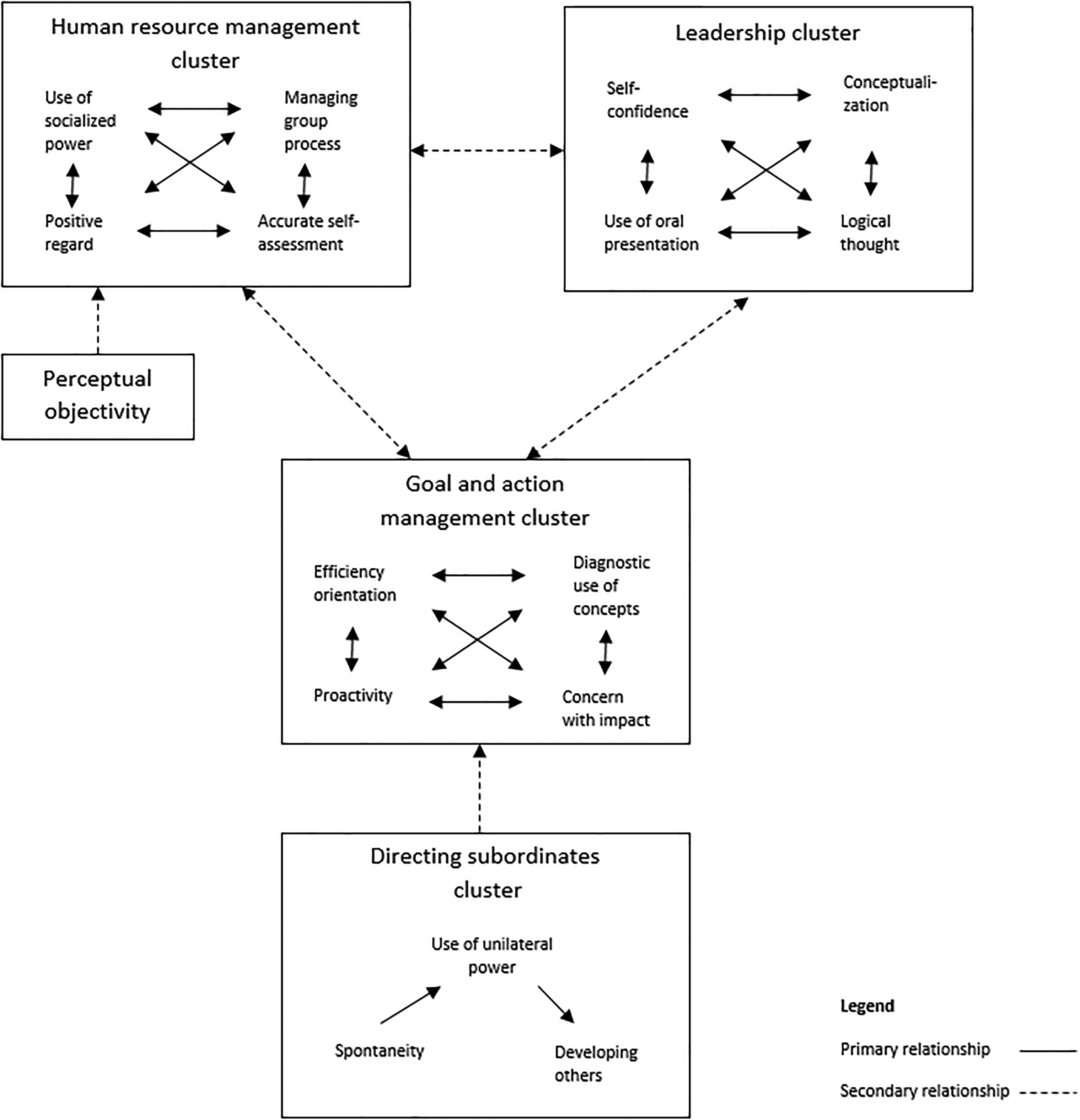
Boyatzis integrated competency model (Boyatzis, 1982).
There have been subsequent studies that have attempted to progress on from Boyatzis’s work. Quinn et al. (2003), like Boyatzis, considered the studies that have taken place before them. They concluded that there is no one way a manager should act and by implication suggest that models with a focus on identifying a manager by a single set of actions are not accurate as they assume a manager will only adopt a single approach to a given management situation. The examples of these types of models include McGregor’s (1960) X and Y managers, which indicate whether a manager believes staff to be autonomous and self-motivated or requiring constant supervision, or Tannenbaum and Schmidt’s (1958) continuum that considers to what extent managers allow staff to make their own decisions. Instead of labelling each manager as having one approach to addressing all situations, Quinn et al. (2003) acknowledge that different situations require different responses, and therefore, a manager must have a diverse skill set to draw upon to enable them to utilise the correct response. For example, a manager may be more directive with a new and inexperienced employee whereas they would be more facilitative with an experienced and capable employee. Quinn et al. (2003) propose that there are four categories of management approach. Each category is aligned with the different stages in management theory development. These include rational goal model (based on scientific management), internal process model (based on Fayol’s business functions), human relations model (based on Mayo’s social theory) and open system model (based on work by researchers such as Porter and Mintzberg). Each category will require a manager to adopt a different approach. There are associated roles or identities that a manager must adopt and with these a set of corresponding management competencies (see Figure 2). This model acknowledges that a manager must possess the ability to adapt to a given situation. Each segment on the circle indicates a different approach that might be used by a manager. For example, the mentor role may be adopted with a new member of staff to train, guide and develop them.
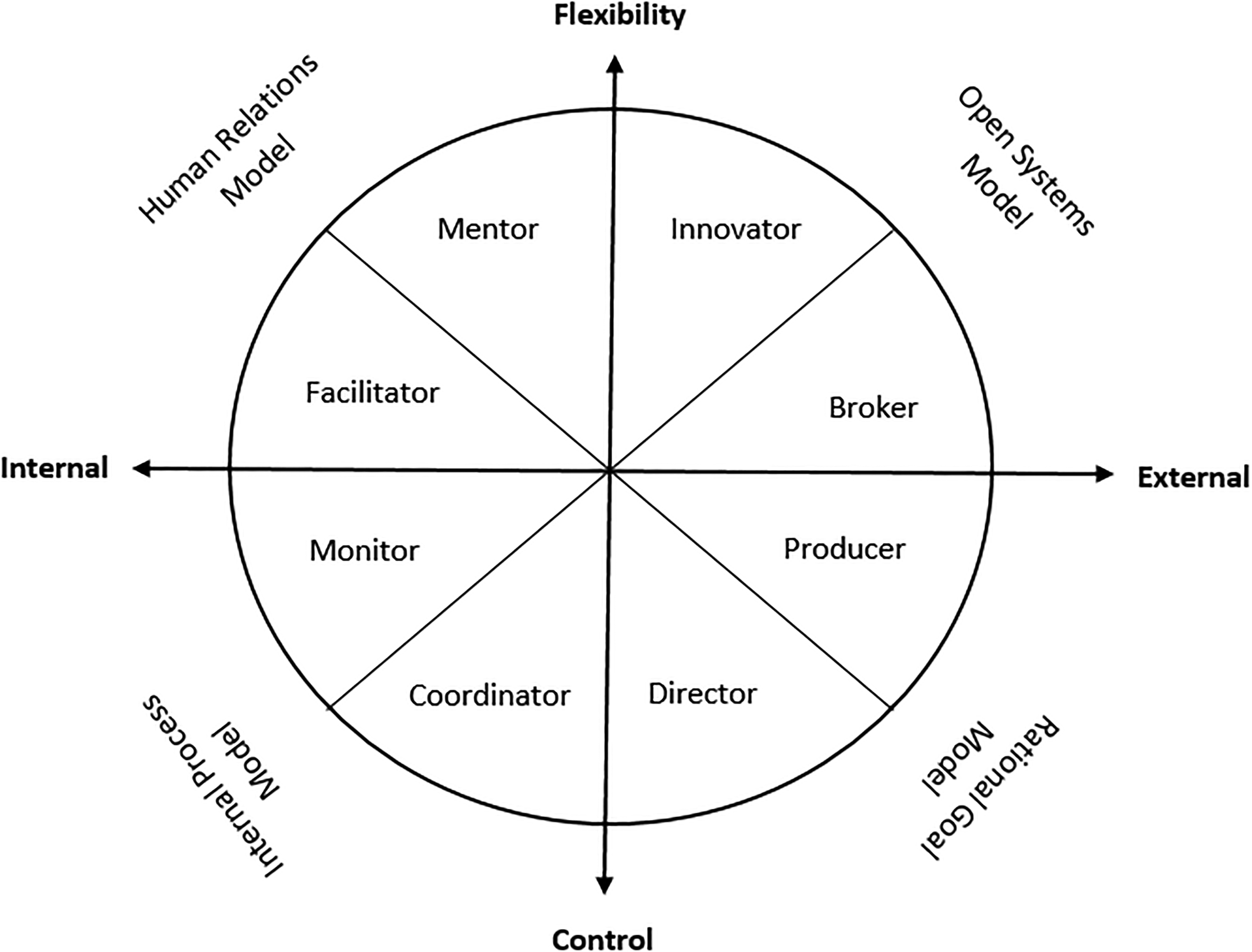
Becoming a master manager: competency framework (Quinn et al., 2003).
This model is of significant value, as it appreciates that a manager cannot use one approach for all situations. Thus, implying effective managers must be highly perceptive in assessing a situation to know which approach to use; then, they must have a high degree of emotional intelligence to assume that required role and finally the skills to effectively assume the role.
Both competency models presented have moved management theory on as they provide a three-dimensional model from which managers work. They consider both the functions of the manager and the responses and behaviours managers should adopt when approaching those functions. While it is reassuring that these models are informed and based upon work of noted scholars, such as McGregor, Mayo, Mintzberg, Porter, etc., it is also a potential limitation. As already established, each of these theorists was of a particular time-period with specific organisational and external pressures. As a result, their theories derived a solution to the challenges of their time. To consolidate theories of a set of time-period, which are not similar to each other and potentially not representative of modern-day working environment, could itself present a weakness. Furthermore, both models have been created for the management profession, but no consideration is given to the context of the working environment that the manager is operating within. Therefore, while these models are a useful consolidation of management theory and provide a more three-dimensional perspective, compared with the two-dimensional perspectives which preceded them, there is still a need for further work. Dierdorff et al. (2009) support this and argue that it is not possible to use a generalised approach when attempting to establish manager competencies and/or effectiveness. Their study identified three requirements of a manager’s role: conceptual, interpersonal and technical/administrative (Dierdorff et al., 2009). This categorisation was justified by an analysis of 50 years of research, showing how each study into management can be positioned into these roles. Furthermore, using 52 managerial occupations and a sample size of 8633 managers from the US Department of Labor’s Occupational Information Network, their study further breaks down each of the three requirements into 18 broad work roles (Figure 3).
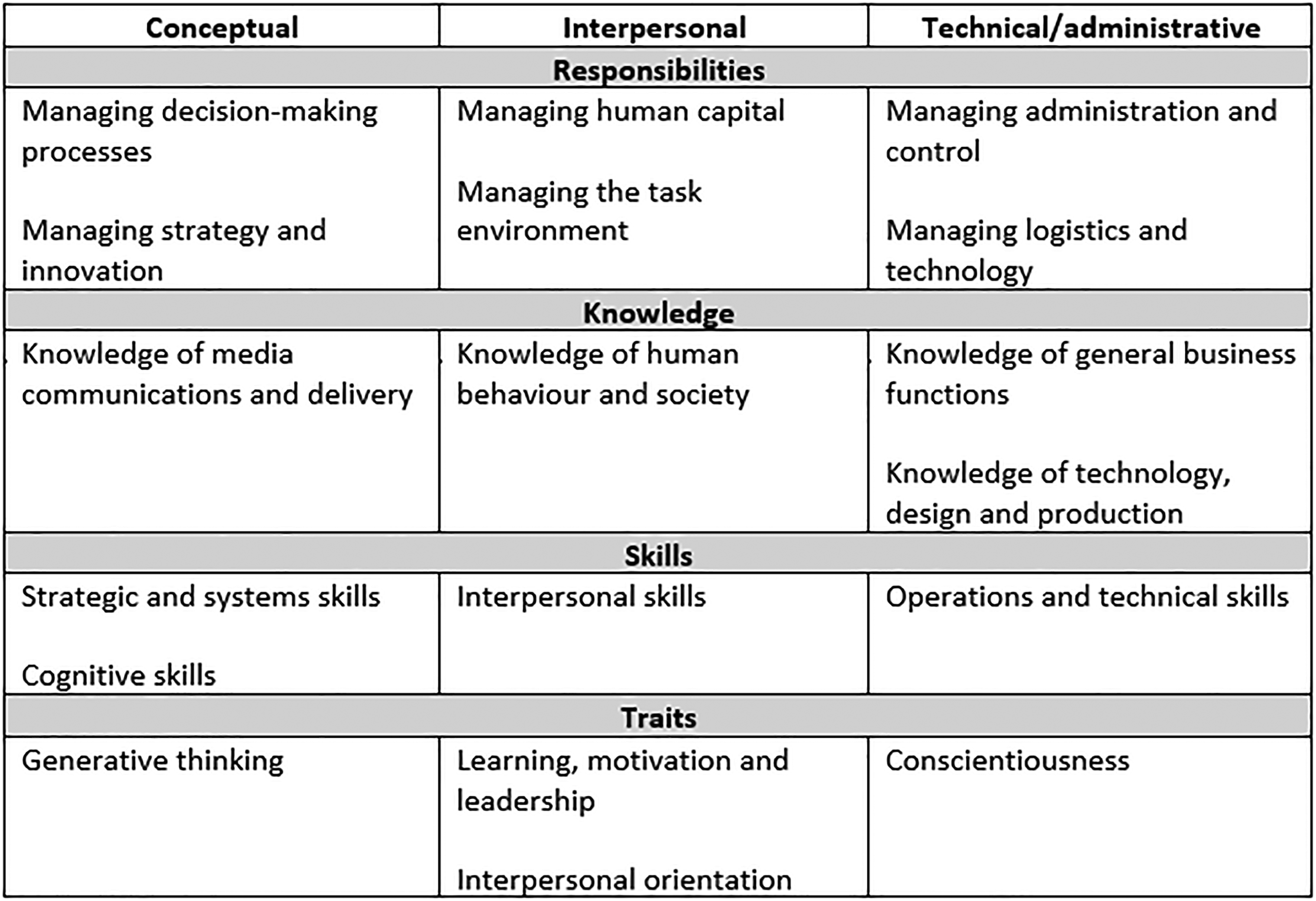
Managerial work role requirements (Dierdorff et al., 2009).
Dierdorff et al.’s (2009) competency model has a different focus to that of Quinn et al. (2003). Rather than focusing on the required management response to a given situation, it instead reviews the role as a whole. Each of the four categories is reminiscent to that seen in a job description. Furthermore, responsibilities, knowledge, skills and traits are not dissimilar to Pukelis and Smetona’s (2012) explanation of competency. This is perhaps more useful when determining what exactly a manager should be able to do to fulfil their role effectively. As to be expected, this model has its limitations. Firstly, it was derived from a broad range of management roles of which only 9% were education managers in post-secondary education and all of them were based in the USA. Secondly, it has a greater weighting towards hard rather than soft skills. Hard skills being the technical skills of a job role and the knowledge required to fulfil them, whereas soft skills are the intrapersonal skills required to fulfil the role (Laker and Powell, 2011). The extent to which a competency framework balances hard and soft skills is an important point for consideration. Robles’ (2012) study confirms this and emphasises that the development of both hard and soft skills should be equally weighted as successful managers will need both technical expertise and an ability to work well with others. Finally, and as acknowledged by Dierdorff et al. (2009) themselves, more research is required as to the impact of a manager’s specific context on their success. As this is absent from their study, it is not possible to establish if this competency model would be wholly appropriate for a FEMM in England.
This paper does acknowledge that the core functions of middle managers are comparable from sector to sector. It also agrees with a range of scholars (Dierdorff et al., 2009; Hosie and Nankervis, 2016; Johns, 2006; Potgieter and Coetzee, 2010) that when analysing the expectations of a specific role, in this instance a FEMM in England, it is not possible to do this credibly without considering the context in which that role resides. It is important to recognise the specific expectations of FEMMs as this can enable the identification of sector-specific competencies required for those middle managers. Furthermore, context can provide a greater weighting to which management requirements are more prevalent (Dierdorff et al., 2009).
The role of FEMMs
The incorporation of FE providers in 1992 meant that business functions became the responsibility of each institution. Leader (2004) discusses the implication for structural change and the emergence of FEMMs who adopted what O’Leary and Smith (2012) describe as a private sector managerialist approach, not dissimilar to Fayol’s concept of business activity and its implications for a manager. Using this model with consideration of a 1990 FEMM’s role, it is clear there is an alignment. Table 1 helps to illustrate this alignment.
Comparison of Fayol’s manager and an FE manager.
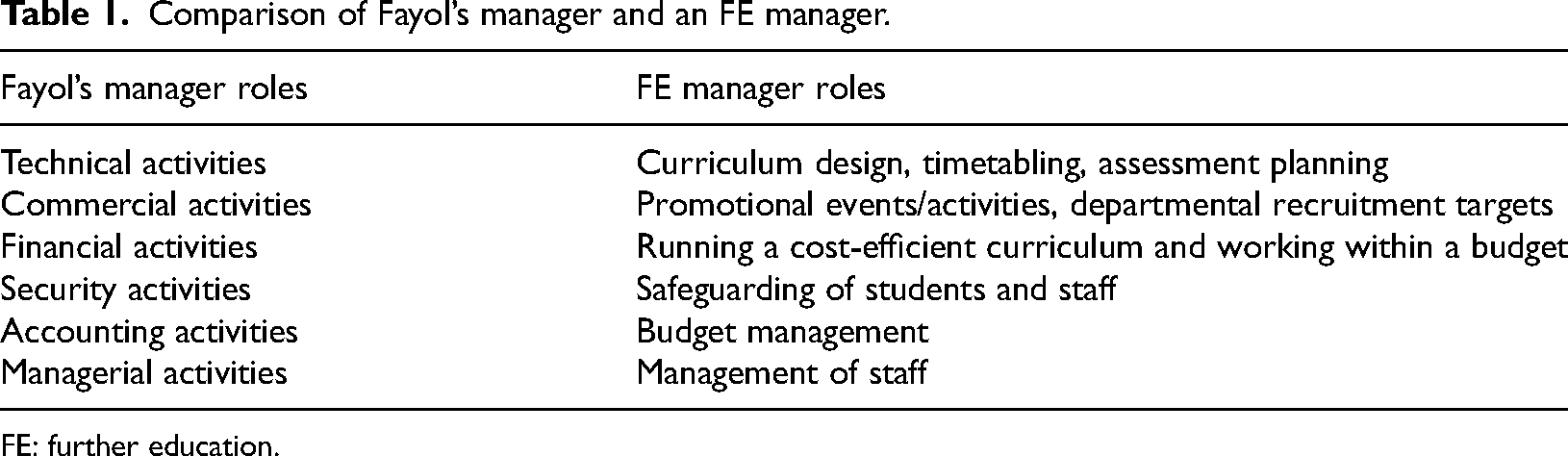
FE: further education.
While this is not a contemporary perspective when compared with other more recent studies, there is a clear compatibility with generic and FE management functions. These functions are a part of a FEMM role but the working environment of FE has changed considerably in the past 20 years and is still dynamic. Therefore, these functions are perhaps too simplistic and too closely aligned with the Taylor style of scientific management. As previously established by Dierdorff et al. (2009), when conducting a study of management that whether it is to ascertain manager behaviours, or effectiveness, it is not possible to do so with a generalised approach. Therefore, it is pertinent to establish a greater understanding of the role of a FEMM.
As a starting point, both Thompson and Wolstencroft (2015) and Leader (2004) explain that FEMMs translate strategic vision into day-to-day activities and ensure organisational policies are adhered to. This is essentially being a mixture of Dierdorff et al.’s (2009) managing human capital, and administration and control competencies. While this expectation seems standard to that of any other middle manager, it should be noted that post-incorporation transition was not without its challenges. The newly adopted business approach by FE college managers was driven by performance measures (McTavish and Miller, 2009) and a need to meet funding linked targets led to high staff turnover (Avis, 2005). According to Simmons and Thompson (2008), the changes demoralised the workforce partly because it did not blend well with the ideology of educators, that is, education should not be considered a business. Avis (2005) details further implications for the early management practice, where performance management led to perceptions and accusations of bullying and a blame culture. Both Avis (2005) and Thompson and Wolstencroft (2015) suggest that an influx of female employees and the feminisation of management in FE may have helped to reduce occurrences of intimidating masculine management practices. If considering Boyatzis (1982) or Quinn et al.’s (2003) models, this would suggest, at this point in time, there was a lack of human relation competence as managers were more focused on targets and the achievement of goals, which was to the detriment of their employee needs.
It is not simply the behaviour of managers, which comes under scrutiny. While his study was not specific to FE, Walsh (2006) argues that a further challenge for educational managers was the over reliance on bureaucracy which came as a result of strategies to improve quality and standardise curriculum. This led to managers adhering to systems and procedures to produce outcomes and thus seeing students as statistics rather than people. Edward et al.’s (2007) study across 24 FE learning providers confirms this practice was present in FE, concluding that managers were target and funding focused. Their study also highlights the consequence of not meeting the targets as they evidence the fiscal impact on FE institutions. While their research is based on adult community learning (ACL), its experience is comparable to other parts of the FE sector as the same targets and funding demands were affecting the whole sector. Both sources also suggest that management practice can have an over-reliance on goal-orientated competencies, which can be to the detriment of other competencies.
Briggs (2005), Leader (2004) and Beresford and Michels (2014) each highlight the variety of duties included in the role of a FEMM. Briggs (2005) tests the understanding of the role by cross-referencing responses from three key groups: senior leaders, middle managers and team members. The study was limited as it only focused on one large multi-site FE college, meaning conclusive results for the sector may not be drawn. However, its findings do mirror other studies. Briggs (2005) found that each group had similar perceptions of the role. The initial analysis of FEMMs by authors such as Briggs (2005) and Leader (2004) would suggest their role is primarily a transactional one, that is, senior managers establish a vision and strategy for the organisation, which is then put into practice by middle managers. This process of being a tool of implementation may rely more on Dierdorff’s et al. (2009) technical and interpersonal requirements compared with conceptual requirements. Briggs (2005) also cites several studies which prioritise mediation between senior leaders and teaching teams as one of the fundamental duties for middle managers in FE. Leader (2004) highlights a similar need. These studies reinforce the need for a greater weighting to interpersonal requirements, which is in contrast with what many scholars suggest as goal-orientated practice by managers in FE (Avis, 2005; Edward et al., 2007; Thompson and Wolstencroft, 2015; Walsh, 2006).
More recently, Beresford and Michels (2014) discuss that the role of FEMMs has become far greater than transactional. The need for FEMMs to act as industry entrepreneurs is seemingly more important given the continual reforms to curriculum, funding and quality assurance that the FE sector experiences. The requirement for FEMMs to be able to balance budgets and create an efficient curriculum, which is highly subscribed to, is paramount. FE colleges are only funded on the students they recruit; therefore, FEMMs need to be mindful of the cost efficiency of their curriculum areas. Beresford and Michels (2014) highlight the need for innovation by FEMMs, for example, the need for FEMMs to be creative in how the curriculum is delivered at a reduced cost, or initiating marketing activities to ensure courses are not under subscribed. This suggests that Dierdorff et al.’s (2009) conceptual requirement is also a key aspect for FEMMs as those who do not possess these qualities could face reducing student enrolments and consequently their organisations could go into decline. In a challenging financial landscape where colleges are subject to financial stability and structural checks, such as Area Reviews, a structural review of current FE providers so that they are able to operate within a tight fiscal environment (BIS, 2015). According to the Department for Education, these structural reviews have facilitated ‘a reduction of 26% in the number of separate college corporations, with the associated running costs’ (DfE, 2019: 5); a FEMM must have good financial acumen and skill for making efficiency savings. Furthermore, managers must take a leading role in their teams for ensuring students are safeguarded. This requires a good understanding of internal and external support functions/stakeholders who may need to be referred to if an incident should occur. The ability to make informed decisions with technical competence shows how interrelated the requirements of a FEMM are. In addition to these responsibilities is the most important responsibility to provide high-quality learning to students.
Overall, it appears from the literature that post-incorporation managers took a goal-orientated, private sector approach to management. As explained by Elliott (2016), this was exacerbated by the fear culture as a by-product of sector-wide college restructuring. Managers needed to demonstrate a grasp of the important technical competencies as they needed to ensure targets were met so that their institutions could meet their funding requirements. However, it also appears that this competency was overdeveloped and resulted in the human relations or interpersonal elements being overshadowed. This paper does not intend to evaluate past management practice but it does seek to establish what competencies are required for future practice. The lessons of the past show that interpersonal skills are a key competency for FEMMs and one that it is not always prevalent. In addition, the ability to work in a dynamic working environment and respond with an entrepreneurial vision means that FEMMs do require conceptual competencies; otherwise, their organisations may not move forward. This conclusion does suggest that FEMMs need a balance between each of the elements presented in Dierdorff et al.’s (2009) competency framework, that is, a balance of conceptual, interpersonal and technical/administrative role requirements. The challenge is understanding the extent to what that balance should be and to what extent should competencies suggested by Boyatzis (1982) and Quinn et al. (2003) be incorporated. As stated by McNamara (2009), in a dynamic working environment, a management approach needs to be organic and adapt, dependent on the need. To fulfil their core function, FEMMs will require the technical ability to translate and devise plans to implement the organisational strategy. They require interpersonal skills to motivate and communicate effectively with their staff. Moreover, in an ever-changing environment where FEMMs need to be autonomous entrepreneurs, they will require conceptual skills to devise their own strategies and make decisions.
Competencies required for FEMMs
It is important to note that the majority of FEMMs are teachers who are promoted into a management role. While they will have done extensive training and development to become a professional teacher, the opportunities for comparable training as an education manager are inconsistent (Thompson and Wolstencroft, 2015). A rationale for this lack of training is the absence of professional expectations (Corbett, 2020). Once a FEMM is appointed the lack of sector specific standards can become problematic as the development of management competencies resides within generic management training. The limitation with this style of training is that it tends to draw upon private sector approaches, which adds fuel to the criticism by scholars such as Humphreys and Hoque (2007) who believe FE managers use private sector practice as it is seen as a gold standard, whereas it is not necessarily suited for education. The transferability of private sector practices into the public sector is often questioned (Boyne, 2002). However, the public sector needs to ensure that it adopts the correct private sector practice and not repeat the mistakes of the past, in particular, the poor human resource practices as referred to by so many authors (Avis, 2005; Edward et al., 2007; Simmons and Thompson, 2008; Thompson and Wolstencroft, 2015).
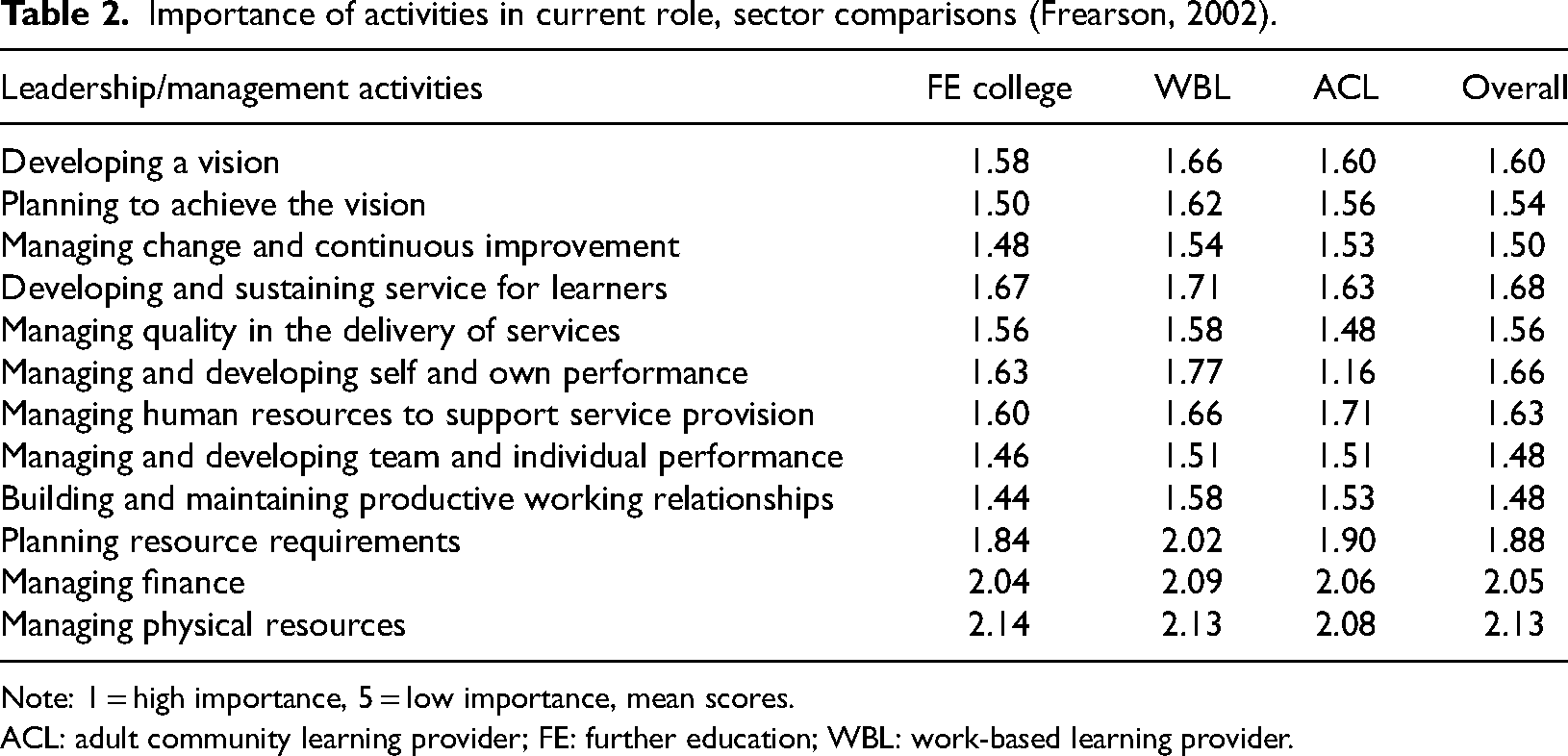
To develop a literature-informed competency framework, it is necessary to summarise the functions and responsibilities so that it can then go further and begin to align these duties into a competency framework model. Frearson’s (2002) report was based upon national research of FE institutions in England. It elicited 1316 responses from FE staff, respondents ranged from supervisors to principals. The sole focus of the research was to investigate the development of leadership and management in the FE sector. While this study could be viewed as dated, it is unique in that it provides an analysis of FEMM role requirements and training needs at a national level, something that has not since been repeated. The report presents management and leadership activities and the rating of importance by respondents to the survey. Table 2 shows the results of the survey.
Importance of activities in current role, sector comparisons (Frearson, 2002).
Note: 1 = high importance, 5 = low importance, mean scores.
ACL: adult community learning provider; FE: further education; WBL: work-based learning provider.
The results shown in Table 2 provides four key points for consideration. Firstly, no score given is lower than 2.14, where the range is 1 (high importance) to 5 (low importance), thus suggesting leaders and managers perceive all activities as important. Secondly, given the importance of the activities, it can be assumed all of these activities were considered pertinent to the role of a manager/leader at the time of this study. Third, overall, there is a reasonable agreement across the sector in terms of importance for each activity. Finally, while all activities were considered important, there were five activities that were scored distinctly higher by leaders and managers in the study; these were as follows:
Managing and developing team and individual performance Building and maintaining productive working relationships Managing change and continuous improvement Planning to achieve the vision Managing quality in the delivery of services 6. Managing physical resources 7. Managing finance
The two activities considered to be the least important of the list (though still rated important) were:
The findings of this survey do somewhat contradict research studies undertaken during similar periods which found leaders and managers to be more driven by performativity to the detriment of staff welfare (Avis, 2005; Edward et al., 2007; Simmons and Thompson, 2008; Thompson and Wolstencroft, 2015). It is assumed this may be due to managers being aware they were important, but overwhelmed with performativity pressure. Thus, how they responded to the survey and their actions in working life are in contravention, or, as other research studies focus on staff perception, there is a disconnect between a manager’s perception and a subordinate’s perception.
Building a FEMM competency framework
The activities in Frearson’s (2002) report are not competencies in themselves; however, they can be synthesised into a competency framework. Using Dierdorff et al.’s (2009) research, it is possible to develop a draft contextualised FEMM framework.
Table 3 shows an initial synthesis of these two studies and an initial competency framework. It should be noted that this shows the beginning of a potential framework. However, Frearson’s (2002) study only provides a starting point in terms of the responsibilities for the framework. By reviewing the original content of Dierdorff et al.’s (2009) framework, the 12 activities rated in Frearson’s (2002) study can be allocated to the appropriate category.
Initial further education middle manager (FEMM) competency framework (responsibilities).
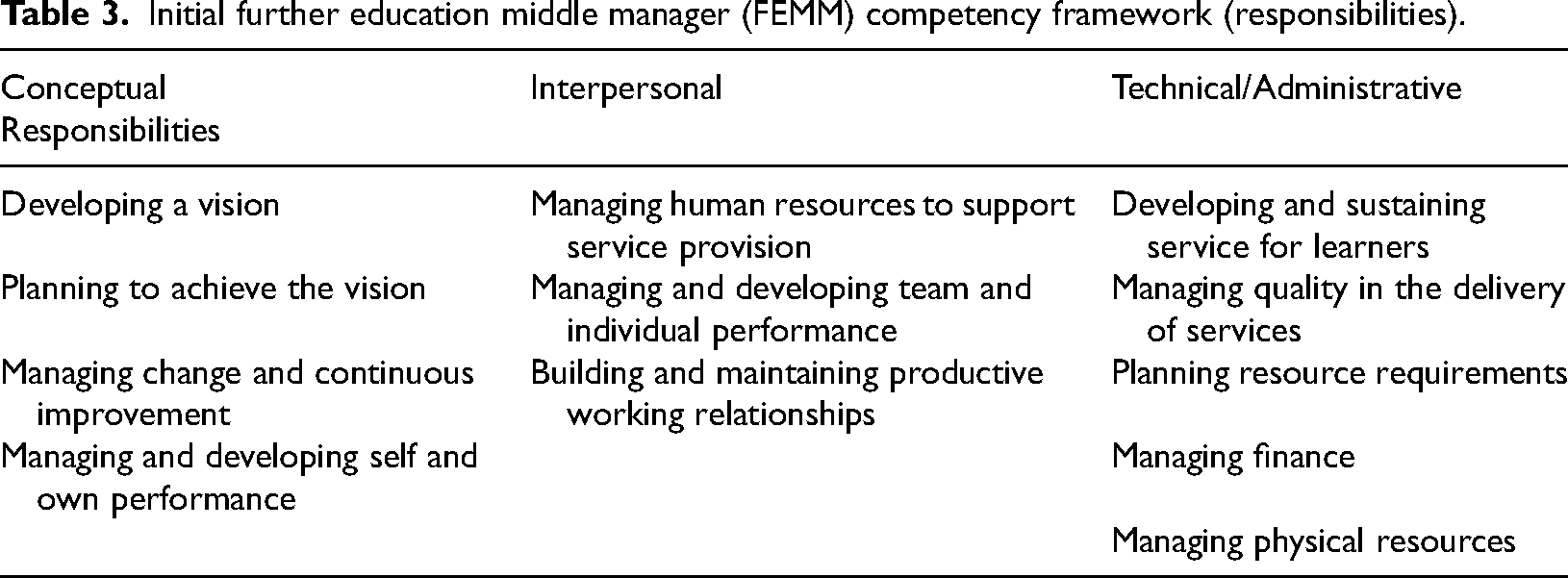
The first category, conceptual responsibilities, includes activities that are not definitive or tangible. Primarily, these include the vision a manager has for their department including the conceptual ideas which must be present for that vision to become a reality, that is, change management and self-improvement. It should be noted that this section does not refer to the implementation of these points, as the implementation of a vision is via interpersonal and technical responsibilities. However, a department/organisation led by a manager who lacks vision will likely plateau, which in a dynamic environment such as FE will result in strategic drift and declining performance (Johnson et al., 2008).
The second category, interpersonal responsibilities, is focused on one of the key competencies, that is, managing staff effectively and appropriately, as stated by several authors (Avis, 2005; Edward et al., 2007; Simmons and Thompson, 2008; Thompson and Wolstencroft, 2015). However, it does go further than this to consider the importance of also developing positive working relationships with wider stakeholders as managers will interact with a broad range of internal and external stakeholders. If these relationships are well managed, it can result in improved organisational performance. Furthermore, managers can utilise good working relationships to ensure their conceptual responsibilities are fulfilled.
The third category, technical/administrative responsibilities, highlights the technical aspects of a manager’s role. It is within this category that this paper suggests FEMMs would have some pre-established competencies, that is, managing quality of provision and delivering an effective service to learners. Essentially these two aspects are the focus of a teacher, that is, providing a good educational experience to students. However, this category also houses competencies a teacher may be unfamiliar with, that is, budget and resource management. While a teacher will be aware of the fiscal challenges rarely are they required to manage a budget and plan how resources (such as equipment and teaching spaces) will be allocated.
Responsibilities within the initial FEMM competency framework are the first stage of creating a contextualised FEMM competency framework. Following on from this is to categorise the knowledge requirements that underpin the responsibilities. Table 4 shows the supporting knowledge requirements. As with responsibilities, these are categorised in three ways: conceptual, interpersonal and technical/administrative. These are relatively straightforward to establish given that the knowledge element directly supports its corresponding responsibility.
Initial further education middle manager (FEMM) competency framework (knowledge).
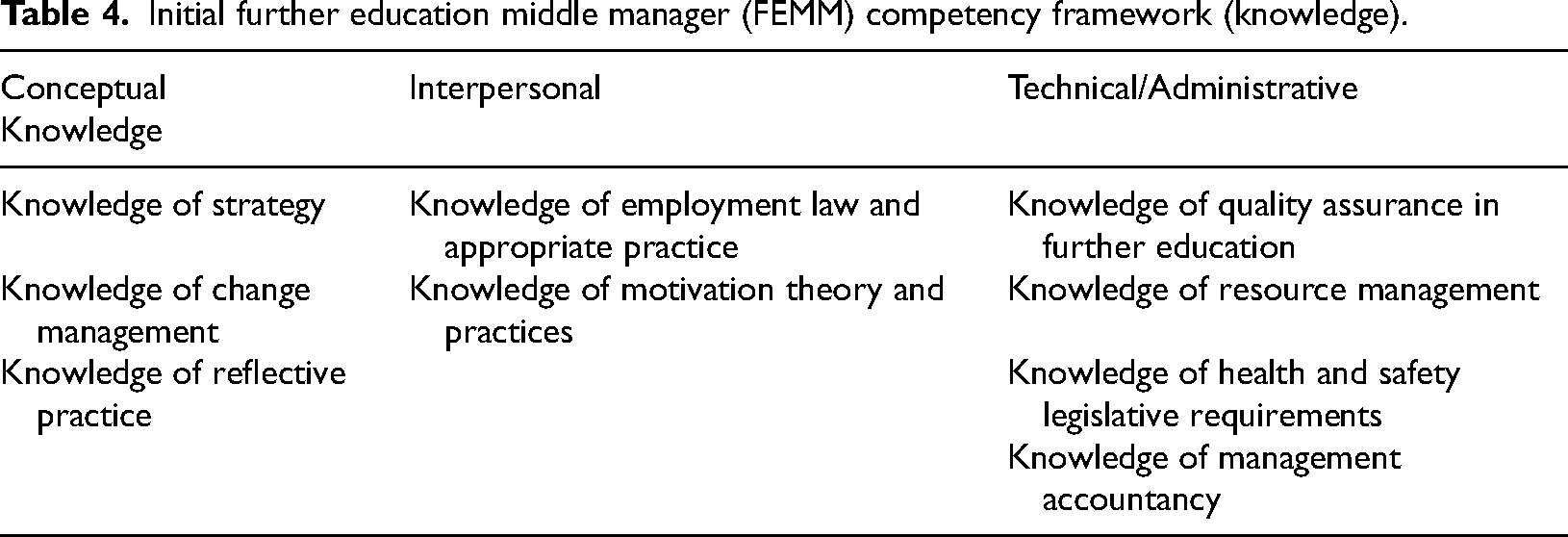
The first category, conceptual knowledge, includes the knowledge of strategy and change management. These two aspects correlate with the responsibility to form a vision and manage change and continual improvement (Johnson et al., 2008). Furthermore, the knowledge of reflective practice underpins the responsibility of self-development and performance review; this element should be present in FEMMs prior to taking on the role as a key aspect to teacher development is reflective practice.
The second category, interpersonal knowledge, includes awareness of key legislation and appropriate practice (Avis, 2005; Edward et al., 2007; Simmons and Thompson, 2008; Thompson and Wolstencroft, 2015). This will support a manager in knowing what they are able to legally do and what is good practice when carrying out their responsibilities of managing staff. In addition, this category includes knowledge of motivational theory, as this will enable managers to consider appropriate strategies when managing staff, which will maximise performance and create a positive working environment.
The third category, technical/administrative knowledge, includes knowledge of quality assurance, that is, what is good practice in teaching and learning; resource management, that is, optimum methods for using equipment and teaching spaces; health and safety, that is, relevant legislation and guidance which can vary depending on the areas that are managed. For example, a manager for an engineering department will have wider consideration compared to a manager for a business department; management accountancy is knowledge of KPIs and budgets.
While knowledge has an obvious and direct link to the activities/responsibilities, skills can be more subjective; what skills are needed to be a strategic thinker? There are a range of sources (Bass and Riggio, 2006; Conger, 2013; Fink, 2005; Hyatt et al., 2007; Yukl, 2013), which discuss what skills are required for leadership and management. This paper draws upon the relevant links to create Table 5. It is acknowledged that there are limitations in the subjectivity of this exercise; however, as no other study has attempted to construct a set of competencies in the context of FE educational management it is deemed as an acceptable starting point which can be tested via primary research.
Initial further education middle manager (FEMM) competency framework (skills).

The first aspect is conceptual skills. Fink (2005) provides a comprehensive review of leadership skills required in education. While his review is more focused on a school-based system, it does provide useful guidance in terms of pertinent skills. While this paper focuses on middle managers and strategy is more akin with leadership than management, this paper acknowledges as does Lambert (2012) that middle managers need to develop into strategic thinkers to succession plan for future leaders. Fink (2005) concludes that the skills linked to strategy and change are being future thinkers and critical thinkers. Future thinkers are those who can link the past, present and future direction of an organisation (Fink, 2005), whereas critical thinkers can reflect on the long-term outcomes of an organisation and ask the right questions to determine which change would be most suited to the organisation (Fink, 2005).
The second aspect, interpersonal skills, is potentially one of the most important skills given the previous reference to poor HR practice by FEMMs. Interpersonal skills can become quite broad in terms of good communication, behaviour, role modelling, likeability etc. A concept that captures these factors is emotional maturity (EM), defined by Hyatt et al. (2007: 30) as ‘The understanding and acceptance of all of one’s normal feelings and emotions and the appropriate response to those emotions in all circumstances’. Essentially, it is about having an appropriate reaction to each given situation, which is not dissimilar to Fink’s (2005) notion of emotional understanding and further supports this paper’s interpretation of Quinn et al.’s (2003) competency framework, that is, managers need to adopt different responses to differing situations. Hyatt et al. (2007) explains that often managers know the best approach to a given situation; however, due to the pressures of meeting targets and increasing work demands they do not take the time to focus on the EM response and instead use the quickest or most convenient method. For example, when instigating change, rather than adopting a consultative approach and taking on board opinions the manager will adopt a quicker path. This will not rely on consultation but simply to ensure the task is done so they can move on. In the short term, this may work; however, it can have medium- and long-term implications and, as such, lead to criticism of a private-sector managerialist approach as described by Avis (2005) and Simmons and Thompson (2008).
The third aspect is technical/administrative skills. Some of these skills could already be present from a FEMMs time as a teacher, that is, planning, organisation and attention to detail. However, some skills may not. For example, managers need to draft business-style reports and manage budgets, and therefore, there is a need for a good level of literacy and numeracy skills. These skills may well be present from a manager’s time as a teacher. However, this cannot be assumed as FE Initial teacher education in England does not require basic (Level 2) maths and English qualification as pre-requisites, which is in contrast to their counterparts in secondary and primary school settings.
The final section of the contextualised competency framework for FEMMs is traits, shown in Table 6. Much like how knowledge links to responsibilities, traits link with skills. McEvoy and Richards (2006) explain that traits can assist in the underpinning development of wider competencies, not dissimilar to Robles’ (2012) finding with regard to soft and hard skills and the need to ensure that technical knowledge and expertise are supported by good intrapersonal skills. McEvoy et al.’s (2005) study found that development of traits was static meaning little progress was observed, which could be problematic if traits were not pre-existing and needed to be developed. However, Dweck (2012) argues that traits are not fixed and can be developed through the use of a growth mindset. This is supported by the research of Yeager & Dweck (2012) which investigated the development of resilience in students.
Initial further education middle manager (FEMM) competency framework (traits).
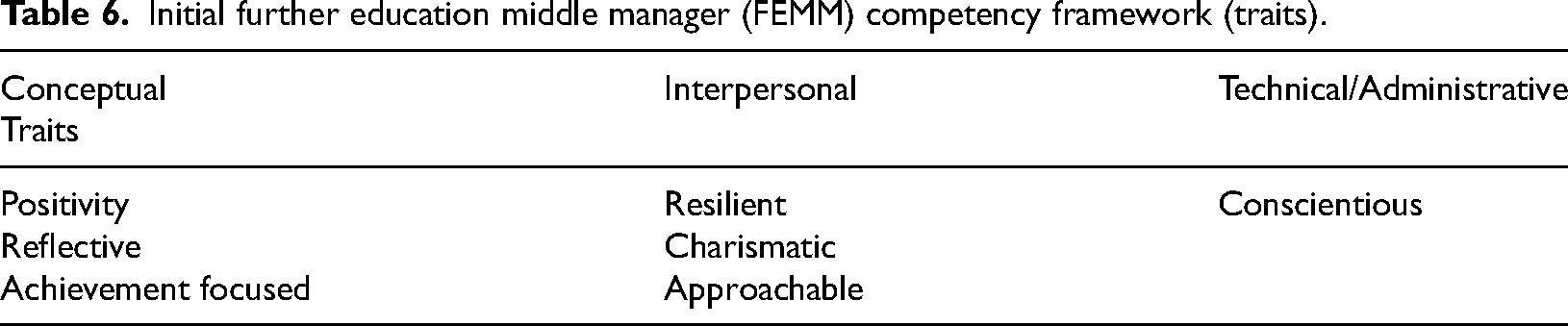
The first aspect, conceptual traits, should underpin a future and critical thinker. Therefore, in order to be forward thinking, one must have a positive outlook as they seek to move the organisation forward with optimism (Fink, 2005) rather than dwell on the issues of the past or challenges which cannot be overcome. However, for the organisation to progress in a meaningful way, a manager must consider the past, to build on successes and not repeat mistakes. Therefore, the ability to reflect is essential to making meaningful decisions. Furthermore, reflection is needed for a manager to self-assess and manage their own performance. Finally, the literature does point to a need to meet targets for quality assurance and funding; in response, a need to be achievement focused has been incorporated.
The second aspect, interpersonal traits, is those that underpin emotional maturity. To sustain emotional maturity a manager must be resilient. As discussed earlier in this paper, FEMMs are faced with continual challenges in their working environment. Pressures of the role are such that they may well become frustrated/stressed (Page, 2013); however, this frustration should not be passed onto their subordinates or to students. Therefore, they must have resilience to accept the challenges and maintain an appropriate disposition. In addition, they need to build positive working relationships which can facilitate positive influence. As explained by Popper (2004), this influence can be explained by Weber’s (1964) concept of charisma and charismatic authority which can be used as a basis to form stable and meaningful working relationships. It is acknowledged that from this concept derived charismatic leadership theory, a widely discussed topic and linked to transformational leadership, which is referred to by many popular leadership texts (Bass and Riggio, 2006; Conger, 2013; Yukl, 2013). It is recognised that the principles of charismatic and transformational leadership are considered frequently in educational contexts. However, it is a variation of these contemporary principles, which is referred to in the interpersonal traits section of the competency framework. This variation is more in line with the discussion that a manager/leader builds effective working relationships which enable and motivate staff through charismatic and approachable management traits (Popper, 2004; Weber, 1964).
The third aspect, technical/administrative traits, underpins the skills of planning, organisation and being literate and numerate. In essence, the ability to fulfil the technical aspects of the job role, those activities which are more operational than strategic requiring a FEMM to be conscientious. An ability to pay close attention to detail and strive for the best possible outcomes with painstaking time and effort should not be underestimated. The literature discussed in this paper that focuses on the FE context agrees conclusively on at least one thing; operating in the FE sector is challenging and requires hard work and dedication by all (Corbett, 2017). Therefore, it seems prudent that to fulfil the technical/administrative responsibilities, knowledge and skills a manager will need to be conscientious.
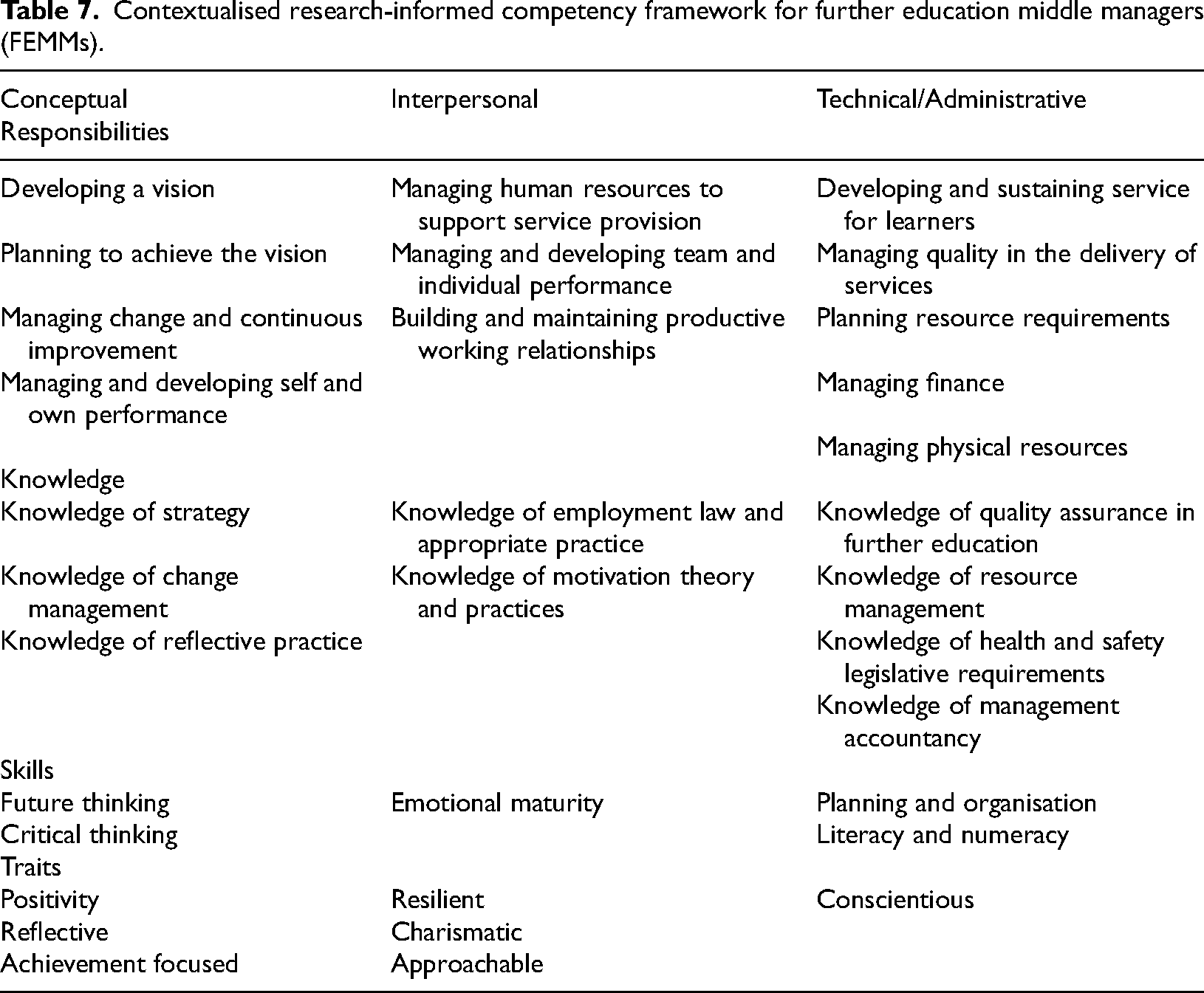
This paper has discussed the origins of FEMMs and the associated challenges that come with the role. It has drawn considerations of the training received in a prior teaching role and the expectations placed on FEMMs. The provision of a framework which required contextualisation (Dierdorff et al., 2009) coupled with a range of studies and research into the roles of FEMMs has provided a contextualised literature-informed competency framework for FEMMs (Table 7). This framework is a synthesis of the literature discussed that provides a basis from which primary research can be initiated.
Contextualised research-informed competency framework for further education middle managers (FEMMs).
Conclusions
The FE sector is an important and significant element of the English education system. The sector was born from a post-war era where FE training institutions were required to support regional economic development. From these roots, FE has established a diverse provision that needs to be responsive and innovative in addressing changes in policies, funding and expectations. At the forefront of this change are the staff who operate in FE institutions, a key role being the FEMM. While it is evident this role has significant responsibility for the development and implementation of organisation strategies, it is also evident that it is a role that is subject to high level of criticism, yet is provided with disproportionate and insufficient levels of support.
This paper has provided the opportunity to discuss management theory and consider what previous authors consider to be the core competencies of an education middle manager role. It has established that management theory models have evolved from scientific management to open systems theory; often, this has been done as a response to the economic and political climate of the time. From these management theories have born competency models. This paper has focused on three models (Boyatzis, 1982; Dierdorff et al., 2009; Quinn et al., 2003). These models were chosen as: firstly, they consider the history of management theory and utilise it to form contemporary models. Secondly, as they represent the development of competency modelling over time, each being an enhancement of its predecessor. The final model (Dierdorff et al., 2009), which also uses the largest research base for its development, asserts that any competency model must be contextualised to the role and industry for which it is being applied. This highlights a limitation in most developed contemporary management competency models in terms of their use for education middle managers.
Education management literature highlights the importance of the middle manager role. It goes on to highlight this role is not always executed in an effective way, which is a result of poor training and preparation ill-informed by sector-specific standards. There is currently a void in the field of knowledge with regard to the competencies required to be an effective education middle management. In the case of the FE sector in England, literature does confirm the expectations of this role, but the last large-scale study was conducted in 2002, over 19 years ago and only reviewed the functions of managers and leaders, rather than the competencies required to fulfil the functions. It is proposed that this paper provides a contextualised literature-informed competency framework for FEMMs. It is hoped that this framework will be further tested and used to proactively consider the development needs of education middle managers and so support them in their role. In addition, this paper presents a challenge to the field of management theory, as it proposes a new approach to the development of management competency frameworks. This new approach places an emphasis on the context in which the management role operates rather than a generic, one size fits all approach.
Footnotes
Declaration of conflicting interests
The author declared no potential conflicts of interest with respect to the research, authorship, and/or publication of this article.
Funding
The author received no financial support for the research, authorship and/or publication of this article.
