



Abstract
While policy-makers in Britain can justifiably lay claim to creating the term NEET to define young people who do not engage in formal learning, training or employment, the high number who fall into, and remain in, this category continues to challenge them. This, in part, is attributable to the extended use of the term NEET to capture all young people between the ages of 16 and 24 who fail to make sustained transitions, as opposed to the 16–18 year old cohort the term was initially designed to measure. This article will provide a discussion about the continued relevance of the term NEET to articulate, define and quantify youth disengagement in England. It will also explore a recent government-led policy intervention that has been introduced to tackle the issue. A particular focus will be the growing profile and involvement of the private sector in designing and leading NEET programmes. Within this, there will be a discussion about who should be taking the lead and whether a relinquishing of responsibility by government for the ownership of NEET programmes and their delivery is appropriate, given the current restrictions on the public purse. Of importance here is what this trend means for young people themselves with regard to the provision of positive and sustained opportunities on a scale that meets the needs of an increasingly diverse and persistent population.
Introduction
The term NEET (not in education, employment or training) is now widely used to define and capture levels of disadvantage and disengagement among an increasingly diverse population of young people. In England, as in many other countries, the term embraces a wide catchment, in terms of age, characteristics and segmentation, with regard to young people’s propensity to re-engage in education, employment or training (EET). Moreover, policy interventions to address the NEET ‘problem’ include prevention, reintegration and compensation measures targeted at specific sub-groups within the overall population. Also, programme interventions are increasingly delivered in a climate where financial resources are often scarce and where performance relating to value for money outcomes is questioned (Finn, 2010).
This paper will examine the continued relevance and applicability of the term NEET and question whether it accurately quantifies and meets the needs of the population it was designed to serve. It will assert that, while some eligible groups of young people fail to be included in the NEET population figures for England, other young people, most notably those who are profiled as being ‘inactive’ within the NEET group, are often overlooked within the eligibility criteria for specific programme interventions. This is exemplified in the delivery of the Youth Contract (YC), which was launched in England in 2012 to support young people aged 16–24 who are NEET to achieve positive outcomes, namely access to EET. The implementation of the YC for 16 and 17 year olds in England by the Department for Education (DfE) will be explored to draw out, through evaluation results, the challenges and contradictions faced when introducing a policy which focuses on outcome-based devolved contracting and commissioning. It will pose questions about the virtues of adopting such an approach and how it collided with the statutory responsibilities held by local authorities (LAs) to implement the Raising of the Participation Age (RPA), which includes identifying young people who are NEET and addressing their needs. In conclusion, it will question the value for money of the adopted delivery model, in a climate of austerity, when close restrictions and monitoring of how tax payers’ money is spent are imposed on individual government departments.
Is the term NEET any longer meaningful?
The widespread use of the term NEET in the UK, as is well documented in the literature, emanated from the Labour government’s concern in the late 1990s for a group of young people under the age of 18, who had been removed from the unemployment statistics following the implementation of the 1988 Social Security Act (Furlong, 2007). This exclusion of those under the age of 18 who failed to engage in EET from official statistics and, in most cases, from entitlement to unemployment and associated benefits, led to intensive research in the late 1990s and 2000s, with a view to quantifying the size, composition and support needs of the newly defined NEET population and to introduce a range of policy interventions (Gracey and Kelly, 2010). The latter included targeted guidance and support services provided by the Connexions Service, 1 a range of tailored learning programmes and financial incentives, which were offered in return for young people’s active and sustained participation in EET activities (Maguire and Rennison, 2005).
Due to escalating rates of youth unemployment and inactivity among 18–24 year olds, the term NEET has been increasingly used, in recent years, to embrace a much broader and older group, which falls outside the scope of the originally defined cohort (Eurofound, 2012). While the NEET rate for the under 18s group has progressively fallen, that of the over 18s has remained persistently high in England and throughout the UK. This begs the question – if the term NEET was coined to define a group of young people who could no longer be defined as unemployed, why has it been extended to include the young unemployed, as well as a much older age group?
The answer to this question is not straightforward. It can be partly explained by statistical collection methods, which point to the official unemployment statistics providing only a partial coverage of young people’s activities (for a similar discussion in Germany see Granato et al. in this issue) – that is they just record young people who declare themselves available for, and actively seeking, work and those who are eligible for welfare benefits. In contrast, the NEET rate embraces a much wider cohort, with young people who are inactive from the labour market, as well as those who are actively seeking work (Office for National Statistics, 2013). While this more inclusive approach should be applauded, the move to define a much wider and older group within the NEET group co-exists with a paucity of research evidence about the extended group, in terms of its characteristics and diversity, as well as limited policy intervention to support the group’s needs. Extending the use of the term NEET, allows the connotation linked to it to be assumed by a much wider cohort, namely individual responsibility for worklessness, skill deficiencies and social exclusion (Furlong, 2007), rather than addressing the collective structural dynamics which are creating and sustaining unacceptable high levels of youth disengagement.
Moreover, since 2010, due to cuts in England to those local services which hold responsibility for the mapping and tracking of the under 18s NEET cohort, an emergent issue, which promises to inhibit the targeting of support for NEET young people, is the lack of comprehensive data on the current status of those within the age group, with wide variation between local authority areas and regions in the proportions whose activity is unknown (Maguire and Newton, 2013). Less drastic cuts have been imposed on services and provision in Wales, Scotland and Northern Ireland, where the devolved administrations retain responsibility for post-16 provision and support. While it cannot be assumed that all young people who have unknown destinations will, in effect, be NEET, it raises questions about the accuracy of NEET rates for the under 18s group. There is currently a dearth of research evidence about the ‘unknown’ post-16 destinations group in terms of its characteristics and composition. It also suggests that significant proportions of young people have no contact with support services, nor do they have access to intervention programmes which may improve their education, training and employment outcomes (Maguire, 2015).
Such high levels of ‘unknown’ post-16 destinations among the under 18s cohort, coupled with an extension of the term NEET to include large numbers of 18–24 year olds who can be either defined as unemployed or inactive, raises serious questions about the continued validity and accuracy of the term to capture levels of disengagement among young people in England. Moreover, it makes policy planning and intervention more complex, given the diversification of the population, the lack of research evidence about the composition of the extended population and a lack of confidence in the robustness of tracking mechanisms to capture the size of the under 18s population. Significantly, the House of Lords inquiry into youth unemployment expressed misgivings about how the term NEET was being applied, stating that the presence of a number of different definitions was ‘a nightmare’ (House of Lords, 2014: 13).
Instead, it could be argued that the term NEET is too loosely defined. Responsibility for an extended NEET cohort also now straddles three government departments, DfE, Department for Business, Innovation and Skills and the Department for Work and Pensions (DWP), which makes accountability, coordination and strategic responsibility for the NEET agenda increasingly complex.
In 2011, the UK Government’s Building Engagement, Building Futures document set out proposals to reduce youth unemployment among 18–24 year olds and increase their participation in EET (HM Government, 2011). These included: the launch of the National Careers Service; reforming the apprenticeship programme; and promoting the effective use of flexibilities in the skills system and the Work Programme to best meet the needs of young people. The Work Programme is a welfare-to-work initiative, which was launched throughout the UK in 2011, and is focused on re-engaging the long term unemployed (over the age of 18 years of age) with the world of work, through an outsourced and payment by results (PbR) delivery model. The Traineeships programme, which is targeted at young people who are aged 16–19 and qualified below Level 3, or are aged 19–24, was launched in August 2013 (Department for Education and Department for Business, Innovation and Skills, 2014). Traineeships offer a bridge into the world of work and are targeted at young people who are not currently in a job and have little work experience.
Apprenticeship incentives in England have achieved little in terms of addressing youth unemployment and increasingly attract a growing number of participants over the age of 25 years. For example, from 2009/10 to 2012/13, the proportion of those starting apprenticeships who were under the age of 19 fell from 42% to 23%, while that of 19–24 year olds fell from 41% to 33%. In contrast, there was a sharp rise in the proportion of those starting apprenticeships who were aged over 25, from 18% to 45% (House of Commons Library, 2014).
Since 2010, the Cabinet Office, the DWP and, to some extent, private investors, as well as philanthropic organisations, have assumed a much greater involvement in introducing policy initiatives to tackle NEET early intervention. For example, the DWP’s Innovation Fund, which was piloted in 2012, is focused on supporting disadvantaged young people and those at risk of disadvantage, aged 14 and over. The Youth Engagement Fund, which is jointly funded by the Cabinet Office, DWP and the Ministry of Justice, which was introduced in 2014, aims to improve educational achievement and employability and to help prevent young people aged between 14 and 17 from becoming NEET. The emphasis within both of these early intervention measures is on PbR. These initiatives are partly funded through social impact bonds (SIBs) (Social Finance, 2015), with private investors funding innovative projects and being rewarded on the basis of achieving positive outcomes.
YC delivery model
The challenges surrounding policy design and implementation can be highlighted through the delivery of the YC. It was launched in 2012 to assist young people aged between 16 and 24 who are NEET to re-engage in EET (HM Government, 2011). While the overall programme was overseen by the DWP, the DfE, which has statutory responsibility for 16 and 17 year olds, ran a separate intervention to that which exists for the 18 plus group. For the first time in the UK, a policy intervention was delivered through a PbR and ‘black box’ delivery model to young people under the age of 18. The delivery model involved devolved management of the programme from central government through a supply chain of prime providers, who derived payment through their performance targets. These targets were linked to the proportion of young people who were recruited and retained on the programme, through strict eligibility criteria, as well as to the number of programme participants who secured sustained outcomes as a direct result of their programme participation. This delivery model has been utilised extensively within welfare-to-work programmes, notably in Australia and the USA, over sustained periods of time (Finn, 2010). However, it is less common within initiatives targeted at younger groups, which are largely outside the welfare system and where there is much greater focus on supporting initial engagement or re-engagement into education or training, as well as securing work outcomes.
Since the 1980s, there has been an increased focus in the UK on the use of outcome-based commissioning and contracts within public services. This emanated from neoliberalist thinking adopted by the Thatcher government in the 1980s, which focused on privatisation, deregulation and reductions in government spending, with the overall goal of increasing the role of the free market both in the running of public services and in the economy per se (Jones et al., 2005). This follows a trend observed in most OECD countries, where at least some employment and training programmes are outsourced, although significant differences exist in terms of where responsibility for purchasing is devolved, how contracts are managed and the degree to which outsourcing is commonplace. In Britain, this process started in 1987 with the introduction of output-related funding, when contractors were recompensed on the basis of outcomes achieved through their performance in securing jobs and qualifications for programme participants (Bennett et al., 1994). Finn notes that, in 2008, the Department for Work and Pensions published a ‘Commissioning Strategy’, which set the scene to develop a ‘welfare market’ in Britain. This involves procuring provision from a small number of ‘prime contractors’, whose funding is linked to the achievement of sustained job outcomes for programme participants. Prime providers are expected to establish their own ‘supply chains’, through sub-contracting arrangements with a range of small, medium-sized and specialist contractors (Finn, 2010). With the launch of the Work Programme in 2011 and the Youth Contract in 2012, this approach was accompanied by ‘black box’ contracting, which gave prime providers the flexibility to decide individual service provision, within a system driven by job outcome related payments.
Critics of this approach point to the challenges of reducing ‘cream skimming’, ‘creaming’ and ‘parking’, which are terms used to denote practices whereby contractors and subcontractors are selective in their recruitment (cream skimming and creaming), or where they make nominal investment in some programme participants (parking), in order to maximise the income generated from running a specific service or programme (Finn, 2010; UKCES, 2010; European Commission, 2012). This causes an acute dilemma for policy-makers, in terms of ensuring that the hardest to help/reach groups are adequately represented within specific programmes, while, at the same time, ensuring that the design of programmes or services are not over-complicated in their administration or reward system, which may deter some providers from bidding for the contracts. Moreover, while evaluation evidence does point to the cost and efficiency savings that have been derived from similar models, which have operated in the USA and Australia, there is limited data to show that this has not been achieved at the expense of reducing service or programme quality, especially for the most disadvantaged (UKCES, 2010: 33).
Youth Contract
The statistical results from the delivery of the YC for 18–24 year olds show that a nominal 2070 YC wage incentive payments were paid to employers for young people who completed the full 26 weeks employment between June 2012 and May 2013 and that some training providers who were responsible for delivering the programme had experienced delays in obtaining programme information (Jordan et al., 2013). As well as wage incentives, the YC for 18–24 year olds includes apprenticeship payment incentives, subsidised jobs and work experience places and sector-based work academies which offer a mixture of training, work experience and a job interview at a local firm through Jobcentre Plus. Enrolments to the wage incentive element of the programme ended in August 2014. Between April 2012 and August 2014, payments were made for 20,030 individuals, with 9660 payments to employers for individuals who had completed the full 26 weeks employment (House of Commons, 2015; Department for Work and Pensions, 2015).
£126m of YC funding was allocated to support disengaged 16–17 year olds in England between April 2013 and March 2015 (Department for Work and Pensions, 2014b). The core target group for the programme was 16–17 year olds who are NEET and was initially targeted at young people with no GCSEs at A*–C. PbR comprised a key element of the programme. In three areas (Liverpool, Newcastle-Gateshead and Leeds-Bradford-Wakefield), the YC formed part of the City Deal, which aimed to deliver city-wide approaches to drive economic growth and to help young people move into full-time education, or start an apprenticeship or a job with training. In the City Deal areas, it was the responsibility of LAs, as opposed to prime providers, to both design and deliver the YC. Essentially, two programmes were in operation – a ‘national model’ operated by prime providers across most of England and the ‘core city’ model driven by City Deal arrangements.
Within the prime provider model, the contracts on offer were worth up to £2,200 for every young person helped, with the full amount payable only if the young person was still in full-time education, training or work with training six months after re-engaging. There were three payment points:
An initial payment when a young person began the programme and an action plan has been agreed.
A re-engagement payment when the young person entered one of the re-engagement outcomes (3 to 6 months after the initial payment).
A sustainability payment when the young person had been engaged in one of the sustainability outcomes for five of the six months from the date of re-engagement.
The maximum length of the programme for any young person was twelve months. The outcomes that were incentivised at the end of the programme were:
Sustained participation in full-time education or training leading to an accredited qualification funded by the Education Funding Agency (EFA).
Sustained participation in an apprenticeship.
Participation in full-time employment with part-time training equivalent to at least 280 guided learning hours per year (around one day per week).
Youth Contract for 16–17 year olds: evaluation evidence
The evaluation of the YC for 16–17 year olds was commissioned by the DfE to cover the operation of the programme between October 2012 and March 2014. The study included impact and economic assessments, which derived data from the National Client Caseload Information System (NCCIS), the National Pupil Database and the Individual Learner Record to construct a participant group and a matched control group. A process evaluation comprised: initial and review interviews with national stakeholders; prime providers and lead contacts in the core cities (47 face-to-face and telephone interviews); two national surveys of LAs, which achieved response rates of 56% and 46% respectively and longitudinal case studies in six LAs operating the national model, as well as in the three core city areas. The case studies included semi-structured interviews with a range of stakeholders, including LA strategic leads, operational delivery leads, delivery partners, young people, parents and employers. The first case study visits were conducted between April and October 2013, with follow-up visits being completed (except in one area) between November and January 2014 (Newton et al., 2014).
The most recent figures released by the EFA highlighted that take-up had been slower than anticipated and that positive outcomes achieved have been paltry (see Figure 1) (Education Funding Agency, 2014). Between January 2013 and March 2014, 15,125 young people were recruited to the programme, of whom 8114 were re-engaged in a positive outcome. From the latter group, 2824 young people achieved sustained outcomes (retained in a positive outcome for five out of six months). Low take-up and completion rates were due, in part, to the restricted qualification criteria applied in most areas of England, which initially confined eligibility to young people with no GCSEs A*–C. From January 2013, YC eligibility was broadened to include young people who have one GCSE A*–C, young offenders and young people in or leaving care, regardless of their qualification status. While the initial design decision focused on tight eligibility criteria, the subsequent extension did not significantly increase volumes. The latter group, which is referred to as the ‘extended cohort’ in Figure 1, comprised 3356 entrants between January 2013 and March 2014, of whom 1834 were re-engaged in positive outcomes and 621 achieved sustained outcomes.
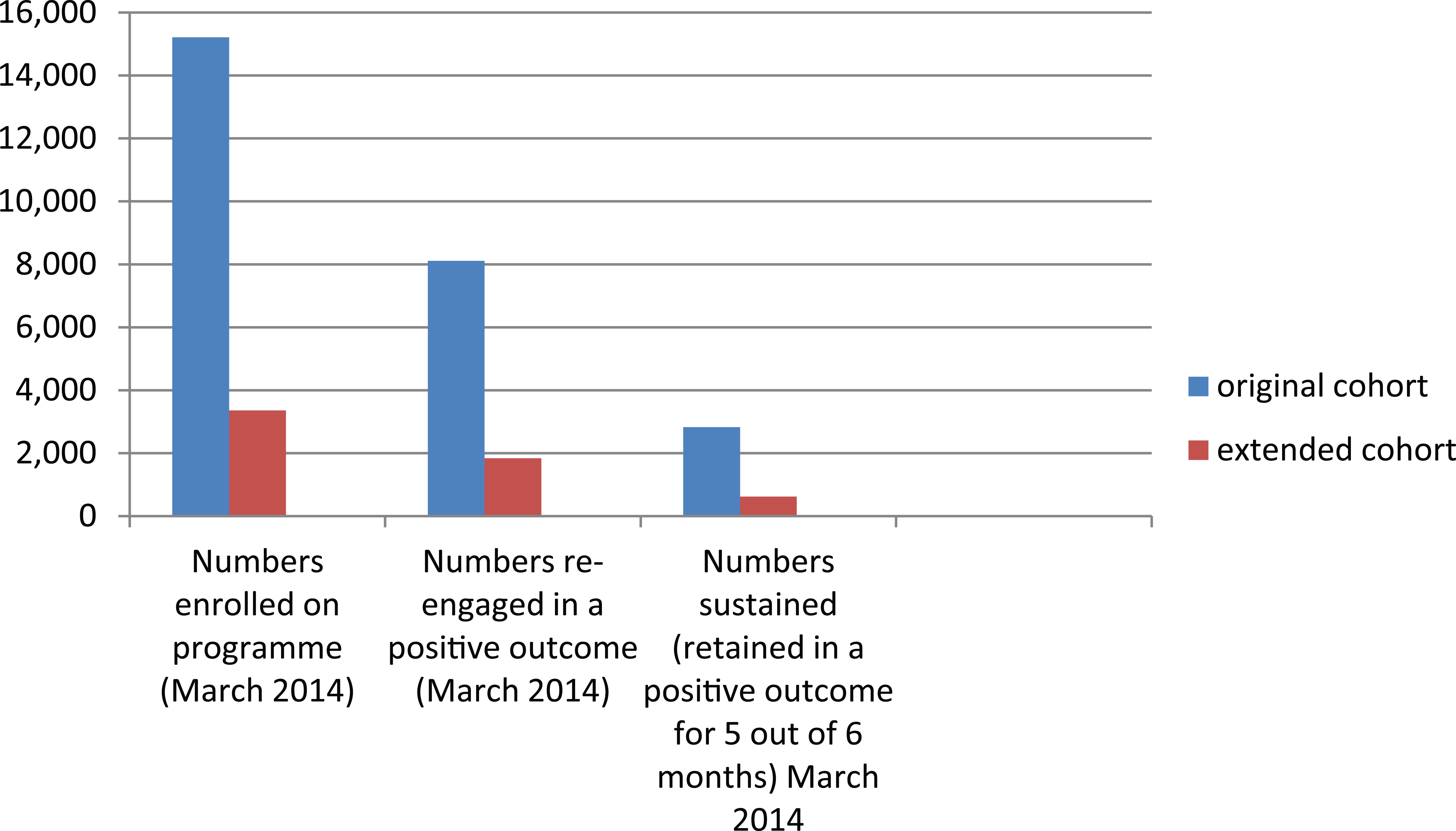
Youth Contract for 16–17 year olds original and extended cohort: delivery date for January 2013–March 2014.
While the focus of the evaluation was to measure the performance of the YC and its local delivery, the evidence highlighted substantial variation between LAs in the proportion of young people who had been recorded as NEET prior to entering the YC and hence raises serious concern about the accuracy of NEET statistics. The NCCIS data showed that between 16% and 41% of programme participants were not identified as NEET when they started the YC, or were identified as NEET after starting the programme (Newton et al., 2014: 44). These findings concur with the emergent issue in England about the lack of comprehensive data on the current status of those within the age group, with wide variation between local authority areas in the proportion whose activity/status is known, which inhibits the targeting of support for NEET young people. While NEET rates among 16–18 year olds in different regions of England had more or less plateaued between 2010 and 2013, there was a significant increase, from 2010, in the proportions of 16–18 year olds who had no measured destination outcomes, that is, their whereabouts were recorded as ‘unknown’ (Maguire, 2015).
Figure 1 highlights that the extension to the eligibility criteria within the national model did not significantly expand the take-up of the programme. This was largely attributed to the difficulties that prime providers and their supply chains encountered in recruiting eligible young people – difficulties which were attributed to inaccurate data and/or the inability to access local data. The decision to award the delivery of the YC to prime providers, rather than to LAs, resulted in many LAs being reluctant to share destinations data and to work in cooperation with their local YC delivery agents. The lower than expected numbers, combined with back-loaded payment systems that were perceived to be focused too heavily on the delivery of hard outcomes, i.e. disadvantaged young people’s ability to progress to EET provision in relatively short time periods, resulted in some providers questioning the financial viability of the delivery model (Newton et al., 2014).
These issues were less acute in the three core city areas, where LAs managed YC delivery, there were no qualification entry requirements (eligibility included all young people in the NEET group) and there was far less emphasis in their sub-contracting arrangements on a PbR delivery model. Diluted or non-existent PbR models that operated in the core city areas, enabled small and voluntary and community sector organisations to be included within YC delivery, as the financial risks associated with PbR, which often act as a barrier to their inclusion, were largely removed (Newton et al., 2014). A recent report by the Work and Pensions Select Committee (2012) has highlighted the intensive process that is involved in providers finding and engaging young people in the NEET group, which frequently requires work in local communities and engagement with schools, youth clubs and local voluntary and community organisations.
The prime providers had essentially bid for the YC on price, although the ‘per head’ contract value and lower than expected take-up rates had, in effect, undermined the financial assumptions made in the bidding process. The net effect was that the YC was commercially unworkable: Those [PbR weightings….] You had to tick a box for the weightings on the outcomes and it was very clear if you didn’t tick a box which was weighted towards (achieving) sustainment you wouldn’t win. This is classic DWP work programme, flexible new deal bidding tactics. [But…] these are kids, they’ve never had a job, they’re 16 and 17, they’ve got no qualifications, the education system or whatever has failed them, and we’ve applied a work programme-type funding model, which is OK if the way things work is more geared to front end and, most importantly, the net values are higher. (Prime provider) (Newton et al., 2014: 59)
The ‘black box’ approach to delivery provided prime providers and the LAs in the core city areas with considerable discretion to determine the nature and content of the YC. The principal component of the programme was to provide intensive support to young people from key/guidance workers, with the overall goal of achieving re-engagement and subsequently sustained participation in EET among YC participants. There was significant variation and scope with regard to how this was delivered, with some providers specifying that their supply chain contractors must meet with young people on a weekly basis, while in other localities there was much greater discretion given to sub-contractors on the mode and regularity of contact with programme participants. Each stage of this process – initial participation, re-engagement and sustained participation in EET – triggered payments from the EFA to the prime providers and the LAs in the core cities. In turn, the prime providers and the LAs cascaded payments to their ‘supply chain’ of sub-contractors based on individually agreed contracts relating to their performance (PbR). This had the effect of passing the risk down the supply chain, with a pro-rata management fee being retained by the prime providers. Young people were not paid to participate in the YC, although, in some areas, they were offered financial incentives to attend short-term work experience placements (Newton et al., 2014).
Changes were evident within supply chains during the course of the evaluation, with most being made due to sub-contractors withdrawing from their contract (usually because numbers were lower than expected and the contract became unviable) or for under-performance. In one geographical area, the prime provider was replaced due to programme under-performance and the contract was assumed by another YC prime provider. As the programme evolved, an increasing number of LAs became involved in supply chains as sub-contractors, which they welcomed as a means of helping to shape the delivery of the YC (Marvel and Newton, 2014). However, the evidence suggested that the limited financial returns and associated risks emanating from supporting YC delivery undermined its value to potential delivery organisations, in particular smaller VCSE (voluntary, community and social enterprise) bodies.
It was widely asserted that participation and ‘success’ within the YC should not have been measured solely in terms of EET outcomes and that the acquisition of ‘soft’ outcomes, such as the development of self-confidence and other social skills, as well as young people’s re-engagement with support services, should also be recognised. Furthermore, there was a lack of acknowledgement in the programme design and within the payment structure, of the time and effort needed to recruit and sustain young people from the hardest to reach/help groups. This was attributed to the lack of inclusion of the acquisition of soft skills by young people and their ‘distance travelled’, as measured outcomes from the programme. The importance of intensive support and guidance to address specific needs, which was facilitated by small caseloads, was highlighted as a critical factor in engaging young people from vulnerable groups, although it was recognised to be costly and not fully supported by the funding received either by the prime providers (outside of the core city areas) and, most notably, by sub-contracted local delivery agents. The evaluation concluded that insufficient funding was available up-front in the national model to support the recruitment process and the intensive work that often had to be undertaken to develop soft skills before young people (in particular the most disadvantaged) were able to progress into pre-engagement and sustained outcomes (Newton et al., 2014). These findings align with evidence from studies of other NEET intervention programmes, which show that the re-engagement and intensive support should not be displaced by the drive ‘to prove’ that programmes are effective, solely through performance measures which focus on deriving the maximum number of EET outcomes in relatively short timescales (Maguire, 2013).
Discussion
This article has sought to challenge the widespread use of the term NEET to define an increasingly wide age range and far greater diversity in its population. In contrast to a term that was originally designed to classify under 18 year olds who were excluded from the unemployment count, the term is now widely used to include young people between the ages of 16 and 24 who are NEET, as well as those who are actively seeking work, i.e. those in the unemployment ‘count’ and in receipt of welfare support. However, the extension of the term NEET has not coincided with an expansion of our knowledge and understanding about the composition and needs of this extended group, which is a fundamental requirement to underpin effective policy development. Moreover, it may be argued that the extended use of the term to include a much wider cohort, has served to obscure our understanding of the extent to which youth disengagement and disaffection continues to exist in England today.
This lack of research evidence on which to base effective policy planning is exemplified by the case study of the YC. Here is an example of a recent policy that was rolled out as a national delivery model, without any prior testing or piloting of its suitability to meet the needs of its intended cohort. While the performance of the YC for 16 and 17 year olds, in terms of both the overall numbers of young people entering the programme and its success in delivering sustained positive outcomes, largely failed, the evaluation evidence suggests that this is attributable to flaws in programme design and its commissioning, rather than to the demand for intervention.
Firstly, it raises very serious questions about if and how PbR models should be constructed. That the allocation of a £126m budget (Work and Pensions Select Committee, 2012) to the YC for 16 and 17 year olds was spent to engage fewer than 20,000 young people and to achieve sustained outcomes for approximately 2500 young people (March 2014 figures), in a climate of economic austerity and restricted government spending, raises alarm bells about programme initiatives being rolled out nationally before assessing their impact through trials or pilot initiatives to test their widespread viability. Knee-jerk policy-making becomes very costly when large amounts of public funds are allocated to a small number of prime providers, without any hard evidence that devolving government responsibility for NEET re-engagement through a black box and PbR model would actually work. However, the YC policy, in a similar vein to the UK’s Work Programme model, follows the principle underlying current government policy, which is to reduce direct state intervention and public spending in this area and to outsource responsibility for training and employment activities. It follows neoliberal policy thinking, which largely took root in Britain during the 1980s and advocates minimising the role of the state in the delivery of public services and strengthening the role of a free market.
With 23.5% of 15–24 year olds (a total of 7.5 million) unemployed in Europe in June 2013, the European Union agreed to speed up the implementation of the Youth Employment Initiative (YEI) and the Youth Guarantee schemes. The Youth Guarantee requires all member states to make sure that ‘within four months of becoming unemployed or leaving formal education all young people up to the age of 25 receive a high-quality offer of a job, an apprenticeship or a traineeship’ (European Commission, 2015). Assistance is also given to member states through the EU structural funds, principally the YEI, whose €6 billion funding allocation will now be available from 2014 to 2016, to extend apprenticeship and work placement opportunities. While the YEI was introduced in a number of areas in England in 2014, the Youth Guarantee has not been adopted by the government in England, despite calls from a House of Lords inquiry for it to replace some existing provision, most notably the YC (House of Lords, 2014). In contrast, the Youth Guarantee has been introduced by the devolved administrations in Wales, Scotland and Northern Ireland.
Secondly, if PbR models are to be introduced in England, should programme performance be measured solely in terms of ‘hard outcomes’, i.e. sustained participation in EET. Research evidence shows that the acquisition of soft skills is often a pre-requisite for achieving young people’s re-engagement in EET and the length of time needed to do so may be closely aligned to both the length of time they have spent in the NEET group and the period of their disengagement from statutory services and other interventions. The acknowledgement of these requirements also needs to be reflected within payment systems, with an increased emphasis on up-front payments to support the development of soft skills and to map and recognise ‘distance travelled’.
Thirdly, the YC evaluation evidence clearly demonstrated that small voluntary and community sector organisations were essentially squeezed out of the YC delivery model (apart from in the core cities), due their inability to manage the financial risks and penalties associated with a PbR delivery model. However, research evidence on successful NEET intervention programmes has consistently highlighted the important role of smaller voluntary sector agencies, in terms of their capacity to undertake outreach work and their versatility to adapt and respond to, and meet, the needs of an increasingly diverse population (Eurofound, 2012).
Aligned to this point is the need to determine at whom programmes are targeted, by whom, why and what can realistically be achieved in a given timeframe. While the term NEET has become a ‘catch all’ definition for young people who have failed to make successful transitions, budget constraints are largely responsible for programme interventions tending to be focused on targeted groups within the overall population. This approach leaves swathes of young people, most notably the NEET inactive group, i.e. young people who are not actively seeking work, on the sidelines and at particular risk of long-term economic and social exclusion. If we are going to embrace the term NEET to define youth unemployment, exclusion and disengagement, policy-makers must ensure that adequate interventions are made to both quantify and address the needs of all who are labelled as belonging to this group. While we might conclude that the YC largely failed, its overall ambition remains largely unresolved.
Footnotes
Funding
This research received no specific grant from any funding agency in the public, commercial or not-for-profit sectors.
Notes
Author biography
Until March 2015,