



Abstract
The basis of this article is a follow-up study of a cohort of pupils in the third largest city of Sweden, Malmö. The pupils finished fourth grade at compulsory school in 2008. We have data about every individual in the cohort as well as corresponding information about their parents. The information concern educational choices, educational accomplishments, employment relations, incomes from work and different kinds of social benefits and allowances. We got annual data on these variables from 2008 until the last follow-up year 2019 when most of the individuals were 21 years old. Most of them left upper secondary school in 2017 when they were 19 years old. They were therefore in the beginning of their transition 2019, either aiming for education or work. The results show that vocational education generated favourable conditions for work and incomes provided that the diploma goals ware reached. Individuals with foreign background and with unfavourable socioeconomic origins were overrepresented among those that didn’t reach the diploma goals; this was true for students on VET-programmes as well as higher education preparatory programmes. It should also be mentioned that experiences from a national programme in upper secondary school generally improved conditions for establishment. Those that didn’t reach the goals of compulsory school and weren’t eligible for studying at a national programme met the greatest difficulties in finding jobs and decent income levels.
Introduction – The development of the Swedish VET-model
Swedish traditions of vocational education differ in important ways from experiences in other countries (Jørgensen et al., 2018; Persson-Thunqvist and Gustavsson, 2021; Soskice, 1998; Streeck and Thelen, 2005; Winch, 2000, 2002). One distinguishing characteristic is that vocational education at upper secondary level has been school-based with minor elements of workplace-based learning (Olofsson and Panican, 2017). The apprenticeship tradition is weaker compared to neighbouring Nordic countries like Denmark and Norway and especially compared to the German-speaking countries at the European continent. Exchanges between school authorities and representatives of industries and social partners have taken place within local programme councils at school unit levels and national programme councils organized by the Swedish Agency for Education (Skolverket). The representatives of work life influence VET-programmes though these programme councils, but the responsibility rests with school authorities. Those who represent work life have a pure advisory role.
But even if the main responsibility of vocational education rests with the schools, there are historic and present-day elements that merit a description of the Swedish VET-model as a hybrid model (Olofsson and Thunqvist, 2018). In some sectors social partners have concluded agreements concerning vocational training that regulate conditions for, and forms of, apprenticeship-like education that functions as mandatory extensions of VET-programmes in upper secondary schools. These agreements between employers’ organizations and trade unions regulate training hours, certain training elements and in some cases also rules for final exams. This means that in some trades it is not enough to complete a vocational programme in upper secondary school to reach a skilled worker status. Such agreements exist for construction workers, electricians, and plumbers, among others. These agreements, however, only cover a minor part of the labour market. Nevertheless, they are worth mentioning because they are rather unknown as parts of the Swedish VET-tradition. Agreements on vocational training at industry-level go back to an old tradition within the Swedish labour market model. In 1938 the main social partners at national level concluded what became known as the Saltsjöbaden Agreement (Saltsjöbadsavtalet). This was an agreement that regulated negotiation procedures and industrial actions between the partners, but the agreement also laid the foundations for arrangements in other areas of mutual interest between the partners. Vocational education was one of those areas. One central point of departure was thus that the partners at industry-level should be responsible for the final steps in the training of skilled workers. This means that even after the extension of the initial VET-programmes within the regular education system, there still exists a parallel system of apprenticeship training in some industries.
The integrated Swedish upper secondary school was founded in the beginning of the 1970s (Nilsson, 2013). The new upper secondary school encompassed both tracks preparing for higher education and fields preparing for work. The latter VET-programmes were in the beginning scheduled for 2 years but were in the 1990s transformed into 3-year programmes. At first apprenticeship training was primarily considered as an educational pathway outside upper secondary school, organized through the above-mentioned agreements by the partners at industry-level, or as an alternative for pupils with difficulties in following the ordinary school-based programmes (Lundahl and Olofsson, 2014). But after an educational reform in 2011 apprenticeship training was introduced as an equal alternative to school-based vocational tracks (Lindahl, 2014; Olofsson and Persson Thunqvist, 2018). Today, there are 12 different vocational programmes in upper secondary school and close to 15% of all pupils in VET-programmes follow an apprenticeship track (Kuzcera and Shinyoung, 2019). Apprentices may have an employment contract besides a training agreement although this is very unusual. To be qualified as an apprentice at least 50% of the education time must be workplace-based. For pupils in school-based vocational tracks a minimum of 15% of the total time in education should be offered as workplace-based learning (Andersson and Lindberg, 2022).
A less universalistic model
The Swedish educational system at compulsory and upper secondary levels is often described as an integrated and universalistic model in contrast to more differentiated education models where pupils are sorted into different pathways that determines future educational and career choices (see, e.g. Busemeyer, 2014; Hadjivassiliou et al., 2019; Opper, 1989; Pohl and Walther, 2007). The last-mentioned description can in some ways be questioned, however. There is a lot of evidence suggesting that the educational system in Sweden, both at compulsory and upper secondary levels, have become less equal. Several reforms during the 1990s led to a fast expansion of private schools. The educational system in Sweden has become very influenced by market elements (for an overview, see Holm and Lundahl, 2019; Lundahl et al., 2013; Lundahl et al., 2014). For every student there is a school voucher, a specified amount of money, that the municipality must pay to a private school or another municipal school authority that offers youngsters compulsory or upper secondary education. Close to 30% of the students in Swedish upper secondary schools get their education in private schools. Follow-up studies confirm that disparities in educational achievements have grown over time (Andersson et al., 2018; Vlachos, 2018).
Many youths in both compulsory school and upper secondary school encounter difficulties in pursuing their education. 15 percent of the pupils leaving compulsory education are not qualified to study at a national programme in upper secondary school. This means that they are directed to an introductory programme, which is a kind of preparatory education below upper secondary level. Very few of these youngsters ever complete an education at upper secondary level. To this should be added that between 20 and 25% of the students that begins a national programme in upper secondary school doesn’t achieve the educational goals. 1 Youths without accomplished education are eligible for adult education, at municipal adult education and folk high schools, but many of them encounter difficulties in the transition to working life and get trapped in precariat-like conditions with substantial difficulties supporting themselves. It should also be noted that a larger part of the students following VET-programmes, compared to students in programmes preparing for higher education, face difficulties in achieving the goals of education (Skolverket, 2021). The last point is mainly attributed to factors connected with differences in socioeconomic backgrounds, but also in some respects with gender. The employment status and levels of educational attainment of parents influence educational accomplishments of their children at the same time as girls generally performs better in schools than boys (Skolverket, 2006). Boys are a bit overrepresented in VET-programmes in Sweden. The family background of the students is of less importance. Students with a foreign background 2 are more likely than students with domestic background to choose programmes preparing for higher education. At the same time, students with a foreign background are heavily overrepresented in introductory programmes. A larger part of this group of students doesn’t accomplish compulsory school which means that they are not eligible for studying at a regular national programme in upper secondary school (Skolverket, 2021).
Challenges for the VET-model
Vocational education serves several functions and should meet objectives at different levels. At the individual level the education should first and foremost facilitate transition to work. Here it’s important to point at several essential dimensions. Vocational education doesn’t only create conditions for more stable employment and earnings conditions. It also facilitates participation in communities of practice, progression within a trade and career development (Lave and Wenger, 1991; Olofsson and Panican, 2019). At the societal level vocational education in upper secondary school constitutes an indispensable part of manpower and skill provision, for the matching on the labour market. Connected to these important functions, experiences in Sweden have been less favourable during the last decades. The supply of skilled labour has decreased at the same time as long-term forecasts suggests increasing shortage of vocationally educated labour, especially in the social care and health sector, private service and manufacturing industry. Forecasts indicates that demand for labour with post-secondary education has been overestimated, especially when it comes to post-secondary education without professionally attachments, at the same time as bottlenecks are clearly connected to vocational programmes in upper secondary schools. The share of pupils leaving compulsory schools that applies for VET-programmes fluctuates from year to year but has decreased over time. Until the beginning of the 1990s well over half aimed for VET-programmes. Today less than 30% choose these programmes. In metropolitan areas shares are even lower (Olofsson and Panican, 2022).
At the same time as a decreasing share choose VET-programmes and a considerable part of every cohort doesn’t fulfil the goals of compulsory and secondary education, a large share of those aiming for higher education preparatory education at upper secondary level don’t continue to post-secondary education. All in all, this contributes to the mismatch problems on the labour market and to making transitions from school to work more complicated. At the individual level this contributes to welfare losses and at municipal and state level to higher costs when more young people become dependent on social security benefits.
Some general remarks about vocational learning
There is a great research interest in vocational learning, not least against the background of problems of mismatch on the labour market, deeper understandings of the connections between work-place learning and increased productivity and rising social challenges in connection to school to work transitions for youth. A change- and development-oriented learning constitutes an indispensable part of a vocational education that both aims to satisfy demands in modern work life (Ellström, 2010; Engeström, 2010) and at the same time to guarantee better conditions for young peoples’ skill formation, mobility in the labour market and more secure income conditions (OECD, 2010).
Initial vocational education has long-standing historical roots, different shapes in different countries and is continually confronted with new challenges (Mann and Ranieri, 2021). The speed of workplace changes within transformed production systems, related to on-going digitalization and automatization, bring new challenges for VET (Antera et al., 2022) and means that less qualified assembly and service work disappear in an accelerating pace. Adaptions of just in time-principles for production control results in higher pressure for flexibility and changes to variations in customer demand. Within less hierarchical work organisations demands on employees’ responsibility and engagement has risen (Olofsson and Panican, 2019).
Education- and qualification-related demands are therefore higher today than before, but does this mean that initial vocational training with considerable elements of workplace-based learning lost its relevance? The high interest shown in apprenticeship training, not least within the EU, signal something else. Changed work organisations, new technology, and a lifelong-learning perspective rather indicate that these educations do correspond to qualification demands that young people confront today and will continue to confront in the foreseeable future (Euler, 2021). Skills associated with collaborative abilities, problem-solving, critical and creative thinking, develops most favourably in real-life workplaces where youth are confronted with requirements and conditions of work as well as other co-workers in mixed ages and with different experiences. To enhance those abilities a good general theoretical basis must be guaranteed. In many countries general academic subjects, for example, a second language, mathematics, and social studies, is given more space within apprenticeship training as well as initial VET more generally. In this context, Dietrich Euler (2021) makes the point that key-competencies, expert knowledge, and vocational competencies can be understood as hybrid competencies. He explains that most workplaces need “flexible persons competent enough to apply practical abilities, with a cognitive understanding of work processes and key-competencies to process problems together with colleagues in work teams, and a capacity to contribute to enhancements and innovations at the workplace” (p. 41).
But behind endeavours to promote apprenticeship training there are naturally also intentions connected to social policy. Apprenticeship training creates educational pathways for young people less inclined for school-based studies and not seldom with a less privileged social background. Through apprenticeships an occupational identity might develop whose importance for personal development, maturity and independence should not be underestimated. Comparative investigation also shows that relative unemployment rates for youth – that is unemployment for youth and young adults compared to unemployment for middle aged and older people – tends to be lower in countries with more widespread apprenticeship systems than in countries more heavily relying on school-based vocational education (OECD/CEDEFOP, 2021; Wolbers, 2007).
Apprenticeship systems clearly have some advantages compared to school-based training systems (see for example OECD, 2010; OECD/CEDEFOP, 2021). But there are also tensions within apprenticeship training systems that might make them less fruitful for participating individuals as well as less efficient from a socioeconomic perspective. The corona pandemic illustrates, on an overall level, that there must be strong interventions and supportive institutional frameworks with close connections between school authorities and social partners, to promote wider workplace-based learning within vocational education (OECD, 2021; OECD/CEDEFOP, 2021). In many countries the financial support has increased for employers taken on apprentices. This was happening already before the pandemic, for example during the crisis of 2008–2009. In practice the states compensate employers for financial risks linked to investments in apprenticeship training. Alternative pathways for education, among others special apprenticeship centres, has been tried in some countries to offer educational possibilities for young people that otherwise might find it difficult to get an apprenticeship.
Most important for evaluating and guaranteeing quality standards of educations are the collaboration between businesses and public institutions. The social responsibility and mutual commitments between the social partners through collective agreements on vocational training is also often pointed at as a basic requirement (Euler, 2013). The challenges following on the corona pandemic has once again illustrated weaknesses in institutional foundations for vocational education in many countries, with negative social impacts for youth and ultimately damaging effects on skills provision and forces of development in work life.
Objective and questions
The objective of our article is to highlight patterns of establishment and income conditions for youth in Sweden in relation to educational backgrounds in upper secondary school. Our main interest will be the effects of school-based vocational education and apprenticeship training. We will address the following questions: 1. What basic conditions affect choices between vocational programmes and higher education preparatory programmes in upper secondary schools? 2. In what way do educational background affect the probabilities for employment and a stronger establishment in working life? 3. In what way do educational backgrounds affects risks of being NEET (Not in Employment, Education or Training) and dependent on social security benefits?
Methods and data
The empirical basis of our article consists of register data. We have conducted a follow-up study of a cohort of pupils in the third largest city of Sweden, Malmö. The pupils finished fourth grade at compulsory school in 2008 (they were then 11 years old). 3 We have data about every individual in the cohort as well as corresponding information about their parents. The information concern educational choices, educational accomplishments, employment relations, incomes from work, and different kinds of social benefits and allowances. We got annual data on these variables from 2008 until the last follow-up year 2019 when most of the individuals were 21 years old. Most of them left upper secondary school in 2017 when they were 19 years old. They were therefore in the beginning of their transition 2019, either aiming for further education or work.
We are, accordingly, following young peoples’ pathways from compulsory school to upper secondary school and ahead to the last follow-up year of 2019. As our study concern one cohort, we don’t investigate the importance of variations in business cycles, structural changes, or cohort sizes. They are the same for all individuals included in the investigation. The variations that can be investigated concern some background factors for the children and their parents. As we follow the children over some years, we can trace influences from these background factors on childrens education, and how educational choices influence labour market opportunities. As said before, we use register data, and the results will partly be presented as comparisons between children with different backgrounds, partly as results from logistic regressions.
When we investigate in what way socioeconomic factors influences educational choices and establishment patterns for children our point of departure is the social status of the parents in 2008, in other words when the pupils of the cohort finished the fourth grade at compulsory school. We will highlight information about the parents’ educational levels, employment, and income conditions.
By using register data and basic correlation analysis we can distinguish patterns at structural levels influencing educational choices and variations in social conditions at group-level for individuals with different backgrounds. But to get deeper as well as broader insights into casual mechanisms we would of course have to use more advanced methods and complementing data. The research could for example be enriched by using qualitative methods digging deeper into individuals’ experiences and conceptions in connection to choices of education and career paths.
A brief background about Malmö
Malmö constitute the third largest city in Sweden with a bit more than 350 000 inhabitants, located in the southernmost part of the country very close to Copenhagen. During the last 50 years Malmö went through a transformation from a social homogenous industrial city to a multicultural educational city. Immigration has been large scaled. Today more than 30% of the population are born outside Sweden (Salonen et al., 2019).
Social conditions are more divided than in other parts of the country and follows distinct socioeconomic, geographical, and ethnic patterns. There are major educational gaps. Among the population in Malmö there are both large sections with higher education and low education.
The low employment rate constitutes one major concern in Malmö, especially for low educated and people with foreign backgrounds. Labour market conditions for these groups are more fragile than in other parts of the country. The NEET-group is also larger than in other municipalities in Sweden.
The share of young people in education has increased substantially over time. At the same time there is a potential for more accurate educational choices. VET-programmes in upper secondary schools could provide a relatively secure path to working life. Seen against this backdrop, it’s a challenge that so few choose these educations (Olofsson and Panican, 2022).
A follow-up of the cohort that left fourth grade at a compulsory school in Malmö in 2008
Upper secondary education among the fourth graders from 2008 (percentages, N = 2842).
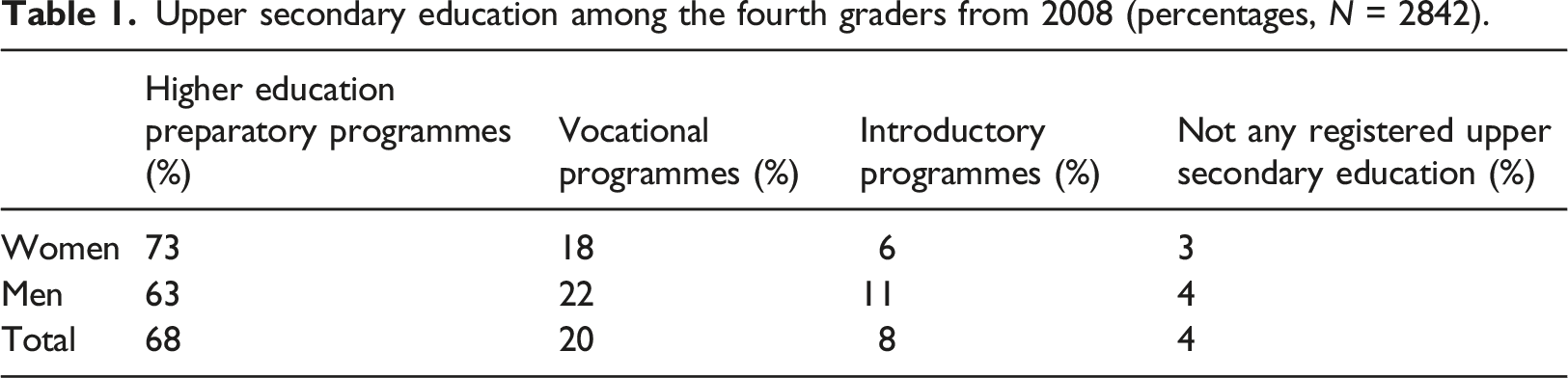
Conditions that influenced educational choices
What then influenced educational choices except gender? Several factors were important. Family background was mainly important in relation to the percentage studying at introductory programmes. In total, individuals with foreign background represented 44% of the individuals belonging to the cohort. Educational choices didn’t differ so much between individuals with domestic and foreign backgrounds. Students with foreign background were somewhat underrepresented at VET-programmes as well as in higher education preparatory programmes. 46% of the apprentices had foreign background, thus indicating that composition in relation to family background was more even among apprentices. Those with foreign background were, however, heavily overrepresented in introductory programmes. 12% of the fourth graders with foreign background had been registered at an introductory programme compared to 6% of those with domestic background.
Choices of educational pathways were influenced by several different basic factors. One important factor was the educational status of parents. Eight out of 10 with two parents with post-secondary education choose higher education preparatory programmes. Only one in 10 choose a VET-programme. For individuals with two academically trained parents the odds ratio for choosing a higher education preparing programme was more than 100% higher compared to individuals with only one or no parents with post-secondary education.
The employment status of the parents was also important for educational choices. A very large percentage of the fourth graders with two working parents choose higher education preparatory programmes and fewer choose VET-programmes. Among fourth graders with no working parents there were also three times as many that had been registered at an introductory programme (12% compared to 4%).
Not only the employment status but also income levels were important. The higher the income of the parents in 2008, the higher the probability that the four graders went to higher education preparatory programmes. 76 percent of the four graders from a higher education preparatory programme had at least one parent with incomes that exceeded the average for all parents in the population. Many of the students with parents with lower-than-average income also choose higher education preparatory programmes, but that percentage was thus much lower. More individuals in the age group with parents with lower incomes had experiences from a VET-programme or an introductory programme.
Educational attainments in upper secondary school and further education
Completed or uncompleted upper secondary education 2019 (percentages, N = 2842).

Completion rates varied a lot between programmes. Precisely as at national level, completion rates were highest in higher education preparatory programmes. In VET-programmes the percentage that reached the diploma goals were much lower. Of those that went to a higher education preparatory programme, 80% hold a diploma or equivalent in 2019. Among fourth graders that went to VET-programmes the corresponding percentage was 60%. Among fourth graders with a background in introductory programmes only 20% had reached the goals for a diploma at a national programme in 2019. A large part of the cohort also had experiences from adult education after upper secondary school, mainly municipal adult education but also from studies at folk high schools. These percentages amounted to 25%. The largest part of these individuals had a background from higher education preparatory studies at upper secondary school, in total 69%.
What factors besides gender influenced probabilities for having reached the goals for a diploma at upper secondary school? Naturally, the family background was important. 76 percent of those with domestic backgrounds had achieved the goals of an upper secondary education in 2019 compared to 62% of those with foreign backgrounds. At programme level fourth graders with foreign background were thus overrepresented among those that didn’t complete an education. The percentage with foreign backgrounds of those that didn’t complete was somewhat higher among those that followed a higher education preparatory programme than a VET-programme, 52% compared to 49%. The highest proportion was, however, among them with a background in introductory programmes, namely, 62%. Within the group with foreign background, individuals born in Sweden with two foreign-born parents, the so called ‘second generation’, were least represented among them with a completed education. If we once more connect to fields of education, we can conclude that this group was overrepresented among those with a background in higher education preparatory programmes as well as in introductory programmes.
Percentages of the cohort with experience of post-secondary education in 2019 (N = 2842).

A somewhat larger numbers of those with domestic background than those with foreign background begun academic studies but the difference was rather small, 43% compared to 40%.
Educational choices at upper secondary school and gender affected probabilities for higher education. But socioeconomic factors discussed in connection to the choice of fields of education at upper secondary level were also of importance. For a young person with academically educated and employed parents, with higher-than-average incomes, the choice of higher education was much more likely. The education level of the parents stands out as the most important factor.
Gainfully employed in 2019
Employment rates in 2019 related to educational pathways in upper secondary school (N = 2842).
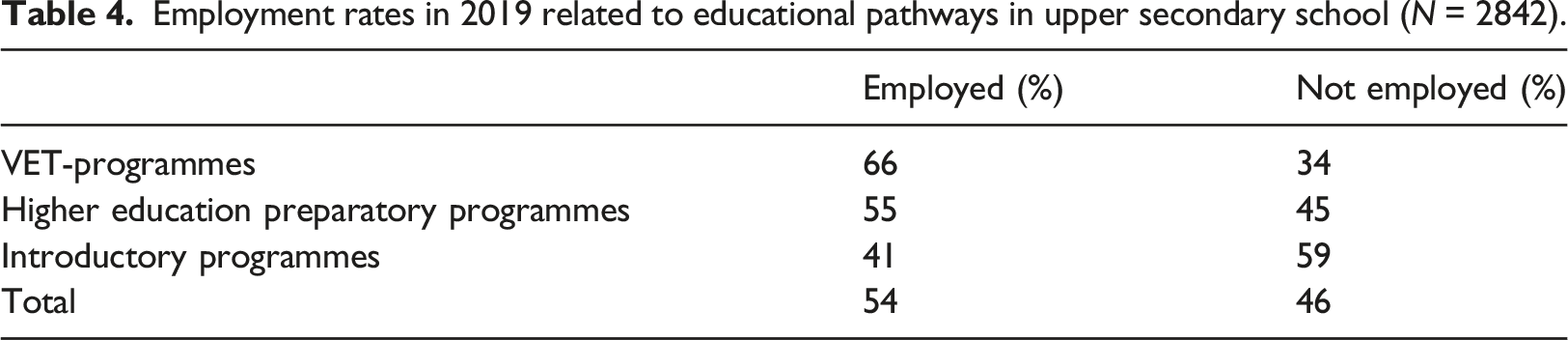
The data in Table 4 covers all individuals in the cohort. If we exclude those who still were studying in 2019 the rate of employed people was naturally higher, but maybe not so high that could be expected. For the whole population of fourth graders from 2008 the employment rate were then 62%. Among those with a background in VET-programmes the employment rate went up to 74% and among those that followed a higher education preparatory programme to 66%. Of those who had been apprentices in upper secondary school 82% were working in 2019. Previous students at introductory programmes had a very low employment rate, only 42%.
Shares of the fourth graders with an earned income above four price base amounts 2019 related to educational background (not studying, n = 1590).
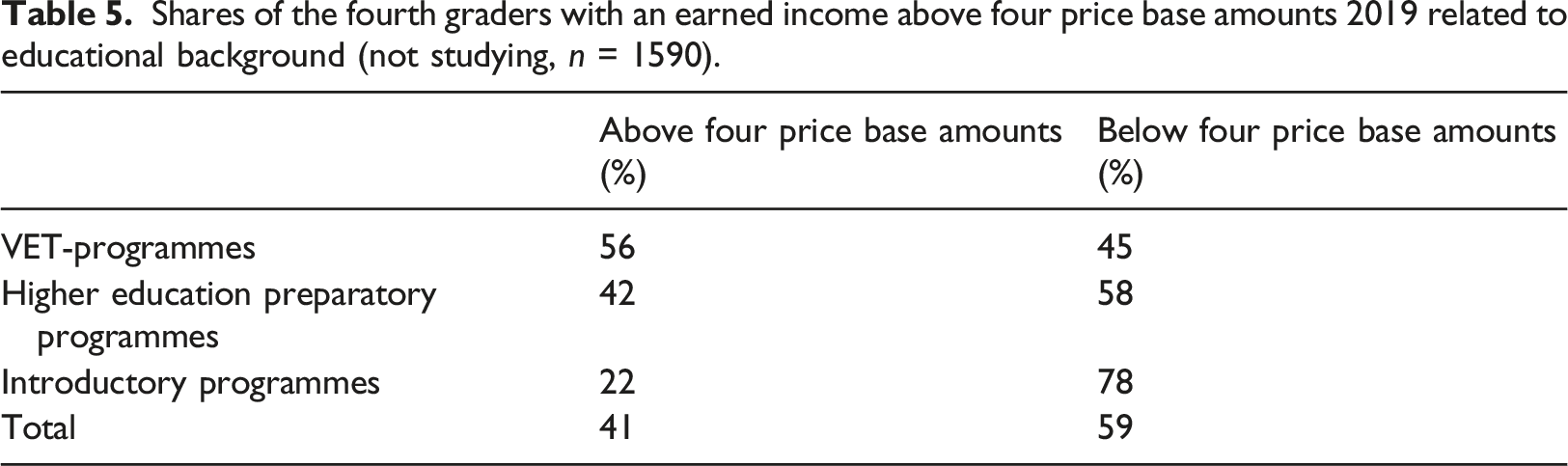
As could be expected the percentage with incomes from work above four price base amounts were highest for those with a background in VET-programmes. If we pick out those that followed an apprenticeship path the percentage were considerable higher, 69%. There were, however, quit large variations in relation to different VET-programmes. The share of four graders with earned incomes above four price base amounts were highest among individuals that had been studying at the building and construction programme, child and recreation programme, electricity, and energy programme, and at the health and social care programme. The differences related to gender was small but there were substantial differences in relation to family background. 46 percent of those with a domestic background had a higher earned income compared with only 34% of those with foreign background.
Several other factors than educational pathways and family backgrounds affected the likelihood of the individuals in the cohort being employed or not. The educational level of the parents was important. Individuals that had parents with only pre-secondary education were less likely to have a higher income according to the definition we use here. Individuals with parents with earned incomes below average as well as parents with municipal income support was much less likely to have higher income. The employment status of the parents seems to have been of particular importance. A logistic regression shows that the odds ratio for having higher income in 2019 was 60% higher among individuals with two working legal guardians compared to individuals without or with only one working legal guardian. The share with higher income was 15% points higher in the former group than in the latter. This is reasonably also an important explanation for the difference in relation to family background. The percentage with working parents was more than 40% points higher among individuals with a domestic background compared with individuals with a foreign background, 64% compared to only 22%.
Employment rates in 2019 related to educational background and achievement (not studying, n = 1590).
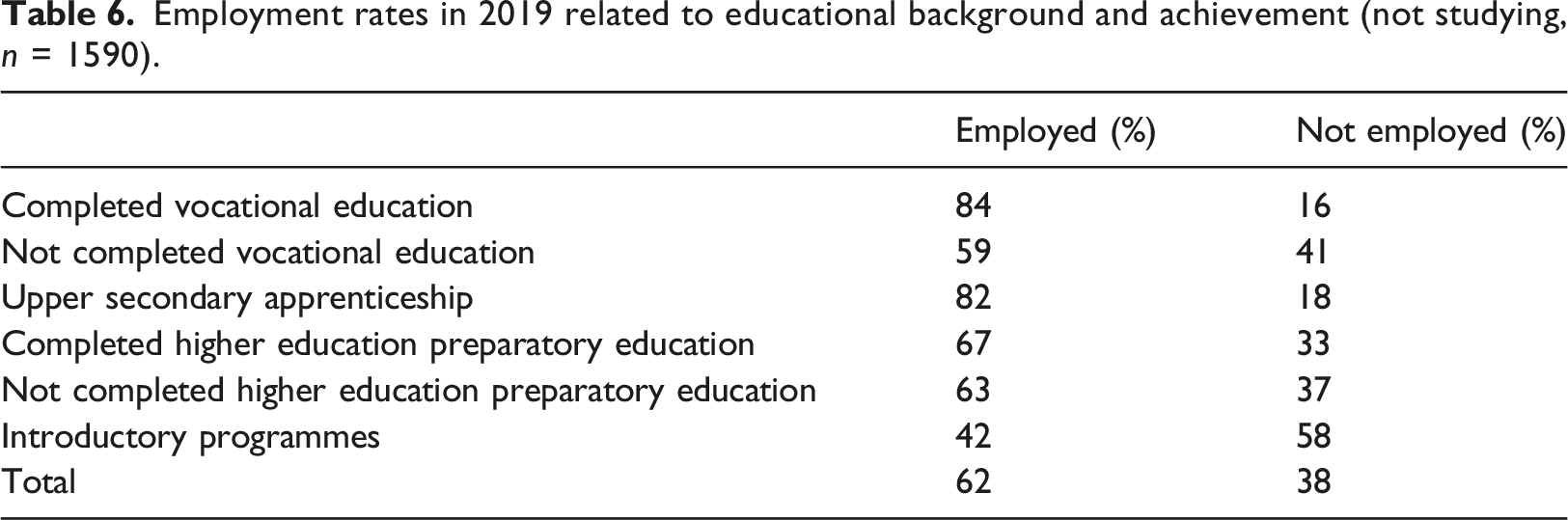
The same pattern appears if we investigate the percentages with a higher income, above four price base amounts. Vocationally educated with a completed education had jobs to a much greater extent than their comparison groups, but also higher earned incomes. That is an indication of more stable employment, more hours worked and higher wages.
It should once again be stressed that the data refers to individuals that weren’t registered as students in 2019. Vocational education generated favourable conditions for work and incomes provided that the diploma goals ware reached. Individuals with foreign background and with unfavourable socioeconomic origins were overrepresented among those that didn’t reach the diploma goals; this was true for students on VET-programmes as well as higher education preparatory programmes. It should also be mentioned, lastly, that experiences from a national programme in upper secondary school generally improved conditions for establishment compared to have been registered at an introductory programme. Individuals with a background on VET-programmes and introductory programmes were similar in many ways connected to socioeconomic background conditions. This contributes to reinforce the images of social compensating effects connected to vocational education.
Youth that neither worked nor studied among the fourth graders from 2008
NEET-ratios for men and women 2019 (the whole population, N = 2842).

A higher percentage of those with a foreign background belonged to the NEET-group than those with domestic background, 17% compared with 14%. Underlying these differences were varying socioeconomic circumstances. Our data about the social status of the parents shows that the risk of being NEET decreased significantly for an individual with two working parents and was highly increased if one of the parents had unemployment compensation (including municipal income support). The odds ratio of being NEET was 50% higher for individuals that didn’t have two working parents compared to those with two working parents.
NEET-ratios in 2019 for those that competed respectively did not complete an upper secondary school programme (the whole population, N = 2842).
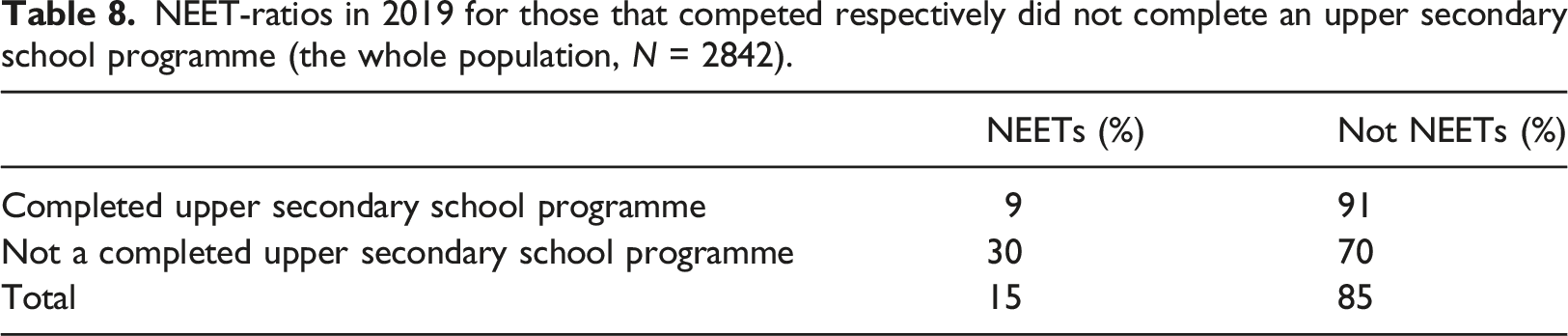
Against the background of these information, it may be of interest to look a bit more closely into how educational backgrounds affected risks of being NEET.
Educational background and NEET
The information we reported earlier about employment rates and establishment rates (in relation to an income level of four price base amounts) displayed substantial variations, both in relation to if the individuals had completed an upper secondary education and in relation to educational pathways. In the following we will focus on the group that didn’t studying in 2019. We will accordingly not relate the numbers of persons in NEET to the whole population but merely to those that did something else than studying the last follow-up year.
The group that didn’t study consisted of 55% men and 45% women; women studied at a greater extent than men. The percentages with a domestic and foreign background corresponded by and large to the distribution in the population. The latter reflected that the propensity for education was about the same irrespective of family background. A higher share of those with foreign background were in the NEET-group, 31% compared to 24% of those with domestic background. But even here we can trace several underlying factors that strengthened differences connected to family background. If we depart from the socioeconomic status of the parents, we can conclude that those that had two gainfully employed parents in much lesser extent were NEETs compared to those with only one or none employed parent. 22% of those with two working parents was included in the NEET-group compared to 32% among others. 34% of the fourth graders with parents that got unemployment compensation (including municipal income support) was included in the NEET-group compared with 22% of those that didn’t have any parent with social benefits related to unemployment.
Educational background must, however, once more be seen as most crucial. Among those that didn’t study in 2019 individuals with a background in vocational education and introductory programmes constituted a larger share compared to the population in general. 28% were vocationally educated, 53% had studied at a higher education preparatory programme and 12% at an introductory programme. Even if it was a smaller share of individuals with a higher education preparatory educational background, compared to the whole population of four graders from 2008, higher education preparatory education was still the most usual educational background among those that didn’t study.
NEET-rates in relation to educational backgrounds among fourth graders from 2008 that didn’t study in 2019 (n = 1590).
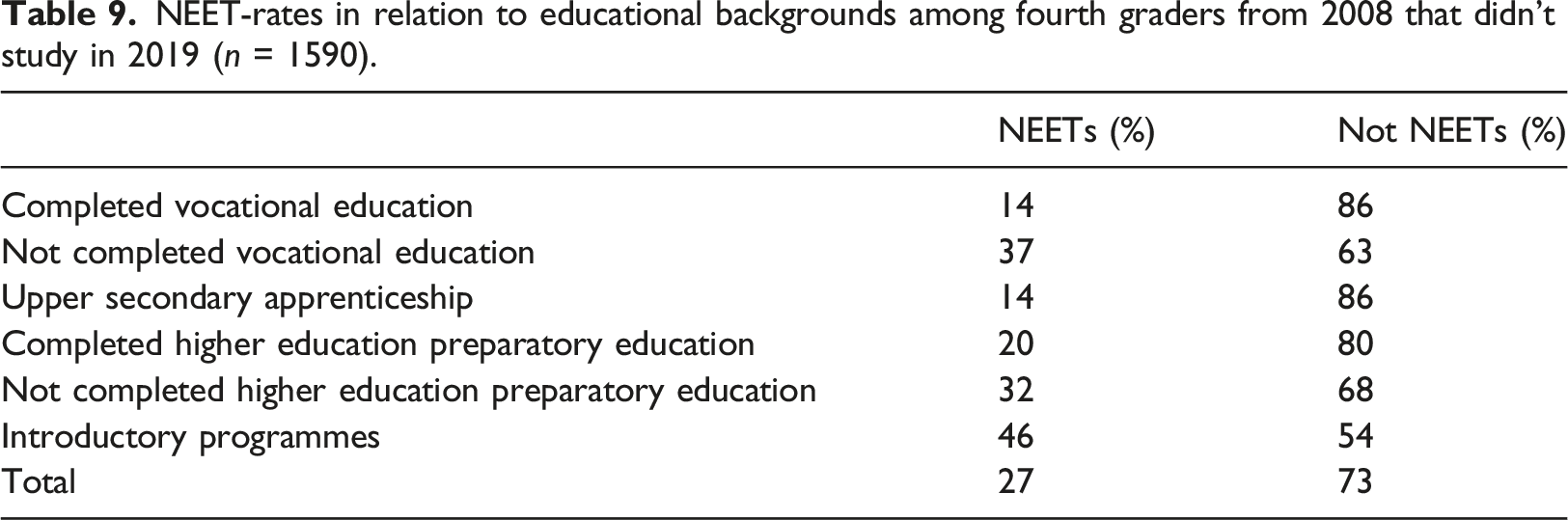
Even among those with a higher education preparatory programme from upper secondary school, there was a larger proportion of those that didn’t complete their studies with a diploma that belonged to the NEET-group, but the difference was smaller. The share of those with a background on higher education-oriented programmes at upper secondary schools that didn’t complete their education was much higher in the population that didn’t study 2019 compared to the population at large. The opposite was true for vocationally educated, where the share with completed education was higher among those that didn’t study 2019 compared to the wider population.
NEETs and social security benefits
38% of those classified as NEETs was receiving unemployment compensation and/or municipal income support in 2019 compared to 12% of those that didn’t belong to the NEET-group. Those who received activity compensation – what was earlier called disability pension or earlier retirement – also belonged to the NEET-group. Around 10% of those with a NEET-status had been granted activity compensation. This means that close to half of the NEET-population received social security benefits. If we look closer to the distribution of social benefits and allowances within the NEET-group, we can trace differences connected to family background. Among those with foreign background 50% received unemployment compensation or/and municipal income support compared to 28% of those with domestic background. Foreign born NEETs had the highest share with unemployment related compensation. A higher percentage of those with domestic background, however, received activity compensation.
And once more, the educational background was of great importance. As shown before, most of the NEETs didn’t complete upper secondary education. 45% of these individuals received unemployment compensation and/or municipal income support. The corresponding proportion among those with completed upper secondary education was 29%. A significantly higher percentage of those with a background on VET-programmes and introductory programmes, compared to those that had studied on a higher education preparatory programme, were dependent on unemployment compensation and municipal income support. The latter fact could have several different explanations. The majority of those that were NEETs with a background on VET-programmes didn’t reach the diploma goals (63%), which means that they never completed their upper secondary education. Among those with a background on higher education preparatory programmes, the majority completed their education (54%). The latter group might also have had more livelihood options. In general, they had less fragile socioeconomic backgrounds, and their parents might therefore have taken more responsibility for providing their children. Of course, there is a possibility that they also supported themselves through employment abroad or undeclared work. Information about this kind of conditions is not covered in our register data.
Some concluding remarks
Vocational educations in Sweden at upper secondary level are mainly school-based and the primary responsibility rests with the school authorities. There are some structures in place guaranteeing the social partners information and even possibilities to influence VET-programmes, through programme councils at local and national levels, but these structures have mainly information-exchanging and advisory functions. Apprenticeship training has not been so important as part of the Swedish VET-model as in many other European countries, but students have since 2011 a possibility to choose an apprentice track as an alternative to school-based education within all VET-programmes. However, a rather tiny share of the VET-students chooses an apprenticeship and even apprentices have primarily a status as school students. Very few have a combined employment and training contract.
For many decades now the interest in VET-programmes among pupils leaving the Swedish compulsory school has decreased. At a national level there is less than 30% of those following a national programme in upper secondary schools that attends a VET-programme. Over a period, an increasing share of the pupils instead choose higher education preparatory programmes. As today, a clear majority chooses these programmes. Close to 15% don’t even complete the compulsory school with approves results, which means that they are directed to one of the introductory programmes. In general, it’s a shortage of labour with skills acquired in VET-programmes. Long-term forecasts indicate that the shortage will be even stronger in the future. To this should be added that unaccomplished education at compulsory- and upper secondary-levels results in weak conditions for establishment on labour market, something that indirectly contributes to problems for the persons concerned to provide for themselves.
Our follow-up of the age group that left the fourth grade in one of the compulsory schools in the city of Malmö in 2008 clearly illustrates some of the challenges: mismatch on the labour market, misalignment between educational choices and skill needs in work life and, lastly, adverse social consequences of inadequate basic education.
Vocational education generally increased the possibilities of finding a job with good earning conditions. This was also true for the few that choose an apprenticeship track within a VET-programme. A rather significant part of those that choose higher education preparatory programmes, but didn’t continue education at post-secondary level, faced problems in establishing themselves. At the same time, we noted the significance of completing an upper secondary education, in other words the importance of fulfilling the goals for a diploma. This was of great importance for those that had a background on a VET-programme. Those who had begun but not completed a VET-programme had much worse conditions in terms of employment and earned incomes.
The educational background also influenced risks of being NEET. Those with a background on school-based VET-programmes and upper secondary apprentices faced the lowest risk of becoming NEET. Those that had a university preparing education from upper secondary school without continuing to the post-secondary level faced higher risks of becoming NEETs. Individuals with foreign background were overrepresented in NEET compared to those with domestic background, but this almost entirely reflected educational backgrounds. In relative terms, more people with foreign background didn’t complete upper secondary education, which appears to be the most important risk factor for being NEET. Even the employment status of the parents was an important factor affecting risks of being NEET. A larger part of those with foreign background than those with domestic background had parents that weren’t gainfully employed.
Footnotes
Declaration of conflicting interests
The author(s) declared no potential conflicts of interest with respect to the research, authorship, and/or publication of this article.
Funding
The author(s) disclosed receipt of the following financial support for the research, authorship, and/or publication of this article: This work was supported by the Malmö City and Malmö University: Young people from Malmö and their transitions to working life through higher education.
