



Abstract
This paper addresses the use of videography combined with group interviews, as a way to better understand the informal learnings of 11–12 year old children in cross-cultural encounters during French–German school exchanges. The complete, consistent video data required the researchers to choose the most significant sequences to highlight the processes by which the pupils communicated and expressed feelings and meanings within their experiences. The target of these paradigmatic situations was focused on two important questions relevant in the science of education:
- First, an epistemological and ethical question arose about the relationship between the researchers and the subjects of the research: How could cooperative research with pupils be led so that they were considered actors within the situation, and could share with the researchers the meaning of what happened in their cross-cultural experience?
- The second question arose from a methodological problem, which caused the researchers to develop a mixed apparatus involving a special recall technique using video data combined with group interviews to help the children remember what they were experiencing during the filmed interaction.
Keywords
Introduction
As part of a research project about the ‘intercultural informal learning of children in a Franco-German exchange programme’, on behalf of the Franco-German Youth Office (OFAJ), this study chose to conduct its analysis using video data of encounters between French and German pupils. This choice, made by researchers from the University of Paris XII and Universität Siegen, gave rise to the following theoretical and methodological questions:
How would filming have to be done in order to realize the aims of the research, which include the study of cross-cultural experiences and the analysis of the process of informal learning during the encounters between children?
To what extent can a researcher freely follow his/her choices and intuitions while collecting video data without subverting the theoretical premises or unduly distorting the analysis?
Reviewing all the data, how can the researchers make choices which reflect a common Franco-German methodological framework? The video data offered to all the researchers a common medium through which they could be aware of the diversity of their interpretations.
These questions divided the research team; some members wanted to first define a shared theoretical framework which would be indispensable for filming as well as for analysing the data, while others thought that the fieldwork could guide the research in collecting as well as analysing the data in order simply ‘to follow the actors’ during their interactions. This research pays particular attention to ‘what happens’ in the interactions within a group of 11–12 year old children.
The purpose of this research was to study how children develop understanding amongst themselves without the use of a common language. This meant the observer focused on the group dynamic and said nothing about further interpretations of the sequences, which were filmed. The Franco-German research team, which included primarily specialists in the field of education, agreed to refer to a pragmatic sociology (James, 1998) in which the actions of the children, who learn by doing and communicating, highlight their representations and ideas.
The instructions for filming were very brief: record the interactions between French and German pupils during the exchange. If it is accepted that the researcher should be able to break away from their own theoretical framework from the outset, questions need to be asked about: a) how the researchers might select ‘analysable’ sequences and elaborate their meanings; and b) the precise meanings imparted by the actors.
The several levels of choosing time and space (when and where the filming took place) as well as which sequences of data should be analysed, provide the idea of a paradigmatic situation and lead to the methodological issues of videography theory.
The data were collected by German researcher Swaantje Brill at a French school during an exchange with a German class in Saint Philbert (a seaside town in Brittany) in April 2013. This exchange lasted four days, and the film lasted 67 minutes.
It is proposed to compare and contrast two selected sequences from this video material, particularly with respect to coding gender relationships and the feelings engendered by debate within the processes of communication. How and why these two sequences were chosen as likely to be rich in meaning will be the first point of discussion. These will be designated ‘paradigmatic situations’. By referring to an adapted version of grounded theory (Strauss and Corbin, 2004), sequences which provide the opportunity to build a coding process with particularly significant types of standards that are relevant to describing intercultural experiences will be pointed out.
Secondly, specific features that seem to be especially significant to the processes of interaction will be described. The use made of the video data leads to the test of a methodological apparatus as a framework for constructing intercultural standards and indicating easy and difficult communication processes, based on the experiences and activities of the children. This methodological approach explains the paradigmatic situation as a construct of the research. The comparison of two such paradigmatic situations, which exhibit both similarities and differences, allows the construction of such coding characteristics.
Finally, the phase of interpretation not as a product but a process is addressed. The method of treating the video material is a way of establishing what it means for both the researchers and the children. Group interviews with the children have been added to these two video sequences. This type of confrontation can reveal discrepancies between the meanings given by the children to their experiences and the researchers’ interpretations of what they witnessed. Such incongruities offer the opportunity to investigate how the researchers share their experience of the situation with the children, and this comparison between several interpretations has led to the consideration of the researchers as participants in the situation, despite the precautions taken beforehand to remain objective.
The focus of this paper concerns these different methodological steps. They are based on a theoretical framework of the pragmatics of human communication (Watzlawick et al., 1967). One axiom of this theory is that ‘[h]uman beings communicate both digitally and analogically” (Watzlawick et al., 1967, 66). In other words verbal communication is mainly digital (digital means that language is a system of discrete, discontinuous elements like in a computer scheme), and can be easily transcribed into text, while non-verbal communication is mainly analogical and needs to be filmed in order to be apprehended by anyone not present at the time the interaction occurs. Video can capture silence, sighs, laughter, posture, gestures, etc., and these may influence any interpretation of the underlying meaning.
Another axiom is that ‘every communication has a content aspect and a relationship aspect such that the latter classifies the former and is therefore a metacommunication’ (Watzlawick et al., 1967: 54). This theoretical standpoint justifies the necessity to combine the video footage with group interviews with the children to discuss the filmed communication. One more axiom of this pragmatic of human communication concerns the punctuation of the sequences 1 in terms of their varying lengths, and at what point in each interaction the researcher decides to stop recording.
All these methodological aspects will be discussed and information about the different processes of interpretation involved at various stages will be gathered.
Case study
Description and comparison of the two selected sequences
To analyse what happened between the students during the filmed interactions and discuss their experiences, it is useful to compare these two selected situations because of certain contrasts between them that allow for elaboration of some empirical standards without taking them for granted.
The first major difference between the two situations concerns the way the students share the experience as a group. In the video of the first group, all six boys can initially be seen speaking together, though during the account of eating the French ‘baguette’, only three boys speak while the other three listen. The second group exhibits a very different pattern of communication with a different group organization: there is no communication between the boys and girls in the group, who sit on either side of the table without taking notice of each other or expressing the desire to interact with one another. This lack of interaction between the two genders emphasizes a communication gap, so that the researchers were irritated by the boys’ failure to relate to the girls. This pattern of behaviour was manifest on three levels:
Physical attitude: The fact that the boys pay no attention to the girls contrasts with the expectation of the French boy (in the first group) that he will be looked at and understood by the German one.
Social conventions of courtesy and ‘savoir vivre’: Offering the dish with the spoon turned towards the German child to make him understand that he should help himself contrasts with the lack of politeness towards the girls, to whom the boys do not pass the dishes of fish and noodles and neglect to enquire whether they would like anything to eat.
Speaking and expectation, which shows a lack of balance within the boys’ group: The French boy sitting beside the German one seems to want to explain something about his friend and is fond of speaking. In contrast, the other French boy wants to eat, seems hungry, and takes the dishes without respecting the traditions of hospitality. These rough manners highlight the difficulties of communicating, and contrast with the stimulated, excited, cheerful relationship between the boys at the first table.
The differences between the two selected situations are summarized in Table 1.
Comparative analysis of the two selected sequences, during mealtime at St Philbert (April 2013); processed video stills by Swaantje Brill (2013, Universität Siegen).
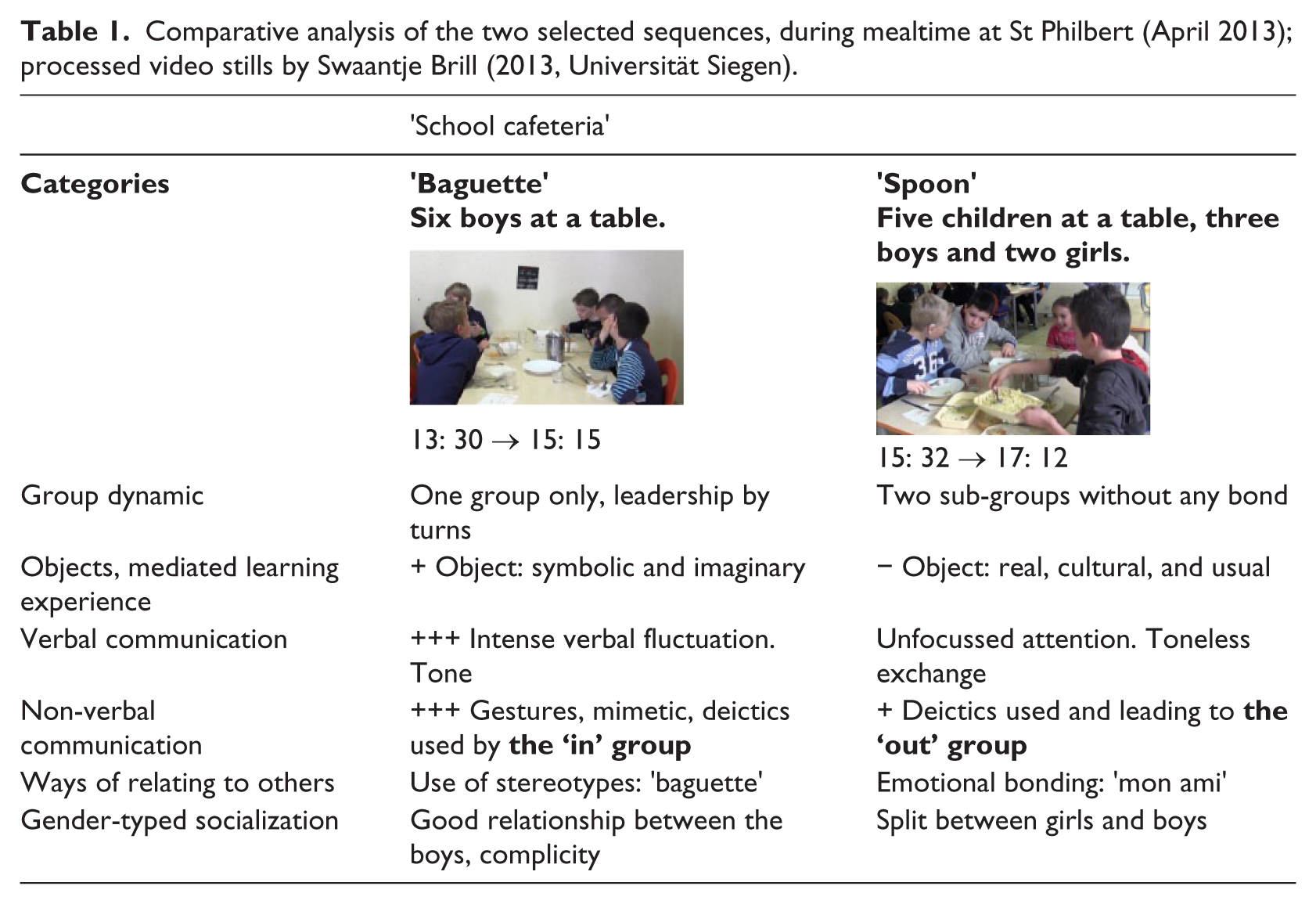
Due to the different constitutions of these two groups, a contrast between the speaking processes and interaction dynamics within them can be observed. This way of describing the two situations will assist with the coding of the material and enable standards to be established which can then be applied to the whole of the video data. In order to fine-tune this analysis, the interactive dynamics will be described in detail.
The first group of boys
The beginning of the sequence shows the six boys finishing their starters. They speak one after the other, which gives the impression that they are gradually constructing elements of a common story. The focus of the exchange then shifts to the three boys sitting at the corners of the table, while the other three boys listen attentively. This gives the impression that they are speaking freely and harmoniously, with a progressive intensification of ‘deictics’ when the topic centres on the experience of eating a ‘baguette’. A climax in the story can be observed at this point when the German boy produces multiple interconnected words and gestures relating to the ‘baguette’. The deictics shown here by the three boys are particularly suggestive. They listen to each other, repeating the word ‘baguette’, and the young German boy exclaims, ‘ah, ah ah!! ja ja ja!’, nodding his head to confirm correct interpretation by the other boy. They share eye contact to confirm mutual understanding. All this demonstrates that they are willing and happy to communicate and understand one another.
After this climax in the conversation, communication becomes more problematic. The French boy tries to ask the German boy a question, but he does not understand, and the French boy turns towards the researcher who is filming and shrugs his shoulders, looking disappointed (figure 1).
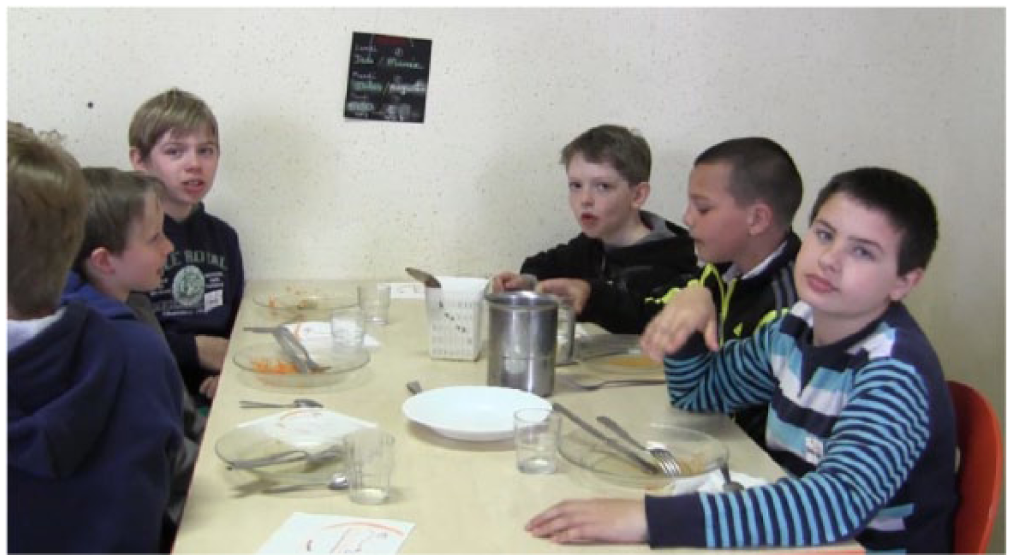
Processed video still by Swaantje Brill (2013, Universität Siegen).
The first group thus deals with issues of symbolic signs concerning a French cultural stereotype. The German boy uses a French word (‘baguette’), relating a mimetic gesture to a symbolic object; smiling and excited, he recounts how another German child discovered the taste of the ‘baguette’ as he was eating a big sandwich. The French boy strengthened this interaction by showing how long French bread can be. This role-playing between the three children, who shared mimetic gestures, expresses their desire to display their knowledge of French customs and reinforces linguistic understanding.
At this time, the boys at this table do not eat; instead they are involved in describing the experience of eating and they express object-oriented pleasure with laughter and complicity. This analysis highlights the complementarity of linguistic and non-verbal communication in this situation.
The second group of boys and girls
On the other hand, describing the dynamics of interaction within the second peer group deals with two channels of communication which are not connected: an implicit, bodily, and object-oriented communication; and the explicit goal of talking about a friendly relationship. However, what is observed must be more precisely described in order to understand what actually happens.
At first, the German boy is seen giving the French one some fish, and the French boy, sitting beside him, signals back to him that he should help himself, which he does. The other French boy, facing him, had already helped himself. This is the first level of implicit communication, based on ‘savoir vivre’, but there is also a second level, happening at the same time, whereby the three boys seem to be talking about their friends (figure 2) and show in turn where they are sitting at other tables. They try to identify their friends using gestures.
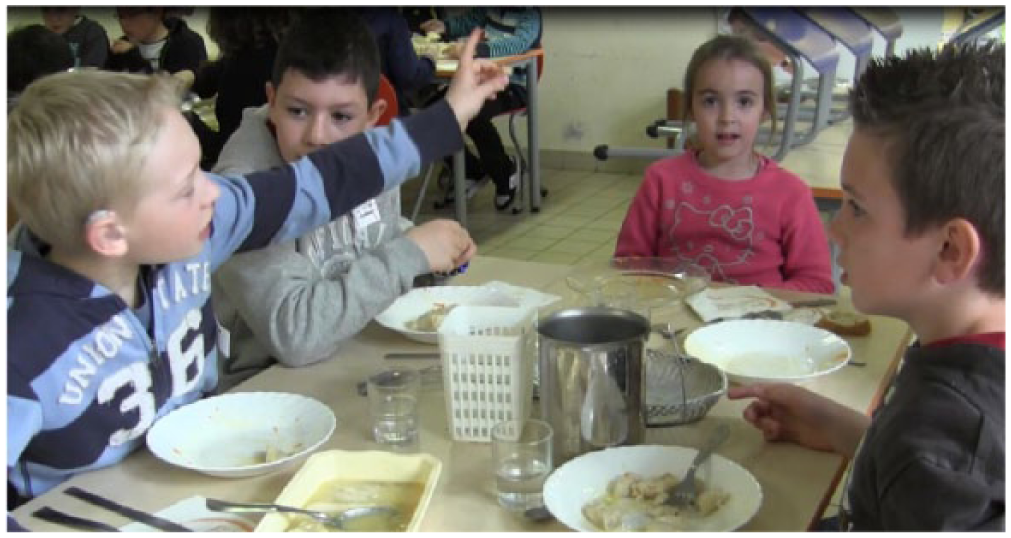
Processed video still by Swaantje Brill (2013, Universität Siegen).
The waitress then brings a dish of pasta and puts it down between the French boy and the German boy, and the French boy pointedly turns the handle of the spoon towards his German guest.
When the German boy does not help himself, the other French boy facing him gets up, takes the dish, and helps himself generously while the two other boys continue their conversation as they eat their fish. He then puts the pasta dish back on the other side on the table. The French boy again turns the spoon handle towards the German boy, who this time takes hold of the spoon and serves himself some pasta.
On the other hand, the girls who are sitting on the other side of the table talk amongst themselves while the boys keep the two dishes of food on their side without passing them over to the girls. This film sequence is focused on the boys, and the girls do not seem to interest the researcher who was filming. This awareness of the attitude of the researcher causes reflection on her motivation, and the choice of sequences derives from her choice.
In this sequence, bodily and non-verbal communication becomes increasingly important for understanding the different behaviours of the two French boys. One manages to deal with his guest very effectively by acting in a reciprocal way while the other thinks only of helping himself and eating. This discrepancy may occur because of the superposition of two different channels of communication, a linguistic one with a genuine topic and bodily gestures involving objects (spoons and dishes) which concerns another matter – how to behave in a polite manner toward a guest (figure 3).
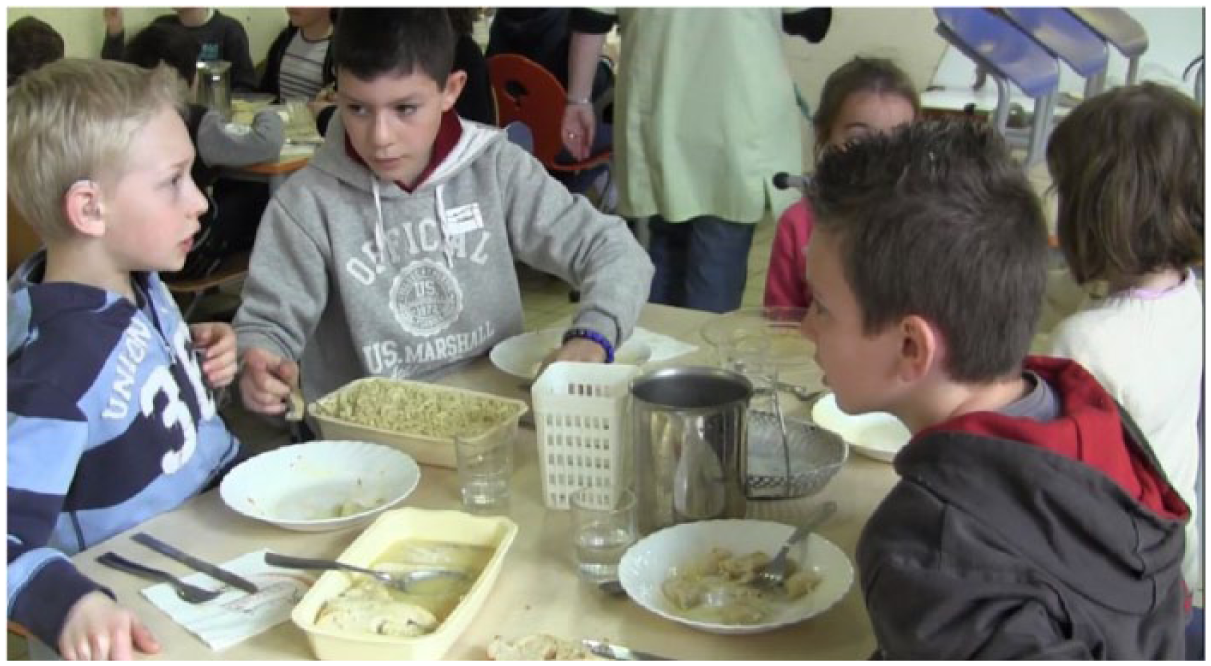
Processed video still by Swaantje Brill (2013, Universität Siegen).
Such description allows the construction of an open encoding of the material, which could contain several kinds of standards, such as:
dealing with objects (symbolic, usual, familiar, empirical, imaginary) as an opportunity to develop interactions;
non-verbal communication, bodily gestures, mimetic processes, and role-playing;
various linguistic channels (story-telling, deictics, facts from everyday life experience);
topics of discourse as core mediation within relationships and the focus of cross-cultural experience, including beginning, development, and climax of the linguistic interchange;
group dynamics, such as leadership, group affiliation, the feeling of belonging, exclusion, loneliness;
gender relationships, both positive and negative; and
value-related experience and affects: confusion and misunderstanding, good and stimulating understanding, pleasure, exciting relationships, expectation, disappointment, complicity, etc.
What are the actors telling us about these sequences?
The field study was concluded by conducting group interviews with the French pupils who had taken part in the Franco-German exchange programme. It is interesting to compare what was observed in the videos with the explicit points of view of the subjects, as this allows interpretations to be fine-tuned, confirming or invalidating certain aspects of them.
From a methodological perspective, it should be noted that the sequences filmed at the cafeteria date from 2013. The pupils were then in the last year of primary school (CM2), and contact had to be re-established with them now that they had moved to another school. Due to practical constraints, only two of the children were able to be interviewed – the second one on the right in the ‘baguette’ sequence (Boy A) and the first on the right in the ‘spoon’ sequence (Boy B).
The interviews were thus conducted one year after the original filming. A stimulated recall technique 2 was employed which combines input from Yves Clot (Clot et al., 2000) about the method of ‘crossed autoconfrontation’ with the group interview technique. To determine the meanings which the subjects gave to these situations one year later, the videos were played for them in order to trigger their memories of the interactions, and ask about the interpersonal dynamics at the time (Filliettaz and Bronckardt, 2008). This stimulated recall serves a double purpose:
1) to document the background of the cultural context of the interactions, both verbal and non-verbal; and
2) to encourage a focus on the episode in order to improve the recollection of the experiences.
The interviews thus began with viewing the two sequences at the cafeteria. Each pupil was then asked a series of questions in order to understand what they had felt, thought, and experienced during that lunch.
At first, the two boys seemed to find it difficult to remember what had happened because of the time that had elapsed between the original exchange and the interview. Therefore, this stimulated recall technique was indispensable in helping them to remember their past impressions. It also seemed that these 12-year-old children had difficulty giving precise expression to their feelings, and analysing what had happened and how they had experienced it; the video thus provided support by guiding them progressively towards different moments within the exchange and reactivating memories other than those strictly linked to the selected sequences. The connections that they were able to make between the situations, the context, and the actions involved, as well as between their impressions and their practice, were rich in meaning and can enhance understanding of informal communication in a cross-cultural context.
The contents of this group interview should be further described. First, the children expressed satisfaction at seeing images that brought back good memories. It is important to note that the children had freely chosen where to sit in the cafeteria, and that they had specifically chosen to sit with the German student rather than stay with their French classmates. This is a key element in a study centred on the informal dimension of learning (Groux and Ailincai, 2012).
With respect to the ‘baguette’ sequence, the boy pointed out the gestures made by his German friend sitting on the right, which were intended to make him understand that the German boy facing him liked bread and ate a lot of it. The boy also mentioned that the teacher had introduced them to the German language and that he knew a few words. The German boy had also been taught some French, which enabled them to communicate verbally. In addition to this, the boy stressed that they had tried throughout the exchange to teach one another new words. The French boy who was interviewed insisted that the atmosphere at the table was relaxed and fun.
The sequence was filmed when the French boys and the German one were sharing a series of jokes, once again mainly through the use of gestures. Reference to this sign language and its symbolic meaning appeared several times in the boys’ feedback and seems to have strongly supported communication. The boy explained to us that he was not very popular with his French classmates but that he had immediately felt at ease with his German counterpart. This highlights the fact that misunderstanding or ignorance of language does not necessarily hinder interaction or informal learning. Moreover, the boy explained that the exchange about the ‘baguette’ was initiated by the question he addressed in French to the German boy sitting against the wall to the left of the table: ‘Est-ce que tu aimes la brioche?’ 3 . The German boy, sitting to his right, then immediately made the connection with bread.
Last, when asked about the look he gave the researcher filming him, the boy responded that he had not been bothered by being filmed and that he saw this as an opportunity to reinforce his recollections of the exchange.
Regarding the ‘spoon’ sequence, the boy introduced the people sitting at the table, two French boys and a German one sitting top left. The girls, he explained, were not part of the exchange programme; they were French and belonged to a lower level class. He specifically mentioned the friendship between the German boy and the French boy opposite him, which explains their polite gestures (the German boy serving the French boy, with the latter turning the spoon handle towards the former). He then returned to the topic at the beginning of their discussion, when he had asked who the German boy’s friends were. He explained that he asked this question first in French but that the German boy did not understand, and then explained that his classmate pointed to them both, saying, ‘nous copains’. Then, he said the name of another German boy, followed by ‘copain!’, pointing at the German boy at the table. This enabled the German boy to confirm that he now understood.
The two interviewees explained that, in general, to make their German counterparts understand something, they first tried using other words in French, then sign language, and sometimes asked for help from an adult who spoke both languages.
Going back to the encounters at the table, the pupil then talked about the second topic of conversation: returning to the host family after school. He explained how he simplified his language, so that the German boy could better understand: ‘Si on dit des mots clés, ils comprennent mieux, je pense, que si on dit toute la phrase’ 4 . He used this technique several times during the exchange.
Both the interviewees recounted different types of behaviour of the two nationalities in the cafeteria. They explained that the Germans were not accustomed to eating in a cafeteria nor to being served with such dishes, and they were thus reluctant to serve themselves when food was brought to the table, even though the French pupils wanted to let them serve themselves first, ‘par respect’, as one pupil said.
Discussion
Theoretical background and methodological proceedings
The primary notion which structures this project is the study of the interactive dynamics between the children in the videos. In the experience of cross-cultural encounters, interaction seems to be the principal factor affecting relationships and the means by which children discover the aims, representations and values influencing these relationships. Interaction is thus not a result but a process; it depends on the environment, on the meaning the participants invest in the situation, and on their feeling of security (Winnicott, 1975) in spite of the necessity to contend with an unknown language and different types of behaviour and social norms.
This core conception of interaction, both verbal and non-verbal, embraces an anthropological point of view (Goffman, 1974, 1991) in tandem with a social-psychological theory (Marc and Picard, 1989; Montandon, 2011), which gives an important place to communication via the pragmatic use of language (Filliettaz and Bronckardt, 2008). Such a conception of interaction is inevitably linked with the signalization of the actions, gestures, and objects manipulated during the interaction. Refusing an objectivistic conception of interaction as a sequential exchange of information, we can envisage it as a progressive co-construction of an intersubjective reality, thus giving access to the meaning of the experience (Lemonie and Montandon, 2014). This dynamic approach leads us to question the emotional nature of the interactions. Colin and Müller (1996) emphasize the concept of the ‘added value of outfocussing’ (71) which is triggered by the fact of discovering an environment different from the traditional classroom. Such distancing may lead an individual to redefine the situation (Thomas, 1923) which he has created from his own representations, and this situation becomes a prerequisite for action.
Interaction can be experienced as disruption, which disturbs an individual’s habit (habitus), or it can be felt as a desire to come into contact with another person and build new bonds. This paradoxical experience is specific to cross-cultural encounters where the emotional dimension has to be taken into account; feelings can range from surprise to repulsion, from admiration and enthusiasm to reprobation, a sense of insecurity, discomfort, or even to competitive behaviour or rivalry.
These interaction-related situations, both formal and informal (Rogoff et al., 2001) are a great source of diversified learning experiences. Within the framework of ‘learning by experience’ theories (e.g. ‘transformative learning’ (Mezirow, 2001)) born of the American trend towards pragmatism (Dewey, 1997), Cross (2006) refers to a mixed spectrum of learning processes where formal and informal learning are ranges along a continuum of learnings. Children develop their knowledge of things at the same time as they experiment with and evaluate the world they live in (Dörpinghaus and Nießeler, 2012).
One way of facilitating interactions between children is by enlisting the help of objects. An object or ‘thing’ becomes a go-between or a transitional object, as defined by Kaës et al. (1979), both given and created, and partaking of both inner reality, as an imaginary object, and outer reality, as a material one. This object generates bonding and becomes decisive in the way it develops relationships within the group. Resorting to such transitional objects and settings, as defined by Winnicott (1975), is important to guaranteeing the continuity of bonds where intercultural encounters engender a readjustment of context.
This theoretical frame, involving things as mediated by formal and informal learning, provides the second criterion for selecting sequences. An object-oriented approach is an opportunity to develop cooperative learning strategies and practical participative education, which facilitates cultural diversity and multiple values. This approach enables access to other conceptions of the world. In object-oriented education, children acquire knowledge about things in an intuitive, silent manner by considering them as elements of their daily lives, viewed from different angles.
These two core concepts, interaction and object, are the theoretical framework for selecting the video sequences to analyse. The choice depended of the quantity and quality of the interactions. The quantitative aspect deals not only with the number of interactions but also with the number of actors involved in the interaction, so that almost all the members of the group take part in the communication. From a qualitative point of view, the nature of interactions concerned several different aspects: the different levels of communication (verbal, non-verbal, gestures, sign language); the contents of the discourse; the way the speakers engaged in the conversation; and finally, the psychological, social, and emotional outcomes of these interactions (pleasure, disappointment, excitement, boredom, etc.). Dynamic organization generates a transformative experience which gradually changes ways of thinking and acting, and which provides other ways of behaving and seeing the world. This method of linking interaction with all these categories can be related to the procedures and techniques of grounded theory (Glaser and Strauss, 1967), which has been adopted for the purposes of this study.
Categories such as interaction, object, level of communication, and group dynamics have allowed the introduction of an initial rough coding into the empirical data. When the two sequences were compared, new categories emerged from the tension between them, including gender relationships and various connections with things (real, symbolic, imaginary, clearly indicated, or implicitly understood). Such a methodological apparatus explains how a case study can be built from contrasting situations, and how signs which are not perceived at once show that each situation is a construct 5 by describing and coding its elements.
Steps in the video analysis
This section discusses the four primary choices made by the researchers in developing the video analysis.
Choice of investigative field
The constraints of space and time imposed on the collection of data by the schools involved in the exchange programmes can be ignored; more important are the decisions about when and where filming should occur. It was agreed to film informal activities at mealtimes, on the school playground, and during walking tours, although also occasionally filming was done during lessons.
What the German researcher, Swaantje Brill, chose to film in St Philbert
She filmed what she considered ‘typical’ interactions between the children and cross-cultural communications between French and German participants. She did not waste time filming a table of girls when nothing significant was happening but spontaneously identified significant moments and scenarios (deictics, emotional expressions, laughing, expressions of disappointment) to show that something was taking place. Such situations seemed relevant to this project. The question remained, however, of what was happening in the children’s minds when nothing appeared to be happening externally. That is a limitation of the medium of the video and the reason why the material was supplemented with a group interview with the children. This study also wanted to further its investigation by interviewing the researchers themselves, to discover how they decided whether to continue filming or to stop in a given situation.
The choice of paradigmatic situations was dependent on the corpus of film available
What is a paradigmatic situation? How did the researchers construct the selected sequences?
The focus of this was on two video sequences at mealtime in a French school during the Franco-German exchange programme. One of these sequences attracted attention because of the strongly marked behaviour of some children when conversing with each other, but while this emphasized some positive aspects of intercultural relationship, the question arises whether it is also worth noting difficulties in communication in another peer group at the same time and place.
What are the characteristics of the selected sequences? First, they were chosen according to their length: each sequence needed to be long enough to show the development of the dynamics of interaction. The first sequence lasted 1 minute, 45 seconds, and the second lasted 1 minute, 40 seconds. These two sequences were compared intuitively without knowing beforehand that they both were of similar duration.
Swaantje Brill, in recording the video, followed what happened at four tables for four minutes. She concentrated on the first and last tables, as though uninterested in the activity at the other tables, and indeed devoted additional time to her two chosen tables, one with six boys and the other with three boys and two girls. Therefore, these sequences can be considered as a whole, insofar as she stopped filming one table when she felt there would be not anything new and moved to the other, as if each episode in the story was coming to an end.
Another characteristic of this type of narrative is the topic itself, which is often the focus of interactions. In the first instance, the story is structured around the ‘baguette’, a symbolic, cultural object, and in the second instance, the topic of social conventions about helping oneself to food is mediated by the use of the spoon as a material but also a cultural, common object.
These objects provide a focus for this study’s investigation because they suit its theoretical framework and facilitate the interactions between the children, promoting gestures and communication. Many deictics were also observed, with the children involved in excited story-telling or friendly speaking and communication.
The group environment is also very important: a desire to communicate can be observed, and the relational network seems to be rich and complex enough to show how a group is being constituted in a cross-cultural situation. Gender relationships, heterogeneity, and diversified attitudes are ingredients in this complexity. These are some of the reasons why the two situations can be compared. Comparison helps to isolate different aspects of the development of the interaction, providing critical distance and space for reflection. These new elements were not noticed at the outset.
The criteria which create a paradigmatic situation combine length, topic, interaction, and development, and indicate group constitution and the complexity of relationships. These characteristics constitute something like ‘freezing’, as Kurt Lewin (1951, 1972) called the peculiar process of a new pattern occurring in group dynamics. This approach underscores the sameness of the two selected sequences as well as the significant features which justify interest in them.
In the two sequences, eating could be considered either as a cultural topic involving stereotypical discourse or an activity related to table manners and social conventions. However, the analysis ought not focus on one, single element but use the categories and the connections between them in a whole system. This systemic framework allows consideration of the researchers as part of the situation or as elements of the system 6 .
A very important detail is the way in which the boys look at the filmmaker: in the first sequence, one French boy often looked at the researcher when he could not understand or when he felt the German boy did not understand him. What does this attitude imply? It might be variously interpreted as including the researcher, a cry for help, or as asking the researcher to witness the misunderstanding.
Now, it must demonstrated which part of this case study is a construct of the research itself and what may be of lasting value for the actors; thus, how the researcher is perceived by others can be identified, whether as a witness, a disrupting actor, or a member of the group, and how the researcher impacts the events as they unfold.
Such paradigmatic situations engender typical and experience-related moments which can be identified as ‘freezing’ principles and organizing formats that provide models for the dynamics of interactions in cross-cultural encounters.
Interpretative
Choice of a case study (Montandon 2013) in group interviews. As previously stated, the project was completed by conducting group interviews with two French pupils on the exchange programme. The purpose was to harmonize the points of view of the actors, their subjective experiences, with the ‘objective’ data. Such a ‘comprehensive’ method is intended to confront what the researchers consider relevant to what they, as children, have experienced, and to the meanings they gave to those experiences.
This phase of data collection is a vital complement to the video data and to the first interpretations that the researcher can make. The interviews provide explanations relating to the sequences and to the participants’ feelings, impressions, and experiences in terms of group dynamics and context.
The assumption can then be made that the environment and setting of the exchange, and even the learning context, played a prominent part in promoting the interactions and ways of communicating. Games and play seem to encourage this propitious atmosphere. The interviews also provided guidance to the researchers when viewing the videos. The gestures and linguistic simplifications can be classed as a creolizing that means speaking French like Creole people of language, are keys to informal communication, and appear to be effective for the children, based on the fact that they are used repeatedly.
The interview data also highlight the connections between theory and methodology. In matters relating to facts, without the stimulated recall, the interviews with the children would have been very difficult, especially because a whole year had elapsed since the original exchanges. The researchers therefore had to adapt their questions to the interviewees so that they agreed to a stimulated recall. In such a setting, the researcher precisely followed the actors to let them speak.
After the feedback from the children and some more recent experience with a new exchange, the study began to question what the precise place of the researchers was in the investigation. The researchers were considered to be participative witnesses, neither full members of the group nor outsiders. Without being so naïve as to imagine that the researchers’ presence is hidden, it is believe that the researchers were accepted by the actors, and their furtive glances suggest that they were checking whether they were being listened to and observed. It seems possible in the video to observe when the children were distracted by the researcher.
To return to the meaning of the paradigmatic situations, to what extent do they mean something to the researchers and actors? The interview data allow this question to be answered in two ways. First, it could be said that these situations had meaning only for the researcher, since the pupils did not at first know what was going to transpire. Subsequently, the children were able to link these video sequences to their personal experiences of the exchange, and this is considered legitimate for their own experience as well as relevant to the research at hand.
Conclusion
This paper demonstrates the complexity of the relationship between researchers and their field of investigation in terms of conceiving the research as well as collecting and analysing the data. This study tried to find a balance by questioning both the researchers and the participants about the outcomes of the recorded interactions. Video data provide a common and indispensable foundation for the whole research community as well as the opportunity to deal with multiple levels of remembering, which is a type of experienced capital which can be used to elaborate the meanings that each actor gives to a given situation. One characteristic of this paradigmatic situation analysis as a case study (Wernet, 2006) is that the method focuses on subjects and context, and emphasizes differences between and similarities within codes and categories. Such coding deals with manifest, as well as latent, content in a paradigmatic situation.
Another aspect of interpretation is that any situation always involves multiple meanings, and the researcher’s interpretation is influenced by his or her personal history, academic training, and cultural background. This again underlines the complexity of a binational project and was something which generated much discussion between the French and German research teams; the two video sequences were the responsibility of a German researcher, the group interview was conducted and analysed by a French researcher, and the comparative analysis of the selected videos was led by a second French researcher. To make this whole procedure intelligible and consistent, this project had to be cognizant of many factors, including the methodological apparatus, the use of different languages (French, German, and English), and the combination of these elements.
This study has sought to overcome the differences arising from the researchers different scientific backgrounds and to combine these views in order to develop collaborative research methods.
Footnotes
Funding
This research received no specific grant from any funding agency in the public, commercial, or not-for-profit sectors.