



Abstract
Many teachers enter classrooms with limited cross-cultural awareness and low levels of confidence to accommodate cultural diversity. Therefore, teaching a heterogeneous body of students requires teachers to have culturally responsive teaching self-efficacy (CRTSE). The investigation of factors impacting teachers’ self-efficacy in teaching diverse students has produced mixed results. The purpose of the current study was to explore the determinants of CRTSE in a sample of Canadian preservice teachers. One hundred and ten preservice teachers from a medium-sized public Canadian University completed measures of political orientation, CRTSE, cross-cultural experiences, and teacher burnout. Higher levels of preservice teachers’ CRTSE were predicted by lower levels of Emotional Exhaustion (i.e., a key aspect of burnout syndrome) and more frequent cross-cultural experiences in their childhood and adolescence. Implications for training preservice teachers are discussed.
Keywords
Immigration has an important role in shaping the identity and demographic patterns of Canada (Gushulak et al., 2011). Immigration trends in different parts of Canada continue to increase the diversity of students in classrooms. Despite such growth in the heterogeneity of students, the composition of the educator workforce remains dominated by White teachers (Cooc & Yang, 2016; Ryan et al., 2009). The discrepancy between student culture and school culture can impede students’ learning opportunities, and therefore, diminish their achievements (Gay, 2010). Creating an inclusive learning environment in which students experience a sense of security and belonging requires educators recognize issues of diversity and be prepared to work with a heterogeneous body of students. Teachers who begin their career while not having adequate diversity awareness demonstrate low levels of confidence in dealing with the cultural heterogeneity of their classrooms (Palazzolo, 2015). The lack of confidence of teachers may enhance their anxiety levels and negatively impact their views of themselves as capable individuals (Bandura, 1997). Therefore, culturally responsive teaching self-efficacy (CRTSE) can serve as a core aspect of teachers’ attributes. Siwatu (2007) views CRTSE as judgments that teachers hold about their capabilities in executing practices associated with culturally responsive teaching. The pluralistic nature of the Canadian society necessitates the need for better understanding CRTSE of preservice teachers—individuals under training in teacher preparation programs—in order to help them become culturally responsive educators through effective training.
Culturally Responsive Teaching Self-Efficacy
Bandura’s (1997) social cognitive theory (SCT) is central to understanding the concept of CRTSE. According to Bandura (1997), cognitive factors play an important role in regulating one’s behavior. Bandura (1997) suggests that behavior can be influenced by outcome expectations and self-efficacy which are two types of expectancy beliefs. Outcome expectations are what individuals perceive to possibly take place as a result of their actions; however, self-efficacy beliefs or expectations enable individuals to exercise control over their actions (Schwarzer et al., 1999). Both outcome expectations and self-efficacy can be influential factors on motivation. However, the latter is “a stronger predictor of an individual’s behaviour” (Siwatu, 2011, p. 361). Self-efficacy beliefs can be defined as one’s judgments of personal capability in performing a specific course of action successfully (Bandura, 1997). SCT postulates that, in the face of adversity, self-efficacious individuals are more likely to demonstrate high levels of effort and persistence in accomplishing a particular task. Several researchers, such as Tschannen-Moran and Hoy (2001), have applied the concept of self-efficacy to teachers and attempted to measure the construct of teacher self-efficacy. Teacher self-efficacy can be defined as “a teacher’s individual beliefs in their capabilities to perform specific teaching tasks at a specified level of quality in a specified situation” (Dellinger et al., 2008, p. 752). Effective teaching in multicultural settings requires teachers to hold similar convictions about their capabilities and be culturally responsive. Gay (2010) views culturally responsive teaching as “using the cultural knowledge, prior experiences, frames of reference, and performance styles of ethnically diverse students to make learning encounters more relevant to and effective for them” (p. 31). Despite the call for the preparation of culturally responsive educators (Gay, 2010; Villegas & Lucas, 2002), many pre- and in-service teachers often do not consider themselves prepared enough to teach culturally diverse students (Landorf et al., 2007; Moloney & Saltmarsh, 2016; Premier & Miller, 2010; Tucker et al., 2005).
Importance of Culturally Responsive Teaching Self-Efficacy
Ample evidence points to the associations between teachers’ self-efficacy and their teaching behavior (Tschannen-Moran & Hoy, 2001). Several researchers have also found a positive link between teachers’ self-efficacy and students’ academic achievement (Shahzad & Naureen, 2017), though, others have suggested that there is only a modest relationship between teacher self-efficacy and student outcomes (Klassen et al., 2011). In addition, researchers have noted that cultural mismatch and biased expectations can lead to failure of students from various ethnic groups (Voltz, 1998). Therefore, to provide an empowering learning environment for all students, it is important to identify, challenge, and rebuild teachers’ low expectations, stereotypical beliefs, biases, and cultural misunderstandings (Pohan & Aguilar, 2001). In terms of implementing effective teaching practices in multicultural classrooms, the assessment of teachers’ CRTSE gains a greater importance as opposed to the assessment of their teacher self-efficacy in general. This is mainly because self-efficacy is context specific (Bandura, 1997). From this perspective, teachers’ self-efficacy beliefs may vary from one situation to another. When teaching a specific subject or when working with a particular student, teachers may consider themselves self-efficacious individuals; however, the same teachers may not find themselves as self-efficacious in other settings (Tschannen-Moran et al., 1998). Therefore, when it comes to instructing multicultural classrooms, it is important to take into account teachers’ culturally responsive teaching self-efficacy rather than their teaching self-efficacy in general.
Factors Contributing to Culturally Responsive Teaching Self-Efficacy
Teaching in multicultural classrooms places challenges on teachers (McAllister & Irvine, 2000; van Tartwijk et al., 2009). In a study conducted among novice teachers, those who worked in highly heterogeneous schools had lower levels of job satisfaction, encountered greater difficulty in forming relationships with their students, and perceived their working environment as more complex and struggling compared to their counterparts teaching in less diverse settings (Freeman et al., 1999). Such outcomes may partially be explained by the fact that many teachers do not feel prepared to teach students from various ethnic backgrounds (Tucker et al., 2005). Therefore, there is justification for investigating the factors that may be associated with teachers’ CRTSE. From this perspective, the potential impact of age (Ghanizadeh & Moafian, 2011; Shaukat & Iqbal, 2012), gender (Gürbüztürk & Şad, 2009; Sak, 2015), ethnicity (Sleeter, 2001), political orientation (Hachfeld et al., 2015; Nadelson et al., 2012), and cross-cultural experiences (Kolano et al., 2014), on teachers’ CRTSE levels should be investigated.
Age
Several studies have investigated teachers’ self-efficacy beliefs as a function of their age; however, the results of such studies are inconclusive. For example, Shaukat and Iqbal (2012) found that, compared to their older counterparts, younger teachers scored higher on classroom management and student engagement, two dimensions of the Teachers’ Sense of Efficacy Scale (Tschannen-Moran & Hoy, 2001). However, younger and older teachers did not significantly differ in their instructional strategy (Shaukat & Iqbal, 2012). Other scholars have reported a positive link between teachers’ self-efficacy and age, suggesting that teachers’ self-efficacy beliefs increase as their age increases (Ghanizadeh & Moafian, 2011). Despite this, age differences in teachers’ self-efficacy beliefs have not been confirmed in several other studies (Pendergast et al., 2011; Tschannen-Moran & Hoy, 2007). Therefore, the investigation of the impact of age on teachers’ self-efficacy beliefs has yielded inconclusive outcomes.
Gender
The literature indicates mixed findings with respect to gender differences in teachers’ self-efficacy beliefs. For example, Gürbüztürk and Şad (2009) found that, compared to their male counterparts, female preservice teachers had higher levels of self-efficacy beliefs. The result of this study was consistent with that of Cheung (2006) reporting higher levels of self-efficacy beliefs among female school teachers than among males. However, Klassen and Chiu (2010) found that female teachers had lower levels of classroom management self-efficacy than their male colleagues. In a similar vein, higher levels of self-efficacy beliefs were found among males than among female preservice teachers (Sak, 2015). Despite this, several other scholars’ examination of gender differences in teachers’ self-efficacy beliefs yielded insignificant results (Aziz & Quraishi, 2017; Yavuz, 2010). Therefore, research findings on gender differences are inconclusive.
Ethnicity
Sleeter (2001) conducted a review of the literature on preparing preservice teachers for instructing in heterogenous school settings. According to Sleeter (2001), compared to many White preservice teachers, prospective teachers of color “tend to bring richer experiences and perspectives to multicultural teaching” (p. 94). Many White preservice teachers tend to enter classrooms with limited knowledge and experience of other cultures and tend to adopt a color-blind approach (e.g., ignoring ethnic and cultural differences in classrooms) to deal with cultural diversity (Sleeter, 2001). Those who ascribe to colorblindness may view equal treatment of all students regardless of their backgrounds as a way to promote equality in their classrooms (Stoll, 2014). However, evidence has demonstrated that colorblindness was inversely associated with novice teachers’ desire to adapt their teaching practices to meet the needs of diverse students (Hachfeld et al., 2015). Other scholars have also reported that teachers’ ethnic background may impact their teaching abilities. For example, Pang and Sablan (1998) suggested that White pre- and in-service teachers were uncertain about their capabilities to effectively teach and meet the needs of African American students. Gorski et al. (2012) found that, in comparison with White and other race participants, African-American teachers had lower levels of efficacy to teach multicultural teacher education courses. In contrast, Nadelson et al. (2012) have found no association between multicultural efficacy (i.e., having confidence in serving students in multicultural contexts effectively; Guyton & Wesche, 2005) and ethnicity. From these findings, it can be deduced that teachers’ ethnic backgrounds may impact their self-efficacy to teach in heterogeneous environments; however, the results of different studies are mixed. Hence, the examination of ethnicity as an influential variable on teachers’ CRTSE is warranted.
Political orientation
Teachers’ political worldview may impact their approach to cultural diversity. Teachers who hold conservative attitudes tend to believe that minority students can benefit from assimilation into the mainstream culture (Jenks et al., 2001). On the other hand, a liberal approach tends to be aligned with embracing diversity and cultural pluralism (Jenks et al., 2001) and multicultural attitudes (Nadelson et al., 2012). For instance, researchers found that teachers who hold assimilationist beliefs reported lower self-efficacy beliefs with respect to their immigrant students (Tatar et al., 2011). It is noteworthy, though, that Tatar et al. (2011) conducted their study in Israel among immigrant teachers. As such, the outcome of this study might not be generalized in the Canadian context, where White teachers are the dominant educators (Ryan et al., 2009). Therefore, replication of this study is needed in Canada to verify the consistency of the results. The potential link between political inclination and perceived teaching efficacy in multicultural settings should be considered.
Cross-cultural experiences
According to Johnson (2002), in recruiting prospective educators, their prior intercultural interactions should be taken into account, as such experiences have been found to impact racial awareness of White teachers. Researchers have suggested that preservice teachers’ experiences with diversity (e.g., having immigrant friends and traveling) can greatly influence their approach to multicultural education (Garmon, 2005), “a process entailing an inclusive, multidisciplinary approach to teaching that takes into account personal, cultural, and academic influences in which students live” (Nadelson et al., 2012, p. 1186). Kolano et al. (2014) reported that teachers who were familiar with their students’ “individual needs, customs, and cultures” tended to feel effective and confident in working with English language learners. Although the result of their study pointed to the impact of teachers’ intercultural experiences on their feelings of effectiveness, the sample was limited to teachers who taught English language learners. In real educational settings, however, not all ethnically diverse students have limited English proficiency nor do all the teachers only serve such students. This suggests that teachers’ feelings of effectiveness may change when they have immigrant students with adequate English knowledge and students from their own cultural backgrounds in the classrooms. Moreover, the majority of the teachers in this study had diversity training, experiences of traveling abroad, and knowledge of a foreign language. However, not all teachers possess such qualities. Consequently, the relationship between teachers’ CRTSE and their cross-cultural experiences should be examined in a more diverse sample.
Culturally Responsive Teaching Self-Efficacy and Teacher Burnout
Due to the demanding nature of the teaching profession, many teachers experience high levels of work-related stress (Botwinik, 2007; Kipps-Vaughan, 2013), which, in turn, may bring about burnout syndrome (Bermejo-Toro et al., 2016). Burnout can be defined “as a chronic state of exhaustion” derived from long-time dealing with stressful circumstances, particularly among human services industry (Schwarzer & Hallum, 2008, p. 154). Such experiences may bring about deleterious consequences. For example, a strong association exists between the novice teachers’ desires to leave the teaching profession and their levels of burnout (Goddard & Goddard, 2006). This leaving behavior may partially be explained by the fact that teachers with high levels of stress experience low job satisfaction (Gandhi, 2017; Watson et al., 2010). However, self-efficacy beliefs seem to act as a buffer to feelings of job burnout (Aloe et al., 2014). Researchers have found that teacher self-efficacy beliefs and burnout are inversely related (Friedman, 2003; Høigaard et al., 2012; Skaalvik & Skaalvik, 2010). The struggles of teaching in multicultural classrooms can lead teachers to experience diversity-related burnout (Tatar & Horenczyk, 2003). Several studies examined how teachers’ cultural receptivity (Swearingen, 2009) and multicultural sensitivity (Joseph, 2010) are related to their burnout. However, there seems to be less attention paid to the association between CRTSE and teachers’ burnout. For this reason, making inquiries into such a relationship is crucial when it comes to working with heterogeneous student populations.
Current Study
The preceding review of the literature indicated limited studies and inconsistent results in terms of the predictors of teachers’ sense of self-efficacy in teaching diverse students. For instance, in some studies (e.g., Gorski et al., 2012; Pang & Sablan, 1998), teachers’ ethnicity was found to be a significant determinant of their confidence in teaching diverse students, whereas in the others (e.g., Nadelson et al., 2012), their ethnicity had no influence on their multicultural efficacy. In a similar vein, research findings with regards to potential impact of age (Shaukat & Iqbal, 2012; Tschannen-Moran & Hoy, 2007) and gender (Aziz & Quraishi, 2017; Cheung, 2006) on teachers’ self-efficacy beliefs are inconclusive. A gap exists in the literature examining how teachers’ political worldviews and cross-cultural experiences affect their CRTSE in the Canadian context. Finally, even though the notion of diversity-related burnout has been identified, the literature has not clearly specified whether teachers’ CRTSE serves a protective role in the stressful teaching conditions of the multicultural classrooms. The purpose of the current study is to add to the existing literature by measuring Canadian preservice teachers’ CRTSE levels as a function of their academic program year and investigating the role of burnout in predicting preservice teachers’ CRTSE in teaching in multicultural classrooms.
Research questions and hypotheses
The current study addressed two research questions. The first research question was “Do preservice teachers enrolled in different years of their teacher education program vary in their CRTSE levels?” It was hypothesized that as preservice teachers took more multicultural courses and received more training, their levels of CRTSE would increase. Therefore, senior preservice teachers (i.e., those in fourth and fifth academic years) were expected to possess higher levels of CRTSE than their junior counterparts. The second research question asked, “Do cross-cultural experiences, political worldviews, and burnout predict preservice teachers’ CRTSE levels after accounting for the impact of demographic variables (e.g., age, gender, and ethnicity)?” It was hypothesized that preservice teachers’ cross-cultural experiences, political worldviews, and burnout would remain significant predictors of their CRTSE over and above the variance accounted for by demographic variables. Preservice teachers who had higher levels of cross-cultural experiences were expected to have higher CRTSE. Preservice teachers with lower levels of burnout were expected to possess higher levels of CRTSE. Moreover, participants’ political orientations would affect their CRTSE such that compared to conservatives, liberals were expected to demonstrate higher levels of CRTSE.
Methods
Participants and Procedure
A convenience sample of undergraduate Canadian preservice teachers enrolled in the Faculty of Education at a Canadian University were recruited for this study. The university was a medium-sized public university located in an urban setting. One hundred and ten preservice teachers participated in this study. The mean age of participants was 26.19 (SD = 8.44). The majority of participants (i.e., 90%) were of White European descent, and 79% were female. Ninety-two percent of participants had English as their primary spoken language. Participants in different years of their teacher education programs (i.e., First through the fifth year) participated in this study; however, 64% were senior students. Participants were enrolled in elementary, secondary, and arts education. However, the majority were in the elementary stream (63.6%). In exchange for their participation, participants were entered in a draw for two $50 Amazon gift cards.
Following ethical approval, the researchers recruited participants from undergraduate teacher education classes. We searched the university system for the classes offered to preservice teachers by the Faculty of Education. We contacted instructors teaching at various academic levels (e.g., first through fourth year) and sought their permission to advertise the study in their classes. We advertised the study in core classes common to all undergraduates, such as Pedagogy: Theory and Practice, Assessment and Evaluation, and Working with Difference and Diversity. We also advertised the study in a few specialized courses, such as Teaching English as a Second Language. Some participants completed the surveys online using Qualtrics software (Qualtrics, Provo, UT). To maximize recruitment efforts, the researchers gained permission from some instructors to conduct the study in their classrooms. The researchers asked those who were interested to participate in this study to provide their responses on the paper version of the same measures; there were no statistically significant differences between the results of the online and paper-based versions. Those who completed the surveys online, provided their email addresses on a sign-up sheet that was circulated in class. The researchers then emailed them a link to all survey material. Other participants provided their responses on a paper and pencil version of the surveys after they were reassured about the confidentiality of their participation and their right to withdraw from the study at any time.
Measures
Culturally Responsive Teaching Self-Efficacy Scale (CRTSE)
The CRTSE is a 40-item Likert-type scale designed to investigate how efficacious preservice teachers are in executing particular teaching practices that are implemented by culturally competent teachers (Siwatu, 2007). Participants rated their confidence in their capabilities to operate such teaching practices (e.g., “I am able to identify the diverse needs of my students”) on a continuum from 0 (no confidence at all) to 100 (completely confident). An average total score was calculated. A higher score on the CRTSE scale represented higher perceived self-efficacy. Previous studies using this scale have reported an internal reliability of 0.96 (Siwatu, 2007). In the current study, the internal reliability was α = 0.93.
International Personality Item Pool Liberalism Scale (IPIP-LS)
The IPIP Liberalism Scale is a 10-item questionnaire that assesses participants’ liberal versus conservative political worldviews (Goldberg, 1999). On a 5-point Likert-type scale ranging from 1 (strongly disagree) to 5 (strongly agree), the participants responded to different political statements (e.g., “believe laws should be strictly enforced”). Higher scores are reflective of greater liberalism (see https://ipip.ori.org/newNEOKey.htm#Liberalism for a listing of the items). Using Cronbach’s alpha, Hirsh et al. (2010) reported an internal reliability of α = 0.86. In the current study, the internal reliability was α = 0.78.
Multicultural Efficacy Scale (MES)
The MES is a 35-item Likert-type scale that consists of three subscales measuring multicultural efficacy, cross-cultural experiences, and attitudes toward teaching in multicultural settings (Guyton & Wesche, 2005). In the current study, the Experience with Diversity subscale of the MES was utilized. This subscale is a 7-item Likert-type subscale that the current study utilized to assess participants’ cross-cultural experiences. Using a 4-point Likert-type scale, preservice teachers responded to statements (e.g., “I went to school with diverse students as a teenager”) varying from 1 (never) to 4 (frequently). Experience with Diversity subscale had a Cronbach’s alpha internal reliability of α = 0.76, which was the same value that had been reported in previous studies (Nadelson et al., 2012).
Maslach Burnout Inventory-Educators Survey (MBI-ES)
The MBI is a 22-item questionnaire consisting of three subscales: Emotional Exhaustion, Depersonalization, and Personal Accomplishment (Maslach et al., 1996). In order to measure preservice teachers’ burnout levels, on a 7-point Likert-Type scale, the respondents described their feelings with respect to several statements (e.g., “I feel emotionally drained from my work”) varying from 0 (never) to 6 (every day). Average scores for each of the subscales were calculated. Higher scores on the Emotional Exhaustion and the Depersonalization subscales corresponded to higher levels of burnout, and lower scores on the Personal Accomplishment subscale corresponded to higher levels of burnout. Iwanicki and Schwab (1981) reported an internal reliability of α = 0.90 for Emotional Exhaustion, α = 0.76 for Depersonalization, and α = 0.76 for Personal Accomplishment. In the current study, the Emotional Exhaustion, Depersonalization, and Personal Accomplishment subscales indicated an internal reliability of α = 0.90, α = 0.63, and α = 0.78, respectively. Given the poor reliability of the Depersonalization subscale, it was not used in the following analyses.
Data Analysis
Power analysis
G*Power 3.1.2 was used to calculate the sample size needed for this study. For a hierarchical regression analysis with a medium effect size, alpha = 0.05, and power = 0.80, and seven total predictors, the estimated number of participants needed for this study was N = 103.
Data preparation
Prior to the analyses, data were checked for evidence of violations of normality. Variables of interest (i.e., CRTSE, Emotional Exhaustion, Personal Accomplishment, experience with diversity, and political orientation) were examined through histograms and normal Q-Q plots. Participants’ scores on the above-mentioned variables had an approximately normal distribution around their means. To check for multicollinearity, we conducted a correlational analysis to examine the correlations between all predictors (See Table 1). Gender, ethnicity, program year, and language were categorical variables, and they were coded dichotomously (i.e., male–female, White–non-White, year 1, 2, and 3–year 4 or 5, and English–Other). With respect to program year, students in the fourth and fifth years of their teacher education program were coded as senior students while those in other academic years were coded as junior students. We found that language and ethnicity were highly correlated, r = −0.83, p < .001. For this reason, we did not include language in the regression analysis. Residual plots, normality plots, and histograms from the hierarchical regression analyses were examined. The assumptions of normality, linearity, and homoscedasticity were all satisfied.
Correlations Between Study Variables.
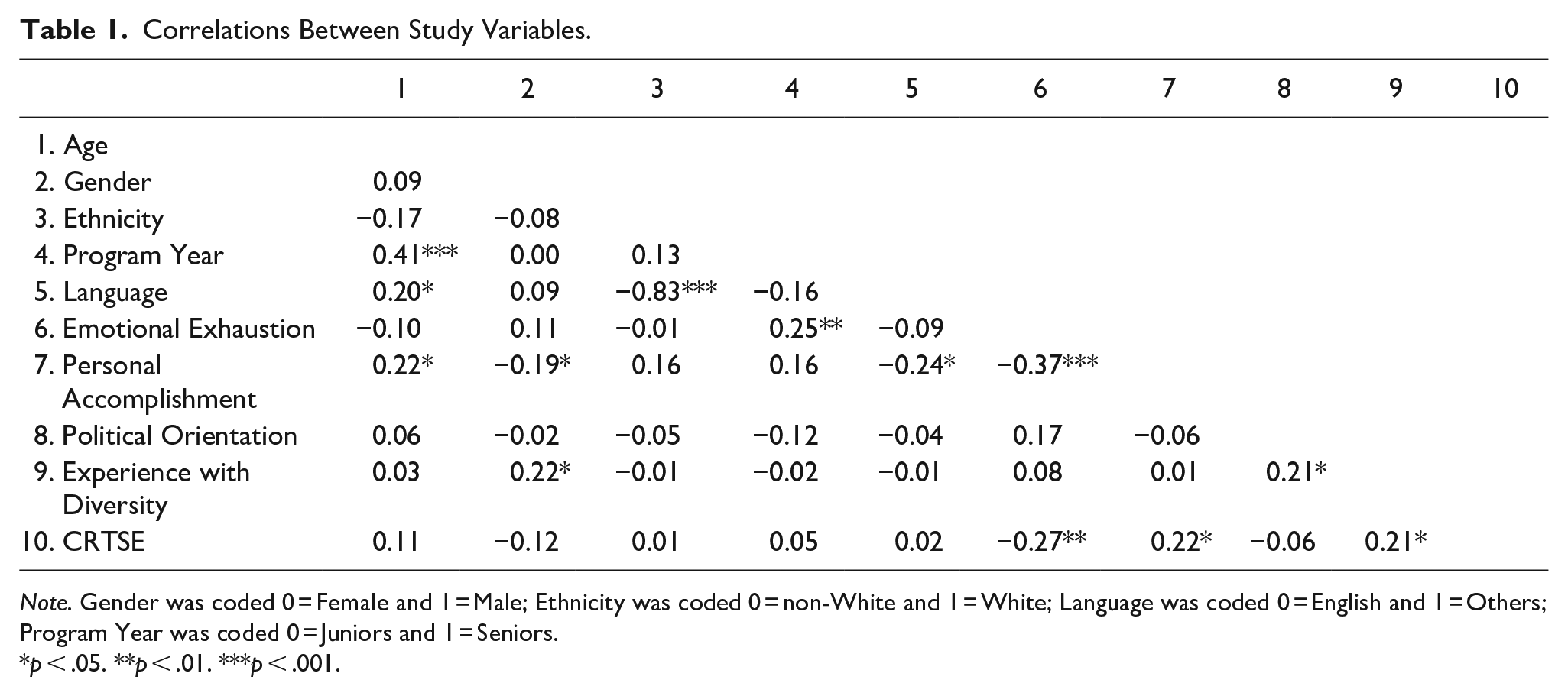
Note. Gender was coded 0 = Female and 1 = Male; Ethnicity was coded 0 = non-White and 1 = White; Language was coded 0 = English and 1 = Others; Program Year was coded 0 = Juniors and 1 = Seniors.
p < .05. **p < .01. ***p < .001.
Results
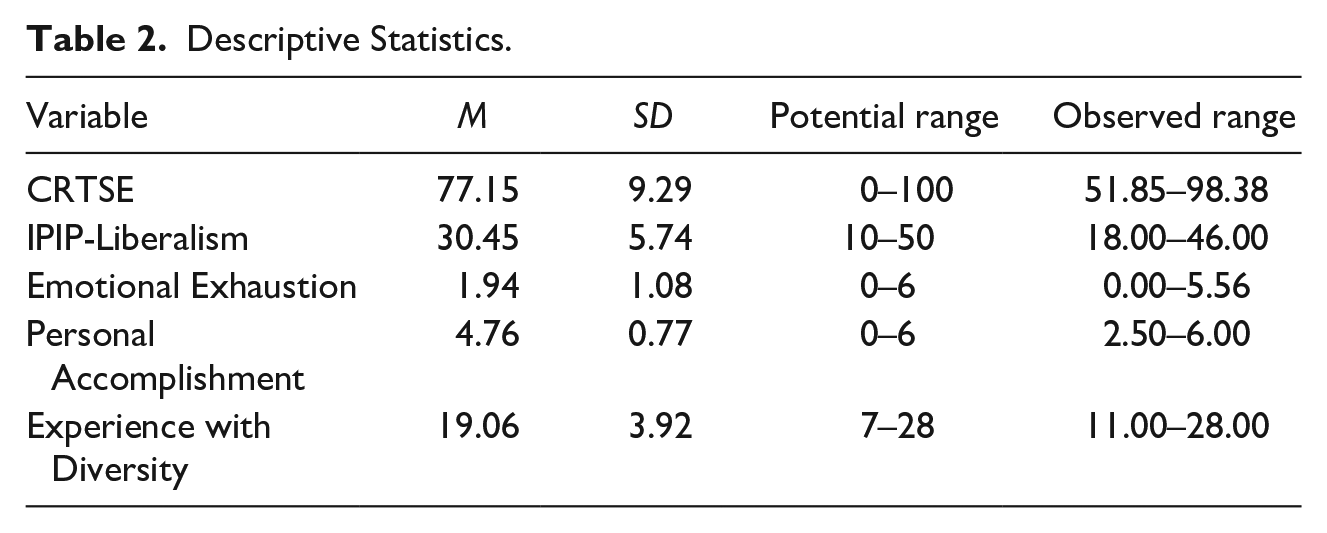
The means and standard deviations for the measures can be found in Table 2. The results revealed that on average, preservice teachers had CRTSE score of 77.15 (N = 110, SD = 9.30). Using CRTSE scoring guidelines, participants were found to have high levels of CRTSE. According to MBI-Educators Survey scoring guidelines, participants had moderate and high levels of Emotional Exhaustion and Personal Accomplishment, respectively.
Descriptive Statistics.
To answer the first research question, an independent sample t-test with was conducted to examine the differences in CRTSE levels of senior and junior preservice teachers, with program year as the independent variable and the CRTSE as the dependent variable. The results revealed no significant differences in CRTSE levels of senior and junior preservice teachers, t(106) = 0.51, p > .05.
The second research question asked, “Do preservice teachers’ cross-cultural experiences, political worldviews, and burnout remain a significant predictor of their CRTSE levels after accounting for the impact of demographic variables?” To answer this question a hierarchical regression analysis was conducted with CRTSE as the dependent variable. To control for the impact of demographic variables, age, gender, and ethnicity were entered in the first step. Given that experience with diversity, political orientation (IPIP-liberalism), and burnout have been found to impact teachers’ self-efficacy beliefs, they were entered in the second step. All the variables entered in the regression analysis were continuous except for gender and ethnicity which were coded dichotomously. Gender was coded as female versus male, and ethnicity was coded as White versus non-White. The overall model was statistically significant, F(7, 98) = 2.58, p < .02 and accounted for 15.6% of the variance in CRTSE (Table 3). The first step of demographic variables did not significantly contribute to the model. Significant predictors were Emotional Exhaustion, β = −0.21, p < .04 and Experience with Diversity, β = 0.28, p < .01. Higher levels of preservice teachers’ CRTSE were predicted by lower levels of Emotional Exhaustion and more frequent cross-cultural experiences in their childhood and adolescence.
Hierarchical Regression Predictors of Culturally Responsive Teaching Self-Efficacy.
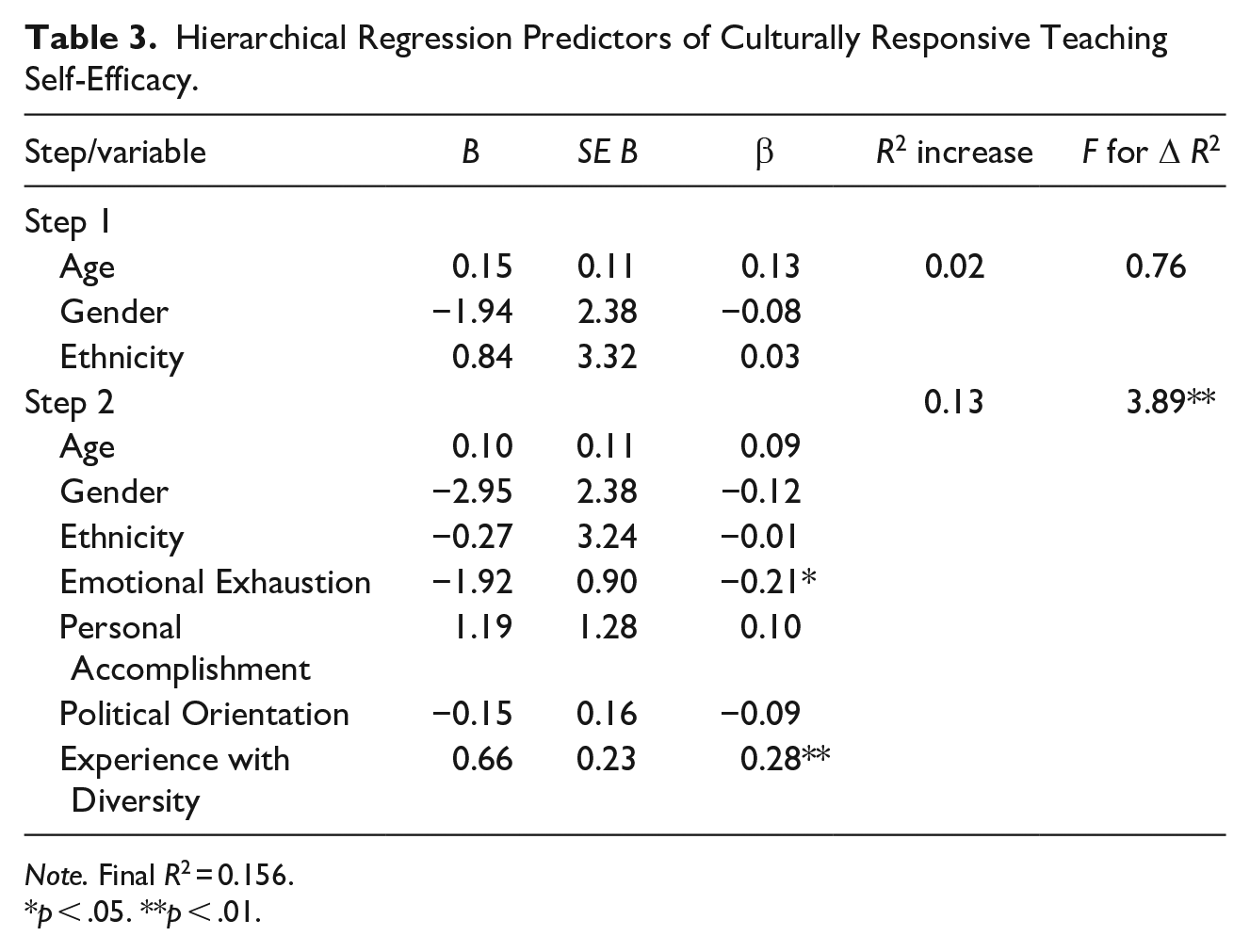
Note. Final R2 = 0.156.
p < .05. **p < .01.
Discussion
In this study, we examined whether senior and junior preservice teachers vary in their CRTSE levels. We also explored the predictive role of cross-cultural experiences, political orientation, and burnout on preservice teachers’ CRTSE levels after accounting for the potential influence of age, gender, and ethnicity. The results of this study revealed that preservice teachers reported high levels of CRTSE. However, reporting high levels of CRTSE in preservice teachers does not necessarily imply that they will be self-efficacious teachers when they actually enter the classrooms. Prior research evidence found that preservice teachers’ high levels of self-efficacy beliefs during student teaching dropped significantly one year after their entry into the teaching profession (Hoy & Spero, 2005; Swan et al., 2011). Since preservice teachers have not confronted the challenging nature of the teaching profession yet, they may underestimate its complexity (Hoy & Spero, 2005). This may lead them to believe that they can effectively teach and manage their classrooms. Therefore, it is not surprising that high levels of burnout are found among novice teachers within the first year of their teaching careers (Gavish & Friedman, 2010).
Contrary to the researchers’ hypothesis, senior and junior preservice teachers did not vary in their CRTSE levels. However, previous studies found that as students’ education extends through college, they embody more positive perspectives toward diversity (Nadelson et al., 2012). The findings of the current study, though, were consistent with the results of Nadelson et al. (2012) which revealed multicultural coursework had no impact on preservice teachers’ attitudes toward diversity. Other researchers have pointed to the negligible influence of multicultural coursework on preservice teachers’ attitudes toward diversity and have noted that many factors (e.g., their social and educational backgrounds) may impact their attitudes (Locke, 2005). Therefore, the influential role of other factors on CRTSE may explain the lack of variation in preservice teachers’ CRTSE levels as a function of their academic year. Garmon (2005) has suggested that educational experiences are not the only influential factor in changing teacher candidates’ attitudes toward diversity; however, dispositional factors (e.g., openness, self-awareness, and commitment to social justice) and various experiences (e.g., inter-cultural and support group experiences) are also at play.
In examining the role of cross-cultural experiences, political orientation, and burnout in predicting preservice teachers’ CRTSE levels, only cross-cultural experiences and Emotional Exhaustion aspect of burnout were found to be the significant predictors of CRTSE. The outcomes of the current study pointed to the existence of a negative association between preservice teachers’ Emotional Exhaustion and CRTSE levels. Higher levels of preservice teachers’ CRTSE were associated with lower levels of Emotional Exhaustion. This outcome is consistent with the research of Skaalvik and Skaalvik (2010) who reported a negative relationship between teacher self-efficacy and both aspects of teacher burnout (Emotional Exhaustion and Depersonalization). This outcome was also in accordance with the results of a study by Savas et al. (2014) who reported that teacher self-efficacy and burnout were negatively correlated. Burnout syndrome has been found to influence performance related variables, such as job satisfaction and intention to quit (Goddard & Goddard, 2006; Talachi & Gorji, 2013). Since the outcomes of the current study and other related studies have shown that there is a negative association between burnout and self-efficacy beliefs, it can be suggested that enhancing CRTSE levels may prevent preservice teachers from developing burnout, experiencing low job satisfaction, and leaving the teaching profession.
The results indicated that more cross-cultural experiences predicted higher levels of preservice teachers’ CRTSE. This outcome is parallel with the research of Kolano et al. (2014) who reported that teachers who had familiarity with their students’ cultures, customs, and unique needs felt more effective in working with English language learners. Similarly, Siwatu et al. (2016) found that preservice teachers had doubts about their self-efficacy beliefs due to their “lack of knowledge regarding student diversity and culturally responsive pedagogy” (p. 286). Smith et al. (1997) also found that factors, such as “exposure to different cultural backgrounds, education, travel, and personal experience with discrimination as a child or an adult” (p. 54), were influential in leading prospective teachers to develop more diversity related awareness and sensitivity.
The outcomes of the current study suggested that preservice teachers’ diverse multicultural experiences in childhood and adolescence are an important predictor of their CRTSE. This suggests that preservice teachers carry forward their cross-cultural experiences that they have gained during their early, formative years into teaching profession. Given that immigration is increasing in Canada, perhaps, the next generations of preservice teachers will have stronger CRTSE, as they will be exposed to a more diverse set of population while growing up. Since cross-cultural experiences have positive relationships with CRTSE levels, throughout the teacher education program, preservice teachers’ exposure to multicultural situations should be increased to facilitate the development of their efficacy beliefs which, in turn, prevent them from developing burnout in the future. Bandura (1997) suggests that mastery experiences are the most significant factor in the development of self-efficacy beliefs. Therefore, teacher education programs should involve preservice teachers in multicultural contexts to help them gain “direct experiences, rather than [merely] learning ‘about’ them” (Seeberg & Minick, 2012, p. 2).
Mere exposure to multiculturalism and celebration of differences do not necessarily equip preservice teachers to deal with the challenges of teaching in multicultural classrooms. Educators and administrators need to intentionally implement strategies in teacher preparation programs to enhance preservice teachers’ CRTSE levels. Such strategies should include mastery experiences, which play a significant role in the development of efficacy beliefs (Bandura, 1997). Preservice teachers’ efficacy beliefs can also be enhanced through their exposure to teachers who have efficacy in teaching in multicultural contexts (Siwatu, 2007). This can happen because research indicates when individuals believe in the competency of those around them, they are more likely to imitate their behavior (Bandura, 1986). Teacher education programs should also increase preservice teachers’ exposure to multicultural contexts, which, in turn, may help them enhance their self-efficacy levels. The initial identification of preservice teachers’ burnout levels may protect them against experiencing burnout and low occupational satisfaction deriving from instructing in multicultural contexts. Implementing such strategies can help teacher mentors to provide preservice teachers with better training practices and appropriate curricula. The preparation of culturally responsive teachers and the enhancement of their efficacy beliefs at earlier stages of their training will provide a positive classroom atmosphere for both teachers and ethnically diverse students.
Limitations
Several limitations of this study should be noted. The sample was drawn from the population of the undergraduate preservice teachers enrolled in the Faculty of Education at a medium-sized Canadian university. Therefore, the results of this study are based upon one institution and may not be generalized to preservice teachers at different universities. Also, this research was based on a small sample size and needs to be replicated. Even though the researchers sought to recruit an approximately equal number of preservice teachers in different years of their programs, the majority were senior students. Moreover, it was not clear if preservice teachers participated in this study had any experience in actual multicultural classrooms. Finally, given that 90% of the participants were of European descent, other studies should investigate the relationship between ethnicity and CRTSE levels in a more diverse sample.
Implications and Future Directions
We sought to better understand the potential determinants of CRTSE given the increasing diversity of classrooms. The lack of difference in CRTSE levels of senior and junior preservice teachers was surprising and suggested that CRTSE did not progress over the course of the undergraduate years. This may be better understood in the context of existing training opportunities. In this regard, it its important to examine the current courses that deal with the cultural and linguistic diversity to determine their effectiveness in enhancing teacher candidates’ CRTSE levels. Also, the extent to which field experiences and internship programs expose preservice teachers to multicultural contexts and help them increase their cross-cultural experiences should be investigated. By identifying the predictors of CRTSE and the relationship between CRTSE and burnout syndrome, teacher education programs may be enhanced to better prepare culturally responsive teachers. This, in turn, can provide better learning opportunities for ethnically diverse students.
Some directions for further research include undertaking a follow-up study with the same population of preservice teachers to monitor their CRTSE and burnout levels after they enter the real classrooms. The influence of other factors (e.g., the perception of school environment, personality types, and the existence of cultural stereotypes) on preservice teachers’ CRTSE should be investigated. It would also be beneficial to examine the relationship between preservice teachers’ CRTSE levels and their students’ characteristics (e.g., ethnicity, religion, learning disability). In addition, future research should study teacher education programs and their impacts on preservice teachers’ CRTSE to see how effective these programs are in preparing culturally responsive teachers. Finally, the field of education can benefit from studies that implement mixed methods of inquiries (e.g., quantitative and qualitative) to provide more comprehensive explanations for the observed results.
Footnotes
Declaration of Conflicting Interests
The author(s) declared no potential conflicts of interest with respect to the research, authorship, and/or publication of this article.
Funding
The author(s) received no financial support for the research, authorship, and/or publication of this article.
