



Abstract
Turkey is increasingly becoming a regional hub for international students. The number of international students in Turkish universities has grown by almost 300% in the last decade. The current internationalization efforts of the Turkish government and universities have the potential to make Turkey an even more attractive destination for international students, especially from surrounding regions. This remarkable growth comes with some opportunities and challenges that deserve close attention. This study explores the factors influencing international students’ decisions to choose Turkey as their study destination and the challenges they experienced. Data were drawn from 37 international students studying in Turkey through semi-structured in-depth interviews. The results suggest that geographical proximity and cultural, historical, religious and ethnic affinities seem to be very prominent in international students’ decisions to study in Turkey as an emerging regional hub. Several other factors including comparable quality of education, affordability of living and education, scholarship opportunities, and recommendations by family or friends are also found to influence their choice of Turkey. The major challenges include lack of adequate guidance and information during pre- and post-arrival processes. Policy recommendations for emerging study destinations such as Turkey are discussed based on the findings.
Introduction
The internationalization of higher education is a rapidly growing phenomenon that challenges and alters the way higher education has been conceptualized and practiced. Countries and individual higher education institutions all over the world are adapting new policies and procedures to attract more international students. The rationale for and approaches to internationalization vary by institution and country. Traditionally, the motivations for internationalization in academia have been the academic rationales of improving educational partnerships and quality, the economic rationales of raising revenue from tuition and recruiting well-known scholars, the social/cultural rationales of promoting cross-cultural understanding and awareness, or the political rationales of promoting public diplomacy and foreign policy (Knight and de Wit, 1999).
The worldwide internationalization efforts driven by a combination of these rationales have enabled greater student mobility across countries. According to OECD data, the number of international students enrolled outside their home country increased from 2.1 million in 2000 to 4.3 million in 2011—an increase of more than 100% (OECD, 2013). Moreover, there is growing competition among countries to attract more international students. Recent data on student mobility suggest that source countries, which have traditionally sent out most of the international students, are also slowly becoming important study abroad destinations for international students (OECD, 2013). Traditional host countries such as the USA, Germany, France, and Australia face increasingly fierce competition from new entrants like New Zealand, the Russian Federation, South Korea, Singapore, and China (De Wit et al., 2013).
Turkey, with its long history of sending students abroad for higher education, has primarily been regarded a source country (Kondakci, 2011). However, like many other source countries, Turkey has stepped up its efforts to recruit international students in recent years. Figure 1 displays the total number of international students studying in Turkey in the last two decades. As shown in Figure 1, inbound student mobility increased negligibly between 1983 and 1992. In 1993, a new scholarship program administered by the Turkish government, the Grand Student Project, caused a marked increase in the number of international students studying in Turkey. This upward trend continued until 1997, at which point the number of international students declined slightly each year until 2003. The trend ticked upward again beginning in 2004, and has remained positive. In 2013, Turkey hosted approximately 55,000 international students.
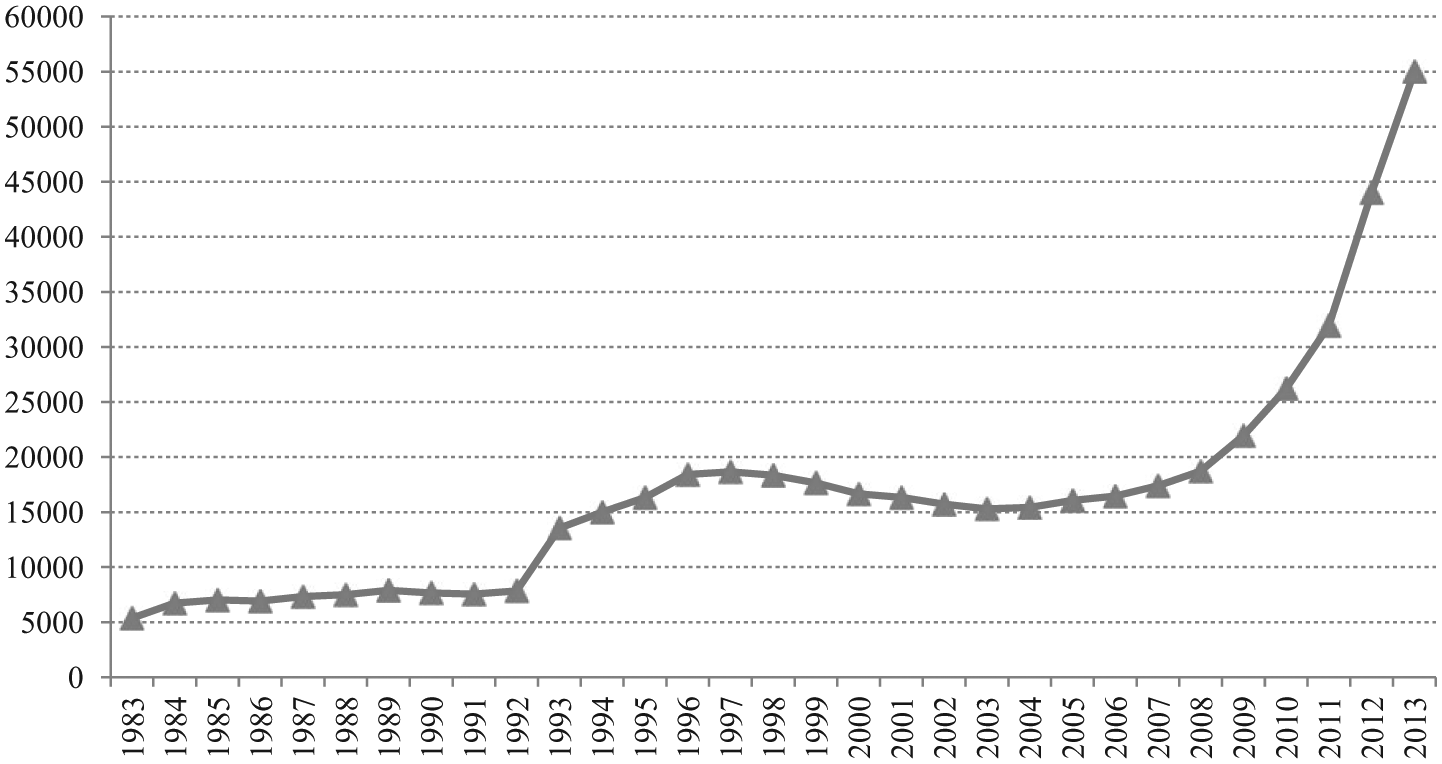
Total number of international students studying in Turkey (1983–2013).
The fluctuation in the number of international students over the last couple of decades points to different experiences of internationalization in Turkey. First, as indicated above, the increase in the number of international students between the years 1993 and 1997 is closely related to the Grand Student Project scholarship program launched in 1993. Targeting students from the Turkic Republics as well as Turkish and cognate communities in the former Soviet Union and Eurasia, this program aims at building lasting bridges of friendship in the Turkish world, promoting Turkish language and culture, and strengthening traditional links among the countries of the Turkish community (Kavak and Baskan, 2001). This scholarship program, along with several other scholarships offered through bilateral agreements with other countries, accounted for more than half of the new inbound students during the 1990s. This indicates that earlier internationalization processes in the 1990s were primarily driven by social and political rationales toward Turkic countries and communities.
The gradual decline observed from 1997 until 2003 reflects some important challenges faced by Turkey in its internationalization efforts. The decline in the number of international students is closely related to high drop-out rates. For example, between 1992 and 2009, a total of 31,982 scholarships were distributed; of those, 16,684 were revoked for reasons including academic failure, withdrawal, non-attendance, and the inability to complete the program on time. This means a success rate of less than 50% for the Grand Student Project scholarships. This rate is quite low given that students on scholarships are thought to be more motivated and successful than domestic students. The high drop-out rates of international students in Turkey may be attributable to a number of factors. While some scholars relate this issue of high attrition to the inbound students’ prior success levels and ineffective selection procedures (Vural and Alkan, 2009), others link it to lack of planning and insufficient care and support for international students (Kavak and Baskan, 2001).
The increasing number of international students from 2004 onward signifies a change of scope and activities with regards to the internationalization of education in Turkey. As mentioned before, internationalization efforts in Turkey date back to the 1990s. These early efforts were primarily driven by social and political rationales, as reflected in the Grand Student Project. In other words, foreign policy assumed a pivotal role in the internationalization of education in Turkey in the 1990s (Yanık, 2004). However, the focus of the recent internationalization agenda in Turkey has been extended to include academic and economic rationales, as well. Government authorities, including the President of Turkey, the Minister of Customs and Trade, and the President of the Council of Higher Education (CoHE) repeatedly stressed the importance of internationalization by underlining academic and economic imperatives (i.e. Hürriyet, 2011a; Sabah, 2011). Internationalization today is regarded as an important step towards improving the quality and competitiveness of the higher education system in Turkey. Moreover, there is a greater emphasis on the economic benefits of hosting more international students (Hürriyet, 2011b). Therefore, attracting more full-fee-paying international students has recently become a crucial part of Turkey’s internationalization agenda.
As Turkey broadens the focus of its internationalization agenda, various structural, executive and legislative arrangements have been introduced to assist the nation’s higher education institutions in attracting more international students. For instance, in 2010, the CoHE, the coordinating body of the higher education system, revoked the central placement exam (i.e. Foreign Student Exam or YÖS) that international students were required to take for admission to higher education institutions in Turkey. Instead, the CoHE vested each institution with the authority to determine its own placement criteria and to place international students on its own. Moreover, the CoHE encouraged each university to establish a well-functioning international student office. In addition to efforts by the CoHE, the Ministry of Trade took steps to support and continues to encourage the international marketing of higher education institutions. Presently, the ministry’s initiative provides half of all the transportation, accommodation and advertising expenses universities incur in their marketing efforts abroad. These executive and legislative arrangements allow higher education institutions in Turkey to attend international education fairs and exhibitions outside the country and engage in marketing activities outside the country more aggressively. The government’s goal is to increase the number of international students in Turkish universities to 100,000 by the end of next decade.
Despite the fact that there have been some improvements in the internationalization of Turkish higher education, there is limited research on internationalization of higher education in Turkey to guide related policies and practices. Particularly, there is a need to understand why international students choose Turkey for higher education in order to better inform institutional marketing practices and government policies. Moreover, given that completion and retention rates of international students in Turkey remain low, there is an urgent need to understand the problems encountered by international students. Such efforts will provide the individual institutions and government agencies with guidance in helping students to have more satisfying experiences during their time in Turkey by better addressing students’ needs and discontents. Accordingly, the current qualitative study, based on semi-structured face-to-face interviews with international students studying in Turkey, seeks to address these needs by investigating factors that influence international students’ decision to study in Turkey and the challenges they experience at every step, from making the initial decision to enroll in a Turkish university to their experiences as students living and studying in Turkey.
Student mobility
Several theoretical frameworks have been developed to explain the dynamics of cross-border student mobility. One of the earliest studies in this field, conducted by Lee and Tan (1984), aimed to establish a model of international student flow and to explore the factors that influence or dictate the flow of higher education students from less developed countries (LDC) to developed countries (DC). Their model suggests that the flow of students from the LDCs to DCs is determined primarily by the excess in demand for higher education in the LDCs. Their model also outlines that, in addition to excess demand, many other factors affect the flow of LDC students to DCs, such as commonality of language, historical links, quality of higher education in the LDC, the relative wealth of the LDC, differences in the cost of living and the distance of the LDC from the DC.
Similarly, McMahon (1992) investigates the factors affecting the flow of students from 18 developing countries to the host countries, particularly to the United States. She proposes “push” and “pull” models based on two different sets of factors. The “push model” accounts for factors within the home country that influence the outflow of students. These factors include the economic strength of the home country, the level of the home country’s involvement in the international economy, the availability of higher education opportunities in the home country and the priority assigned to education by the home country. The “pull model” focuses on the factors present in the host countries, particularly the USA, that attract an inflow of students. The pull factors include political and economic linkages between the host and home country, the economic capacity of the home country relative to that of the host country, and the level of financial support provided to international students by the host country.
While the push–pull model developed by McMahon is valuable in explaining the global patterns of international student flow, it says very little about international students’ decision-making processes or the range of factors that affect students’ decision-making processes. Yet, McMahon’s model has served as the basis for most of the later empirical studies on international student choice. Researchers have refined the standard push–pull model to understand why students seek an international education or how they decide on a particular country or institution. For instance, in their highly cited study, Mazzarol and Soutar (2002) surveyed 2,485 international students to identify the range of factors that motivate students to study abroad and that inform their choice of a particular country or institution. They found that the decision-making process of choosing a study destination involves at least three distinct stages. In the first stage, the student decides whether to study locally or internationally. The decision-making process in this stage is usually influenced by a series of push factors associated with the home country. After the student decides to study abroad, or at least considers it as a viable option, the next stage of selecting a host county starts. In this stage, pull factors associated with potential host countries play a crucial role in choosing one country over another. After deciding on a particular country or countries, the student tries to form a decision about the institution. A variety of pull factors—this time related to institutions and/or linked communities—shape the decision-making process in this stage.
Numerous other models, in addition to the push–pull model, have been developed to explain the dynamics of international students’ mobility. Using a similar two-dimensional approach, Park (2009) offers a 2-D model in order to explain the Korean students’ international mobility. The first D, the driving force factor, explains the forces that drive students’ decision to study abroad. The second D, the directional factors, refers to the forces that influence the students’ choice of destination country. Li and Bray (2007) extend the one-way push–pull model into a two-way push–pull model by suggesting that there are also some pull/positive factors at home country that may encourage students to stay at home and some push/negative factors at host countries that may discourage international students from studying there. The pull factors at home include “desire to stay with family, awareness of the relevance of domestic education, and increasing internationalization of domestic institutions”, and the push factors from host countries include “increasing fees and other costs, restrictive policies on foreign students, uncertainties in visa approvals, tightening of immigration policies, and discrimination against students” (p.795). Furthermore, Li and Bray suggest that both push and pull factors are external forces and that there are also internal factors such as “family background, academic characteristics, perceptions and motivations, which shape the affordability, accessibility and desirability of external higher education” (p.813).
The few studies that research international student choices in Turkey build on the McMahon model. For instance, in order to examine why international students choose to study in Turkey, Kondakci (2011) offers a two-dimensional model. The first dimension makes a distinction between students’ pre-departure and post-departure rationales. The pre-departure rationales are related to the factors that attract international students, while post-departure rationales are used to explain how/why a students’ plan to study abroad in a certain country is sustained. The second distinguishes between students’ public and private rationales. Public rationales are related to “aspects of life of host/home countries that may pull/push the students to choose a particular country for study abroad” (p.575). Private rationales, on the other hand, focus on a student’s personal choices and personal characteristics. Kondakci reveals that while students coming from Western, economically developed, countries are motivated by private rationales, students from Eastern, economically developing, countries are impelled by public rationales. For students from East Asia and the Middle East, geographical, historical, and political factors are relatively more prominent compared with economic factors in their decision to choose Turkey (Kondakci, 2011).
Challenges faced by international students
The internationalization literature suggests that student satisfaction is very important in attracting more international students (Li and Kaye, 1998). Student satisfaction produces long-term effects such as student loyalty, positive image of the country or higher educational institution and effective word-of-mouth marketing (Arambewela et al., 2006). Extending the kind of care and support that is crucial to international students’ satisfaction may prove difficult without an adequate understanding of issues they confront. When the needs of international students are not adequately met, they return to their home countries not as ambassadors for the host country but as deterrents, warning others against studying there (Macready and Tucker, 2011).
Research focusing on challenges confronted by international students is drawing increasing attention due to the importance of student satisfaction and well-being. In this section we provide a review of the five most common problem categories international students face: language/communication, academic, social/cultural, financial and psychological. While this categorization helps us provide a structured presentation of our findings, it is important to note that the boundaries are fluid as the problems are interdependent. In other words, problems in one category are often the predictors of problems in other categories.
Language/communication
Extant research suggests that language and communication barriers, both in academic and social settings, are significant issues faced by international students with low language proficiency (Andrade, 2006; Townsend and Poh, 2008). In terms of their academic lives, language barriers diminish international students’ ability to understand lectures, actively participate in class discussions, and complete reading and writing assignments. Ultimately, such barriers may cause academic failure (Butcher and McGrath, 2004; Duru and Poyrazli, 2007; Li and Kaye, 1998). In terms of social lives, language and communication barriers have a negative impact on students’ social and cultural adjustment (Kagan and Cohen, 1990; McLachlan and Justice, 2009; Smith and Khawaja, 2011). In addition to academic and social issues, students with language difficulties can experience psychological problems (Zhang and Goodson, 2011). Social isolation, loneliness and depression are some of the psychological problems students may face (McLachlan and Justice, 2009; Smith and Khawaja, 2011).
Academic
Difficulty of learning in a foreign language is one of the most commonly cited academic issues encountered by international students (Townsend and Poh, 2008). Moreover, unfamiliarity with the host countries’ educational system—particularly with the educational norms and practices—evokes different academic problems for international students. International students who are unfamiliar or uncomfortable with the teaching/learning style of the host institution experience various difficulties in teaching/learning processes (Poh, 2008; Poyrazlı and Grahame, 2007). In addition to these issues, McLachlan and Justice (2009) suggest that international students are under more pressure to succeed academically, as failure has significantly more serious consequences as an international student. For instance, international students who receive financial assistance from their country or from their host institution may lose their scholarship permanently if their academic performance is poor. Similarly, international students who are studying abroad at their own expense may have to pay more money in tuition in the case of extending their studies because of academic failure (McLachlan and Justice, 2009).
Social/cultural
Adapting to a new social environment and cultural norms is a challenging process for most international students. The experience of culture shock is reportedly prevalent among international students as they adjust to the sociocultural differences between home and host countries (Zhou et al., 2008). International students encounter various other social and cultural problems as they try to adjust different cultural norms and social patterns (McLachlan and Justice, 2009; Sherry et al., 2010; Yeh and Inose, 2003). For instance, due to language barriers and differences in cultural norms, international students experience difficulty in socializing and establishing friendships with locals and other international students, which in turn affects international students’ sociocultural and psychological adaptation (Li and Kaye, 1998; Townsend and Poh, 2008). It is suggested that the more cultural differences there are between home and host countries, the more stressful the adjustment process is for students (Kegel, 2009; Yeh and Inose, 2003). Cultural differences also cause cultural misunderstandings which affect students’ adjustment processes and psychological well-being (Sherry et al., 2010). In addition to cultural misunderstandings, prejudices or discrimination are also noted as another potential social issue that negatively influences the students’ social and psychological adjustment (Brown and Jones, 2013; Lee and Rice, 2007; Poyrazlı and Grahame, 2007).
Psychological
Extant research suggests that international students also face psychological problems such as homesickness, loneliness, social isolation, disorientation and depression (Kegel, 2009; McLachlan and Justice, 2009; Poyrazlı and Lopez, 2007; Sawir et al., 2007). These psychological problems are closely related to the difficulties students encounter in their social and academic lives. As mentioned above, research reveals that being subject to discrimination can create mental health problems such as depression and severe homesickness (Poyrazlı and Lopez, 2007). Moreover, students who cannot socialize successfully or who maintain weak social ties due to low language proficiency and cultural adaptation are more likely to experience psychological problems such as loneliness and homesickness (Sawir et al., 2007). Academic pressure on international students can also have a negative impact on their social lives and lead to social isolation and loneliness (McLachlan and Justice, 2009).
Financial
Several studies show that the majority of international students experience financial problems or at least feel financial anxiety (Li and Kaye, 1998; Poyrazlı and Grahame, 2007; Sherry et al., 2010). Financial problems arise from factors such as loss of scholarship opportunities, work permit restrictions, and increases in tuition fees and accommodation costs (Smith and Khawaja, 2011). Li and Kaye (1998) found that financial anxiety is one of the most common concerns identified by international students in the UK. Their results showed that approximately one-third of the participants stated having financial concerns. McLachlan and Justice (2009) report that financial concerns are most prominent during the initial years of study.
Demographic variables
Prior research suggests that students with different demographic characteristics are confronted with different problems with different degrees of intensity. For instance, Poyrazlı and Lopez (2007) reveal that there is a connection between the level of perceived discrimination, race and ethnicity. Other studies find that marital status (Duru and Poyrazli, 2007), country of origin (Yeh and Inose, 2003), gender and age (Li and Kaye, 1998) can impact the intensity of the students’ experiences when confronted with these issues.
Methodology
This research employed a qualitative research design. In qualitative research, researchers purposefully select participants or sites that will provide rich data to understand the problem and the research question (Creswell, 2003). Data were collected through semi-structured in-depth interviews. Interview questions were developed based on literature review and focus group interviews. The focus group interviews were conducted face-to-face with 11 international students in three focus groups. In-depth interviews were conducted face-to-face with 37 international students studying in the cities of Ankara (20 students) and Istanbul (17 students) over a 2-week period. Participants for both focus group and in-depth interviews were selected using the snowball sampling method.
As the main goal of the focus group interviews was to form the questions for in-depth interviews, we present only the findings of the in-depth interviews in this article. When quoting an interview, the initials are used to denote whether the interview took place in Ankara (A) or Istanbul (I). After each letter, a unique number is used to represent each interviewee. The participants included both scholarship and non-scholarship students who were from various countries and regions such as Azerbaijan, East Turkestan, Morocco, Palestine, Afghanistan, Kazakhstan, Kirgizstan, Bosnia-Herzegovina and Albania. They were also from different universities and various academic areas ranging from engineering to law. The majority of participants were undergraduate students, but some were either graduate students or students at language preparation schools. The interviews were conducted either in Turkish or in English depending on the choice of the interviewee, and lasted 30–60 minutes.
The researchers took notes during the interviews. In addition, the interviews were digitally recorded and afterwards transcribed. After transcription, we analyzed the transcripts through the three-step systematic coding approach (Neuman, 2011). First, open data coding was used to condense data into the major themes; then axial coding was used to organize the subthemes and links them by discovering key categories; and finally, after the concepts had been well developed and several core generalizations had been identified, selective coding was used to select cases.
Results and discussions
The results are presented in two major categories: factors influencing international students’ choice of Turkey as a study destination, and problems encountered by international students. At the end of each subsection, the results are summarized in a brief discussion.
Factors influencing international students’ choice of Turkey
Interviewees identified several factors that influenced their decision to choose Turkey as their study destination. These factors are grouped into five categories: quality of the education, affordability, scholarship opportunities, proximity, and recommendations by others.
Quality
Many international students reported that they thought that education in Turkey was on a higher level of quality when compared with education in their home countries. To emphasize the quality of Turkish universities, students used similar expressions such as: “Education in Turkey is of a much higher quality. That’s why I chose Turkey” (A10), “In our country, there’s no such education” (A9), “Considering education, Turkey is a lot better” (A5), “Turkey is a great country and its education is great, too” (A14), “In Sudan … the universities are not good as the universities here” (I19), and “I thought that education would be better compared to Azerbaijan” (I15).
Affordability
Students noted the affordability of education and living expenses in Turkey when compared with alternative countries among their reasons for studying in Turkey. As two students described: “I chose Turkey because Europe is much more expensive” (I13), “compared to other European countries and Dubai, Turkey is inexpensive” (A6). Another student, emphasizing that the affordability of education in Turkey should not have been taken as an indicator of the quality of education, stated that “education in Europe and in the USA is more expensive. Turkey is cheaper and at the end you get the same education. Why should I pay more money for the same education?” (I4). In some cases, students disclosed that, despite the relative affordability of education in Turkey, it was still more expensive than their home countries. A Moldavian student exemplified: “financially, compared to our country [Moldavia], it’s still expensive. But compared to the other countries, it’s better” (A14).
Scholarships
Another commonly mentioned consideration in choosing Turkey as destination for higher education was the availability of scholarships for international students provided by the Turkish government, universities, and the home countries of the students. To illustrate, a student from Serbia noted: “I thought going to and studying in India as well; however, there was no scholarship for studying in India. Thus, I chose to study in Turkey because of the availability of scholarships” (A5).
Proximity
International students mentioned cultural, religious or ethnic kinship (i.e. Muslim or Turkish roots) as important factors for choosing Turkey. A Moroccan student described her situation as follows:
Actually we ‘Moroccan people’ can easily go countries speaking French. But I did not want to go there, even though my sister and my uncle are there. I prefer to come to Turkey, because it is a Muslim Country and I do not want to forget my origin. It is really good, if you’re invited a country where you feel like you’re in your country, the same tradition, the same religion. (I6)
A student from Palestine stressed cultural and political kinship for choosing Turkey:
Turkish culture is quite similar to our culture. Especially, because of recent political events, the perception of Turkey in Palestine is very nice. Turkish people and [the country of] Turkey helped the Palestinian people, while the other Arab countries didn’t do much for Palestine. (I7)
Turkey’s position among the Islamic countries was mentioned by a participant from Kirghizia as follows: “It’s the most developed of all Muslim countries. That’s why I chose it” (A4). A participant from Azerbaijan explained his reason for choosing Turkey by saying: “I chose Turkey because it’s the center of the Turkish world” (A17).
Recommendation
Recommendations of friends and relatives who have either visited or studied in Turkey played a significant role in shaping the students’ decision to study in Turkey. For example, a student from Albania said: “My cousin was in Turkey. He liked it. He recommended it. And I came” (I12). Again, an Afghan student explained his reason for choosing Turkey: “My uncle studied here. He recommended it. For me, coming here was easier. Going to other countries was difficult” (A16).
In general, international students considered a combination of various factors in choosing Turkey as their study destination. These factors consist of quality of education, affordability of education and living, scholarship opportunities, recommendations by others and cultural, historical, religious and ethnic links. Despite the popularity of economically developed and Anglophone countries as study destinations abroad, there is a growing flow toward developing and non-Anglophone countries such as Turkey (Kondakci, 2011). Factors such as cultural, historical, religious and ethnic affinities seem to be very prominent in this growth. Moreover, given that a substantial number of the international students in Turkey receive scholarship from governmental and non-governmental institutions, it makes sense that scholarship opportunities are also an important pull factor (Vural and Alkan, 2009).
Problems encountered by international students
In this section, we provide findings related to the problems international students face at various stages of their experience in Turkey, from the problems they face in the university application process, visa procurement process and enrollment procedures to those they face in their academic and social lives.
The application process
The majority of the interviewees stated that they had not encountered any problems during the application process. A student from East Turkistan, for example, stated that a non-for-profit foundation helped her so that she had no problems during the application process (I11). An Albanian student studying in a private university, who had not fully completed the application in the beginning, stressed how helpful the university counseling center can be: “Later, the university called and told me ‘you need this stuff to complete the application’ and I completed the application. So there was nothing difficult. The university helped me a lot; they called me most of the times” (I17). Students who reported having problems stated that the biggest problem was insufficient information. A Moldavian student expressed his thoughts on the application process in these words: “How do I apply? Which documents do I have to bring? I didn’t know anything. There was no one to inform us. That’s why I had difficulties” (A14). Another student from Uzbekistan, who came to Turkey by his own means, was not informed about the need for a Diploma Equivalency Certificate, which would have to be obtained from the CoHE in Turkey, in order to enroll for a master’s degree in Turkey until he was already in Turkey. A student from Kirghizia complained about the indefinite and long waiting time for the announcement of scholarship recipients (I9).
When starting an application, students might be still uncertain about which country to choose. They might still be considering alternatives. However, it has been observed that unless the students have made a definitive decision on a destination, the problems encountered during the application process may serve as deterrents. Students may lose their motivation at the beginning of the process and reconsider their choice. Nevertheless, no matter how much the application process is simplified, students may experience problems due to differences in cultural norms and systematic processes. Consequently, it would be advisable to offer informative counseling services to simplify the process. Counseling will help students to fully complete their applications and not lose their motivation (Tidwell and Hanassab, 2007).
Visa and enrollment procedures
Based on information reported by students, problems during the process of arriving to Turkey were grouped into three categories:
Limited quota (numerus clausus). One of the problems scholarship students encountered is not being able to enroll to the program/major they intended to due to limited quota. A Moldavian student expressed his frustration in these words: “Students can’t get into the program they like to. Because there aren’t enough seats, so you can only choose certain fields” (A12).
Visa. The visa procedures do not seem to be a problem for most students. However, a student from Chechnya said that he waited longer than 6 months for a visa (A6).
International office personnel. One of the problems international students spoke about was the lack of properly trained international officers at some Turkish universities. Students reported both negative and positive experiences in terms of personnel attitudes. This is partly caused by a lack of staff training regarding how to handle international students. A Bulgarian student explained: “When we went there to enroll, they behaved as if we were the first foreign students ever. They didn’t know that our documents were different. It was problematic because they had no knowledge about this” (A17).
International students need visas to be allowed to enter a country or to reside there. Like the application process, it is highly recommended that this procedure, too, should be purged of extensive bureaucracy, simplified and swiftly concluded. The long and uncertain visa procedures can be discouraging. The most distinct example is the US after September 11. After the attacks, the US complicated the visa procedures due to security concerns. This caused a severe drop in the number of student visa applications (Johnson, 2009). After obtaining visas and arriving in the new country, students have to engage in procedures such as enrolling in the university and getting a residency permit. Lack of information and trained staff may exacerbate the problems students face during these procedures. Consequently, it is very important that universities give them structured guidance and orientation as soon as they arrive, as the opposite may cause students to withdraw even before they have a chance to start their studies.
Academic life
International students named language proficiency as their most challenging problem during their academic life in Turkey. Many students reported problems with understanding their instructors due to students’ insufficient knowledge of Turkish (or English). Some students stressed that their language training was inadequate. An Indonesian student, for example, said: “After I went to a Turkish language preparatory school, my language was good for daily communication but not for academic classes” (A3). Another student from Turkmenistan stated that she had some difficulties at the beginning but overcame them with time (I4).
Another issue in academic life is related to the negative attitude of some instructors. A student from Kazakhstan said: “Actually, I haven’t really experienced any [discrimination]. But some teachers told me: ‘There could be three Turks instead of you’” (I9), meaning that places are very limited in Turkish universities and international students cost a lot more than domestic students. A Serbian student commented on the instructors’ attitudes in these words: “Honestly, there are good and bad teachers. Some are really helping us and with others, we hesitate to ask questions” (A5).
Another issue related to academic life was the difficulty of classes. Students from different countries consistently pointed out that the Turkish universities were generally more difficult compared with universities in their home countries. A student from Azerbaijan confessed: “Getting a bachelor’s degree here is really hard. I don’t understand why they make it so hard. It could be a little easier.” (I13). Two students from Indonesia and Bulgaria also stated that classes in Turkey are more difficult than their home countries (A3, A16).
Overall, consistent with the literature, this study revealed that the most important problem that accounted for students’ academic failures was insufficient language skills. Students with insufficient Turkish or English skills have difficulties understanding classes, fulfilling assignments, and communicating with teachers. As anticipated, students overcome these difficulties in the course of their education because their language skills improve and they adjust to the system. Another difficulty related to academic life was the difference between educational systems and the perceived difficulty of education in Turkey. Perceived difficulty could be related to the level of students’ preparedness for academic life. An additional factor which influenced academic success was the negative attitude of teaching personnel towards international students. These could be exceptions, because only a few students reported such problems.
Social life
During the interviews it was ascertained that international students were generally content with their social lives in Turkey. Only a few students stated that they experienced problems in their social lives due to cultural differences. An Indonesian student conveyed his feelings as follows: “Of course there are cultural differences, for example, the Turkish students make a lot of jokes but it annoys us. We know they are joking, but we don’t like jokes like that” (A3). Some female students reported misunderstandings due to their way of dressing. A student from Kirghizia, for example, shared her experience based on her different dressing style: “Culturally, too, for example when I dress people ask me if I’m going to a wedding. However, where I come from, everybody dresses like this” (A4). However, international students with similar cultural backgrounds said that it was easier to adapt to social life in Turkey. A Syrian student, for example, explained the situation: “I stayed at a dorm, it took them a month or so until they found out that I’m not a Turkish citizen. They couldn’t find any differences, not in my looks, not in my speech, nor in my culture” (I5).
International students have problems due to language barriers in their social life as well as their academic life, as mentioned above. Several students reported misunderstandings in everyday situations during their first years due to their insufficient knowledge of Turkish language. Another problem pointed out by the international students was related to accommodation. This problem is rooted in the currently limited availability of the dorms and in the limited alternatives to the dorms. A student staying in a dorm in Ankara expressed his discomfort caused by overcrowded dorms as follows: “Our dorm is overcrowded. It’s really uncomfortable” (A17). This problem is not limited to international students. Some Turkish students are also dissatisfied with the public dorms (Gür et al., 2012) and often have difficulties with renting apartments.
Some international students experienced financial difficulties in the general sense. Several students expressed that the scholarships are inadequate. An Afghan student without any scholarship spoke about his financial problems, too: “I have a lot of financial problems. Living in Afghanistan is a lot cheaper. My family works so much and sends money to me and it takes me only two weeks to spend it, although I’m using it cautiously” (A16).
In short, international students have problems in their social lives due to cultural differences, language barriers, accommodation situations, and financial problems. In a foreign country with different cultural and social norms, international students generally feel lonely because they lose the social network they had in their home country and have problems building new social contacts (McLachlan and Justice, 2009; Sherry et al., 2010; Yeh and Inose, 2003). Finding new friends and building a new social network, where they feel comfortable and safe, are processes that take time. It is important that students survive this phase without experiencing too much stress or depression. Accordingly, universities should offer support systems for international students from the first day they arrive on campus onwards. For example, it is known that orientation courses and extracurricular activities for international students help them to get over the initial cultural shock and help their sociocultural adjustment (Poyrazlı and Lopez, 2007). This study found that international students are generally pleased with Turkey. Only a few reported major problems in their social life.
Conclusions
Within the last decade, the international student population in Turkey has grown by almost 300%. The recent internationalization efforts of the government and universities have the potential to make Turkey an even more attractive destination for international students, especially from surrounding regions. This remarkable growth potential does not come without its challenges and obviously requires more investigation. More research on emerging regional study destinations such as Turkey is needed to guide policies for sustainable growth in international student numbers in these regions.
This study has been motivated by this need and has investigated the factors influencing international students’ choice to study in Turkey, and experiences of international students in Turkey. The findings suggest that pull factors such as cultural, historical, religious and ethnic affinities seem to be very influential in international students’ choice of Turkey. Given that at least one-quarter of all international students in Turkey receive scholarships, funding opportunities are also important pull factors. In addition to these pull factors that are closely related to social and political rationales of internationalization, there are also factors related to academic and economic rationales of internationalization that play important roles in pulling international students to Turkey. These include quality of education and comparatively low cost of education and living. An implication of these findings is that by emerging as an important regional hub, Turkey has the potential tools—both academically and economically—to become a leading destination country. To fulfill this potential, attracting more full-fee-paying international students from abroad should be a priority on both the government’s and universities’ agendas.
This study also reveals that while Turkey continues to host an increasing number of international students, these students encounter various problems at different stages of their academic parcours including application and enrollment processes and in their social lives. The findings of this study particularly suggest that the international students are not well informed and guided during the application and enrolment processes. An important implication of these findings is that for this growth to be sustainable and continuous, more resources should be provided for counseling and support services aimed at helping international students in adjusting to a new education system and social life in a foreign country. Based on the CoHE’s 2010 decision to urge universities to establish international student offices, many universities in Turkey now have international offices. This is a big step towards adjusting to the growing number of international students, and might lessen the problems international students encounter. The findings also suggest that some of the teaching personnel do not know how to approach international students from different cultures and therefore need structured guidance about this issue.
Footnotes
Acknowledgements
This article is derived from the findings of a report published by SETA Foundation titled Küresel eğilimler ışığında Türkiye’de uluslararası öğrenciler [International students in Turkey in the light of global trends] in 2011. The authors would like to thank to Murat Öztürk for his valuable feedback as well as Zülfi Ozan, Nur Kırmızıdağ and Sara Fischer for helping to copy edit the manuscript.
Funding
This research received no specific grant from any funding agency in the public, commercial, or not-for-profit sectors.