




Abstract
Arab migration to Europe has triggered vast public debate on immigration and European identity. But how do Arabic-speaking groups perceive their European resident countries? This study departs from the crucial role of media arenas in orienting perceptions. Adopting the approach of agenda-setting theory, it analyses news coverage on France and Germany, performing a multilevel text analysis of 3109 news articles in Arabic and relating them to usage data. The analysis of issues showed that France is presented as an active stakeholder in foreign politics, whereas Germany is more strongly depicted in the realm of domestic politics.
Keywords
Introduction
In recent years, migration of Arabic-speaking individuals to Europe has been substantial. A very young population, limited economic and political perspectives, and violent turmoil in the Arab region have caused many Arabs to leave their countries and seek a future elsewhere (Ribas-Mateos, 2016; Winckler, 2017). In France, for instance, 4.3 per cent of the total resident population were first-generation Arab migrants in 2011, that is, Arab nationals who had experienced migration at first hand (Organisation for Economic Cooperation and Development, 2019). European countries with historically weaker ties to the region also witnessed an increase in their Arab resident population. In Germany, one of the main receiving countries of refugees from war-torn Syria, the Arab resident population grew accordingly, between 2015 and 2017, by almost one-third from 762,000 to 1.2 million Arab nationals living in Germany (Statistisches Bundesamt, 2019).
The dimensions of Arab migration to Europe triggered intense political and public debate on European identity and the need for integration of the migrants into their host societies (Dell’Orto, 2013; Hobolt, 2016; Schwarz, 2016). Independently of the normative standpoint chosen for this topic, and whether migration is seen as or expected to be a process of co-construction or assimilation, immigration encompasses processes of societal negotiation, adaption and, ultimately, change (Fortunati et al., 2013; Paparusso, 2016). Media play an important role in this context. They provide the informative infrastructures of public spheres through which society members know about each other, debate, and form a sense of belonging to the abstract notion of their society or nation (Habermas, 1991; Schlesinger, 2000). Considerable scientific attention has consequently been directed at understanding the way in which immigration is presented and debated in media arenas. This has generated valuable insights into the processes of societal change in European countries witnessing immigration, as well as into the mechanisms and effects of public opinion formation in European societies (Aalberg and Beyer, 2015; Burscher et al., 2015).
Yet, given the inherent transnational character of migration, not only should the national media of European countries be understood as fundamental in this process, but also those media used by Arabic-speaking migrants, long-term residents and citizens. Due to high language barriers at the beginning, personal ties and especially genuine political interest, these groups remain prone to consuming media from their countries of origin, even if their migratory transition dates back decades or was performed by their parents or ancestors (Lacroix and Le Roux, 2016). Those media not only foster a flow of information from and a tie to their origins, an aspect in the focus of research, the consumed media also transmit information and an external perspective on the countries in which they currently live. The set of mediatized topics, as well as the way they are presented, will consequently impact individual knowledge and viewpoints (de Vreese and Boomgaarden, 2006; McCombs, 2005). In analogy to the importance of European media for public opinion formation, transnational media consumption can thus shape the relationship between migrants as well as individuals with more remote migratory backgrounds and their European societies. By extension, the external perspective presented to Arabic-speaking audiences in Europe is thus of high political interest to European countries in order to understand and actively shape their relationships to migrant populations and citizens with ties to the Arab world.
To better understand this external perspective, this paper presents an analysis of Arab online media coverage on two European countries, Germany and France. The investigation was guided by agenda-setting theory, stating the relevance of mass media communication in public opinion formation and political agenda-setting (McCombs and Shaw, 1972). Departing from this background, this paper offers a first in-depth analysis of Arab professional online media content used by Arabic-speaking audiences in Europe, paving the way for further studies focussing on the link between media agenda-setting and public opinion among this specific group. Accordingly, the empirical analysis considered the two levels of media agenda-setting: issue salience and attributes (Wu and Coleman, 2009). The integration of geographically disaggregated usage data allowed for an innovative approach to analysing the bulk of media coverage consumed by the aggregate of individuals capable of understanding Modern Standard Arabic and willing to consume Arab media outlets living in the respective European country. Issue salience was thus not only measured based on volume or frequency of articles devoted to a given issue, but directly linked to how strongly the respective news offer was used by this group. The inductively collected sample of media articles included 3109 articles from 630 different online news sources collected in the time span between 1 February 2019 and 30 April 2019.
In the first step, issue salience was assessed and compared, answering the following research questions:
In the second step, articles treating the most salient issue to Arabic-speaking populations living in the respective country in the realm of domestic politics were analysed in more detail, considering the second level of agenda-setting. Based on word frequency analysis, the most often used attributes, reporting tone and emotionality, as well as actor nature in the given issue area were assessed for each country, addressing the last research question:
Literature review and hypotheses
Agenda-setting theory
Agenda-setting theory departs from two premises concerning mass media communication and society: First, media do not treat each topic or issue equally, they perform an issue selection. This selection is reflected in the varying volume or intensity of media attention dedicated to an issue, that is, issue salience (Akkerman, 2011; Boomgaarden and Vliegenthart, 2009; Lawlor, 2015). Second, this issue salience influences the level of importance individuals attribute to topics or issues. Given this link, mass media are in a position to strongly influence individual perceptions and ultimately behaviour, and, on the aggregated level, public opinion (McCombs, 2005; McCombs and Shaw, 1972). The underlying mechanism is described as the cognitive process of ‘accessibility’ (in contrast to ‘applicability’ as outlined by framing theory (cf. Price and Tewksbury, 1997). The higher the frequency of an issue in news coverage, the more accessible will its related information remain in audiences’ memories. This heightened accessibility triggers individuals to rank the importance of strongly covered issues higher than that of issues that are poorly reported (Iyengar, 1990; Iyengar and Kinder, 2010). This attribution of importance is thus not based on single instances of media coverage, but on the sum and frequency of the aggregate media coverage of the issue treated in very heterogenous terms (Kim et al., 2002; Rogers and Dearing, 1988).
Theory refinement led to the addition of a second theoretical layer to agenda-setting: attributes. Beyond the drawing of attention towards given issues, media are also in a position to portray those issues in certain ways. News coverage inherently transmits a variety of attributes (such as the description of characteristics). Whereas the first level of media agenda-setting provides a ranking of issues to the public, that is, a cognitive ‘object of reflection’, this second level orients the perspective, that is, the ‘way of reflection’ (Balmas and Sheafer, 2010; Kiousis et al., 2006). In this context, emotional assessments also play an important role. Coleman and Wu (2010) describe an emotional-affective agenda of news media: they find that the power of emotions to impact audience perception prevails over merely rational assessments.
The assumed link between media agenda-setting and public opinion has undergone thorough empirical investigation. Especially in the context of elections and political issues, it was found to be coherent but with varying effect strengths (Coleman and Wu, 2010; Ireri et al., 2017; Son, 2006). This led to a reassessment of factors and interaction effects, adding layers to the model and reinforcing its predictive strength. For instance, audience-effects or the role of new online media arenas and their logics got increasing attention (Maniou and Bantimaroudis, 2021; Vu et al., 2019).
The context of Arab media production
This study represents a first exploration of media influence on Arabic-speaking residents in Europe by putting its focus on the media content side of the equation. The question has nevertheless to be asked whether agenda-setting theory can be transposed to the context of Arab media marked by authoritarian regimes. Based on the characteristics of Arab media settings and studies on media agenda-setting in the Arab world, the following specificities will have to be kept in mind.
First, Arab media are not independent. This fact impacts the actor nature behind media agenda-setting, as Arab governments and elites are in a position to strongly influence media coverage through censorship and actual media ownership. If political agendas dictate Arab media agendas to some extent, the effects of media on public opinion have to be attributed to the political realm (Hamada, 1993; Saad and Rugh, 1980; Sakr, 2005). This nexus is crucial for contextualizing the results of the presented analysis. It also contributes largely to its societal relevance as issue prioritization and opinion formation of Arabic-speaking populations in Europe are potentially influenced by the political agendas of Arab states rather than independent opinion leaders.
Second, it is well known that Arab media are not independent. Accordingly, studies found that the effect of media coverage on public opinion is limited especially when it comes to domestic issues. In this realm, media coverage is oftentimes censored, limited to a few issues, and so removed from social reality that its impact and credibility suffer considerably. Nevertheless, Arab media have agenda-setting power influencing public opinion when it comes to foreign politics. Avoiding domestic criticism, Arab media are biased towards foreign politics reporting and are often used as foreign policy tools by Arab governments. Studies have found that in this realm, they influence public opinion in line with agenda-setting theory: They set topics and lead people to think about them in certain ways (Al-Haqeel and Melkote, 1996; Mellor, 2005; Rugh, 2004; Sakr, 2005). Nevertheless, this does not mean that within the realm of foreign politics, Arab audiences are straightforwardly misled by media coverage oriented towards political agendas. Rather, it means that in accordance with the core of agenda-setting theory, the over-representation of foreign politics in media coverage leads audiences to think more saliently about those issues, even if the information is taken at much critical distance. In this sense, media are successful in orienting the audiences towards thinking about foreign politics even if domestic issues could be considered of more immediate importance to the respective societies and individuals. By extension, the outlined theoretic link between issue salience and attributes presented in Arab media to Arabic-speaking individuals living in Europe and individual perceptions of the respective country can be assumed to persist.
Third, Arab professional media offerings are central to providing public information. The wave of revolutions during the Arab Spring in 2011, in particular, triggered immense scientific attention towards the effects of the newly introduced online media on the political activism of Arab citizens. The de-professionalization of journalism, that is, availability of information on social networks and new forms of citizen journalism, was consequently considered the democratizing engine capable of modifying the authoritarian societies of North Africa and the Middle East (Howard and Hussain, 2013). Nevertheless, empirical studies contest the assumption that Arab citizens circumvent elite gate-keeping and successfully ‘self-mass-communicate’ by setting their own news agendas on social media and online platforms (Castells, 2007; Hermida, 2010). Aday et al. (2013), for instance, showed that information circulating on Arab social media still largely emanates from professional news outlets, with citizen journalism only representing a small fraction of the whole and being itself dependent on established news channels to proliferate throughout the region. Professional journalism thus still represents a major building block in the region’s news infrastructure, providing the most information to audiences, and consequently disposing off most agenda-setting power.
Arab transnational media consumption
In order to apply the outlined framework of agenda-setting theory to the given research context, the characteristics of media consumption of Arabic-speaking individuals in Europe must be considered.
Research on Arab diaspora communities outlines that transnational media consumption directed at Arab media outlets is recurrent. Personal ties and political, religious and entertainment interests motivate the use of Arab media even decades after migratory transition (Halperin, 2018; Lacroix and Le Roux, 2016). Case studies show that Arab migrants use Arab media on several levels and with diverging priorities. Regional, national, foreign national as well as pan-Arab media outlets are used in parallel (Haeuptli, 2019; Halperin, 2018). Rinnawi (2012) finds in his study of the transnational media use of the Arab minority in Germany that media consumption diverges between generations, with the younger generation tending to rely more strongly on online news. Alawi (2007) also found that even the younger generation of Arabs in Germany, who does not encounter language barriers, tends to prefer Arab over German media outlets. For the French case, Hmida et al. (2009) find a multilayered media habit amongst citizens and residents originating from the Maghreb region (i.e. Morocco, Tunisia and Algeria). As French remains an important language in these Arab societies, the ability and habit to consume French in parallel to Arab outlets is well anchored. A key aspect here remains the mastery of Modern Standard Arabic, the language of Arab media, which diverges considerably from the dialects spoken in the Maghreb region.
In both cases, the transnational media consumption of professional online outlets is thus not as recurrent and available to the entirety of Arabic-speaking residents within a given European country, with relevant generational, socio-economic and cultural differences co-determining usage patterns. Consequently, the agenda-setting power of Arab media can only be in place for that part of the Arab diaspora in Europe that is able and willing to consume those media. Nevertheless, there is little evidence to assume that this subset diverges considerably in its characteristics from audiences within the Arab world: Studies have found that the substantial young populations are more prone to the consumption of online news, with the internet advancing to the main platform of news consumption within the region. National, foreign national as well as pan-Arab media outlets are used in parallel, oftentimes complemented by foreign language outlets (Al-Asfar, 2002; Dennis et al., 2018).
In accordance with research on other diaspora groups, Arab professional media are moreover understood as the communicative platforms through which political activism in the respective countries of origin was performed, especially during the Arab Spring in 2011 (Beaugrand and Geisser, 2016; Müller-Funk, 2016; Oiarzabal and Alonso, 2010; Sheffer, 1986). Consequently, transnational media consumption is understood as being of high political relevance to the countries of origin.
On the theoretical background of agenda-setting theory, this perspective should be further extended as proposed by this research. Arabic-speaking audiences in Europe witness the same exposure to agenda-setting by Arab professional news media as publics resident in the Arab region when consuming them. As the media agenda is encompassing, it shapes not only migrants’ political activism within their country of origin, it presents also an outside perspective on host countries to Arabic-speaking individuals in Europe. Understanding media content presented to Arabic-speaking residents can consequently offer valuable insights into the information based on which individual and group perceptions of the resident country and its society are formed, even if not every member of the Arab diaspora consumes Arab media. This holds for both levels of media agenda-setting: The salience of given topics in media specifically consumed by Arabic-speaking individuals in Europe reflects the type of issue that is likely to be considered important by this specific group. Investigating attributes in turn can enlighten the way Arab media potentially trigger Arabic-speaking individuals in Europe to think about their host country or resident society.
Hypotheses
The first hypothesis addresses the first research question, focussing on the issues in European countries that get reported in Arab media. This represents the first step in analysing issue salience by focussing exclusively on what Arab media offer. As outlined earlier, Arab media are biased towards foreign politics when it comes to reporting on the political activities of their own respective countries. It can be assumed that this bias is perpetuated in the realm of reporting on other nations. Arab media would thus focus on foreign politics rather than domestic politics or other issue areas in their reporting on European states. This leads to the following hypothesis:
The second hypothesis derives from findings on the media usage behaviour of Arabic-speaking audiences outside the Arab world, addressing issue salience. The outlined theoretical and empirical research on Arab diaspora media consumption shows no strong bias when it comes to formats, outlets or orientation of the news offers within this specific group as compared to the national Arab audiences. Nevertheless, for the specific realm of professional online journalism, the relevance of their consumption by diaspora members as a means to political participation within the given country of origin is highlighted. It can thus be assumed that media do not only offer more political news coverage on foreign countries as outlined in Hypothesis 1, but that diaspora members are also more prone to consume them given their inherent interest in political news coverage. This leads to the following hypothesis:
Concerning the third research question, addressing attributes, the very lack of studies investigating the representation of European states in Arab media implies also a lack of scientifically supported hypotheses. Consequently, the analysis will orient itself towards the question on how Arab media portray the two countries to their Arabic-speaking audiences in Europe on an exploratory basis.
Methodology
Media outlet selection and data collection
This study analyses the online media discourse on the most aggregated level as presented to the very heterogenous group of Arabic-speaking residents and citizens in two European countries, France and Germany. In order to select the media outlets in which this discourse materializes, the specificities of the Arab online media realm must be considered.
First and as already outlined, Arabic-speaking audiences in the Arab world use online media transnationally. Based on a shared language, as well as the cultural and economic integration of the Arab world, media production and offerings are not limited to national borders. Especially in the online realm, transnational usage patterns contribute to the increasing integration of the Arab public arena, constituted by media offerings from various nations and with various target audiences (Haeuptli, 2019). Taking this usage pattern into consideration and facilitating an understanding of the media consumption of Arab diasporas, a narrowing down of the analysis to selected national arenas had to be excluded. A pre-selection would have generated a biased representation of the aggregated media discourse to which Arabic-speaking audiences in Europe expose themselves.
Second, the Arab online media realm is very diverse, with new and small media offerings attracting audiences (Haeuptli, 2019). Especially against the background of the outlined lack of independence of a large part of traditional legacy media in the Arab world, focussing on the analysis of legacy media would not depict the entire picture of the online media discourse at the aggregated level. Consequently, the analysis had to take into consideration a broader array of media outlets without prejudging the importance of legacy media to Arabic-speaking users in Europe.
In order to honour these requirements, data collection was performed inductively based on Google Alerts. Two searches were set up for the country names and the corresponding demonyms of France and Germany in Arabic. This application of a linguistic criterion combined with a second step of manual geographic attribution allowed for the collection of a data set of media coverage on the two countries originating in the Arab world. Google Alerts is used in various research fields in order to monitor news coverage (Siegner et al., 2018; Voumard et al., 2018; Weichelt et al., 2018). The alerts ran from 1 February 2019 until 30 April 2019, leading to a total of 2964 hits for France and 3952 hits for Germany. The corresponding websites were manually reviewed, recording whether the sites were professional online news offers. The distinction between professional and non-professional offers (e.g. blogs, citizen journalism or similar) was based on the following criteria: a consistent identifying name, a permanent editorial (core) team, as well as regularity of publication or renewal of content (regular and at least bi-weekly). In addition, the country of origin was manually assessed through information on the news site itself, that is, self-descriptions or headquarter addresses. Missing information was complemented by additional research on social media profiles such as Twitter or Facebook, where locations are declared in a standardized manner. This allowed for the exclusion of journalistic content in Arabic not originating in an Arab country – outside the research focus of this study – as well as subsequent quality checks. To exclude systematic biases from this data collection approach using Google Alerts, the sample was cross-checked with indices of Arab legacy media, and the geographic distribution of the sources was analysed. This quality check led to satisfactory results, with no patterns of systematically missing sources or exclusion of geographic regions being apparent. Some 2821 hits in the case of France and 2956 in the case of Germany were derived from a total of 1437 professional news sources. This data was randomly sampled, resulting in the final data set with 1271 news articles mentioning France and 1838 mentioning Germany from 630 news sources. This random sampling was performed in order to assure further manual quality control involving an Arabic-speaking researcher. Each hit in the sample was manually reviewed in order to exclude non-journalistic or erroneous content emanating from a journalistic website (such as an advertisement or weather broadcast).
Relating media content to audiences
In order to generate a link between the media content offered and their actual usage by Arabic-speaking audiences in Europe, traffic data of the news sites was recorded based on publicly available data from Google Analytics and similarweb.com for the time span between 1 March and 31 May 2019. The data allowed for a geographic disaggregation of the total online traffic as shares of traffic emanating from France and Germany towards the news sites. Based on this data, two separate weightings of the 630 news sources were implemented, one for each data subsample containing the articles of France and Germany, respectively. It allowed for the attribution of varying importance to news articles based on the traffic towards its news site from each respective European country. This approach allowed approximation of the exposure of Arabic-speaking audiences in each respective European country to the different news sources, and by extension to the articles in the sample.
The integration of geographically disaggregated usage data was necessary since the analysis does not concentrate on legacy media. It is questionable whether legacy media are still prioritized given the general knowledge about widespread censorship (Rugh, 2004), excluding an ex-ante assumption of legacy media to be most influential in shaping opinions. The approach moreover considers the latest agenda-setting research underlining the increasingly relevant role of new media in virtual spaces as compared to traditional media (Aruguete, 2017). The resulting measurement of issue salience based on weighted frequency thus allows for a focus on media with a high potential to influence opinions, as they are most used by the defined subset of Arab diaspora members in Europe.
The weighting based on usage data also allows for an inductive definition of the Arabic-speaking audience in Europe. By using a linguistic criterion, it is argued that any professional online news offering could potentially be consumed by any Arabic-speaking individual in Europe, independently of their individual migratory background or citizenship. The defining criteria for the audience lies in their capability to understand Modern Standard Arabic, combined with a willingness to consume Arab media. This defines a proxy to a given subset of the Arab diaspora, without arguing for the inclusion of every diaspora member. Consequently, this approach does not aim at depicting the media consumption patterns of entire national or ethnic groups living in Europe (such as, for instance, the Maghreb descendants in France) or of the entire socio-economic, cultural and generational spectrum of Arab societies (including linguistic minorities and individuals unable or unwilling to consume news in Modern Standard Arabic). These pre-chosen limitations must be kept in mind when interpreting the results of this study. Taking into consideration the outlined literature on Arab diaspora media use, this translates to an audience under investigation that is likely to be younger, well-educated, ethnic Arab, and more strongly in connection with the respective homeland. From an agenda-setting perspective, this focus on the specific (Modern Standard) Arabic-speaking audience, and thus only a part of the Arab diaspora, poses fewer problems nevertheless. It makes sense to consider the actual audience able and willing to consume news offers when analysing the agenda-setting effects of media coverage.
European country case selection: France and Germany
The selection of the two European countries, France and Germany, was based on their common characteristics. Both are similar in size and geographic location, their economic power and geopolitical relevance are comparable, too. Both countries are also at the core of political activities in the European Union (EU). As these aspects have been shown to affect the amount and type of news coverage abroad on a given state (Golan and Wanta, 2003; Wu, 2000, 2003), selecting two similar countries facilitates the comparability of the results for each country and their conjunction to other, diverging, characteristics. Those consist mainly of different relationships to the Arab world. France as a former colonial power dominating North Africa has a long-standing involvement with the Arab world, and represents an ‘old destination’ of Arab migrants to Europe. From a domestic standpoint, the recent increased influx of migrants from the Arab world may have been due to its dimensions, yet, Arabs are a long-standing diaspora community in France (Maillard, 2005). Germany in turn can be characterized as a ‘new destination’. Its ties to the Arab region are historically less pronounced and Arab migration has became substantial only since the beginning of the Syrian civil war in 2011 (Statistisches Bundesamt, 2019). Based on these differences, the production site of Arab news, that is, coverage on the two states, as well as the consumption choices of the Arab audiences in each country are likely to diverge. The case selection will thus also provide first insights into the role of these characteristics in the context of Arab media agenda-setting, while keeping structural factors constant.
Data analysis
Issue salience
In order to identify the topics present in the two country corpora, topic modelling based on latent Dirichlet allocation (LDA) was performed (Blei et al., 2003). It represent a method for automated content analysis ‘designed to automatically organize large archives of documents based on latent topics, measured as patterns of word (co-)occurrence’ (Jacobi et al., 2016). The analysis was performed in the R Studio environment based on the topicmodels (Grün and Hornik, 2011) and the tm package (Feinerer et al., 2008). In this analytical step, the articles were limited to titles and the first 150 characters, as topics are expressed most prominently within the title, lead paragraph and/or the first lines. These text sections were subsequently translated with Google Translate in order to facilitate processing in the R Studio. The translations were randomly checked by an Arabic-speaking researcher to confirm that the rather straightforward structure of the title and the lead were well translated. Google Translate has moreover been shown to deliver valid results in other research as well (de Vries et al., 2018). One topic model for each text corpus was run, perplexity tests identified 41 topics (France) and 35 topics (Germany) as best fits. The articles in each topic were then assessed based on the issue they treated, assigning corresponding titles to each topic and indicating whether the issue treats foreign politics, domestic politics or any other. This assignment was cross-checked in a blinded test with a random sample of topics, leading to identical topic attribution in 95 per cent of the cases. In line with agenda-setting theory, issue salience was subsequently assessed in an issue ranking relying on the number of articles in each topic field weighted based on usage data of their corresponding news site.
Attributes
One issue per country was chosen for an in-depth qualitative analysis of attributes. The focus was thus laid on the most salient issue treating domestic politics in each country. News coverage of domestic politics was prioritized over other types (such as bilateral relations, sports or human-interest topics) as the main research interest of this paper lies in understanding the notions Arabic-speaking audiences get from their resident countries and European societies when consuming Arab news. Information on domestic politics is predestined to explain and relate to the macro structure of the society and the state.
The issues chosen thus encompass 153 articles for France and 188 articles for Germany. In a first step, the attributes were assessed based on word frequencies using the qualitative data analysis software, MaxQDA. There was no prior translation via Google Translate, the news articles were analysed in their original language by an Arabic-speaking researcher. Word frequency analysis is recurrently used in both agenda-setting and framing analysis in order to assess attributes, tone and emotion in large text corpora (Al-Rawi, 2014, 2017; Arrese and Vara-Miguel, 2016). This procedure provided a list of the most often used words, excluding the most recurrent headwords (e.g. articles) as well as a link to the corresponding location of the words in the articles. Frequencies were first analysed based on the occurrence and content of attributes (adjectives and qualifying nouns). The focus here led to a quantification of such attributes as well as to identifying emotional perspectives and buzzwords transported, for instance, by rhetoric figures and unusual, dialectic or colourful language.
Second, the most recurrent words were analysed based on their semantic field: It was assessed whether they reflected exclusively event-based facts (answering questions such as what? when? where?) or whether they reflected a broader thematization, argumentation or perspective on events (answering questions such as why? what does it mean?). This analysis encompassed a constant going back and forth between the word frequency list and the articles in Arabic in order to assess not only the meaning of the most recurrent words, but also how they interact with their context. This procedure also allowed the assessing of the depth of information provided, analysing the thematic spectrum offered within the text corpora.
Third, the most prominent actors and stakeholders were assessed via the identification of proper names and job titles and based on their occurrence in the text corpora.
Results
Hypothesis 1: Issue areas
Hypothesis 1 stated that news coverage on the two countries would fall mainly into the area of foreign politics (bilateral relations, activities in intergovernmental or supranational organizations). Since this hypothesis relates exclusively to the production side, that is, choice of topics by media outlets, nominal shares for the three areas of foreign politics, domestic politics and other issues were compared (cf. Table 1).
Shares of total number of articles per issue area and country.
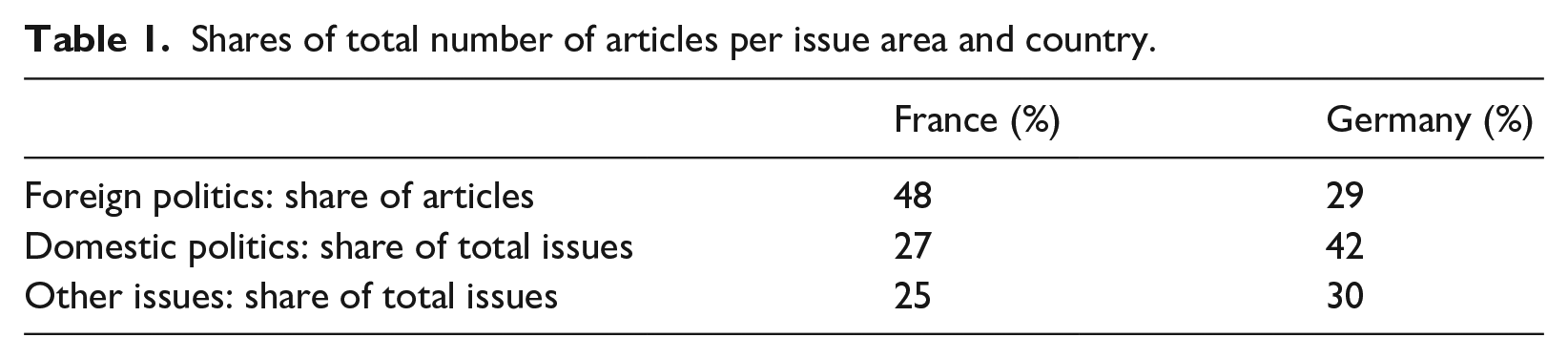
The hypothesis cannot be accepted. Although the case of France shows the assumed distribution with foreign politics forming 48 per cent of news coverage, media attention towards Germany focuses more strongly on domestic politics (42%) than on foreign politics (30%).
Hypothesis 2: Issue salience
Hypothesis 2 stated that issues within the political realm would be most salient to Arabic-speaking audiences in Europe as compared to issues in other realms. As salience is operationalized based on usage data, Table 2 presents the nominal shares of consumption weighted based on total online traffic directed towards the given outlets.
Weighted shares of total online traffic directed to the three topic areas per country.
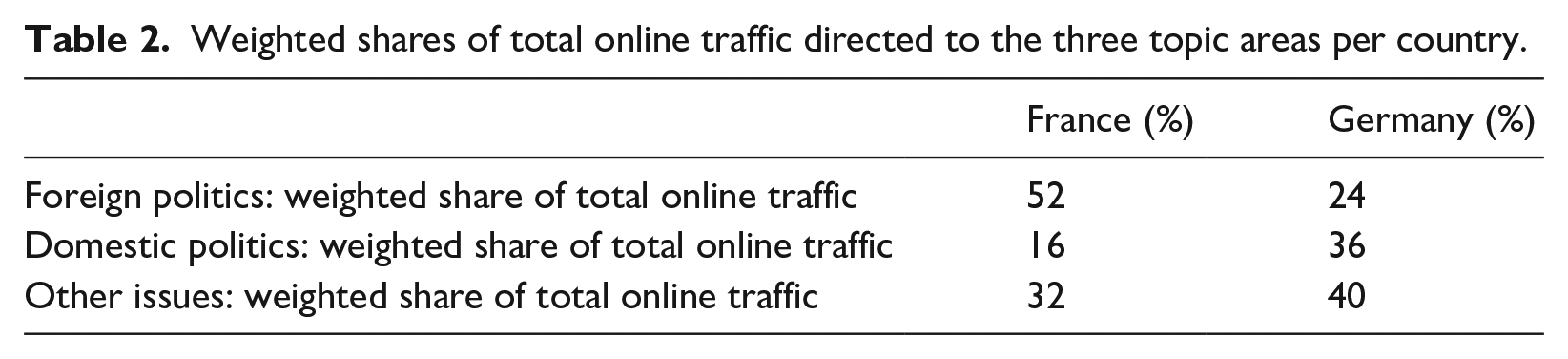
The hypothesis can be accepted. In total, 68 per cent of online traffic emanating from France and 60 per cent of online traffic emanating from Germany was directed towards Arab news outlets presenting articles in the political realm (foreign and domestic). Nevertheless, there are considerable differences between the consumption of news on foreign and domestic politics in the two countries: for Arabic-speaking audiences in Germany, domestic politics are far more salient than for Arabic-speaking audiences in France.
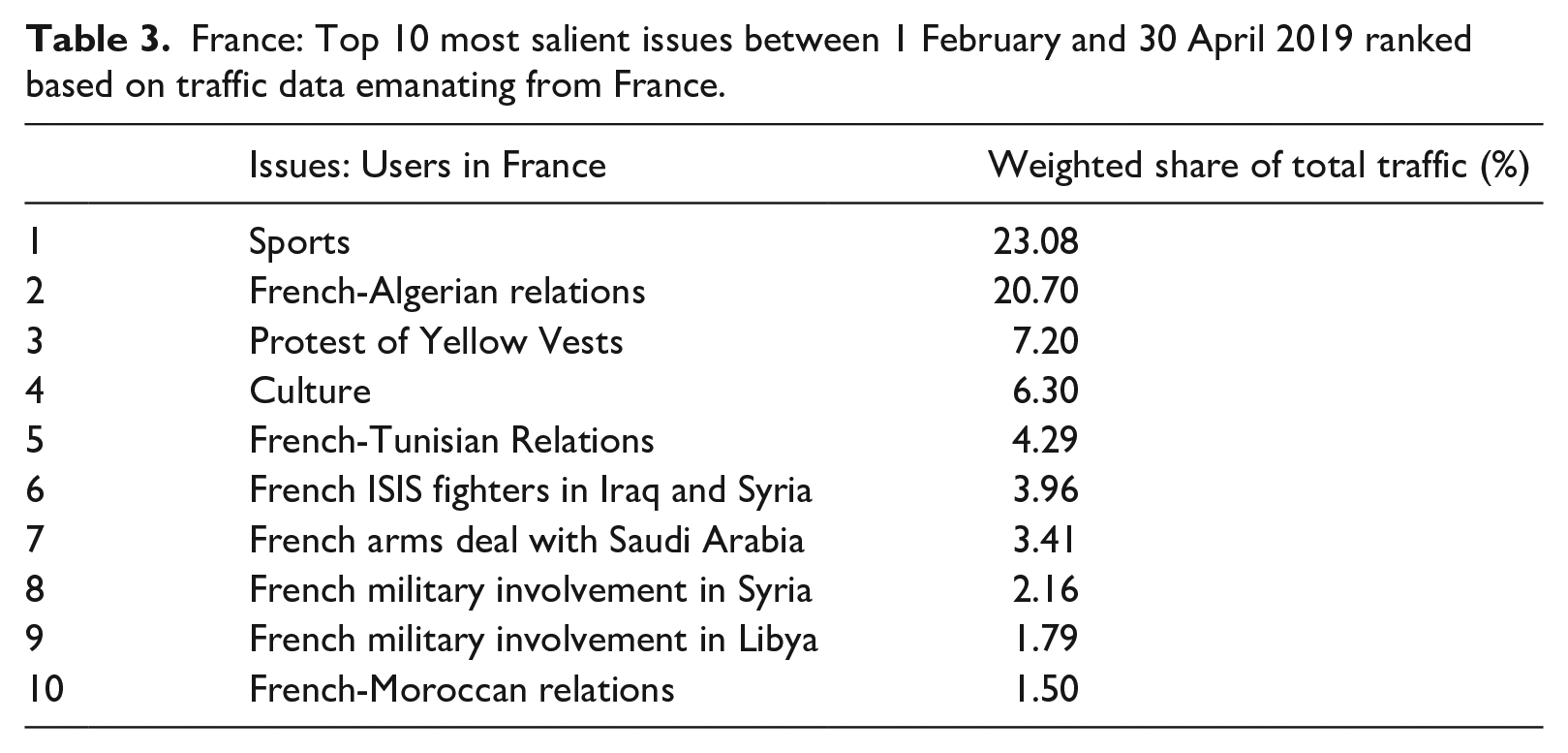
In order to gain a more detailed understanding of the content in the three issue areas, Tables 3 and 4 present the top ten most salient issues for the specific group of users living in the respective country (cf. Appendix, Tables A3 and A4 for the entire issue list, weighted shares and coding of issue areas).
France: Top 10 most salient issues between 1 February and 30 April 2019 ranked based on traffic data emanating from France.
Germany: Top 10 most salient issues between 1 February and 30 April 2019 ranked based on traffic data emanating from Germany.
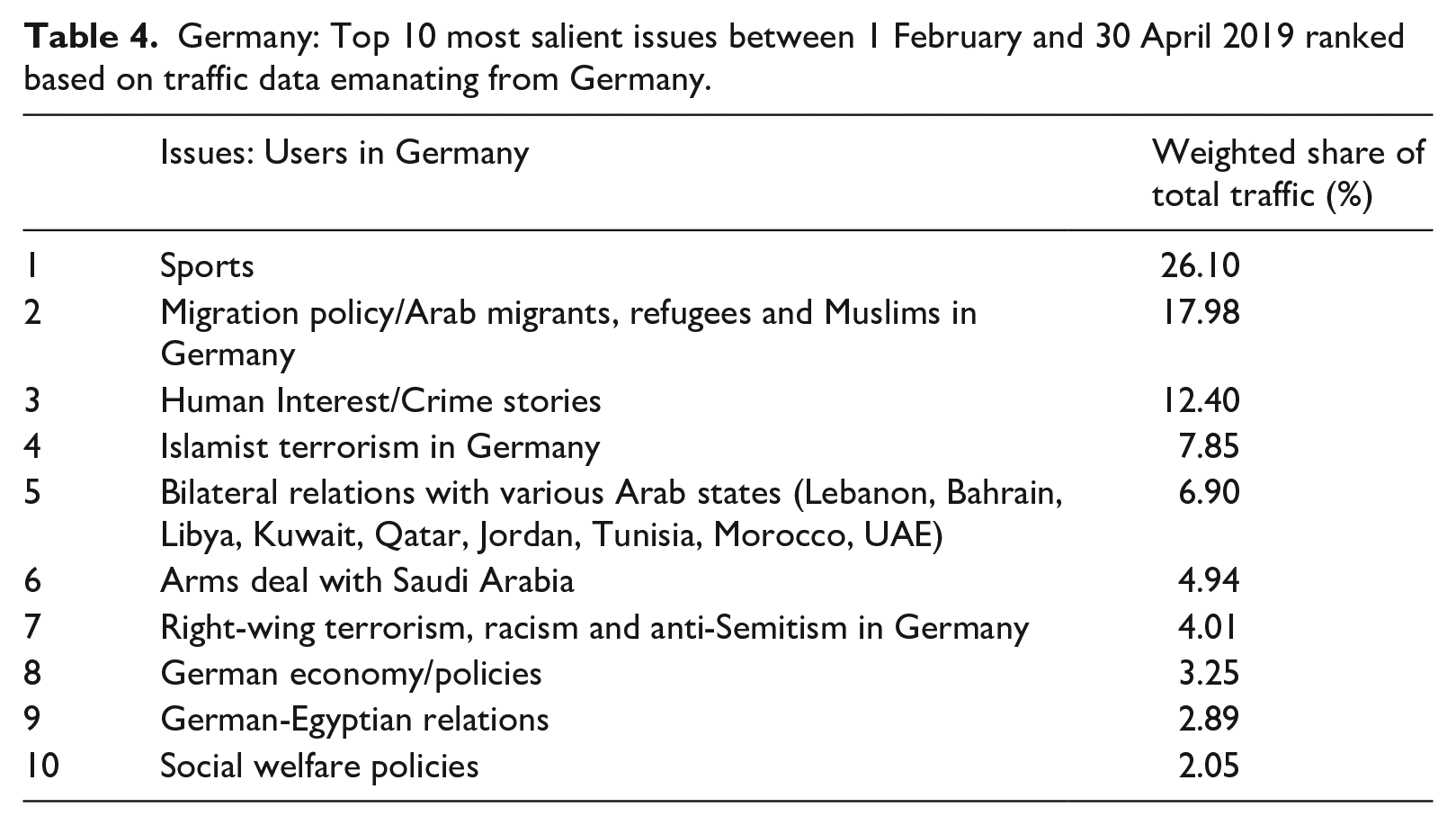
Interestingly and for both countries, it is news coverage in the realm of sports that attracts the largest audience. This could point at the specific interest of the audience group using online devices for news (younger generations), but also the generally high interest of Arabic-speaking audiences in sports that persists even when living outside the Arab region. The results show moreover the already outlined difference between the two countries when it comes to the relevance of foreign politics. France is salient through its political and military involvement in the Arab world, whereas Germany’s migration policies as well as Islamist terrorism in Germany attract more attention than bilateral relations with countries from the Arab world.
Hypothesis 3: Attributes
The two most salient domestic political issues were the demonstrations of the grass-roots movement called the ‘Yellow Vests’ in France and the issue of ‘migration policy’ in Germany. Figures 1 and 2 illustrate the word frequency analysis based on word clouds for the two text corpora (cf. Tables A5 and A6 in the Appendix for a list of the 50 most recurrent words for each corpus and their English translation).
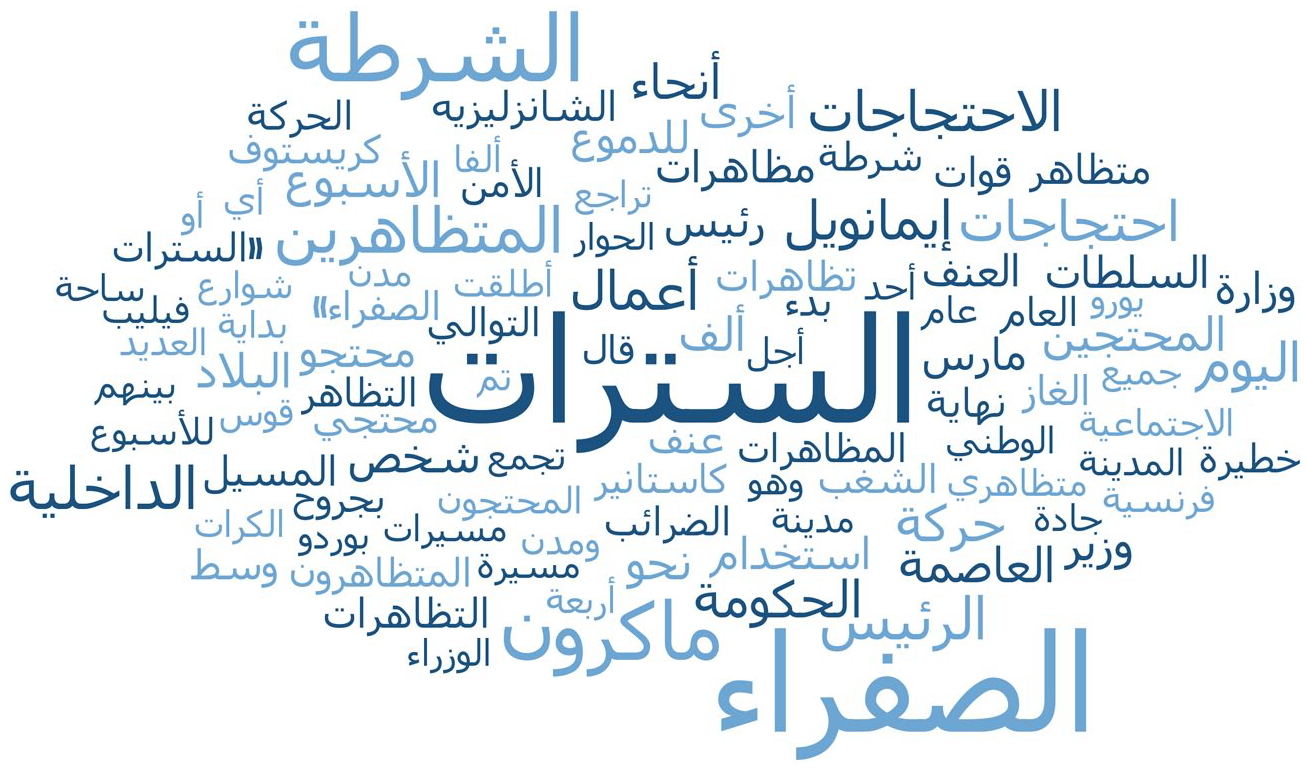
Word cloud depicting word frequencies in the issue area of the ‘Yellow vests’ (France).
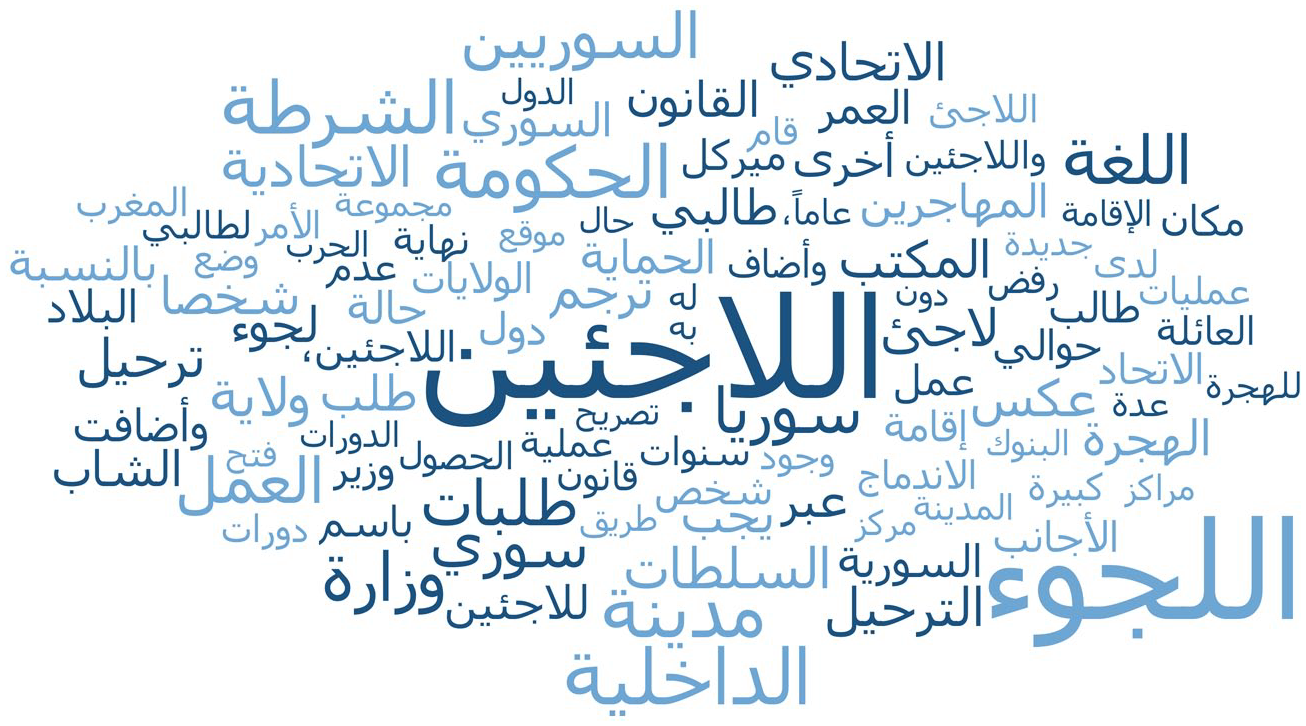
Word cloud depicting word frequencies in the issue area of ‘Migration policy’ (Germany).
Attributes, emotional perspectives and buzzwords
In general, and for both issues, attributes (qualifiers and adjectives) were scarce. The analysis shows the occurrence of few emotional perspectives or buzzwords, the perspective being oriented towards neutrality. When analysing the context of the present attributes and emotionally loaded words, the recurrent focus on violence and violent disputes is found to set a tone of conflict. In the French case, this can be attributed to the events, which were objectively violent. For Germany, migration is recurrently linked to disputes and crimes among or against refugees.
Reporting style and depth of information
Overall, both issues were treated in a reporting tone rather than in a thematizing way. Consequently, the bulk of the content evolved around event-based information, giving insights into the what, where and when of events rather than explaining the why. This even holds for the German issue concerning a broader societal phenomenon rather than actual events. Reporting on migration was also strongly event-oriented (e.g. changes in the law, deportations, new border restrictions, etc.).
The information transferred to the reader concerning the two countries thus varies. For France, little explanation was given on why the mass protests happened, merely stating that the demonstrators were demanding lower taxes. The broader societal context as well as the political affiliation of the movement (at the extreme margins of the political spectrum) were not thematized. For Germany, more substantial information was provided. Based on the analysis, it appears that Arab media orient migrants, and especially Syrian refugees, strongly in the functioning of the German asylum system. Nevertheless, the information remains selective with little context, allowing little insights into the importance of immigration from a German perspective or the international community. Information remains mainly technical and stands in harsh competition with the reporting on individual destinies.
The analysis sets out a general tendency found to hold for the two text corpora. It does not imply that thematizing and in-depth reporting on the two issues did not occur at all. It is more the case that, in sum, the bulk of articles are in a reporting tone and outweighs those contributions.
Actor nature and stakeholders
The most active part in reporting of both issues was attributed to state officials and the police. Other individuals, for example, civil society representatives or the individuals concerned, were subsumed under the collective name to which they belonged (‘demonstrators’, ‘migrants’, ‘youth’). Consequently, the discourses are marked by state officials (ministers, president, etc.) performing activities, as opposed to a large mass of unknown individuals. In this context, the role of the police, too, must be underlined. In both topic areas, Arab media scrutinize police action closely. For the French issue this is to be expected as the police were involved in containing the riots and blockades. In the case of the German issue, however, where the role of the police is less immediate, they nevertheless attracted attention in the context of violence against refugees.
Discussion
What outside perspective for those within?
The results on issues and issue salience have different implications for the two countries in understanding and actively shaping their relationships with their Arabic-speaking populations.
Based on the analysed media coverage, the Arabic-speaking audience perceives France strongly through its international agency, military involvement and bilateral relations with Arab states. In those fields of action, potential effects on the analysed subset of the Arab diaspora in France should be kept in mind. Domestic politics in turn attract the least online traffic. In addition, the offered information is very event-oriented, which may contribute to a lack of nuanced understanding of the French society and state based on Arab media consumption.
In the case of Germany, issues and issue salience concentrate more strongly on domestic politics. The two highest-ranking political issues concern migration in Germany and Islamist terrorism. Right-wing terrorism and racism (issue ranks 7 and 8, respectively) can also be understood as indirectly concerning the presence of Arabs in Germany. German domestic politics are thus portrayed based on issues in connection with Arabs living in Germany, and news serves, in contrast to the French case, as a potential source for understanding the immediate living situation of the Arab diaspora. Nevertheless, the relatively low salience of other domestic political issues conveys a one-sided image of German politics. To Arabic-speaking audiences in Germany, the country is depicted as a ‘host country’ for the immigrant Arabs, yet not in its functioning independent from Arab immigration.
Methodological implications and limitations
The analytical scope and methodological approach in this study are innovative because of their focus on a scarcely investigated topic, that is, the representation of resident countries to a given subset of the Arab diaspora in Europe, and its inductive collection of online media sources and content and the resulting definition of this subset based on a linguistic criterion. Relating to recent research on agenda-setting, the necessity of a link between salience based on the amount of media coverage and the usage data became apparent, especially in the context of the status of legacy media becoming increasingly contested (Maniou and Bantimaroudis, 2021; Vu et al., 2019).
This study is designed as a first exploration of media influence on Arabic-speaking groups in Europe by putting the spotlight on media content. As already outlined, the implementation of a linguistic criterion limits the analysis to a specific subset of the Arab diaspora in Europe. In accordance with the explicit focus on media offerings, the analysis cannot consequently provide insights into the media usage patterns of the entire diaspora group (which would include individuals unable or unwilling to deal with Modern Standard Arabic). The analysis is also not designed to give insights into the detailed media habits of given subsets of Arabic-speaking individuals in Europe, or media consumption patterns on an individual level. Web traffic numbers were accordingly used to put the importance of media coverage into perspective, rather than giving insights into media consumption behaviour. Further studies will have to cover these aspects on a more disaggregated level. Moreover, in order to take the next step following agenda-setting theory, media content analysis in combination with consumption analysis will have to be related with public opinion surveys among Arabic-speaking individuals living in Europe. Linking the two sides of the equation, and not just through the proxy of usage data, can give valuable further insights into Arab diaspora media consumption and the factors influencing the relationship of migrants and Arabic-speaking citizens with their countries and societies of residence. Further studies will also have to consolidate the findings of this paper by analysing news coverage on more issues, more European states and over a longer period of time in order to exclude event-driven biases.
Conclusion
Against the background of substantial Arab migration to Europe, and the centuries-old presence of Arab diaspora communities and Arabic-speaking European citizens, this paper shed light on an interesting aspect: Arab media consumption by Arabs living in Europe and the potential impact of this consumption on personal or public perceptions of the respective host countries. This approach considers the importance of transnational news consumption for diaspora communities in shaping not only their relationship to their countries of origin, but also the place in which they live currently.
The study of issues depicted two contrasting pictures for the two countries. France, the ‘old destination’ of Arab migration, is predominantly reported on based on its international agency. France thus shapes its mediated relationship to parts of its Arab diaspora largely abroad, as Arabic-speaking audiences in France consume the most information about France in this realm. This implies that the Arabic-speaking subgroups of French society get an outside perspective on French foreign policy and interventions. This perspective may potentially diverge largely from what media present in the same issue realms to the French national audience and thus potentially create friction. Germany, the ‘new destination’, got more media attention and a broader audience in the realm of domestic politics. Issues relating to migration, Islamist terrorism and racism attracted substantial online traffic. Arabic-speaking minorities in Germany thus get informed about aspects they are directly concerned by through Arab media. Given this focused ‘outside perspective’ on a selective range of issues, information on the domestic politics of Germany nevertheless strongly regroups around its dealings as a ‘host country’.
Given the overall limited depth of information presented in the media articles, that is, reduced occurrence of attributes and thematization, Arab media can be understood as a limited source of information on host countries. In line with the discussed lack of freedom of Arab journalism, reporting on the two countries was not oriented towards debate, the perspectives of the various actors or a discussion of background information. Single events, such as police violence or the deportation of refugees, are thus oftentimes communicated without an explanation of the causes, circumstances and potential future developments. To some extent, the reader is thus left without orientation on how to relate the presented information to the broader societal and political context. Given the discussed importance of emotion in cognitively shaping attributes and issue salience, this may lead to a one-sided understanding of the issues themselves and, by extrapolation, the entire society in which Arabic-speaking audiences.
Further studies will have to assess how far and how the discussed media characteristics impact personal perceptions and the public opinion of Arabic-speaking audiences in Europe, and how this impact interacts with opinion formation on the individual and on the diaspora group levels. Keeping agenda-setting research in the frame and considering the outlined findings, paying attention to Arab media content as source of information for a subset of the Arab diaspora in Europe can generate valuable insights. They can potentially assist in handling the challenges of migration for both Arab migrants and European societies, as well as in facilitating successful coexistence and exchange in the long term.
Footnotes
Appendix
Table A1 presents the total traffic numbers directed to the respective Arab countries, that is, the sum of clicks on the news sites in the respective country within the time period between 1 March and 31 May 2019.
Tables A3 and A4 present the full ranked issue lists for France and Germany based on the weighted share of total traffic each issue area attracted in general as well as from the respective country specifically. Issues marked in white belong to the foreign politics realm, the ones in dark grey to domestic politics, and the light gray marks issues belonging to other areas.
Funding
The author received no financial support for the research, authorship, and/or publication of this article.
