



Abstract
Various literature has examined how affordances of online media such as openness and connectivity have constituted digital counterpublics, that is, discursive arenas where members of subordinate social groups invent and circulate oppositional interpretations of their identities. At the same time, and in sharp contrast to the bilateral nature of online media, most of this literature has focused on content produced by the group members only, without addressing neither its acceptance by the hegemonic public nor the internal discursive negotiations surrounding it. Using the Facebook page “Write it down! I’m an Arab” as a case study, the current study examines the role played by reader comments in the formation of networked counterpublics. We found that reader comments expand the counterpublic sphere in two directions: vertical and horizontal. Vertically, they produce an interface between the dominant public sphere and the counterpublic sphere. Horizontally, they function as a discursive arena within the group members.
The rise of new media and social networks has been seen as especially conducive for subordinate social groups to bypass state and market controls and to construct alternative collective identities (Lee, 2018; Papacharissi, 2002; Renninger, 2015; Thorsen and Sreedharan, 2019). A wealth of literature has examined the way in which these groups harness the affordances of digital media, such as connectivity and openness, in favor of collective action and participation in social change, resulting in the formation of networked counterpublics—that is, parallel discursive arenas, constructed through networked technologies, where members of subordinate social groups invent and circulate counterdiscourses to formulate oppositional interpretations of their identities, interests, and needs (Chan, 2018; Dahlberg, 2011; Eckert et al., 2021).
Much of the literature on networked counterpublics tends to explore the discursive themes and practices produced by members of marginalized groups on social networks, for example, by analyzing Hashtag campaigns disseminating on Twitter, in which dominant discourses are opposed and counterdiscourses are articulated (Kaiser, 2017; Wonneberger et al., 2021). However, the discursive negotiations surrounding these counterdiscourses have been studied at significantly lower scales, although not completely abandoned (see, for example, Chan, 2018; Gallagher et al., 2018; Jackson and Foucault Welles, 2016; Lien, 2022; Toepfl and Piwoni, 2018).
This is a notable gap, as an exclusive focus on discourse in isolation from the dynamics of its social acceptance (or opposition) may miss the deeper discursive struggles that it often involves. Moreover, with specific reference to online discourses, an analysis of content produced by one party only ignores the bi-directionality inherent in the architecture of the Internet, which differs from the “monopoly of speech” (Salter, 2013: 226) that has characterized legacy media.
In this regard, reader comments, which afford different publics to communicate and competing discourses to be intersected (Kaiser, 2017), may provide a significant contribution to the formation of networked counterpublics. In what ways is this contribution made? Indeed, in recent years, there has been a proliferation of studies that have addressed user comments as networked counterpublics and examined their place in the public sphere (see, for example, Chan, 2018; Davis, 2018; Lien, 2022). However, a systematic analysis of how media affordances of user comments contribute to the formation and shaping of networked counterpublics is still missing.
The current study seeks to fulfill this goal by analyzing 1358 reader comments of Israeli-Jews and Israeli-Arabs published on the Facebook page “Write it down! I am an Arab,” a networked counterpublic of Israeli-Arab citizens, in which they share with the Israeli-Jewish public their experiences and feelings as an ethno-national minority who is politically, socially, and economically marginalized (Molavi, 2009).
The research question is therefore:
What is the role of reader comments in the formation of networked counterpublics?
Conceptualizing counterpublics
The notion of counterpublics was introduced by Nancy Fraser (1992) as a critical intervention to Jürgen Habermas’ (1989) conception of the “public sphere.” Rather than viewing the public sphere as a singular and inclusive space, in which access is guaranteed to all citizens who want to participate in political debates (Habermas, 1989: 73), Fraser (1992) suggests a multiple-spheres approach, and asserts that some publics are excluded from or subordinate to mainstream society based on unequal power relations (p. 23).
Counterpublics can be formed on the basis of political or religious beliefs, ethnic, class or gender background, or other constructed identities. What is common, however, is their similar engagement in counterhegemonic practices, which challenge the dominant discourse (Geiger, 2016). Counterpublics unite and mobilize subordinate social groups to find the “right voice or words to express their thoughts” (Fraser, 1992: 66) and to protest against the participatory privileges enjoyed by members of dominant social groups (Thorsen and Sreedharan, 2019).
In addition to their role in legitimizing and sustaining marginalized communities, counterpublics explicitly and strategically seek to challenge the “dominant knowledge” inherent in the mainstream public sphere (Jackson and Foucault Welles, 2015: 394). Counterpublics help communicate the narratives and experiences of marginalized groups to the mainstream public sphere and push the dominant public to acknowledge and respond to these lived realities (Eckert and Chadha, 2013).
In other words, counterpublics are oriented both internally and externally; they function as spaces of withdrawal and regroupment within subordinate social groups as well as bases for agitational activities directed toward the public at large (Fraser, 1992). Toepfl and Piwoni (2018) define these goals as “inward-oriented” and “outward-oriented.” Inward-oriented goals refer to the “invention, elaboration, and formulation of alternative identities, interests, and needs, which can be expected to be typically pursued in safe, secluded communicative spaces.” Outward-oriented goals are “the breaking up and shifting of consensus structures within dominant publics by engaging with wider audiences and targeting dominant publics with ‘counterpublicity’” (p. 2014). The digital age, and specifically the rise of social networks, has provided vast potential for fulfilling these two types of goals.
The networked public sphere and digital counterpublics
Prior to the emergence of the Internet, counterhegemonic voices found it difficult to penetrate, challenge, or surpass the public sphere. Most sources of information, debate, and opinion that constituted the public sphere were dominated by traditional mass media, which generally replicated mainstream political elite opinions and left consumers with little choice over content (Downey and Fenton, 2003).
However, with the advancement of the Internet, and particularly social media, the traditional top-down structure of information flow has eroded, and a decentralized, participatory logic has taken its place (Dahlgren, 2012). In this new logic, users have become both content producers and receivers in an enormously dense network of individuals and groups (Lee, 2018; Renninger, 2015). As a result, networked digital media contribute to fundamental changes in the formation of the public sphere, mainly due to their capacity to facilitate horizontal or civic communication (Downey and Fenton, 2003; Papacharissi, 2002).
Within this environment, a diversity of social groups can link up with each other for purposes of sharing information, providing mutual support, organizing, mobilizing, or solidifying collective identities (Dahlgren, 2012). In recent years, several authors have paid attention to the question of how networked counterpublics emerge and develop (see: Jackson and Foucault Welles, 2016; Kaiser, 2017; Kavada and Poell, 2021). Many of them adopt a media affordances perspective, according to which particular socio-technological characteristics and dynamics of online media shape how networked publics come to be experienced and enacted (Tiidenberg and Siibak, 2018).
Digital counterpublics and media affordances
Coined by American ecological psychologist James J. Gibson (1979), the concept of affordances was introduced into the field of science and technology to explore the interaction between individuals, organizations, and technology (Weber and Haseki, 2021). Affordances, then, are “possibilities for action [. . .] between an object/technology and the user that enable or constrain potential behavioral outcomes in a particular context” (Evans et al., 2017: 36). However, these possibilities belong neither to the technology nor to the user but to the interrelation between the purposes of the user and the capabilities of the technology.
The “middle way” it offers between technology-specific accounts and social constructionist accounts (Bimber and Gil de Zúñiga, 2020) has made the framework popular among communication scholars and has been broadly employed in describing people’s interactions with communication technologies, especially since the rise of digital media. From this standpoint, digital and social media afford political and civic actors expanded opportunities to act, and have thus become sites of political assembly, where political discourse, citizenship, and media are interwoven (Xu, 2020). Central features supporting this potential include the openness of networked digital media, interactivity, and accessibility, reflected by the absence of gate-keeping mechanisms (Jackson and Foucault Welles, 2015), which allow for the formation of publics on an “unprecedented temporal (very fast), spatial (geographically dispersed) and affective (strong, mobilizing sentiment) scale” (Tiidenberg and Siibak, 2018: 4).
These features also contribute to the formation of counterpublics. For example, Tremayne’s (2014) network analysis on the development of the #OccupyWallStreet movement demonstrates the networking affordances of social media and their ability to mobilize subsequent offline protests. By analyzing 3500 Facebook posts from the Ukrainian #IAmNotAfraidToSayIt online campaign, Lokot (2018) indicates that the use of a focused set of hashtags in a ritualistic pattern afforded users more opportunities for metavoicing and community building in reacting to personal stories of sexual victimization. Similarly, Jackson and Foucault Welles (2015) illustrate how the feature of retweeting allows porousness between publics.
As can be seen from these examples, much of the empirical literature on affordances and counterpublics has focused on the features of hashtags and retweets, illustrating how they facilitate the emergence and evolution of counterpublics. The present study asserts that reader comments, one of the most widespread practices of online participation and a central intersection between different publics (Kaiser, 2017), have no less significant contribution.
Research rationale and contribution
The existing literature on networked counterpublics has provided important insights into the dynamics of counterpublics’ formation and engagement online. Yet, this extant research has mostly described the discursive patterns by which dominant knowledge is contested and alternative claims are proposed (Kavada and Poell, 2021), while the dynamics of internal negotiations surrounding the formation of counterpublics have been given much less scholarly attention. This lacuna intensifies against the possible differences in the level of resistance to hegemony by different group members, as introduced by Nentwich and Hoyer (2013), who distinguish between “strong” and “weak” counterdiscourses: The former is in direct opposition to the dominant discourse, while the latter “is positioned in a rather co-optive relationship towards the dominant discourse and clearly lacks opposition” (p. 561). In other words, not all group members necessarily support the same discursive strategies for opposing dominant knowledge. Analyzing the communication between group members within a counterpublic may contribute to a better understanding of the meaning-making process of counterpublics.
Counterpublic communication may also be contentious in its interactions with the dominant public. Despite some change in recent years, most studies on networked counterpublics have neither analyzed how counterpublics are accepted nor opposed by the hegemonic public (Toepfl and Piwoni, 2018). Unfortunately, such a perspective neglects the outward-looking character of counterpublics as well as the fact that subordinate social groups create their own unique spaces within—and not entirely separate from—the dominant public sphere (Davis, 2018).
This dual research deficit is even more evident given that digital and social media are characterized by affordances such as reactivity and connectivity, which allow for the bilateral flow of information between different audiences (Xu, 2020). Thus, the present study will examine the role played by reader comments (written both by members of the dominant public and by members of the subordinate social group) in the formation of networked counterpublics. The case study selected to achieve this goal is the Facebook page “Write it down! I’m an Arab,” which is a counterpublic of the Arab minority in Israel.
Background: the Arab citizens of Israel
Israel is a multicultural society in which Jews form about 75% and Arabs about 21% of the total population (Myers-JDC-Brookdale, 2018). The Arab citizens of Israel 1 are the indigenous population of the land who remained in the newly established state after the 1948 War of Israeli Independence with the neighboring Arab countries. Unlike the Palestinians who lived in the territories occupied by Israel during the Six-Day War of 1967 and are under the civilian and security control of the Palestinian Authority (and in certain areas under Israeli military rule), about one and a half million Arabs are full citizens of the State of Israel. However, given that Israel is a self-defined Jewish state that recognizes no distinction either between religion and state or between religion and nationality, the Arab citizens of Israel are both a religious and a national minority (Smooha, 1990).
Since Jewishness is a “master status” in Israel—a basic condition for receiving citizenship and civil rights—it serves as a mechanism for broad discrimination against Arab citizens (Sasson-Levy, 2013), and pervades every level of Israeli society, from the private to the public sphere, and at social, legal, and political levels (Molavi, 2009). In addition, Arab citizens are subject to deep suspicion from the Jewish majority in regard to their relationship with the Palestinian national movement (Jamal, 2005).
Israel’s public sphere also maintains this situation. For example, most third sector organizations in Israel promote the interests of the Jewish public (Jamal, 2007); the Arab citizens of Israel are among the least represented groups in the Israeli mainstream media (Mendelson-Maoz and Steir-Livny, 2011); and the Hebrew language is dominant in all spheres of Israeli society (Molavi, 2009).
The Israeli-Arab counterpublic sphere and the Facebook Page “Write it down! I am an Arab”
These ongoing patterns of exclusion and discrimination have led the Israeli-Arab society to search for public spheres that counteract state hegemony, enabling them to influence the process of opinion making and cultural production in their society (Jamal, 2007). Consequently, an Arab counterpublic sphere has been developed, in which political and social movements and civic institutions have been working to expand the meaning of Israeli citizenship by demanding changes in the structure of the Israeli state that will bring about civic equality, and an adequate expression of the Arab identity in the mainstream discourse and public sphere (Jamal, 2005).
The vast majority of these counterhegemonic actions take place in the physical environment, for example through parties, civil society organizations, legal centers, joint committees, and research centers, as well as through the rise of private Arab media institutions and outlets, all representing an authentic search for new self-definition for the Arab citizens of Israel (Agbaria and Mustafa, 2012). However, in February 2020, a Facebook page named “Write it down! I am an Arab” was launched, which is a pioneering attempt to harness the online space for Arab civilian involvement that challenges the dominant Israeli-Jewish discourse, or, in other words, to form an Israeli-Arab networked counterpublic.
The page was established by Israeli-Arab activists in collaboration with Sikkuy-Aufoq Association, a shared Jewish and Arab nonprofit organization that works to advance equality and partnership between the Arab citizens of Israel and the country’s Jewish citizens (https://www.sikkuy-aufoq.org.il/). The name of the page is taken from a poem by Mahmoud Darwish, the Palestinian national poet and one of the most significant symbols of Palestinian national identity (Khnifess, 2016), and its stated purpose is to serve as a stage for Arab citizens who tell aloud and without apology what it is like to be an Arab citizen: [. . .] racism and discrimination [. . .], we are not only here to tell how difficult it is but to raise our situation to public awareness and fight for our place [in an attempt] to reach the mainstream media as well. (https://www.facebook.com/TirshomAniAravi).
As can be understood from this definition, the page meets all parameters of networked counterpublics, which, as Kaiser (2017) highlights, can be defined as: (1) structured around a specific issue that is morally or politically polarizing and that has the power to shape a group’s identity, (2) opposed to the dominant hegemony within this discourse, (3) marginalized and/or excluded from the dominant public discourse, and (4) with its own influential media outlets or online sites/platforms.
The page features videos of Arab citizens who share their feelings and experiences on a variety of issues with the Israeli-Jewish public in Hebrew, hence can be more specifically defined as “an outward-oriented” counterpublic (Toepl and Fiowni, 2015). These include their feelings during a strict security check (e.g. at the Israeli airport), dealing with racist remarks, and difficulties of integrating into the general Israeli society.
As of this writing, the page has over 14,000 followers. The page received considerable media coverage in the Israeli media, in the Arab-Israeli media and also in the pan-Arabic media (e.g. on the Al Jazeera network). Every video posted to the page has elicited between tens and hundreds of responses from Jewish and Arab commenters, which constitute the research population.
Methods
Data collection and sampling
The sampling method consisted of several steps. First, a list was compiled of all the videos published on the page during the month of February 2020. Of these videos, only the videos in which Arab speakers shared their personal experiences and feelings were selected for analysis (e.g. videos explaining Arab customs such as Ramadan fasting, or news items covering the page were filtered out). Subsequently, all comments responding to these videos were collected using a .Net code (C#). For each individual video, 20% of all comments were randomly sampled, including threads. A total of 1358 comments to 21 videos were analyzed, 49.3% of which were written by Israeli-Arabs and 50.7%—by Israeli-Jews. A commenter’s identity (Israeli-Arab vs Israeli-Jewish) was determined by his or her name and language of writing. In the vast majority of times the identity determination was unequivocal. In three cases where the author’s identity could not be determined; the responses were omitted from the analysis.
Procedure
A thematic analysis approach was employed to analyze the comments. We followed the six phases of thematic analysis presented by Braun and Clarke (2006): becoming familiar with the data, generating initial codes, searching for themes, reviewing themes, defining and naming themes, and producing the report.
To gain familiarization with the data, the author (who is an Israeli-Jew) and three research assistants (undergraduate students aged 23–26, with previous experience in content and thematic analysis; one of whom is an Israeli-Jew and the other two are Israeli-Arabs) read and re-read all 1358 comments in the dataset. Since the researcher and the Jewish research assistant are not fluent in Arabic, the Arab research assistants—who are fluent both in Hebrew and Arabic—translated the Arabic-written comments into Hebrew. In this way, the researcher and three research assistants could read and code all comments.
To enhance the study’s credibility, the author discussed definitions of categories and themes with the research assistants, as well as interpretations of meaning. Based on these discussions, an initial coding schema was developed by which every comment was coded. Codes were not mutually exclusive, as comments were coded under multiple categories where appropriate. In cases where a comment didn’t match any of the coding categories, it was classified as “other.”
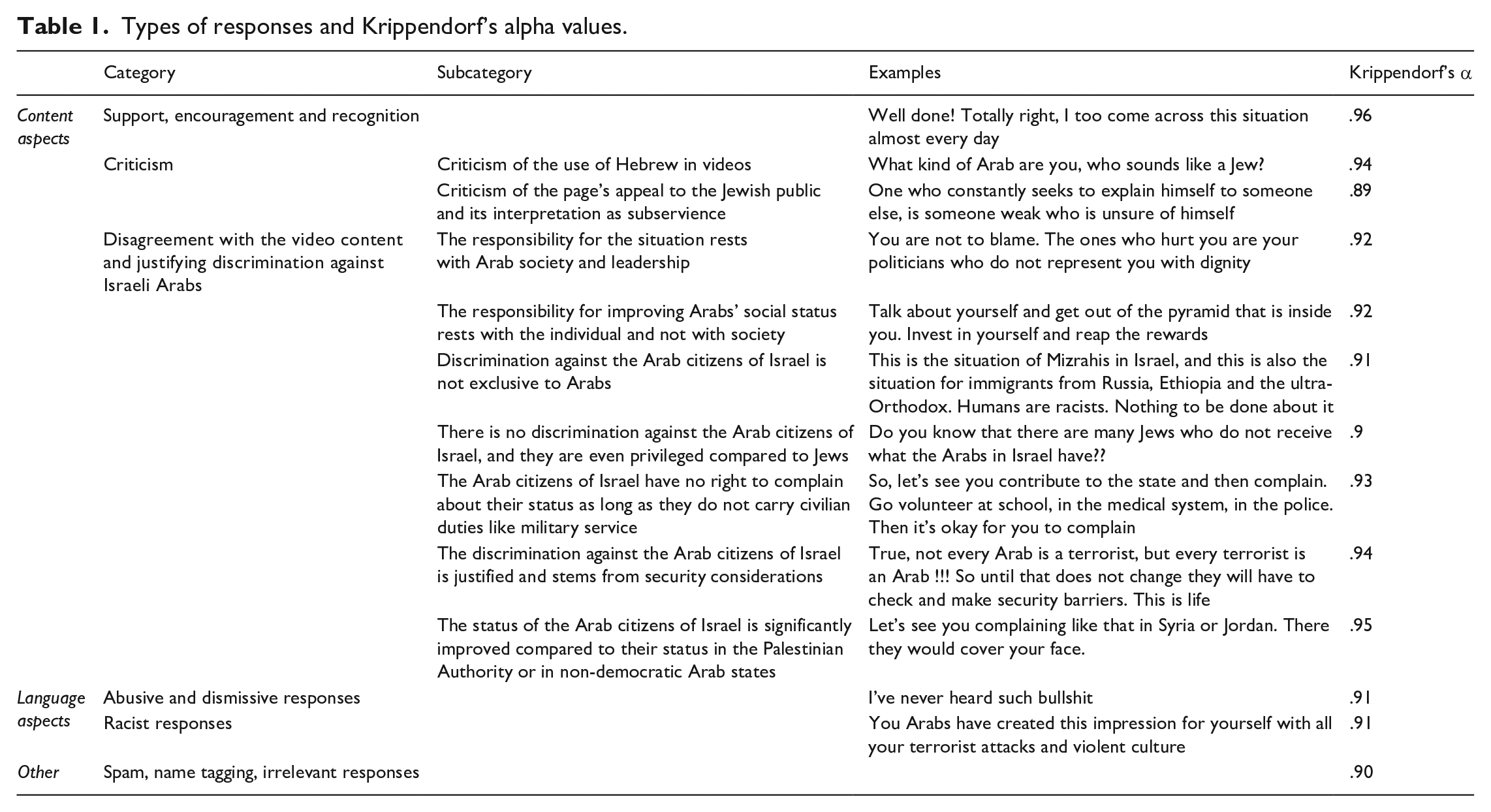
During the first phase of the coding process, the author and research assistants coded 100 comments together. Discrepancies between them were resolved by consensus. Next, all four evaluators coded 300 identical comments independently. Krippendorff’s alpha values were calculated, which ranged between 0.89 (“criticism of the page’s appeal to the Jewish public”) and 0.96 (“support and encouragement”). Then, the four evaluators continued to code the entire data set according to the agreed-upon coding schema. Table 1 summarizes the definitions and Krippendorff’s alpha values for each category in the coding schema.
Types of responses and Krippendorf’s alpha values.
After dense coding, the dataset was collated into potential themes. Data was analyzed by the author and the research assistants until new themes did not continue to emerge and saturation was reached. The researchers worked independently in the identification of themes, and several conversations took place to discuss them until a comprehensive understanding of the underlying patterns within the data had emerged.
Ethical considerations
The study didn’t involve human subjects directly, but rather the content they produced on social media. Data collection procedures followed the ethical merits of Internet-based research using publicly available data only and maintaining user anonymity (Bogen et al., 2018). The study cites comments written on the page without any identifying marks. Thus, it was considered exempt from institutional review board (IRB) approval and no formal informed consent process was required. However, the author contacted the page webmasters in order to get their approval to analyze the page content.
A thematic analysis of Jewish-Israeli reader comments
Theme 1: dismissing Arab claims
The most common response among Jewish-Israeli commenters (39.3% of responses) was to dismiss Arab allegations in an abusive way, which was also accompanied by racist expressions: You and anyone who participates in these videos is a liar. Well, what can be expected of you? [. . .] stupid! It’s better you shut up.
The offensive allegations, which reflect an Israeli-Jewish superiority over the Arab population and reproduce the Israeli-Jewish hegemonic discourse, were substantiated in a number of ways. The most common among them (13% of responses) was that criticizing Israel was disloyal and ungrateful: For over 70 years you have only been crying [. . .]. We want to vomit you out not because you are Arabs, but because you are ungrateful! You enjoy all the rights that the state grants, yet bite the hand that feeds you. As a people who are so strict about “honor” you do not deserve respect because you do not respect those who are good to you and lie without shame.
According to several commenters, Arab “ingratitude” is intensified due to the very existence of the Facebook page “Write it down! I am an Arab” being made possible by the freedom of expression allowed in Israel. This claim emphasizes Israel’s democratic regime, but ignores its discriminative characteristics. 14.1% of the Jewish-Israeli commenters retorted that ungrateful Arabs should therefore go live in the Palestinian Authority or other Arab dictatorial states: You are more than welcome to leave our “dear” country [. . .] enough to whine and to be ungrateful [. . .] there are countries that would have forced you to put a veil on your face. So it’s hard for you here in our democratic country that lets you talk nonsense freely?? You can choose to live in one of the many countries around us and then we’ll see if you keep talking the same way.
For 8.6% of Jewish-Israeli commenters, not only is the status of Israeli-Arabs good compared to citizens in Arab countries, but they are also privileged compared to the Jewish citizens of Israel: Every word that comes out of your mouth is incitement against the state. You get even more rights here than Jews. You do not serve in the army, you are easily admitted to university, you evade taxes. And despite all that you choose to whine.
In addition, 4.4% of commenters expressed an expectation that the Arab citizens of Israel would “balance” their privileged status by contributing to the Israeli state, for example, through service or civic volunteering: Do you want equality? Then serve in the army or at least in national service and be loyal to your country. It is impossible to oppose the state on the one hand and to demand rights from it on the other. Go volunteer at school, hospital, police. Then you can come up with complaints.
These commenters asserted that rights cannot be claimed without fulfilling civic obligations, reflecting an ethnorepublican citizenship discourse (Peled, 1992), in which the functioning of civic virtue (i.e. the fact that the Arab citizens of Israel are not recruited to the Israeli army) serves as a mechanism of ethnic exclusion.
Theme 2: justifying discrimination against Israeli Arabs
Large parts of the Israeli public have traditionally congratulated themselves on being a resilient democracy in the face of the myriad pressures emanating from security needs (Rouhana, 2006). Hence, as many Arab speakers described their hard feelings during the security checks they had to go through, it is not surprising that 19.6% of the commenters suggested an alternative perspective that justified discrimination against Arab citizens on security grounds: I do not justify any discrimination, but the root of the discriminatory treatment of Arabs does not stem from racism but from security motives. In light of the situation that every Arab decides to leave home and stab, I think it is possible to understand why certificates are checked.
It should be noted that at the same time as justifying discriminatory policy, several Israeli-Jewish commenters expressed empathy for the inconvenience suffered by Arab speakers. However, most commenters who used the security reasoning treated the discrimination as a sad yet unchangeable reality: I put myself in your place and I get upset. But unfortunately, there is a very dismal security situation which is impossible not to mention when talking about painful cases of this kind.
Some commenters even expressed a reverse expectation that Arab speakers would understand the Jewish point of view. However, this reflects their difficulty to acknowledge the Arab narrative and “a zero-sum game” perspective: You call us brainwashed and on the other hand ask for a complete understanding of your narrative, and then you are surprised that we do not want to hear it. This is a tango, my friend.
Two additional justifications for the low status of the Arab citizens of Israel appeared in the responses. First, 5.2% of Israeli-Jew commenters claimed that the blame for the situation rests with the Arab public and leadership: I agree with every word you said and with the need for improvement. Only, unfortunately, Arab society has respectfully earned the stigmas against it. [. . .] There are facts, which the Arab sector denies, and continues to blame others, instead of checking what can be fixed.
Second, 4.9% of respondents claimed that the discrimination and racism were not directed exclusively at Israeli-Arabs, but also at other minority groups, including Israeli-Jews: Dude, you just described what it’s like to be Mizrahi
2
in Israel, no matter where you come from. So, from one Mizrahi to another, enough with that self-victimization. A cultural society is not a bad thing.
This type of response normalizes the discrimination against the Arab citizens of Israel and trivializes their feelings.
Theme 3: recognition of the Arab narrative
Along with opposing and dismissive responses, there were also supportive and encouraging responses, albeit on a small scale: 13.1% of Jewish-Israeli commenters expressed support for the page and its goals. The vast majority of responses were general compliments and encouragement, such as “Well done” or “Thanks for sharing,” while others were more specific, referring directly to the content expressed by the Arab speakers, such as: “Although it hurts to hear, I’m glad you’re voicing your pain” or “No, it does not upset me that you are who you are. On the contrary, glad you are here with us!”. The most supportive commenters even tried to protect the Arab speakers from the abusive reactions of other Jewish-Israeli respondents I read the comments here and my heart is broken [. . .] to be afraid of every Arab, is this the life we choose for ourselves? A person shares with us his difficult personal experience. [. . .] Once for a change try looking through the eyes of the other [. . .]. Please, try to respond more sensitively.
By expressing empathy and denouncing the abusive responses, the Israeli-Jewish commenters have acknowledged the experiences described by the Arab speakers and legitimized them. The author of the following comment, for example, who signed her remarks with the phrase “fuck with them” (Author’s emphasis), referring to security checkpoints at Israel’s national airport, even positioned herself on the Arab side: Thank you for the brave and honest sharing [. . .] what shocks me the most is that it is not new to me, everyone knows that Arab citizens are harassed every day at the airport. It is so fucked up and I admire you for the tolerance with which you told your experience. Fuck with them.
Another respondent apologized to the Arab public for the racism “that the racists of my people, who have themselves become victims of racism for generations, are demonstrating against you.” However, as mentioned, this type of response was rare compared to the abusive and dismissive responses.
A thematic analysis of Israeli-Arabs’ reader comments
Theme 1: encouragement and support
The most common responses among Israeli-Arab commenters were support and encouragement; 46.1% of the responses complimented the speakers (“You are the best!”), encouraged (“Proud of you. Well done!”) and congratulated (“May Allah bless you”) them. A lower rate of comments (15.2%) justified the speaker’s claims or reinforced them by sharing a personal story (“You are right. This is our daily reality. Happened to me also too many times”) or by writing the phrase “Write it down! I’m an Arab,” which expressed connectedness and identification with the page goals.
Theme 2: “Write it down! I’m a whiner”: perceiving the page as subservience to the Jewish public
Despite the dominance of supportive responses, criticism was also evident among Israeli-Arab commenters, as well as offensive expressions. The main criticism dealt with the page orientation, which was directed toward the Jewish public. In the eyes of 12.5% of Arab commenters, the page’s appeal to a Jewish audience signifies weakness and inferiority: The fact that people say what it is like to be an Arab in Israel shows weakness, surrender, laxity. [. . .] There is no need to explain to the warden how the prisoner feels. For God’s sake, I do not understand what the purpose of this initiative is? Should we justify our human existence on earth ?? We do not have to prove anything and we do not have to convince anyone. The page name should be “Write it down! I’m a whiner..”
Thus, like the Jewish commenters, many Arab respondents dismissed the speakers’ claims and perceived them as “whining.” Moreover, according to 5.2% of them, by sharing experiences that position Israeli-Arabs as victims, the page perpetuates their low status and relieves responsibility from Arab society: To be an Arab is to understand that 90 percent of the problems we experience every day come from the home, neighborhood, street and community in which we live, and that we drag them with us [. . .] and blame others for them. To be an Arab is to stop complaining, to stop whining and start acting.
According to this approach, change in Arab society should grow from within and not from without.
Theme 3: “You think you’re Jewish and you speak like one”: criticism of the use of the Hebrew language
A derivative of the claim that the Facebook page “Write it down! I am an Arab” is bowing to the Jewish public and thus preserving the power relations in Israeli society concerned with the choice of Arab speakers to use the Hebrew language. This choice was made consciously by the page administrators with the aim of “fighting delegitimization and incitement [. . .] and reaching the general public, who do not know and understand what ours seems to take for granted” (https://www.tirshomaniaravi.info). On the other hand, 7.9% of the Israeli-Arab commentators, interpreted the use of Hebrew as a renunciation of Arab identity and subservience to Jewish society: How do we want to present our existence when we express our situation in Hebrew? An Arab who acts artificially to hide his Arabness is a person who has no personality.
Many of them resented the accents of the page participants, who, according to the Arab commenters, were artificial and tried to resemble the Jewish form of speech: Your way of speaking reflects your state of mind. You think you’re Jewish and you speak like one.
The issue of the “Jewish” accent also served as a central object of ridicule. 12.3% of the comments written by Israeli-Arabs were offensive and disrespectful: And you like run? And they like walk away? And you like Calm down, I’m just an Arab with a hijab who does not bomb anything but my Ashkenazi R because I desire to be an Israeli and not to blow myself up. I am a good dog woof.
These responses referred to the attempt to make the experience of the Arab minority accessible to the Jewish public as a renunciation of Arab identity. Instead, the Israeli-Arab commentators claimed distinctiveness, seeking to affirm the specificity of their own identity.
Discussion
Using the Facebook page “Write it down! I am an Arab” as its case study. The current study examined the role played by reader comments in the formation of networked counterpublics. The findings indicate that reader comments expand the boundaries of the counterpublic sphere in two directions: vertical and horizontal. Vertically, they produce an interface between the dominant public sphere and the counterpublic sphere. Horizontally, they function as a discursive arena within the counterpublic.
Reader comments as a vertical conduit for information flow: the penetration of the dominant discourse into the counterpublic space
Traditionally, counterpublics have been understood as “parallel discursive arenas” (Fraser, 1992: 67), separate and somewhat autonomous from the hegemonic public sphere, where members of subordinate groups could participate in their own kind of collective sensemaking, opinion formation, and consensus building. (Geiger, 2016). It is in such spaces that marginalized groups can be free of “the supervision of dominant groups” and thus find the “right voice or words to express their thoughts” (Fraser, 1992: 66). However, the present study found that by using the interconnected network structure of reader comments, Jewish-Israeli users infiltrated hegemonic discourse into the counterpublic and thus harmed its distinctiveness as well as the liberating and transformative power it holds (Harmer and Lewis, 2022; Milioni, 2009).
The page “Write it down! I’m an Arab” is an “outward-oriented” counterpublic that aims at extending the public sphere by contesting the Jewish-Israeli hegemonic position. However, most of the Jewish-Israeli commenters sought to undermine the legitimacy of the Arab counter-discourse through silencing the Arab speakers, dismissing and sometimes trivializing their claims. Thus, not only did the digital counterpublic not necessarily fulfill its goal “to influence, challenge, and rewrite dominant public narratives” (Jackson and Banaszczyk, 2016: 392), but the abusive reactions of Jewish-Israeli users reproduced the hegemonic power relations in the counterpublic.
Moreover, from an Affordances theory perspective, comment sections “offer emerging counterpublic collectives one key opportunity: that of contesting the discursive boundaries of mainstream public spheres and of breaking up the hegemonic structures of democratic “publics at large” (Toepfl and Piwoni, 2015: 469). The present study indicates, however, that reader comments can also reverse the flow of information and constitute a hegemonic discursive space. The infiltration of hegemonic discourse into a counterpublic space through the comments of Jewish-Israeli users undermines the transformative capacity of the counterpublic and reaffirms the hegemonic social order. In other words, networked counterpublic spaces are alternative arenas where inequalities and exclusion can be eroded but also reinforced.
Reader comments as a horizontal conduit for information flow: internal negotiations on the counterpublic formation
In addition to external opposition to the page, which was expressed through the comments of Israeli-Jews, the Arab counterpublic also experienced internal opposition. Although most of the comments written by Israeli-Arabs supported, complimented, and encouraged the page participants, a significant portion of Arab commenters sharply criticized the page, claiming it reflected a weak and inferior position and affirmed the existing unequal power relations in Israeli society. Thus, the comments of the Arab respondents served not only to consolidate and strengthen the Arab collective identity but also to negotiate and question it.
In recent years, there has been a proliferation of studies challenging the concept of the singularity of the counterpublics as developed by Fraser, showing that multiple counterpublics can exist within each marginalized community. The study by Jackson and Banaszczyk (2016), for example, which analyzed the discursive and political power of the hashtags #YesAllWomen and #YesAllWhiteWomen, illustrates how feminist counterpublics use Twitter to produce feminist frames about violence against women while simultaneously engaging in community debates about race and inclusion (p. 393).
Similarly, the current study found that the comments of Arab respondents constituted a space for resistance to be nurtured within the Arab counterpublic, in which both shared and diverging identity-based points of view were present. In this sense, the comments of Arab respondents enabled the existence of what Nentwich and Hoyer (2013) define as a “strong” counterdiscourse, which is characterized in direct opposition to the dominant discourse, while a “weak” counterdiscourse “is positioned in a rather co-optive relationship towards the dominant discourse and clearly lacks opposition” (p. 561).
Felski (1989) describes counterpublics as critical oppositional social forces claiming distinctiveness against the dominating mainstream public sphere. It is likely that the harsh opposition to the page by many Arab respondents stems from this attribute. The Arab commenters did not object to the page’s aim, but to its implementation strategy, that is, addressing the Israeli-Jewish public in their own language. This objection represents internal discourse among the Arab-Israeli minority, which in recent years has discovered alternative spheres for expressing opinions and ideas without having to gain access through the hegemonic Jewish gatekeepers (Jamal, 2007).
As social media increasingly involves masses of users, national political issues and relations play a key role in online contention and debate more frequently than in the past (Kavada and Poell, 2021). The Arab commenters signified the ongoing negotiation among the group members to define and redefine counterpublic narratives from their respective standpoints (Jackson and Banaszczyk, 2016). Within this process, reader comments serve as a space for widening the (counter) public debate.
Summary and conclusions
A main aim of the counterpublic is the deconstruction of dominant discourses and the strengthening of a sense of collective identity among participants (Toepfl and Piwoni, 2015). In recent years, extensive literature has found that social networks constitute a discursive space that contributes to the realization of these goals through affordances such as accessibility and connectivity (Jackson and Foucault Welles, 2016; Kaiser, 2017; Tiidenberg and Siibak, 2018). In the present study, however, it was found that, in addition to their deliberative role of promoting democratic discussion and deliberation around socio-political issues, reader comments were often used to question, negotiate, silence, oppose, and even undermine the legitimacy of the Arab counterpublic both from within and without.
Thus, our first conclusion is that the affordances of reactivity and interactivity not only play a liberating role for networked counterpublics but also an exclusionary role, and that power and gatekeeping are still inherent in public discursive spaces. Our second conclusion is that reader comments also widen the internal boundaries of the counterpublic space by allowing distributed forms of contention (Kavada and Poell, 2021) between the members of the subordinate social group over their identity, narratives, and goals. As such, the present study reinforces recent literature that challenges the conceptualization of counterpublics as monolithic and homogeneous and suggests that they are dynamic and multiple.
It should be clarified that our findings do not question the importance of counterpublics in constructing the identities of subordinate social groups and in broadening public debate. Nevertheless, the study argues that focusing on content produced by members of the subordinate social group only, without addressing neither its acceptance by the hegemonic public nor the internal negotiations surrounding it, reduces the counterpublic to a structure instead of a process and imposes a media logic that characterizes traditional media on a hybrid environment in which content producers are also consumers, and vice versa. Instead, the current study shows that public-counterpublic relations are bilateral and that networked counterpublics are not homogeneous or static but subject to ongoing negotiations, both internally and externally.
Future directions and study limitations
How much impact does the negotiation described above have on the majority-minority relationship in the real world? Do simultaneous and diverging discourses within counterpublics reduce their influence on contesting the discursive boundaries of mainstream public spheres? How are reader comments perceived in the eyes of members of the minority group and members of the majority group, and do they also represent public opinion outside the digital world? And does the discursive dominance of certain publics vary and change over time as a result of the activities of counterpublics? These questions are beyond the scope of the present study, which focused on the online sphere only. Examining them in future studies (e.g. by concentrating on the media representation of the Facebook page “Write it down! I’m an Arab” in Israeli and Arabic media, or through interviews with the page’s participants and commenters) can place the current research findings in a broader context of public-counterpublic relations.
Finally, two matters concerning the external validity of the study should be discussed: First, the current study focused on a counterpublic operating on Facebook. Reader comments on other platforms, such as blogs, which replicate the environment of the traditional offline alternate publics in several ways and create the illusion of privacy for the participants (Steele, 2018) or Twitter and Instagram, which connect users via hashtag or by following certain accounts (Bossetta, 2018), may play other roles in the construction of counterpublics.
Second, although this case meets the parameters of counterpublic, it may also be characterized by unique characteristics that reduce its external validity. For example, the fact that the page’s administrators have created an outward-oriented counterpublic that appeals to the dominant public in its language might have contributed to particularly hostile reactions from Israeli-Arab respondents. Similarly, it is possible that national minorities evoke harsher reactions from the dominant group members than ethnic minorities, for example. Thus, an examination of the role played by reader comments in other counterpublics (both inward- and outward-oriented) is required.
Footnotes
Funding
The author(s) received no financial support for the research, authorship, and/or publication of this article.
