



Abstract
Taking Egypt as a case study, this article examines the relationship between social media and Habermas’ public sphere and public space in less democratic settings. Using a survey of Tahrir Square protesters and process tracing to examine 18 years of social media use, the article proposes a theoretical model highlighting the role of social media in carving out an eventful public sphere, despite the lack of public space to promote communicative action in authoritarian settings. Unlike the process described by Habermas, which takes place in democratic societies, the narratives presented in this study reveal a different pattern of communication which centers around an event through which larger issues are discussed within a defiant space. This happens through initiating conversation and drawing attention to the event, engaging counterpublics, establishing links of affinity, and possibly, calling for action. Factors influencing the success of an eventful public sphere under state control include the nature of the event, its effect on the publics, the public’s affinity to the event, potential social or cultural resistance, the amount of risk involved, and the potential scope of participation.
Keywords
Researchers have attempted to explain the role of social media in the string of revolutions and uprisings that swept the Arab World in 2010–2011 through various theoretical frameworks. Foremost among these are mobilization and/or social movement theories, much of which is versed in Habermas’ (1962/1989, 1974) concept of the public sphere. Habermas (1962/1989) conceptualized the public sphere as the space between individual citizens and the state. It is a space where freedom of thought and expression exists, where people discuss and debate issues of public concern openly, form a public opinion, and communicate their ideas to the state with the aim of influencing state action.
While the classic Habermasian ideas were formulated and studied within the context of free democratic societies, research tackling the public sphere in less democratic settings has been scarce. This article fills a gap in the literature through examining how the concept of the public sphere plays out in more authoritarian contexts, where public space might not even exist and journalism is state controlled. Taking Egypt as a case study, the article traces the process by which social media carved out a public sphere amidst a lack of freedom of thought and expression. The study proposes a theoretical model of the interplay between the public sphere, social media, journalism, and public space in authoritarian settings. It argues that change agents in Egypt used social media to peck at the borders of state control, forcing their way into creating an online public sphere, which, with the help of other factors, turned into the ultimate occupation of offline public space that toppled a dictator who had ruled Egypt for 30 years. The article discusses the factors that facilitated this process, as well as those that led to its reversal.
The Public Sphere: Classic, Virtual, Eventful
The classic Habermas (1974) public sphere is a free and inclusive space where information deliberation takes place within a democracy. The sphere is accessible to the public, and the resulting public opinion seeks to influence state power (Figure 1). Journalism is part of the public sphere to the extent that its agents engage in political debate, and exercise their role as a Fourth Estate in holding political power accountable to the people through what Habermas called critical scrutiny (Garman, 2019). Journalism has a critical role to inform, engage, protect public interest, and watch over power. The inclusion and independence of the public sphere would counterbalance journalistic attempts to sway public opinion.

Public space, public sphere, journalism, and the state in a democracy.
Fraser (1992) argued that the public sphere is populated by “subaltern counterpublics,” forming discursive arenas “where members of subordinated social groups invent and circulate counter discourses to formulate oppositional interpretations of their identities, interests, and needs” (p. 123). Through discursive contestation, they engage in the formation not only of public opinion but of identity for their respective publics. As societies are stratified, individuals will engage in one or more counterpublics, adding to the diversity of the public sphere.
But perhaps nothing has contributed to the diversity and inclusion of the public sphere more than the creation of the Internet, and specifically, interactive platforms or social media. Marshall (2004) noted that the Internet offers “a new transformation of the public sphere” (p. 53). Jones (1997) argued that the Internet formed a “new public space” that is “made by people” (p. 31). However, Dahlberg (2007) argued that the mere presence of the Internet as a space is not enough for the creation of a democratic public sphere. Rather, an effort needs to be made to encourage different counterpublics to use the space (online and offline) to form identities and articulate varying discursive contestations in order to be able to foster a robust public sphere. Along the same lines, Papacharissi (2009) noted that “the public sphere must not be confused with public space,” and that the public sphere is “conceptually distinct from the public, public affairs, or public opinion” (p. 232). As she put it, “A virtual space enhances discussion; a virtual sphere enhances democracy” (Papacharissi, 2002, p. 11). She argued that while the Internet might provide the space for potential political deliberation, that alone does not ensure turning the space into a public sphere, which requires the actual “democratic exchange of ideas and opinions” in a free and inclusive manner (pp. 11–13).
The relationship between public space and the public sphere is of particular interest to this article. Since the Habermasian model requires democracy and freedom to allow for rational deliberation and discursive contestation to take place, it would follow that the public sphere does not exist under authoritarianism. While in democratic societies the autonomous infrastructure of potential communication that is the public space, physical or virtual, is to varying degrees available and precedes the potential formation of a public sphere, this prerequisite is missing in authoritarian states, where any existing space is defiant rather than free, and exists despite the system, not as part of it. The defiant space lacks the safety of free and autonomous expression, and has an element of risk associated with it at all times. It is therefore usually habituated by (subaltern) counterpublics. This article argues that under these circumstances, a public space can eventually materialize via an eventful public sphere, online or offline, where deliberation and discursive contestation are centered around a dynamic incident or event, or a series of events, through which larger issues are discussed and debated. The eventful public sphere is carved out around the event despite a lack of pre-existing autonomous public space. If the sphere manages to break outside the boundaries of state control, it creates a public space which could extend beyond the sphere (Figure 2). The event serves to draw the public’s (and other counterpublics’) attention to the issues, and the sphere establishes a personal connection and affinity between the counterpublics and the issues, and emphasizes that discursive contestation is imperative despite the high risk of participation.

Public space, public sphere, journalism, and the state in authoritarian settings.
Taking Egypt as a case study, this article traces the process by which activists (counterpublics) used social media to peck at the borders of state control, carving out an eventful public sphere where no autonomous public space existed. The media narrative eventually changes as state controlled news media are overpowered by user-generated content on social media, as bloggers become sources and citizen journalists, and as traditional journalism is forced to pay attention and provide more balanced content. In 2011 in Egypt, the process ultimately culminated in the overtaking of physical public space, of which Tahrir Square is an exemplification.
While this article focuses on the role social media played in forming an eventful public sphere in Egypt which eventually led to occupation of offline public space, it is important to note that the distinction between the eventful public sphere and the public space is not a distinction between online and offline. The eventful public sphere can take place online or offline, and the spaces carved along with it can also be virtual or physical. In the case of Egypt, social media helped create that sphere as state agents initially ignored the online space as necessarily frivolous, which allowed for the sphere to grow away from state repression, and helped gain more public space for the counterpublics, online and offline.
The Arab Spring, Social Media, and Mobilization
On 25 January 2011, Egypt joined what became known as the Arab Spring when major demonstrations erupted against police brutality, corruption, poverty, and repression. What started with a Facebook event organized as a day of anger ended in 18 days of continuous, unprecedented demonstrations and occupations of public spaces that resulted in the toppling of then-President Hosni Mubarak, who had ruled autocratically for three decades. There has been near-consensus in the literature on the important role played by the Internet and social media in this process, with some calling these movements an Internet or a Facebook revolution (El-Nawawy & Khamis, 2012; Hauslohner, 2011; Khamis et al., 2012; Talbot, 2011), and others acknowledging social media as a significant catalyst operated by scores of skillful activists and counterpublics (Abdulla, 2011; Eaton, 2012; Gerbaudo, 2012; Harb, 2011; Lim, 2012; Shahin, 2012).
Some researchers examined the Egyptian revolution through resource mobilization theory. Eltantawy and Wiest (2011) argued that social media presented a novel means of communication and information dissemination, and linked protesters to each other and to sympathizers worldwide. Castells (2012) contended that social media help activists mobilize, organize, deliberate, coordinate, and decide courses of action. It also “creates the conditions for a form of shared practice that allows a leaderless movement to survive, deliberate, coordinate and expand” (p. 229). Lim (2012) argued that “the role of social media in the Egypt revolt was not merely technological but also sociopolitical. Social media represent tools and spaces in which various communication networks that make up social movement emerge, connect, collapse, and expand” (p. 234). She contended that social media “may be viewed both as technology and space for expanding and sustaining the networks upon which social movements depend” (p. 234, emphasis in original). Tufekci and Wilson (2012) found that social media were instrumental in providing information about the protests and encouraging participation. Shahin (2012) maintained that activists “used social media extensively and skillfully for several years to raise public awareness, expose the repressive policies of the regime, and build and organize a wide virtual constituency of people from different sectors of society.”
Some studies examined the counterpublicness of the Egyptian blogosphere. El-Nawawy and Khamis (2014a) analyzed five Egyptian political blogs and found that they served to achieve public mobilization, documentation, or deliberation. They concluded that political blogs “contributed to the democratization in Egypt in a manner that paved the way for the Egyptian revolution of January 2011” (p. 962). In another study (El-Nawawy & Khamis, 2014b), they found “a clear indication that (blogs) played a crucial role in destabilizing the older hierarchies of power in society” (p. 55). Riegert (2015) argued that in line of Fraser’s (1992) subaltern counterpublics, blogging was the first step for many Egyptian youths in public participation on the political and/or cultural levels, a testament to “digital media’s potential to open up new physical or ideational public spaces to discuss issues of common concern” (p. 460).
Abdulla (2014) argued that social media was instrumental in bringing about the revolution through providing new venues for critical voices, challenging the existing journalism establishment, and helping activists organize against the government. Indeed, a 2008 government report warned against blogs for being outside the realm of censorship, which “provokes certain political and ethical reservations” (IDSC, 2008, cited in Abdulla, 2013). Sánchez-Villar (2019) noted that as the differences between traditional and citizen journalists have become blurred, social media, and blogs in particular, have the opportunity to promote issues outside the agenda set by major media corporations, thus expanding the margins of expression to more diverse publics, and gaining more credibility. This influence of blogs and social media is what Russell (2016) credits as the main reason behind a paradigm shift in the power dynamics of traditional journalism. As activists amplify their voices via social media, journalism is forced to make way for their “hacktivist sensibilities,” paying more attention to transparency, openness, inclusiveness, and the public interest, perhaps sometimes at the expense of the traditional value of objectivity.
Studies tackling the public sphere in less democratic settings have been scarce. Ayish (2008) argued that new technologies are bound to make the public sphere more global and transnational, and that the concept therefore needs to be reconsidered in light of the political and cultural aspirations of the non-Western world. He emphasized that the Western-style public sphere is not compatible with the Arab world as such, and that new perspectives for the concepts need to be thought out that are more culturally and politically congruent. Lynch (2006) argued that a public sphere was created in the Arab World through Al Jazeera’s call-in shows following the 2003 invasion of Iraq, but that the contributing public was “weak,” in Fraser’s (1992) terms, and rather ineffective in communicating their voices to those in power. Kraidy and Krikorian (2017) argued that “a comprehensive understanding of the public sphere must integrate the contentious, the affective, and the performative, alongside the rational-deliberative” (p. 112). They contended that revolutionary publics are not “weak” since they take action, sometimes toppling dictators, but they’re also not “strong” since they do not have proper institutional political structures, including effective parliaments.
Clarke (2011) noted the near consensus in the social movements literature that mobilization under a repressive regime is very difficult, and requires a “degree of political opening” created by a force majeure such as external political or economic pressure or defeat in a war (p. 402). This article argues that in the context of the Egyptian revolution, that political opening was created at least in part through social media, which allowed the carving out by counterpublics of a revitalized, eventful public sphere at a time when public space was very scarce. The article further argues that when that sphere was restricted a few years after the revolution, access to online and offline public space diminished and ultimately disappeared, together with the diversity of voices in the media that was primarily created by the counterpublics.
Method
Four research questions are addressed in this article:
What is the relationship between public space and the public sphere in an authoritarian setting? How is it different from the classic Habermasian model, which is conceptualized in the context of a democracy?
What is the process by which an eventful public sphere is created, and what is the role of social media in this process?
What are the characteristics of the “event” around which a public sphere can be formed?
What is the role of journalism in the process, and how is it affected by social media and the sphere in terms of sources, content, and news coverage?
To answer these questions, the article uses the quantitative and qualitative methodologies of survey and process tracing, respectively. Tufekci and Wilson (2012) noted that surveys of protesters are rare and have mostly been conducted in relatively stable democracies. In a firsthand opportunity to assess how social media contributed to the creation of a public sphere and occupying public space in Egypt, the author conducted a survey of 476 participants in Tahrir Square shortly after Mubarak was ousted. Tahrir Square is seen as the symbolic center of the Arab Spring, and a source of inspiration for freedom worldwide (Kerton, 2012). The questionnaire was conducted in Arabic. Although this was a convenience sample, the researcher made every attempt at being inclusive of the diversity of protesters in the Square by surveying participants from every corner of the Square. The space in Tahrir was informally organized into corners, whereby groups of protesters or counterpublics managed to find each other and engage in deliberation and contestation when bullets and tear gas were not pouring in. Many had camped there and had tents in the center of the Square for the 18 days of protests. If one was familiar with how the space was organized, it was possible to find the respective corners of the artists, journalists, students, activists, workers, lawyers, out-of-towners, and so on. While protesters moved around, they still regressed toward their respective corners of the occupied public space, so moving around the Square and covering all corners guaranteed more of a diverse, inclusive sample.
The article primarily uses the qualitative method of process tracing to analyze social media use, the development of the eventful public sphere, its relationship to public space, and the role of and effects on journalism. Researchers have argued for the importance of process tracing as a case study methodology to analyze complex causal relationships between variables (Bennett & Elman, 2006; Stanyer & Mihelj, 2016). Collier (2011) defines process tracing as “the systematic examination of diagnostic evidence selected and analyzed in light of research questions and hypotheses posed by the investigator. Process tracing can contribute decisively both to describing political and social phenomena and to evaluating causal claims.” Collier calls it a “fundamental tool of qualitative analysis” based primarily on “description as a key contribution.” The approach is centered around a careful description of trajectories of change as well as being attentive to “sequences of independent, dependent, and intervening variables” (p. 823). The results may be presented as a narrative or as a diagram, and the implications, even though based on the analysis of one case, may lend themselves to generalization (Gerring, 2007).
George and Bennett (2005) describe process tracing as a method to infer causal links between variables, with the realization that an outcome possibly has more than one plausible explanation, or that several factors have contributed to an outcome. The method is based on extensive knowledge of and close engagement with diagnostic evidence, since as Collier (2011) puts it, it involves examining “the unfolding of events or situations over time” (p. 824). Collier, however, explains that such analysis is based on describing certain static moments in detail, snapshots of particular moments in time, and analyzing observations to establish sequence and causality. The data involved in such descriptions could be from either primary or secondary sources, and could sometimes be quantitative. In this study, the survey feeds into the data analyzed through process tracing, together with media and previous research accounts, field notes, government legislations, and reports from local and international civic society organizations. The survey results are therefore placed chronologically within the process tracing analysis, which is presented through five narratives (including the survey), namely, the early days of social media; pre-revolution social media; the 18 days of revolt (the survey); the post-Mubarak golden age of social media; and the crackdown and demise of the public sphere. The overall results of the study seek to answer the research questions as well as to support the proposed theoretical model presented in Figure 2.
One challenge of process tracing is deciding when a particular process started, since each factor is based on previous variables and itself contributes to current and future outcomes (Sakr, 2012). In this article, it seems logical to start with the introduction of the early forms of user-generated content in 2004, and trace the process by examining the variables chronologically until the present time. The underlying premise is that social media users carved out a virtual, eventful public sphere in Egypt, one that proved so vital that whoever has hegemony over it at any given time is afforded the upper hand in accessing and controlling society’s public space(s).
Pre-Revolution Social Media and Public Space
Before the introduction of social media and user-generated content, public space was very limited, almost non-existent, in Egypt. The media were (and still are) owned and controlled by the government and by a few government-oriented businessmen. Citizens, particularly youth, had very little chance of voicing their opinions in the media (Harb, 2011). When blogging was introduced in 2004, it provided the first forum of expression that was relatively free from governmental (and parental) control, mainly because it was thought of as frivolous and inconsequential. Egyptian political bloggers formed a tight network of counterpublics and developed a huge following as they delved into sensitive and critical issues that traditional journalism could not cover. From democratic reform and elections to police brutality to sexual harassment, an alternative arena for deliberation and discursive contestation was being formed as bloggers analyzed the social, economic, and political fabric of Egyptian society through blogging about events or incidents that were being brought to the public’s attention despite being ignored by the traditional media. Egypt maintained “the most active blogging community in the Arab World” (DW Akademie, 2012), forcing traditional journalism to try to compete as many bloggers received international journalism and blogging awards and their follower numbers competed with the circulation of major Egyptian newspapers (Abdulla, 2014, 2021).
YouTube was introduced in 2005, adding a visual layer to the arsenal of online counterpublics, who were able to shoot and transmit videos, most notably of small demonstrations organized by the then new Egyptian Movement for Change, known as Kefaya (Enough). Kefaya aimed to put a democratic stop to Mubarak’s rule, which had started in 1981. Chants of “Down with Hosni Mubarak” were heard by scores of Egyptians on YouTube for the first time before the Presidential elections of 2005. Bloggers became so influential that The Economist called them “a shaper of the political agenda” (“Bloggers May Be the Real Opposition,” 2007). Traditional media were at times forced to cover the issues that bloggers brought to the foreground, thus widening the scope of discursive contestation in a manner typical of counterpublics. As Sakr (2013) put it, this period saw a particularly rapid transformation in styles and uses of journalism, which helped to expose the rifts as a prelude to resolving them . . . These forces found an outlet in new media spaces, where they could challenge government corruption, election rigging, police brutality, and unemployment. (p. 89)
Facebook was introduced to Egypt in 2007, and was an instant hit among youth. The platform’s structure provided a forum for more horizontal, decentralized communication (Abdulla, 2011), unlike blogs which centered around the individual blogger. Facebook was the first obvious tool of an online eventful public sphere that helped create or extend an offline public space. In 2008, blogger Esraa Abdel Fattah initiated a group (event) called “April 6 Strike” in solidarity with a planned strike by factory workers of the industrial city of El-Mahalla. The Facebook group called on its members, who quickly reached over 73,000, to refrain from work and stay home on 6 April in solidarity with the workers, who demanded higher pay and better work conditions. The Facebook call was successful as more numbers joined the protests in Mahalla, while the streets of Cairo and other major cities were practically empty. While Abdel Fattah was arrested following the protests, the Facebook group survived and became the 6 April Youth Movement, an active entity during the revolution.
The Buildup to the Revolution and the 18 Days
Perhaps the unfortunate “event” that was most successful in piercing the borders of state control was the killing of 28-year-old blogger Khaled Said, who was beaten to death by police informants outside an Internet café in Alexandria. Four days later on 10 June 2010, a Facebook page by the name of Kullena Khaled Said (We Are All Khaled Said) was anonymously created, featuring a profile picture of Said, a fair-skinned, neat-looking guy, in a gray hoodie. The first post on the page featured another picture, leaked from the morgue, of a disfigured Said, with the words: “I demand justice.” 1 The page became very popular very quickly, with 300 likes in the first 2 minutes, and 36,000 in 1 day (Ghonim, 2012). At the peak of its popularity, it had over 4 million followers, about one-fifth of Egypt’s Internet users at the time. The page was later attributed to Wael Ghonim, then Google’s Middle East and North Africa marketing executive, who steered it to discuss taboo topics of police brutality, torture, and corruption. The first offline event that the page organized was a silent stand where young people stood apart in black shirts along the Corniche of Alexandria on the Mediterranean with their backs to the street for an hour, some holding pictures of Khaled Said or signs against police brutality. These events grew more popular with each stand as more counterpublics joined in, occupying a physical public space of a few kilometers each time. The stands became a trademark of the page, and were organized all over Egypt, and eventually this eventful public sphere proved most effective in the buildup to and during the 18 days of the revolution.
It was the “We Are All Khaled Said” page that hosted the invitation to an event on 25 January 2011, entitled “A Day of Revolt Against Torture, Poverty, Corruption, and Unemployment” (Figure 3). The invitation went viral, reaching over 1 million people, about 10% of which clicked “attending.” This meant that around 100,000 people were willing to revolt against the Mubarak regime, an indication of “power in numbers” and an exemplification of Kant’s idea of “solidarity among strangers,” which underlies much of Habermas’ thought. The protests surpassed all expectations, as millions occupied public spaces in Egypt, eventually forcing Mubarak to step down on 11 February.
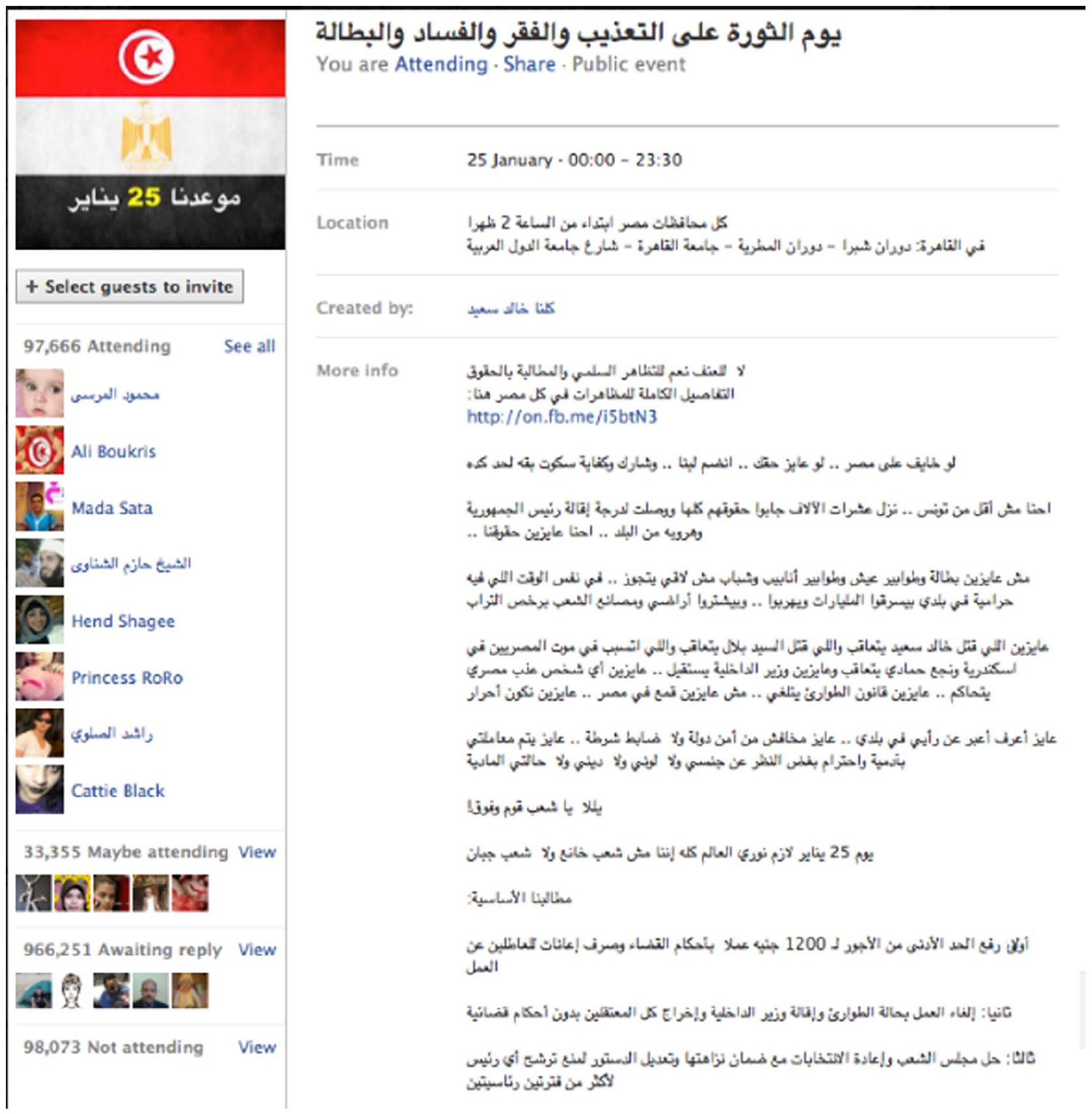
The invitation to a “Day of Revolt Against Torture, Poverty, Corruption, and Unemployment” as hosted by the “We Are All Khaled Said” page.
Surveying the Revolution: Tahrir Square Protesters’ Usage of Traditional and Social Media
To assess how social media contributed to the creation of a public sphere, the author conducted a survey of 476 participants in Tahrir Square shortly after Mubarak was ousted. Respondents had a mean age of 33.7 years, with a median of 30.5 and a mode of 24 years. The sample had diverse levels of education, from illiterate (2%, n = 9), which the research assistants helped fill out the survey for, to PhD holders (1.7%, n = 8). The majority were university graduates (37.8%, n = 174), and university students (18.5%, n = 85). Slightly over two-thirds of respondents lived in Cairo (68.6%, n = 288), while almost one-third (31.4%, n = 132) lived outside of Cairo. About 16% of the sample said they went to Tahrir Square every day during the 18 days of protests, with the average days of protesting being 8.46 (SD = 6.11), and the average nights spent on the Square being 2.92 (SD = 4.43). Over 60% of the sample said they had never participated in a demonstration before January 2011 (n = 278).
In terms of media consumption, 78.1% of the sample (n = 356) said they read a daily newspaper, with 81.2% specifying they read an independent, privately owned newspaper, and 27.6% (n = 113) saying they read a government-owned newspaper. Most respondents (91.4%, n = 414) accessed free-to-air satellite television, while 32.6% (n = 147) accessed terrestrial television, and 9.6% (n = 43) accessed premium cable channels. Respondents reported watching television for a daily average of 4.06 hr (SD = 3.46), surfing the Internet for 3.59 hr (SD = 3.82), surfing Facebook in particular for 2.56 hr (SD = 3.61), and reading a newspaper for 1.13 hr (SD = 1.17).
There was an obvious lack of interest in national journalism, as almost half of the sample (48.3%) said they Never or Seldom watch national news (M = 2.67 on a Likert-type scale of 1–5, SD = 1.37). The most popular source of news was Arab news channels such as Al-Jazeera and Al-Arabiya, which 71.5% said they Always or Often watched (M = 3.98 out of 5, SD = 1.20). The evening talk shows on Egyptian television which were quite popular at the time followed, with 66% saying they Always or Often watched them (M = 3.89 out of 5, SD = 1.20). International news channels such as CNN and the BBC had a mean score of 2.78 out of 5 (SD = 1.36).
Respondents’ news consumption patterns since 25 January were not different. Al-Jazeera was most popular, with 77.5% saying they Always or Often watched it (M = 4.20 out of 5, SD = 1.17); followed by Al-Arabiya, with 64% (M = 3.83 out of 5, SD = 1.04); BBC Arabic, with 58.3% (M = 3.57, SD = 1.38); CNN (M = 2.61, SD = 1.41); and finally the Egyptian Satellite Channel (M = 2.30, SD = 1.29); and Nile TV (M = 2.22, SD = 1.25).
Confirming the importance of the Internet and social media as a source of information, 70.1% said they Always or Often got their news and information online (M = 3.88 out of 5, SD = 1.42). Facebook was the highest rated, with 67.3% saying they Always or Often got their news there (M = 3.77 out of 5, SD = 1.55), followed by Twitter, with 23.3% (M = 2.10, SD = 1.58).
The overwhelming majority of the sample was Internet users (85.6%), at a time when Internet penetration in Egypt was under 30% (Abdulla, 2013). Facebook users accounted for 76.7% of the sample, and Twitter users 28.5%. Slightly under half the sample (44.7%) were followers of the “We Are All Khaled Said” Facebook page. When the government shut down Facebook and Twitter on the first day of protests, 14.4% of the sample still managed to access these platforms, mostly through proxy servers. However, when the government shut down the Internet entirely, only 7.5% still managed to get through. Interestingly, 27.5% reported that their response to the shutdown was to join the protests on the street. Over half the sample (51%, n = 236) said they first heard about the revolution from the Internet. This was followed by television (23.5%, n = 109), friends (14.7%, n = 68), and finally newspapers (4.1%, n = 19).
Respondents seemed to have little interest in political participation prior to January 2011, which again confirms the notion that many were finding their place in a public space for the first time. The majority (60.4%) had no voting card. Only 19.4% had voted in the previous Presidential elections, and 8.6% were members of a political party. In contrast, 98.1% intended to vote in the following Presidential elections, and 66.4% intended to join a political party. These findings are in line with Tufekci and Wilson (2012), who found that social media, particularly Facebook and Twitter, played a central role in revamping the Egyptian public sphere in the lead up to the protests.
The Golden Age of Social Media in Egypt
Calhoun (1992) noted that “A public sphere adequate to a democratic polity depends upon both quality of discourse and quantity of participation” (p. 2). In this sense, the golden age of social media in Egypt in terms of fostering a public sphere started a few months before the revolution and lasted for about 3 years. Facebook was (and remains) by far the most popular social network, with users growing exponentially from 4.2 million in January 2011 to 8.6 million in September, to almost 14 million by mid-2013 (Abdulla, 2013). User numbers reached 56.2 million in May 2022 (Statista, 2022), of which 60.5% were men, and 57.6% were aged 18–34 (NapoleonCat, 2022). Twitter offered a fast-paced, robust space for live tweeting events and demonstrations, as well as for interesting and heated deliberation and contestation among activists (Abdulla, 2014). Such conversations, both on Twitter and Facebook, were joined by thousands of previously apolitical citizens, thus creating new counterpublics and widening the eventful public sphere. Activists gained a huge local and international following, and a symbiotic relationship developed between them and traditional media (Alexander & Aouragh, 2014), who competed to host or interview them. Activists constituted important sources of news and information, whether through their live tweeting of protests while dodging bullets, or the actual discursive contestation on social media that often turned into news stories. Those in power soon realized that social media constituted a news outlet they cannot afford to ignore. The Supreme Council of Armed Forces (SCAF), which ruled the country after Mubarak, started an account on Facebook, where it first issued all its official statements before being quoted by traditional media outlets.
During the 18 days that toppled Mubarak, two media collectives were started and gained vast popularity, constituting an important and powerful addition to the journalism scene in the country. Mosireen (determined) and Kazeboon (liars) worked together to provide documentation of protests and demonstrations, and to highlight incidents of regime brutality, which were mostly ignored by traditional journalism. Mosireen collected footage, mostly from non-professional protesters using smart phones, and made it available online for download and public use. Kazeboon organized or helped people organize public screenings of the footage on the streets. Both entities recruited volunteers and publicized their screenings via social media. Mosireen was the most viewed nonprofit channel on YouTube worldwide in January 2012 (Lane, 2012). Kazeboon shows became very popular, with several being organized every week all over Egypt. Organizers shared tips online on low-budget screening ideas, such as rented projectors and speakers, and a white linen sheet on a wall comprising the screen (Abdulla, 2014). Counterpublics watched while literally occupying a space on the concrete floor of the street, as they interacted with others in the eventful public sphere. Screenings often turned into chants, marches, demonstrations, or into occupation of more public spaces. A piercing message to traditional journalism was delivered when a show was projected onto the walls of the government-owned Egyptian Radio and Television Union building, the only entity that was legally entitled to broadcast news in Egypt (Abdulla, 2016), with a picture of a television screening the word Kazeboon (liars).
Overall, the media scene seemed more diverse and inclusive than ever. A few days after Mubarak’s downfall, the Ministry of Information was abolished. The media, traditional and social, were exuberant with heated debates and discussions. The public space and the public sphere(s) were unprecedented, and the public and counterpublics were immersed in deliberation and contestation that seemed to create new political and social identities for those who sought them.
Cracking Down on the Public Sphere
The ousting of Mubarak was the pinnacle of hope for Egyptians for political and social reform, including in journalism and free expression. However, this did not last for long. Starting March 2011, activists and journalists started getting summoned to military trials, and in July the Ministry of Information was reinstated (Committee to Protect Journalists, 2011b). In October 2011, blogger Alaa Abdel Fattah was arrested (Committee to Protect Journalists, 2011a).
Muslim Brotherhood candidate Mohamed Morsi became President of Egypt following SCAF, and his year in power was characterized by further crackdown on the media in terms of an unprecedented number of lawsuits filed for “insulting the President” (“Rights Group: Morsy Files Record Number of Defamation Charges,” 2013). Yet, this period witnessed a vibrant and diverse media, mainly because the balance of power was divided between Morsi (and the Brotherhood), SCAF, and the revolutionary forces. Morsi was ousted a year later in mid-2013, and soon thereafter Emergency Laws, which were commonplace for 30 years under Mubarak, were reinstated. In November, an Anti-Protest Law was passed and used to support the detention of several bloggers under the accusation of using social media to call for protests. The public sphere and the public space were being eroded. Huge concrete walls were installed in downtown Cairo to prevent public gatherings, and a vile campaign hit the media to tarnish the reputation of activists. The diversity of voices in the media faded away, and a monotone chorus claimed the revolutionaries were agents of foreign countries, spies, and traitors, who used social media to destroy Egypt.
The online public sphere was further restricted through two more pieces of legislation. The 2015 anti-terrorism law states that journalists, both traditional and online, who publish accounts of terrorism-related news which do not coincide with the government’s official account may face fines large enough to shut down any independent news outlet (up to 500,000 EGP or US$31,600) (“Egypt’s Parliament Endorses Controversial Anti-Terrorism Law,” 2016). The 2018 Internet law deems social media users with over 5,000 followers to be “publishers,” legally liable for their content under regular media laws. The law stipulates that websites have to be licensed, and allows the Supreme Council on Media Regulation to block websites (“Egypt Targets Social Media With New Law,” 2018; “Twitter Users in Egypt With More Than 5,000 Followers Will Be Classed as Media Entities Amid Crackdown on Dissent,” 2018). Lawsuits and detentions over a tweet or a Facebook post, and accusations of publishing false information and fake news or abusing social media affected over 300 people (Association for Freedom of Thought and Expression, 2021). Online activists as well as independent journalists who practiced Russell’s (2016) idea of journalism as activism, were mostly silenced, either through detention, self-exile, or self-censorship. The government also cracked down on TikTok, detaining and sentencing several females for nonpolitical content. They were charged with “attacking the family values of Egyptian society” (“Egypt Arrests Young Women Who Posted Clips on TikTok,” 2020).
Egypt has been ranked as “Not Free” by the Freedom on the Net reports since 2015, with its score dropping every year. In May 2017, blocking websites started with 21 news and human rights websites, including AlJazeera, Huffington Post Arabic, and the award-winning Mada Masr, one of the very few remaining independent journalism portals (Freedom House, 2019). Other independent news portals, such as AlBedaya, Darb, and AlManassa, were also blocked. Blocked websites were estimated at over 600 in 2021, including over 100 news websites (Masaar, 2021). One study noted that such blockages not only limit available content and access to information, but also increase self-censorship. Blocked digital journalism outlets suffered financial losses, and several had to lay off staff or close down, discouraging investors from financing independent journalism (Shawky & Mohsen, 2020).
Habermas (1989) argued that the decline of the public sphere happens primarily as a result of state power as well as corporate power as media corporations expand tremendously and their emphasis is focused solely on profit at the expense of public discourse. To this effect, the major social media platforms which were credited for lending a voice to the voiceless counterpublics in Egypt also contributed to the demise of the public sphere. Algorithms started promoting like-minded posts to like-minded people, thus creating an echo chamber effect and decreasing discursive contestation. Many activists had their Facebook, Twitter, or YouTube accounts suspended or deleted without explanation over the years, but more so recently. This started in 2007 when award-winning blogger Wael Abbas had his YouTube account removed. The account, which had aggregated many police brutality videos, was only restored after complaints from international organizations. Abbas also faced a Facebook 30-day suspension in 2017, and Twitter deleted his verified account with over 350,000 followers (York, 2018). Facebook’s real name policy poses a problem for activists who need anonymity for security reasons. The policy had at one point resulted in suspending the “We Are All Khaled Said” page, because Ghonim had started it under a pseudonym. Twitter’s MENA office, based in the United Arab Emirates, has suspended numerous activists’ accounts without explanation. There are also complaints about “muzzled” or shadow-banned accounts, which do not seem to have the same reach or engagement they previously did, and whose follower count remains static or decreases over months despite the addition of new followers (Abdulla, 2021, 2022). Egyptian activist and researcher Wael Eskandar documented over 60 Twitter accounts that were suspended in September and October 2019, including his own. Twitter apologized saying the suspensions were a mistake, but offered no explanation (Rajagopalan, 2019).
Discussion: Answering the Research Questions
The data presented in this study trace the process by which social media was an important factor in carving out an eventful public sphere in Egypt within the confines of a defiant space. In sharp contrast to Habermas’ public space, which is an autonomous space for communication and a prerequisite within democratic societies for the formation of a public sphere, in pre-2011 Egypt, any space that existed was heavily guarded by the state and did not allow for the free discursive contestation or communicative autonomy that would result in a public sphere. The analysis shows that under these authoritarian conditions, counterpublics used social media to peck at the thick borders of repression enforced by the state, until they managed to create cracks in the system, which eventually resulted in a breakthrough outside the borders of state control. It has to be noted that the defiant sphere is also “public” in the sense that it is open and accessible to anyone. However, in practicality, access is restricted by the high risk of state retribution involved in participation.
The analysis shows that the mechanisms by which this process took place was by (a) initiating conversation around an event, either an incident that took place or a planned event; (b) drawing attention to the event and to the involved activists and bloggers as sources and agents; (c) engaging counterpublics in discursive contestation around the event on social media; (d) establishing links of affinity to counterpublics and to traditional media to draw more members into the deliberations; and possibly, (e) calling for action or setting an agenda. This process started slowly with the introduction of social media in 2004 as bloggers caught their audiences’ attention through discussing incidents of police brutality and/or sexual harassment. The process garnered more following as YouTube allowed bloggers to document their conversations with video, then later as Facebook and Twitter allowed more “horizontal communication” in a culture that had traditionally only supported “vertical communication” (Abdulla, 2011, p. 45).
Unlike the process described by Habermas, which takes place in democratic societies (Figure 1), the narratives presented in this study reveal a different pattern of communication in authoritarian settings which centers around an event within a defiant space. Discursive contestation taking place around that event carves out an eventful public sphere which, if successful in transcending state control, translates into the creation of public space (Figure 2). This pattern grabbed Egyptian activists’ attention in 2008 after a blogger created a Facebook event to support the 6 April workers’ strike. The huge following and the outcomes meant that Facebook had great potential in turning the communicative autonomy of the virtual public sphere into offline activism in a public space.
The best exemplification of an eventful public sphere that turned into a huge public space in Egypt was the “We Are All Khaled Said” Facebook page. The page accumulated over 4 million supporters, who discussed taboo issues of police brutality, torture, and corruption. The admins utilized it as a space for young counterpublics to speak their minds, gradually showing them that their voice counts, and can be transformed into a physical public space. The page hosted the biggest “event” to ever occur in modern Egypt, a day of anger which turned into a revolution, and resulted in toppling a dictator. The page admins gathered momentum for their events through discursive contestation on social media in a manner that increased the publics’ affinity to both the event and the issues. Their “networked leadership” used sophisticated techniques to open up engaging spaces for counterpublics (Poell et al., 2015). The page constituted an eventful public sphere which allowed for interactivity, discussion, and action, and engaged counterpublics in a manner that was unprecedented in Egypt. It also served as a practical example of shared governance and political participation (Abdulla et al., 2018). These arguments are supported by the survey results presented in this study, which showed that about 77% of the participants were Facebook users, 45% followed the page, and 60% had never participated in a demonstration before January 2011.
The analysis in this study points to several characteristics of the event around which a public sphere may be formed. Events of significant impact on large sectors of the population, such as elections, warrant attention. Timeliness, affinity, and cultural proximity also proved important as counterpublics interacted with incidents that they felt could happen to any of them such as sexual harassment or police brutality. Unlike traditional journalism where prominence or celebrity status is important, social media users gathered around nameless or non-celebrity victims of human rights violations as issues of social justice and human dignity came to the forefront. As the discursive contestation around an event leads to a call for action, participation is linked to the amount of risk involved and the potential scope of participation, which in turn also depend on the scope of repression in the environment. Successful examples include the 2008 call to stay home where the risk involved was minor, and the call for protesting on 25 January, when the risk was major but was offset by the potential for massive participation, as over 100,000 citizens indicated their positive response to the “event.” The revolution’s slogan of bread, freedom, social justice, and human dignity increased its affinity to the counterpublics, as these are basic human rights with little to no cultural or social resistance. In this sense, activists used social media to form and link counterpublics, who reconciled their identity around the event or cause, and around their shared sense of exclusion from communicative action and meaningful participation in public life. They expanded the boundaries of free expression and discursive contestation, pushing the limits of state control and acquiring public space.
The tide turned, however, as the state realized the mobilizing potential of social media. The crackdown caused the public sphere to collapse, and with it, the public space that was briefly accessible to all. The major social media platforms contributed to the decline of the public sphere and to creating echo chambers in place of discursive contestation as algorithms came into the picture and as the focus on profit trumped that of enabling counterpublics.
The mobilizing effect of social media in Egypt had a major impact not only on politics but on journalism as well. Almost half the sample surveyed in Tahrir Square said they rarely or never followed local news. In comparison, over 70% said they got their news online, particularly from Facebook, and over half the sample first heard about the revolution online. Abdulla (2007, 2013, 2014) argued that every new development of online technologies helped create and expand the public sphere and added pressure on traditional journalism. From blogging to the simple function of allowing comments on news stories to user-generated content on social media, journalism was becoming more accountable to the public as alternative venues for “publishing” evolved, and users demanded more integrity in reporting. As early as 2007, Wael Abbas was the first blogger to win the Knight International Journalism Award from the International Center for Journalists, a clear testament to the effect of citizen journalism and to the blurring of the borders of traditional journalism. In 2020, Mada Masr’s editor in chief Lina Attalah won the same award despite her online news portal having been blocked in Egypt since 2017. Attalah was also listed as one of Time magazine’s “100 Most Influential People of 2020.”
Sakr (2013) contended that the revolution was a tipping point for journalism in Egypt, whereby “what it means to be a journalist became a burning question” (p. 1) as journalists had to compete with accounts of reality transmitted by non-professional protesters with mobile phones to a public that would no longer accept government propaganda. As this study documented, media collectives such as Mosireen and Kazeboon collected, verified, and made accessible hundreds of hours of footage and interviews, which served to confront and embarrass inaccurate media accounts as well as provide material for outlets willing to air the footage. An unprecedented symbiotic cross-media relationship came to exist between activists, bloggers, and social media users on one hand, and advocacy journalists and media outlets on the other, as the former constituted an important and credible source of news and information, and the latter provided more reach, and in turn, more credibility. The crackdown on the public sphere hugely impacted journalism in the country as the diversity of voices disappeared into censorship, fear, or detention. Journalism was highly affected by this process, whereby the presence of the eventful public sphere helped negotiate more freedoms, and the erosion of the sphere led back to state controlled media, where the public(s) turned into mere spectators.
Conclusion
This study proposes a theoretical model of the interaction between an eventful public sphere and public space in an authoritarian setting. Unlike the Habermasian model which functions in a democracy, the model highlights the role of social media in carving out an eventful public sphere within a defiant, rather than an autonomous, public space. The process involves initiating conversation and drawing attention to an incident or event on social media, engaging counterpublics in discursive contestation, increasing affinity to the cause, and calling for action. The eventful public sphere may or may not gain momentum, and its mere presence is not a guarantee for breaking free of state control or for turning the defiant space into autonomous public space. Some factors affect the likelihood of success, including the nature and impact of the event, the public’s affinity to it, social or cultural resistance, the amount of risk involved, and the potential scope of participation. It has to be noted that it is not always clear where the defiant sphere ends and the autonomous public sphere begins. It may be that a fully autonomous public sphere never materializes in authoritarian settings, just like it hardly does in democratic settings. It may be that spaces under authoritarian regimes are always defiant, and always populated by counterpublics who are willing to bear the consequences of defiance.
It is important to emphasize that, within the case study presented, this article does not claim that social media or the eventful public sphere were the only factors that led to occupying public space nor to the later inaccessibility of this space in Egypt. Rather, as process tracing implies, social media was and remains one important factor, with huge potential. To the extent that citizens can utilize it, they can reopen and/or extend the public sphere and perhaps public space. Tech-savvy Internet users are often a step ahead of their governments on the technology front, so it remains to be seen whether newer technologies, along with lessons learned and changes in the environment, might provide further opportunities to reclaim the public sphere, and with it, the public space.
Finally, more research needs to be carried out to test the fitness of the model presented in this article in other less-than-democratic settings. There is also a need for more academic research into how journalistic norms, including objectivity, transparency, accessibility, and public interest, are changing or evolving in light of new technologies, particularly in less democratic settings. Furthermore, conceptual and empirical research can illuminate a human rights-based approach to the functioning of social media platforms, so that a robust and inclusive public sphere is realized that is open and accessible to all.
Footnotes
Acknowledgements
The author thanks Provost Salma Ghanem of DePaul University for her valuable insights during the planning stages of this article; and Mohamed Gameel and Shaimaa Fekry for the illustration of Figure 2. The author dedicates this article to the martyrs of the Egyptian revolution, and to the memory of her graduate student Mahitab Khalil, who translated the survey used in this study, and her friend Amr Assaad, who helped distribute the survey in Tahrir Square.
Declaration of Conflicting Interests
The author(s) declared no potential conflicts of interest with respect to the research, authorship, and/or publication of this article.
Funding
The author(s) received no financial support for the research, authorship, and/or publication of this article.
