




Abstract
This article addresses recent debates in critical management studies (CMS) on the impact of research beyond academia and critical performativity—in other words, it addresses the need for researchers to engage with and intervene in organizational practices while remaining critical of these practices. GenderLAB has been developed to address this need by organizing academic activism and drawing critical insights from studies in gender equality and diversity in a way that can impact organizations. By combining the reflexive process of norm critique with action-oriented design thinking, GenderLAB contributes a methodology that holds potential for overcoming the current critical/constructive impasse in CMS literature.
Keywords
Introduction
The practical intervention described in this article answers a long-standing call in critical management studies (CMS) for a way to operationalize critique and theory. In critical diversity management research specifically, that call is for methods of intervention (e.g. Holck et al., 2016), especially in debates about critical performativity (Spicer et al., 2016). Such discussions have been taking place in CMS for at least a decade (Spicer et al., 2009) and have developed into a unique research agenda, with a growing number of authors suggesting ways to mobilize critical insights with performative effects for organizational practice and managerial discourse (Ashcraft and Muhr, 2018; Cabantous, et al., 2016; Christensen, 2018; Nentwich et al., 2015; Reedy and King, 2019; Riach et al., 2016). Though some researchers assert that such critical performativity may be possible on a practical level (e.g. Wickert and Schaefer, 2014), others report “failed performativity” (Fleming and Bannerjee, 2015) due to difficulties in applying the theory (Butler et al., 2018; King and Land, 2018). Despite these regular calls and lively debates, published examples of CMS researchers actively working to intervene in organizations are still rare (King, 2015).
Performativity as a concept has heterogeneous meanings and uses. In a CMS context, “critical” performativity refers to a research agenda that seeks to make critical theory influential in organizations (Gond et al., 2016). For that reason, this article considers the discussions about critical performativity alongside related concerns in CMS regarding the impact of research beyond academia and academic activism (see Prichard and Benschop, 2018; Rhodes et al., 2018). The workshop format GenderLAB was developed to contribute to those ongoing discussions. In short, GenderLAB seeks to disrupt, at a practical level, existing organizational practices and norms in the name of gender equality and diversity. 1 Practical activist intervention and its facilitation is thus the starting point of this article. However, this article does not analyze the intervention and facilitation itself; 2 rather, it focuses on arguments for combining GenderLAB’s two main components: design thinking and norm critique. To this end, the article progresses as outlined below.
First, the GenderLAB pilot workshop—held at Copenhagen Business School (CBS)—is described, with the facilitator guide detailing the practical aspects of the project provided in the appendix. 3 Next, some of the persistent gender equality and diversity issues in organization and management are discussed, alongside an analysis of how GenderLAB can help generate new and innovative solutions to those issues. Thirdly, the concepts of design thinking and norm critique are introduced with the purpose of arguing for their combination in GenderLAB and detailing how doing so mitigates their potential individual limitations. It is this coupling of design thinking with norm critique that establishes this article’s contribution to advancing critical performativity in organizational gender equality and diversity.
GenderLAB in practice
This article focuses on a specific GenderLAB workshop delivered in a 90-minute format, which was integrated into a full afternoon and evening program marking International Women’s Day 2019. It included talks and case presentations of gender equality and diversity issues in three organizations: Danish Defence, Roskilde Festival, and CBS. 4 Around 350 people from diverse professional backgrounds and sectors, industries and organizations had signed up for the event and were randomly divided into groups of eight to ten participants. The groups were presented with a series of time-limited exercises, beginning with Circles of My Multidimensional Self. For this norm-critical reflection exercise, participants define aspects of their identities and pair them with stereotypes using the “I am. . ., but I am not. . .” formula, for example, “I am married to a man, but I am not a woman.” This exercise served several purposes. One was to introduce the participants to each other in a way that allowed them to self-determine which categories to share, that is, to experience the privilege of self-identifying rather than having other people’s assumptions imposed on them. As a result, some groups became interested in reflecting on discrepancies between how one sees oneself and how others do, and also which identity markers become more prominent under which circumstances. This discussion led to another purpose of the exercise: to explore and critically reflect upon the stereotypes typically associated with certain identity categories, and how those representations may be experienced as constraining if they fail to describe the participants accurately. Figure 1 below shows the examples provided by one of the lab leaders. This exercise was returned to as the lab progressed, to allow for continuous reflection.
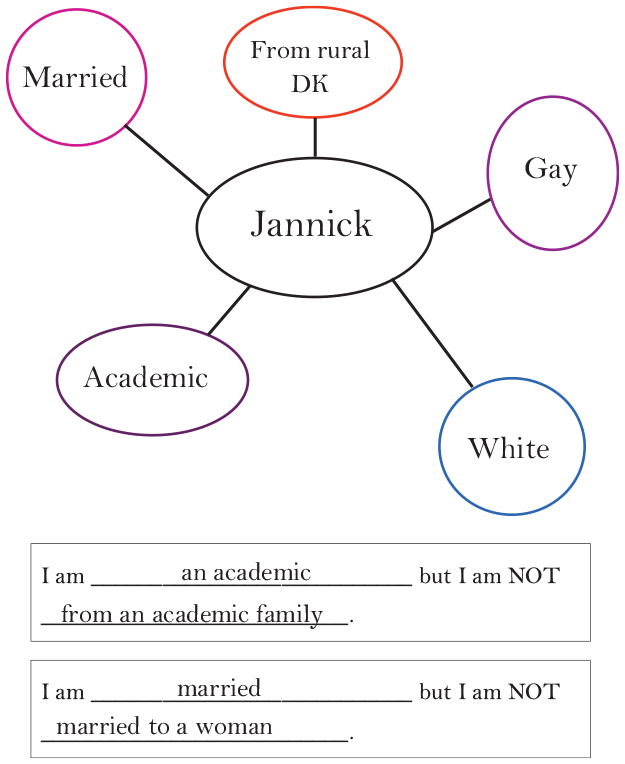
Circles of My Multidimensional Self.
A case-organization was then assigned to each table, and each participant was tasked with identifying the problem in that organization from their own perspective. The diversity of the participants resulted in a number of different perspectives on the same case. Moreover, participants had to state the problem both in writing and as a drawing (i.e. they also had to visualize the problem to activate different parts of the brain).
This task was followed by a two-phase ideation exercise. In design thinking, ideation is a dynamic, co-creative tool with a focus on co-producing a large number of ideas for addressing “wicked problems” (Buchanan, 1992; Rittel and Webber, 1972), that is, complex problems or families of problems that may be difficult to resolve definitively. In the first phase, participants had 1 minute to think of a solution to one of the problems identified by the group. The problem and its possible solutions were then circulated to allow other participants in the group to add further possible solutions as seen from their perspective, taking inspiration from the solutions already suggested (Figure 2).
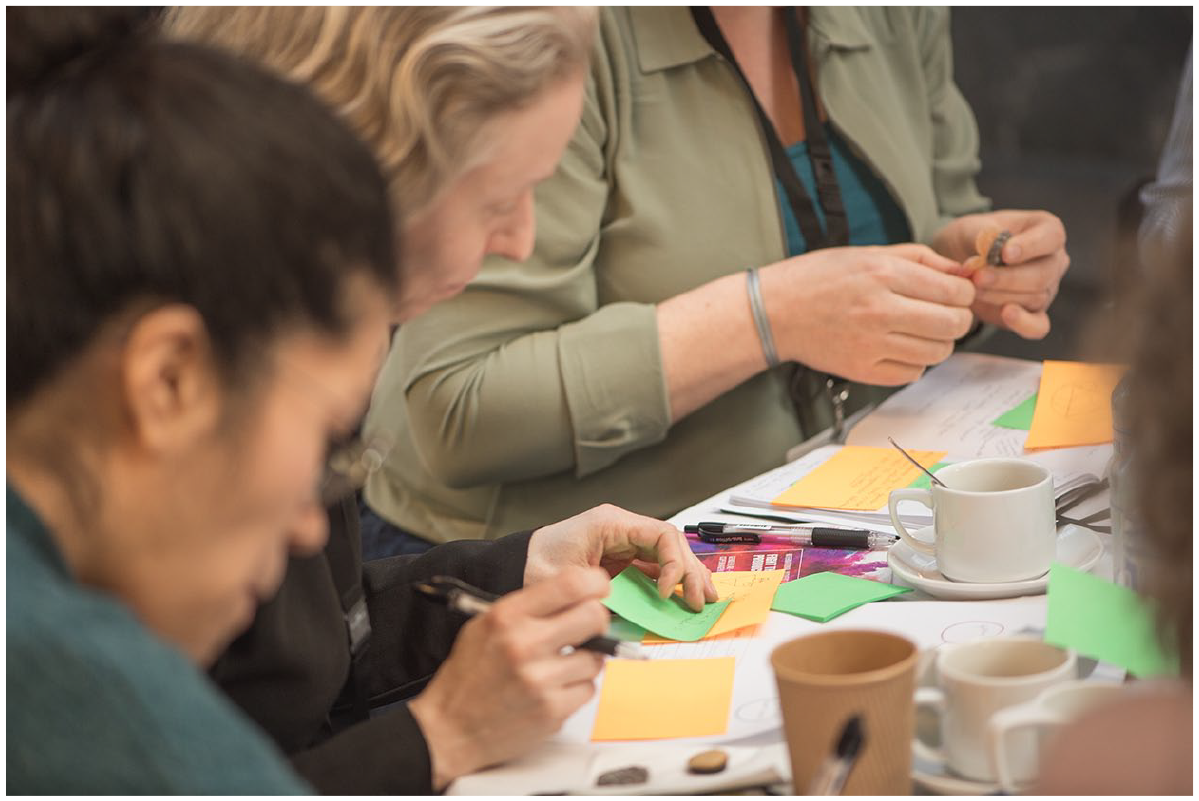
The ideation process using color-coded Post-it notes.
The second phase repeated the process of the first phase, but with a productive obstruction added: Each participant was asked to adopt a role (e.g. manager, sergeant, festival guest, professor, student) and to consider the solutions from the perspective of the assigned role. This task served as a means of building empathy through awareness of the different level of leverage one might have depending on their position in the case-organizations’ power structures. It also reminded participants that any solution always comes from a certain perspective and never from a neutral standpoint. The roles, therefore, also served the purpose of including perspectives that were likely to be repressed (e.g. the experience of a person of color in a white space).
Finally, participants were allowed to share their ideas and were asked to select the best ones based on three criteria: those ideas that reflect an individual approach to problem-solving, those that reflect a structural approach, and those that are the most thought-provoking solutions. (These criteria were chosen to make room for more “radical” ideas and avoid selection based solely on perceptions of what is realistic). Selected ideas were displayed on an online dynamic dashboard and projected onto a whiteboard for all participants to see, as well as to inspire the case-organizations in their future work on gender equality and diversity. 5
GenderLAB in theory
In theoretical terms, GenderLAB is intended as a clean break from context-blind understandings of gender equality and diversity, which are prevalent in some of the literature on diversity management. Generalized approaches are criticized for neglecting the situatedness of power and knowledge in organizations and, thus, for perpetuating inequalities (Bannerjee and Linstead, 2001; Christensen, 2020; Christensen and Muhr, 2018; Janssens and Zanoni, 2014; Jonsen et al., 2011; Knights and Omanovic, 2016; Oswick and Noon, 2014; Özkazanc-Pan, 2008; Tatli and Özbilgin, 2009; Zanoni et al., 2010). To make GenderLAB relevant and readily applicable to specific organizational contexts, and to avoid producing solutions that disregard situated knowledge and the embeddedness of gender and diversity in organizations (Acker, 2006; Ahonen et al., 2013; Holck, 2018), a concrete case has to be developed for each specific GenderLAB workshop. The case describes the case-organization and presents different perspectives on a certain gender equality and diversity issue for which the organization wants to find workable solutions. Moreover, the workshop format is intended to include a broad spectrum of organizational members and stakeholders to ensure the involvement of the many (regular employees, future candidates, and other beneficiaries of equality and diversity work), not just the few (e.g. managers, consultants, and other external “experts”).
GenderLAB encourages participants to become aware of some of their own biases through norm-critical reflection and makes immediate, active use of that momentary raised level of awareness to qualify not only the problem-solving but also the identification of the problems to be solved. In doing so, it makes participants aware of what they think of as normal and guides them to move beyond their own normativities. As such, GenderLAB offers a practical methodology for limiting the impact of unconscious bias and stereotypical thinking. Overcoming biases matters in equality and diversity work because biases are based on historically and culturally defined ideas of, for example, gender, race, class, sexuality, age, etc., as well as management, leadership, and organization. As such, biases shape what is perceived as “normal” in any given context, so certain “bodies” will automatically be associated with specific professions and positions (Ashcraft, 2007, 2013; Einarsdóttir et al., 2016; Heilman and Caleo, 2018; Monaghan, 2002). Some bodies benefit from stereotypical thinking, as they appear to “fit in,” whereas others are disadvantaged due to their perceived “misfit” (Garland-Thomson, 2011) with organizational norms. Perceptions of normality also affect what is considered to be a “problem” in the first place.
The GenderLAB concept
GenderLAB was conceived as a learning laboratory where participants have structured conversations about ambitions, scale, and the impact of ideas and possible solutions to problems, as an extension of Staunæs and Kofoed’s (2015: 45) notion of the “pop-up laboratory.” Lab—short for laboratory—refers to “a place of work” that is designed for “testing assumptions on a particular research subject.” As the name implies, GenderLAB’s overall research subject is gender and, more specifically, gendered relations. The idea behind the GenderLAB held at CBS on March 8, 2019 was conceived through collaboration between CBS and KVINFO, the Danish knowledge center for gender, equality, and diversity. The intention was to mark and celebrate International Women’s Day in an engaging, inclusive, and thought-provoking way that would bring together diverse allies from different practice and knowledge domains to explore and co-create new ways of thinking and dealing with issues relating to gender equality and diversity. In other words, GenderLAB sought to propose new and innovative solutions to old, familiar problems. To that end, norm critique and design thinking were combined to develop an approach whereby the former would raise critical awareness while the latter would supply a vibrant and operational element. The contributions of design thinking and norm critique are discussed in the next two sections.
The contributions of design thinking
The methodology of design thinking is anchored in design research, but its tools can be applied beyond the realm of design problems, including the more intangible business domains of organization and management (Brown, 2008; Buchanan, 1992; Elsbach and Stigliani, 2018; Jones and Thornley, 1963; Rittel and Webber, 1972; Schön, 1983; Simon, 1969). In GenderLAB, design thinking was employed as an intervention-based means to expand norms for gender and diversity. Studies into the application of design thinking to gendered issues are not commonplace, but there is some notable research in this area. Warnecke (2016), for example, shows how design thinking can be tailored to produce more gender-sensitive entrepreneurship programs. Focusing on the ways that capabilities are related to entrepreneurship training, the author describes how design thinking may be used to deal with programs’ gendered bias. By the same token, in their review article about the application of design thinking in relation to organizational culture, Elsbach and Stigliani (2018: 2311) find that “the use of design thinking tools may nurture the development of empathy” in organizations. As Devine et al. (2012) show, such empathy for other groups is important in avoiding the activation and reinforcement of stereotypes.
Design thinking is characterized by “designerly” mindsets, practices, and tools revolving around several themes: human-centeredness (i.e. translating user needs into viable design solutions), co-creation, empathetic involvement, elimination of the fear of failure, rapid prototyping, visualization, iteration, and experimentation (Brown, 2008). As a cyclical, rather than linear, process, design thinking is structured around three overall phases: (1) a need-finding and defining phase, (2) an idea-generating and developing phase, and (3) an idea delivery and testing phase (Seidel and Fixson, 2013). As GenderLAB was scheduled for only 90 minutes and it had 350 participants, strict selection and adaption of design thinking tools was required. Thus, GenderLAB made use of empathy building, iteration, and co-creation. 6 These are tools employed in the early stages of design thinking, when an understanding of the challenge is developed and the problem at stake is identified and ideated. Empathy is employed to understand the challenge, and iteration and co-creation are tools for the ideation process to enhance creative, unconventional, and multi-perspective problem-solving. During the workshop, background music was used to create a positive and productive atmosphere, with a bell sound effect marking transitions.
The contributions of norm critique
The methodology of norm critique (Christensen, 2020b; Holck and Muhr, 2017) is rooted in queer theory (Ahmed, 2006; Butler, 1993; Henriksson, 2017; Just et al., 2017; King, 2016; Parker, 2002, 2016; Pullen et al., 2016; Rumens, 2018) and pedagogies. The queer theoretical background of norm critique challenges binary thinking, closed definitions, and power hierarchies by examining norms for gender and other categories of difference, including how these categories may intersect (Acker, 2012; Dennissen et al., 2018; Rodriguez et al., 2016; Villesèche et al., 2018). In other words, a focus on perceived differences at the individual and group levels replaces an emphasis on norms and how these norms organize (gender) inequalities through the exclusion of diversity, which is understood as that which deviates from, and thus does not conform to, given organizational norms (Christensen, 2020a). The norm-critical reflection exercise included in the GenderLAB described in this article is an adaptation of Christensen’s (2018) identity exercise.
Norms operate based on the fact that we do not have to think about them, but they survive only insofar as they are re-constituted performatively through continuous repetition in the socio-material environments within which they exist (Cabantous et al., 2016). To effect change, therefore, the purpose of GenderLAB’s norm-critical exercises is to shift focus from “the other” to “the self,” thereby prompting the majority of the participants (who represent dominant norms) to become reflexively aware (Alvesson and Sköllberg, 2009) of how they relate to, for instance, gender norms. This inclusion of the majority is necessary to break from the normalized organizational assumptions that structure social relations, standards, and expectations (Ashcraft, 2013; Ghorashi and Ponzoni, 2014; Muhr et al., 2016; Muhr and Sullivan, 2013). Whereas design thinking is about organizing a agile process, the role of norm critique is to (re)introduce friction to that process with the specific aim of explicating the unmarked categories where power and privilege cluster in organizations (Ashcraft and Muhr, 2018; Case et al., 2012; Choo and Feree, 2010; Haraway, 1988; McIntosh, 2012). As Christensen (2018) has demonstrated, such explications enable empathy-building between participants who are presented with different experiences of organizational life that can feed into and qualify the design-thinking activities. 7
Combining design thinking and norm critique in GenderLAB
Whereas the iterative design thinking process offers a way of structuring conversations on ambitions, scale, and the impact of ideas and possible solutions to self-identified problems, the norm-critical reflection exercises (e.g., “Circles of My Multidimensional Self”) raise awareness of, disrupt, and transgress commonly held assumptions, beliefs, and stereotypical and prejudiced views among participants due to unconscious biases (Morse, 2016; Moss-Racusin, 2012; Soll et al., 2015; Williams, 2015). In combining design thinking with norm critique, this article argues for the complementarity of the two concepts. Their combination makes up for at least two fundamental flaws that each approach holds individually and which are otherwise difficult to avoid. Whereas norm critique is process-oriented, design thinking tends to be results-oriented. Design thinking (in the ideation phase) is about quantity over quality and the idea is to get as broad an output as fast as possible. It goes without saying, therefore, that design thinking ideation is a short activity that allows little or no time for critical reflection. In spite of its name, design thinking emphasizes doing over thinking.
For illustrative purposes it is useful to liken design thinking to Kahneman’s (2011) notion of System 1, which is the category he uses for thinking on auto pilot. As System 1 operates automatically and quickly, it leads to many of the systematic errors in our intuitions: “The main function of System 1 is to maintain and update a model of your personal world, which represents what is normal in it” (Kahneman, 2011: 71, our emphasis). A potential risk with design thinking is that participants remain in this state, only activating System 1. On its own, design thinking thus becomes a form of functional stupidity (Alvesson and Spicer, 2012, 2016) in which the solutions produced originate from each participant’s own normative position. Their norms of categories shape not only what appears as a problem, but also how that problem appears, and, for that reason, what solutions seem plausible. We may, of course, observe differences in the ideas accumulated if the participants themselves present diverse perspectives. However, the presence of different voices does not guarantee the voicing of differences, if some voices are marginalized. For that reason, norm critique was introduced into GenderLAB.
In isolation, however, norm critique can give rise to dysfunctional reflexivity, the opposite of functional stupidity. Norm critique activates Kahneman’s (2011: 21) System 2, which is often “associated with the subjective experience of agency, choice and concentration.” A state of reflexivity refers to a state of thinking that operationalizes System 2 with an increased level of awareness about the complex and multifaceted ways in which gender equality and diversity issues intersect. In this state, participants can easily get overwhelmed with complexity and unable to act on their knowledge. In other words, norm critique may render participants reflexive in the moment but if participants do not know what to do about it, this reflexivity is not likely to translate into organizational practice beyond the learning space created with GenderLAB. For example, realizing that one is privileged in some regard(s) does not make much difference if the realization only results in feelings of guilt or if it is used as a platitude to showcase awareness for the sake of it (see Noon, 2017). Awareness on its own does not change attitudes or behavior (Dobbin and Kalev, 2018), and bias or diversity training with the aim of raising awareness has been found to be one of the least effective diversity measures (Kalev et al., 2006). GenderLAB differs from such training, however, in that it utilizes awareness immediately by producing complementary practices that can be implemented at a structural–organizational level instead of targeting individual attitudes and behaviors. As such, the focus is on changing processes not people.
To summarize, combining norm-critical methods and exercises in the design thinking process ensures that the two methodologies counterbalance the flaws of the other. Another reason for their successful combination is the common understanding in design thinking and norm critique of certain problems as “wicked” or “higher level” (Rittel and Webber, 1972). The basic assertion here is that “every formulation of a wicked problem corresponds to the formulation of a solution” (Buchanan, 1992: 16, emphasis in original). In other words, the very definition of a problem preempts the available solutions. There is no absolute solution to a wicked problem. If the problem is redefined from a different perspective—say at a structural rather than an individual level—what previously appeared as an obvious solution may no longer be as apparent.
Taking the underrepresentation of women in management (e.g. Christensen and Muhr, 2019) as an example, if problematized as a matter of women not being able to “do” management (a biological essentialist perspective), a possible solution would be to “fix” women, thereby helping them to develop management potential. In this case, women as a group become the site for intervention. Another way of viewing underrepresentation, however, could be as a matter of discriminatory recruitment practices that, generally speaking, favor men over women due to the misalignment between stereotypical views of women as a group and normalized, masculine idea(l)s for management (e.g. Eagly and Karau, 2002; Powell and Butterfield, 2012). In this case, it is more likely that the excluding organizational norms—rather than women—would become the site for intervention. As such, the foremost task of GenderLAB’s norm-critical reflection exercises is to counter the individualization of problems and redirect attention to organizational norms instead.
Concluding remarks
This article’s contribution is not the lab format itself. Rather, its contribution is how GenderLAB integrates action-oriented and productive elements from design thinking with norm-critical perspectives and exercises that allow for critical reflexivity to mitigate bias in the design process, thereby qualifying the solutions that it generates. A third overall argument can be added to the two already presented for combining these two approaches.
Firstly, the combination of design thinking and norm critique helps to maintain a flow that does not become too aligned to either side of the critical-performativity dichotomy to the detriment of the other. Secondly, design thinking and norm critique both subscribe to the idea that a certain way of problematizing will preempt possible solutions. Combining the two ensures that a given problem is viewed from multiple vantage points, thereby preventing situations where a group of like-minded people end up producing a solution that could turn out to be problematic for others.
Finally, the norm-critical exercises are not only designed to include different voices in the process by making participants aware of positions other than their own. Within GenderLAB’s performative format, such exercises anchor an appreciation of wickedness as a more general condition for problem-solving in the areas of gender equality and diversity. As such, GenderLAB adds to ongoing CMS debates about the purpose and possibility of critical engagement with organizations (e.g. Parker and Parker, 2017) by becoming a way to build different organizational realities. For that to happen, a necessary next step is to continue experimenting with the lab format (which is freely available under a Creative Commons license) to incorporate prototyping exercises so that the solutions produced are further discussed, reflected upon, and developed for later implementation in collaboration with relevant case-organizations. Prototyping is not only the next logical step but also a condition for initiating and assessing GenderLAB’s practical effects.
Supplemental Material
Appendix_-_Facilitator_Guide_for_GenderLAB – Supplemental material for GenderLAB: Norm-critical design thinking for gender equality and diversity
Supplemental material, Appendix_-_Facilitator_Guide_for_GenderLAB for GenderLAB: Norm-critical design thinking for gender equality and diversity by Jannick Friis Christensen, Rebekka Mahler and Stina Teilmann-Lock in Organization
Supplemental Material
Appendix_-_Minute_Plan_for_GenderLAB – Supplemental material for GenderLAB: Norm-critical design thinking for gender equality and diversity
Supplemental material, Appendix_-_Minute_Plan_for_GenderLAB for GenderLAB: Norm-critical design thinking for gender equality and diversity by Jannick Friis Christensen, Rebekka Mahler and Stina Teilmann-Lock in Organization
Footnotes
Authors’ note
All three authors of this article are affiliated with the CBS Diversity and Difference Business-in-Society Research Platform (see cbs.dk/diversity). Said platform is Copenhagen Business School’s concept for “engaging in knowledge production based on context-driven, problem-focused and interdisciplinary research that deals with complex societal and business problems”. The role of the platform is to initiate, facilitate, and support outreach activities that may impact society through “academic publications, dissemination as well as new improved business models”, thereby enhancing the relevance of our research and education.

Supplemental material
Supplemental material for this article is available online.
Notes
Author biographies
References
Supplementary Material
Please find the following supplemental material available below.
For Open Access articles published under a Creative Commons License, all supplemental material carries the same license as the article it is associated with.
For non-Open Access articles published, all supplemental material carries a non-exclusive license, and permission requests for re-use of supplemental material or any part of supplemental material shall be sent directly to the copyright owner as specified in the copyright notice associated with the article.
