




Abstract
We studied change initiatives towards self-managing organization in five companies, focusing on changes in leader-follower relations. Our discursive analysis based on interviews of 18 middle-managers and 38 employees suggests that organizational members identify with different types of responsibilities depending on their organizational position. We grouped these responsibilities into four orientations – organizational, institutional, coordination, and individual/work – that involve both synergistic and antagonistic elements, reflecting a plurality of interests and organizational concerns. When the authority relations between ‘leaders’ and ‘followers’ were weakened in the case organizations, these asymmetries of responsibility pushed the authoring of organizational activities into divergent trajectories. Sometimes this divergence was perceived by managers as conflicting with the organizational or institutional responsibilities they identified with. Managers controlled this tension both by influencing their subordinates’ authoring normatively and by resorting to hierarchical control practices in situations and authoring arenas perceived as critical. This resulted in hybrid arrangements including both shared and hierarchical forms of control. Eventually, one of the companies remained in and another one reintroduced conventional hierarchical structures. Accordingly, we discuss our reservations regarding the emancipatory enthusiasm around shared forms of control, as the shared mode of control seems to ‘work’ as long as employee authoring is contained within managerial power and interests.
Introduction
Critical leadership research comprises a loose collection of studies concerned with the power dynamics of leadership (Collinson, 2011). A common starting point for these critiques is the generic notion that mainstream leadership theories contribute to the myths of leadership (Gemmill and Oakley, 1992), unreflexively normalizing and legitimizing power structures, ideologies, and identities (Calás and Smircich, 1991; Tourish, 2014). Many critical scholars approach leadership as discourse that draws on common linguistic resources and shapes everyday communicative practices between organizational members (Fairhurst, 2008; Fairhurst and Grant, 2010). Leadership discourse specifically affects organizational life by constructing an asymmetrical dichotomy between ‘leaders’ and ‘followers’ (Collinson, 2005; Prince, 2005), and making this dichotomy a performative reality by shaping the identities and relations between ‘leaders’ and ‘followers’ (Collinson, 2005; Meindl, 1995). As leaders and followers both participate in these relational processes, ‘leadership communication is inherently power-based, a site of contestation about the nature of leadership’ (Fairhurst and Connaughton, 2014: 414).
However, in many contemporary organizations, this contestation has become rather complex and ambiguous, partly due to the emergence of post-bureaucratic ideas and ideals of organizing, promoting less hierarchical and more collective or autonomous forms of control (Hodgson, 2004; Sewell, 1998). The challenge to leadership research is both conceptual and empirical. Conceptually, the notion of asymmetrical ‘leader’-’follower’ relations might not capture the complexity of leadership interactions in more shared or distributed leadership configurations that might look more like teamwork or collaboration (Denis et al., 2012; Gronn, 2009; Holm and Fairhurst, 2018), as leadership influence is not necessarily tied to an actor’s hierarchical position as a ‘leader’. To account for this, we draw on Yukl’s (2013: 23) definition of leadership as ‘the process of influencing others to understand and agree about what needs to be done and how to do it, and the process of facilitating individual and collective efforts to accomplish shared objectives.’ What comes to empirical research, post-hierarchical organizing has seldom manifested as a clearly distinguishable organizational form, but rather as ambiguous hybrids between hierarchical and shared control arrangements and leadership processes (Ashcraft, 2006; Hodgson, 2004; Holm and Fairhurst, 2018). Thus, studying leadership in post-bureaucratic contexts ‘is not simply a case of either hierarchical control or shared control, it becomes a both-and of myriad permutations where ambiguity easily takes hold’ (Holm and Fairhurst, 2018: 695).
Interestingly, post-bureaucratic discourses are promoted from both managerialist and critical standpoints, either to respond to competitive pressures of the ‘knowledge economy’ or to pursue emancipatory ideals (Ashcraft, 2006; Hodgson, 2004). Furthermore, such discourses are not only becoming the norm in chic information technology (IT) firms but are also inspiring organizational change initiatives in traditional industries such as health care (van den Berg et al., 2022). One popular approach is called ‘self-managing organization’, which Lee and Edmondson (2017) define as radical, formal decentralization of power. Indeed, despite their hybrid implementations being sanctioned by and relying partly on hierarchical structures, post-bureaucratic prescriptions usually draw on exclusively emancipatory rhetoric of liberating individuals or groups from overly hierarchical and oppressive power structures (Sewell, 1998). This one-sided image can spark further ambiguity for organizational members involved in the change interventions towards hybrid forms of control, and potentially mask deeper power dynamics at play in the ensuing leadership processes. Thus, studying these discourses and their effects on relational leadership processes from a perspective sensitive to power and conflict becomes increasingly important.
In this paper, based on interviews of employees and middle managers in five case companies, we ask: how are leadership relations shaped by the introduction of shared forms of control promoted in the discourse of ‘self-managing organization’. We show how varying conceptions of ‘responsibility’ are central in shaping organizational members’ sense of what is collectively important. We contribute to the critical discursive literature on leadership by outlining the concept of ‘asymmetries of responsibility’, that is, dissonant differences in the personally experienced ‘responsibilities’ that employees and managers identify with. These differences reflect conflicting interests and practical concerns associated with different organizational positions and professional identities. Drawing on the concept of authoring in leadership communications (Holm and Fairhurst, 2018; Taylor and Van Every, 2014), we argue that with the introduction of shared control arrangements, asymmetries of responsibility can cause tensions as the bureaucratic authority of ‘leaders’ is weakened while ‘followers’ are increasingly mandated to both resist bureaucratic authority and take themselves part in authoring organizational purposes that orientate collective activities. This can allow employees to focus more on the responsibilities related to their personal interests, work, and the coordination of everyday activities. However, managers are likely to come up with more subtle tactics of normatively influencing their subordinates as they try to uphold their more organizationally and institutionally oriented responsibilities. In situations where managers’ personal sense of responsibility is severely threatened, they can double back to more explicit hierarchical control practices. These findings help to explain why shared forms of control tend to coexist with hierarchical control arrangements.
Control, leadership discourse, and responsibility
Our conception of organizational control draws mainly from labour process theory, where control is seen primarily as a means to subordinate workers to serve the interests of capital (Sewell, 1998). This perspective diverges from functionalist perspectives where particular forms of control are seen as more natural and value-neutral aspects of organizing. Discursive leadership processes can be seen as co-constituting and legitimizing control arrangements that serve particular interests over others. For example, Collinson (2011) criticizes orthodox leadership discourse as promoting an unproblematic view of coalescing interests of leaders and followers. More generally, the Gramscian conception of hegemony highlights how such an impression of converging interests is a product of discursive processes in which subordinate groups consent to the dominant ideological structures that reflect and privilege the interests of dominant groups (Mumby and Stohl, 1991).
Importantly, hegemonic discursive processes also have a more subtle constitutive role regarding everyday work. Power and control can be ‘conceived as instantiated in the routine discursive practices of everyday organizational life’ (Mumby and Stohl, 1991: 315). While organizations are potential sites of fragmented and conflicting interests, discursive practices produce unity and coherence in social relations, organizing these interests into relatively stable arrangements of authority and identification at a certain point in time (Mumby and Stohl, 1991). Organizational control can rely on multiple discursive techniques, some directed at controlling behaviour in a rather overt manner and others working through more covert normative social processes such as identity regulation (Alvesson and Willmott, 2002). Since the second half of the 20th century, control has been typically exercised through formal authority relations based on bureaucratic rationalization and rules (Edwards, 1979). Kakavelakis and Edwards (2022) highlight how bureaucratic structures and corporate ideology in capitalist organizations promote self-interested moralities in leader-follower relations. However, many authors have suggested that post-bureaucratic organizing is taking new forms where normative and identity-based techniques might be more central (Alvesson and Willmott, 2002; Fleming and Sturdy, 2009; Sewell, 1998). These techniques also partly depend on each other. Kärreman and Alvesson (2004) argue that in knowledge-intensive firms, slightly loosened bureaucratic structures work in tandem with a heightened socio-ideological control of selves. Indeed, post-bureaucratic organizing often manifests as hybrid arrangements involving bureaucratic, hierarchical, and more shared control practices (Ashcraft, 2006; Hodgson, 2004) and leadership processes (Holm and Fairhurst, 2018) rather than as a clearly distinctive organizational form.
In this paper, we focus on the meanings associated with the concept of ‘responsibility’. Some authors have claimed that in leadership research, responsibility is ‘one of the most under researched concepts in this field, as well as one of the most relevant’ (Pless and Maak, 2011: 4). We argue that ‘responsibility’ is a key element of the organizational discursive practices that constitute leader-follower relations due to its relevance to the identities and agency of both leaders and followers. Our analysis starts from a general understanding of ‘responsibility’ as signifying conceptions and impressions of an actor’s personal authorship regarding events and outcomes, imbued with related normative duties, expectations, and commitments (Dan-Cohen, 1992; Giddens, 1999). For example, Tomkins et al. (2020) found that police leaders experience an extensive sense of responsibility for outcomes that are perceived as being ‘on their watch’, feeling guilt and receiving blame even for issues that are largely out of their control. ‘Responsibility’ thus reveals one discursive mechanism by which organizational control is produced by defining appropriate individuals (Alvesson and Willmott, 2002). We consider ‘responsibility’ as a wider concept than ‘accountability’, which we also use in our analysis as denoting more situated relations and expectations of being evaluated and sanctioned by salient others (Hall and Ferris, 2011), ‘liability’ referring to its formal legal articulation.
By focusing on more specific meanings and articulations of ‘responsibility’, participants’ interview accounts allow us to showcase how participants make sense of and identify with various discursively constituted aspects of leadership relations in their everyday work (Fairhurst and Uhl-Bien, 2012). More specifically, we suggest that varying conceptions of responsibility frame and motivate actors’ personal contributions to authoring communications where collective objects, purposes, and transactions that constitute organizing are continuously (re)defined (Holm and Fairhurst, 2018; Taylor and Van Every, 2014). Authoring is not only reserved for actors in formal leadership positions but is mediated by perceptions of legitimate translation of organizational purposes (Holm and Fairhurst, 2018). Adoption of post-bureaucratic discourses such as ‘self-managing organization’ arguably distribute this legitimacy to a wider population in the organization. With authority, on the other hand, we refer to a specific mode of authoring relations characteristic of hierarchical control, where the authoring work of a superordinate actor is heavily prioritized over that of actors cast as subordinate to them, and subordinates are held accordingly accountable. In conventional bureaucratic organizing, authority is usually achieved and maintained through formal hierarchical structures.
To clarify the relationships between our key concepts, with authoring and authority, we signal relational patterns involving discursive acts that articulate meanings constituting organizing in terms of particular activities and collectives. With responsibility, we refer to collections of meanings attached to particular individuals by themselves and other salient actors, defining these individuals by articulating and orienting the nature and normative expectations of their personal agency. The responsibilities organizational members identify with thus shape and motivate their organizational authoring efforts.
The reduction of managerial authority in self-managing organizations
The reduction of managerial authority is at the core of self-managing organization (Lee and Edmondson, 2017), and it is pursued either by reducing the hierarchical layers of the organization to make it ‘flatter’ or by changing the managerial role or leadership style such that a manager has less explicit authority over other employees. ‘Liberating leadership’ (Getz, 2009) or ‘power-with leadership’ (Salovaara and Bathurst, 2018) are leadership ideals that aim to give freedom and power to employees. Getz (2009) states that liberating leaders create work environments that build on employees’ self-motivation, desire for equality and ownership, and need to grow. However, Pickard and Islam (2020) showed that this kind of leadership may cause paradoxical effects instead of liberation, increasing the levels of social pressure and stress among employees.
Previous studies have illustrated the complexities involved in reducing managerial layers or changing the roles of former hierarchical leaders. Ingvaldsen and Benders (2020) showed how the intertwined relationship between power and accountability in an organization that eliminated supervisory roles resulted in an informal reconstruction of hierarchy. Further, Schell and Bischof (2022) studied organizations that had eliminated the role of a formal manager and substituted it with the role of a ‘link’. While some managers welcomed this new role, others reacted with ignorance or active resistance. Maurer et al. (2023) showed that managers’ intraorganizational social positions affect their reactions upon losing their formal managerial roles; for example, they may stay resilient, change jobs, or feel victimized. Kummelstedt (2023) argues that simultaneous hierarchical and collective leadership would be effective in a self-managing organization, particularly when a hierarchical organization moves towards self-management. This literature strengthens the idea that post-bureaucratic organizing often results in control arrangements that fluctuate between shared and hierarchical forms of control.
To recap, our overall aim in this paper is to explore how leadership relations are shaped by the introduction of shared forms of control promoted in the discourse of ‘self-managing organization’. More specifically, our analysis is guided by the following research questions: 1. What is the role of ‘responsibility’ in the discourse of self-managing organization? 2. What kind of specific meanings and conceptualizations do organizational members occupying different hierarchical positions give to ‘responsibility’ in the context of their work? 3. How do organizational members navigate different conceptions of ‘responsibility’ through leader-follower interaction and expressions of shared or hierarchical control?
Methods
Context and data collection
Case companies and participants.
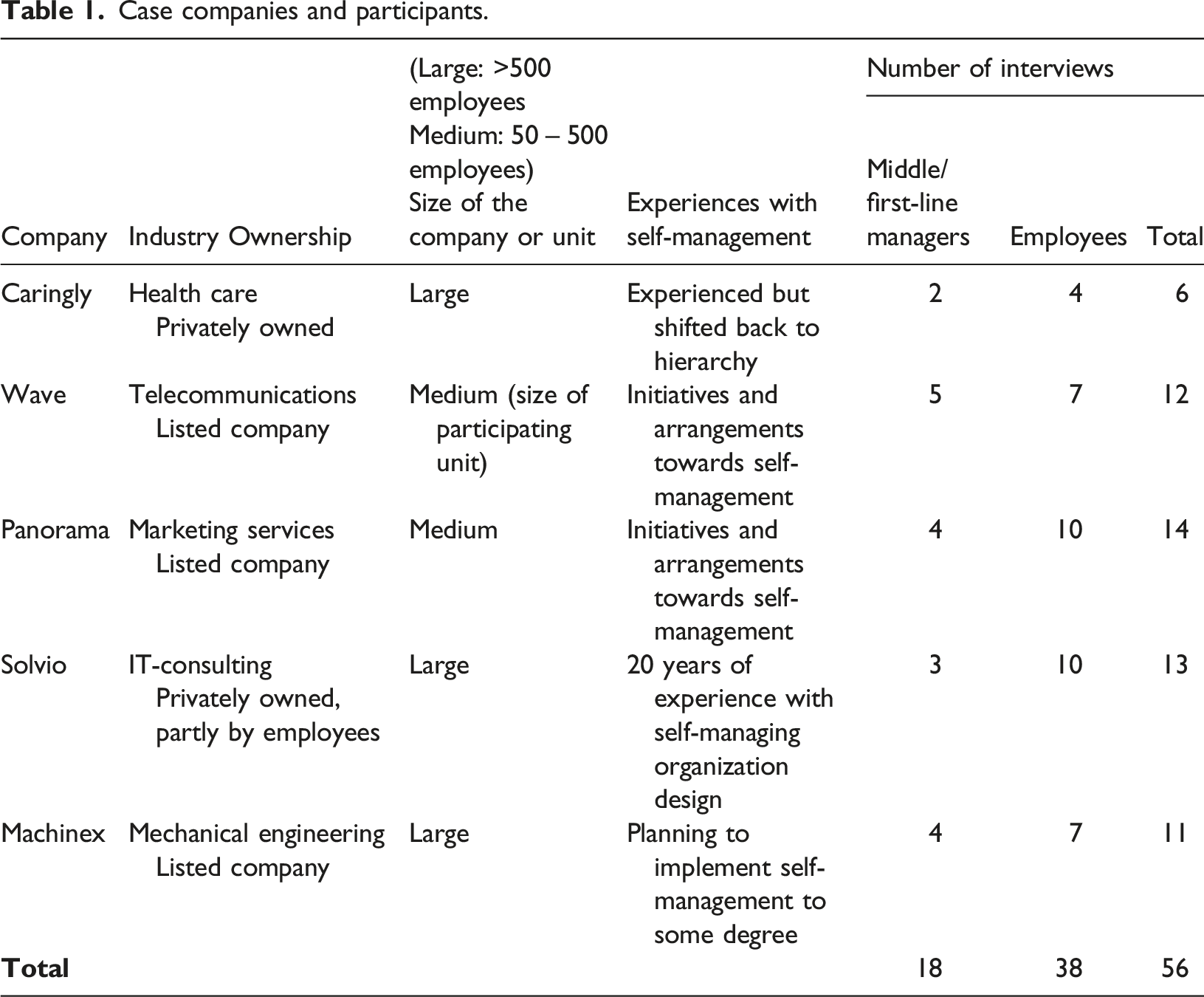
Interviews were conducted with 18 middle and first-line managers (we use ‘managers’ to denote this group) and 38 employees (Table 1). These interviews focused on the participants’ experiences related to self-managing organization. The interview guide followed a semi-structured format, with open-ended questions on decision-making, leadership, teamwork, conflict resolution, and employee well-being at the participant’s company. In addition, participants were asked to express their views on the concept of self-management and were encouraged to reflect on its positive and negative aspects. Moreover, the participants were requested to evaluate whether their organization had introduced initiatives towards a flatter organizational design and whether they would characterize their company as a self-managing organization.
The interviews were conducted face-to-face and lasted 58 min on average. All participants gave their informed consent to have their anonymized interview transcripts to be stored in a secure storage and that they can be used for research purposes. Apart from 16 interviews that were conducted in English, the language of the interviews was Finnish, and the quotes presented in the findings section are translations. The interview tapes were transcribed verbatim. Table 1 shows the number of interviews conducted at each company.
Data analysis
Our data analysis consisted of iterative cycles of content analyses following an abductive logic. Based on pragmatist epistemology, abductive analysis seeks to generate new theoretical insights through inferences that make sense of unexpected findings in the data (Timmermans and Tavory, 2012; Van Maanen et al., 2007). This involves continuous interplay between observational and conceptual work throughout the analysis (Van Maanen et al., 2007). While abductive theorizing aims to explain empirical observables, the explanations can refer to processes that we have limited abilities to observe, such as complex social processes (ibid.). In contrast, purely inductive or deductive analysis processes potentially produce more certainty, but are limited in their innovative capacities, as they are either confined to generalization from particular observations (induction) or to explanations predetermined by the researcher (deduction). Deductive and inductive procedures can nevertheless be seen as complementary to abduction to provide further testing of novel theoretical explanations (Timmermans and Tavory, 2012; Van Maanen et al., 2007).
Abductive analysis is also a potential way to narrow the gap between management theory and praxis, being especially useful in research that considers participants as co-contributors to theorizing in addition to being mere data sources (Nenonen et al., 2017). While we primarily aim to study and explain the discursive processes represented in our data, we have also used interview materials and other communications with our participants as theoretical inspiration. However, as explanations of social phenomena likely involve complex unobservable processes (Van Maanen et al., 2007), we do not consider participants as necessarily the best experts in explaining their experience, even though they might the best observers of their experience. While not taking lay explanations at face value, they are considered as leads giving inspiration to theorizing that leans on more academic conceptualizations.
Our analysis comprised three broad iterations. Each iteration involved constant conceptual reflection co-occurring with varying coding procedures on the interview materials. Throughout all stages, the unit of analysis involved varying elements depending on interview context, from a single fragment of a sentence or a full sentence to larger sections of text conveying a participant’s perception of a particular issue. These larger segments could involve, for example, short narratives depicting events and issues related to implementing ‘self-management’, whereas shorter fragments could contain a clearer statement of meaning related to ‘self-management’.
The first iteration of our analysis involved open coding focusing on participants’ conceptions and articulations of self-managing organization, or ‘self-management’, as most participants put it. We were especially interested in managers’ interpretations and responses to perceived employee-level issues in implementations of self-managing organization, as we had consistently heard reflections about these issues in our informal communications with representatives from case organizations. The first iteration resulted in three key results that guided our analysis further. First, we came up with an initial data structure about the generic meanings that participants associated with ‘self-management’. This data structure (as clarified in later iterations) is reflected in Figure 1 by the aggregate dimension of ‘self-managing organization as emancipation to responsibility’. These meanings appeared quite uniform across different groups of participants and case companies. Second, participants’ abundant talk around ‘responsibility’ drew our attention as a surprising theme, especially as it was frequently used to explain perceived implementation issues. We also noticed many indications of significant variation across participants in their more detailed conceptions of ‘responsibility’. Third, we noticed that there were interesting discrepancies between managers’ positive accounts on the general idea of ‘self-management’ and their pessimistic narratives about issues in its implementation. Data structure of 1st and 2nd iterations.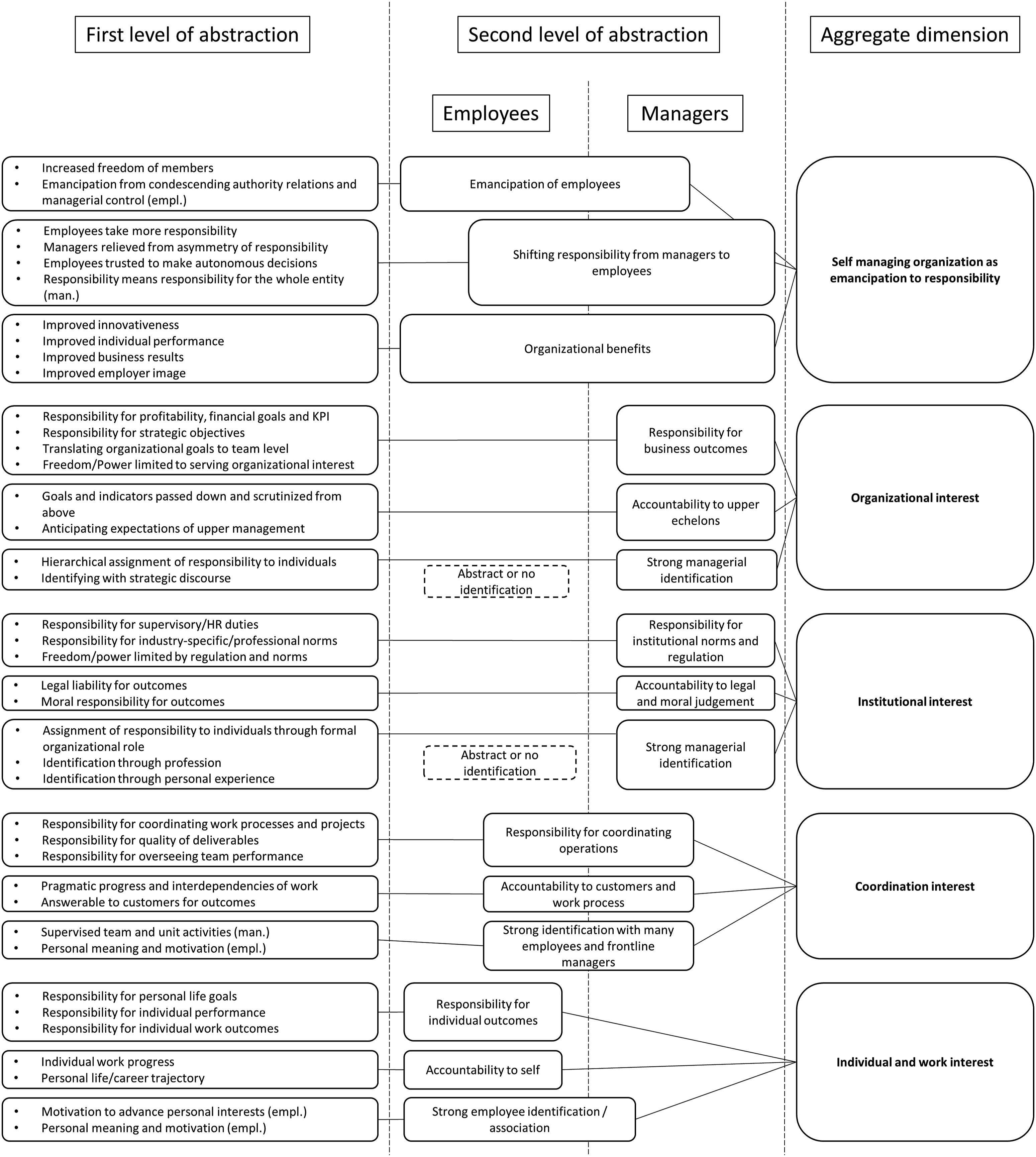
The second iteration centred around more detailed and systematic coding around the specific meanings that participants associated with ‘responsibility’. The data structure that resulted from this iteration is shown in elements related to the four different ‘interests’ presented in Figure 1 that we refer to as asymmetries of responsibility. This part of coding initially relied on systematic inductive coding of participant concepts, but the final data structure was later influenced by our wider reflections on the explanations of this variation. This conceptual work is especially reflected in the second and third levels of abstraction in Figure 1 but also involved clarifying the first level of abstraction accordingly. As we were especially interested in the uneven distribution of these meanings in different groups of participants (manager/employee, position in hierarchy, work role, organization), we also tabled each participant and their responsibility conceptions to study and validate the distribution. The incidence of different conceptions of responsibility in managers’ and employees’ interviews is roughly represented in Figure 1 as the position of second level concepts in relation to respective columns. During the second iteration, we became more convinced that the observed uneven distribution of responsibilities was relevant to managers’ perceptions of and reactions to issues of implementing self-managing organization.
In the third iteration, we took a more processual approach to the analysis. We coded participants’ perceptions about and reactions to outcomes and issues resulting from changes towards self-managing organization, and explored different ways they could be causally related. We found that employee reactions differed significantly from managers, and conceptualized an antagonist relation between managerial and employee perceptions that could be explained by the initial asymmetries of responsibility. This difference in orientations, in turn, seemed very relevant in managers’ further reactions. There were also relevant differences between organizations at this stage, which are covered in the findings section. Although present more implicitly in earlier iterations, here we also gave a more explicit role to theoretical concepts. We were inspired by critical leadership studies, as we thought that the leader-follower relationship is the relevant level of analysis for this case, and because the self-managing organization interventions explicitly aim for increasing the autonomy of individuals, so it is a concrete case of emancipatory ideals (that we share to some degree) introduced to organizations. We became more mindful of the discursive aspects and power implications of both the discourse of self-managing organization and the different articulations of responsibility. Finally, analysing our empirical cases as hybrid configurations between shared and hierarchical control through the lens of authority/authoring helped us make sense of the implications of asymmetries of responsibility to leadership processes from a broader perspective. The results of third iteration are presented in Figure 2 and discussed in the section titled ‘Authoring shared and hierarchical control’. We also experimented with various other theoretical concepts that did not end up in our final analysis. Authoring shared and hierarchical control.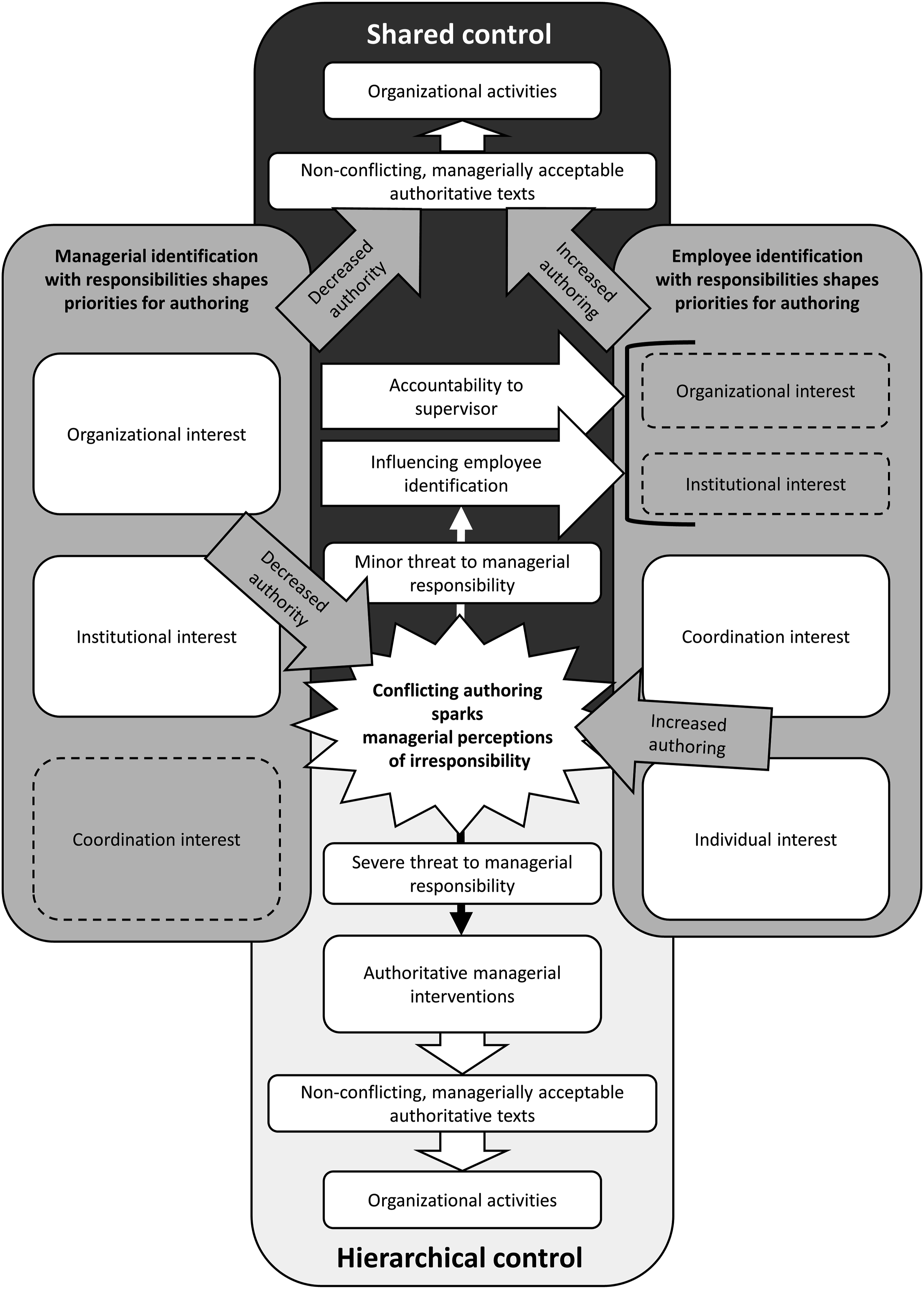
Self-management discourse as emancipation to responsibility
The managers and employees across case organizations shared similar views on the general meaning of self-management. One common theme was to highlight the organizational benefits of self-management. Participants also found self-management as desirable from a personal standpoint. Specifically, both managers and employees conceptualized self-management at the individual level as the increased freedom of members of the organization, especially lower-level employees. However, both groups also acknowledged that this would require employees to take more responsibility for their work and its outcomes. This vision, which appealed to both groups, could be described paradoxically as emancipation to responsibility. Managers usually emphasized the responsibility aspect, whereas employees emphasized autonomy.
Purported organizational benefits included increasing the ‘wellbeing’, ‘motivation’, and ‘commitment’ of employees to enable ‘efficiency’ and taking ‘full use of people’s capacity’. Participants also highlighted ‘innovativeness’ through increased ‘creativity’ and ‘agility’. Self-management was said to enable ‘faster decision-making’ ‘in this fast-paced world’. Such benefits were assumed to lead to happy customers, improved ‘financial results’, ‘profitability’, and ‘success as a business’. Some participants thought that ‘there’s no other chance’ than to be self-managing in the current competitive environment, and that it would also be an asset in hiring employees.
Increased freedom and responsibility were usually presented as interrelated aspects of self-management. Most managers felt that ‘there can be no freedom without responsibility’ (Solvio_manager). According to them, a good aspect of self-management was that their subordinates would take ‘full responsibility for their actions and what comes out of it’ (Solvio_manager). This would consequently ‘lighten the workload’ (Wave_manager) of managers by relieving some of their responsibility for things they cannot control. Several managers explained that they had ‘lots of responsibility in this middle management role but not enough power’ (Panorama_manager). With self-management, managers wouldn’t have to ‘instruct every action behind [subordinates] back […] but it should come naturally’ (Machinex_manager).
Like the managers, the employees perceived the responsibility and freedom to make autonomous decisions as a key aspect of self-management, but unlike managers, they highlighted their eagerness to be emancipated from condescending authority relations: ‘What I love is that I am treated as an adult here, and I can make my own decisions; no one acts like my parent here’ (Solvio_employee). The responses also indicated a distaste for being ‘micromanaged’ and ‘asking for permission’ from supervisors or ‘10-person committees’ and a desire to be ‘trusted as an individual’ and as a person ‘capable of making fast, smart decisions for the company’ (Solvio_employee).
While some employees did associate responsibility with doing ‘smart things’ to benefit the whole organization, these were mostly vague assumptions. For example, one employee at Panorama said that when your ‘own motivation increases, then it will always be seen by the end customers, so the result is better’. The employees seemed to have the idea that as long as they took responsibility for their own work, good things would follow for the company. The managers associated responsibility more exclusively with ‘working for the whole’ (Panorama_manager) and taking ‘more responsibility to do your work in a good way for the company’ (Machinex_manager). Explicit references to managerial accountability were not prevalent in the employees’ narratives but were a central aspect for managers: ‘I think self-management means that you can make decisions yourself and maybe make the right decisions, prioritize doing those. Of course, based on what the company expects from us.’ (Wave_manager)
Asymmetries of responsibility
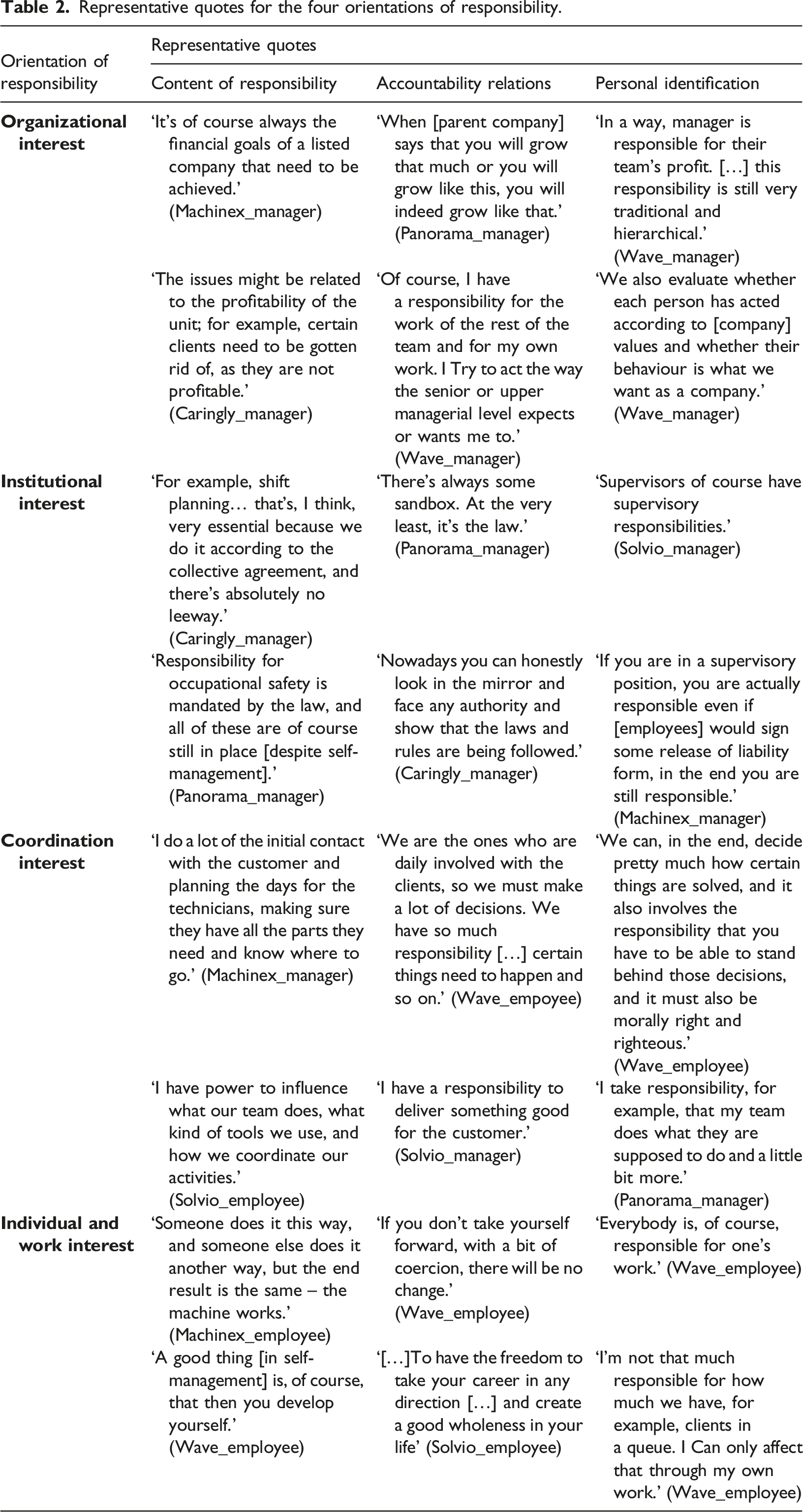
Representative quotes for the four orientations of responsibility.
Organizational interest
Most manager-level participants’ sense of responsibility was primarily oriented towards organizational interest. They saw that the key role of a supervisor is to be ‘responsible for the profits’ (Machinex_manager). Related business outcomes were often concretely measurable: ’either there’s a sale or not’ (Machinex_manager). Many managers also described translating more abstract ‘strategic objectives’ into lower-level indicators for their own unit, such as ‘number of hours or amount of products’ (Wave_manager). Freedom depended on contributions to these company interests: ‘There’s freedom as long as you make sure you are responsible, and you deal with your responsibilities. It is a kind of confined freedom’ (Solvio_manager). The scope of agency and decision-making power associated with their responsibility was thus mostly confined to ‘working towards reaching the target that has been set for us.’ (Wave_manager) and further translating hierarchically determined ‘company goals and strategic objectives that we get’ (Wave_manager).
Managers were held personally accountable to upper-level management on business outcomes: ‘what is our profit, and how much they [upper management] still demand from us’ (Wave_manager). Personal managerial identification with organizational responsibilities also manifested as more abstract strategy discourse, such as seeing oneself as ‘journeying towards that vision’ (Panorama_manager) or establishing personal goals that also ‘meet the strategy or values’ (Panorama_manager) of the company. The managers consented to working towards the company’s interests, taking them for granted: ‘I can act, and I have the power to act and make decisions. But I am always working in line with the upper [management] or with company values or our department or unit.’ (Wave_manager)
A few employees mentioned abstract concepts related to organizational interest, but they were not concerned with evaluating and controlling these objectives like the managers; rather, they assumed that good-quality work on their part would align with these interests: ‘In my opinion, we do a good job. High quality achieved by everyone prioritizing the interests of the company – in their own work.’ (Panorama_employee)
Institutional interest
Although less prevalent than organizational interest, many managers were also oriented towards what we call institutional interest. This category included responsibilities stemming from the institutional and regulatory environment of the organization. For example, managers from all case organizations highlighted their formal responsibilities related to human resources (HR) management while in a supervisory position. These could involve essential HR activities such as ‘staffing, hiring, career development, and skill development’ (Solvio_manager) as well as mundane ‘things that HR demands, such as working-hour inspections and other supervisory duties’ (Machinex_manager). Industry-specific, institutionally regulated responsibilities were also present including medical practices and professions (Caringly), chemical safety (Machinex), and occupational safety (Panorama). Responsible managerial agency was thus clearly confined by regulation and institutionalized moral norms.
Managers were often assigned formal liability: ‘But I will, in any case, be liable if there’s mistakes made in our team. I’ll be responsible for that mistake, not the individual expert.’ (Machinex_manager) While managers were held accountable for these regulations, some managers also expressed more personal identification through their profession (e.g., nurse) or meaningful past events such as an employee who had died at customer. These managers took their responsibilities very seriously: ‘We do not want to cut corners when it comes to responsibilities. We have also made this clear to the employees; everyone has a right to stop working if one feels that it is dangerous.’ (Machinex_manager)
Institutional responsibilities were not prevalent in the employee interviews. Instead, some managers thought that employees would, for instance, ignore their occupational safety rights if their supervisors wouldn’t hold them accountable. However, a few employees did identify these responsibilities on an abstract level: ‘We are encouraged to make decisions. As long as they are ethically right, legally right, and right for us, we have freedom.’ (Wave_employee)
Coordination interest
The third category of responsibility was oriented to fulfilling the practical need to coordinate collective everyday activities. This orientation was present in nearly half of both the employee and (mostly first-line) manager interviews. For first-line managers, this type of responsibility would involve overseeing the concrete work of employees in the field. Coordination needs could stem from running continuous processes such as home care visits in Caringly or separate customer projects: ‘We have a customer that needs us to come as fast as possible’ (Machinex_manager). For employees, coordination responsibilities could vary in scope: ‘In some cases, there might be a really small functional responsibility, and in other cases, some responsibility is related to following through with the whole project’ (Panorama_employee). Coordinating the projects and processes of the case companies would often involve sorting out complex interdependencies between people and materials on a daily basis: ‘I had a look at unfinished work from the previous week and made some schedules with the field maintenance manager or with the field supervisor and the workshop manager to take care of all machinery and obligations related to machinery and so on.’ (Machinex_manager)
Neglecting coordination responsibilities would quickly backfire as important processes would stop, and colleagues and subordinates couldn’t carry out their work. Being accountable to important customers added an additional weight to this responsibility: ‘Each of us who has their own customers, we do answer with our own face, and it will backfire quickly if we mess things up’ (Panorama_manager). To some employees, the coordination responsibilities as such seemed to provide a personal sense of meaning and motivation: ‘When thinking about responsibility, no one makes demands, but I demand it from myself in principle, only because you get a good position and want to do the right things. And when the goals you have set, sort of all the time, are related to a good client project and good client outcomes and so forth, you use them as guiding principles in your work to direct freedom in the right way.’ (Solvio_employee)
Managers higher up in the organizational hierarchy rarely mentioned this orientation, similar to employees who focused on very individualized work efforts such as in sales work.
Individual and work interest
The fourth category of responsibilities involved employees’ person-specific considerations, such as career and skill development, well-being, and individual work performance (without much regard to the interdependencies involved). Some employees had their own interests clearly in mind: ‘That’s a good thing [in self-management]. Everybody is, well, a cliché, a smith of his own fortune. For example, for one’s own career development, if you want something, you have to work for it. […] It’s usually everybody’s own responsibility’ (Wave_employee). However, for many employees, the object of taking responsibility was work for its own sake: ‘You have your own freedom and responsibility for that work’ (Solvio_employee). Many employees found it motivating to understand that self-management was about exercising more freedom and responsibility in their narrow personal sphere of work, be it for their own interest or for the sake of work itself: ‘I am more motivated when I take responsibility for something, and no one tells me what to do. I sort of know myself that I need to take care of some issues. Then I will take care of it from the beginning to the end. And if something goes wrong, it’s me who made the mistake. I will know that I can blame myself for that, which is perhaps what motivates me more.’ (Caringly_employee)
Also, many managers from one case company, Wave, had similar ideas about their subordinates’ responsibilities and the nature of self-managing organization. Their unit mainly handled sales and customer service work, with limited interdependencies between different individuals and the work done by them. The individual performances contributed in a linear way to organizational profitability; therefore, employees could see themselves as high-performing athletes who strived to attain better performances: ‘You can't expect someone to come and tell you, “Hey, now you should improve this”, but rather, I myself am awake and constantly strive towards ensuring that I train and learn in the areas where I have room for improvement and stay up to date all the time.’ (Wave_employee)
Authoring shared and hierarchical control
Self-management discourse granted employees more autonomous responsibility, that is, expectations and legitimacy to author organizational activities around their work roles. At the same time, managerial mandates to express hierarchical authority were weakened. However, the level of ambition associated with the change initiatives varied across different organizations. Solvio had adopted and maintained a self-managing culture since its induction and each employee was highly expected to take responsibility: ‘I think it really asks a lot from you or from me to self-organize and make sure that ... like, there is so much responsibility on myself, so there is also a lot of pressure that I put on myself. It’s hard.’ (Solvio_employee)
Wave and Panorama adopted more or less piecemeal changes towards self-management, while Caringly had a history of bad experiences with a more ambitious change. Machinex was still in the planning phase. Several interviews indicated that also in Wave, Panorama, and Caringly, the introduction of self-management had increased the expectations towards employees to author their individual work and, in some cases, the coordination of collective work. Employees saw these changes as mostly positive, as they could align their work with individual and coordination interests that their sense of self was vested in: ‘Maybe there’s a sense of freedom when you are able to make your work more rational by taking action from a client-oriented perspective’ (Caringly_employee). Such perspectives had often been repressed in hierarchical authoring practices: ‘When the customer says that it doesn’t work like that, we do understand that, but it may not necessarily translate into changes in, for example, the planning activities. It doesn’t necessarily mean anything to them.’ (Machinex_employee)
Much of the time, when such empowered employee authoring did not interfere with organizational or institutional interests, managers were happy with this more shared mode of control, as it also relieved their extensive sense of responsibility:
‘[Employees] can make decisions with the customers by themselves, how to handle them. They can do that autonomously; they don’t have to ask for my permission as a supervisor. So, they could make those decisions themselves and justify them because they are also responsible for those mistakes then, *laughs*.’ (Wave_manager).
However, sometimes managers perceived the authoring by (some of) their subordinates as irresponsible as it neglected or conflicted with institutional and especially organizational interests. Many managers questioned employees’ ‘genuine commitment’ to organizational interests: ‘I wish they [subordinates] would take more responsibility for tracking the profits [...] controlling the collective profitability of the team; I feel that it’s still very much in my hands’ (Wave_manager). They also saw variance in the responsibility orientations of different employees: ‘Some people are quick to shrug off anything that’s not their business or claim that they have a lot already. Others make an effort to truly wear the company hat, so to speak’ (Panorama_manager). Our interpretation is that for some employees, self-management meant identifying also with responsibilities related to organizational (and institutional) interests, becoming indeed a self-manager, while others saw it more as a mandate to prioritize individual and coordination responsibilities.
These concerns threatened the managers’ sense of self as they were still heavily vested with organizational and institutional concerns: ‘If the team member doesn’t find it meaningful whether they have carried their responsibility or not, then it’s the supervisor’s responsibility’ (Wave_manager). However, there was a higher threshold to intervene overtly in subordinates’ authoring, as the self-management discourse and corresponding changes to formal role definitions had eroded the managerial mandate for authority: ‘You weren’t in the formal supervisory position, but you were still responsible for everything’ (Caringly_manager).
Often managers’ concerns with employee irresponsibility posed only a minor threat. These could, for example, concern free riding: ‘If an organization is self-managing, and some guy [thinks that] this enables making do at a minimum level, I see that as a risk’ (Panorama_manager). Even when employees consented to undertake organizational and institutional responsibilities, managers could find issues in their readiness to do so: ‘They were not ready to take the power, or, as I interpreted it, they were not ready to take on the responsibility’ (Wave_manager). Such issues could be corrected as they were seen as stemming from lack of individual skill and understanding: ‘Those who understand [self-management] are doing the right things, making the right decisions.’ (Wave_manager)
Many managers thus came up with a new ‘coaching’ style of leadership that was about ‘sparring, guiding, and directing but not managerial; there’s nothing like going through task lists’ (Panorama_manager). This involved influencing subordinates through subtle normative techniques that would promote organizational and institutional interest without compromising the shared mode of control. ‘The role of the supervisor is increasingly becoming the role of a trainer, coaching those people forward so that they can make sense of their objectives, […] and connect them to the outcomes of the whole unit’ (Wave_manager). Instead of overt exercise of authority, these interactions relied on soft conversations about self-related issues: ‘We do talk about them. If I notice that somebody doesn’t perform or I notice that their efficiency has to improve or isn’t getting going properly, we have a conversation about how they’re holding on and whether the individual is doing well and sleeping ok, whether they remember to eat and drink, or if they have a headache.’ (Wave_manager)
However, sometimes managers perceived more severe threats to their sense of responsibility vested with organizational and institutional interests. Some problems with employee irresponsibility were seen as structurally originating rather than matters of individual development. In Solvio, issues with the aggregate levels of the organization or the ‘big outcome of the project’ easily became no one’s responsibility: ‘What happens at the tribe level is that those [collective outcomes] are not a personal concern of anyone, so they don’t affect individuals anymore; individuals rarely work on those or even try to’ (Solvio_manager). Some managers saw their subordinates as lacking access to information or financial pressure associated with aggregate-level concerns, which made it difficult to make decisions from the organizational perspective: ‘You don’t have a holistic understanding about what is good and what is bad for the whole company […] because you don’t have all the information at your disposal’ (Panorama_manager). Some managers were also sceptical whether employees would be ready to be responsible when the ‘shit hits the fan’ or critical issues are at stake: ‘Of course, in all activities, we strive to assign responsibility and power to team members, but when it comes to big issues, it might be that employees either don’t dare to take up the responsibility or simply don’t want to.’ (Wave_manager)
Regarding these issues, managers expressed concerns about the feasibility of self-managing organization. While they were positive about self-management and employees’ capabilities in general, they had reservations about how far this approach could actually be taken and whether it would work in situations where things don’t go smoothly. Regarding these issues, managers resorted to hierarchical control practices. In Caringly, the distribution of responsibility for institutional regulation and company profitability proved problematic. Caringly reverted back to formal hierarchical structures after such concerns erupted with a rather ambitious initial attempt at self-management. Managers in Caringly consequently saw the possibilities of self-management as rather limited: ‘[Grassroots-level work] cannot be liberated. Like I said, we are still fixing that liberation quite a bit. It just doesn’t [fit] into the world of healthcare staff, like, “just do what you do” […] it just doesn’t work.’ (Caringly_manager)
Similarly, Machinex never managed to take major steps towards self-management during our project, even though they had made an initial decision about implementing self-management: ‘But kind of, for it to be self-managing, well, no, not a chance. Every once in a while, it’s like shepherding a kindergarten, you know, and quite frankly so. Then, when you discuss things with them, it returns to normal. So maybe it’s part of the employee role – if you don’t intervene, they will indeed live recklessly.’ (Machinex_manager)
Wave and Panorama did not formally revert to the organizational structures preceding their change interventions, but they retained a lot of formal residue of hierarchical control. As one manager explained, ‘They told me that the [budgeting software] licence costs a couple of grand per year, and our corporation doesn’t think that this kind of person [subordinate] needs that. They don’t have a [formal] budgeting responsibility, so they don’t need access to that tool’ (Panorama_manager). Decision-making for big financial decisions remained in a traditional corporate mode, with power concentrated at the top ‘with the blessing of one specific gentleman’ (Panorama_manager).
Furthermore, when major strategic or financial issues were at stake, managers retained the right to intervene. ‘When we talk about money, I often have it so that [my supervisor] is CC’d so he knows that he can intervene if he finds it necessary’ (Panorama_manager). Managers from Solvio also recognized this tendency, as the following response suggests:
‘But if it’s about some new thing, strategy, strategic change so it’s not so self-managing anymore. Then, the [hierarchical] controls are usually turned on. Which is maybe a good thing’ (Solvio_manager).
Discussion
Based on our findings, we conceive ‘self-managing organization’ as a set of discursive resources that promotes certain redefinitions to the communicative relations between ‘leaders’ and ‘followers’ by reorienting meanings around ‘responsibility’, promoting what we call, paradoxically, emancipation to responsibility. The self-management discourse provides legitimacy for ‘followers’ to take on more autonomous responsibilities, without constant surveillance and control by their ‘leaders’ based on asymmetrical authority relations. In other words, ‘followers’ become seen as more legitimate authors of organizational purposes and meanings that orient collective efforts authoritatively (Holm and Fairhurst, 2018; Taylor and Van Every, 2014). Our findings showed that both managers and employees consider this narrative appealing, as it promises numerous organizational and individual benefits, including the reduction of asymmetries of agency (Tomkins et al., 2020) felt by managers and increased freedom and self-actualization for employees.
Our main contribution is related to the finding that while the abstract meaning of ‘responsibility’ might be widely shared in terms of denoting conceptions and impressions of an actor’s authorship and related normative duties and commitments (Dan-Cohen, 1992; Giddens, 1999), the specific contents of ‘responsibility’ remain open to varying articulations including values, interests, and epistemic perspectives. Specifically, our findings revealed an asymmetry of responsibility – that is, managerial ideas and ideals of responsibility were rather different from and sometimes antagonistic to the responsibilities experienced by employees and professionals. The responsibilities of participants varied in their orientation towards different interests that we grouped into four categories: organizational, institutional, coordination, and individual/work. The managers in this study expressed their identification with typical capitalist organizational interests such as profitability and, sometimes, with institutional concerns such as professional regulation and occupational safety. The employees felt the greatest responsibility for attaining concrete work outcomes and sometimes for coordinating first-line work processes. Our analysis points towards both organization-structural and identity related factors in explaining these stark differences in identification.
In terms of intra-organizational factors, our findings suggest that identification with certain responsibilities was highly shaped by what kind of accountability relations actors are exposed to through their everyday work. Accountability in this sense can be defined as ‘perceived expectation that one’s decisions or actions will be evaluated by a salient audience and that rewards or sanctions are believed to be contingent on this expected evaluation’ (Hall and Ferris, 2011: 134). Managers identifying strongly with organizational responsibilities frequently reported conforming to expectations of evaluation from top management. Institutional responsibilities were explicitly related to legal liability and sometimes to moral conscience regarding colleagues and patients. In terms of coordination responsibilities, sometimes there was a concrete accountability relationship with the customers, together with more implicit expectations to keep interdependent processes and projects going. Those employees who did not face these more encompassing accountability relations could focus on their individual work efforts and personal life goals. Importantly, bureaucratic authority relations between ‘leaders’ and ’followers’ weakened in changes towards self-managing organization both in terms of the accountability aspect (less overt evaluation and sanctions by supervisors) and authoring aspect (more legitimacy for followers to partake in authoring). Before the interventions, these authority relations sustained a connection from employee level to organizational and institutional interests through the hierarchically imbricated accountability and authoring influences (see Taylor and Van Every, 2014). When these chains of communication were weakened, many employees - rather than taking up organizational and institutional responsibilities - oriented their empowered authoring efforts in accordance with those responsibility conceptions that they personally identified with or were suggested by the remaining accountability relations.
Ideological processes related to identities of employees and managers might also play a significant role in explaining different responsibility orientations. Socioeconomic contexts might play a key role here. For example, in traditional industrial contexts, the conflict of interest between working class and owners/management can shape their identities towards antagonistic subject positions. This can be further heightened by an adversarial industrial relations climate that can decrease worker commitment to companies compared to a cooperative climate (Lee, 2004). We could see signs of this in Machinex and especially Caringly interviews, with the poor employment conditions of nurses being a constant topic in the Finnish media. Further, Finnish nurses increasingly face precarious employment that involves more individualized bargaining and increased vulnerability and job insecurity (Hult et al., 2022), making personal interest in the narrow sense a more salient concern for employees. On the other hand, managers across industries and also professionals in particular industries such as IT-consulting are often highly educated people with a middle-class socio-economic status. They might more readily identify with pro-business values and pursue high-status career trajectories, thus seeing corporate ends aligning with their own interests and identities. Students are also socialized into disciplinary cultures through education (Becher, 1989). For example, Ylijoki (2000) describes the study culture of a computer science department in a Finnish university as valuing high-salary jobs in private companies and seeing student interests aligning with those of IT companies. This is supported by our anecdotal finding that most employees who were concerned about company profits (even though in a rather abstract sense) were Solvio employees. Päiviö (2008) found similar values in her study conducted with students in a Finnish business school.
As adoption of post-bureaucratic discourses likely weakens the bureaucratic authority relations between ‘leaders’ and ‘followers’, we argue that associated shared forms of control are more dependent on ideological alignment of employee identities with the dominant organizational interest. We think this is central to self-managing organization, because with less salient hierarchical authority relations that would orient and control employee activities towards organizational and institutional interests, there would arguably have to exist a more personally held normative commitment to those ends should they not be ignored. This might call for new forms of normative control (Fleming and Sturdy, 2009) or identity regulation (Alvesson and Willmott, 2002). In the context of this study, managerial perceptions of the feasibility of self-management were related to their perceptions of variance in how their subordinates identified with organizational (and institutional) responsibilities. Managers found themselves struggling with new problems with follower consent and commitment rather than being relieved completely from the asymmetry of agency (Tomkins et al., 2020). From the perspective of the managers, some employees did the wrong kind of authoring which conflicted with managers’ sense of responsibility as they were still very much identifying with and held accountable for organizational and institutional responsibilities. This partial de-bureaucratization threatened their managerial identities in a new way (McKenna et al., 2010). Some companies solved this by never actually following through with implementing formal self-management changes (Machinex) or by reverting formally back to old structures (Caringly), whereas the managers in the other companies (Wave, Panorama, Solvio) had to manage the leader-follower relation in more subtle ways. While they could rely to some degree on formal residues of hierarchical control practices and revert to authoritative control in exceptional situations, they would also draw on ‘coaching leadership’ to influence their followers authoring. We interpret this as an attempt to regulate the identities (Alvesson and Willmott, 2002) of their followers by training them to internalize responsibilities oriented towards organizational interests. In other words, when authoring the organization for their followers from a position of authority was less appropriate, leaders started to author their followers into organizationally appropriate authors. It should be added, however, that in more exceptional situations, or when ‘shit hits the fan’, hierarchically authorized interventions were again seen as more appropriate by all parties. Oscillation between shared and hierarchical forms of control was thus apparent, depending on severity of the situation from a managerial perspective.
The self-management discourse, in particular, might provide a powerful performative avenue for identity regulation as it relies on the concept of ‘responsibility’. The generic meaning of responsibility associates personal identities with situated agency, and it has a near-universal positive connotation. Thus, tapping into responsibility as a discursive resource enables harnessing the creative authoring capabilities of individuals’ together with their motivation to self-actualize to serve particular interests. On the other hand, the specific discursive contents of ‘responsibility’ are open to various articulations, and they seem to have remained so in the self-management discourse. This leaves the specific contents of ‘responsibility’ to be contested between different organizational members, as was evidenced by our study. Many employees indeed felt empowered to focus on the individual and coordination work they originally identified with, even though interventions of managerial control could counter such developments to a degree.
Considering this however, we have reservations about promoting self-management as a clearly emancipatory organizing intervention that would serve interests of all stakeholders, as the autonomy to author individual and collective work orientations and efforts seems highly contingent on aligning this authoring with managerial interests. Similarly, Sewell (1998) has argued that recent managerial discourses promoting autonomous teamwork and the rhetoric of emancipation have resulted in new forms of surveillance and discipline that cause ‘teams to take on the responsibility for rationalizing and intensifying their own work activities’ (Sewell, 1998: 401; see also Barker, 1993). Also in our study, several Solvio employees expressed feeling too much responsibility. More emancipatory versions of self-management would presuppose strong commitment from powerful stakeholders to the importance of individual, work, and coordination interests, possibly at some expense to profits. Such conditions seem more likely in contexts of public or alternative ownership such as cooperatives. Indeed, Huber and Knights (2023) present an empirical case of a cooperative in which collective normative control worked through a sense of collective responsibility to others rather than serving hegemonic domination or personal egoistic interests. There are also conventionally owned companies that have introduced practices to alleviate economic conflicts of interest among organization members. These practices can involve transparent and equal salary structures and more equally distributed options, dividends, and bonus arrangements.
Such arrangements are becoming somewhat popular in small IT consultancies (Solvio had some arrangements in place), although this may reflect the high demand for and low supply of (and thus good bargaining position) skilful employees in this industry and thus be more difficult to achieve in traditional industries. For example, Caringly employed hundreds of modestly paid employees with zero-hour working contracts. Many employees were simultaneously contracted for several companies. From such a precarious employment position, it seems far-fetched that employees would identify with company profitability rather than try to make their own livelihoods. Finally, different industries have different kinds of institutional and professional regulations in place, which further influence work responsibilities.
Our findings also suggest some practical implications regarding leadership communications in contexts of post-bureaucratic control. First, many of the participants seemed to have little knowledge about the content and relevance of responsibilities and interests they did not personally identify with. For example, managers higher up in the hierarchy would often lack knowledge of coordination responsibilities even when they were essential for delivering the products or services of the company. On the other hand, employees often had a vague understanding about strategic or financial concerns of the organization. Increased and more widely shared understanding and recognition of the spectrum of legitimate responsibilities and associated interests across the organization could enhance the potential scope of shared control. This could manifest as authoring that considers various interests more comprehensively and alleviate the perceptions of irresponsibility sparked by conflicting interests (see Figure 2). Second, contrary to the usual self-management prescriptions, our findings as well as extant literature suggests that elements of hierarchical control are likely to remain alongside shared control. Rather than trying to eliminate hierarchical elements or sweep them under the rug, organizational members could collectively author a clear set of rules defining the situations and practices where hierarchical control and coordination are considered legitimate and desirable. Such arrangements could also alleviate the issues of employees experiencing too much responsibility when individual issues grow out of their control.
To conclude, we contend that the concept of ‘responsibility’ is a key arena of discursive contestation and identity regulation. It is appealing to actors because of its widely shared generic meaning and positive moral connotation across contexts. We call for a more detailed appreciation of the spectrum of meanings and articulations of responsibility and associated forms of authoring and control in different situated contexts. Salient organizational issues such as corporate social and environmental irresponsibility aren’t necessarily about a lack of responsibility but, rather, to what ends and how responsibility is enacted.
Limitations
Our study has several limitations. First, our analysis is based on interviews constructed during a short time period. While providing relevant discursive and narrative materials, employing ethnographic methods would have produced more longitudinal insights on the change processes in the case organizations. Thus, our findings should be interpreted as pertaining primarily to the discursive aspects of self-management and related change interventions and less representative of how the change processes unfolded across time and space. The interview samples are also rather small compared to the size of the studied organizations, which may limit the discursive nuances exposed in our study. Second, the transferability of our findings might be limited by the national context and the specific industries of the case organizations. For example, a markedly individualist and conscientious conception of ‘responsibility’ might be specific to the contemporary Finnish culture. Industries can also differ significantly across countries in terms of institutional arrangements, regulation, and culture that shape associated responsibilities. Finally, our study focuses on a particular set of discursive resources related to shared forms of control. Other articulations shared control might be less focused on ‘responsibility’.
Footnotes
Acknowledgements
We are indebted to Eeva Laine, Jori Mäkkeli, Iina Ryhänen, Essi Sundström, Visa Varpenius, and Noora Vänttinen (in alphabetical order) for conducting the interviews that made this study possible.
Declaration of conflicting interests
The author(s) declared no potential conflicts of interest with respect to the research, authorship, and/or publication of this article.
Funding
The author(s) disclosed receipt of the following financial support for the research, authorship, and/or publication of this article: This work was supported by Business Finland [project 4022/31/2018].
