



Abstract
Arts-based approaches to leadership development are becoming increasingly popular because of their potential to highlight the symbolic, aesthetic and sensual dimensions of organizing, thus opening up new possibilities for insights and action. However, our study shows that such interventions can also surface complex dynamics and can be co-opted in ways that diminish their more empowering potential. Our focus is on one such leadership development initiative within a UK based education institution focussing on Forum Theatre, a specific form of dramaturgy typically used to challenge structures of power and oppression. We draw on semi-structured interviews with senior level participants and facilitators to ask whether the programme was effective as a means of learning and empowering the participants. Our findings suggest that the co-option of Forum Theatre to serve organizational interests raises significant concerns when it requires a domestication of its more radical potential.
Introduction
The ‘aesthetic turn’ in leadership and organization studies has generated a plethora of research exploring the potential of artistic and creative methodologies for illuminating the symbolic, aesthetic and sensual dimensions of organizing (e.g. Linstead and Höpfl, 2000; Nissley et al., 2004; Strati, 1999). Building on these insights, the use of arts-based approaches not only as a heuristic but also for facilitating leadership development provides opportunities for experiential and sensory-based learning in which meaning-making emerges from social/collective interactions (Taylor, 2008). Arts-based approaches ‘transform[e] aesthetic experiences to develop non-rational, non-logical capabilities and self-knowledge that constitute and cultivate experiential knowing, aesthetic awareness and, in general, the so-called soft issues of managing and leading’ (Sutherland, 2012:26). Commenting specifically on theatrical art forms Posner (2008), Taylor (2008) and Elm and Taylor (2010) suggest that theatre can help us understand the performance of leadership alongside what it means to perform the role of a leader (Carroll and Levy, 2008; Gagnon and Collinson, 2014). Theatrical interventions can also provide opportunities to engage with reflection and critique, ‘calling into question the spaces we inhabit and subverting the divisions that constitute social and political space’ (Critchley, 2019: 6).
In this paper, however, we problematise the use of theatrical interventions in organisations, drawing on an analysis of one such leadership development initiative using Forum Theatre. Forum Theatre is a model of dramaturgy that is specifically concerned with articulations of power dynamics. Developed by Augusto Boal (1979) as a ‘Theatre of the Oppressed’, it centres on people who are experiencing issues of marginalisation and oppression and who are encouraged to develop scenarios that dramatize these situations, thus envisaging new possibilities for intervention and challenge. However, our findings suggest that the radical potential of Forum Theatre becomes domesticated within the organisational context, thus losing its true potential. Our study highlights the complexities involved in using Forum Theatre with regards to two key aspects of domestication: the processes of domestication implemented in organizations in the very adoption of what is supposed to be a radical method to challenge and change the status quo; and the role of the senior leaders. We suggest that the binary conceptualisation of oppressors and oppressed, that underpins Forum Theatre, appears more nuanced in our accounts.
Here we address two critical questions: how are the tensions between the management project of leadership development and the emancipatory project of Forum Theatre domesticated within the context we are studying? And what conceptualisations of leadership are being manifested and performed within the event? Our paper contributes to the increasing literature that problematizes both the use of arts-based methods in leadership development as well as the agentic dynamics for senior leaders who are commonly seen as individuals who influence others and lead change (see Edwards et al., 2021; Gagnon and Collinson, 2014; Nicholson and Carroll, 2013; Tourish and Willmott, 2023).
The article proceeds as follows: we begin with a review of some of the challenges inherent in the use of all arts-based methods within leadership development programmes, outlining the tensions involved in applying Forum Theatre within organisational settings. We consider whether the processes of domestication can provide a helpful lens to explore its ‘de-radicalisation’ or co-optation for the achievement of institutional priorities. Subsequently, we describe our methods for data collection and analysis; present our findings with quotes from senior leaders who participated in senior leadership development programmes featuring Forum Theatre; and offer some concluding remarks. We highlight some of the ways in which the radical potential of Forum Theatre was tamed and harnessed in the furtherance of a very limited understanding of leadership development.
Challenges in applying arts-based approaches to leadership development
Research into the use of drama in leadership development (see, for example, Beirne and Knight, 2017; Kärreman, 2001; Mangham and Overington, 1987; Starkey et al., 2019) draws on conceptualisations of theatre such as Burke’s (1969) studies of life as dramatic in ‘form’ and Goffman’s (1959) on the dramaturgy of life as drama. Schreyögg and Höpfl (2004) identified two separate strands within the literature on organization and theatre: one that views organizational life as theatre, and the other that explores the use of theatre in organizations. Studies pertaining to the first tradition of inquiry are largely based on research by Goffman and Burke, while studies viewing theatre as a metaphor (Cornelissen, 2004; Cornelissen et al., 2005) aim to draw parallels ‘between theatrical performances and organizational performances’ (Schreyögg and Höpfl 2004: 692).
Before reviewing some of the literature on the use of Forum Theatre in leadership development, we begin by highlighting some of the challenges that are inherent in enlisting any form of art-based methods in this context. We focus, firstly, on a consideration of whether all arts-based methods are equally applicable to developing leadership skills; secondly, on contrasting underlying assumptions about their relevance and usefulness; and thirdly, we highlight some, often unconsidered, risks and disadvantages of their use.
Firstly, there are on-going debates about precisely how arts-based methods actually work and whether some are better suited than others to support specific development goals. This has generated different frameworks to aid the understanding of the different art forms and their application to organizations. For example, Taylor and Ladkin (2009) identify four different functions of arts-based leadership development (these are skills transfer, art making, projective techniques and illustration of essence). Although these may overlap to some degree, they argue that there are important differences between them and should be deployed differently, depending on the aims of the programme. The Sutherland framework (2012) is sequential rather than oppositional, proposing that arts-based methods ‘work’ through a progression of stages in which ‘arts-based learning environments afford aesthetic workspaces where participants engage[d] in aesthetic reflexivity to create memories with momentum to inform their future leadership practice’ (P.25, emphasis on the original). Kjellstrom et al.’s (2020) model, while generic rather than specifically focused on arts-based methods, creates a hierarchy of six different ways of conceptualising leadership development, starting with developing the individual through to a more holistic understanding of human development that extends beyond the organization and includes considerations of its role within the wider society. These different positions involve increasingly complex understandings of leadership and of the skills required (and, by extension, different forms of art-making). For example, Smolević Jones et al. (2016) suggest that leadership involves ‘mastering the ability to reformulate discursive constructions of processes and identities’ (P. 427) which, in the Kjellstrom et al. model, is a higher order skill., and one which would seem highly relevant to the identity-performing functions of theatre.
Underlying considerations about the relevance and applicability of arts-based approaches to leadership, and theatre in particular, offer the contrasting assumptions referred to earlier. One holds that organizational life is theatre (Schreyögg and Höpfl, 2004) with the other suggesting that theatre provides a useful metaphor for understanding organizational processes (Cornelissen, 2004; Cornelissen et al., 2005). Another way of understanding this distinction is that of the relative emphasis on process or product. In the first understanding, leadership itself can be understood as an artistic endeavour and, therefore, one aim of leadership is to produce something of artistic value (Kostera, 2022; Strati, 1999; Szostak, 2024). Leadership development in this conceptualisation becomes the cultivation of artistic sensibilities and their deployment within the specific contexts in which the leading is taking place. Taylor and Ladkin (2009) illustrate this point by suggesting that ‘when managers look to Shakespeare for lessons in leadership, they are not interested in the process that Shakespeare went through to write the plays but rather are interested in the result of the process—the play itself—and the lessons that it contains for them’ (P.61). However, if we assume that the relationship between leadership and the arts is metaphorical, we can develop insights into the experiences of leadership by exploring the similarities and differences between them. In Taylor and Ladkin’s typology (2009) this second understanding focuses more on the processes of art-making and skills transfer rather than on the artistic product itself.
This application of arts-based methods in non-arts-based contexts is increasingly popular; examples such as community-based arts (McLean, 2014) and trauma-based arts (McMahon et al., 2024) demonstrate some of the ways in which arts-based methods can generate new insights and promote social and individual change. However, they also raise some interesting questions and challenges, particularly around how we might evaluate their effectiveness. These are not new questions, as the arts have been long been used for more instrumental purposes to promote aims beyond the creation of art, however they still remain relevant and unresolved in the context of (senior) leadership.
Finally, it is important to consider if there are inherent risks in applying art-based methods out of context. Flamand and Baccouche (2022) suggest that there are. Their work adapted Shepherd’s ‘3-D’ model of the ‘dark side, the downside and the destructive side’ (P.2), to propose that the dark side of the use of arts-based methods in corporate setting concerns the potential to surface negative emotions such as fear and anxiety (in both performers/creators and audience); the downside, as ‘participants’ loss of capital’; (P.8) including a sense of being de-skilled; and the destructive side as possible negative effects beyond the actual participants. This last dimension, they observe, is the least researched, and thus the least well defined but can include such things as wasted use of resources (if the development initiative is not ‘successful’) or the unattainable promise of creative methods promoted as solutions where they are not appropriate.
This discussion suggests that before it is possible to evaluate the effectiveness of any specific arts-based leadership development intervention it is important to be aware of how leadership is understood within the context in which it is being enacted, and what specific skills are the focus of that specific arts intervention. Without that clarity there is a risk that the intervention will not achieve its potential and may even be counterproductive, leaning towards the ‘destructive side’, raising the above-mentioned issues of risk.
Forum theatre as a pedagogy of the oppressed
Forum Theatre would seem an anachronistic choice for a leadership development programme within a setting that has been much critiqued for its increasing corporatization (see Parker, 2018; Wood, 2022 for a full discussion of this critique which is beyond the scope of our article). However, this particular theatrical intervention is increasingly being annexed by the private and public sectors (Britto, 2019). Although it might be argued that all art is, at least potentially, subversive in its capacity to unsettle and challenge taken for granted assumptions (Schwabenland, 2012). Forum Theatre is one of the most explicit forms of art for radical critique. Gagnon and Collinson (2014) argue that issues of power, context and identity are imbricated in all forms of leadership development, however implicit they may be. Therefore, our interest is whether the use of Forum Theatre in leadership development facilitates a more radical conceptualisation and inhabiting of the role of a leader, or whether the context itself serves to domesticate, or ‘tame’ its subversive potential in the furtherance of ‘neoliberal’ considerations (Boal, 2019).
Forum Theatre, in Augusto Boal’s original conceptualisation (1979, 1995, 1998), is designed to give voice to people in oppressive situations and provide a space for alternative scenarios to be imagined and manifested. Strongly influenced by the critical pedagogy of Paolo Freire, Forum Theatre is one part of ‘the arsenal of the oppressed’, a set of artistic practices rooted in Marxist and anti-colonial revolutionary thought that empower and instigate change. Forum is generally performed to interrogate oppressions and to problematize structural mechanisms that uphold the status quo, exposing power dynamics, and setting a call to action. As conceived by Boal, Forum is intended to challenge prescribed social behaviours, disrupt normative understandings and to unsettle the interplay between individual and collective responsibilities.
As such, Forum Theatre does not immediately suggest itself as a useful resource for leadership development; leaders are not usually regarded as oppressed, nor would they necessarily be motivated by opportunities to ‘disrupt the status quo’. Mangham (2001) points out that Boal’s founding ideals for Forum as a route to worker liberation may also conflict with the coalescence of organizational identity and dissemination of management approach that underpins many training/learning initiatives. However, Forum has been identified as particularly effective in promoting dialogic involvement between the organizational actors enmeshed in the implementation of change (Bushe and Marshak 2009). Within workplace settings, through the architecture of Forum Theatre, participants can create a mirror of organizational life, the ‘looking-glass effect’ as termed by Meisiek and Barry (2007), through acting-out their at-work behaviours, perspectives, and desired actions, thereby contributing to the ‘script’ of the institution. The traction of Boal’s Forum Theatre techniques in these environments manifests a belief that organizations are in a state of perpetual becoming. The dialogical construction of the Forum method surfaces conflict to enact strategies for change, and for personal and organizational transformation (Meisiek and Barry 2007:1808).
Furthermore, through the performance of a role within the enacted scenario, new understandings can be surfaced and embodied that allow us to question how ‘identities are constructed and communicated to others, contested and authorized’ (Yuval-Davies and Kaptani, 2009: 56). The nexus between identity, power and context in leadership development is highlighted by Gagnon and Collinson (2014) in their discussion of the ‘regulatory [and contextual] practices that constitute an idealised leader’ (P.645). Their study explores how these are aligned to the organization’s particular construction of the ideal leader in that context, but also that they may be both accepted and resisted in practice.
In Forum Theatre a play, or scene, portraying a situation in which oppression is being experienced (e.g., gender violence, children’s rights, work-place bullying) is first performed by the actors, then repeated, with the audience stopping the action to intervene and take over the role of the oppressed person. In embodying the protagonist and acting out alternatives to the original story, the play/scene is re-scripted by the participants, as each “spect-actor” (Boal, 1995) takes part. The possibilities for alternative actions are manifold, unpredictable, novel and co-created in the moment. Participants are thus shaping and entangled with/in the emergent narratives. In Boal’s Forum, there is no one ‘magical solution’ or best scenario, but a proliferation of possible avenues to be explored through the intertwined subjectivities at play. It is in this disruption of hegemonic social and political narratives, in the deconstruction of the hierarchy of relationships, and in the rupture to the aesthetic frame, that Boal located Forum’s radical and liberatory potential as a ‘rehearsal for the revolution’ (Boal, 1979: 122). Clark and Mangham (2004) point out that although more conventional forms of theatre cast the audience in the role of the passive observer: Not so in Boal-inspired theatre […] Boal’s life work has been to enable spectators to transgress, to break the conventions, to enter what he calls the ‘mirror of a theatrical fiction’, rehearse forms of struggle and then return to reality with ‘images of their desires’ ready to take action (P. 844).
Forum Theatre has played a major role in developing interventions with marginalised communities around the world to unlock solutions to the endogenous issues they face. However, concerns remain about its relevance to support learning and empowerment for more heterogeneous or technocratic groups – including for senior leaders who, as noted above, are not usually thought of as ‘the oppressed’. Boal himself stated that use of Forum in ‘business’ represented ‘unacceptable deviations’ and ‘total treason to the philosophical basis of this form of theatre’ (Boal 2002).
We now, therefore, turn to a consideration of whether the uses of Forum Theatre in such contexts requires a ‘domestication’, or taming of its radical potential. In organizational analysis the domestication approach has been primarily applied to the fields of technology and systems, exploring the dynamics by which new, potentially disruptive technologies are introduced and integrated – ‘domesticated’ – into the organization’s day-to-day operations; a ‘taming of the wild’ (Haddon, 2011:313), ‘changing a wild animal species into one that lives in and is useful for a household’ (Haga and Ravn, 2019: 126-127). To be domesticated, a new practice must be made the organization’s ‘own’ through practical, cultural and symbolic processes (Haga and Ravn, 2019). Silverstone (2005) suggests that these processes proceed by appropriation, incorporation, objectification and conversion, so that the initial, disruptive shock factor reduces over time. In the appropriation stage, decisions are made about whether to bring this new, potentially disruptive technology into the organization. Once the decision is made its ‘newness’ must be incorporated within the existing operating systems. Through objectification, when it is given a place or position, and finally, though conversion, when it has been absorbed into wider system in such a way that it can be communicated to others as integral. Perhaps more relevant to our example is Thompson’s work (2016) in which he applies the concept of domestication to his analysis of Critical Theory, claiming that it has been ‘effectively emptied of radical, political content’ (P.2). This criticism resonates with concerns about the use of Forum Theatre within leadership development programmes.
However, we also note that the concept of domestication also suggests a more ‘homely’ interpretation that goes beyond the purely utilitarian. When animals become domesticated, they are not only resources that are useful (e.g. guard dogs, guiding dogs etc.), but they also provide companionship and contribute to creating a home. Interestingly, recent research into the use of artificial intelligence, particularly the natural language processing systems such as ChatGBT, which is clearly a disruptive and potentially frightening technological development, highlight ways in which users are coming to regard the technology as providing friendship and support, for instance with friendly robots and companiable avatars (see, for example, Brandtzaeg et al., 2022). Thus, we suggest that domestication is an ambivalent concept with multiple and sometimes contradictory connotations.
Methods
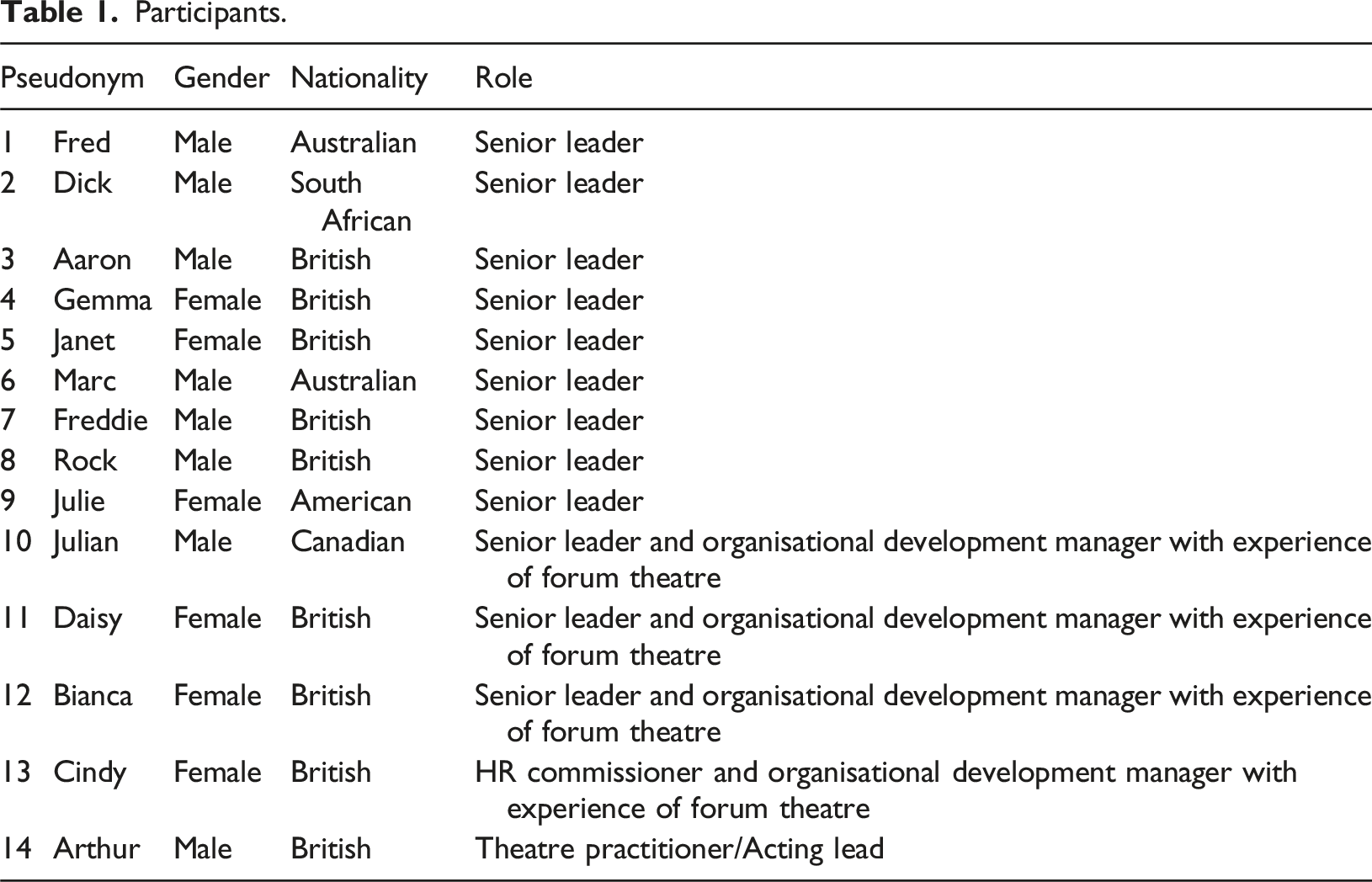
Two of the authors are familiar with the use of Forum Theatre in corporate settings – one as a drama academic and practitioner, and both as participants in various forum theatre sessions across different teams. Given the potential sensitivities around the use of Forum as a dramaturgical intervention in organizations, perhaps particularly so, in the case of senior leaders – we chose to employ qualitative interviews to understand the individual experiences and sense-making of participants, as common praxis in qualitative research. As such, our study draws on semi-structured, qualitative interviews with 14 people who took part in senior leadership training programmes in which a full-day session using Forum Theatre was included to facilitate leadership skills development and ‘change-making’. Twelve of the participants were in senior leadership positions in a medium-sized, UK educational organization (i.e. they held roles of section/department Director or Head). The remaining two participants were the commissioning human resource manager, and the arts practitioner who oversaw the delivery of the Forum Theatre intervention (see table of participants). We chose to interview the commissioning manager and the head of the acting company to better understand the organisational dynamics of inclusion and agency behind the design and implementation of the theatrical learning experience and beyond the individual participants. The questions asked in the interviews were different for people in different roles – conversations with the commissioner and actor company focussed on the reasons behind commissioning Forum Theatre for senior leadership development, on the processes involved in creating the script between the organization and the acting company, the aims of the sessions, as well as the benefits and drawbacks of using this tool in leadership learning. Interviews with participants (some of whom had also commissioned Forum Theatre in other developmental sessions within the teams they lead) focussed on their understanding of arts-based methods learning and forum theatre, their experience as participants, and the benefits and drawbacks of this type of learning, The Forum Theatre training intervention was requested by the senior executives of the organization (i.e. those managing the senior leaders), organized centrally by staff in the Human Resources (HR) department led by one of our interviewees (Cindy), and delivered by a company of actors (the actors were external to the organization and were not interviewed) led by Arthur. The senior leaders were not involved in the development of the session, or the scripting of the scenarios to be acted out. The drama company has extensive experience of using Forum Theatre in corporate training with Arthur, the director, having worked for over 10 years in sectors such as healthcare, finance, education and sales. Due to the significant costs involved in providing this training, most companies he works with tend to be profit-making and of medium-large size.
Participants.
We were also given confidential documents (contracts, briefings and scripts) by the human resource manager, who had been working with the senior executives in the organization to instruct the acting professionals about the script. We used these to analyse the role of the commissioners and the actors in shaping the script; however, descriptions of the actual scenarios were not added to the findings to preserve intellectual property rights and anonymity.
Thematic analysis was employed to explore narratives within the participants’ accounts (Hardy and Phillips, 2004), involving the development and clustering of descriptive and/or interpretive themes, and the subsequent identification of master/subsidiary themes. Following the approach by Gioia et al. (2013) we engaged in several rounds of iterative coding; we identified first-order concepts and then aggregated them into second-order themes, paying attention to similarities, differences, and diversity of experience. For example, we identified the broad theme of learning, which was then articulated in terms of learning through arts-based methods, and forum theatre in particular, with additional codes on learning for leaders, and other codes related to the benefits of learning through forum theatre, challenges, and so on. The first broad themes to inform our analysis were identified a priori, based on the themes set out in the literature review and our own experiences, echoing topics addressed in the interview questions; these were integrated by themes emerged inductively from the data. Secondary and third level themes were developed during the data analysis stage. In the final stage of the analysis, we particularly focussed on instances where tensions were explicitly or implicitly discussed. We went back and forth iteratively between the data and the literature to refine codes and decide what to focus on in the theorising and presentation of the findings. This allowed an iterative process with a more deductive focus at the start of the analysis, and a more inductive approach thereafter.
Domesticating forum theatre in the furtherance of leadership development
Our findings focus on two, inter-related themes: the processes of domestication we identified in the commissioning and implementing of the Forum Theatre initiative and, considered as a regulatory practice (Gagnon and Collinson, 2014), how the development of the ‘leader’ was enabled or constrained by this practice. We begin by highlighting some of the ways in which the radical potential of Forum Theatre was tamed and harnessed in the furtherance of a very limited understanding of leadership development.
Tamed by design: The appropriation of forum theatre as a medium for leadership development
In the preliminary negotiations with the company that was to be contracted to deliver the training, the scenarios proposed by the HR commissioner were to be shaped around the topic of ‘having difficult conversations’ or ‘staff grievances’. This suggests a rationale for the choice of an arts-based approach in which participants could engage in experiential learning and, potentially, develop increased understanding of the ways their behaviours have an impact on others. However, despite Forum Theatre’s radical heritage, the motivation for commissioning the training seems to have been entirely instrumental. We were told by the HR commissioner that ‘from an HR perspective, [the desired outcome] would be a reduction in the number of [employee] grievances – there is a very hard bottom-line, if you like, of a very positive outcome that we could see better performance and less informal complaints, and less formal grievances’. From the very outset the HR Director frames her motivation in terms of specific, measurable outcomes that seem designed to close down debate (‘less informal complaints’). This means that the openness to unexpected and radical solutions inherent in the nature of Forum Theatre was not taken on board. Here we can already identify the first point of domestication, and one of the ‘regulatory practises’ that Gagnon and Collinson (2014) suggest act to frame what is considered as acceptable leadership within particular contexts.
Arthur, the facilitator from the theatre company, did not see his role as challenging the commissioners or even of suggesting a wider range of possibilities. He told us that the clients [sic]: …have as much input as they like, as they are the clients, and you have to respect that […] They don’t necessarily give us a script, but they may give us learning outcomes, so we ask them ‘what do you want from this, what are your objectives and what are you hoping to achieve, what do you want people to do, or perform differently?’ That would develop the learning outcomes, and we ask for scenario ideas and then we write the script based on that.
Arthur regards the commissioners as ‘clients’ with ‘objectives’ and ‘learning outcomes’. This discourse is very ‘corporate’ in tone – and demonstrates that, from the very outset, Arthur is keen to show that Forum Theatre can be appropriated into a setting very different from that in which it was originally developed. These choices of words provide reassurance that nothing too disruptive is likely to occur, and the dramaturgical tool is at the service of the organisation. They also firmly place the design and creation of the theatrical interventions with the commissioners – there is no suggestion that the participants should share in the choice of topics for scenarios. Here we can see that although the training programme incorporates techniques from Forum Theatre, it appears that its underlying principles have already been subverted and domesticated. Learning outcomes are pre-set by the commissioners, and there is planned curation by Arthur to meet these ends during the session by directing participants towards the set outcomes in the rescripting of the scenarios.
‘It’s not role play’: Positioning the theatrical intervention
Within the literature on processes of domestication, the stage of ‘objectification’ is described as one in which the new technology, or practice, is provisionally assigned a place within the organization and new meanings about its relationship to the larger entity are shaped. We were struck by the information that there was a deliberate attempt to present the Forum Theatre event as something innovative and exciting, but also as something it was not, ‘not role play’. Cindy also told us that she had kept the dramaturgical nature of the training hidden from the participants, ostensibly so that people would not be alienated from the start. And this strategy was seemingly successful because it was replicated by three participants, Gemma, Bianca and Daisy, who decided to commission an additional Forum Theatre-based session for their own teams; ‘when we advertise, we have taken great pains to say there is no role-play as nobody wants to do role-play!’ (Bianca). Jane concurred: ‘role-play puts people off, particularly people at the more senior level, people just roll their eyes’. Again, although this strategy could be seen as providing reassurance, it also serves to neutralize the possibilities of disturbance, thus providing another point of domestication. Furthermore, as the nature of the intervention was not disclosed until people joined the session, they were not able to make informed decisions to participate nor the opportunity to leave.
Participants were introduced to Forum Theatre only after joining the event, which was described to them as an intervention in which the audience can change the narrative and shape, or re-script the scenarios to come to different conclusions. But again, this was misleading, as during the scenes participants did not have this open-ended agency to shape scenarios and learning, instead they were redirected by actors and facilitators to the behaviours and goals that had been previously agreed. The event was not organized to encourage, or even to welcome, unscripted responses or innovative solutions from participants. This provided a very significant point of domestication which is completely at odds with both the principles and practices of Forum Theatre. Thus, the potential of the event for leadership development and the meanings ascribed to it were constrained. Forum Theatre was not considered as an opportunity for institutional-level learning stemming from the senior leaders, but only as a way for the organization to shape the behaviour of its members.
Several participants did resist this positioning, with Marc commenting that ‘if [the organization] used those sessions as a source of their learning then they might learn more’. Some participants described it as ‘indoctrination’ and ‘brainwashing’ with Daisy saying that ‘it was used as a way to recalibrate our attitude […] so it was a subtle form of mind control’. However, other participants did not perceive the training as being so overtly coercive: Fred felt that it was ‘a constructive way to understand that in a particular situation you have to do this, that or the other’, while Marc said ‘It was just another tool you could use to deal with situations’. The description ‘just another [useful] tool’ suggests that the taming of Forum Theatre’s radical potential was already well advanced.
The instrumentalizing of forum theatre in changing behaviour
In line with the benefits discussed above of using arts-based methods in organisational learning, some participants did find the event to be helpful and to give them insights about how they could better handle ‘difficult conversations’ (so as to avoid informal or formal grievances). They talked about developing increased empathy, about ‘seeing things differently’, gaining new perspectives and more understanding of how their actions were experienced by others. One such account is Bianca’s: ‘Often people don’t understand the impact of their behaviour on others, and that is what Forum Theatre does really well […] if you see that person crying in a corner on their own you might think “well I meant it as a joke but now I can see how that possibly could hurt someone”, that’s a very powerful thing, it provides people with very specific tools to deal with things because it’s hard, it’s tough dealing with emotions like that.’
Other accounts did reveal more conflicting emotions about having to follow pre-determined priorities or expectations which can be seen in Julian’s reflection: With whom do you empathise? The institution, whose line you have to take because that’s what you signed up to do, or your colleagues who you worked with for many years, and you now have to say ‘Look, I see what you are saying but we are just not doing that’?
Julian’s dilemma speaks to the experiences of ‘middle managers’ who can find themselves caught between workers and the higher levels of the organization, particularly when they have been newly promoted to a more senior role. Both Bianca’s and Julian’s comments demonstrate that participating in the Forum Theatre event provoked reflection and a consideration of the dilemmas and contradictions in their roles. However, these reflections focused on the level of individual, rather than the systemic, which constrained the potential of the event.
Conversion: Representing organizational imperatives as congruent with individual values
In the final stages of domestication, the hitherto potentially disruptive practice, or technology, has not only demonstrated its usefulness but been absorbed into the organization’s values processes. In our study we observed that some participants interpreted the desired behavioural outcomes the event was designed to produce as being congruent, rather than in conflict, with their own values. For example, Fred told us that ‘we were being steered towards having a challenging conversation with a person who has work performance issues. There is nothing wrong with a corporate culture determining or assisting and supporting its employees to do that’. Julian said that ‘I shared those same values, so in that sense I didn’t feel manipulated.’ This identification enabled them to position themselves as agentic participants rather than as staff being manipulated into acting in a certain way.
Daisy and Bianca found the session so valuable that they went on to commission further Forum Theatre events for their own staff teams. For Daisy ‘it was a horrific day and exhausting all the way to the end. It was very successful’ Bianca told us that the even ‘was emotionally exhausting but you had to relax enough to be able to expose yourself. It was genuinely the most effective staff development training I have ever been on.’
Our analysis demonstrates that through the processes of domestication the Forum Theatre event served as a technology of quiescence rather than challenge. It was presented, by the facilitators, by the commissioners, and by most participants in terms that were comforting and reassuring, suggesting that nothing disruptive or unsettling would occur. And yet, Daisy and Bianca’s eliding of uncomfortable emotions of ‘exhausting’ and ‘horrific’ with ‘effective’ and ‘successful’ is striking. These contradictory, even paradoxical experiences carry the suggestion that the taming of the radical may not be entirely complete, and some resonances of danger and unpredictability may still remain. At the same time, it resonates with the ambivalent nature of domestication which tames and supports at the same time.
Forum theatre and the regulating of leadership
Gagnon and Collinson (2014) argue that leadership development programmes ‘may be viewed not only as learning processes for leadership competence, but also as relatively intensive regulatory practices designed to target and transform participant identities’ (P.661). Having shown how the use of Forum Theatre within leadership development initiatives was highly domesticated, what can we discern, from the participants’ accounts, about the development of the ‘idealised’ leader (Gagnon and Collinson, 2014) that was being performed with the theatrical intervention?
In analysing the data, we discovered that the words ‘leadership’ or ‘leading’ were very rarely used, with many more references to ‘management’ and ‘managing’. This was quite striking because the event was branded as a ‘senior leadership development’ initiative yet even the facilitator, Arthur, described it as ‘a management training scheme’. We were told that ‘the people [attending the session] are mid to senior managers (Janet); ‘participants were mid-career people in their 40s, established managers’ (Dick); the programme was for ‘the managers that have not done the management accounts training’ (Bianca). These participants did not describe themselves as leaders, even though their titles, roles and inclusion in the event itself identify them as people in senior leadership positions.
We would argue that the labels people use to name themselves and their roles have a performative function. Carroll and Levy (2008) propose that the ‘manager’ identity is a default one that offers security in the face of the more amorphous, albeit valorised identity of ‘leader’. They suggest that ‘a manager identity lacks the profile and current hype of a leader identity, but it’s established and known all the same, while leader identities […] are “intangible” and “nebulous’” (P.76).
Most of the participants were very hesitant to get involved in the training, expressing a range of anxieties and fears about exposure and vulnerability. Some examples in the narratives surface these tensions: ‘you are in front of people who will be judging your performance’; ‘I interacted in the end, even though I didn’t want to do it because I don’t like audience participation’. Aaron said, ‘I didn’t speak in that session as I thought I don’t know [the other participants] well enough to trust them to know how I feel’. Daisy echoed this, stating: ‘It’s more difficult when you have to expose yourself and your thought process in front of people you have to influence later. It doesn’t incline you to participate as there is a consequence there if it doesn’t go well’. And Julie remarked ‘I was burning to say, “I have a huge problem in my department, and I don’t know how to defuse this really abusive [situation]”’.
These observations, evoking lack of trust, fear of exposure and of the ‘consequences’ are striking, given that in their senior leadership roles these people participate in decision making at the highest levels of the organization. These emotions, such as lack of confidence, uncertainty, and vulnerability would seem to be at odds with traits that are traditionally identified with senior leaders. Daisy told us: ‘[the facilitators] are asking us to actively participate in a way that, by definition, is going to make us vulnerable – about leadership skills and how we project skills and ideas. We are actually going to be exposed even if we don’t act’. Daisy’s comment is one of the very few that does refer to ‘leadership’, but in the context of identifying a double bind where she will be exposed regardless of whether she speaks up or stays quiet.
Voicing opinions and taking centre stage, which should not be unusual actions in performing senior leadership, seemed to be particularly unwelcome. One participant said openly that the organisation did not encourage staff to speak up, even at this very senior level, to admit to failure, or even to being unsure how to act: ‘It’s not that often that people are put in a situation where they are asked to speak out about experiences that may have been not good, in the way they have handled something’. And even the more confident ones expressed some hesitation: ‘I felt nervous because I didn’t want people in the room to think I was showing off, because I knew exactly what I had to say and how to say it’ (Fred).
We also observed a tendency for the British participants to attribute the courage to speak up to being ‘non-British’ with Daisy (British) saying ‘participation is also about compliance because if you are in a room of people where you are not quite sure of your position, and even if you are very uncomfortable, particularly if you are British, you comply. The non-UK participants leapt to the front and were much more engaged straight away’. Aaron (British): ‘I felt that the English sat back, and I could see the fear; [laughs] they thought oh my God are they gonna ask me on stage!’. Interestingly, the participants who had not been born in the UK also drew on this heuristic with Marc, who is Australian, saying ‘hesitation is partly cultural and partly personal […] That kind of thing [making mistakes in front of others] doesn’t bother me’. Dick, of South African origin, said ‘the British are really good at not saying what they think or feel, so I think there is some cultural resistance as it’s even more out of their comfort zone’. These comments demonstrate a somewhat imprecise elision of culture and nationality; however, there were no other references to this in participants accounts.
These accounts suggest a context in which taking up and inhabiting an outspoken leadership role is highly problematic. Our senior leaders do not necessarily show traits and behaviours traditionally ascribed to people working at their level. Gagnon and Collinson (2014) challenge the view that ‘leaders are the people in charge who make decisions while followers are those who merely carry out orders from “above” ‘(P.647). We suggest that the role of the leader emerging from these accounts is quite nuanced and highly constrained, thus reflecting a limited sense of agency.
The effectiveness of forum theatre effective as a leadership development initiative
It seems clear from our findings that the radical potential of Forum Theatre for empowering the disempowered was significantly tamed. There is even a suggestion, in the anxieties expressed about participating, that the initiative may have been disempowering -- one of the potential risks of arts-based methods identified by Flamand and Baccouche (2022). However, the broader learning potential of art-based methods beyond the specific use of Forum Theatre is still present, as alongside these accounts we found examples of important learning gained. For instance, Gemma told us that ‘I have changed my way of working, I am better at my job after [the intervention] than before. I certainly approach management differently’. Several highlighted increased opportunities for self-reflection, with Daisy saying that ‘It made me re-think a lot about my own interactions. I had never really thought about it. It would have been an extremely useful thing to have earlier in my career as it changed my tolerance level and my awareness’. And Julian’s description of the training as ‘holding up a mirror’ does support the efficacy of the event as an arts-based imitative, if not a radicalizing one. Nine of our interviewees did embrace the opportunity to get involved in re-scripting the scenario, despite some experiencing it as uncomfortable, challenging or even ‘dangerous’ (Fred). Marc told us: ‘it’s fun and it allows you to be someone else […] it helps you put yourself in somebody else’s shoes.’
Our findings show that this arts-based training initiative did achieve some positive impact and that there was a positive aesthetic dimension to the experiences recounted by the participants. Participants attested to an increased capacity for empathy and greater awareness of multiple perspectives as a consequence of participating in the event. Several spoke of its profound impact, and three went on to commission similar events for their own staff. These findings support Edwards et al.’s (2013) suggestion that arts-based methods can help participants ‘access intuitions, feelings, stories, improvisation, experience, imagination, active listening, awareness in the moment, novel words and empathy’ (P.4). These are important capacities: Barry and Meisiek (2010) point out that organizational theatre can facilitate the processes of a dialogical ‘looking more’ and ‘looking differently’ which can uncover unnoticed aspects of organizational life partly through ‘showing’ the issue, but also through the dialogical opportunity to co-construct alternative solutions through audience participation. Simpson et al. (2018) also point out that organizational change demands we capture the inventive and creative dynamics of organizing.
Domesticating the beast
Contributing to the literatures on organisational theatre, and leadership development, our analysis demonstrates the different processes of domestication of the radical potential of Forum Theatre which, in this event, was harnessed as a resource for fulfilling organizational goals while defanging its more subversive potential. This allowed the organization to reap at least some of the benefits attributed to arts-based methods without taking any risks. It could be argued that, albeit not what Boal intended, in this sense, it achieved the limited, if not ambitious aims the commissioners desired.
However, beasts are never completely tamed and domesticated. Some participants felt manipulated and ‘brainwashed’, suggesting a more uneasy accommodation. More concerning is the amount of anxiety, insecurity, lack of confidence and unsureness expressed by so many participants, which suggests that the Forum Theatre event was experienced as actively disempowering. This is unlikely to have been a desired outcome for the commissioners, even if the ways in which they appropriated and positioned the theatrical intervention served to tame it as an incorporated, regulatory practice.
Where opportunities for wider learning were realised, it was despite – rather than because of – the intentions of the commissioners. Our findings highlight that the motives of those who commission the use of Forum Theatre in corporate settings can be significantly less radical in their intentions than in earlier exemplars of Boal’s work. Julian Boal (Augusto Boal’s son) disowned such corporate uses of Forum Theatre, claiming that the ‘peak of “bad faith” would be achieved by those who intentionally depoliticize Forum by working with human resources […] for the recruitment and domestication of workers’ (Boal, J, 2019: 292). We suspect he would regard the ‘reduction in the amount of grievances’ and individual level change as such a domestication.
Arguably, what the Forum Theatre intervention did achieve was to surface the problematics in the way ‘leadership’ was conceptualised and inhabited in this particular context. Although the participants occupied senior roles and had responsibilities for large departments and functions of the organisation, they rarely used the words ‘leader’ or ‘leadership’. It seems that the identity claim being made here is rather that of ‘manager’. We take Carroll and Levy’s (2008) suggestion that the manager role is often a ‘’default’ position because it is more clearly understood. However, in this context, in which our participants occupied such senior roles, we do not find that explanation entirely sufficient. We suggest that the reconceptualization of leader as manger may be a more actively desired, ‘idealised’ role (Gagnon and collinson, 2014) within the organization. Our analysis highlights how senior leaders themselves can be manipulated and can find themselves in complex webs of agentic dynamics, often akin to those experienced by middle managers who negotiate challenging demands from employees and the organization. Senior leaders may have less of a voice in deciding the direction of travel when change is needed and may be overtly or covertly pushed to follow a certain normative directive in the ways they themselves enable or shape change.
The empowering of senior leaders in those aspects of their roles where they feel oppressed would have required their involvement in determining the scenarios and initial scripting as well as a clear identification with the role of the oppressed – something for which there was little evidence. It would have potentially led to different outcomes and learnings, for them and possibly for the organisation. Here we see domestication being redeployed in different ways and at different stages: through the design of the leadership learning course, in the framing of it as something new but not threatening, in the lack of genuine openness to rescripting of scenario and outcomes, and in the creation of a less radical but more comfortable and instrumental learning opportunity.
Concluding remarks
This leads us to our final observation: the problematising of the oppressor/oppressed binary in Forum Theatre. Romano (2019), while acknowledging the power and relevance of the Forum Theatre model, highlighted the importance of moving away from oppressor/oppressed dichotomies to explore the true complexity of organizational systems. Our data suggests that the participants did not see themselves in either of these dichotomous roles. The emancipatory potential of the Forum Theatre intervention was not enabled for them, starting with the design of the session, the rigid scripting and set outcomes, and thus did not figure in their motivation for joining, nor act as a heuristic in their reflections and sense-making. There were some observations that seemed to come from one or other of those subjectivities: for example, the implicit acknowledgement of their more powerful positioning regarding the staff they support and manage (and can commission training for) on the one hand, and some of the reflections against being ‘indoctrinated’ and manipulated on the other. But these identifications were transitory and shifting, and while they did not present themselves as leaders, neither did they depict themselves as ‘rank-and-file’ organizational members in need of voice, challenging hierarchical structures and values.
Boal designed Forum to give voice to people who are marginalised, silenced or ignored – this is not how we conventionally regard senior leaders who drive the organizational agenda, but who are able to instigate the change they think is necessary. However, when faced with the aesthetic theatrical intervention, taken for granted assumptions about their role, level and agency became more nuanced. Whether senior leaders can be regarded as ‘oppressed’ is an interesting question: these leaders are expected to have the power and roles necessary to speak up, instigate change and make decisions, but there was little evidence that they took up this power in anything other than an individual sense. And yet, even then, their reflections highlighted uncertainties and vulnerabilities. As such, in the everyday life of organizations, we can see that hierarchical level, agency and dynamics are nuanced and shifting. It is important to problematise too simplistic an attribution of the roles of oppressor and oppressed, or leader and manager. The event was constrained within an organizational narrative of compliance and monodirectional learning, which also resulted in it being perceived by some as ‘manipulation’ or ‘propaganda’, and even a waste of time.
Our study is small and has limitations which could be explored in future research. We have only collected data from one organization; it would thus be useful to consider other institutions. Co-opting Forum Theatre to serve the needs of organisations may be a venture that is doomed to fail, at least in terms of its more radical and transformative potential. However, it would be interesting to explore this across different non-profit and profit-making industries. Although the educational organization studied here was non-profit making, the increasingly corporatized mimicry of many universities within the neoliberal academic context is well documented (see Felicity Wood’s 2022 study for a detailed exposition of this argument).
Given the more complex and nuanced power and agency dynamics that emerged in our study with regards to the experience of people in senior leadership roles, a comparative study of the experiences of lower level leaders and middle-managers would be interesting to see if perspectives on agency, empowerment and manipulation through Forum Theatre training and learning are different when people occupy different roles and hierarchical positions. A longitudinal investigation of the impact of learning through Forum Theatre would also shed light on the application of knowledge to praxis and on the long-term effects (or lack thereof) on people’s understanding and behaviour in the workplace.
Footnotes

Funding
The authors received no financial support for the research, authorship, and/or publication of this article.
Declaration of conflicting interests
The authors declared no potential conflicts of interest with respect to the research, authorship, and/or publication of this article.