




Abstract
Mise au Jeu is a Quebec-based social intervention organization that has been putting on forum theatre – in the Augusto Boal tradition of the theatre of the oppressed – for over 20 years. We investigate how such a non-profit organization creates spaces where members of a deprived communities can elaborate counter-narratives to deconstruct dominant narratives, thereby helping them to make sense of situations of oppression they are living and to act to promote social change. By unpacking counter-narrative strategies and their enabling mechanisms, our study contributes to the narrative tradition in two principal ways. First, while extending Deetz’s work on dominant narratives, we enrich existing understanding of the disruptive power of counter-narratives in situations of social exclusion by bringing to bear the theatrical principles and techniques of Augusto Boal, a missing voice in extant narrative literature. Second, we propose a reflexive discussion related to the political conceptualization of counter-narratives.
Keywords
Telling stories helps build social bonds and make sense of everyday experiences (Tye-Williams & Krone, 2015). Narratives work as “equipment for living”, (i.e., “symbolic resources used by individuals to size up circumstances and envision otherwise”) (Harter, 2017, p. 297). The contribution of narrative analysis has been undeniably significant for elucidating various organizational issues, such as an organization’s strategy and practices (Fenton & Langley, 2011), its processes of stability and change (Vaara et al., 2016), and its leadership processes (Hall, 2011), which has culminated in the idea that organizations may indeed be defined as storytelling systems per se (Boje, 2001). However, more work is needed to refine our understanding of the narrative role that organizations perform in the arena of social challenges.
The alarming scale of the worldwide rise in socio-economic inequalities, poverty, and exclusion over recent decades is generating increased debate. In organizational theory, interest in this phenomenon is reflected in the concept of “grand challenges” – which are characterized as being complex and uncertain – and the call to develop approaches to tackle them (George et al., 2016). One path to address grand challenges is to deepen our understanding of problematic situations that affect a plurality of actors in different ways (Journé & Raulet-Croset, 2008). Of the various perspectives on analyzing and dealing with problematic situations, two are prominent: the interactionist and the narrative. From an interactionist perspective, problematic situations require actors to use the available frames they have at hand to make sense of what is happening. A narrative perspective sees the need for actors to develop alternative narrative strategies to comprehend the negative experiences they endure (Boje & Lundholt, 2018; Hoyer & Steyaert, 2015). Our study draws on both perspectives, with a particular focus on the potential of narrative analysis in comprehending problematic situations that involve oppression and social exclusion.
Under the broad umbrella of narrative approaches, one promising avenue is counter-narratives. In that vein, narrative scholars (Alvesson & Deetz, 2000; Frandsen et al., 2016) outline the transformative power of counter-narratives, which consist of the stories people tell to resist dominant and normative cultural frames. In terms of explaining situations of oppression and social exclusion related to grand societal challenges, we contend that the full potential of counter-narratives remains underexplored, particularly in organizations using a community-based approach. We seek to understand the transformative power of counter-narratives geared to enabling community members to collectively deconstruct hegemonic narratives, and to feel prepared and equipped to take action to change their problematic situations.
This study focuses on the theatre intervention work of a Quebec-based social-oriented nonprofit organization called Mise au Jeu (hereafter MAJ). A theater intervention is a play around a given issue (e.g., discrimination, exclusion, violence, etc.), organized jointly by MAJ and a group of people from a neighborhood, a school, a community center or health service. This play is preceded by numerous meetings and discussions. MAJ was founded in 1991 by Luc Gaudet, a social activist who acquired the fundamentals of forum theatre from its originator, August Boal. MAJ’s underlying mission is to identify conditions under which excluded/oppressed people can truly participate in defining and developing solutions for the problematic situations they experience. In developing its theatrical interventions, MAJ has relied heavily on the repertoire of techniques developed by Augusto Boal, although it has adapted them in the course of its interventions over 31 years. The underlying premise of Boal’s framework is that everyone has the capacity to act in the theatre of their own life, wherein each person is simultaneously an actor and a spectator. Thus, people are “spect-actors” (Boal, 2005).
Since its beginnings, MAJ has created interventions around realities often hidden from the general public in Québec. These include: the discriminatory and abusive living conditions of domestic workers who live with their employers; the world of sex work; violence in young people’s relationships; downtown Montreal’s cohabitation of homeless people and fixed residents; the upheavals undergone by newly arrived immigrants; racial profiling; and acceptance of diversity in sexual orientation.
This study seeks to better understand how counter-narratives might help members of a deprived community to collectively reframe master narratives which, ultimately, serve to legitimate, reinforce and reproduce their oppression and social exclusion. We build on the concept of situation (Journé & Raulet-Croset, 2008) to point out how master strategies and counter-narrative strategies interact during MAJ’s theatre intervention initiatives. We thereby provide two main contributions. First, our study contributes to the narrative tradition in management and organization studies by identifying a set of concrete counter-narratives that are strategically used to deconstruct and reframe community members’ accounts. In particular, we extend Deetz’s (1992) framework of discursive closure strategies – a seminal work extensively cited but rarely operationalized as it is in our study. Second, we problematize the way counter-narratives are often “produced” in the field by showing how MAJ uses the available resources they have at hand – Boal’s (2005) forum theatre principles and techniques – to stimulate community members to speak for and from themselves, and to develop a grasp of the oppressive and socially exclusionary situations that they are living. We thereby enrich existing understanding of the political, transformative and disruptive power of counter-narratives in a community context – a dimension heretofore neglected in this literature. In the next section we present a literature review, followed by our methodological approach. Later, we present the case, the findings and a dialogical discussion, along with final insights which invite alternative ways of conceptualizing counter-narratives.
Theoretical Background
Some authors consider the narrative perspective as a paradigm in itself (Fisher, 1985), while others see it as a theoretical approach permeating other paradigms, approaches and methodologies (Fenton & Langley, 2011; Vaara et al., 2016). Nonetheless, all these authors agree that narratives give shape to reality since they hold the power to either silence or give a voice to situational actors, and, thus, to legitimate (or delegitimate) what Davies and Harré (1990) have termed subject positions. An important distinction is made in the literature between master and emergent narratives.
Master Narratives
Master narratives are powerful discursive constructions that provide channels for individual and organizational sensemaking/sensegiving (Deetz, 1992; Vaara et al., 2016). Organizational communication scholars tend to define a master narrative as a larger cultural narrative that “silently shapes local narratives about a given construct by laying cultural resources or norms over local narratives” (Smith & Dougherty, 2012, p. 454). Adopting a wide-ranging perspective, Gabriel (2016) coined the expression “narrative ecologies” to refer to environments – organizations and societies – where narratives interact, compete and evolve together. Within such narrative ecology, Gabriel (2016, p. 221) uses the term “narrative monocultures” to describe environments where hegemonic values underpinning master narratives give little room for oppositional voices. In such environments, master narratives dominate by exerting moral authority over our imagination, while providing a stock of plots and characters that are easily recognizable and justifiable (Boje, 2011; Czarniawska, 1997). Within a long tradition of scholars who have worked extensively at identifying master narratives at play in different environments (e.g., Mumby & Ashcraft, 2017; Pullen et al., 2019), the work developed by Deetz in the early 1990s remains simultaneously canonical and utterly contemporary.
Master Narrative Strategies for Discursive Closure
In “Democracy in an Age of Corporate Colonization”, Deetz (1992) presents a set of discursive closure strategies mobilized by dominant groups in order to justify and assure the continuity of established power positions. For Deetz (1992, 187), discursive disclosure “exists whenever potential conflict is suppressed […] through the privileging of certain discourses and the marginalization of others”. Deetz (1992) presents a number of strategies of narrative domination used by managers in order to assure the maintenance of their power positions.
The first one is the disqualification strategy, which consists of denying any other person her right to speak on the pretext that she does not have the necessary expertise, does not express herself properly or has interests that differ from those of the majority. Statements such as “you’re just saying that because you’re a woman [manager, lover, angry…]” illustrate the strategy to disqualify emergent narratives and accounts, and to justify the use of more “technical” and “professional” ones (Deetz, 1992, p. 189). Second, the naturalization strategy consists of separating practices and ideas from their context and production history. In doing so, certain practices and ideas are presumed to be universally applicable to any context, as if social constructs were “given in nature” (Deetz, 1992, p. 190). The strategy of naturalization therefore privileges certain narratives and accounts since they may be perceived as “natural” and “self-evident”. Third, the neutralization strategy consists of maintaining a seemingly neutral discourse, but one which nevertheless favors the majority (and/or dominant) group. In conjunction with disqualification and naturalization, the strategy of neutralizing reinforces the assumption that supposedly “neutral” and “objective” narratives and accounts based on “facts” picture a “world as it really is” (Deetz, 1992, pp. 191–192 - italics in the original). Fourth, the avoidance strategy seeks to avoid, as far as possible, subjects which can upset the status quo and endanger the interests of the majority. The strategy of avoidance is often materially manifested simply by the absence of places and spaces of expression where feelings and emotions may be treated as relevant to political questions. Some organizations systematically exclude “human experienceable emotions” in order to avoid certain topics, thereby concealing conflicts (Deetz, 1992, p. 193). Fifth, the subjectivation strategy consists of treating the problems brought to light by individuals as mere personal opinions without any real validity. Again overlapping with disqualification, this strategy features the “matters of opinion” label often being employed as a reason to stop discussion – whereas it is precisely such matters that should serve as the starting point (Deetz, 1992, p. 194). Sixth, the legitimization strategy constitutes legitimizing the dominant group’s practices by systematically referencing them in terms of the value system shared by the dominant group. It thus becomes impossible to question the practices without criticizing the values of the group. Such strategy appeals to “grand master values” and “historical narratives” in evoking “higher order explanatory devices” to politically “stop value clarification and lead to commitments and actions that are beneficial for certain groups” (Deetz, 1992, pp. 193–194). Finally, the pacification strategy tries not to solve the problem, either because it is too big and therefore insoluble - the dominant group claiming to be impotent – or because the conflict appears to be insignificant. Pacification strategy may be seen as a spin-off of avoidance: “messages that pacify tend to discount the significance of the issue, [its] solvability, or the ability of the participant to do anything about the issue.” (Deetz, 1992, pp. 196–197).
We consider this set of master narratives to provide a powerful analytical tool for understanding how their deconstruction by emergent narratives might enable individuals to collectively create meaning out of oppressive situations. Therefore, as we describe later, we contrast these master narrative strategies proposed by Deetz to the emergent counter-narrative strategies deployed by MAJ.
Emergent Narratives
While master narratives represent hegemonic assumptions, critical and poststructuralist scholars propose that emergent narratives are predisposed to challenge or deconstruct those taken-for-granted and normative assumptions embedded in master narratives. Our literature review on this critical and poststructuralist approach outlines two concepts: antenarratives and counter-narratives.
Antenarratives
One of the most recent and flourishing streams of emergent narrative research comes from the concept of antenarrative, a term coined by Boje (2001). Antenarratives are not yet fully fleshed out narratives, but rather a genre of prospective storytelling, or “a bet on the future pattern” (Boje, 2011, p. 1). Scholars focus on antenarratives to render visible the organizational, social and political contexts that trigger deconstruction of events and identities (e.g., Hopkinson, 2014), as well as to propose sophisticated theoretical models that grasp the complexity and fuzziness of meaning creation (e.g., Svane et al., 2016).
Counter-Narratives
Defined as the stories people tell and live precisely to provide resistance against current master narratives and values (Andrews, 2004), counter-narratives are another flourishing stream of emergent narrative research. The seminal work of Nelson and Lindemann (2001) explains that counter-narratives seek to identify oppressive elements of master narratives, and then to counter-formulate the story by refusing, repudiating and contesting such elements, with a view towards reframing and restoring identities and subject positions that, historically, were damaged by abusive power systems. The main difference between counter-narratives and antenarratives revolves around the linearity of time. Whereas antenarrative analysis focuses on the antecedents and on the non-linear unfolding of narrative construction, counter-narrative analysis is about uncovering and presenting alternative ways of viewing the situation proposed (Lundholt, 2016).
Our interest in retaining counter-narratives as our theoretical concept rests on the fact that they do not exist independently of master narratives (Frandsen et al., 2016). In fact, they are interconnected: counter-narratives emerge because master narratives exist, while master narratives may aim at discrediting counter-narratives and/or incorporating them into their own discourse for the purpose of regaining legitimacy (Gabriel, 2016; Kuhn, 2016). This interconnection is also noted by LeGreco and Douglas (2017), who recognize that master and disrupting narratives are two processes that operate together. Other scholars (Smith & Dougherty, 2012, p. 465) similarly emphasize that master narratives frequently contain “fractures” revealing inconsistences and contradictions that are inherent in hegemonic discourses and which become evident in situations of struggle, thereby opening room for counter-narratives to emerge.
In sum, analyzing counter-narratives uncovers and displays “alternative ways of the situation proposed […] what the situation dictates, requires or commands” (Boje & Lundholt, 2018, p. 24). We will take a brief look at the concept of situation, which sheds light on the requirements of a counter-narrative and its generative process.
Counter-Narratives and Situations
Problematic Situations, Frameworks and Counter-Narratives Strategies/Mechanisms.
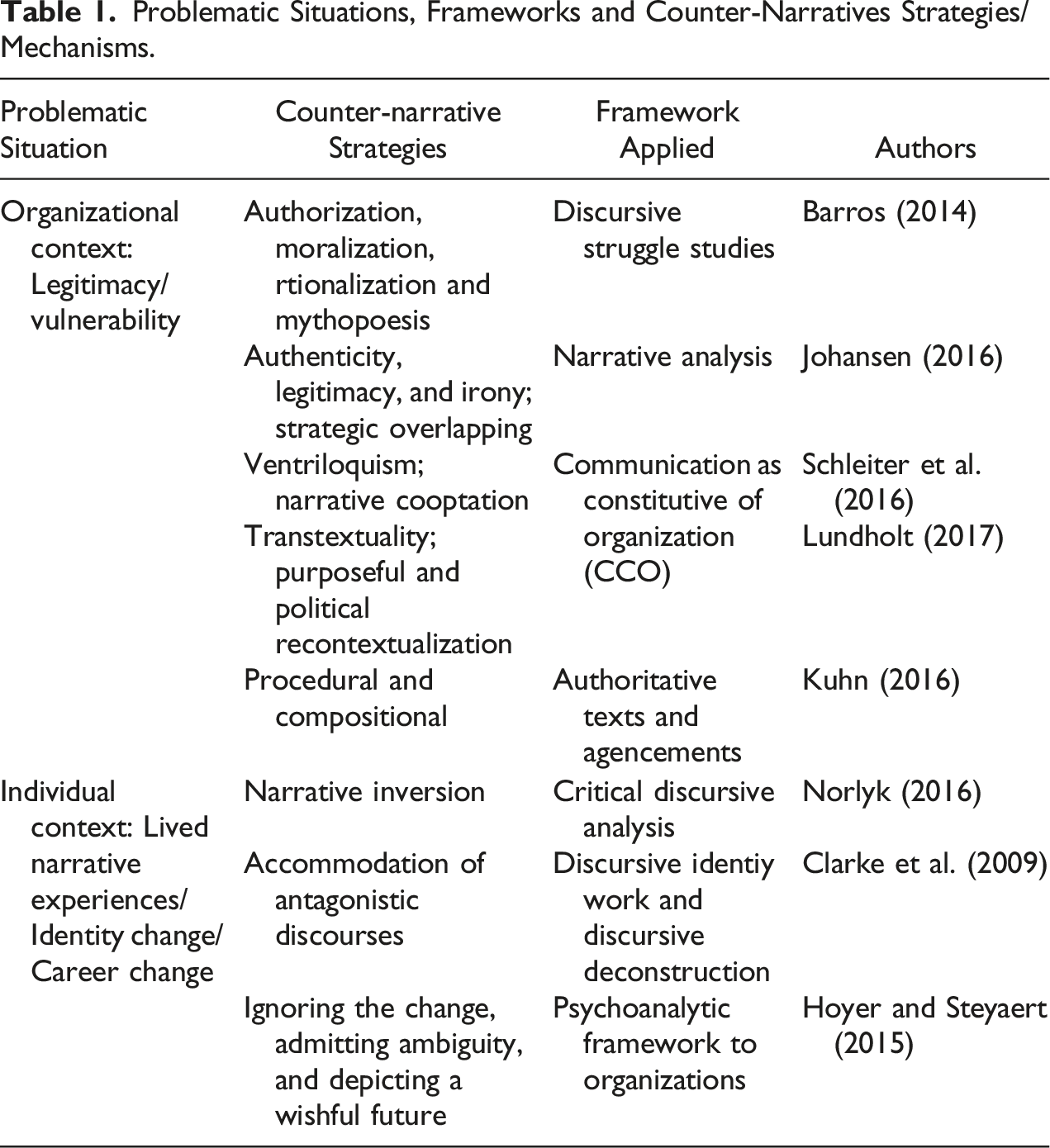
For example, Lundholt (2016) targets an organizational situation, that of vulnerability, to illustrate how a partnership between Lego and Shell unwittingly created textual counter-narratives that put the former organization at an impasse. Transtextuality was the strategy identified by the author as explaining how actors politically and purposefully recontextualized texts “to serve to their quest” (Lundholt, 2016, p. 59). For reasons of length, we cannot describe in detail all the studies reported in Table 1 and the frameworks they applied. But we bring to light two issues prevalent in this literature. First, we observed that the problematic situations are primarily associated with two types of contexts: organizational and individual. This is relevant because we are interested in counter-narratives operating in the community/societal context. The lack of studies on contexts broader than individual or organizational suggests a gap in the literature that we propose to fill, in line with the call made by Smith and Dougherty (2012, p. 474), asserting that “future studies should center more on individuals in lower socioeconomic classes” to expand our knowledge on the interactions with master narratives. Second, we noticed that the frameworks utilized as sensemaking devices are the ones proposed by scholars themselves to analyze the situation. This is equally relevant because our interest is to grasp the framework used by organizational actors themselves to make sense out of the situation they are living. It represents a response to the call for co-generating theorizing on the interaction of the master narratives and counter-narratives that emerge from an engaged research (Deetz, 2008a; Smith & Dougherty, 2012).
Returning to the grand challenges and to the problematic situations located at the community/societal level, we formulate the following research question: How might counter-narratives help members of a deprived community to collectively reframe master narratives? Our goal is to produce relevant knowledge on how counter-narratives might help members of a deprived community to collectively reframe master narratives that legitimate, reinforce and reproduce their oppression and social exclusion. Our focus on deprived communities emerged from our engaged research in the province of Quebec, as we are part of a research center with a long tradition in the field of social economy, where issues like social exclusion and epistemic justice are central. Among the different social-oriented organizations we have interacted with in our territory, MAJ emerged as one with which it was imperative for us to deeply engage and investigate in a collaborative manner, as we describe in the methodological section that follows.
Methodological Approach: Participatory Inquiry
We decided to focus our field work on MAJ for several reasons, but primarily because it embodies a nonprofit organization working on issues that require strong interaction, communication and reflexivity at the community-based level. Our research method is characterized as participatory inquiry, a qualitative approach wherein the division between the subject (the one that investigates) and the object (the one that is investigated) disappears. Within a participatory research project, communities of inquiry and action evolve together to address issues that are relevant for those who participate as co-researchers (Reason & Bradbury, 2008). Our research team is made up of four researchers, one of whom – Researcher-3 – has been following MAJ since 2015 and has employed a set of participatory inquiry techniques, including participating in the board of MAJ as well as interacting with other team members to evaluate their practices. The other three researchers also had the opportunity of interacting with MAJ members and performances, but to a lesser degree. In terms of the ethical implications of a participatory design, besides adhering to certain well-known criteria for rigorous non-positivistic research – such as authenticity, plausibility and reflexivity – we have also followed two other main principles to assure the legitimacy and reliability of our work. They are: (a) the principle of the researchers-practitioners agreement, which seeks to ensure the development of a mutual understanding of, and commitment to, the research goals, and (b) the principle of transparency, to guarantee that all participants (including the reader) can trace the aims and techniques of the research process (Pozzebon, 2018).
Collecting Empirical Material
The collection of empirical material can be divided into two main phases. During the first phase (November 2015 to January 2016), Researcher-3 conducted a first set of interviews. The respondents included three managers of MAJ (the founder, the director, and the technical director), the president of the board of MAJ, and six team members. These 10 interviews, lasting an average of 1 hour each, were recorded and translated. The primary goal of this initial phase was to understand MAJ’s principal activities and work phases and facilitate the collection of materials essential to an analysis of MAJ’s main practices.
The second phase began in June 2016, when Researcher-3 conducted 19 individual semi-directive interviews (averaging 1 hour each) with representatives of various stakeholders in MAJ’s interventions on a territory, including participants from schools and community associations. This phase culminated in a compilation of the findings – mainly, the immediate effects of the interventions – which were contained in a report, supported by numerous quotes from the interviews, that was handed over to all people making up MAJ’s participants. This second phase served as a social validation of the insights produced in the first phase.
Both phases were characterized by intense participant observation and interaction, including 20 hours of formal participation in five theatre interventions, to grasp participants’ (community members’) actions and discourses more closely, as well as their exchanges, proposals, and commitments. Data collection during the participant observation consisted largely of field notes and memos written down by Researcher-3 during and after the meetings and conversations. Researcher-3’s involvement with MAJ became very close with some team members, particularly the founder, leading to 3 years of participation in numerous activities and conversations, and travelling with the team to various locations.
Analyzing Empirical Material
We integrated all interview transcripts, field notes, and other relevant documents into EXCEL. We then coded the collected empirical material using hermeneutical analysis, with a particular focus on identifying the principles and strategies utilized by MAJ’s team members, in order to understand the master and counter-narrative strategies produced through their interventions. Validating our reflections with MAJ’s founder/players and receiving feedback from audiences in international management conferences helped to refine our hermeneutical analysis. It is important to note that all four researchers had an equal role in the data analysis and validation of the findings. The criteria applied to ensure the quality of our research methodology was based on the participatory inquiry tradition as documented by Reason and Bradbury (2008) and Pozzebon (2018).
Presenting the Case: MAJ and the Forum Theatre
MAJ’s mission is to give voice to citizens and to lead them to identify, in a collaborative mode, solutions to the pressing problems that affect their communities. For over 20 years of engaging with local associations, MAJ has been applying theatrical techniques inspired by Augusto Boal’s tradition of the theatre of the oppressed – more particularly, the forum theatre. As previously noted, Boal’s underlying assumption involves people’s dual role as “spect-actors”: “The theatre of the oppressed is the theatre in its more archaic meaning: all human beings are actors, because they act, and spectators, because they observe. We are all spect-actors.” (Boal, 2009, p. ix)
The theatre of the oppressed seeks to transform people from passive spectators – merely an audience – into active citizens. For Boal, the oppressed could consist of workers, peasants, unemployed people, women, immigrants, the vulnerable of any age, people with physical or mental disabilities – in short, all those who have been rendered “silent” or from whom the right to full expression has been withdrawn. Boal shows how theatre might lead to a new way for the oppressed to express themselves and, through such expression, to discover new meanings: “citizens are not those who live in society, but those who transform it” (Boal, 2009, p. 22). Prominent among the different types of intervention conceived by Boal is the forum theatre: a short play or scene that dramatizes a situation, with an oppressive ending that provokes spect-actors to react and become protagonists of dramatic action themselves.
MAJ’s Model of Action
The methodology developed by MAJ around forum theatre aims at having an effect on people, including mobilizing their power to act to transform environments that negatively affect their living conditions. This methodology can be divided into different steps: 1) creation of a climate of confidence – conducive both to free expression by each member and to overall learning by the group – through collective play; 2) sharing of stories involving experiences of oppression or conflict situations that have been badly resolved; 3) writing and staging of a play; 4) performance along with animation of a theater-forum by a “joker”; 5) identification of and experimentation with solutions; 6) a deliberation phase, where the public vote on and adopt a number of recommendations.
In the forum theatre, the joker plays a key role as a kind of moderator, who helps the debate go forward by encouraging the public to speak about what they see and think and to give feedback on other proposals. The joker has a big role. From what the participant says, the joker questions. It makes people think, go further. (Respondent-2)
The idea is that “solutions” have to emerge from the group, as they are the experts on the situation. The joker’s responsibility is to guide the participants through the process by helping them to define the problem, to create alternatives and to bring them into action. We do not teach. We are bringing out knowledge. We make it emerge. It is assumed that everyone has the solutions, the knowledge in them, by their life experiences or whatever. We just ask questions. Have people dig and then help them put that together. We do not impose anything. (Respondent-2)
The way people in the room react, intervene and construct new articulations is affected by the way in which the situation is described and defined, the qualities that are attributed to the persons and objects staged and the associations that are made between the elements of the scene. The jokers, in complicity with the artists and/or the artistic director, lead the debate whose principle is to always return the speech to the public after each intervention. (MAJ’s methodological guide).
Proceeding from the recognition that no one can learn in a climate of fear, jokers create an environment that feels safe both physically and emotionally. The organization deploys a toolbox including a panoply of games and exercises that put everybody in a position of equality and learning. From this starting point, through collective play, individuals reach their limits, surpass them, go beyond the fear of ridicule, have fun and learn together. The theatrical aspect of the activity is a constant reminder that it is taking place in an environment distinct from the actual reality. Such an environment offers each participant the possibility of getting outside of herself to play a role to advance the debate in a constructive and non-violent way.
Findings and Insights
We identify four categories of counter-narratives that serve to neutralize and deconstruct master narratives, fostering the emergence and expression of alternative discourses concerning the situations addressed during the forum theatre activity. These categories are characterization, depersonalization, mediation and provocation. For each category of counter-narrative, we present the enabling mechanisms that foster their emergence. Figure 1 shows those findings. Counter-narratives and enabling mechanisms in action.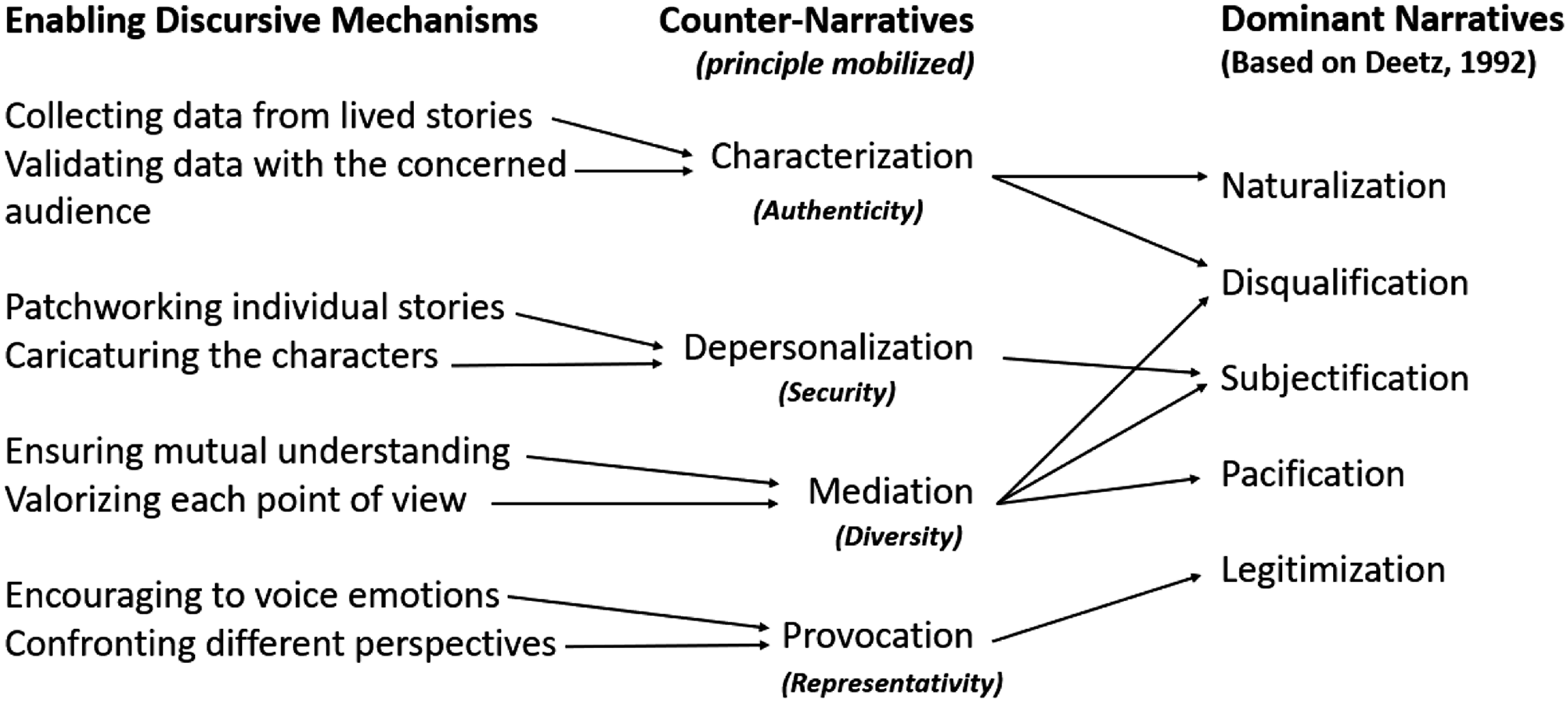
Characterization
For (Boal, 2005), if a message is intended to be authentic, it needs to be expressed in action. In Boal’s words, the character “does what she does” (2005, p. 52). The first counter-narrative strategy we have identified relates to ensuring action’s authenticity through characterization. This valued authenticity involves both the forum theatre’s content – the problems and situations presented to the public – and its form – conditions that induce participants to come on stage and act out the way they do things. We have identified two main enabling mechanisms driving the characterization counter-narrative: collecting data from lived stories and validating data with the concerned audience.
Collecting Data From Lived Stories
MAJ develops its plots and scenarios by gathering information from stories personally experienced by community members. This practice takes different forms, including a document search, interviews and theatrical workshops involving the members and groups concerned with a given problem. The aim of MAJ is to get the words, the representations, the vision, the speech of the people who are the first ones to be concerned, and to use them as data to build their intervention. (Respondent-1)
In all cases, an effort is made to consider different points of view and embrace diverse interpretations of the reality, encouraging participants to put together a multifaceted portrait of the situation discussed. MAJ invests significant time and effort in this approach with the aim of creating a portrait of the situation that is as close as possible to reality – though without, as we will see later, reproducing an “identifiable” event or targeting a “specific” individual.
Validating Data with the Concerned Audience
Once the data is collected from different sources, a theatrical piece of work is put into writing collectively. MAJ’s team members validate with community members whether each scene represents their reality. During the animation, the first thing we ask is to validate the realism of what we have just proposed or the realities that are presented. If it’s symbolic, people will make connections with reality. That’s important. If your audience does not adhere to what you just presented, you cannot make a forum. (Respondent-2)
This type of real-time validation practice is extremely important, given that forum theatre activities seek to trigger participants’ will to change their lives. If the written scene does not speak to the affected individuals, there is an implied need to return to the previous enabling mechanism, i.e., collecting more authentic data. A similar type of validation is carried out during performance, where the joker constantly asks the audience if the situation described by each scene speaks to them and, more importantly, if it does so without judging or confronting who is right or wrong at this phase.
The Relation to Master Narratives
Both the above enabling mechanisms highlight the care that MAJ takes in recreating situations and experiences that are authentic – as close as possible to the spectators’ realities. Our analysis leads us to argue that the authenticity created by these enabling mechanisms helps to neutralize or deconstruct two master narrative strategies. First, by collecting data from stories experienced in real life, the forum theatre directly opposes the master narrative strategy of naturalization. Naturalization presents itself as “objective”, thus separating practices and ideas from the context and history of their production. Deetz (1992, p. 190) explains that in naturalization, what is actually “socially produced” is treated “as given in nature”, where the “particular is disguised in the universal”, leading to a discursive closure that “always plays into the privileging and marginalizing of discourses”. MAJ makes a robust effort to detach the “particular” from the “universal”, so as to render the former in the most explicit way possible. This strong contextualization of the scene is highly important.
Second, in order to ensure that piece of work being performed on stage is authentic, validating data with the concerned audience allows spectators to engage in a time-ordering exercise to make sense of the causes of the problem, which further allows them to both propose and perform solutions, leading to a debate over concrete elements. This enabling mechanism is a sensemaking endeavor in which spect-actors begin collectively to write down the roles and the characters they will perform, thereby counteracting the master narrative strategy of disqualification. Disqualification consists of denying any individual their right to speak on the pretext that they do not have the necessary expertise, do not express themselves properly or have interests that differ from those of the majority (Deetz, 1992). According to Deetz (1992, p. 188), “socially produced notions of expertise” function as an “ideological fiction”, separating those who are granted the right to determine and question things from those who are not. MAJ catalyzes resistance to this hegemonic imposition through the enabling mechanism of data validation, which directly counters the thrust of the disqualification strategy. By encouraging members of the public to give their interpretation of the situation, MAJ accords them the status of experts on the situations that will be written and performed on stage, while inviting them to bring to bear their own subjective perspective on the problem. As we will see later, the collective sum of differing and divergent subjectivities will help them understand how their realities are perceived by others. These two enabling mechanisms pave the way for a forum theatre’s actions to leave aside theoretical discourse, which is often detached from the extant context and concomitant emotions. Objectivity and technical expertise are set aside in favor of participants’ subjectivities and lived knowledge.
Depersonalization
For Boal (2005, p. 145), if we search in the Other what we have in common, “we must identify [ourselves] in this Other, even though [we] do not recognize the Other in his or her full individuality”. In pursuit of this goal, the second counter-narrative strategy we have identified relates to the principle of security, the feeling of not being individually targeted. This sense of security is paramount so that members of the public can identify with the situation without recognizing themselves specifically in a particular character/situation. We have further identified two enabling mechanisms that constitute the counter-narrative to depersonalization: patchworking the individual stories into one and caricaturing the characters.
Patchworking the Individual Stories Into One
To avoid any specific individual being recognized, each scene consists of a common story drawn from the experience of many people. We need to create a play that will bring together different points of view and that will not tell all the stories of domestic violence, but that will make a common history that will allow everyone to identify themselves or know an aspect of interventions in situations that are experienced. (Respondent-2)
From different stories, MAJ will create a generic scene with the potential to make an impression on everyone in the public, but without putting them in an uncomfortable situation where they will adopt a defensive attitude. To this end, the forum theatre seeks to draw participant-representatives from different sectors of the same milieu. According to their heterogenous life experiences, participants will react differently to the situations proposed, and their individual interpretations are paramount in further enrichment of the discussion. However, if an individual thinks that the scene is talking about her or something she has done, that person will adopt a defensive stance, leaving the purpose of the activity unfulfilled. To avoid this situation, each character winds up being a combination or a patchwork of several experiences. Thus, specific spectators cannot be recognized by one another, allowing them to feel free to personally identify with, and react to, the situation being performed on stage. This will serve as the starting point for creating a commonly held – and more complex – vision of the issue depicted.
Caricaturing the Characters
Finally, the actions and attitudes of the characters are caricatured. This is important because it enables the public to identify quickly and because it avoids anyone saying: “That’s me we’re talking about”. We must be careful not to take an example exactly like what happened. We try to be smart, to target the problem, but without targeting the persons concerned. (Respondent-5)
Accordingly, in the particular words used, the story compiler will avoid repeating what has actually been said or going into details but will focus rather on attitudes, dynamics and context. Caricature is employed to rapidly evoke an image or a gesture that embodies recognizable values, and to demonstrate that these values are constructions which can be reconstructed. Caricaturing also serves as a tool to delineate antagonists and enhance their respective perspectives, hence laying the groundwork for further mutual understanding. It also helps by making people laugh, adding a touch of humor that serves to relax the atmosphere.
The Relation to Master Narratives
Patchworking individual stories into one guarantees the security aspect of the activity by avoiding the inevitable conflicts that would occur if a person felt directly targeted. Moreover, caricaturized portrayal of the characters allows spectators to maintain a certain distance from the situation and not be caught up in a flood of emotion that would overwhelm them, especially if it depicted a situation that happened to them personally. Together, these two enabling mechanisms diametrically oppose the master narrative strategy of subjectivation, which treats the problems brought to light by individuals as mere personal opinions without any real validity. Deetz (1992, p. 194) elaborates that “matters of opinion” is the reason often evoked to stop discussion at a place which should actually serve precisely as its starting point since the difference between people’s opinions “represents an opportunity to escape from self-blinders”. Under the principle of security, depersonalization is intended to make everyone see that, ultimately, all points of view – even dominant views – are subjective, thereby fostering a stronger subjective and collective interpretation that is better equipped to resist the master narrative strategy of subjectivation. Indeed, by being patchworked, each subjective point of view becomes an opportunity to initiate dialogue and escape from self-blindness. In tandem with caricaturization, this collective and subjective interpretation is stronger and more capable of resisting master narratives and discourses which diminish the relevance of a single individual point of view.
Mediation
In line with the principles of authenticity and security of the activities, Boal (2005, p. 37) emphasizes that “no problem is unique and exclusive to one person alone”. Problems are plural, since they express different perspectives and wills that take shape in conflictual social structures. Therefore, the success of a forum theatre intervention depends on creating a space of respect wherein these conflicting wills are expressed, justified and debated (Boal, 2005). The joker plays a mediation role by catalyzing interaction among spectators through questioning, and by stimulating the emergence of conflicting wills through managing interventions and allowing the debate to evolve constructively. It is under the principle of diversity, (i.e., respect towards conflicting wills) that the fundamental role of the joker is situated. We have therefore identified mediation as a third counter-narrative strategy, composed of two enabling mechanisms: ensuring mutual understanding and valorizing each point of view.
Ensuring Mutual Understanding
The joker facilitates the assertions of participants by ensuring that all concerned groups – oppressors and oppressed – can express their interpretations of the situation and propose ideas. I rephrase everything the spectators say, and I do it on purpose. […] the fact of having to rephrase, because if the person in front said something to me, the one behind did not necessarily hear. So I rephrase. As I rephrase, I speak again. After someone else is against it. What she will say I will reformulate it. (Respondent-6)
It is important that those present are directly affected by the problem. For example, if the issue concerns the relationship between police and youth, the vision of both groups will be mediated into the forum theatre. To put all opinions on an equal footing, the joker tries to allocate the same amount of time to all groups. The joker will systematically rephrase the participants’ words, ensuring that everybody, including himself, has understood what the participant said. Otherwise, to the extent that it is not clear what a particular individual has to say, that person is being excluded, as are others who share the same point of view.
Valorizing Each Point of View
The joker also directs spectators’ attention to the range of different perspectives on each proposal. Thus, everyone can give their own point of view and hear those of others in an atmosphere of exchange. We need to bring together different actors from different backgrounds on the same subject. The greatest successes of MAJ were when people from different backgrounds came together. (Respondent-7)
The joker valorizes each intervention by trying to find out how the assertion helps to solve the problem. Even if it offers only a single element, the joker will emphasize that small changes can open the door to other changes.
The Relation to Master Narratives
Through these two enabling mechanisms, the counter-narrative of mediation neutralizes three master narrative strategies. First, by the mechanism of ensuring mutual understanding, the joker highlights the fact that all participants have valuable expertise to contribute in proposing solutions for the situation being presented, thus deconstructing the master narrative strategy of disqualification. As previously noted, disqualification consists of denying a particular person’s right to speak on the pretext that the individual lacks the necessary expertise, does not express herself correctly or has interests that differ from those of the majority (Deetz, 1992). The joker encourages every group member to participate and reformulates their individual contributions in a way that demonstrates how oppressors and oppressed experience different subjectivities. In particular, reformulation prevents misunderstanding by ensuring that everyone has understood the situation, and by offering people an opportunity to re-hear their own words and realize their potential impact. As a result, each participant feels listened to and the debate can go forward without misinterpretation.
Second, the enabling mechanism of valorizing each point of view stands in opposition to the master narrative strategy of pacification. For Deetz (1992, p. 196), participative democracy requires “the capacity to mutually solve problems through exploration of different points of view and alternative actions”. In contrast, the master narrative strategy of pacification seeks to either diminish the significance of the issue or to magnify it, to depict a problem as either insignificant or insurmountable. In either case, the aim is to render it unsolvable. By valorizing every point of view, the joker alleviates extreme views by showing spectators that the problem is no longer a monolithic mass which is impossible to change. Instead, since problems are pluralized, they can be broken down into smaller problems that are capable of resolution through cumulative small changes.
Third, our analysis also demonstrates that, taken together, these two enabling mechanisms also rein in the master narrative strategy of subjectivation, which treats the problems brought to light by individuals as mere personal opinions without any real validity (Deetz, 1992). With priority given to mutual understanding of diverse points of view, and with significance attributed to each opinion, members of the public are brought to the inevitable realization that each perspective is, by nature, subjective. This realization forestalls pejorative dismissal of mere individual opinions being used as rhetorical ammunition to stop a debate – said dismissiveness being the essence of the master narrative strategy of pacification. Instead, spectators start to realize that, in fact, the multiplicity of subjective perspectives generates a more complete and, perhaps, a more objective impression. This accumulation of subjectivities becomes increasingly clear in the process, as will be demonstrated by its culmination in the final counter-narrative.
The principle of diversity and respect towards conflicting wills that underlies mediation is important through fostering a climate of confidence that encourages free speech. This is especially important in groups which, in real-life situations, tend not to express themselves in the presence of the dominant group. While conflicting wills are the quintessence of forum theatre – and thus need to be justified – “justification” does not equal “acceptance” (Boal, 2005). Therefore, conflicting volitions need to be more than mutually understood and valorized. They also need to open alternative paths for the situation being performed on stage, taking us to the final counter-narrative strategy.
Provocation
Boal (2005, p. 59) indicates that “[…] each member of the audience can decide whether she feels represented by [an] intervention or not, and, if she doesn’t, she can go on stage and give her own version of things”. Consequently, we identify a fourth counter-narrative strategy based on the principle of representativity of the people concerned by the problem. In line with the previously mentioned principle of security, concerned individuals need to identify with the situation without recognizing themselves specifically in a particular character/situation. Nonetheless, it is here that they are being provoked to act and give their own version of things. Through the lens of representativity, we perceive two enabling mechanisms that drive the counter-narrative strategy of provocation: encouraging to voice emotions and confronting different perspectives with respect.
Encouraging to Voice Emotions
Depending on the particular situation being discussed, the public concerned may be comprised of groups who are not used to speaking up about their issues and/or may have a negative perception of their own value and expertise. There is an affective part around the game, an affective solidarity is created, a connection through actions. Everyone sees people intervene and play. ‘Did you see what happened? Did you feel her emotion in her voice? Did you feel this emotion?’ Very different people in opposition can have a moment of affective solidarity. A ‘together’ then becomes possible. There is a strength of the experience lived in common. (Respondent-4)
The role of the joker here is to get spectators to go on stage and talk about a situation. The problematic situation presented in the play triggers a process of reflection and the search for alternatives or new solutions. The actors arouse feelings in the spectators, touching them emotionally as well as symbolically. On the stage, actors use their own emotions, expressed through their bodies, to produce an effect of vibratory resonance. Encouraging spectators to give verbal expression to their emotions achieves the objective of creating a performance that provokes the audience cognitively and emotionally.
Confronting Different Perspectives
The performance distinguishes itself from a simple speech by not remaining solely at the cognitive level but by mobilizing the affective level as well. [I]t is important to take opinions for and against to try to make them confront each other, try to make their reflection and discussion go further. Try to give all aspects a chance. Always dig, make them talk as much as possible. (Respondent-3)
The joker acts not only as a mediator but also as a challenger of the points of view expressed by the spectators. Once the proposal is reformulated, the joker asks the public to react to it. The idea is to co-construct new proposals around the comments of various participants, by questioning and confronting the different ideas emerging among them. Confronting the diverse points of view with each other allows forum theatre to elicit and reinforce alternative discourses.
The Relation to Master Narratives
We found that the counter-narrative of provocation helps to neutralize the master narrative strategy of legitimization, in which the dominant group’s practices are justified by systematically linking them with the value system shared by the dominant group. In Deetz’s formulation (1992, p. 195), legitimization “appears in the rationalization of decisions and practices through the invocation of higher order explanatory devices”. Such devices appeal to master values and narratives, leading to the adoption of allegiances and deeds that are beneficial to dominant groups (Deetz, 1992). As for the other master narrative strategies, deep structure legitimization revolves around power struggles where dominant groups intend to camouflage conflicts and contestation via discursive closure. The combined effect of two enabling mechanisms – encouragement to voice emotions and confronting different perspectives – exerts specific influence on the process of legitimization. First, it provides the different groups with an opportunity to challenge the dominant discourse in a context where everyone is afforded the same respect and all opinions expressed are considered valuable, thereby disrupting master narratives’ presentation of certain ideas as universally accepted and unquestioned. Second, it also gives a chance to break with the status quo and allow participants to express what they really think about the situation and the ways in which it contravenes their own value system. Our analysis suggests that the counter-narrative strategy of provocation acts to enhance grass roots empowerment as people are led to realize that solutions to their own problems are likely to be conceived collectively – not by experts or those outside the problem, but by people directly involved in it.
Dialogical Discussion and Insights
In responding to the research question posed - “How might counter-narratives help members of a deprived community to collectively reframe master narratives?” – our study contributes to the narrative tradition in management and organization studies in two streams of discussion.
In the first stream, in addition to extending Deetz’s framework, the originality of our study also lies in combining two well-known critical thinkers – Boal and Deetz – for the first time, as far as we know. Although the seminal work of Deetz (1992) on master narratives is a reference in the literature – particularly his notions of discursive closure and corporative rationality (Cooren et al., 2006; Sveningsson & Alvesson, 2003) – his specific framework on master narratives remains surprisingly underdeveloped. Therefore, we respond initially to our research question by proposing a set of concrete counter-narrative strategies – namely, characterization, depersonalization, mediation and provocation – which both builds on Boal’s theatre intervention principles (2005, 2009) and extends Deetz’s (1992) work. We found that through its deployment of counter-narrative strategies and their enabling mechanisms, MAJ’s methodology leads community members to articulate and acquire a grasp of situations of oppression and social exclusion, as well as to jointly experiment with and test various responses, concomitantly permitting deconstruction and reframing of oppressive hegemonic accounts. Our study also contributes to the literature concerning struggles (Fleming & Spicer, 2008; Herrmann, 2017) by presenting particular counter-narratives that illustrate polyvocality, an intertextual nature of discourses arising from a multidimensional dynamic that animates the interface between power and resistance. Such polyvocality and intertextuality – which ultimately configurate organizations as storytelling systems (Boje, 2001) and sites of struggle for meaning (Herrmann, 2017) – leads us to a second stream of discussion related to the political conceptualization of counter-narratives.
On the one hand, at the heart of Augusto Boal’s theatrical principles and techniques lies the idea that people living in oppressive situations are the most qualified experts to find solutions adapted to their reality, and that theater can give a voice to all those who are usually silenced. On the other hand, Journé and Raulet-Croset (2008) claim that the concept of situation leads to a reflexive epistemological question: What knowledge is mobilized, and how is it produced, when individuals immersed in problematic situations embark on questioning? More importantly, to what extent is this knowledge truly useful for them? Analyzing the literature on counter-narratives, we note that scholars are the ones who, in fact, define the scope of the situation (legitimation, managerial control, etc.) and the level of analysis (organizational or individual), and identify counter-narrative strategies. Moreover, we observe that the frameworks utilized as sensemaking devices are the ones proposed by scholars themselves to analyze the situation. In other words, these studies present the authors’ interpretation of facts, without necessarily putting forward the interpretation mobilized by organizational actors themselves and its evolution.
For example, with regard to situations related to organizational legitimacy, authors like Barros (2014); Johansen (2016); Kuhn (2016) propose counter-narrative strategies and mechanisms that were identified based on theoretical frameworks selected by the authors themselves, which were then mobilized to interpret the interaction of the individuals in the field (see Table 1). Even when social actors (e.g., members of a community) are considered knowledgeable enough to, as Latour (2006, p. 45) emphasizes, give a “sophisticated and also reflexive” account of what they are living, the final account of what they have experienced is somehow “imposed” by the interpretative frameworks which the authors employ. The theoretical challenge spotlighted by both the concept of situation and the theatrical principles of forum theatre involves the extent to which prevalent “exogenous” and “imposed” interpretive frameworks reflect the currently available knowledge that actors mobilize in the field. The shift in focus to knowledge produced by individual participants implies a new approach to problematizing counter-narratives – one which opens an alternative way of conceptualizing the potential for a better grasp of situations of exclusion and oppression at the community level, and which foregrounds the knowledge used by the actors themselves. In such a perspective, knowledge is produced in action, through experience and experimentation. In our view, this perspective also has theoretical and political implications for the way in which counter-narratives are problematized “on behalf of” community actors.
Our view is that the prominent methodological and epistemological choices (e.g., researchers as outsiders that impose their frameworks) tend to eclipse the political nature of the knowledge that social actors themselves currently have at hand, as well as how useful it is, and for whom. We contend that the analytical findings from an exogenous approach tend to have greater relevance for theoretical debate within academia than for giving voice to the people who actually experience situations and develop narratives. Put differently, despite the rich and insightful contributions provided by the counter-narrative literature, confronting societal challenges with a view towards addressing them successfully may require more participative methods to demonstrate how organizational members can unravel the plot of the intrigue that is presented to them. As stated by (Barbour, 2017, p. 302), participatory and engaged research focuses on “empowering the stakeholders of research to find, understand, and tell stories together, and in and through narrative, they can mark experience, generate insight, and navigate its difficulties”. Deetz (2008a, 2008b) notes the increasing need for more engaged and co-generative theorizing between researchers and community actors.
At the research level, such a perspective integrates an inclusive dimension into knowledge co-construction processes; and at the practical level, it allows giving a voice to people who are victims of social and epistemic injustice. This engaged and participatory perspective implies a commitment to devise reflexive methodological questions regarding the nature and the principles of the knowledge pursued, acquired and possessed by community actors. How do we, as researchers, interpret, present and to, a certain extent, perform knowledge – and for whose benefit, and why? These thoughts are aligned with a very recent perspective proposed by Contu (2019), who questions who exactly benefits from theoretical accounts and “fantasies” created by organizational theorists. Echoing other critical scholars such as Barad (2007) and Butler (1993), this author affirms that theoretical frameworks are performative, hence theorists are responsible for the consequences of their theorizing (or lack thereof) since these might have the effect of excluding actors’ visions and, somehow, trivializing or distorting conflicts.
In a context where humanity faces grand challenges related to serious problematic situations – such as climate change crises, social inequalities and poverty – the vector of people at the community level developing their own counter-narratives warrants exploration. From a more specifically practitioner standpoint, the demonstration of counter-narrative strategies and mechanisms at work in real time provides an empirical example of how an organization dealing with societal challenges may be inspired to structure its routines and practices by taking two lines of approach: first, by understanding the nature of the master narratives targeted for deconstruction, and, second, by developing or building on bottom-up frameworks that aim directly at deconstructing hegemonic views. In this regard, our paper also contributes to extending the seminal work of Nelson and Lindemann (2001, p. 169) on counter-narratives, as it provides a detailed account of the counter-narrative strategies and enabling mechanisms developed to “refuse, repudiate and contest” master narratives of exclusion and oppression.
According to Gabriel (2016), “narrative ecologies” are environments where narratives interact and compete with each other while embedded in wider sociopolitical realities. The case of MAJ illustrates what Gabriel (2016, p. 222) termed “narrative allotments and gardens”, (i.e., “small and informal organizations […] where individuals’ stories and experiences are treated with great interest and consideration”). We argue that it is the mutual understanding of the conflicting interests and sociopolitical realities arising from respective narrative “monocultures” and “gardens” (Gabriel, 2016) which allows counter-narratives to help individuals from deprived communities collectively reframe prevailing hegemonic narratives. Using Gabriel (2016, p. 221) “narrative ecologies” terminology, these two frameworks illustrate what would be considered a narrative “garden” – perhaps more aptly, a narrative “oasis” – inside a monoculture of societal hegemonic narratives.
Conclusion
In this paper, we have presented the case of Mise au Jeu, a Quebec-based organization that has been using Augusto Boal’s principles of forum theatre for over 20 years. Our study contributes to the narrative tradition in two principal ways. First, we enrich existing understanding of the disruptive power of counter-narratives in situations of social exclusion by outlining the theatrical principles and techniques of Augusto Boal and by extending Deetz’s work on master narratives. Second, we therefore propose a reflexive discussion related to the political conceptualization of counter-narratives.
We sought to understand how counter-narratives might enable MAJ members to collectively reframe master narratives that, ultimately, legitimate, reinforce and reproduce situations of exclusion and oppression lived by community members. Our analysis has shown how MAJ uses Boal’s (2005) principles (authenticity, security, diversity and representativity) to create counter-narrative strategies (characterization, depersonalization, mediation and provocation) that, embedded with enabling mechanisms (collecting data from lived stories, validating data with concerned audience, patchworking individual stories, caricaturing the characters, ensuring mutual understanding, valorizing each point of view, encouraging to voice emotions, and confronting different perspectives) seek to deconstruct master narratives. To describe these master narratives, we employed Deetz’s (1992) framework of strategies of discursive closure (naturalization, disqualification, subjectivation, pacification, and legitimization).
As a final thought, one of the limitations of this paper is that we were primarily focused on the epistemological aspect of the organization – as well as its social effects – which meant forgoing reflections on its organizational form and its ontology. In view of the polyphonic interplay between master and counter-narratives in the context of societal challenges, it is worth pursuing further research into the way that organizing emerges. This perspective is already the subject of CCO colleagues (e.g. Putnam & Fairhurst, 2001; Schoeneborn et al., 2019), who provide inspiring insights on whether organization or organizing are constituted by communication in action in sites of struggles over meaning.
In the case of MAJ, our analysis suggests that, in view of the counter-narrative principles that the organization emerged from, it is likely that the ultimate goal is resistance to master narratives. Given that master-narratives work at silencing and discrediting excluded communities, our case opens the door to discussion on how resisting individuals and communities organize themselves – or create alternative organizational forms – to fight against the sources of their oppression. The literature offers examples of organizing related to resistance (for instance, Haug, 2013; Wilhoit & Kisselburgh, 2019). However, it is less explicit in presenting examples where counter-narrative principles that are in strict contrast to dominant hegemonic views are the ontological base from which organizational forms emerge.
Future studies could also address this issue at a prior stage: how and what type of organizational forms and organizing may emerge from the clash of master and counter-narratives in the context of social challenges? This point would motivate empirical and theoretical studies that employ the concept of situation to observe how counter-narratives situated in societal settings of struggle generate organizational forms, rather than focusing on struggles over meaning in a “pre-existent” organizational form (Putnam & Fairhurst, 2001).
Footnotes
Acknowledgments
The authors would like to thank the whole MAJ team, in particular Luc Gaudet, who opened the doors of the organizations and consecrated a lot of time to reflect upon its activities, and David Himmelstein for his previous help in professional editing and proofreading.
Declaration of Conflicting Interests
The author(s) declared no potential conflicts of interest with respect to the research, authorship, and/or publication of this article.
Funding
The author(s) received no financial support for the research, authorship, and/or publication of this article.
