



Abstract
In this paper I distinguish between ‘leadership through crisis’, using leadership to analyse, make sense of and respond to crisis, and ‘leadership by crisis’, using the construction and construal of crisis as the basis for the exercise of leadership. Using the framing of the multidisciplinary ‘moral entrepreneur’ literature, I examine the role of President Donald J Trump as a moral entrepreneur who leads by crisis in construing and constructing crises (moral panics) and persuading society to develop or enforce rules consistent with his own ardently held beliefs. I argue that Trump’s leadership by crisis draws on and is legitimated by three contextual factors: the ideology of entrepreneurialism; the structure (social media platforms) and content (hype and bullshit) of the messaging around moral panics; and the image of the superhero, specifically Batman, in popular culture which provided cultural legitimation for Trump’s presidency. The paper concludes with the argument that leadership is a performance and draws on Turner’s discussion of dramaturgy to identify directions for further research on the leadership implications of moral entrepreneurship as a social drama.
Keywords
So in this hour of crisis and dismay/… all sway forward on the dangerous flood/Of history that never sleeps or dies,/And, held one moment, burns the hand. (W H Auden 1935)
1
Introduction
The nature, origins and impact of the leadership style of President Donald J Trump has been extensively commented on. One (admittedly indirect) analysis concluded that Trump’s executive leadership style in office during his first presidency had “been bold, competitive, and self-assured (i.e., ambitious); tough and directive (i.e., dominant); impulsive and undisciplined (i.e., outgoing); and disruptively tradition-defying, with an inclination to shade the truth and skirt the law (i.e., dauntless)” (Immelman and Griebie, 2020: 1). Another analysis, based on Hermann’s LTA (Leadership Trait Analysis), has concluded that Trump’s leadership style is not, despite widespread belief to the contrary, a significant break with the past, except in two respects: his high level of distrust (reflected in suspicion about outsiders such as international treaty signatories, trade partners and so on), and in paranoia about the loyalty of his supporters), and his low interest in public policy (Allen and Gallagher, 2022; see also Carati and Locatelli, 2023; Renshon and Renshon, 2020). Together, these have encouraged some commentators to see Trump as akin to an authoritarian mob boss, a leader of a criminal organization or mafia who rules with absolute power and control, often using coercive and violent tactics to maintain their authority. Such a figure typically operates within a hierarchical criminal structure, demanding loyalty and obedience from their subordinates (widely reflected in the appointment of family members to positions of influence and to appointment on the basis of past loyalty rather than demonstrable knowledge of or expertise in the role) while wielding significant influence over criminal activities (Baptist and Clark, 2024).
Trump’s leadership has been variously styled as ‘fascist’ (Tourish, 2024); ‘mobster-style’ (Baptist and Clark, 2024); ‘charismatic’ (Joosse, 2018; Light, 2023); ‘populist’ and part of a resurgence in ‘strongman/heroic leadership’ (Gabriel, 2024; Metz, 2024); ‘authoritarian’ (Allen and Gallagher, 2022), ‘chaotic’ (De Berg, 2024), ‘hopeless’, in the sense of a leadership that exploits despair and uncertainty to ‘manufacture fear and loathing in order to move their followers into action against particular outgroups’ (Jaser and Tourish, 2024: 253); and ‘darkly transformational’ (Wilson and Chace, 2024). It has also been characterised as immature and childlike (the ‘Toddler-in-Chief’ - Drezner, 2020). Indeed, Trump described himself to a biographer in these terms: “When I look at myself in the first grade and I look at myself now, I’m basically the same. The temperament is not that different.” (D’Antonio, 2016: 40). Perhaps unsurprisingly, this immaturity is accompanied by a high degree of ego-centrism and self-efficacy bias (Adubato, 2017) (see Annex 1) and chaos (De Berg, 2024), where a ‘chaotic, non-deliberative nature’ is appropriate ‘if your policies are unconventional; if your chief methods of persuasion are force of personality and propaganda rather than reasoned argument and fact-based discussion; and if your aim is to dominate rather than achieve institutional consensus’ (De Berg, 2024).
I argue in this paper that De Berg’s (2024) description of unconventional policies, force of personality and propaganda and domination rather than consensus is consistent with a view of the leadership of Trump as a ‘moral entrepreneur’, defined as ‘an individual, group, or formal organization that takes on the responsibility of persuading society to develop or enforce rules that are consistent with its own ardently held moral beliefs’ (De Young, 2007). Moral entrepreneurs emerge from, exploit and create crises (Fuller, 2013), particularly in the form of moral panics (Cohen, 2011), the stigmatization of a particular group of people to be seen as “the other” or “folk devils” and use of media outlets to convince the public that this group is to blame for the ills of society: ‘because moral entrepreneurs hold sway over the people of their respective groups, the public believes the claims and demands a solution to the problems brought by these folk devils’ (Flores-Yeffal and Sparger, 2022: 1). In his first presidency and in his election campaigns, Trump has made claims concerning inter alia immigration, trade, health care, NATO and transgender rights that have incited moral panics (Hier, 2019; Pepin-Neff and Cohen, 2021).
The argument of the paper is structured as follows. First, I set the ‘moral panic’ characterisation of the moral entrepreneur in the wider context of the relationship between leadership and crisis. Specifically, I distinguish between ‘leadership through crisis’ (which addresses the leadership required to response to crisis) and ‘leadership by crisis’ (which is predicated on the creation or manipulation of crisis as the basis for leadership). Second, I summarise the key characteristics of leadership as represented in the conceptualisation of the moral entrepreneur as originally identified by Becker (1963) and elaborated on by subsequent researchers. Third, using Trump as a case illustration, I argue that the leadership of the moral entrepreneur does not emerge in a vacuum and highlight three contextual factors that have prompted Trump’s emergence: the ideology of entrepreneurialism and the ‘enterprising self’ (Christiaens, 2019; Foucault, 2010; Jones and Spicer, 2009; Kelly, 2013); the structure (social media platforms) and content (hype and bullshit) of the messaging around moral panics (Cohen, 2011; Flinders and Wood, 2015; Goode and Ben-Yehuda, 1994; Spicer, 2020); and the image of the superhero, specifically Batman, in popular culture (Cates, 2011; Hassler-Forest, 2023; Morrison, 2012). The paper concludes with the argument that moral entrepreneurship is a performance and draws on Turner’s (1974) discussion of dramaturgy to identify directions for further research on the leadership implications of moral entrepreneurship as a social drama, a unit of ‘aharmonic or disharmonic process, arising in conflict situations’ (Turner, 1974: 37).
Leadership and crisis
Research into leadership and crisis has been and continues to be heavily focused on the forms of and role of leadership in dealing with crisis in terms of, for example, the interpretation of crisis events, the creation of crisis typologies, the nature of decision making during crisis and crisis response strategies (James et al., 2011), on the basis that ‘crisis leadership plays a vital and distinct role in navigating organizations through the crises they will inevitably encounter’ (Riggio and Newstead, 2023: 202). In the critical leadership tradition, attention has been focused on, for example, the type of leadership produced in crisis (Chambers et al., 2010; Mabey and Morrell, 2011) and the problemisation of leadership by the occurrence of crises (Grint, 2005; Probert and Turnbull James, 2011). Grint (2005) in particular has analysed how some leaders create the kind of situation that fits and legitimates their preferred leadership style, and has identified specifically the relationship between crisis and directive leadership. ‘Crisis’ is ‘no longer considered to be an occurrence or a one-off event but instead can be viewed as endemic and constitutive’ (O’Reilly et al., 2015: 489); it is, in other words, a polycrisis, the causal entanglement of crisis in multiple global systems (Lawrence, 2024; Lawrence et al., 2024).
From a discursive perspective (Hay, 1996), crises are intersubjectively shared perceptions and experiences that need to be constructed into a crisis through processes of crisis identification, crisis definition and crisis constitution, processes that are driven by the more powerful actors (De Rycker and Mohd Don, 2013: 31), including, as we will discuss below, the moral entrepreneur. Furthermore, from a cultural political economy perspective, Jessop (2013) has argued that crises disturb prevailing meta-narratives and policy paradigms: there is ‘proliferation (variation) in crises interpretations, only some of which get selected as the basis for ‘imagined recoveries’ that are translated into economic strategies and policies – and, of these, only some prove effective and are retained” (Jessop, 2013: 238). This points to an important distinction: the literature on leadership and crisis is, for the most part, focused on ‘leadership through crises’, using leadership to analyse, make sense of and respond to crisis; crisis understood as narrative or imaginary raises the possibility of ‘leadership by crises’, using the construction and construal of crisis as the basis for the exercise of leadership and providing opportunity for those actors with market, political or rhetorical power to make their models or stories count as they emerge from, exploit and create crisis (Fuller, 2013). This has a parallel in Spector’s (2019) distinction between a crisis-as-event model and a crisis-as-claim model. He argues that a crisis is a claim asserted from a position of power and influence, intended to shape the understanding of others. A constructed crisis by a leader may or may not be legitimate, and, legitimate or not, the content of a claim alone does not determine whether people decide to believe it. Rather than viewing crises as the result of objective events, leaders impose crises on organizations to strategically assert power, exert control and represent interests ‘embedded in each and every claim of urgency … generated by a sense of nostalgia and confusion about an idealized past and an uncertain present’ (Spector, 2019: 15). One such leader is the moral entrepreneur, and the vehicle they use to articulate crisis as the basis of their leadership is the moral panic.
The concept of the moral panic refers to a ‘volatile state or situation in which society resets emotionally to a group or individuals perceived as a well-defined threat along ethnic, religious or lifestyle lines’ (Metz, 2024: 98). The exaggerated emotional responses focus on outsiders, or ‘folk devils’, who are seen as a threat to the building blocks of society, reflected in social order and consensus around values and norms. This actual or perceived deviance leads to demonization of the other (Cohen, 2011; Goode and Ben-Yehuda, 1994) and an attempt to push back the marginalized back to the margins. Moral panic theories, accordingly, explicitly describe the emotional dynamic directed against the dangerous other or the political elite (Garland, 2008; Young, 2009). There are a number of dimensions to moral panic that can be identified (Goode and Ben-Yehuda, 1994; 1156–158): concern, hostility, consensus, disproportionality and volatility, to which have been added the loss of revered social values (family, a traditional way of life) and the symptomatic nature of the issue as a synecdoche for a broader assessment of the state of society (Garland, 2008: 11). Moral panics, in other words, create the potential for leadership by crisis (Bromley, 2007; Goode and Ben-Yehuda, 1994; Minhee and Calandrillo, 2019; Pepin-Neff and Cohen, 2021; Quinones, 2015).
The leadership of the moral entrepreneur
In terms of leadership, moral entrepreneurs are actors engaged with an absolute ethic in a moral enterprise which is not focused on improving current practices to catch up with current ethical norms but, as they see it, on improving those through the introduction of new and better ones consistent with their own ardently held moral beliefs (De Young, 2007). They take advantage of ‘situations given or constructed as crises’ (Fuller, 2013: 118) to articulate crisis in terms that they believe themselves to be uniquely suited to resolve, even at a significant cost, at least in the short term: ‘‘the key feature of moral entrepreneurship is that responsibility … is devolved to individuals who take it upon themselves to use their unique superpowers to try to right the wrongs of the world’ (Fuller, 2013: 120). As such, moral entrepreneurs sit within a long tradition of heroic leaders, which continues to attract attention (Allison et al., 2016; Bardon et al., 2023; Spector, 2023) notwithstanding the rise of interest in collective leadership (Edwards and Bolden, 2023; Döös and Wilhelmson (2021). Given the recent expansion of cross-disciplinary interest in heroism studies more generally (Allison et al., 2024) and on the importance of the hero in popular culture (Karki, 2024), I suggest that it is appropriate to return with a critical gaze to the analysis of heroic leadership as embodied in the figure of the moral entrepreneur: Who are these moral entrepreneurs? Where do they come from? And how do they function? I answer the first of these questions in the remainder of this section, and address the other two questions with specific reference to Donald Trump in the following section.
Definitions of moral entrepreneurship/the moral entrepreneur.
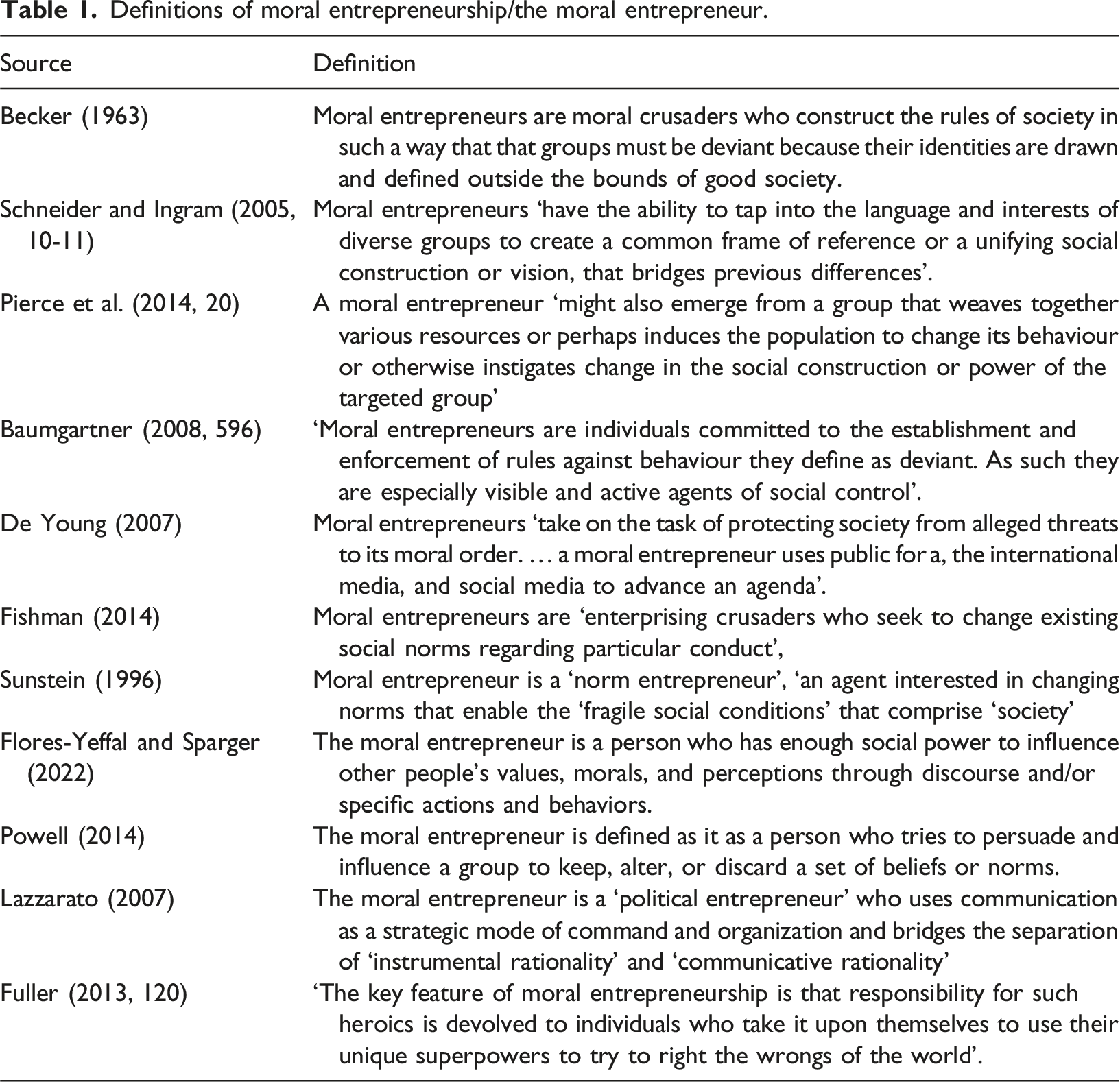
For Becker there are two types of moral entrepreneur. The rule creator as crusading reformer ‘is interested in the content of rules. The existing rules do not satisfy him [sic] because there is some evil which profoundly disturbs him. He feels that nothing can be right in the world until rules are made to correct it’ (Becker, 1963: 147). The rule enforcer implements and enforces the rules in practice: ‘just as radical political movements turn into organised political parties and lusty evangelical sects become staid religious denominations, the final outcome of a moral crusade is a police force’ (Becker, 1963: 48). In Becker’s analysis, these rule creators are self-righteous ideologues who are quite willing to use whatever means possible to accomplish their stated mission, making it difficult in many circumstances to decide whether the actions of a moral entrepreneur are virtuous or vicious (Greenhalgh et al., 2019). Furthermore, moral entrepreneurship does not assign ethical valence to the act of rule creation: it can refer to taking the greatest strides forward to the greatest failed social experiments, and the rule creator may be an interfering busybody or a high-minded humanitarian (Dellwing et al., 2014). Rule creation is merely an enterprising commitment to changing society for better or worse, and it is invariably motivated by socio-political and financial factors anchored in the adoption of a moral crusade, the identification of a practice which may be harmful to the group in which it occurs and a belief that something must be done about it. Whether as representatives of grassroots, professional, or elite interests or whether as initiators, organizers, propogandists, ideologues, or enforcers, moral entrepreneurs endeavor to influence the content and the enforcement of rules. Some of their moral crusades will fail to achieve their mission, but those that do succeed will designate those who will become society’s “outsiders” (De Young, 2007: 3088; O’Sullivan, 1994). Moral entrepreneurship does not exist in a vacuum but is set within and gains moral meaning from its particular social context (Fazzino et al., 2014). As the ideals of the moral entrepreneur become entrenched in the institutional setting, as rule enforcers adopt the rule creators’ espoused moral principles into systems, structures and processes, the consequences of moral entrepreneurship for its varied stakeholders and participants may become part of the ‘taken for granted’ way of doing things (Greenhalgh et al., 2019: 719).
The concept of moral entrepreneurship has been explored in an increasingly diverse range of contexts, including human rights (Felner, 2012; Mosley and Tello, 2015; Reich, 2003), ethics and ethical leadership (Kaptein, 2019; Pompe, 2013), global governance (Rengger, 2003), international commercial arbitration (Posner, 1997), IP protection (Fishman, 2014), anti-social behaviours (Müller, 2015; Yar, 2013), and health, diet and welfare (Shdaimah and McGarry, 2018; Waring, 2010). There have been some applications of moral entrepreneurship in the business field, including studies of corporate whistleblowing, markets (Balsiger and Schiller-Merkins, 2019), multinational business (Dean, 2020), corruption (Adut, 2004), populism and fascism (Chavez and Sriram, 2024; Hall, 1979; Light, 2023), professional sport (Abrutyn, 2018), sustainability (Antadze and McGowan, 2017), university knowledge translation processes (Massaro et al., 2024) and ethical leadership (Kaptein, 2019).
My focus in this paper is on leadership by crisis in the political domain, where political heroism has been defined as ‘the conduct taken by a leader who seeks to advance the greater good of a community, society, or state in foundational periods or at times that require critical change’ (Palazzolo, 2024: 1571). This ideal, however, has run aground on the rocky shore of a politics which is more transparent, contentious and polarized and where holding public office is seen as less admirable and increasingly subject to serving sectional interests (Palazzolo, 2024: 1577). It is important, therefore, to note that leadership through moral entrepreneurship should not be confused with ethical leadership and the moral entrepreneur as an innovator in ethics should not be confused with the ethical leader who leads in an ethically appropriate way, nor with the morality of leadership, that is, the values and behaviours associated with leading, nor with an account of the organisation in moral terms (Hägg et al., 2024). It is moral in the sense of the social dimension (oriented at public change with ground-breaking scale and effect), the policy aspect (promoting or advocating innovative ideas) and norm-orientation (creating a ‘norm bandwagon’ to change social norms whereby even small shifts in norms can lead to rapid and far-reaching revision of the prevailing norms) (Pozen, 2008) – moral entrepreneurship is a long term commitment with social expectations (Pompe, 2013). Furthermore, as a disruption of the status quo appealing to a moral vocabulary and the language of ‘ought’, moral entrepreneurship can be approached from the perspective of moral agency (Moberg, 2006; Watson et al., 2007; Weaver, 2006), conceptualized as a contextualized normative judgement and action to respond ‘to the demands and contingencies of the present’ (Emibayer and Mische, 1998: 994) to effect the ‘twin goals of shifting norms and bringing about social change’ (Antadze and McGowan, 2017: 1).
Much of the moral entrepreneurship literature to date assumes moral entrepreneurship is a ‘good’ – ‘the fine art of recycling evil into good’ (Fuller, 2013: 118) or being ‘confronted with an evil that concerns them and that they wish to rectify’ (Massaro et al., 2024: 1). What has not been explored, however, in this literature is the extent to which moral entrepreneurship may be directed to morally ambiguous outcomes, and it is to this that we now turn.
Donald Trump and the construction of the moral entrepreneur
The case of Donald Trump provides an illustration of the way in which conventional business entrepreneurship can be transformed or leveraged into moral entrepreneurship. It is impossible ‘to understand the contemporary American political landscape without thinking critically about Trump’s business career, his leadership style, how he has been marketed to the American public and how his approach to business is informing the conservative political agenda’ (Mollan and Geesin, 2020: 414). The entrepreneur/businessman, reality TV show host and second-time President of the United States took upon himself, in his first election campaign, the responsibility of using what he saw as his unique superpowers to try to right the wrongs of the world, or more accurately, the United States. He did so by following an emancipatory playbook (Rindova et al., 2009) which identified three core elements as central to an emancipatory process. First, seeking autonomy represents a perceived need to break free of or break up perceived constraints, embodied in Trump’s case by a call to put America first and Make America Great Again. Second, authoring is the process of taking ownership by defining relationships, arrangements, and rules of engagement, and changing the positions of power (Muegge and Reid, 2019: 23): ‘authoring does not refer to an outright rejection of all established norms and forms of authority but, rather, designing arrangements that support the change-creating intent’ (Rindova et al., 2009: 484). Third, making declarations is about managing interpretations and expectations, mobilizing support, and generating change effects through discursive and rhetorical acts about intended change. Based on an analysis of the discourse of the ‘enemies’, and corruption in the ‘Washington DC swamp’, Trump’s instrumental use of language as rhetoric and a framing practice establishes the ‘image here is of an irresponsible ‘strongman’ (or showman, in Trump’s case) whipping the masses into a frenzy to unsettle the established order (Biegon, 2019: 519).
Demographics of the 2024 US presidential election.
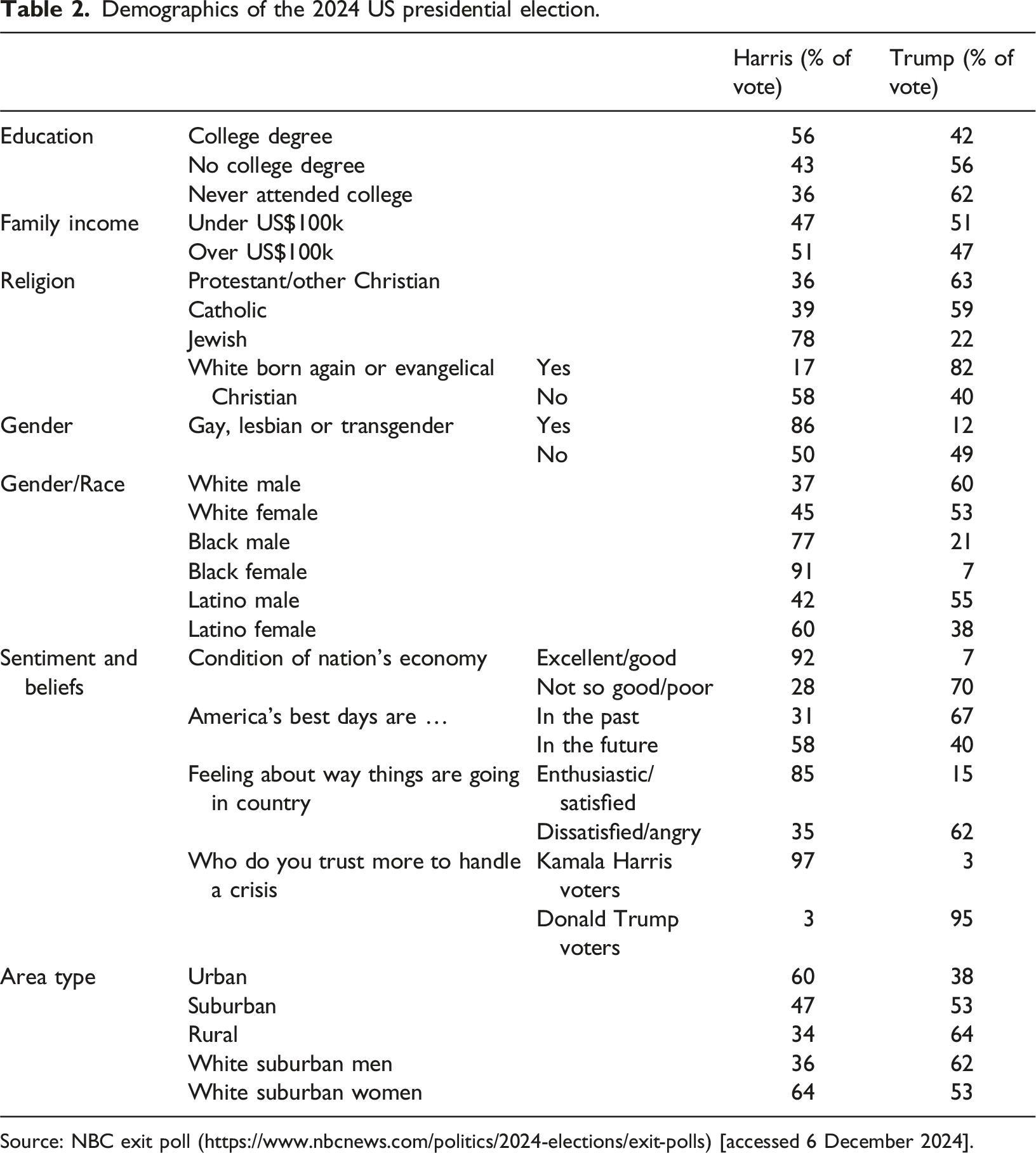
Source: NBC exit poll (https://www.nbcnews.com/politics/2024-elections/exit-polls) [accessed 6 December 2024].
In terms of demographics, Trump’s electoral appeal in 2024 was more broadly based than in the 2020 election. Specifically, his share of the vote (relative to Harris) was higher the lower the level of educational attainment and family income, was higher the more rural the voter’s location, and was higher for all gender/race combinations with the exception of black males and black females (although these two groups were strongly in the Harris camp, Trump’s share of their vote was higher than in 2020). Not surprisingly, those who had a negative view of the condition of the economy, believed that America’s best days were behind it, and were dissatisfied or angry with the way things were going, voted strongly for Trump. In appealing to those who had lost good jobs, closeness to family, community trust, a debt-free life, and pride (Hochschild, 2024), Trump capitalized on the preexisting sense of many people that they have been both disdained and unfairly treated by political and cultural elites (Goethals, 2018, 2024). His self-defined authority for this was explicitly based on his successful entrepreneurial career, burnished by populist media presences including his ‘how to’ book The Art of the Deal and his hosting of the reality TV programme The Apprentice (Krause-Jensen and Martin, 2018).
Following Becker’s (1963) definition of moral entrepreneurs as rule creators or crusading reformers aiming to present their own regimes to better society, it has been argued that Trump fits this mould, creating a moral panic around the ‘societal evil’ of immigration in particular (Flores-Yeffal and Sparger, 2022) to reinforce the message that his ‘cause is for the betterment of individuals and society and whose vested interest in that cause maintains their political power or position’ (Vuolo et al., 2017: 21). 2
However, this authority has been shown to rest on highly questionable foundations. Trump’s self-image is unequivocal (Annex 1), as his ghost-written introduction to The Apprentice makes clear: New York. My city. Where the wheels of the global economy never stop turning. A concrete metropolis of unparalleled strength and purpose that drives the business world. Manhattan is a tough place. This Island is the real jungle. If you are not careful it can chew you up and spit you out. If you work hard, you can really hit it big, and I mean real big…My name is Donald Trump, and I am the largest real estate developer in New York […] About 13 years ago I was seriously in trouble. I was billions of dollars in debt. But I fought back and I won. Big league. I used my brain. I used my negotiating skills, and I worked it all out […]. I have mastered the art of the deal, and I have turned the name Trump into the highest quality brand … (cited in Krause-Jensen and Martin, 2018: 89–90).
When scrutinised in greater detail, there is another, very different account (Mollan and Geesin, 2020). Trump’s career started in the late 1970s, funded by his father, Fred Trump; over a number of years this represented an estimated transfer of wealth of some US$500m at today’s prices. If prudently leveraged and passively invested in Manhattan real estate this could have grown to around US$80bn by the time he ascended to the presidency in 2017 (DeLong, 2024). Instead, Forbes magazine estimated his 2017 net worth to be around US$2.5bn, leading to the charge that in destroying the vast majority of his potential net worth he was one of the world’s biggest losers (Buettner and Craig, 2024). Although on this account his ‘success’ has been categorised as an illusion, Trump’s ability to save himself from bankruptcy on several occasions and hand responsibility off to those he did business with demonstrates ‘considerable skill and ingenuity of some sort … [and] great (if low) cunning and resilience’ (DeLong, 2024: 49).
It is that cunning and resilience that underpins Trump’s emergence as a moral entrepreneur (Pepin-Neff and Cohen, 2021). It is not, however, the only underpinning. A number of commentators have pointed to Trump’s exercise of charismatic authority over his followers (Falk, 2020; Light, 2023; Lukes, 2017; Taki, 2020). In particular, Lukes built on Weber’s (1958) observation that charismatics ‘break with all traditional or rational norms’ (p. 250) to argue that, as president, Trump repeatedly and casually violated established legal, moral, and traditional norms but retained his followers despite howls of shocked indignation from opponents (Wilson and Chace, 2024). As a post-truth leader, Trump embodies a perception of a higher reality than that of the actual world we live in (Spoelstra, 2020). Other commentators, argue that in times of crisis frightened people turn for reassurance to an inspiring charismatic leader (Prost and Doucette, 2019); others observe that cults proliferate when societies undergo rapid change or crisis, and point to the cult of personality that surrounds Trump (Hassan, 2019: 65, 119). In seeking to answer the ‘Where do they come from and how do they function?’ questions with respect to Trump’s moral entrepreneurship, there are three contextual features that stand out.
The mythology and ideology of entrepreneurialism
The first of these views the emergence of the moral entrepreneur as the ‘ultimate generalization of the entrepreneurial spirit, whose peculiar excesses have always sat uneasily with the utility maximiser image of … homo oeconomicus’ (Fuller, 2013: 118). In his lectures on governmentality and biopolitics Foucault (2010) argued that the neoliberal mentality has reconfigured humans from being waged/salaried employees to become ‘entrepreneurs of themselves’ (Christiaens, 2019; Cooper, 2015). Developed into an ideology of entrepreneurialism (Jones and Spicer, 2009), this ‘provides a way of thinking and talking about entrepreneurship that extols entrepreneurship and risk-taking as virtuous and lionizes entrepreneurs and their contribution to economic progress’ (Hartmann et al., 2022: 25). What is new in this analysis is the (re)positioning of entrepreneurship as entrepreneurialism (Caliskan and Lounsbury, 2022), a cultural ideal embodying the ‘implicit, taken-for-granted assumptions about what is desirable and appropriate’ (Brattström, 2022: 135). In adhering to cultural ideals, the moral entrepreneur both gains legitimacy and contributes to a process of institutionalization in the creation of a web of values, norms, rules, beliefs, and taken-for-granted assumptions (Barley and Tolbert, 1997: 93). This ‘entrepreneurship as cultural ideal’ is couched in highly positive terms as something inherently beneficial for both individuals and society, representing not only something that actors do but a lifestyle choice that relates to their way of being, their identity. This in turn leverages the ideology of entrepreneurialism which sees entrepreneurship as being ‘supported without questioning of its validity … [as it] … spreads into all areas of life’ (Brandl and Bullinger, 2009: 159–160). As transmitted into popular culture through the mass media, social media and public discourse, society buys into these narratives and buys into ‘the entrepreneur as a mythical figure with out of the ordinary talents and capacities to transform and renew the supply of consumer products and services, industrial sectors and whole economies’ (Hallonsten, 2023: 49).
Without this shift from entrepreneurship to entrepreneurialism, prompted by the neoliberal influenced heroicisation of the for-profit entrepreneur and the adoption of this as the cultural model of society as a whole, Trump’s ascent would have been more difficult, if not impossible: his claims to superior business acumen are at the heart of his attractiveness as a presidential candidate and in mobilizing supporters in his political base (Mollen and Geesin, 2020). The ideology of entrepreneurialism is also reflected in Trump’s own assessment of what he could bring to the White House: the very first page of The Art of the Deal (Trump and Schwartz, 1987) has Trump saying: ‘Most people are surprised by the way I work. I play it very loose. I don’t carry a briefcase. I try not to schedule too many meetings. I leave my door open. You can’t be imaginative or entrepreneurial if you’ve got too much structure’. While a central element in the emergence of Trump as a political leader, this ideology of entrepreneurialism can have substantial negative consequences due to its inherent constraining of autonomous and critical reflection and the reification of misconceptions about what entrepreneurship is and what leads to entrepreneurial success (Pedersen et al., 2022). In general terms, ideology, as with cultural ideals, can ‘trap’ actors within it and see them struggle to break out of the illusions and belief systems that it imposes (Farny et al., 2016; Ogbor, 2000). This marginalizes alternative ways of thinking (da Costa and Saraiva, 2012), obscures structural constraints and exaggerates individual agency (Caliskan and Lounsbury, 2022), and promotes acceptance of economic precarity (Eberhart et al., 2022).
Spreading the word, building the base
These are addressed in the second contextual factor underpinning Trump’s rise – the communication strategies he used and the way he used them. This raises questions concerning the relationship between presidential decorum and social media usage, as Trump’s Twitter usage operated as a platform to reinforce populist rhetoric and pushed his various spectacles (e.g., entertainment, business, and presidency) through the notion of “winners” and “losers”’ (Blankenship, 2020: 117). The progressive universalisation of entrepreneurialism is itself embodied in and reinforced by discourse, and in particular by forms of discourse (such as hype and bullshit) that substitute for reasoned argument. For example, hype has been characterised as a collective vision and promise of a possible future, around which attention, excitement, and expectations increase over time, and serves as a cultural resource by which leaders might encourage greater early stakeholder support and resources (Logue and Grimes, 2022). Similarly, Christensen et al. (2019) argue that bullshit necessarily extends beyond its mundane uses where it often is conflated with lies (false statements made with deliberate intent to deceive), propaganda (biased or misleading information), jargon (specialized words or expressions that are difficult to understand for people outside a particular group or profession), and rhetoric (the art of effective persuasion) (e.g., Teitge, 2006). In the post-truth world of ‘fake news’ (Deye and Fairhurst, 2019; Foroughi et al., 2019) bullshit is a distinct social phenomenon that undermines respect for the truth (Frankfurt, 2005). It is not lying, for in order to lie it is necessary to be aware of and seek to avoid the truth: ‘It is just this lack of connection to a concern with truth – this indifference to how things really are – that I regard as the essence of bullshit’ (Frankfurt, 2005: 33f). Whereas the liar misrepresents the truth, the bullshitter ‘misrepresents what he is up to’ (p. 13) and wilfully misleads and hides his or her enterprise (Spicer, 2020). For Christensen et al. (2019), this is exemplified in particular in the communications of Trump specifically, and of self-appointed moral entrepreneurs more generally. For others, the election of Trump is an ‘eerie development into a post-factual world of show politics’ (Krause-Jensen and Martin, 2018). This is the world of leadership-by-crisis, the articulation of power and control and the expression of interests embedded in claims of urgency (Spector, 2019), the world of the moral entrepreneur.
Technology and social media play an important role in this, providing a vehicle for transitioning moral panic into action (Goode and Ben-Yehuda, 1994). Twitter/X, and latterly Truth Social, Trump’s own social media platform created after his (temporary) exclusion from Twitter, is in many ways unique in its ability to act as a policy tool in spreading moral panics. This raises questions concerning the relationship between presidential decorum and social media usage. In general terms, Presidential communication aims to mobilise public opimion in support of the President and his policies, and is focused, more often than not, on symbolic enhancement rather than policy accomplishment (Cohen, 2014). Trump’s Twitter usage operates as a platform to reinforce populist rhetoric and pushes his various spectacles (e.g., entertainment, business, and presidency) through the notion of “winners” and “losers” (Blankenship, 2020: 117).
While it is acknowledged that social media can offer numerous advantages, it is important to recognise that it can also be a platform for toxic behaviours. Early emancipatory notions of the internet and cyberspace portrayed it as a realm separate from the physical world, free from differences and inequalities between people. However, in practice technology does not create entirely new behaviours; what it does change is the context in which they occur - it is like playing the same game with new rules (Tufekci, 2021). Specifically, social media such as Twitter/X ‘constitute significant targets, facilitators, and instruments of panic production’ (Walsh, 2020: 841) and are complicit in the propagation of misinformed beliefs about issues (Armitage, 2020). Indeed, in the words of one commentator, ‘it may be that Twitter as a public space is prone to bullying behaviour as a structural element of its social media identity. The more brutal the tweet, the more vulnerable the target, the more followers, and the more “likes”’ (Pepin-Neff and Cohen, 2021). In other words, the problem with Twitter as a mode of governance is that it impacts the relationship between the state and the public, rewarding the political arsonist with more matches and facilitating the environment in which moral panics can be used to repeatedly harm marginalized communities (Pepin-Neff and Cohen, 2021).
Trump had over 30 million Twitter followers in 2017 (Pepin-Neff and Cohen, 2021), and his use of the platform granted him a perceived emotional authenticity and a source of power (Shane, 2018). The ‘circulation of affect’ (Pepin-Neff and Cohen, 2021) so engendered drives the emotional transference that reinforces and disseminates a moral panic. Without access to Twitter/X, and latterly to his own Truth Social platform, as a tool to facilitate social mobilization campaigns (which ‘are mostly used to mobilize needful local, national and international available resources around a proposed social action in correcting social injustice’ (Olutokunbo et al., 2015: 64), Trump’s ability to facilitate moral panic, emotional transfer, and social mobilization, in other words to act as a moral entrepreneur, would have been severely constrained. Trump’s social media usage provided a platform to reinforce his spectacle and populism-driven presidency, characterized as it was by reckless decision-making, unique rhetorical style (capitalization, misspellings, explosive attacks), and volatile behavior (Blankenship, 2020).
Cultural legitimation: Batman returns
It is a weekend in August 2015, and Donald Trump has just alighted from his helicopter to pay a campaign visit to the state fair in Des Moines, Iowa (Washington Post, 2015). One of the crowd, 9 years old William asks: ‘Mr Trump?’ ‘Yes?’ replied Trump. ‘Are you Batman?’ asked William. ‘I am Batman’, replied Trump.
The third and final context for the emergence and rise of Trump as a moral entrepreneur arises from the wider social and cultural context. In an argument that has significant implications for the emergence and influence of moral entrepreneurs (Willner, 1984: 61) has concluded that the pre-eminent requirement for obtaining charismatic authority is cultural legitimation rather than, or in addition to, crisis. Accordingly, all charismatic leaders (see Light (2023) for a discussion of Trump and charisma) derive their authority from the invocation of myths that are ‘common symbols of a shared cultural heritage’, and are ‘assimilated to the dominant myths of his culture’. In other words, for charismatic leaders to obtain charismatic authority, a cultural history needs to be tapped in a manner that explains and authenticates the claimant’s identity and proclaimed mission (Light, 2023). There must exist, therefore, shared prior ideational legitimation of both their mission and identity (Bell, 2020). This is consistent with a social identity theory account of Trump’s behaviour, both while in office and subsequently in his ‘they stole the election’ campaign and in the events around the January 6th assault on the US Capitol. Trump’s speech on January 6th ‘constructed his followers as a morally virtuous ingroup whose existence was threatened by the actions of an immoral outgroup. He invoked a moral duty for group members to protect the group by eliminating that threat through repeated references to issues related to the group’s shared social identity’ (Wilson and Chace, 2024: 270–271, quoting Ntontis et al., 2023).
From Batman to Trump: the moral entrepreneur as superhero.
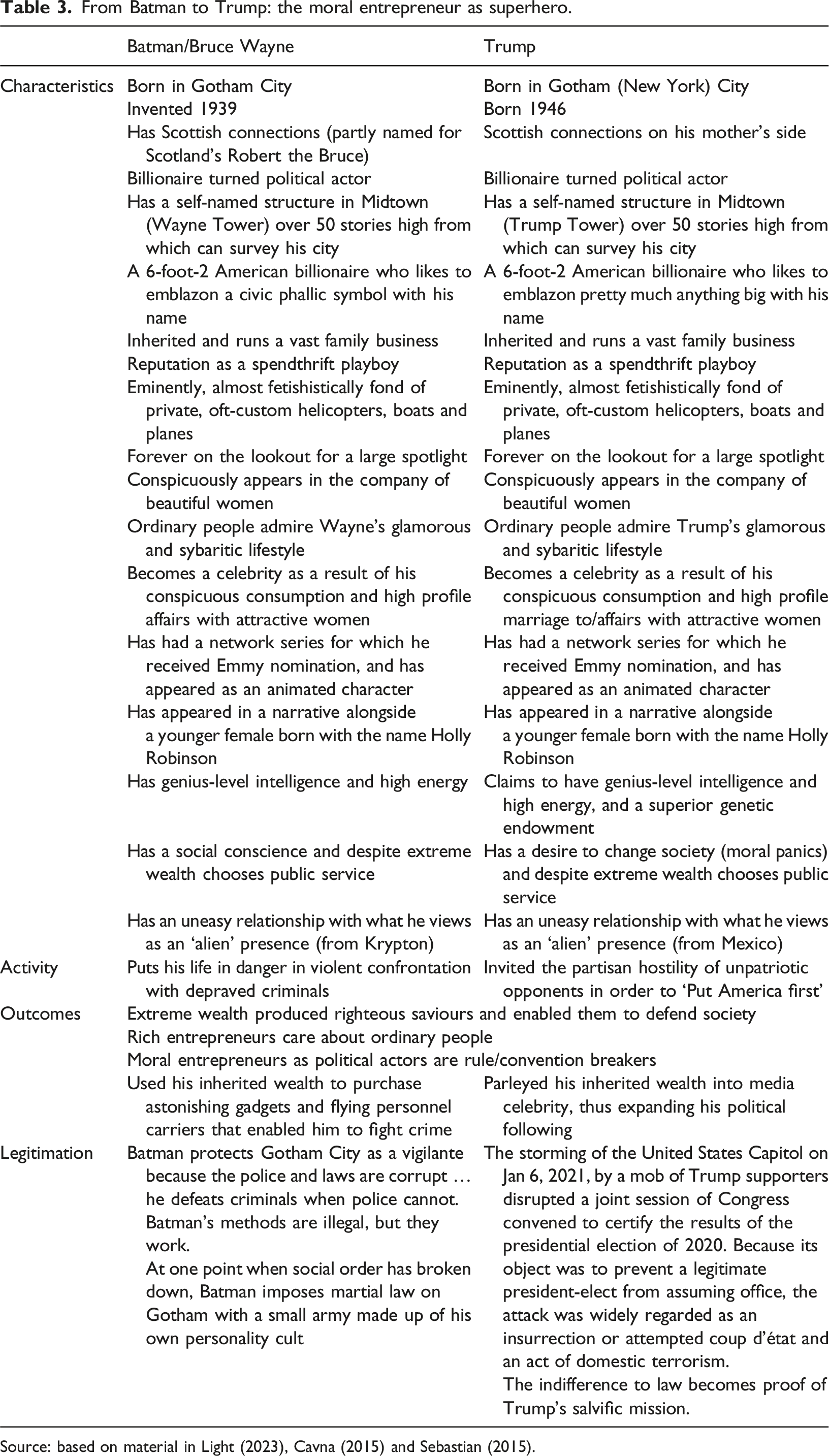
Source: based on material in Light (2023), Cavna (2015) and Sebastian (2015).
This in turn is reflected in the archtypical and allegorical value of superheroes. One example illustrates this, in the political sphere (Cates, 2011: 834): in Frank Miller’s The Dark Knight Returns (1986) a middle-aged Batman emerges from a forced retirement to thwart old nemeses and restore order to a Gotham City which has sunk into crisis and chaos following a blackout and power failure from a faraway nuclear explosion. Batman recruits impressionable gang members into a vigilante militia and seizes control of the city to bring sense to a world plagued by worse than thieves and murderers. Batman emerges from this as a spirit of local resistance against a government that is both evil and imbecilic, embodying the ‘American fighting spirit’ (Klock, 2002: 44): ‘Batman becomes … [a] … figure of individuality and resistance’ (Cates, 2011: 835). The parallels with the attack on the Capitol (power failure at the centre, crisis and chaos, creation of a loyal militia, labelling the government as evil and imbecile, and the appeal to a nebulous previous ‘golden age’ (The American fighting spirit, MAGA) are disturbingly close. From crisis to crisis, superheroes maintain a perpetual and unchangeable present, the ‘temporal paradox’ (Eco, 2004) that audience expectations seek the characteristic pleasures of archetypes and myths. If superheroes ‘can be read as allegorical figures for particular abstract nouns - Batman representing suspicion or resistance to outside authority … then it’s solely outside of their canonical stories that these nouns can push verbs into objects: in parallel universe stories, allegory can be turned into argument’ (Cates, 2011: 839).
This specific illustration of the ‘dark side’ of the comic book superhero points to a further issue: comic book superheroes always exist uneasily with established authorities, often working at cross-purposes to them, and the exercise of their powers (and their idiosyncratic nature) serves to unify a populace that was hitherto internally divided. For Light (2023), citing Mirowski (2014, 199), Schumperetian economics had found its way into popular entertainment mass media, and because Batman resembled Trump, Americans could easily understand that Trump’s dark side had a redeeming reverse side: ‘Because Batman had already brought the economists’ soteriology 3 into their living rooms, secular Americans could understand Trump as a saviour, not just a politician. Therefore they were primed to grant him charismatic authority’ (Light, 2023: 538). The political and psychological impact of superheroes relies on the audience’s familiarity with the devices, tropes, archetypes and characters of the superhero genre, a familiarity provided, in the case of Batman in particular, by decades of comic book publication and movie production.
In this respect it is apposite that of all the superheroes he could have chosen, it was Batman that Trump chose to clothe himself in, rather than his contemporary and sometime adversary, Superman. Fundamentally, both superheroes are about human perfectibility (Cates, 2011; Wolk, 2007). Superman is effectively the perfect human (although ironically, he is an alien and not human at all) and Batman has pushed himself to the edge of being greater than human, defining the peak of humanity as dangerousness and a lack of weaknesses. Superman has a vast array of superhuman abilities and moves planets; Batman has highly trained human abilities and operates at the level of street crime, fighting thugs in alleyways, with ethics and methods that are often described in shades of grey. Superman, by contrast is capable of much greater, genuinely superhuman, feats but is characterized by his efforts to create an orderly outcome without any moral compromise. Batman occupies a world that is already broken and the hero does what he can to create justice within it. For Superman, the best sort of crisis is a situation that tests his primary-coloured ethics, the resolution of which rests in him cheating the very terms of the dilemma so that his pristine moral record is preserved: heroic action must and does prevent the world from breaking in the first place.
Combining Light’s (2023) specific arguments and Cates’ (2011) more general analysis, ‘a combination of social Darwinism, Austrian School economics, and entertainment media had led Americans to understand rich entrepreneurs as exceptional individuals whose strength and intelligence, when autocratically exercised, would reinvigorate the nation as well as the economy’ (Light, 2023, p. 534) This secular message had been spread to the general public by the economics profession as well as by entertainment superheroes: Wall Street Republicans understood Trump as the kind of saviour predicted by economic theory, and entertainment audiences understood him as the Batman superhero. All this cultural iconography thus primed the anticipation of a moral entrepreneur. However, a word of caution is appropriate. First, returning to Eco’s ‘temporal paradox’, as Batman never aged and his status quo remains virtually unchanged, he offers a poor model for the ‘complications of adult responsibility; aided by their great power or great wealth their secret-identity lives remain fantasies, for the most part, of actions without consequences’ (Cates, 2011: 847), underlining Drezner’s (2020) characterisation of Trump as ‘Toddler-in-Chief’. Second, during his Presidency, across a broad swathe of policy areas, Trump largely acted as an accelerant for already existing causal processes in society, rather than providing a radical break with past politics (Carati and Locatelli, 2023): ‘Nonetheless, his actions undermined democracy, truth and confidence in state institutions amongst much of the American population. He further polarized social cleavages and inflamed race relations’ (James, 2021: 765). It remains to be seen how this plays out in his second presidency, although all the indications are that he will continue to do so and do in an even more intense way.
Moral entrepreneurship as performance
In taking forward the ideas and analysis reported in this paper on moral entrepreneurship and leadership by crisis, we can build on two streams of literature. First, the ‘leadership as performance’ literature highlights the nature of leadership as an emergent and co-constructed process between leader and follower(s) (Gaffney, 2014; Gigliotti, 2016; Harrison, 2017; Peck and Dickinson, 2009; Peck et al., 2009). This is enacted through storytelling (Ellington, 2024) and communication (Fairhurst, 2007; Hackman and Johnson, 2013; Ruben and Gigliotti, 2016). Specifically, the performance or enactment of leadership is particularly evident during crises and their accompanying uncertainties (Alvesson and Sveningsson, 2003a, 2003b; Hall, 2007). Second, for some commentators the mainstream view of the moral entrepreneur from Becker onwards is unnecessarily limited, and they contend that moral entrepreneurs are countercultural, constructing new ideas and ideals, acting more like a creative bricoleur than Becker’s custodian of the status quo (Fazzino et al., 2014). As such, they suggest that moral entrepreneurs engage in persuasive performances when attempting to counter stigmatized labels.
Together, these literatures point to the relevance of Turner’s (1974: 37–41) dramaturgical approach for the analysis of leadership through moral entrepreneurship as a social drama which unfolds over time. For Turner, social dramas as units of aharmonic or disharmonic processes arising in conflict situations unfold in four phases accessible to observation (Figure 1). First, there is a breach of regular norm-governed social relations occurring between people and groups within the same system of social relations and interaction. This represents a symbol of dissidence, a symbolic trigger of confrontation or encounter. Such a dramatic breach can be made by an individual but they always act or believe that they act on behalf of other parties whether these parties are aware of it or not: the moral entrepreneur sees her/himself as ‘as a representative, not a lone hand’ (Turner, 1974: 38), giving voice to the overlooked, unheard and left-behind. For Trump this breach was articulated in the MAGA slogan – ‘Make America Great Again’ – a slogan which served as the anchor for two presidential campaigns, and in the ‘we were robbed’ narrative surrounding the outcome of the 2020 campaign which represented Turner’s symbolic trigger of confrontation and tapped into a growing sense of economic and social alienation felt by wide sections of American society. Moral entrepreneurship: a dramaturgical framework.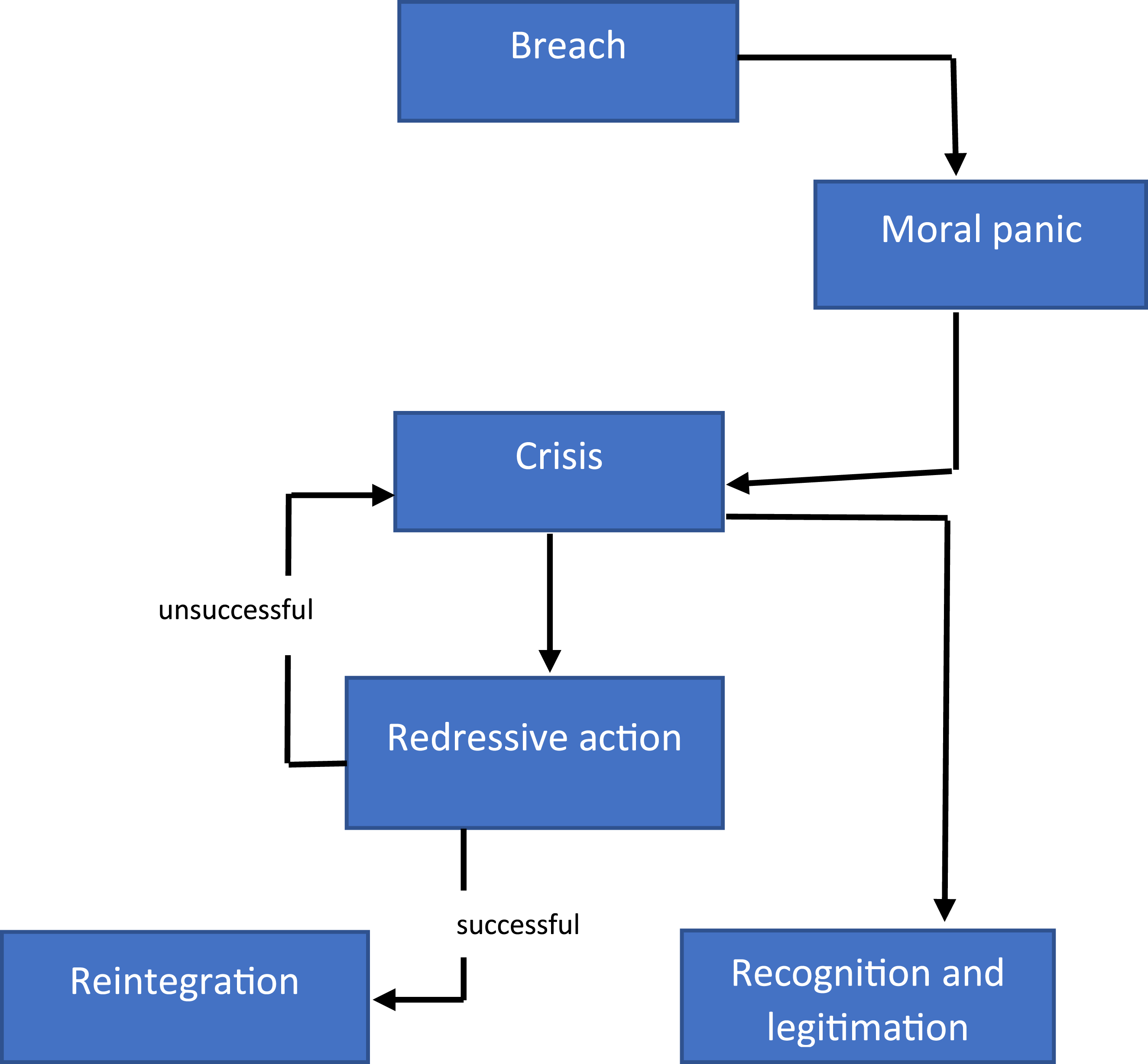
Second, through the creation of moral panic(s) crisis follows a breach of regular norm-governed social relations, and there is a tendency for the breach to widen and extend until becomes coextensive with some dominant cleavage in the wider set of relevant social relations to which the conflicting or antagonistic parties belong, an ‘escalation of the crises’. Each crisis represents a threshold between more or less stable phases of the social process, and this liminality ‘takes up its menacing stance in the forum itself and, as it were, dares the representatives of order to grapple with it. It cannot be ignored or wished away’ Turner (1974: 39). As discussed above, Trump’s leadership by crisis leveraged the breach in previous norm-governed social relations. First, he created crises to embed and reinforce these breaches, based on the stigmatisation of individuals (e.g., immigrants, LGBTQ+ members of the armed forces) and institutions (e.g., China/the EU as presumed exploitative trade partners, and the recent assault on higher education institutions). Second, he transformed the nature and functioning of the presidency itself (e.g., the use of social media as a primary mode of communicating policy and the reliance (in his second term in particular) on Executive Orders rather than debates in the legislature to determine and shape policy). Crisis, in other words, is a turning point, one of those moments of danger and suspense that reveals a true state of affairs.
For Turner, this liminality leads to the third phase of a social drama - redressive action. To limit the spread of crises certain adjustive and redressive mechanisms, informal or formal, institutionalised or ad hoc, are brought into operation by leading or structurally representative members of the disturbed social system. Mechanisms vary in depth and complexity and are a function of the depth and shared social significance of the breach, the social inclusiveness of the crisis, the nature of the social group within which the breach took place, the degree of autonomy of the social group with reference to wider or external systems of social relations. While not all moral entrepreneurial campaigns will be successful (Flores-Yeffal and Sparger, 2022), redressive action (such as the series of legal challenges to Trump’s attempts to overturn the results of the 2020 presidential election and his conviction on criminal charges, making him the first convicted felon to successfully run for the highest elected position in the country), may fail, resulting in a regression to crisis as the basis for leadership. The failure to mount an effective campaign to counter Trump has come under recent scrutiny (Allen and Parnes, 2025; Tapper and Thompson, 2025; Whipple, 2025). What emerges from this is the absence of redressive machinery capable of handling crises and restoring the status quo, or at least some measure of rapprochement between the parties. For Turner, the key question is ‘is the redressive machinery adequate, and if not, why not’? For the moral entrepreneur, a negative answer precedes a regression to crisis. For the disturbed society, a positive answer can lead to ‘a distanced replication and critique of the events leading up to and composing the “crisis” (Turner, 1974: 41), in the form of a judicial or political process or in the metaphorical and symbolic idiom of a ritual process. In the case of the rise of Trump, and in view of the particular circumstances paving his way, more research needs to be devoted to the nature, effectiveness ad scope for improvement in society’s redressive mechanisms.
This redressive phase of social dramas in turn shapes Turner’s final phase of a social drama as either the reintegration of the disturbed social group or the social recognition and legitimisation of the irreparable schism between the contesting parties. Applying this to the political sphere (Turner et al., 1966), a comparison with the ordering of political relations that preceded the power struggle, erupting into an observable social drama with that following the redressive phase suggests that the scope and range of the field will have altered, the number of parts will be different, and their magnitude will be different. Overall, the nature and intensity of the relations between parts and the structure of total field will have changed. New norms and rules may have been generated and old rules will have been abrogated and fallen into disrepute, and the basis of political support will have altered. As a consequence the basis for legitimacy will have changed, as will the techniques used by moral entrepreneurial leaders to gain compliance. In the case of Trump, for example, these processes are still to be worked out in terms of both the capture of the Republican party by Trumpism and the fundamental divisions and fault lines in US civil society he has exploited.
Turner identifies this final phase of a social drama as one in which there is both change and continuity. Given this, the treatment of the leadership of moral entrepreneurs such as Donald Trump as social dramas and as dramaturgy offers opportunities for both conceptual innovation in integrating leadership, crises and moral entrepreneurship and methodological developments in terms of a temporally-sensitive processual study undertaken through an extended-case history, conducted over a considerable length of time and collected as a sequence of processual units of different types, including social dramas as discussed above.
Conclusion
In this paper I have discussed the emergence of a new type of leadership actor – the moral entrepreneur, who establishes their leadership through the creation of moral panics and their ability to tap into sections of society who felt fearful, left-behind, and marginalised by mainstream politics (Ferguson et al., 2020; Lewis-Beck and Quinlan, 2019; Rudolph, 2019). The paper uses the totemically significant example of leadership as a moral entrepreneur, the 45th president and incoming 47th president of the United States, Donald J Trump. Trump’s ascent to the presidency in 2016 and again in 2024 reflected his ability to leverage a number of cultural legitimacy platforms, from the heroicisation of the ‘entrepreneur’ and the ideological commitment to ‘entrepreneurialism’ in contemporary discourse, to the contemporary comic book superhero, who embodies and even mythologizes the contradictory values of neoliberalism (Hassler-Forest, 2015) and ‘effectively humanizes institutional discourses that glorify real-world practices of surveillance and torture, while the characters’ various personal traumas legitimize their violent and unilateral response to external threats’ (Hassler-Forest, 2023).
This has wider implications. If it is still the case that “the difficulty under capitalism . . . is to find a stable mythology expressive of its inherent values and meaning” (Harvey, 1990: 217), then the moral entrepreneur as superhero clearly still offers at least the closest approximation of just such a mythological structure. In these superhero narratives, we sympathize with the main characters not because of their ideals but, on the contrary, precisely because they have abundant flaws that make them relatable. They do not offer positive models for behavior or convincing accounts of what it would like look to do things right (Kotsko, 2012). Twenty-first-century culture therefore offers a wide variety of iconic characters and public figures – superheroes, neoliberal politicians and celebrities CEOs alike - whose transgressions are an essential part of their appeal.
There is an important caveat here. The increasingly common focus in the moral entrepreneur literature on individuals rather than institutions or agencies, as Becker originally conceived it, carries the risk of privileging a leader-centric account of events and social dynamics, with only one driving, strategically minded actor, in the case of this analysis Trump. However, we know little of how various counterforces play in to how moral entrepreneurship and leadership by crisis unfold. For example, is the response to a Trumpian moral entrepreneurship the creation of a moral panic or crisis constructed around Trump as a threat to democracy, and pointing out his followers as ‘others’ who threaten the fabric of civilised society? It is to address questions of this kind that a dramaturgical perspective has value.
The moral entrepreneurship perspective can, of course, be extended to the analysis of ‘leadership by crisis’ in other domains. For example, it could provide the basis for analytically examining climate change activism in the formation, emergence and behaviours of current and new cultural populations, such as movements like Occupy, Extinction Rebellion, Just Stop Oil, and activists such as former US Vice President Al Gore and Greta Thunberg (Fisher and Nasrin, 2020). Applying a dramaturgical lens (Fazzino et al., 2014), as discussed above, not only would show how deviance is socially constructed, but also how performances shape deviant labels, as in the case with “hactivists” in the Anonymous movement who justify their “deviant” actions by constructing governmental entities as the villains of societal progress (McCarthy, 2015). The Trump case study above has highlighted the importance of socio-cultural legitimation in developing moral entrepreneurship, but it remains the case that we know little of the factors associated with the success or failure of moral entrepreneurship as it develops over time: the literature to date is stronger on moral entrepreneurship as symbolic enhancement than policy advancement. Turner’s dramaturgy offers a multi-phase processual perspective on the emergence and unfolding of social dramas. Each phase has its specific properties, speech forms and styles, rhetoric, nonverbal languages and symbolisms, which will vary cross-temporally and cross-culturally. Moral entrepreneurs disrupt existing moral codes and give rise to a new one, alter the views about what is “right” or “wrong” and lead morality through the creation of a new (but not necessarily ‘better’) morality. As the Trump case demonstrates, they do not do so in a vacuum, and it remains a challenge for future research to identify the background conditions, the application of moral entrepreneurship as leadership by crisis, and the redressive mechanisms available to mitigate or overcome these challenges to the established social, political and economic order. What we can conclude from the Trump case is that not only do moral entrepreneurs pursue a ‘godlike quest to turn an unwanted crisis into an unwasted opportunity’ (Fuller, 2013: 128), but they create and fan the flames of moral panics, which express concern, generate hostility, build consensus, embody disproportionality and stimulate volatility (Goode and Ben-Yehuda, 1994) in othering those identified as associated with ‘deviant’ behaviour and the loss of revered social values, as ‘visible and active agents of social control’ (Baumgartner, 2008: 596). The moral entrepreneur, like the comic book superhero, speaks ‘loudly and boldly to our greatest fears, deepest longings, and highest aspirations …. They exist to solve problems of all kinds … At their best, they help us confront and resolve even the deepest existential crises’ (Morrison, 2012: xvii). But there is also a dark side to this performance of leadership by crisis: in an era of constitutive crisis, the moral entrepreneurs are the influencers of behaviour, the instruments of power in radical uncertainty – it is they who have the market, political and rhetorical power to make their stories count.
Footnotes
Declaration of conflicting interests
The author(s) declared no potential conflicts of interest with respect to the research, authorship, and/or publication of this article.
Funding
The author(s) received no financial support for the research, authorship, and/or publication of this article.

Notes
Author biography
Appendix
Trump on Trump – selected quotes.. Source: https://hyperscapes.com/trumps-assessment-selected-quotes/ [accessed 23-11-2024].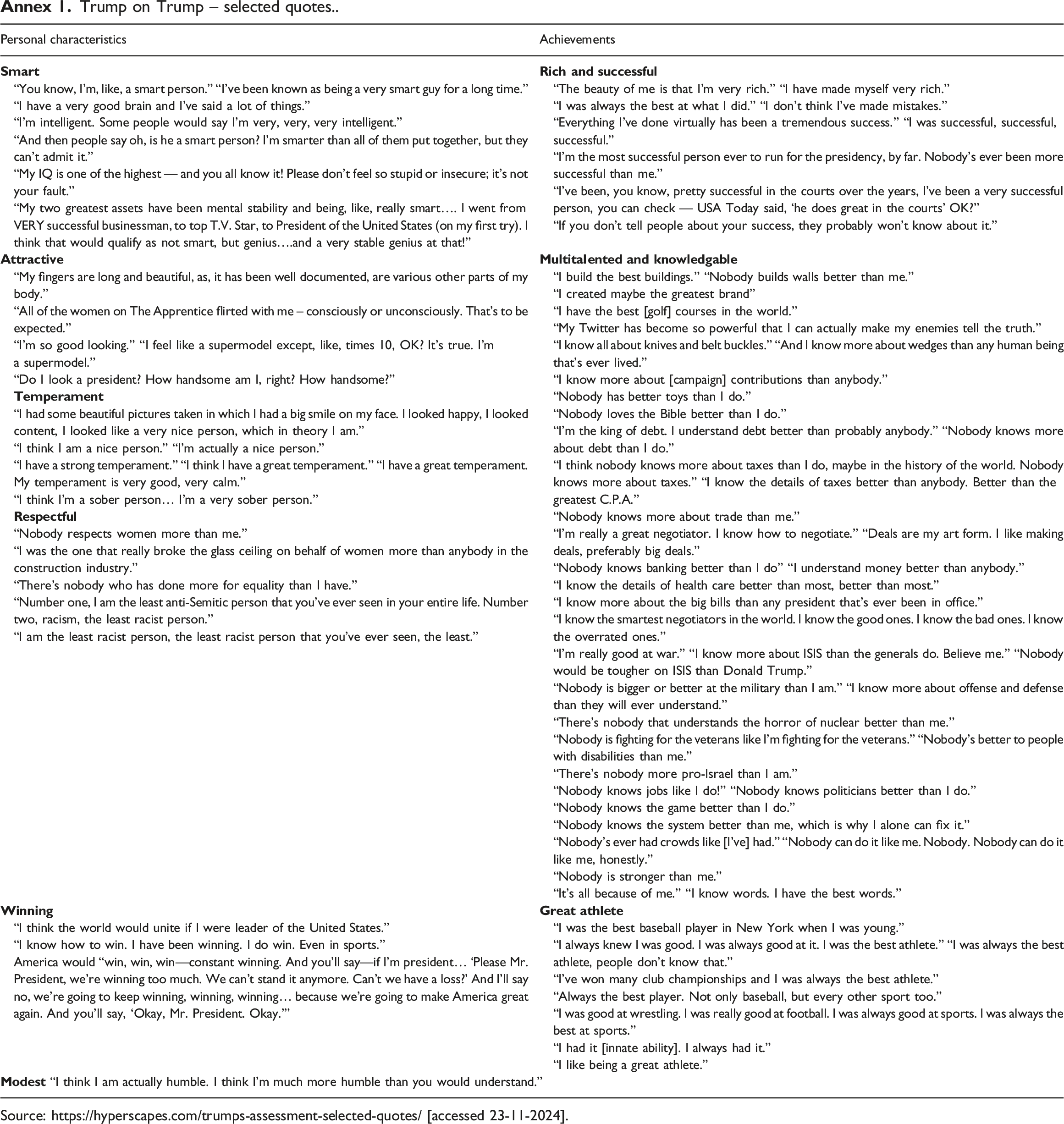
Personal characteristics
Achievements
“You know, I’m, like, a smart person.” “I’ve been known as being a very smart guy for a long time.”
“I have a very good brain and I’ve said a lot of things.”
“I’m intelligent. Some people would say I’m very, very, very intelligent.”
“And then people say oh, is he a smart person? I’m smarter than all of them put together, but they can’t admit it.”
“My IQ is one of the highest — and you all know it! Please don’t feel so stupid or insecure; it’s not your fault.”
“My two greatest assets have been mental stability and being, like, really smart…. I went from VERY successful businessman, to top T.V. Star, to President of the United States (on my first try). I think that would qualify as not smart, but genius….and a very stable genius at that!”
“The beauty of me is that I’m very rich.” “I have made myself very rich.”
“I was always the best at what I did.” “I don’t think I’ve made mistakes.”
“Everything I’ve done virtually has been a tremendous success.” “I was successful, successful, successful.”
“I’m the most successful person ever to run for the presidency, by far. Nobody’s ever been more successful than me.”
“I’ve been, you know, pretty successful in the courts over the years, I’ve been a very successful person, you can check — USA Today said, ‘he does great in the courts’ OK?”
“If you don’t tell people about your success, they probably won’t know about it.”
“My fingers are long and beautiful, as, it has been well documented, are various other parts of my body.”
“All of the women on The Apprentice flirted with me – consciously or unconsciously. That’s to be expected.”
“I’m so good looking.” “I feel like a supermodel except, like, times 10, OK? It’s true. I’m a supermodel.”
“Do I look a president? How handsome am I, right? How handsome?”
“I had some beautiful pictures taken in which I had a big smile on my face. I looked happy, I looked content, I looked like a very nice person, which in theory I am.”
“I think I am a nice person.” “I’m actually a nice person.”
“I have a strong temperament.” “I think I have a great temperament.” “I have a great temperament. My temperament is very good, very calm.”
“I think I’m a sober person… I’m a very sober person.”
“Nobody respects women more than me.”
“I was the one that really broke the glass ceiling on behalf of women more than anybody in the construction industry.”
“There’s nobody who has done more for equality than I have.”
“Number one, I am the least anti-Semitic person that you’ve ever seen in your entire life. Number two, racism, the least racist person.”
“I am the least racist person, the least racist person that you’ve ever seen, the least.”
“I build the best buildings.” “Nobody builds walls better than me.”
“I created maybe the greatest brand”
“I have the best [golf] courses in the world.”
“My Twitter has become so powerful that I can actually make my enemies tell the truth.”
“I know all about knives and belt buckles.” “And I know more about wedges than any human being that’s ever lived.”
“I know more about [campaign] contributions than anybody.”
“Nobody has better toys than I do.”
“Nobody loves the Bible better than I do.”
“I’m the king of debt. I understand debt better than probably anybody.” “Nobody knows more about debt than I do.”
“I think nobody knows more about taxes than I do, maybe in the history of the world. Nobody knows more about taxes.” “I know the details of taxes better than anybody. Better than the greatest C.P.A.”
“Nobody knows more about trade than me.”
“I’m really a great negotiator. I know how to negotiate.” “Deals are my art form. I like making deals, preferably big deals.”
“Nobody knows banking better than I do” “I understand money better than anybody.”
“I know the details of health care better than most, better than most.”
“I know more about the big bills than any president that’s ever been in office.”
“I know the smartest negotiators in the world. I know the good ones. I know the bad ones. I know the overrated ones.”
“I’m really good at war.” “I know more about ISIS than the generals do. Believe me.” “Nobody would be tougher on ISIS than Donald Trump.”
“Nobody is bigger or better at the military than I am.” “I know more about offense and defense than they will ever understand.”
“There’s nobody that understands the horror of nuclear better than me.”
“Nobody is fighting for the veterans like I’m fighting for the veterans.” “Nobody’s better to people with disabilities than me.”
“There’s nobody more pro-Israel than I am.”
“Nobody knows jobs like I do!” “Nobody knows politicians better than I do.”
“Nobody knows the game better than I do.”
“Nobody knows the system better than me, which is why I alone can fix it.”
“Nobody’s ever had crowds like [I’ve] had.” “Nobody can do it like me. Nobody. Nobody can do it like me, honestly.”
“Nobody is stronger than me.”
“It’s all because of me.” “I know words. I have the best words.”
“I think the world would unite if I were leader of the United States.”
“I know how to win. I have been winning. I do win. Even in sports.”
America would “win, win, win—constant winning. And you’ll say—if I’m president… ‘Please Mr. President, we’re winning too much. We can’t stand it anymore. Can’t we have a loss?’ And I’ll say no, we’re going to keep winning, winning, winning… because we’re going to make America great again. And you’ll say, ‘Okay, Mr. President. Okay.’”
“I was the best baseball player in New York when I was young.”
“I always knew I was good. I was always good at it. I was the best athlete.” “I was always the best athlete, people don’t know that.”
“I’ve won many club championships and I was always the best athlete.”
“Always the best player. Not only baseball, but every other sport too.”
“I was good at wrestling. I was really good at football. I was always good at sports. I was always the best at sports.”
“I had it [innate ability]. I always had it.”
“I like being a great athlete.”