




Abstract
By utilizing manipulative tactics, such as persuasion techniques and strategies through social media sites, moral entrepreneurs can maintain and/or increase their scope of influence. In this article, we propose another tactic utilized by moral entrepreneurs, a concept we refer to as shifting morals. The complexity of moral entrepreneurs’ life experiences provides them with an endless set of social and moral norms that they can use to tweak their own ideals to encompass other moral framing networks to gain more followers and thus increase their influence. We examine theoretical literature, while also providing examples that resulted from content analysis from media websites to illustrate our proposed concept of shifting morals. We conclude that the shifting morals tactic is another tool moral entrepreneurs use to increase their influence in society to enact social change.
The term moral entrepreneur is well known today as Cohen (1972) used it to elaborate on the concept of moral panics, but it was originally presented by Becker (1963). Cohen (1972) defines a moral panic as a process in which moral entrepreneurs (people with power such as politicians or pundits) select a particular group of people to be seen as “the other” or “folk devils” and utilize media outlets to convince the public that this group is to blame for the ills of society. Because moral entrepreneurs hold sway over the people of their respective social groups, the public believes the claims and demands a solution to the problems brought by these folk devils. For example, Hier (2019) discusses that former President Donald Trump has made many claims that incited moral panics, such as claims concerning “immigration, trade, health care, NATO . . .” (p. 880). As a result, the fear and anxiety created by Trump regarding the beforementioned claims would be considered moral panics according to Cohen. Robert Barron, a Catholic bishop and media entrepreneur, has also been identified as a moral entrepreneur creating moral panics as a result of his religious disaffiliation (Hoover, 2021). John Walsh, 1 a news anchor and rights advocate who founded Missing and Exploited Children’s Network after his son was kidnapped and murdered can also serve as an example here.
Moral panics gain traction and spread through what is known as moral framing networks (MFNs), defined by Flores-Yeffal and Elkins (2020, p. 208) as “particular sectors of the public sphere that share the same moral values” as the moral entrepreneur. It is within these MFNs that a moral entrepreneur holds power or influence, whereas power refers to the ability to persuade and convince people to support or oppose certain rules and norms of society. Once a moral entrepreneur establishes the basis for a moral panic, it is through these MFNs that the panic is strengthened and further perpetuated outside of the entrepreneur’s circle of influence. This phenomenon today gains more immediate traction through technology and social media (Castells, 2013).
In the meantime, some authors have been working to further develop the theory of moral panics, such as leading moral panic revisionists, Sean Hier (2015, 2019) and Critcher (2008). To name a few others, Siltaoja (2013) developed the theory with reference to identities, while Dandoy (2014) introduced Bourdieu’s concepts of field, habitus, and hysteresis to the moral panic framework in the case of humanitarian aid. Wright (2015) also suggests seeing moral panics as enacted melodramas. In addition, Flores-Yeffal et al. (2011) added “the call for action” stage to the previous stages of moral panics provided by Cohen (which were Awareness, then Moral Conversion which led to a Moral Panic). Then, Flores-Yeffal et al. (2017) were able to provide evidence that the public in current times also plays an important role in promoting moral panics, especially with the help of social media sites and modern technology. More recently, Rohloff and Saramago (2019) also used the issue of climate change to further develop the concept.
Despite all these advances, there are still a lot of areas to explore related to this concept of moral panics, one of them being the behavior of moral entrepreneurs. Joosse (2018), for example, introduced the charismatic moral entrepreneur, which refers to a moral entrepreneur that is seen to have exceptional power and ability. Also, Flores-Yeffal and Elkins (2020) were able to provide a contextual framework to explain how moral entrepreneurs operate in online settings, referring to this as “moral framing networks,” thus providing an explanation of the context in which moral entrepreneurs function within their social networks through social media sites. Still, it is important to note that moral entrepreneurs also act outside the moral panic framework by influencing smaller groups of people. For example, Kaptein (2019) introduced the idea of moral entrepreneurship in organization settings. We can think of moral entrepreneurs as those who influence others to gain power, especially within their own MFNs.
It is our intention in this article to introduce a manipulation tactic, referred to as shifting morals, that moral entrepreneurs use to gain power/influence outside of their typical MFN. Therefore, in this article, we use an examination of the literature and content analysis of the World Wide Web 2.0 to advance the sociological literature concerning moral entrepreneurs. We attempt to provide a more detailed examination of how moral entrepreneurs function and strategize their moves within their MFNs to maintain and increase their influence on society. First, we explain what a moral entrepreneur is and the different types. We then connect this to moral entrepreneurs and how they use these networks to gain power in society. After that, we introduce the concept of shifting morals and how moral entrepreneurs use this tactic to gain followers outside their main MFN, thus increasing their area of influence in which they can further spread moral panics. To provide evidence for the shifting morals tactic, we offer some illustrations using real-life examples of how different types of moral entrepreneurs use the shifting morals tactic, with some doing so correctly and others incorrectly.
We define a moral entrepreneur as a person who has enough social power to influence other people’s values, morals, and perceptions through discourse and/or specific actions and behaviors. At times in this article, we use the terms social group and MFN interchangeably to reduce repetition. The difference between a social group in society and an MFN is that the MFN is created in online settings, such as on social media sites like Facebook which have the capability to increase the number of people being influenced exponentially, while social groups are in person, thus limiting the number of people being influenced.
Theoretical Framework
As previously stated, Cohen (1972) defines a moral panic as the process in which a moral entrepreneur, such as a politician, selects a particular group of people within society to be the scapegoats for all of society’s downfalls, referring to them as “folk devils.” Looking closer at this idea of moral panics, it can be concluded that much of the “panic” stems from what this moral entrepreneur believes would be an effective argument to convince the public that the “folk devils” are a threat to society. Again, remember that not all moral entrepreneurs might reach large audiences, but they do have the power to influence people’s morals and norms. This begs the question, what is a moral entrepreneur, and who in our society fits this ideal? To answer these questions, we first turn to Christopher Powell, who expanded on Becker’s definition of the moral entrepreneur from 1963 (Powell, 2014).
Types of Moral Entrepreneurs
Christopher Powell (2014) summed up Becker’s work and created a broader definition of a moral entrepreneur, defining it as a person who tries to persuade and influence a group to keep, alter, or discard a set of beliefs or norms. Regarding Becker’s original work though, it is important to make note that Becker concluded that there were two types of moral entrepreneurs, those that are rule creators and those that are rule enforcers, which we investigate in more detail next.
Rule Creators
Becker first looks at the idea of the rule creator, where he introduces the crusading reformer. Here, Becker makes the claim that this type of rule creator views the current rules of society as unsatisfactory and aims to present their own regime to better society. To quote Becker (1963) directly, He [the crusading reformer] is interested in the content of rules. The existing rules do not satisfy him because there is some evil which profoundly disturbs him. He feels nothing can be right in the world until rules are made to correct it. He operates with an absolute ethic; what he sees is truly and total evil with no qualification. Any means is justified to do away with it. The crusader is fervent and righteous, often self-righteous. (pp. 147–148)
So, as Becker puts it, this moral entrepreneur views his or her own values as being absolute, while also looking at the current state of society as being corrupt or “evil.” Also, as Vuolo et al. (2017) put it, “Moral entrepreneurs are the ‘rule creators’ who typically argue that their cause is for the betterment of individuals and society and whose vested interest in that cause maintains their political power or position” (p. 21). An example of this type of moral entrepreneur in recent history is President Donald Trump. To reiterate, Trump has created a moral panic by blaming the downfalls of society on the immigrants, whom we refer to as “folk devils.” During his campaign and throughout his presidency, Donald Trump made very big remarks concerning the “societal evils” that were these “folk devils” (i.e., calling Mexican immigrants “criminals” and “rapists”). It is important to note though that the crusading reformer feels that by following these reforms, people will see betterment in their lives. Trump did this by claiming he will make America great again by dealing with the immigrants. The creation of societal regimes brings about what Becker refers to as rule enforcers.
Rule Enforcers
Rule enforcers are created because the rule creators have established new rules and norms, requiring a group of people to ensure that the new rules are being followed by society. Becker utilizes the police force to demonstrate this concept. Ideally, police officers work with only the moral entrepreneurs’ ideals in mind, where their own MFNs do not interfere with their distribution of punishment when the law is not upheld. Rule enforcers are less worried about creating the rules to fix the ills of society and instead are more worried about implementing the rules that have been created by others. Based on the data gathered for this pilot study, it is shown that those moral entrepreneurs who shift their morals tend to be both rule creators and rule enforcers.
Functionality of Moral Norms
Bicchieri (2005) states that moral norms are those which are followed unconditionally and depend on emotional reactions. In the case of transgression of the moral norm, the group members would regulate the behavior with punishment. Appiah (2010) argues that “morality, properly speaking, is about the avoidance of harm, of fairness, or consent, or rights; and that your gender and your class, in any case, plays no role in determining what morality demands of you” (p. 178). In addition, morals are systems of beliefs reflected in judgments about what is right or wrong and they emerge out of imprinted values. Values may come from culture, religion, or other systems. It is through these belief systems that people begin associating with specific social groups or MFNs.
A reference group is a group of people that acts as the reference network from which the social norms and moral values are enforced (Bicchieri, 2005). MFNs operate in a similar way to what Bicchieri refers to as a reference group. A reference group or MFN would provide the scripts and the social and moral norms to be followed by the members of the group. Given that a person can navigate many social roles in a society, it is possible that a person might belong to more than one reference group or MFN at once.
Stryker and Burke (2000) define identity as “parts of a self, composed of the meanings that persons attach to the multiple roles they typically play in highly differentiated contemporary societies” (p. 284). Simply put, a person’s self, or identity, can be attributed to the multiple roles they normally associate with within their respective societal structures. Also, Stryker and Burke (2000) refer to Mead’s (1934) framework of identity theory that looks at society as a montage of multiple structures and institutions that are dominated by different ages, ethnicities, religions, and so on. Based on a person’s identity, the person may interact with certain social circles within the institutions of society.
Sy et al. (2018) also argue that a set of moral emotions overlap between the leader and his or her group. They argue that admiration and elevation are developed if the leader demonstrates such moral emotions toward the members of his or her group. Often, leaders tend to appeal to moral emotions to motivate followers to behave in a particular way. Some of these moral emotions can be compassion, shame, guilt, contempt, anger, disgust, embarrassment, gratitude, pride, and elevation (Haidt, 2003) (Tangney et al., 2007). A good example of a set of rules or moral standards followed by the group members and their leader which can produce moral emotions is religion. Failure to follow the teachings of a belief system often results in the offender receiving criticism from other members of the group with higher expectations being placed on the leader of the group (the moral entrepreneur), to follow those rules.
According to Bicchieri (2005), “preferences (and beliefs) are context-dependent is to say that they are sensitive to situation cues and the subject’s interpretation of these cues” (p. 56). Bicchieri also argues that it depends on the interpretation and categorization of the situation based on the cues and on the activation of specific scripts (which are stereotypes of what one should do in a specific situation) on how an individual can react to a particular set of moral norms in society. Therefore, a mother who adheres to other roles such as being a teacher and churchgoer would have different scripts to follow and would have different cues to react upon in given situations.
Hauser (2006) argues that we react to morals depending on how we acquire what he calls, “moral faculty” which is composed of the following:
The moral faculty consists of a set of principles that guide our moral judgments but do not strictly determine how we act. The principles constitute the universal moral grammar, a signature of the species.
Each principle generates an automatic and rapid judgment concerning whether an act or event is morally permissible, obligatory, or forbidden.
The principles are inaccessible to conscious awareness.
The principles operate on experiences that are independent of the sensory origins, including imagined and perceived visual scenes, auditory events, and all forms of language; spoken, signed, and written.
The principles of the universal moral grammar are innate.
Acquiring the native moral system is fast and effortless, requiring little to no instruction. Experience with the native morality sets a series of parameters, giving birth to a specific moral system.
The moral faculty constrains the range of both possible and stable ethical systems.
Only the principles of our universal moral grammar are uniquely human and unique to the moral faculty.
To function properly, the moral faculty must interface with other capacities of the mind (language, vision, memory, attention, emotions, beliefs, etc.), some of which are unique to humans while some are shared with other species.
Because the moral faculty relies on specialized brain systems, damage to these systems can lead to selective deficits in moral judgments (pp. 53–54).
Given this, it can be hypothesized that there are a series of factors that might influence how a person reacts to a social or moral norm, and that depends on the context in which they have developed their identity and on a series of other psychological factors such as their own moral faculty. Therefore, shifting morals can also be an unconscious act.
Moral Entrepreneurs and MFNs
As stated before, moral entrepreneurs are people who hold power within certain spheres of society to have an influence on a person’s perceptions or morals. They utilize media outlets to reach larger audiences so they can have a larger influence on society. Honor is one of the characteristics which would also influence their behavior. Appiah (2010) argues that honor, without considering the personal characteristics of the individual, such as class or gender, can turn one person’s moral sentiments into a public norm. To maintain their honor, people need to follow the moral norms to be worthy of respect, and more importantly, to be respected. Honor does not exist without respect (Appiah, 2010). Furthermore, “esteem plays a critical role, it helps maintain demanding norms of behavior . . . as it is policed by everybody in the honor world” (Appiah, 2010, p. 191). The public spheres in which these entrepreneurs practice their influence are greatly determined by the identities that people in each social circle inhabit and in particular social contexts as well. Take for example President Donald Trump. Through his own beliefs and morals, he has been a part of the Republican Party for some time. However, this forces him to follow the rules and guidelines that have been set up by the Republican Party. Failure to follow these ideals results in the judgment of Trump by people who belong to the Republican Party, which could put his own reputation and honor at risk. Because of this, we would expect that he would follow the moral and social norms expected by his own reference group or MFN. Therefore, moral entrepreneurs must make choices and follow the guidelines of their MFNs in such a way that they are able to keep their followers’ attention and not upset them, especially in an era of instantaneous communication.
The turn of the 21st century has witnessed a more revolutionary evolution of communication technology than any other time in history (Castells, 2013). Within the past two decades, society was introduced to mass communication applications such as Facebook, Twitter, Instagram, and Snapchat. With this increase in transmission of information via social media, moral panics and the influence of moral entrepreneurs spread at an even faster rate. This raises the question though, how does a moral entrepreneur perpetuate the moral panic across multiple MFNs that they may not have had influence in before? It is here we introduce the concept of shifting morals and how moral entrepreneurs potentially use shifting morals as a tactic to increase their influence while maintaining their current following.
Shifting Morals
Members of MFNs are manipulated through persuasion techniques, such as the use of certain words, language, images, videos, to keep the public engaged and supportive of the moral entrepreneur (Flores-Yeffal & Elkins, 2020). When a moral entrepreneur holds sway over a complete MFN, such as the head of the Republican Party and its followers, their values are reflected in the behaviors of the other members of the MFNs and vice versa; that is, the moral entrepreneur must also behave in such a way as to not dissuade other members from abandoning the MFN altogether. Because of their power and position within their MFN though, moral entrepreneurs have some room in which they can stray from the expectations of the MFN.
That is not to say that a moral entrepreneur can go completely against the beliefs and values of their MFN. What we propose is that due to their position of power and influence on the MFN, the moral entrepreneurs can draw other morals and beliefs from their own moral faculties and deviate slightly from the morals and norms presently manifested in the MFN they hold sway. By doing this, they gravitate their influence to focus on members of other MFNs that normally would not look at the moral entrepreneur based on their own values and norms. This shift in a moral entrepreneur’s own MFN provides an avenue in which the moral entrepreneur can attract more members into his or her MFN while still retaining most of their followers and retaining the values that their other followers believe in. This is where our proposed concept of shifting morals is used.
Methods
To find the data to support our thesis, we first do a theoretical review of the literature followed by a content analysis of the information we gathered through a netnography of the 2.0 Web over a 2.5-year period (Kozinets, 1998). During this time, we collected information on 20 different moral entrepreneurs via their personal websites, online newspaper articles, academic articles, and social media sites such as Facebook, Twitter, and Instagram. From those 20 we identified, we selected about 10 current moral entrepreneurs to follow in more detail (i.e., acquired transcripts of their speeches, checked their followers’ statistics, often checked their follower’s comments on media outlets, etc.) to examine how they behaved within their respective MFNs and whether they used shifting morals or not.
It is important to clarify that we are not claiming that these moral entrepreneurs had the capability of shifting the morals of the public, but that they instead shifted their own morals. For example, we note Senator John McCain who wrote and supported an amnesty bill to legalize undocumented immigrants, but then shifted his own views on immigration when running for president, going as far as to say he was not supporting his own immigration bill (Benen, 2014). Therefore, we performed a content analysis of the comments and reactions from their followers, news outlets, and media sites to identify moments in which the moral entrepreneurs altered their own moral views that did not align with previous moral beliefs. To be specific, we gathered the details about the moments in which they switched their own moral views, from being in favor to opposing the issue in question. Then we assessed whether each of these moral entrepreneurs had gained or lost followers during that period (before and after shifting their morals). While we do believe Donald Trump is a valid source of information pertaining to the use and application of the shifting morals tactic, we do not include him in the following examples as he has been the center of media outlets for the past few years.
These moral entrepreneurs were not selected at random but because they had shifted their morals as they were presenting themselves to society online. Because of this, the article is only a pilot study in which the purpose is not to demonstrate that shifting morals happen to all moral entrepreneurs, but that it is indeed a strategy utilized by some moral entrepreneurs which can be highly effective in increasing their power and influence.
Shifting Morals Examples
We first look at a very influential politician, Senator Mitt Romney. In accordance with Becker’s types of moral entrepreneurs, we place Romney into a middle ground between rule creator and rule enforcer. We came to this conclusion because while Romney does enforce his own ideals and create his own policies as a senator, he still has a sense of enforcing other rules and regulations in an attempt for justice, as we will see further in the discussion. We specifically chose Senator Romney as an example because he was the only Republican Senator who voted against President Donald Trump during his impeachment trial in 2020. At that time, Senator Romney argued that the reason for his decision was based on his religious beliefs. In a speech before the vote, Romney explained, You see, I support a great deal of what the President has done. I have voted with him 80% of the time. But my promise before God to apply impartial justice required that I put my personal feelings and biases aside. Were I to ignore the evidence that has been presented and disregard what I believe my oath and the Constitution demands of me for the sake of a partisan end, it would, I fear, expose my character to history’s rebuke and the censure of my own conscious. (Cathey, 2020)
It looks like Romney’s moral faculty was more strongly influenced by his religious affiliation than by his political affiliation. And while it may be hypothesized that Senator Romney would lose followers by going against the very person they follow, Figure 1 shows that Romney actually more than doubled his number of followers over 8 months after the impeachment trial.
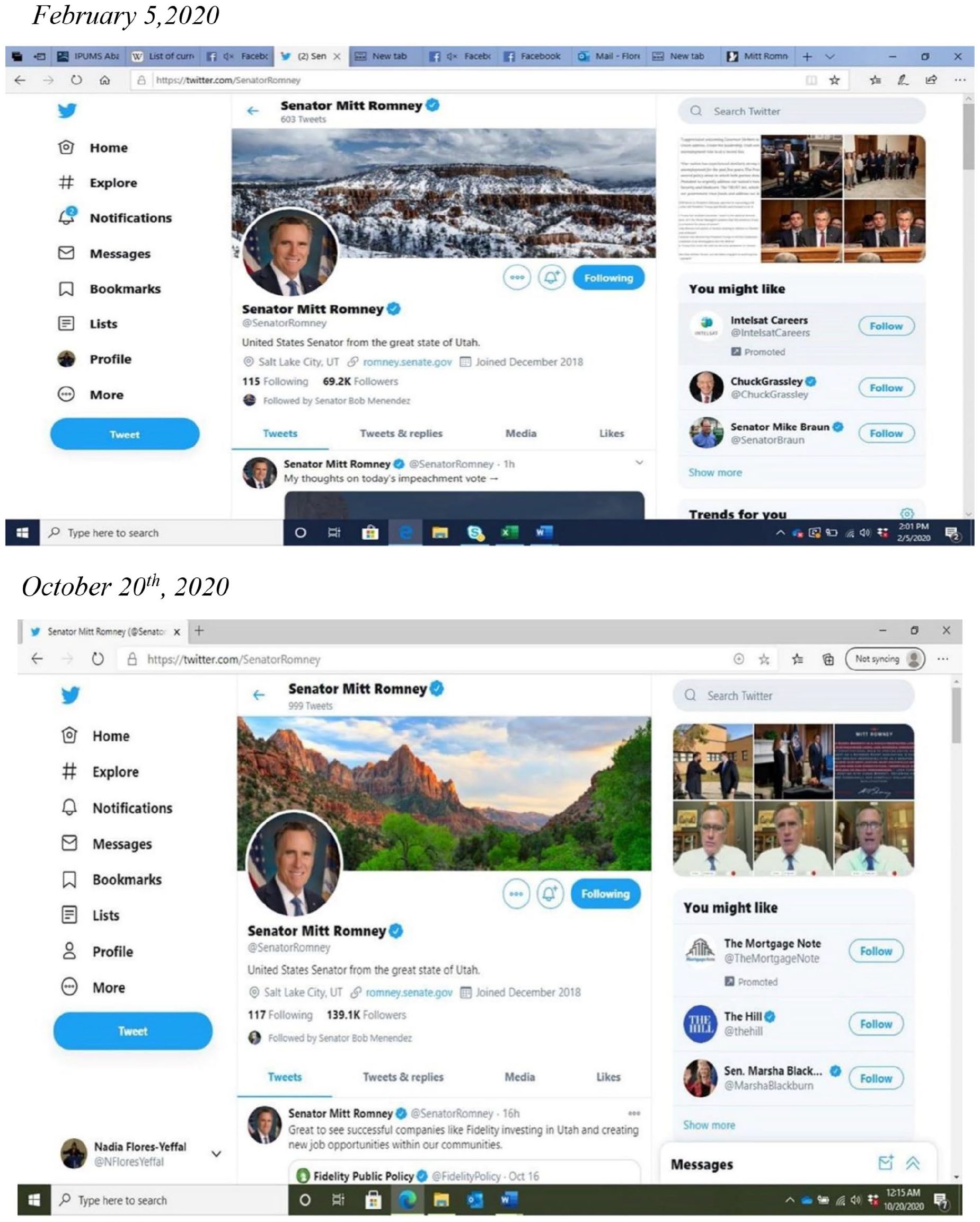
Screenshots of Senator Mitt Romney’s Twitter account from February and October 2020.
Notice that Senator Romney did not completely denounce Trump’s actions (or morals). Instead, he deviated from the Republican MFN and adopted a moral from his religious identities’ MFN. As a result of this, Romney proved to people outside of his MFN that he was not just a follower of Trump and showed that he also has the tenacity to follow his own values and morals which can be more important for his honor than being loyal to his own political party or supporting former President Trump.
Next, we look at news anchor Chris Wallace, a moral entrepreneur that we place within the rule enforcer category of Becker’s typology due to his unbiased commitment to unearthing the truth under the lies of other moral entrepreneurs’ regimes. Following in the footsteps of his father, Mike Wallace, Chris Wallace has been in the TV arena for most of his life. At the time of this writing, Wallace works for Fox News, one of the most conservative media stations that exist in the United States. Despite this, Wallace does not completely follow the same conservative nature as his employer. Instead, he is known for staying impartial and unbiased in his interviews ultimately seeking the absolute truth about corruption and/or missing information. This is seen during an interview with Donald Trump Wallace did in July of 2020, where Trump was bragging about acing a cognitive test he had taken. During the interview, Trump made claims that both Biden and Wallace could not do as well as he did in a campaigning attempt to make Biden look bad to his followers. As shown in Figure 2, this prompted Wallace to shut the claims down by saying he took the test already and that it was not that hard (Meisenzahl, 2020).
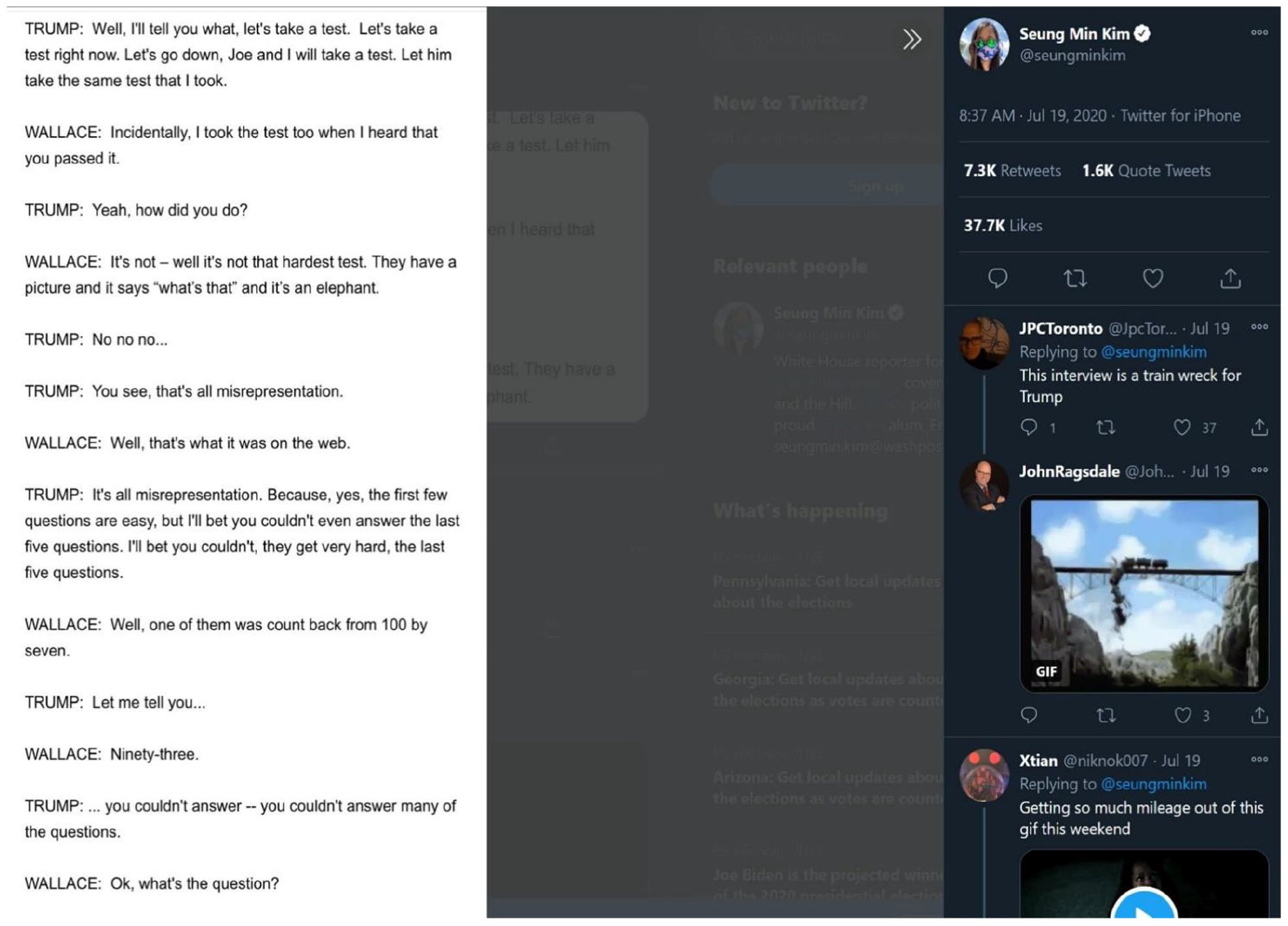
Twitter with interview conversation between Donald Trump and Wallace.
Chris Wallace utilized the concept of shifting morals because while he was working for a predominantly Republican news network, which subjects him to the rulesets found in the republican MFN, he also utilizes morals and ideals found within his identities as a reporter and registered Democrat (Grynbaum, 2020) to further his prowess on the job. Instead of following the conservative nature of Fox News, Wallace has made a name for himself as being neutral and unbiased when interviewing people and/or when being interviewed himself. By remaining impartial, Wallace not only is able to gain followers from both sides of the debate but has also been deemed both an insider and outlier at Fox News (Grynbaum, 2020).
Our next example of shifting morals focuses on the Mayor of Lubbock, Texas, Dan Pope. Pope is in his third term as mayor of one of the most conservative cities in Texas. We place Pope in the category of a rule enforcer because he almost never develops policies of his own, instead, he enforces the rules dictated by others. Pope ran for his third term against another republican candidate, Stephen Sanders. There was not a Democratic candidate running for the same position. Still, Dan Pope has used the shifting moral tactic to gain traction and support from the liberal voters in the area. For instance, he is supporting the arrival of a Planned Parenthood clinic in Lubbock, Texas, which confronted huge opposition from members of the community. Pope justified his support for the clinic by saying, Pope mentioned that his hesitation was not due to his beliefs regarding abortion, but rather about focusing on the responsibilities of the city. Pope said that while he is pro-life, telling Planned Parenthood they cannot come to Lubbock would be in some ways like telling United they couldn’t build another store telling the Southern Baptist Convention they couldn’t do another church start in Lubbock. (Beckmeyer, 2020)
So, it is not that Pope believes in pro-choice, he just believes in equal opportunity, where it would not be fair to allow businesses such as United or the Southern Baptist Convention to set up shop while denying Planned Parenthood’s request. Also, in the face of COVID-19, Pope also changed his views on wearing masks in Lubbock, Texas. At his monthly meeting in July of 2020, Pope stated that his stance on masks had changed (Stell, 2020). He ends the speech by saying, “Let’s follow these hygiene practices. Let’s take care of the people we love and let’s take care of our neighbors whether it’s the person next door or the person that lives across town” (Stell, 2020). While advocating for masks does not follow Lubbock’s conservative social group, some members of the community agreed with Pope. One member of the community at the meeting July commented, “I think we’re having a pretty good approach here in trying to be as conservative as possible as far as shutting everything down and locking it down forever” (Stell, 2020). So, not only has Pope increased his chances of gaining followers with the liberal side of Lubbock, Texas, he has also kept members of the conservative groups of Lubbock on his side because of the way he handled the COVID-19 situation (Stell, 2020).
It is not that Pope is turning against his republican social group but instead altering his MFN to include other areas of his moral faculty concerning human conservation and equal opportunity, thus increasing his following and the probability of him winning his campaign; in the end, Pope won the election, showing that shifting one’s morals can have positive results.
We now turn to actress Selena Gomez, a moral entrepreneur not involved in politics. Selena Gomez started her acting career at a very young age, starring in the show Barney and Friends. In 2007, Selena Gomez gained a huge fanbase consisting of young boys and girls by starring as Alex Russo in Disney’s Wizards of Waverly Place. Recently though, Selena has branched out and taken more adult roles in films. She has even taken up an executive producer position for Netflix’s Living Undocumented. Because this goes against Gomez’s fans’ image of her, this alteration in roles could have resulted in a loss of followers. However, by portraying a different set of moral norms that go against her typical moral faculties, Gomez was able to make a graceful transition away from her child image.
Selena Gomez utilized the shifting morals tactic by turning to two other MFNs that she resided in, her family and ethnicity. Before the Netflix series’ debut, Gomez wrote an essay to Times about her family coming to America as immigrants and her own thoughts on the immigration process in general (Legaspi, 2019). As a Mexican American woman, Gomez also identifies with some MFNs that immigrants also find themselves in. By adopting those beliefs, Gomez was able to connect with those consumers, while also increasing her popularity in the process. While it may have been risky to be in affiliation with a series that looks at undocumented immigrants, the way in which Selena Gomez makes her stance without fully supporting the undocumented immigrants allowed her to minimize any backlash she might have received. This is shown in the beforementioned essay, where Gomez states, “I understand it’s [referring to the system] is flawed and that we need rules and regulations, but we also have to remember that our country was formed by people who came here from other countries” (Gomez, 2019). It is through this tweaking of moral values to align with another identity that we show that the shifting moral tactic can be used outside of the political ring. We document that Gomez has gained at least 4 million additional followers on Twitter since the film was released.
We also include two examples of moral entrepreneurs that, while not necessarily having as much notoriety as previous examples, do show failures to utilize the concept of shifting morals; that is to say, these entrepreneurs actually hurt their own followings by failing to follow specific aspects of shifting morals.
First, we look at the senator of Massachusetts, Elizabeth Warren, who ran for the presidency in the 2020 election. However, in March of 2020, Warren suspended her campaign. While there are many factors that resulted in Warren ending her run for president, we focus on two major events that occurred during her run. At the very beginning of the campaign, back in 2018, Warren released results of a DNA test showing she has Native American ancestry to help back up previous claims and to combat any questions and attacks that may arise from such a statement (Berg & Bradner, 2018). This actually had disastrous ramifications for Warren, with many Native American people telling her to denounce the ancestry, due to the accusations that by claiming this ancestry, Warren had “normalized white people claiming to be native and perpetuated a dangerous misunderstanding of tribal sovereignty” (Egkolfopoulou, 2020). As a result, Warren lost some headway in the race as she struggled to clean up the mess she had made with Native American tribes. In this example, Warren had tried to shift her MFN to include the Native American social groups as a means of evading political attacks. However, because of how poorly it was done, it hurt Warren in the long run.
The second incident for Warren occurred when Susan Sarandon introduced Bernie Sanders in Iowa, where she stated, “He is not someone who used to be a republican” (Lim, 2019). This statement was directed toward Warren, who was republican well into her 40s. While not necessarily a problem, this fact led to some followers losing trust in Warren, questioning if they could trust a former republican nominee compared to one who was not (referring to Bernie Sanders). In reference to shifting morals, Warren had gone against the MFN of democrats completely by once being a republican. Regarding MFNs, betrayal can cause followers to lose faith in potential moral entrepreneurs. This is the situation Warren found herself in, losing some followers due to the chance she may betray her followers due to her previous affiliations.
Next, we look at actress Lea Michele, mostly known for her work on the TV sitcom Glee, which ran from 2009 to 2015. While not as influential as political leaders, Michele does have some sway over how her fans act in the public sphere through her MFN. In June of 2020 though, Lea Michele received backlash from past co-stars and fans alike.
In response to the recent surge of Black Lives Matter posts on social media, Michele posted her own support for the movement on her media profiles, resulting in past co-stars of Glee, Samantha Ware, Dabier Snell, Amber Riley, and Alex Newell (all of African American descent), calling Michele out for giving them a hard time on the set, saying that it bordered on racism (Polson, 2020). It must be made clear that we are not analyzing Lea Michele’s alleged racism. Instead, we focus on Lea Michele going against an identity that had her looking down and being rude to fellow cast members, resulting in backlash from those members when she attempted to show support for a national movement.
When Michele tried to apologize and perform damage control, many other co-stars from other shows and films began to discredit Lea Michele as well. As a result, Michele saw a drastic drop in her number of Instagram followers. Figure 3 shows Lea Michele’s Instagram account analytical history. As shown in the graph, Lea Michele lost over 100,000 followers in the month of June, which is when she received the social media backlash; this loss is greater than any other loss in the graph. She also lost a thousand more followers the following month.
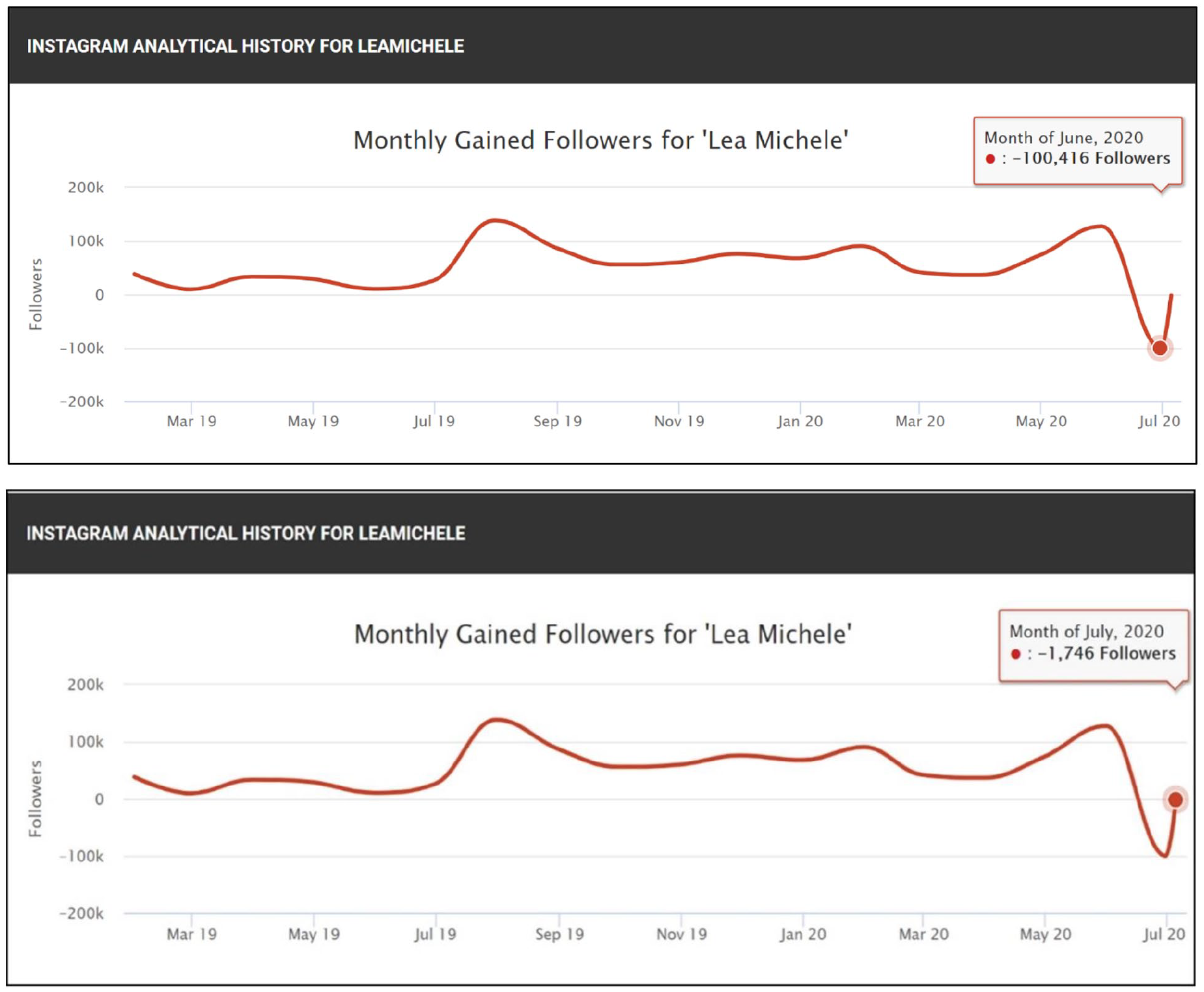
Screenshots of analytical history for Lea Michele’s Instagram Account ranging from January 2019 to July 2020.
While these two examples do not have the same caliber as the beforementioned examples, they do set up specific parameters of the shifting morals tactic. While it is possible to tweak one’s moral values to acquire other followers, it cannot be done by completely altering the MFN to mirror another. This is seen in both examples; Lea Michele could not support a group of people that she also treated poorly in the past and Warren lost followers due to her affiliation with the Republican Party in the past and by trying to prove Native American ancestry during her presidential run.
It should also be noted that when utilizing shifting morals as a tactic, it must be done cautiously, with extra regard to other people’s feelings and awareness. Warren did not contemplate how the Native American population would react to an older White female claiming to have Native American blood. Lea Michele did not consider the feelings of past coworkers when she tried to show support for a movement. Essentially, these examples provide evidence that to utilize the shifting morals tactic, moral entrepreneurs must exercise caution and formality when trying to persuade others to join their cause as people have their own moral faculty and follow a particular set of scripts, social norms, and moral values. If the moral entrepreneur is not careful with his or her shifting moral tactics, the strategy can backfire.
Therefore, we define shifting morals as a tactic utilized by moral entrepreneurs to increase or maintain their power where they incorporate values from their moral faculty that they had not revealed before into strategic moves of behavior to attract members of other social groups to their own MFNs. At the same time, they most likely keep the members of their own MFNs due to forgiveness. Through the use of persuasion as a manipulation tactic, moral entrepreneurs can manipulate the minds of the public, but this effect can be magnified to a greater extent with the utilization of the internet, social media, and media outlets to reach out to a larger audience at a greater speed. It is through this medium that the shifting morals tactic can attract members of other MFNs at a rapid pace.
Conclusion
Through this pilot study, we have proposed a new theoretical lens to explain the behavior and tactics of moral entrepreneurs in society. Future research should continue to explore this proposed concept of shifting morals. We hope this concept of shifting morals can help advance our understanding of how moral entrepreneurs have influence in society, and therefore, can also create moral panics with the help of the internet. Every person within society adheres to a complex set of social identities that provide them with a moral faculty that influences how they select which social norms and moral norms to follow. People who belong to the same social groups (outside the internet setting) or MFNs (in the internet setting) follow a particular set of morals and values, where each member monitors one another to ensure the network’s values are being followed and maintained and that those values and morals also match those of the moral entrepreneur leading the MFN. However, because people have a complex set of previous experiences, they develop a particular moral faculty which can provide a variety of social values and morals that a moral entrepreneur can pick from in specific situations. There is the capability of self-reflection among the members of the network, so forgiveness is also likely to take place. With shifting morals, moral entrepreneurs tweak their own beliefs by conforming to other values found in their moral faculty and in that of the members of other MFNs. As a result, the members of other MFNs are attracted and become followers of the moral entrepreneur. By gaining followers outside of their typical field of power, moral entrepreneurs are able to increase their influence and enact other regimes that can further their own dominance of society.
Footnotes
Acknowledgements
We would like to thank Deborah Gbadebo for helping us to collect the data for this project and for providing valuable insights. Also, we would like to thank Charlotte Dunham, to the participants of our session during the American Sociological Association 2021 Annual meetings, and to the anonymous reviewers of this article who provided useful comments to improve this article.
Declaration of Conflicting Interests
The author(s) declared no potential conflicts of interest with respect to the research, authorship, and/or publication of this article.
Funding
The author(s) received no financial support for the research, authorship, and/or publication of this article.
