




Abstract
Crisis situations require employees to be adaptive and proactive in order to be successfully managed. Because servant leaders focus on serving their followers, they should be able to fulfill their followers’ needs and respond appropriately to situations that cause uncertainty, thereby helping them manage crises. Against this backdrop, we investigated whether the perception of servant leadership can support follower adaptivity and proactivity in a crisis context. Additionally, we examined two potential mediating processes to explain these relationships (i.e., followers’ basic psychological need satisfaction and procedural justice perceptions). Using a longitudinal study with three measurement points between March 2020 (at the beginning of the COVID-19 crisis) and October 2020, we surveyed 129 teachers employed at several schools in a private school association in Germany. In line with our hypotheses, the results of the path analysis showed that servant leadership perceptions were positively associated with both mediators. The relationships between servant leadership and followers’ proactivity and adaptivity were mediated by basic need satisfaction. However, contrary to our assumptions, we found no direct associations between servant leadership and follower behavior, no indirect relationship between servant leadership and adaptivity via procedural justice, and even a negative indirect relationship between servant leadership and proactive behavior via procedural justice. Based on our findings, we discuss the potential benefits and negative implications of servant leadership in the crisis context.
A crisis can generally be described as an unexpected and highly salient event that can be disruptive from the perspective of leaders and organizational stakeholders (Y. L. Wu et al., 2021). The global financial crisis, the European sovereign debt crisis, and the COVID-19 crisis are just a few well-known examples of recent crises. Because of their destructive potential, successful navigation through such crises is crucial. Previous research has identified two key aspects that help individuals adjust to work-related changes: adaptivity and proactivity. Adaptivity is needed to develop personally in response to new demands, and may involve modifying one's skills or values to reach this goal. Conversely, proactivity is required to align one's role requirements with individual needs, abilities, and identity, for example, by changing methods or materials (Nicholson, 1984; Zacher & Rudolph, 2022). The two constructs are not only important performance indicators in times of uncertainty (Griffin et al., 2007) but can also foster employees’ health and well-being (Cangiano et al., 2019; Chen et al., 2021; M. Zhou & Lin, 2016). Nevertheless, it remains unclear how adaptivity and proactivity can be promoted among employees in a crisis context.
Leadership behaviors and perceptions thereof 1 have already been found to be positively associated with employee performance and well-being (Avolio et al., 2009; Inceoglu et al., 2018); in uncertain times, these associations are even stronger than under conditions of certainty (Rudolph et al., 2021; Waldman et al., 2001). One possible reason for the more substantial effects of leadership in uncertain contexts is that employees are likely to seek additional resources, such as more guidance and support, from their leaders (Rowley et al., 2021; Rudolph et al., 2021; Waldman et al., 2001; Wee & Fehr, 2021). Nevertheless, the state of research on leadership during crises is highly controversial. Some researchers have found that directive leadership behavior is more pronounced during a crisis (Garretsen et al., 2024) and can be beneficial, for instance, by reducing complexity (Krause et al., 2024). However, there is also evidence that supervisor support, compassion (Vaziri et al., 2020), and other communal values and traits such as attentive communication styles are essential in the crisis context (Kniffin et al., 2021) as these empathetic leader behaviors can help alleviate employees’ concerns and anxieties.
Servant leadership may be a solution to reconcile these controversial findings. Research on change management has shown that servant leadership is positively associated with employees’ coping with change (e.g., Sousa & van Dierendonck, 2014). As crisis management can be classified as a type of change management (Howes et al., 2021; van Wart & Kapucu, 2011), this research can be drawn upon. However, it remains unclear whether servant leadership benefits employees’ adaptivity and proactivity specifically in a crisis context, and if so, how this association can be explained. We propose that servant leadership may foster these behaviors through two key mediators: basic psychological need satisfaction and procedural justice. First, according to self-determination theory (Deci & Ryan, 2000), individuals possess three innate psychological needs: autonomy, competence, and relatedness. The satisfaction of these needs is essential for fostering motivation, improving performance, and enhancing well-being. Even in times of crisis, the satisfaction of followers’ basic psychological needs has been shown to play a crucial role in ensuring their well-being and performance (Šakan et al., 2020; Vermote et al., 2022). Servant leaders, with their focus on follower well-being and support, are particularly adept at recognizing and addressing these needs. During a crisis, servant leaders can ensure that followers understand the purpose and value of specific actions, thereby fostering autonomy satisfaction. They also nurture a sense of community and mutual support, meeting the need for relatedness. Furthermore, servant leaders provide guidance and resources to help employees develop the skills required to tackle crisis challenges, promoting competence satisfaction (Vermote et al., 2022). As followers’ basic needs are satisfied, they are likely empowered to respond proactively and adaptively to the crisis (Gagné et al., 2022). The positive association between servant leadership and followers’ basic need satisfaction (Chiniara & Bentein, 2016) as well as the positive association between servant leadership and employees’ adaptivity and proactivity, mediated by intrinsic motivation, has already been found in the non-crisis context (Bande et al., 2016), providing first evidence for the postulated associations.
Second, procedural justice, which refers to the perceived fairness of processes used to determine outcome allocations, including workload distribution or task assignment (Colquitt, 2001; Thibaut & Walker, 1975), plays a crucial role in crises. Crises can elicit strong emotions and uncertainty, potentially leading to feelings of anger and resentment (Coombs & Holladay, 2005; Mitroff et al., 1988). Such reactions can hinder organizational learning and impede effective crisis management (Bundy et al., 2017). However, servant leaders, with their focus on employee well-being and clear communication, are well positioned to address these concerns. By ensuring clear and understandable procedures and involving employees in decision-making processes, servant leaders can mitigate the negative effects of a crisis, reduce feelings of anger and resentment, and promote procedural justice. These procedural justice perceptions can enhance employees’ adaptivity and proactivity. Supporting this reasoning, previous research in the non-crisis context has shown that servant leadership and procedural justice (Qiu & Dooley, 2022) as well as procedural justice and proactive behavior (Crawshaw et al., 2012) are positively associated and that procedural justice mediates the association between servant leadership and organizational commitment (Kauppila et al., 2022).
In summary, we propose that servant leadership perceptions are positively associated with employee adaptivity and proactivity in crisis contexts through the mediating mechanisms of basic need satisfaction and procedural justice. By addressing employees’ psychological needs and ensuring fairness and transparency in crisis management, servant leaders can play a vital role in helping organizations navigate and thrive during crises. Thus, our study makes several contributions to current research. First, research on effective leadership during crises is still underdeveloped (Bajaba et al., 2021; Collins et al., 2023; Y. L. Wu et al., 2021), particularly regarding the effectiveness of servant leadership (Zada et al., 2022). Therefore, we follow previous calls to extend knowledge on the role of leaders in different change and crisis contexts (Howes et al., 2021; Y. L. Wu et al., 2021) by examining positive leadership (i.e., servant leadership) in the context of a global crisis event (James et al., 2011). Although some researchers have claimed that existing leadership models (prior to the crisis) are no longer appropriate in the face of the recent global COVID-19 crisis and need to be completely rethought (e.g., Harris & Jones, 2020; Rudolph et al., 2021), it is important to investigate (the value of) existing constructs, such as servant leadership, in the crisis context before discarding them (Newman et al., 2022; Seaton et al., 2021). This approach is also essential from a practical perspective because a positive impact of servant leadership not only in non-crisis contexts (see, e.g., Eva et al., 2019, for an overview) but also in crisis contexts would be highly beneficial for organizations: Selecting leaders based on their servant leadership behaviors and training them to apply this leadership style would then also prepare organizations for future crises (Newman et al., 2022). Thus, our study adds to the currently still fragmentary research on leadership in the crisis context.
Second, we shed light on the underlying mechanisms of the relationship between servant leadership and employees’ adaptivity and proactivity by considering two mediators (i.e., procedural justice and basic need satisfaction). Investigating the two competing mediators helps us gain knowledge on which mediators are relevant in how servant leadership affects outcomes (Eva et al., 2019). Third, most studies on servant leadership, both in general (Eva et al., 2019) and among the few existing studies conducted in the crisis context, are cross-sectional survey studies (e.g., Ruiz-Palomino et al., 2022; Zada et al., 2022; as an exception, see J. Hu et al., 2020). We help mitigate the inherent methodological concerns by longitudinally examining the associations of servant leadership with employee attitudes and behavior using a three-wave study design over seven months. By temporally separating predictor, mediator, and outcome variables, temporal precedence can be modeled (Maxwell et al., 2011; Zapf et al., 1996) and common method bias can be reduced (Podsakoff et al., 2012). Furthermore, it is often only possible to gather retrospective data on crises, because the latter cannot be planned or predicted (Collins et al., 2023; James et al., 2011). Instead of relying on archival or retrospective data (which could, e.g., be affected by hindsight biases; Tourish, 2020), we contribute to the current research by using real-time data beginning with the start of a crisis (i.e., the COVID-19 crisis) in 2020.
Theoretical Background
Organizational Crises
A recent review (Y. L. Wu et al., 2021) of the major crisis definitions in the existing literature identified three specific characteristics that differentiate organizational crises from other business problems. First, a crisis is unexpected. Owing to its rarity or abnormality, organizations and leaders are not prepared for it and are not experienced in managing it. For instance, pandemics, environmental disasters, or financial crises have a lower probability of occurrence than other adverse organizational events, such as human error or technical malfunction. The second characteristic of a crisis, salience, encompasses two aspects: (a) the impact is perceived as significant, and (b) the response is perceived as urgent. Thus, a crisis is appraised as significantly threatening an organization's resources and survival. Third, a crisis can profoundly negatively affect organizations and their internal or external stakeholders. For instance, the spread of COVID-19 led to a crisis, hitting the global workforce unexpectedly and hard (Collins et al., 2023; Wu et al., 2021), and the resulting curfews, social distancing rules, and further measures to contain infections caused fundamental changes in working conditions, such as organizational procedures or stakeholder relations (Kim et al., 2021; Y. L. Wu et al., 2021). In Germany, most, if not all, occupational groups were affected by such changes, such as the sudden transition to work from home and online communication (Kim et al., 2021; Kniffin et al., 2021; Zacher & Rudolph, 2022). Teachers, for example, had to teach their courses online instead of face-to-face in their classrooms (Bush, 2021) 2 . The COVID-19 crisis elicited a high level of uncertainty, anxiety, reduced well-being, and loneliness (Carnevale & Hatak, 2020; J. Hu et al., 2020; Lian et al., 2022), thus, negatively impacting stakeholders. Given the high probability of encountering crises in today's dynamic working world (Collins et al., 2023), it is essential to investigate the factors that enable employees to thrive in such contexts (Newman et al., 2022).
The (more comprehensive) change management research can inform the crisis context; especially if a crisis not only comprises short-term reactions but endures over a more extended period, thus involving different types of change (van Wart & Kapucu, 2011; e.g., in the case of COVID-19). Change can be defined as “any adjustment or alteration in the organization that has the potential to influence the organization's stakeholders’ physical or psychological experience” (Oreg et al., 2013, p. 4). Nevertheless, although crisis and change contexts in organizations share similarities, it is still unclear whether the leadership competencies required for planned change projects are equally adequate to manage crises, so they must be explicitly studied.
The Servant Leader as Crisis Manager
According to a recent review of crisis leadership (Riggio & Newstead, 2023), five competencies are essential for leaders to successfully manage crises. First, leaders need sensemaking skills to quickly understand the situation, interpret new information, and make informed decisions based on evolving circumstances, ultimately facilitating a shared understanding and collective action. Second, decision making is required during crises, as leaders must make rapid and considerate decisions based on the best available information, taking into account the perspectives of various stakeholders and the consequences of their decisions. Effective decision-making involves seeking advice, analyzing situations from multiple angles, and ultimately selecting courses of action that serve the common good. Third, communication is vital for crisis leaders as it enables the exchange of information, creation of shared meaning, and fostering trust among stakeholders. Effective communication in times of crisis involves clear, frequent, and empathetic messaging that acknowledges the realities of the situation while instilling hope and reassurance. Leaders must be visible, promptly address the crisis, listen to stakeholders, and disseminate information widely to facilitate sensemaking, decision acceptance, and collective action. Therefore, communication is also a prerequisite for the other leadership functions. Fourth, effective crisis leadership entails coordinating resources through task delegation and the facilitation of teamwork. Leaders must be able to align various groups to work towards a common goal, collaborate with external partners, and cultivate trust and resilience within teams to optimize performance during challenging circumstances. Finally, facilitating learning involves leveraging crises as opportunities for organizational growth and development both during and after a crisis. Leaders should focus on extracting valuable lessons from crises, fostering a culture of continuous learning, and reframing challenges as opportunities for improvement.
In line with Riggio and Newstead (2023), another review (Collins et al., 2023) further highlights the importance of communication and sensemaking, especially in the context of external and unintentional crises such as the COVID-19 crisis. Additionally, researchers recommend that leaders provide tangible resources (e.g., information about working from home or access to training) and psychological resources (e.g., feedback and support) to help employees overcome the uncertainties associated with the crisis (Kniffin et al., 2021). Servant leadership contains several of the aforementioned aspects and encompasses additional behaviors demonstrated as beneficial during crises and changes in the literature (e.g., stakeholder focus, sensemaking, empowerment, helpful support; Gau & van Dierendonck, 2011; Sheng et al., 2024; Sousa & van Dierendonck, 2021; van Dierendonck & Nuijten, 2011; van Dierendonck & Sousa, 2016); therefore, it could be an appropriate leadership style in the crisis context.
Over the past two decades, an extensive range of definitions and conceptualizations of servant leadership have been established by researchers. To create a concise definition that encompasses the fundamental elements of servant leadership, an extensive review was carried out, which led to the following definition (Eva et al., 2019): Servant leaders orient themselves toward others, prioritize individual followers’ needs and interests, and care more about others in the organization and wider society than about themselves. By being personally attentive and placing changes in a larger context that extends beyond the organization, servant leaders can enhance the meaning of changes, serving important needs during change (van Dierendonck & Sousa, 2016) and crises. Additionally, they regard their employees as unique, so that they can respond to their individual needs and support them in their personal situations (Eva et al., 2019). As servant leaders should be open to change recipients’ feedback, the reasons for negative reactions can be identified and handled positively and advantageously, so servant leadership could be especially effective in dealing with resistance to change (Oreg & Berson, 2019). Initial empirical, cross-sectional evidence in the context of change suggests that servant leadership is positively associated with commitment to change (Kool & van Dierendonck, 2012) and follower engagement during a merger process (Sousa & van Dierendonck, 2014). Initial cross-sectional studies also indicate that servant leadership is beneficial for a range of outcomes in the crisis context, including task performance (Zada et al., 2022), innovative behavior (Jin et al., 2021), work-life balance (Lamprinou et al., 2021), and psychological well-being (Ma et al., 2021).
To successfully manage changing conditions and be effective in uncertain environments, employees also need adaptivity and proactivity (Griffin et al., 2007). These two constructs encompass different aspects of dealing with change. Adaptivity is the extent to which employees cope with, constructively react to, and support changes in work roles or a work system (Griffin et al., 2007). Other researchers described it as “an individual's ability, skill, disposition, willingness, and/or motivation, to change or fit different task, social, and environmental features” (Ployhart & Bliese, 2006, p. 13). Adaptivity focuses on individuals’ effective adaptation to work despite changing circumstances due to a crisis, for example, by changing their frame of reference or developing new skills (Zacher & Rudolph, 2022). Proactivity, on the other hand, can be described as taking self-guided action to anticipate and initiate changes in work roles or a work system (Griffin et al., 2007). It is self-initiated, future-oriented, and aims to change and improve oneself or the current situation (Parker et al., 2006). Proactivity is required to adjust role requirements to one own's needs, capabilities, and identity, for example, by adapting goals or methods, and is thus an important resource during crises (W. Hu et al., 2022; Ramos-Pla et al., 2021). In the following, we explain why servant leadership could be appropriate for fostering these two constructs in a crisis context.
Servant Leadership and Adaptivity
Servant leadership seems especially useful in fostering adaptivity as it considers followers’ needs while supporting their growth and success (Bande et al., 2016). Servant leaders do not try to force their employees but to persuade and convince them to follow their decisions (van Dierendonck, 2011). Through their employee focus, they are also likely to provide the necessary job resources and develop the required personal resources to enable employees to adapt to uncertain environments (van Dierendonck & Sousa, 2016). In the non-crisis context, first empirical evidence indicates that servant leaders can motivate adaptive employee behavior. A cross-sectional study found a positive direct association between servant leadership and adaptive behavior (Bande et al., 2016), and the results of other longitudinal research showed an indirect relationship between the two constructs (Kaltiainen & Hakanen, 2020; Kaya & Karatepe, 2020). Additionally, in a longitudinal study, leader visioning, a part of the stewardship dimension of servant leadership (van Dierendonck & Nuijten, 2011), was positively related to adaptive and proactive behavior (Griffin et al., 2010). Therefore, we state:
Servant Leadership and Proactivity
We propose that servant leadership can foster employee proactivity because servant leaders support their employees by bringing their strengths into action and helping them grow and develop. Through their strong conceptual skills, servant leaders emphasize clarity if there are problems and provide strategic direction so that followers know where to go and how to succeed (Liden et al., 2008), which can help them be proactive. Empowerment, a dimension of servant leadership, even explicitly aims to motivate employees to be self-confident and proactive (van Dierendonck, 2011; van Dierendonck & Nuijten, 2011). There is first cross-sectional evidence of an indirect effect of servant leadership on proactivity in the non-crisis context (Bande et al., 2016; Luo & Zheng, 2018). Other research found proactive work behavior as a mediator in the positive association between servant leadership and individual performance (Varela et al., 2019).
Mediation by Basic Psychological Need Satisfaction
According to self-determination theory (Deci & Ryan, 2000), individuals have three basic psychological needs (i.e., autonomy, competence, and relatedness) that are innate rather than acquired. These basic needs must be fulfilled to achieve autonomous (i.e., intrinsic and internalized) motivation, optimal performance, and well-being (Deci et al., 2017). Meta-analytic evidence supports the positive associations between basic need satisfaction and follower behavior and experiences (van den Broeck et al., 2016). Also during the recent COVID-19 crisis, basic need satisfaction was found to be vital for maintaining mental health (Vermote et al., 2022), well-being (Šakan et al., 2020), and job performance (Bakker et al., 2023). Employees’ basic need satisfaction and the resulting higher sense of self-determination can then lead to increased proactive and adaptive behavior (C.-H. Wu & Parker, 2017; Gagné et al., 2022). As a result, it is essential to ensure the satisfaction of employees’ basic psychological needs to help them effectively manage crises. In the following section, we will discuss the relationships between the three needs and servant leadership.
Self-determination theory defines autonomy as a “subjective experience of psychological freedom and choice during activity engagement” (van den Broeck et al., 2010, p. 982). During a crisis, there is a high probability that measures must be implemented that employees would not choose voluntarily. For example, during the COVID-19 crisis, work in many areas had to be digitally implemented. Such measures can lead to employees feeling restricted in their autonomy and demotivated to deal effectively with the changes. However, under the condition that they understand the purpose and value of the changes, they can still feel to be willingly acting and experience autonomy (Soenens et al., 2007; van den Broeck et al., 2010). This notion fits the approach of servant leaders, who try to convince their followers instead of imposing tasks or decisions on them (van Dierendonck, 2011). Likewise, the servant leadership dimension of accountability, for instance, should enhance the feeling of autonomy as the leader gives responsibility to followers (van Dierendonck & Nuijten, 2011). Individuals experience competence if they can fully use and extend their skills and feel effective in interacting with their environment (van den Broeck et al., 2010; Vermote et al., 2022). Competence satisfaction helps them deal with complex and changing environments (van den Broeck et al., 2010). During crisis, the capacity to experience competence can be restricted, for example, due to excessive demands. By investing in followers’ growth and success, servant leaders provide opportunities to develop their skills and help them reach their career goals (Liden et al., 2008). Thus, servant leaders may fulfill individuals’ need for competence, as found in a cross-sectional study (Chiniara & Bentein, 2016). The need for relatedness means that individuals desire to belong to others and experience mutual care (Vermote et al., 2022). It can initiate an internalization process of work-related aspects, such as requests or rules (Chiniara & Bentein, 2016; Deci & Ryan, 2000). However, during crisis, this need can easily be frustrated, for example, through curfews and social distancing in the case of the COVID-19 crisis. Servant leaders focus on their followers’ well-being and are likely to build trustful relationships with them (Ehrhart, 2004; Schaubroeck et al., 2011) and foster a climate of community and mutual support (Vermote et al., 2022), thus satisfying followers’ need for relatedness.
The satisfaction of the three basic needs can lead to an intrinsic motivation to effectively cope with a crisis, supporting proactivity and adaptivity (Gagné et al., 2022). Employees who experience sufficient autonomy, feel competent, and have their need for relatedness satisfied are empowered to develop the necessary skills or adjust their environment. There is already empirical evidence for the mediating role of basic need satisfaction in the relationship between servant leadership and organizational outcomes, such as organizational commitment and work engagement (van Dierendonck et al., 2014) and organizational citizenship behavior and employee task performance (Chiniara & Bentein, 2016). Other studies have also shown that intrinsic motivation, operationalized as, amongst others, autonomy, mediated the association between servant leadership and followers’ proactivity (Bande et al., 2016; Luo & Zheng, 2018). In this study, we replicate and extend these findings in a crisis context and using a longitudinal design.
Mediation by Procedural Justice
In addition to self-determination theory, we consider organizational justice theory as a further explanation for the association between servant leadership and adaptivity and proactivity. Procedural justice is defined as perceived fairness in the procedures involved in determining outcome allocations, such as workload distribution or task assignment (Colquitt, 2001; Thibaut & Walker, 1975). To evaluate the fairness of these procedures, criteria such as consistency, unbiasedness, accuracy, correctability, representativeness, and ethicality can be assessed (Leventhal, 1980).
During times of crisis, individuals may experience intense emotions and uncertainty, leading to feelings of anxiety, helplessness, and despair due to their inability to control the situation (James et al., 2011). Crises can also evoke feelings of anger and resentment (Coombs & Holladay, 2005; Mitroff et al., 1988), particularly if individuals perceive a disconnection or disagreement with crisis management strategies and procedures. Effective crisis management requires leaders to exhibit adeptness in decision-making and resource mobilization, necessitating the execution and delegation of a variety of tasks (Williams et al., 2017). Servant leaders, with their focus on follower well-being, can identify sources of ambiguity and incomprehensibility. By considering their employees’ voices and transparently communicating procedures, they can mitigate negative emotional responses and feelings of helplessness among their followers. Allowing individuals to express their opinions and participate in decision-making can fulfill their desire for information and control over outcomes (Thibaut & Walker, 1975).
In line with this reasoning, research on organizational change has shown that procedural justice serves as a valuable resource for employees by ensuring that their opinions are considered and that they have access to relevant information. This empowers employees to protect their resources, adjust to changes, and manage distress (K. Lee et al., 2017). Moreover, studies have demonstrated a connection between perceived fairness and reduced threat appraisal (Fugate et al., 2012). Procedural justice can also strengthen employees’ affiliation with the organization, increasing their inclination to support changes (K. Lee et al., 2017; Michel et al., 2010; Oreg & van Dam, 2009). When employees perceive high procedural justice, they are more likely to accept changes, more willing to help the organization to which they belong, and less likely to resist change (Bernerth et al., 2007; Oreg et al., 2011; Tyler & De Cremer, 2005). Consequently, procedural justice is likely to enable employees to adapt to crises and proactively engage with the challenges at hand. Procedural justice thus emerges as a mediating variable between servant leadership and employees’ adaptivity and proactivity during crises.
Several studies have provided evidence that servant leadership is positively associated with procedural fairness (Burton et al., 2017; Peng et al., 2016; Shim et al., 2016). For example, one study (Ehrhart, 2004) found a positive association between servant leadership and procedural justice, beyond the contribution of transformational leadership and leader–member exchange (LMX). Additionally, procedural fairness has been empirically linked to proactive behavior in a non-crisis context (Crawshaw et al., 2012). With regard to the proposed mediation, there is cross-sectional evidence that servant leadership is associated with commitment to change, sequentially mediated by organizational justice and optimism (Kool & van Dierendonck, 2012); servant leadership even had a larger association with organizational justice than leaders’ contingent reward behavior. Furthermore, a recent meta-analysis showed that procedural fairness partially mediates the relationship between servant leadership and organizational citizenship behavior, voice behavior, and counterproductive behavior (A. Lee et al., 2020). This previous research suggests that servant leadership may also be conducive to adaptivity and proactivity, mediated by procedural justice. Therefore, we hypothesize that:
Method
Sample and Procedure
Our longitudinal study was conducted in the context of the COVID-19 crisis in a German private school association comprising 118 schools, between March (directly after the start of the first lockdown due to the spread of COVID-19) and October 2020 as part of a larger data collection project. Teachers were surveyed at three measurement points, approximately two months apart; two were before and one after the summer break. As school vacations in Germany vary depending on the federal states, we adjusted the survey periods to the federal states, respectively. In March 2020, the school association's secretary general invited the principals via e-mail. In addition, a letter with posters and flyers was sent to each school. Twenty-five principals registered to participate in the study together with their schools. As soon as they registered, they received an invitation e-mail with a link to forward to their staff. The teachers could register with their e-mail addresses and were then individually invited to complete the questionnaires. Participation was voluntary and e-mail addresses were stored separately from the survey data to maintain anonymity. At the end of the last survey, all respondents had the opportunity to participate in a raffle of approximately 70 prizes sponsored by various companies, such as books and board games. In addition, feedback on the results was provided to school principals (if desired) after the completion of the survey if 10 or more teachers (to ensure anonymity) at their school had participated. If the staff consisted of fewer than 10 teachers, teachers’ consent was necessary to receive feedback.
We included teachers who had participated in at least one of the three surveys in the final sample. One school was removed from the sample because of a change of the principal, and three teachers indicated that their direct leader had changed. Finally, data from 129 teachers from 22 schools (on average, 9.60 teachers per school, MIN = 1, MAX = 17, SD = 4.49) were used for this study. On average, 27.61 teachers (SD = 20.76) worked at the schools. Because five teachers requested to be included after the first measurement time (T1), these individuals were not yet part of the sample at T1 3 . Thus, the sample sizes were n = 124 at T1, n = 81 at Time 2 (T2; 65.3% response rate relative to T1), and n = 69 at Time 3 (T3; 55.6% response rate relative to T1). Similar retention rates have been observed in previous longitudinal field studies (Goodman & Blum, 1996; Gustavson et al., 2012). The respondents and non-respondents at T2 did not differ in age, gender, tenure at school, school size, or any key variables measured at T1. The respondents and non-respondents at T3 did not differ in their tenure of working together with their direct leader or key variables measured at T1 or T2, except that T3 respondents reported lower basic psychological need satisfaction (t = 2.133, df = 72.474, p = 0.036; mean for T3 respondents: 6.31, SD = 0.87; mean for T3 non-respondents: 6.63, SD = 0.49). Thus, the findings are unlikely to be explained by participant dropout.
In the final sample, the mean age was 43.73 years (SD = 10.23); 28.7% were female and 18.6% were male (52.7% did not indicate gender). On average, the teachers worked at their schools for 9.08 years (SD = 6.55) and with their supervisor for 6.00 years (SD = 4.71). All measures were answered by the teachers. All but four teachers who identified the assistant principal as their manager reported the principal as their manager. At T1, servant leadership perceptions, adaptivity, and proactivity were measured. At T2, we collected data on basic psychological need satisfaction, procedural justice, and demographics. At T3, the participants responded to questions on their adaptivity and proactivity again.
Measures
Servant Leadership
We measured servant leadership perceptions using the German translation of the 18-item short version of the Servant Leadership Scale (Pircher Verdorfer & Peus, 2014; van Dierendonck et al., 2017). All items, for example, “My manager encourages me to use my talents”, were answered on a 5-point Likert scale (1 = strongly disagree to 5 = strongly agree). The internal consistency of the scale was Cronbach's α = .86.
Basic Psychological Need Satisfaction
To measure basic psychological need satisfaction, we used the nine German need satisfaction items from the Balanced Measure of Psychological Needs (BMPN; Neubauer & Voss, 2016; Sheldon & Hilpert, 2012). The Likert scale ranged from 1 (not at all) to 7 (completely); an example item is “I felt a sense of contact with people who care for me, and whom I care for”. The internal consistency of the scale was α = .77.
Procedural Justice
We used the German version of the procedural justice scale by Colquitt (2001; Maier et al., 2007). The seven items were introduced with “The following questions refer to the processes and procedures that occurred in the last month and directly affected you (e.g., workload, task distribution)” and were rated on a 5-point Likert scale (1 = not at all/almost never to 5 = completely/often). One item was “To what extent have you had influence over the outcome (e.g., workload, task distribution) arrived at by those procedures?” The internal consistency was α = .84.
Adaptivity and Proactivity
We used Griffin et al.'s (2007) work role performance scale to collect data on individual-level adaptivity and proactivity. The three adaptivity items were translated and back-translated to ensure linguistic equivalence between the measure's English and German versions (Brislin, 1986). For proactivity, we used the German translation by Brosi et al. (2018). Participants rated the statements, for instance, “I adapted well to changes in my core tasks” (adaptivity), on a 5-point Likert scale (1 = very little to 5 = a great deal). At T1, Cronbach's alpha was .75 (adaptivity), and .85 (proactivity); at T3, it was .62, and .88, respectively.
Demographic Variables
We asked the participants to provide their weekly teaching load and tenure with their leader at T2, as well as their age, gender, and tenure at the school at T3 (to keep the workload lower at T1). Additionally, we recorded the number of teachers working at the respective school.
Analyses
We used path analysis, including servant leadership, adaptivity, and proactivity at T1 as predictors, procedural justice and basic need satisfaction as mediators, and proactivity and adaptivity at T3 as outcomes. The two mediators were allowed to correlate. We calculated bias-corrected bootstrap confidence intervals (N = 10,000; MacKinnon et al., 2004) and used full-information likelihood to account for missing values. As we were not interested in differences between the schools, we did not apply multilevel modeling but cluster-robust standard errors to account for school affiliation, using the type = complex command in Mplus (McNeish et al., 2017; ICC1 was .14 for servant leadership perceptions).
Results
Confirmatory factor analyses were performed before conducting the analyses (see Supplementary Material). Table 1 provides means, standard deviations, and correlations between the variables. Descriptively, both the means of adaptivity and proactivity were higher at T1 than at T3 (adaptivity: 4.05 vs. 3.87; proactivity: 3.67 vs. 3.45). Perceived servant leadership was significantly correlated with basic need satisfaction (r = .28**), procedural justice (r = .49**), and adaptivity at T1 (r = .27**), but not with adaptivity at T3 or proactivity at T1 or T3. Basic need satisfaction was positively correlated with adaptivity (rT1 = .24*, rT3 = .49***) and proactivity (rT1 = .36***, rT3 = .41***), whereas procedural justice was not significantly correlated with these constructs.
Descriptives and Correlations Between the Study Variables.
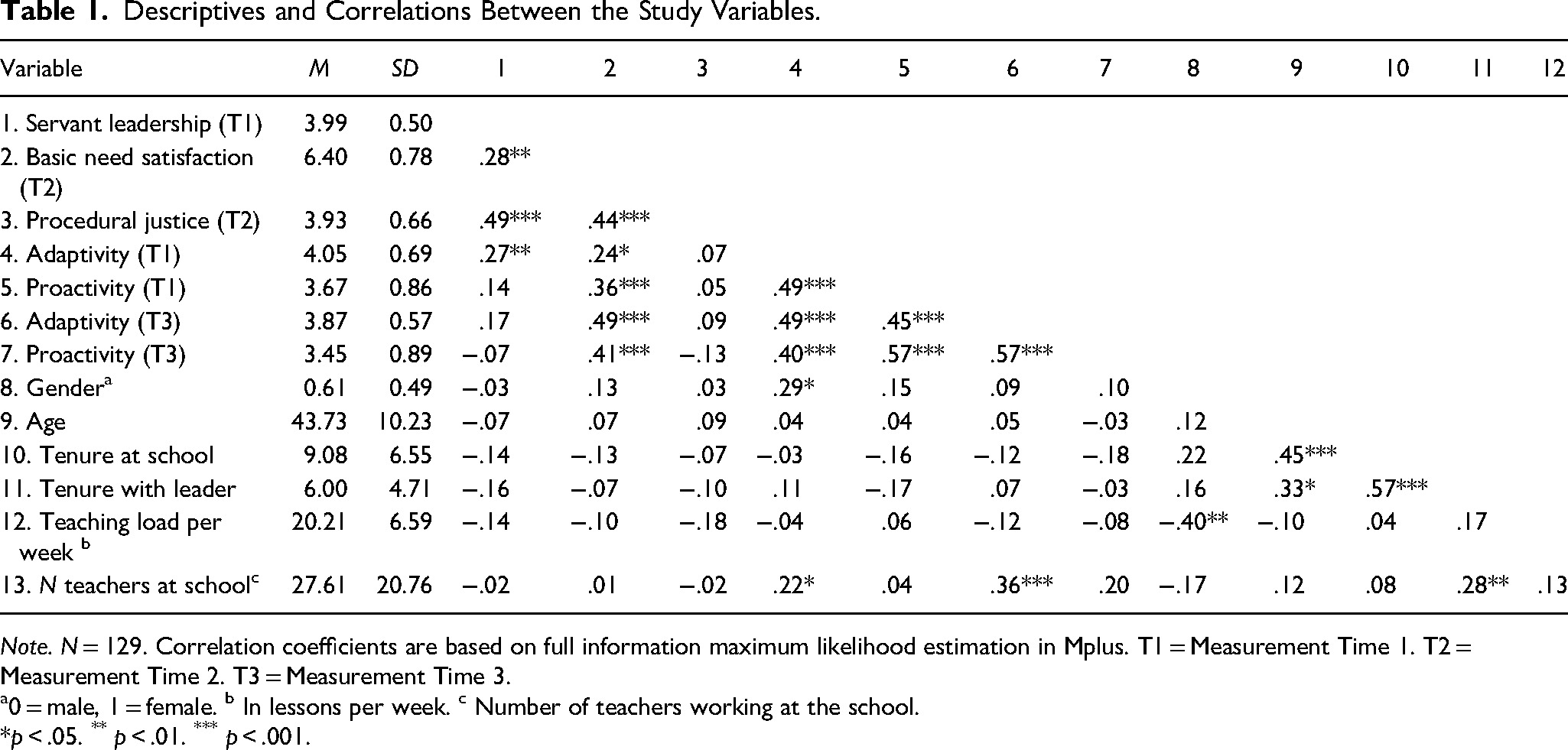
Note. N = 129. Correlation coefficients are based on full information maximum likelihood estimation in Mplus. T1 = Measurement Time 1. T2 = Measurement Time 2. T3 = Measurement Time 3.
0 = male, 1 = female. b In lessons per week. c Number of teachers working at the school.
p < .05. ** p < .01. *** p < .001.
To test our hypotheses, we conducted a path analysis, including adaptivity and proactivity at T1 as control variables. The descriptive variables only correlated significantly with each other but not with the study variables, except for the number of teachers working at the schools. Thus, this variable was included as an additional control variable (additional analyses showed that inclusion or exclusion of the number of teachers working at the school as a control variable did not change the interpretation of the results). In Hypothesis 1 (H1) and H2, we stated a positive association between perceived servant leadership and adaptivity and proactivity. Contradicting the two hypotheses, perceived servant leadership was not directly associated with the outcomes.
Supporting H3, we found a positive association between perceived servant leadership and basic need satisfaction (est. = 0.497, SE = 0.197, 95% CI [0.209, 0.991]). We also identified a positive indirect relationship between perceived servant leadership and adaptivity (est. = 0.154, SE = 0.083, 95% CI [0.043, 0.382]) as well as proactivity (est. = 0.207, SE = 0.096, 95% CI [0.086, 0.522]) through basic need satisfaction. Thus, both H4a and H4b were supported. Consistent with H5, there was a positive association between perceived servant leadership and procedural justice (est. = 0.642, SE = 0.134, 95% CI [0.395, 0.915]). However, contradicting H6a, we did not find that procedural justice mediated the relationship between perceived servant leadership and adaptivity (est. = −0.086, SE = 0.085, 95% CI [−0.268, 0.064]). The mediating path between perceived servant leadership and proactivity via procedural justice was significant but in a negative direction (est. = −0.258, SE = 0.112, 95% CI [−0.519, −0.109]). Therefore, H6b was not supported. The model explained 42.8% of the variance in adaptivity and 40.4% of the variance in proactivity. The unstandardized results are presented in Table 2 and the standardized results are shown in Figure 1.
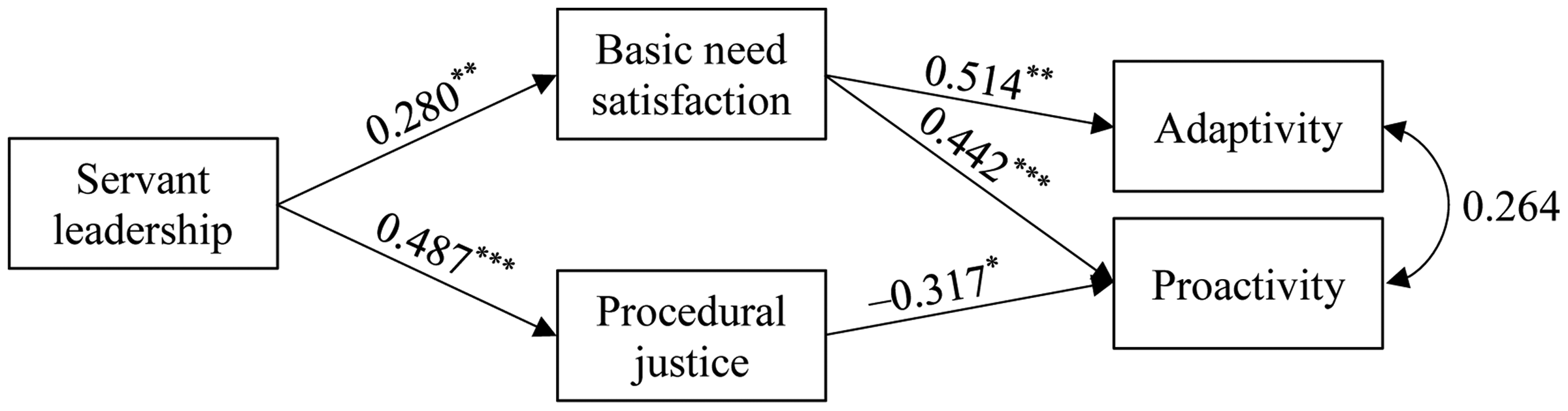
Standardized results of the path analysis model of associations between servant leadership and followers’ adaptivity and proactivity. Note. N = 129. Only significant paths are displayed. * p < .05. ** p < .01. *** p < .001.
Unstandardized Results of the Path Analysis.
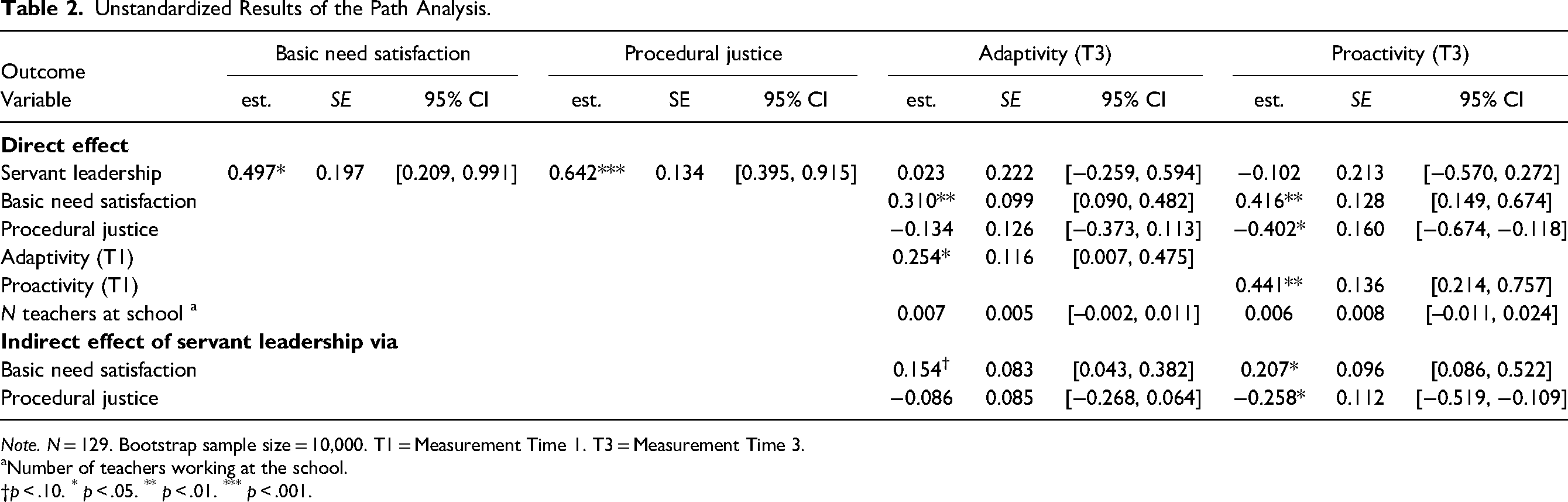
Note. N = 129. Bootstrap sample size = 10,000. T1 = Measurement Time 1. T3 = Measurement Time 3.
Number of teachers working at the school.
p < .10. * p < .05. ** p < .01. *** p < .001.
Discussion
Leadership has been claimed to be an essential parameter in navigating organizations through crises (Gray et al., 2023; Rudolph et al., 2021; Waldman et al., 2001). Nevertheless, from a research perspective, the leadership characteristics necessary during crises are still unclear. Servant leaders cannot only provide direction but also focus on their followers. Therefore, they likely provide helpful (in contrast to unhelpful) support during crises (Gray et al., 2023), helping their employees cope with uncertainties and difficulties related to the crisis and maintain their performance. Consequently, we investigated whether servant leadership can foster teacher adaptivity and proactivity during a crisis and considered basic psychological need satisfaction and procedural justice as mediators. To our knowledge, this is the first study to investigate the proposed relationships longitudinally and in a crisis context, collecting real-time data over several months during the crisis instead of relying on retrospective reports. Our results partly confirm our hypotheses, showing a positive association between perceived servant leadership and both mediators as well as a mediation of the relationship between perceived servant leadership and proactive and adaptive behavior via basic need satisfaction. However, contradicting our assumptions, we found no direct associations between perceived servant leadership and follower behavior, no indirect relationship between perceived servant leadership and adaptivity via procedural justice, and even a negative relationship between perceived servant leadership and proactive behavior via procedural justice.
Theoretical Implications
Our study empirically supports previous suggestions of a positive association between servant leadership and basic psychological need satisfaction in crisis contexts (e.g., Gagné et al., 2022). By empirically investigating these associations within the crisis context and leveraging a longitudinal design, this research enhances previous studies in other contexts (e.g., Chiniara & Bentein, 2016; van Dierendonck et al., 2014). Consistent with other findings in the crisis context that basic need satisfaction plays a critical role in mental health and job performance (Bakker et al., 2023; Vermote et al., 2022), our results indicate that basic need satisfaction is positively associated with teachers’ adaptivity and proactivity. The importance of basic need satisfaction during the COVID-19 crisis may be attributed to several factors, including reduced contact with colleagues and leaders, which likely undermined feelings of relatedness; disruptions in daily routines and heightened demands, which may have diminished feelings of competence; and regulatory measures such as distancing rules and remote work, which likely compromised autonomy satisfaction (cf. Šakan et al., 2020; Vermote et al., 2022). Therefore, even during crises, it is crucial to meet employees’ personal needs for competence, relatedness, and autonomy to motivate and empower employees, facilitating their adaptive and proactive responses to crises. Because of its strong focus on followers and their well-being, servant leadership appears particularly suited for achieving this goal.
As hypothesized, servant leadership was positively associated with our second mediator, procedural justice, extending findings from non-crisis contexts (e.g., Burton et al., 2017; Qiu & Dooley, 2022). However, the further results regarding procedural justice were somewhat surprising. Despite previously established positive relationships between procedural justice and employee proactivity (Crawshaw et al., 2012) and other desirable behaviors and experiences (e.g., commitment to change; Fedor et al., 2006) in different contexts, our findings indicated a negative indirect link between servant leadership and teacher proactivity via procedural justice. This suggests that, in certain circumstances, procedural justice may be negatively associated with proactivity. It is possible that leaders, recognizing their followers’ difficulties and considering their opinions, devised comprehensible solutions, implemented them fairly, and communicated them clearly to their team (e.g., providing appropriate software and exchange of teaching material). Consequently, their followers may have chosen to adopt these solutions, reducing the need for proactive behavior. In times of high strain, individuals are likely to preserve their already threatened or decreased resources and well-being instead of investing resources in proactive behavior (cf. Schmitt et al., 2016). Thus, the higher workload during the crisis may have caused teachers to focus on keeping the school running rather than initiating further improvement. This also corresponds to the finding that despite positive long-term effects, proactivity can negatively affect well-being in the short term (Fay & Hüttges, 2017). It is also possible that the teachers may have perceived their own improvements to their work as a natural part of their job rather than as proactive behavior, particularly if they perceived the processes as fair. They may have been proactive in their work, but because the crisis required continuous adjustments, they may not have perceived themselves as proactive but rather as making efforts to fulfill their job responsibilities effectively despite adverse circumstances. Some researchers have even argued that behavior during a pandemic crisis is only reactive and not proactive (Howes et al., 2021). Therefore, it would be interesting to use different observational methods to explore proactivity in a crisis context and examine employees’ perceptions of their actions.
Additionally, we did not find an indirect association between servant leadership and adaptivity through procedural justice. These results contradict previous findings in other contexts showing indirect associations of servant leadership and adaptivity-related constructs, such as commitment to change (Kool & van Dierendonck, 2012). The non-significant result could stem from insufficient power and requires further investigation with a larger sample size (the resulting power was .41; see Supplementary Material). Nonetheless, it is plausible that no indirect relationship exists. Crises require swift decisions making, and leaders have to provide guidance (van Wart & Kapucu, 2011). At the same time, decisions are not always within the leader's control (e.g., COVID-19 affected not only the organization but society as a whole), so employees may feel compelled to adapt, regardless of their perceptions of procedural fairness. Significance and urgency are two characteristics of crises (Y. L. Wu et al., 2021); it is possible that these context factors reduced the association between servant leadership and employee behavior. Another possible explanation is that procedural justice may not be directly related with adaptivity but there may be mediating mechanisms, such as optimism (Kool & van Dierendonck, 2012) or organizational identification (Michel et al., 2010), which should be investigated in the future.
Our study found no direct relationship between servant leadership and either adaptivity or proactivity. Previous research in non-crisis contexts has shown inconsistent findings, with some studies identifying direct associations between servant leadership and adaptive behavior (Bande et al., 2016; Kaya & Karatepe, 2020), whereas other studies found only indirect relationships mediated by constructs such as work engagement (Kaltiainen & Hakanen, 2020). The two studies that found direct associations were cross-sectional (Bande et al., 2016) or featured a shorter time lag of only two months between measurements (Kaya & Karatepe, 2020), compared to the longer timeframe in our study. The study with full mediation had a longer time lag of 18-month between measurement points. For servant leadership and proactivity, two studies also found direct associations (Luo & Zheng, 2018; Varela et al., 2019) and one found only indirect associations (Bande et al., 2016). All of these studies were merely cross-sectional studies conducted in non-crisis contexts. In addition to potential effects of the time lag between measurement points, the lack of direct effects could be attributed to teachers’ relatively high autonomy in managing their classes, so that the relationship between servant leadership and adaptivity and proactivity may operate only indirectly through motivational factors (such as basic need satisfaction). Future research should examine these relationships in various contexts, including crisis versus non-crisis contexts and different occupational groups, and with different time lags to gain a better understanding of the dynamics at play.
The positive associations between servant leadership and proactivity and adaptivity via basic psychological need satisfaction indicate that servant leadership could help reconcile the ongoing debate about leadership during crises. Some scholars argue that decisiveness should take precedence over inclusiveness in crisis situations (van Wart & Kapucu, 2011). Similarly, there is evidence that more directive leader behavior is displayed and can be beneficial in such a context (Garretsen et al., 2024; Krause et al., 2024). Our findings indicate that directive behavior alone is not sufficient. Instead, supportive leadership behaviors are also required to satisfy employees’ basic psychological needs (C.-H. Wu & Parker, 2017), which, in turn, can foster employees’ adaptivity and proactivity (Gagné et al., 2022). Servant leaders integrate both more directive and more supportive leadership behaviors by providing direction and caring about their followers’ well-being (Liden et al., 2008; van Dierendonck & Nuijten, 2011), both of which are needed during crises.
However, it is important to recognize that servant leadership can also be related to reduced proactive behavior in the crisis context. This complexity highlights the need for a nuanced examination of potential mediators for the effects of servant leadership. By doing so, we might achieve a more comprehensive and differentiated understanding of servant leadership, enabling us to determine which explanations are most suitable and, by including several mediators simultaneously, which effects are dominant (Eva et al., 2019). Such insights can guide the refinement of the servant leadership construct, helping to mitigate potential undesired effects or find appropriate interventions to alleviate them.
Additionally, these findings highlight the necessity to account for contextual factors in leadership research (cf. Johns, 2024). Although the COVID-19 crisis involved several types of change over an extended period, our study indicates that insights from the change management literature cannot be directly applied to crisis contexts. While a positive relationship between servant leadership and follower performance, mediated by basic need satisfaction, was observed across both change and crisis contexts, the results concerning the second mediator, procedural justice perceptions, differed. Previous studies in change contexts have found associations between perceived justice and favorable employee experiences and behaviors, such as reduced threat appraisal (Fugate et al., 2012), acceptance of, readiness for, and commitment to change (Bernerth et al., 2007; Michel et al., 2010; Oreg et al., 2011). Therefore, one might expect a positive relationship between procedural justice and employee adaptivity and proactivity. However, our study in the crisis context found no such (i.e., for adaptivity) or even negative (i.e., for proactivity) relationships during crisis. This discrepancy indicates that contextual factors merit further investigation.
Because our results indicate that servant leadership can be beneficial also in the crisis context, it seems unnecessary or even inappropriate to completely reinvent existing leadership constructs (such as servant leadership) for crisis contexts, as some scholars have argued, particularly in the wake of the recent COVID-19 crisis (e.g., Harris & Jones, 2020; Rudolph et al., 2021). Instead, we recommend that researchers continue to investigate which leadership constructs that have been found to be beneficial in non-crisis contexts (e.g., servant leadership or transformational leadership) can also be effectively applied in crisis situations (Newman et al., 2022; Seaton et al., 2021). Research should then delve deeper and determine whether adjustments to certain aspects of these leadership styles are needed in crisis contexts.
Practical Implications
Implications for Organizations
The way leaders manage crises significantly impacts employees and other stakeholders. Therefore, leaders need to be well trained to successfully and healthily guide their employees through crises (James et al., 2011). Our findings suggest that organizations should select leaders based on their servant leadership behaviors and train them accordingly to be prepared for future crises (Eva et al., 2019; for servant leadership training, see Lohrey & Guillaume, 2015), as this leadership style is associated with followers’ basic need satisfaction and ultimately higher follower proactivity and adaptivity. Servant leadership can also benefit employees and organizations in non-crisis contexts (Eva et al., 2019), so this investment can pay off in multiple ways. In addition to promoting servant leadership, organizations should create further opportunities to satisfy employees’ basic needs during crises. This could involve offering short training sessions (e.g., for remote teaching) to address the need for competence; fostering team cohesion (e.g., by creating attractive opportunities for informal interaction, such as regular virtual coffee breaks) to meet the need for relatedness; or encouraging individuals to incorporate basic psychological need-satisfying activities into their daily lives (see Behzadnia & FatahModares, 2020, for examples of such activities).
Implications for Leaders
Servant leaders can meet the needs of their followers in crisis contexts as they focus on them individually (Eva et al., 2019). During a crisis, they should ensure that their followers understand the rationale and importance of certain actions, thereby fostering autonomy satisfaction. Additionally, they can build trustful relationships and foster a sense of community and mutual support (e.g., by maintaining regular contact even during curfews or by establishing regular virtual exchange formats among colleagues), which addresses the need for relatedness. Furthermore, servant leaders can provide guidance and resources to help employees develop the necessary skills to meet the challenges posed by the crisis (e.g., by encouraging knowledge sharing among employees or by coaching followers to support them in their individual situations), which promotes competence satisfaction (Vermote et al., 2022). It is also important for leaders to be aware that higher perceptions of procedural justice may be associated with lower proactivity. Therefore, leaders should adjust their expectations of proactivity and try to support it in other ways if proactivity is to be increased (e.g., by satisfying basic psychological needs).
Limitations
Owing to the high workload during the crisis (Harris & Jones, 2020), our sample size was relatively small. Consequently, particularly the path from servant leadership to adaptivity via procedural justice should be re-examined with a sufficiently large sample in future research. Furthermore, we surveyed only teachers from a German private school association. Whereas studying leadership behavior and its outcomes at schools during crises is an important endeavor, as there have been no guidelines thus far for school leaders regarding leader behavior during disruptive times (Harris & Jones, 2020), the extent to which the results can be generalized to public schools and other organizations remains unclear. Like enterprises, schools are concerned with frequent change interventions and principal leadership plays a critical role in successfully managing these changes (Beycioglu & Kondakci, 2014) as well as crises (Thornton, 2021). Nonetheless, the effects of leadership may vary across different organizational contexts depending on their unique characteristics and features. For instance, teachers have a high degree of autonomy (e.g., in their teaching methods) and school leadership primarily affects teachers through framework conditions (e.g., setting guidelines for curricula). During the COVID-19 crisis, teachers’ autonomy may have further increased due to remote teaching and the concomitant higher degree of freedom in organizing their workdays (Hilger et al., 2021). However, this high degree of freedom could also have led to stress and overextension when having to create digital teaching materials and conduct virtual lessons (Chan et al., 2021; Hilger et al., 2021). A first study on autonomy during the COVID-19 crisis showed decreased autonomy (Hilger et al., 2021); however, more complex temporal patterns have been observed (Syrek et al., 2022).
Additionally, there is evidence of reduced social support during the crisis compared to before it (Hilger et al., 2021). One possible reason for this is that face-to-face contact between school leaders, teachers, students, and parents was the norm before the COVID-19 crisis. The crisis-related measures suddenly made personal contact impossible, requiring school leaders to be creative in maintaining communication (e.g., sending videos or calling staff via phone; Thornton, 2021). Consequently, roles and relationships between the groups may have changed (cf. Dasborough & Scandura, 2022). Autonomy and relationship dynamics as well as their changes during the crisis could not be explicitly investigated in our study. In future studies, these aspects should be considered to create greater comparability between organizational contexts and to better understand the dynamics of specific crisis contexts.
It is essential to incorporate context into research to determine the theoretical boundary conditions of variables, derive relevant implications, and integrate seemingly heterogeneous research findings (Johns, 2018). However, as we examined our research questions only in the crisis context, we could not compare the results with those in non-crisis contexts. Therefore, it would be valuable to conduct the same longitudinal study with a similar sample (i.e., in the same country and industry) in the non-crisis context and determine differences in the associations. Finally, as we used only one method (questionnaires) and one source (teachers), the estimates could be biased (Antonakis et al., 2010). To minimize this risk, we introduced a temporal separation between the surveys (Podsakoff et al., 2012) and controlled for proactivity and adaptivity at T1. However, we cannot draw causal inferences based on our longitudinal design, as leaders and followers can influence each other simultaneously (Güntner et al., 2020). Additionally, servant leadership perceptions are influenced not only by leader behavior, but also by followers’ interpretations thereof (Hansbrough et al., 2015). Future research should thus use experiments or instrumental variable estimation to determine the causal effects of servant leadership behavior and perceptions (Schowalter & Volmer, 2023).
Although the confirmatory factor analysis indicated an acceptable fit, the reliability of the adaptivity scale was relatively low at T3 (Cronbach's α = .62). This finding may be attributed to the nature of the scale items: while two of the three items focus on adapting to or coping with changes, the third item also involves learning new skills to adapt to changes. The lower inter-item correlation for the latter item may reflect this distinction. During the COVID-19 crisis, teachers likely faced a steep learning curve at the beginning, as they were required to fundamentally alter their teaching methods and acquire numerous new skills. However, as the crisis progressed, the need for learning new skills diminished, but the teachers still had to adapt to constantly changing circumstances. This shift may have led to more varied responses on the scale items, resulting in decreased internal consistency. Future research should explore the performance of the adaptivity scale across different contexts and examine how its internal consistency changes over time. Potential adjustments to the scale may be necessary based on these findings.
Future Research
An interesting way forward would be to investigate other mediating and moderating variables in the association between servant leadership and employee proactivity and adaptivity. Based on stress research, stress triggered by a crisis can drain cognitive resources and lead to emotional exhaustion. Consequently, employees’ work engagement and proactivity may decrease (Liu et al., 2021). Servant leadership may reduce followers’ stress and exhaustion (Mun et al., 2022; Schowalter & Volmer, 2024), thus positively affecting proactivity. Similar associations have been found for task performance as an outcome (Kaltiainen & Hakanen, 2020). In addition, a moderating factor for the influence of servant leadership could be a leader's team size because the leader is probably unable to respond sufficiently to everyone individually once a certain number of subordinates has been reached. In the crisis and change context, resistance to change (Oreg, 2003) could also be a moderator worth investigating. Furthermore, it is likely that, especially during a crisis, not everyone agrees equally with the actions taken; opinions may also differ from those of the leader. This (dis)agreement could affect the association between leadership behavior and employee outcomes. In addition, recent research has found that a fit between needed and received leadership is most beneficial for employees; the amount of needed leadership can vary within individuals, depending on aspects such as the experience of stressors or uncertainty (Tepper et al., 2018). Researchers could thus focus on investigating followers’ needs and expectations regarding leadership behavior and the effects of their fit with received servant leadership.
Another important area for future research is to dive deeper into different crisis contexts to determine whether different associations exist depending on the trigger or locus (e.g., internal or external crisis origin), controllability (intentional or unintentional; Coombs & Holladay, 1996), and the impact or scope of the crisis (James et al., 2011). Different leadership behaviors may be appropriate, depending on the specific crisis type (Collins et al., 2023; Coombs & Holladay, 1996). It is noteworthy that, in the studied context (i.e., the COVID-19 crisis), supervisors’ autonomy was limited because many regulations were imposed by the government. Thus, it would be valuable to explore whether the investigated associations differ between an externally and unintentionally caused and highly comprehensive crisis, such as the COVID-19 crisis, and an internally caused crisis within a specific organization or sector. A further avenue for future research is the examination of crises over time, whether different leadership behaviors are necessary depending on the duration of the crisis, and how required leadership behaviors change.
In this study, we examined servant leadership as a comprehensive leadership construct that focuses on both followers and performance. Future investigations should investigate additional leadership constructs, such as transformational leadership, to explore possible variations in results and assess whether servant leadership uniquely contributes to explaining variance in investigated constructs, as demonstrated for non-crisis settings (e.g., Hoch et al., 2018). Examining multiple leadership constructs within the same study would facilitate a deeper understanding of their commonalities, elucidate which specific characteristics are most essential, and discern whether observed associations merely stem from the shared positivity inherent in these leadership constructs. This approach aligns with ongoing discussions regarding the potential redundancy of constructs in leadership research (e.g., Banks et al., 2018) and contributes to our comprehension of effective leadership in both crisis and non-crisis situations.
In the context studied, leaders had to suddenly coordinate a distributed workforce (Amis & Janz, 2020), which was certainly a challenge. Future research could shift the focus away from employees and investigate what happens to leaders during crises (Collins et al., 2023; Kirchner et al., 2021). Servant leadership behavior is potentially more resource-depleting than less employee-focused leadership styles, even in a non-crisis context (Lan et al., 2023; Liao et al., 2021). Related to this, it is essential to advance the initial available research on aspects that help replenish servant leaders’ resources, such as psychological meaningfulness and followers’ sense of responsibility or support (Lan et al., 2023; D. Zhou et al., 2020). Finally, it is likely that not only leadership contributes to the effective management of crises. Rather, there are other influencing factors such as HR policies including training and upskilling, technical equipment, autonomy, and other resources, as well as job insecurity, which could be studied further in future research (e.g., Rudolph et al., 2021).
The descriptive analysis revealed that both adaptivity and proactivity levels were higher at T1 compared to T3. One possible explanation for this trend is that employees initially exhibited heightened levels of adaptivity and proactivity as they responded to the rapid and significant changes brought about by the crisis. Over time, however, dealing with these changes may have become more routine, leading to a decrease in the demands for adaptivity and proactivity, as employees developed the necessary skills and coping mechanisms. Future research should investigate the trajectories of these constructs throughout crises to gain a deeper understanding of the factors contributing to existing changes and develop measures that optimally support employees during prolonged periods of uncertainty.
Conclusion
Crises can cause abrupt changes that leaders and employees must adapt to and embrace proactively. This reality in today's dynamic world has elevated crisis and change management to essential leadership competencies (Buffone, 2021; Harris & Jones, 2020). Our longitudinal real-time study indicates that servant leadership can help employees deal with upcoming crises. However, it is essential to recognize that servant leadership can influence follower behavior through various mechanisms. Therefore, further research is necessary to examine potential adverse effects. As organizations continue to navigate a rapidly evolving landscape, understanding the nuanced impact of servant leadership remains a pivotal avenue for exploration in the pursuit of effective leadership strategies.
Supplemental Material
sj-docx-1-jlo-10.1177_15480518241287647 - Supplemental material for Servant and Crisis Manager? The Association of Servant Leadership with Followers’ Adaptivity and Proactivity
Supplemental material, sj-docx-1-jlo-10.1177_15480518241287647 for Servant and Crisis Manager? The Association of Servant Leadership with Followers’ Adaptivity and Proactivity by Annika F. Schowalter and Judith Volmer in Journal of Leadership & Organizational Studies
Footnotes
Acknowledgements
We thank Lennart Pötz, Karoline Schubert, and Vera Hebel for their helpful comments on earlier versions of this manuscript. We are also grateful to Wolfgang Stock and Daniel Ehmer for facilitating data collection, and to Christian Wolff and Sebastian Seibel for fruitful discussions about the project. We also thank Anja Gaugigl for her assistance in programming the survey.
Data Availability
Data is available from the authors upon request.
Declaration of Conflicting Interests
The author/authors declared no potential conflicts of interest with respect to the research, authorship, and/or publication of this article.
Ethics Approval
The study was approved by the local Ethical Review Board (2022-06/25, University of Bamberg).
Funding
The authors disclosed receipt of the following financial support for the research, authorship, and/or publication of this article: The publication of this article was supported by the University of Bamberg.

Supplemental Material
Supplemental material for this article is available online.
Notes
Author Biographies
References
Supplementary Material
Please find the following supplemental material available below.
For Open Access articles published under a Creative Commons License, all supplemental material carries the same license as the article it is associated with.
For non-Open Access articles published, all supplemental material carries a non-exclusive license, and permission requests for re-use of supplemental material or any part of supplemental material shall be sent directly to the copyright owner as specified in the copyright notice associated with the article.
