




Abstract
While today it is universally acknowledged that COVID-19 has generated immense challenges for businesses and societies worldwide, public perceptions varied significantly at the time of the pandemic’s initial appearance, even among democratic societies with comparable media systems. The growing scholarship on grand societal challenges in management and organization studies, however, tends to neglect the initial social construction of issues as complex, uncertain, evaluative, and widespread. We address this shortcoming by exploring the initial communicative enactment of COVID-19 in the media-based public discourse in Switzerland, Germany, and the United Kingdom. By applying a social problem work lens, we identify three mechanisms that explain the maturation of COVID-19 into a grand challenge, further showing how these are contextually dependent on differences in discourse quality. We add to research on grand challenges, issue maturation, and framing dynamics by theorizing how issues become constructed and acknowledged as grand challenges in the first place.
Although the coronavirus pandemic (COVID-19) is now universally acknowledged as bringing immense challenges for societies and businesses around the world, the new coronavirus SARS-CoV-2 was not constructed in the Western countries as such a far-reaching challenge to begin with. When the new disease was first officially mentioned on December 31, 2019, most people in the Western world regarded it as a minor and locally contained issue affecting the far-off city of Wuhan in China’s Hubei Province. Many commentators downplayed the disease as a form of “common flu” back then (Dahmer & Schröder, 2019). As the disease developed into a full-fledged pandemic, however, constructions in media-based public discourse changed significantly, and COVID-19 has since come to be almost universally assessed as one of the greatest societal challenges since World War II (Baldwin, 2021). This broad consensus regarding the scale of the challenge contrasts remarkably with the divergent social constructions of COVID-19 in the media-based public discourse of different countries in the months after the virus initially appeared. These variations in how the issue was first construed, even in the respective discourses of democratic countries with pluralistic media systems, are all the more surprising given that SARS-CoV-2 exists as a referent in the objective world that causes a highly contagious and potentially fatal disease and thus confronts all countries with very similar challenges.
In this article, we explore the media-based public discourse to identify the underlying mechanisms that can explain these initial variations in the communicative construction and collective acknowledgment of COVID-19 as a grand challenge (GC), that is, as a societal issue considered to be complex, uncertain, evaluative, and widespread (Ferraro et al., 2015; Gümüsay et al., 2022). Despite growing attention to GCs in management and organization studies (George et al., 2016; Gümüsay et al., 2022), extant research has tended to focus primarily on the back-end aspects of GCs, primarily considering their effects and how GCs can be countered (George et al., 2016; Howard-Grenville & Spengler, 2022). By contrast, there is a dearth of research on how issues come to be considered as GCs in their initial stages. This oversight has led to an important gap in our understanding, since it is only through focusing on the frontend of the emergence of GCs that we can ascertain how issues are scaled up to be collectively acknowledged as larger social problems.
To address our broader research question of how and why issues become enacted as GCs, we draw on theories of social problem work originating in the field of sociology (Loseke, 2008; Miller & Holstein, 1989; Spector & Kitsuse, 1977). This literature sheds light on how people collectively construct certain issues as social problems in the first place through processes of negotiating between claims and counterclaims in public discourse (Best, 2017). In its focus on the communicative construction of problems at the societal macro-level, this scholarship fits well to our focus on the front end of GC construction and acknowledgment, thus helping us to theorize and explain systematic developments in media-based public discourse and their relationship to issue maturation.
To explore the initial stages of issue maturation, we investigate the case of the COVID-19 pandemic and its construction as a GC in the media-based public discourse of three democratic European countries. In contrast to the typical time-lags between government responses and the social construction of other GCs such as climate change, the rapid escalation of COVID-19 infections, and related death numbers imposed an unpostponable need for actions on governments. As a result, institutional responses to curb the spread of the virus ensued in close temporal proximity to prior constructions of the issue in media-based public discourse (Baldwin, 2021). This temporal proximity enabled us to trace the maturation of an issue in fast motion, using institutional responses as a proxy for the shared construction of COVID-19 as a GC. The connection between the media-based public discourse and institutional responses has long been established (Habermas, 1998, 2021), with numerous studies showing how in democratic societies with pluralistic media systems such discourse tends to precede and prepare the way for the enactment of policies (Cohen & Fung, 2021; Neresini & Lorenzet, 2016). Since public discourse unfolds in dynamic processes of co-constructing meanings, however, empirically researching the connection between issue construction in media-based public discourse and policy making usually entails dealing not only with time-lags but also with fuzzy relations of causes and effects (Eberl et al., 2018). The fast-motion character of issue maturation in the case of COVID-19, in contrast, afforded us an opportunity to observe much tighter temporal and spatial connections between discourses, policies, and effects (Baldwin, 2021).
Our empirical study is focused on developments in media-based public discourse and institutional responses to COVID-19 in the period between the first mention of the virus in international media in late December 2019 and the first lockdown decisions taken in Western European countries in March 2020. We selected Switzerland, Germany, and the United Kingdom due to our initial observation of notable differences in the media-based public discourses of these countries regarding COVID-19 and in the timing of their institutional responses. These differences are of particular interest since they emerged in democratic rule-of-law states with relatively similar, pluralistic media systems. Our empirical study addresses two specific questions: (a) How do the differences in the construction of COVID-19 in the media-based public discourses of Switzerland, Germany, and the United Kingdom relate to variations in the institutional responses of these countries? And (b) Which mechanisms in media-based public discourses can explain the collective construction of COVID-19 as a GC? We understand the term mechanism here as “a process in a concrete system, such that it is capable of bringing about or preventing some change in the system as a whole or in some of its subsystems” (Bunge, 1997, p. 414). Our qualitative analysis of these questions is based on detailed line-by-line coding (Charmaz, 2006) combined with a rigor-without-rigor-mortis approach (Eisenhardt et al., 2016) to balance detailed analysis with more holistic treatment of our data while continuously referring to existing theory to inform our sensemaking of this data.
In our study, we identified a systematic relationship between differences in the social construction of COVID-19 as a GC in the media-based public discourses of Switzerland, Germany, and the United Kingdom and variations in the timing of these countries’ institutional responses to the pandemic. From our data analysis, we unraveled three main social problem work mechanisms driving the construction of this issue as a GC in the media-based public discourse around COVID-19: (a) perceived degree of affectedness, (b) orientation toward the collective, and (c) tolerance of ambiguity. Abstracting from our data and drawing from research on social problem work and framing dynamics, we theorize how these mechanisms drive the maturation of issues into GCs by facilitating their construction in media-based public discourse as complex, uncertain, evaluative, and widespread. We furthermore identified discourse quality as a crucial context condition that significantly influences the pace of issue maturation in public discourse. In brief, we find that an issue is more likely to be collectively constructed as a GC if the quality of media-based public discourse is oriented toward attaining consensual and shared understandings based on participation, rational justification of viewpoints, common ground, mutual respect, and authenticity (Steenbergen et al., 2003).
Our study makes two main contributions to the literature on GCs and to research on issue maturation. First, we address the current lack of research on the front-end processes whereby issues come to be constructed and acknowledged as GCs (George et al., 2016; Gümüsay et al., 2022). By theorizing the front-end processes of GC construction as a form of social problem work (Loseke, 2008; Spector & Kitsuse, 1977), our study helps explain why and how issues mature (or fail to mature) into GCs in the public discourse. Second, by theorizing the construction of issues as emergent, multilateral, and interactive processes instead of primarily as strategic purposeful framing processes, we add to works on issue maturation and specifically framing dynamics (Klein & Amis, 2021; Litricio & David, 2017; Reinecke & Ansari, 2021). By identifying discourse quality as an important context condition that facilitates or hinders the construction of new collectively shared understandings of issues, we respond to calls in the framing dynamics literature for explaining how actors reach common understandings about emerging issues as an assumed prerequisite for collective action to tackle these issues in democratic societies (Ansari et al., 2013; Litricio & David, 2017).
Theorizing the Front-End Process of GC Construction
GCs are commonly defined by four key characteristics: (a) as complex issues involving “many interactions and associations, emergent understandings, and non-linear dynamics” (Ferraro et al., 2015, p. 364); (b) as issues creating “radical uncertainty” for organizations as to how to orient their present actions toward uncertain futures (Ferraro et al., 2015, p. 364); (c) as “evaluative” and value-laden issues subject to multiple interpretations and reconfigurations by multiple parties over time, “cutting across jurisdictional boundaries, impacting multiple criteria of worth, and revealing new concerns even as they are tackled” (Ferraro et al., 2015, p. 364); and (d) as issues affecting a multitude of people on account of their widespread prevalence (Gümüsay et al., 2022).
GCs have gained increasing attention in recent scholarship focused on the societal contexts of business (Gümüsay et al., 2022; Howard-Grenville & Spengler, 2022), including studies on climate change (Bansal, 2003), social inequality (Battilana & Dorado, 2010), or refugee crises (Kornberger et al., 2017). While the literature on GCs has primarily focused on the impacts of GCs on organizations and the management of robust collective actions to counter the effects of challenges that no organization can tackle alone (Ferraro et al., 2015; Gehman et al., 2022; George et al., 2016), little attention has been paid to the front-end process whereby issues become constructed as GCs in the first place. Nevertheless, in exploring this process, we can usefully draw on insights from studies that have emphasized the significance of communication in tackling GCs (Gehman et al., 2022; Schoeneborn et al., 2022) and which acknowledge that GCs are “constructed because their representation melds objective facts with subjective representation” (Ferraro et al., 2015, p. 366). Within management scholarship, also the literature on issue management has long recognized the importance of issue construction over time (Schreyögg & Steinmann, 1987; Zadek, 2004). However, studies in this stream have primarily taken the perspective of focal firms to explore how issues undergo processes of maturation from an initial latent stage of dismissal toward their recognition as important issues (Dawkins & Barker, 2020; Presto & Post, 1975; Zadek, 2004). In contrast to exploring the level of the focal firm, we examine in this study the societal macro-level and address the question of how and why issues mature into GCs through social constructions that evolve through interactions between objective facts and subjective representations in the media-based public discourse.
In theorizing the early-stage discursive construction of issues as GCs, we build on scholarship on social problem work that has explicitly focused on this front-end process in exploring the social construction of issues as social problems, including studies on teenage pregnancy (Neitermann, 2013), climate change (McCright & Dunlap, 2000), or the legalization of abortion (Linders, 1998). Popular primarily from the 1970s to the 1990s but largely neglected in recent debates on GCs (for a notable exception, see Mair & Seelos, 2021), this approach suits our inquiry in proceeding from a recognition that social problems do not exist independently of human consciousness and are thus never simply given but rather co-constructed through communicative processes (Habermas, 2003; Loseke, 2008; Spector & Kitsuse, 1977), that is, through social problem work (Loseke, 2008; Miller & Holstein, 1989; Spector & Kitsuse, 1977). In conceptualizing issue maturation as a process of communicative construction in which “audiences” evaluate the relative credibility, ethical merits, and significance of claims and counterclaims about issues from positions influenced by their institutional backgrounds (Hilgartner & Bosk, 1988; Loseke, 2008), this scholarship is not only useful for our inquiry in its focus on the initial front-end construction of GCs but also in that it can help us to shed light on macro-level developments in the media-based public discourse (Neitermann, 2013).
To advance our understanding of how interpretations of issues change over time, we complement social problem work theories with insights from recent research on framing dynamics that has shown how issue maturation can be influenced by emotional attachment (Reinecke & Ansari, 2021), ideological alignment (Klein & Amis, 2021), and the strategic issue framing by certain actors (Ansari et al., 2013; Benford & Snow, 2000; Reinecke & Ansari, 2021). While recognizing these aspects as important, our approach also considers the influence of other interrelated factors on the social problem work involved in the construction of issues as GCs.
In seeking to capture issue maturation at the macro-level of the media-based public discourse, we thus conceptualize social problems, including GCs, as the outcome of communicative exchanges among social actors with opposing claims based on different values, interpretations, and epistemic viewpoints. The construction of issues as GCs is thus understood primarily as a communicative process at societal level influenced not only by emotional, ideological, and strategic mechanisms but also by discursive mechanisms based on reason, evidence, and pro and contra arguments whose validity can be scrutinized in open public discourse (Habermas, 1998).
Method
Data Collection
We collected media articles and documents generated by public authorities in Switzerland, Germany, and the United Kingdom in the period between the first international mentioning of COVID-19 in the international media (December 31, 2019) and the first imposition of lockdowns in these countries: in Switzerland on March 16, 2020; in Germany on March 22, 2020; and in the United Kingdom on March 23, 2020. To explore variations in these countries’ institutional responses to COVID-19, we also gathered documentary data in the form of press releases from Swiss, German, and U.K. authorities. In addition, we included and cross-checked press releases both from federal governments and from ministries of health, commerce, and international affairs to capture a diverse range of institutional responses.
We selected articles from leading newspapers in these three countries to analyze dynamics in the content, structure, emphasis, and frequency of references to COVID-19 in the media-based public discourse of these countries, respectively. Our decision to focus on news media is justified by the evidence that traditional media outlets in societies with pluralistic media systems continue to shape news and serve the public interest in facilitating political will-formation (Napoli, 2019). Empirical research has shown that traditional news media still matter a great deal (Langer & Gruber, 2021) even in the age of digital and social media (Neresini & Lorenzet, 2016; Newman et al., 2021), playing an especially central role as sources of information in times of crisis (Strauß & Jonkman, 2017; Vogler & Eisenegger, 2021). Such traditional media is relevant for our research purpose, moreover, since any buzz from social media and other arenas of public discourse, including governmental and judiciary spheres, tends to be swiftly picked up by traditional media and thereby gain the attention of society at large (Austin et al., 2012).
We aimed to cover a wide spectrum of political orientations in our selection of news media, choosing one leading newspaper from the conservative spectrum in each country (i.e., The Times, Frankfurter Allgemeine Zeitung [FAZ], and Neue Zürcher Zeitung [NZZ]), and one from the liberal spectrum each (i.e., The Guardian, Süddeutsche Zeitung [SZ], and Tages-Anzeiger). Based on evidence that tabloid newspapers tend to reach broader social milieus, we also selected one leading tabloid per country (i.e., The Sun, Bild, and Blick; Esser, 1999). 1 Our selection was furthermore informed by the need to include opinion-leader media (Brosius & Weimann, 1996), that is, media which serve as agenda-setters for themes subsequently picked up by other media and by societal discourse at large. To account for the considerable influence of local and regional news sources on broader media-based public discourse (Oliver & Myers, 1999), we also included local and regional news from the selected media outlets.
We selected the following search terms for the titles of articles: corona* or covid* or sars* or lock* or pandem* or epidem* or infec* (and equivalent terms in German language). Seeking only information-rich articles, we excluded any duplicates or articles below 175 words, resulting in a total of 1,505 articles retrieved through a systematic Factiva search. To assess the relative importance of these in the media-based public discourse of the three countries, we used the online tool SharedCount, which assesses such importance based on social media reactions, including likes, shares, and comments (Day et al., 2014; Xu, 2021). By only including articles with an above-average number of social media reactions, we ultimately selected a total of 603 articles comprising 1,380 pages of data.
Data Analysis
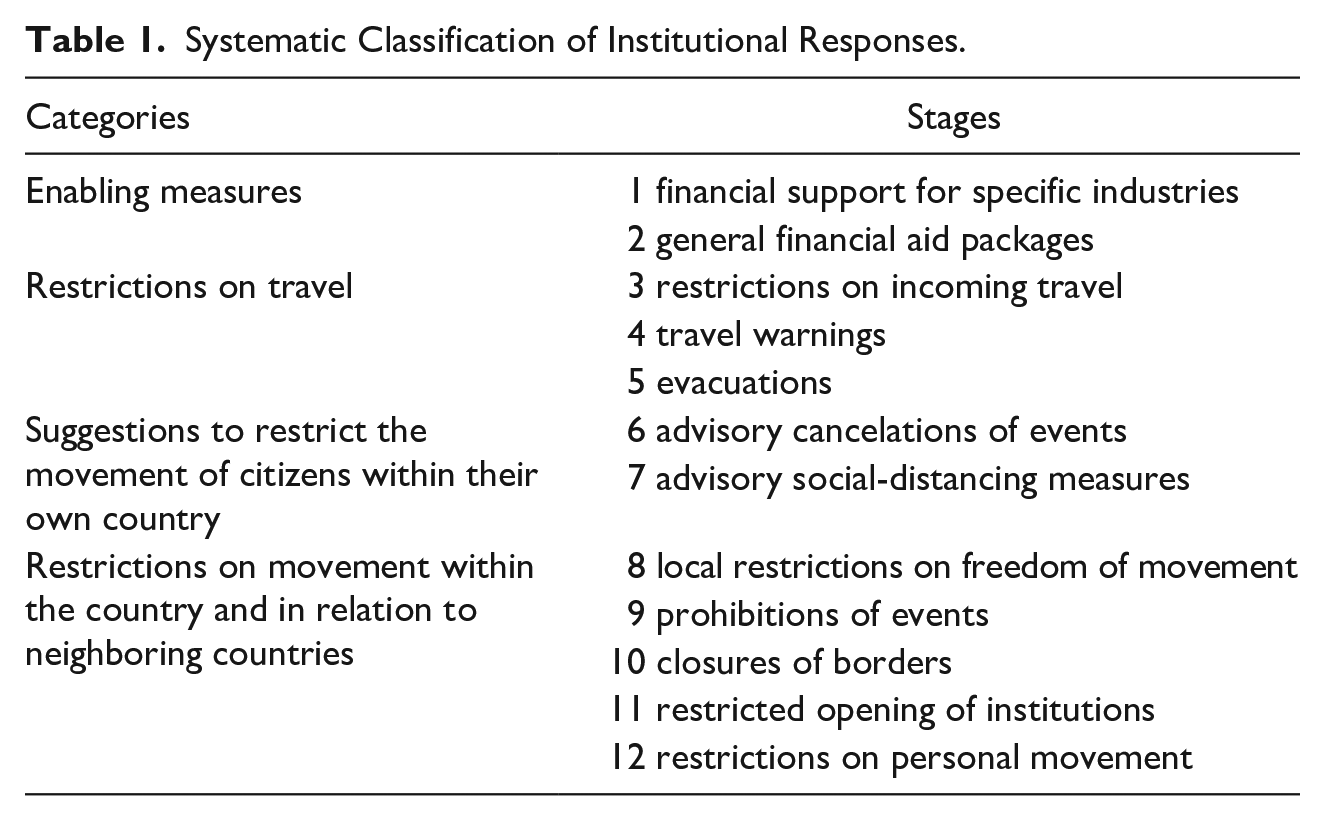
Our comparative analysis of variations in the media-based public discourse of the three countries and their institutional responses to the pandemic included four main steps characterized by back-and-forth consultation between the data, the identification of explanatory patterns, and consulting prior literatures (Timmermans & Travory, 2012). In the first step, we explored and tracked differences in the countries’ institutional responses as proxy variables for the increasing construction of COVID-19 as a GC, subsequently cross-checking our systematization with Hale et al.’s (2021) indices for the Oxford COVID-19 Government Response Tracker. To analyze these responses systematically, we developed a 12-stage ordinal scale of their relative harshness based on the implications of each measure for individual freedoms, classifying harshness along two dimensions, that is, the number of people affected and the implications for freedom of movement (with a Stage 1 classification indicating very minor implications for freedom of movement for a very small number of people and a Stage 12 classification indicating severe implications for freedom of movement for a very large number of people). To simplify our classification of institutional responses, we developed four broader categories of harshness subsuming several stages, as shown in Table 1.
Systematic Classification of Institutional Responses.
In our second step of the analysis, two authors separately undertook in-depth line-by-line coding (Charmaz, 2006) of 60 randomly selected newspaper articles (representing about 10 percent of our dataset) to allow for the emergence of explanatory patterns and to reduce the influence of any preconceived ideas (Walsh et al., 2015). After comparing and discussing our coding to make collective sense of any emerging differences, the first author developed an initial codebook (Charmaz, 2006), using NVivo software to ensure consistency and further systematize our coding. This codebook was then tested and enriched through numerous iterations using approximately 150 newspaper articles.
In addition to fine-grained line-by-line coding, we employed a rigor-without-rigor-mortis approach as the third step of our analysis (Eisenhardt et al., 2016). This approach proposes that reading a whole dataset to gain an initial broad comprehension can help researchers confronted with highly complex data to derive categories from the contextuality and relationality of broader text passages, interpret first relations between codes, and develop first impressions of the most relevant codes (Eisenhardt et al., 2016). To analyze our data holistically in this way, we grouped our data according to time and country contexts and read them through as a whole (Gabriel et al., 2010). This enabled us to refine our codebook further in two main ways, as elucidated below:
(a) Having grasped the broader lines of debates in the data, the first author identified second-order themes within which to subsume the first-order codes. This contextualization of the first-order codes allowed for clearer differentiation of their meaning. Through this process, we were able to note, for example, that several codes formerly identified as separate belonged to the broader debate about the perceived degree of territorial affectedness by COVID-19, including codes such as: (1) COVID-19 is primarily a local crisis in Wuhan; (2) an Italian health crisis is a health crisis for us; and (3) pandemics are global and require global cooperative thinking. We subsumed these codes, among others, under the second-order theme of perceived degree of territorial proximity.
(b) Applying a rigor-without-rigor-mortis approach further enabled us to identify entirely new codes that only become apparent when exploring the context and relationality of broader text passages (Eisenhardt et al., 2016; Gabriel et al., 2010). It was only through this procedure, for example, that the important aggregate dimension of discourse quality emerged from our data. Thus, when reading the whole dataset, the first author initially identified three distinct discursive processes evident in certain newspaper articles (Gabriel et al., 2010). Through collective discussions of examples from our data, we eventually conceptualized these different orientations of media-based public discourse as polarization, compromise-seeking, and consensus-seeking. To allow for the ongoing identification of additional contextual and relational codes, therefore, we decided our systematic coding should include the coding of whole articles. Through such systematic coding, we unraveled mounting empirical evidence of the three identified subcategories of discourse quality. After going back to the literature and collecting newspaper articles under the three second-order themes, the first author identified a number of additional first-order codes by which to distinguish between articles, based on which our subsequent discussions led to further refinement and detailing of our discourse quality codes. For example, articles initially clustered within the second-order theme of polarization in the quality of media-based public discourse were now further differentiated into the following first-order codes: (1) no argumentative justifications; (2) simplifying arguments and referring to authorities; (3) blaming others instead of engaging with opposing argument; and (4) prevalence of us-versus-them logics.
In a fourth step, we applied the codebook to the analysis of all 603 articles and created separate timelines for each country to trace the coding of these articles back to the date of their first appearance. We then compared and contrasted the detailed timelines of the three country contexts to derive a data structure with higher levels of aggregation and theoretical abstraction. In this way, we identified systematic relationships in the data from all three countries between the appearance and disappearance of codes and the introduction of institutional responses. Informed by the literature on issue maturation, and specifically the scholarship on social problem work, we then began collectively theorizing these systematic relationships, while iteratively checking back-and-forth with our data. Having identified and coalesced 54 first-order codes into 10 second-order themes, further theorization and abstraction led us to integrate these second-order themes into four aggregate dimensions that serve as the main explanatory mechanisms of our theorizing for the maturation of issues toward GCs. (See Appendix A for examples of the evidence on which we based our codes.) 2
Findings: Differences in How COVID-19 was Enacted as a GC in Switzerland, Germany, and the United Kingdom
Figures 1a–c provide an overview of our analysis, charting the development and timing of institutional responses to COVID-19 in relation to media-based public discourse in Switzerland, Germany, and the United Kingdom. In these figures, developments in discourse are ordered vertically according to the increasing harshness of institutional responses over time while the horizontal bars represent the three social problem work mechanisms which we propose can explain the discursive construction of COVID-19 as a GC: (a) perceived degree of affectedness (comprising the second-order codes of changing perceptions about preparedness and changing perceptions about territorial proximity); (b) orientation toward the collective (comprising trust-vs.-distrust in actors’ willingness to serve the common good, primacy-vs.-non-primacy of protecting negative freedoms, and primacy-vs.-non-primacy of economic interests); and (c) tolerance of ambiguity (comprising changing assumptions about valid sources of knowledge and changing assumptions about the timing of actions). The different colorings of these horizontal bars indicate variations in prevalent media-based public discourse constructions over time, with solid black indicating dominant status-quo constructions and gray and split black-and-white shading indicating significant differences in the processing of controversies arising around these status-quo constructions. More specifically, in terms of discourse quality, gray shading indicates (a) the deliberative processing of competing claims surrounding COVID-19 through argumentative engagement with opposing positions. Such engagement is evident in our data in two main forms: (1) through compromise-seeking aimed at reaching a modus operandi whereby various voices could be heard with the overarching aim of finding best-for-all understandings of COVID-19 rather than following the most convincing arguments; or through (2) consensus-seeking aimed at reaching joint agreement on common positions based on rational arguments shared by all those participating in the discourse. Split black-and-white shading on the bars indicates the (b) polarized processing of controversies related to COVID-19 in media-based public discourse in which participants neither engaged in argumentation nor mutually respected the right of their opponents to hold other positions on viewpoints on matters of public concern. Finally, solid white indicates the point at which the vast majority of arguments in media-based public discourse converged toward new constructions of the pandemic.
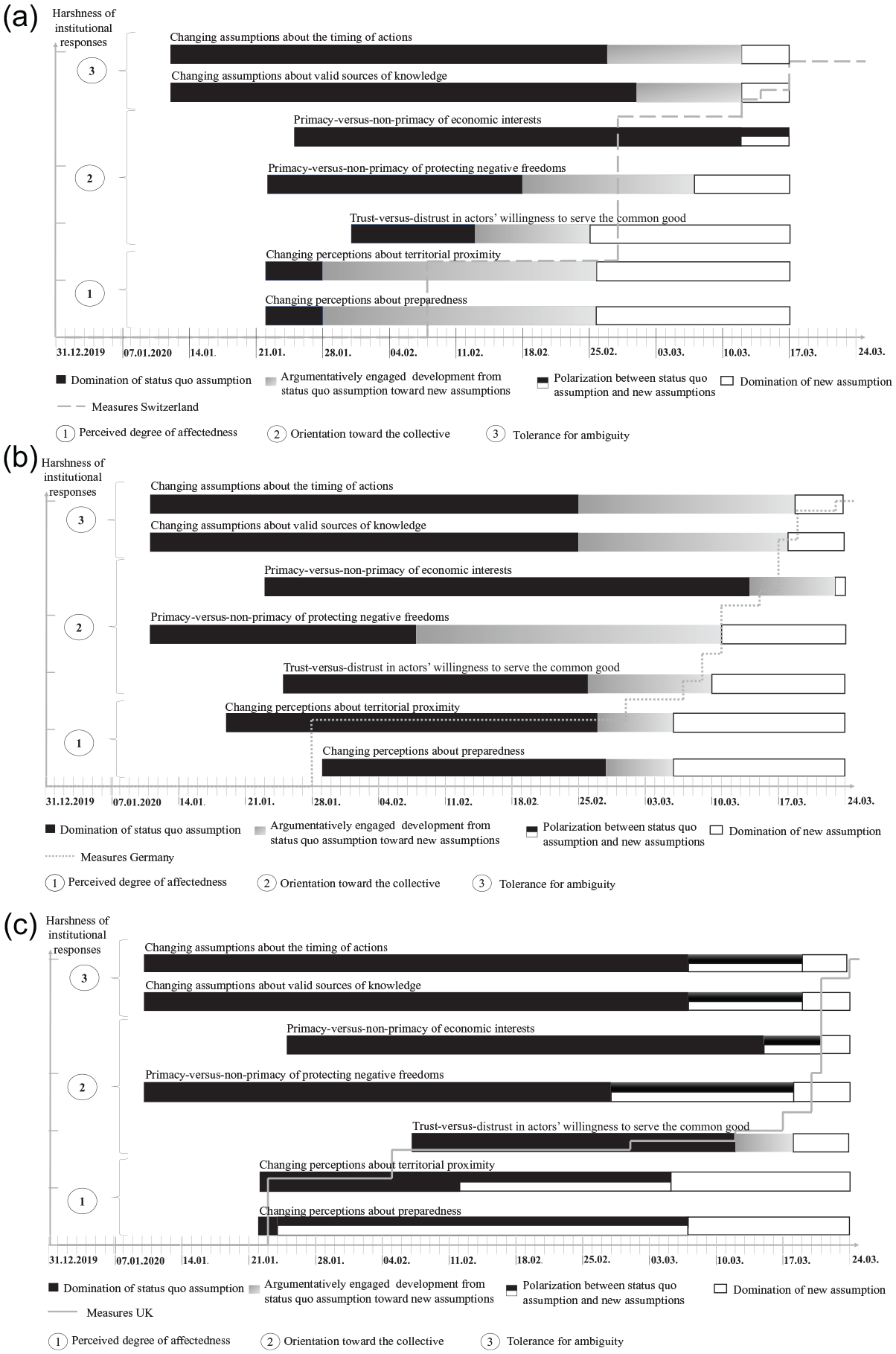
Development of institutional responses in relation to the media-based public discourse in (a) Switzerland, (b) Germany, and (c) the United Kingdom.
Institutional Responses
Figure 2 presents the detailed timeline we derived from our data of institutional responses in Switzerland, Germany, and the United Kingdom, with these responses serving as proxies indicating the respective maturation of COVID-19 into a GC in each country. As this figure shows, although the same institutional responses to COVID-19 eventually came to be introduced in Switzerland, Germany, and the United Kingdom, the timing of their introduction differed significantly.
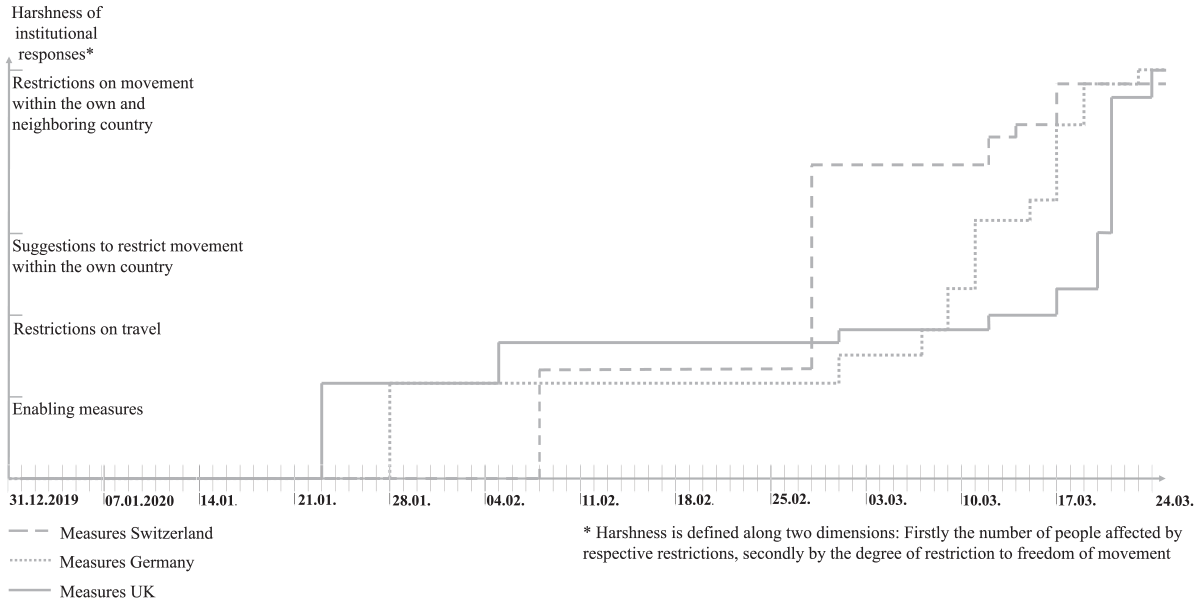
Developments of institutional responses in Switzerland, Germany, and the United Kingdom.
Introduction of institutional responses in Switzerland
As a first institutional response to COVID-19, the Swiss government obliged all travelers arriving from China to register with the authorities as of February 7, 2020. On February 26, a ban on large public events was imposed at local level, and 2 days later, the decision was taken at national level to cancel all events with more than 1,000 people. While other countries initially introduced only advisory steps, the Swiss government immediately introduced restrictive measures. To increase the scope for institutional responses to the pandemic, a special situation or Besondere Lage 3 was announced on February 28. On March 11, border-checks with Italy were introduced, and on the following day, the first support package was announced for businesses. On March 13, a ban was imposed on events involving more than 100 people, together with a ban on skiing and the closure of the Swiss border with Italy. The highest state of emergency, Ausserordentliche Lage, 4 was announced on March 12 at local level and on March 16 at national level (lockdown in Switzerland).
Introduction of institutional responses in Germany
The German authorities updated their travel advice for Wuhan on January 27, 8 days earlier than Switzerland, and started to evacuate German inhabitants from the city of Wuhan on January 31. On March 6, the government implemented stricter travel advice for countries classified as risk countries, including Italy, Iran, South Korea, and Japan. To mitigate the economic consequences of these and other measures to curb the spread of the virus, the government promised help for businesses and changed the laws for short-term contractors on March 10, announcing a three-step plan to support the economy on March 13. In terms of restrictions on freedom of movement within Germany itself, the first measures introduced by the authorities on March 8 were advisory restrictions on events with more than 1,000 people, followed on March 12 by advice to restrict social contacts. Local governments in Germany began prohibiting events with more than 1,000 people on March 10, almost 2 weeks after Switzerland. More rigorous measures were implemented at local level on March 14 with the first closures of schools and childcare facilities. Nationwide restrictions were implemented from March 16, when borders were closed, followed by the closure of all non-essential shops on March 17. Local restrictions on freedom of movement began to be implemented on March 19 and a nationwide prohibition on meeting more than one person in public was introduced across Germany on March 22 (lockdown in Germany).
Introduction of institutional responses in the United Kingdom
The U.K. government’s first major response to COVID-19 was to impose tests on all passengers arriving at Heathrow airport from Wuhan as of January 22, followed by a decision to evacuate its citizens from the city of Wuhan on January 29 (i.e., 3 days before Germany). On February 4, the government advised all U.K. citizens to leave China, and from February 29, travel warnings were announced for risk areas, including Italy, South Korea, and Iran. Financial help packages were announced on March 11 and March 17, shortly after Germany. In contrast both with Switzerland, which implemented restrictions on large public events on February 28, and with Germany, which started advising the cancelation of such events from March 8, the U.K. government took no further actions until March 16 when it issued advice for people to work from home wherever possible. Only on March 19, three weeks after Switzerland and eleven days after Germany, did the U.K. government advise the cancelation of large public events. Whereas Switzerland and Germany began introducing restrictive measures from February 28 and March 14, respectively, the U.K. authorities decided on restrictive measures only after March 20, with all schools, pubs, and unnecessary shops ordered to be closed from March 21 and a ban on meetings of more than two people in public imposed at national level on March 23 (U.K. lockdown).
Mechanisms of the Construction of COVID-19 as a GC in the Media-Based Public Discourse
Below we first present the key findings from our analysis of the media-based public discourse in the initial stages of the COVID-19 pandemic in Switzerland, Germany, and the United Kingdom by describing how the four aggregate dimensions we identified in our data played out differently across these countries (i.e., perceived degree of affectedness, orientation toward the collective, tolerance for ambiguity, and discourse quality; see Figure 3).
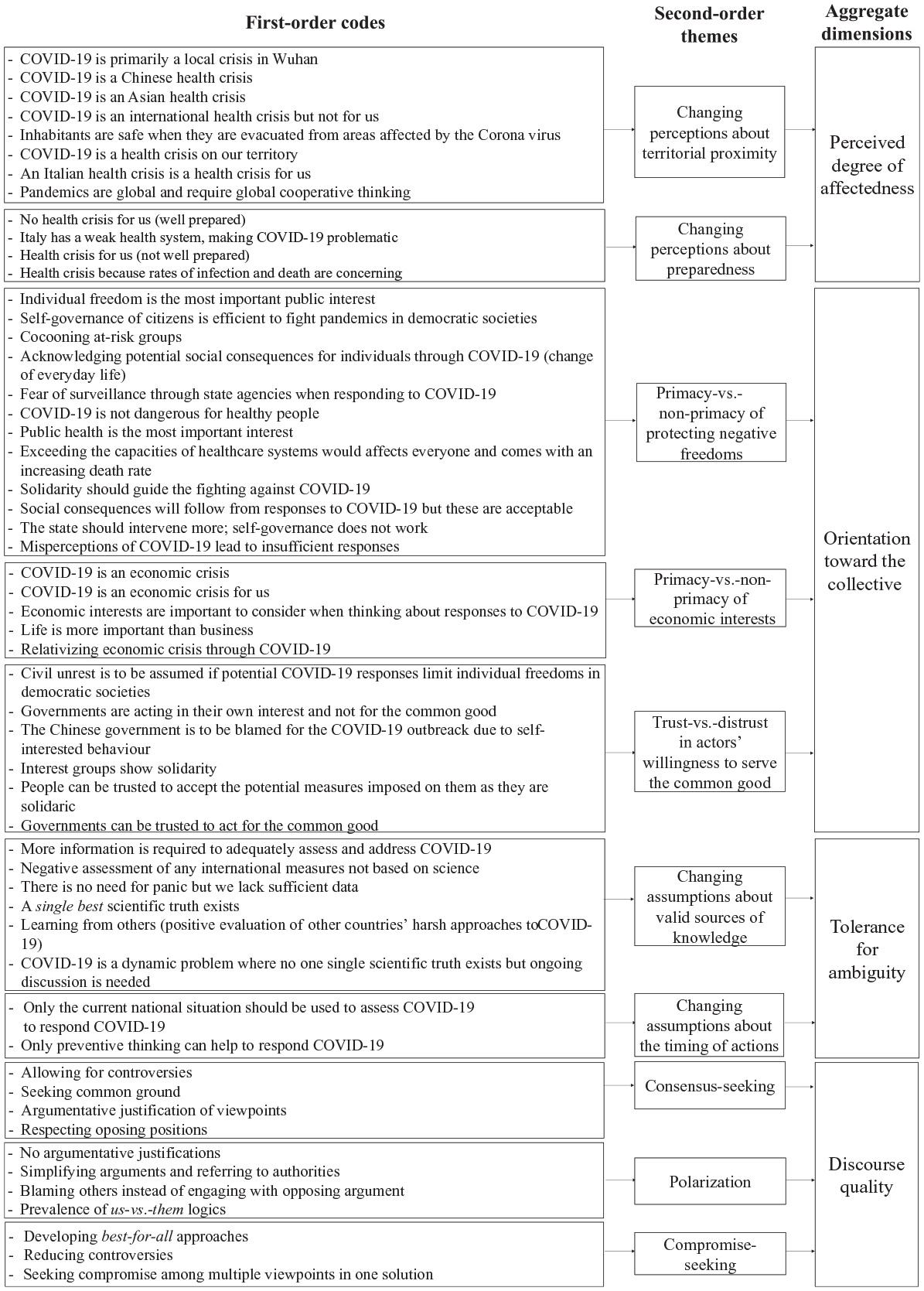
Data structure.
Perceived degree of affectedness
The first mechanism we identified as central to the maturation of COVID-19 into a GC, perceived degree of affectedness, refers to the evolution of constructions in the media-based public discourse regarding the extent to which this issue was perceived as likely to affect the populations of the three countries: from first being seen as a problem likely to affect only an anonymous other into a challenge likely to affect an identifiable us. We find this dynamic evolved via two main processes of re-interpretation of (a) the territorial proximity of the issue and (b) the country’s degree of preparedness for the challenge.
In all three countries, the media-based public discourse around COVID-19 started off similarly in constructing the virus as territorially distant and in widely assuming these countries were well prepared to counter diseases, such as COVID-19. When concern was initially caused by the high numbers of infections in the Chinese province of Hubei and the city of Wuhan in late January, this was framed in the media-based public discourse primarily as a local Chinese problem happening at a great territorial distance from Switzerland (NZZ, January 21, 2020), Germany (SZ, January 21, 2020), and the United Kingdom (The Guardian, January 21, 2021). Although the potential implications of COVID-19 for these countries did begin to be discussed in late January (NZZ, January 23, 2020; Bild, January 22, 2020; and The Guardian, January 24, 2020), the danger continued to be downplayed, with assurances these countries were well prepared. For example, it was commonly assumed in discourse across these countries at this point that “a plan to efficiently fight a pandemic would exist and would be ready for activation in case of suspected cases” (NZZ, January 23, 2020).
Switzerland was the first country to see a shift in public discourse regarding the perceived extent to which the population would be affected by the pandemic, with our data showing that COVID-19 was less and less considered a territorially distant problem in Swiss discourse by February 23. From this time onward, there was growing acknowledgment of the widespread nature of COVID-19 and its problematic consequences for at-risk groups, with increasing concerns expressed in public discourse that Switzerland might not be sufficiently prepared. Responding to the increasing numbers of infections in Italy, it was now declared that the virus had “arrived in Europe” (Blick, February 24, 2020) and that “it would not be surprising to see the first cases in Switzerland within the coming days” (Blick, February 24, 2020). Concerns were now also expressed about the capacity of the Swiss health care system to cope, with fears that “a high number of seriously affected patients might lead to an overload on the healthcare systems” (NZZ, February 26, 2020).
In Germany, this shift in the perceived affectedness of COVID-19 and its widespread nature occurred from March 5, no less than ten days after Switzerland. We attribute this significant delay primarily to differing assessments in media-based public discourse of the situation in Italy, with the prevailing view in German discourse being that rising infections in Italy were not a matter of concern for Germany since Italy “even in normal times [would have] an overloaded healthcare system” (SZ, February 24, 2020). Accordingly, no reassessment was made at this time of the risks connected to COVID-19 for the German healthcare system. In the United Kingdom, meanwhile, questions were increasingly raised about the country’s preparedness in late February (The Guardian, February 29, 2020), though it was only from the first week of March that it was finally acknowledged that COVID-19 was not a territorially distant issue (The Times, March 7, 2020).
A further change in evaluations of the degree to which the pandemic was likely to affect local populations was evident in the media-based public discourse in Switzerland from March 6 onward, with concerns now voiced “that the death rate from the virus might increase if [Swiss] healthcare systems cannot sufficiently respond to an exponential increase in cases” (NZZ, March 6, 2020). Similar concerns emerged in media-based public discourse in Germany and the United Kingdom about a week later than Switzerland.
In sum, we identified significant differences in the timing of key shifts in the perceived degree of affectedness of COVID-19 in the media-based public discourses of the three countries, with Switzerland acknowledging that this issue was highly likely to affect its population about ten days before Germany and the United Kingdom. These variations in the timing of shifts in assessments reflect the extent to which constructions in the public discourses in these countries acknowledged COVID-19 as widespread (Gümüsay et al., 2022).
Orientation toward the collective
The mechanism we identify as orientation toward the collective explains shifts in moral evaluations of issues, as they happen when the goals of in-groups and communal ways of acting to facilitate the common good attain primacy over personal goals such as the prioritization of negative freedoms (i.e., freedoms from restrictions imposed on individuals by the state or third parties, Triandis, 2001; Wellmer, 2000). In our data, we identified evidence that such orientation was driven by three key changes in public-discourse constructions of COVID-19 regarding (a) the primacy-versus-non-primacy of negative freedoms; (b) the primacy-versus-non-primacy of economic interests; and (c) trust-versus-distrust in the willingness of actors to serve the common good. As we elucidate below, this mechanism facilitated the issue maturation of COVID-19 into a GC by fostering the construction of this issue as both evaluative and complex (Ferraro et al., 2015).
Regarding the primacy-versus-non-primacy of negative freedoms, negative freedoms were initially considered of primary importance in the media-based public discourses surrounding COVID-19 in Switzerland, Germany, and the United Kingdom (NZZ, January 27, 2020; SZ, February 3, 2020; The Guardian, February 5, 2020). For example, the strict quarantine measures imposed in Wuhan and later aboard the Diamond Princess cruise ship corresponded with critical assessments in the discourse of all these countries regarding the social consequences of imposing such measures (Tages-Anzeiger, February 8, 2020; SZ, February 3, 2020). At this time, it was widely argued that such strict restrictions would harm negative freedoms and that their introduction would be inappropriate in view of the minor danger the virus posed for most people, constituting a “lack of trust in the self-governance of citizens” (NZZ, January 31, 2020; The Guardian, February 5, 2020). The perceived evaluativity of COVID-19 as an issue was thus quite low at this point, with individual freedom predominating as a barely disputed reference of worth in the discourse of all three countries.
Safeguarding negative freedoms was first questioned in the media-based public discourse in Switzerland in late February, with articles querying the adequacy of measures already adopted and criticizing the government for its “incredulous and passive observation of how the virus spreads” (Blick, February 25, 2020). The same period saw increasing concerns that stricter measures would harm negative freedoms, with articles depicting a “conflict of interests in which the closure of borders would inflict unbearable harm on the freedom of each and every citizen” (NZZ, February 24, 2020). Constructions of COVID-19 in the Swiss public discourse as an evaluative issue further increased toward the end of February as conflicting criteria of worth competed for dominance.
In Germany, arguments stressing the primacy of negative freedoms began to drop out of the debate some two weeks later than in Switzerland, with fewer claims being made from March 5 onward that lockdowns would constitute a “hysterical” overreaction and that strict measures would entail intolerable levels of surveillance (Bild, March 4, 2020). In the United Kingdom, in contrast, arguments advocating the primacy of negative freedoms continued to prevail until mid-March, with discussions centered around concerns that while “flattening the peak is very good for the NHS [National Health Service], it may not be good for society” (The Times, February 20, 2020). Far more so than in Switzerland and Germany, media-based public discourse in the United Kingdom continued to debate the potential dangers of mass surveillance arising from strict measures (The Times, March 5, 2020), with a strong emphasis on the need for people’s self-governance (The Times, March 17, 2020). The idea of “cocooning” high-risk groups to protect the negative freedoms of all other citizens and the long-term aim of achieving “herd immunity” were also discussed in UK discourse at greater length (The Guardian, March 13, 2020). The evaluativity of COVID-19 thus remained low in the United Kingdom until mid-March as the primacy of negative freedoms clearly remained the dominant criterion of worth.
Switzerland was also the first country in which public health was increasingly prioritized in the media-based public discourse, with articles appearing from early March arguing that “measures to restrict the further spread of the virus must be understood as an act of solidarity” (NZZ, March 6, 2020) and that citizens “have to accept restrictions on their personal freedoms to diminish the danger for society” (Tages-Anzeiger, March 9, 2020). Previous arguments prioritizing individual freedom as the highest public good dropped out of discussion and the social consequences of harsh measures were now depicted as significant but tolerable (Tages-Anzeiger, March 13, 2020; Tages-Anzeiger, March 16, 2020). A similar shift in constructions of the issue took place in Germany only a few days later, with articles increasingly speaking of “the solidarity of Germany as a society” (SZ, March 13, 2020; SZ, March 14, 2020). In the United Kingdom, however, it was only from March 17 (i.e., three weeks later than Switzerland and two weeks after Germany) that the primacy of negative freedoms came to be reconsidered and alternative references of worth began to be discussed, with notions of self-governance now subject to increasing scrutiny (The Times, March 18, 2020) and growing calls for solidarity in a “united national effort” (The Guardian, March 10, 2020).
Regarding changing constructions in the media-based public discourse as to the primacy-versus-non-primacy of economic interests in responding to COVID-19, it should first be noted that the extension of this debate beyond health-related consequences again reflected a growing construction of the issue as both a highly evaluative and complex challenge. Initially, the primacy of economic interests prevailed in the media-based public discourse of all three countries, with fears voiced that measures to tackle the virus would “come with significant economic costs” (Tages-Anzeiger, January 30, 2020) and would be “problematic for companies and consumers” (FAZ, February 25, 2020), with “serious implications for the global economy” (The Times, January 24, 2020). From mid-February onward, an increasing number of articles advocating the prioritization of economic interests appeared in all three countries, including claims characterizing the proposed measures as a “hysterical” response (NZZ, February 24, 2020; The Times, February 27, 2020) stressing the need to consider their “disastrous economic consequences” (NZZ, February 24, 2020; SZ March 12, 2020; Bild, March 16, 2020; The Times, March 3, 2020). This expansion of the debate beyond health-related aspects to economic concerns greatly increased the complexity of constructions of COVID-19 in the media-based public discourse of all three countries.
Economic interests were first discussed in public discourse as secondary to health concerns in Switzerland from March 12, followed shortly afterward by Germany on March 14 and the United Kingdom on March 17. Criticisms of values driven by economic priorities now appeared in Swiss discourse (NZZ, March 14, 2020), with assertions that no human right is more important than the “right to health” (Blick, March 16, 2020; SZ, March 14, 2020). Nevertheless, concerns about the economic costs of measures continued to be voiced and acknowledged in all three countries, especially in discussions about the need for financial-help packages (Tages-Anzeiger, March 13, 2020; The Times, March 19, 2020) and the need to provide “economic help through the expansion of short-term work agreements legislation” (Tages-Anzeiger, March 13, 2020). The evaluativity of COVID-19 as an issue further increased in social constructions through these reassessments of economic priorities, with criteria of worth increasingly subject to question at different times in the discourses of each country.
Regarding changing constructions of trust-versus-distrust in the willingness of actors to serve the common good, we observe significant variations in the persistence of claims about the self-interestedness of actors in tackling COVID-19 in the media-based public discourse of the three countries. Initially, from late January to early February, accusations of self-interested behavior on the part of foreign entities—and especially the Chinese government—appeared in the media-based public discourses of all these countries, with claims that China was engaging in a “war of information” (NZZ, January 31, 2020) by withholding crucial data about the virus (The Guardian, January 21, 2020; Bild, January 27, 2020).
In Switzerland, such expressions of distrust began to decrease from mid-February, corresponding with a shift in focus away from the trustworthiness of foreign actors to a closer evaluation of the willingness of domestic actors and entities to serve the common good. As the need for harsher measures came to be discussed with growing intensity, Swiss newspapers quoted citizens declaring they would “understand the measures” (Blick, February 24, 2020), highlighting public willingness to comply with restrictions for the common good. This shift reflected the growing construction in the Swiss public discourse of COVID-19 as evaluative and highly complex, with its wider societal implications now debated in addition to its health-related and economic ramifications. From March 7, it was increasingly argued that Swiss governmental bodies were trustworthy and that “governments are doing a great job” (Blick, March 13, 2020). Confidence in the willingness of actors to act in the interests of the common good continued to be strong in Swiss media-based public discourse from thereon.
In Germany, in contrast, the construction that actors would prioritize their self-interests over the common good prevailed in media-based public discourse until early March, although fears that strict measures might “lead to civil unrest as people refuse to comply with the rules” (SZ, March 3, 2020) only briefly came to the fore at the beginning of March (in contrast to the persistence of such fears in the U.K. discourse). A reassessment of actors’ willingness to serve the common good first became evident in German discourse from March 10 onward (i.e., more than a fortnight later after this reassessment of the issue had first emerged in Swiss discourse). The German government’s management of the crisis was now positively appraised as being oriented toward the common good and commended for not being “emotionally rooted or based on any ideological fights between parties” (FAZ, March 10, 2020). A shared understanding now prevailed that the population of Germany would comply with restrictive measures, since “extremely different situations will require certain interests to be prioritized” (SZ, March 13, 2020). Although the constructed complexity of the issue had already increased in Germany through discussions regarding the effects of the pandemic in various social fields, its evaluativity increased still further as previous assumptions about the self-interestedness of actors were subjected to competing claims that actors could be trusted to serve the common good.
In the United Kingdom, public expressions of distrust in the willingness of actors to serve the common good persisted for much longer than in Switzerland and Germany, prevailing until March 17 (The Guardian, March 20, 2020). In addition to predictions of civil unrest in response to harsh measures (The Times, February 29, 2020), distrust was also expressed in the U.K. government as a potentially self-interested entity/actor “shirking responsibility” (The Guardian, February 28, 2020), with counterarguments only emerging from March 8 (The Guardian, March 8, 2020; The Times, March 9, 2020). The evaluativity of COVID-19 with regard to the state-citizen relationship thus arose much later in constructions of this issue in U.K. discourse.
In sum, our data show that the social problem work mechanism of orientation toward the collective developed very differently in the media-based public discourses of Switzerland, Germany, and the United Kingdom, though the divergent way debates unfolded in these countries regarding the prioritization of negative and positive freedoms, including the importance of negative freedoms, the primacy of economic interests, and the relationship between the state and the individual. Although the primacy of economic interests continued to be a dominant construction in the media-based public discourse in all three countries, we identified significant differences in the development of trust-versus-distrust in the willingness of actors to serve the common good and in assumptions about the primacy-versus-non-primacy of protecting negative freedoms. It is these differences, we argue, that led to Switzerland becoming the first country to acknowledge the scale of evaluativity and complexity of COVID-19, followed a little later by Germany and significantly later by the United Kingdom.
Tolerance of ambiguity
The third mechanism we identify in our data as a driver of issue maturation in the case of COVID-19 is tolerance of ambiguity, defined as the degree to which the pandemic came to be evaluated in the media-based public discourse as an issue about which no single truth exists. We assessed such tolerance as high when public discourse acknowledged COVID-19 as a challenge that could only be understood and tackled by including multiple viewpoints, balancing trade-offs, and handling paradoxes without clear-cut solutions (Schreyögg & Steinmann, 1987). This mechanism reflects and operates in line with other changes in social constructions, as in the shift we observed from the initially prevalent stance that only actions justified by current evidence should be taken to tackle COVID-19 toward an acknowledgment of the validity of multiple sources of knowledge and the need to take preventive actions on the basis of uncertain future states. Tolerance of ambiguity thus directly affected the construction of COVID-19 as a GC in reflecting and fostering growing discussion and acknowledgment not only of the complexity but specifically the uncertainty of this issue.
In all three countries, a strong emphasis was initially placed on the importance of applying systematic and scientific knowledge in tackling COVID-19, with widespread agreement that the timing of any actions to counter the pandemic must be appropriate in reflecting how strongly the countries were affected by the virus. In Germany, for example, it was argued that “further research is needed to discover the source, transmission, and degree of infection to thoroughly evaluate potential counter-measures” (FAZ, January 10, 2020), while in the United Kingdom, it was widely argued that more information was required to respond adequately to the virus, since “when public health responses are rushed, problems follow” (The Guardian, January 9, 2020).
A shift in the public discourse regarding the appropriate timing of countermeasures was first evident in Switzerland in early March when it became widely accepted that measures should be taken on the basis of “preventive thinking that can reduce the spread of a pandemic” (NZZ, March 11, 2020). In Germany, such preventive thinking first emerged in the public discourse on March 13, while the dominant construction in U.K. media-based public discourse that “you need to do the right thing at the right time” and that “if you go too early, people will become fatigued” (The Guardian, March 13, 2020) persisted for significantly longer, only succumbing to counterclaims from March 17.
Again, it was in Switzerland that constructions of COVID-19 in the public discourse first shifted from the prevailing idea that any measures to tackle the pandemic should be based exclusively on prior scientific evidence and must not be taken in a state of ambiguity. These arguments were supplanted by a growing acceptance of ambiguity about the issue, including an acknowledgment that actions needed to be taken even in spite of uncertainties and lack of knowledge about the pandemic (NZZ, March 2, 2020). From the beginning of March, positive evaluations of the increasingly harsh measures imposed in other countries began to appear in the Swiss media-based public discourse, with the experiences of other countries now increasingly considered an acceptable and valid source of knowledge with which to justify the imposition of such measures in Switzerland (NZZ, February 28, 2020). While this change in prevailing constructions occurred almost simultaneously in Germany (SZ, March 3, 2020), arguments against taking any action in a state of ambiguity persisted in the U.K. media-based public discourse until March 17, including claims that measures adopted by other countries were based on “a lack of scientific evidence” (The Guardian, February 24, 2020). For example, the U.K. Prime Minister Boris Johnson insisted at the time that he was “guided by the science, with suggestions that other countries’ actions are driven by the political need to be seen to act” (The Times, March 13, 2020). Counterarguments to these claims in the form of positive appraisals of the harsh preventive measures taken by other countries first appeared in the United Kingdom from March 6. Thereafter, an increasing number of articles in the U.K. media focused on evaluating the ambiguous scientific evidence for various measures (The Guardian, March 13, 2020), including the basis for mass testing in Italy (The Guardian, March 18, 2020).
In sum, tolerance of ambiguity and corresponding constructions emphasizing the uncertainties surrounding COVID-19 first emerged in Switzerland in early March, a little later in Germany, and only as late as from March 17 in the United Kingdom. This shift is indicated by changing evaluations of the appropriate timing of actions and a stronger realization of the need to tolerate ambiguous and insufficient knowledge in tackling the pandemic.
Discourse Quality as a Context Condition of Issue Maturation
In addition to the three social problem work mechanisms we abstracted from our data analysis, we further identified discourse quality as a crucial context condition that significantly affected the issue maturation of COVID-19 in being more or less facilitative of the attainment of collectively shared understandings of new issues and their construction as GCs (Voß et al., 2006). Defined as the extent to which a society’s media-based public discourse adopts a constructive approach to politics that encourages wide participation, offers justifications for claims and strives for common ground, mutual respect, and authenticity (Steenbergen et al., 2003), discourse quality constitutes the context or discursive environment in which the social problem work mechanisms of perceived degree of affectedness, orientation toward the collective, and tolerance of ambiguity unfold. As such, discourse quality determines whether and to what extent opposing claims concerning an issue can be dealt with on the basis of reason and argumentation or on strategic influence, emotions, and ideologies. We identified two main categories of processing controversies in media-based public discourse surrounding COVID-19: (a) deliberative processing through argumentative engagement with opposing positions, either through (1) consensus-seeking or (2) compromise-seeking; and (b) polarized processing of controversies without argumentative engagement and with no mutual respect for opposing parties and their arguments (see also Steenbergen et al., 2003).
We conceptualize the first category of discursive processing as a consensus-seeking form of discourse that acknowledges the validity of different positions and tolerates controversy in seeking an argumentative settlement based on the better argument (Dryzek & Pickering, 2017). In reflexive discourse, actors actively justify and revise their positions in the light of emerging new evidence and knowledge (Steenbergen et al., 2003), willingly reformulating their positions through self-scrutiny to render them more acceptable to opposing parties, with reflexivity understood as “the ability of a structure, process, or set of ideas to reconfigure itself in response to reflection on its performance” (Dryzek & Pickering, 2017, p. 353). A key aim of reflexive discourse is to establish common ground to allow for decisions on specific courses of action through jointly navigating the tensions between the need for diversity and communality. A case in point can be seen in the way questions as to the priority of safeguarding negative freedoms first emerged in the Swiss media-based public discourse in late February even as criticisms were mounting that stricter measures would harm negative freedoms and result in a “conflict of interests in which the closure of borders would inflict unbearable harm on the freedom of each and every citizen” (NZZ, February 24, 2020). As this example shows, claims and counterclaims in the Swiss public discourse included an acknowledgment of conflicts of interests and argumentative engagement with opposing positions, leading to a broadening of the debate as conflicting criteria of worth competed for dominance in interpretations. Modes of reflexive discourse can also be observed in the way the perceived degree of affectedness of COVID-19 was discussed in Switzerland primarily through engagement with the different arguments of opposing parties. In an article in Tages-Anzeiger from January 29, for example, criticism of Switzerland’s preparedness in view of the assumed close territorial proximity of COVID-19 was balanced by engagement with opposing arguments, including the following concession:
“The likelihood of an infection through a Chinese tourist is very low,” says Daniel Koch. This is because an infection requires very close contact and one would need to be closer than one meter to the infected person. (Tages-Anzeiger, January 29, 2020)
Only after presenting opposing arguments did this article conclude that “however, infections could appear in Switzerland at a later point in time.” Importantly, this deliberative discourse was not aimed at reaching a compromise between parties but rather at assessing the validity of competing arguments (e.g., in arguing that the positions taken by “Corona-Denialists are questionable, as their premises are wrong”; Tages-Anzeiger, March 6, 2020). Another example of this discursive aim can be seen in much later changes in U.K. media-based public discourse regarding the primacy of negative freedoms, with articles from March 17 onward increasingly questioning the primacy of negative freedoms and self-governance (The Times, March 18, 2020) over the need for a “united national effort” (The Guardian, March 10, 2020). An initially highly polarized debate thus shifted from this point onward to a discussion in which the arguments of opposing parties came to be properly heard and evaluated, thereby enabling the best-argued positions to gain greater traction, including growing calls for a united national effort (for further evidence, see Appendix A). From this, we conclude that reflexive discourse facilitates faster issue maturation, as is evident from the significantly more rapid construction of COVID-19 as a GC in the Swiss media-based public discourse.
The second mode of deliberative processing of discursive controversy we identified took the form of compromise-seeking through homogenizing efforts aimed at attaining a common understanding by incorporating all different standpoints and reducing controversies (Furnari, 2014). For example, the German media-based public discourse regarding negative freedoms was primarily oriented toward seeking compromise in arguing that the social consequences of the pandemic meant “we have to take decisions all together” (SZ, March 9, 2020) and that “we now have to discuss as a whole society and need to agree on what we are all okay with giving up to tackle the virus” (SZ, March 9, 2020). Advocates of harsh measures thus sought to achieve compromise by incorporating certain points from opposing positions in their arguments, including the importance placed on protecting negative freedoms (SZ, March 13, 2020; FAZ, March 9, 2020). Such compromise-seeking was also evident in the German public discourse around the primacy-versus-non-primacy of economic interests, with articles framing the government’s actions as consistent with the “aim of the government to compromise between protecting the economy and stopping further spread of the virus” (Bild, March 10, 2020). In the United Kingdom, such compromise-seeking discourse only began to prevail from March 17 onward as the previously polarized debate on the primacy of economic interests shifted toward argumentation that acknowledged the economic costs of restrictive measures while justifying these costs as reasonable compared with the public-health risks of not imposing such measures (The Guardian, March 20, 2020).
Comparing the discourse quality of the three countries, it becomes evident that the compromise-seeking structure of media-based public discourse in Germany facilitated a steady and gradual rather than rapid process of issue maturation.
In polarized discourse, participants do not engage in argumentation with respect for opposing positions. As defined by McCoy et al. (2018, p. 16): “Polarization is a process whereby the normal multiplicity of differences in a society increasingly align along a single dimension and people increasingly perceive of and describe politics and society in terms of ‘Us’-versus-‘Them’.” Participants in polarized discourse thus typically place little value on mutual respect for opposing arguments in debate, do not seek to justify their positions, and show no willingness to revise their initial stances as new arguments and evidence arise (Steenbergen et al., 2003). Such processing was especially evident in the U.K. public discourse regarding the extent of the country’s preparedness to tackle the pandemic and the issue’s perceived degree of affectedness. Unlike the confidence still evinced in the Swiss and German discourse at this early stage, questions were first raised in the United Kingdom about national preparedness in the last week of January, with one article quoting the Leader of the Opposition as saying that “Labour asks the government to reassure the public about NHS capacities in case the virus reaches the UK” (The Guardian, January 26, 2020). The voicing of such concerns provoked further polarized debate at this point, with opposing camps restating their opinions without engaging in mutually respectful consideration of different positions and competing arguments. As a consequence, minority opinions failed to be considered and the initial construction that the country was well-prepared continued to prevail, with the U.K. government frequently cited in the media as “closely monitoring the situation” and “taking all precautions” while claiming the “risk to the public remains low” (The Guardian, January 26, 2020). The U.K. public discourse surrounding the primacy of protecting negative freedoms also became highly polarized, with opposing camps not engaging in argumentation but primarily restating their positions, especially in debates about the threat of mass surveillance (The Times, March 5, 2020) and the importance of citizens’ self-governance (The Times, March 17, 2020).
The media-based public discourse in the United Kingdom regarding the willingness of actors to serve the common good in responding to the pandemic also became polarized, with claims that key actors were acting out of self-interest persisting until at least March 17 (The Guardian, March 20, 2020), although counterarguments to such claims first appeared from March 8 (The Guardian, March 8, 2020; The Times, March 9, 2020). In this discourse, actors justified their positions by reference to authorities (e.g., “the science”) rather than engaging in in-depth argumentation. For example, the U.K. government was often cited as asserting that all its actions were “guided by the science” (The Times, March 13, 2020) or based on the advice of the World Health Organization, typically without offering any further rationale (The Times, February 27, 2020). Instead of argumentative engagement with differing positions, perceptions of opposing parties were often expressed in ever-more aggressive language. In an article in The Guardian on February 29, for example, one NHS doctor was cited as accusing the U.K. government of having “no idea of the problem” of people returning from “affected areas”, while another was quoted as criticizing the government and members of the public: “It’s a no-brainer, the government need to tell those who are coming back what to do . . . There seems to be an attitude [among returning travellers] of: ‘We don’t care if we infect a whole GP surgery full of people.’”
Polarization was also evident in Swiss discourse regarding the primacy of economic interests, with opposing positions frequently asserted without any attempt at argumentative engagement. While blunt claims were made on one side that the proposed “measures are crazy” and that “the existence of thousands of companies is at risk for the sake of safeguarding only a small minority” (Blick, March 16, 2020), counterclaims likewise failed to offer much argumentative engagement, as in the retort that company representatives should simply “stop complaining but be happy that restaurants have been open until now” (Blick, March 16, 2020).
Based on the fact that the U.K. media-based public discourse was characterized primarily by polarization and that the maturation of COVID-19 into a GC was slowest in the United Kingdom, we identify a systematic relationship between polarized discourse structures and the pace of issue maturation.
Discussion: Toward a Theory of the Communicative (Co-)Construction of GCs in Democratic Rule-of-Law States
In the following discussion, we further theorize our findings to answer our research question of why and how issues become constructed as GCs in public discourse, mobilizing insights from scholarship on issue maturation and specifically social problem work literatures. More specifically, we develop theory that can explain how the co-occurrence of the three discursive mechanisms (perceived degree of affectedness, orientation toward the collective, and tolerance of ambiguity) and their contextual embeddedness in broader discourse quality facilitate the maturation of an issue into a GC.
Perceived Degree of Affectedness as a Mechanism of GC Construction
Our study confirms that the perceived degree of affectedness of an issue, that is, the extent to which it is constructed as directly affecting a population, serves as a key mechanism of social problem work driving the construction of an issue into a GC. This finding is supported by our data in the systematic relation we identify between a relatively high perceived degree of affectedness vis-a-vis COVID-19 and the speed with which measures to tackle the pandemic were intensified beyond travel restrictions to include limitations on citizens’ freedom of movement within their own countries (see Figures 1a-c). In theorizing this systematic relationship, we draw from social problem work scholarship that has found issues are more likely to become conceived of as social problems if audiences believe claims that these issues will have direct adverse consequences for them. By increasing the perceived degree of affectedness of an issue, arousing fears and concerns fosters people’s willingness to counter an issue to protect themselves and their loved ones (Miller & Holstein, 1989). In our data, the growing perception that almost everyone, also oneself and people’s loved ones could be affected by COVID-19 corresponded with an increasing acknowledgment that COVID-19 was not a contained local Chinese problem but need to be seen instead as a widespread issue (Gümüsay et al., 2022). 5 In sum, we find that claims in the media-based public discourse fostering a high perceived degree of affectedness led to an intensified construction of COVID-19 as a GC, paving the way for the swifter imposition of harsh measures.
Orientation the Collective as a Mechanism of GC Construction
Co-occurring with a high perceived degree of affectedness, a high degree of orientation toward the collective in the media-based public discourse further facilitated the construction of COVID-19 not only as widespread but also as a complex and evaluative issue. Orientation toward the collective was thus evident in our data as a key social problem work mechanism driving the construction of COVID-19 as a GC, corresponding with and reflected by certain escalations in measures. Such orientation itself depends on a high degree of trust in the willingness of actors to serve the common good and a lower prioritization of economic interests and negative freedoms. Conversely, a lower degree of orientation toward the collective in the media-based public discourse corresponded with higher levels of distrust in actors’ willingness to serve the common good and a higher prioritization of negative freedoms and economic interests. We thus identify and theorize a systematic relationship between a high degree of orientation toward the collective and the swifter imposition of increasingly harsh measures, as elucidated below.
Scholars of social problem work (Loseke, 2008) have emphasized the centrality of “motivational claims” (p. 76) in the construction of issues as social problems. By presenting new criteria of worth and constructing issues as problems that would be morally wrong to leave unaddressed, motivational claims encourage emotional responses among audiences (Loseke, 2008), thereby facilitating a reassessment of values and perceptions. To be effective in bringing about an orientation toward the collective, therefore, claims about an issue must indicate that specific conditions call for a reassessment of prevailing “cultural themes” (i.e., contextually and historically specific perceptions about how the world should work, Loseke, 2008, p. 64). Our data confirm the centrality of such reassessments in attaining orientation toward the collective and thus in the maturation of COVID-19 into a GC, including reassessments of the cultural themes of capitalism (e.g., through discussions about the primacy of economic interests) and individualism (e.g., through discussions about negative freedoms and the state-citizen relationship). These reassessments corresponded with a high degree of orientation toward the collective because such orientation holds the common good to be the primary criterion of worth and the main moral ground of evaluation, thereby increasing the likelihood of an issue being constructed as a morally intolerable threat that must be acted upon. The importance of shifts in criteria of worth in the construction of GCs has previously been identified in the works of Ferraro et al. (2015), who highlight “evaluativity” (p. 368) as a defining characteristic of GCs. Our findings are also consistent with recent scholarship on framing dynamics that has emphasized the importance of emotional attachment (Klein & Amis, 2021; Reinecke & Ansari, 2021) and the connectivity of certain frames with ideologies held by agenda-setters at individual (micro) level (Benford & Snow, 2000; Klein & Amis, 2021) thus increasing the likelihood of constructing new issues as collective action frames.
The relationship we identify between a high degree of orientation toward the collective and the imposition of increasingly harsh measures in response to COVID-19 can further be explained by drawing again on theories in the social problem work literature which propose that an issue is more likely to be constructed as a social problem when it is seen as affecting multiple fields of society and multiple cultural themes at the same time (Loseke, 2008). For example, the extension of COVID-19-related discussions beyond health concerns to economic and social concerns helped the issue mature in public construction into an increasingly complex issue (Ferraro et al., 2015). In sum, we conclude that orientation toward the collective intensifies the maturation of issues as GCs by increasing their construction as both complex and morally concerning (Ferraro et al., 2015; Schoeneborn et al., 2022).
Tolerance of Ambiguity as a Mechanism of GC Construction
In addition to and in combination with a high perceived degree of affectedness and a high orientation toward the collective, our data show that a high degree of tolerance of ambiguity served as a third key mechanism driving the construction of COVID-19 as a GC. This can be observed, for example, in the fact that decisions at national level to impose strict lockdowns were only reached after such tolerance had been attained (i.e., after accepting the ambiguity of current knowledge about COVID-19) and calling for preventive thinking in the face of uncertainty had come to the fore in media-based public discourse in the respective countries (see Figure 1a–c).
To explain and theorize the systematic relationship between a high level of tolerance of ambiguity and decisions to impose lockdowns, we again draw from and build on the social problem work literature and the evidence it has provided of how the construction of issues as social problems typically depends upon people believing in claims that depict a dark future if no action is taken to tackle them (Benford, 2002; Loseke, 2008). In addition, the literature on strategic issue management can further help explain how the acceptance of ambiguity regarding knowledge is central to issue maturation (Schreyögg & Steinmann, 1987). Proceeding from the premise that knowledge is inevitably ambiguous in the context of rapidly evolving and dynamic issues, this scholarship has shown how such uncertainty does not allow for planning but instead requires risk-taking and ambiguity-tolerant sensemaking of issues (Schreyögg & Steinmann, 1987); this comes close, for instance, to the recent call by the German Ethics Council that the media-based public discourse needs to develop tolerance for science’s inherent “epistemic vulnerability” (Deutscher Ethikrat, 2022, p. 136). Our observation that a higher tolerance of ambiguity fosters a greater collective understanding of issues even in the face of uncertainty regarding the future relates to the finding in the literature on GCs that uncertainty is a defining characteristic of GCs (Ferraro et al., 2015). By demonstrating the important role played by claims that foster tolerance for ambiguity in intensifying the construction of issues as GCs and thus leading to swifter and harsher countermeasures, we address a gap in research that has primarily emphasized the role of expert opinions in facilitating the construction of social problems as GCs (Loseke, 2008).
Discourse Quality as a Context Condition of Enacting GCs
In contrast to the three key social problem work mechanisms outlined above, the crucial context condition of discourse quality does not concern the question of what is being said in media-based public discourse nor add to what is said but instead determines how things are said and how different opposing claims are processed. Because issue maturation depends on developing collectively consensual understandings of issues, this context condition can either facilitate or hinder the construction of an issue as a GC. This is evident from our empirical observation that countries with a higher quality of media-based public discourse proved faster and more effective in constructing a common understanding of COVID-19 as a GC, with Switzerland attaining such understanding most rapidly through consensus-seeking discourse, Germany a little later through compromise-seeking discourse, and the U.K. latest of all on account of its rather polarizing discourse.
In identifying that consensus-seeking discourse facilitates a more rapid attainment of collective understanding, our analysis aligns with literature on public discourse and collective decision-making that emphasizes the importance of media-based public discourse as a process that can facilitate or impede collective understanding, including the recognition, definition, and evaluation of collective problems (Dryzek, 2010; Dryzek & Pickering, 2017; Habermas, 1998). This observation further corresponds with claims in this scholarship that the rapid collective construction of issues as GCs and the acceptance of potentially controversial but effective responses to such issues is best facilitated by consensus-seeking discourse that incorporates mutual respect and the rational justification of multiple viewpoints, since this discourse structure allows for the most effective responses to prevail even if based on arguments initially espoused by a minority (Steenbergen et al., 2003). Compromise-seeking as a discourse form, by contrast, has been found to be less effective in this regard because such discourse is not driven by a search for the better argument but rather by the aims of avoiding conflict and wielding strategic influence, typically combined with a lack of willingness to change and revise positions in the light of new arguments, evidence, insights, and interests related to the issue at hand (Chambers, 2003; Dryzek & Pickering, 2017; Habermas, 2021). This is in line with our findings showing that persistent efforts in the German media-based public discourse to include status-quo-based considerations rendered it difficult for the issue to mature quickly enough into the acknowledgment of a GC since this discursive form did not easily allow for new positions to gain dominance. Instead, new constructions were constantly balanced with the initially unproblematic constructions of the issue, making any rapid change in the prevailing construction unlikely. Our analysis further supports studies in this scholarship that have identified polarizing discourse as an impediment to attaining collective understandings of issues as GCs (McCoy et al., 2018). This is because such discourse reduces argumentative engagement by treating opposing parties as enemies to be diminished rather than as opponents with valid concerns (Habermas, 2021). In turn, this insight is also in line with our observation that trust broke down in the U.K. public discourse, making it difficult to achieve compromise, consensus, or tolerance for contrary views among opposing parties. By hindering the attainment of common ground and devaluing the need for mutual respect and reasoned argumentation, polarized discourses tends to lead to a fragmentation of opinions about issues at individual or group level rather than to collective constructions and agreements on countermeasures (McCoy et al., 2018).
Limitations and Generalizability of the Theorizing
Regarding the limitations and generalizability of our model to other GCs, it is important first to note certain specificities of the COVID-19 pandemic as a case context. First, COVID-19 is a GC evolving in fast motion; while the rapid maturation of this issue was advantageous for the purposes of our research, other GCs evolve much more slowly, as in the case of the communicative construction of climate change as a GC over several decades (Ansari et al., 2013). One key consequence of this rapid evolution was that COVID-19 did not need to compete for media attention with other more slow-moving GCs and thus more easily dominated the public debate (Eisenegger et al., 2020). In the case of less rapidly evolving issues, ongoing competition for public attention itself might influence issue maturation beyond the factors captured in our theorizing (Hilgartner & Bosk, 1988; Loseke, 2008). Second, we observe a strong correspondence between the rapid emergence and immediacy of COVID-19 and the speed with which this issue was both constructed in the media-based public discourse and responded to by institutions. While institutional responses to COVID-19 served our purposes well as an analytical tool to approximate the maturation of this issue as a GC, we acknowledge this might not apply in the same ways for other GCs. In the case of climate change or eradicating extreme poverty, for example, there are much longer time-lags between evolving constructions of these issues and institutional responses, potentially arising from and affected by aspects not captured in our theorization and which thus require further exploration. Notwithstanding the specificities of our case, we maintain that similar social problem work mechanisms to those we identified in media-based public discourse around COVID-19 may also unfold in the maturation of other issues.
The generalizability of our theorizing for explaining the evolution of COVID-19 as a GC in other countries worldwide is limited by our exclusive focus on democratic rule-of-law states. Our theory builds on the assumption that effective and legitimate policy enactment in democratic states requires public justification and that such enactment is thus moderated by public discourse in media and parliaments in which societal issues are assessed argumentatively. In such societies, evaluations of societal issues are developed and are constituted through media-based public discourse leading to public will-formation regarding collective aims and priorities (Cohen & Fung, 2021; Dryzek, 2010; Habermas, 2021). However, this process is highly unlikely to apply to the same extent in nondemocratic countries, rendering our model less effective for explaining issue maturation in countries with different political systems.
A further limitation on the generalizability of our theorizing stems from our assumption that public discourse can be thoroughly captured through an analysis of the traditional news media. Although we have explained this assumption further above, we acknowledge our theory does not capture how certain characteristics within the media system itself might influence issue maturation, primarily because we do not distinguish between the conditions particular in the specific media discourses and the conditions of respective broader public discourse (Newman et al., 2021). In addition, while our study relies on country contexts with pluralistic media systems in which traditional media outlets still aspire to represent the broader public discourse, the situation is likely to be different in countries where the media landscape is either even more polarized, as in the United States (Edkins, 2017), or more homogenized and state-controlled, as in Russia (Toepfl, 2020). Further research is thus needed to ascertain which mechanisms can explain the construction of GCs in countries with polarized or homogenized media landscapes, including what if any role is played by discourse quality in such conditions.
As a final limitation, we acknowledge that additional factors may have influenced the construction of COVID-19 as a GC beyond those identified in our study, including institutional context conditions, such as the relative size of the countries studied, differences between more centralized or federalized political systems, and the inclusion of countries in broader governance structures, such as the European Union (EU). However, we did not find any of these context conditions to be significant in the media-based public discourse about COVID-19 in the period under investigation.
Conclusion: Contributions and Directions for Future Research
By demonstrating how and why social problem work mechanisms facilitated the maturation of COVID-19 into a GC in media-based public discourse and how this facilitation was dependent on the context condition of discourse quality, our study contributes both to the literature on GCs and to the scholarship on issue maturation and framing dynamics.
Contributions to Research on GCs
In contrast to the prevalent focus in extant research on GCs on the back-end effects of such challenges and how they can be tackled, we theorize the front-end processes involved in the construction of issues as GCs, thereby addressing an important oversight and gap in extant research (George et al., 2016; Gümüsay et al., 2022; Howard-Grenville & Spengler, 2022). Proceeding from the premise that GCs are neither given nor necessarily considered as GCs from the moment of their initial appearance, our study emphasizes and demonstrates the value of tracing the communicative (co-)construction of GCs over time (Spector & Kitsuse, 1977), thereby building on and extending works that have pointed to the crucial role of communication in ensuring collective orientation toward a GC (Ferraro et al., 2015).
In addition, we show empirically how the social problem work literature can advance understanding among scholars of organization and management regarding the initial construction of issues as social problems by shedding further light on how and why discursive processes in the media-based public discourse facilitate or hinder the maturation of issues into GCs. By affording primacy to the communicative construction of GCs, our theory enables research to focus on the various difficulties that arise from the failure of an issue to attain maturation in media-based public discourse, thus extending the scope of analysis beyond the challenges related to the implementation of measures to tackle GCs. In this way, our theorizing can help explain the maturation paths of current issues that remain largely in a latent or emerging stage. In the same context, our explanatory mechanisms can help us to account retrospectively for why issues such as climate change and the need for poverty alleviation have remained in a latent stage for so long (Zadek, 2004).
Contributions to the Literatures on Issue Maturation and Framing Dynamics
By identifying discourse quality as a crucial but hitherto understudied context condition that can facilitate or hinder the maturation of issues into GCs, we add to the literature on issue maturation and recent research on framing dynamics (Klein & Amis, 2021; Litricio & David, 2017; Reinecke & Ansari, 2021). In identifying this context condition through theorizing the construction of GCs as the outcome of preliminary interactive discursive processes, our study adds specifically to the current literature on framing dynamics by helping explain how and why consensus can arise around new field frames, thus addressing an aspect that has so far received little attention from a framing dynamics perspective (Ansari et al., 2013, p. 1028; Benford & Snow, 2000; Litricio & David, 2017; Reinecke & Ansari, 2021). In particular, we theorize discourse quality as a context condition that strongly influences how competing frames around emerging issues play out against each other, with less polarized discourse being more likely to facilitate consensus in constructing an issue as a GC. On this basis, we call for further research on issue maturation from scholars of framing dynamics, social problem work, and issue management to investigate the discursive processes that guide issue maturation rather than exploring primarily the strategic framing of single actors (Benford & Snow, 2000; Reinecke & Ansari, 2021). Such investigations could usefully include quantitative research to explore the specific relationships between issue maturation and discourse quality.
Finally, our novel theorizing of the importance of discourse quality has important practical implications for future policy-making, including the need to consider long-term investments in safeguarding discourse quality. This would need to include efforts to improve citizens’ social media literacy at the individual micro-level, combined with initiatives to develop innovative modes of governance to tackle the corrosion of discourse quality by the growing spread of disinformation and hate speech at the societal macro-level of public discourse (Cohen & Fung, 2021; Habermas, 2021). Undertaking such efforts to safeguard the quality of media-based public discourse is essential, we argue, to enable societies to cope adequately with the future emergence of sudden and unprecedented GCs, such as COVID-19.
Footnotes
Appendix
Exemplary Evidence for Codes.

|
|
|
|
| Perceived territorial distance
1) COVID-19 is primarily a local crisis in Wuhan: “It is only the city of Wuhan which is affected. Although cases are being reported also from other big cities in China and some very few cases have been reported in neighboring countries, these are nonetheless associated with the city of Wuhan since they caught the virus there.” (SZ, January 21, 2020) 2) COVID-19 is a Chinese health crisis: “Even in neighboring countries [of China], no real outbreaks have been detected until now.” (SZ, February 5, 2020) 3) COVID-19 is an Asian health crisis: “In Thailand, Japan, and South Korea four infections have been counted and confirmed. All patients have been in Wuhan before. Why is there this erratic development? The World Health Organization calls this “the result of an increasing search” for the new Corona virus.” (SZ, January 21, 2020) 4) COVID-19 is an international health crisis but not for us: “The US, South Korea and Japan detected their second case, and Singapore reported two more, for a total of three. In the UK, tests for the virus on 14 people were reported to have come back negative as the government sought to calm public concern. With tests still in process on several other possible cases, the health secretary, Matt Hancock, chaired a meeting of the emergency Cobra committee to ensure appropriate measures were in place should the virus reach the UK. Leaving Whitehall after the meeting, he told reporters that the risk remained low.” (The Guardian, January 24, 2020) 5) Inhabitants are safe when they are evacuated from areas affected by the Corona virus: “In contrast to France, the US and Japan who are putting in place logistics to get their citizens out, there was no clarity on Sunday whether the UK government would evacuate the 200 Brits trapped in Wuhan.” (The Guardian, January 26, 2020) |
| Perceived as territorial affecting issue
6) COVID-19 is a health crisis on our territory: “We can safely say there are already a few thousand people infected in the UK.” (The Times, March 7, 2020) 7) An Italian health crisis is a health crisis for us: “Exchange with Italy is intensive: Daily 70,000 people commute between Switzerland and Italy. Specialists doubt that the spread of the virus can still be contained. ‘For me it would not be surprising, if already Monday or during the week the first cases would be communicated’, says the infectiologist Pietro Vernazza (63).” (Blick, February 24, 2020) 8) Pandemics are global and require global cooperative thinking: “The idea: To work together against pressing global illnesses—financially, with shared know-how and with administrative organization beyond multiple countries. Germany is strongly supporting such ideas of cooperation.” (FAZ, January 24, 2020) |
|
|
| Perception of being well prepared for the occurring problem
9) No health crisis for us (well prepared): “A plan to efficiently fight a pandemic exists and will be ready for activation in case of suspected cases.” (NZZ, January 23, 2020) 10) Italy has a weak health system, making COVID-19 problematic: “Italians have the habit of flooding their hospitals even with symptoms of annual flu.” (SZ, February 26, 2020) |
| Perception of not being well prepared for the issue
11) Health crisis for us (not well prepared): “None of [the] patients who had travelled back from at-risk countries had been given any information at airports or seaports on what to do if they developed symptoms of coronavirus.” (The Guardian, February 29, 2020) 12) Health crisis because rates of infection and death are concerning: “That this is necessary [lockdowns], show the numbers of the Coronavirus, which increased again faster than ever: Yesterday alone 73 deaths have been reported. Therefore, a total of 563 people have died overall, while a total of 28,018 became infected.” (Bild, February 7, 2020) |
|
|
|
|
| Primacy of negative freedoms
13) Individual freedom is the most important public interest: “The preventive screw can be tightened easily but this comes with a price. To avoid the Coronavirus reaching Switzerland one day, if it has not already, one has to close the borders completely. However, this would be an all too serious denial of the individual freedoms of each and every citizen. In addition, it would have drastic consequences for the economy.” (NZZ, February 24, 2020) 14) Self-governance of citizens is efficient to fight pandemics in democratic societies: “Power to enforce the restrictions will be used if needed, but Mr Johnson said: ‘Most people would accept that we are a mature and grown-up and liberal democracy where people understand very clearly the advice that is given to them.’” (The Times, March 17, 2020) 15) Cocooning at-risk groups: “There’s going to be a point, assuming the epidemic flows and grows, as we think it probably will do, where you’ll want to cocoon, you’ll want to protect those at-risk groups so that they basically don’t catch the disease and by the time they come out of their cocooning, herd immunity is been achieved in the rest of the population.” (The Guardian, March 13, 2020) 16) Acknowledging potential social consequences for individuals through COVID-19 (Change of everyday life): “The health secretary urged schools to remain open warning against ‘overreaction’ that would harm the economy and society more widely.” (The Times, February 27, 2020) |
| 17) Fear of surveillance through state agencies when responding to COVID-19: “Likewise, South Korea’s approach of text messages containing precise details of the movements of infected individuals would probably raise more privacy concerns if rolled out in Britain.” (The Times, March 5, 2020) 18) COVID-19 is not dangerous for healthy people: “Normally the illness might only be problematic for people who have suffered from pneumonia-like diseases earlier on or people with chronic diseases.” (Bild, January 27, 2020) |
| Negative freedoms are only secondary
19) Public health is the most important interest: “The herd-immunity strategy of the British government is completely wrong as it would put mathematical considerations over the health-related security of the people.” (SZ, March 16, 2020) 20) Exceeding the capacities of healthcare systems would affects everyone and comes with an increasing death rate: “The current exponential increase will bring the German healthcare system to its limits by the beginning of Mai . . . causing many deaths due to the inability to serve all patients.” (SZ, March 13, 2020) 21) Solidarity should guide the fighting against COVID-19: “Our society has been too much about distrust and anger in recent times. Now we recognize that we need each other! The Coronavirus is a challenge for the whole society. The symptoms can be handled well in most cases by our medical staff. However, the virus will change our every-day life. We can only tackle this virus in a collective effort.” (Bild, March 10, 2020) 22) Social consequences will follow from responses to COVID-19 but these are acceptable: “To secure working of all societal and security relevant functions in society, emergency childcare will be established. Here, children of the police force, healthcare workers, firefighters and many more can be taken care of. The emergency childcare is organized by the municipality in established settings. The number of personnel working in community help is increased heavily. All this is done to “keep the current situation in place”, said Göbel. He would be well aware what would go “on the streets.” His son would usually be taken care of in the kindergarten in Gräfelfing, which had to close as one of the first kindergardens after a confirmed COVID case. However, ‘let us be as much human as possible in everything we do.’, said the district administrator.” (SZ, March 14, 2020) 23) The state should intervene more/Self-governance does not work: “While quarantine measures for people infected and people at risk remain voluntary, the number of cases in Germany will increase and increase.” (Bild, March 13, 2020). 24) Misperceptions of COVID-19 lead to insufficient responses: “From the headquarter of the CDU it can be heard: ‘The measures in Austria are way too draconic.’ Really? The fact is that Austria has 507 confirmed cases of COVID-19 on Friday and COVID-19 is not exempting Austria.” (Bild, March 14, 2020) |
|
|
| Primacy of economic interests
25) COVID-19 is an economic crisis: “Even if the quarantine of Wuhan by the Chinese authorities is rigorously implemented, the economic impact will already be far beyond the costs of medical treatment.” (The Times, January 24, 2020) 26) COVID-19 is an economic crisis for us: “COVID-19 is becoming a serious threat to the economy as uncertainty, risk-aversion and decision-making paralysis start to affect every corner of it, from small companies to multinationals. At the Canary Wharf headquarters in east London of HSBC, Britain’s second biggest company, the entire tenth floor was evacuated on Thursday and 100 analysts sent home after one of their colleagues tested positive.” (The Times, March 7, 2020) 27) Economic interests are important to consider when thinking about responses to COVID-19: “The bigger economic impact, however, is that a new coronavirus introduced uncertainty into the decisions of consumers, businesses and investors.” (The Times, January 24, 2020) |
| Economic interests are secondary
28) Life more important than business: “The lives of workers come before business interests.” (SZ, March 17, 2020) 29) Relativizing economic crisis through COVID-19: “Stop complaining! If a restaurant in these weeks cannot survive because of the restrictions, then the business has been standing on weak ground anyway.” (Blick, March 16, 2020) |
|
|
| Assumption of self-interested actors
30) Civil unrest is to be assumed if potential COVID-19 responses limit individual freedoms in democratic societies: “Coronavirus has the potential to trigger deadly civil disobedience if Scottish ministers are forced to lock down cities and block the internet, an academic has claimed. China has contained the spread of the virus through its authoritarian rule, with half of the country’s 1.4 billion people under some degree of lockdown, and internet traffic closely monitored to weed out unofficial health advice. Chris Odgen, associate professor in Chinese politics at St Andrews University, said that similar provisions might be required in Scotland if the infection took hold but people might not be so easily cowed.” (The Times, February 29, 2020) 31) Governments are acting in their own interest and not for the common good: “The Corona crisis leads to an instrumentalization of the virus. This is bad political acting but could have been expected especially from a party like the SVP. This party is trying to use the spread of Sars-CoV-2 as a reason to motivate people to follow their Begrenzungsinitiative to restrict the immigration to Switzerland.” (Tages-Anzeiger, March 7, 2020) |
| 32) The Chinese government is to be blamed for the COVID-19 outbreak due to self-interested behavior: “Independent journalism will be needed and civil society actors whom people can trust besides the government. Peking however will use the crisis to increase its power and hinder independent journalism as well as civil society activism for trustworthy information about the crisis.” (SZ, February 3, 2020) |
| Assuming of actors willing to serve the common good
33) Interest groups show solidarity: “From a business perspective, the selling of Corona test packages is of only minor importance for Roche. The biggest part of the costs would be accounted to the laboratories and clinics. ‘For each test we earn only 15 Swiss Francs’ Schwan calculates.” (FAZ, March 14, 2020) 34) People can be trusted to accept the potential measures imposed on them as they are solidaric: “People will be relaxed despite the strict regulations” (Bild, February 25, 2020) 35) Governments can be trusted to act for the common good: “It is easy to criticize governments and authorities but it has to be considered that the virus confronts governments all around the globe with nearly impossible tasks as uncertainty proves to be the biggest problem.” (Blick, March 7, 2020) |
|
|
|
|
| Systematic/scientific knowledge constitutes solid ground for action
36) More information is required to adequately assess and address COVID-19: “The health authorities in China are right, therefore, to take the time necessary to carry out thorough tests and to ensure more diagnosis. When public health responses are rushed, problems follow—as we saw with early responses to the Nipah outbreak in 1999.” (The Guardian, January 9, 2020) 37) Negative assessment of any international measures not based on science: “[According to a UK government report] there is very limited evidence that restrictions on mass gatherings will have any significant effect on influenza virus transmission.” (The Guardian, February 24, 2020). 38) There is no need for panic but we lack sufficient data: “The startling spread of the coronavirus across the globe is causing understandable alarm. But though it is still too early to draw definitive conclusions about how many deaths may occur, the statistics point to general trends that can get lost in the drama.” (The Guardian, March 13, 2020) 39) A single ‘best’ scientific truth exists: “We will make the right decisions at the right time based on the best scientific evidence.” (The Guardian, March 13, 2020) |
| (Unsystematic) experiences constitute solid ground for action
40) Learning from others (Positive evaluation of other countries’ harsh approaches to COVID-19): “The Italian government has acted strongly and effectively but also circumspectly in the face of the virus, and those who called their actions panic-fueled can be deemed wrong in light of the new developments.” (SZ, February 24, 2020) 41) COVID-19 is a dynamic problem where no one single scientific truth exists but ongoing discussion is needed: “Would it have been better for governmental institutions to remain silent? No, for sure not, but one needs to speak about lacking knowledge. These uncertainties are just common in the face of new infection diseases. We learn something new about the virus every day. The unprecedentedness and dynamics require high standards of assessments, management and communication.” (SZ, March 9, 2020) |
|
|
| Focussing action only toward the present situation
42) Only the current national situation should be used to assess COVID-19 and guide action to respond COVID-19: “The main message appeared to be that everyone knew that the situation was going to get much worse, but the plan was to do nothing different until it had actually got worse.” (TheGuardian, March 9, 2020) |
| Preventive focus of action
43) Only preventive thinking can help to respond COVID-19: “Last Thursday the government estimated that Britain was four weeks behind Italy; now it thinks that it may be closer to three weeks. These new social-distancing measures are needed to prevent the further spread of the infection and ease the pressure on the health service to avoid it becoming overwhelmed, as it has been in parts of Italy.” (The Times, March 17, 2020) |
|
|
|
|
| 44) Allowing for controversies: “The ‘security and health’ of employees would be of highest priority, said Volkswagen CEO Herbert Diess. Everything that need to be done to slow down the spread of the virus is done. The CEO as the soldier for his people? It is not that easy at Volkswagen. Even if Diess introduces himself as the soldier of its employees at the digital annual press conference of the company eager to fight the virus, representatives of the workers’ council said that it took a long time to convince the CEO of VW to stop production. He would have preferred to hold up production as long as the value chains of Volkswagen are in good order. The decision on Tuesday morning came about as the result of an intensive exchange of arguments between the traditionally influential representative of the workers’ council in Wolfsburg Bernd Osterloh and the CEO. How short-term this decision was can also be seen from the many unanswered questions about how this decision will be executed from a legal point of view.” (SZ, March 17, 2020) |
| 45) Seeking common ground: “The Corona pandemic attacks liberal democratic societies in Western countries as something what can be called an already ill patient. Part of this illness is a high degree of lost orientation and insecurity coupled with a loss of trust in political and economic institutions; an increasing tendency to dystopian thinking, dire prognoses of the future which have replaced the classic optimism toward an innovative future in liberal societies. In addition, the concept of objective truth has been severely eroded, undermining commonly held convictions in western societies and rendering it difficult to find common ground. All these developments have increased exponentially during the Corona pandemic: The virus comes as the biological manifestation of a much more general crisis of values. There is much more on the table than only the medical-based answer to the virus. The Corona crisis not only exposes the vulnerability of the international network but also the need for solidaric cooperation, including national as well as international exchange. Now it needs to be assessed whether the architecture of the liberal system that has always had a difficult stand toward the relationship between positive and negative freedoms is still valid in spite of having shifted in recent years toward isolation and individualism. The Corona crisis can only be answered, however, on the basis of a common understanding of values. We need to agree that negative freedoms are based on and facilitated by positive freedoms.” (NZZ, March 14, 2020) 46) Rational argumentation to justify viewpoints: “The behavior of citizens can be attributed to a failure in the quality of risk communication. It is not enough for state institutions just to argue publicly about their good plans to tackle the pandemic. It has to be regularly discussed how and why specific actions and decisions have to be taken. It is commonly ignored that we need informed and ‘enlightened’ citizens to tackle a pandemic (SZ, March 9, 2020) 47) Respecting opposing positions: “From a utilitarian perspective the case is clear: If you assume that all those people who survive an infection are immune to COVID-19 (albeit this is unclear), would then the development of herd immunity through gradual infections not only be reasonable but even given from an ethical stance? Even with a high death-rate such as Italy’s, a huge part of the society would be safe and in consequence the greatest value for the greatest number of people would be reached, which is the moral maxim that utilitarian’s follow. Independent of the practical problems of such an approach, the utilitarian approach already provides answers to the practical questions arising if resource-scarcity appears. Here the favored method of utilitarian philosophy the case example can be used. Let us assume there is only one ventilator but two patients. One who desperately needs ventilation is a 78-year-old pensioner who smokes, has diabetes, and has only a low life expectancy even if he survives Coronavirus. The second person is a 29-year-old mother of two. From a utilitarian perspective the case is clear. The young woman would get ventilation and lifesaving therapy because her expectancy of life is higher and society could profit more from her survival. However, from a deontological stance, where principles and maxims are valued more than consequences, both have the same right to lifesaving therapy irrespective of their personal stances.” (SZ, March 17, 2020) |
|
|
| 48) No argumentative justifications: “Sports events and concerts may have to be cancelled and schools closed for more than two months if the UK is hit by a global pandemic of coronavirus, the chief medical officer has warned. Prof Chris Whitty said the country should prepare to face disruption to many normal activities ‘for quite a long period’ and to pay a heavy ‘social cost’ for efforts to thwart the virus.” (The Guardian, February 27, 2020) 49) Simplifying arguments and referring to authorities: “Covid-19, the new coronavirus that has killed nearly 1,800 people in China, causes only mild disease in four out of five people who get it, the World Health organization has said. ‘It appears that Covid-19 is not as deadly as other coronaviruses, including Sars and MERS,’ said the WHO director general, Dr Tedros Adhanom Ghebreyesus, adding that the officials were ‘starting to get clearer picture of the outbreak.’ The conclusion comes from analysis of data from Chinese authorities relating to 44,000 cases of Covid-19 in Hubei province, where the coronavirus was first recorded.” (The Guardian, February 17, 2020) 50) Blaming others instead of engaging with opposing argument: “The lack of information has led to many booking appointments with their GP, which risks infecting other patients with weaker immune systems. ‘It’s a no-brainer, the government need to tell those who are coming back what to do,’ James said. ‘They’ve missed almost everyone at this stage of arrivals.’ Despite his surgery website and posters clearly instructing people who have traveled to affected regions in recent weeks not to enter the GP practice, James said some patients have ‘breezed past our bright yellow posters suggesting they stay at home. There seems to be an attitude of: ‘We don’t care if we infect a whole GP surgery full of people,’ he said.” (The Guardian, February 29, 2020) 51) Prevalence of us versus them logics: “Jonathan Ashworth, the Shadow Health Secretary, said: “The NHS is currently under immense strain this winter with staff already working flat out and hospitals overcrowded. We need urgent reassurance from ministers they have a plan to ensure we have capacity in place to deal with coronavirus should we need to.” Priti Patel, the Home Secretary, insisted on Sunday that the government was taking “all precautions”, despite criticism it had been slow off the mark to find and give information to the thousands of people in Britain who had flown back from Wuhan in recent weeks. Professor Martin Dove, a British academic, said no one from the UK government had tried to contact him regarding the coronavirus outbreak despite his having recently returned home from working in Wuhan.” (The Guardian, January 26, 2020) |
|
|
| 52) Developing best-for-all approaches: “Some representatives of the ruling parties (e.g., Hamburg, Bremen, Hessen, Sachsen) believed draconic measures to be currently unjustifiable, warning that difficulties in childcare of million employees could follow from these measures. Result: A compromise which only describes the federal rule-of-law. In one paper (seen by Bild Zeitung) it says only: ‘The decision is to be taken by the different states’.” (Bild, March 14, 2020) 53) Reducing controversies: “Did directors or people responsible for museums have had reservations against your decisions? They have been sad about the decisions which I am too, but they had no regrets. All the people responsible for Berlin’s museums and theatres agree that there is no way around this decision. I can only thank them for their solidarity and understanding and the creativity with which they are addressing the situation.” (SZ, March 14, 2020) 54) Seeking compromise among multiple viewpoints in one solution: “Do we harm the economy if we protect human life? No, explains the expert for economic cycles Michael Grömling (55) of the Institute of the German economy. ‘It is good for the economy to save the life of human—these two are no opposing poles.’ The decisions of the German government would be ‘measures which account for both’. Politician Mark Hauptmann, specialized in economic questions (35, CDU) explains, ‘on the one hand side we need to slow the spread of the virus while avoiding panic and a major economic downturn’.” (Bild, March 10, 2020) |
Note. SZ = Süddeutsche Zeitung; FAZ = Frankfurter Allgemeine Zeitung; NZZ = Neue Züricher Zeitung; NHS = National Health Service.
Acknowledgements
We thank Special Issue Editor Gerry George and the three anonymous reviewers for their insightful and constructive comments during the review process.
Declaration of Conflicting Interests
The authors declared no potential conflicts of interest with respect to the research, authorship, and/or publication of this article.
Funding
The authors disclosed receipt of the following financial support for the research, authorship, and/or publication of this article: Andreas Georg Scherer and Bennet Schwoon disclose the receipt of financial support for the research, authorship and publication of this article from the Swiss National Science Foundation (Grant No. 100018_165699) and express their gratitude for this funding.
