




Abstract
Our article introduces an exploratory process study of successful plural leadership configuration in searching for alternative solutions to wicked problems. The study was executed within four educational organisations that solved challenging wicked problems arising from today’s changing contexts. We argue that plural leadership configuration is a dynamic process when people in diverse organisational positions, roles, and levels design profitable endeavours through their ideas and activities, bring about desirable outcomes within diverse conditions and outline the future. We searched for potential systemic patterns, characteristics, and structure within this dynamic process. To find these properties, we exploited the theoretical concept of an event that corresponds to organisational experiences in terms of people, ideas, activities, conditions, and outcomes. We presumed that the systemic properties could be found through events’ interaction that is proved to be dynamic. Consequently, we exploited dynamic system theories and studied chains of succeeding events and their agglomerations. As a result, we determined properties that were generalisable across the four organisations. The main results indicated that to find alternative solutions to wicked problems, a strong connection between activities and ideas was crucial. However, committed people were needed as moderators between them. Focusing only on conditions such as plans or new programmes, did not bring about successful solutions.
Introduction
Leadership can be studied as a singular or plural phenomenon (Raelin, 2016). Different and often controversial ways of conceptualising leadership as plural have been presented, although the idea of a relational or group function is common to most (DeRue et al., 2015; Edwards and Bolen, 2022; Holm, 2022; Sullivan et al., 2012). Denis et al. (2012) highlights the many theories and terms used, such as shared, distributed, collective, collaborative, integrative, relational, or post-heroic. To avoid this dilemma, we adopted the concept of plural leadership configuration, proposed by Gronn (2009, 2015). Plural leadership configuration can be examined as an entity or a process (Van de Ven and Poole, 2005). We examined it through process ontology, which refers to a process that manifests through so-called events that interact (Peterson, 1998; Poole et al., 2000).
Although an event is a theoretical construction, it provides an analytical tool for understanding the plural leadership configuration process in real life, because events correspond to organisational experiences (Morgeson et al., 2015). Denis et al. (2012) proposes four streams to study plural leadership (see also Gronn, 2015). We exploited their stream of producing leadership through interaction, in our case, through interaction of events in configuring plural leadership, not from the common interactive perspective of people involved.
The process of plural leadership configuration crosses diverse organisational boundaries and may have desirable or undesirable consequences (Denis et al., 2012; Tourish, 2019). Accordingly, we define plural leadership configuration as a process of interactive events that are experienced together with others in different organisational contexts, positions, and at many levels. The events may be various. They can concern diverse stakeholders and their roles and duties in the process; their ideas and plans; topics and targets of leadership; systems, programmes, or projects established; stakeholder meetings; or outcomes of the process.
But why study plural leadership as a process, and what can we benefit from focusing on events’ interactions? First, 25 years ago, Pettigrew (1997) stated that studies concentrating on static analyses were unfortunately privileged over process studies. We argue that studying plural leadership as a process is even more crucial today due to continuous changes and consequential ambiguous problems that challenge organisations and their leadership. These problems are called wicked (Rittel and Webber, 1973). Grint (2005) and Conklin (2006) explain that wicked problems cannot be solved by anyone alone. Plurality is required. In addition, alternative solutions are needed to solve them due to the complicated nature of these problems. Finding alternative solutions takes time and requires a process view. Second, an event provides a meaningful theoretical and analytical tool to study the plural leadership process to solve wicked problems because leadership attends to, interprets, and acts on events (Peterson, 1998). Moreover, events correspond to organisational experiences and, in this way, allow for the study of plural leadership configuration in real life (Morgeson et al., 2015).
The kind of plural leadership configuration process that finds alternative solutions to wicked problems, i.e., is successful, should be dynamic in nature (Hoffman and Lord, 2013; Richardson, 2004). For example, Gronn (2015) emphasises that individuals, as units of analysis, fail to recognise the important dynamics involved in leadership configuration. Importantly, many scholars presume that a dynamic process has properties, such as patterns, characteristics, or structure (Richardson, 2004). To understand the dynamic properties of a successful plural leadership configuration process, we applied dynamic system theories (Howe and Lewis, 2005; Smith and Thelen, 2003; Thelen and Smith, 2006) to examine events’ interactions as successive events (Peterson, 1998).
Our 3-year explanatory process study included several stakeholders in diverse positions and represented different organisational levels. The study was part of a large international research project (2015–2020) and concerned successful plural leadership configuration within four educational organisations in Finland, Canada, and Sweden. By successful, we mean finding alternative solutions to wicked problems that bring about and design desirable organisational endeavours and functions and outline the future (Raelin, 2016; Sullivan et al., 2012).
Our aim was to search for dynamic properties to successfully solve wicked problems through a plural leadership configuration process. However, we also wanted to remain open to results showing that no properties existed. We considered that if we were able to find these properties, our study could both promote crucial process research in leadership (Acton et al., 2018) and assist practitioners to cope more effectively with ambiguous problems, support their organisations in designing desirable functions and endeavours, and better outline their future. We stated the following research question: How does the process of successful plural leadership configuration manifest through events’ interaction as dynamic and systemic patterns, characteristics, and structure when solving wicked problems?
Poole et al. (2000, pp. 112–113) state that process research requires revisions and extensions of traditional methods and that the same standards of reliable and valid measurement found in good quantitative studies are needed at the same time, carefully reflecting qualitative nuances. They propose a way to meet these standards. It is to use a mixture of methods (Creswell and Plano Clark, 2011, pp. 48–52). Therefore, we combined qualitative content analysis of process narratives (Adams et al., 2007), told by the participants, with quantitative log-linear analysis of events’ interactions as chains in utilising a common data set (Tabachnik and Fidell, 2013; Van de Ven and Poole, 2005; Yammarino and Dansereau, 2011).
The outline of this article is as follows. First, we define what we mean by plural leadership configuration. Second, the investigation and classification of the events and their chains as organisational experiences are explained. Thereafter, we discuss wicked problems and explain the rationale behind using dynamic system theories. Finally, we introduce the exploratory study and the patterns, characteristics, and structure we found within four real-life successful plural leadership configuration processes.
Plural leadership configuration
First, plural leadership is a collective or collaborative group or relational function (Edwards and Bolden, 2022; Holm, 2022). In leadership studies, the concepts of collective and collaborative have been used both alternatively and uniformly. Collective often refers to a cluster of individuals larger than a group. It can also represent a department or an entire organisation (Yammarino and Dansereau, 2011). Quick (2017) examines how leadership changes from an individual phenomenon to a more pluralistic and, finally, to a more collective one. Collective leadership is also used in connection with organisational learning (Denis et al., 2012), strategic change (Denis et al., 2001), or co-actions and -practices (Sklaveniti, 2020). Novicevic et al. (2017) investigate how institutional work plays a central role in the emergence of collaborative leadership success or failure through conflict, and Kramer and Crespy (2011) explain collaboration as a group process. Due to this ambiguity, we understand the concepts of collective and collaborative as interchangeable elements of plural leadership.
Second, plural leadership is emergent (Acton et al., 2018). It is created and recreated as a process in which individuals participate (Denis et al., 2012; Gronn, 2015; Wood, 2005). Plural leadership can emerge in an organisation or community also without a formal position (Acton et al., 2018; Denis et al., 2012; DeRue et al., 2015; Novicevic et al., 2017; Quick, 2017; Yammarino and Dansereau, 2011). According to our idea of successful plural leadership configuration, it designs desirable organisational functions and endeavours, and outlines the future. Consequently, successful plural leadership configuration refers to making a collectively and collaboratively positive difference compared with what already existed. This means reformulating the existing leadership to produce outcomes, capabilities, or functionalities that are qualitatively different from the original ones (Acton et al., 2018).
Third, emergence means that something novel is coming into being. Plural leadership is a process of continuous becoming (Acton et al., 2018; Packendorf et al., 2014). Sklaveniti (2020) speaks about fleeting moments in connection with the coming into being of collective leadership. She moves the focus from single instances towards the leadership process across time in sifting away from individualist theorising. Wood (2005, p. 1114) sees leadership itself as a process and explains it as “a becomingness in which the fixity of ephemeral arrangements conversely come and go”. To distinguish these temporal arrangements, we exploited event studies and the theoretical construction of an event.
Events and event chains
Our main theoretical concept for investigating plural leadership configuration as a process was an event (Allport, 1940; Hoffman and Lord, 2013, Lord et al., 2015; Poole et al., 2000). Events are discrete and bounded points in space and time that together form a process (Isabella, 1990; Morgeson and DeRue, 2006). Peterson (1998) considers events to be central to understanding the sequence of process entities. He says that they are the smallest meaningful units that can be identified. They are unique, more, or less comprehensive, or complex. Events also vary with respect to criticality, urgency, and duration.
As Poole et al. (2000, p. 129) state, one cannot study everything that happens in a context, but an event categorisation is needed. We searched for a categorisation that would refer to collective and collaboration, emergence, and becoming, wicked problems, and alternative solutions in plural leadership configuration. We adapted the categorisation tested by Poole et al. (2000, pp. 106–108), which we considered workable for our study purposes. It included five event types: people, idea, activity, conditions (context in Poole et al.), and outcome. Although other important events certainly exist, we considered these five as fundamental in the plural leadership configuration process. People events refer to actors and other stakeholders as collectives. Idea events refer to central topics, ideas, plans, and so on as emergence and becoming. Activity events refer to actions and endeavours as collaboration. Conditions events refer to systems, projects, programmes, meetings, or other occurrences at the local, national, or global levels in linking them to wicked problems as consequences of change. Outcome events refer to positive, negative, or mixed alternative solutions that can be intermediate, tangible, or intangible.
Leadership must be examined in context (Pettigrew, 1997). Importantly, although an event is a theoretical construction, it represents distinguishable organisational experiences and connects plural leadership configuration to the day-to-day of organisational life. Morgeson et al. (2015) explains how what happens to us in the form of events embodies the essence of what we call experiences. According to Weick and Sutcliffe (2007), organisational experiences are increasingly surprising, alarming, complicated, or multifaceted. However, positive results in complicated contexts, circumstances, and environments are needed.
We studied events’ interactions as chains of successive events in producing plural leadership (Denis et al., 2012; Poole et al., 2000: p. 41). We considered an event to be a semi-autonomous entity that interacts with other events and changes its place in the chain when the previous event predicts the next one (Tabachnik and Fidell, 2013). In this way, events’ interactions dynamically affect the process of plural leadership configuration (Morgeson et al., 2015). Hence, we refer to a collective, collaborative, emergent, and becoming process when events’ interactional dynamics allow the finding of alternative solutions to highly challenging problems called wicked (Rittel and Webber, 1973).
Wicked problems
Denis et al. (2012, p. 272) formulates that “Several advocates of pluralizing leadership emphasize its particular importance in areas where work is complex and interdependent and requires creativity”. Although leaders have the main responsibility of obtaining the intended results in complex working situations, no single individual alone can solve wicked problems; plural leadership is required (DeRue et al., 2015; Sullivan et al., 2012).
Wicked problems are highly complex and usually appear in connection with social complexity, which makes them even more wicked (Conklin, 2006). Grint (2005) and Conklin (2006) explain that they are novel or unique. One cannot understand the entity of the problem until a solution has been developed. Wicked problems do not possess an obvious resolution point or assessment mechanism, and they have no stopping rule. Their resolution depends on the stakeholders, and these problems are embedded in similar problems. Solutions to wicked problems are not right or wrong. Every solution to a wicked problem is a “one-shot operation”. Thus, wicked problems have no given alternative solutions, and most problems have degrees of wickedness when wickedness is the property of the problem.
Conklin (2006) further explains that the process of solving wicked problems is opportunity-driven and includes unpredictable leaps where possible solutions are created and considered how they might work. He further claims that it is important to understand the dynamics of the solution space. In our study, the solution space comprised organisational experiences through which we searched for dynamic and systemic properties of successful plural leadership configuration.
Dynamic systems
Langley et al. (2013) explains how wicked problems are often related to event chains that unfold temporarily and in which people and their environments are involved in a constant flux. They say that this kind of process is dynamic in nature. For example, Richardson (2004) suggests that a process may have a dynamic system along with patterns, characteristics, and structure, an assumption that is based on the idea that a system worldview exploits and consists of processes. Thus, we argue that events’ interaction within a successful plural leadership process is dynamic and systemic in terms of the order of events in the event chains.
To study properties of successful plural leadership configuration, we utilised dynamic system theories (Smith and Thelen, 2003; Thelen and Smith, 2006; Van Geert and Steenbeck, 2005). We did this for two main reasons. First, dynamism is interconnected with the processual solving of wicked problems when plural leadership is configured within diverse timescales and at many levels (Lord et al., 2015). Second, dynamic system theories are the broadest and most encompassing of all theories related to temporality, along with their two main hypotheses of interaction and openness (Dynamic System Theory, Retrieved 2019).
Howe and Lewis (2005) explain that systems are modelled using a combination of earlier states. Interaction means that any systemic state is adequately characterised only in relation to other states. In our study, succeeding events within the chains represented these combinations. Openness is based on the idea that variations in interactions give rise to systemic boundaries. However, these boundaries are semi-permeable and allow an overlap. Thus, the chains may agglomerate due to dynamic forces. We presumed that the agglomeration of event chains permits the configuration and (re)formation of plural leadership and reveals dynamic properties (Collinson, 2020). Consequently, we were interested in finding agglomerations of overlapping event chains as signs of dynamic and systemic patterns, characteristics, and structure in configuring successful plural leadership.
The exploratory process-study
Bertalanffy and Bouding (as cited in Hammond, 2003) propose the general systems theory, which argues that a system could be generalised. At each abstraction level, an optimum degree of generality exists. Consequently, we wished to identify a dynamic system that might be generalisable across the four organisations involved in the study as patterns, characteristics, and structure in successfully solving wicked problems. We stated the following research question: How does the process of successful plural leadership configuration manifest through events’ interaction as dynamic and systemic patterns, characteristics, and structure when solving wicked problems?
The exploratory process study concerned successful plural leadership configuration in four educational organisations in diverse cultural and linguistic contexts: two in Finland, one in Canada, and one in Sweden. They represented early childhood, basic, upper secondary, and adult education. Although the contexts varied among the organisations, they had several common features. All represented Western culture and belonged to the Organisation for Economic Co-operation and Development (OECD). Teacher education was conducted within higher education institutes, or a master’s degree was required. A principal or director position required experience of teaching and in-service or another similar education. All the organisations also represented public education.
The first reason for choosing these organisations was that they provided an adequate and rich data set in the long term. Second, they practised plural leadership in their real-life actions across levels, roles, and duties. Third, the organisations faced demanding wicked problems that powerfully influenced the achievement of their self-stated goals. Fourth, and most importantly, they were successful in finding alternative solutions to their wicked problems.
We renamed the organisations A, B, C, and D to guarantee their anonymity. In early childhood, basic, and upper secondary organisations, all stakeholders, such as principals, directors, vice-directors, teachers, assistants, administrative people, or work-life representatives, solved their wicked problems together. The adult education organisation included several departments, thousands of students, and hundreds of staff members. Therefore, only one department practising plural leadership was included.
The organisations were found through the research team’s networks. In the beginning, at least one of the team members met with each organisation to ensure through face-to-face conversations that they were resolving authentic wicked problems and that the organisations understood the type of study in which they were participating. During the follow-up, the team members continuously communicated with the organisations through visits or video meetings to confirm the processes, however, without any attempt to influence them.
During the study, the organisations employed freeform narratives to describe their experiences whenever they estimated that they were important in solving their wicked problems. Although a single person loaded the narratives on a secure Internet site protected by the university of the principal investigator (Jäppinen), the information was gathered and created by all the stakeholders. The narratives included text, figures, pictures, and videos on how the process progressed. This was done either in their mother tongue or in English. At least one of the research team members understood the language of a particular organisation, and all were fluent in English. This allowed English to be the common language of the study.
Morin (2006) notes that the distinction between systemic elements must be maintained when establishing the relationship between the whole and its parts. To fulfil this requirement, we used the same data set throughout the study. This composition allowed us to exploit the results of previous study phases in those that followed.
Examining the process narratives
First, we outlined the wicked problems based on the narratives. We realised that the nature of their wicked problems changed regarding the degree of wickedness and might also vary during the study when a new or altered wicked problem was revealed behind the existing one (Conklin, 2006; Rittel and Webber, 1973).
The wicked problem of Organisation A was to engage students at a school that represented a minority language within the area of a dominating major language. This was crucial regarding the survival of the school, as they competed for students with the majority language schools. There was no obvious resolution point or single assessment mechanism to solve the wicked problem because it was embedded in other similar problems: The organisation had to consider the competition with the majority language, culturally challenging issues related to the minority language, parents’ attitudes and wishes, the administration’s regulations, the school’s own demands, and the needs of the surrounding economic life to which the students would later relate. Consequently, the stakeholders’ efforts required plural leadership. During the study, the stakeholders realised that their common efforts improved learning results and made the school more attractive. In this way, a new wicked problem arose. How to activate and engage the students themselves more strongly in their own learning processes to guarantee better results and, consequently, the approval of the surroundings?
Organisation B stated as their wicked problem a constant sense of hurry that increased stress among staff members. They wished to minimise or even eliminate it in their daily work. The stakeholders wished that solving their wicked problem would also have an impact on the quality of their work. They started to reflect on whether it was rational to list an endless number of tasks to be done, or, on the contrary, to pick the essential ones that would fulfil their given tasks. However, in searching for alternative solutions for their wicked problem, they realised a more profound dimension of the hurry problem. They understood that there were hidden and underlying factors beneath regarding attitudes and organisational culture. In this way, their wicked problem turned to change their entire mental paradigm and forced them to step out of the existing culture to learn and to be given concepts of how to organise their daily routines.
Organisation C stated as their wicked problem making their instructional strategies a natural part of their work. The wicked problem was crucial due to the increasing number of students who had a different cultural and linguistic background than the major habitants. Thus far, these strategies had been on quite a general level. During the process, the stakeholders realised that it was important for successful instructional strategies to better understand each other’s work, increase stakeholders’ job satisfaction, emphasise the improvement of student achievement, and exercise self-evaluation in a more productive way. Although their wicked problem changed to some extent during the process study, they merely refined it. In other words, the wickedness of their problem was slightly different than in Organisations A and B.
At the beginning of this study, Organisation D was small and independent. Their wicked problem was improving their structure and operations and, in this way, better managing their economic constraints. They struggled with courses that needed to be cancelled because they did not have enough students participating, and this hindered teacher recruitment. Typical of this wicked problem was that it was related to many other challenges, such as communicating with and reaching the students, promoting the courses, and making the courses more customer oriented. The first response to the wicked problem was to merge with a bigger organisation. This new organisation then merged with another organisation. During the process, a new wicked problem arose: How to adapt to the merges and how to benefit from them? They understood that they had to develop their educational processes more deeply, not organisational issues, so that the planned courses could be realised, which would attract students and decrease costs.
Next, we identified the five event types of people, idea, activity, conditions, and outcome from the narratives and allocated them into event chains. To convert the real-life organisational experiences explained in the narratives into theoretical events, we needed a practical concept. This was the incident (Poole et al., 2000: pp. 130–133). Incidents were time-span periods in the process and corresponded to the empirical observations of the stakeholders. They helped organise the voluminous data into meaningful entities from which to define the events and their chains. In brief, incidents in the narratives were timely defined experiences the stakeholders thought important in solving their wicked problems. The number of incidents varied among organisations. One incident could last from one to several days, weeks, or even months.
The five event types were coded incident by incident in the narrative data through qualitative content analysis (Adams et al., 2007). The event types were defined according to their main meaning, based on the emphasis given by the stakeholders. When the central meaning was focused on actors or other stakeholders, it was defined as people events. When it was about topics, ideas, or plans, they were defined as idea events. Actions- and endeavours-emphasised meanings were defined as activity events. Systems, projects, programmes, meetings, or other similar occurrences at the local, national, or global levels were defined as conditions events. Outcome events were positive, negative, or a mixture of tangible, intangible, or intermediate alternative solutions or conclusions on how to treat the wicked problem.
This defining phase was validated through triangulation when two researchers established the initial definitions, and a third verified them in the chosen data extracts. The percentage of triangulation varied between 70 and 90, depending on the researchers and incidents. When differing opinions arose, they were discussed until a consensus was reached.
A roadmap was created for each organisation to visualise its plural leadership configuration process, along with four road lines that indicated the first four event types (Figure 1). The lowest line was for people events, the second for idea events, and the third for activity events. The upper line was associated with conditions events. Outcome events seemed to be connected to several event chains and were marked under the lines, indicating the approximate process phase when they appeared. This happened in all organisations just after some progression and not throughout the entire process, as the other events did. Figure 1 presents a piece of the roadmap in Organisation A. A piece of the Roadmap in Organisation A.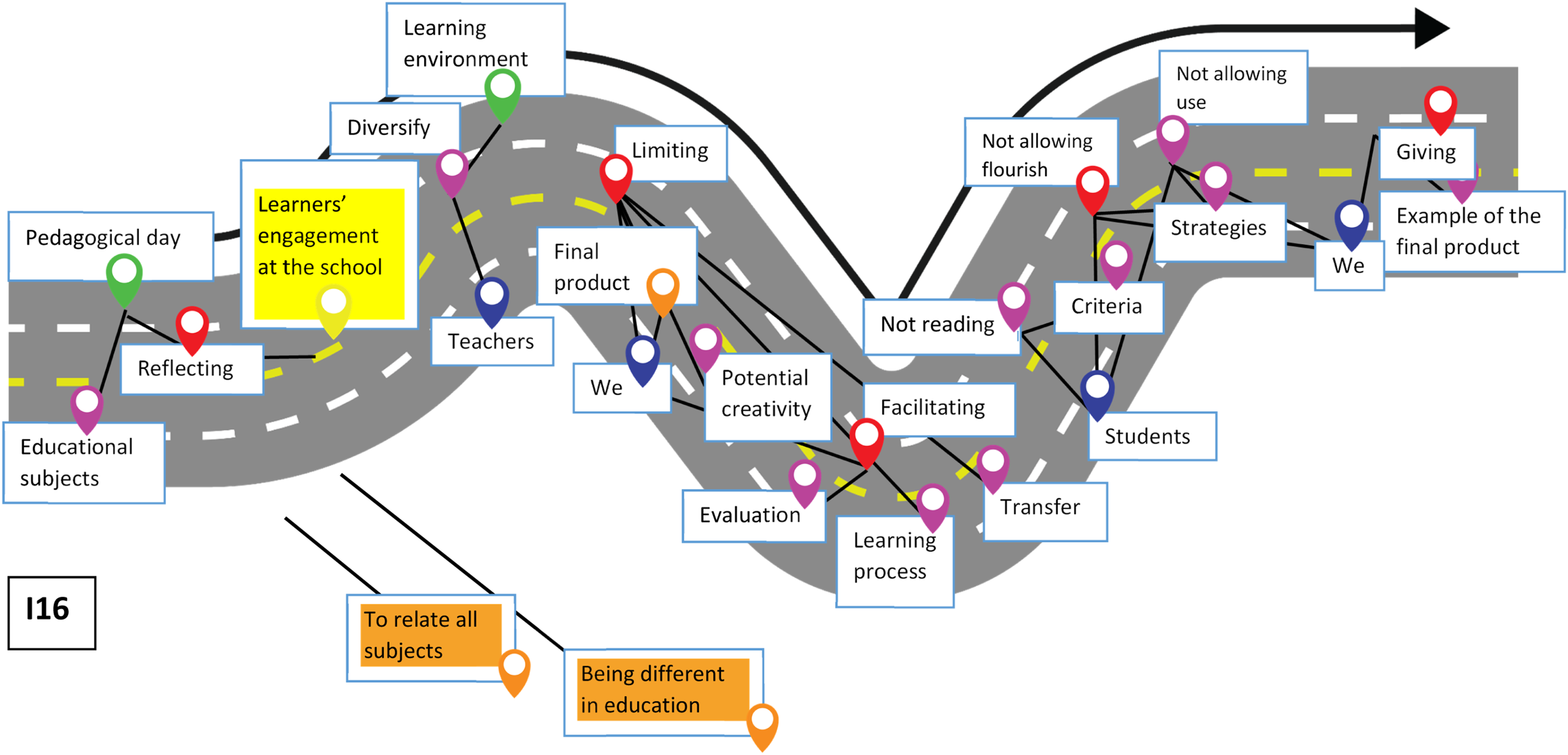
Within each incident, the people, idea, activity, and conditions events were connected to one another as event chains (black connection lines in Figure 1) when the single events related to the same meaningful entity and showed a contextual dependency. The number of event chains varied according to the different incidents. A few chains included all five types. Each time the stakeholders mentioned their wicked problem, it was marked in yellow (Figure 1).
To gain a better understanding of this study phase, we present an incident from the end of the study from Organisation A (marked with I and serial number 16 in Figure 1). The incident was presented both as pictures and as verbal explanations that often included post-it notes. The incident began with a description of a pedagogical day (conditions) that focused on reflecting on (activity) how to change the instruction to manage all educational subjects (idea) and relate them to the central idea of the school, thereby enhancing learner engagement in the school (wicked problem). These events formed the first event chain. The reflection to change the instruction produced practical suggestions to associate all subjects to help solve the wicked problem and create a distinct instruction compared with schools of the majority language.
Then, the teachers (people) travelled to a calm location to continue their reflection on how to diversify (activity) the learning environment (conditions). These events formed the second event chain. Then, the narrative continued with several practical questions that were not considered processual issues. What did the community expect to happen during the next year? How could the current situation be improved? How could the learning experience be more authentic?
In the third event chain, the stakeholders explained their brainstorming. They consistently used the term “we” (people). They recognised that they were limiting (activity) themselves to the final product of learning, as well as their potential and creativity (idea). They noted that they should facilitate (activity) evaluation (idea) and not limit the learning process (idea) or the “transfer” effect (idea). They also speculated about what would happen if they did not present the final product to the students, but instead presented authentic contexts.
In the fourth event chain, the term “we” was again used consistently. This discussion addressed why the students (people) were not reading (activity) the criteria (idea) and why they were given (activity) an example of the final product (idea). The stakeholders recognised that they were not allowing the students to flourish (activity), using (activity) their own strategies (idea).
In this phase, we made some tentative observations about the dynamic system properties in all four organisations. For example, people events seemed to move from individuals and single leaders towards teams and wider stakeholder groups, and from single roles and positions to collective ones, when the common effort became broader and more multifaceted as the process progressed. Activity events seemed to take on more diverse and varied forms according to the demands of the process and alternative solutions to the wicked problems that arose. Next, we introduce the dynamic and systemic patterns, characteristics, and structure of a successful plural leadership configuration process that we found from our data.
Patterns
The next phase was to find the patterns. Consequently, we examined the generalities of plural leadership configurations using a mix of methods (Van de Ven and Poole, 2005). We combined qualitative event analysis of the narratives with quantitative log-linear modelling of successively occurring events to identify patterns in the event chains that were purposeful and more or less typical.
Information from the four roadmaps about the types and ordering of the events was transformed into one quantitative numerical data set. First, occurrences and non-occurrences of people, idea, activity, and conditions events within each incident were quantified by code value 1 if the event had occurred and 0 otherwise (Poole et al., 2000). We omitted outcome events because they did not appear until the process had progressed. Second, the occurrences of events within each incident were ordered according to the information provided by the roadmaps. Figure 2 provides a snapshot of the large data set from the four organisations. A screenshot from the quantitative data.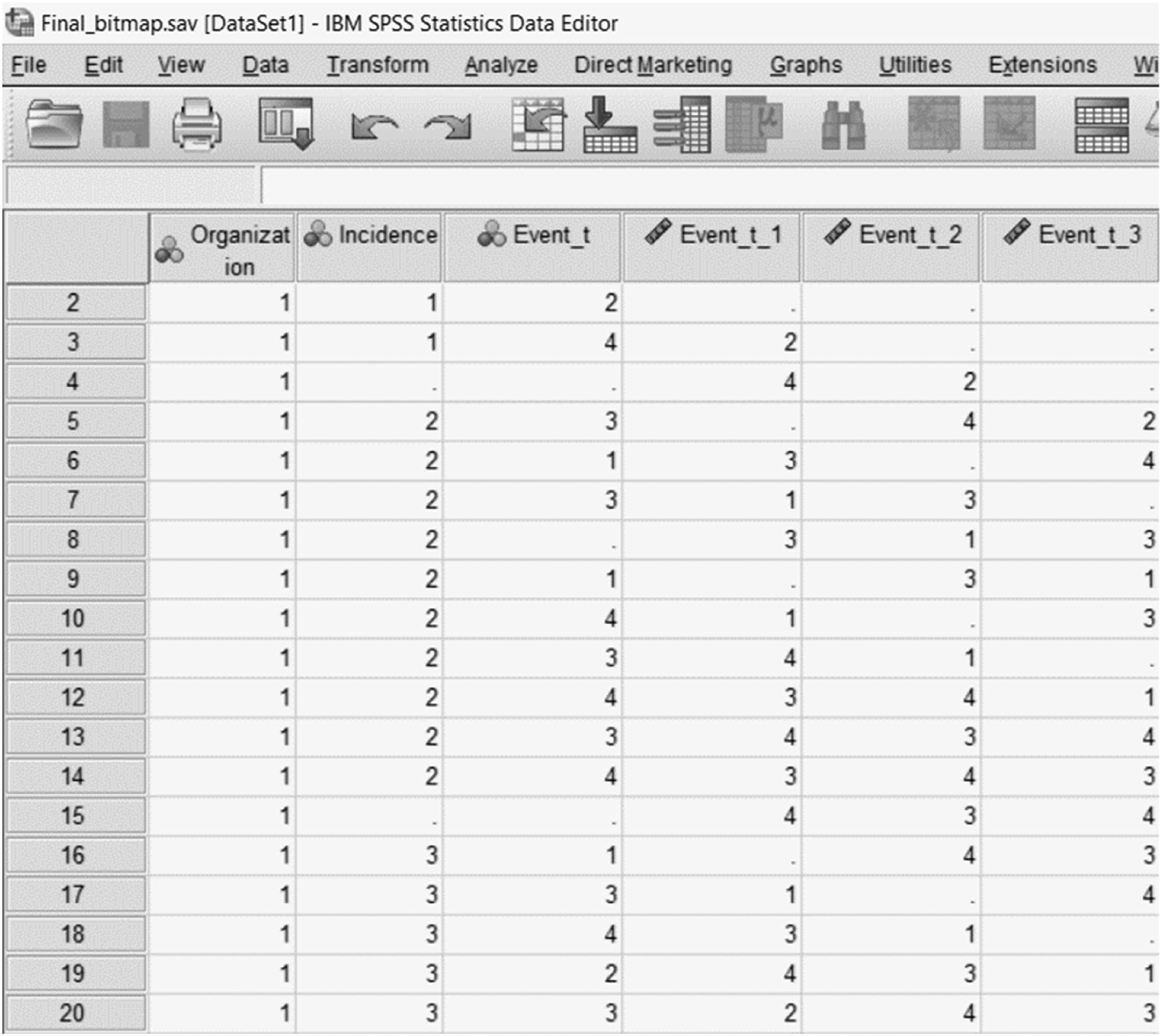
Our variable of interest was the Event. It measured the type of event that occurred in the organisations at time point t (Event t ). The variable had four categories that described the event type: 1 = people, 2 = idea, 3 = activity, and 4 = conditions. For the analyses of successive events, three lagged variables were created from the variable Event t : a variable Event t-1 measuring the event occurring at a time point before Event t (at t-1), a variable measuring the event occurring at time point t-2 (Event t-2 ), and a variable measuring the event occurring at time point t-3 (Event t-3 ).
Our presumption was that the interaction of events was essential to plural leadership configuration. Therefore, our main interest was in the ordering of events, with a focus on three and four successive events. Event chains of two successive events were considered too simplistic and were excluded. The analyses were conducted using a log-linear main effects model. Log-linear models are a family of models that can be used to analyse the interrelationships between two or more categorical variables (Tabachnik and Fidell, 2013). First, we investigated the associations of three categorical variables of successive events (Event t , Event t-1 , and Event t-2 ) by modelling a three-dimensional contingency table of the events (the three event variables were cross-tabulated). The contingency table included 4*4*4 = 64 potential cells, of which 59 cells included at least one observation. One cell referred to a potential combination of three event types.
Second, associations of four successive events (Event t , Event t-1 , Event t-2 , and Event t-3 ) were examined by modelling a four-dimensional contingency table. This contingency table included 4*4*4*4 = 256 cells, of which 135 cells included at least one observation. In our models, the cell counts of the contingency tables were assumed to follow a Poisson distribution. To determine which patterns of three or four successive events were observed more or less often (typical or atypical, respectively) than would be expected if the variables of interest were independent of one another, the adjusted standardised residuals (ASR) were investigated. Adjusted standardised residuals larger than 1.96 were considered typical, whereas ASRs smaller than −1.96 indicated atypical event patterns (Agresti, 2002).
Patterns of three successive events (Only patterns with |ASR| > 1.96 are presented).
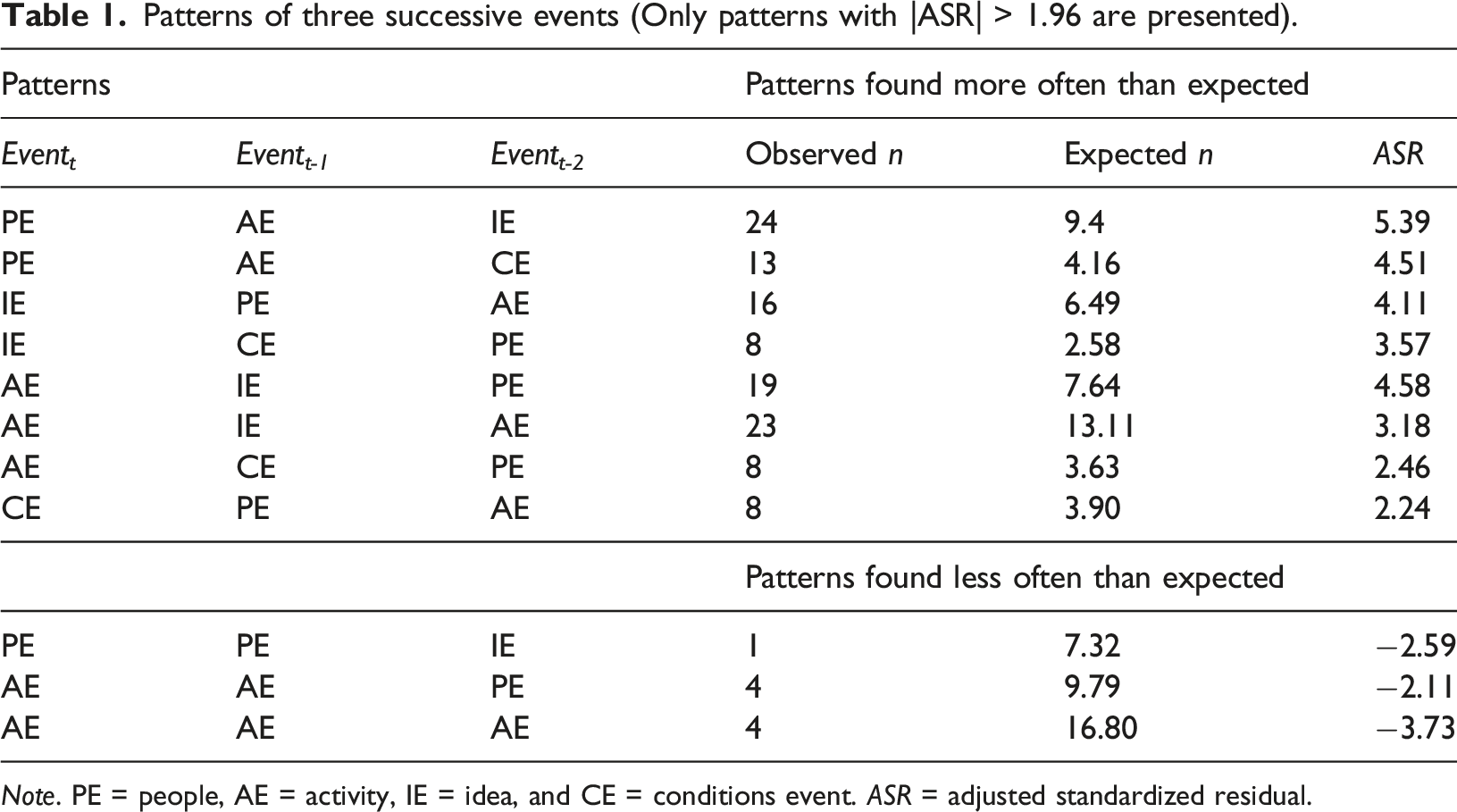
Note. PE = people, AE = activity, IE = idea, and CE = conditions event. ASR = adjusted standardized residual.
In the typical three-event patterns, most event chains (50 chains in three patterns) began with an activity event (Table 1). This event was followed by either idea or conditions events, but idea events occurred more frequently (42 chains out of 50; 84.00%) than conditions events (8 chains out of 50; 16.00%). The next most typical pattern began with people events (two typical patterns covering 37 event chains), followed by activity events in both patterns. The third event in these patterns was either an idea event (covering 24 event chains out of 37; 64.86%) or a conditions event (covering 13 event chains out of 37; 35.14%). Two of the most typical patterns began with an idea event (covering 24 event chains), which was likely to be followed by a people event (covering 16 out of 24 event chains; 66.67%) and less likely to be followed by a conditions event (8 out of 24 chains; 33.33%). One typical pattern began with a conditions event, followed by people and activity events. In the atypical three-event pattern, two or more events appeared. The recurrent event was either an activity or a people event.
Next, we examined the patterns of the four successive events. The likelihood ratio test (
Patterns of four successive events (Only patterns with |ASR| > 1.96 are presented).
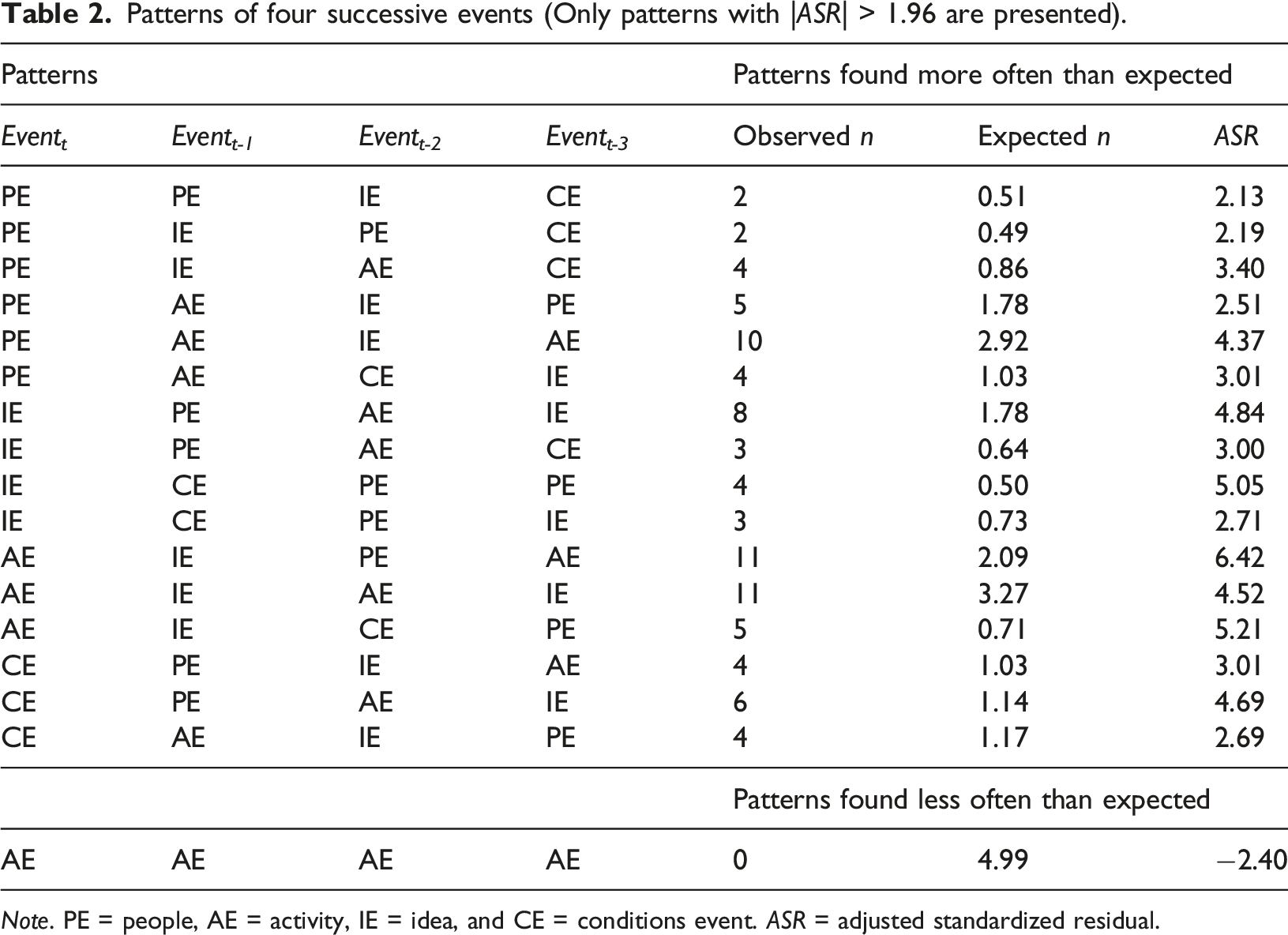
Note. PE = people, AE = activity, IE = idea, and CE = conditions event. ASR = adjusted standardized residual.
Agglomerations of the purposeful patterns
Agglomerations of three-event and four-event purposeful patterns were presumed to indicate important dynamic phases within the plural leadership configuration process (Howe and Lewis, 2005). Therefore, we identified the interaction of events within these agglomerations. We returned to the process narratives and marked the purposeful patterns within each incident. We focused on agglomerations that included: (1) at least two purposeful four-event patterns plus three or more purposeful three-event patterns; or three purposeful four-event patterns plus at least two purposeful three-event patterns; and (2) single events belonging to different purposeful three- and four-event patterns.
We found 16 agglomerations that were spread evenly across the four organisations and altogether represented 39 incidents. Among these agglomerations, there were 64 purposeful three-event and 57 four-event patterns that were also spread across the four organisations. The large number of incidents seemed to be related to the large number of purposeful patterns, but not to the number of agglomerations. Moreover, the agglomerations were spread across several incidents, but they did not appear until the process progressed to a specific stage. The process proceeded to at least one-third in each organisation before the first agglomeration of purposeful patterns appeared. This finding was presumed to strengthen our idea of systemisation in solving successfully wicked problems through a plural leadership configuration process.
Characteristics
We continued with the agglomerations and the purposeful patterns they included to find out characteristics of successful plural leadership configuration. Because the three-event patterns were involved in the four-event patterns, it seemed reasonable to concentrate on the four-event patterns and the most representative ones to increase the reliability of the study. We chose seven purposeful patterns according to the following criteria: (1) the number of agglomerations in which purposeful patterns were included in pointing to strong dynamics; (2) the representativeness of the patterns within at least three organisations (only one pattern was found in two, but with this pattern, the other criteria were significantly fulfilled); (3) the number of incidents in which these patterns manifested; and (4) the number of positive outcome events related to these patterns. The seven purposeful patterns were in the order of significance 1. activity-idea-people-activity, 2. conditions-people-activity-idea, 3. people-activity-idea-activity, 4. people-activity-idea-people, 5. idea-people-activity-idea, 6. activity-idea-activity-idea, and 7. activity-idea-conditions-people.
We concentrated on the events’ interactions in these seven most purposeful patterns. We presumed that they would reveal the dynamic and systemic characteristics of successful plural leadership configuration. The following is a description of this study phase by means of examples from the four organisations. Note that the quotes may include events that do not belong to the seven patterns. One event may also have been included in several patterns.
The first quote comes from a moment towards the end of the process in Organisation A. Alternative solutions to the wicked problem of engaging students in the school and providing them with more opportunities to participate in their own learning processes started to emerge. One highly important aspect was the entrepreneurial approach, as seen in the quote below. It includes an agglomeration of three purposeful patterns presented separately after the quote. As mentioned earlier, the seven patterns were numbered according to their significance. Thus, the smaller the number before the pattern, the more purposeful it is. Regarding events’ interaction, the most dynamic one happened between activity and idea events, enriched by one people and one conditions event. “Yesterday, a second round-table session was held for the students. They had a forum to give their opinions and ideas about entrepreneurship and their learning. The entrepreneurial approach finally arrives here and will allow students to make learning more personalized and engaging, while enabling them to personally undertake projects in the school and in the community”. 2. Conditions-people-activity-idea Yesterday, a second round-table session (conditions) was held for the students (people). They had a forum to give their opinions (activity) and ideas about entrepreneurship and their learning (idea). 3. People-activity-idea-activity …for the students (people). They had a forum to give their opinions (activity) and ideas about entrepreneurship and their learning (idea). The entrepreneurial approach finally arrives here and will allow students to make learning more personalized and engaging, while enabling them to personally undertake (activity)… 6. Activity-idea-activity-idea …to give their opinions (activity) and ideas about entrepreneurship and their learning (idea). The entrepreneurial approach finally arrives here and will allow students to make learning more personalized and engaging, while enabling them to personally undertake (activity) projects (idea)…
The second quote is from Organisation B, at the end of the narrative, when the members tested different solutions to their wicked problem of a sense of hurry. They discussed information that should be prepared to be clear, and how to step out of the cultural, learned, or given concepts of how to arrange their daily routines. In this way, they aimed to find a new paradigm that would have the space to evolve. At the end of the quote, a new wicked problem arises: How to prepare for and be committed to accomplishing mutual decisions? The quote includes an agglomeration of five purposeful patterns, which are presented separately after the quote. Again, the most dynamic interaction happens between activity and idea events, enriched by people events. “We have weekly team meetings for all our groups and a collective one, always on Wednesdays, where every group has a representative and the obligation to pass the information to all team members. We create a memo of the decisions that were taken and leave it on our coffee table to be read and checked. Everyone knows that it’s his/her responsibility to obtain essential information about the meetings. Our weak spot does not seem to be the arranged structure of handling direct information but rather the preparation of and commitment to accomplishing mutual decisions”. 4. People-activity-idea-people …every group (people) has a representative and the obligation to pass the information to all team members (activity). We create a memo of the decisions that were taken (idea) and leave it on our coffee table to be read and checked. Everyone (people)… 1. Activity-idea-people-activity …to pass the information to all team members (activity). We create a memo of the decisions that were taken (idea) and leave it on our coffee table to be read and checked. Everyone (people) knows (activity)… 5. Idea-people-activity-idea …a memo of the decisions that were taken (idea) and leave it on our coffee table to be read and checked. Everyone (people) knows (activity) that it’s his/her responsibility (idea)… 3. People-activity-idea-activity Everyone (people) knows (activity) that it’s his/her responsibility (idea) to obtain essential information about the meetings (activity). 6. Activity-idea-activity-idea …knows (activity) that it’s his/her responsibility (idea) to obtain essential information about the meetings (activity). Our weak spot does not seem to be the arranged structure of handling direct information (idea)…
The next quote from Organisation C deals with alternative solutions to making the organisation’s instructional strategies a natural part of their work. One solution was that they exploited external expertise and realised that more multiform collaboration between the teachers was necessary. The quote includes an agglomeration of four purposeful patterns. As before, the most dynamic interaction takes place between idea and activity events, enriched by people events. “We also had an external lecturer who has been working a lot with genres in schools who talked about that. She specifically spoke about the so-called circle model. It’s a model that is based on introducing and gathering facts together with the class, and also creating an example text together before the students write texts on their own. During this year, the teachers also once did colleague observations to study how a colleague works with genre-based instructions”. 3. People-activity-idea-activity …an external lecturer (people) who has been working a lot with genres in schools who talked about that (activity). She specifically spoke about the so-called circle model (idea). It’s a model that is based on introducing and gathering (activity)… 6. Activity-idea-activity-idea …has been working a lot with genres in schools who talked about that (activity). She specifically spoke about the so-called circle model (idea). It’s a model that is based on introducing and gathering (activity) facts (idea)… 4. People-activity-idea-people …together (people), and also creating (activity) an example text (idea), together before the students (people) … 1. Activity-idea-people-activity …write (activity) texts on their own (idea) … During this year, the teachers (people) also once did colleague observations (activity)…
The final quote comes from Organisation D. It is from the end of the process when the members were proposing alternative solutions to refine their role and task and improve their organisational structure and operations, and, in this way, better manage economic constraints. This was the only organisation where we found no agglomerations and only one purposeful pattern; however, it was the most significant one. We will return to this finding in the Discussion section. 1. Activity-idea-people-activity …Establishing (activity) instructions (idea) for teachers who are planning (people)… gathering (activity) the instruction materials…
Structure
Finally, the seven purposeful patterns representing all four organisations were connected. We wanted to determine whether there was a generalisable structure that would describe successful plural leadership configuration (Figure 3). We examined the seven patterns’ connections according to the number and direction of the relationships between the events. We used the symbol ¤ to indicate the strength of each connection, along with the width of the line. As Figure 3 shows, the strongest connections were from activity to idea (8 ¤) and from people to activity (5 ¤). Fewer connections appeared between idea and any of the other three events (people, activity, or conditions) and between conditions and people. No connection was found between people and idea or conditions, activity and people or conditions, or conditions and activity or idea. Characteristics and structure of successful plural leadership configuration.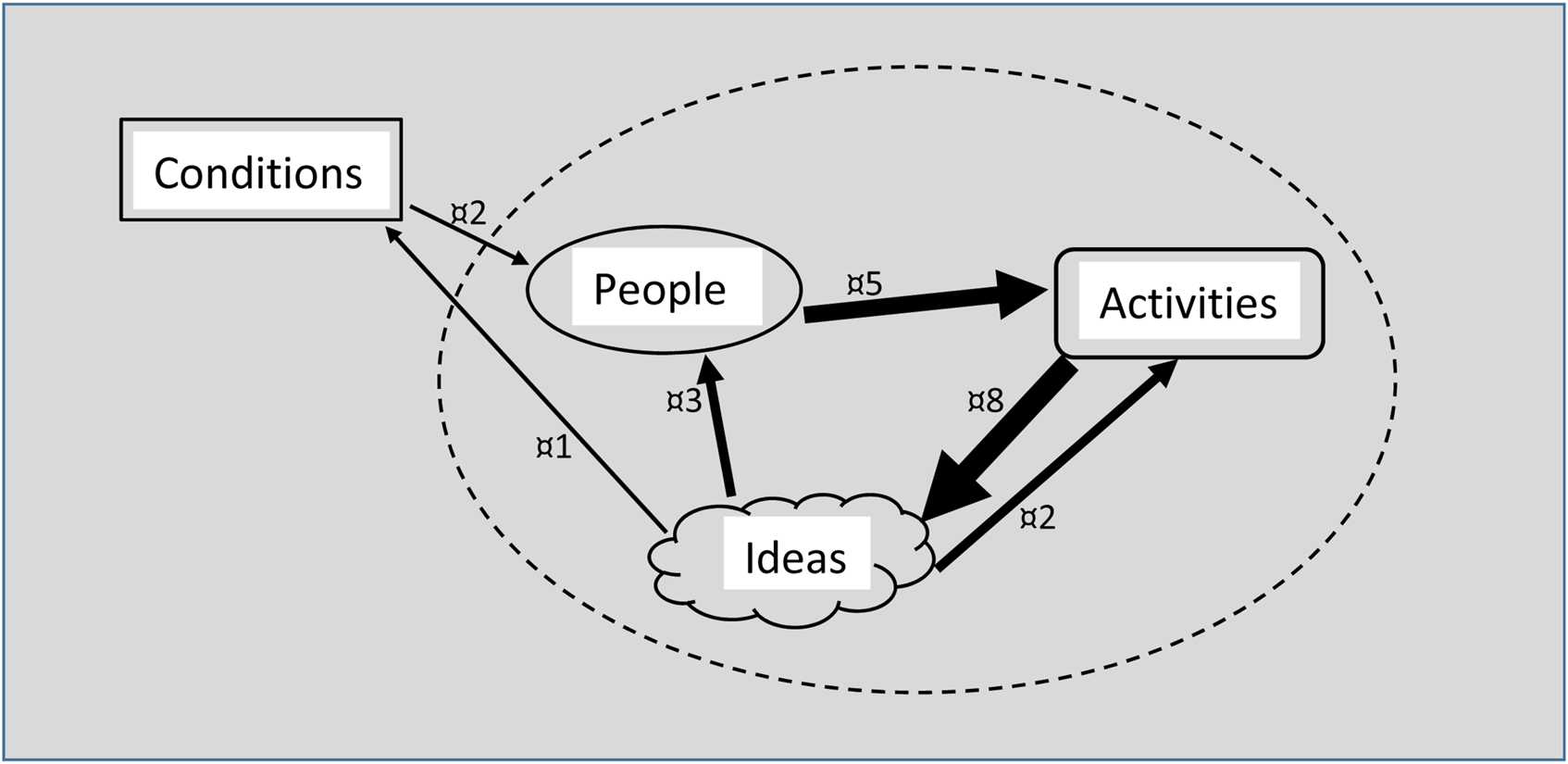
We realised that the seven purposeful patterns seemed to form a structure (Figure 3). Its core was situated between activity and idea events, with eight connections altogether from activity to idea, and two from idea to activity. The direction from activity to idea proved essential. However, the existence of a connection between idea and activity was not sufficient for successful plural leadership configuration. Activities and ideas had to be connected to people, which seemed to function as moderators between the other events. In addition, it seemed important that activity events did not have a direct impact on people. Conditions events seemed to play a minor role and were significant only when they were connected to people events or appeared after idea events. Importantly, people, activity, and idea events formed a kind of “triangular drama” (the circle dashed line in Figure 3) in which the most important connections existed from activity to idea and from people to activity. Connections from idea to activity and people seemed to enhance successful plural leadership configuration.
According to our selection criteria, the patterns of activity-idea-people-activity and conditions-people-activity-idea seemed to be more powerful than the others. Possible reasons for this might be as follows. First, these were the only two patterns that had a connection to outcome events in our data. Second, the pattern of activity-idea-people-activity started with the most powerful connection from activity to idea and was succeeded immediately by the people moderator. The pattern of conditions-people-activity-idea ended with the relationship between activity and idea, preceding people. Conditions events always required a connection to people capable of productive activities that resulted in new ideas.
We also found some atypical, not purposeful, patterns: people-idea-idea, activity-activity-people, activity-activity-activity, and activity-activity-activity-activity. In these cases, the connections between activity and idea were missing, and people did not have a moderator role.
Discussion
The aim of our exploratory process study was to search for dynamic and systemic properties of successful plural leadership configuration. By successful, we meant finding alternative solutions to wicked problems and bringing about and designing desirable organisational functions and endeavours and outlining the future. Importantly, successful plural leadership makes a positive difference to what is already there and produces outcomes, capabilities, or functionalities that are qualitatively different from the original ones (Acton et al., 2018).
We claimed that the patterns, characteristics, and structure of successful plural leadership configuration could be studied through organisational experiences of people, idea, activity, and conditions events’ interaction, as chains of successive events in solving highly challenging wicked problems. Consequently, we conducted an exploratory process study within four educational organisations in three countries where we examined successful real-life plural leadership configurations executed across levels, duties, and roles.
At the end of our study, we discussed the outcomes with the organisations. In Organisation A, the successful plural leadership configuration became evident with the considerable increase of students, which was indeed due to plural efforts. In Organisation B, the sense of hurry was evidently decreased. One enjoyable consequence was that they bought a rocking chair and agreed that anyone who felt stressed could sit there without having to explain or feeling ashamed. In Organisation C, the staff realised that the students had started to write better texts, and they were noticeably more active. They also succeeded better in national tests. The teachers also noticed that they received more positive responses from the students. Organisation D developed its daily work by establishing several projects that it experimented with to change the existing organisational culture and, in this way, presumed to be able to realise courses that otherwise would have been cancelled. However, the process was still ongoing by the time our study was finalised.
We realised that dynamic and systemic properties of successful plural leadership configuration really existed. The properties comprised at least seven patterns that represented different ways of responding to a wicked problem. As for characteristics of these patterns, the dynamic interaction between activities, ideas, and people proved crucial. These three formed a structure. It indicated the particular importance that people had real opportunities to execute productive activities that then resulted in new ideas, and that these ideas could return to the people to be implemented. Surprisingly, conditions events only supported the process.
Successful plural leadership configuration seems to require committed people who share responsibility and have a real opportunity to act and create new ideas. Without these prerequisites, plural leadership might not be capable of producing desirable solutions to wicked problems. When we examined the narratives, this presumption was provided with some confirmation. Of the 38 outcome events, 24 were directly connected to people, and 14 were indirectly connected. How people events developed was also essential: from the individual to the collective, from single to collaborative, from inside to outside, from general to more specific, and from formal to informal. Concentrating on contextual issues, for example, establishing new plans or programmes or (re)structuring other organisational issues without committed people and their activities and ideas, seemed inefficient.
With respect to the limitations of our study, the small size of our data set must be considered for at least two reasons. First, the quantitative analysis of four successive events was somewhat challenging, as 47.27% of the cells in the four-way contingency table were empty (there were no observations). Second, although there was no statistically significant difference in the marginal distribution of the four-way contingency table among the four organisations, a more detailed analysis of the equality of the contingency table among the organisations could not be conducted. Therefore, although we presumed that the successful plural leadership configuration was similar across organisations, this could not be concluded with certainty.
In addition, Organisation D engaged only in the pattern of activity-idea-people-activity, although it was the most powerful one. One possible explanation is that their process was unique, owing to a series of organisational merges that they experienced during the research project. This suggests that the organisation-specific nature of experiences might also play an important role and, in this way, influence the results. Finally, the number of agglomerations of the event chains and the number of incidents and purposeful patterns were dissimilar across the four organisations. Some had approximately the same number of agglomerations and patterns, but they reported a different number of incidents, which may have influenced their processes and impacted our results. Nevertheless, according to the process narrative data, although their wicked problems were different, the event chains were quite similar.
Conclusion
Our results should be considered as only tentative and exploratory in nature. Although it is essential to test the idea of a plural leadership configuration as a collective, collaborative, emergent, and becoming process in today’s changing contexts, which produce highly challenging wicked problems and challenge leadership, more research with larger samples is needed, along with specific contents of diverse, also negative, processes. However, we argue that understanding the process to develop according to the events’ order as systemic patterns, characteristics, and structure might help other organisations and their leadership to concentrate on important event interactions and to guide their processes towards more successful solutions.
Holm (2022) argues that one reason for not seeing changes of practice is the potential lack of alignment between formal managers’ assumptions and the principles of plural leadership. We propose that the lack could be strengthened by understanding the systemic and dynamical nature of a successful plural leadership process. Thus, we propose that our results may be applicable to other types of public or private organisations in solving highly challenging wicked problems.
For example, Sullivan et al. (2012) examined leadership for collaboration in the public sector as a situated agency. One issue they highlight is negotiating within contexts of dynamic complexity when facing wicked issues and how this could weaken shared meaning and collaborative strategies. Packendorf et al. (2014) adopted the process perspective and studied project leadership during organisational change as a process of becoming within the private sector. Although these are other important viewpoints in leadership studies, we suggest that considering the dynamics of the plural leadership configuration process could facilitate the treatment of especially wicked problems and allow for more successful responses to the demands of society.
Footnotes
Declaration of conflicting interests
The author(s) declared no potential conflicts of interest with respect to the research, authorship, and/or publication of this article.
Funding
The author(s) received no financial support for the research, authorship, and/or publication of this article.
