



Abstract
In this Curated conversation, we bring together five scholars with a shared interest in collaborative approaches to grand challenges but who offer distinct approaches and foci. Our intention is to deepen the conversation between different communities in management research, with the ultimate objective of exploring potential avenues for mutual inspiration, learning, and collaboration. In their individual essays, the contributors to this conversation offer pointed insights into different aspects of collaboration in the context of grand challenges. In addition, we identify four pivotal themes across these essays, which, so we argue, constitute suitable foci for scholarly collaboration across community boundaries with the potential to recenter the “big picture” of collaboration. Our hope is to facilitate cross-pollination and thereby generate additional rigorous, realistic, and actionable approaches to the topic.
Introduction: Complementary Approaches to an Opalescent Phenomenon
Stephan Leixnering, Dennis C. Jancsary, and Johanna Ayrault
Inequality, health & well-being, decarbonization, sustainability, digitalization—these societal issues have increasingly come to be labeled by management researchers as “grand challenges” (Brammer et al., 2019; George et al., 2016; Gümüsay et al., 2022). The notion of a grand challenge, namely to define a central problem in order to focus attention on it, can be traced back to the great German mathematician David Hilbert. Later the idea was expanded beyond its original mathematical ambit (Omenn, 2006) to become a unifying label for the most pressing social and environmental issues that our societies face today. Conceptually, grand challenges are similar to so-called “wicked problems” (Rittel & Webber, 1973; e.g., Dorado et al., 2022)—both are ambiguous, incomplete, constantly changing, and normatively charged. Due to this inherent complexity, most contributors to the debate on grand challenges agree that they can only be suitably addressed through some sort of collaboration involving diverse actors (e.g., Ferraro et al., 2015; Pradilla et al., 2022) rather than interventions by, on the one hand, isolated individual such as politicians or activists, or, on the other, collective actors such as governments or corporations. For this reason, scholarly discourse has come to focus on themes of collaboration, cooperation, and cross-actor relationships in addressing grand challenges.
Despite the agreement on collaboration as key, the burgeoning literature on grand challenges has come under criticism for its ambiguity and lack of clarity. For example, Seelos et al. (2022, p. 263) highlight the multiparadigmatic character of management research as a potential reason to explain why “scholars grounded in different research principles do not want to understand and engage with each other.” Additionally, recent critical voices have warned against a naïve enthusiasm for collaboration, pointing out that it frequently teeters “on the edge of failure” (Grimm & Reinecke, 2024) and is accompanied by “traps” (Couture et al., 2023). The starting point for this Curated conversation, accordingly, is the somewhat paradoxical and striking observation that while collaboration is widely accepted as a primary requirement for tackling grand challenges, there is in fact limited agreement and cross-pollination—or collaboration—among scholars with different lenses on this topic.
The framing and theorizing of collaboration is currently fragmented, with different communities espousing distinct theories, vocabularies, and foci. For instance, collaboration is debated in literatures on multistakeholder initiatives (e.g., Everett & Jamal, 2004; Gray & Purdy, 2018), cross-sector partnerships (e.g., Arslan et al., 2024; Clarke & Fuller, 2010), organizational development and change (e.g., Pavez et al., 2022), robust collective action (e.g., Alexander, 2020; Gehman et al., 2022a), decision-making in crises (e.g., Gimenez et al., 2018; Kornberger et al., 2019) as well as innovation and co-creation (e.g., De Vaujany et al., 2020; Olk & West, 2023; Scherer & Voegtlin, 2020). Scholars have adopted various conceptual perspectives on collaborations and partnerships. For example, public administration scholars focus on collaborative governance of public- and private-sector actors (e.g., Cristofoli et al., 2022: Emerson et al., 2012) while other communities stress the importance of organizational design (e.g., Baumann et al., 2023) and strategy (e.g., Bansal et al., 2025), emphasize the active role of business corporations in collective responses (e.g., Pop et al., 2023), or highlight the relationship between engaged scholars and managers (e.g., Banks et al., 2016; Sharma & Bansal, 2023).
This brief and necessarily incomplete list of relevant foci illustrates the breadth and wealth of the discourse in management studies regarding collaboration for addressing grand challenges. Beyond the inherent ambiguities that characterize most academic fields, the risk of such conceptual fragmentation is that management research gets stuck in siloed perspectives, masking the common phenomenon that all these perspectives seek to explore. Therefore, we believe that collaboration across differences is not only important in practice, but also in scholarship. The generation of rigorous, realistic, and actionable approaches to collaboration for tackling grand challenges will benefit from more in-depth reflection at the intersection of multiple scholarly communities, thereby transcending compartmentalized expertise and offering a better understanding of the “big picture.”
In contrast to other attempts at integration (e.g., George et al., 2024; Gümüsay et al., 2022; Kunisch et al., 2023; Seelos et al., 2022), our goal is not to provide another literature review or add to the already impressive body of empirical and conceptual work. Instead, we hope to contribute to scholarship in a rather unconventional way. Our starting point is not a specific gap or conceptual puzzle in literature on collaboration for grand challenges; rather, we wish to foreground pivotal themes for which relevant communities already possess detailed insights. Today there is little awareness (we believe) that these crucial topics and issues have the potential to bridge communal divides and—in analogy to the (in)famous parable of the blind men describing an elephant—increase our potential to see the whole through the parts. In this metaphor, each pivotal theme is an elephant, and each sub-field has access to a wealth of insights on the part it specializes in. By opening and sketching spaces for broader conversations across scholarly communities, we seek to inspire researchers to bring their insights together.
For this purpose, we establish and generatively interrogate a conversation between scholars who have, over the past years and decades, intensely engaged with the topic of grand challenges in various ways and with different emphases. In particular, we draw on the lively debates and insights that emerged during the symposium “The Relational Dimension of Tackling Grand Challenges: Debating Collaboration and Cooperation,” which took place in August 2023 at the Academy of Management's Annual Meeting in Boston. During the symposium, the contributors to this Curated piece discussed the topic from a range of angles and perspectives to reveal generative overlaps, tensions, and complementarities. In this conversation, we intend to highlight pivotal themes that characterize collaboration for tackling grand challenges in a more holistic manner and thus create integrative points for future conversations.
In this spirit, our introduction to the Curated conversation proceeds as follows: First, we provide some guidance through the featured essays by briefly characterizing the primary focus of each one. Second, we distill designability, normativity, interdependency, and scaling as the prominent pivotal themes emerging across the five essays as well as the wider literature. Finally, we end our introduction with a few concluding insights.
Some Guidance Through the Curated Conversation
The contributions to this conversation engage with some of the most pressing questions and research lacunae on collaboration for tackling grand challenges:
What Actually Is a Grand Challenge?
The broad engagement and increasing interest within management studies for the issue of grand challenges has led to a proliferation of concepts, potentially to the detriment of analytical traction. Discussing the resulting diverse and ambiguous understandings of grand challenges (e.g., Dorado et al., 2022; Pop et al., 2023), scholars have bemoaned a lack of clarity that limits the potential for impactful research (e.g., Seelos et al., 2022; but see Gehman et al., 2022a; Gümüsay et al., 2022, for counter perspectives). What unites most discussions on definitional issues is an understanding that grand challenges vary across core dimensions, and that it may be useful to distinguish different forms and types. One important contribution to a focused and nuanced conversation on collaboration and coordination for tackling grand challenges is provided by Martina Linnenluecke's essay, which critically engages with common understandings of and attributions to grand challenges, disentangling the concept according to its scope and contextual specificities. Her essay challenges the value of any overarching label, suggesting that “grand challenges” be further qualified even in management research. One crucial idea here is that when we distinguish distinct categories of challenge, this foregrounds different actors, forms of collaboration, and knowledges. An important link to the other pieces in our conversation is the notion that challenges can shift from one category to another, creating additional complexities that require flexibility in collaborative response.
How Can Collaboration Be Achieved?
While collaboration is often celebrated as a prime solution to grand challenges, how exactly it should be established and maintained remains, at best, a matter of contention (e.g., Baumann et al., 2023) and, at worst, a black box. Collaboration rarely happens by itself—it must be facilitated and organized (e.g., Alexander, 2020; Kaufmann & Danner-Schröder, 2022). Recent work has stressed that classical stakeholder approaches fall short here, since, firstly, these largely center on the perspective of the firm instead of starting from the issue or problem (e.g., Berrone et al., 2023) and, secondly, mostly ignore the natural environment and planetary boundaries. Ignacio Pavez's essay addresses the general preconditions for successful interorganizational collaboration as well as the dynamics of collaboration processes across several phases. One particularly valuable piece of the puzzle for this Curated conversation is the insight that collaboration needs to be designed—and can only be evaluated—with a specific vision in mind. For Pavez, the vision is to foster a just, resilient, and thriving society.
How to Set Up Collaborative Governance?
When the focus is on collaborative solutions, we tend to overlook the fact that fragmentation, differentiation, and contradiction, which are mostly viewed as barriers to collaborative efforts, are not to be bemoaned but actually celebrated as an essential feature of modern, pluralist societies. A central concern in tackling grand challenges is thus the issue of governance (e.g., Pop et al., 2023), which can be effective when it enables networked action, collective processes, and small wins (Dentoni et al., 2018). Some scholars have already focused on the role of actors who convene and orchestrate collective action, and how they achieve the necessary robustness and flexibility in their efforts to meet uncertainty and complexity (e.g., DiVito et al., 2021). At the same time, calls have emerged for a stronger consideration of polycentric and hybrid governance arrangements (e.g., Reypens et al., 2021). Renate Meyer contributes to our set of essays by highlighting the necessary and inherent tension between the need for diverse actors to act in concert when addressing new “species” of crises and the inevitability of fragmentation in the form of governance gaps, which is a typical feature of complex social systems. Fragmentation and contradiction become salient whenever a multitude of different actors engage in collective action. Accordingly, the insight that grand challenges can never be conclusively solved but only continuously addressed not only stems from the dynamic nature of challenges themselves, but also from the necessarily imperfect character of collaborative governance.
How Do Problems and Solutions Interact?
The focus on collaboration requires clarification of what a relational stance toward grand challenges can and should entail. Recent contributions (e.g., Couture et al., 2023; Grimm and Reinecke, 2024) have rightly challenged the idea of collaboration as a stabilizing force over time, given that overcoming a grand challenge may in fact require a transformation of current conditions. Others have emphasized that, in the context of grand challenges, constant change not only occurs in external environments but also among and within collaborating organizations, which requires a shift in governance arrangements (e.g., DiVito et al., 2021) and a willingness amongst actors to adjust their roles in line with evolving collaborative engagements (e.g., Alexander, 2020). Going one step further, Joel Gehman's piece reminds us to examine questions of relationality and temporality, as it is not only challenges that are dynamic but also actors, collaborations, and implied entanglements, which should all be understood as constantly evolving. This means that trajectories and understandings of the respective challenges are shifting too, further undermining the idea of collaboration as a kind of desirable end state or universal solution. Instead, such a perspective foregrounds temporality and the politics of values.
And What About Power?
Recent work on multistakeholder collaborations has criticized the blind spot around power asymmetries, which potentially results in naïve approaches to collaboration (e.g., Everett & Jamal, 2004; Gray et al., 2022). Not only do unequal distributions of power potentially hamper successful collaboration; systemic change often requires a substantial shift in and redistribution of power (e.g., Dentoni et al., 2018). For instance, in their call for reflexive and participative governance, Scherer and Voegtlin (2020) encourage greater empowerment of stakeholders, who remain marginalized in standard governance models. Against this backdrop, Barbara Gray's contribution provides much-needed critical engagement with the idea of collaboration as the only way forward, powerfully elaborating how this is itself a complex achievement that requires a favorable configuration of meanings and power in the respective field. Her essay stresses the lack of any shortcuts to constructive collaboration, and that any engagement with grand challenges may first require an honest assessment of the relational status quo, potentially revealing the need for other forms of action to create a fertile soil for collaboration through shifts in power structures.
Calling for Scholarly Collaboration in Addressing Four Pivotal Themes
With their diverse backgrounds and foci, the collected essays paint a nuanced overall picture, outlining crucial tensions and complementarities with generative potential. Across this conversation, we highlight four pivotal themes that can function as “gravitational centers” for future conversations across relevant scholarly communities, since the richness of these themes cannot be fully addressed by a single perspective. As issues of designability, normativity, interdependency, and scaling are inherently interwoven, conversations can be usefully conducted across them. Together, they constitute one way of characterizing the “big picture,” which would benefit from a collaborative approach across communities.
Designability
A first pivotal theme in the conversation is the designability of collaborations. If design has always been central to the literature on collaborations (e.g., Bryson et al., 2006), the context of grand challenges adds the backdrop of ungovernability and uncertainty. Recent research has suggested viewing organizational design as problem-solving systems (e.g., Baumann et al., 2023) that foster “opportunities for creating complementarities across organizations” (Ambos & Tatarinov, 2023, p. 255). While acknowledging the complexity of grand challenges, these scholars are optimistic about the potential of achieving the requisite variety in designs by moving from classic organizational design to ecosystem solutions. Others, however, have warned that collaborative governance, rather than simply adopting a complexity-matching design, in fact requires constant change and adaptability (e.g., DiVito et al., 2021; Hayter & Link, 2020). The main tension arises when the need for a clear design and governance structure clashes with the impossibility of ultimately controlling collaborations (e.g., Quayle et al., 2019).
Precisely because this tension is well known in the literature, we suggest that it offers a great opportunity for different communities to interact generatively. Experts on organizational design, governance, ecosystem management, organizational networks, and similar topics will likely discover shared interests and complementary analytical strengths. This provides ample motivation to engage jointly on the tricky task of designing for structured and stable collaborations, all the while retaining an awareness that the deeply complex and dynamic nature of grand challenges calls for considerable, ongoing flexibility in forms and trajectories. This pivotal theme encompasses classical questions related to centralization, formalization, and configuration. It also relates to the problem of balancing standardized, tailored designs with unintended effects and informal dynamics. The context of grand challenges adds to and exacerbates issues of multilevel and multisector collaborative design, as well as clashes between different entrenched governance modes and multiple, overlapping relations of dependency and power. While no single community has all the answers, together they bring a wealth of insights to the table.
Normativity
Our second theme encompasses diverse perspectives on the normativity of collaborative practices and outcomes
While the problem of the evaluative nature of grand challenges is broadly known, this is still treated in a rather fragmented manner. We believe that scholars across different communities including (but not limited to) strategy, organization theory, public administration and policy, and nonprofit management could generatively collaborate on the related questions of evaluation, culture, and ethics. This may provide novel, more integrative perspectives on collaboration in contexts where the playing field is uneven, even in the absence of a central authority. Conflicts over appropriate norms for assessing the success of partnerships become more salient the larger these partnerships grow. Such discussions could even help answer questions such as: Who legitimizes specific forms of collaboration? (e.g., Olsen et al., 2016); or: Who should “watch the watchers”?, that is, to whom is the collective accountable (e.g., Scherer & Voegtlin, 2020)? If different scholarly communities contrast their respective understandings of what is normative in collaborations, this could generate in-depth, contextually grounded insights into questions of value(s) and the respective societal fault lines as well as foster useful debate.
Interdependency
The third theme permeating the conversation concerns interdependency, specifically the need to further expand the types of interdependency we usually consider in the context of grand challenges. The importance of interdependency has been widely acknowledged in the literature, as has the need for actors to manage it, for instance through the development of specific dynamic capabilities (e.g., Dentoni et al., 2016) as well as through flexible, hybrid, or reflexive governance (e.g., DiVito et al., 2021; Reypens et al., 2021; Scherer & Voegtlin, 2020). As our conversation reminds us, grand challenges are themselves interdependent, meaning that any individual challenge cannot be disentangled from related ones. The main tension in this pivotal theme is the question of how to deal with multiple, overlapping interdependencies without resorting to simplistic ceteris paribus assumptions or locating theories too far from what practitioners would perceive as actionable insights.
We believe that greater debate between scholars focusing on paradox, complexity, process and related theories could help generate insights on this pivotal theme. A particular focus could be on the exploration of how grand challenges can shift (for instance, from local to global level), requiring a simultaneous change in collaborative solutions. In addition to links between challenges, it is essential to remember the complex and dynamic relationships existing between actors and solutions, as well as interdependencies between forms of governance, as this directs our attention to gaps between these. Moreover, problems and solutions are never entirely independent; indeed a solution may change the nature of the initial problem it was meant to address. These different forms and dimensions of interdependence show why collaborative ways of addressing grand challenges can always only be provisional and incomplete. Clearly, the dynamics and multidimensionality of interdependencies call for ongoing, organic adjustments of collaborative efforts and their modes of governance. Cross-community conversations create a broader fund of knowledge on how to engage with multifaceted interdependencies, which may then generate more broadly applicable insights.
Scaling
Finally, the issue of scaling ties into most of the previous themes. Dentoni et al. (2018, p. 334) suggest that the “relationship between reaching breadth/depth of systemic change and addressing societal problems is particularly challenging to understand.” Questions of scaling are strongly linked to centralization and decentralization (e.g., Bansal et al., 2025; Reypens et al., 2021), as well as pre-planned and adaptive governance designs (e.g., Quayle et al., 2019). Our conversation emphasizes the considerable variation in the scope of grand challenges, ranging from local to global issues. As wicked problems are inherently ungovernable, it is futile to strive for perfect orchestration through central steering. Instead, we need to be aware of the respective governance gaps, organizing with rather than against these imperfections. The main tension, accordingly, is how to adapt successful solutions when the scale of a grand challenge changes, or when we wish to apply these to a different grand challenge on a completely different scale.
As with our other pivotal themes, the problem of scaling is widely known and researched. The development of novel solutions would thus strongly benefit from the insights and expertise of scholars researching, for instance, (inter-)organizational design and governance, (social) entrepreneurship, international business, and social movements. Such knowledge could shed additional light on situationally appropriate strategies of “scaling up” collaborative solutions and translating these from one context to another; or indeed “scaling down” collaborations, which may also sometimes be necessary. These discussions could further integrate important insights on how upscaling makes collaborations increasingly ungovernable as conflicts emerge over appropriate norms. Sharing ideas on effective meta-governance to address these dynamics is equally important. Additionally, scaling exacerbates the inherently dynamic nature of design problems. These become even more salient when the distance between actors grows, the character of issues changes, and the stakeholders pool diversifies. This means that novel power dynamics and governance gaps need to be addressed, including questions of accountability.
Key Insights: Collaboration Is Both a Solution and a Problem
We end our introduction with a word of warning. While recent literature confirms the insight that collaboration is not merely a solution but also a complex social achievement (e.g., Couture et al., 2023; Ferraro et al., 2015; Grimm and Reinecke, 2024), we believe that our conversation—specifically seen through the prism of the four pivotal themes —suggests an even harsher truth: Some forms of collaboration can actually undermine efforts to address grand challenges; indeed, it may be nearly impossible to determine at the outset, which forms of collaboration are helpful and which harmful.
This can be attributed to the inherently normative nature of ideas about collaboration, which reduces the likelihood that their design and outcome will be perceived as win-win solutions across diverse sets of stakeholders. In fact, collaborations that reproduce institutionalized power structures may exacerbate existing grand challenges, especially if these challenges themselves “feed on” societal divisions and entrenched inequalities. Ambitions of design and control that lead to harmful centralization and oversteering spawn forms of collaboration that reduce rather than enhance capacities for collective action in the face of complex challenges. However, opportunities for deliberation and reflexivity (e.g., Scherer & Voegtlin, 2020) may be restricted at times of crisis (e.g., Nowell et al., 2018). Further, collaborations need to be tailored to problems in both form and scale; for instance, there may be just too many fingers in the pie when it comes to community grand challenges, for which in-depth contextual knowledge often trumps abstract expertise. Finally, the specific type of collaborative approach may fundamentally alter the nature of the original challenge: Collaborations do not necessarily solve grand challenges but may instead alter or redirect them by creating new forms of interdependency and/or lock-ins, meaning that we need to pay more attention to how some forms of collaboration exacerbate the impact of challenges on various stakeholder groups. All of this suggests that we, as scholars, could benefit from a deeper engagement with cases of failed collaboration and a better understanding the dark side of collaborative designs as well as their benefits.
Despite this rather bleak first learning, our second learning is that—at least in management research—we possess an embarrassment of riches in terms of insights that could be further unlocked through more systematic collaboration across community boundaries. Two factors that may hamper such cross-pollination is the thicket of different conceptual ideas (e.g., Dorado et al., 2022; Seelos et al., 2022) as well as the variety of labels for collaborative solutions (from multistakeholder initiatives to cross-sectoral and inter-organizational collaborations, collaborative governance arrangements, ecosystem solutions, collective robust action, etc.). Of course, we do not dispute the usefulness of distinguishing the specificities of epistemic communities and diverse approaches; these labels certainly highlight crucial differences in conceptual foundations as well as explanatory mechanisms and models. Yet they also background and partially obscure the shared key issues that underlie collaborative designs (as outlined in our pivotal themes). If a shared language seems unrealistic, we at least plead for a willingness to keep the “bigger picture” in sight, and for an appreciation of how insights from unexpected directions may help generate more robust theories and policy recommendations. In terms of conceptual diversification and fragmentation, we will go out on a limb here to suggest that communities other than our own may in some cases already possess vocabularies that would work just as well in our own context. These might provide additional opportunities for synergies—assuming we can resist the temptation to coin yet more novel terms.
All of this leads to the conclusion that—both in practice and academia—collaborating to tackle grand challenges inherently entails “governing the ungovernable.” Thus, we do not call for novel steering fantasies or ever more complex governance models. Collaboration for grand challenges will in all likelihood never be “solved” or “finished,” but remain an ongoing process, as will research on the topic. Instead, it is important to acknowledge the various forces and mechanisms that facilitate, shape, and restrict the achievement and constant re-negotiation of collaborative outcomes. Accordingly, we call for a better identification, understanding, and navigation of grand challenges rather than any futile attempt to eliminate them. For this purpose, we hope that management scholars will be inspired by our Curated conversation to reach out across communities and literatures when studying the urgent theme of collaboration for tackling grand challenges. Ours is but a modest step toward this goal—but one that we believe is worth taking.
Disentangling the Concept of Grand Challenges: Examining Scale, Scope, and Forms of Collaboration
Martina K. Linnenluecke
As the various contributions in this conversation show, grand challenges and wicked problems have become a focal point in contemporary management research, particularly in regard to identifying successful strategies and governance mechanisms that foster collective capacity to act. My contribution focuses on a particular type of “challenge” within grand challenges research: The definition of the concept of grand challenges remains somewhat elusive. Numerous grand challenges have been identified across fields (e.g., Omenn, 2006; Varmus et al., 2003; Yang et al., 2018), but a lack of precision of the term persists. The resulting ambiguity around what exactly constitutes a grand challenge is likely complicating efforts to formulate effective governance arrangements, to identify the governance gaps inherent in tackling grand challenges, and to establish successful collaborative solutions (see the other contributions to this conversation). Recent literature has already pointed out that addressing grand challenges requires a nuanced understanding of public-private collaborations and a tailored approach to multistakeholder governance that can navigate the complexities of multiactor involvement and the diverse nature of these challenges (Couture et al., 2023; George et al., 2024). However, it might be necessary to further analyze the discourse around grand challenges in an effort to refine the conceptual frameworks guiding governance and collaboration strategies and to ensure they are suited for the specific (or even unique) pervasive and complex issues underpinning (different types of) grand challenges.
Types of Grand Challenges
While grand challenges are typically seen as “formulations of global problems that can be plausibly addressed through coordinated and collaborative effort” (George et al., 2016, p. 1880, emphasis added), there is also recognition that grand challenges often have different local manifestations (Mair et al., 2016) and can consist of nested local challenges (Jarzabkowski et al., 2019). Moreover, while certain challenges are universal in scope, individuals, organizations, and communities in different regions grapple with distinct challenges and governance obstacles, and have diverging resources and motivations to act. These arise due to unique geographic, economic, and socio-cultural contexts—but also exposure to specific triggers such as adverse socioenvironmental events that increase the salience of a grand challenge for stakeholders (Couture et al., 2023). Taken together, these factors underscore the need to consider contextual specificities when addressing grand challenges, and to examine the nuances in addressing complex, multifaceted issues based on at least two dimensions (Brammer et al., 2019): The first dimension refers to the geographic scope of a challenge, ranging from local to global. Grand challenges may be either universally experienced, such as poverty and inequality, apply to certain communities or regions, or have a local origin with global ramifications (exemplified by the spread of the COVID-19 pandemic). The second dimension evaluates the breadth of stakeholders, institutions, and systems that are involved in, affected by and/or addressing a specific challenge.
Examining grand challenges according to their geographic scope and stakeholder involvement allows for the identification of four distinct types of challenges (Brammer et al., 2019). Societal grand challenges are global in scale and scope, and impact populations across multiple countries and regions. These challenges typically exhibit complexity in terms of stakeholders and institutions, and include a diverse array of societal representatives, policy makers, researchers, and global institutions. Global grand challenges are also global or multinational in scale but are much more narrowly defined in terms of scientific, stakeholder, and institutional breadth. Complex grand challenges manifest at the national or subnational level in scale yet are broad and intricate in terms of stakeholder communities. Addressing such challenges necessitates the involvement of multidisciplinary, cross-sector collaborative teams, as well as localized stakeholder groups. Community grand challenges are relatively local and impact specific communities at a national or subnational level. These challenges have much smaller stakeholder and institutional breadth, which makes resource allocation and coordination (alongside accountability) more transparent and manageable. The key stakeholders in this type of challenge are communities, local institutions, and regional authorities. The dynamic nature of grand challenges means that challenges can shift from one category to another. For example, while flooding and wildfires were typically limited to a single country or region, they have increasingly started to emerge as a multiregional issue due to the impacts of climate change (Brammer et al., 2019).
The diversity of different types of grand challenges suggests that the formulation of responses to grand challenges substantially depends on the type of challenge—and necessitates the involvement of different actors at different levels, as well as different forms of collaboration, and knowledge. However, and despite the centrality of actors, collaborations, and relationships in tackling grand challenges, little attention has been paid not only to how relationships between actors can aid in solving diverse types of grand challenges, but also how networks of actors, institutions and governance mechanisms (and relationships amongst them) have contributed to the existence and protractedness of various types of grand challenges. For instance, even though the fossil fuel industry is commonly identified as a major contributor to climate change as a societal grand challenge, it has proven remarkably resilient to change and transformation, which can be attributed not only to substantial political influences in political decision-making, but also to public relations building (Wright et al., 2021). In other cases, causal attributions are less clear. For instance, a substantial body of literature has focused describing the causes of poverty in sub-Saharan Africa, including geopolitics (colonialism, conflict-laden borders), geographic factors (aridity, poor soils, endemic diseases, landlocked nations), the failures of aid programs, poor governance, corruption, as well as self-reinforcing mechanisms that lead to a poverty trap (see Kates & Dasgupta, 2007). The respective importance of these factors varies by region, country, and locality, meaning that differentiated efforts are needed to deal with the varied causes (Kates & Dasgupta, 2007).
The Dynamics of Collaboration: Actors and Agency
Collaboration is often seen as an important mechanism in addressing grand challenges, particularly to find new ideas, resources, and expertise to arrive at innovative solutions. However, understanding the dynamics of collaboration in the context of different types of grand challenges necessitates a nuanced examination of all actors (those who contribute to creating the challenge, those who might be able to help address it, those who might oppose solutions or progress) and their respective agencies. In the realm of grand challenges, actors encompass a diverse array of stakeholders, ranging from policymakers and researchers to community representatives and community members, as well as representatives from global and local institutions. Each actor brings a unique perspective and set of capabilities to the table; consequently, identifying the right mix of actors (and ensuring that they have the requisite resources, agency and voice to drive meaningful change) is of critical importance for effective collaboration. Moreover, the temporal and spatial dimensions of collaboration must be carefully considered. Grand challenges often unfold over extended periods and demand sustained commitment and adaptive strategies from all actors. Likewise, the geographic scope of a challenge can span from local to global, which potentially necessitates coordination across diverse regions and contexts.
Given that different types of challenges require tailored strategies and collaborative efforts, different approaches might best fit different types of challenges (Brammer et al., 2019). Community grand challenges, which affect specific communities at a national or subnational level, could benefit from a targeted and localized approach that engages well-defined communities, local institutions, and regional authorities to allocate resources and implement effective solutions. Local efforts can potentially be scaled up to tackle global grand challenges across communities internationally or globally but require mechanisms to operate across different cultures. However, while a community-centric approach empowers local actors and institutions and recognizes their agency in decision-making processes, it will be crucial to mitigate potential power imbalances within the community to ensure that all voices are heard and valued.
Complex grand challenges at the national or subnational scale might instead require a multidisciplinary and cross-sector collaborative approach and the expertise of diverse stakeholders to navigate a range of economic, environmental, and/or scientific issues, and potentially offer some scope for distributed problem solving and experimentation (Brammer et al., 2019). While building global networks can facilitate the exchange of knowledge and resources across borders and diverse sets of stakeholders, this approach requires the consideration of potential power differentials between nations and regions to strive for inclusivity and shared decision-making. Societal grand challenges are the most expansive in scope and require significant collaboration globally multiple stakeholders, institutions, sectors, and national boundaries to tackle challenges that affect a large number of people across multiple countries and regions (Brammer et al., 2019). However, to make these challenges actionable, they might require disaggregation (e.g., local solutions to tackle climate change), which prompts considerations around how solutions can be best managed locally and reassembled to feed into a consolidated global effort. Flexible approaches might be required, as challenges may transition from one category to another over time.
The Challenge of Tackling Grand Challenges
As the above examples show, the complexity of different types of grand challenges is often compounded by the intricate web of multiple actors at multiple levels that surround them. Effectively addressing these challenges therefore not only requires the ability to navigate and coordinate among various stakeholders, each with their own interests, expertise, and resources, but also requires the ability to untangle the underlying issues that form, characterize and sustain grand challenges. For example, the challenge of transitioning to renewable energy sources on a global scale involves substantial changes in regulation, technology, industrial configurations, infrastructure, and end-user practices (e.g., by companies, local communities, households), and action needs to be harmonized for effective progress (Geels, 2002). This point leads to further questions regarding the actors involved in tackling these challenges across different temporal and spatial dimensions.
Should action be scaled up (from the community level to tackling a larger grand challenge), or should action be scaled down (from a global problem to local solutions, see Dittrich, 2022)? For example, can societal grand challenges be broken down into “smaller” challenges to improve action and accountability? Who is managing the process of collaboration and cooperation of different types of grand challenges—is this process best managed via centralized/decentralized, formalized/nonformalized mechanisms? Are some mechanisms such as networks, alliances, partnerships, task forces/working groups, steering committees, or intergovernmental organizations better suited to address certain types of grand challenges (Nilsson, 2017)? Who can and should engage in addressing in tackling grand challenges, who has the capacity and agency to take meaningful action, and how are different stakeholders (e.g., powerful actors versus those with no or low power) shaping outcomes differently? Also, who is refraining from engaging in collaboration and cooperation, perhaps to protect the status quo or their own interests? These queries underscore the need for a nuanced understanding of the dynamics underpinning collaboration and cooperation.
Ultimately, long-term commitment and adaptive strategies are essential for sustained impact, especially in the face of evolving challenges. This contribution argues that it is vital to acknowledge the temporal and spatial dimensions of grand challenges, as well as the diversity of actors involved for each dimension (Dittrich, 2022). Furthermore, and to inform the appropriate scale and scope of collaboration, it is critical to recognize the global, national, or local context of a challenge. However, and irrespective of the collaboration approaches, transparency, accountability, and participatory decision-making processes are fundamental. The effectiveness of any collaboration approach hinges on the ability to navigate the intricate web of power dynamics and agency inherent in addressing grand challenges. Many grand challenges disproportionately impact marginalized communities and thus require substantial consideration regarding how power differentials can be minimized to ensure that agency is distributed equitably. Striking a balance between expertise, resources, and influence will be paramount in charting a course toward meaningful and sustainable solutions.
Designing Successful Interorganizational Collaboration in the Era of Grand Challenges
Ignacio Pavez
We are currently navigating an epoch marked by unprecedented uncertainty and complexity, as exemplified by the succession of concatenated crises we have faced post-COVID-19—ranging from geopolitical conflicts such as the war in Ukraine to unprecedented climate events and rising inflation rates globally (UN DESA, 2023). According to scientists, these are not isolated events but interconnected patterns of a broader socio-ecological crisis with potentially disastrous implications for planetary life and human well-being (Richardson et al., 2023; UN DESA, 2023). At the same time, these so-called Grand Challenges are difficult to tackle, as ideas of success are contested, changes are nonlinear and difficult to model, and it is difficult to forecast future states for the world (Ferraro et al., 2015; Gümüsay et al., 2022).
Building on the idea that collaboration among multiple actors is essential for navigating highly turbulent environments (Emery & Trist, 1965; Worley et al., 2022), the Interorganizational Collaboration (IOC) 1 has emerged as an important framework for not only confronting but also providing solutions to complex societal challenges (Gray & Purdy, 2018). The IOC is defined as “a cooperative, interorganizational relationship that is negotiated in an ongoing communication process, and which relies on neither market nor hierarchical mechanisms of control” (Hardy et al., 2003, p. 323). The IOC manifests in both long-term and short-term initiatives aimed at solving pressing Grand Challenges. For example, long-term collaborations like the Global Alliance for Vaccines and Immunization (GAVI) have immunized over a billion children and averted more than 17.3 million deaths since its inception, making strides in global health. Conversely, short-term collaborations, such as the rapid development of the Covid-19 vaccine by BioNTech and Pfizer or the coordinated response to the Australian bushfires in 2019–2020, illustrate the agility and focused nature of IOC in addressing immediate crises. These examples underscore the versatility and critical importance of IOC as a model for tackling complex issues that transcend organizational and even national boundaries.
In this essay, building on the literature of organization development, I discuss three elements that can help explore how to design successful IOC in the era of Grand Challenges. First, I outline four preconditions that currently make IOC a suitable strategy for addressing Grand Challenges. Second, I explore the “how” of IOC by examining three design elements—IOC phases, IOC practices, and IOC dynamics—that help underpin effective and structured collaborative efforts. Third, I discuss the “why” of IOC, advocating for a normative approach that can help achieve greater societal impacts.
Preconditions for Embracing IOC as a Strategy to Address Grand Challenges
Four preconditions conductive to IOC are now more prevalent in our society, granting IOC increased visibility as a suitable strategy for addressing grand challenges (Pavez et al., 2022). First, there is growing awareness of the structural interdependence of the complex and multifaceted issues that characterize grand challenges (Gümüsay et al., 2022), leading to an increased recognition of the value of IOC to address issues of societal concern (Gray & Purdy, 2018). Second, tackling complex societal challenges requires resources that exceed the capacity of any single organization, leading to the perception that collaborating with other stakeholders is essential for addressing these types of issues (Dentoni et al., 2018; UN DESA, 2023). Third, a complex, uncertain, and dynamic environment requires agile responses from organizations (Worley et al., 2014). Thus, organizational leaders increasingly recognize the importance of building multistakeholder capacity to implement agile processes and strategies capable of dealing with the complex nature of grand challenges (Gray & Purdy, 2018). Fourth, there is a growing call to embrace a collaborative mindset to tackle grand challenges effectively (Scharmer & Kaufer, 2013). This mentality is crucial because it serves as a catalyst for IOC efforts (Antonacopoulou, 2022).
The “How” of the IOC: Phases, Processes, and Dynamics
Even when these conditions are met, it is important to have a structured process in place to initiate and implement IOC in a deliberate manner (Cummings, 1984; Gray, 1989). Three key elements of design can underpin a well-structured IOC effort: IOC phases, IOC practices, and IOC dynamics (Pavez et al., 2022). First, an IOC effort can be treated as a planned process of (trans)organization development, which is usually outlined as a four-phase process: (1) identification phase, (2) convention phase, (3) organization phase, and (4) evaluation phase (Ainsworth & Feyerherm, 2016; Cummings, 1984). The identification phase involves assessing who the key stakeholders are for addressing the issue of mutual concern. This phase often includes an initial analysis aimed at defining the scope of IOC, including activities such as mapping the IOC network and clarifying collaborative goals. The convening phase is concerned with assembling the interorganizational system to determine whether formalizing the collaborative network is both desirable and feasible. Here, a convener works with other actors to explore their motivations for joining the network, build legitimacy within the system, and establish a collaborative platform that can be developed further. The organizing phase involves orchestrating the network's operations by forming structures, instituting communication systems, and cultivating leadership. In this phase, organizations negotiate the network's practical functioning, which usually manifests in an operational blueprint. Finally, the evaluating phase serves as a mechanism to gauge the efficacy of the IOC. This phase can be terminal, signaling the end of a venture, or cyclical, providing continuous feedback throughout the lifecycle of the IOC. Evaluation activities can include performance metrics, stakeholder feedback, and cost–benefit analyses. The scope and duration of the evaluation phase depend on whether the collaboration seeks short-term solutions or aspires to establish more enduring structures.
Although Cummings’ four-phase model offers a robust framework, it is important to note that IOC involves intricate networks that require a thoughtful approach to work with stakeholders that belong to “home” organizations with their own interests. Thus, integrating a set of practices and dynamics into the IOC phases is crucial to facilitate the process (Ainsworth & Feyerherm, 2016; Majchrzak et al., 2015). IOC practices encompass activities, methods, and protocols that enable effective collaboration across multiple organizations. These practices serve as the operational backbone that supports the effective implementation of IOC phases, and include both social and technological components, such as knowledge co-creation, problem-solving, action learning, governance, goal-setting, collaborative processes/relationships, and metrics (Pavez et al., 2022). For example, knowledge co-creation serves to pool expertise for innovative decision-making (Antonacopoulou, 2022), action learning facilitates real-time adaptation (Martínez Orbegozo et al., 2022), governance practices help establish rules and frameworks for collaborative decision-making, planning, and negotiation (Schumacher et al., 2022), and metrics and performance indicators provide feedback for the ongoing IOC phases and assist in assessing its overall success (Sevil et al., 2022). Collectively, these practices enable IOC to adeptly navigate complexities and tensions, thereby enhancing both the fluidity and effectiveness of collaborative efforts.
Finally, IOC dynamics refer to the evolution of the conditions, processes, or mechanisms within an IOC (Majchrzak et al., 2015). From a (trans)organization development standpoint, these dynamics create enabling conditions where stakeholders can share their perspectives on the collaborative process, develop trust and legitimacy, negotiate power structures, and forge mutual agreements. Key dynamics reported in the literature include representation (ensuring equitable decision-making) (Martínez Orbegozo et al., 2022), trust (facilitating social exchanges) (Worley et al., 2022), inclusiveness (honoring each partner's worth), agency (exercising strategic freedom to contribute to IOC goals) (Antonacopoulou, 2022), brokerage mechanisms (connecting diverse entities) (Ceulemans et al., 2022), and leadership and power (providing direction and a framework of authority/influence, respectively) (Schumacher et al., 2022). Collectively, these dynamics maintain the IOC in a state of adaptable and productive flux, ensuring responsiveness to the external environment (Pavez et al., 2022).
The “Why” of an IOC: A Normative Approach Toward Justice, Resilience, and Thriving
Now I complement the “how” of an IOC (phases, practices, and dynamics) with the “why” of an IOC, which extends beyond structured configurations to address the purpose of such collaborations. To begin, it is important to acknowledge that imagining and co-creating a preferable future is vital for developing collaborations capable of transcending current societal trajectories and prefiguring a better future for humanity (Gümüsay & Reinecke, 2022; Pavez et al., 2021). Building on this idea, any IOC endeavor designed to tackle complex societal problems must accept that the present is constrained by a set of assumptions, values, and cultural norms that operate both below and above pure cognition (Munir, 2002). Therefore, the purpose of an IOC should be intentionally designed in harmony with collective beliefs that can forge new social norms and cultural values aligned with the future the IOC aims to create (Hardy et al., 2005; Pavez et al., 2022).
In doing so, adopting a normative approach becomes unavoidable. The parties involved in the IOC must proactively outline what “should be,” thereby defining ethical principles, social norms, and values that can help guide decision-making and action in order to “backcast” socio-political practices leading to shaping such a future (Gümüsay & Reinecke, 2022). While proposing a set of norms that can function across various sectors and contexts is challenging, Pavez et al. (2022) suggest three interrelated concepts to guide our understanding of IOC from a normative standpoint: (1) justice, (2) resilience, and (3) thriving. Justice refers to the equity and fairness perceived in collaboration procedures and extends to broader concerns about socio-environmental unsustainability and inequality. It is used as an umbrella term to represent “commonly held ideals” (i.e., universal virtues that transcend epochs and cultures) when imagining a better society or working for the common good (Peterson & Seligman, 2004). Resilience describes the capacity of individuals and collectives to bounce back from adversity (DesJardine et al., 2019; Kossek & Perrigino, 2016) and, within the realm of IOC, involves acknowledging the social norms that either hinder or foster the collective capacity to confront the inherent risks and uncertainties of tackling grand challenges. It also serves as an umbrella term to address human vulnerability and how IOC actors frame the socio-political norms that may affect their ability to cope with hardships, especially among oppressed groups (Lawrence & Maitlis, 2012). Thriving goes beyond mere survival or adaptability and calls for a visionary approach to IOC that fosters collective imagination and strives for the highest potential of the collaborative endeavor. It symbolizes the inherent human capacity of prospecting the future to achieve the highest state of well-being for all living creatures (Ehrenfeld, 2009; Pavez et al., 2021). By emphasizing justice, resilience, and thriving, this perspective not only enriches academic dialogue but also equips scholars and practitioners to design more effective, sustainable, and impactful IOC aimed at addressing grand challenges.
Key Tensions in Designing Effective IOC
The purpose of this essay was to present elements that can aid in designing effective IOC in the era of grand challenges. In doing so, I suggest paying attention to the “how” and “why” of IOC efforts, as these elements have been shown to be important for increasing the success rate of those efforts. These elements, however, bring important tensions that need to be considered to advance our understanding of IOC as a (trans)organization development process. First, we know that the more complex the change, the more complex it is to succeed using a rigid approach. Thus, it will be important to understand better how to balance structure (IOC phases) and flexibility (IOC processes and dynamics) to adeptly match and adapt to the complexity of such endeavors. Second, adopting a normative approach necessitates a deeper exploration of power, legitimacy, and governance issues, potentially diverging from conventional perceptions. With power and legitimacy likely being dynamic and emergent, the interorganizational system may need to develop capabilities to navigate the process without clear governance, or with emergent governance/leadership mechanisms about which we still know little. Finally, from a research perspective, embracing a normative approach that uses the future as an object of study requires seeking methodological novelty and introducing a more eclectic approach to science within organization studies (Gümüsay & Reinecke, 2022; Pavez et al., 2022).
Governance Gaps and the Collective Capacity to Act
Renate E. Meyer
Terms such as pluricrises, polycrises, or omnicrises capture that we live in unsettled, crisis-ridden times. Multiple crises do not only occur at the same time and unfold in the context of each other, but that they are interrelated in highly complex ways. They interact, trigger each other, spill over territorial borders, disciplinary boundaries, policy fields, economic sectors; they transgress institutional and organizational boundaries, institutional orders and the boundaries between culture and nature. Scholars in public administration and public policy have recently discussed such novel types of crises as transboundary (Ansell et al., 2010), creeping (Boin et al., 2020), or chronic (Guppy & Twigg, 2013). It is this interrelatedness, interwovenness and transboundary nature that turns crises into wicked problems (Rittel & Webber, 1973).
How to address grand challenges and wicked problems has been a core concern in organization and management research in the past years. Relevant for my contribution here are, in particular, two characteristics of wicked problems: No single actor (be it private or public) is in a position to provide the spectrum of competencies and resources necessary to address them, hence, multiactor and multisector collaborations are a “must.” Moreover, there is no central authority capable of orchestrating the actors and their distributed sense- and decision-making. A multitude of actors in the absence of a steering center makes the capacity to act in concert a precious and fragile variable.
When it comes to what prevents collaboration and collective action, what undermines the collective capacity to act in the face of grand challenges, work in organization and management studies as well as adjacent disciplines has studied multiple obstacles—from divergent interests and worldviews, political convictions and moral foundations, the motivational fabric of the actors involved, asymmetric power distribution among actors, demographic features of the involved actors or scaling issues to the increasing fractures in society's social fabric and the decline of trust in core institutions paired with authoritarian politics (Adler et al., 2023; see the other contributions to this discussion). In my contribution here, I will approach the relationality of collaborations from a governance perspective. My focus is on the relationship between governance arrangements and resulting governance gaps.
Governance Gaps
Governance, in an analytic sense, pertains to the complex configurations of structures and practices, institutions and processes involved in the coordination of interdependent actions of societal actors within and/or across sectors (Ansell & Gash, 2008; Benz et al., 2007; Mayntz, 2005; Meyer et al., 2022). Some are formally and deliberately designed, others informal and emergent. In contradistinction to “government,” governance encompasses coordination modes and mechanisms in the absence of a sovereign center. Governance, hence, is polycentric (Ostrom, 2010) and deals with a relationality that can neither be controlled nor ignored. However, it is important to note that the absence of a steering subject does by no means imply that actors are equally powerful. The playing field is and remains uneven.
In most more or less well-defined situations including routine crisis, governance arrangements are in place and coordinate interdependencies between actors. However, governance arrangements are incomplete; failure is, hence, not necessarily the product of bad faith or ill-will but occurs even when the need to collaborate is acknowledged and actors share the intentions and interest in doing so. Wicked problems are so complex and dynamic that they require not only the alignment of different actors and sectors, but also the alignment of a multitude of different governance systems; they materialize in an entire ecosystem of governance modes and arrangements. The inevitability of incompleteness multiplies exponentially when not only multiple actors, but a multitude of polycentric governance systems and modes needs to be aligned. Governance gaps result from fractures, fissures, voids and inevitably emerge at the interfaces of the various governance arrangements. Below, I will distinguish between several types of governance gaps.
A first type results from the decomposition of formerly distinct organizations or public administrations into “organizational landscapes” (“domestic” governance gaps). In the private sector, the formerly large and mighty corporate flagships have disaggregated into business groups and a web of interwoven legal entities. There is no longer a clear structure of authority or organization chart that governs the interrelatedness. In the public sector, two decades of reforms inspired by New Public Management have fragmented public administrations (Brunsson & Sahlin-Andersson, 2000) through the creation of a large number of (semi)autonomous units. These (private and public) organizational landscapes are populated by all sorts of creatures with different organizational forms (corporations, cooperatives, foundations, associations, etc.), different legal bases (private or public law), for- or nonfor-profit status, degrees of formalization, etc. (Leixnering et al., 2021). They work under quite different corporate or public corporate governance regimes and have very different compliance requirements. This proliferation feeds into what Bromley and Meyer (2015) study as hyper-organization. It makes it difficult to locate actorhood and boundaries, produces multiplied interfaces, and strongly increases the relationality within the system. It is obvious that retaining the capacity to act is nontrivial in such organizational landscapes even if there were, in theory, a steering center (e.g., through majority ownership) and the shadow of hierarchy (Héritier & Lehmkuhl, 2008), or more broadly, the shadow of power, is dark and long.
The necessity to collaborate among multiple public bodies (and across all three sectors make visible intra- respectively intersectoral vertical (across levels; e.g., in multilevel system such as federal systems) and horizontal (at the same level; e.g., among multiple nation states or federal states) governance gaps. In research on public-public partnerships, public-private partnerships, multistakeholder partnerships, documentations of governance frictions and fractures abound. To give but one example: Intra-sectoral vertical governance gaps have become painfully visible during the pandemic with regard to the procurement and distribution of vaccines in federal states in the EU. Moreover, in response to grand challenges, novel organizational forms emerge, often technologically supported, platform-driven, temporary and/or partial organizations, with unclear governance modes, but the urgent need to integrate them into the collaborative efforts (e.g., Kornberger et al., 2018).
Spatial governance gaps arise when source of the problem and necessity to address its manifestations are geographically dislocated. Obvious examples are wars and the resulting refugee streams, or climate change that impacts regions independent of causation. Digitalization and AI are good examples for temporal governance gaps. Unintended consequences of new technologies do not show on the drawing board, but in their application. Anticipatory governance issues make it difficult to design the appropriate governance in the beginning of the innovation cycle: Positive visions dominate the discourse; regulators and experts are dispersed across many scientific disciplines and policy fields and often enough in disagreement; powerful lobbying actively works against consensus. Later, when there is more systematic knowledge about benefits and costs of the new technologies, their use is widespread and users regard them as taken-for-granted part of the technological infrastructure (e.g., Twitter/X). Moreover, there is no eye-level regulator to the large corporations that oppose governance. In general, anticipatory governance gets more and more complex, the shorter innovation cycles are. With AI, the innovation wheel is turning faster and faster. ChatGPT and the governance discussions around it are excellent demonstrations of anticipatory governance issues and a temporal governance gap.
These four types of governance gaps are certainly not exhaustive. What is more, addressing wicked problems struggles with all types at the same time. Dealing with forced displacement, for instance, requires attending to refugee streams that are spatially (and often temporally) dislocated from the political unrest and wars that are at their source. The required competencies and resources are intra- and intersectorally dispersed across a landscape of organizations. The same is true for climate change and the natural disasters fueled by it or for large-scale health issues such as the recent pandemic.
Governing the Ungovernable
Grand challenges require collaboration and collective action. They become wicked problems through their interrelatedness and dynamic complexity. Tackling them requires the alignment of a multitude of governance regimes. Relatedness, therefore, is fundamental not only between a multitude of actors and plural crises, but also between governance arrangements. Governance gaps at the intersections are the consequence.
Obviously, one way to tackle governance gaps is investing in the design of more effective meta-governance (e.g., Sørensen & Torfing, 2009) structures, and, undoubtedly, deliberate attempts to align governance modes are important. However, the multiple relational dimensions make wicked problems, per definition, ungovernable. The absence of a central authority and the highly complex interrelatedness implies that there is no meta- or meta-meta position, no Archimedean point, from which an overarching governance system could be designed and no authority that is able to implement it. When dealing with wicked problems, the existence of governance gaps is, fundamentally, unavoidable.
When fragmentation is the diagnosed problem, there is a tendency to respond with centralization of decision-making, hierarchical governance arrangements, metastructures, or a call for strong leaders. However, when we accept that it is in the “nature” of wicked problems that they are per se ungovernable, it becomes evident that striving for overarching orchestration is futile. It is not only futile, but also undesirable and potentially dangerous: The more consistent and seamless the overarching steering architecture, the more totalitarian and ideological is the system. Steering phantasies are the nemesis of democratic, plural societies. The existence of governance gaps is inevitable, and the objective cannot be to eliminate them, but to identify them, understand what produces them, how they unfold, and what their consequences are, in the hope that these insights will sensitize to possibilities of how to navigate and work with them constructively.
Tackling Grand Challenges: A Relational Perspective
Joel Gehman
What Does It Mean to Take a Relational Perspective on Grand Challenges?
Although “relational” may seem at first glance to be a synonym for “social,” such an understanding would be to conflate what is to be explained with its explanation. As Latour (2005, p. 2) put it: “It is no longer clear whether there exist relations that are specific enough to be called ‘social’ and that could be grouped together in making up a special domain that could function as ‘a society.’” Instead, a relational perspective flattens out distinctions between well-worn dualisms such as subject and object, agency and structure, macro and micro. On this account, “humans and things are understood as mutually constitutive and hopelessly mangled” (Garud & Gehman, 2012, p. 983). An actor is no longer the “source of an action but the moving target of a vast array of entities swarming toward it” (Latour, 2005, p. 46). As Michel Callon (1998, pp. 8–9) explained: The agent is neither immersed in the network nor framed by it; in other words, the network does not serve as context. Both agent and network are, in a sense, two sides of the same coin… which amounts to replacing the two traditionally separate notions of agent and network by the single one of agent-network.
Forging such links entails translation, a process “during which the identity of actors, the possibility of interaction, and the margins of maneuver are negotiated and delimited” (Callon, 1986, p. 203). Translation emphasizes displacement and transformation and is “the mechanism by which the social and natural worlds progressively take form” (Callon, 1986, p. 224). Moreover, if such networks are to hold, they must be tested, through trials of strength (Callon, 1986; Latour, 1987). This process upsets the privileging of human agency over nonhuman agency, recognizing instead the symmetrical capacity of objects, technologies, and materials to shape social relations and practices. Finally, the process is always uncertain and disputable, and hence, any outcome is always a fragile accomplishment.
In the context of sustainability, Garud and Gehman (2012) illustrate how a relational perspective is likely to involve multiple stakeholders with divergent interests, values, and power dynamics. Corporate sustainability efforts, for instance, are likely to require navigating relationships with suppliers, customers, regulators, and communities. Garud and Gehman (2012) also stress the interconnectedness between present actions and future consequences, emphasizing the intergenerational aspect of any relations. This temporal dimension underscores how current decisions and behaviors shape the conditions for future generations, but not necessarily in path dependent ways. In this regard, there are multiple tensions, such as between local and future needs, the difficulties entailed in any future-oriented journey, and the challenges of sustaining a journey that can never be completed.
When applied to the question of externalities, a relational perspective challenges the idea that we could identify in advance all potential externalities. For instance, any emission must first be measured before we can think about its sustainability impacts. To measure these, various scientific disciplines will be involved. But, science, especially at its frontiers, is frequently in the making. Further, it might be based on models, for example, of what kinds of harms could accrue. In such instances, science can become politicized, generating yet new concerns. And when those occur, there are bound to be shifts in terms of the groups that are going to get involved and want a seat, a stake, or a voice. At the limit, science can even make controversies worse (Sarewitz, 2004), in the sense of adding to the dissensus rather than aiding in convergence, because there is always another measurement that can be made, another apparatus to be invoked.
A relational perspective is clearly relevant to the question of tackling grand challenges. For example, Ferraro et al. (2015, p. 363) start with a quote from Paul Polman, at the time he was the CEO of Unilever: The issues we face are so big and the targets are so challenging that we cannot do it alone, so there is a certain humility and a recognition that we need to invite other people in. When you look at any issue, such as food or water scarcity, it is very clear that no individual institution, government or company can provide the solution.
In their initial work on grand challenges, Ferraro et al. (2015) defined grand challenges as entailing three facets: complexity, uncertainty and evaluativity. Here I sketch out several questions these facets provoke. First, in our formulation tackling grand challenges goes beyond a systems view of complexity. Instead, complexity is relational. Rather than starting with pregiven entities with fixed attributes, the entire process is endogenous. This raises questions such as: How do we ascertain who is involved? How do we think about the timelines or time horizons in play? How do the actors themselves get transformed and displaced even as problems are being tackled?
Second, tackling grand challenges involves future expectations, often as a means of preventing some particular future from occurring in the first place. For instance, climate scientists build models of the future in the hopes of preventing that future from coming to pass. But, if their interventions are successful, there will never be data to prove they were right, because we will have avoided this future. This troubles the normal notion of falsifiability in science. “Success” in this case works against verification. On the other hand, if the future conforms to their models, it means that we have failed in avoiding climate change. So, that ' a very different understanding of science, which some people refer to as post-normal science (Funtowicz & Ravetz, 1993).
Third, I see grand challenges as intrinsically values-laden. One implication of this conceptualization is that any governance approach that requires agreement on first principles as a precursor to collaboration, is, in my view, doomed to fail. Of course, it would be great if we all agreed, but my starting point is we won’t. And, yet, we are going to need to govern anyway. How will we do that?
So Where Do We Go From Here?
From a relational perspective, grand challenges are an endogenous problem. They are the medium and outcome of networks of humans and things. This also means there is no finish line, no point at which we can say we have tackled our grand challenges once and for all. In some ways this is the conceit that is smuggled into the sustainable development goals; the idea of goals that might be completed by 2030, or ever. For organization scholars, this also brings into focus a clear organizational challenge: to be “sustainable” is not just a matter of becoming sustainable, but of sustaining the capacity to tackle any new externality or challenge that confronts the organization on an ongoing basis. “At any point in time there will always be others in the present and in the future to deal with. Thus, the challenge for policy, strategy and research is not just a matter of becoming sustainable, but of sustaining the ability to embark on such journeys on an ongoing basis” (Garud & Gehman, 2012, p. 992).
Taking Power Differences Seriously in Designing Multistakeholder Partnerships
Barbara Gray
For some time, both organizational theorists and dispute resolution scholars have touted multistakeholder partnerships (MSPs) as solutions to wicked problems and grand challenges (Ferraro et al., 2015; Gray, 1989). However, recent empirical studies evaluating partnership success have raised serious questions about this premise (MSI Integrity, 2020), particularly when power differences among partners are substantial and stakeholders have irreconcilable views of the problem (Gray et al., 2022). Castells defines power as “the relational capacity that enables certain social actors to asymmetrically influence the decisions of other actors in ways that favor the empowered actors’ will, interest and values” (2016, p. 2). Powerful actors may benefit from either episodic or systemic forms of power or a combination of each (Lawrence, 2008), but generally the more systemic the foundations of their power, the more likely they will wield significant leverage within a partnership and promote outcomes favoring themselves over less powerful partners. An equally determinative factor in assessing the potential for partnership success lies in the extent to which partners’ share similar conceptions of the problem under consideration and preferences for how it should be addressed (Gray & Purdy, 2018). Although realizing common problem conceptions and solutions has received considerable attention in the partnership and negotiation literatures, investigating the impacts of power differences in partnerships has remained undertheorized (c.f., Gray, 1989; Gray et al., 2022; Leshore et al., 2024; Menashy, 2017).
Impacts of Power Differences
All fields within which MSPs are formed exhibit differences in power among stakeholders. However, these differences create “high degrees of ethical complexity” (de Bakker et al., 2019) for evaluating partnership impacts (Reinecke & Ansari, 2015). Several researchers have noted the differential impacts of MSPs among stakeholders (Gray & Purdy, 2018; Schouten et al., 2012) particularly with regard to inequitable distribution of benefits for lower power partners, such as small holder farmers in certification schemes for fair trade commodities (e.g., Riisgaard et al., 2020; Wijaya et al., 2018). Similarly, in educational MSPs whose stated values were to eliminate hierarchical differences among partners, a lop-sided distribution of power was found to persist (Jaumont, 2016; Menashy, 2017).
Taking partnerships to scale also often exacerbates conflicts over appropriate norms for assessing impacts. “On the one hand, MSIs need to ensure norm validity by creating mutual agreement among stakeholders” (i.e., stakeholder integration via deliberation), however, commercial pressures to mainstream and scale-up their operations (e.g., by including large-scale buyers) introduce power imbalances into deliberations (Klooster, 2010) that are likely to “privilege commercial objectives over input legitimacy (de Bakker et al., 2019). Scaling up often also introduces other levels of governments that may have competing agendas, making scaled up collaborations increasingly more ungovernable even when the original local design proved successful.
A recent example of a large-scale partnership designed to address the wicked problem of climate-induced food insecurity in Africa (Zaitchik, 2023, p. 18) illustrates how the project's outcomes privileged powerful stakeholders at the expense of those with less political clout. Agribusiness firms with biotech divisions were especially keen on establishing a foothold in Africa, home to an agricultural sector that the business press touted as the “last great frontier” and valued in the trillions of dollars. The firms teamed up with Western governments to establish public-private collaborations to introduce African farmers to their seeds and agrochemicals. The most significant of these was the West African Seed Alliance (WASA), a joint project of the US Agency of International Development and agribusiness giants such as Monsanto and Dupont Pioneer that partnered with West African governments to transform agricultural production by promoting genetically modified (GMO) seed varieties, fertilizer and crop protection products (Zaitchik, 2023).
Despite efforts, such as the Cartagena Protocol on Biosafety, to preserve seed sovereignty for African farmers, who have traditionally engaged in indigenous seed harvesting from their crops, the pro-GMO alliance, aided by the Bill & Melinda Gates Foundation, began to bolster WASA by aggressively training African officials and global investors to promote GMO seeds. This campaign has not only limited farmers’ autonomy to select their own seeds, but introduced criminal penalties for farmers who used and harvested indigenous seeds. The consequences of not considering power differences in this case include furthering the rights of the powerful partners and the loss of indigenous knowledge (Hall & Tandon, 2017).
The Need for Critical Assessment
The WASA case and others, in which the rights and well-being of indigenous and other low-power partners have been neglected or severely compromised through lopsided partnership agreements or failed implementation of these agreements (Riisgaard et al., 2020; Whiteman & Cooper, 2016; Wijaya et al., 2018), highlight the liabilities of neglecting to address power differences in partnership design. Consequently, critical assessment of collaborative partnerships is essential if we want to avoid complicity with the powerful at the expense of the powerless. Two important and related questions are: Who should conduct such an assessment of whether the appropriate conditions for collaboration exist when partnerships are proposed and who can hold them accountable for inclusion and power-sharing, especially in multinational contexts? Ideally, savvy partnership conveners would make such assessments when weighing a partnerships’ probability of success, but, as in the WASA case (above), the conveners, motivated by economic interests, used their clout to steer the partnership in favor of their own interests. Powerful NGOs or governments could fulfill this critical role, but too often the former are beholden to their funders (Frey-Heger et al., 2022) and the latter to the vicissitudes of electoral politics. This leaves only academics or community groups to wave the red flag on colonizing negotiations, as some have done (Gray et al., 2022; Jaumont, 2016; Whiteman & Cooper, 2016). Such assessments, however, rarely change the power distribution in situ in the field.
According to Gray and Purdy (2018), conducive conditions within fields for partnership success require a relatively equal distribution of power (in terms of both voice and equal impacts) and shared understanding of the problem being addressed. Figure 1 shows different field conditions that vary according to the extent of the power disparity among partners and the degree to which they share common meanings about the problem. The dark arrows represent four pathways of change between the field conditions. Only one pathway (from a fragmented to an uncontested field) is conducive to, but not a guarantee of, collaboration. In fragmented fields, in which partners may have relatively equal power but initially have disparate views of the problem, an effective collaborative process may result in a shared agreement once partners come to understand each other's interests. However, in volatile and quiescent fields (characterized by substantial power differences among partners), low power partners may first need to engage in consciousness-raising and contention to create conditions conducive to successful partnerships (such as highlighting the inherent interdependencies among the partners). Through consciousness-raising “oppressed peoples come to recognize their oppression … and develop self-awareness about how the existing social conditions fail to address their needs and interests (Seo & Creed, 2002)” (Gray et al., 2022, p. 12). Consciousness-raising is a precursor to contention in which lower power groups use protests, boycotts and other techniques to increase their bargaining power by highlighting the interdependencies among the potential partners and pressuring the powerful to agree to negotiations. 2
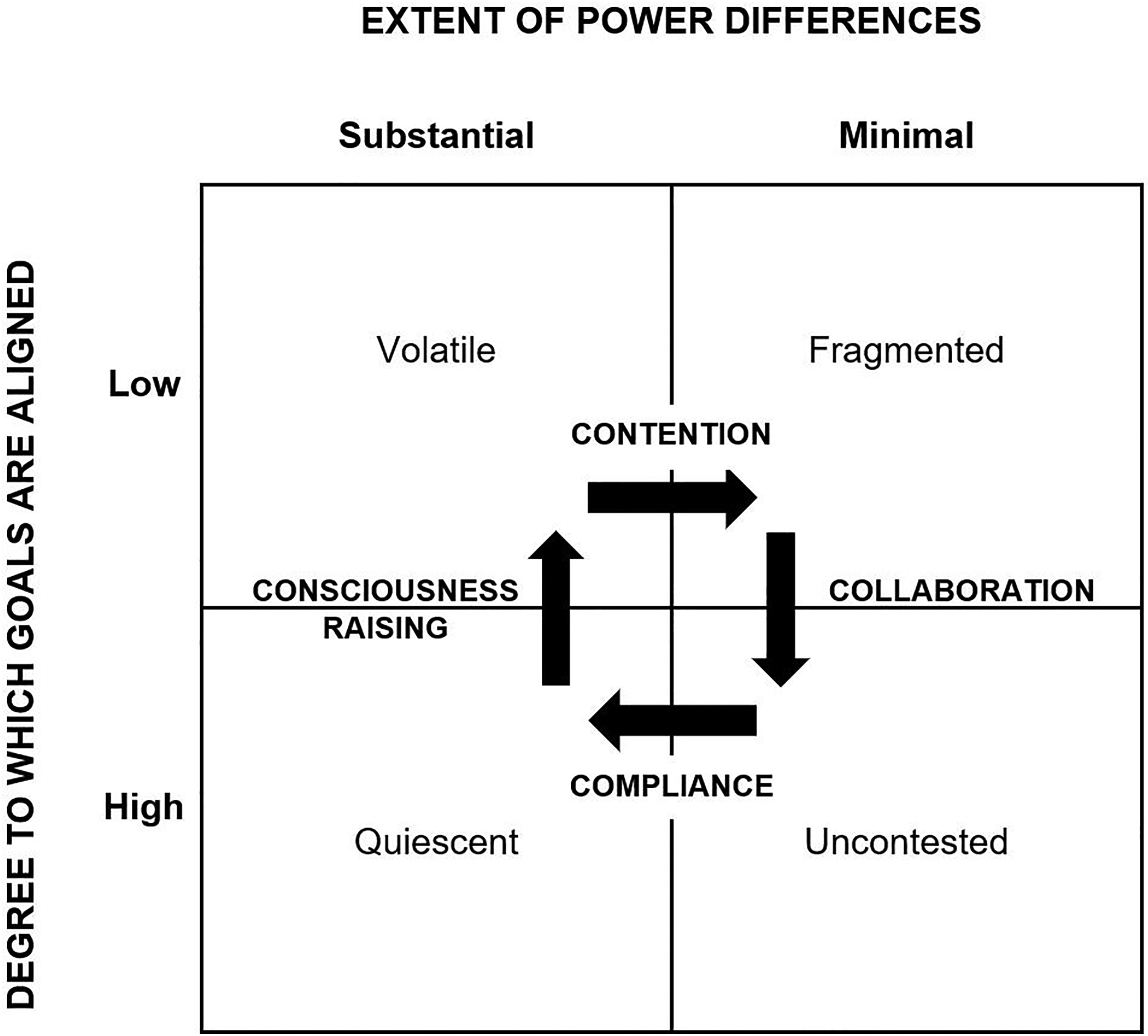
Pathways of Institutional Change (Gray & Purdy, 2018, p. 193).
In order to design partnerships with power in mind, it goes without saying that representation and inclusiveness are critically important. But ensuring that lower power stakeholders secure a seat the table is not always straightforward or sufficient. For example, in a partnership convened by the International Monetary Fund (IMF) that was intended to address a number of externalities associated with Peruvian goldmining operations, and specifically a catastrophic chemical spill, some indigenous groups refused to join from the outset because of their skepticism that the mining company, Yanococha, would participate in good faith (Gray & Purdy, 2018). The mine had demonstrated historical indifference to community concerns, refused to address environmental externalities and was believed to have corrupted regional and national government leaders. In fact, the prediction concerning Yanococha's insincerity was eventually borne out. Despite the IMF's considerable efforts to balance power dynamics within the collaborative dialogue (Mesá de Diálogo y Consenso) (such as, allowing the indigenous groups double representation in the Mesá's governing committee and providing training for them in how to engage in dialogue, and independent monitoring of pollution levels), Yanococha had little incentive to negotiate. Moreover, since the critical issue of holding the mine responsible for damages had been relegated to the courts, the Mesá had little leverage to force concessions from the mine. After four years of operation, the IMF discontinued the Mesá.
Among the lessons learned from the Mesá case, is the fact that since neither a favorable configuration of shared meaning nor relatively balanced power among the stakeholders existed in this situation, negotiations among the other stakeholders with Yanococha were never really legitimate. In fact, the indigenous groups’ only success in exerting influence over the mine's owner resulted from engaging in mobilization to prevent the opening of a second mine nearby. A second lesson learned is that other powerful stakeholders (such as the government or institutions such as the Catholic Church, which wields considerable power in Peru) did not intervene to help level the playing field for the Mesá's deliberations.
Factors for Assessing Power Dynamics
The cases referenced here help to emphasize that successful collaboration is itself a complex achievement that assumes a favorable configuration of meanings and power within a field. More specifically, the cases illustrate four factors for assessing whether power dynamics are impeding collaborative success (Gray et al., 2022, p. 15). These include: (1) the views of critical stakeholders are excluded from deliberations; (2) powerful stakeholders are exempted from participation and compliance with agreements reached; (3) the discursive practices that govern collaborative deliberations inherently restrict the participation of low-power stakeholders and thereby serve to perpetuate or reinforce the initial inequalities; and (4) low-power stakeholders disproportionately bear the costs of implementing whatever agreements are reached during deliberations.
For many MSPs, and particularly for those trying to improve sustainability, advancing the wellbeing of all partners (or, at least not worsening it), is an essential criterion for their success (Gray & Dewulf, 2021). Solutions that impose new or excessive burden on low-power parties are unlikely to yield long-term progress on grand challenges because these problems are likely to reemerge in the future. Consequently, there are no “shortcuts” in designing MSPs to address grand challenges. Successful partnership efforts may first necessitate power-building strategies that level the playing field, hold the powerful to account, and create fertile soil for collaborative deliberations to flourish.
Footnotes
Declaration of Conflicting Interest
The authors declared no potential conflicts of interest with respect to the research, authorship, and/or publication of this article.
Funding
The authors received no financial support for the research, authorship, and/or publication of this article.
