




Abstract
Wicked problems are complex and dispersed challenges that go beyond the capacity of individual organizations and require a response by multiple actors, often in the form of transnational regimes. While research on regimes has provided insights into such collective responses, less is known about how such regimes may form barriers that hinder and block appropriate responses to addressing wicked problems. Exploring the problematic role of regime-level responses is timely given that many of today’s wicked problems are far from being alleviated and in many instances appear instead to be intensifying. We draw from complementary insights of regime theory and research on institutional barriers to explore our research question: How do regimes form barriers to addressing wicked problems, and which mechanisms sustain such barriers? We explore this question with a longitudinal case study of the transnational regime for refugee protection and its response to displacement in Rwanda. From our findings, we develop a model of dissociation that explains how actors move further away from addressing a wicked problem. We identify four dissociative mechanisms (discounting, delimiting, separating, and displaying) that each create a distinct regime-level barrier. These barriers are distributed and mutually reinforcing, which makes it increasingly hard for actors to find alternative ways of responding to an escalating problem. Our study provides insights for research on regimes and wicked problems as well as studies on institutional barriers. We conclude with policy implications for overcoming those barriers, in line with the wider concerns and motivations of this special issue.
Introduction
Wicked problems are complex and dispersed challenges that go beyond the capacity of individual organizations and require a response by multiple interacting actors, often in the form of transnational regimes. Regimes are defined as transnational institutions that are set up to deal with issues that cross national, organizational or regulatory boundaries such as global displacement, pandemics, or climate change (Ansari, Wijen, & Gray, 2013; Djelic & Quack, 2008; James & Ronen, 2007). Regime theory commonly seeks to explain how actors initiate and sustain interaction and collective responses to such complex social issues (Wijen & Ansari, 2007).
While research on regimes has begun to provide insights into how interactions between actors enable a joint response to dispersed wicked problems, we know less about how regimes may form barriers that hinder and block responses to addressing them. This concern is particularly relevant as wicked problems are characterized by circular causality, meaning that each response to a wicked problem might contribute to worsening the problem (Dorado & Ventresca, 2013; Rittel & Webber, 1973; Termeer & Dewulf, 2019). Exploring the problematic role of regime-level responses is also timely given that many of today’s wicked problems, such as displacement or climate change, are far from being alleviated and in many instances appear instead to be intensifying (Lewicki, Gray, & Elliott, 2003). In this study, we thus ask: How do regimes form barriers to addressing wicked problems, and which mechanisms sustain such barriers?
To investigate this question, we complement regime theory with insights from literature on institutional barriers. An institutional barrier is any element of an institution that becomes so strongly embedded and taken for granted that it constrains action to instigate change, i.e., it becomes a barrier to action (Hoffman & Ventresca, 1999; Rayner, 2012; Wade-Benzoni et al., 2002). While existing studies have mainly explored how institutional barriers can affect the actions of individual organizations, with our focus on dispersed wicked problems we explore the formation of barriers at the regime level. Such arguments resonate given the persistent nature of many of the world’s wicked problems, like displacement or climate change, which require a more nuanced theoretical understanding of the constraining nature of (transnational) institutions in forming barriers to addressing them (Khan, Munir, & Willmott, 2007; Lawrence & Buchanan, 2018; Scott, 2014).
Empirically, we focus on displacement as a persistent and intensifying wicked problem. As many as 78% of today’s displacement situations are defined as “protracted” (UNHCR, 2019), commonly developing into social hotspots that are characterized by high levels of poverty, violence, conflicts with host communities, and recruitment activities by terrorist groups (Betts, 2017). We examine how the institution that maintains responsibility to address displacement, namely the transnational regime for refugee protection, formed barriers to addressing the very problem it was meant to alleviate. The transnational regime for refugee protection has developed over the last 60 years and includes donor countries, UN agencies, host governments as well as international and local NGOs. Over a period of three years, we conducted interviews, collected archival documents, and engaged in participant observations in Geneva and in five different refugee camps in Rwanda, covering the range of actors involved in the regime for refugee protection.
Based on our analysis, we develop a model of dissociation that explains how regimes form barriers to the resolution of a wicked problem. We identify four dissociative mechanisms (discounting, delimiting, separating, and displaying) that each create a different regime-level barrier. These barriers are dispersed and mutually reinforcing, which makes it increasingly hard for actors to find alternative ways of responding to an escalating problem. We refer to it as a process of dissociation, as with each response, actors move further away from addressing the very problem they were meant to solve.
Based on our model, we add to ongoing research on regimes and wicked problems (Wijen & Ansari, 2007; Ansari et al., 2013; Gray & Purdy, 2018; Reinecke & Ansari, 2016). We contribute a theoretical understanding of the formation and reinforcing nature of regime-level barriers in response to wicked problems. Our insights also have theoretical implications for studies on institutional barriers (Hoffman & Ventresca, 1999; Rayner, 2012; Wade-Benzoni et al., 2002). Our study shows that regime-level barriers are difficult to undo as these barriers do not reside within particular organizations but are dispersed and emerge in interactions between regime actors. Based on these insights, we also outline policy implications for overcoming barriers in the context of displacement, in line with the wider concerns of this special issue.
Understanding Regime-Level Barriers to Addressing Wicked Problems
Regime theory focuses on explaining how actors orchestrate action to address transnational problems of common concern. Following Wijen and Ansari (2007, p. 1083), regimes can be defined as “social institutions consisting of agreed-on principles, norms, rules, decision-making procedures, and programs, around which actors’ expectations converge in specific issue areas within the world system.” Accordingly, regimes are sets of transnational protocols and norms embedded either in institutions or institutionalized practices (James & Palen, 2006; Krasner, 1982). To explore responses to transnational wicked problems that lack a clear supranational authority (Djelic & Quack, 2008), scholars have drawn on the mutual complementarities between institutional theory and regime theory (Ansari et al., 2013; Wijen & Ansari, 2007). Highlighting the important points of connection, Wijen and Ansari (2007) argue that regimes are transnational institutions and thus have a particular contribution to make to understanding dispersed social problems that require transnational cooperation between a variety of actors. Regime theory sheds light on how collectives of actors interact in their attempts to address these problems, and the role of the differing goals and interests of actors in responses (Gray & Purdy, 2018).
Such complex social problems have often been conceptualized as “wicked problems” because they are high-stakes but unique challenges that commonly cross national boundaries; they are evaluative and require various different solution options and value sets from collectives of participating actors; they are evolving and usually do not have a clear stopping rule; and any response to the problem may form part of intensifying the problem (Dorado & Ventresca, 2013; Reinecke & Ansari, 2016; Rittel & Webber, 1973; Sonenshein, DeCelles, & Dutton, 2014; Termeer & Dewulf, 2019).
Regime theory commonly seeks to explain how actors overcome collective action problems to address such complex wicked problems; however, actors do not necessarily have shared or aligned interests, despite their common links to the issues (see Gray & Purdy, 2018; Termeer & Dewulf, 2019). Research has developed theoretical explanations on how actors may find ways of collaborating in response to complex problems despite a lack of aligned interests. For example, Wijen and Ansari (2007) identify several drivers that help sustain collective action, including the use of bridging tactics to create common ground, the mobilization of bandwagons, devising appropriate incentive structures, or developing capacity to implement joint agreements. The identification of such drivers is seen to complement and further specify institutional theory’s focus on actors’ social and political skills to make coordination possible, specifically in relation to contentious social issues. In another study on construction of a climate change logic, Ansari and colleagues (2013) theorize on the importance of frame shifts to enable diverse collectives of actors establish a working consensus surrounding the issue of climate change.
Similar studies have further looked at collaborative forms of transnational organizing to advance understanding in relation to persistent social problems. For example, Gray and Purdy (2018), while not referencing regime theory directly, examine collaborative partnerships as ways of dealing with transnational wicked problems. Using global migration as an example, they describe collaboration between actors “as the process of negotiating a common set of both norms and routines that will govern future interactions among the participating stakeholders but are subject to revision as stakeholders continually negotiate their relationship over time” (Gray & Purdy, 2018, p. 45). This perspective enables insights into the important roles played by common values, policies, and routinized forms of interaction that develop over time, which form the backbone of how transnational ways of organizing become institutionalized.
Yet, while research to date has provided important insights into the ability of regimes to orchestrate action to address dispersed wicked problems, there is a paucity of theoretical development on the way that regimes may form barriers that hinder and block appropriate responses to tackling such challenges. To address this theoretical gap, we draw from research on institutional barriers (Hoffman & Ventresca, 1999; Rayner, 2012; Wade-Benzoni et al., 2002). An institutional barrier is any element of an institution (e.g., structures, policies, and practice) becoming so strongly embedded that it completely constrains action that would change it, i.e., it becomes a barrier to action. In line with this perspective, research on institutional barriers foregrounds the constraining nature of institutions (Greenwood, Oliver, Sahlin, & Suddaby, 2008). Indeed, Scott (2014, p. 273) depicts an institution “as a double-edged sword” that enables choices and actions as well as curbing and constraining them in response to social challenges, with the latter requiring more attention by institutional theorists.
The analytical focus of existing studies on institutional barriers mainly focuses on the organizational level and on how barriers affect particular organizational responses. For example, Hoffman and Ventresca (1999), in studying debates on trade-offs between “environmental” and “economic” concerns, show how the possibilities of organizational action commonly require far-ranging acts of reframing that change how such problems are seen by organizations (see also Hoffman, Gillespie, Moore, Wade-Benzoni, Thompson & Bazerman, 1999). They argue that “the reduction of institutional barriers involves the unlearning of what has been ingrained into structures, policies, metrics, rhetoric and practice” (Hoffman & Ventresca, 1999, p. 1386). In a study on environmental policy, Rayner (2012) further identifies a variety of strategies that organizations use to filter out “uncomfortable knowledge” that may have adverse effects on the legitimacy of established institutions, while at the same time acting as a barrier to addressing a wicked problem. Wade-Benzoni et al., (2002, p. 48) also refer to the important role of inertia in institutionalized structures, forming barriers to the resolution of environmental disputes because they force organizations “to engage in debate in outdated forms and frames”.
Using complementary insights from studies on institutional barriers and regime theory allows us to unpack the formation of regime-level barriers in response to dispersed and multi-actor wicked problems, focusing on the interactions between different actors in response to the problem (Gray & Purdy, 2018; Termeer & Dewulf, 2019). Given the persistent and often intractable nature of wicked problems like displacement today, a more nuanced theoretical understanding of the constraining nature and problematic effects of regimes in blocking efforts to addressing these problems is of timely relevance. We explore this concern with our empirical case study of the interactions between actors of the transnational regime for refugee protection in their response to displacement in Rwanda.
Methodology
The transnational regime for refugee protection and the wicked problem of displacement
The institution in our case is the transnational regime for refugee protection (from here on referred to as “the regime”), which is based on the Convention relating to the Status of Refugees from 1951 and the Refugee Protocol from 1967. These two legal documents were agreed upon by an international community following the displacement across Europe after the Second World War. These protocols clarify who is a refugee and to what protection and assistance a refugee is entitled. Table 1 provides a brief overview of the key historical milestones of the regime.
Key historical milestones of the transnational regime for refugee protection.
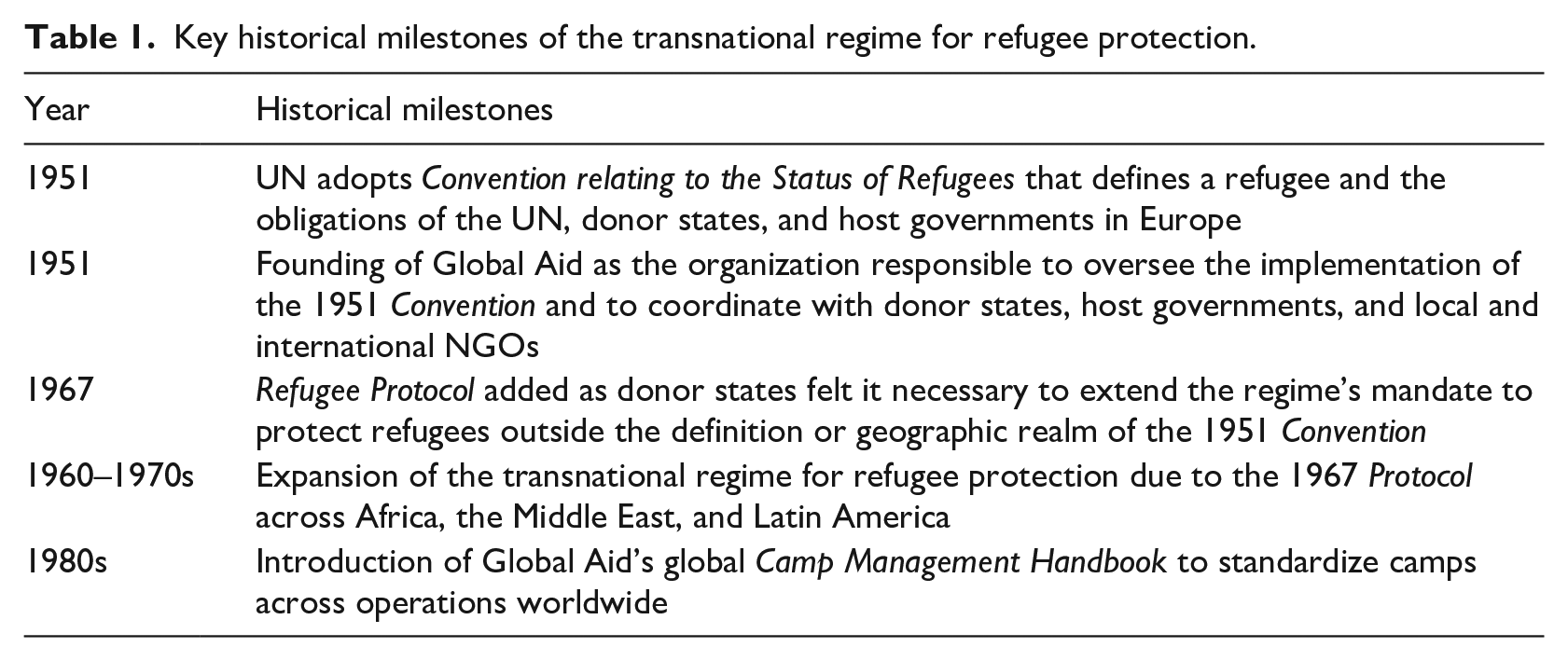
The regime consists of nation states, UN-based organizations, donor states, international and local humanitarian NGOs, and governments that host displaced populations. One key actor is an organization we call Global Aid which was established in 1951 and given the legal mandate to oversee and implement the regime’s mandate. As Betts, Loescher, and Milner (2012, p. 80) emphasize, Global Aid is widely considered a key international organization “that exists to regulate the treatment of refugees,” with its operations now spanning 134 countries.
Despite its important role, in the attempts to organize responses to the wicked problem of displacement, Global Aid interacts and coordinates with the regime’s other actors. Such interactions to organize responses have to take into account donor demands, constraints placed by host governments, and the capacities of NGOs tasked with implementing programs in particular technical areas such as shelter, nutrition, water, or protection in each local operation. With our theoretical interest in how such institutionalized interactions at the regime level can form barriers to the resolution of wicked problems, we placed our empirical focus on the interactions between the regime’s actors in the displacement context of Rwanda.
Data collection
Our theoretical focus emerged from an inductive, longitudinal study (Langley, 1999; Langley, Smallman, Tsoukas, & Van de Ven, 2013) of the regime and its response to the displacement crisis in Rwanda, which has become severely persistent, lasting for more than two decades. Protracted situations like the one we witnessed in Rwanda are no longer the rare exception. In fact, around 78% of today’s refugee camps are defined as protracted, where displaced people spend more than 20 years on average (de la Chaux, Haugh, & Greenwood, 2018; UNHCR, 2019).
Over a period of two years, the first author engaged in fieldwork in five different refugee camps in Rwanda and at Global Aid’s headquarters in Geneva. The first author conducted interviews and engaged in participant observations over three extensive rounds from March 2014 until October 2015. The collection of archival documents proceeded in two additional rounds in 2016 and 2020. In particular, the empirical sources include: 81 semi-structured interviews with actors forming part of the regime; 75 days of participant observations; and the analysis of 84 archival documents that comprise sources from multiple key actors, including donors, UN-based organizations, international and local NGOs, and the host government in Rwanda. We discuss each source below.
Interviews
We conducted interviews with different actors of the regime, including staff members of Global Aid, of international humanitarian NGOs and local implementing organizations in Rwanda. The first 13 interviews were conducted in March 2014 at Global Aid’s headquarters in Geneva. Access was gained through an earlier internship of the first author in 2012, which helped develop key relationships with managers. These interviews were exploratory in nature, to gain a better understanding of the main ways of responding to displacement. The second round of data collection took place from February to March 2015, when the first author conducted 17 further interviews at Global Aid’s headquarters. Here, the intention was to follow up the initial interviews, gaining a better understanding of the different kind of responses to displacement. We learned about the highly routinized and taken-for-granted nature of these responses and how Global Aid interacts with other regime actors, including international NGOs, donors, and host governments.
We initially started this research project with an interest in acute displacement crises. One senior program manager eventually drew our attention to the surprisingly persistent nature of displacement, referring to the fact that nowadays generations of people are born in camps because these camps become protracted over time. Curious about this, the first author was able to negotiate access to such protracted operations, namely the Congolese refugee camps in Rwanda. The first author spent three months at the office in Rwanda, from August to October 2015, and frequently visited the different protracted refugee camps that were spread across Rwanda. The oldest camps have been in existence since 1996 and 1997 respectively and are home to more than 15,000 refugees each. Even the “newest” camp had already existed for six years.
In this phase, 51 interviews were conducted, with members of Global Aid, international partner organizations, and local implementing NGOs. All interviews followed a semi-structured guide that was adapted as our theoretical interest and focus emerged. Each interview lasted between 30 minutes and 2 hours, and, with one exception, they were all recorded and transcribed. Most of the interviews were face-to-face, conducted in the immediate working space of the interviewee, ranging from boardrooms and canteens to tents and sheds. In eight instances, we conducted the interview through Skype.
Participant observations
A second key source of empirical insights are our participant observations. At headquarters, the first author joined staff members for meetings with donors, conference calls, policy briefs, and brownbag sessions (information sessions about new crises), took part in Code of Conduct sessions, and undertook all the mandatory online trainings that Global Aid offered. The first author also socialized with staff members of Global Aid and other UN organizations based in Geneva. In so doing, she learned about the rotation policies of these organizations, as staff members usually talked about their previous duty stations, comparing the different levels of hardship they faced.
In Rwanda, the first author shared a house with Global Aid’s staff in the country’s capital Kigali, attended internal meetings and with partner organizations, drove to the remote camps, and worked alongside them. These experiences allowed first-hand observation of the consequences of some of the different responses. In particular, she witnessed extreme levels of poverty among the displaced population and heard about frequent incidents of violence and abuse. All these observations were captured in field notes, spanning 60 days.
Archival documents
We also base our insights on archival documents, which include documents such as donor appeals, host government reports, monthly updates about the displacement situations, rotation policies, and evaluation reports by different organizations or Global Aid’s Camp Management Handbook. We also collected historical documents and reports to better understand the history of the regime. In total we collected and analysed 84 documents. The archival documents played an important role in corroborating the interactions of the regime’s actors on different concerns and policies. For example, archival documents helped us to understand the interactions between donors, Global Aid, international NGOs, and the host government in Rwanda on common concerns such as the standardized camp policy, the staff rotation policy, the annual planning cycles, or the particular interpretation of the protection mandate. As all of these elements play a key role in the responses to displacement, the use of archival documents offered important evidence to trace regime-level interactions in the humanitarian response.
Data analysis
Our data analysis focused on understanding the regime-level interactions in response to the Rwandan displacement crisis. Our insights emerged by oscillating between our empirical data and the theoretical concepts (Corbin & Strauss, 1990; Glaser & Strauss, 1995). Each round of analysis followed a similar three-level coding process (Flick, 2009) using Atlas.ti, which allowed the theoretical focus to become more pointed. As we collaboratively engaged with our data between the three co-authors, we were drawn to the connection between the protracted nature of the displacement crisis and the detrimental consequences of some of the responses that were shared practices among the regime’s actors. We triangulated our data by relying on the different empirical data sources outlined above (Denzin & Lincoln, 2011; Flick, 2009). Against this background, the data analysis emerged in the following way.
Identifying key responses to displacement and their consequences
In the initial step, our data analysis focused on identifying key responses to displacement that were shared, practiced, and seen as legitimate by the regime’s actors. We coded for all response activities, such as “distributing food,” “handing out blankets,” or “setting up camps.” We then merged similar codes to higher-order categories. Based on this analysis, we identified four central regime-level response practices, namely “protecting” displaced populations in camps, the one-year planning cycle in its function to “focus on a quick response,” the rotation policy which helped to “share the burden” of hardship posts, and the global standardization of camp management approach. We then traced the consequences of these four responses. This step was triggered by descriptions of displacement as extremely “persistent and long-term,” and the emergence of codes such as “camps as social hotspots,” the repeated mention of “violence”, the “creation of poverty,” and camps “becoming recruitment grounds for rebel groups.” Through our analysis, we realized that these consequences were systematically linked to the established responses, such as that dependency was created through long-term assistance and “protection.”
Unpacking interactions between regime actors in upholding responses
In the next step of the analysis, we focused on the different ways that the regime’s actors interact and influence each other in upholding these response practices. In addition to the interviews and observations, documents played an important role in taking stock of the different actors’ positions. In particular, we searched for evidence on the underlying motivations that explain why these response practices were found to be so widely supported among the regime’s actors, including donors, Global Aid, the NGOs, and the host government. For example, the one-year planning cycle was followed and practiced for different reasons. While donors were commonly bound by annual parliamentary spending cycles, humanitarian organizations viewed it as a way of ‘practically’ and quickly dealing with the most pressing demands of the crisis. This analytical step enabled us to examine how the different motivations of and interactions between the regime’s actors made the established responses endure. Furthermore, it helped us examine why the responses we identified remained difficult to change as their endurance does not only depend on the actions of one actor, but is instead perpetuated through interdependencies at the regime level.
Identifying regime-level barriers
In the next step of our analysis, we focused our attention on how these regime-level responses might block options for the resolution of displacement. Inspired by work on institutional barriers, we conceptualized different kinds of barriers, such as when interviewees referred to an “obsession with the protection mandate” that discounts any alternative values and effectively limits the solution space available. After corroborating our interview findings with documents on the policies and positions of different regime actors, we eventually labeled this as “valuational barrier.” Similarly, we identified an “attentional barrier,” due to the strict one-year planning cycle that was endorsed and practiced by all actors and which meant that actors were constantly “reinventing the wheel” or lacking “any exit plan,” as they were unable to pay attention to displacement becoming long-term and persistent. We then traced how these barriers formed, realizing how each barrier manifested in response to the earlier barrier. We labeled this as a process of “dissociation,” as with each response the regime moved further and further away from addressing the problem of displacement. We identified four mechanisms of dissociation that form four distinct regime-level barriers, which we take up in our findings.
Findings
Displacement in Rwanda is a prominent example of a persistent and intensified wicked problem. In this case study, we explore how the transnational regime for refugee protection responds to the displacement crisis, and by doing so intensifies the very problem it was meant to alleviate. In particular, we document how four main ways of responding to displacement formed barriers to the resolution of the wicked problem. These four main ways of responding, which mutually influenced each other, included: encampment to implement the international “protection” mandate for displaced populations; the institutionalized enactment of a short-term perspective on the crisis, manifested through one-year planning cycles; the widely practiced staff rotation policies, kept in place to share the burden of hardship posts; and the standardization of a global camp management solution. The response practices were widely accepted and taken for granted at the regime level, shaped by the interactions between several key organizations who formed part of the transnational regime for refugee protection (from here on referred to as ‘the regime’).
The Rwanda Country Refugee Response Plan 2019 summarized some of these key actors: The refugee response in Rwanda is led and coordinated by the Government (Ministry in charge of Emergency Management – MINEMA) and [Global Aid] at the capital and field levels, and includes a multitude of UN and NGO partners, local civil society organizations, and private sector partners including social enterprises.
Accordingly, while Global Aid and the Government of Rwanda were the key legal actors guiding the response, they were supported by numerous donors and international and local NGOs in the implementation of aid programs. In what follows, we outline each response practice and its consequence for the displacement situation in more detail.
Encampment to implement the protection mandate
The response to displacement relied on the regime’s strongly held protection mandate, which valued and promoted the protection of refugees. The value of protection has been at the core of the regime from the beginning, as one of Global Aid’s founding documents highlighted: Based on the 1951 Geneva Refugee Convention, [Global Aid]’s core mandate is to ensure the international protection of uprooted people worldwide.
The protection mandate was mainly interpreted by the regime’s key actors as confining displaced populations in designated sites through encampment. This interpretation of the protection mandate led to the establishment of the first Congolese refugee camp in Rwanda in 1996, and several other refugee camps in the following years. The strong reliance on the encampment solution is emphasized by the Rwandan Ministry in charge of emergency management: Rwanda hosts 149,602 refugees mainly Congolese and Burundians . . . 92% of the refugee population is located in refugee camps and they rely on humanitarian assistance while 8% of refugees reside in urban areas mainly Kigali and Huye and are self-reliant. (MINEMA Report, 2016).
This general preference for camps was also emphasized by the OECD Development Assistance Committee (DAC), a key international forum for several of the most high-profile donors: Humanitarian assistance in many contexts continues to focus primarily on refugees in camps, giving less attention to displaced populations outside camps and to the communities hosting them . . . Countries often insist on settling refugees in “designated sites” or enforce stricter encampment policies. (OECD-DAC, 2017, p. 33/36)
The practice of “protecting” over 90% of displaced populations in camps is particularly noteworthy in the context of Rwanda, a country where displaced populations have freedom of movement and other basic rights legally guaranteed – and still remain in camps and dependent on assistance: While refugees in Rwanda enjoy a generally favourable protection environment, the context of refugee camps and lack of livelihood opportunities mean that most refugees are still highly dependent upon assistance to meet their basic needs. (Rwanda Country Refugee Response Plan, 2019, p. 5)
The regime’s actors generally upheld the protection mandate and the encampment solution for different reasons. For the Rwandan host government, encampment was closely linked to the notion that such camps would be easier to police and to suggest that displacement is an isolated problem that is well contained and maintained in this manner. For humanitarian organizations like Global Aid and other implementing NGOs, the reason for their endorsement of protection and encampment was more strongly related to their view that camps are crucial to facilitate the rapid provision of assistance to displaced populations. Indeed, it was considered much easier and quicker to distribute shelter, water, food, and medical assistance when people are located in one central space, as a camp manager emphasized: Is it easier to help people in a camp? Sure. Everybody is in the same place.
Accordingly, the regime’s actors strongly converged towards protection and encampment as the preferred value in response to displacement and their mutual interactions contributed to enacting it. Such regime-level interactions manifested in several ways. For example, this interactive nature of the regime was expressed between Global Aid and the Rwandan government: The Government of Rwanda has been generously hosting refugees for over two decades and coordinates the refugee response with [Global Aid], as well as providing land to establish refugee camps and ensuring camp management and security. (Rwanda Country Refugee Response Plan, 2019, p. 4)
Accordingly, our evidence reveals how the institutionalized interactions between Global Aid, international donors, and the Rwandan government resulted in an aligned but narrow interpretation of the protection mandate that favored the establishment and maintenance of displacement camps. Over time, the initial encampment solution became increasingly rigid and could not easily be redesigned. And while “protective camps” initially served the purpose of protection and assistance, over time the narrow focus on protecting people effectively discounted alternative ideas to respond to the displacement crisis.
Institutionalizing a short-term perspective on the crisis: one-year planning cycles
The regime’s narrow interpretation of the protection mandate in favor of keeping displaced populations in camps was reinforced by strict one-year planning cycles that institutionalized a short-term perspective on the problem. One-year planning cycles were not particular to Rwanda, but are a long-established regime-level practice to focus on protection and immediate needs, as emphasized in an OECD policy assessment: Responding to long-term humanitarian needs with short-term funding keeps the focus on meeting immediate humanitarian needs, but can prevent a thorough and shared analysis of how to best address the root causes of those needs. (OECD, 2017, p. 1)
The evidence indicates that the regime’s actors support and uphold this one-year budgeting cycle for different reasons and motivations. Donors, for instance, enforce the one-year planning cycle as they usually work with the annual public expenditure cycles of governments, as a donor report revealed: Most OECD Development Assistance Committee members do not have predictable humanitarian budgets, as governments generally work with annual public expenditure cycles. (OECD-DAC Report 2017, p. 5/6)
Global Aid and other humanitarian organizations consider short-term cycles as the most effective way to focus on immediate needs and provide quick solutions: And you can quote me that in any lifesaving operations, a quick solution is better than the right solution because normally right solutions take time (. . .). This is what I call a solution, quickly you do it. [interview with senior program manager)
Local implementing NGOs that receive funding from international donors or Global Aid also had to “follow the planning cycle” and thus further reinforced the short-term orientation of the entire operation. For the Rwandan host government, in turn, the short-term planning cycles enabled them to claim that the displacement crisis remains a relatively temporary phenomenon.
This institutionalized short-term perspective fostered a response approach to problems often referred to as “firefighting.” This implied that in the response to the Rwandan displacement crisis, the different regime’s actors commonly ended up “taking buckets of water and throwing it at places where they think might be a problem,” as one senior camp manager put it.
Over time, the short-term perspective became highly consequential, as it effectively ignored the possibility of the crisis becoming long-term and persistent. In the absence of a clear stopping rule (Rittel & Webber, 1973) that indicates when a wicked problem is “over,” the one-year cycle delimited actors’ temporal horizon and avoided the potential long-term nature of displacement. The one-year budget cycle thereby reinforced the central mandate as it fostered a short-term perspective focused on the day-to-day management of emergency assistance rather than exploring and considering other forms of support, as one interviewee criticized: And experience suggests that in Africa, refugee situations are far more likely to persist for long periods of time than they are to be resolved in a matter of weeks or months. Nevertheless, Global Aid and its donors have continued to administer what are essentially emergency relief operations for periods of five, ten or fifteen years. (interview with livelihood officer)
Hence, there are usually no long-term strategies to decommission a camp. As one of our interviewees put it: Oh, we’re never gonna leave. Like, exit strategy, that’s not our thing.
Initial displacement sites intensified and turned into violent social hotspots
In consequence, the focus on protection paired with a short-term horizon meant that displacement sites commonly developed into violent and social hotspots over time, as displaced populations became dependent on short-sighted assistance, as one of the senior program managers admitted: If we continue providing water and food, there will be dependency; there will be no solutions, the assistance needs to come with some durable solutions inside. But if you plan only on the money that you have, you never think of durable solutions. You don’t assess the end strategy.
Short-term emergency aid thus intensified the problem situation and led to dependencies and poverty. Ultimately, displaced populations find themselves in a situation worse than at the beginning of the displacement crisis, explained in the following quote: So, what actually happens is that over time, your refugee problem goes like this. At first you start to cut assistance, you cut positions, you cut the problem – what you actually do is you create poverty. Fifteen years after the emergency, you have a community that did get used to a constant reduction of standards. First, the health post closes [. . .], and they become weaker and weaker, there’s less education so they become less and less qualified and in the end there’s less and less food. (interview with senior camp manager)
Accordingly, the regime’s approach of focusing narrowly on protection and delimiting actors’ temporal horizon effectively formed barriers to the resolution of displacement and contributed to an intensification of the problem over time. These barriers were reinforced through the widely practiced staff rotations, as we outline below.
Sharing burden and keeping a distance from the crisis through staff rotation
Even though the response to the displacement crisis contributed to the development of social hotspots, the regime’s actors struggled to make changes to the established practices. One of the key barriers to learning from the problems that the humanitarian response had created was to be found in the strict staff rotation policy. Staff rotations are common in many donor organizations, UN agencies, and international NGOs. As in other countries, in Rwanda the policy was designed to share the burden of exposure and to keep distance to extreme social hotspot contexts: [Global Aid]’s rotation policy is the distinctive system by which the mobility of staff members is organized. Rotation involves the ranking of duty stations based on a hierarchy related to degrees of comfort or hardship whereby . . . E denotes extreme hardship . . . The time limit imposed on assignments at E duty stations is intended to protect staff from burnout caused by working in extreme conditions. (Global Aid Rotation Policy)
The widespread adoption of the staff rotation policy across the regime’s actors existed not only to share the burden of hardship posts. Instead, it was further driven by particular donor interests in low overhead costs, as the Humanitarian Policy Network emphasized: In explaining excessive staff turnover, some have pointed to donors’ insistence on low overheads, encouraging the use of short-term contracts through short funding cycles . . . A reliance on short-term contracts linked to funding has meant that employees need to find a new position every year or so. (ODI’s Humanitarian Policy Network, 2006, p. 1)
The consequences of the policy are described as rather problematic – preventing actors learning from previous mistakes. Oxfam, one of the key implementing organizations in Rwanda, described some of the implications of the staff rotation policy as follows: One of the implicit assumptions that often underlies program design is that the people who initially come up with an idea and turn it into a project or program then stick around and implement it. The reality is often very different – high levels of staff turnover are almost universal in both NGOs and aid agencies, with serious consequences . . . typically expats work a couple of years, then leave, either through burnout or because they are on short-term contracts. Then new arrivals start the learning process all over again (often including repeating the same approaches and discussions of the previous years – at worst, producing a Groundhog Day of “steep learning curves,” followed by loss of the accumulated knowledge. Then repeat). (Oxfam Report, 2013)
Thus, the rotation policy in Rwanda effectively distanced staff members and other actors from the consequences of their own program. A manager for the international NGO Save the Children emphasized that if “you are only going to be somewhere for a short time, you don’t engage as much.” In particular, the rotation policy fostered ignorance of the social hotspot dynamics that were developing in each camp. Actors considered issues of violence as one-off incidents rather than as the consequences of their earlier responses. A community officer recalled how she was searching for historical information about a camp, and eventually talked to a local security guard. This guard mentioned frequent cases of violence, which none of the rotating international staff had picked up: I’ve realized that he was mentioning that some protection issue came up again over time. And I was just thinking, if we had a kind of history of the operation, sometimes it could be useful because you would realize that some of these issues are coming over and over.
The rotation policy in NGOs and Global Aid, supported by donors, effectively blocked the regime’s capacity to recognize the detrimental consequences of its established response to displacement. One interviewee reflected on the implications of these responses in Rwanda, emphasizing that Global Aid shifted so far from addressing the initial problem that all they do now is to try and mitigate the results of having created a social hotspot: You actually created a social hotspot . . . The resources you have, you start investing them on mitigating the result of having created a social hotspot, right?
Accordingly, as actors narrowly focused on protection and encampment and continued to operate in a short-term planning mode, the staff rotation policy further reinforced ignorance about the gradual intensification of the wicked problem by distancing actors from the results of their own actions.
Displaying solution by standardizing camp management
For the operation to continue largely unchanged in the face of the emerging problems, a range of regime actors including donors, the Rwandan government, and the broader public had to be reassured that something was done about addressing the problem of displacement. Against this background, the standardization of all camp management practices became a tool to quickly set up new camps independent of the local context. This standardization took the form of a global Camp Management Handbook that rotating staff members followed despite their distance to each local displacement situation. One senior manager recalled their experiences with the handbook: There is this camp toolkit book. Toolkits are very interesting when you’re actually working in the camp. It’s even more interesting when you’re starting from scratch, because it explains everything . . . That’s how Global Aid is able to start a camp very fast.
A manager critically asserted that standardized camps can be presented as a “solution that is shiny and fresh and where ribbons can be cut” to reassure an international audience or the local host population that the problem was addressed: What I’m getting at is that some of the things, such as camps, are done as a quick fix or as a fig leaf or as an idea to give voters the idea that something is happening, where in fact whatever is happening is similarly not getting anywhere near the actual source or cause of the issue.
We observed some tentative attempts to adopt a less standardized approach. One example of such an attempt was the introduction of a new guideline titled Alternatives to Camps (ATC), which was formulated in acknowledgment of some of the detrimental consequences of the standardization efforts. Acknowledging the negative consequences of camps, the document explicitly calls for less standardized and uniform approaches. The guideline encourages country offices to seek local alternatives to camps whenever possible, as the preamble of the document outlines: [The] policy is to pursue alternatives to camps, whenever possible, while ensuring that refugees are protected and assisted effectively. (Global Aid’s Alternatives to Camps)
Yet, such initiatives remain aspirational. By 2019, there was no evidence of initiatives like the ATC being significantly implemented in Rwanda. To the contrary, the standardized approach to managing camps was as persistently practiced as ever, suggesting that it takes more than the outline of a vision to update the decades-old, entrenched humanitarian response practice that proved beneficial for all of the regime’s actors. While donors or the international community maintained such standardized structure to display that something was being done about the displacement crisis, the host government in Rwanda commonly supported the standardized approach as it provided a way of arguing that the standards for refugees did not exceed the ones for the host populations. An evaluation report further outlined that Global Aid and partner NGOs also had a strong interest in showcasing these highly visible and standardized camps: This was partly because [Global Aid], as well as governmental and non-governmental refugee agencies, had a vested interest in perpetuating the “relief model” of refugee assistance, which entailed the establishment of large, highly visible and internationally funded camps, administered entirely separately from the surrounding area and population. (Global Aid Evaluation Report 2016)
Social hotspots became persistent and widely spread
However, this display of a standardized solution was highly problematic. A field officer referred to the current persistent state of displacement, and criticized the “functional” and standardized approach to tackling the issue: I mean, the world has never been a greater turmoil than since 2013, 2014, 2015. It’s really an apocalypse now, right? And still, we still apply the same logic that we have applied for 40 or 50 years, which basically means you have a huge headquarters that dictates basically doctrine structures, policies, guidelines. And front-line staff is supposed to implement them.
Distancing actors from the problem paired with a standardized solution meant that actors gradually lost the capacity to realize how their responses had effectively prolonged and spread the problem of displacement. In several operations, the standardized approach to camp management eventually created more harm than good, as one of our interviewees explained: Why is McDonalds not serving pork in its Pakistan outlet? It’s because precisely, it will not sell, right? [. . .] Whereas this organization, which is operating in highly different environments, highly dynamic, comes up with one-size-fits-all approach to all operations which is absurd, completely absurd [. . .] Listen, it doesn’t work here. It is even worse because we are creating more harm than good. (interview with deputy regional director)
In summary, our findings identified four main responses to displacement in Rwanda that are widely accepted and distributed, i.e., highly institutionalized, among all regime actors. Table 2 summarizes the different reasons why regime actors supported these responses. The interactional and distributed nature makes it more difficult for individual actors to abandon any of the response practices in isolation from the others.
Support reasons for different regime-level responses.
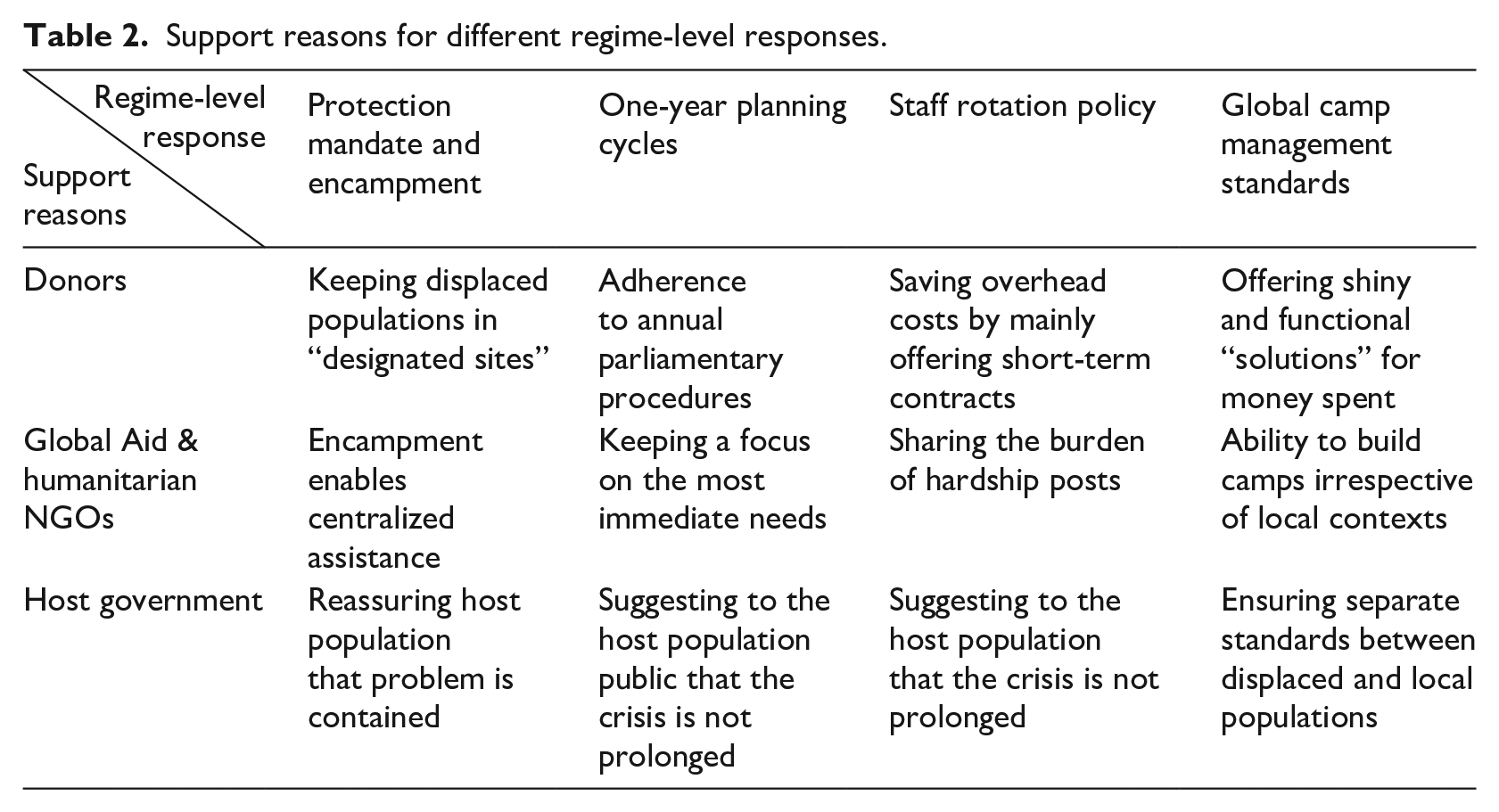
We outlined how these four responses moved the regime further away from addressing the problem of displacement. In particular, the taken-for granted value of “protection” discounted alternative solutions to the problem, the one-year planning cycle delimited actors’ temporal horizon, the subsequent rotation policy distanced actors from each local displacement situation, and the global camp standards merely served to display that something is being done about addressing the problem. These responses built upon and reinforced one another, effectively blocking efforts to address the escalating problem of displacement. Below, we conceptualize these four steps as mechanisms of dissociation that form regime-level barriers to tackling wicked problems.
Discussion: A model of dissociation
The central research question that guided our study was: How do regimes form barriers to addressing wicked problems, and which mechanisms sustain such barriers? From our findings, we conceptualize a model that identifies four distinct mechanisms that explain the formation of such regime-level barriers in response to wicked problems. We refer to these mechanisms as mechanisms of dissociation as with each step the regime’s actors respond to a barrier rather than the problem, thus moving further away from addressing the issues at hand. These barriers are dispersed among many interacting actors and mutually reinforcing, which makes it increasingly hard to find alternative ways of responding to the problem. Our model is depicted in Figure 1. Below we describe the model in more detail.
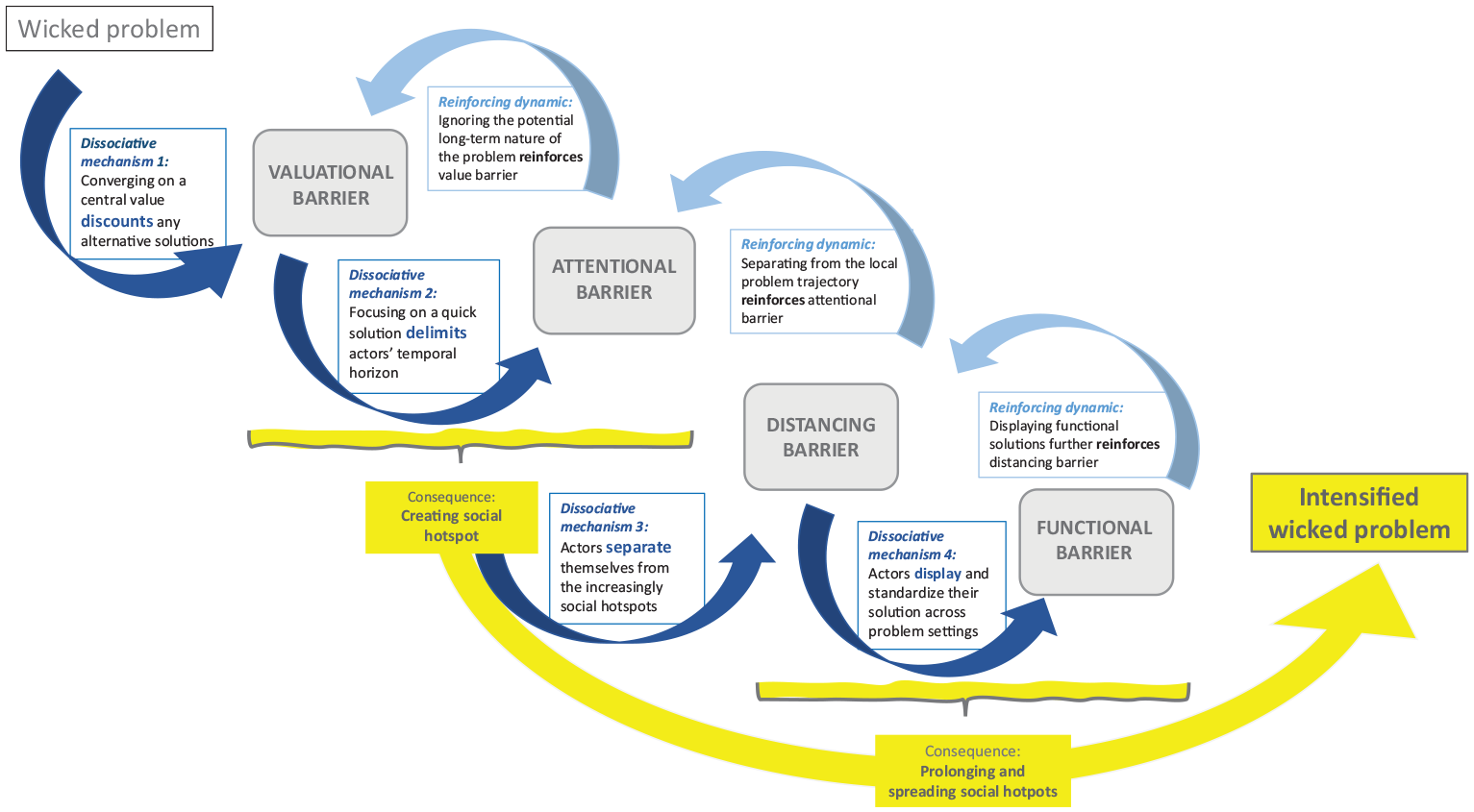
Model of dissociation.
Dissociative mechanism 1: Discounting alternative solutions
The first mechanism describes how actors initially dissociate themselves from a wicked problem by discounting alternative solutions that are deemed inconsistent with the regime’s values. While values are central in enabling and mobilizing an initial regime response (Kraatz, Flores, & Chandler, 2020), our findings highlight how values may at the same time constrain the regime’s ability to adjust and adapt their mandate differently as a wicked problem response unfolds over time. By converging on a central value to suppress potential disagreement, such as the strongly held protection mandate in our case, a regime’s guiding value may risk restricting and narrowing the solution space available for consideration (Slawinski & Bansal, 2015). Strictly adhering to a central value can thus enable a dispersed set of actors to cooperate despite not having fully aligned interests, while compromising a regime’s potential for adaptability to the changing nature of the problem. Instead of pragmatically drawing from heterogeneous criteria of assessing values to keep options open for contextual adjustments (Ferraro, Etzion, & Gehman, 2015; Gatzweiler & Ronzani, 2019), a narrow interpretation of one overarching value constrains the regime’s action repertoire and makes them discount alternative solutions to organize a response.
In our case, the transnational regime for refugee protection, including UN-based organizations, the host government, NGOs, and key donors, formed around the core value of “protection,” which manifested in the form of “protective” camps as the preferred solution. However, this emphasis on protection and the camp solution gradually became the only available option in response to displacement. Any attempts to rebuild lives outside those protective camp spaces were effectively discounted by referring to the regime’s core mandate of protection.
The dissociative mechanisms of “discounting alternative solutions” gives rise to a valuational barrier at the regime level. A valuational barrier manifests itself as the regime’s actors mutually influence each other to uphold an agreed-upon value that keeps cooperation intact, but “filters out” any solutions that require a different value base. A valuational barrier reinforces a path-dependent approach that solely pursues one seemingly “right” solution that is aligned with the core value of the regime and that passed the initial value filter. This is notably problematic in response to wicked problems, as wicked problems are inherently evaluative, ambiguous, and ill-defined and require solution options based on different value sets (Churchman, 1967; Ferraro et al., 2015; Termeer, Dewulf, Breeman, & Stiller, 2015). A valuational barrier effectively blocks the capacity of actors to realize that there is no definitive right or wrong solution to an ambiguous wicked problem and renders any constructive engagement with differences between regime actors more difficult (Gray & Purdy, 2018).
Such a valuational barrier does not narrowly reside within one given actor, but instead is collectively enacted and re-enacted in the interactions between actors forming part of the response to the wicked problem. Overcoming a valuational barrier thus requires deconstructing a web of mutually reinforcing relationships between the regime’s actors agreeing to and sustaining the barrier. It is due to this interactive and distributed nature of the barrier that it remains stubbornly persistent over time, as in sticking to “existing meanings even if there are clear signals of their finiteness” (Termeer et al. 2015, p. 696).
Dissociative mechanism 2: Delimiting the regime’s temporal horizon
We observed a second dissociative mechanism which delimits the temporal horizon of the regime’s actors in response to wicked problems by focusing attention on issues perceived as most urgent and planning efforts to narrowly restricted time periods. This mechanism is a reaction to the valuational barrier, as actors’ attention and resources are targeted towards making a central solution “work” as quickly as possible. The delimitation of actors’ temporal horizon leads to a short-term “emergency mode” that narrows the consideration of future perspectives and hinders regime actors from jointly embracing more long-term planning. As a result, the development of a long-term vision or exit strategy to the initial solution is rarely pursued.
The dissociative mechanism of delimiting the temporal horizon leads to an attentional barrier. An attentional barrier effectively blocks the capacity of actors to pay attention to the “persistence” of a wicked problem (Rittel & Webber, 1973; Termeer et al., 2015). Wicked problems are commonly defined as long-term and persistent problems that lack a clear stopping rule (Reinecke & Ansari, 2016). Delimiting actors’ temporal horizon to the “here and now” implies that actors pay less attention to the possibility of the problem evolving to be persistent over a longer period of time (Dorado & Ventresca, 2013). Such a temporal orientation is reinforced as actors mutually commit to it, leading to a collective sense of temporal myopia – a preference to “favoring the short term over the long term” (Slawinski & Bansal, 2015, p. 543). The mutual influences and pressures between different regime actors led to a taken-for-granted attention to managing only the acute aspects of a problem. In our case, this temporal myopia was mutually reinforced as donor countries were committed to the annual budgetary demands of parliamentary procedures, Global Aid and other humanitarian organizations preferred to stay within their respective area of expertise (one-year planning and emergency management), and host countries like Rwanda were reluctant to publicly acknowledge that displacement crises on their territory were far from temporary.
We observed a reinforcing dynamic between the attentional barrier and the valuational barrier. Ignoring the long-term nature of a wicked problem fortifies the narrow focus on the initial agreed-upon value. As actors create an initial set of actions to implement their mandate, they tend to ignore those aspects of the problem “that fall outside the scope of their attention and for which they have no action repertoire” (Weick & Sutcliffe, 2001, in Termeer et al., 2015, p. 681). In other words, they only pay attention to the short-term and “solvable” aspects of a problem. As a result, the wicked problem intensifies. In our case, the initial safe camps turned into violent social hotpots as displaced populations became increasingly dependent on short-term emergency aid.
Dissociative mechanism 3: Separating from the intensified local problem
We observed “separating” as a third dissociative mechanism that unpacks how the regime’s actors create distance between their actions and the local intensification of a wicked problem. Separating occurs in response to the attentional deficits. As actors only pay attention to the acute aspects of a problem, they are more likely to attend to other acute problems while at the same time separating from the local trajectories of the existing problems. Separating means that regime actors detach their staff and resources from a local wicked problem with the aim to share the burden of working in social hotspot contexts. In so doing, regime actors become more and more detached from the contextually intensifying and escalating problem situation, making it difficult to detect their own contributing role in the problem. Instead of helping to shape a process through which actors can assume responsibility for the local development of an issue (Reinecke & Ansari, 2016), “separating” forms a key mechanism to move actors further away from the consequences of their own doings. In our case study, such separating took the form of staff rotations to other acute displacement crises, while actors rarely perceived violence and poverty in the existing camps as a consequence of their own program.
Separating from the local wicked problem trajectory leads to a distancing barrier. A distancing barrier blocks the capacity of a regime to perceive their response to the problem as part of the problem. However, wicked problems are characterized by circular causality, as each response to a wicked problem might become a symptom of another problem (Dorado & Ventresca, 2013; Rittel & Webber, 1973; Termeer & Dewulf, 2019). A distancing barrier effectively hinders an appreciation of such a potentially cyclical nature, and individual reflections on such dynamics are usually not taken seriously as the barrier is dispersed across many different actors. As a result, the repeated occurrence of social hotspot dynamics is usually blamed on external events and causes. The regime’s lack of ability to perceive its own actions as part of the problem further reinforces the attentional barrier and adds to the persistency of a wicked problem. In our case, actors blamed less funding for the enduring violence and poverty in the camps, while failing to see rising levels of poverty as also linked to their own short-term emergency aid provisions.
Dissociative mechanism 4: Displaying standardized solutions
We identified displaying standardized “solutions” as a fourth dissociative mechanism. This mechanism emerges again in response to the earlier distancing barrier as regime actors are unfamiliar with the local trajectory of a wicked problem while seeking to demonstrate that something is being done about addressing the problem. Such functional solutions thereby further spread the problem. In our case, the standardized handbook enabled actors to quickly set up camps across Rwanda (and globally), despite actors’ lack of familiarity with each local displacement context. In so doing, the short-term “camp solution” and its negative consequences (dependency, poverty, and violence) effectively spread across different displacement sites.
The mechanism of displaying solutions results in a functional barrier. A functional barrier allows regimes to ignore that wicked problems are inherently unique and that standardized solutions that seem to work on a functional level do not address the local dynamics of a problem. In other words, a functional barrier masks and hides the “situational complexity” of wicked problems (Alford & Head, 2017, p. 401), rather than helps to surface and address it. It resonates with what Slawinski & Bansal (2015, p. 543) refer to as a “reduction of the attributes” of wicked problems. The functional barrier forms and solidifies as regime actors collectively engage in this form of “functional ignorance” (Roberts, 2018) that emphasizes the symbolic rather than substantive aspects of problem solving. The barrier is thus particularly persistent, and hard to undo, as the different regime actors benefit from such a functional approach. Positive change efforts in local settings, as depicted in some studies (Lawrence, 2017; Mair, Martí, & Ventresca, 2012; Mair, Wolf, & Seelos, 2016; Reinecke & Ansari, 2016), thus remain rare and complicated to initiate if actors display “functional” solutions that do not address the substantive local and unique dynamics of a wicked problem. Our findings showed how all actors of the transnational regime for refugee protection benefitted from the global and standardized approach to camp management. Donors were able to showcase to their constituencies that their financial contribution had resulted in tangible and concrete outcomes, while Global Aid appreciated the ability to quickly set up standardized camps irrespective of local circumstances.
We observed an additional reinforcing dynamic between the functional barrier and the distancing barrier, which solidifies the overarching process of dissociation and moves the regime further and further away from addressing the problem. As a result, the wicked problem is further prolonged and spread. Even when individual actors realize the consequences of their work, it is hard to undo the set of distributed barriers that serve to suppress and ignore key characteristics of a wicked problem.
Contribution and Implications
This study contributes an understanding of the formation of regime-level barriers in response to wicked problems. In particular, we add to debates on regime-level responses to wicked problems, which have thus far paid insufficient theoretical attention to the way that regimes may form barriers and become implicated in the intensification of a wicked problem. Our insights also have theoretical implications for studies on institutional barriers. Adopting a regime-level perspective on barriers adds to understanding their persistence, as the distributed and reinforcing nature of barriers makes their deconstruction difficult. We further discuss key policy implications for overcoming these barriers in the context of displacement, in line with the wider concerns and motivations of this special issue.
The formation of regime-level barriers in wicked problem responses
Wicked problems, like displacement, inequality, or climate change, commonly reach across individual organizations and national boundaries and therefore involve responses by multiple interacting actors that work towards “solutions” perceived as legitimate at the regime level (Ansari et al., 2013; Gray & Purdy, 2018; Reinecke & Ansari, 2016). A number of studies have offered important insights into factors that enable such collectives of actors to organize joint responses. These factors include, for example, the co-construction of field-level frames to tackle global climate change (Ansari et al., 2013) or mechanisms to attribute responsibility in humanitarian crisis (Reinecke & Ansari, 2016). These studies have provided important analytical insights into collective regime responses to address widespread social issues (Ansari et al., 2013; Ansari & Reinecke, 2016; Gray & Purdy, 2018; Wijen & Ansari, 2007).
We add to these debates by shedding light on the problematic and constraining nature of regimes in the context of wicked problems, which has thus far been given insufficient scholarly attention. We unpack how regimes form barriers to addressing the very problems they are meant to alleviate by focusing on the institutionalized interactions between actors involved in the response. We contribute a model of dissociation that explains how regimes form barriers that move actors further away from addressing the problem. This adds to explaining a core feature of wicked problems, namely that attempts to address the problem may become implicated in making it worse (Dorado & Ventresca, 2013; Rittel & Webber, 1973; Termeer & Dewulf, 2019).
Through our model, we identify four mechanisms of dissociation – discounting, delimiting, separating, and displaying. These mechanisms of dissociation give rise to distinct regime-level barriers – a valuational, attentional, distancing, and functional barrier. Each barrier blocks the regime’s ability to recognize a specific wicked problem dynamic and therefore hinders appropriate responses to the situation. For instance, the valuational barrier effectively blocks the capacity of actors to realize that there is no clear-cut right or wrong “solution” for wicked problems, and that wicked problems are inherently evaluative and require solution options based on different value sets. The attentional barrier, in turn, blocks actor’s capacity to pay attention to the potential long-term nature of a wicked problem. A distancing barrier affects the capacity of the regime’s actors to perceive their responses as part of the problem. This barrier effectively shields regime actors from recognizing their role in the trajectory of an escalating wicked problem. Finally, a functional barrier compromises actors’ capacity to recognize that each wicked problem is inherently unique, and that standardized solutions that are perceived as “functional” do not address the local dynamics of a problem. Rather than referring to points of stagnation in wicked problem response (Termeer et al., 2015), we use the notion of barriers to reflect the extremely solidified nature of these blockades.
This process of dissociation is self-reinforcing. Self-reinforcing means that each barrier reinforces and amplifies the “blocking” effect of the previous barrier, leading to a negative chain of events that progresses towards more detrimental outcomes over time and thus contributes to an intensification of the problem. The unpacking of such reinforcing nature provides a more nuanced understanding of the “vicious cycle” metaphor often used to describe wicked problems (Dorado & Ventresca, 2013; Termeer et al., 2015). It also explains why changing the course of action becomes so difficult once a whole system of distributed and reinforcing barriers is set in place.
While we do not claim that the dissociative mechanisms and barriers necessarily manifest in the same order or sequence for all wicked problems, we regard the identified mechanisms and barriers as important theoretical building blocks to advance understanding of the formation of regime-level barriers, and their effects on the trajectory of wicked problems. Our study helps to clarify how barriers dissociate the regime’s actors from the wicked problem, and thereby unwittingly further aggravate the very problem they are meant to address.
Theoretical implication for studies on institutional barriers
Our research also has theoretical implications for studies on institutional barriers. To date, scholars have used the notion of “institutional barriers” mainly to emphasize the extent of institutionalized responses becoming barriers to action for particular organizations (Hoffman & Ventresca, 1999; Rayner, 2012; Wade-Benzoni et al., 2002). Our study shifts the analytical focus of institutional barriers beyond the organizational level, to account for the multiple actors involved in responses to these challenges, and how their different agendas and actions culminate in regime-level barriers.
Given that wicked problems are by definition dispersed and multi-actor problems (Rittel & Webber, 1973: Termeer & Dewulf, 2019), our study indicates that a shift from the organizational to the regime level is significant to foster understanding about the distributed and interactional nature of barriers to addressing wicked problems. Importantly, regime-level barriers do not emerge out of the isolated actions of individual actors or only affect singular organizations (Hoffman & Ventresca, 1999; Wade-Benzoni et al., 2002). Instead, the barriers are dispersed and emerge through interactions between the regime’s actors through which they dissociate themselves from a wicked problem. The interactional and distributed nature of the barriers makes their deconstruction challenging and contributes to their persistence. This is because such a deconstruction process would require re-configuring the web of established regime-level interactions between actors that mutually sustain the institutional barriers we identified.
The distributed regime-level nature of the barriers further leads to a widespread ignorance of individual actors in perpetuating and intensifying wicked problem dynamics, thereby protecting themselves from the possibility of more direct forms of accountability and criticism for particular actions. This leads to a situation in which barriers foster a distributed form of ignorance (see Rayner, 2012), in which actors react to the negative implications of the barrier, instead of focusing on developing approaches to deal with an escalating wicked problem.
Policy implication for displacement actors
In line with this special issue’s wider interest in organizational and institutional responses to disruption, division, and displacement, our study also has policy implications for actors working within the displacement regime. Our insights on the formation of barriers to addressing wicked problems can form an important prerequisite and first step towards overcoming them in practice.
Fruitful approaches to overcome the regime-level barriers we identified may lie in advancing agendas that favor experimenting with and testing of alternatives to the established approaches to displacement, which are much more rooted in localized responses, contextual adaptability, different forms of partnerships and of funding that take account of the multi-year nature of most displacement crises. While our study has shed light on the constraining and self-limiting nature of regimes in wicked problem responses, regimes are not by nature ill-designed for experimentation and robust action.
One promising approach to formulate novel values and visions for dealing with displacement may, for instance, lies in fostering a much closer collaboration and integration with actors external to the transnational regime for refugee protection, such as from the development sector. Given that a large share of displacement crises around the world is no longer temporary, tackling such protracted displacement may entail much more development-oriented alternatives, which foster values such as increased choice and self-reliance of displaced populations. As a consequence, opening up the solution space may encourage experimentation with different ways of distributing and funding aid, such as cash-based assistance. Cash-based assistance favors the distribution of money and vouchers instead of in-kind items to displaced populations, and therefore offers possibilities for increased individual choice and ultimately self-reliance in line with local circumstances.
Expanding the temporal horizon could mean experimenting with longer-term planning cycles to pay attention to the protracted nature of some of these displacement scenarios. For example, Rwanda recently became a pilot country for an extended multi-year planning cycle that allows them to take seriously the demands of the protracted Congolese camps. Such expansion requires actors who are usually hesitant to embrace changes to acknowledge the long-term nature of today’s displacement problem and renegotiate policies, practices, and relationships based on multi-year planning cycles.
Localizing responses may add to both overcoming distance and the functional approach by focusing on local expertise and decentralization that emboldens country offices to seek contextual alternatives to standardized camps whenever possible. This would also require including a larger share of staff that is “local,” who are deeply familiar with the contextual requirements of the unfolding wicked problem, leaving it to local offices to work out the specifics based on their detailed understanding of each operation. By building on approaches that provide more space for decentralized and localized decision-making, the regime can renegotiate policies to promote a more careful balance between the need for concerted international efforts that require a certain degree of standardization and hierarchy, with an openness towards local capacities and contextualization. As the UN Secretary-General put it, in the 21st century humanitarian assistances has to become as “local as possible, international as necessary” (UN, 2016).
These alternatives recognize the possibility for pragmatic and contextually adjusted responses that take into account a plurality of values, different planning scenarios, critical voices and local opportunities as well as constraints. It is to such ongoing debates that our study seeks to offer practical insights – to overcome the barriers we identified.
Conclusion
In line with the theme of this special issue on the role of institutions in today’s manifestations of disruption, division, and displacement, our study forms an important starting point for research and scholarly debate on understanding regime-level barriers to the resolution of today’s dispersed wicked problems. As our study indicates, change efforts and “re-solutions” to these wicked problems cannot simply be designed at the desk of experts or policy makers, as barriers are deeply embedded within the existing institutionalized practices and policies that so far remained poorly understood. While we see promise in exploring concepts such as distributed experimentation or robust action (Ferraro et al., 2015) to initiate change efforts in overcoming barriers, there is still more work to do in understanding the inner workings of regime-level barriers. Our study raises a number of theoretical and practical questions for future research. For instance, one promising future research avenue would be to examine how barriers are not only formed, but also reproduced over time and across different localities, building on the initial theoretical insights in our study. In practical terms, future research will need to spend more time examining which of these barriers are particularly pertinent for what kind of wicked problems (displacements, pandemics, or climate change) to deal “more wisely” (Termeer et al., 2015) with the diverse social problems of our times.
Footnotes
Acknowledgements
We would like to express our special thanks to three anonymous reviewers and our editor, Barbara Gray, for their guidance, dedication, and invaluable suggestions in developing the paper. We would also like to thank the following people who have provided comments and feedback at various stages throughout the process: Joep Cornelissen, Emilio Marti, Michael Barrett, Royston Greenwood, Jennifer Howard-Grenville, Christine Beckman, Kamal Munir, Matteo Ronzani, Marianna Fotaki, Martin Kornberger, and David Cooper. We are also grateful to the participants of the sessions where this study has been presented: the Rotterdam School of Management paper development sessions, the University of Edinburgh Business School’s annual paper development workshop, the 2019 Sustainability Salon at Ivey Business School, the 2019 COSI conference at Queen’s Smith School of Business, the 2018 Academic of Management annual meeting, the 2018 EGOS colloquium, and conferences at Warwick Business School and the London School of Economics.
Funding
The author(s) received no financial support for the research, authorship, and/or publication of this article.
Note
The authors contributed equally and are listed in alphabetical order.