



Abstract
This article aims to enhance understanding of the role of place in urban leadership by examining the way leadership changed significantly following the introduction of mayoral governance into a UK city. In 2012, 10 cities in England held referendums to decide whether to introduce a directly elected mayor model of leadership. Bristol was the only city to vote in favour of this radical change, and the Bristol Civic Leadership Project, set up before the first mayor was elected in November 2012, was designed to discover what differences the directly elected mayor model might make to the leadership and governance of a city. This article addresses two important questions: (1) Does the institutional design of local governance in a place influence leadership effectiveness? (2) How, if at all, do the leadership styles of the individual elected as mayor affect the quality of place-based governance? The article identifies three main reasons why place is important in public policy – expression of identity, strengthening democracy and enhancing governmental effectiveness – and considers how the leadership innovations in Bristol engage with these three dimensions of place. As well as presenting evidence documenting how bold civic leadership has transformed the governance of a particular British city, the article contributes to leadership studies by exploring the relationships between place, power and leadership.
Keywords
Introduction
Societies across the world are faced with, at least, four major challenges at once: (1) the COVID-19 health emergency; (2) a very sharp economic downturn arising from the pandemic; (3) a growing climate emergency; and (4) an upsurge in community anger about growing social and economic inequality. Various writers have suggested that complex challenges of this kind require not just improvements in international, national and multi-level governance, but also a significant expansion in the power and influence of place-based leaders. For example, Barber (2013) claims that city mayors, singly or jointly, are more capable of responding to transnational challenges than nation states because they are not mired in ideological infighting and sovereign rivalries. In similar vein, Hambleton (2020a) argues that the nature of modern challenges, as well as the way local leaders have responded to the COVID-19 calamity, demonstrates the value of strengthening place-based power and developing effective, collaborative leadership at the local level to enhance the ability of societies to cope with future threats. Despite these claims about the importance of place, leadership scholars have given relatively little attention to place and place-based leadership.
This article aims to enhance understanding of the relationships between place, power and leadership by exploring the introduction and development of mayoral governance in Bristol, UK. More specifically, this piece aims to throw light on two questions that recur in the literature on public leadership, public management and political science: (1) Does the institutional design of local governance in a place influence leadership effectiveness? (2) How, if at all, do the leadership styles of the individual elected as mayor affect the quality of place-based governance?
In relation to the first question, there appears to be a widespread belief, certainly within the world of urban political science and, more broadly, within the world of public policy, that the institutional design of local governments does, indeed, matter. For example, scholarly studies indicate that institutional design can either bolster or stymie the ability of elected politicians to exercise effective civic leadership (Berg and Rao, 2005; Leach, 2006; Swianiewicz, 2007). Across the world, many reformers take the view that steps to redesign local governance arrangements should be undertaken to give place-based leadership capacity a boost. Thus, many countries have now opted for directly elected executive mayors in the belief that introducing identifiable, visible mayors will strengthen the local leadership of place (Hambleton, 2013; Sweeting, 2017a). Notwithstanding the international enthusiasm for introducing directly elected executive mayors, there appear to be very few longitudinal ‘before’ and ‘after’ studies examining the actual impact of such changes. This article is a contribution to filling this gap.
In relation to the second question, there is an extensive literature on the strengths and weaknesses of alternative leadership styles. One of the early contributions to this literature distinguished three styles of leadership: authoritarian, democratic and laissez-faire (Lewin et al., 1939). While recognised, at the time, as a significant step forward, this approach was criticised for being simplistic, and for failing to explore which style would be most effective in which situations and why. In the years since then, the literature on leadership styles has burgeoned. There are now many business books exploring the relationships between diverse leadership styles and the way they relate to tasks and/or context (Cooper, 2011; Pandit, 2015).
Leadership style also features in the literature relating to urban politics and city leadership and, in this context, we highlight Clarence Stone’s book, Regime Politics, which provides a detailed analysis of the exercise of power in Atlanta from 1946 to 1988 (Stone, 1989). In this influential study, Stone provides numerous insights on city politics, and here we wish to highlight a key perception relating to urban leadership: ‘The power struggle concerns, not control and resistance, but gaining and fusing the capacity to act – power to, not power over’ (Stone, 1989: 229, author emphasis).
Stone understood well enough that leadership goes to the heart of politics, that is, to the capacity of citizens to act on their shared concerns. His analysis also shows how there are very different ways of conceptualising and exercising power. We build on his distinction between ‘power to’ and ‘power over’ in the presentation below.
This article is divided into five parts. The first section explains how our analysis draws on three literatures: leadership studies, the significance of place in public policy, and urban governance. The role of place in public policy has been neglected and one of the reasons why the directly elected mayor model of urban governance has proved attractive to many countries is that, potentially at least, it enables elected local leaders to tap into the power of place. A second section introduces the Bristol Civic Leadership Project, a study designed to assess what difference the mayoral model makes to the governance of the city and explains the research methods used in this case study of urban leadership. The third section provides an analysis of the way citizens’ and civic leaders’ perceptions of the strengths and weaknesses of the directly elected mayor form of governance have evolved over time. A fourth section considers styles of mayoral leadership. Informed by a typology of urban leadership styles developed by John and Cole (1999), this section compares the two very different leadership styles of the first two directly elected mayors in the history of Bristol – Mayor George Ferguson (2012−2016) and Mayor Marvin Rees (elected in May 2016). A final section draws out lessons relating to the role of place and power in modern public leadership and suggests, inter alia, that place should be given more prominence in both leadership and public management studies.
Leadership theory, place and the mayoral model of city leadership
Our starting point is to suggest that place has been neglected in leadership studies. For example, Van Wart (2013) conducted a useful review of scholarship relating to administrative leadership theory in the period 1992−2011. This study examined the content of 878 journal articles and it is noticeable that place does not feature. Jackson (2019) takes the view that while place may be mentioned by public leadership researchers, it rarely becomes the focal point of scholarship.
It would, however, be misleading to suggest that leadership theory has paid no attention to place. Some leadership scholars have argued that place can bring ‘the flighty realms of leadership theory down to earth…’ (Grint and Holt, 2011). Moreover, the literature on city and regional leadership has expanded (Collinge et al., 2010; Hambleton, 2015; Sotarauta, 2016). A new Handbook on City and Regional Leadership provides an extended international examination of the inter-relationships between geography and leadership, one that provides valuable insights for future theory and methods relating to the study of place-based leadership (Sotarauta and Beer 2021). Some of this literature explores the role of leadership in the new forms of collaborative governance that are being developed in many cities and city regions across the world (Ansell and Gash, 2008; Torfing and Ansell, 2017). In addition, we should note that studies of the collective dimensions of leadership often involve examination of evolving approaches to leadership in particular localities (Ospina et al., 2020; Quick, 2017). In this vein, Page (2010) provides an insightful study of the way Norman Rice, Mayor of Seattle (1990−1998), used his power to convene different stakeholders in various civic engagement initiatives to reduce hostility and build shared understandings that, in turn, enabled joint problem solving to take place.
Hambleton (2015: 83−97) identifies several reasons why place should be given more attention in public policy, and here we highlight three of them. First, place forms an important part of our identity as human beings, it contributes to our sense of belonging (Tuan, 1977). More than that, places express a distinctive ethos or set of values. In a stand against the way globalisation is ‘flattening cultures’ Bell and de-Shalit (2011) set out a strong case for recognising the value of place to our psychological wellbeing. Second, place provides the spatial units for the exercise of democracy. Elected local authorities provide the democratic building blocks that underpin nation states and, ultimately, international democratic institutions (Treisman, 2007). Third, it is self-evident that places are different and face different kinds of challenges. It follows that effective policies must be capable of responding to the different needs of different areas and this is, of course, a key argument for having powerful local governments (UCLG, 2008).
Advocates of mayoral governance take the view that directly elected mayors can bolster these three purposes. Mayoral governance helps, they argue, to express local feelings, strengthen local democracy and enhance governmental effectiveness. In many countries, such as Canada, Japan, New Zealand and the USA, the directly elected mayor model of local governance is long established. In recent years, other countries have adopted the model, usually as part of a reform strategy for local, urban and/or metropolitan government. For example, directly elected mayors have been introduced into the following countries during the last 30 years or so: Germany (all Länder that did not already have directly elected mayors opted for mayors in the 1990s), Italy, Hungary, Poland, Slovakia, England and Ireland (Hambleton and Sweeting, 2014). It is important to stress that there are many different models of mayoral governance in operation around the world (Hambleton, 2015), and variations within countries. For example, in a study of city leadership in the USA, Svara highlights the wide variety of city charters in place across the country and draws a helpful distinction between ‘executive mayors’ and ‘facilitative mayors’ (Svara, 1990). In England, the introduction of mayoral governance drew on international experience to pave the way for the introduction of different models of mayoral leadership in local government, at regional level, and in London (Fenwick and Johnston, 2020).
Supporters of the model of electing city leaders directly by popular vote claim that it has advantages for both democracy and efficiency. Directly elected mayors are portrayed as being more visible, more accountable, more legitimate and more powerful than other kinds of city leader through being able to draw upon a direct and distinctive place-based mandate (Gash and Sims, 2012). Put simply those advocating directly elected mayors believe that the model delivers better place-based leadership than other models.
The merits of the directly elected mayor model are, however, disputed (Copus, 2006; Orr, 2004). Opponents fear that mayoral contests are likely to become personality driven. Instead of focusing on different policy options and alternative manifestos, mayoral election debates can, they argue, descend into a mere clash of personalities (Latham, 2017). The concentration of power in the hands of one individual can have drawbacks. It can overload the individual decision maker, who may be tempted to share power with unelected officers or advisers, rather than other elected actors. It can also create ‘bottlenecks’ in decision-making, slowing down the progress of policy initiatives. Critics also point out that because mayors are elected for a fixed term of office, they may act in a manner that is indifferent to, or even opposed to, public opinion.
Advantages and disadvantages of directly elected mayors.
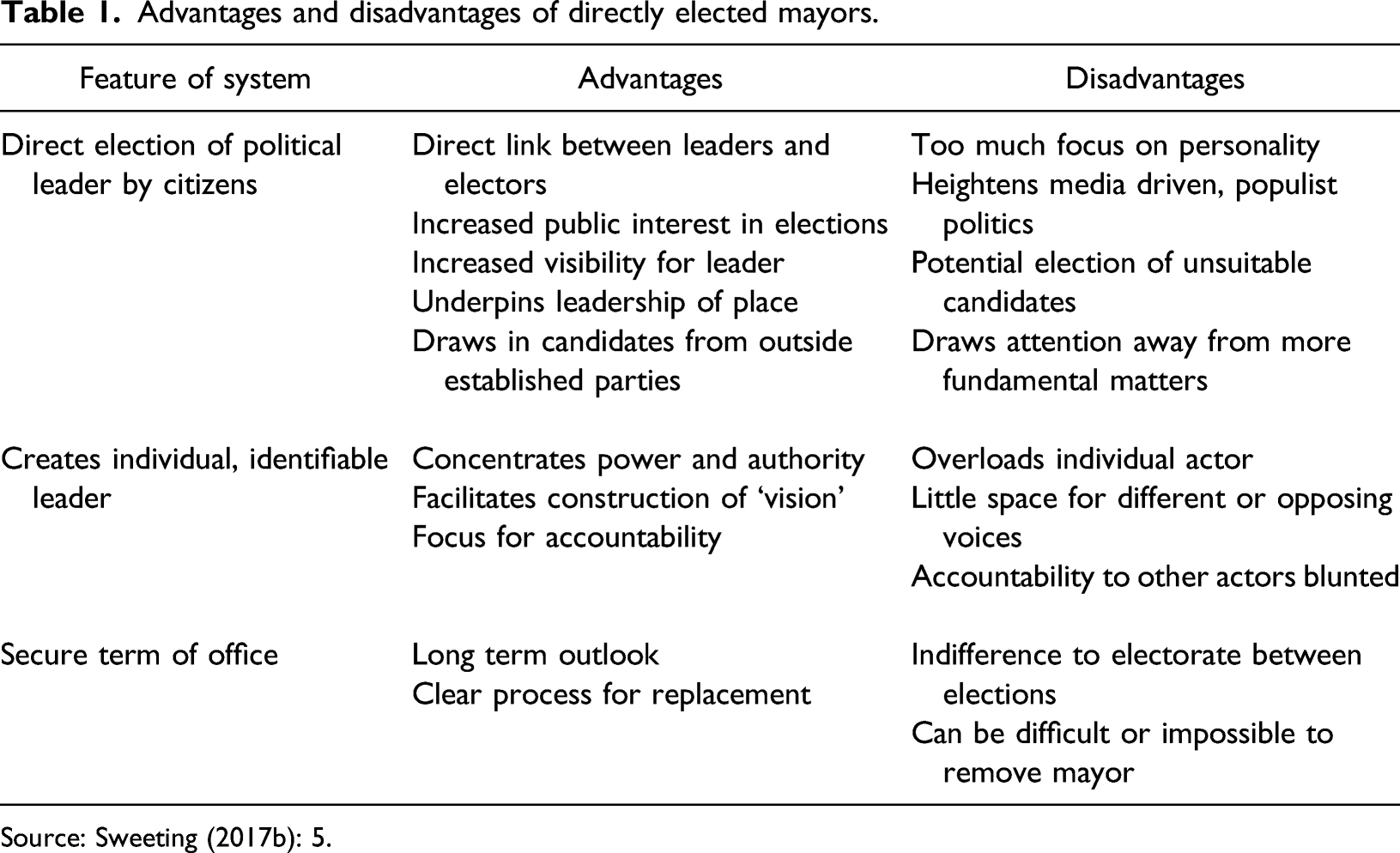
Source: Sweeting (2017b): 5.
The Bristol civic leadership project
Bristol provides an illuminating case study of the interplay between leadership and place for three main reasons. First, the citizens decided to bring about a radical change in city governance arrangements when they voted to introduce a mayoral form of governance in 2012. Second, the first two directly elected mayors of Bristol have both emphasised that they see themselves as leaders of place, and not simply the council. Third, the two mayors have very different styles of leadership.
The reasons why the citizens of Bristol decided, in a referendum held in May 2012, to introduce a directly mayor are documented elsewhere (Hambleton and Sweeting, 2015). In essence, the referendum result reflected, in part, frustration with the frequent changes in city leadership and a widespread perception that Bristol was not ‘punching its weight’ and, in part, the fact that a lively group of civic activists and business leaders organised an effective ‘Vote Yes’ campaign.
Bristol civic leadership project data.
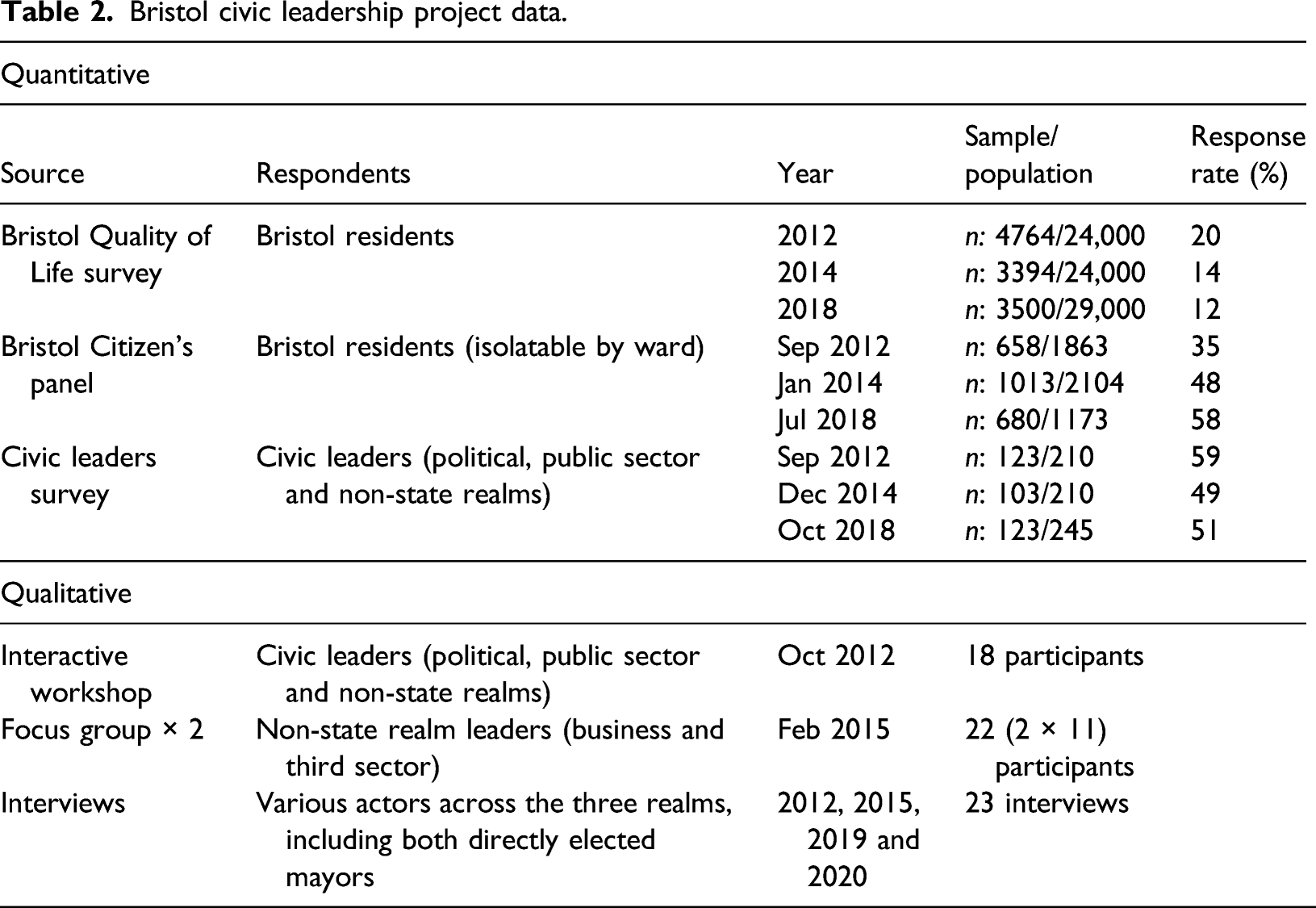
Qualitative data collected has been thematically analysed according to the main themes of relevance to the research and new themes emerging from the data. Quantitative data has been analysed using SPSS and, where appropriate, has been subject to statistical testing – though we only use descriptive statistics in this article. Also, one of the researchers has been closely, but informally, involved with policy development at City Hall. We therefore also use his experience to inform the discussion below, in the sense of participant observer, alongside presentation of other data.
For the civic leaders’ surveys, we wanted to analyse the opinions of a broad and diverse cross-section of those involved in Bristol’s governance including councillors and local government officers, and also a range of actors beyond the council. We created a framework to capture these opinions, called the ‘realms of civic leadership’ in recognition of the fact that, despite the adoption of the mayoral model, place-based leadership and power is dispersed across a variety of sectors in modern governance (see Figure 1). The realms of civic leadership. Source: Authors.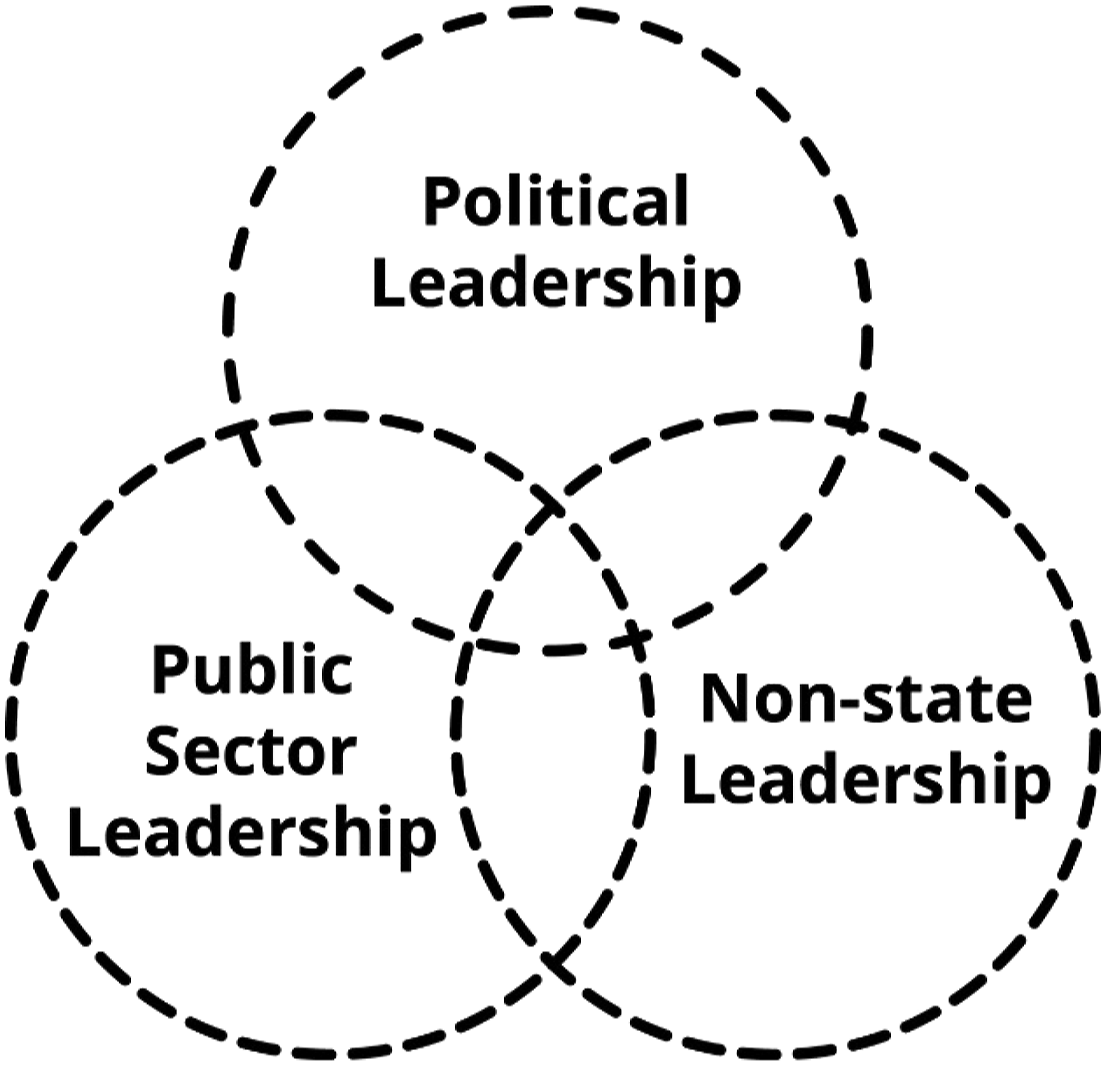
The logic of this framework is that it illuminates the nature of collaborative leadership in diverse, modern places. Rather than seeing place-based leaders in a homogenous, undifferentiated way, we distinguish between three broad kinds of leader: political leaders, public sector leaders and non-state leaders.
The political leadership realm contains people elected by the citizenry. Their involvement is based on being part of the electoral chain of command that links the state and civil society, and their role is, essentially, a representative one (Copus, 2015). The public sector leadership realm contains public servants working for local authorities, central government departments and other public sector organisations to plan, manage and deliver public services. Their involvement is based on professional expertise and state sector resources, and their primary role relates to service provision. The non-state leaders realm comprises community activists, business leaders, social entrepreneurs, trade union leaders, voluntary sector leaders, religious leaders and so on. It is the most diverse of the three realms. Participants here may be involved in place-based leadership in a range of ways – representing, advocating, providing services or simply by taking part in matters relating to the governance of place. Our surveys of civic leaders covered each of these realms. 2
Changing perceptions of city governance
In relation to changing perceptions of city governance, the move to a mayoral model of governance helped to accelerate change in the way that Bristol was viewed externally. For many years, the city council was viewed as inward looking, lethargic and under-performing, especially by central government. For example, the 2002 Comprehensive Performance Assessment (CPA) report found the council’s performance ‘weak’ (Audit Commission, 2002). The introduction of the mayoral model has gone some way towards changing central government perceptions of the city council.
After the introduction of mayoral governance, one Whitehall civil servant commented on the preparedness of the council to be ‘innovative’ and ‘radical’ and regarded it as something of a ‘national leader’ (Interview: Public sector leader, 2015). Now, the city does not lack ‘self-confidence’. Bristol is the only large UK city outside London with an above average GDP and can lay claim to being the UK’s ‘smartest city’ (Woods et al., 2017). Bristol was one of the Rockefeller 100 ‘Resilient Cities’, was European Green Capital in 2015 and was shortlisted for European Capital of Innovation in 2019. It would be wrong to suggest that this positive lift in external perceptions of Bristol is solely a result of the introduction of mayoral leadership – a longer-term trajectory of rising recognition is in play. But it is clear that the first two mayors of Bristol have both been successful in boosting the national and international profile of the city.
Part of the reason for this upswing in national and international profile is that the mayoral model gives visibility to the city leadership position. A number of civic leaders interviewed highlighted this aspect, including one who stated: ‘Both our mayors have been internationalist and recognised that part of Bristol’s strength is that it is an outward looking city but also that it doesn’t have a lot of international profile… In the last seven years Bristol’s star has risen and it continues to rise and part of that is because of mayoral leadership’. (Interview: Non-state leader, 2020)
The citizens of Bristol also changed their perceptions of governance after the introduction of the mayoral system. One of the most striking empirical findings of our research was the remarkable leap in perceptions of the visibility of city leadership. Under one quarter of respondents agreed the city had visible leadership under the previous leader and cabinet model; over two thirds did after – from 24% in 2012, to 68% in 2014, and 51% in 2018 (Bristol Citizens Panel Data).
Civic leaders, including politicians and public servants, many of whom have links beyond the city, felt that Bristol had better external representation following the introduction of mayoral governance. In 2012, before the introduction of the mayoral model, 31% of respondents agreed with the statement that ‘The leadership of the council is effective in representing the council in national and international arenas’. Figures after the mayoral model was introduced were much higher: 61% in 2014 and 52% in 2018 (Bristol Citizens Panel Data).
The differences in responses between respondents in different realms to this question bring us to another point – that the introduction of the mayoral model changed perceptions of governance within the city on the part of those who are involved in it, but unevenly. Those in the political realm were considerably less likely to view the change to mayoral governance as positive, unlike those in the other two realms.
Our research shows that many councillors felt disempowered by the introduction of the mayoral model, with responses reflecting that perception, whereas many of those outside that realm reported positive change. For example, in relation to the above question about representation, of the three realms of leadership, councillors in the political realm held the most positive views about arrangements prior to the introduction of mayoral governance, and the least positive views after its introduction, when compared to those in the public sector managerial and non-state realms.
For non-state leaders, a single figurehead was transformative for communication and collaborative action within the city. One commented: ‘Basically, people know who to turn to, who to ring up, who to blame, who to praise, whatever else. It gives the place a sense of identity and personality’. (Interview: Senior business leader, 2020)
What about the relationship between place and leadership? One councillor told us emphatically (in relation to Rees) that: ‘The mayor is “leader of the city” … he is not just leader of Bristol City Council, and there is a huge difference between the two distinctive governance roles’ (Interview: Bristol City Council Senior Councillor 2020). Our survey data also spoke to this issue, via the degree of agreement with the statement ‘The leader/directly elected mayor is both a leader of the council and a leader of the city’. The results, presented in Figure 2, show how those in the political realm are inclined to think differently to those in the other realms (in common with many other variables). Councillors felt the combination of ‘council-and-city’ leadership roles was much more prevalent before the mayoral model was introduced than after. This contrasts with the views of civic leaders in the public sector and non-state realms who felt that the combination of these roles has been given a significant boost following the introduction of the mayoral model. Civic leaders’ survey 2012, 2014 and 2018 ‘The leader/directly elected mayor is both a leader of the council and a leader of the city’, percent agree, by realm of leadership.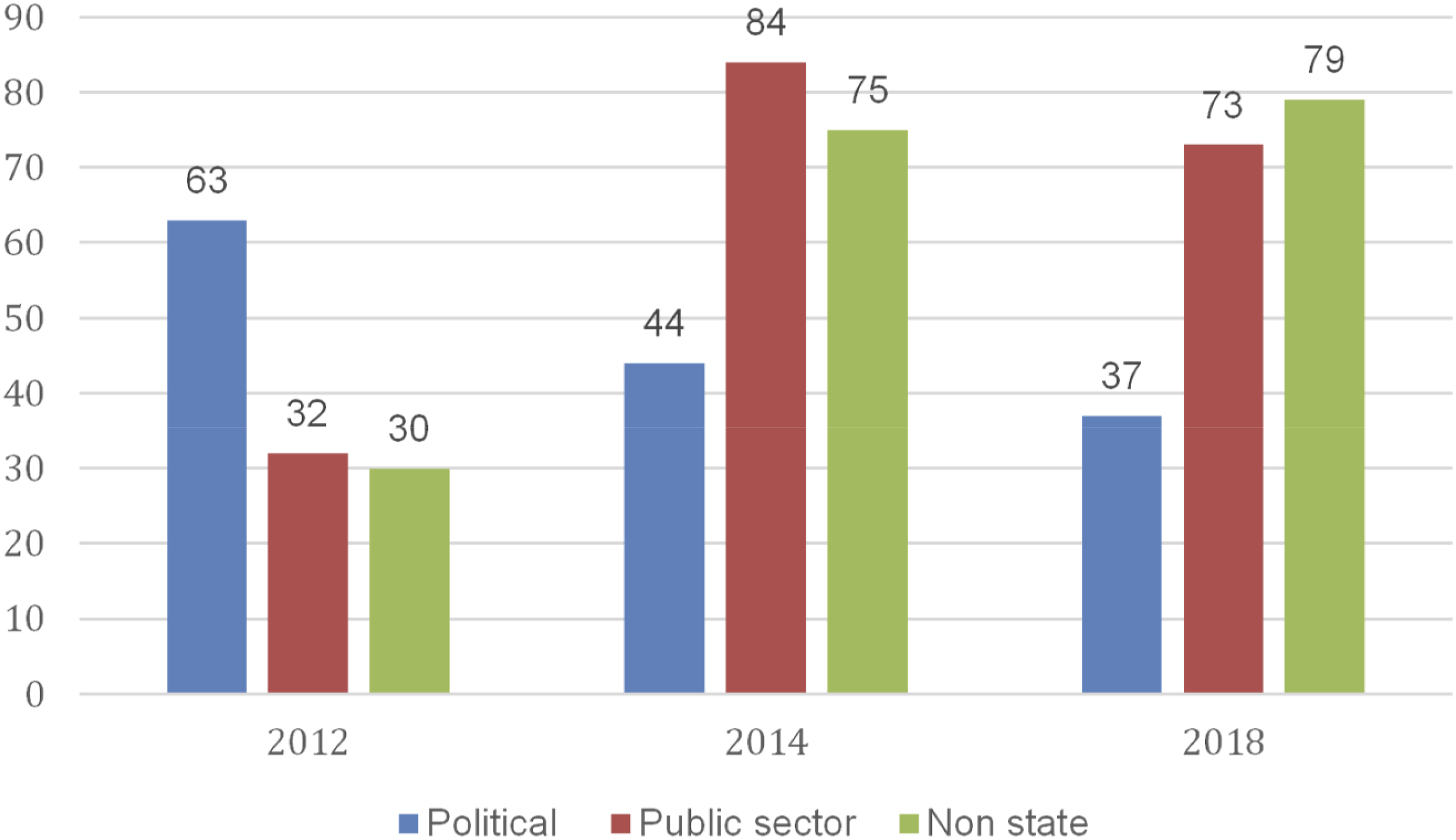
Similar patterns are apparent in responses to other questions. For example, Figure 3 provides the views of different realms of civic leadership in response to a question about whether they agreed that the leadership of the council has a vision for the city, before and after the introduction of the mayoral model. It shows that councillors were most likely to agree that the leadership offered a vision for the city before the introduction of the mayoral model, but least likely to agree afterwards. Civic leaders’ survey 2012, 2014 and 2018 ‘The leadership of the council has a vision for the city’, percent agree, by realm of leadership.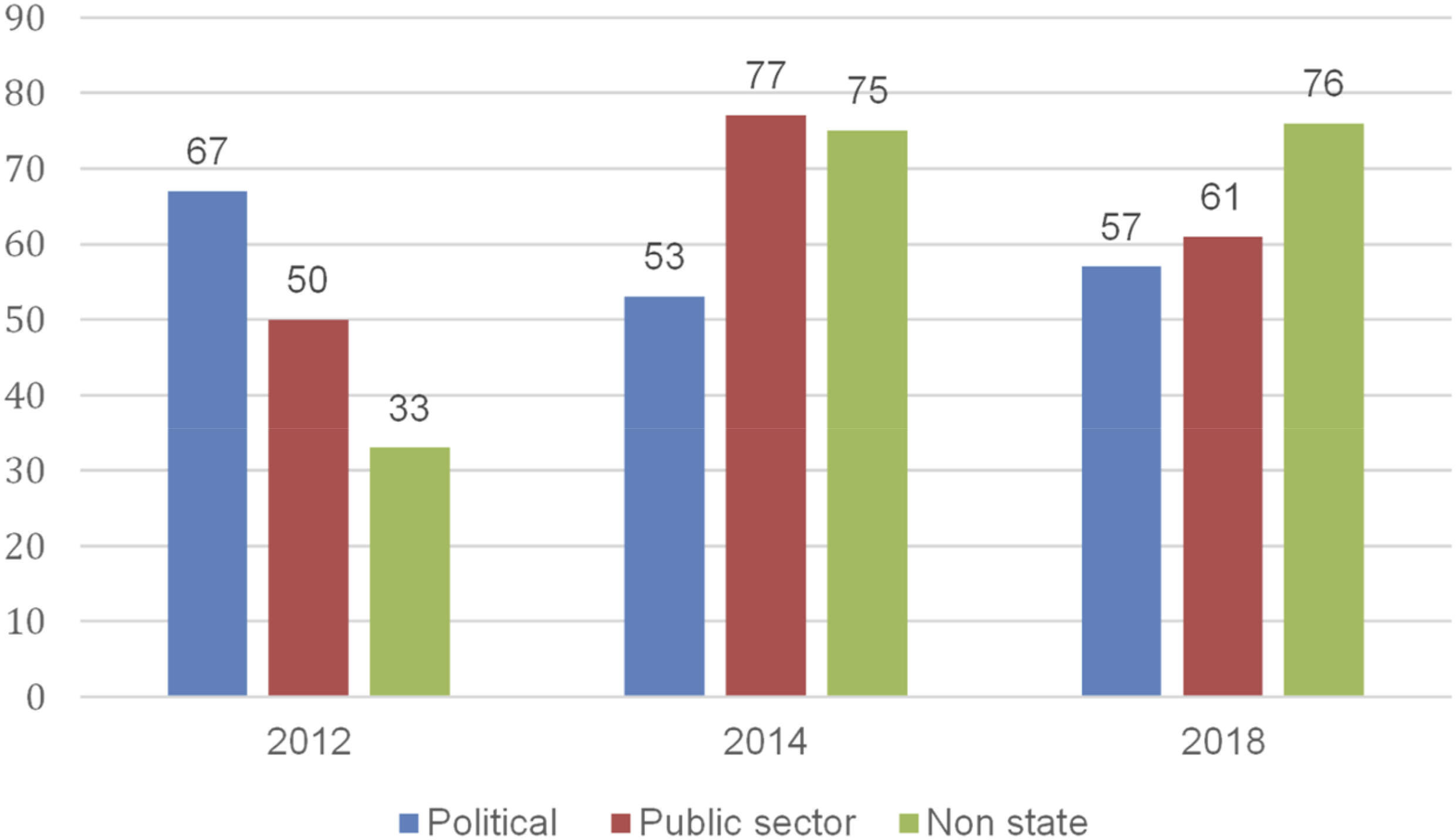
Our research highlights how the more centralised and individualised leadership introduced in 2012 has led to changes in the ways that politics ‘happens’ in the city, and these changes have in some senses depoliticised its governance (Sweeting and Hambleton, 2020). While it does not necessarily follow that the introduction of a mayoral model will centralise, it is a predictable outcome that appears to have occurred in the first years of the mayoral model in Bristol. This aspect is indeed part of the rationale for mayoral systems. As discussed above, mayors provide a focus and a figurehead upon which legitimacy and authority is bestowed. Despite the ability in legislation to give executive councillors decision-making powers, Mayor Ferguson’s cabinet was advisory, an arrangement that has been continued by his successor. It is hardly surprising that many councillors reported a loss of influence in decision-making after the mayoral system was introduced (Oliver, 2017).
While Mayor Ferguson urged councillors to take a more active role in their neighbourhoods, such a role has not established a strong position for councillors. Bristol has long struggled to create an effective system of neighbourhood representation (Hoggett and Kimberlee, 2001). Funding for neighbourhood governance arrangements was hit very hard by central government’s austerity policies. Moreover, Ferguson’s status as an independent politician deprived him, the city bureaucracy, and the broader governance system of the party political links that would normally be in place. Such links can be expected to provide a check on executive power, and serve to disperse, formally and informally, decision-making and authority around the governance system. The centralisation that is a consequence of the model was thus exacerbated by the way in which Ferguson approached the mayoral role, and by his independence from party. We will return to consider Mayor Ferguson’s leadership style shortly.
The visibility of the mayor and centralisation of the system that comes with mayoral governance was underpinned and enhanced by a constitutional change to the way the city is governed. At the same time as the mayoral system was introduced, the way of electing councillors in the city also changed. The old system entailed electing one third of councillors each year, without elections in the fourth year. Hence, in most years there were elections of some sort in the city, providing a platform for issues of public concern to be discussed, debated and reported on, and with the possibility of change in the balance of power in the council, and potentially a change of leader.
The new system of governance, introduced in 2012, entailed not only the election of the mayor for a 4-year term, but also the election of all councillors, at the same time as the mayor with an equal 4-year term. The frequency of elections in the city has, in effect, been cut from three in every 4 years, to once every 4 years. Additionally, experience from the 2016 election shows that the visibility that the mayoral candidates tend to enjoy can overshadow councillor elections, with, for example, billboards of the faces of mayoral candidates appearing around the city. There were also hustings for mayoral candidates, and in between elections, the mayor’s Annual State of the City address takes place, a practice that enhances the visibility of the mayor.
In summary, our research on governance change identifies two opposing forces operating on and influencing the political process of the city. The first is the politicising force, evident in the creation of a powerful politician at the centre of governance, endowed with institutional and political resources, and with the personal legitimacy and visibility that the mayoral model offers. The opposing force, that of depoliticisation (Flinders and Wood, 2014), occurs in both obvious and subtle ways. The more obvious way is the weakened role of councillors, and the reduction in frequency of elections in the city, diminishing opportunities for democratic debate and contestation. Less obvious is the way in which, in a context where the formal political process becomes dominated by mayoral priorities, other issues outside them become much more difficult to get onto the public policy agenda. We conclude that the introduction of mayoral governance has brought about significant change in the governance of the city. Institutional redesign has clearly ‘made a difference’ to place-based leadership in the city.
Evaluating mayoral leadership styles
In this section, we turn to consider the impact of mayoral leadership style on the governance of the city. The study of leadership is a multi-disciplinary exercise attracting contributions from the fields of management studies, organisation theory, psychology, history and political science. Because our research is focussed on place-based leadership and the role of leadership in promoting public innovation, we are particularly interested in concepts and frameworks that throw light on the interplay between leadership styles, local power structures and the possibilities for urban innovation. In fact, urban political science offers numerous typologies of leadership styles. For example, Yates provides an early and influential categorisation based on his study of city leaders in the USA. His framework distinguishes four leadership styles: (1) crusader, (2) entrepreneur, (3) boss and (4) broker (Yates, 1977).
John and Cole (1999) provide a helpful typology and we draw on their framework in the discussion below. This framework (see Figure 4) comprises two dimensions. Earlier we drew attention to the important distinction made by Stone in his analysis of urban politics in Atlanta (Stone, 1989). He provides many insights on the first key dimension of leadership style; namely, the way power is conceived and exercised by a leader. He distinguishes between leaders who focus on generating the ‘power to’ achieve outcomes from those who focus their efforts on trying to exercise ‘power over’ others. In simple terms, he contrasts the desire and ability to act authoritatively, at times to command and control others, from the desire and ability to release untapped sources of energy by empowering others. This is the vertical dimension in Figure 4. Typology of urban governance leadership styles. Source: John and Cole (1999), 102.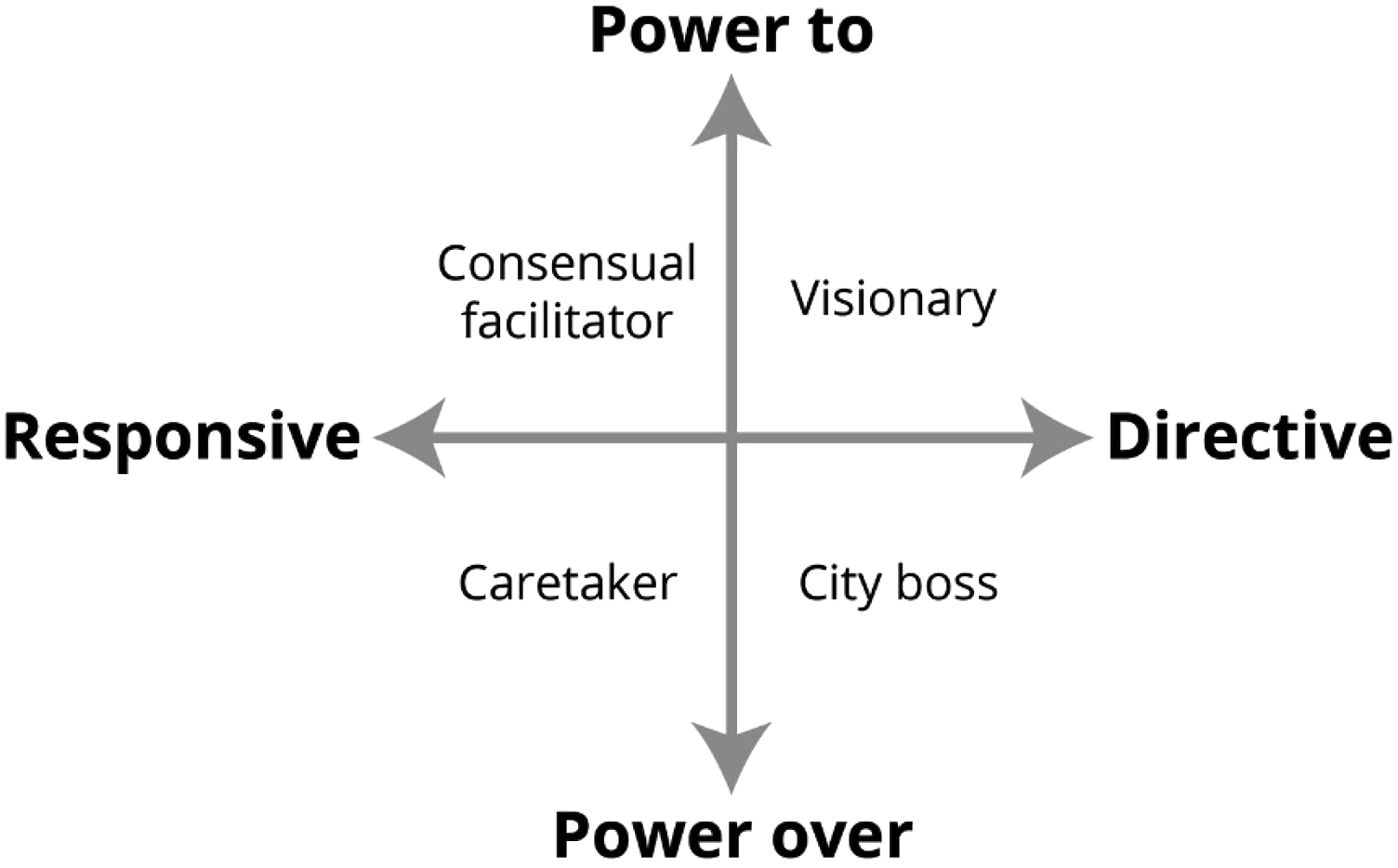
In relation to the second dimension, the framework draws a distinction between those leaders who have a clear political agenda and a strong interest in bringing about change and those that tend to respond to other actors and external events. Leaders who are change oriented are considered directive. Other leaders may believe that the status quo is desirable and/or that only modest change is necessary. This is the horizontal dimension in Figure 4.
Conceptual frameworks of this kind necessarily simplify a much more complex reality. It is also the case that individual leaders may move their position on these two dimensions depending on the issue at hand and/or changes in the immediate context. Nevertheless, we believe that the model is helpful in revealing tendencies in city leadership behaviour. We take the view that the framework provides a useful starting point for understanding the predominant leadership style of a given directly elected mayor or other local political leader. Other scholars have also made use of this framework to study leadership styles (Getimis and Hlepas, 2006).
Figure 4 suggests that urban leaders can be grouped into four categories reflecting their location on the two dimensions of leadership style. On the left of the diagram, we find leaders who tend to operate in a ‘responsive’ way. The caretaker is, essentially, a weak political leader who is not that interested in changing things significantly. Such leaders may be effective as party leaders or as city managers, but they are likely to find it hard to cope with rapid policy change and they tend to have low recognition of the need for public innovation. The other type of responsive leader is the consensual facilitator. Such leaders are, like the caretaker leaders, relatively easygoing but they are far more adaptable. They are likely to be good at partnership working and are able to generate capacity in others by persuasion and relationship building, rather than by the authority of office.
On the right side of the diagram, we find leaders who tend to be ‘directive’ in their leadership style. The city boss could well have a clear vision of what they want to see happen, but they are unlikely to be very good at listening to other voices. They may lack the understanding, or patience, to participate in active networking and innovative policy making that modern city politics now requires. The visionary combines elements of directive leadership with capacity generation. The visionary has a clear idea of what they want to achieve but knows that they need to work creatively with others to co-create new possibilities. They tend to adopt an inclusive approach to decision-making but exercise political will, rather than formal authority, to generate support for a shared vision.
Before our analysis of the leadership styles of the first two directly elected mayors of Bristol, we make two points. The first is that our quantitative data suggests that changing the structure of leadership in Bristol, from a cabinet and leader model, to a directly elected mayor model, has impacted on the style that leaders adopt. This is demonstrated in Figure 5, which shows the responses from our surveys of civic leaders to key variables pertaining to the typology of leadership styles. In essence, our quantitative data indicates that both mayors offer leadership that is more visionary and more potent (i.e. moving to the right along the responsive/directive spectrum) than was displayed under the leader and cabinet system. Civic leaders’ survey 2012, 2014 and 2018, leadership style variables, percent agree.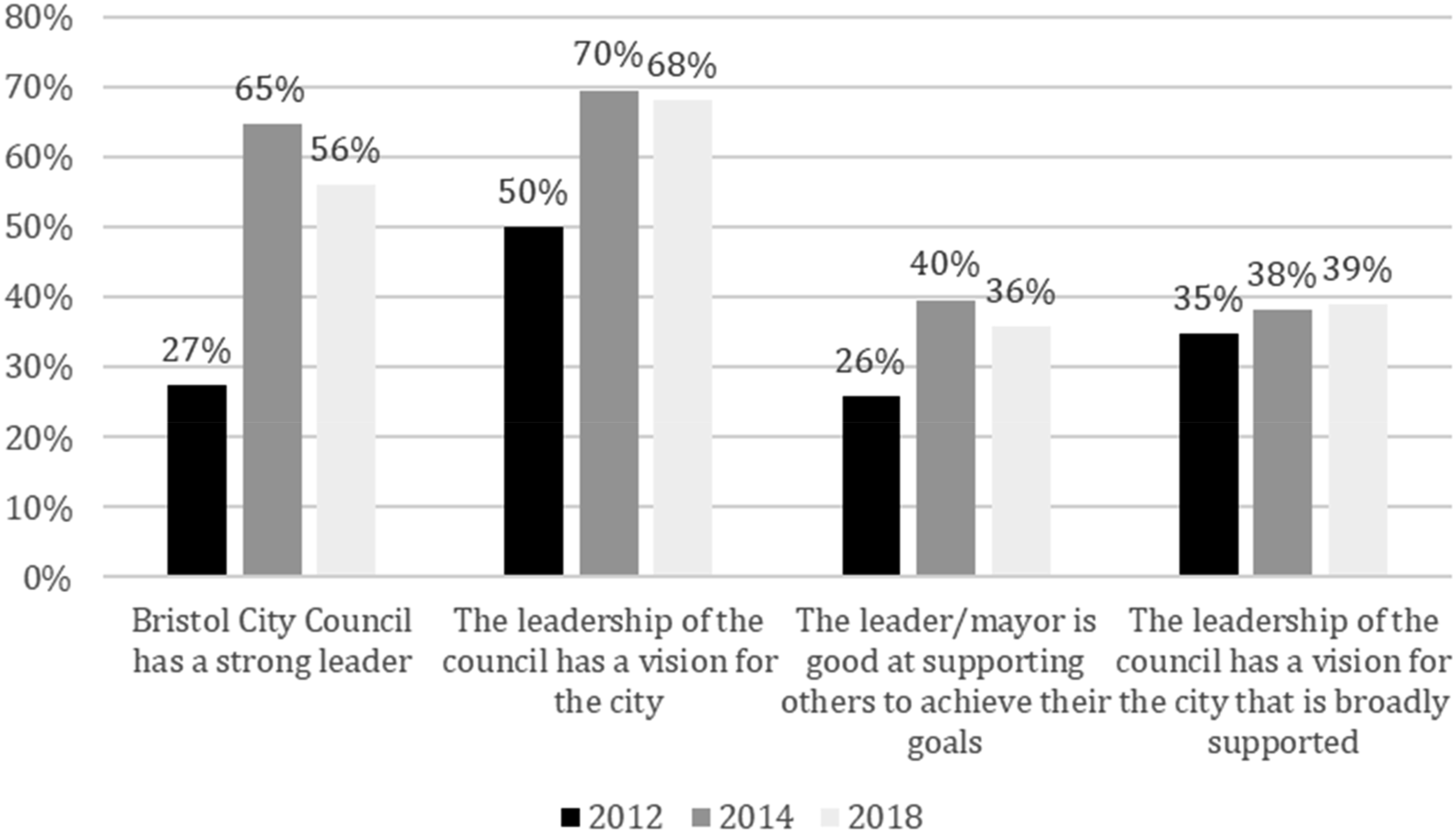
Responses to questions to civic leaders on whether Bristol has a strong leader, and whether that leadership offers a vision for the city, are considerably higher under mayoral leadership. There is also evidence, albeit less clear-cut, that mayoral governance offers leadership that empowers others and attracts their support (i.e. moves up the power over/power to spectrum). More respondents agree that the leader or mayor supports others to achieve their goals with the mayoral system. More respondents also agree that the leadership of the council has a vision for the city that is broadly supported in the mayoral model – albeit less than those who simply agree that the leadership has a vision for the city. However, our second point is that we also argue that a much more nuanced analysis is revealed by our qualitative data which follows and that there are important differences in leadership style between the first two directly elected mayors of Bristol.
Introducing the first two directly elected mayors of Bristol
The first two directly elected mayors of Bristol have very different backgrounds. Ferguson previously had a successful career as an architect. He was President of the Royal Institute of British Architects (RIBA) in 2004 and was heavily involved in urban regeneration projects in the city where he was already well known prior to running for mayor. Rees is mixed-race, has a working class background and was brought up in some of the most deprived wards in Bristol. He has a long history of civic activism, notably in relation to youth work, and has been a freelance journalist and local radio presenter. Rees has never been a councillor but, in the period before he was elected as the Labour Party candidate for Mayor in 2012, he had built a strong reputation as an articulate spokesperson for the less well off in the city.
In the November 2012 mayoral election, Ferguson became Bristol’s first directly elected mayor with Rees in second place. Ferguson’s unexpected victory as an independent candidate in 2012 attracted national media attention. In May 2016, Rees beat Ferguson into second place to become the first ever mayor of black African-Caribbean descent to lead a major European city.
National policies for local government pursued by both the UK Coalition Government (2010−2015) and the Conservative Government (since 2015) have placed major constraints on the exercise of place-based leadership in the UK.
In essence, the central state has chosen to decimate central government financial support to local government, an approach described as ‘super-austerity’ (Lowndes and Gardner, 2016). In the Bristol case, the cut in central government financial support was from £201 million a year in 2010/2011 to £45 million a year in 2019/2020, a 78% cut (Hambleton, 2017). A consequence is that both Mayor Ferguson and Mayor Rees have been faced with extremely difficult budget challenges.
The leadership style of Mayor Ferguson (2012−2016)
Ferguson quickly established a mayoral reputation for taking decisions quickly with little or no consultation. On his first day in office Ferguson revoked Sunday car parking charges with immediate effect. He also announced that the ‘Council House’, the municipal headquarters, was to be renamed ‘City Hall’ to signal that the council building should be seen a resource for the city, not simply a ‘house for the council’.
Ferguson also lifted the visibility of political leadership in Bristol and set out a clear vision for the city. His document, A vision for Bristol, set out a strategy described by the local newspaper, as a vision for a ‘bold, energised, green city’ (Bristol Post, 2013). In 2015, Bristol was awarded the status of European Green Capital, although the foundations for that success, as Ferguson often explained, were constructed well before he was elected. Under Ferguson significant decisions were often taken relatively swiftly, such as the introduction of 20 miles per hour speed limits, residents’ parking zones and the creation of Bristol Energy, a council owned energy provider.
While often decisive, Ferguson’s leadership style can be criticised for being too centralised, needlessly top-down, and even rushed and autocratic. For example, the public consultation processes for residents’ parking zones were wholly inadequate, and the proposals were met with widespread public anger and resistance. In his first Mayoral Annual Lecture, in November 2013, Ferguson admitted that he could be impatient, and announced that he was paring the parking scheme back. It can be argued that it was the way the initiative was imposed that antagonised the public.
Mayor Ferguson did not make good use of the 70 ward councillors elected to Bristol City Council. At times, he appeared to see them as an obstacle to be bypassed. Our research on leadership in Bristol found that the role of councillors in exercising leadership was unnecessarily restricted following his election. ‘With this singular focus it is so easy for the mayor to become isolated, he was living in a bunker, at times. More often than not we were finding things out after the fact, reacting to decisions, not helping to inform them. That fact framed many of our interactions’ (Interview: Bristol City Council Senior Councillor, 2020)
Moreover, this sentiment was not limited solely to councillors. One voluntary sector respondent, lamenting the concentration of power in the position of the mayor, stated: ‘Councillors are less visible, it’s a mayor and officer council now’ (Interview: Non-state leader, 2015).
Returning to the typology of leadership styles presented in Figure 4, we can see that Mayor Ferguson’s preferred leadership style was clearly on the directive side of the framework. While he had a vision for the city, it was largely his vision. His leadership approach was, in essence, characterised by a continuing effort to impose this vision on the city. It follows that his dominant leadership style can be placed in the city boss quadrant.
The leadership style of Mayor Rees (2016−2021)
In contrast, Mayor Rees has adopted a different style of leadership. At his Swearing-in ceremony, Rees demonstrated his strong commitment to developing a collective, rather than an individualised, approach to city leadership. This ceremony was not held in City Hall as Rees wanted to demonstrate that City Hall is only part of the governance of the city. Moreover, Rees was not the only speaker on the platform. He was joined by a senior health services manager, the Vice-Chancellor of one of the two local universities and a senior police officer. From the outset, Rees was signalling his interest in sharing power and valuing the leadership contributions of other non-state agencies and actors. In his own speech, Rees emphasised that his City Office model of city leadership, a notion he had spelt out in his campaign for mayor, was intended to improve partnership working and would emphasise the co-creation of new ideas and ways of working. This model came to be known as the Bristol One City Approach (Hambleton, 2020b).
It is possible to summarise the main features of Rees’s One City Approach by referring to five elements. First, City Gatherings of civic leaders, drawn from the realms of place-based leadership shown in Figure 1, have been held on a regular basis since the City Office Founders Meeting held in July 2016. City Gatherings, create highly interactive ‘city conversations’, with participants working together in cross-sectoral teams, to examine the major challenges facing the city and to explore ideas on how to tackle them. By 2021, City Gatherings were attracting over 400 participants.
Second, Rees created an ‘innovation zone’ in City Hall just outside the Mayor’s Office. People, from any of the realms of leadership in the city, who are working on activities relating to the City Office agenda, were invited to work in this space on Tuesdays. In addition, the City Office organised regular presentations and workshops on Tuesday mornings.
A third element in the model was to create and deliver specific City Office collaborative projects. One example is the Street Homelessness Challenge project where Rees asked local leaders to work together to create 100 extra beds for homeless people. A project group, chaired by the City Office Director, was set up and City Office partners subsequently launched a ‘spectrum of activity’ to tackle homelessness (Morris, 2017). This approach brought in actors not normally involved in addressing this challenge, for example, local businesses.
Fourth, the Bristol One City Plan, sets out a ‘big picture’ strategy for the future development of the city, one that looks forward to 2050, and one that agencies are expected to commit to. 3 The central aim is to create a city that is fair, healthy and sustainable. It is important to emphasise that this is not a conventional city council plan – it is a collective plan that sees the city council’s activities as part of a much broader civic effort. A City Funds Board has been set up to help deliver the One City Plan. 4
The fifth element in the One City Approach is the development of place-based leadership talent. City Gatherings, mentioned earlier, identified the importance of developing and delivering new kinds of civic leadership programmes, ones that target under-represented groups in the city. The idea is for the City Office to orchestrate a step-change in the provision of place-based leadership programmes – ranging from city leadership courses for young people (under 18s) through to advanced place-based leadership workshops for senior leaders from the realms of leadership shown in Figure 1.
One Senior Officer felt that this bringing together of city partners would have been unlikely to occur without both the mayoral mandate and Rees’s distinctive ‘convene and ask’ style which drew upon shared ownership of goals: ‘The One City Approach and the City Office… I think that this would have been very hard to do if it had not been spear headed by a mayor. In terms of enacting change the council has very many responsibilities… it is a very brave initiative to, in effect, take on wider responsibilities’. (Interview: Public manager, 2019)
One fellow politician, reflecting on Rees as mayor, found him exercising power in different ways: ‘As mayor of the city Marvin has both soft and hard power that he uses for the betterment of all the citizens of this city’. (Interview: Bristol City Council Cabinet Member, 2020)
In June 2020, Black Lives Matter protesters in Bristol pulled down a statue of the prolific slave trader Edward Colston and dumped it into Bristol Harbour. This attracted international news coverage not least because Bristol was one of thousands of cities and communities across the world protesting the killing of George Floyd by American police officers in Minneapolis in May 2020. In responding to this civil disobedience, Rees sought to balance the complexity of speaking for an ethnically and socio-demographically diverse city, by facilitating a wider collective conversation as not simply about race, but incorporating class and a distinct need to address social immobility in the city. A recognition of the dispersal of power across multi-layered contexts as a defining feature of modern city leadership (Budd and Sancino, 2016) has informed both the leadership style and discursive substance of Mayor Rees’s actions.
We now return again to consider the typology of leadership styles presented in Figure 4. It is clear that Mayor Rees’s dominant leadership style can be located in the top part of the diagram. Clearly, he has a vision for the city and his leadership style places him in the consensual facilitator quadrant of Figure 4, arguably with some overlap into the visionary quadrant.
Putting leadership in its place: Emerging themes
At the beginning of this article, we identified two questions for consideration: (1) Does the institutional design of local governance in a place influence leadership effectiveness? (2) How, if at all, do the leadership styles of the individual elected as mayor affect the quality of place-based governance? Our longitudinal study of place-based leadership and public innovation in Bristol shows that both institutional design and leadership style can, indeed, have a significant impact on governmental performance. First, the redesign of Bristol’s model of governance in 2012 changed the way leadership of the city was exercised and perceived – the impacts were in some ways startling. Second, our research also shows that the first two mayors of Bristol had very different styles of leadership and, more important, these differences influenced decision-making processes in the city, and they also shaped the way city governance was perceived by different groups and interests.
In this final section, we turn directly to the theme of this Special Issue: ‘Putting leadership in its place.’ Our research suggests that the role of place in public leadership should be given more attention by leadership scholars. As explained earlier, place matters in public policy for three main reasons: (1) place forms an important part of our identity as human beings; (2) place provides the spatial units for the exercise of democracy; and (3) place plays a key role in delivering governmental effectiveness. Our research also suggests that power – in this article, we have highlighted the exercise of ‘power to’ leadership – is a key variable. We now consider how our analysis of governance change in Bristol speaks to these three aspects of place, and in doing so we throw new light on the role of power in place-based leadership.
For leadership and place identity, our research on mayoral governance in Bristol shows how the first two mayors of Bristol saw themselves as place-based leaders, as well as leaders of the city council. From the beginning, both mayors saw themselves as leaders of the city, and they both developed an influential public profile going well beyond the council chamber and the corridors and meeting rooms of city hall. It is clear that the direct election process enables mayors to adopt a stance emphasising that they serve the place, and reflect its ethos and values, and not just those of the city council or their party. This is because their political mandate stems from a very large citywide election. In most elected local authorities in Britain, the elected councillors choose the leader of the council. Many council leaders elected through an internal process of this kind do, of course, adopt a very outgoing approach and many claim, rightly, to be leaders of their place. However, the legitimacy of direct election by thousands of citizens enables elected mayors to make a more convincing representative claim that they speak for the place as a whole. They are, in some ways, the ultimate place-based leader. Voters expect their directly elected mayors to focus on serving the interests of their city or place and, generally speaking, they do.
It is also the case that in going beyond the confines of city hall, effective leaders are obliged to take steps that fuse together the capacity to act amongst diverse sets of actors, or in other words adopt ‘power to’ strategies. This is necessarily a key part of place-based leadership, as directly elected mayors, no matter how powerful they might be within their own municipal organisations, lack formal powers to act outside it. They have to rely on empowering others to achieve their goals, and pursue the goals of the citizens that elected them. City leadership that reflects, draws on and develops the ethos and values of place is, at root, leadership that fuses the power to act.
This ability to fuse the capacity to act locally also links to the democratic aspects of place and public policy. The first two directly elected mayors of Bristol were able to utilise the existence of their direct democratic mandate to operate and lead at the level of the city. This mandate enabled them to speak, with authority, for their city and to exercise place-based leadership. Both mayors were able to operate ‘upwards’ in a remarkably effective way, meaning that they were successful in representing the city on the national and international stage. Also, as illustrated by the Bristol One City Approach, Mayor Rees was able to use his citywide mandate to bring about a significant expansion in ‘horizontal’, collaborative working across organisational boundaries, meaning the mayor was able to convene the voices, insights and resources of partners to define and address many of the complex challenges facing the city.
Our research shows that it was the clear and distinct legitimacy of direct election that enabled both mayors to act as the focus of collaborative place-based leadership. Hence, there is a direct link between the form of election via the democratic process, and the collaborative empowerment (or ‘power to’ capacity) that the mayors were able to energise. In an important sense, the electoral mandate provided these mayors with the autonomy and legitimacy to co-create new spaces within which to lead, spaces which clearly exist outside the traditionally conceived representative democratic sphere. However, given that the ‘democratic anchorage’ (Sorensen and Torfing, 2005) of these new spaces of collaborative city governance, such as the Bristol One City Approach, cannot be appraised by normative democratic standards there is a need for researchers to explore new ways of evaluating the very nature of place-based, democratic local governance.
While our research on Bristol suggests that the mayoral model has given a helpful boost to collaborative leadership in the city, the model can be criticised. For example, Latham (2017) takes the view that directly elected mayors can lead to cronyism, patronage and corruption, and supporters of this view will see evidence of such practices in recent reports on Liverpool City Council, led by a directly elected mayor (Caller, 2021). Less dramatically, our research on Bristol has revealed many city councillors feel that the model has diminished their influence, and some believe that the mayoral model should be abandoned. While our research reports on governance change in Bristol suggest that discarding the mayoral model would have significant drawbacks, we have consistently argued that the role of councillors in exercising leadership within the model has been unnecessarily restricted (Hambleton and Sweeting, 2015; Sweeting et al., 2020). Our research suggests that the roles of councillors in city governance should be developed and strengthened, a conclusion also reached by the independent democracy commission report on mayoral governance in Newham, London (Newham Democracy and Participation Commission, 2020).
For the third aspect of place and public policy that we focus on, of governmental effectiveness, there are clear advantages to the mayoral model. The variation between places means that different local governments need to be able to do things differently. However, while it is clear from the evidence presented in this article that imaginative political leadership can make a difference to the governance of a particular place, these local efforts are, in the UK, constrained by an array of unhelpful centralised controls exercised by distant figures in Whitehall and Westminster. Such central control does not only limit the formal legal and financial power of leaders. It also diminishes their ability to involve other partners in local problem solving – in other words it weakens their capacity to exercise ‘power to’ leadership. The UK government’s highly centralised approach to public policy making impairs governmental effectiveness in a variety of ways.
The legal constraints imposed on local leaders in particular countries, or states within federal countries, by higher levels of government vary enormously. In some countries, for example, Germany and Sweden, local governments enjoy constitutional protection from interference by higher levels of government. These protections create a significant amount of local political space within which locally accountable, civic leaders can pursue bold strategies for public innovation. This autonomy enables local political leaders to bring together actors from the different realms of place-based leadership shown in Figure 1 to co-create new solutions to pressing public policy challenges. Unfortunately, in some countries, and the UK provides a troubling example, locally elected authorities enjoy no constitutional protection and have little or no independent fiscal power. Directly elected city mayors and, indeed, other locally elected leaders in a highly centralised state, like the UK, have relatively little political space in which they can generate the local capacity to act. Reformers interested to strengthen the ability of place-based leadership to address current societal challenges need to consider not just the institutional design of local governance but also take steps to bolster the legal and fiscal power of elected local governments.
Finally, we turn to outline three suggestions for future directions in leadership research that stem from our analysis. First, it is still the case that relatively few contributions to leadership studies, even studies purporting to advance understanding of collaborative governance and the importance of local co-creation processes, pay insufficient attention to the power of place. This gap could, perhaps, be addressed by leadership scholars collaborating in a more proactive way with colleagues in other disciplines who focus more sharply on power relations in modern society – in, for example, urban political science and community development studies.
Second, the findings presented here spotlight the activities of directly elected municipal leaders in the leadership of place. We would like to encourage more empirical studies of place-based leadership in different countries and contexts. In particular, it would be a step forward for public leadership studies if future research could expand our understanding of the performance of different municipal leadership models in different settings. For example, it would be helpful if future research could compare and contrast the strengths and weaknesses of, not just the various directly elected mayor models of leadership, but also other approaches to collaborative public leadership of cities and localities.
Lastly, we highlight what could be described as a relative ‘black hole’ in both leadership studies and local government studies. In this article, we have explained how effective place-based leadership arises when leaders from the different realms of civic leadership come together. These realms have been configured here as political leadership, public sector leadership and non-state leadership (see Figure 1 and also Footnote 2 for how these realms can be further refined). Whilst research on local governance and city politics has advanced our understanding of local political leadership, it remains the case that more research is needed not just on the leadership exercised by appointed public sector officials and non-state leaders, but also on the way leaders from the different realms of leadership interact.
Footnotes
Declaration of Conflicting Interests
The author(s) declared no potential conflicts of interest with respect to the research, authorship, and/or publication of this article.
Funding
The author(s) disclosed receipt of the following financial support for the research, authorship, and/or publication of this article: This article is financially supported by Bristol City Council (Evaluation of the introduction of mayoral governance) and Economic and Social Research Council (Impact Acceleration Scheme).
