



Abstract
This article introduces the notion of ancestral leadership that emerges from intergenerational wisdom at the intersection of people, place and ancestral knowledge. Place is a key component of collective continuity in ancestral leadership that reinforces identity, belonging and intergenerational reciprocity. The findings show that places carry leadership legacies and require ongoing maintenance to ensure genealogies of leadership are available to future generations. Engagement with ancestral leadership and its practical application is not bound to tribal and cultural contexts. By knowing the place of someone’s ancestors as a lens into their leadership, one sees structures of accountability that extends beyond culturally bound contexts, and includes their leadership expressed in professional environments. The authors contribute to leadership theory by illuminating how ancestral legacies of leadership continue to inform contemporary generations of leadership and is transmitted intergenerationally within frameworks of genealogy.

(Whakataukī as cited by Pita Tipene in Hēnare et al., 2013: 23)1
Our deepest human sense of belonging is rooted in our connection to place. Transcending boundaries of time and space, place offers rootedness in a world we work extraordinarily hard to make familiar, safe and survivable. Yet, despite the power of language, symbolism and story to establish belonging, what remains an unresolved and under-researched leadership issue is how human ties to place are carried across generations and sustained through the continuous relationship between ancestors and their descendants. An intriguing leadership dynamic unfurls where the voices of ancestors and their descendants overlap, revealing a story of simultaneous continuity and change with each new generation. At the heart of this ancient dynamic is a complex environment where tradition and heritage interact with innovation and opportunity to inform how leadership emerges (Tapsell and Woods, 2008). The opening whakataukī, or proverb, from Māori Ngā Puhi leader Sir James Hēnare captures the intimacies of place that engage processes of imagination, memory, responsibility, creation, stability, learning and spirituality. Further, it expresses the importance of those ancestors who have paved the path for others to follow. As a leadership story, the footprints of the ancestors are tied to place for eternity. Their names are enshrined in collective memory and their legacies endure through ongoing threads of genealogy referred to in the Māori language as whakapapa.
Contributing to the theme of community and locality in this special issue ‘Putting leadership in its place’, we theorise that ancestral leadership is a resilient system of leadership that emerges from the complexities of kinship structures and informs contemporary leadership practices in all spheres of life, including the workplace, political arenas or tribal institutions. In this article, we argue that ancestral wisdom informs how leadership knowledge is passed down and enacted through generations of Indigenous leaders. In societies that recognise the knowledge held by place, it is the work of leadership to nurture relationships with place in order to draw on this knowledge. We explore concrete examples of how Indigenous Māori leaders demonstrate engagement with ancestral leadership in their day-to-day lives.
What follows is a review of literature situating our theory in extant conversations about leadership and place, Indigenous ontologies of belonging and emerging Indigenous leadership research. We then explain our research method for gathering data using oral history to conduct qualitative interviews. Following, we present the findings that speak to the embodiment of place and genealogies of leadership and power derived from relationships to land. We then discuss ancestral leadership in which place and community are intimately tied and inextricably linked, describing intergenerational leadership ethics that provide a system of accountability through reciprocal obligations to people, place and cosmology.
The agency of place in leadership
The role of place, of where leadership is created, Jackson (2019) argues is often undervalued in leadership literature. Geographical and anthropological literature has theorised place as a combination of (1) geographical location; (2) locale; and (3) a sense of emotional attachment (Agnew, 2011; Jackson, 2019; Ropo et al., 2013). Attachment to place brings about a sense of belonging, purpose and identity (Carmel and Naveh, 2002; Hirsch, 1995; Hunziker et al., 2007; Morphy, 1995; Ropo et al., 2013). The geography of physical spaces, coupled with the intangible socio-cultural processes that create attachment, impact on how leadership emerges from particular places in particular contexts. Jackson (2019) highlights how the context of a place can shape its prominence in history, or how catastrophic environmental disasters, at specific locations, can compel leadership response. Hunziker et al. (2007) explain that the functional use of space, when imbued with personal experiences and collective meanings, is transformed into place. The creation of place is, therefore, a series of spiritual, cultural and social values and processes that bond people to their surroundings. Whilst a place-based approach is gaining prominence within mainstream leadership scholarship (Collinge et al., 2010; Mabey and Freeman, 2010; Ropo et al., 2013), we contend that place has always been integral to Indigenous leadership. Taking place into the leadership equation, Jackson argues, may produce greater social cohesion, with local solutions to specific local setting.
In Indigenous thought, concepts of place are derived from cosmology connecting all reality to a universal process of perpetual emergence (Cajete, 2000; Hēnare, 2001, 2003; Gladstone, 2015; Wilson, 2008). As a reflection of cosmology, Indigenous concepts of place are inherently spiritual, in part because the origins of place are unbounded by time and space, having emerged from an eternal darkness and into eternal light. It is through the spiritual landscape of creation energies that land, ecosystems and people evolve (Marsden, 2003). It is also due to this pre-human existence that the spirituality of place imbues it with agency (Tuck and McKenzie, 2015). The eternal unfolding of reality is articulated in Indigenous art, language, ceremony, and increasingly, is expressed in Indigenous business, innovation and entrepreneurial contexts as a driver for the realisation or unleashing of unlocked Indigenous potential (Hilton, 2021; Kawharu et al., 2017).
Tuck and McKenzie (2015) argue that to understand place is to see beyond its socially constructed meanings to include how place interacts with more-than-human entities. Part of understanding entails becoming literate in the languages of the land itself. To provide a few concrete examples, in te reo Māori, the Māori language, there are a range of words that capture place in terms of their specific context and we offer a brief discussion of three—papakāinga, tangata whenua and manuhiri. Papakāinga refers to a village or community and is attributed to notions of home, a base to which people often return or relate to through kinship ties (Dell, 2017). Papakāinga is tangible evidence of one’s standing in place and belonging (Hēnare, 1988). Tangata whenua and manuhiri are interconnected terms and often appear together centred around those who belong to a place and those who are visiting a place. Tangata whenua refers to the people of the land whose ancestral power and authority (mana whenua) is recognised due to their longstanding relationships to particular places (papakāinga) and is derived from descent and ancestral ties (mana tūpuna) (Henry and Wolfgramm, 2015). Manuhiri refers to the role of the guest of tangata whenua. Both actors within this exchange relationship fulfil roles within a hospitality framework, whereby giving and receiving hospitality depends on whose territory or place of descent the relationship unfolds. Tangata whenua and manuhiri enact the power and agency of place in an ongoing cycle of relational responsibility.
Tewa Indian philosopher and educator Cajete (2016) posits that place, from an Indigenous perspective, is the spirit of the community. This place is the site where human, natural and spiritual lives intertwine. … each Indigenous community is considered a sacred place, a place of living, learning, teaching, healing, and ritual—a place where the people share the breath of their life and thought (Cajete, 2000: 276).
In this creative act of place, collective and personal connections develop and the process of belonging unfolds. To belong to a place extends beyond human-to-human attachment to one another and involves fostering relationships with communities, natural landscapes and spiritual ancestors (Cajete, 1994, 2000). The journey to place is about becoming more whole as an individual through relationships with all components of being. As Wilson (2008: 80) says, Identity for Indigenous peoples is grounded in their relationships with the land, with their ancestors who have returned to the land and with future generations who will come into being on the land. Rather than viewing ourselves as being in relationship with other people or things, we are the relationships that we hold and are part of.
In this view, humans are not simply acting as recipients or givers of a transaction but have taken on the role of conduits within a chain of relationships for eternity. Belonging, thus, nurtures our being and inspires powerful acts of loyalty, affection, care and reverence for place. Within these frameworks of accountability, through our research we probe into the role of leadership (among a host of other actors) that accounts for and responds to the challenges that emerge from place-based interactions. What is the nature of leadership that will inevitably speak of our actions today to future generations? What does this mean for leadership if the relational process becomes a place to journey to belong?
In Māori philosophy, interconnections between concepts such as time and space are often distinguishable through context rather than as disparate phenomena (Smith, 1999, 2012). It is the ongoing relationships and histories impressed upon our understandings of time and space that matter most. By virtue of their ever-unfolding nature over time, the power and agency of place is affirmed as an entity that creates, reminds, hosts, empowers, responds and receives. Caring for and maintaining ancestral relationships rests on the community to name, remember and enact stories of belonging through song, prayer and oral history held in collective memory (Archibald, 2008; Mahuika, 2012).
Theorising Indigenous leadership
We now turn to studies that theorise about Indigenous leadership in a range of global contexts. Indigenous scholars working in the area of leadership have articulated leadership as a tool for galvanising change within Indigenous communities and nations, asserting Indigenous identity to resist pressures to change from outside, overcoming historical inequality or any combination of those factors (Begay et al., 2007; Warner and Grint, 2006). In early theorising, articulations of Indigenous leadership capture the triumph of leaders often resisting the pressures of dominant culture to modernise, assimilate and erase traces of traditions and ancient ways of life. Warner and Grint (2006: 231) argue that Indigenous leadership is a contextually bound ‘sphere of influence’ wherein the role of individual leaders is to temporarily carry a position of status. Connecting with dispersed leadership theories, Gladstone and Pepion (2017) argue that traditional Indigenous Blackfoot leadership tasks are distributed across wider communities and tribes with the aim of maintaining balance across diverse community member strengths.
Reflecting on the longstanding traditions that underpin contemporary iterations of administrative and tribal leadership, scholars find that such roles often carry or mirror the cultural functions of accountability and responsibility that existed for many generations before (Gambrell, 2016; Gladstone and Pepion, 2017; Kelly, 2017; Rosile et al., 2018; Stewart et al., 2017). While capturing principles of leadership grounded in the past, Indigenous leadership scholars have had to account for recent political and legal advances that are shaped by emerging discourses of self-governance, self-determination and rebuilding Native nations (Begay et al., 2007; Warner and Grint, 2006). These advances often introduce non-Indigenous actors into the mix of Indigenous institutional and organisational environments.
Indigenous scholars find that ethics of collectivity and reciprocity continue to inform ways that Indigenous communities engage in the global market by implementing Indigenous leadership and governance principles in the boardroom and in day-to-day management practices (Spiller et al., 2020). Drawing on Māori organisational contexts, Ruwhiu and Cone (2013) find that Māori Indigenous systems of exchange, collaboration and modes of communication inform a pragmatic leadership mindset primed for agility and adaptability. Henry and Wolfgramm (2015) argue that relational leadership is manifested through an embodiment of Māori identity, highlighting the interaction between Indigenous ways of being and doing. Inherent within this ontological orientation are spiritual concepts such as mana whenua that captures ancestral power and agency derived from physical environments (Henry and Wolfgramm, 2015).
Across these studies, a common theme can be found that decentres outdated discourses of Indigenous cultures and traditions as being static, unchanging and stuck in the past. Impactful leadership draws on the dynamic aspects of Indigenous cultures to tackle today’s challenges, from the micro interactions that take place internally, to finding creative approaches to society’s grand challenges. Tradition and culture offers a competitive edge that is ontologically and epistemologically aligned with Indigenous aspirations and rights (Verbos et al., 2017). While relationships to place are central to Indigenous ontology and philosophy, and many Indigenous leadership studies reference place implicitly as an aspect of shared social and cultural experiences, we find a gap exists in explicating the nuances of how we come to understand contemporary Indigenous leadership through the wisdom of ancestral voices grounded in place. With a deliberate focus on leadership links to place that are carried intergenerationally in the everyday lives of Māori leaders, our research helps to bridge this gap and understand ancestral leadership as simultaneously of the past, present and future.
Indigenous research methods
In alignment with Indigenous ways of being, Indigenous ways of knowing shaped our approach to research design. The primary objective of the data collection was to explore Māori leadership knowledge that is experienced and embedded in ancestral and genealogical histories (Bishop and Glynn, 1999; Meyer, 2001, 2008). The pathway to understanding leadership in ancestral histories is through the voices of the ancestors which is expressed in the voices of their descendants (Hēnare et al., 2017; Kelly, 2012; Nicholson, 2019). In this research, we rely on Indigenous oral history as both a method to capture Māori narrative (Lee, 2009) and a methodology to understand and analyse Māori ancestral leadership (Archibald, 2008; Archibald et al., 2019). These oral histories retain legacies, bringing ancestors and descendants to life in the present and in perpetuity (Hēnare et al., 2013; Kelly, forthcoming). The sharing of such histories and knowledge honours the multi-dimensional aspect of how participants are in relationship to their families and communities, and therefore comes with responsibilities about how they determine the knowledge can be used (Bishop, 2008; George, 2010; Kelly, forthcoming; Mahuika, 2012; Nicholson, 2019).
Our research draws upon the qualitative data collected from the first author’s (2012) master’s research over a period of 10 months. The first author conducted semi-structured interviews with nine Māori leaders from three distinct tribal regions in Aotearoa-New Zealand: Te Tai Tokerau, Tainui and Kahungunu. Eight of the participants are women. All but one participant (given the pseudonym April Huna) consented to have their name used. Through an oral historical lens, interview participants were invited to share their perspectives on leadership oriented around family and community upbringing. Specific focus was on ways that the values of leadership are learned and expressed throughout the participants’ lives.
Recognising that Aotearoa-New Zealand houses a diverse population of Māori identities and histories, we chose to focus our discussion on the hapū (tribal group) of Ngāti Hine from Te Tai Tokerau to contextualise the discussion of ancestral leadership knowledge. Participants of Ngāti Hine were asked to comment on how their ancestress, Hine-ā-maru, is remembered and talked about in the Māori world today. Specifically, participants were asked about whether this ancestral knowledge influenced their own translations of leadership.
Research access
The research offered in this article is intimately connected to the personal and professional relationships of both authors with the Dame Mira Szászy Research Centre (DMSRC) of Māori and Pacific Economic Development at the University of Auckland Business School. The late Associate Professor Mānuka Hēnare, who at the time was the Director of the Centre was influential in the oral history reports mentioned below, the first author’s research outlined in this article, both authors’ PhD research, as well as their life development. Whilst the environment of tertiary education enabled the authors to be guided by Hēnare through formal assessment and written learning, it is the lasting impact of relational and reciprocal learning that Hēnare encouraged through shared experiences of time spent together attending meetings, networking and engaging in ongoing debate and discussion. Hēnare is now one of the voices of the ancestors whose legacy is heard throughout this article.
The participants were approached to be interviewed for this research upon recommendation by Hēnare through the DMSRC. It was through the existing relationships of the DMSRC that facilitated the first author’s access to the participants. For example, Pita Tipene and Rowena Tana are at the helm of Te Aho Claims Alliance (TACA), the organisational body representing the treaty claim of Ngāti Hine. The business expertise of research participants spans both public and private sectors including, but not limited to, accounting, film and television, small business consulting, primary to post-graduate teaching, organisational management, board and governance representation, national and tribal politics, hapū-iwi management and administration, Waitangi Tribunal treaty negotiations and multi-national corporations.
The DMSRC was commissioned by 200 Māori hapū and iwi claimant groups, including Ngāti Hine, to write three oral history reports for presentation to the Waitangi Tribunal 2 for Te Paparahi o Te Raki regional inquiry WAI 1040 (Hēnare et al., 2009, 2010, 2013). These reports were influential in the Stage 1 WAI 1040 report (Waitangi Tribunal, 2014) concluding that Ngā Puhi rangatira, tribal leaders, who signed the Treaty of Waitangi/Tiriti o Waitangi in 1840 did not cede sovereignty. The reports cover the worldview of Māori from te Tai Tokerau, the Northland region of Aotearoa-New Zealand, and its spiritual, geographical, social and economic tribal landscapes. The reports include discussions about Hine-ā-maru and Te Ruki Kawiti and the roles they played in the history of Ngāti Hine. Both authors witnessed the treaty processes of Te Paparahi o Te Raki regional inquiry and were involved in the commissioned oral history reports as researchers at the DMSRC.
In addition to the qualitative interviews, the first author attended events of Ngāti Hine tribal significance in 2010 and 2011 including (1) Te Paparahi o te Raki district hearings where evidence was presented to the New Zealand Crown in te reo Māori, (2) Ngāti Hine Festival where oral histories were presented in celebration of Hine-ā-maru and affirmed through dance, songs and feasting and (3) Ngāti Hine tribal meetings in preparation for treaty hearings. These events were approached as a form of ethnography where the first author used methods of observation and took field notes to capture how leadership was expressed in real-time by leaders and the ways that legacies of ancestors were invoked to shape Māori leadership today.
Oral histories, interviewing the ancestors
Semi-structured interviews were conducted as ‘conversations’ (Kovach, 2009, 2010) with each of the participants interpreting the questions differently. The interviews were conducted over the phone and in-person in a range of locations including the participants’ homes, papakāinga, places of work and at the University of Auckland where the first author completed her post-graduate studies. Video recording was used as the medium for data collection in order to include the physical nature of interviews such as location, facial expressions, body language and clothing that animate and energise the narratives being shared. This is seen as a suitable means of data collection that works well with Indigenous oral tradition as a means of knowledge transfer (Cajete, 2000; Hēnare, 2003; Kawharu, 2009; Makokis, 2001; Murton, 2012) and enable life-story narrative to unfold (Shamir et al., 2005).
Video recording allows the researcher to work with a medium as close to the original interview as possible. This is important as it is a means to accurately represent the participants in the manner they chose to represent themselves. Being able to visually revisit their stories reinforces the memory of energetic and emotional exchanges between researcher and participant, participant and environment, and adds to the collective memory (Kelly, 2012). In some interviews it was sensed that the participant was getting tired and might appreciate the interview reaching a close, which became evident through their body language, level of concentration and verbal cues. Video allowed for the first author to revisit experiential factors that influenced the research data. As a means of data gathering, video captures many of the features of oral tradition that may more accurately portray the detailed narratives given by participants. However, as with any method of data collection, video recording has its limitations and would not suffice as a proxy for oral history as it is practised in community governance settings (Kelly, Forthcoming).
A site visit to the wharenui (ancestral meeting house) named Mōtatau seen in Figure 1 was one form of experiential engagement with ancestral leadership by way of the poupou (carved wall post) of Hine-ā-maru in Figure 2. Conducting interviews with living descendants next to the carved representation of Hine-ā-maru brought to life Hine-ā-maru as an active participant. Her descendants spoke to her directly, invoking her legacy and renewing her leadership wisdom. Hine-ā-maru was being interviewed through her descendants. The first author heard interviewees’ accounts of how experiences in their early lives informed their approaches to leadership in their professional lives. Listening to the participants share how ancestral leadership feels when they are surrounded by the voices of their ancestors, one gains a deeper understanding of the salience of leadership purpose that reflects what is most cherished in their lives—family, community and connection to place. Therefore, it is relevant to have conducted some interviews in the place where Hine-ā-maru settled 500 years ago ‘where the kūmara [sweet potato] were bountiful’ (Pita Tipene) as a metaphor for the future of Ngāti Hine. Photograph of Mōtatau Marae (taken by first author, 17 June 2011). Photograph of Hine-ā-maru carving at Mōtatau Marae (taken by first author, 17 June 2011).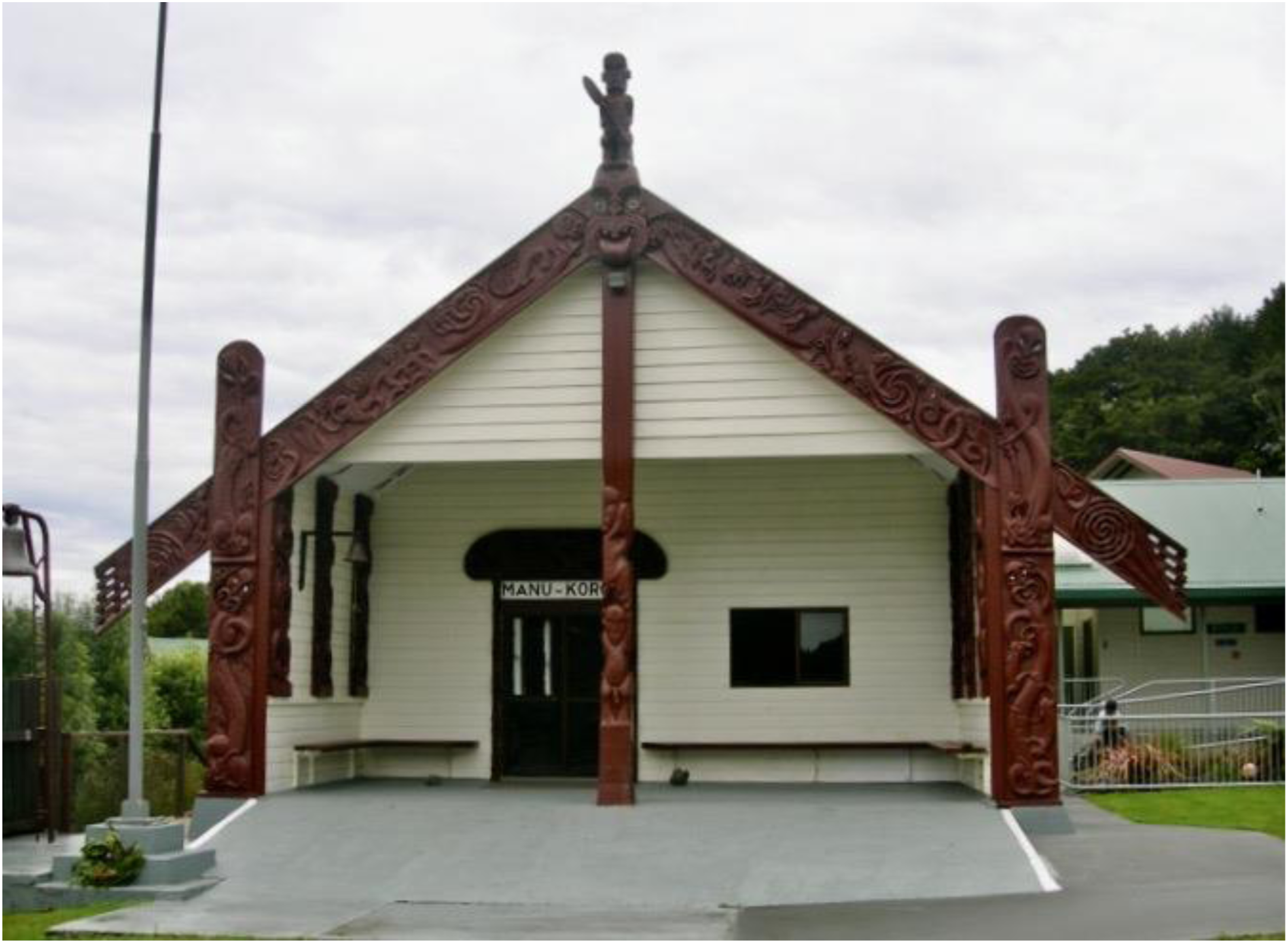
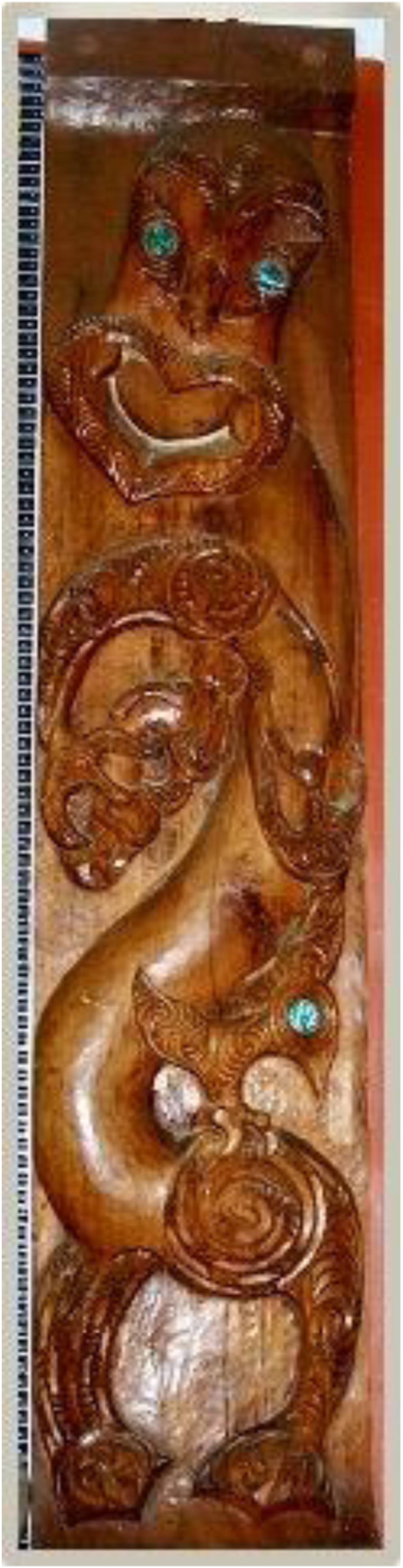
Hine-ā-maru
Although many conversations unfolded about various Māori leadership examples in the process of conducting the interviews, for the purpose of illuminating a particular ancestral context in detail, we focus the article on one female ancestress, Hine-ā-maru represented as a carving in Figure 2. Descendants of Ngāti Hine trace their whakapapa to Hine-ā-maru who lived approximately 500 years ago and founded the tribal lands of the Ngāti Hine people. From this ancestral leader, they take the name Ngāti Hine and keep her legacy and leadership alive in their oral history traditions (Hēnare et al., 2009). Hine-ā-maru is visually represented inside many wharenui throughout Aotearoa-New Zealand, but is most prominent at Mōtatau marae, located within Ngāti Hine territory. The legacy of Hine-ā-maru is of great importance to ways of understanding what it means to be Ngāti Hine. The collective memory of Hine-ā-maru recalls that her tenacious and staunch disposition allowed her to endure through hardship. Alongside those aspects are strong characteristics of love, caring and attention to all.
Te Ruki Kawiti
Te Ruki Kawiti is another important ancestor of Ngāti Hine. He was a leader of Ngāti Hine at the time of the signing of the Treaty of Waitangi/Tiriti o Waitangi in 1840. Kawiti initially resisted signing the treaty, which officially introduced British rule, aiming to ‘ensure that the lands of his people would be left intact so that Ngāti Hine would never become landless or homeless, or slaves to the Pākehā [Europeans]’ (Hēnare et al., 2013: 141). After pressure from his people, Kawiti reluctantly signed. Later, he fought against the British Crown in what is often referred to as the Northern Wars that challenged the assertion of British sovereignty over Māori land. Te Tangi o Kawiti 1846 is an oral literature within Ngāti Hine seen as a lament, prophesy or legacy where Kawiti is believed to remind his people of their responsibility to ensure Te Tiriti was honoured and oppose any failure to uphold its covenants (Hēnare et al., 2013; Jakeman, 2019). To this day, Te Tangi o Kawiti is invoked in Ngāti Hine challenges with the Crown.
Data analysis
Interviews were all conducted and transcribed by the first author in order to facilitate greater familiarity with the data. A thematic analysis (Braun and Clarke, 2006) was used to analyse the raw data transcripts alongside the visual cues from the video. Visual thought maps recorded the eight preliminary themes that emerged from the data with links to illustrative written quotes. These maps broadly consisted of where participants took their discussion of leadership, key players in their narratives and where they connected certain ideas together. In the process of coding, a question arose, ‘how does one code spiritual insights?’ that prompted a return to Māori philosophy around knowledge creation.
The next iteration of analysis produced three main themes: (1) leadership knowledge that is witnessed or observed; (2) leadership knowledge that is relational; and (3) leadership knowledge that transcends. These themes correlated with Ngā Kete e Toru o te Wānanga, the three baskets of knowledge brought down from the heavens in Māori mythology (Marsden, 2003). The baskets are: (1) te kete aronui that contains knowledge of what we see; (2) te kete tuauri contains knowledge of the patterned world, or how things work; and (3) te kete tuatea contains knowledge of the cosmos. The baskets reflect three layers of human development in terms of what is, how things are and why they are that way. What is important about connecting emergent themes from the interviews to Ngā Kete e Toru o te Wānanga is the multi-dimensional aspect of how Māori leadership is experienced on a day-to-day basis across all three epistemological dimensions, which allows for more than what is said to inform the findings. Further, the baskets enabled visibility of deep love and reverence for ancestors to whom one may not have met, yet knows intimately through whakapapa. In addition to verbal responses, visual cues from the videos shed insight on how the questions were interpreted.
Findings
We now present findings from the oral history interviews. From interviewing the ancestors, we illuminate the insights of Māori leaders—physically and spiritually—that bring ancestral leadership to life. The findings fall into the following broad categories: (1) experiencing leadership in ancestral places; (2) genealogies of leadership; and (3) mana whenua, ancestral power inherent in physical landscapes.
Experiencing leadership in ancestral places
Māori leaders spoke about the lifelong experience of engaging and interacting with ancestral wisdom in ancestral places. When the participants spoke about leadership, they shared more than their memories of the actions and behaviours of their kin relatives; they spoke about a present-day spiritual and social interaction with ancestors, place and context. Ngāti Hine ancestral leadership is visually, metaphorically and genealogically preserved in embodied places and ancestral artefacts such as wharenui where important tribal activities take place. The wharenui are seen as ancestors in and of themselves with the characteristics of a body that is attributed with sacred being (Kawharu, 2010). The artworks and design of wharenui include poupou and tukutuku (woven panels). Photographs inside wharenui also represent ancestors and their legacies, and as such are imbued with agency and spiritual power. These artefacts provide the opportunity for descendants to engage with ancestors in an ongoing basis, serving as reminders of ancestral lineages derived from both human and ancient cosmological origins (Tapsell, 2008). It is in these embodied places that the intangible connection to ancestors can be actively and visibly felt (Salmond, 2017).
The experience of conducting the interview inside of Mōtatau with Pita Tipene brought his ancestors to life. He told stories about their leadership legacies and demonstrated how telling and re-telling their stories keeps their leadership alive. Pita directly refers to his ancestor Kawiti, whose presence in the Mōtatau wharenui provides ongoing access to ancestral leadership knowledge.
I look back at how our grandparents and ancestors led, and there are people portrayed in this very whare—the likes of Kawiti—who stood for Māori rights….Moving into the future, I think those things will endure.
Ancestors are also enshrined through naming places of significance. Pita Tipene talks of the naming of the wharekai, the building where food is prepared and served for large gatherings. He says, …Mihiwera, who this dining hall up here is named after. She died in 1936 and her name was given to that building because she looked after guests. There were literally hundreds who regularly came through this place. The people loved and respected her so much so they gave her name to that building.
Having Mihiwera memorialised on a building carrying her name captures the leadership of a woman who carried a strong ethic of hospitality and caretaking of guests. The building is a place to go to experience the essence of her leadership. The practice of bringing contemporary work and organisational settings into a place that represents not just a human body but a woman’s body, specifically shifts the quality of dialogue and interactions that occur in that place as compared to a conventional boardroom or workplace. Embedding leadership within a woman’s womb as an ancestral place wraps layers of intergenerational knowledge and a feminine dimension of leadership around typically masculine and rationally driven processes of decision-making, consensus and conflict management. Māori traditions of oratory learned in the cultural setting of wharenui informs ways of being and doing leadership that can be transferred into professional contexts. In addition, the process of conducting business inside of a sacred house signals a deliberate effort to facilitate dialogue in line with Māori leadership practices—whether it is making business deals, settling politics or celebrating community achievements.
Lynette Stewart talks about the legacy of Dame Mira Szászy that carries on in the professional work of nurses as a regional leadership characteristic.
When I think of Mira Szászy, I think of what she was herself, who she was, and really importantly, the legacy that still lives in the area that she came from up north. I still see it with the beautiful Māori nurses up there. There is something that is intrinsic, and her legacy, I’m sure will live on for a long time. Dame Mira was a solitary woman who achieved much in her own life, but to me, she achieved much, and continues to achieve much, in the lives of others, who still look to her example, her benefit to all of us actually, including myself.
Other forms of immaterial ancestral knowledge are passed down through collective memory including prayers, songs, proverbs, stories and mythologies that reinforce kinship connections over time. The messages contained within oral traditions remind descendants about legacies of leadership in terms of their shared identities and relational ties to land. Maxine Shortland affirms that collective memory ensures that knowledge passes to future generations but its maintenance requires consistent effort to keeps the memories alive. She says,
The reflection of how we talk about her [Hine-ā-maru] is in our waiata, in our songs and our stories that we hand down to everybody…and to each other. It does change depending on whānau [family] telling the stories, but the essence of her resiliency—where we’re from, who we are—is very much steadfast.
The experience of leadership in ancestral places concerns how leadership resides in the places where descendants nurture their legacies. These places can be geographic, architectural, behavioural and ceremonial.
Genealogies of leadership
The findings in this section demonstrate how the concept of whakapapa is a landscape that represents a journey to place, a journey to find community, explore legacies of leadership and forge connections with the places of the ancestors (Cajete, 2016). Whakapapa constitutes much more than kinship and family ties. Whakapapa literally means to place in layers one upon another and thus entails a deep understanding of the purpose of something in relation to its true origins (Nicholson, 2019). It provides a structure for ordering the universe and assigns value based on ties between people, the natural world and the cosmos (Marsden, 2003; Tapsell, 2008). In the process of turning to whakapapa as a repository of ancestral wisdom, the participants shared insights about their collective identities that represent extensions of the self in another time (the past). The participants spoke about the implications of their actions and behaviours today that may ripple into the future. Looking back, Maxine Shortland reflects on how resilience became a strong narrative passed on in Ngāti Hine families and it traces to Hine-ā-maru: The thing about Hine-ā-maru is she was very strategic. As a long-term visionary, she saw things [that needed to be done] that were taken on by rangatira. Out of the hardships endured at that time, she ensured that her family would have more whānau [family], and that they would understand who they are, where they come from and what things are important for them to sustain and survive.
Lynette Stewart captures the complexity of time in relation to ancestral leadership as an eternal spiritual and metaphysical reality when she identified the nature of continuity as flowing in both directions. On the one hand, she is a part of moving a legacy of spiritual leadership forward, while on the other hand, knowing that she too is humbly part of an eternal cosmology of leadership beyond both place and time as a living ancestor.
I saw Māori leadership [growing up] that was without a doubt immense - of immense spiritual quality, and some of those leaders, I know that I will meet in eternity (Lynette Stewart).
Whether they connect to lineages in the near or distant past, we see a continuity of leadership through time. There were also instances when participants described a process of discovery of their whakapapa that unearthed ancestral leadership they had not been previously aware of. Pauline Harris, of Kahungunu descent, reflected on the first time she heard her academic career success attributed to one of her well-known ancestors Ihaka Whaanga. Sparked by curiosity, she connected with her ancestor, thus uncovering their shared legacy of kindness and generosity. There is a wealth of knowledge, known and unknown, in genealogy, and the untapped potential of this resource is infinite. The participants’ ability to understand lineage through oral history or through experiences of witnessing leadership in practice by their forebears provides a sense of legitimacy to both the purpose and function of leadership.
In the interviews, references to whakapapa reflect cultural understandings that in order to know someone it is important to know the place that they are from, which, by implication is to know their ancestors (Murton, 2012). It is common for tribal leaders to speak of ancestors in the first person, invoking and remembering that ancestor in the present (Salmond, 2014). For example, Rowena Tana says:
I see things that I’m doing are things that my grandmother and I guess all the women of her times would do as well—looking after the family, the people and making sure they’re alright. When you need to step up to the mark and show leadership, then you do it, because that’s what we need to do.
When Rowena says, ‘you need to step up’ and ‘that’s what we need to do’, she speaks in the first and second person, but refers to a collective you and a collective we in both instances. More broadly, she also observes herself as if she is being observed by her ancestors. In the same interview, Rowena also spoke about conversations with her grandfather, Sir James Hēnare, who would make references to Hine-ā-maru and connect his leadership efforts to the broader landscape of Māori leaders who championed land rights in Te Tai Tokerau. With no separation between oneself, one’s ancestors and the tribe, these examples demonstrate how leadership is understood across generations. The construction of events, memories and people, informed by place, reveal an intricate system of layered, intergenerational leadership. Lynette Stewart comments on how she interprets the process of translating ancestral leadership:
The reality of who your ancestor or ancestress was, is how one translates that reality from your own personal knowledge of who they were. It’s up to you how you actually translate that out through your own life. I won’t try to put into words what my knowledge base is, because should I do so, it could never be enough. It could never explain what I’ve been taught as a child by my Māori aunties and my uncle. What I try to do is try to live it out.
Although the reality of living out the legacy of one’s ancestors is a challenge, the participants felt that they contribute to a larger story of tribal continuity that provided a framework for shaping the work of leadership. Participants made reference to their genealogies at a micro level in terms of their immediate families, but also at meso and macro levels connecting their understandings of leadership to a universal sense of belonging. It was conveyed that individual identities do not exist in isolation from the metaphysical, spiritual and cosmological relationships that are part of their family stories and overall life experiences. At the heart of whakapapa is an ethic of interconnectedness and eternal continuity, bringing to life the notion of an eternal present. With no separation between past, present and future, whakapapa can be visually represented as an ever-unfolding spiral in which threads of the human experience are linked to a unified whole.
Mana whenua: Ancestral power inherent in landscapes
Another aspect of ancestral leadership that resonated throughout the interviews was how the spiritual power to engage as a leader is legitimated from different sources other than people, one of which is the land itself. Longstanding existence in one place is important, but equally as important is recognition of the inherent power and authority of land known as mana whenua. The link between humans and place is an inherently spiritual one with whenua meaning both land and placenta. The implication being that the land nurtures and provides all that is needed for life to thrive, just as the human placenta provides sustenance for human creation (Hēnare, 2001, 2003). One participant, Ella Henry reflects on all human experience coming into the world from our mothers and our eventual journey back to Papatūānuku, or Mother Earth:
Hineahuone was the first human [in Māori cosmology]. I think it’s pivotal to the nature of traditional Māori culture that the first human is a woman. We literally come out of our mother, and go back into our mother Papatūānuku when we die.
Drawing on the knowledge that involves becoming literate with the language of the land, the role of tohunga (spiritual leaders) entails honing a particular set of skills that are based on intuition and being attuned to the sacred.
A tohunga is really somebody who can read the signs. The tohu [sign] is that notion of leadership. You have a tohunga who is good with war. You have a tohunga who is good with growing kūmara. You have a tohunga who is good at helping babies be born. Those people are your aunts and uncles and they are the backbone of your community and they keep you safe so that you can one day assume that role. That to me, is a pretty sustainable leadership process (Ella Henry).
There is a particular intimacy with place that is developed in the sacred leadership of tohunga. At the same time, relationship with one’s ancestral place may not necessitate being there in person as the only way to access and engage with its power. Mana whenua is not bounded by geography as the spiritual power of place extends to the ability to carry that power with you wherever you go. Again, Ella Henry says,
There are Māori who will never go back to the kāinga [papakāinga]. They live in Paris, London, Sydney, and Auckland and they will never go back to the kāinga. But what they are taking with them is the kāinga out into their new communities they’re forming.
Mana whenua as interpreted here, is power and authority inherent in landscapes that humans carry by virtue of collective identities and a sense of belonging to place. Pauline Kingi, of Tainui descent, described mana whenua in a conversation about her whakapapa recalling the name that she carries, Kumeroa. The story of Kumeroa details an ancestor whose journey to settle in the place where the Tainui people continue to live today was harrowing. Yet the experience came to shape a Tainui leadership whakapapa that is characterised by determination, grit and resilience. Pauline spoke of her professional life and the experience of obtaining her law degree from Harvard University. She refers to ‘the long hard struggle’ of both her career and embodying the leadership of Kumeroa as one and the same.
My Māori name is my grandmother’s name, which is Kumeroa. Kumeroa referred to when the people of Tainui came across from the ocean, overland to the Waikato River. The long, hard struggle to bring the canoes across from the ocean to the river was called te Kumeroa – the long, hard struggle of Tainui. And that is my name, and that is my life. So that context introduces you to who I am in terms of my ancestral background.
Discussion
Many places, many genealogies and divergent views
Place-based ancestral leadership in Māori contexts does raise some tensions that have resulted in national debates and turmoil concerning inter-tribal cohesion. Questions often arise as to who is considered tangata whenua and who is manuhiri, especially where tribal territories are overlapping and people carry multiple genealogies. Does genealogical connection alone determine tangata whenua status and allow one to speak on their behalf? Do those who reside on the papakāinga have a greater stake in leadership discussions? Whilst one may carry the mana of their whenua when they travel and settle to live in other countries, there is ongoing debate as to whether they are still able to give efficacy to such mana in a place that does not recognise the essence of that power. Additionally, where some may leave the papakāinga, their return is not always welcomed or recognised by those who have stayed.
In the process of the ethnographic data collection through witnessing presentations to the Waitangi Tribunal as well as iwi and hapū negotiations, it was seen that the emotional aspects of such a heavy process were tangibly felt and reverberated for weeks after. There are sometimes tensions as Māori can trace their whakapapa to more than one place, invoking different ancestors and different legacies. This can cause dissention within kinship groups. The settlement negotiation of the WAI 1040 claim was attempting to reconcile the historical injustices of multiple kinship groups, all with whakapapa to the wider tribal alliance of Ngā Puhi. However, as reported by the New Zealand Herald (Neilson, 2021), ‘In recent years negotiations have been stymied with Governments refusing to negotiate with the notoriously – divided iwi at hapū level, leading to disputes – including by Ngāti Hine – over who held the negotiating mandate.’
Whilst this dispute may have more to do with the Crown attempting to unite differing injustices in order to simplify and pragmatise Crown redress, this exemplifies that despite genealogical connections and the same overall purpose of fighting for place, divergent views can still be disruptive. What is common amongst the claimants is that they are all whanaunga (related) and fighting for place, but their interpretations of ancestral directives are not necessarily aligned. There are few leadership studies, if any, that explore these tensions shedding light on an area for future ancestral leadership research.
In 2019, Ngāti Hine officially announced their aspirations to separate themselves from the WAI 1040 claim and launch their own claim to continue to uphold, maintain and exert their mana whenua and mana tūpuna as tangata whenua of Aotearoa-New Zealand (Radio NZ, 2019). The hapū of Ngāti Hine hold fast to the ancestral wisdom of Hine-ā-maru and Te Ruku Kawiti. The name Hine honours the feminine, and ā-maru means shelter, power and authority. The name Hine-ā-maru indicates that she provided for her people a sense of protection and safety. Likewise, the legacy of Kawiti, and specifically Te Tangi o Kawiti ‘not only memorialised the war between hapū and the Crown, but also guided his people by setting the tone for their resistance and relationship with the Crown going into the future’ (Downs, 2019: 16).
Intergenerational reciprocity
Often Māori leadership acts in service of a collective good, but few studies view these leadership processes intergenerationally to provide a temporal and kin-based view together (Ruwhiu and Elkin, 2016). Indigenous scholars from many disciplines have framed the process of relationship and belonging as dependent on and underpinned by reciprocity, the intangible relationships with and between the spiritual and natural worlds (Archibald, 2008; Cajete, 2000; Kelly, 2017; Nicholson, 2019; Roberts et al., 1995; Spiller et al., 2011; Wilson, 2008). Returning to the origins of humanity in Indigenous thought, there is an added layer of reciprocity, which entails not only taking from the energies that give life to this world but also returning energy through spiritual connection and ceremony. As a reference point, looking to Ngā Kete e Toru, the baskets of knowledge referred to in the processes of data analysis, metaphorically speaking, the baskets remain full because new knowledge is continuously created and returned for others to learn from. Reciprocity is not bound by time; instead, these life-giving acts create an eternal cycle of intergenerational gifting. Kelly (2017: 85) explains that, ‘rather than exchange and reciprocity being thought of as closing a loop, conceptually, the driver of reciprocity is to extend the relationship beyond a two-dimensional circle to that of an eternal spiral of reciprocity’. One way to ‘pay’ generosity forward across generations is through the roles and responsibilities of leadership. Strategically, this is how communities maintain existing relationships and forge new ones through reciprocal gifting (Dell et al., 2018; Hēnare, 2003; Kelly, 2017; Nicholson, 2019). This orientation guides a set of ethical practices that permeate all aspects of leadership, including in the realm of labour and professional conduct (Ruwhiu and Elkin, 2016).
Kawharu (2009, 2010) refers to ancestral landscapes as the places that embody the connection between people and their ecosystems. Because ancestors are seen as the original trustees of the landscape, and the values of such trusteeship are passed down to guide present and future generations, this framework enables oral histories to weave together ancestry, knowledge, rituals and intergenerational obligations of care with the surrounding landscape of ancestral leadership. Ancestral landscapes provide a system of historical record-keeping as a canvas on which continuity and change is tracked over time (Kawharu, 2009, 2010). Ancestral landscapes become a source of identity, power, continuity and spirituality in leadership; with each person a product of community, genealogy and land simultaneously (Nicholson, 2019).
In leadership, reciprocity provides the structure for social relations that encourage remembrance of ancestral knowledge. However, reciprocity is laden with obligations and responsibilities that create complex social ties and are not always harmonious (Tapsell, 2008). Giving back means a conscious and continuous effort must be made to affirm and reaffirm power and authority by remembering the places and landscapes that create communities. Language, knowledge, history, ethics, values and people are all part of reciprocal relationships ensuring that future generations have the freedom and capabilities to practice their cultural values, to experience ancestral landscapes and to be part of the natural community. In many cases, participants expressed that ancestral leadership involved leaving the community for various reasons such as education, personal development or employment, but reiterated that it was necessary to eventually reconnect in the spirit of reciprocity. Whether that meant physically returning or finding ways to contribute remotely, how that happened was less defined. Reciprocity maintains the vitality of the relationships of the human kin group between their ancestors, the spiritual realm and the natural environment that in turn enhances their mana (Kawharu, 2009).
However, not all reciprocity occurs within perfectly balanced power relationships, nor are gifts neutral commodities (Hēnare, 2003). Relationships and how they are symbolically represented in material terms containing historical and collective memory can tell powerful organisational stories (Greve and Rao, 2014). One can easily uphold the spirit of reciprocity whilst also enacting revenge, frugality or spite. The messages that accompany gifts may deviate drastically from the obligation to gift. Therefore, the wisdom of Lynette Stewart’s words, ‘It’s up to you how you actually translate that out through your own life’ signal that understanding the principles of ancestral knowledge alone are not enough; it is also the perception by others of the relationship in totality that counts. A critical component of leadership as a learning journey is application of knowledge as an uncertain practice (Ruwhiu and Elkin, 2016). Only through that experience does ancestral wisdom translate into ancestral leadership through trial and error, mistakes, achievements and imperfect being.
Conclusion
A burgeoning body of literature on Indigenous leadership reflects Indigenous philosophies of collective wellbeing, the importance of relationality and shared and distributed power and decision-making. We identified a gap in explicating how we come to understand leadership through shared genealogies and relationships to the places of our ancestors. The interviews in this research shed light on that gap. As a contribution to the field of leadership, we demonstrate that ancestral leadership entails journeying to the places that hold ancestral wisdom. In some cases, ancestral leadership involved listening to the voices of the ancestors that continue to speak through carvings, songs and ancestral homes. In other cases, turning to genealogy as a resource for ancestral leadership reveals insights into the possibility of leadership pasts we did not even know about. Finally, at a deeper experienced level, the power of ancestral leadership transcends physical place and is a place that you carry with you no matter where you are.
Recognising that this study is specific to Māori contexts, considering application of some of the insights to broader international Indigenous contexts, we were left with additional questions that may be explored in future research about the risks of essentialism or imposing romanticised or over-simplified notions of who the ancestors were onto a landscape of contemporary complexity. To what extent is change accounted for? How are processes of human development visible through time in the realm of ancestral leadership? How much of a margin exists to colour outside the lines that were drawn so long ago? In the excerpt highlighting the power of mana whenua for tribal members living overseas, there are other concepts such as ahi kaa that reference the work of those who ‘keep the home fires burning’ or continuous occupation (Hēnare et al., 2013). For those who contribute to ahi kaa, their efforts to ensure continuous connection to place can be at odds with those who benefit from that shared power in principle but are not contributing to its day-to-day maintenance resulting in resentment and intra-community tensions. We see the potential for future research to explore some of these tensions between generations, between tribal groups to deepen ancestral leadership across these past, present and future domains.
According to this study, place-based intergenerational leadership connotes a way of carrying wisdom and insights from ancestral voices and understanding how those voices might inform leadership experiences, values and practices. Future leaders will face leadership challenges that cannot be anticipated, but by providing a core set of shared principles of leadership grounded in purpose, place and identity, ancestral leadership calls leaders to account for where their behaviour and decision-making is derived from. No matter where they practice their leadership, whether it is in the boardroom, courts of law or managing a bank, the spiritual dimension of ancestral leadership permeates physical and geographical place. The places where ancestral leadership unfolds is in day-to-day interactions. Ancestral templates for ethical action provide structures of kin-accountability, not just to generations alive today but to future descendants. Being accountable to both your ancestors and your descendants in ancestral leadership enacts the principle of reciprocity as it captures how Māori leaders nurture or feed legacies that they have inherited (Kelly et al., 2014). Harnessing the spiritual power from the places of our ancestors is a resource that connects and sustains leadership through the generations.
Footnotes
Declaration of Conflicting Interests
The authors declare no potential conflicts of interest with respect to the research, authorship and/or publication of this article.
Funding
The author(s) received no financial support for the research, authorship and/or publication of this article.
Dedication
We dedicate this article to Associate Professor Mānuka Hēnare whose legacy lives on through our research and careers. It is hard to sum up the profound impact Mānuka had on both of our lives as a scholar, friend, mentor, thought leader and kaumatua at the University of Auckland Business School. His invitation into Te Ao Māori, the Māori world leaves us forever changed.
