




Abstract
Leadership education can be reductionist and facile. Recent scholarship in management and organizational history has reexamined many of the most established business school concepts and literatures, rethinking the ‘lessons’ taught from – among others – Taylor, Maslow and the Human Relations School. This study similarly uses historical methods (oral historical and archival) to analyse the career of Robert S. McNamara, a major figure often portrayed simplistically in leadership literature. McNamara is often characterized as a ‘good manager but poor leader’, notorious for failures associated with micromanaging by questionable metrics. While this picture is partially accurate, it is far from complete. McNamara’s career – for all its management failures and weaknesses – also featured many traits associated with celebrated concepts of ‘leadership’, especially during his long tenure as President of the World Bank (1968–81). We develop an historical narrative that reevaluates and updates our understanding of this comparatively unexplored latter stage of McNamara’s career. The article argues against the construction of simplistic ‘leadership lessons’ that suffer from three weaknesses: (1) a poor grasp of historical events, (2) a weak understanding of history as a discipline and (3) a reliance on artificial constructs and dichotomies, such as leadership (good) versus management (bad). We suggest that there is much to learn from deepening the scholarly relationship between critical leadership studies and management history.
Introduction
The terminology of ‘leadership’ has penetrated deeply into all manner of occupations, often driving out older concepts associated with ‘management’ (Collinson 2011; Jackson and Parry, 2018; Learmonth, 2005; Learmonth and Morrell, 2019). Leadership has also become a widely used trope in the fields of politics and history (Nye, 2013; Wilson, 2016). But there is widespread dissatisfaction with the weakness and inaccuracy of so much of the published content of the ‘leadership industry’ (Kellerman, 2012). Mainstream texts often rely on simplistic and ill-informed ‘leadership lessons’ (Spector, 2016; Tourish, 2017; Wilson, 2016). The complexities of history are often given especially superficial treatment (Cummings et al., 2017; Decker et al., 2020; Gutmann, 2018).
This article is about Robert S. McNamara, a flawed giant of twentieth century corporate management and public administration. His career has been the subject of an Oscar-winning documentary The Fog of War, the director of which described McNamara as ‘the quintessential American figure’ (Morris, in Bloom, 2010: 111). For all his fame, McNamara is mostly associated with failure. To his many critics, McNamara represented the practical and ethical limitations of abstract and technocratic forms of management – especially in his infamous obsession with ‘management by numbers’ (Peters, 2001: 83). Numerical analysis plays a central role in accounts of McNamara’s career (Halberstam, 1972; McCann, 2016; Rosenzweig, 2010; Shapley, 1993; Sharma, 2017). He brought statistical process control systems to Ford Motor Company, ramping up work pressure and restricting operator discretion (Starkey and McKinlay, 1994). As Defense Secretary he was ridiculed for claiming that ‘every quantitative measure we have’ indicated that the United States was on the verge of victory in the Vietnam War (Sheehan, 1990: 290). His style was criticized as arrogant; he would micromanage with spreadsheets and metrics while pompously declaring management to be ‘the most creative of all the arts’ (McNamara, 1967: 359). The business school mainstream describes his approach as outdated and now rightly abandoned (Denning, 2010: 164–166; Hoopes, 2003: 251–252; Johnson and Bröms, 2000: 59–62; Rosenzweig, 2010).
McNamara is portrayed as a one-dimensional figure relying on technocratic, elitist, impersonal and sometimes bullying processes; a ‘good manager but poor leader’ (Chandler and Chandler, 2013: 43–55). He often appears as an embodiment of everything wrong with traditional forms of organizational practice, while ‘leadership’ offers ‘radical’ solutions to the limitations of his outdated brand of ‘management’. Stephen Denning, for example, in his Leaders’ Guide to Radical Management, depicts World Bank staffers as ‘[l]iving in a fog of institutionalized bullshit’ and ‘browbeaten by Robert McNamara into silence’ (2010: 76).
This article argues that, as applied to his tenure at the World Bank, this ‘good manager, poor leader’ portrayal of McNamara is a major simplification. Without offering an apologia for the man, we argue that the classic ‘business school’ account of McNamara is incomplete and historically unsound, resulting in a partial and caricatured portrayal from which simplistic leadership lessons are drawn. We argue that such historically inadequate portrayals of complex management figures do a disservice to leadership studies, stymying the development of potentially much more indeterminate, detailed, complex and historically informed narratives of managers, organizations and leaders (Alvesson and Sveningsson, 2003; Collinson, 2017; Cummings et al, 2017; Popp and Fellman, 2017; Spector, 2016). In exploring McNamara’s tenure at the World Bank, we interrogate the relationship between leadership and management, arguing that this dichotomy is forced and unhelpful. Through close interrogation of historical sources, we show how (in McNamara’s case) both ‘management’ and ‘leadership’ are intertwined and inseparable. The boundaries between them are indistinct (Kotterman, 2006; Gordon and Yukl, 2004) and highly rhetorical (Alvesson and Svenigsson, 2003; Learmonth, 2005; Pfeffer, 2015). Mainstream leadership literature, however, is painfully unwilling to engage with this uncertainty, preferring to offer simplistic ‘lessons’ about the limitations of ‘management’ and the virtues of ‘leadership’.
The article proceeds in the following directions. Firstly, it describes how ‘management’ has been rhetorically outmaneuvered by ‘leadership’ (Jackson and Parry, 2018), and why binary splits of this kind are so problematic, especially when applied to historical figures without due attention to the empirical and ontological complexities of historical evidence and narrative. The article then outlines the historical methods and context, before proceeding to develop our narrative on McNamara’s World Bank years across three main areas of concern. We interpret the broader meaning of our narrative in a discussion section that summarizes and evaluates McNamara’s leadership impact at the World Bank. Finally, we offer a conclusion in which we advocate a closer integration of management history with critical leadership studies, with the aim of developing more complex, more accurate and more intellectually stimulating accounts of leaders from history.
The rhetorical games of management and leadership: The historical limitations of binary logic
The actions and traits of prominent historical figures are often drawn on in the construction of ‘leadership lessons’ (Gutmann, 2018; Spector, 2016). But these lessons can be simplistic. Leadership writers, typically looking to elevate the practical and ethical values of leadership, often display a poor grasp of historical evidence, turn a deaf ear to ontological and methodological debates in history as a discipline and rely on artificial constructs and dichotomies in delivering their ‘lessons’ (Booth and Rowlinson, 2006; Decker et al, 2020; Mollan, 2019; Nye, 2013; Rowlinson et al, 2014). Given the largely prescriptive and normative orientation of leadership writings, detailed discussions of historical evidence and reasoning rarely feature. As a result, the historical ‘lessons’ that emerge tend to rest on didactic constructs, often expressed in binary terms, such as leadership being separate from and largely superior to management (Spector, 2016: 153), or the boosterism for ‘transformational’ over ‘transactional’ leadership (Nye, 2013).
The leadership industry has produced a wide range of approaches that distinguish management from leadership (Bennis, 1989; Bennis and Goldsmith, 1997; Certo, 1997; Chapman, 1989; Kotter, 1990; 2001 [1990]; Kotterman, 2006; Gordon and Yukl, 2004; Lunenburg, 2011; Northouse, 2007; Zaleznik, 2004 [1977]). A famous early typology was provided by Kotter (1990). He posits that leadership and management are distinctive and complementary activities, with managers and leaders both orienting themselves to business activities in distinct ways. First, they must ‘create an agenda’. Second, they must ‘develop a human network’ of people and relationships that can accomplish the agenda. Third, they need to ‘execute’ – ensure that job gets done (Kotter, 1990: 6). With respect to the first challenge, leaders set the direction while managers do the planning and budgeting needed to move the organization along that path (first binary). The second activity is alignment, which requires leaders to communicate the new direction and build coalitions sympathetic to the vision and committed to its achievement. The complementary activity by managers is organizing and staffing (second binary). Finally, the leader must continuously motivate and inspire perhaps by ‘appealing to basic but often untapped human needs, values and emotions’ (Kotter, 2001: 86). Managers respond by controlling and problem solving, defining performance indicators, monitoring progress toward targets and trimming the sails to keep the ship on course (third binary) (Kotter, 1990: 4–5).
While Kotter does at least retain a place for ‘management’ in his account, clearly he allots it a subordinate role to leadership. This is quite typical of leadership literature where leaders are treated as heroes (Grint, 2005; Hughes, 2016; Tourish, 2013) and where a management/leadership dichotomy usually involves the rhetorical downgrading of ‘management’ (Jackson and Parry, 2018). We use Kotter as a means for structuring our historical narrative around three different types of business activity (agenda-setting, managing people and execution), while remaining skeptical about the degrees of difference between managerial and leaderful activities or traits within those domains. A similarly critical analysis could be applied to other leadership writers whose approaches also rely on distancing management from leadership (Bennis, 1989; Burns, 1978; Collins, 2001; Greenleaf, 2002) and ‘congratulate the present’ (Cummings et al, 2017: 321) by associating management with outdated and degraded practice. This distancing ‘purifies’ leadership (Collinson, 2011) by displacing its less edifying elements (control, micro-management, secrecy and authoritarianism) onto a downgraded and falsely outdated ‘management’. This ‘purification’ rests on a deletion of contradiction (Vince and Mazen, 2014), tangential and partial uses of history (Booth and Rawlinson, 2006; Cummings et al, 2017) and a refusal to recognize organizational power (Collinson, 2011). The unwanted and unethical elements of leadership are projected onto ‘management’ as management is written out of the picture. Our article, in contrast, writes management back into leadership, arguing that management and leadership often cannot be empirically disentangled and that the exercise of ‘leadership’ is often dependent on the simultaneous exercise of actions associated with ‘management’.
Historical method and context
World bank group oral history interviews cited.
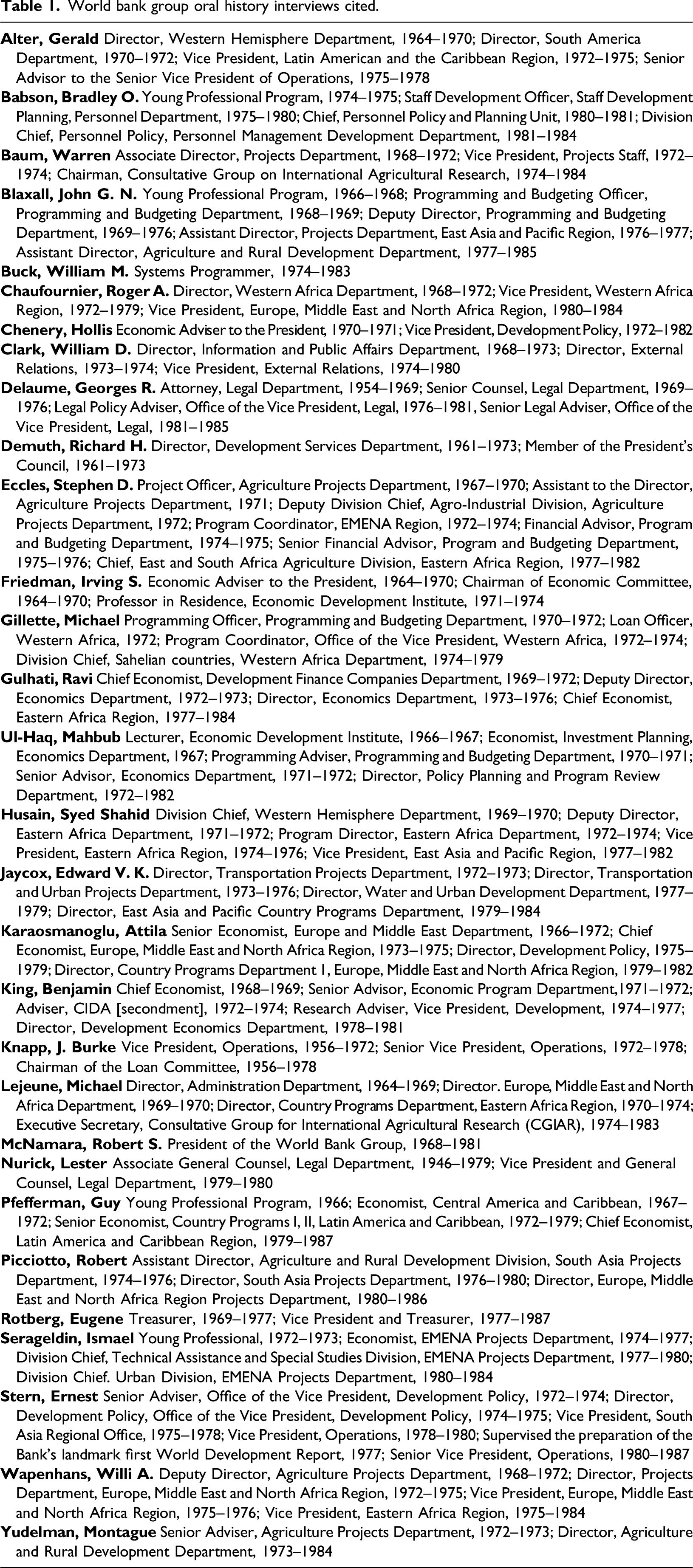
While there are often good reasons to be skeptical about published corporate histories, the interview transcripts are candid and detailed about the policies of the World Bank and of the personal and collective experiences of the professionals working within it (Perks, 2010). Our approach was to enter into an analytical dialogue with these texts (Cándida Smith, 2011), in order to associate segments of these texts with interpretative themes. Influenced in part by Kotter’s basic framework of the activities of managers and leaders, we developed three broad themes around which we arranged the evidence from the sources, namely: forming policy agendas, interpersonal relations and work practices. These themes structure our historical narrative (Abrams, 2010: 113; Thompson, 2000: 270) which is presented below. The narrative places the oral testimonies into a broader analytic context; a process assisted by the incorporation of documentary sources into our analysis (Ritchie, 2014: 133).
In addition to the oral history sources, we also explored the Robert S. McNamara papers deposited in the Library of Congress. These sources are extremely extensive, comprising 268 containers and 107.2 linear feet of documents. We conducted a detailed search for all materials relevant to managerial work and organizational climate in the World Bank. Sources most relevant to our study were correspondence between personnel and internal memoranda about reorganizations and employment conditions during the McNamara era. From this archive, we consulted 19 folders in total.
We acknowledge the limitations of Kotter’s framework and approach. A penetrating critique of his method observes that ‘In Leading Change, Kotter (1996, 2012) offered no context, no company names and no named leaders’ (Hughes, 2016: 457). In this respect, we are perhaps a step ahead of Kotter. But our article is illustrative, not definitive. The sources we use demonstrate how the Kotter binaries might – or might not – illuminate McNamara’s Presidency of the World Bank. Our use of historical sources does not allow us to accept or reject hypotheses derived from Kotter. But, unlike Kotter’s later work, our article draws on evidence from multiple witnesses – it amounts to more than our personal observations or speculations about McNamara’s tenure at the World Bank. Oral histories are an underused source in the academic study of management (McCann, 2016). They can help enrich the debate about the complex meanings of management and leadership – even if they can never offer a final verdict. But when are verdicts ever final?
McNamara was a major figure in the professionalization of management in the 20th century. He did not write a great deal about management; rather he was a high-profile manager at elite levels of US society. He studied and taught strategy and cost accounting at Harvard Business School, before applying the new methods of ‘statistical control’ to the Army Air Forces in the Second World War. In 1946, he, along with a group of nine other so-called ‘Whiz Kids’ (Byrne, 1993), was hired by the Ford Motor Company, where McNamara progressed up the management ranks to become President of Ford in 1961. By this stage, he was arguably the nation’s most prominent corporate executive, symbolizing the dramatic new influence of quantitative-focused, college-trained administrators who were revolutionizing postwar industry and government (McCann, 2016).
He was invited to join President Kennedy’s cabinet, taking the role of Defense Secretary from 1961 to 68. He oversaw significant change at the Pentagon, bringing in cost-evaluation such as the Planning-Programming-Budgeting System and exerting strong civilian managerial control over a sprawling military machine. Whatever successes he had up until that point became overshadowed by the disaster of the Vietnam War. McNamara was initially a major supporter of US intervention, infamously using quantitative indicators to demonstrate ‘progress’ that was always elusive (Daddis, 2012; Halberstam, 1972; Sheehan, 1990). He belatedly tried to change course without success and was ultimately removed by President Johnson in 1968, who found McNamara a new administrative home at the World Bank. Upon arrival, McNamara had a reputation for being exceptionally hard-driving and results-based, a powerful executive figure who seemed likely to instigate major change at what was then a collegial and somewhat sleepy Bank environment (Sharma, 2017).
Judgements about McNamara’s presidency range from positive (Kapur et al, 1997; Kraske, 1996) to critical (Cochrane, 2019; Sharma, 2017). Rather than assessing the efficacy of the Bank under McNamara, our purpose is to provide a detailed historical narrative of McNamara’s presidential style and actions. The following three sections provide our exploration of the historical sources, structured around a critical reading of Kotter’s framework for understanding the activities of leaders and managers.
First binary: ‘Creating an agenda’
The leader ‘sets a direction’
When McNamara began work as its President on 1 April 1968, the World Bank retained many features of a gentlemen’s club. It was relatively small, there were almost no women on the professional staff, and its values were conservative, closely aligned with those of Wall Street. McNamara would change all of this (Ayres, 1983; Kapur et al, 1997; Kraske, 1996; Sharma, 2017).
From the outset, McNamara aspired to transform the institution from a bank with a small letter ‘b’ and a limited remit into the premier development agency and a pioneer on all fronts, including healthcare, education and other social sectors in addition to its established role as a funder of sound infrastructure projects. There were two overriding aspects to McNamara’s vision: the first and uppermost being to broaden the Bank’s mandate, 1 the second to tackle world poverty.
The number of lending operations approved rose from 62 in fiscal year 1968 to 266 in fiscal 1981. In the same period, new commitments rose, in nominal terms, from US$953.5 million to US$12.4 billion – roughly a five-fold increase in real terms (Ayres, 1983: 4). McNamara forced the pace of the lending cycle by tying projects to a 5-year lending programme driven more by the demands of country governments than by the reticence and prudence of a staff committed to perfecting project design (Sud, 2014).
This shift ran counter to the instincts of the old guard on the Bank’s senior management team. In an oral history interview with McNamara recorded in 1991, the President spelled out his differences with two notable members of the ancien regime, Warren Baum and Bernard Chadenet.
2
The restructuring of 1972 was a major breakpoint in the Bank’s organizational history: ‘They [Baum and Chadenet] believed sincerely that to begin to dilute projects to take account of country considerations would weaken the quality. I thought the reverse, that the closer you got projects to the development requirements of the country in terms of broad development objectives, the stronger the projects would be and the greater contribution the money and the technical assistance would make to development. And to do that, I wanted the country division chief and the country economist to play a much greater role in it. And I wanted the project people to begin to become much more intimately acquainted with the country and its needs then they had been in the past. So, the reorganization in '72 was designed to accomplish that underlying objective’.
3
This interpretation of the agenda set by McNamara was endorsed by Ernie Stern, the man who became his second-in-command.
4
Another senior figure put it as follows: ‘There was now a strong and clear signal that the unit of planning, the unit of account, the unit of decision-making was the country and no longer the sector… It turned the Bank from a specialist, sectoral, engineering-oriented investment bank relying on market signals into an institution defined by economic planning, broad based, development-oriented, and no longer preoccupied with isolated entrepreneurial investment decisions’.
5
This major organizational and operational change shows the leader ‘setting a direction’. To raise the international profile of the Bank, McNamara complemented the expansion of lending by strengthening the research department, whose outputs fed into his annual speeches to the Board of Governors – his main signalling device. The speeches were carefully orchestrated and based on months of groundwork. What is striking is that they contain both ‘leadership’ and ‘management’ tropes. Often there is the ambitious, sometimes flowery language of ‘visions’, ‘humanity’, ‘courage’, ‘hope’, etc. But equally present was their overriding directness. The speeches were focused to a point, always asking staff for ever-greater efforts.
These increased demands, alongside the 1972 reorganization, were powerful managerial processes aimed at delivering on a leadership vision. A memo from William Clark, Director of Information and Public Affairs, to McNamara highlights the importance of reinforcing the President’s new vision: ‘The machinery for publicising the Bank needs some refinement and perhaps some enlargement. […] At present this is done almost solely by Mr McNamara’s visits where I have been able to see their immense impact. But there is no follow up and the image fades. What we need is to use Bank missions to renew the message. […] To carry out the program we would need people who are sensitive to LDC [Less Developed Country] opinions, and were really well acquainted with Bank strategy as Mr McNamara sets it.’
6
McNamara’s ‘leadership’ involved ‘setting a direction’, and his ‘management’ then enforced it using a very direct and specific style, involving organizational restructuring, message control, close agreement among the inner circle of senior leaders, extensive articulation of quantitative data and a considerable degree of top-down assertion.
The second part of McNamara’s leadership agenda was the focus on poverty. When he assumed the Presidency, his aim was to ‘increase resource transfer to promote growth’ and that ‘whether he admitted it or not, he was in the trickle-down camp’. 7 Monty Yudelman challenged the orthodoxy at an OECD meeting early in McNamara’s tenure. Yudelman (who was then working at OECD) made a presentation about the importance of small farmer development (not a widely shared view at that time). He challenged the focus on large-scale mechanization, telling McNamara that ‘you do it all wrong at the World Bank’. McNamara’s immediate response was defensive but then he went on to suggest that Yudelman might ‘come and tell us how to do it right’. Yudelman was impressed by McNamara’s willingness to consider an alternative vision of development. ‘McNamara was open to persuasion, but he was such a powerful intellect and he marshaled his numbers so effectively that it was very, very hard to persuade him’. 8
Mahbub ul-Haq told a similar story, noting that his first encounters with McNamara in 1971 ‘were extremely unhappy ones’. Ul-Haq had questioned the growth focus. McNamara responded that ‘this kind of belligerent questioning of growth…was totally uncalled for’. The exchange prompted ul-Haq to tender his resignation. Rather than accept it, McNamara ‘asked me to write down coherently, all the arguments that I could marshal in favor of the thesis that we must focus directly on poverty and on the poor sectors, on certain target groups, and that “trickle down” would not work. … His belligerence was often an invitation to sharpen your own arguments and to be professional and until he had come to terms with something in his mind, he would keep rethinking it and coming back to it…It was through that process of deliberation that he came to the concept which was to dominate World Bank thinking and my own thinking for a long time to come – the concept of increasing the productivity of the poor’.
9
Supporters of the poverty focus were in no doubt about the seminal nature of McNamara’s agenda-change. Stern was adamant that ‘McNamara…is the one who developed the concept of absolute poverty, which is still used as a benchmark. We started with relative poverty and the equity issue. But McNamara, in one of his speeches, developed the concept of absolute poverty, defined as people who were below a minimal living standard. It built on the “basic human needs” concept which was very popular at the time. So, the analytical focus on poverty reduction were put in place during Mr. McNamara’s period’.
10
Mahbub ul-Haq characterized McNamara’s approach to tackling poverty as ‘hardheaded, hardnosed’: ‘He wanted to make poverty, as he kept telling me, acceptable to the bankers. It had to be a bankable proposition, it had to be financially viable. I think his great contribution was to take up this concept of increased productivity of the poor’.
11
The manager ‘plans and budgets’
To make his leadership vision a reality McNamara brought to bear qualities that were strictly managerial. One of the first moves he made as President was to set up the Programming and Budget Department (P&B), revamping a unit created by his predecessor George Woods. 12 P&B was a tool for tracking progress toward the objective of expanding the World Bank. According to Systems Programmer William Buck, the formation of this department was ‘a key event in shaping the way the Bank managed itself’. 13 McNamara described the Programming and Budgeting Department as his ‘control mechanism’, allowing him to project inputs and outputs and to monitor performance. 14 Although P&B preceded McNamara, he made it much more central than under the prior regime, replacing the director that Woods had appointed. 15 As a corollary, he tightened control over the staff budget, by quantifying staff-years worked, numbers in position and the grade structure. 16 For the first time, staff were required to fill out monthly time sheets.
By one crude measure, the increase in lending during the McNamara years was efficient. The number of operations rose at a much faster rate than the administrative budget, to an extent unparalleled in any other period (Sharma, 2017). McNamara’s control of detail extended down to the design of his core planning instrument – the ‘Standard Tables’ – which he set in stone within weeks of starting the job: ‘By June 1968, the Standard Tables had titles and reference numbers that would remain in effect. Table 1 and its associated tables, for example, showed country by country lending volumes. Table 2 showed the loans outstanding, country by country, and so on. The Table 3 series dealt with borrowings, and the Table 4 series with the Bank’s financial statements, which had been worked up earlier but now projected out for five years, sources and applications of funds.’
17
According to a McNamara protegee, a senior figure in P&B: ‘In McNamara’s mind, these Standard Tables embodied the entire plan, the entire purpose and structure of the organization…[They] were regularly distributed to the President’s Council and to various senior managers at different levels. And McNamara was always, I think, genuinely amazed that other people in the institution didn’t regard these as their daily morning literature….The reason the Standard Tables made sense to him was because he’d designed them to the last detail. He knew exactly what information they included, and it fitted into categories that were important to him, that he had established.’
18
There was an element of metrics fetishism that tallies with the widely held portrayal of McNamara the micromanager obsessed with restrictive numerical processes. But the presentation of the numbers links directly into the World Bank’s ambitious ‘vision’ and to its external and internal messaging – elements that are central to leadership. Ernest Stern observed: ‘He worried about which way the charts ought to be printed, and he specified the format for the budget presentation right down to the shape of the margins because the presentation of facts mattered to him. They determined whether the audience would understand the points he wished to convey.’
19
McNamara was a numbers-man. He fixated on numerical details. That part of the story is very well known, and there is plenty of evidence for this in the oral and documentary sources. But McNamara’s broad and powerful leadership vision is also present, and was an integral part of his practice of management. McNamara’s presidency of the Bank demonstrates how the realization of leadership’s ‘vision’ and ‘spirituality’ often relies on management’s ugly and prosaic processes.
Second binary: ‘developing a human network’
The leader ‘aligns his people’
For Kotter, ‘alignment’ is a central element of effective leadership. This entails communicating the vision and building support for its implementation. The sources suggest that McNamara did this by exercising tight messaging control in large public meetings, by using small group meetings with trusted advisors to refine and consolidate the vision and by cultivating relationships with confidants outside the Bank who could help amplify the message.
The large meetings chaired by McNamara were masterclasses in choreography. This was best illustrated at the Board Meetings where the Executive Directors approved projects in a ‘dog and pony show’: ‘One of his colleagues who came over from the Pentagon and who was familiar with his approach there when he would have to make presentations to groups, referred to the way in which he dealt with the staff at the Board as a “dog and pony show”….McNamara, sitting as Chairman of the Board, was the complete master of the subjects which came before it, including the individual lending operations. He was superb in fielding the questions which were asked by executive directors…He would take their questions, make much more sense out of them often than the questioner himself was aware of, make them very pointed, and then ask the staff to respond and help the staff, if necessary, and elaborate on the answers after the staff had done it.’
20
This is not to say that Board members were never consulted or that their views were not considered by McNamara. Although the outcomes of Board meetings were determined by the President in advance, he was careful to sound out the executive directors beforehand. ‘When McNamara became President, he went out of his way to ask the directors for approval of various acts. I told him from time to time – I was his lawyer for many years – I said, “You don’t have to do this, Bob.” He said, “No, I want to do it. I want to get the directors involved and I want to get them to approve these things.” And they always did.’
21
Small, informal meetings were used extensively to canvas ideas and build coalitions. The following three statements provide some illumination: ‘McNamara would bring together whoever he needed to discuss a problem. He would have smaller meetings in his office with one or two Vice Presidents and he would go down into the organization to bring whoever he thought might be useful to him in arriving at a final decision….He would seldom have a meeting, reach a decision, without bringing together the people who were most responsible for it, regardless of where they were in the hierarchy.’
22
‘In a one-to-one relationship, or even in a small discussion with him, you really could have a debate and get a sense that you were in on the creation of something.’
23
‘Almost every initiative on policy started as the result of a very close discussion between him and one or two other people.’
24
To help develop and propagate his vision, McNamara also made strategic use of informed outsiders. McNamara valued his external relations chief William Clark’s contacts with elite agenda-shapers outside the Bank. Three of these were Barbara Ward, Maurice Strong and David Rockefeller,
25
all of whom Clark claimed as old friends. Rockefeller ‘was quite an influence on Bob, and, oddly enough, he was a very close friend of Barbara’s. In the early days of McNamara’s presidency, when he frightened the bankers of Wall Street, Barbara and David Rockefeller jointly gave a dinner for Bob to meet the top financial people, and I think Barbara brought in one or two rather more academic characters. It was a great success. It laid to rest a lot of the passion that had been aroused by that first speech.’
26
The manager ‘organizes and staffs’
The organization of the Bank was recast by McNamara. Although McKinsey was nominally in charge, it was he who masterminded the 1972 reorganization. It broke the hegemony of the central technical department which was project focused by creating five regional vice-presidencies that were country-program focused, each with a 5-year lending plan encouraging rapid lending growth (Sud, 2014). The 1972 reorganization ‘turned the Bank into a development institution with a strong planning bias.’ 27
Before the reorganization, McNamara complained that ‘even after a year or two in the Bank he had not gotten a handle on the institution…not yet found a way in which he could operate the levers of command’ (Kapur et al., 1997, v1: 246). But he did not rush to reorganize. A senior figure in P&B recollected: ‘What is remarkable to me is that McNamara waited four years, until it was overwhelmingly obvious that a reorganization was required, simply because of the growth in staff. Unlike most Presidents of the Bank, who have probably been told that they have only a year before they are ‘captured’ by the staff, and therefore embark on an ill-advised reorganization immediately on arrival, McNamara understood the huge costs that any reorganization imposes. He waited until he was sure what he wanted, and it was also obvious to everyone else that major change was needed.’
28
McNamara’s reach extended to staffing. His Standard Tables included a section on personnel. Early on in his tenure, he projected that the professional staff would more than double in size between 1968 and 1973. 29 The actual rate of expansion exceeded this early estimate. The total number of staff increased from 1574 (of which, professionals numbered 767) in fiscal year 1968 to 5201 (professionals, 2552) in fiscal 1981. The proportion of professional staff that were women doubled during McNamara’s tenure, reaching 12% in fiscal 1980 (Ayres, 1983).
McNamara paid close attention to high-level personnel decisions but there is a mixed reading of his effectiveness. Bradley Babson recalls that McNamara ‘personally approved every single promotion to a division chief, the creation of every single senior position.’ 30 For all the close-knit meetings in which he would be open to advice, he also had a tendency toward autocracy: ‘His own conviction that he could make all the right decisions if only he had the right data blinded him to the need for “good management practices” throughout the institution.’ 31 A range of reports and memos about staff morale and organizational effectiveness circulated the Bank in the 1970s. For example, a 16-page report of 28 November 1976, several years after the reorganization, describes many confidential staff complaints. It describes ‘a feeling among large segments of the staff that the quality of the Bank’s work is suffering’. There was an ‘[a]tmosphere of working under constant and increasing time pressure’, amid a ‘[f]eeling of being overregulated and overregimented’, where ‘highly paid staff labor over mechanical details.’ 32 In ‘developing a human network’ McNamara’s notorious reliance on micro-management was a central feature.
Third binary: ‘execution’
The leader ‘motivates and inspires’
As regards ‘motivation and inspiration’, the sources on McNamara’s leadership tend to be more explicitly critical. Some staff were inspired by the poverty-reduction vision. Ismael Serageldin recalls that, in 1973 ‘McNamara made the decisive Nairobi speech saying the lower 40 percent of the income distribution are going to be our primary clients. And then he used words that really touched me…he said absolute poverty is a condition beneath any definition of human decency.’
33
On the other hand, McNamara undoubtedly intimidated many he came into contact with. This had a chilling effect, inhibiting creative thinking by mid-level professionals and reducing the upward flow of ideas (Denning, 2010: 166; Kapur et al., 1997, v1: 244). Staff outside the inner circle seem to have felt unappreciated. One man who owed his rapid promotion to McNamara observed: ‘I don’t think that McNamara was particularly interested in the opinions of most of the senior staff at the Bank. He clearly paid attention to Hollis Chenery, Mahbub ul-Haq, Ernie Stern and various other people, but he felt that the staff had certain limitations.’
34
McNamara’s behaviour in large meetings contributed to this exclusion: ‘In 90 percent of the cases it was obvious that he had already made up his mind … and he was going to make sure that everybody was on board because we had to implement this. And I’ve seen him ask somebody, “Well, what do you think about this, John?” and then John would start talking and McNamara would get impatient and grab it away from him.’
35
Those whom he allowed to get close were able to express contrary views. Feeling acknowledged in this way, they were more likely to come away from these encounters motivated and inspired. Mahbub ul-Haq was one of those closest to McNamara: ‘In a large meeting, he may have shouted down the person who was dissenting from him, he would show intolerance because he would like to dominate a meeting and he would never like to be challenged. The time for dissent was one to one, quietly in his office. The most interesting moments I spent, and the ones when real policy was made, were those when he called me into his office and gave me sometimes three to four hours and we just sat there and talked about things.’
36
While some staff appeared to be motivated by McNamara’s poverty-reduction vision, there was considerable criticism about the undemocratic and exclusive ‘bubble’ that formed around him. This criticism – that senior figures of an organization are isolated, inaccessible and largely unwilling to listen – speaks directly to problems of organizational control that are usually written out of the ‘purified’ mainstream leadership paradigm.
The manager ‘controls and solves problems’
Biographies of McNamara—notably, Shapley (1993)—have demonstrated how much ‘control’ was an organizing principle throughout his life. The World Bank sources echo this theme, with some provisos. Had he been totally fixated on control, McNamara would surely have begun his term as President by immediately clearing house; and he would have reorganized immediately, rather than waiting until 1972. Indeed, when McNamara assumed office in 1968, the senior managers assumed that he would replace them with his own appointees. He surprised them by heaping praise on the incumbents. The only person he brought with him directly from the Pentagon was his secretary 37 and the only immediate change he made to senior personnel was to replace John D. Miller with William D. Clark as head of public affairs. 38 He surrounded himself by highly experienced managers. Organizational change would not have been possible without the support of first-rate talents like Knapp and ul-Haq (both of whom he had the good fortune to inherit) and Chenery, Rotberg and Stern (all of whom he appointed).
But there was one respect in which McNamara’s exercise of control was unmatched by any of his predecessors or successors at the Bank: his mastery of data and information flow. Statistical control epitomized his approach to management. According to Warren Baum: ‘Chadenet and I had a private expression in characterizing him which was, “What can’t be counted doesn’t count.” And although McNamara was inclined to deny it, he put great weight on what could be quantified. He had an enormous appetite for data and could consume vast amounts very quickly and master it in the process.’
39
Some interviewees gave a picture distressingly similar to McNamara’s Defense Department days: ‘McNamara was not interested in conversation. He wanted statistics. Even the economists in the Bank, who were pretty good people and serious professionals, told us that there was no personal exchange. All you had to answer the questions was to provide statistics, statistics, statistics.’
40
McNamara pleaded with Irving Friedman, the Chief Economist he inherited from Woods, to protect him from his weakness for numbers. Friedman said that he tried; and it worked for about six months. 41 Part of the problem was his belief that ‘poor data were better than no data at all.’ 42 A second failing was McNamara’s insistence – remarkably naïve for a person with his statistical training – that there always be an exact number, not a probability range. 43 Faced with their bosses’ insistence on having data even when they weren’t legitimately available, staff not infrequently gamed the numbers. An investigation of the economic analysis in a sample of projects concluded with ‘a very frank statement that rates of return were cooked.’ 44
The ambitious expansion of the Bank’s activity and concomitant growth of managerial and quantitative processes led to problems with work intensification and staff morale. For example, an 8 January 1971 letter to McNamara from his director of personnel relays notes from a conversation with an unnamed staff member ‘with a Projects background’: ‘There is a morale problem. So many people are working under such pressure that the motivation which used to make us all work hard in good spirit (our sense of mission) has taken a big dip. […] Instead of conversation between staff members being mainly concerned with the substance of the work, to-day they often belly-ache about the “system”. […] [T]hey feel harassed and driven by the constant pressure brought upon them.’
45
David Halberstam (1972) noted that McNamara could read faster than others could speak. Peter Drucker observed that McNamara preferred written to oral exchanges.
46
He read more of the World Bank’s written output than any President before or since. Perhaps it was part of the ‘legend’ associated with McNamara’s approach to time management – to spend no more than 7 mins on any one topic.
47
Mahbub ul-Huq made a similar observation: ‘Basically, his communication with the staff was through the written word. I learned that, often in order to influence McNamara, to get to him, I had to get a memo on his desk, whet his appetite enough to get into his office, and then discuss it with him for two hours, if the spirit moved him.’
48
He seemed able to read everything the institution produced: ‘I remember we had in our rooms special telephones with green buttons for a direct line into McNamara’s office. We used to call them “green hornets.” At 7:30 in the morning my green hornet would start beeping. McNamara would ask, “Attila, did you see this report that came out yesterday?” It could be a draft report in white or yellow cover, which means not even division chiefs would have seen it. Sometimes I would reply, “Yes, I saw it.” Sometimes I would say, “I didn’t see it, but give me an hour.” Then he would complain, “Am I the only one who is reading these things?” And I would tell him, “Yes, sir.”’
49
An imperative for McNamara was to remove inconsistencies in the information that was communicated and, to the extent possible, make sure that everyone in the institution had sight of the same information. According to John Blaxall: ‘one of the early exercises was determining how much we were going to lend country by country. The area departments put up their plan, and the projects divisions put up their plan. Needless to say, the two plans weren’t very similar. At that moment McNamara said, “Look, this is exactly the point. We want one plan around here. We want to have one set of information.” He used the phrase that the Bank needed to have one sheet of music that everyone played from.’
50
The tight centralization of control was interpreted differently by those who experienced it. Baum, who worked very closely with McNamara, provided an interestingly ambivalent judgement, remarking that ‘McNamara was the quintessential leader. He led the institution, and he led it, to my mind, to new and very important heights. He was, in my view, a poor and indifferent manager.’
51
Willi Wapenhans took a more critical view: ‘He was not a person that empowered or inspired, nor did he have confidence in others. He demanded action and performance in accordance with his own perceptions. He could not solicit creativity because everything in the person insisted on compliance.’
52
Once again, we see management and leadership closely entangled: the ‘management’ statistics, compliance and pressure, plus the broad canvas ‘leadership’ aspects of vision, ambition and message. Both elements reinforced an intense, results-driven and mostly undemocratic organizational milieu.
Discussion
The well-known story of McNamara’s intense and numbers-driven management style certainly continues into the World Bank period of his career (Sharma, 2017). However, our exploration of historical sources from McNamara’s time as Bank President also reveal a broad and arguably successful leadership vision coupled to that exercise of control. The extensive deployment of activities associated with both leadership and management leads to some uncomfortable elements creeping into a leadership space rhetorically ‘purified’ in the mainstream literature (Collinson, 2011).
Although there was a strong esprit de corps in the McNamara Bank, the President’s operating style was intimidating. McNamara’s focus on quantification also resulted in some distortion, by encouraging the gaming of indicators and rates of return by staff and leading to a neglect of the institutional dimensions of development that did not easily translate into numbers. His penchant for planning (‘Stalinist central planning’, in Martin Wolf’s words 53 ) and agnostic attitude toward public versus private management, led to a neglect of private sector development. To the extent that leadership encourages free thinking and provides inspiration, his tendency toward small, insider groups and message control suggested autocratic rather than democratic leadership. Undoubtedly there were contradictions and failures (Cochrane, 2019; Sharma, 2017).
Longer-term aspects of his legacy are also of concern. The ‘approval culture’ identified by Wapenhans in a seminal report was the direct result of incentives created by McNamara (Wapenhans, 1992). Ramping up the lending programme led to the rewarding of numbers of projects approved by the Board and the favouring of big operations over small – rather than encouraging a focus on development outcomes. This perverse situation was uncannily similar to the infamous Vietnam War ‘progress’ indicators, where ‘bureaucracy does its thing’ (Daddis, 2012; Komer, 1972). Experimental, pilot initiatives – exemplified by the subsequent rise and demise of the small-scale Learning and Innovation Loans – were persistently discouraged. There was a steady build-up in the front-loading of Bank operations: increasingly, more weight was given to crafting an immaculate project design before approval – with all the related safeguards and other precautionary measures – rather than privileging the creative adaptation of design during implementation (Natsios, 2010).
The poverty impact of lending is always debatable (Cochrane, 2019; Pincus and Winters, 2002), and this is no less true for McNamara’s Bank than for other development agencies and eras. But there is little doubt that McNamara was central to the change of the Bank’s vision and mission from growth above all to poverty lending. This transformative change is something typically associated with ‘leadership’, even while most accounts of McNamara fixate on the ‘management’ aspect of his career: the focus on data, control, scale and intensity. Our historical narrative indicates that his Presidency of the Bank was equally notable for both its ‘management’ and ‘leadership’ aspects, with our analysis suggesting that these two traits are empirically and conceptually difficult to disentangle. Attempts to extract simple leadership lessons based on binary thinking are unlikely to be convincing.
Conclusion
‘Lesson #8: Be prepared to reexamine your reasoning’. Morris (2003: 1:17:05)
The subtitle to The Fog of War, Errol Morris’ documentary film of 2003, is ‘Eleven Lessons from the Life of Robert S. McNamara’. The ‘lessons’ were put into the movie ‘very late in the game’ (Morris, in Bloom, 2010: 141). Some viewers found them clumsy and intrusive, and McNamara himself had ‘horrible disagreements’ (Morris, in Bloom, 2010: 125) with the filmmaker over their inclusion, insisting that the lessons were Morris’ not his. Morris’ films are complex and ambiguous. At face value the device of the eleven lessons seems out of character with his directorial style. But Morris has subsequently argued that the lessons are ‘ironic’; stating that ‘[i]t’s very odd to me that people talk about the lessons without pointing out that there might be intended ironies with each and every one of them’ (Morris, in Bloom, 2010: 125).
Our article seeks to engage with similar notions of ambiguity, indeterminacy and irony as applied to leadership lessons, especially those that emerge from stories told about historical figures. In-depth management history research has encouraged the rethinking and perhaps abandonment of some the exaggerations, falsehoods and simplicities endemic to management and leadership literature (Bridgman et al, 2019; Booth and Rowlinson, 2006; Cummings et al, 2017; Spector, 2016). It has also stimulated a thoroughgoing discussion within management history about the contested natures of historical method, ontology, narrative and the nature of evidence amid the claims and counter-claims of postmodernist analysis (Bowden, 2020; Decker et al, 2020; Mollan, 2019; Popp and Fellman, 2017). These discussions have great potential to further unpack and critique the limitations of the knowledge claims made by mainstream leadership writings (Collinson, 2017; Collinson and Tourish, 2015). If management learning, scholarship and practice is to move beyond simplistic ‘leadership lessons’, then it needs to engage much more seriously with matters of power, complexity and contradiction (Alvesson and Sveningsson, 2003; Collinson, 2011; Learmonth, 2005; Vince and Mazen, 2014). This is especially true in relation to leadership studies in historical settings, where narratives, evidence and truth-claims relating to historical organizations and figures are contested and far from straightforward.
McNamara’s career history is dominated by his 8 years at the Department of Defense (1961–8). His long and important career at the World Bank (1968–81) is much less well known. The World Bank barely features in The Fog of War, to McNamara’s evident frustration (Bloom, 2010: 142). Understandably, McNamara’s public identity is almost exclusively shaped by the central role he played in the Vietnam conflict. He has been pilloried from the left as a warmonger and from the right as an interfering technocrat who bound the US military in ‘self-imposed restraints’ that snuffed out any victory scenario (McCann, 2016). His soulless, remote, ‘faceless bureaucrat’ persona mirrors post-1960s critiques about excessive conformity and uncaring bureaucracy in advanced industrial societies (Jewitt, 2016) and the subsequent torrent of writing about organizations and business school education having ‘lost their way’ (Bennis and O’Toole, 2005). While number-crunching, planning and controlling represented the cutting-edge management aesthetic of the 1960s, today’s leadership theorists rhetorically distance themselves from numerical analysis and micro-management (Collins, 2001; Denning, 2010; Kotter, 1990) even as ‘big data analytics’ become ever more central to the running of organizations (Mau, 2019). In what appears to have been a rejoinder to countercultural sensitivities about stifling post-war conformity, McNamara asserted that ‘the real threat to democracy comes from undermanagement, not from overmanagement’ (1967: 359). This viewpoint is the polar opposite to leadership rhetoric since the 1990s, such as Kotter’s claim that ‘U.S. corporations today are overmanaged and underled’ (Kotter, 2001: 85). Leadership gurus, consultants and corporate restructurings have repeatedly attacked US companies for being bloated with ranks of unnecessary managers focussing on arcane technocratic problems while lacking ‘vision’ and ‘spirituality’.
Why is this a problem? Surely no one would want to defend McNamara’s restrictive and technical approach? It is a problem because the ‘good manager, poor leader’ portrayal is a simplistic trope that lacks historical foundation and contributes to the unhelpful proliferation of facile leadership ‘lessons’. We suggest that there is potentially much to learn from deepening the scholarly relationship between the academic fields of management history (such as Cummings et al, 2017; Decker et al, 2020; Mollan, 2019; Popp and Fellman, 2017) and critical leadership (Collinson and Tourish, 2015; Learmonth and Morrell, 2016, 2019; Wilson, 2016; Spector 2016).
Contemporary and historic failings of organization and leadership often provide the rhetorical ammunition for business school ‘blockbuster’ texts that offer ‘radical solutions’ for overturning failed practice. A resurgence of populism has encouraged widespread criticism of expertise, ‘cosmopolitan elites’, technocrats and ‘globalists’ (Mollan and Geesin, 2020), with the World Bank very much in the firing line. But, lacking adequate historical and conceptual detail, the fire and fury of a leadership blockbuster does little to enhance our knowledge of what management and leadership empirically entails. The ‘historic turn’ (Booth and Rowlinson, 2006; Cummings et al., 2017) emphasizes detailed uses of history to encourage a reconsideration of how management and leadership are practiced and taught. It is ironic that Robert McNamara, a figure so closely associated with all the failings of ‘management’ can be a vehicle for just this kind of reconsideration.
Footnotes
Acknowledgements
The authors would like to acknowledge the work of the World Bank Group Archives, which is responsible for organizing and collating the oral histories. All oral histories are ultimately made available to the public and many referring to the McNamara period can be found at  . The oral histories used in this article were chosen by the authors, not by the Archives; and in no way do we claim our selection to be exhaustive. We would also like to acknowledge the helpful suggestions made by two anonymous reviewers.
Declaration of Conflicting Interests
The author(s) declared no potential conflicts of interest with respect to the research, authorship and/or publication of this article.
Funding
The author(s) disclosed receipt of the following financial support for the research, authorship and/or publication of this article: Funding from the British Academy/Leverhulme Small Research Grants Scheme is gratefully acknowledged. Project title: ‘Trust in Numbers Revisited: A Career-Based History of Performance Metrics’, award reference: SRG\170583.