



Abstract
Amidst growing demands for more democratic forms of organizing, we argue that better understanding the origins of transformational leadership theory offers a way forward. Transformational leadership theory, originally developed by American political scientist James MacGregor Burns in the late 1970s, is the best-known and most influential leadership theory in management studies. Transformational leaders are visionaries who engage with followers’ higher-level needs and inspire them to deliver extraordinary outcomes for their organizations. Democracy was at the core of Burns’ conception of transformational leadership: voters selected their leaders and voted them out if they failed to deliver on their visions. However, this was overlooked by those who introduced the theory to management studies. Using intellectual history, we contrast the conventional representation of transformational leadership theory in business with Burns’ original conception. We explore how and why the democratic foundation of the theory was lost, why this matters, and what can be done to recover it.
Keywords
Calls for more democratic forms of organizing have grown louder in recent years to address environmental destruction and social inequalities, which corporations have contributed to through their single-minded pursuit of profits (Amis et al., 2020; Battliana et al., 2022; Tomaskovic-Devey and Avent-Holt, 2019; Wright and Nyberg, 2017). Drawing on lessons learnt from the Covid-19 pandemic about the vital role played by essential (and largely low-wage) workers, Harvard Business School professor Julie Battilana and colleagues Isabelle Ferreras and Dominique Méda launched an initiative to reorganize the economy on three dimensions: democratizing firms, decommodifying labor, and decarbonizing the environment (Ferreras et al., 2020). Democratizing firms means involving employees in decisions. Ferreras et al. (2020) call for work councils, which have existed in Europe since the 1940s, to be granted similar rights to boards of directors, with chief executives requiring the approval of both for major decisions including strategic direction, profit distribution, and even the selection of CEOs: “A personal investment of labor – that is, of one’s mind and body, one’s health, one’s very life – ought to come with the collective right to validate or veto these decisions”.
Even before Covid-19, pressures for a stronger voice for employees were building. The US Business Roundtable’s redefinition of the purpose of a corporation to promote “an economy that serves all Americans” (Business Roundtable, 2019) was heralded as the end of shareholder primacy, the view that maximizing shareholder value should be the primary objective of corporations. However, an analysis of corporate documents from 128 companies that joined the statement concluded that it was “mostly for show” and the companies “did not intend it or expect it to bring about any material changes in how they treat stakeholders” (Bebchuk and Tallarita, 2022: 1031). Rather than benefit stakeholders, the main effect of the Roundtable’s statement was to release pressure for regulation to protect stakeholders. Consistent with this argument, Raghunandan and Rajgopal (2020) found that signatories of the statement spent more on lobbying policymakers than companies who were not signatories. Workplace democracy advocates argued that if the Roundtable was serious that companies exist for the benefit of all stakeholders, including employees, then employees must be given greater control over them (Rodgers, 2019). As Dewey (1937: 218) noted, democracy requires that “all those who are affected by social institutions must have a share in producing and managing them”.
The view that employees should elect their leaders is a significant challenge to prevailing mainstream thinking on corporate leadership. Since the 1980s, transformational leadership, originally developed by American political scientist James MacGregor Burns, has been one of the most studied areas of leadership (Spector, 2016; van Knippenberg and Sitkin, 2013). Burns (1978), in analyzing American politics, concluded the nation needed ‘transforming leaders’ with visions of a better future, rather than ‘transactional leaders’ who engaged in pork barrel politics, exchanging campaign promises for votes. His idea was subsequently translated into management studies by Bernard Bass and others as a theory that conceived of leaders as heroic, inspirational figures whose visions of the future inspire and galvanize employees, resulting in employees working harder, being more committed to the organization and ultimately generating higher levels of performance. Bass (2008) developed four key factors to characterize transformational leadership: - - - -
One such ‘transformational leader’ celebrated in business is Facebook creator and CEO Mark Zuckerberg. Zuckerberg’s leadership is regarded as a key contributor to his phenomenal success as an entrepreneur: his passion, sense of purpose, fostering a culture of empowerment, and his commitment to innovation (Walter, 2013). Stephen Robbins, the world’s best-selling management textbook author describes Zuckerberg as an example of a transformational leader who has “immeasurable influence on shaping the culture of their organization” (Robbins et al., 2015: 98). Robbins et al. note that in his early days Zuckerberg “would end employee meetings by pumping his fist in the air and leading employees in a chant of ‘domination’” (p. 100).
The glow surrounding Zuckerberg’s transformational leadership has faded dramatically in recent years. Facebook has been caught up in numerous controversies over the privacy of the data it collects on users. The highest profile case, in 2018, involved Cambridge Analytica, a political consulting which collected data and used it to advise candidates running for office, including Donald Trump. Cambridge Analytica got hold of the personal data of 87 million Facebook users via a quiz app developed by Aleksandr Kogan, a data scientist at University of Cambridge. Kogan’s app, This is Your Digital Life, collected data not just from those who agreed to take the quiz but all the people in their Facebook network. Facebook was criticized for acting too slowly when they became aware of the breach and for not taking data privacy more seriously.
Recently, Facebook’s biggest shareholders expressed anger at Zuckerberg’s pledge to continue investing heavily in his vision of an embodied internet, the metaverse, reflected in the rebranding of his social media company as Meta. Despite a 75% fall in Facebook’s share price, Zuckerberg doubled down on the vision, projecting even bigger losses in the year ahead (Waters and Agnew, 2022). Shareholders were upset but were powerless to stop him since he owns 13% of the equity of the company, and controls 54% of the votes through a special class of shares (Waters and Agnew, 2022). According to Naughton (2021), “Facebook is a dictatorship entirely controlled by its founder, Mark Zuckerberg”.
The capture of a corporation by a transformational leader who ignores criticism and doggedly pursues their vision at enormous cost confirms the worst fears of critics of transformational leadership theory. Dennis Tourish has been writing about this ‘dark side’ of transformational leadership for more than 20 years (Tourish, 2013; Tourish and Pinnington, 2002). Tourish’s target has not so much been leaders themselves, but business schools for their uncritical promotion of transformational leadership theory and slavish worship of celebrity CEOs, starting with General Electric’s Jack Welch in the 1980s.
We share Tourish’s concerns about the dangers of transformational leadership theory. And we agree with him that one “cannot separate the practice of leadership from how it is taught” (2013: 97), making it important to reflect on how leadership is taught in business schools. However, unlike Tourish, who sees transformational leadership theory as incompatible with more democratic organizations, we suggest that it can be part of the solution. To make this argument, we return to the origins of the theory, developed by Burns. Democratic mechanisms and institutions were crucial for Burns, but when the theory was brought into management studies by Bass and others, this democratic foundation was lost.
We are not the first to have spotted differences between Burns’ and Bass’ conceptualizations of transformational leadership theory (Burnes and By, 2012; Carey, 1992; Denhardt and Campbell, 2006; Khanin, 2007; Simola et al., 2010; Yukl, 1999). While the democratic component is generally overlooked, it has been noted by some (Allix, 2000; Burnes et al., 2016; Wilson, 2016). Wilson sees the potential of transformational leadership theory to enhance workplace democracy, noting that “perhaps now is a good time to recapture this [democratic] ideal and try to put it to work properly” (2016: 217). We concur, and seek to advance this agenda by exploring this forgotten past of transformational leadership. Drawing on Burns’ original conception, we develop an alternative to the dominant understanding of the theory within management studies, including within management textbooks. Our alternative representation has implications for how leadership is taught and practiced. If students can see that transformational leadership theory, in its original form, can be a means for democratizing work, there is hope that leadership might be practiced differently in the future.
We begin in the next section with a brief review of intellectual history, the methodological approach we employ to look more deeply and more critically at the origins of transformational leadership theory.
Methodology
Our methodological approach in this study is intellectual history, defined by Gordon (2012: 1) as “the study of intellectuals, ideas, and intellectual patterns over time”. In intellectual history, understanding the social, economic, cultural, and political context in which an idea arises is critical (Higham, 1961).
The deployment of intellectual history within the study of leadership has been led by Bert Spector. His book Discourse on Leadership: A Critical Appraisal (2016) is a wide-ranging critical analysis of how the concept of leadership has developed over time. The central premise of Spector’s work is that ideas have consequences. By understanding that ideas are powerful and subjective forces that can either change or reinforce the status quo, researchers explore how and why ideas occur when they do (Higham, 1961; Spector, 2014, 2016). In studying leadership, Spector examines how the idea has been “articulated, studied, and debated by academics as well as practitioners, journalists, and those who sought to influence the thoughts of others” (Spector, 2016: 1). To effectively engage in a critical historical examination using intellectual history, the researcher should follow the literature trail wherever it takes them (Spector, 2016).
Spector’s work in this regard builds on a growing body of research aimed at the critical investigation of the origins of management and organization ideas, a body that has been termed a ‘historic turn’ (Clark and Rowlinson, 2004), or an increased ‘sensitivity to history’ (Suddaby, 2016), that recognizes the importance of historical context and processes (Coraiola et al., 2021; Mills et al., 2014; Rowlinson et al., 2014). One stream of this body, termed the ‘uses of the past’, focuses on how organizational actors produce and use history in the present (Lubinski, 2018; Paludi et al., 2021). A second stream focuses on how management studies uses the past to project pathways into the future, and it is this stream that we seek to contribute to.
Central to both streams is the distinction between the past and history. As Jenkins (1991: 14) notes, the production of history is always a subjective process, and “no matter how verifiable, how widely acceptable or checkable, history remains inevitably a personal construct, a manifestation of the historian’s perspective as a ‘narrator’”. This challenges the objectivist view of the historian as an impartial observer who conveys the ‘facts’ of the past (Munslow, 1997). For Jenkins, the writing of history always has a purpose, it is always for someone, or something.
A recurring feature of the second stream of work in management studies’ historical turn has been shining a light on the crafting of a sanitized, ideologically conservative narrative of the field’s past (Cooke, 1999). Cooke’s historiographical review of the subfield of change management highlighted that its “very construction has been a political process which has written the left out and shaped an understanding of the field as technocratic and ideologically neutral” (Cooke, 1999: 81). In a similar vein, Cummings et al. (2016) concluded that Kurt Lewin’s foundational ‘change as three steps’ model (unfreeze-change-refreeze) is a later construction by others rather than by Lewin himself, and legitimizes a top-down, managerialist conception of planned change within organizations. Others have highlighted how past events – slavery, African American, Latino, and other ‘minorities’ contributions, the role of female thought-leaders – have been forgotten or absented from management history (Cooke, 2003; Desmond, 2019; O’Connor, 2000; Prieto and Phipps, 2019; Rosenthal, 2018; Wanderley et al., 2021; Williams and Mills, 2017).
Highlighting the misrepresentations of foundational theories in management studies, and important omissions from our field’s history in this way, is not an end-in-itself. Cavanagh et al. (2023: 9) advocate ‘historical sensibility’, defined as “sensitivity to and appreciation of possible pasts in future, action-oriented decision-making”, as a means of stimulating critical and innovative thinking. As Bridgman & Cummings argue, “if we can think about theory differently, there is a possibility we can act differently too” (2021: 122).
Our research investigations began with an analysis of Burns’ development of transformational leadership theory in the book Leadership (1978). Monographs are helpful because they are lengthy and detailed, and because they provide insight into the author’s state of mind. We then focused on the scholars who brought Burns’ ideas into management studies and argued that powerful transformational leaders would rescue organizations from economic decline by establishing compelling visions to inspire their workforces (Bennis and Nanus, 1985; Tichy and Devanna, 1986; Tichy and Ulrich, 1984). In particular, we focused on the work of Bernard Bass, the researcher most associated with transformational leadership theory in management studies. A founding editor-in-chief of Leadership Quarterly, Bass is the most cited leadership scholar.
From here, we dug deeper into the context around transformational leadership theory’s adaptation by paying attention to those Bass was citing and acknowledging for their intellectual contributions. These were primarily books, monographs, and journal articles – the typical outputs of academic study. We supplemented this academic literature with interviews, news articles, obituaries, and organization websites.
Finally, we drew on management textbooks as cultural artefacts that both mirror and shape organizational practices, reflecting the practical concerns of both scholars and current and future organizational participants (Calás and Smircich, 1989). Textbooks are “intrinsically important to the constitution and maintenance of a discipline” (Lynch and Bogen, 1997: 663) and the primary instrument for students engaging in management studies (Stambaugh and Trank, 2010). By constructing an understanding of what management is, textbooks reinforce and legitimize established dominant logics, socializing students as to how they will be managed and what is expected of them as future managers (Cameron et al., 2003; Cavanagh et al., 2023; Cummings et al., 2017; Williams and Mills, 2019). In addition to analyzing transformational leadership theory’s representation in a variety of leading management textbooks, we analyze 18 editions of Robbins’ Organizational Behavior. Notably, Robbins published the first edition only 1 year after Burns published Leadership (1978), but transformational leadership theory was not included until the fourth edition published in 1989, shortly after Tichy, Ulrich, Bass, and Devanna introduced the theory to management studies. Following the editions of this same textbook, allowed us to analyze how the theory’s representation was altered by changing contexts over time.
Through this approach, our paper offers an alternative history of transformational leadership theory. We explore how the theory has come to be represented in management studies, contrast this representation with the origins of the theory in political science, and provide explanations for what might explain the differences. Instead of dismissing transformational leadership, as many now do, rethinking its history in this way can make it possible to practice leadership differently too. Indeed, rather than being the enemy of greater workplace democracy, we argue that recovering the origins of the theory can help us advance it in practice.
James Macgregor Burns’ transforming leadership theory
“Ultimately the moral legitimacy of transformational leadership, and to a lesser degree transactional leadership, is grounded in conscious choice among real alternatives” (Burns, 1978: 36, emphasis in original)
Burns’ Leadership (1978) is regarded as a seminal text, gained a Pulitzer Prize, boasts more than 40,000 citations on Google Scholar, and changed how people thought about leadership theory. Burns distinguished between transactional and transforming leadership. In transactional leadership “leaders approach followers with an eye to exchanging one thing for another: jobs for votes, or subsidies for campaign contributions” (p. 4). Transforming leadership, he argued, is more complex and more potent: “the transforming leader looks for potential motives in followers, seeks to satisfy higher needs, and engages the full person of the follower” (p. 4). Transforming leadership has a transformative effect on both leaders and followers: “it raises the level of human conduct and ethical aspiration of both leader and led” (p. 20). Burns’ exemplar was Mahatma Gandhi, “who aroused and elevated the hopes and demands of millions of Indians and whose life and personality were enhanced in the process” (p. 20).
Transforming leadership was, for Burns, moral leadership, that resulted not just in higher levels of motivation, but higher levels of morality too. Burns explained in three distinct points what moral leadership meant to him (Burns, 1978). First, leaders and followers need to have a relationship built on mutual needs, aspirations, and values beyond brute power. For Burns, brute power is comparable to a dictatorship where leaders use a title or force to lead or ‘rule’. Second, followers must be aware of different leaders and programs and be able to choose amongst these alternatives, as reflected by the quotation at the head of this section. For Burns, a political scientist, the capacity to choose amongst alternative leaders and programs meant voting for a democratically elected political representative. In election campaigns, followers must be “exposed to the competing diagnoses, claims and values of would-be leaders” (1978: 36) so that followers can determine their own true needs. These true needs are defined by their motives, values, and goals. Burns (1978) believed that leaders should be opposed and contested by followers and other leaders and that competition and conflict are central to leadership. This process is what makes leadership moral. The third aspect of moral leadership is that leaders must take responsibility for their promises and commitments.
Thus, for Burns, for leadership to be moral, there needed to be democratic institutions and mechanisms. He wanted to create distance between his theory of leadership and the leadership of dictators and tyrants. In 2001, when asked whether his thinking on leadership had evolved since his 1978 book, Burns was even “more impressed by the role of conflict, which tends to be downplayed in much of the literature by people who are more interested in consensus” (Bailey and Axelrod, 2001: 115). Burns highlighted and dismissed the tendency of leadership scholars to favour consensus over conflict, identifying “the notions of competition and conflict, leaders and followers, the reciprocal process, mobilization” as crucial elements of leadership (Bailey and Axelrod, 2001: 115). Burns reiterated the connection between leadership and democracy in his 2003 book Transforming Leadership: A Pursuit of Happiness. When leaders empower followers, there is a chance that followers’ beliefs and confidence might sow the seeds of conflict: “Followers might outstrip leaders. They might become leaders themselves. That is what makes transforming leadership participatory and democratic” (Burns, 2003: 26). Burns’ belief in the importance of conflict in the leader-follower relationship made him wary of charismatic leaders. Charisma disrupts the empowerment process between leader and followers, resulting in obedient followers with no mechanism or desire to give feedback to their leader. Burns regarded charismatic leadership as confusing and undemocratic at best and tyranny at worst.
There can be no doubt, therefore, that democratic processes were central to Burns’ theorizing of transforming leadership. The view that followers should vote for their leaders, judge them on their ability to deliver their promises, and remove them from office when they fail to do so is unremarkable, given that Burns’ theory is developed in the context of democratic politics of a nation-state. In the next section, we explore what happened when Burns’ theory of transforming leadership was picked up by management writers.
The transformation of transforming leadership theory
This section proceeds in three stages: the state of management studies before Burns’ publication of Leadership; the social, economic, and political context during the translation of the theory that shaped its evolution within management studies; and what happened (and did not happen), after the translation that obscured important elements of Burns’ theorizing, especially those related to democratic processes.
Before: Management studies in the 1970s
The 1970s were a difficult time for the American people. In 1971 President Richard Nixon responded to increasing inflation by implementing wage and price freezes. Two years later, the price of oil increased dramatically and tipped the economy into a recession. It was a turbulent time in US labor history, with militant picket lines and industry-wide strikes a response to employer attempts to erode gains won by unions.
The intellectual ideas circulating at the time reflected what was happening on the ground. One representation of this is the Google Ngram in Figure 1, which shows phrases that have occurred in a corpus of books over different timeframes. Interest in industrial democracy was high during the 1970s, just as it had been in the tumultuous period of employer-labor relations from 1910 to 1930. Google Ngram.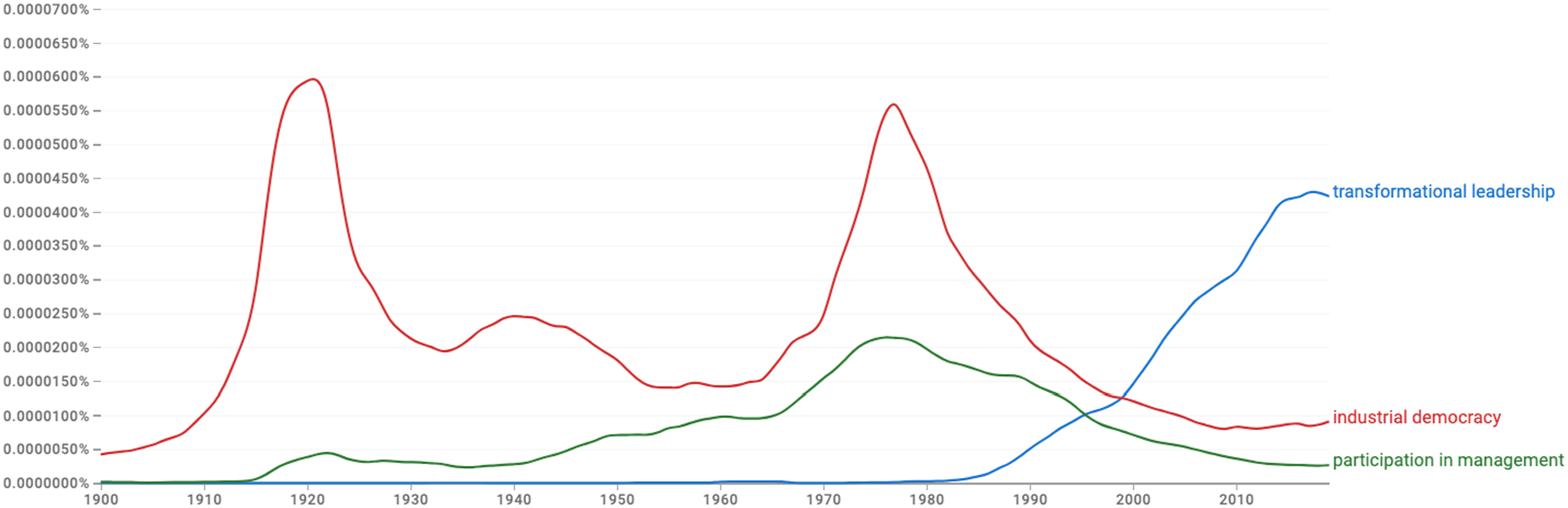
A related idea, also reaching new heights in the 1970s, was participation in management. One scholar at the forefront of this idea was Bernard Bass (Bass et al., 1979; Bass and Shackleton, 1979). Bass and Shackleton (1979) compared and synthesised American and European representations of participative management and industrial relations. Industrial democracy was more formal and had a legal element, while participative management was more informal. Industrial democracy was suited to organized worker representation, and participative management was a more face-to-face collaborative approach between managers and employees. Bass & Shackleton were enthusiastic about the future of shared decision-making in organizations, concluding “it is unlikely that the trend toward industrial democracy and participative management is a passing fad” (1979: 402) and that “in the coming years, we expect increasing attention to be paid to industrial democracy and participative management” (1979: 403).
These predictions did not prove to be correct, because the context shifted in ways that were unfavourable for greater involvement by employees in decision-making. Neoliberalism, which had fallen out of favour following the Second World War, began regaining popular support, culminating in the election of Ronald Reagan as US President in 1981 following a period of stagflation. Its intellectual leader, Milton Friedman who served as an advisor to Reagan, advocated a free market economic system with minimal government intervention. Friedman’s 1962 book, Capitalism and Freedom, was a best-seller, but his most well-known contribution is his 1970 article in The New York Times, where he stated that ‘the social responsibility of business is to increase its profits’. With the role of business within neoliberalism being maximizing shareholder value, the push for industrial democracy and participative management subsided.
The poor performance of the US economy was also of great concern to management writers. Hayes and Abernathy’s 1980 article in Harvard Business Review warned readers that corporate America was managing its way to economic decline. American organizations lacked technical competitiveness and growth compared to other countries, and they blamed management rather than external forces like inflation, government regulation, and tax policy: “modern management principles may cause rather than cure sluggish economic performance” (1980: 67). Other writers wondered why the Japanese economy was performing so much better, and their search for ideas that could rescue the US economy led to widespread interest in Japanese management practices. Japanese companies were extolling the importance of having shared values, moving away from mechanistic views of organizations, and focusing on shared beliefs, behavior, knowledge, values, and goals (Ouchi, 1981; Pascale and Athos, 1982).
Another link in the chain was psychoanalyst Abraham Zaleznik’s Harvard Business Review article published in 1977, which introduced the idea that leaders and managers were different. Managers were impersonal, passive, risk-averse, anxious people who could tolerate mundane work, and whose work is primarily an enabling process that conserves and regulates the existing order. In contrast, leaders were personable, active, risk seekers and takers, who developed fresh approaches to problems. Zaleznik lamented that conditions of society, including business organizations, favoured the development of managers and were stifling to leaders who exhibited creativity and imagination (Zaleznik, 1977).
This was a clarion call for leadership, but within management studies, research on leadership had stagnated. In Robbins’ first three editions of his Organizational Behavior textbook (1979, 1983, 1986), before the first inclusion of transformational leadership theory, Robbins described the state of leadership research as voluminous, confusing, and contradictory. Leadership research was primarily focused on individual and group behavior, and scholars lacked a grand idea to establish the study of leadership (Spector, 2016).
A struggling US economy, the rise of neoliberalism, and the inability of existing leadership ideas to provide a compelling solution to the problems of the day, was fertile ground for the seeding of Burns’ theory of transforming leadership within management studies. The publication of Leadership (1978) turned attention to “the statesmen who moved and shook the world” (Bass, 1993: 375). By connecting leadership theory to leaders at the top, Burns unknowingly created an exciting and seemingly much-needed shift for management scholars to refresh their focus.
During: Translating transforming leadership theory
Tichy and Ulrich (1984), writing in Sloan Management Review, were the first to make the connection to Burns and express enthusiasm for the potential of transformational leaders. They laid the blame for the continued decline of American corporations on “transactional managers” (p. 59) who lacked a compelling vision of the future and clung to the status quo. The key to revitalising large corporations like General Motors, AT&T, and General Electric was a “new brand of leadership” (p. 59), a “solid corporate example of what Burns referred to as a transforming leader” (p. 60).
Tichy and Ulrich’s personification of transformational leadership in action was Lee Iacocca, chairperson of Chrysler Corporation, who “provided the leadership to transform a company from the brink of bankruptcy to profitability” (1984: 59). Tichy and Ulrich (1984: 63) outlined “three identifiable programs of activity associated with transformational leadership”: create a vision, mobilize commitment, institutionalize change. Creation of the vision is the responsibility of the transformational leader, not something to be delegated to others. Iacocca “developed a vision without committee work or heavy staff involvement”, relying instead on his “intuitive and directive leadership, philosophy, and style” (p. 64). Mobilizing commitment occurs when “the organization, or at least a critical mass of it, accepts the new mission and vision and makes it happen (p. 64). Iacocca mobilized large factors of employees to his vision “while simultaneously downsizing the workforce by 60,000 employees” (p. 59). The institutionalization of change requires transformational leaders to “transmit their vision into reality” through changes in communication, decision-making, and corporate culture. Iacocca used internal communication to signal his vision, appeared in Chrysler’s ads to be the face of change, and transformed the internal culture “to that of a lean and hungry team looking for victory” (p. 60).
Spector (2014) concluded that Iacocca was little more than a ‘macho bully’ and Tichy and Ulrich’s use of him as the “embodiment of the transformational leadership construct” was, “at best, highly romanticized” and at worst “misleading and disingenuous” (2014: 361). However, it is easy to see elements of Burns’ theory that were appealing to management scholars. It could be moulded to a narrative that the decline of corporate America could only be reversed by heroic, daring CEOs with visions of a more prosperous future. It could also be drawn on to promote the view that leadership and organizational change are inextricably linked, thereby providing support for a new sub-field of change management that was taking shape at the start of the 1980s. For Tichy and Ulrich, leaders were people who transformed organizations. Their three elements of transformational leadership closely resemble Kotter’s (1995) eight steps for transforming organizations, and a range of other models developed in this period (Cummings et al., 2016). Less appealing to Tichy, Ulrich, and other management writers were Burns’ ideas on morality and democracy.
While Bass was not the first to draw on Burns’ theory for a management audience, he would become the person most associated with transformational leadership theory within our field. In his book Leadership and Performance Beyond Expectations (1985a), Bass listed ways his conceptualisation differed from Burns. Burns (1978) wanted to reserve transforming leadership for the forces of good and believed that Hitler exemplified everything he believed leadership was not. Bass dismissed Burns’ argument that transformation must be ‘elevating’, arguing that while Hitler was an immoral and brutal leader, he was transformational in the sense that he created change and transformed Germany. Thus, he dismissed Burns’ grounding of transforming leadership in morality, at the same time strengthening the association of the theory with transformational change.
Bass’ stance on the morality of leadership shifted in an article Ethics, Character, and Authentic Transformational Leader Behavior (1999), co-authored with Paul Steidlmeier. They argued that genuine transformational leadership must be grounded in moral foundations (Bass and Steidlmeier, 1999). When leaders act consciously or unconsciously in bad faith, this is inauthentic or pseudo-transformational leadership. Pseudo-transformational leaders are less likely to listen to conflicting views and are intolerant of differences of opinion between them and their followers. Bass retracted his earlier claim that transformational leaders could be ‘virtuous or villainous’ by stating that he was mistaken (Bass and Steidlmeier, 1999).
However, this article also makes clear Bass’ thinking on worker voice and participation in business decisions. Remember, in the 1970s Bass was a leading promoter of participation in management and shared decision-making. In addressing critics of transformational leadership who argued the theory “is antithetical to organizational learning and development involving shared leadership, equality, consensus and participative decision-making” (Bass and Steidlmeier, 1999: 192–3) Bass and Steidlmeier (1999: 202–3) responded: “For human relationists, the coming together of the values of the leader and followers is morally acceptable only if it comes about from participative decision-making pursuing consensus between leaders and followers. Whether a leader is participative or directive, however, is not a matter of morality. It is a matter of the naiveté or experience of the followers and many other contextual considerations. In many cases, directive leadership is more appropriate and acceptable to all concerned”.
What is striking in reading the work of Bass and other management writers who translated Burns’ theory for a management audience is that there is no consideration that Burns was writing about politicians and voters. If readers were not aware of this, it could easily be assumed that Burns was writing about corporate America. We found no explicit critical reflection on the parallels and differences between the contexts of democratic politics and business. Rather, key differences are assumed – the business world does not operate according to democratic principles, employees do not vote for their leaders, the role of leaders is to drive change from the top-down to improve organizational performance, and participation, dissent, and questioning of leaders’ visions are welcome only when it strengthens the proposed change. Burns chose to overlook Burns’ essential democratic foundation of transforming leadership theory – despite his earlier interest in industrial democracy and participative management.
After: Burns’ response to transformational leadership theory
The 1980s saw a great tidal wave of interest in transformational leadership, depicted in Figure 1. As it grew in influence, interest in industrial democracy and participative management waned. As we have seen, the theory of transformational leadership that emerged within management studies was quite different to that developed by Burns in political science. In this section, we investigate Burns’ response to those developments.
Burns was certainly aware of how Bass and others were shaping his theory. The foreword of Transformational Leadership, published in 2006 by Bass and Ronald Riggio, describes a meeting of leadership scholars at the University of Maryland nearly a decade earlier. The topic for debate was whether Hitler was a transformational leader. As noted earlier, Bass initially took the view that transformational leaders were those who created transformational change, irrespective of their moral values. The foreword, signed off by Burns and Georgia Sorenson of the Burns Academy of Leadership, states that “after 3 days of intense debate, Burns, the scholar, took a bold stand: from his perspective, the term ‘leadership’ should be reserved for the forces of good” (2006: viii). While Burns staunchly defended the essence of his theory being grounded in morality, there is no mention of the democratic underpinnings of his notion of moral leadership.
Why didn’t Burns defend the democratic component of transforming leadership? Perhaps Burns, a political scientist, shared Bass’ view that business was an area where democratic principles did not apply. More likely, based on an interview Burns had with Bailey and Axelrod (2001), he felt it was not his place to comment on management scholars’ development of his theory. Burns was asked what it takes to be a great organizational leader and to comment on the challenges business leaders face. He responded: “I do not pretend to be an authority, or even deeply informed, on organizational leadership aside from reading some of the work that has been done in this area” (Bailey and Axelrod, 2001: 116). Burns was complimentary toward Bass and his associates and expected they would be remembered as great leadership theorists (Bailey and Axelrod, 2001).
Another possible explanation is that Burns was grateful to Bass and other management scholars for popularizing his work. Political theorists have neglected the issue of leadership because of greater concern for democratic government and ideas of ‘equality, justice, and community’ (Peele, 2005). Tintoré and Güell (2015) analyzed the 100 most-cited leadership articles in politics, business, and education. They found that “transformational” was the most commonly occurring word (beyond the words “leadership” and school”). However, “transformational” was not mentioned in any of the political science articles – all the occurrences were in business and education articles. It would be misleading to suggest Burns had no impact on political science. A Center for Political Leadership and Participation opened in 1981 at University of Maryland and in 1997 this was renamed The James Macgregor Burns Academy of Leadership. However, in 2017 its official home became the Møller Centre, an executive education provider in Cambridge, reflecting the influence of Burns’ thinking in business. Perhaps this made it easier for Burns to ignore the democratic deficit in the translation of his theory.
Recovering the democratic origins of transformational leadership
Why does it matter that Burns’ democratic underpinning of transformational leadership theory was ignored by management scholars who popularised his theory? In this section, we put forward three reasons. First, it matters because transformational leadership theory remains influential, evidenced by its continued appearance in executive education programmes, management textbooks, and discussions of leadership in business and the popular press. Second, it matters because there is an opportunity provided by our alternative history of transformational leadership theory to change how we teach it to business students. Third, it matters because if we teach the theory differently and in a way that is closer to Burns’ original thinking, alternative approaches to leadership can emerge that can contribute to the democratization of work.
Returning to the origins of transformational leadership theory and tracing its evolution matters because the theory remains influential. The theory was included in all mainstream and critical management textbooks that we sampled (Buchanan and Huczynski, 2019; Clegg et al., 2019; Griffin, 2019; King and Lawley, 2019; McShane et al., 2019; Robbins et al., 2022; Schermerhorn et al., 2020; Williams, 2022). All outline the conventional understanding, namely Bass’ representation of transformational leaders as visionaries who drive organizational change by inspiring their followers to go beyond their own self-interest and perform above expectations. Some acknowledge the essential moral element of transformational leadership that Bass came to accept later in his career (Schermerhorn et al., 2020; Williams, 2022). Moreover, some explore the ‘dark side’ of transformational leadership (Buchanan and Huczynski, 2019; Clegg et al., 2019; King and Lawley, 2019; McShane et al., 2019). But none deal with the democratic origins of the theory developed by Burns and therefore none explore the possibility of how the theory might be applied to promote workplace democracy.
The second reason why exploring the evolution of transformational leadership theory matters is because it reminds us that foundational theories of management are not set in stone. As historiography teaches us, the production of history is always a subjective process – a necessary selection by the historian of people, places, and events as important, and others as unimportant. So it is with the construction of management theories. We have examined how influential management writers crafted transformational leadership theory for their audience, in response to the context they inhabited at the start of the 1980s – the decline of America as the global economic powerhouse, a lack of trust between managers and workers, and a feeling that management had become impotent. Bass and his contemporaries took from Burns the importance of individual leaders, the centrality of a vision, the need to mobilize the commitment of followers, and the idea of transformational change. They used these ideas to craft a new management manifesto for corporate America. As we have seen, these writers also looked past important elements of Burns’ theory which were not helpful for their agenda – the essential morality of transforming leadership and, most importantly from our perspective, that moral leadership requires followers to choose their leaders.
Two representations of transformational leadership theory.
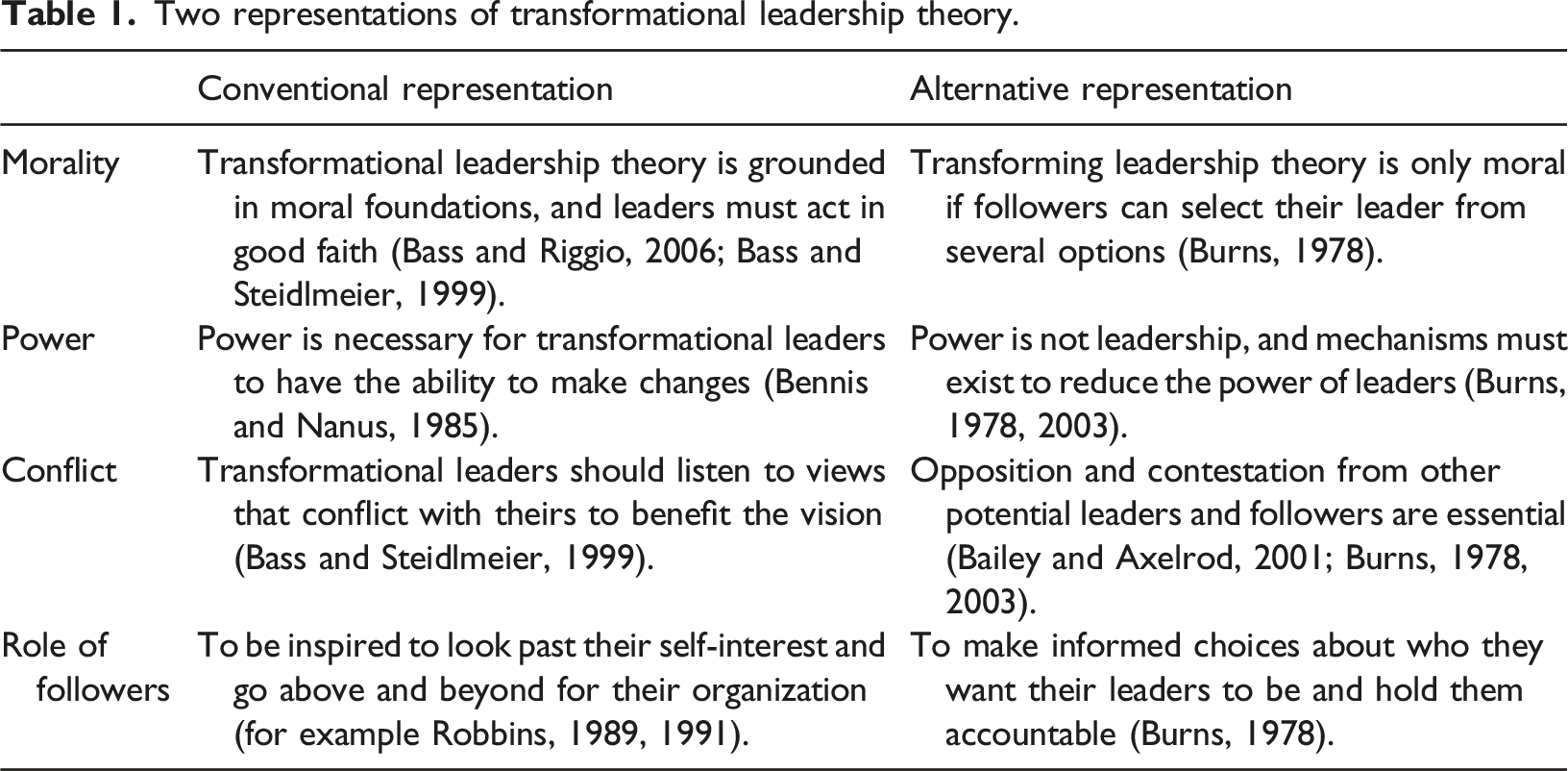
For Burns, democracy shaped all four elements of morality, power, conflict, and the role of followers. Transforming leadership is only moral if followers select their leaders. Opposition and conflict between leaders and followers are essential and act as mechanisms to prevent leaders from accruing excessive power. After selecting their leaders, the role of followers is to hold them accountable for their performance.
In contrast, the conventional representation is silent on these democratic elements. While transformational leaders should act with morality and in good faith, they are not accountable to followers in the way that Burns envisaged. It is leaders’ responsibility to develop a vision for the organization and to inspire employees to look past their self-interest, buy into that vision and help make that vision a reality. Transformational leaders are encouraged to listen to views that conflict with their own, but only in ways that benefit the vision and organizational performance. In the conventional representation, transformational leadership theory has an instrumental purpose – to enhance the performance of the organization rather than the broader social outcomes that Burns articulated.
The third reason why looking again at the origins of transformational leadership and how it was translated for a management audience matters is that if management students were taught transformational leadership in a way closer to Burns’ conception, the theory could contribute to democratizing work. To be sure, there are arguments against giving employees a vote on who leads them: employees usually do not have an ownership stake in the business and might therefore vote for leaders who will give them pay raises or go easy on them, rather than for leaders with the best interests of the organization at heart. Or it might be argued that conducting votes on leaders and other key decisions would paralyze organizations and make them too unresponsive to a rapidly changing business environment. We do not pretend that the idea of more democratic structures in organizations is straightforward. But we do believe the issue warrants more serious consideration and debate given the challenges we face today. Textbooks presenting our alternative representation of transformational leadership theory, alongside the conventional representation, would stimulate that debate. We acknowledge that this might be a challenge for best-selling management textbooks, which predominantly reflect a unitarist, managerialist worldview. At the very least, we would welcome management textbooks with a critical orientation to consider our alternative representation for inclusion.
This is not an abstract debate about how theory is represented. The practical implications are real and important. Earlier we discussed the case of Facebook’s Mark Zuckerberg, celebrated in management textbooks as a visionary and the inspiration behind the company’s extraordinary success (Robbins et al., 2015), but more recently blamed for its fall from grace, the company a dictatorship controlled by its founder who cannot see past his grand vision of the metaverse (Naughton, 2021). Facebook is not an isolated example. Amazon’s Jeff Bezos was featured in the sixteenth edition of Organizational Behavior as an exemplar of a successful leader (Robbins and Judge, 2015). However, not mentioned is Amazon’s notorious reputation for underpayment of workers, extreme physical exertion in fulfilment centres, brutal corporate culture, and a series of fatalities in the workplace. How we teach leadership and management theory to students socializes them into how they should behave as employees and how they should operate as managers (Calás and Smircich, 1989; Cavanagh et al., 2023; Stambaugh and Trank, 2010). If we teach theory differently, there is the possibility that organizations will be led differently in the future.
Conclusion
The case of transformational leadership is another example of Cooke’s (1999) writing the left out of management theory. An obituary of Burns mentions his politics were left-wing (Weber, 2014). He ran for Congress as a Democrat in 1958 and commented that another party’s supporters attacked him for being an “atheistic communist, etc” (Bailey and Axelrod, 2001: 114). Burns was passionate about democracy and concerned about the abuse of power. These concerns influenced his work and can be identified throughout his seminal book Leadership (1978). The moral element of transforming leadership is what concerned him most. This morality, he explained, is defined by whether followers have “conscious choice amongst real alternatives” (Burns, 1978: 36).
The democratic component of transforming leadership theory that was crucial to Burns was unimportant to those who introduced it to management studies. His work was co-opted by management theorists to further their interests in top-down, transformational change. Bass, formerly an advocate of employee participation in management decision-making, became enamoured with the idea of powerful, heroic leaders and their grand visions for organizational transformation. He actively dismissed critics’ concerns about the lack of checks on transformational leaders and argued that, in most cases, directive leadership is more appropriate (Bass and Steidlmeier, 1999).
Looking deeper into the origins of transformational leadership theory matters because it remains influential. While Figure 1 shows interest might have peaked, its leader-centrism means it shares a strong family resemblance to other popular approaches to leadership today, including authentic, responsible, ethical, servant, and positive leadership theories (Alvesson and Einola, 2019; Robbins and Judge, 2018; Spector, 2014). It also remains influential outside of academic circles, including in the popular press, with Ukrainian President Volodymyr Zelensky (Fox, 2022) and former New Zealand Prime Minister Jacinda Ardern recently described as transformational leaders (Grant, 2021).
The field of transformational leadership research is not without problems. In a damning review of 25 years of transformational leadership research, van Knipperberg and Sitkin (2013: 45) concluded “it is a body of research riddled with major problems”: a flawed construct, no definition of the theory independent of its effects, and no explanation of how the dimensions of the theory can be differentiated from other aspects of leadership. While they argue that transformational leadership, as a concept, should be “dropped from scientific inquiry”, they also accept that their call “is decidedly not to say that we should abandon all ideas and insights from research in charismatic-transformational leadership” (van Knipperberg and Sitkin, 2013: 45–6.) We agree that although the science is deeply flawed, there is value in exploring the theory in new ways, as we propose in this article.
We are conscious that at present, there appears little enthusiasm amongst critical management scholars for transformational leadership theory. Tourish (2013) worries the theory breeds cultish organizations. Cults typically have a charismatic leader and a compelling vision. Followers are rewarded for compliance and penalized for dissent. Followers are encouraged to believe the leader has their best interests at heart and a common culture is seen to be necessary for the group to succeed, making dissent or critique even less likely. However, this is a criticism of the conventional representation, and in particular, Bass’ conception of idealized influence which relates to followers identifying more readily with charismatic leaders. As explained earlier, charisma was not a prerequisite for Burns’ transforming leaders. In fact, he was wary of charismatic leaders for exactly the reason that Tourish is.
Tourish (2013) prefers Burns’ pluralist notion of transactional leadership – the idea of leaders recognising that followers might have different interests and objectives and therefore engaging in some ‘give and take’ around that. We believe this can be accommodated within Burns’ conception, since he makes it clear that opposition and contestation from other followers and leaders are essential to transforming leadership. Tourish’s other suggestion is to consider more democratic processes in organizations. This is where we encourage Tourish and those promoting workplace democracy to look again at the potential of transformational leadership. Remember, Burns believed that the ability of followers to elect their leaders was a necessary safeguard against the threat of transformational leaders going rogue. What if employees were given the right to choose who leads them, as well as the power to replace them?
We acknowledge that transformational leadership can be seen as more of the same – a theory of individual leadership with a binary relationship between leader and followers – which means we fail to recognise the potential of collective leadership (Currie and Lockett, 2007; Raelin, 2018). While we welcome the development of collective approaches, in many organizations this is not a realistic alternative for now. For this to occur there needs to be greater democratization of work. Transformational leadership theory, in its original, democratic form, is a useful step along that path.
We also acknowledge this paper only looks at a narrow aspect of transformational leadership theory, the lost democratic component. Some may be critical of our favoring of Burns’ conceptualization of the theory when he was silent on other aspects like gender and race, which are important parts of any discussion of leadership (Ladkin and Patrick, 2022). Other narratives are still possible, and we encourage future research in this regard.
In exploring the origins of transformational leadership theory, we build on and seek to contribute to, critical historical research within management studies. We also contribute to developing a business education that is more aware of the historical origins and evolution of theories for the purpose of cultivating critical, reflexive practitioners (Cavanagh et al., 2023; Cunliffe, 2016; Tcholakian et al., 2023). We do not claim to have the answers to the challenges facing business and society today. We do suggest that looking again at Burns and reflecting critically on how the democratic context in which he developed his ideas might be applied to the workplace is a worthwhile undertaking. The advantages of pursuing this, as well as the limitations and potential problems, are all issues of worthy debate in our business schools.
Footnotes
Declaration of conflicting interests
The author(s) declared no potential conflicts of interest with respect to the research, authorship, and/or publication of this article.
Funding
The author(s) received no financial support for the research, authorship, and/or publication of this article.
