




Abstract
Managerialism versus professionalism is a central axis of conflict across many occupations. ‘The profession of arms’ is no exception. This article explores the contested yet symbiotic relationship of management and the military via a discussion of the Vietnam conflict and contemporary debates over restructuring the US military to fight so-called ‘New Wars’. It portrays a complex picture of the organization and measurement of destruction, arguing that managerialism has long been an important ideological element of civilian and military practice. While management systems such as the infamous ‘measurements of progress’ in the Vietnam War were practically dysfunctional, they were effective up to a point in their managerialist goal of portraying civilian and military organizations as effective, evidence-based, progressive and ethical. This logic also pertains to contemporary debates over ‘progress’, and its measurement in the Iraq and Afghanistan counterinsurgencies and the campaign against Isil. Despite its practical limitations, managerialism is highly prevalent as ideology in warfare, fixating on tactical and operational levels, thereby excluding broader strategic, political or ethical discussions. ‘Progress’ and its mismeasurement in Vietnam and the New Wars are therefore best understood not simply as reasons for military and civilian failures in prolonged and inconclusive conflicts but as evidence of the success of managerialism in restricting public scrutiny and accountability of the business of war.
Introduction
When Norman Schwartzkopf told reporters during Desert Storm that estimates of how many Iraqi soldiers had been killed were meaningless, I raised my fist in the air and shouted for joy. (Marlantes, 2011: 118)
Uniformed professionals have long complained of the unwanted and counterproductive intrusion of civilian managers into the business of war. To many observers of American wars – especially to Vietnam veterans – ‘body counts’ are a potent symbol of the failures, remoteness, and disrespect shown by civilian ‘war managers’ as regards the realities of combat. General Tommy Franks repeated this refrain during the Second Gulf War when he famously claimed ‘we don’t do body counts’. 1 But although professional militaries increasingly want to establish themselves as the sole shapers and executors of warfighting strategy, doctrine and conduct (Strachan, 2013: 83), military operations are in reality always inseparable from broader political strategies and goals (Bacevich, 2008; Daddis, 2014; Porch, 2013). This is arguably even more true in the era of ‘New’ (Kaldor, 2012), ‘asymmetric’, ‘hybrid’ or ‘irregular’ wars, such as counterinsurgencies, counter-terrorism and nation-building operations, where objectives and fronts are unclear and where war is ‘among the people’ (Fitzgerald, 2013; Strachan, 2013: 83–84; US Army and Marine Corps, 2007). Without ‘measurements of progress’ how can the political, security, cultural and economic objectives of a counterinsurgency campaign be politically framed, let alone met (Boettcher and Cobb, 2006)? In the US campaigns in the Second Iraq War, in Afghanistan and in the current conflict against Isil, metrics used to estimate population security and the operational readiness of host country security forces have been endlessly created and discussed as military leadership and civilian politicians develop narratives of progress and success. Despite the military’s public disdain for managerial measures, such as the infamous Vietnam era ‘body count’, in the messy and political business of war the ideology and practices of managerialism have wide currency and cannot be so easily separated from those of professionalism.
In common with many occupations, the profession of arms has an awkward and conflict-ridden relationship with ‘management’, especially when managers are drawn from outside their own ranks. This relationship deepened as management as a profession in its own right expanded and matured during the Cold War (Cooke, 1999; McCann, 2015; Waring, 1991). Hostility between professionals and management reached its apogee after the Vietnam conflict when a widely popularized explanation for stalemate and failure claimed that the US military was hemmed in by the ‘self-imposed restraints’ (Moyar, 2006; Sorley, 2007: 354) and self-delusional metrics of civilian management, and was forced to fight with ‘one arm tied behind its back’ (Greiner, 2010: 96). This article explores the role of managerialism in war by discussing the historiography of the Vietnam War and the contentious recent discussions around ‘re-learning’ counterinsurgency doctrine for the ‘New Wars’ of the globalized, post–Cold War era (Fitzgerald, 2013; Nagl, 2005; Porch, 2013; Strachan, 2013). Focussing on the debates around civilian mismanagement of the Vietnam conflict, especially as personified by the arch-manager Defense Secretary Robert McNamara, it argues that militarism and managerialism are closer in nature, spirit and aim than they might first appear. Although military forces are increasingly keen to distance themselves from civilian management (Bacevich, 2008; Johnson, 2004; Strachan, 2013), the article portrays ‘management’ and ‘the military’ as deeply entwined in their shared use of managerialist ideology (Klikauer, 2013), manifested in vague and ritualized symbols, metrics and ‘toolkits’, and a fixation on operational levels without due regard for the political aims and purposes of war. This situation has a remarkable persistence into the so-called ‘New Wars’ of the 21st century, suggesting that managerialist artefacts, ideologies and practices (such as body count) remain vital components of warfare despite their practical inadequacies.
Building on emerging research into the Cold War and management (Cooke, 1999, 2006; Kelley et al., 2006; McCann, 2015; Spector, 2006), the ‘dark side’ of management (Hanlon, 2015; Linstead et al., 2014) and critical career biography (Collin and Young, 1986; Gibson et al., 2013), the article proposes the concept of ‘war managerialism’, a version of general management ideology applied to the ‘killing work’ or ‘businesslike killing’ (Greiner, 2010: 222, 221) of warfare. The article argues that military ‘failings’ in Vietnam were only partially related to the unwanted intrusion of managerialist methods, such as body count and quantitative measurement, over the professional norms of warfare. Atrocities, strategic confusion, indiscriminate use of force, lack of public accountability, questionable metrics and assertions of dubious ‘progress’ remain very much staple features of warfare, in Vietnam, the recent counterinsurgency conflicts in Iraq and Afghanistan, and in contemporary efforts to ‘degrade’ Isil (Kaldor, 2012: 179; Porch, 2013).
The article is informed by the ‘historic turn’ in management and organization studies (Booth and Rowlinson, 2006; Clark and Rowlinson, 2004; McCann, 2015; Mills et al., 2016), a broad approach which problematizes the ‘Whiggish’ history prevalent in management thinking whereby consecutive technological and conceptual developments are presented as scientific improvements on prior practice based on ‘lessons learnt’. By contrast, ‘historic turn’ writings in management history are influenced by Foucauldian and other poststructuralist writings in suggesting multiple lines of historiographic enquiry and arguing that ‘history is never for itself, it is always for someone’ (Jenkins, 2003 [1991]: 21). Military and management history ‘lessons’ are often constructed to serve the interests of specific rules, ideologies and institutions that claim authority over knowledge and practice (Bourke, 2006: 33). The historical analysis developed in this article describes the deep intertwining of corporate, political, military and scholarly elites into a similar agenda that attempts to normalize and justify the organization and measurement of destruction according to metrics of ‘progress’. Destruction, ‘killing work’ and its measurement are central features of the business of warfare (Carroll, 2007; Greiner, 2010), and managerialist ideology (promoted by senior civilians and military professionals) has long played an important role in placing these controversies into ‘democratic exclusion zones’ (Klikauer, 2013: 1) away from public scrutiny and from complaints from lower-ranked military professionals. While war managerialism has taken many specific forms across various conflicts over time, its overall logic remains relatively unchanged; the application of ‘rational’ management discourses and technologies to rhetorically promote, control and normalize war while shrouding its brutal, irrational and uncontrollable nature (Bourke, 2006; Chwastiak, 2001).
The article proceeds in the following directions. The next section briefly introduces the notion of ‘war managerialism’ and sketches out the importance of the Second World War (WWII) in providing operational and conceptual space for the rapid growth of civilian management methods into the military and wider corporate life. There follows two sections exploring the contentious historiography surrounding the civilian and military ‘war managers’ (Kinnard, 1977) during the Vietnam War who, to a large extent, persisted with WWII-era ideologies and practices despite the quite different and highly complex nature of this conflict. McNamara and his management methods have been subjected to huge criticism but often in superficial ways that do not take into account the broader strategic and political context of US military power and the increasingly ideological, as opposed to practical, role of war managerialism. The article moves on to evaluate the revision of military doctrine and practice since the Vietnam debacle, suggesting significant overall continuities in the logic of war managerialism even as its content and tone changes to reflect the New Wars era. Conclusions then follow, in which war managerialism should be understood not so much in terms of civilian intrusion, hubris and failure but more in terms of a superficial yet powerful form of ideology (Gantman, 2005; Klikauer, 2013), which aims to reproduce and sustain the practices and legitimacy of the business of war.
‘Putting bombs on a business basis’: managerialism in the Second World War and after
Managerialism is a broad and pervasive ideology (Deem et al., 2007; Klikauer, 2013; Townley, 2002) promoting the ‘application of a narrow conception of management as a generalized technology of control to everything’ (Parker, 2002: 11). Management technologies have their roots in the institutions supporting 19th-century industrialism, including higher education and the military (Hoskin and Macve, 1988). But the rapid growth of management as a distinct profession in its own right with designs on intruding into and controlling almost all organizational domains is usually traced to the 1960s; managerialism was boosted considerably by the widespread use of management technologies by the US and UK militaries in WWII (Byrne, 1993; Waring, 1991). Managerialism is usually a pejorative term used by critics who decry the ways in which it drives out other knowledge, crafts and professions, and bestows significant status and authority upon management and managers whose technical and ethical expertise is questionable at best and fictional at worst (Gantman, 2005; Klikauer, 2013; Townley, 2002). ‘Management is regarded as that generic activity, group, and institution that is necessarily, technically and socially, superior to any conceivable form of social practice and organization, such as craft, profession, or community’ (Deem et al., 2007: 6). The abstract artefacts and practices of general management (performance measurement, management accounting and quality improvement metrics) come to dominate organizational discourse (Miller and Rose, 1990; Power, 1996) and, in stark contrast to their espoused function of providing clarity and accountability, often cause wasteful distortions, confusions and ‘gaming’, generating demand for yet more measures and their management (Hood, 2006; Ordonez et al., 2009). Professionals resent the ways in which managerialism shuts out and diminishes their norms, crafts and claims to expertise. In time, however, typically they are forced to relent as they themselves take on and contribute to the language, tactics and practices of managerialism that have become the only legitimate forms of organizational discourse and action (Chwastiak, 2001; Townley, 2002). Managerialism is deeply problematic as practice yet extremely widespread as ideology.
It is well established that staple business school language of strategy, vision, leadership, mission, operations, logistics and line and staff is militarily derived (Freedman, 2013; Mutch, 2006). Concepts, disciplines and practices of management and accounting have filtered between corporate, government and military organizations since industrial modernity (Hoskin and Macve, 1988). Robert McNamara (1913–2009) was a prominent example of the postwar American managerialist creed, exemplifying its fondness for statistical analysis, standard operating procedures, tight financial control and the insertion of ‘management’ as an ideology and interest group into senior levels of organizations to the exclusion of others (Klikauer, 2013). McNamara’s academic background lay in mathematics, statistics, philosophy and the newer disciplines of cost accounting and general management. At Harvard, he studied and taught Druckerite ‘management by objective’ approaches that influenced the post-depression US corporate economy in the Chandlerian ‘managerial capitalism’ mould. 2
McNamara’s involvement in the business of war began as his employer, Harvard Business School, was contracted to run a management training programme for the US Army Air Corps during WWII (McNamara, 1995: 8; Twing, 1998: 148–149). Air Corps officers learnt the statistical control methodologies required for ‘putting bombs on a business basis’ (Hendrickson, 1996: 98), as the enormous logistical, strategic and organizational challenges of the air wars against the Axis Powers stimulated new forms of statistical accounting and logistical control. The Air Corps’ new Office of Statistical Control applied quantitative managerial techniques designed to measure, account for and manage the logic and practices of warmaking. In a paradigmatic example of how managerialism intrudes into the working worlds of professionals, these new operating principles were imposed over the often reluctant professional values of the military, with officers frequently chafing at the perceived arrogance of the ‘Whiz Kids’ and their flow diagrams, flip charts, questionnaires and statistical manuals (Baritz, 1998 [1985]); Byrne, 1993: 48–51; Zaleznik, 1989: 100–104). US Air Force General Curtis LeMay described them as ‘the most egotistical people that I ever saw in my life. […] They felt that the Harvard Business School method of solving problems would solve any problem in the world’ (as quoted in McMaster, 1997: 20).
But in a ‘total war’ aimed at the destruction of a sovereign power’s cities, industry and population as well as their military (Collier and Lakoff, 2014: 27–28; Lindqvist, 2012), the ideology and practice of logistics, statistics and systems analysis were arguably complementary to these objectives. Management is thus an indispensable element of the American Way of War, which has traditionally emphasized massive firepower, overwhelming numbers and advanced logistics, in which the ‘dark side’ of management (Hanlon, 2015; Linstead et al., 2014) is clearly implicated in ‘killing work’ (Greiner, 2010; Morris, 2003).
Although obstructed by bureaucratic and professional resistance at many points, the Whiz Kids achieved considerable influence (Byrne, 1993: 58). One of the most important and controversial involved Stat Control reports suggesting the need for a radical departure in tactics in the air bombardment of Japan. The original plan of building new airstrips in Nationalist China proved to be cost ineffective, so LeMay’s XXI Bomber Command shifted its base of operations to the islands of Tinian, Guam and Saipan (Hadley, 2007: 24–28). The devastation of Japanese cities through firebombing (and the added risk to US airmen from flying the B-29 bomber at lower altitudes) was hugely controversial, as brilliantly depicted in perhaps the most memorable and disturbing passage of Errol Morris’ Oscar-winning documentary film on McNamara The Fog of War (Morris, 2003). In an interview interspersed with a montage of appalling destruction juxtaposed with dreary administrative memos, reports, slideshows and figures, a sometimes choked and teary McNamara recalls that ‘in March of 1945, in that single night, we burned to death a hundred thousand Japanese civilians in Tokyo: men, women and children’. He claims the firebombing tactic was LeMay’s, yet he also clearly admits shared culpability: ‘I was … part of a mechanism that… that in a sense recommended it. […] He – and, I’d say, I – were behaving as war criminals’ (McNamara, in Morris, 2003: interview excerpts between 33 minutes, 50 seconds to 41 minutes, 24 seconds; see also Blight and Lang, 2005: 119; Hadley, 2007: 24–26). A May 1945 memo from McNamara illuminates this rear-echelon war managerialism: By flying available crews 6 sorties [or 100 hours per crew] per month in June and July, the Command can exceed programmed effort in those two months by 2000 sorties, or by 23%. […] However, if, during the next 6 months, actual crew flow to the theater exceeds that programmed, or if the actual crew loss rate is less than the programmed rate of 1.6% per sortie, the actual crew inventory on hand in late October may be equal to, or in excess of, plan. (Memo from Lt. Col. R.S. McNamara to XX Air Force Chief of Staff, Gen. L. Norstad, 22 May 1945, as quoted in Blight and Lang, 2005: 120)
Managerialism thus obscures killing work by framing it as an objective, value-free science, much like engineering, accounting or statistics (Funnell and Chwastiak, 2015; Lindqvist, 2012). The moral horrors of area bombing are thus written out, and the shift to the much more intense air assault on Japanese cities is widely credited as a success for McNamara and the Army Air Forces, in that it allowed objectives to be predicted, met and measured in the most efficient manner possible (Frank, 1999: 57–82).
After the war, McNamara moved to Ford Motor Company as part of a group of management experts, given a brief to radically reorganize what had become a chaotic organization riven by clashing empires and lacking a functioning information architecture (Byrne, 1993). The wartime application of managerial disciplines, such as operations research or systems analysis, led to their wide promotion into corporate management (Chwastiak, 2001; Gantman, 2005: 68–69; Starkey and McKinlay, 1994; Waring, 1991). After rising to the summit of the Ford hierarchy, McNamara was appointed to Kennedy’s cabinet as Defense Secretary in January 1961, and these corporate planning, measuring and accounting techniques found their way back into public administration. Techniques and concepts such as the Planning Programming Budgeting System were used to try to ‘rationalize’ the Pentagon, place it under tighter civilian management and control its spiralling costs (Chwastiak, 2001; McCann, 2015). McNamara was widely feted by the media as a dynamic and capable professional manager, while being resented by the generals for his ‘bean counting’ just as he was by the Ford engineers. The stage for the ‘management versus military professionals’ conflict was set.
‘Now we’re off to bombing these people’: the uncertain chain of escalation
The Vietnam War generated deep controversies about the effectiveness of civilian management in war. WWII-style war managerialism designed to support the American Way of War made much less practical sense in the highly complex Vietnam conflict which was, at various times and places, simultaneously a ‘big unit’ war between uniformed armies, a limited war and a counterinsurgency (Greiner, 2010; Sorley, 2006). US forces could not simply destroy North Vietnam from the air like they did Japan. Whereas WWII was a conflict between nations in which a ‘total victory scenario’ consisted in the near-complete destruction of the enemy’s armed forces, population, economy and government, the overall strategic goal of American involvement in Vietnam was never clearly understood or set. Viet Cong (VC) and North Vietnamese forces, influenced by organizational and tactical doctrines of guerrilla war and so-called ‘people’s war’, refused to fight in open engagements in which the US and its allies could easily beat them. The enemy was elusive. Often it was impossible for US forces to ‘close with’, ‘fix’ and ‘destroy’ it using their favoured tactics of attrition and massive firepower.
But ‘progress’ had to be asserted by the US military and government. War managerialism in this conflict thus took the form of a façade of clear progress against objectives communicated to the public, media and Congress, framed in McNamara’s management speak of casualty statistics, percentage of population secured, weapons seized, areas ‘cleared’ of VC insurgents and declines in incidents of terrorism (Chwastiak, 2001, 2006; Gibson, 1986). War managerialism thus increasingly drew its value from its ideological influence rather than its practical efficacy (Klikauer, 2013). Like managerialism elsewhere, it became increasingly ‘fictionalized’ (Gantman, 2005: 145–152) via its growing ‘lack of correspondence between the statements of the ideologies and factual reality’ (Gantman, 2005: 146).
But in providing this disingenuous ideological shield, McNamara’s arrogant and technicist approach also gave the military the opportunity to argue that his micromanaging encouraged self-delusional reports of ‘progress’ (Krepinevich, 1986; McMaster, 1997) and prevented US forces from going ‘all out’ and winning outright (Moyar, 2006; Sorley, 2007). In many accounts, McNamara the manager was blinded by his own inflexible quantitative techniques, and the Vietnam War was thus lost because of outdated and flawed civilian micromanagement (Byrne, 1993; Chandler and Chandler, 2013: 42-55; Dodgson, 2012; Lewis, 2012; Muehlbauer and Ulbrich, 2014: 448–449). The military has often used this argument to claim it should be allowed freer rein to run the business of war without political interference.
However, a deeper reading of America’s torturous path to war and its strategic and tactical failures once committed reveals a complex, indeterminate picture. Although one of the central characters in the saga of military escalation (Barrett, 1993; Ellsberg, 2002: 57; Halberstam, 1992 [1969]; Karnow, 1991; Sheehan, 1990), McNamara – like much of the civilian leadership – was privately never fully committed to the major engagements that eventually emerged. Although he projected an air of certitude and often arrogance to the press, Congress and the American public (Sheehan, 1990: 554), he was never certain about the appropriate size, scale and risks of military involvement (Halberstam, 1992 [1969]: 516). The United States climbed a gradual chain of escalation, with the principals at each time committing only what was considered the minimum forces necessary to ensure South Vietnam would not fall (Ellsberg, 2002; Gelb and Betts, 1979; McMaster, 1997). ‘Now we’re off to bombing these people’ said a depressed and uncertain President Johnson in a recorded telephone conversation with McNamara on 26 Feb 1965. ‘[…] I don’t see any way of winning’ (as quoted in Alterman, 2004: 171). The military repeatedly asked for larger escalations at every point with McNamara often bargaining them down. By taking the middle road and the forced consensus insisted on by Johnson, McNamara was ultimately pilloried by the left who regarded him as a war criminal or imperialist (Chomsky, 1996; Hendrickson, 1996) and by the military and the right as an interfering bureaucrat who prevented America from winning the war by fixating on a ‘no-win’ strategy that bound US forces in excessive ‘self-imposed restraints’ (see Halberstam, 1992 [1969]; Karnow, 1991).
This is not to say that civilian management crafted an effective strategy. Far from it. The concept of bombing North Vietnam as a demonstration of US ‘resolve’ and as ‘communication’ to Hanoi and Moscow to back off and drop their support for the Vietcong ‘insurgency’ in the South was based on abstract reasoning about raising the costs of war to a level that the North and the VC could not bear. Informed by game theory and new strategies developed by the defence intellectuals of the Pentagon and RAND Corporation (Kaplan, 1983), civilian micromanaged aerial bombing would supposedly obviate the need for large-scale ground troops while remaining sufficiently small scale so as not to provoke China’s entry into the war (Gibson, 1986; McMaster, 1997). The bombing campaign would be carefully targeted to avoid civilian casualties, it could be ‘limited’, switched off at times, pushed up or down, ‘a bargaining chip’ (Ellsberg, 2002: 52; Halberstam, 1992 [1969]: 516) to be combined with diplomatic overtures to North Vietnam in the hope of effectively bombing them to the negotiating table once the position had been ‘communicated’ to the communists that they could not possibly win. But Washington grossly misunderstood the nature of the conflict and the determination of the North Vietnamese forces and political leadership. ‘Bombing as communication’ was a failure of ethics, of policy-making, of military strategy and as a piece of ‘systems analysis’. Rather than working in place of ground troops, it helped accelerate the mechanics of escalation in which the United States was still compelled to commit boots on the ground or see the South fall. While a practical failure, the managerialist notion of ‘bombing as communication’ did serve an ideological function: US ‘resolve’ and its self-righteous willingness to avoid ‘a wider war’ were indeed communicated to Hanoi and to the world.
The ground war in Vietnam was also a strategic and tactical disaster for the United States (except for its corporations working on cost-plus contracts to the Pentagon, such as weapons manufacturers, logistics, construction, communications and medical service providers, and food and uniform suppliers (Gibson, 1986; Sheehan, 1990: 621–626)). But the blame for failure cannot all be laid at the door of McNamara’s number-driven management technique, even if the military might want it to be. Right until the Tet Offensive of early 1968, McNamara publicly projected an image of certitude and resilience; the bombing and the ground troops were necessary and correct interventions, the strategy was working, and there was light at the end of the tunnel (Karnow, 1991: 341). His hypocritical and disingenuous public persona drove many to resent him (Brigham, 2006: 134). This became even more true as it emerged in the Pentagon Papers and the 1982–1985 Westmoreland versus CBS libel trial that McNamara believed the war to be ‘unwinnable militarily’ from perhaps as early as 1965 (Shapley, 1993: 602). Why did he not resign and go public with his doubts? Critics branded McNamara as not only deceitful and remote but also a moral coward (Hendrickson, 1996).
But if we are to fully understand war managerialism, we need to examine its motives and logics (Klikauer, 2013). McNamara, the administration he served, and the military and civil bureaucracies involved in Vietnam needed to show messages of ‘resolve’, ‘progress’ and ‘headway’ (Sheehan, 1990: 287) in their huge efforts. What public servant or bureaucracy can publicly show weakness or equivocality? War managerialism provided the ideological tools for the construction of a narrative of certainty, necessity, modernity, professionalism and ethical probity (Chwastiak, 2001, 2015). Key figures in the military such as Generals Harkins and Westmoreland time and again made similar pronouncements of certain victory, ‘standing in the ruins and saying everything was great’ (Oberdorfer, 2001: 34). Reams of performance data were collected by US military commands and circulated around military units, the press and the Congress, typically demonstrating the efficacy of United States and South Vietnam combat troops and the inevitability of success, such as kill ratio (or ‘exchange ratio’), percentages of troop readiness, body counts, weapons seized or hamlet security. Figure 1 would be typical. Included in a manual edited by US Army Generals Ewell and Hunt, it claims to show continual improvements in exchange ratio, and hence, combat effectiveness of units under their command, even as ‘victory’ or ‘pacification’ of the III Corps Tactical Zone never came closer in reality. The spike in exchange ratio in 1969 is doubly controversial. There are good reasons to believe the numbers are inflated and simply irrelevant as a measure of progress. More disturbingly, they may be at least partially accurate in their reflection of the increase in indiscriminate killing that appeared to take place in the Mekong Delta during supposed ‘pacification’ campaigns such as ‘Operation Speedy Express’. Critics claim that dead civilians were simply included in the body count as ‘enemy KIA’ as Ewell and Hunt relentlessly pressed for higher kill ratios (Turse, 2013: 208–209).
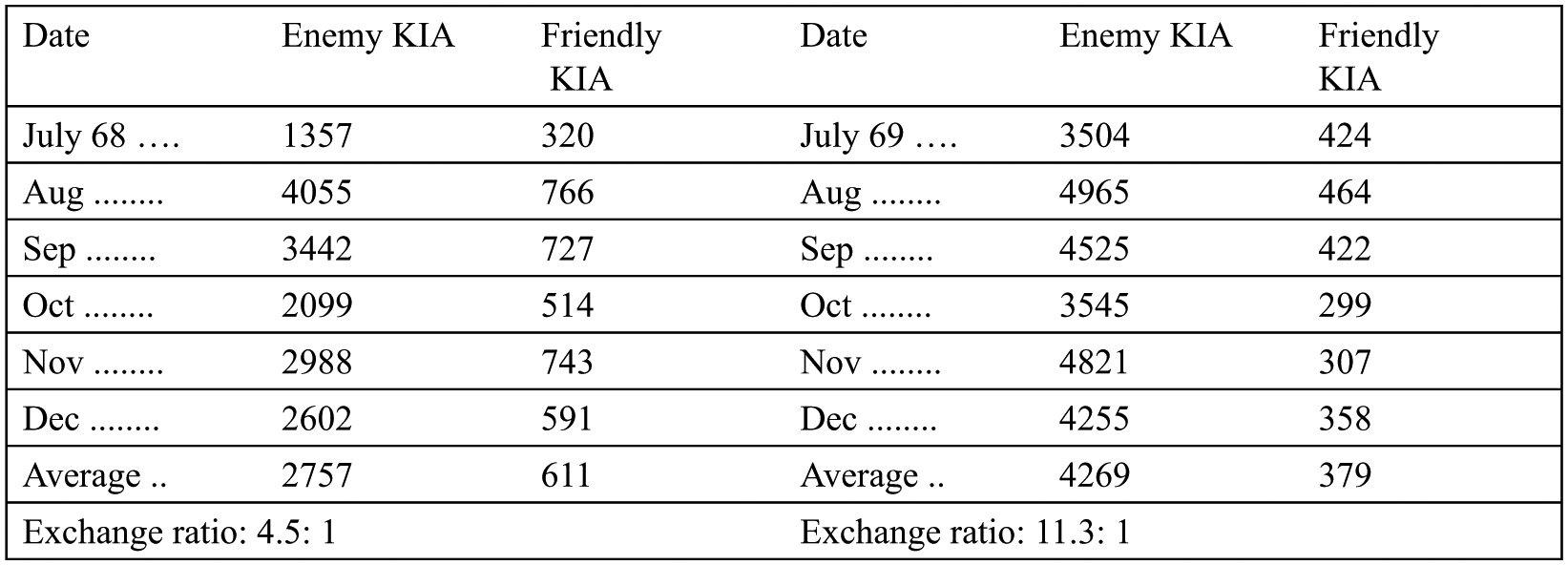
III Corps tactical zone selected combat statistics (Jul–Dec 1968 and Jul–Dec 1969).
Many have suggested that such management data were self-delusional, with several sources (from conservative military analysts as well as liberal critics of the war) arguing that the numbers were routinely inflated, falsified or simply unknowable, presenting an entirely bogus picture of progress, population security, combat effectiveness and eventual victory. The trickery and falsehood of systems analysis and measurements of progress were the means by which civilian management dismissed military professionalism and judgement, and senior officers would degrade their own profession by copying these practices (Kinnard, 1977; Lewis, 2012). Ewell and Hunt themselves came in for huge criticism from subordinate officers such as Colonel David Hackworth who regarded them as typically remote and careerist ‘desk jockeys’ using dubious measures to boost their own status to the detriment of the overall war effort. Their metrics displays were ‘worthlessly theatrical […] maps, charts, sitreps, stats, kill rates, body counts galore; the whole deal […]. All of them pure-grade crap’ (Hackworth and England, 2002: 7).
Certainly, this view holds some merit. But it would be wrong to dismiss war managerialism as solely delusional or manipulated by ambitious individuals. The Pentagon Papers (US Department of Defense, 1971) and recordings of White House telephone conversations (Prados, 2003: 151–177) do not generally suggest that the principals had no idea what they were doing or that they were deluded by wishful thinking or hubris (Gelb and Betts, 1979). On the contrary, they demonstrate that many of the foreign policy decision-makers expressed deep reservations about the chances of success but felt compelled to keep committing to South Vietnam; the domino theory and the doctrine of containment had trapped them in an impossible situation (Ellsberg, 2002; Gelb and Betts, 1979; Greiner, 2010; Karnow, 1991; Komer, 1986). The war strategy was indeed unclear, open-ended and deeply inadequate (Coram, 2010; Kinnard, 1977; Komer, 1972, 1986; Krepinevich, 1986; McMaster, 1997), but the fault here was shared by Johnson’s inner circle of advisors in escalating US commitment and by the military for ‘playing out [its] institutional repertoire’ (Komer, 1986: 41) of firepower-intensive attrition rather than adapting to a counterinsurgency campaign. McNamara was ‘part of a mechanism’ that failed disastrously in Vietnam. But to what extent did his numerical, technical and managerialist approach cause this failure? As the next section will show, the closer one looks at the historiography, the less relevant the charge of ‘civilian intrusion’ appears as a primary reason for military failure in Vietnam. Rather, war managerialism – the body counts, the statistical tables and the measurements of progress – were ‘part of a mechanism’ that helped to promote, sustain and normalize this disastrous war even in the face of failure. In that sense, war managerialism was functional to the business of war.
‘Every quantitative measurement’: metrics of ‘progress’ as corporate communications
Much has been made of McNamara’s infamous statement to the press that ‘[e]very quantitative measurement we have shows that we’re winning this war’ (as quoted in Sheehan, 1990: 290). Taken on face value, this is a damning indictment of the self-delusional hubris of Vietnam’s ‘war managers’ who stupidly took solace from illusory measures of progress (Gibson, 1986; Kinnard, 1977; Muehlbauer and Ulbrich, 2014). The quote appears frequently in writings on McNamara (see, for example, Dodgson, 2012; Karnow, 1984: 82; McMaster, 1997: 354; Powell, 1995: 103). But closer inspection casts doubt on that interpretation. The comment was made off the record to a reporter three years before the major troop build-ups of 1965. Was McNamara so blinded by his numerical–technical numbers to the extent that he really believed in these ‘measures’ both then and later, or was this statement an example of a ‘throwaway’ piece of corporate communications for the press? The line itself comes from Sheehan, who was one of the reporters present at the time it was made (May 1962). It is not an especially surprising or revealing quotation given the compulsion of managerialism to endlessly project success regardless of operational realities.
Body counts were the most (in)famous of the Vietnam era ‘quantitative measurements’, and anyone associated with them has come in for very heavy criticism from liberals and from the military alike: for example, ‘McNamara’s slide-rule commandos had devised precise indices to measure the unmeasurable’ argues Colin Powell (1995: 103). However, while it is perfectly plausible to find fault with target-driven systems for their propensity to drive gaming, falsifying of statistics, goal displacement and self-delusional wishful thinking (see Hood, 2006; Ordonez et al., 2009; US Army and Marine Corps, 2007: 190), many analyses of this kind lack balance, in that their pinning of blame for military failure on the technical issues of body counts and systems analysis detracts attention from foreign policy delusions and military imperatives that go far wider, and the functional and ideological role of managerialism in trying to frame and justify them. In Douglas Kinnard’s (1977) The War Managers, for example, Vietnam era generals pointed to widespread failure in strategy, tactics and measurement of progress. Enemy capability and will were vastly underestimated, no effort had been made to understand the culture and politics of the region, and the South Vietnam regime was desperately weak (see also Daddis, 2011; Krepinevich, 1986). Critics looking for an easy explanation for US failure have often seized on ‘the management numbers’ as the most obvious problematic.
But the Vietnam historiography is complex and multivocal (Fitzgerald, 2013), as ‘history’ always is (Jenkins, 2003 [1991]). Body counts were arguably a product of the US Army rather than McNamara’s stats-driven ‘technowar’ (Gibson, 1986) and, being widely used in Korea (Gartner and Myers, 1995; Turse, 2013: 43), predate the Vietnam conflict. Going further back, ‘confirmed kills’ in the First World War were regularly ‘gamed’ for propaganda purposes, and even casualty figures in the American Civil War were ‘dickered’ with (Andreas and Greenhill, 2010: 13–14). The French military also never found a way to make the ‘measurement of progress’ work during its own wars in Indochina (Daddis, 2011), and body count was one of many forms of problematic data that flowed through and overwhelmed the US command (Daddis, 2011, 2012). It was extremely well known that Vietnam body count numbers were routinely inflated at each level of the chain of command (Kinnard, 1977: 75; Turse, 2013: 45–46), and that other ‘progress report’ mechanisms (such as the ‘Hamlet Evaluation System’) were gamed to show a falsely positive story (Brigham, 2006: 48; Daddis, 2011, 2012; Sheehan, 1990: 697). Once the media and the general public had widely turned against the war from 1968 onwards, the absurdities of body count became a key element of the media coverage and of the CBS–Westmoreland libel trial (Gartner and Myers, 1995: 389). Body count was how a generation understood the Vietnam failings and atrocities, and how many came to wrongly regard such technical–numerical behaviour as so different from and antagonistic to the US military’s business of war. North Vietnam also exaggerated American casualties, most famously via the ludicrous ‘Hanoi Hannah’ radio broadcasts (Verrone and Calkins, 2005: 191-2). But nobody described this as a form of self-delusion that undermined the North‘s war effort.
Moreover, analysis based on The Pentagon Papers (such as Gelb and Betts, 1979; Komer, 1986) points at times to scepticism and opposition from McNamara and the Office of Systems Analysis about the body count driven search-and-destroy strategy. The critique of McNamara as a war manager should not be about ‘the numbers’ themselves as if blame for the US defeat in Vietnam can be placed on failed technique employed by incompetent and remote senior managers. While an important part of the gross wrongdoings of the Vietnam War – and may well have contributed to atrocities such as the deliberate targeting of civilians to boost the count (Turse, 2013) – ‘the numbers’ were not the root cause of the US military failure. ‘The numbers’ were a product of the broader system of warmaking and a manifestation of war managerialism’s attempts to justify war and portray it as successful. McNamara’s faults as a manager are, therefore, not about his use of outdated or mistaken techniques. The moment he takes the job as Secretary of Defence he becomes ‘part of a mechanism’ that has always behaved in such ways and to a large degree continues to do so; a ‘mechanism’ with a ‘degree of moral blindness, not just in McNamara, but in the whole culture, that surpasses comment’ (Chomsky, 1996: 75). Or to put it in a simpler phrase that was in wide currency ‘on the ground’ in Vietnam: ‘Killing is our business and business is good’ (Allen, 2008: 50; Greiner, 2010: 273; Turse, 2013: 163). Amid all the discussion of diplomacy, escalation, bombing as communication and underestimating North Vietnamese resolve, it is easy to forget that the US Air Force and Navy dropped four times as much ordnance on South Vietnam (approximately four million tonnes) than it ever dropped on the North (Allen, 2008: 46–47; Chomsky, 1996: 74; Jackson, 2015: 131). McNamara sat at the summit of ‘a killing machine of extreme proportions’ (Allen, 2008: 42) and was never able to fully control it. Measurements of progress were part of the broader managerialist ideology used to try to promote and sustain the war, an ideology that senior civilians and military figures co-produced.
Some have compared McNamara to Albert Speer – workaholic, genius administrator, morally tainted, struggling with guilt and attacked by some for attempting to ‘whitewash’ history (Hendrickson, 1996: 359; Shapley, 1993: 482). Such considerations take us into the historically fascinating territory of how ‘ordinary men’ are able to encourage, structure, facilitate, promote, take part in, fail to stop, and try to explain or atone for ghastly atrocities (see Bauman, 1989; Browning, 1998; Hanlon, 2015; Linstead et al., 2014; Mochulsky, 2011; Sereny, 1995). The following segment of a speech from a major figure in the American opposition movement to the Vietnam War is illuminating in this regard: I do not believe that the President, or Mr. Rusk, or Mr. McNamara, or even McGeorge Bundy are particularly evil men. If asked to throw napalm on the back of a ten-year-old child they would shrink in horror – but their decisions have led to mutilation and death of thousands and thousands of people. What kind of system is it that allows good men to make those kinds of decisions? (Paul Potter, President of Students for a Democratic Society, 1965, as quoted in Scott, 2010: 123)
‘The system’ is large and multifaceted. It includes the Cold War mindset of the State Department and the Pentagon, the ‘groupthink’ (Janis, 1982) that triggered the step-by-step escalation even when the outcomes were likely to be poor (Gelb and Betts, 1979), the ‘institutional constraints’ which encouraged the military to ‘play out its repertoire’ rather than take pacification seriously (Jones, 2013; Komer, 1986) and the secrecy, misrepresentation and at times outright lies that led to a sidelining of potentially critical voices such as the media and US Congress (Halberstam, 1992 [1969]; Karnow, 1991; McMaster, 1997). Congress voted overwhelmingly for the Tonkin Gulf Resolution 3 (98-2 in the Senate, 441-0 in the House; Allen, 2008: 38) and only much later started to voice consistent criticism. Opinion polls suggested that the majority of the US public was supportive, indifferent or ignorant as regards United States involvement in the war; it was only after the Tet Offensive that public opinion decisively moved against it (Brigham, 2006: 110). 4 Liberal critics have often discussed the ulterior motives of a military–industrial complex in fuelling an unnecessary war (Gibson, 1986; Sheehan, 1990; Turse, 2013), but we do not even need to go this far. ‘What kind of system’ allowed the war? Mainstream opinion allowed it to a considerable extent, encouraged by the ideology of war managerialism.
Set in its broader historical context, while the war in Vietnam was, of course, ‘mismanaged’, ‘quantitative indicators’ appear more as symptoms rather than the cause of the ‘failings’. For those with a more radical position, the strategic and tactical errors are not really ‘fallings’ at all – warmaking is simply what the military–industrial complex does, and the system does not recognize that it has done anything particularly wrong (Allen, 2008; Chomsky, 1996; Gibson, 1986). In a sense, ‘the system worked’ (Gelb and Betts, 1979) in that conscious decisions to prevent the South collapsing were taken, and it was only once the United States lost the motivation to continue intervening that the North was able to win its decisive victory in 1975.
Through bitter experience McNamara belatedly and partially attempted to change course. Once the failures of the strategy had become more obvious – certainly by late 1965 – a significant stream of much-derided ‘quantitative indicators’ started to be used to argue against the conduct of the war. Certain defence intellectuals working outside the glare of publicity deployed systems analysis in an effort to de-escalate and to change strategy away from the Army’s big-unit ‘search and destroy’ tactics towards a counterinsurgency campaign (Gibson, 1986: 274–278). One of McNamara’s most trusted ‘Whiz Kids’, Alain Enthoven, head of the Office of Systems Analysis, used quantitative techniques to provide a derisory critique of Westmoreland’s demands for extra troops to deploy in ‘Search and Destroy’ operations: On the most optimistic basis, 200,000 more Americans would raise [the enemy’s] weekly losses to about 3,700, or about 400 a week more than they could stand. […] In theory we’d wipe them out in 10 years. (US Department of Defense, 1971: 543; see also Krepinevich, 1986: 188–189, 200)
These analysts ‘knew that General Westmoreland’s ‘attrition strategy’ could not succeed’ (Baritz, 1998 [1985]: 246), and the ‘most damning evidence against the Army Concept came from the Systems Analysis people’ (Krepinevich, 1986: 188; see also Kinnard, 1977: 72; Thayer, 2016 [1985]). The so-called JASON study (Brigham, 2006; Gibson, 1986: 347–349; Komer, 1986: 53–54) also strongly demonstrated that an increased effort at pacification was the only hope for ‘victory’, and even then the prospects were far from good and the gains of victory unclear. Many of McNamara’s advisors also turned against war, such as Enthoven, McNaughton and most famously Dan Ellsberg, who was later to leak the Pentagon Papers to the press (Ellsberg, 2002; Weiskopf and Willmott, 2013). McNamara himself became torn between further analysis of the increasingly disquieting evidence emerging from his analysts and his own deep loyalty to the President.
While McNamara’s technocratic approach was deeply flawed, the Vietnam War historiography is considerably more complex than the narrow and anecdotal portrayal commonly found in the management literature and the work of military and political historians, which typically seizes on the ‘every quantitative measurement’ quotation and its implications of a hubristic civilian manager naïve about war and deluded by numbers. An alternative reading of McNamara criticizes not so much his blind faith in systems analysis but in his inability and unwillingness to develop and articulate an effective strategy for America’s aims in Vietnam, falling back time and again to ‘measures of progress’ in efforts to demonstrate success and certitude to the public even though privately he and his management systems were increasingly producing data indicating failure. War managerialism was actually functional up to a point: it presented an acceptable public face of war as successful and necessary until the realities of defeat and moral taint became widely recognized after Tet. Moreover, despite all the hand-wringing over transcending McNamara’s ‘legacy’, war managerialism as corporate communications remains central to the 21st century’s ‘New Wars’ as the following section shows.
‘Money as a weapons system’: COIN as ‘new wars’ managerialism
Problems related to unclear strategy, indiscriminate use of force, failures to adapt and unwillingness to understand political and cultural realities have been strongly replicated in more recent US military conflicts. Many have drawn direct links from Vietnam to Iraq and Afghanistan, with failure to ‘learn lessons’ a central narrative (Campbell, 2007; Fitzgerald, 2013; Lebovic, 2010: 214; Ryan and Dumbrell, 2006). Komer’s notion (1972) that military and civilian bureaucracies refuse to even try to learn – that ‘bureaucracy does its thing’ – applies equally to the Iraq and Afghan conflicts (Frier and Rose, 2007; Greentree, 2013). The US military and State Department were ‘unprepared to face situations in Iraq and Afghanistan strikingly similar in some ways to the conflict in Vietnam’ (Willbanks, 2010: 286). 5 Similar failings in the British Army’s operations in Iraq and Afghanistan are evaluated in Ledwidge’s (2011) Losing Small Wars. These New Wars are also saturated with questionable metrics and assertions of progress, with wide evidence of performance measures being fabricated, mistrusted or ignored. ‘[T]he metrics system is junk, the scoring mechanism is broken’ claimed an anonymous coalition officer in Afghanistan (as quoted by Connable, 2012: 188).
While contemporary managerial theory and imagery may have rhetorically evolved and updated itself since the 1960s, the New Wars era does not demonstrate any improvement in US military performance (Bacevich, 2008). Diamond (2007: x) describes dreadful bureaucratic chaos, internecine strife and failures to adapt and learn in the Iraq and Afghanistan wars, and disparages an Army ‘driven by PowerPoint’ (p. xii). How does this differ from McNamara’s flip charts and headway reports? Several analysts have drawn direct parallels from McNamara to Rumsfeld, in that both were ‘brilliant and fatally arrogant’ (Diamond, 2007: xiii; see also Brigham, 2006: 134): The bottom line is that the United States ignored its own doctrine […]. It failed to identify desired capabilities for the security forces and instead relied upon numbers of ‘manned, trained, and equipped’ troops, a situation oddly reminiscent of the ‘body count’ mentality and Robert McNamara’s ‘Whiz Kids’ in the Vietnam War. (Thomas, 2007: 79)
Rumsfeld has used language and logic very similar to the infamous ‘crossover point’ that was so ridiculed in Vietnam: ‘[a]re we capturing, killing or deterring and dissuading more terrorists every day than the madrassas and the radical clerics are recruiting, training and deploying against us?’ (as quoted in Thomas, 2007: 105). A leaked Pentagon memo by Rumsfeld muses in numeric, McNamara-esque style: ‘we lack metrics to know if we are winning of losing the global war on terror’. 6
Informed by a specific reading of the historiography in which pacification failure was a key reason for the loss of Vietnam, much has been made of the need for the United States to re-learn counterinsurgency (or ‘COIN’) doctrine in the Iraq and Afghanistan conflicts, a doctrine that supposedly focuses on population security rather than attrition of the enemy (Fitzgerald, 2013; Nagl, 2005; US Army and Marine Corps, 2007). Facing an insurgent enemy as elusive as the VC, military analysts emphasized the need for US forces to fight the wars in Iraq and Afghanistan in ways they failed to do in Vietnam. COIN has become the central ideology of New Wars, supported by and manifested in reams of managerialist reports, statistics and toolkits. But COIN is just a tactic, ‘a set of instructions’ not a grand strategy (Kaplan, 2013: 363; Porch, 2013; Strachan, 2013). The successes of counterinsurgency may be overrated; the much-trumpeted ‘successes’ of the British counterinsurgency campaigns in Kenya and Malaya do not bear close scrutiny (Mumford, 2012; Porch, 2013), and its supposedly effective application in the US wars in Iraq and Afghanistan is also highly questionable (Gentile, 2013).
Indeed, COIN is an ideology that obscures as much as it clarifies. It shares the managerialist obsession with tactics, operations and metrics of progress, which precludes serious discussion of the purposes of fighting and excludes public accountability over warfare, diplomacy and nation-building (Porch, 2013). COIN artefacts are peppered with nonsensical and simplistic diagrams suggestive of a vague and detached managerialism, yet a pernicious kind that shuts out perspectives from other actors across civil society (Klikauer, 2013: 2). The ‘activities matrices’, human terrain mapping models and network diagrams of the Afghan and Iraq wars are a rebooted McNamara-ism, and much of them are ‘fictionalized’ (Gantman, 2005), in that they are ideological in nature rather than practical. Some border on the bizarre, such as a ‘perception assessment matrix’ that appears in the much-hyped 2006 US Army and Marine Corps Counterinsurgency Field Manual or FM 3-24. 7 The management artefacts of the New Wars reflect an ahistorical narrative that prior management information systems (e.g. those in Vietnam) were inadequate, hence their subsequent augmentation by today’s military practitioners with more data and better processing. In a RAND Corporation study of counterinsurgency assessment and metrics entitled Embracing the Fog of War, Connable rehearses the failures of Vietnam-era systems analysis and is also critical of contemporary effectiveness indicators, colour-coded reports, ‘campaign assessment’ spreadsheets and centralized lists of progress metrics. Conversant with the limitations of McNamara’s systems analysis, military analysts have proposed something called SoSA, a System-of-Systems Analysis (Connable, 2012: 62–66). The modernization and continual improvement of analysis, the rejection and replacement of ‘outdated’ approaches and the gathering of yet more data lead to ever-more extraordinary and paradoxical managerialist creations. Sometimes, these inadvertently provide the opposite effects to those intended. A good example is a Joint Chiefs of Staff PowerPoint presentation entitled ‘Dynamic Planning for COIN in Afghanistan’, produced in partnership with PA Consulting Group. 8 This management toolkit claims to model the feedback loops and ‘system dynamics’ of counterinsurgency processes for US commanders in Afghanistan, but the 30-slide extravaganza seems perhaps even more irrational and arcane than McNamara’s flowcharts and statistical tables. Slide 22 became infamous when widely reproduced by an incredulous news media which labelled it ‘the bowl of spaghetti’ ‘COIN Dynamics’ is updated war managerialism; the scope of data and ‘analysis’ is broadened and inserted into more complex models, but the product remains deeply problematic. It acknowledges and models complexity and fluidity but provides no persuasive explanation of how to make the eight distinct colour-coded ‘dynamics’ amenable to management or direction.
Largely incapable of providing practical insights, war managerialism does provide a sheen of technical ‘best practice solutions’ that precludes discussion and cogitation of the broader purposes and controversies of war. In keeping with managerialist trends described in Gantman (2005), recent years have seen a proliferation of management ideas, concepts and trends in the military domain, ranging from esoteric mathematical formulae to evaluate ‘Effects-Based Operations’ to crassly simplistic and even commercial fads. Examples of the latter are commonplace. General Tommy Franks’ ‘starburst’ concept for Iraq operations looks like a feeble MBA case study of a ‘matrix management structure’ (Bacevich, 2008: 166; Franks, 2004: 340) and has nothing to say about strategy or context.
General Martin Dempsey’s leadership and sporting metaphors are tired and hackneyed: ‘win, learn, focus, adapt, win again’ and ‘the scrimmage should be as hard as the game’ (Dempsey, 2011). ‘Four Star Leadership’ is the brand heavily used by the Tommy Franks Leadership Institute and Museum. Sponsors have included Pepsico and Oklahoma Christian University. 9 Pentagon briefings on the Iraq and Afghanistan wars have long combined an odd mixture of military certainty and managerialist pop-management vagueness. Superficial details and fancy slide design are combined with optimistic assertions of inevitable progress. US Centcom’s pre-Iraq invasion briefings declassified in June 2005 provide a good example. One particular slideshow is entitled ‘Compartmented Concept update 4 August 2002’. Slide five of the ‘“Modified” Plan Operational Timeline’ (see Figure 2) provides a Gantt chart of ‘Shape the Battlespace, Decisive Offensive Operations, Complete Regime Destruction, and Post Hostilities’. 10
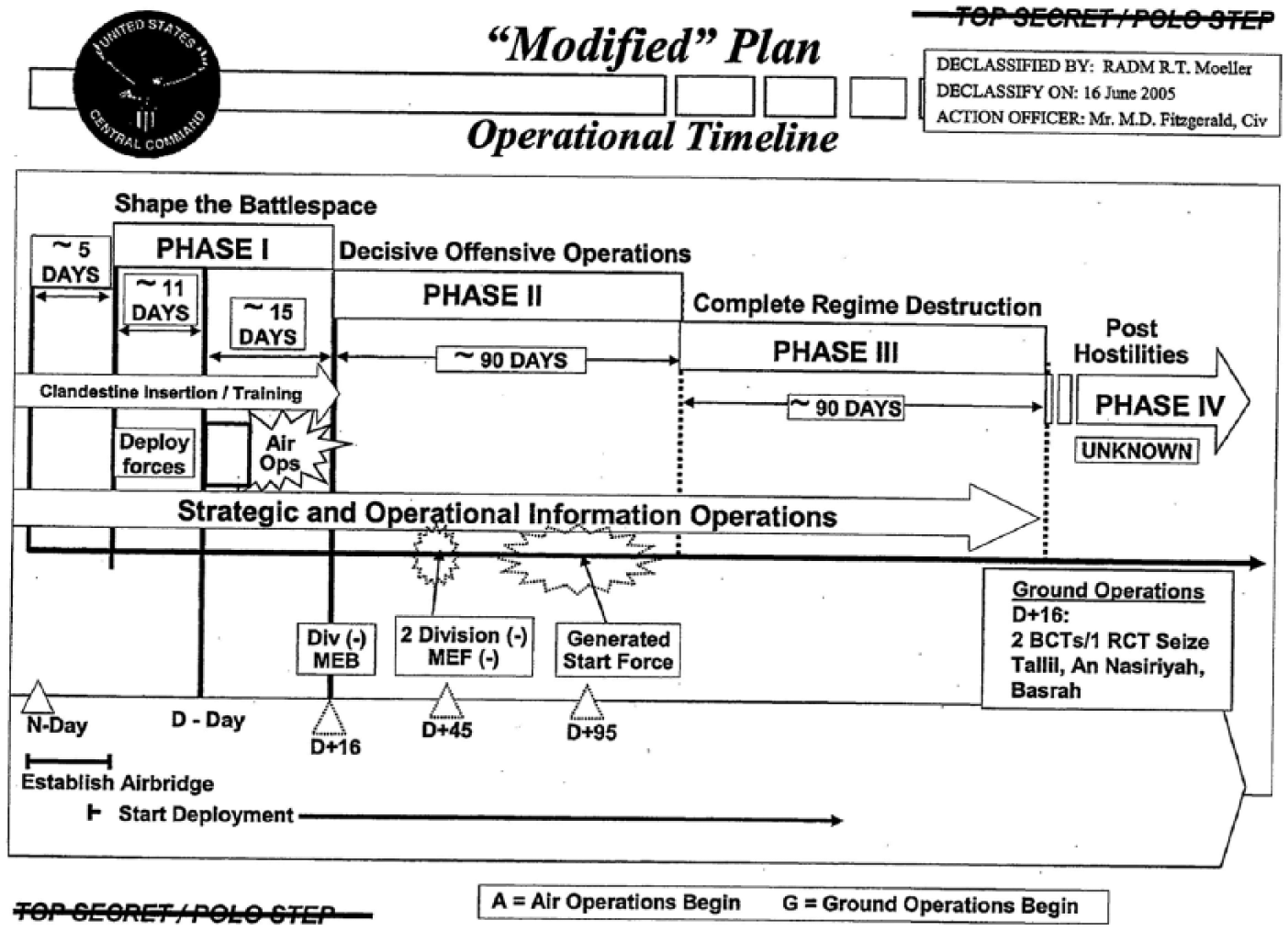
Slide 5 of the ‘Compartmented Concept’ pre-Iraq invasion briefing, August 2002.
Grand strategy seems vague and optimistic but smaller tactical details are sprinkled in: specific units ‘[s]eize Tallil, An Nasiriyah and Basrah’ by D + 16, and the ‘Generated Start Force’ joins in on D + 95. Tactical details play well with military commanders and divert attention from strategic weakness (Porch, 2013). The management language tries to recast warfighting as a procedural and everyday public service measurable in simple accountable stages (Chwastiak, 2015; Funnell and Chwastiak, 2015). Much like in Vietnam senior military leadership, while often criticizing the emptiness of managerialist ideology (Connable, 2012: 281; Ricks, 2007: 47), is equally implicated in its co-production. The conceptual space that military professionals would like to carve out for themselves as distinct from civilian management collapses. Managerialism has completed its ideological objective (Klikauer, 2013).
Command briefings in Vietnam used statistics demonstrating the progressive destruction of VC and the gradual turning of the indices towards victory. ‘Measure it and it has meaning. Measure it and it is real. […] Beating them? Most of the time we could not even find them’ (Powell, 1995: 103). Similarly in the British campaign in Afghanistan in the mid-2000s, the constant briefings we were receiving (and indeed giving) represented the war the army would have liked to have been fighting, rather than the one in which it was actually involved. […] PowerPoint presentations gave an account of development that I did not recognize from my own daily meetings inside and outside the wire with Afghan officials. There was talk of ‘inkspots’ of development, spreading (as they supposedly had in the Malaya campaign in the 1950s) from one ‘secured’ area to another within an ‘Afghan Development Zone’ that, as far as I could see, was entirely illusory – and indeed turned out to exist almost entirely in the minds of those PowerPoint briefers. (Ledwidge, 2011: 2)
Packaged as ‘best practice’, managerial discourse is in reality often ‘fictionalised’ (Gantman, 2005) and of limited practical usage (Grey and Mitev, 1995). Civilian management sets the agenda in ‘measuring progress’, and much of the military falls-in and avidly co-produces the latest ideology, in this case COIN and its own measurement dynamics. The distinction between management and professionalism increasingly blurs as military organizations also adopt managerialist ideology to normalize and justify complex, indeterminate and bloody COIN campaigns. Asymmetric wars tend to feature high degrees of civilian casualties (Greiner, 2010: 31). COIN has a long history of extra-legal activities and indiscriminate use of force (Fitzgerald, 2013), and is by its nature imperialistic and colonialist in its assumptions of nation-building (Porch, 2013: 1–2). ‘Pacification’ in Vietnam was often extremely violent and deeply influenced by body count, but this reality was shrouded behind stats-driven discourses of ‘population security’ and ‘combat effectiveness’ as necessary conditions before any efforts to ‘win hearts and minds’ (Fitzgerald, 2013: 27–30). Today’s COIN doctrine also rhetorically downplays the use of violence as it portrays military force as benign and humanitarian – soldiers and marines are re-imagined as police officers, educationalists, anthropologists, social workers, engineers, farmers or bankers: warfighters at brigade, battalion, and company level in a counterinsurgency (COIN) environment employ money as a weapons system to win the hearts and minds of the indigenous population to facilitate defeating the insurgents. (Lewis, 2012: 500)
‘COIN’ becomes ‘money as a weapons system’. Warfare is rhetorically reframed as a business and management activity. Yet COIN in practice often prioritizes violence or ‘kinetic’ operations, with exponents of ‘non-kinetic’ methods derided as ‘tea drinkers’ for wasting time in endless meetings with ‘locals’. Body counts remain an important measure of progress combined with yet more indices against which to measure ‘progress’. War managerialism continues to act as a rhetorical shield behind which military ‘killing work’ is normalized and, as the remit of COIN extends into managing and policing ‘population security’, the scientific rigour of academic disciplines such as accounting, mathematics, statistics, anthropology and economics is also pressed into service. The widespread use of private sector military, cyber-security and intelligence-gathering contractors weakens public oversight yet further (Godfrey et al., 2014; Porch, 2013: 332). 11 Far from abandoning the obsessional quantitative accounting of the Vietnam days, new technologies such as unmanned aerial vehicles enable the gathering of ever greater volumes of data on every conceivable tactical, social, economic and anthropological feature of the population being ‘secured’, creating the impression of ‘evidence-based’ operations and assessment (Arkin, 2015; Connable, 2012). The militarization and managerialization of everyday life are equally involved in the construction of an ideology portraying COIN to be ‘as ordinary as any other federal program’ (Chwastiak, 2015: 506).
Major combat operations have ended in Iraq and Afghanistan, but ongoing hostilities against Isil remain significant and controversial. This highly complex and indeterminate conflict does not feature large deployments of US regular troops. Instead, it involves a range of nations and coalitions with the US commitment largely limited to special forces, airstrikes and unmanned aerial drones. Technical systems, such as drones and electronic surveillance, continue to grow in capacity, becoming ever more data hungry and data rich, promising to transform wars into remote-controlled, individually targeted counter-terrorist operations with no possibility of defeat (Arkin, 2015). Yet, by fixating on the tactical level of execution and measurement, technology-driven COIN normalizes killing, fails to articulate strategy and promises no victory (Chamayou, 2015: 60–72). These difficult realities are shrouded by managerialist measurements of progress. Progress in such a complex scenario is difficult to measure, but with the military under pressure to show results there will always be a temptation to record and announce body count style data: ‘We have killed on average one mid-to-upper-level Isil leader every two days since May’ claimed Pentagon spokesperson Col. Steve Warren in November 2015. 12 Some reports claim that over 10,000 Isil fighters have been killed by airstrikes or home-country allied forces but, just as in Vietnam, these numbers are alleged to be gamed and inflated and in any case probably an inappropriate measure of progress. 13 Others in the military, mindful of Vietnam analogies, try not to be drawn into body count debates, and COIN progress has even been measured by the falling price of fruit in Afghan markets. 14 War managerialism is alive and well: record the information, tick the boxes, demonstrate progress, even if it is effectively meaningless (Hood, 2006).
Discussion and conclusion
The Vietnam War was a disaster for the US Army involving a ‘slow disintegration of professionalism’ (Lewis, 2012: 261) and leading to major rethinks of military doctrine and posture. Similarly, business school discourse has co-opted 1960s counter-culture to claim that McNamara and his vision of management ‘by the numbers’ is ineffective, immoral and stale, urging culture change, spontaneity and an end to micromanagement (McCann, 2015). Dodgson (2012) labels McNamara an ‘anti-hero’ in contrast to other management ‘heroes’ upon whom he has previously written, such as Josiah Wedgwood (Dodgson, 2011). Chomsky (1996) compares McNamara to Lenin in his evangelist portrayal of management as a driver of social change, asserting that ‘he does not recognize that anything wrong was done’ (p. 75). For David Halberstam he was simply ‘a fool’ (Halberstam, 1992 [1969]: 250). He is likely to remain extremely unpopular among military professionals (Lewis, 2012; Muehlbauer and Ulbrich, 2014).
Yet despite the criticism of the questionable data and techniques of McNamara and the myriad other Whiz Kids, quantitative systems analysis retains a central role in today’s New Wars. Such is the range of what qualifies as management knowledge there will always be analysts who continue to lionize these very methods. Some claim that Drucker’s ‘Management By Objective’ is ‘timeless’, asserting its moral, liberal arts essence (Maciarello and Linkletter, 2011). The indispensability of ‘Big Data’ is repeatedly declared in management, foreign policy and military circles (Cukier and Mayer-Schoenberger, 2013).
Large organizations (and the military in particular) are keen to focus on ‘lessons learnt’, but attempts to demonstrate practical improvements from the development and modernization of managerial ideas are often unpersuasive (Gantman, 2005: 145; Grey, 2009). Multiple readings of history imply the teaching of different ‘lessons’ (Fitzgerald, 2013). Rhetorical rejections of measurement, systems, rationality and the orientation towards culture, visions, values and leadership (Peters and Waterman, 1982) have been very widespread, with the first wave of such critiques being a response to the rise of Japanese competition in the 1980s (see, for example, Halberstam, 1986; Hayes and Abernathy, 1980). It is not that these authors are wrong to criticize the focus on numbers and systems that ‘lobotomized’ business (Byrne, 1993: 8) and threatened creativity, judgement, professional norms and common sense. Clearly, a narrow data-driven approach can be dysfunctional. But the real ‘value’ of managerialism lies not in the practical virtues of management knowledge when applied in the field. Military officers and liberal critics are right to note that these are often nonexistent. Rather, war managerialism has broader aims; its task is to provide ‘a numbing glossolalia of techno-speak’ (Bourke, 2006: 29) to justify and normalize the horrors and failures of war as moral and progressive, and to portray military organizations as professional, modernized and scientific organizations. This is why the techniques and artefacts of war managerialism remain so prevalent despite the discrediting of the Vietnam-era data and metrics. US performance in New Wars bears many resemblances to Vietnam-style failures, and complex and unpopular metrics-driven ‘numbers games’ still dominate the management of everyday life in the military just as in many other occupations (Lutz, 2011; Ordonez et al., 2009; Weiskopf and Willmott, 2013).
Given its ubiquity and its resistance to critique, can war managerialism really then be considered a failure? War managerialism encourages the military, the press and the public to imagine destruction and its measurement as normal, everyday and expertly managed. ‘Managerialism seeks to redirect thinking away from truth and into a specific direction that is invented by a hegemonic and powerful group’ (Klikauer, 2013: 4). It marshals everyday management language to normalize the use of war powers so that military interventions are not reflective of states of emergency but part of everyday ‘preparedness’ or ‘resilience’ (Collier and Lakoff, 2014). War has become routine. Military professionals sneer at civilian business managers like McNamara and Rumsfeld, but they too have become ‘war managers’ (Kinnard, 1977) in their adoption of managerialist ideology to influence public opinion over war and to promote the profession of arms as a scientific body of impartial, technical experts.
Management technologies such as body counts or COIN analytics do not actually drive the decisions to wage war. Rather, war managerialism is an ideology that attempts to frame and normalize it. The Vietnam disaster was not primarily a result of flawed and delusional managerial systems, but of an outgrowth of the Cold War ideological mindset and of the demands and logics of the much larger military–industrial complex (Allen, 2008; Butler, 2014 [1935]). The ways in which ‘problems’, ‘tragedies’ and ‘errors’ have been contemporarily and historically framed often preclude illuminating discussions of who is drawing ‘lessons’ and for what purposes (Fitzgerald, 2013; Herring, 2002: 356). At a conference about the Vietnam War held in Hanoi in 1995, General Vo Nguyen Giap made an instructive remark to McNamara: Lessons are important. I agree. However, you are wrong to call the war a ‘tragedy’ – to say that it came from missed opportunities. Maybe it was a tragedy for you, because yours was a war of aggression, in the neo-colonialist ‘style’, or fashion, of the day for the Americans. […] But for us the war against you was a noble sacrifice. We did not want to fight the U.S. We did not. But you gave us no choice. […] So I agree that you missed opportunities and that you need to draw lessons. But us? I think we would do nothing different, under the circumstances. (Vo Nguyen Giap, as quoted in McNamara et al., 1999: 24)
Here, we have an explanation of the war based around Vietnamese nationalism, independence, communist ideology and American ‘imperialism’. From Giap’s perspective, the fundamental explanatory factor is the US foreign policy posture, not of ‘failings’ of civilian leadership or management style. Similar accounts appear in the work of radical liberals such as Chomsky (1996), Allen (2008) and Johnson (2004) who characterize the organization of destruction as a central component of US imperialism, re-enforced by the imperatives of war profiteering and the military–industrial complex. Even in today’s so-called New Wars era, governments retain a fondness for large-scale, highly mechanized and automated, and very expensive militaries (Sechser and Saunders, 2010). A recent policy piece by McKinney et al. (2013) – one of whose authors (McMaster) is a trenchant critic of McNamara and a promoter of today’s counterinsurgency doctrine (Gentile, 2013: 20) – recently wrote of the need for the US Army to keep purchasing and maintaining tanks and armoured vehicles, even as irregular warfare among the people is becoming the norm. So much for winning hearts and minds.
In the face of these powerful contextual forces, the notion of excessive civilian micromanagement becomes a very unpersuasive explanation for the Vietnam and New Wars failings. A more radical historical reading questions whether these were even ‘failings’ at all as managerialist metrics and ‘numbers games’ remain functional to the ugly business of warmaking and the military–industrial complex that enables and encourages it (Butler, 2014 [1935]; Carroll, 2007; Chomsky, 1996; Chwastiak, 2001; Godfrey et al., 2014; Porch, 2013: 339). The US military’s struggles around organizational learning in the ‘New’ wars in Iraq and Afghanistan are extremely well known (Brigham, 2006; Connable, 2012; Fitzgerald, 2013; Frier and Rose, 2007; Gardner, 2010; Gibson, 1986: 433–459; Greentree, 2013; Kaplan, 2013; Lebovic, 2010; Nagl, 2005; Porch, 2013; Willbanks, 2010). The deep limitations of targets, numbers and their gaming (Andreas and Greenhill, 2010; Hood, 2006; Hussain, 2015; Ordonez et al., 2009), and the hubris inherent in much of management practice and education (Grey and Mitev, 1995; Locke and Spender, 2011), remain pervasive problems that suggest the ‘lessons’ of Vietnam remain very far from being ‘learnt’. Senior leadership in both the civilian and military does not want to learn them; they instead prefer to update and reboot the ideology of managerialism in order to reproduce and normalize the business of war and to promote the professionalization project of a military conversant with the latest management technologies.
Put simply, war managerialism is a general ideology of senior military leadership which asserts the righteousness and progress of warfare using the ‘scientific’ technologies of the day. War is being managed. Operations are proportionate. Tactics are humane and evidence-based. Victory is just around the corner. It closely follows the logics and practices of managerialism in any organizational setting; projecting struggle as progress and failure as success. Any concerns or dissent are irrelevant as the languages and technologies of managerialism continually establish senior leaders as the sole possessors of organizational, practical, strategic, tactical and moral credibility (Deem et al., 2007; Gantman, 2005; Klikauer, 2013). ‘All warfare is based on deception’, 15 and managerialism provides powerful forms of deceit.
Fierce debate will continue to rage around the historiography and revisionism of the Vietnam War and of US military’s recent ‘re-learning’ of counterinsurgency. But the argument presented here suggests one constant – managerialism is an inherent part of the cultures and practices of war and a central element of the military–industrial complex. Management and the military are professions with deep shared interests in the business of war. War managerialism becomes increasingly ideological and less practical over time, but its goal is less and less about offering practical systems and more and more about ideologically normalizing war and making states of emergency permanent and mundane (Chwastiak, 2015; Collier and Lakoff, 2014). It is important to note that managerialism does not always complete its ideological missions; critique is never silenced, even from within the military itself (Connable, 2012). We should not assume that senior leadership is always able to understand and successfully manipulate the (il)logics of managerialism to achieve its ends. But managerialism remains a highly pervasive ideology in organizational life despite the confusions, protestations, failures and scandals. There is potentially wide scope for further exploration of how Critical Management Studies can interact with Critical Military Studies (Basham et al., 2015). In a spirit of post-disciplinary scholarship, the two CMS’ should be encouraged to further open up the complexities of the organization and measurement of destruction and to consider why, despite its obvious practical, intellectual and moral inadequacy, managerialism continues to adapt and survive as a powerful ideological force in organizational life.
Footnotes
1.
‘Who is counting the bodies in Iraq?’ BBC News, 11 December 2009.
3.
The Gulf of Tonkin Resolution was passed by both Houses of the US Congress in response to President Johnson asking for Congressional authorization for the use of any necessary methods, including military, to defend a member of the Southeast Asia Collective Defense Treaty, in this case the Republic of Vietnam. It was a direct response to the highly controversial Gulf of Tonkin incidents, in which US Navy vessels were reportedly fired upon by North Vietnamese Navy torpedo boats. The resolution was open-ended and led to the Operation Rolling Thunder campaign of aerial bombardment of North Vietnam as well as later troop escalations. No formal declaration of war against any power was made.
4.
5.
6.
‘Leaked memo exposes Rumsfeld’s doubts about war on terror’, The Guardian, 23 October 2003.
7.
This matrix offers advice to field commanders on what to do in the event of food shortages among the civilian population being ‘secured’. We learn that if the ‘Cultural norm’ is ‘Rice’ yet the ‘Alternative proposed by COIN force’ is ‘Meat and potatoes’, then the ‘Possible consequences of unchanged perception’ are ‘Starvation; rioting’ (U.S. Army and Marine Corps, 2007: 315).
8.
‘The McChrystal Afghanistan PowerPoint slide: can you do any better?’ The Guardian, 29 April, 2010. The image also appears in the RAND Corporation publication Embracing the Fog of War (Connable, 2012: 40) and was reproduced in many British and American national newspapers with highly critical commentary. Jon Moynihan, Executive Chairman of PA Consulting Group, the London-based consultancy that provided much of the graphics on the slideshow presentation, complained in a letter to the editor of The Times claiming that his company‘s work had been misrepresented (‘In using charts to grapple with complex situations we should support dynamic thinking and avoid the over-simplistic’, The Times, 3 May, 2010). The complaint was partially justified in that the news narrative became about the supposed shortcomings of PowerPoint rather than the questionable thinking behind the representations and doctrines of COIN themselves. As of February 2017 the entire slideshow is available for viewing on the MSNBC website:
10.
This slideshow one of many Pentagon briefings on the Second Gulf War held at The National Security Archive at George Washington University. Figure 2 reproduced here is Tab L, slide 5. These materials are reproduced from www.nsarchive.org with the permission of the National Security Archive.
11.
In a repeat of the processes whereby military innovations filter out of warmaking settings and into those of the corporate and public sector, COIN has spread into the tactics of urban policing (Porch, 2013: 343) as police forces become militarized (Kraska and Kappeler, 1997).
12.
‘Quote of the day’, i Weekend, 14 November 2015.
13.
‘Team Obama’s B.S. ISIS body count’, The Daily Beast, 6 June 2015.
14.
‘Pentagon doesn’t know how many people it’s killed in the ISIS war’, The Daily Beast, 1 January 2015.