




Abstract
The study aims to discover the dynamic and processual nature of a supervisory relationship (here a leader–member exchange) through a novel, theoretical concept termed leader–member exchange breach, and by examining the characteristics of negative exchange interactions within the leader–member exchange relationship. The notion of the leader–member exchange breach is empirically defined through data on 336 responses to open-ended questions on negative interactions between leaders and subordinates, analyzed through qualitative analysis methods. The results of the study raise questions about the complexity of leader–member exchange relationships and show that breaches of the leader–member exchange relationship might lead to a reassessment of the dyadic relationship between leaders and their subordinates, spanning or even breaking the exchange relationships. This study extends current knowledge on leader–member exchange relationships by providing a viewpoint on the leader–member exchange breach that helps explain the processual and dynamic nature of those relationships through interpersonal interactions and exchanges.
Keywords
Within the complex set of relationships in organizations, leader–member exchange (LMX) relationships between leaders and their subordinates are fundamental and have been described as the foundation of leadership (Graen and Uhl-Bien, 1995). The LMX relationships are unique and range in quality from low to high. The quality and nature of LMX relationships can be assessed through exchange and communication between the parties, and the LMX relationships develop through reciprocal exchange processes (Bauer and Green, 1996; Graen and Uhl-Bien, 1995; Liden et al., 1993). The quality of these relationships is usually assessed subjectively, and a positive follower perception of the LMX relationship, that is, the perception that the follower has a high-quality relationship with the leader, has been connected to high levels of follower job performance, organizational commitment, and job satisfaction (e.g., Cogliser et al., 2009). Moreover, on a general level, high-quality LMX relationships are also linked to lower levels of turnover intention or role conflict (Gertner and Day, 1997).
Research suggests that the development and maintenance of an LMX relationship should be viewed through microlevel interaction processes between the leader and the subordinate (Hofmans et al., 2019), and that the LMX process is also altered through the interactions and exchanges between the parties (Brower et al., 2000). The social exchange process includes both tangible and intangible (i.e., communicative) exchanges and interactions between parties, usually the leader and the subordinate, including exchanges of resource distribution and feedback, and can be divided into work and personal exchanges (e.g., Sheer, 2015). Traditionally, the development of LMX, the social exchange process included, has been viewed as a linear, continuous, and smooth process progressing toward a mature state and remaining stable at the stage of development it attains (Bauer and Green, 1996; Dienesch and Liden, 1986; Liden and Graen, 1980).
However, things do not always go smoothly, and studies have queried LMX stabilization and possible changes in LMX relationships (Brower et al., 2000; Cropanzano et al., 2017; Day, 2014; Mäkela, 2009). Research indicates that the exchange relationship might change due to an exchange event within a strong emotional or instrumental context but has not yet been able to fully characterize such events (Ballinger and Rockmann, 2010). Moreover, while the roots of a positive exchange cycle have been studied, the situations triggering poor conduct and a negative exchange cycle have been studied to a notably lesser extent (Cropanzano et al., 2017). Furthermore, the research on dyadic conflict within the context of the leader–subordinate interaction remains scarce (Kacmar et al., 2012). Subordinates might, for example, hold their leaders accountable for exchange inconsistencies in the team and organizational settings, for example, being dissatisfied with the leader’s distribution of resources (Anand et al., 2015). Followers’ feelings that there are discrepancies between what the organization is obliged to provide and what they actually receive might manifest in the supervisory relationship (Henderson et al., 2008). However, although the LMX theory encompasses the quality of the exchange relationship, whether there is a perception of promised exchange remains unknown (Liden et al., 1997).
Research on LMX has been criticized for emphasizing the perspective of the leader in the LMX process (Graen and Uhl-Bien, 1995), and there have been calls for a more thorough investigation of the follower’s role in the process of leadership (e.g., Shamir, 2007). For example, the authors found only one study illustrating how leader deception influences the perception of the LMX held by subordinates and their commitment to the leader and the organization (Griffith et al., 2011). Therefore, the current study examines perceived breaches of the dyadic exchange relationship from the perspective of the follower because such breaches might have a considerable influence on the deterioration of follower commitment, job satisfaction, and ultimately can even result in the termination of the working relationship (e.g., Conway and Briner, 2005; Coyle-Shapiro, 2002).
Accordingly, this study aims to explore the dynamic and processual nature of LMX relationships by employing qualitative research methods to examine negative exchange interactions within the LMX relationship that can lead the parties to reassess the quality of the relationship. The study aims to make both theoretical and empirical contributions, and accordingly its aims are twofold: First, to make a theoretical contribution to the existing LMX literature by introducing the breach viewpoint on the relationships through the concept of the LMX breach. Second, the study offers an empirical contribution by identifying the characteristics of the incidents leading to the LMX breach in supervisory relationships. The following theoretical review presents the concept of the LMX breach in detail.
Conceptualizing LMX
Firmly, rooted in the social exchange theory and the role-making model of leadership, the LMX theory defines the unique, dyadic relationship between a leader and each of their subordinates (e.g., Graen and Uhl-Bien, 1995). The relationships are “negotiated over time through a series of exchanges, or ‘interacts’ between leader and member” (Bauer and Green, 1996: 1538). Honest and open exchanges build trust (Butler, 1991), the presence of which later indicates a high-quality LMX relationship with trust extending beyond the requirements of the formal employment contract (Dienesch and Liden, 1986). It has been said that the subordinate’s trust in the leader positively predicts that subordinate’s experience of the quality of the LMX (e.g., Sue-Chan et al., 2012), and breaches of trust alter the LMX relationship, making the relationship dynamic rather than static (Brower et al., 2000).
High-quality LMX relationships are characterized by mutual trust, obligation, and respect (Graen and Uhl-Bien, 1995), leading to multiple positive individual- and organizational-level outcomes (Gertner and Day, 1997). The expectations of the parties have been linked not only to the development process of the LMX (Liden et al., 1993; Wayne et al., 1997) but also to predict the quality of the mature relationships (Wayne et al., 1997), as unmet expectations are linked to lower-quality exchange relationships (Maslyn and Uhl-Bien, 2001). Moreover, it is suggested that the occurrence of affective events can cause the relationships to fluctuate in quality in each of their development stages (Cropanzano et al., 2017).
The nature of exchange within the LMX relationship both defines the quality of the relationship and simultaneously develops it (Sheer, 2015). However, the exchange process is sometimes perceived as a continuum (e.g., Bauer and Green, 1996), although possible fluctuations should be acknowledged. An important viewpoint on the LMX relationship concerns the multidimensionality of the relationships (Liden and Maslyn, 1998), portraying the characteristics and nature of the relationships between the parties (Dienesch and Liden, 1986; Liden and Maslyn, 1998). Moreover, the dimensions of LMX can be seen as currencies of exchange (Dienesch and Liden, 1986; Sheer, 2015).
The dimensions consist of features related to the relationship on both the personal and professional sides of the LMX (Dienesch and Liden, 1986; Liden and Maslyn, 1998). The dimensions recognized are affect, which manifests as a liking for someone and sits on the interpersonal side of the relationship; loyalty, which signals a faithful attitude to another person that is unaffected by situational factors; contribution relates to the exchange in the work context and comprises the resources the supervisor provides beyond those required by any formal agreement; and professional respect for the other party sits on the work-related side and is built on both subjective experiences and the perceptions of others (Liden and Maslyn, 1998: 50). The dimensions of affect, loyalty, and professional respect are viewed as social currencies of exchange and contribution as a work-related currency (Maslyn and Uhl-Bien, 2001). These dimensions can signal the quality of the LMX because they are often strongly present in high-quality relationships, as lower-quality relationships are usually based on contractual exchange and low-level personal contributions and commitment (for a review see, Gertner and Day, 1997). In the following section, the exchange process within the LMX relationship is examined in more detail.
Leader–member exchange processes
The dynamics of supervisory relationships can be described through a social exchange process (Cropanzano et al., 2017). Following the rationale underpinning the social exchange theory (Blau, 1964), an exchange process can be defined by the presence of reciprocal transactions, in which, “an action by one party leads to a response by another” (Cropanzano and Mitchell, 2005: 876). The social exchange process begins with one party, either leader or subordinate, treating the other party in a way that triggers a reciprocal cycle of exchanges (Cropanzano et al., 2017; Eisenberger et al., 2004). This pivotal exchange has been described as initiating action that leads to either a positive or a negative exchange cycle. On the negative side, for example, abusive behavior, incivility, and bullying by the leader are perceived as negative initiating actions (Cropanzano et al., 2017). Moreover, there might be anchoring events that change the course of the exchange relationship (Ballinger and Rockmann, 2010).
Exchanges can be based on tangible or intangible elements (specifically communicative types), divided into work and social exchanges (Sheer, 2015). The notion of LMX is firmly linked to tangible exchanges through organizational resources (Erdogan and Liden, 2002), such as salary progress and tasks (Wilson et al., 2010). The leader can often unlock goods, such as monetary benefits and career advancement opportunities (Wilson et al., 2010); however, there might be situations in which the process of tangible exchanges between the dyadic partners is compromised. An example would be if subordinates feel their expectations of rewards have not been met by their employer, leading them to feel they have been unjustly treated (Hollander, 1978). It has been noted that perceived justice and equity (Henderson et al., 2008; Hooper and Martin, 2008) are essential for successful exchange relationships. The notion of LMX differentiation (Henderson et al., 2009; Liden et al., 2006) suggests that leaders develop relationships varying in quality and level of exchange with each of their subordinates. Such variance can lead subordinates to perceive an injustice if they view the leader to be distributing resources inequitably. The process of LMX differentiation has been shown to influence follower outcomes on dyadic levels (Henderson et al., 2008) and increase relational conflict in teams (Hooper and Martin, 2008).
Moreover, there are also many intangible—that is, communicative—exchanges between a leader and follower. In general, leadership can be seen as being built on communication (Fairhurst and Connaughton, 2014), which can be divided into work communication exchanges and social communication exchanges (Sheer, 2015: 222–223). Intangible exchanges are often related to feedback, or work-related information that is distributed between the parties, in addition to development opportunities and mentoring provided by the leader (Wilson et al., 2010). Such intangible exchanges can revolve around aspects like flexibility, attention, and influence (Graen and Scandura, 1987); as when a leader provides affiliation resources, such as encouraging words or sympathy and the subordinate offers their commitment and loyalty in return (Wilson et al., 2010). Accordingly, a supervisor being perceived by subordinates to be incompetent or lacking in empathy has been identified as one of the most influential factors in situations where trust has been destroyed in leader–follower relationships (Grover et al., 2014).
It is important to note that interaction and the communication of the leader per se can be destructive (Fairhurst and Connaughton, 2014) and lead to a negative exchange outcome. That negative outcome within the social exchange process might, for example, be triggered by unacceptable behavior by a leader, such as bullying or unprofessional conduct (Cropanzano et al., 2017), which would also encompass a situation where a leader takes credit for actions performed by a subordinate (Sparrowe and Liden, 1997). Furthermore, deception on the part of a leader will also negatively influence subordinates’ perception of the LMX, and thus, their commitment to the leader and the organization, leading to a deterioration of trust, subsequently weaken the quality of the LMX relationship in the eyes of the subordinate (Griffith et al., 2011). Therefore, through unmet expectations (Ballinger and Rockmann, 2010) or destructive communication practices (Fairhurst and Connaughton, 2014), a negative exchange cycle could be initiated.
Spanning the relationships within the leader–subordinate dyad: LMX Breach
The beliefs and expectations of the subordinate regarding the relationship influence the impact of the actions of the leader and of incidents arising in supervisory relationships (Game, 2008). The very earliest notions about the social exchanges in organizations suggested that the relationship is firmly based on each member’s expectations of the actions of the other (Hollander, 1978: 73). The expectations within the social exchange relationship might be related to communication and interaction, perceptions of justice, or the conduct of the leader (Grover et al., 2014; Lee, 1999; Son et al., 2014).
The expectations of the parties, and whether those expectations were fulfilled, manifest in the parties’ everyday interaction, which affects the way they perceive the quality of the relationships (Uhl-Bien et al., 2000). For example, subordinates—and especially those who perceive their LMX relationship to be a high-quality one—might expect substantial support from their leader in certain situations (Lester et al., 2002). However, if the leader fails to meet their subordinate’s expectations of them, the leader–follower relationship might suffer from a loss of trust (Grover et al., 2014; Restubog and Bordia, 2006).
Moreover, research indicates that the behavior and actions of the immediate manager can trigger several different emotional responses and reactions among subordinates (Andiappan and Treviño, 2011): Employees often harbor a sense of injustice when they witness actions they consider unfair on the part of a manager, and those negative feelings can have severe consequences that might stretch to irremediable loss of trust and withdrawal from the relationship (Griffith et al., 2011; Grover et al., 2014).
To conclude, LMX relationships are processual and developed through reciprocal exchange and interaction cycles based on tangible and communicative elements (Brower et al., 2000; Sheer, 2015). Moreover, expectations guide the perceptions of the leader and the dyadic relationship with the subordinates. However, there might be negative incidents and events interrupting the exchange (Ballinger and Rockmann, 2010; Cropanzano et al., 2017) that is fundamental to the relationship and those incidents compromise the trust and respect between a leader and subordinate, which will weaken the LMX in the perception of the follower. Moreover, the expectations relating to the exchange and other aspects of the LMX relationship might be unfulfilled. Therefore, based on the literature review above, the current research introduces the concept of the LMX breach based on the literature review above. An LMX breach occurs when a party to the LMX relationship perceives an expectation or promise concerning the conduct of the other party or the content of the expected exchange agreement to be unmet. An LMX breach is defined here as being realized through events and interactions taking place between a leader and subordinate leading to a cognitive sensemaking process through which the parties to the LMX relationship reassess the strength of the relationship with the other party. Below, we empirically examine the process involved in an LMX breach.
Method
The data supporting this study consist of the individual accounts of 386 informants collected by eliciting responses to open questions, distributed over the period 2011–2013 as a part of a larger survey study involving five Finnish organizations. Those organizations operate in the public and private sectors, and in the fields of logistics services, and early childhood education services, and there are also two specialist organizations operating in the insurance and pension sectors.
This analysis uses data extracted from a large-scale questionnaire focused on themes such as work well-being, leadership, and work performance. The open-ended question that is the foundation of this study was included in the part of the questionnaire investigating subordinates’ thoughts on their leader and their supervisory relationships, with questions based on the University of Vaasa LMX scale (Tanskanen et al., 2019), followed by questions related to trust losses in LMX relationships arising from critical, negative incidents occurring in the interaction between a leader and follower. The exact question was “Have you, at some point during your career (a) lost trust in your supervisory relationship, (b) fallen out with the supervisor permanently, and/or (c) sought to exit the supervisory relationship for reasons related to the supervisor?”
Having answered the question, the informants were asked to recall and describe such events. The leader in question was defined as the subordinate’s immediate manager at some point during their career. The respondents were advised there was no limit to the length of their answers. The open questions employed ensured the incidents related by the informants in their own words (Jackson and Trochim, 2002) could be captured.
Using open questions affords the informants greater anonymity and encourages honest answers on a delicate subject (Erickson and Kaplan, 2000; Jackson and Trochim, 2002). Moreover, the method provided researchers with a relatively large amount of qualitative data on individual incidents. Most responses varied from a few words to several sentences and some informants provided even longer accounts. Those answers that were shorter than one sentence or did not answer the question were eliminated, leaving a total sample of 336 responses that were narrative in nature, describing perceived breaches of an LMX in the informants’ own words.
Analyses
This study adopts qualitative content analysis and thematic analysis methods, and in addition to connection to the existing literature on LMX relationships, new theoretical avenues were constructed based on qualitative data analysis. The aim of the analysis was to provide a rich description of the dataset and the characteristics of the LMX breaches, providing information about predominant themes emerging from the data (see Braun and Clarke, 2006). Content analysis was used during the initial analysis to code the data and thematic analysis to analyze and theme the codes that emerged. The data were analyzed in a theory-driven manner, and the characteristics and nature of the incidents were elicited in relation to the dimensions of the LMX.
The first phase of the analysis process involved the researcher becoming familiar with the data through a careful reading of the responses elicited, note taking, and comparing those data to identify differences and similarities (Elo and Kyngäs, 2008; Braun and Clarke, 2006). During the open coding process, the emphasis was on identifying interesting features of the data and marking parts that indicated a potential category. Each reported incident was a unit and it coded once only. The text was constantly compared to determine whether its learning would fall into an existing category or was best assigned to a new category. Those categories illustrated behavioral examples of the incidents, with connections to the dimensions of the LMX, such as “disrespectful comments about the subordinate’s personal characteristics” (revealing affect) or “giving a promised task to a friend” (revealing loyalty). Therefore, the research interest lay in identifying the features of the incidents in relation to the dimensions of the LMX.
The next step of the analysis was to distill the content of categories that were connected or overlapping into potential themes with conceptual similarities. As a result, eight potential themes including, for example, bullying, favoritism, and lack of support and information were developed. These themes were distinct yet were broad enough to summarize the ideas comprised within the text segments (Attride-Stirling, 2001: 392). Next, three main theoretical themes were formed from these potential themes, in which the patterns identified were reflected against the literature-based analysis of the LMX breach to portray the types of the LMX breach experienced by the specific informants. At this stage, the extracts supporting each theme were read carefully once more and found to confirm the coherence of the themes (Braun and Clarke, 2006). Moreover, the incidents of each theme were calculated to provide knowledge on their frequency and the extent of the themes
Findings
Themes, definitions, and sample excerpts.
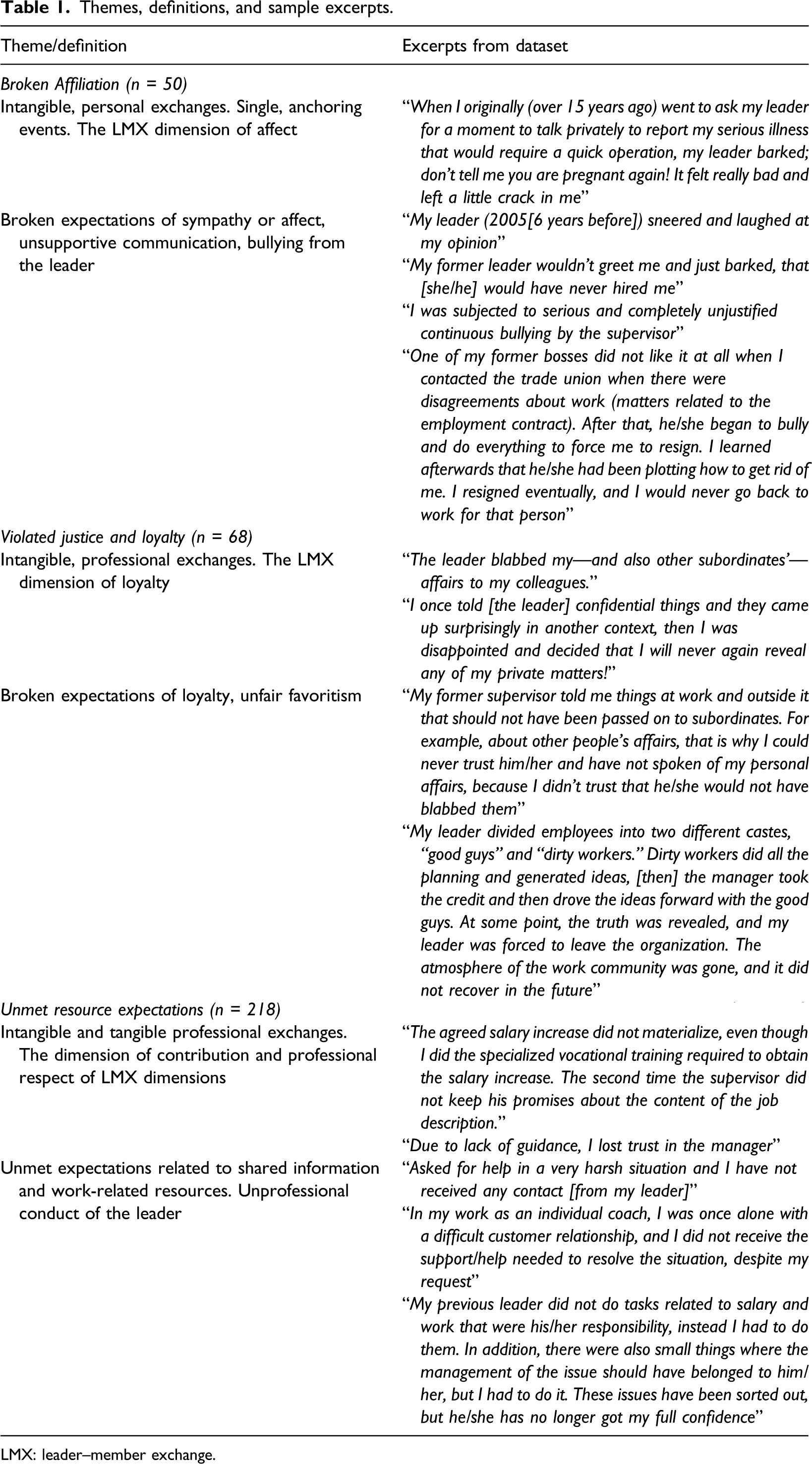
LMX: leader–member exchange.
Broken affiliation
Within the first theme, the incidents flow from the dyadic relationship and interaction between the subordinate and their leader being emotionally charged, and those incidents violate the feelings of affect and the expected respect and empathy, from the other party. The subordinate’s expectation of a leader responding with empathy to their concerns was established by (Wilson et al., 2010). The events that trigger the expectation might be single events, which happened years ago, but the importance to the subordinate is indisputable and resulted in the employee feeling there had been a breach in their supervisory relationship. That breach was sometimes of such severity that it affected the emotional state of the subordinate.
These incidents touched upon the dimension of affect in the LMX relationship, embodying mutual liking and affect between the parties to leader–follower dyads, and representing the possibility of that affect being undermined in an LMX breach. Moreover, the exchange could be seen as communicative and highly personal, such as when there was an expectation of empathy or respect in a certain exchange situation, or an expectation that a greeting is reciprocated in everyday interaction. It seems that these interactions served as anchoring events for future interactions and should be viewed as exchange occurrences with strong emotional or instrumental charge (Ballinger and Rockmann, 2010).
The incidents often occurred as a part of the everyday communication and interaction of the parties and in ordinary workplace exchange situations. Those interactions included negative comments or terse responses from the leader that the subordinates felt were meaningful and hurtful, as demonstrated by the subordinates being able to recall them sufficiently years afterward to describe their feelings and the specific actions of the leader or the tone used. These incidents are related to the personality and character of the parties and the actions of the parties directed at each other. In an employment relationship, the parties are usually expected to behave professionally and respectfully toward each other and responding to an exchange situation in a certain way, and therefore, the actions of the leader might be perceived as demonstrating a failure to fulfill an obligation in the eyes of the subordinate. Although many of the incidents within this theme could be considered rather minor, there were accounts of some more severe experiences gathered. Some subordinates felt the behavior on the part of the leader was hurtful and intended to diminish them, and the subordinates concerned felt the criticism they received targeted their personal characteristics.
The reported incidents eroded the subordinates’ trust in the leader and continued to influence the feelings and perceptions of the subordinate for some considerable time afterward. In some cases, the subordinate had experienced negative behavior from the leader that they considered to constitute bullying, which has been identified as a serious issue with the potential to trigger a negative exchange (Cropanzano et al., 2017). It seems that in some of the incidents the relationship did not recover from the perceived breach and sometimes triggered the termination of the working relationship.
Interestingly, it seems that in some cases, the incidents between subordinate and leader prompt behavioral and affective changes on the part of the leader. There were incidents after which the leader seemed to withdraw from the affective exchange relationship and altered the behavior and attitude toward the subordinate. The leader might have assumed the relationship would include more developed personal exchanges with the subordinate including some outside of the working environment, and when that assumption was not met, withdrew from the exchange at work. These behavioral changes of the leader undermined the subordinate’s trust and led the subordinate to perceive a breach of the LMX relationship.
To conclude, within this theme, the relationship between subordinate and leader suffered from an LMX breach triggered by affective incidents. In some cases, the incident might have been so personal for the subordinate that the leader would not even recognize the situation. Therefore, the experience of the breach was often highly individual—covering only the person telling the story. Therefore, the incident must be examined through the subjectivity lens and be acknowledged as potentially serious to the complainant.
Violated justice and loyalty
Within this theme, many incidents link to the larger social context in which the dyad is embedded such as the team. For example, the dyad might face conflicts with multiple actors interfering in the exchange and interaction processes of the dyadic parties. The trustworthiness of the leader can be assessed through the LMX dimension loyalty. The exchanges within this theme were also to a great extent, communicative, but related to the professional side of the relationship. One of the most regular incidents within this category was betrayed confidentiality, in which the leader had divulged a private or confidential matter to someone external to the dyad. There might have been a real promise made of confidentiality or an expectation of it due to the nature of the information shared and the leader’s role.
In a dyadic relationship, there are multiple exchange processes related to the loyalty dimension of LMX: For example, subordinates are often willing and might even be obliged to discuss personal issues with their leaders, expecting loyalty in return. The willingness probably occurs because the subordinate views the leader as trustworthy, and an obligation can arise, for example, if the organization requires an employee to give personal details relating to their health to claim sick leave. However, the respondents cited instances of trust being broken, such as when the leader discussed private matters with someone unconnected with the issue. An important viewpoint was the presence of multiple parties, and in some cases, the realization of the incident through third parties.
Moreover, a person outside the dyad could be seen as a passive or active party to the perceived breach; a passive actor would be a colleague to whom the leader related a matter considered private by the subordinate perceiving the breach. An active actor would be a colleague who, for example, participated in the bullying of the aggrieved subordinate at work alongside the leader. Interestingly, some subordinates reporting an incident were bystanders and perceived a breach in their dyad, although the experience did not directly affect them. Such situations complicate the wider relationships within the work team and organization and also influence subordinates’ perceptions of their relationship quality.
Within this theme were also instances related to favoritism applied to certain subordinates, evoking strong feelings of injustice among the subordinates who were witness to it. When subordinates experienced incidents of favoritism, it provoked strong feelings of inequity and made those subordinates reassess their standing in the group. It became clear that equality between subordinates is something subordinates expect, and in some cases, the perception of inequality between subordinates even led to a termination of the relationship. Moreover, unfair treatment led to behavioral changes between the parties; for example, some respondents described communication and exchange subsequently being limited.
In conclusion, loyalty is an important element within the dyadic relationship, and there is often a strong expectation of loyalty from the leader in return prompted by sharing private information. In addition, discussions among the work group contrasting justice and equity can often cause subordinates to reassess their own standing and the quality of their exchange relationship, and in such circumstances, the feeling that here has been an LMX breach is triggered by the actions of third parties.
Unmet resource expectations
In addition to the affective side of the LMX relationship and the elements related to the loyalty dimension, work-related resources controlled by the leader (e.g., career progression and shared information) including the leader’s conduct and support are important to LMX relationships through tangible and intangible work-related exchanges. These interactions are related to the contribution dimension of the LMX and also that of professional respect. This theme encapsulating two LMX dimensions was the dominant one revealed by the survey.
The first expectation of subordinates relates to resources concerning their career and work role and the associated resources, for example, salary rises, a challenging task load, or a promotion path. When subordinates have career-related expectations, certain actions taken by a leader can be perceived as undermining those expectations; in other words, a discrepancy develops between expectations and reality. Although some of the decisions related to the career of the subordinate are made at a higher level of the organization, the immediate supervisor is strongly perceived as the agent of the organization responsible for the decisions made on the career and work of the subordinate. If their expectations are not met, subordinates’ can perceive the exchange agreement to be breached and their trust in the leader to be unwarranted.
It is important to note that the references to resource expectations usually featured an element of reciprocity. The respondents often felt that their perception that a contract had been breached arose from a situation in which the subordinate fulfilled their side of the reciprocal resource exchange by improving their performance or by undertaking training, and therefore expected more extensive resources (such as new tasks or an improved salary) from the leader in return. In an organization, the leader is expected to do many things, including nurturing subordinates’ careers or ensuring they receive appropriate remuneration as they progress within the firm. However, subordinates also expect leaders to take care of more routine organizational tasks, and some respondents reported failings on the part of the leader related to these routine issues.
In addition to the expectations around resources related to the career and tasks of the subordinate, the subordinates expected other intangible resources to be provided by the leader, for example, work-related support and information. The leader might not give enough support or feedback to their subordinates and that omission compromises the trust the subordinate feels in their dyadic relationship. One feeling expressed was that of frustration: The subordinates felt frustrated when the leader acted in ways contrary to those they expected, and they wrote of feelings such as powerlessness, desperation, and disappointment. It seems that the subordinates were expecting to engage in an exchange cycle related to intangible elements that would lead to a more extensive exchange of resources such as the provision of professional information and mentoring. The subordinates might have initiated the exchange of information but felt they were not getting anything in return. Moreover, due to the role of the leader, the subordinates often expected support from the leader in various situations, for example, in complicated customer interactions or defending the subordinate’s actions in problematic situations.
In addition to the expectation concerning the work-related resources, or support and information from the leader, perceived leadership is also something the subordinates have expectations of. One viewpoint on the LMX relationship between the parties is the professional respect of the subordinate for the leader: Professional respect relates to the work dimension and includes respect for the leader and the assessment of the leader’s actions, built on the subjective assessment of the subordinate (Liden and Maslyn, 1998). The respondents criticized leaders for (on occasion) being unprofessional, lacking strong leadership, demonstrating deficient leadership, and misusing their managerial position for personal benefit. In other words, the incidents diminished the professional respect for the leader. To a great extent, the incidents cited were tied to the behavior and conduct of the leader, and to some extent to the job tasks or work itself. It is important to note that the dimension of professional respect is to some extent based on personal reputation and subjective perception and not founded on exchange episodes as the other dimensions of LMX are (Sin et al., 2009). Moreover, these incidents are largely related to an overall atmosphere in the organization due to the leaders’ actions or way of working. It seems that also within this theme were some behavioral or emotional changes, and some felt that they could no longer work under their supervisor.
To conclude, in a dyadic relationship, the subordinate has expectations of the behavior of the leader and also of the tangible and intangible resources the leader should provide them. When leaders act unprofessionally and do not discharge their obligations as their subordinates perceive they should, the subordinate can be disappointed that their expectations are not being met. The leader might not give enough support or feedback to the subordinate and that influences the trust the subordinate has in the dyadic relationship.
Discussion and conclusions
The aim of this study was to examine the dynamic and processual nature of LMX relationships, through negatively charged exchanges and interactions. The study aimed to present a theoretical contribution to the existing LMX literature by introducing a novel concept of the LMX breach. Moreover, the study offered an empirical contribution by illuminating the descriptions and representations of the negative incidents and interactions leading to the LMX breach in supervisory relationships.
Notions on the development of the social exchange relationship (e.g., Bauer and Green, 1996) suggest, in line with this study, that the relationship between the leader and their subordinate is an ongoing process, assessed through events (Ballinger and Rockmann, 2010), occurring in the microlevel interaction processes between the parties, where they assess the quality and expectations of the exchange (Brower et al., 2000; Hofmans et al., 2019). It should be noted that expectations of exchange or conduct, and not having those expectations met, lead to the perception that exchange expectations have been violated (Game, 2008). The results presented above also indicate that negative interactions can prevent a relationship from developing into one of high quality (Cropanzano et al., 2017) and also diminish the perceived quality of the exchange relationship (Ballinger and Rockmann, 2010; Cropanzano et al., 2017).
Therefore, this study suggests that the LMX breach can be defined through negative incidents and interaction occurring in LMX relationships that compel subordinates to reassess the quality of their relationship with their leader, as well as their willingness to engage in further exchanges with that leader. That situation also illuminates the dynamic and processual nature of LMX relationships and the possible deterioration of the relationship quality. As stated earlier, the dynamic view of LMX relationships is noteworthy (Gertner and Day, 1997), as is their processual nature (Day, 2014; Day and Miscenko, 2015; Van Breukelen et al., 2006).
Based on the data and the theoretical underpinnings of social exchange theory, an LMX breach can develop through two exchange-related processes. First, there might be negatively charged initiative or anchoring exchange actions, through which the relationship might take a turn for the worse. The results of this study support the finding that even a single, negative event affecting the parties can lead occurrences within social exchanges to deteriorate in quality (Ballinger and Rockmann, 2010; Parzefall and Coyle-Shapiro, 2011). The data presented above might suggest that negative, personal interactions in particular could be especially harmful and might also affect the person experiencing the hurtful incident for a long time. Although the duration of the LMX relationships in this data could not be defined, it might be assumed that these incidents can happen at any stage of the relationship (Cropanzano et al., 2017). Second, it seems that the process could be influenced by a lack of positive exchange actions. That could be the situation if, for example, the subordinate felt their relationship with their leader lacked certain positive exchanges or interactions with the leader such as necessary information or support. The absence of positive exchange actions is likely to lead subordinates to reassess the exchange quality in the relationship with the leaders. In addition, there are indications that certain LMX breaches escalate over time, particularly those triggered by issues with professional respect.
Interestingly, when dissecting the frequency of the perceived breaches, the theme related to resources and professional respect was predominant among those revealed by the survey responses. This finding implies that the role of the leader is strongly related to providing resources, such as support, information, and access to desired tasks. Breaches of the relationship related to these areas had an impact on the trust in the leader. The finding also indicates that having a strong LMX relationship could have a pivotal role as a resource, as realized through work-related exchanges, including shared information and support (Erdogan and Liden, 2002) and also career advancement and development opportunities (e.g., Han, 2010). However, these results bring into question the personal side of LMX relationships and emotions within those relationships. Although the breaches relating to more personal aspects of the relationship were less frequent, in some cases, the emotional response was strong. It could be that the more personal incidents were more severe in nature and therefore less frequent. This assumption is supported by a previous study, which found the interpersonal and abusive violations of trust were seen as more severe than those related to supervisor incompetence, for example (Grover et al., 2014).
Research suggests unmet expectations are linked to lower-quality LMX relationships (Maslyn and Uhl-Bien, 2001), and the results of the current research advance that finding in that they show unmet expectations could also be linked to deteriorating relationship quality and one or both parties withdrawing from the exchange relationship. This finding would seem to run counter to those relating to the more often studied exchange cycles within an LMX, in which the relationship is strengthened through exchange processes (Bauer and Green, 1996; Graen and Uhl-Bien, 1995). As noted earlier, the rationale behind negative exchange cycles certainly merits further study (e.g., Ballinger and Rockmann, 2010).
Furthermore, the respondents written responses made it clear that especially in work-related events, the influence of a social network within the organization and the effect of other actors on the experience of the LMX breaches were fundamental. The results showed that the LMX dyads were a part of a broader social network, with multiple actors influencing the experience of an LMX breach; a finding in line with recent studies of LMX relationships in organizations (Graen and Uhl-Bien, 1995; Regts et al., 2018; Sparrowe and Emery, 2015). Trust is important to a working relationship (e.g., Grover et al., 2014), as is perceived justice and equity (Henderson et al., 2008; Hooper and Martin, 2008), and the results of this study indicate that subordinates assess the trustworthiness and perceived commitment to justice of the leader by reflecting events taking place within other dyads.
Moreover, the relationships subordinates have with others, for example, in a work group or team, and the strength of those relationships influence their experience of an LMX breach. This viewpoint incorporating multiple relationships between different actors influencing each other is supported by previous studies (e.g., Sparrowe and Emery, 2015). Moreover, the findings of this study support the earlier notion of the role of social comparison (Henderson et al., 2009; Hooper and Martin, 2008) in relation to a person’s perception of the quality of their LMX relationship. The results of this study indicate that by reflecting the nature of their exchange with the leader compared to others, subordinates also construct the perception of their own relationship with the leader and its quality. This reflects the notion that in the course of their daily interactions within the work group, subordinates contrast their own LMX relationship and their standing in the work group (Hu and Liden, 2013). Moreover, the data expose a set of incidents taking place within dyads, as well as in a broader context, such as at the team and organization level, linking the incidents on a dyadic level to, for example, the psychological contracts of the subordinates.
To conclude, the findings of this study make valuable theoretical and empirical contributions to challenge the static view of LMX relationships and introduce a novel theoretical concept of the LMX breach. Through several events illuminated by the data, the subordinates assess the strength of their relationship with the leader, and whether the expectations concerning the conduct of the leader or content of the exchange are being met. The breaches of LMX were linked to the dimensions of the LMX and had an impact on how the subordinates perceived the relationship on both personal and professional levels and were also related to both tangible and intangible resources.
Limitations of the study and implications for practice and future research
One obvious limitation of the study stems from the nature of the data. Although the dataset produced many answers, most of which were interesting and rich, the answers were generally rather short, and in the future, the phenomenon should perhaps be explored through interview data. In addition to the qualitative research methods, the phenomenon should be examined quantitatively and especially longitudinally so that the antecedents and outcomes of the phenomena could be identified more specifically. However, the current research does include some longitudinal information, as the perceptions of the subordinates were partly based on their recollections of past events, and in addition, some of them described a change in atmosphere or behavior after the incidents. Nonetheless, more longitudinal data would have offered stronger findings on the actual change in quality of the relationships in question. Additionally, the viewpoint of the leader would have been interesting, as the data now offer a limited and subjective view of the incidents. However, as stated above, the subjectivity of the incidents must be acknowledged and accepted.
The findings of this study offer interesting future research avenues and implications for practice. This study should prompt a discussion on the dynamic and processual nature of the LMX through its examination of conflicts on multiple levels and the dimensions of the relationship. In line with the recent suggestions for further research on the LMX (Day, 2014; Day and Miscenko, 2015), the results of this study suggest that the dynamic and processual nature of the LMX should be studied further. Moreover, future research might consider the variable forms of the negative incidents taking place between the dyadic partners in small, everyday interactions, but in addition also in the organizational context with multiple actors involved in the process. Furthermore, future studies should delve into the dyadic nature of the breaches and investigate the supervisory side of those negative interactions and exchanges.
In addition to the theoretical implications, practical suggestions can also be proposed. Although the fundamental, and in some cases challenging, role of the leader became apparent, the role of the subordinate in the process of leadership must be acknowledged. Therefore, it is most important for organizations to develop practices to help both leaders and subordinates deal with situations where a negative incident occurs in a dyadic relationship. However, from the viewpoint of the leader, as the results of this study indicate, recognizing those incidents might be challenging, or perhaps not even possible. The main emphasis should be on helping leaders in dyads to improve their relationships with their subordinates, especially the interaction and communication patterns fostering an open and free exchange culture. Additionally, neutral channels for open feedback should be offered to permit subordinates to freely express their concerns and perceived breaches of the LMX and to foster the development of procedures to address such situations. Moreover, organizations should strive harder to recognize the important role of the leader in overall organizational settings, where the leader acts as an individual actor but in addition, as a representative of the organization.
Footnotes
Declaration of Conflicting Interests
The author declared no potential conflicts of interest with respect to the research, authorship, and/or publication of this article.
Funding
The author received no financial support for the research, authorship, and/or publication of this article.
