



Abstract
Objective
African Americans are more likely to develop end-stage kidney disease (ESKD) than whites and face multiple inequities regarding ESKD treatment, renal replacement therapy (RRT), and overall care. This study focused on determining gaps in participants’ knowledge of their chronic kidney disease and barriers to RRT selection in an effort to identify how we can improve health care interventions and health outcomes among this population.
Methods
African American participants undergoing hemodialysis were recruited from an ongoing research study of hospitalized patients at an urban Midwest academic medical center. Thirty-three patients were interviewed, and the transcribed interviews were entered into a software program. The qualitative data were coded using template analysis to analyze text and determine key themes. Medical records were used to obtain demographic and additional medical information.
Results
Three major themes emerged from the analysis: patients have limited information on ESKD causes and treatments, patients did not feel they played an active role in selecting their initial dialysis unit, and interpersonal interactions with the dialysis staff play a large role in overall unit satisfaction.
Discussion
Although more research is needed, this study provides information and suggestions to improve future interventions and care quality, specifically for this population.
Keywords
Introduction
Chronic kidney disease (CKD) affects more than 14% of the US adult population.1,2 CKD is defined as the gradual decrease in kidney function, resulting in loss of the kidneys’ ability to handle fluid and waste.1–3 End-stage kidney disease (ESKD), the most severe form of kidney disease, is associated with increased morbidity, mortality, and health care use.1–3 Patients with ESKD have an increased number physician visits, hospitalizations, and medications and require kidney replacement therapy (KRT) such as hemodialysis, peritoneal dialysis, or kidney transplant. 2 In United States, the rate of ESKD is higher for African-American, Hispanic, and Native Americans compared to Whites, despite these groups having a similar prevalence of early-stage CKD.1,2
African Americans represent only 13.4% of the US population; however, they account for 35% of adults with kidney failure and are 3.5 times more likely to develop ESKD than their White counterparts.1,2 African American with ESKD have decreased access to kidney transplantation, the best form of KRT. African Americans with ESKD also receive less information about KRT modalities and have less access to high-quality ESKD care compared to Whites.1,2,4–7 For example, African Americans are less likely to be referred for transplant and to receive a preemptive transplant.4–8 In addition, African Americans with ESKD are more likely to have in-center hemodialysis (IHD) than home KRT modalities compared to their White counterparts.1,9 A recent study found that 72% of Black ESKD patients (vs. 57% of White patients) received IHD.1,4,9,10 African Americans are also less likely than Whites to receive dialysis at a high-quality dialysis facility despite greater proximity to these facilities. 10 Thus, African Americans have reduced access to high-quality ESKD treatments across KRT modalities.
These inequities are well-documented; however, there is a gap in the research on the process of how ESKD patients, particularly African American patients, make their initial or subsequent dialysis facility choice. Selection of lower-quality units could be due to higher quality facilities lower acceptance of patients with high social risk or differential referral patterns based on insurance, care network, or provider bias.8,10 It could also be due, in part, to patient self-selection based on location or peer recommendation.8,10
Patient education about all KRT treatment options and choice of facilities is a possible intervention that may improve African Americans’ access to high-quality KRT.11,12 Multiple studies suggest that ESKD education can increase informed decision-making by patients about ESKD self-care behaviors, treatment modality, and site of care.11–14 Patients with kidney disease often have missed opportunities to receive KRT education both prior to and after ESKD.8,14–17 Thus, we sought to better understand patients’ knowledge about their ESKD and to discover how they selected their KRT modality and site of care. Through structured interviews with urban African American patients in a hospital setting, we sought to identify gaps in participants’ knowledge of their CKD course and barriers to KRT selection in an effort to identify how we can improve health care interventions and health outcomes among this population.
Methods
The study is reported according to the Consolidated criteria for Reporting Qualitative health research (See Appendix Table 1). 18
Participant recruitment
General medicine inpatients were approached for written consent for the Hospitalist Project, an ongoing research study of hospitalized patients at an urban, Midwest academic medical center. 19 Among these participants, eligible patients for this study included: self-identified African American patients with ESKD on hemodialysis, between the ages of 18–75 years, English speaking, and without significant cognitive impairment. Recruited patients were initially identified through electronic medical records, and those who appeared to meet study criteria were approached in person by a research assistant (ER) who described the study and verbally consented patients for participation. After participant consent, eligibility was confirmed through medical record review. We excluded patients who were receiving first ESKD treatment during this hospitalization and who were currently receiving KRT other than in-center hemodialysis (e.g., current peritoneal dialysis or transplant). Recruitment took place between May and December 2019. Participants were part of a larger study focused on improving health knowledge for patients receiving in-center hemodialysis. This qualitative interview took place prior to the survey and education intervention. This project was approved by the Institutional Review Board of the authors’ academic medical center.
Study design and data collection
Participant interviews
The research interviewer conducted semistructured, individual, in-person interviews with participants using an interview guide. The research interviewer (AK) was an African American nephrology social worker with prior experience working with patients with ESKD and conducting health-related interviews. She had no prior relationship with participants. The interview guide included open-ended questions to assess patient knowledge about CKD prior to ESKD, about KRT modality selection, and experiences with different types of KRT. It also probed experiences with prior dialysis units, the process by which participants selected hemodialysis sites, and satisfaction with the current IHD site. The interview guide also asked respondents to describe their experiences and preferences in regard to their treatment plan and care team. Using a cognitive interview, the interview guide was field tested and revised to improve understandability and flow. 20
Inpatient interviews took place in the participants’ private rooms. Sessions started with an introduction to the study and interviewer. The interviews took approximately 30 min to complete (range 16–83 min). Patients received a $20 gift card for study participation upon interview completion.
Chart review
Participants’ electronic medical records were reviewed by project staff to abstract data on kidney replacement modality and to obtain additional medical information. In addition, comorbidities at the time of the interview were captured from the participant progress notes and problem list that includes patients’ prior ICD-10 coded diagnoses as well as new issues captured during that hospitalization.
Analysis
Interviews were audio-recorded by project staff and professionally transcribed verbatim by an independent transcription service. The transcripts were then reviewed for completeness before being entered into NVivo8 software (QSR International, www.qsrinternational.com) to allow reviewers to code and search qualitative data. We used a modified template analysis approach to analyze these interviews, trained group members (MS, AK, JT, and ER), created a code book, initially organized by the interview guides, and then iteratively amended through further data review. 21 These reviewers independently reviewed the transcripts. To ensure internal consistency among reviewers, 21% of all transcripts were analyzed by the group in alternating pairs. The coded transcripts were reviewed in data meetings by reviewer pairs. The joint reviews continued until group members reached consensus on any changes to be made to the codebook. Through this iterative process of analysis and comparison, a final codebook data agreement was reached between reviewers, which allowed for a final, in-depth analysis of all of the remaining transcripts. 22 There was no participant feedback on interviews or coding.
Results
Respondent demographics
We screened 2745 possible eligible patients resulting in 272 confirmed eligible potential participants. A total of 66 patients were approached for study participation during hospitalization: 11 declined study participation; 6 refused the interview; 11 were discharged prior to completion of the interview; 38 completed the interview; and 5 completed interviews were ruled ineligible due to other KRT modality. Consistent with the focus of the study, all participants were African American. We present the results from the convenience sample of 33 participants with ESKD on in-center hemodialysis who were between the ages of 18 and 75 years, English speaking, and without significant cognitive impairment. Approximately 42% of the respondents were women (n = 14), and the mean age for respondents was 53 years, with ages ranging from 26 to 75 years old. Most patients received Medicaid insurance (n = 30, 90%) followed by Medicare insurance (n = 24, 73%) and commercial insurance (n = 3, 9%). Patients were admitted for a range of conditions: 33% for hemodialysis-related issue (sequelae of missed hemodialysis (n = 9), or other hemodialysis-related concern (n = 2); 21% for infectious issue (sepsis [n = 3] or other infectious concern [n = 4]); 24% for CVD (myocardial infarction [n = 2], peripheral vascular disease [n = 2], hypertensive urgency, not related to missed HD [n = 2], stroke [n = 2]); 21% other issues (GI concern [n = 3], respiratory complaint [n = 3], and anemia [n = 1]).
Interview themes
During our interviews exploring knowledge among urban, African-American patients of their ESKD diagnosis, and how they selected their treatment modality and dialysis unit, we found three major themes. First, a large number of people reported that they did not know the cause of their kidney failure or were not aware of their CKD until their kidneys failed. Second, most participants had limited knowledge of KRT modalities and did not feel they were able to play an active role in selecting their initial dialysis unit. Finally, we found that interpersonal interactions with the dialysis staff, particularly frontline staff (technicians and nurses), play a large role in overall unit satisfaction.
Limited information on CKD and ESKD causes
Although all patients interviewed were on dialysis, most reported they were unaware of their CKD diagnosis and conditions that lead to kidney failure until just prior to starting dialysis.
Some of these patients had a precipitating event, like surgery, which pushed their CKD to ESKD. For example, one participant, 58-year-old man noted: “I had foot surgery and they gave me dialysis before the surgery…and they just kept giving me dialysis.”
Of the one-third (n = 11) of subjects who discussed what contributed to the decline of kidney health, three patients reported an unknown cause of kidney failure. Although others were aware of diseases associated with their ESKD, many did not have detailed information or did not attribute these conditions to the onset of their kidney failure at the time they were diagnosed with ESKD.
For example, several participants reported that when they first had kidney failure they did not understand that hypertension could cause ESKD. A 60-year-old woman reports: “That's why I was always trying to find out that… what's the reason why my kidneys were failing. The only thing I could think was from the gunshot, or high blood pressure medication, or it's gabapentin. I was getting gabapentin 900, three times a day…since 2000.
Another participant, a 47-year-old man, reports his delayed understanding that hypertension caused his kidney failure: “After seven years I definitely got an understanding… It was due to high blood pressure and some medication that I had been taking that …had pushed it over the edge.” “It led from me, what do they call that, you know, sugar and all that stuff.”
Thus overall, most participants did not report that they had much knowledge of their CKD or disease trajectory. Prior research has shown a correlation between a lack of knowledge about CKD causes and a lack of knowledge about ESKD treatment options.9,22
Limited information on KRT treatments
At the time of KRT initiation, none of the participants mentioned that they selected from among various KRT options. At the time of the interview, some participants had knowledge and experience with other forms of KRT, including home hemodialysis (n = 1, 3%), peritoneal dialysis (n = 6, 18%), and transplant (n = 2, 9%). The one patient who had experienced home hemodialysis spoke favorably: “Yeah, switched to home hemo. But then about a little bit over three months ago, my care partner had to quit. So that thrust me back in to where I am now, back in the center, which it's okay…. And now they got me being this big advocate, talking to everybody about [home hemodialysis]. And, you know, I try to talk to them, but both of them look at me and say, “No, no, no. Too much work.” (55 year old man)
Prior work has shown that African American patients are significantly less likely to initiate KRT with peritoneal dialysis and are more likely to switch from peritoneal dialysis to hemodialysis.23–25 Among our participants, experiences with peritoneal dialysis and their reasons for the transition to hemodialysis varied. One patient did not like peritoneal dialysis and transitioned to hemodialysis. One patient had peritonitis and had to change to hemodialysis. Another patient reported a positive experience with peritoneal dialysis but had to stop due to difficulties maintaining social support. “When I started 22 years ago, [my nephrologist here] convinced me that PD would be good for me. …then I did PD for like two and a half years. And the only reason why I stopped was because of my wife and …the people that make the PD supplies. (55 year old man)
Most concerning were those who ruled out other KRT modalities based on others’ experiences, incorrect assumptions, or false information. One patient spoke about her presumed ineligibility for transplant. When asked whether she had talked to her nephrologist about transplant she replied: “I know they wouldn't do it because I've got COPD, and I've had three heart valve replacements. Yeah. And I've had so many surgeries and I know they ain't going to give me no kidney… That's my own figuring…[My nephrologist and I] well, we never discussed it.” (68 year old woman)
Another participant mistakenly assumed that patients had to be on dialysis to get a transplant. She did not appear to be aware of preemptive transplant or preemptive listing. “I just wish for dialysis that they would have this waiting list. Because I feel like people die every day. There's kidneys always available. I don't think that we should have to be put on dialysis on a waiting list to get a kidney.” (52 year old woman)
Factors influencing choice of in-center hemodialysis units
Participants reported that hospital staff and nephrologists took an active role in the patients’ IHD unit selection process. Many patients began hemodialysis while hospitalized and needed to be accepted to a unit prior to discharge. A 38-year-old woman patient reported her experience: “Well, when I was first told I wasn’t given like no option. I was just told that I was going to have to start dialysis as soon as possible. So I wasn't given a chance to sit back and think about it and, you know, talk about it or none of that. I had to go straight on it.” “Someone chose that [the unit] for me. The clinic I was at …chose that for me.”
Even when patients were able to choose, it was often from a limited range of options. There were multiple factors that influenced the selection of the IHD units, ranging from the proximity of unit to the patient home, nephrologist/hospital affiliation for continuity of care, and patient relocation to another state. We found that 45% (n = 15) of patients initiating in-center hemodialysis chose their unit based on the guidance of a medical staff person or doctor. This included participants who had to transfer dialysis units based on efforts coordinated by the dialysis social worker. In one case, a patient was released from prison and was instructed by the prison social worker to go to the nearest emergency room for dialysis unit placement. Patients placed at a dialysis unit from the hospital were directed by their nephrologist or received a list of nearby facilities to choose from before initiating the dialysis admission process.
Conversely, about 9% (n = 3) of subjects reported that they maintained autonomy and chose HD unit based on their own priorities, such as proximity of the unit to home and continuity of care. “Oh, I just wanted to change. Plus [the dialysis center] is affiliated with the university, and this is the hospital all my doctors are at.” (44 year old man)
“Mhm. I chose it. Yeah, because it's closest, just about eight blocks from my house.” (69 year old woman)
Staff influenced patient feelings about their IHD unit
Participants’ interactions with dialysis technicians and nurses heavily influenced the quality of their experience at IHD units. Dialysis unit staff contributed to positive patient experiences, with 42% (n = 14) reporting HD unit satisfaction. Respondents highlighted staff accommodating patient schedules and treatment by dialysis staff and nephrologists as primary reasons for satisfaction. “Love it. They treat me excellent… When I first started going to dialysis, I was still working. And they would accommodate my schedule because I travelled out of town a lot. They didn't change my schedule every day. I thought, you know, I would have to change at least two days a week. No problem.” (56 year old man) “Well … I think that Dr [ABC] and the nurse practitioner are very, they tend to be concerned and helpful when they know you have issues and problems. There's four or five other technicians that's halfway decent and fair, you know.…” (56 year old man) “Yeah. Because at the dialysis that I go to, you know, they give me a special kind of milk. Yeah, I like that mocha milk.” (52 year old man)
In other cases, unit staff contributed to patient dissatisfaction. More than half of respondents (n = 19, 58%) shared dislikes and challenges faced at their current dialysis unit, and 13 (39%) participants mentioned staff. Participants reported that dialysis staff needed to provide better functional care, for example, be more sympathetic and attentive to patient needs, in addition to providing better technical care, for example, receive cannulation training to decrease the needle pain associated with treatment. Below are examples that reflect factors that affect quality of patient care, experience, and satisfaction. “Well, I just think that, you know, I guess those people been there awhile. And I think they're more insensitive to the patient because they've been there.” (56 year old man)
“My social worker isn't helpful. And not to be mean, but my kidney doctor is [a jerk]. She's very smug. Not that really fond of Dr [ABC]” (26 year old woman)
“I don't know. For one thing, Dr [XYZ], she's the doctor, she's explained to them that I need master [cannulators] because I am on coumadin. …So they'll do that for a little while. And then I guess the masters get tired because they have to come and do another section to do it. And then whoever has my section, they just let them go and I just quit trying. ….But I just wish they [the techs] were a little more caring, that's all.” (69 year old woman)
Other IHD likes and dislikes
In 2 of 19 (11%) interviews, patients mentioned that the physical space influenced their satisfaction with their unit. “It's a smaller unit so it's a little better. X Chain had 24 chairs. And Y Chain only got 12 chairs.” (75 year old man)
Three participants (16%) mentioned that physical space influenced their dissatisfaction with their unit. One respondent mentioned offering snacks and blankets as a change that could make his current HD unit better. Two participants shared that the cleanliness of the overall dialysis unit was subpar and contributed to unit dissatisfaction. “The technicians should be more cleaner than what they are. There have been times where I've came to dialysis and the chairs that I sat in somebody else's dried blood was in the chair…And I didn’t like that. That was very unsanitary to me…You got some technicians that is more cleaner and thorough. And you got some that just don't care.” (38 year old woman)
Discussion
This study focused on identifying gaps in participants’ knowledge of their CKD course and barriers to KRT selection in order to determine what is needed to improve health care interventions and health outcomes among this population. In this sample of hospitalized African American patients with ESKD, patients reported that they were not aware of their kidney disease until they were at or near ESKD. Possible explanations for this lack of knowledge include inadequate provider communication, limited health literacy, and patient denial about their illness. Inadequate provider communication about CKD and likelihood of progression to ESKD may explain patients’ limited knowledge. 26 Health care providers communication about CKD has been shown to need improvement overall. Language about CKD is often vague, infrequent, and/or jargon-filled. 27 In addition, physician encounters with African American patients are less informative, patient-centered, and positive.28,29 To improve knowledge about kidney disease, several studies have used effective, innovative interventions that may be practical for our patient sample, such as report cards and digital health applications.11,12,30 Prior work has shown that African Americans do not view progression to KRT as likely even if they have multiple risk factors such as uncontrolled hypertension and diabetes. 31 This lack of knowledge about ESKD may negatively affect patients’ motivation to follow recommendations to manage their health, such as consuming a low-potassium diet, exercising regularly, and taking medications.
We also found that initially most patients were unaware of KRT treatments other than in-center hemodialysis. This is consistent with prior work with African American patients and other racial and ethnic minority groups with advanced CKD that showed limited knowledge of treatment options other than in-center hemodialysis. 31 Some patients, particularly those with long-standing ESKD, had used multiple KRT modalities including home hemodialysis, peritoneal dialysis, and transplant. Other patients who were aware of home dialysis or transplant had negative views or incorrect information. Our findings are similar to those of previous studies that have shown that regardless of CKD stage, there was a lack of knowledge about CKD overall and specific KRT treatment options.32–34 Low socioeconomic status, measured by income, education, and employment, was associated with patients’ decreased CKD knowledge and awareness compared to their higher SES counterparts.9,31,35 Similarly, undocumented patients as well as patients who are African American or Hispanic also had low CKD knowledge.31,35,36
We would expect patients with ESKD to have greater knowledge about KRT options.32,34 ESKD patients have a higher frequency of health care contact, which points to missed opportunities for education.11,30 Health care providers have an affirmative duty to provide patients with information on all KRT treatments, particularly those associated with better outcomes. Specific to ESKD patients, one study found that nearly 20% of hemodialysis patients did not feel that choices for dialysis were explained well to them before starting, and 11% regretted choosing hemodialysis. 34 In fact, more than 60% of patients either on peritoneal dialysis or hemodialysis were unaware of the disadvantages of their modality. 34
Structural racism prevents equal access to high-quality healthcare facilities and other resources for African Americans and other minoritized groups with CKD due to barriers of insurance, location, or bias. 33 This results in a lack of education, support, and appropriate care when diagnosed with CKD and limits access to quality treatment. 33 All healthcare staff can be better educated about and work to challenge social injustice and structural racism that exists within healthcare systems to create positive change and increase equity in health care facilities. 37 It is the responsibility of all the staff, including physicians, nurses, dialysis technicians, and nephrology social workers, not only to provide the necessary KRT information but also to also confirm the patients understanding of all available options to improve their health. 37 Programs that integrate CKD education, provide information on treatment modalities, and discuss the personal benefits and risks of all options would help improve decision-making in minoritized patients. 37
After documenting barriers to patient-informed decision-making, effective interventions should be developed, evaluated, and consistently implemented. Many interventions such as decision aids also have been developed to improve KRT decision-making. 30 Another innovative option is providing “pre-dialysis” education to post-dialysis patients to encourage acute start hemodialysis patients to consider transitioning to home modalities and seeking a kidney transplant. 17 Another promising intervention is teaching healthcare workers more about heath disparities and its impact on CKD care. 37 One policy intervention would be for Centers for Medicare & Medicaid Services (CMS) to provide financial incentives to dialysis units that increase the proportion of patients on home modalities and referred for transplant. 38 Similarly, CMS could also provide incentives to dialysis units that reduce disparities between African American and Whites’ use of these modalities. Future research can test interventions to see which healthcare system changes improve CKD patient care and outcomes.
Even after reaching ESKD, patients may still face barriers to high-quality care due to the site of care. More than half of the patients reported disapproval of their clinic. Primary reasons cited were lack of cleanliness at the units and staff who were perceived as uncaring and insensitive. In fact, nearly 40% of interviewees expressed that dialysis staff should be more sympathetic and should receive better cannulation training to decrease the pain associated with hemodialysis treatment. We also found that relationships with staff members play a critical role in patients’ level of satisfaction with their dialysis clinics. The patients who stated that they were satisfied with their IHD site praised the technicians and nurse practitioners for how attentive they are to their concerns and how they listened to them and created a friendly atmosphere. Interpersonal climate in dialysis units influences patient well-being. 39 Patient satisfaction ratings are also strongly associated with clinical quality ratings. 40
African American patients may be more likely to attend dialysis units where patients have high social and medical complexity which may lead to higher staff burnout.4,41 The hemodialysis staff mentioned by interviewees in our study as providing poor care may be facing burnout, which is correlated with poor patient satisfaction in dialysis clinics.42,43 Rates of emotional distress and depression are as high as 35% among racial and ethnic minority patients with ESKD which could lead to increased demands on dialysis clinic staff in minority-serving dialysis facilities.44,45 To reduce staff strain and improve satisfaction, studies have focused on implementing novel staffing schedules, reducing staff-to-patient ratios, or improving training for dialysis clinic staff.46–48
Several of the changes that interviewees suggested in our study to improve their experience, such as joining a unit affiliated with their preferred hospital or having a clean facility, can be addressed at dialysis initiation when patients “shop” for clinics. However, we found that most of the interviewees in our study were not able to play an active role in selecting which units they received dialysis treatment. Nearly half of patients had their nephrologist or social worker choose the center for them, and only 9% reported actually deciding on their unit based on factors such as proximity to home or for continuity of care. Many resources are available to help patients make informed choices. CMS has a publicly available website, Dialysis Facility Compare, that lists quality ratings for all dialysis facilities within a given zip code. 38 The National Kidney Foundation provides educational materials to help patients choose a dialysis clinic, including evaluating whether the staff are experienced and welcoming, cleanliness of the facility, and whether their nephrologist is part of the team at the clinic. 49 However, in order for patients to choose a dialysis facility, they have to have prior knowledge that ESKD is imminent. Future work should explore how patients can play a more active role in determining what dialysis clinic they attend and whether this improved autonomy is correlated with increased satisfaction with their clinic experience. Along with this, studies that work on ways to improve staff and patient relationships and education on treatment options and overall knowledge of ESKD can be beneficial to improve outcomes as well.
We report several limitations to this study. First, we interviewed a relatively small number of African American patients from one medical center in the South Side of Chicago which limits generalizability. We had theme saturation among our participants, but additional themes could emerge by interviewing participants in different locations. Second, we used a convenience sample of respondents, and their responses to questions may not represent those of all African American patients with ESKD. Although additional research is needed to support these findings, this study still provides examples of what is needed to develop interventions to improve patient outcomes.
Conclusion
This study suggests that African-Americans with ESKD may encounter several barriers to receiving high-quality care. First, they may not be encouraged to be actively involved in modality or unit selection. Second, they may not receive information regarding kidney transplantation and home dialysis modalities. Finally, they may be dissatisfied with some aspects of their in-center hemodialysis care. This information may be used to develop and implement policies and programs to improve the quality of CKD care for all patients.
Footnotes
Acknowledgments
The authors would like to thank Hospitalist Project Staff for their assistance in this research.
Contributorship
Conception/Design: AK, ER, MQ, MS; Data Acquisition: AK/ER; Analysis/Interpretation: AK, DA, ER, JT, LZ, MP, MQ, MS; Drafting/Critical Revision: AK, DA, ER, JT, LZ, MP, MQ, MS.
Declaration of conflicting interests
The author(s) declared no potential conflicts of interest with respect to the research, authorship, and/or publication of this article.
Ethical approval
Ethical approval for this study was obtained from the Institutional Review Board: University of Chicago BSD (IRB18-1279).
Funding
The author(s) disclosed receipt of the following financial support for the research, authorship, and/or publication of this article: This work was supported by the Central Society for Clinical and Translational Research Early Career Development Award and the NIDDK (R21DK124597).
Guarantor
MS.
Informed consent
Written informed consent was obtained from all subjects before the study.

Appendix Table 1
Consolidated Criteria for Reporting Qualitative Research (COREQ) checklist.
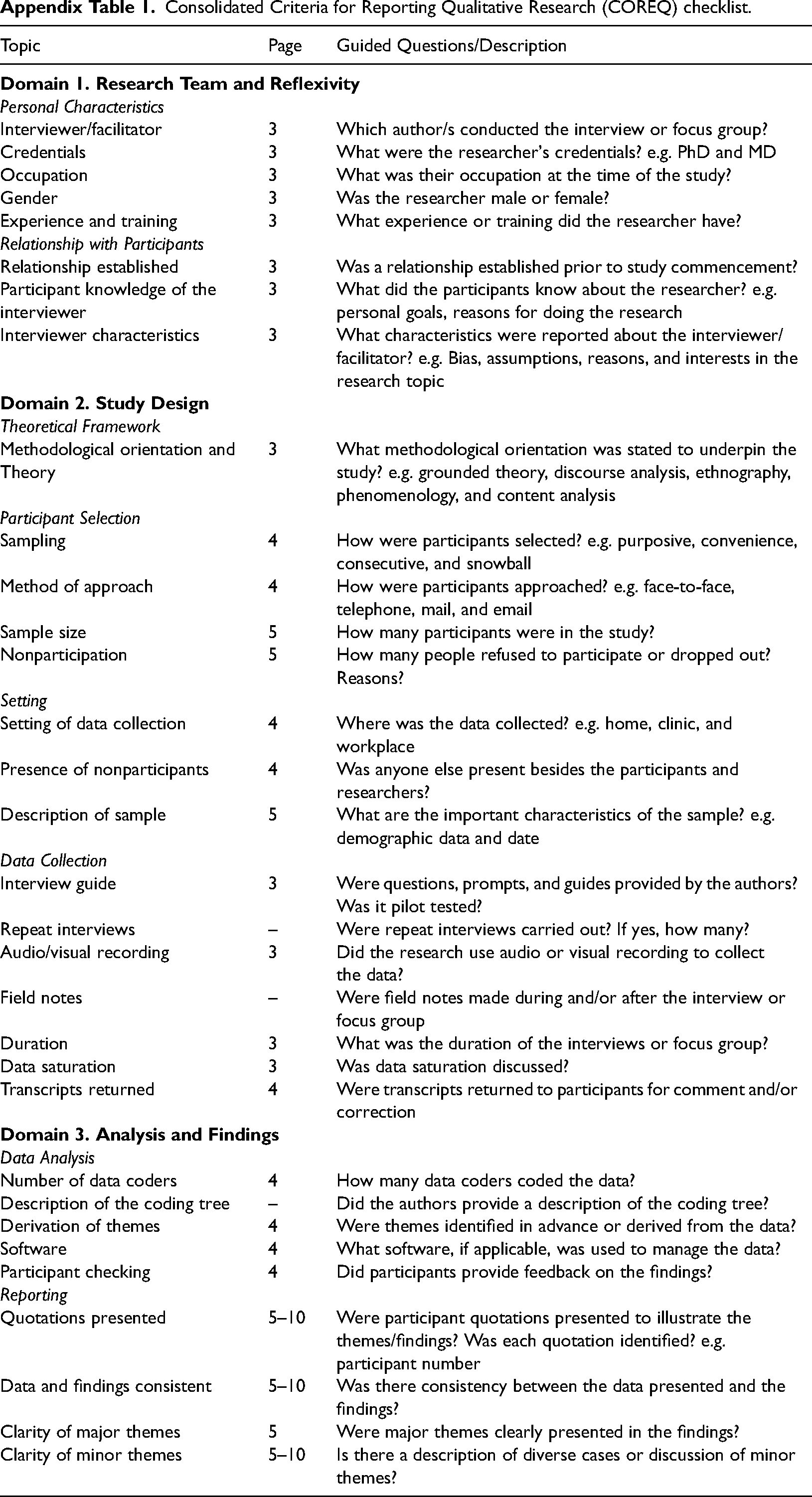
| Topic | Page | Guided Questions/Description | |
|---|---|---|---|
|
|
|||
| Personal Characteristics | |||
| Interviewer/facilitator | 3 | Which author/s conducted the interview or focus group? | |
| Credentials | 3 | What were the researcher's credentials? e.g. PhD and MD | |
| Occupation | 3 | What was their occupation at the time of the study? | |
| Gender | 3 | Was the researcher male or female? | |
| Experience and training | 3 | What experience or training did the researcher have? | |
| Relationship with Participants | |||
| Relationship established | 3 | Was a relationship established prior to study commencement? | |
| Participant knowledge of the interviewer | 3 | What did the participants know about the researcher? e.g. personal goals, reasons for doing the research | |
| Interviewer characteristics | 3 | What characteristics were reported about the interviewer/facilitator? e.g. Bias, assumptions, reasons, and interests in the research topic | |
|
|
|||
| Theoretical Framework | |||
| Methodological orientation and Theory | 3 | What methodological orientation was stated to underpin the study? e.g. grounded theory, discourse analysis, ethnography, phenomenology, and content analysis | |
| Participant Selection | |||
| Sampling | 4 | How were participants selected? e.g. purposive, convenience, consecutive, and snowball | |
| Method of approach | 4 | How were participants approached? e.g. face-to-face, telephone, mail, and email | |
| Sample size | 5 | How many participants were in the study? | |
| Nonparticipation | 5 | How many people refused to participate or dropped out? Reasons? | |
| Setting | |||
| Setting of data collection | 4 | Where was the data collected? e.g. home, clinic, and workplace | |
| Presence of nonparticipants | 4 | Was anyone else present besides the participants and researchers? | |
| Description of sample | 5 | What are the important characteristics of the sample? e.g. demographic data and date | |
| Data Collection | |||
| Interview guide | 3 | Were questions, prompts, and guides provided by the authors? Was it pilot tested? | |
| Repeat interviews | -- | Were repeat interviews carried out? If yes, how many? | |
| Audio/visual recording | 3 | Did the research use audio or visual recording to collect the data? | |
| Field notes | -- | Were field notes made during and/or after the interview or focus group | |
| Duration | 3 | What was the duration of the interviews or focus group? | |
| Data saturation | 3 | Was data saturation discussed? | |
| Transcripts returned | 4 | Were transcripts returned to participants for comment and/or correction | |
|
|
|||
| Data Analysis | |||
| Number of data coders | 4 | How many data coders coded the data? | |
| Description of the coding tree | -- | Did the authors provide a description of the coding tree? | |
| Derivation of themes | 4 | Were themes identified in advance or derived from the data? | |
| Software | 4 | What software, if applicable, was used to manage the data? | |
| Participant checking | 4 | Did participants provide feedback on the findings? | |
| Reporting | |||
| Quotations presented | 5–10 | Were participant quotations presented to illustrate the themes/findings? Was each quotation identified? e.g. participant number | |
| Data and findings consistent | 5–10 | Was there consistency between the data presented and the findings? | |
| Clarity of major themes | 5 | Were major themes clearly presented in the findings? | |
| Clarity of minor themes | 5–10 | Is there a description of diverse cases or discussion of minor themes? | |