




Abstract
This article explores the growing trend of using rap lyrics and music videos as evidence in criminal trials and considers the discriminatory implications of such practice. Drawing on qualitative interviews with 43 police staff (officers and civillian investigators) and lawyers experienced in investigating, prosecuting or defending cases of serious violence, it focuses on instances where ‘joint enterprise’ (or secondary liability in criminal law) has been invoked to charge and prosecute groups of individuals. The findings reveal that despite legal safeguards designed to prevent prejudicial use of such evidence, its application persists in serious youth violence cases in which secondary liability is used to convict black and brown young men. Our research indicates the use of rap audiovisuals in court encourages jurors to view this content as autobiographical evidence of gang affiliation, bad character, criminal intent and complicity which could compromise the principle of due process.
Introduction
In March 2020, two men were convicted of the murder of Bright Akinleye, music producer and manager of a drill artist associated with a rap group known as 23 Drillaz (BBC News, 2020). Three years earlier, 16-year-old Cemeren Yilmaz was killed by four young men, who it was alleged were members of the ‘Black Tom Gang’ (BBC News, 2019). In the criminal trials for both cases, the court heard how the victims were casualties of tit-for-tat violence between groups of young men whose fractious relationship had played out on social media (BBC News, 2019). In both cases, rap music was admitted as evidence in court and formed a key part of the Crown Prosecution Service’s case. 1
Law enforcement has increasingly made explicit the connections between crime and black music which has been subject to state regulation and control (Fatsis, 2021). More recently, police officers have become increasingly dependent on social media content, including rap lyrics, when solving crimes (Fontecilla, 2013). Perhaps this isn’t surprising since rap music has been described by some people as violent, nihilistic and misogynistic (Kubrin, 2005), and anti-establishment to the point of being described as ‘murder music’ (Martin, 1993). The admittance of rap lyrics and associated music videos in criminal trials has been vehemently contested. Academics have long argued that such material when admitted into court is highly prejudicial and discriminatory (Fatsis, 2023; Nielson and Dennis 2019; Owusu-Bempah 2022; Quinn, 2018). A central concern is the common misinterpretation of rap/drill music as confessional narratives by criminal justice practitioners. Ilan (2020) and others (Fatsis, 2019) suggest that lyrics are (re)framed as ‘true facts’ in criminal court by unenculturated police experts and prosecution counsel seeking convictions for serious violent offences. This, they argue, strips rap music of any artistic creativity, recasting lyrics as self-referential narratives and a true reflection of a person’s personality or lifestyle (Dunbar et al., 2016). The existing scholarship provides valuable inroads into our knowledge on this use of rap lyrics and music videos in criminal trials via lyrical content analysis of rap songs (Ilan, 2020; Kubrin, 2005), expert witness testimony (Nielson and Dennis, 2019), critical analysis of court cases (Owusu-Bempah, 2022) and theoretical insights (Fatsis, 2019). At the time of writing, little national or international research has explored the process by which rap lyrics and music videos are translated into evidence as part of the investigation from the perspective of criminal justice practitioners (Owusu-Bempah, 2022). Nor do they reveal the decision-making process of prosecutors who seek to admit rap lyrics or music videos into evidence in criminal trials.
Drawing on the testimonies of criminal justice practitioners involved in the investigation and prosecution of serious violent crime involving multiple young people, this article makes an empirical contribution to the debate. It further examines how police practitioners, guided by a paradigm of risk and justice for the victim(s) (Young et al., 2020), actively mine open-source media accounts as part of the intelligence gathering process and take full advantage of the opportunities that rap lyrics and music videos offer to bolster the prosecution’s case. It describes prosecutorial decision-making to admit such evidence against defendants in cases where young people are accused of, and charged with, serious multi-handed violent crimes. The research shows some legal practitioners are aware of the potential prejudicial implications of the material but nonetheless exploit rap lyrics and music videos, deferring responsibility for its probative or prejudicial value to the judge and jury. We argue here that the use of rap music in cases of serious violence undermines the fundamental legal principle of due process. Before we present the data supporting our claim, we outline in the following section how rap music connects to serious violence and is converted into evidence in criminal trials.
Connecting rap to serious violence
The mid-2000s saw spiraling rates of recorded knife crime offences alongside government initiatives aimed at addressing the perceived growing ‘gang menace’ (Mayor’s Office for Policing and Crime [MOPAC], 2019).
2
Around the same time, media reports connected drill music to the ‘rise in youth murders’ (Mararike et al., 2018) and the then Metropolitan Police Commissioner Cressida Dick opined that drill music was all: [. . .] about glamorising serious violence: murder, stabbings [. . .] they [Drill artists] describe the stabbings in great detail, joy and excitement [. . .] in London, we have gangs who make drill music, and, in those videos, they taunt each other. They say what they are going to do to each other and specifically what they are going to do to who. . . (Waterson, 2018)
Commissioner Dick’s statement fails to acknowledge that the drill music genre is intentionally provocative, threatening, hedonistic and hostile. The braggadocio present in drill music is deliberately menacing; it is a defiant musical artform that broadcasts the hot-house pressure of inner-city life (Hancock, 2018), reflecting the mundane pain (Bakkali, 2019) experienced by the young urban poor living with the inequalities of neo-liberal capitalism, poverty, social exclusion and punitive social control (Fatsis, 2019). The genre’s recall of serious violence, particularly gang violence, nonetheless has attracted attention from criminal justice professionals who were under increasing political pressure to eliminate knife crime and gang-related offending; particularly in London (Home Office, 2018).
While research shows that a ‘small minority of young people’ share music videos that ‘display and incite serious incidents of violence in real life’, ‘violent intent is the exception rather than the norm’ (Irwin-Rogers and Pinkney, 2017: 7–8). Activists and critical scholars argue that there is no consistent evidence to suggest that rap/drill music systematically causes crime (Kleinberg and McFarlane, 2020; Owusu-Bempah, 2022). Instead, they argue, the police dramatically overstate the causal relationship.
Converting rap music into evidence in joint enterprise cases
With the advent of the internet, criminal justice practitioners have a number of new opportunities to find ‘case making’ material connecting victims and attackers in ways that was not possible before the explosion of social media (Browning, 2011). This avenue of enquiry is particularly useful in multi-handed murder cases in which it is not clear who inflicted the fatal blow. Using a complex legal statute that enables a person to be convicted of an offence committed by another via the principles of secondary liability – or what is commonly known as ‘joint enterprise’ – it is possible for the police to investigate anyone present at the scene of a violent crime, or with knowledge of it, as suspects even if they played little or no part in the fatal act itself. 3 The law of secondary liability allows an individual to be prosecuted for an offence perpetrated by another person if it can be proven that they intended to assist or encourage the principal offender in the substantive offence (Crown Prosecution Service, 2019).
Rap lyrics and music videos – often made public online – are attractive ‘dramatic fodder’ for criminal justice practitioners who seek to identify or connect individuals and demonstrate the violent inclinations of suspects, especially in cases with little to no forensic evidence (Monteith, 2022). Such material can then be used to infer culpability, prove bad character, or supposed gang affiliation. This digital ‘digging for dirt’ (Browning, 2011) activity is somewhat supported in law and in legal guidance generated by the Director of Public Prosecutions (2020), which states ‘Gangs are increasingly using drill music and social media to promote gang culture, glamorise the gang lifestyle and the use of weapons. They may post videos online that seek to taunt rivals, incite violence or glamorise criminality’ (CPS, 2021).
According to sections 78 of the Police and Criminal Evidence Act (1984) and section 112(3)of CJA 2003, material such as rap lyrics and music videos can be offered as evidence in a criminal trial if: it is relevant; has integrity; proves, beyond a reasonable doubt, that the facts asserted are true; that the defendant(s) are capable of committing the act for which they are being prosecuted; and satisfies one of the seven gateways set out in section 101(1) of the Criminal Justice Act 2003. If it does not, the judge has the authority to exclude it (Scaife, 2014). To be utilised as part of the prosecution’s case the police and prosecution need to make sure that the rap evidence provided to the court not only satisfies the above conditions but provides the prosecution with the best possible opportunity to make the strongest case against the defendant(s) by providing the jury with the evidence that outlines the full circumstances of a violent crime, connects the defendants with its execution or cover up, and establishes the link between the images and serious violence (CPS, 2021). Thus, prosecution parties wanting to adduce rap lyrics and music videos as evidence must demonstrate its relevance, probative value and address issues of prejudice and ‘hearsay’ before it can be admitted into court.
Academics who have extensively researched the use of rap lyrics and music videos in criminal trials have pointed out the probative value of rap/drill as evidence is more likely to be argued in multi-assailant cases. In her analysis of 38 appellate cases in which rap was utilised in court, Owusu-Bempah (2022) found that where rap music/lyrics was deemed relevant to the substantive case these were used to adduce bad character to demonstrate association between defendants and to the crime, or place the crime within a ‘gang’ context. 4 In a similar vein, Scaife (2014) found online material was used to infer intention to commit, or assist, a criminal act, to undermine the credibility of witnesses and defendants, and suggest a link between parties where association was previously denied.
Critiquing the conversion
The literature offers several reasons for prohibiting rap lyrics and music videos as evidence in court. A key criticism is the lack of understanding among criminal justice practitioners regarding such music, which results in the uncritical acceptance of rappers’ staged performances as factual evidence. As Blanchard (1999) contests, a rapper’s integrity is premised upon ‘keeping it real’ (being true to the roots of their experience) whilst writing lyrics that will sell. Young people locked out of the illegal drug economy turn to the ‘attention economy’ hoping to transform rap videos peppered with honour slights, mendacious boasts about criminal activities and violence into cold hard cash, sponsorship and lucrative record deals (Stuart, 2020a). Following the business model of record labels, the commercial success achieved through rap puts pressure on artists to project an aggressive, intimidating personality and exaggerate danger (Stoia et al., 2017) in a credible and marketable way (Kubrin, 2005; Perrym, 2004) regardless of their actual experience of such violence.
An appreciation of the artistic aggressive characterisation and imagery in rap music is often not reflected in criminal justice practitioners’ interpretations of rap and drill music. As Ilan’s (2020) research attests they erroneously accept the lyrical formulas and tropes (e.g. graphically disrespectful and degrading comments) as authentic, autobiographical accounts of criminality. In a criminal investigation, and stripped of all artistic validity, rap music is reduced to an aggravating factor, its creators as ‘gang-affiliated’ co-conspirators and an exploitable commodity for law enforcement (Fontecilla, 2013).
Fatsis (2023) drawing on his experience as an expert witness, notes how police officers are often called upon in court as experts to make linguistic judgements regarding the meanings inherent in rap lyrics, the significance of the videos as a factor in violence and evidence of defendants’ gang association. Like Owusu-Bempah (2022) and Ilan (2020), Fatsis contends that these ‘experts’ interpret rap without specialised knowledge or authority inevitably leading to biased and dangerously oversimplified portrayals of the music and the rappers. He surmises further that the use and interpretation of rap in criminal trials is based on a racist logic, stereotypes about black people, black music and represents an assault on black culture (Fatsis, 2023). Rap music is mostly created by young people of colour therefore, according to Dunbar (2019), it is intrinsically linked to race and positioned as uniquely dangerous over and above other forms of music like rock, metal country and goth which are also associated with violence. This framing, especially when used in cases where joint enterprise is applied, is a guilt producing device (Clarke and Williams, 2020; Williams and Clarke, 2016) that favours the prosecution case, making it less likely that defendants will receive a fair trial.
Joint enterprise, rap and due process
The above critique challenges the fairness of utilising rap/drill music as evidence in serious violence cases, particularly when principles of secondary liability are applied. There is a potential double disadvantage for young defendants from black and mixed ethnic backgrounds, as they are disproportionately represented in criminal cases in which secondary liability is used (Hulley and Young, 2024) and in prosecutions where there is an accompanying ‘gang’ narrative (Quinn et al., 2024). The extant evidence points, in our interpretation, to two key issues. First, that the admission of rap music in court is objectionable because it encourages prejudicial biases to surface against the defendants and second, the subsequent convictions secured against them are flawed, in part because the investigative and prosecutorial process did not operate in the manner required under due process. The due process model of justice requires that the instigation of legal procedures do as much as possible to factually protect the innocent by eliminating as many mistakes in the fact-finding process. This is as opposed to the crime control model of justice, which prioritises an efficient justice system that identifies, apprehends, and screens suspects to determine the ‘facts’ and ‘truth’, to secure as many convictions as necessary to preserve social stability and assuage the public (Packer, 1964: 15).
Identified by some as ‘objectionable music’ (Blanchard, 1999), rap music has been entangled with pathological, legislative processes that associate the musical creativity of young people from marginalised communities with issues of public safety, crime, violence and disorder (Fatsis, 2021; White, 2017). 5 Linked to stereotypical perceptions of black culture and violence, the use of rap music in this way ‘served to exclude those who the state deem to be undesirable or undeserving of its protection’ (Fatsis, 2019: 1300) culminating in a prejudicial processes that accepts rap lyrics as an autobiographical narrative, thereby eroding the presumption of innocence for young suspects and defendants of colour and exaggerating the sense of their guilt.
The possible impact of prejudice in court can be observed through research studies like those conducted by Fried (1996) and Dunbar (2020) who note that people harbouring prejudicial perceptions about rappers tend to form negative judgements about them and express heightened concern about the effects of such music. Dunbar (2020) found that mock jurors who assumed a defendant’s guilt placed more evidential weight on rap lyrics. Similarly, Eisen’s et al. (2013) mock jury research indicated that jurors are influenced by extra-legal factors, such as perceived gang affiliations from aggressive and defiant lyrics, explicit depictions of weapon possession, and ‘gang’ signifiers. These factors can significantly prejudice trial outcomes, increasing the likelihood of a guilty verdict and a more severe sentence (Eisen et al., 2013). This may explain why in his review of the treatment of and outcomes for people of colour in the criminal justice system, David Lammy advised that ‘the line between prejudice and probative value must be appropriately drawn when social media evidence is put before a jury’ (Lammy, 2017: 19–20).
This literature review underscores several areas of concern regarding the conversion of rap and drill music into evidence to support the prosecution of multiple suspects in cases that rely on secondary liability, including that its use can undermine due process. Therefore, the use of rap lyrics and music videos in criminal proceedings is a matter of significant importance that warrants careful consideration. As Owusu-Bempah (2022) observes there is limited understanding of how police officers interpret and utilise such material in investigations of serious violence, how much prosecution lawyers rely on rap in criminal trials and the grounds on which judges admit or exclude them. This article draws upon the testimonies of detectives, defence and prosecuting lawyers to bridge a knowledge gap. It examines the evidentiary challenges and queries arising from the inclusion or exclusion of rap and drill music artefacts in the prosecution of multiple defendants under secondary liability law. In doing so we connect these issues to the exercise of due process.
The study
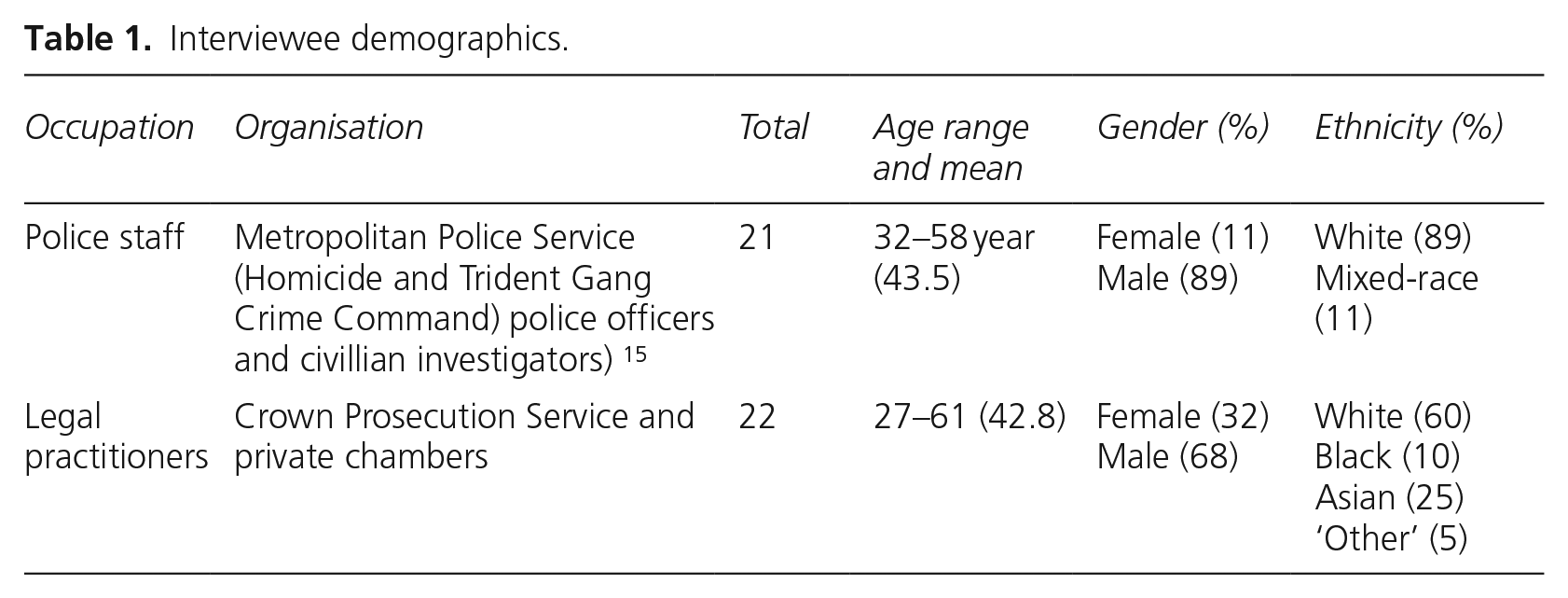
This article draws on data from a larger qualitative research project, funded by the Economic and Social Research Council (ESRC) [ES/P001378/1] conducted between 2017 and 2019, which explored the dynamics of friendship and serious violence among young people. For the purpose of the study, serious violent crime encompasses these offences as defined in English and Welsh law: grievous bodily harm (GBH), wounding with intent to cause serious injury to another person (Section 18 of the Offence Against the Persons Act 1861), manslaughter and murder. The study utilised a qualitative approach grounded in a constructivist epistemology as outlined by Creswell (2014). Specifically, the study sought to understand secondary liability law in practice. Qualitative interviews were conducted to explore legal practitioners’ perspectives of serious multi-handed violence involving young people and their application of secondary liability in practice. The findings reported in this paper are derived from semi-structured interviews with 43 police staff (police officers and civillian investigators) and legal professionals with experience of investigating, prosecuting or defending cases of multi-handed violence (see Table 1). 6
Interviewee demographics.
Access and participant details
Access to legal professionals was gained through a combination of purposive and snowball sampling. Prosecution and defence lawyers were recruited via key contacts in law chambers, online searches, and an advertisement on the Criminal Bar Association website. In total, 22 legal practitioners participated in the study, including a retired judge, solicitors, members of the Crown Prosecution Service (CPS) – the prosecuting agency for criminal cases in England and Wales – and barristers handling both prosecution and defence work, including Treasury Counsel (appointed by the Attorney General to prosecute on behalf of the state). Police participants were accessed through senior contacts in the Metropolitan Police Service. 7 Senior officers from homicide teams and Trident sent emails to colleagues who volunteered to participate. 8 This purposive sampling approach generated 19 homicide detectives to the study. Additionally, two civilian intelligence officers with expertise in analysing social media output were interviewed.
Prior to recruitment, the research team determined that all had experience of cases involving multi-handed violence. All participants received information about the research prior to providing consent to take part. Interviews were conducted at venues selected by our volunteers, typically their workplaces, and lasted between 1 and 3 hours. 9 The interviews focused on practitioners’ experiences of investigating and prosecuting multi-handed cases, the practical application of secondary liability law, procedural fairness, due process and understanding of young people’s social relationships in the context of serious collective violence.
An iterative framework of analysis was used to interpret the data. This reflexive process aims to create insight as well as develop interpretive meaning and understanding (Srivastava and Hopwood, 2009). Interview transcripts were uploaded to NVivo for analysis which concentrated on practitioners’ methods of investigating and prosecuting serious violence as well as the use of data from mobile phones and social media for prosecutorial purposes. 10 Particular attention was given to practitioners’ views on rap and drill music, the authenticity of online content as indicators of criminal intent, the use of music shared on social media to prove association and bad character, as well as the admissibility rules of evidence in court. To preserve participant anonymity, all identifying details were omitted and pseudonyms were allocated to each individual.
Datamining: Gathering the evidence
‘If we get a video where we can identify these people and the video is called a gang name, rapping the gangs that we know exist and they are rapping out offences that we know existed between those gangs, then that is another intelligence [source]’. (Gerard, Police Intelligence Analyst)
The police staff in our study explained that the examination of mobile phones and the monitoring of internet content pertinent to cases of serious violence involving multiple young people had become more frequent in the search for evidence. They saw this technique as a crucial part of the investigative process, not least because in ‘gang’ cases witness testimony was often not forthcoming. Under such conditions, detectives and civillian investigators in the current study went 'digging for dirt' (Browning, 2011) on the suspects’ mobile phone and open access sites, like YouTube, for content that could be transformed into case-making material. They advocated for the utility of rap and drill music in identifying ‘gang related’ content, evidence of planning or intention to commit the substantive crime and association between the protagonists.
‘A lot of the stuff we deal with is gang-related, so it comes to almost translating what somebody is trying to say, especially with the drill music that is going on, as much as there is stuff that's put-on YouTube [. . ..] or they will have lyrics in their phone about what they are doing, what they’ve done, what they plan on doing, and it takes someone to actually sit and look at it and work out what they’re actually talking about’. (Patrick, Homicide Detective)
The quotations above illustrate that police frequently monitor the social media and online accounts of young suspects and scrutinise the content to assess its relevance to the case. As noted earlier, rap music can be used as a vehicle to collectively ‘broadcast badness’ (Lauger and Densley, 2018). Therefore, the proactive search of young peoples’ phones and media platforms can broaden the investigative scope but it also exposes numerous young people to police investigations by casting the criminal justice net ever wider. Research indicates that rap music videos are often staged performances by young people seeking status or economic benefits (Stuart, 2020b). Yet officers appear to unproblematically interpret lyrics without considering the cultural context in which it is created. In our study, officers overlooked the nuances and instrumentally focused on the investigative advantages of such evidence. As one detective remarks: ‘it’s intelligence, at the end of the day. [. . .] you look at that you think, ‘have I got enough evidence to arrest him?’ It [the video] doesn’t put him there [at the scene] but it’s useful intelligence and it can be great if you get another bit of evidence’. (Rob, Homicide Detective)
In this sense, rap and drill music videos formed part of a package of evidence that police officers were attempting to generate.
Repackaging the evidence: Framing rap music as authentic accounts of violence
Research has shown that from their digital bounty, police can forge connective links between suspects, recast honour slights, marks of disrespect and dramatic acts of violence into evidence (Fatsis, 2019; Schwarze and Fatsis, 2022). Detectives in the current study demonstrated this transformation by interpreting media content literally. Anne, quoted below, described a case where a music video was uploaded to a social media platform 12 hours after a murder. She says: ‘. . . in sort of background information we’ve got YouTube videos, we’ve got photographs taken online and some of the young people involved in that . . . Some are real horrors, don’t get me wrong, and they are nasty, nasty people regardless of age’. (Anne, Homicide Detective)
Anne identified the YouTube videos and photographs as meaningful evidence and probative to the prosecution’s case. Similarly Adrian below describes what he sees as a direct link between the content displayed on screen and an incident of murder.
‘[In the song] they’re talking about going out and stabbing people and within an hour of videoing one of these films, they went out randomly to a different postcode area and chased a kid and stabbed him to death because he was walking through that postcode area, wrong place, wrong time. We’re getting that all the time’. [Adrian, Homicide detective]
Our research does not allow us to ascertain the validity of these claims or to accurately identify the individuals in the video as the perpetrators. However, to ensure due process it is critical to ‘differentiate between vast majority of music videos that mirror the raw realities of young people’s lives from videos that cross the line by showing youths brandishing weapons, making inflammatory remarks about violent events and issuing explicit threats to stab or shoot specific individuals or members of rival groups’ (Irwin-Rogers and Pinkney, 2017: 8). Rap is a deliberately antagonistic and anti-authoritarian artform where status is dependent upon the ability of rappers to express an authentic persona that exudes hypermasculinity (Kubrin, 2005), not least because being ‘gangsta’ and ‘keeping it real’ sells (Blanchard, 1999). However, the ability of police officers to differentiate between rap content intended to incite violence and from those whose purpose is to artistically dramatise life ‘on road’ for entertainment or economic reward is debatable. The potential consequence is the introduction of undue prejudice into investigative and legal proceedings.
Not every police officer failed to grasp the nuance of rap and the serious implications for young people who get caught up in a murder investigation. Homicide detectives, like Baj, distinguished between the ‘hundreds and hundreds of videos where different rappers and different groups and all sorts are talking about doing all sorts of mean and wonderful things, but ultimately they don’t play it through’ and footage depicting real acts of collective violence.
Whilst such officers acknowledged the somewhat tangential links between a video circulated online and a violent event in real life, detectives tasked with solving cases of serious violence were alive to ‘risk to public safety, public confidence and to the organisation reputation if we are unable to successfully prosecute violent crime’ [Marcus, Trident]. In the pursuit of justice, which for these detectives meant doing a good job in difficult circumstances (Young et al., 2020), and producing a high rate of apprehension and conviction, all investigative avenues were pursued to establish the ‘facts’ of the case to construct a plausible narrative to imply probable guilt. As Trevor, a homicide detective explained small bits of intelligence add up when ‘you’re working on such a large picture’ in a homicide investigation involving multiple people.
Rap in the court room
From the police testimony, it was evident that detectives saw their job as intelligence gatherers whose remit it was to present a package of evidence to the CPS for assessment. In turn, it was the responsibility of the CPS and prosecution barristers to determine the evidential value of rap and drill music paraphernalia when charging individuals with murder and its probative value in court. As Toby [Homicide Detective] notes: ‘It comes down to the skill of the barrister. We are not selling it [the mined material] as definitely caused this [murder]. What we are saying is we can show this happened and we can show you were associated with that person here’.
In following the formal administrative procedures that take place within the criminal process prosecuting lawyers argued that they ‘err upon the side of prosecuting’ (Kamu, prosecution lawyer) when deciding whether a charge is in the public interest and if there is a realistic prospect of conviction. 11 Prosecuting lawyers in the study echoed the views of the detectives regarding the probative value of content embedded on mobile phones and online social media sites. Like police officers, lawyers assessment of the lyrics, or actions in a music video, was one of bearing witness to an individual’s involvement in a group criminal offence. The authenticity claims made by Peter and Alex below demonstrate what Nielson and Dennis (2019) would refer to the (mis)identification of rap as rhymed confessions and Pyrooz et al. (2013) as evidence of a distinct parallel between online narrative and real-world violence.
‘I’ve had instances where people are singing particular songs, [. . .].”They’ve gone to recording studios directly before the offence, for example, and recorded a song making [laughs] a song with lyrics that suggested that they wanted to stab people.’” [laughs] (Alex, prosecution lawyer) ‘There was one I did where [the defendant] was rapping about a shooting he did. And it was great, basically. We could show what shooting it was, and he did do it, and he has been convicted of it. So, this isn’t bullshit, this is true. When he says, ‘I’m going to kill this person [. . .] because of this’ and then it happens this isn’t just kids showing off, messing about; it’s real’. (Peter, prosecution lawyer)
Prosecution lawyers expressed dismay at the type of material young people produced citing the ‘stupidity’ of rappers who upload potentially incriminating material ‘you just think, you’re an idiot, you’re just providing evidence [for the prosecution] but it’s part of the culture, isn’t it?’ (Peter, prosecution lawyer). In some instances then, once young people have been charged with a serious violent offence and music lyrics or videos are admitted into criminal court, they are deprived of their artistic licence and seen as no more than factual representations of violent events and violent actors (Hirschi, 2018). Under these circumstances, prosecuting lawyers are able exploit the uploaded material to infer violent behaviour and meaningful (criminal) associations between young people implicated in complex multi-handed cases of serious violence. As potentially guilt inferring artefacts, prosecuting lawyers in the current study described presenting rap and drill lyrics and music videos in court to illustrate the defendant(s) state of mind before and at the time of the substantive offence, to prove association, intent, or motivation to commit the substantive offence (Dennis, 2007).
Gang association, ‘bad character’ and complicity
In cases of serious violence involving multiple young people, in which prosecution lawyers want to use secondary liability to charge a number of people, demonstrating knowledge of the essential facts and intention to encourage and assist (necessary to charge with the substantive offence) can be a significant challenge. Prosecutors in this study appeared to draw on ‘bad character’ provisions of the Criminal Justice Act 2003 that allows ‘evidence of, or disposition towards misconduct’ (s99) if it is probative and not unduly prejudicial.
12
As has been noted in other research, rap and drill lyrics or music videos that reference terms like ‘splashing’, ‘dipping’, ‘touching’ and ‘cheffing’ (all terms for stabbing), ‘skengs’ (guns) ‘beef’ (disputes) and ‘pokes’ (knives) and ‘chetes’ (machetes) not only capture the attention of other young people and record companies (Machell, 2019), but also prosecuting lawyers, whose task it is to demonstrate intention and knowledge of wrongdoing. This point is illustrated clearly by an experienced barrister working on homicide cases: ‘[. . .] as prosecutor and investigator, you are looking for a motive. [. . .] And also, what was their state of mind? So, if you have someone rapping in advance of an organised confrontation, [and they] stab someone then that is pretty good evidence as to what their state of mind was at the material time’. (Paul, prosecuting lawyer)
Prosecuting lawyers sought to introduce into court the idea that the presence of defendants in a collective music video demonstrated association and a collective will towards violence. This creates a ‘plausible’ story as to why the offence happened and why all the defendants are responsible (Kern Griffin, 2013: 294). Whilst the CPS state that creating rap or drill music is not a criminal offence, that they recognise artistic freedom and insist that there is no mandate to prosecute people for their musical tastes (Fouzder, 2024), the testimonies gathered here show rap and drill music videos, and associated online content, to be powerful visual and audible short cuts to infer gang association and probable guilt.
‘One of the things that the social media videos get used for is to prove membership of a gang [. . .] Sometimes there are gang colours or particular gang signs that are made during the course of the video. Sometimes you can establish, or attempt to establish, gang membership through those’. (Alex, prosecuting lawyer)
Within the context of a well-established ‘gang talk’ narrative that permeates criminal justice systems (Hallsworth and Young, 2008) any indication of gang association (e.g. name, emblem or colour) in online content helps. 13 The CPS encourage this connection, as part of the decision-making guidelines for criminal justice practitioners by stating ‘gangs are increasingly using drill music and social media to promote gang culture, glamorise the gang lifestyle and the use of weapons’ (CPS, 2021).
Being able to infer gang membership from a music video or lyrics online provides a useful thread with which to build a patchwork of evidence, to reach the legal requirement to support a charge and pursue a conviction using secondary liability. 14 Yet, research shows that inferences drawn for such material can be unreliable and underpinned by regressive and racist ideologies which overstate the causal link between gangs, rappers and serious violence (Fatsis, 2019; Ilan, 2020; Monteith, 2022).
The observed limitations of rap as evidence
In this study, some legal experts expressed concern over the growing reliance on rap and drill lyrics and music videos as evidence for prosecuting serious violent crimes among young people. This is demonstrated by the following quotation: ‘The prosecution are using a lot of these videos to draw inferences about gang membership, knowledge, friendship circles, and it’s not the same. I had a guy who is well established on YouTube. I didn’t know who he was, but he was like, ‘Look at all these videos that I’ve done’. And he goes, “I pay for them”. These people are part of the production. I don’t know who they are’. (Gita, defence lawyer)
Highlighting the transactional and performative aspects of music video production, Gita points out the dangers of using rap and drill music video and lyrics as framing devices for serious violence, including murder. She shows how easily young people can become implicated in a case by simply being a paid ‘extra’ in a music video. In addition, lawyers spoke of similar concerns regarding the potential bias that such content might bring into jury deliberations. Echoing criticisms raised in research found in mock juror trials (Dunbar, 2020; Eisen et al., 2013) they pointed out that, like unenculturated practitioners, jurors unfamiliar with the genre may find it challenging to distinguish between the rappers’ on-stage persona and the defendants’ ‘true’ self as charged, perhaps falling back on negative assessments of rap as dangerous and rappers as violent (Martin, 1993). Indeed, Schroeder (2010: 473) argues that ‘music’s powerful effect on human emotion makes it a dangerous addition to the supposedly logic-and-reason-based setting of a courtroom. This added emotion makes it even more difficult for jurors to set aside their feelings and make rational decisions’. Thus, in this research some prosecution barristers appreciated the nuance and complexity of this form of evidence and, where possible, refrained from admitting it as evidence. As Alana, notes ‘I generally don’t use them [rap music/lyrics] because they can be prejudicial; they don’t show the defendants in a good light. It may well be that the background evidence show the defendants in the dock are part of a gang but proving that is the motivation for a crime is difficult [. . .] you are trying to prove that they participated in a killing, not prove that they’re in a gang.[. . .] The fact that a kid might be in a gang doesn’t mean that he’s actually killed somebody, or been involved in a joint killing; it only gets you so far’. (Alana, prosecuting barrister)
The challenge jurors face in distinguishing defendants on trial from characters in videos that glorify violence was not so troubling for some prosecutors who viewed their role as to: ‘get the jury to understand the mindset of somebody who is performing in this way; [to ask] is this performance or is this autobiographical. And you [as the prosecution] say, “No, he is singing about himself and what he thinks, not this caricature that he has created for the purposes of his videos’. (Stephen, prosecuting lawyer)
Stephen recognises that while individuals may craft personas in music, if adeptly integrated into criminal trials, rap music can serve as powerful prosecutorial evidence. This is particularly true when combined with other evidence, such as CCTV footage, cell phone data and witness testimony, and woven into a convincing narrative of gang rivalry. Ultimately, prosecuting lawyers noted that it fell upon the jury to consider the significance of the evidence in determining innocence or guilt not them: ‘I think from a prosecutions’ perspective, [music content] is tantalising evidence. You look at it and you think, ‘Yeah, that could really be of some value to us,’ but you have got to think of the wider picture, which is what the defence is going to be saying about this. How do we present this in a way that actually bolsters our case and does not make us look like idiots when we produce this rap lyric and the defence immediately responds by producing a load of other lyrics about him claiming to have done all sorts of stuff that he could not have possibly done, but saying to the jury, ‘but this is [what] he really meant that time?’ (Stephen, prosecuting lawyer)
Jurors are tasked with determining the ‘facts’ of a case and bear sole responsibility for acquitting or convicting defendants. Yet they act in collaboration with a judge who provides guidance on legal issues, decides on the admissibility of evidence in court, and instructs the jury on whether to draw inferences from the evidence presented. Many scholars and campaigners advocate against the use of rap because of the potential adverse effect it could have on the fairness of the proceedings, negating due process. Lawyers in this study noted that certain judges are showing more awareness of the prejudicial impact of using rap music evidence and ‘gang talk’ in court and refusing to admit it: ‘It’s quite difficult to get it in because judges are like, Well, we don’t understand what they’re saying,[and] it’s very prejudicial because you’ve got all these people with masks on and tooled up. . . [laughs] [. . .] The police love it, but I’m a bit more sceptical’. (Kamu, prosecuting lawyer) ‘You can make a YouTube video in your bedroom on your phone. It doesn’t mean you are in a gang, . . . And so, yes, courts are good. They’ve got a lot better at excluding reference to gangs unless there’s positive evidence of it and proper intelligence of gang affiliation, gang culture, and even if there is it still has to be directly relevant to the offence’. (Josie, defending lawyer)
These testimonies suggest that there is some scrutiny in courts as to the fairness of admitting rap music into evidence in a criminal court case. Police officers and lawyers suggest that some judges acknowledge that young people’s online persona may not reflect their actual behaviour and refuse to admit such evidence: ‘It’s becoming harder and harder to even use [music videos] because the courts and the law is so weak. You almost have to get someone saying, ‘I committed this crime on this day at this time’, to actually get it as evidence. [. . .] We’ve got an abundance of evidence, we’ve got enough evidence to fill this room, but to actually get it into the courtroom for the jury to hear is the complicated part’. (Patrick, homicide detective)
Nonetheless, and in spite of Patrick’s frustrations, he points to the viability of rap music as evidence and his own determination to employ it in investigations of serious violence that rely on secondary liability to convict multiple youths of a single serious violent offence.
Concluding thoughts
Our study makes an empirical contribution the expanding critique on the use of rap music as evidence in court. It highlights how existing legislation in England and Wales encourages criminal justice professionals to trawl suspects social media accounts for case-making material and to equate rap music, and as creators, with serious violence. In this endeavour, the law becomes a valuable tool for prosecutors in complex, multi-handed cases, where the main protagonist(s) may not be identifiable from more traditional forms of evidence, such as CCTV, DNA or eye witness testimony.
Our research reveals that during jury trials police ‘experts’ and prosecuting lawyers use rap audio and visuals (often supposed indications of gang membership) to shape the prosecutions narrative. Jurors are encouraged to view this content as autobiographical evidence of criminal behaviour, gang affiliation, bad character and complicity. While there are legal safeguards to prevent the admission of rap lyrics and music videos in such cases, our research has shown that such evidence continues to be used in cases of serious youth violence in which secondary liability is employed to convict multiple individuals. Where judges’ rule that rap is probative, rather than prejudicial, there is a significant risk that young people on the periphery of an offence, or ‘associated’ with a principal offender (e.g. in the background of a music video) will be drawn into a criminal investigation in efforts to convict ‘all those responsible’ (see Young et al., 2020).
As a fundamental principle of law, due process protects the rights of people subject to criminal sanctions and seeks to ensure the elimination of mistakes that may undermine the systems legal legitimacy (Packer, 1964). However, our research (and a growing evidence base) shows that the introduction of rap into the court increases the probability of error in the judicial process. In light of these findings, we should be concerned about the continued use of rap music as evidence in court and call for a review of its use. The literature indicates that rap music is disproportionately utilised in trials involving defendants from black and mixed-race backgrounds and research suggests that black individuals are more frequently prosecuted under secondary liability (Mills et al., 2022). The persistent employment of rap as evidence and the reliance on police practitioners as experts, who lack cultural understanding (Fatsis, 2019; Ilan, 2020) continues to perpetuate the criminalisation of black culture and exacerbate the injustices highlighted by activists and scholars.
Footnotes
Acknowledgements
Thank you to Dr Nikhaela Wicks for her comments on an earlier version of this paper. Thanks also to the anonymous reviewers for their insightful and constructive feedback. Thank you to Dr Gary Pritchard for his research assistance.
Declaration of conflicting interests
The author(s) declared no potential conflicts of interest with respect to the research, authorship, and/or publication of this article.
Funding
The author(s) disclosed receipt of the following financial support for the research, authorship, and/or publication of this article: The research study upon which this article was founded was supported by the Economic and Social Research Council [grant number ES/P001378/1] and the Isaac Newton Trust.
