




Abstract
Schools today often operate in a context of performative accountability in which forms of student assessment become representative of success in a competitive global knowledge economy. While research has explored the nature of top-down assessment directives and the implications of these for local stakeholders, the way in which assessment policy is enacted in schools has been largely neglected. Through analysis of interviews with six middle leaders working across public and private primary and secondary schools in NSW, Australia, this study investigates assessment policy work at the school level, drawing upon Ball et al.'s (2011) typology of policy actors to explore how middle leaders understand their role, and the influences upon and implications of this work. The study highlights the complex role of middle leaders in the enactment of assessment policy, characterised by tensions between innovation and compliance, and a ‘hyper-enactment’ of assessment work that goes beyond both regulatory mandates and understandings of best practice. This school-level policy work may therefore be an important contributor to current work pressures in schools. Understanding how such work is – and is not – related to systemic requirements may thus enable such pressures to be more effectively supported moving forward.
In a competitive knowledge economy, the status of education is raised, with performance data at the student, school, and system level representing progress and shaping policy pressures (Camphuijsen and Parcerisa, 2023; Lingard et al., 2013). In the context of Australia, from which the data reported upon in this article are drawn, Programme for International Student Assessment (PISA) results regularly cause a flurry of media commentary focused on international rankings and declining performance (e.g. Cassidy, 2023). Meanwhile, one politician referred to the 2023 results of Australia's national standardised census test, the National Assessment Program: Literacy and Numeracy, or NAPLAN, as a ‘national embarrassment’ (Duffy and Young, 2023). Assessment has thus become a high-stakes aspect of work in schools, involving the navigation of considerable external pressures at local levels – both in terms of policy as ‘text’ (formal requirements at state, system or school level), and as ‘discourse’ (the unwritten ‘rules’ and expectations by which subjects think and act) (Ball, 1993).
The complexities of school-level assessment policy work have, however, been largely overlooked in critical education policy research. Attention has been given to directives or reforms handed down from above (e.g. Lingard et al., 2012) and to the workload (e.g. Stacey et al., 2022) and other impacts (Daliri-Ngametua and Hardy, 2022) of approaches to assessment on the daily work of teachers. However, the ways in which policy is enacted in schools (Ball et al., 2011) has been largely neglected in critical research on assessment (Barnes et al., 2025), particularly in terms of middle leaders. This is despite a recent growth in attention to middle leaders as a distinct category of workers in schools (e.g. Grootenboer et al., 2015; Hefnawi, 2024), with analysis of distributed (Harris, 2004) and instructional (Hallinger, 2005) leadership underscoring their role in school-based policy processes. This is a particularly important omission given the growth in the proportion of middle leader roles in Australian schools in the years prior to this study (AITSL, 2023).
This article aims to address this gap through an in-depth analysis of the policy work of middle leaders in school-level assessment processes. The following research questions guide our investigation:
How do middle leaders understand their role in enacting assessment policy at the school level? What are the external organisational and school-based factors which influence this work? What are the possible implications of this work for assessment quality and staff workload?
In what follows, we first outline the regulatory context surrounding assessment in NSW schools (where we base our study) and the recent growth in middle leader positions in such schools. We then provide a review of the literature on middle leaders, policy work, and assessment. This is followed by an overview of the conceptual framework for the study, drawing on Ball and colleagues’ typology of policy actors (Ball et al., 2011) and Colman’s (2021) notion of ‘hyper-enactment’, and an outline of the research methods undertaken. The findings and discussion are organised according to the three research questions, exploring the roles, influences upon, and implications of middle leaders’ assessment policy work in schools.
The regulatory context of assessment in NSW schools
Regulatory requirements for assessment work in Australia, and the state of NSW more specifically, are perhaps less extensive than may be expected given documented workload concerns relating to data collection and reporting (McGrath-Champ et al., 2018). At the federal level, the Australian Education Act (2013, Section 77 (2)c) requires the approved authority (which in NSW is the NSW Educational Standards Authority, hereafter NESA) to ensure that schools participate in NAPLAN and stipulates reporting requirements. At the state level, formal credentialling requirements in NSW pertain to the Record of School Achievement (RoSA) in the second last year of compulsory schooling, and the Higher School Certificate (HSC) in the final year. To remain registered and/or accredited, schools must also demonstrate their compliance with NESA requirements, including having a plan for how assessment is undertaken, monitored, and recorded; and be in accordance with NESA's Assessment Certification Examination (ACE) Rules. Regulation of assessment is also evident in individual Stage 6 (completion years) syllabus documents’ guidelines and specifications, as well as in general advice and notices relating to Stage 6. Regulations around assessment in NSW therefore pertain mostly to credentialling, particularly during the final two years of schooling. Beyond this, there is not much regulation of schools’ assessment work at the level of federal and state government authorities. This is surprising given documented pressures experienced in schools around data collection and evidence generation (e.g. McGrath-Champ et al., 2018), and indicates that these pressures may arise somewhere between the level of these authorities, and the work of teachers in schools. This may include the governing bodies of schools, with the three sectors in NSW including the government (or ‘public’) school system, managed at state level; systemic Catholic schools, managed at diocesan level; and independent schools, managed by school- or network-level boards or councils.
The possibility that middle leaders may be key to this equation is considerable, given that Australian Teacher Workforce Data (AITSL, 2023) reveals a surge in middle leaders in recent years. The proportion of leaders increased from 4% in 2018 to 11% in 2022, almost tripling in 4 years. In NSW, formal middle leadership roles include ‘assistant principals’ (usually based in primary schools) and ‘head teachers’ (heads of faculty areas in secondary schools). More informal middle leadership roles have also proliferated in different schools and systems (AITSL, n.d.). This includes, for example, roles with particular pedagogical or curricular responsibilities, or roles with central authorities but which are based in schools. Lipscombe et al. (2023) have directly linked the rising proportion of middle leaders in schools to increased workload and intensification, arguing that the ‘increasing number of leadership positions in schools [results] from the intensification of school administrative and compliance responsibilities, coupled with a greater focus on school improvement’ (p. 277). However, the relationship here is not entirely clear: whether increasing leadership positions are merely responding to enhanced administration and compliance demands, or whether such roles may (also) be involved in generating this greater volume and complexity of work.
Middle leaders’ policy work in schools
Middle leaders have a unique positionality, usually embedded in both the executive and the teaching staff in schools (Grootenboer et al., 2015). According to Lipscombe et al. (2023: 271), middle leaders operate in a space featuring ‘dichotomies such as support and monitoring, and leading and managing’. Similarly, Edwards-Groves et al. (2023) argue that middle leaders are deeply entwined with everyday administrative and transformational processes inside schools, executing their roles ‘in’ and ‘from’ a middle position within a web of interrelationships. In this intermediary role, middle leaders engage in processes of ‘sense-making’, balancing multiple demands and communicating these in ways that are appropriate for their local community (Ganon-Shilon and Schechter, 2017).
This work of translating external policy demands for an internal audience can be isolating (Skerrit et al., 2023), as middle leaders contend with and attempt to reconcile external and school-based pressures. Adie's (2014) study of how standards-referenced assessment policy is interpreted at the school level concluded that policy reform relies heavily on site-based dialectical processes, while Hardy and Melville (2019) argue that positive outcomes are achievable when policy is understood as praxis, again emphasising the site-specific nature of policy work. While school-level context is an important factor in the negotiation of policy requirements, however, so are the specificities of national regulatory contexts. Looking at the experiences of policy enactment in two English schools under intense scrutiny from Ofsted, Colman (2021) traced the ‘hyper-enactment’ of policy, a term she coined to describe excessive and obsessive responsiveness to school inspection. The study investigated the tensions between compliance and resistance, and how these shaped the policy work of schools under a pervasive ‘disciplinary gaze’ from the external authority. She concluded that ‘to comply fully [with external policy directives] is at times to turn away from contextual and value-based priorities’, including consideration of the students’ best interests (p. 280). Colman (2021) demonstrates how these tensions and compromises can be strongly felt by leaders.
Assessment policy and workload
While the regulatory framework in NSW may not be as expansive (or invasive) as that in England, where Colman’s (2021) study was located, there is evidence that accountability regimes are shaping policy enactments within Australian schools. Of all activities at the school level, assessment policy and practice arguably involve the highest degree of accountability infrastructure. Lingard et al. (2013: 549) have noted the privileged status of testing, for instance, which is ‘linked to a narrow form of educational accountability, as a new meta-policy in school systems framing practices in schools, including its impacts on curriculum in use and pedagogies’. In one study of data practices in a Queensland school, Hardy and Lewis (2017) demonstrate a ‘doublethink’ whereby teachers simultaneously exalt and mistrust data-driven practices, resonating with similar observations from the UK (Ball, 2003; Braun and Maguire, 2020). Daliri-Ngametua and Hardy (2022), in another Queensland study, argue that the dissonance arising from the ‘datafication’ of teachers amid performative accountability imperatives has resulted in demoralisation and devaluing of the teachers’ role and purpose in the educational landscape.
Indeed, there is evidence that current school-level assessment practices are reshaping roles and relationships within school workplaces. In a study of school-level data practices in two Australian schools (Selwyn, 2022), a strong contrast emerged between the data-work being done in schools – usually ‘low-level, unsophisticated and involv[ing] a fair amount of “manual” work’ (p. 99) – compared with the more sophisticated and comprehensive ‘data-veillance’ frequently discussed in the literature. Despite the relatively simplistic practices, however, Selwyn noted that working with assessment data gave some middle leaders ‘tacit power’ within the school, making ‘small statistical adjustments that nevertheless had sizable impacts on students’ and teachers’ experiences of school’ (p. 109).
Examining the ‘manual’ aspects of this phenomenon, as highlighted by Selwyn (2022), is crucial given that so much assessment policy work is bound up in administration: creating databases, handling notifications, managing submissions, and data input and output. Administration is commonly reported as a key pressure faced by Australian teachers (e.g. McGrath-Champ et al., 2018). According to the OECD's TALIS, 55% of Australian teachers cited ‘having too much administrative work to do’ as a major source of stress, compared to the OECD average of 49% (Thomson and Hillman, 2019: 27). This raises the question of who or what is driving this administrative burden in NSW, especially since NESA's requirements are seemingly minimal. One teacher in Ball et al.'s (2011) study declared, ‘the lower down the totem pole you are, your time and your workload are increased because other people have boxes to tick’ (p. 629). To what extent assessment policies and practices in schools are considered ‘box ticking’, and for whom, is a central concern of this project.
Conceptualising policy actors’ work in schools
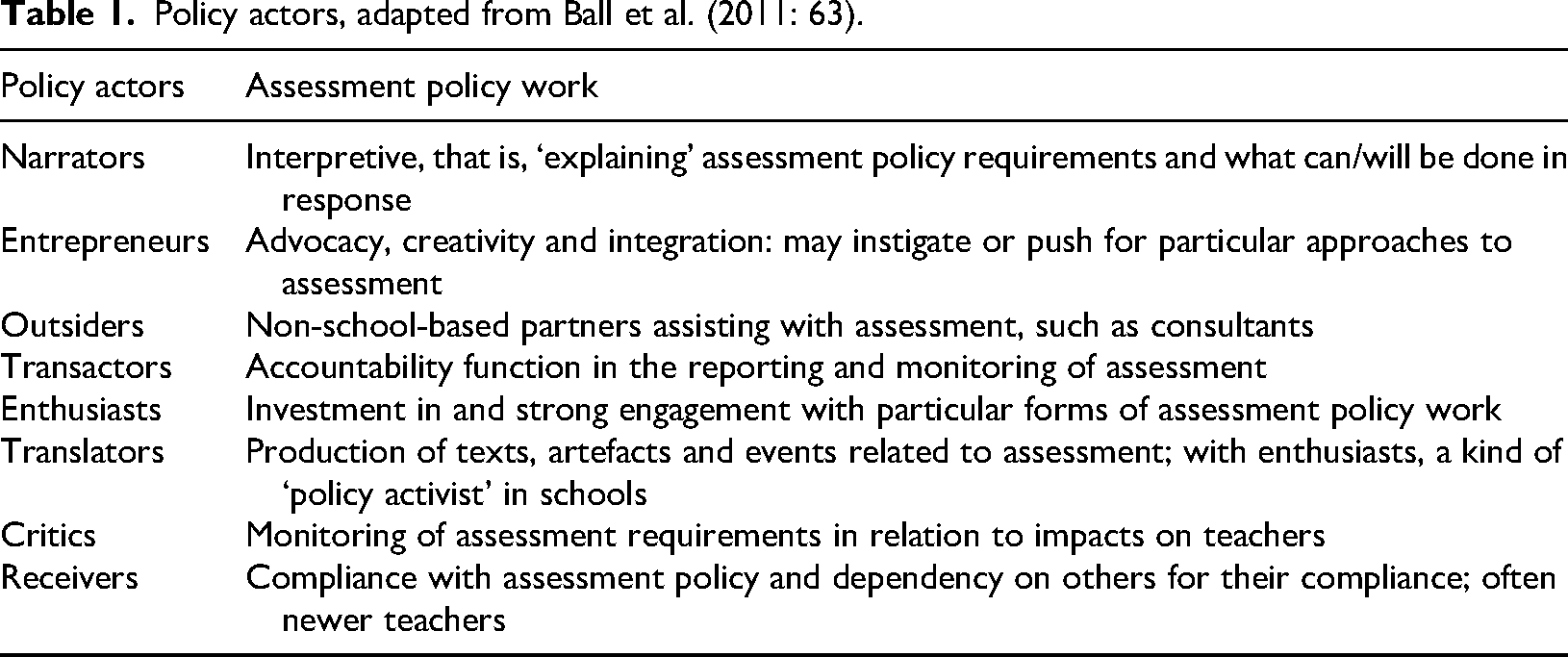
To examine the role of middle leaders’ policy work at the school level, this project uses Ball et al.'s (2011) typology of policy actors: Narrators, Entrepreneurs, Outsiders, Transactors, Enthusiasts, Translators, Critics, and Receivers (see Table 1). Roles in this model are not fixed, nor are they mutually exclusive. This approach emphasises policy as a process of meaning-making, ‘diversely and repeatedly contested and/or subject to different “interpretations” as it is enacted (rather than implemented) in original and creative ways within institutions’ (Ball et al., 2011: 2). The notion of enactment, as distinct from implementation, is key, and reflects a definition of policy that includes actors’ understandings and interpretations, and goes beyond the textual to also incorporate the discursive (Ball, 1993). Policy work is therefore understood as involving the coding of policy ideas into texts (the official, tangible output), but also the engagement with policy as discourse, shaping ‘possibilities for thought’ (Ball, 1993: 14). In this study, we argue that while the production of policy as text is an important part of middle leaders’ work (visible in the creation of assessment handbooks, for example), they also act within and from policy as discourse, in which policy is ‘produced and formed by taken-for-granted and implicit knowledges and assumptions about the world’ (Ball, 2015: 311). In this way, we understand ‘policy work’ to include intermediary work with agendas set by others – such as senior school executives, or at system and regulatory levels – as well as more active involvement in the development of school-level policies and procedures around assessment.
Policy actors, adapted from Ball et al. (2011: 63).
Several studies have drawn upon Ball et al.'s (2011) typology to investigate school-level policy work. Colman (2021), for instance, augments the concept of policy enactment to suggest the idea of ‘hyper-enactment’, as described above, in which ‘a more serious, energetic’ (p. 276) enactment of policy than is strictly necessary becomes apparent. This notion of ‘hyper-enactment’ resonates considerably with the data we present below. Barnes et al. (2025), meanwhile, explore teachers’ enactment of assessment policy in the Australian state of Victoria; this study focused on the resulting shape of assessment practice rather than broader implications (such as for workload), however, and did not have the emphasis on middle leadership that is a feature of our study. Indeed, Skerrit et al. (2023) appear to be unique in using the typology to focus specifically on middle leaders. They highlight the role of middle leaders as translators and offer a rich description of the policy work undertaken in this mode, concluding that translation work can be isolating and advocating for more research in this area to better understand policy enactment at the school level (Skerrit et al., 2023: 582). The present study builds on these works to consider the usefulness of the typology in understanding school-level policy work of middle leaders in NSW.
Approach and method
The data drawn upon in this article consist of six semi-structured interviews with middle leaders who had experience in assessment policy work in NSW schools within the five years prior to when the study was conducted, in late 2023. We understand the study as an example of what Merriam and Tisdell (2016) describe as a ‘basic qualitative study’ (p. 24), interested in how people interpret their experiences within the world. In our case, we were interested in experiences with assessment policy work within the world of schools. Such experiences could involve, for example, the administration and management of assessment practices within a particular faculty or more widely at either the school or system level, including leading the professional development and leadership of staff in assessment policy and procedures. We limited our recruitment to NSW teachers as this population is subject to the same external assessment requirements as overseen by NESA; however, we did not limit ourselves to any particular sector, as we understand concerns related to workload stress to be present across the teaching workforce (Thomson and Hillman, 2019). The decision to focus solely on middle leaders was also deliberate; while research has increasingly explored the role of middle leaders (e.g. Grootenboer et al., 2015; Hefnawi, 2024), this has not been a focus in the critical policy research on assessment, which has focused more on system-level directives (e.g. Lingard et al., 2012) and teacher experiences (e.g. Daliri-Ngametua and Hardy, 2022). The work of middle leaders in assessment policy, contextualised within the NSW regulatory framework, is therefore the particular gap to which we seek to contribute with this article. However, we acknowledge that looking only at middle leaders nevertheless omits other key actors in schools, in particular, teachers and senior leaders.
To recruit participants, we initially targeted UNSW's Masters of Education cohort, most of whom are either school leaders or aspiring school leaders. An initially low response rate (n = 2) prompted a widening of recruitment channels to the social media website ‘X’ (Twitter), using the hashtags of #NSWteachers, #aussieed, #teachertwitter, #teachers, and #edutwitter to maximise exposure to the target group. This process, as with the procedures adopted across the project as a whole, were approved by the UNSW Human Research Ethics Committee (HC230427).
The six participants came from all three school sectors in NSW (public/government, and private, including Catholic systemic and independent), reflecting a range of levels of school advantage. Participants and their pseudonyms are summarised in Table 2.
Participant summary.
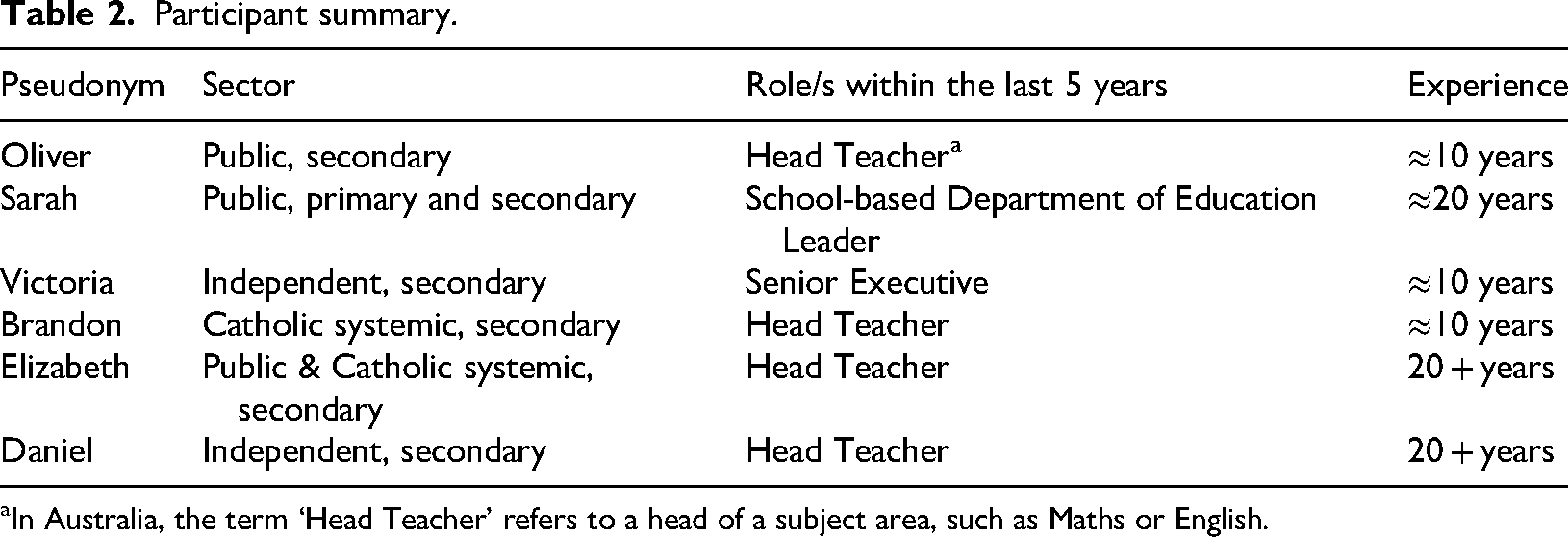
In Australia, the term ‘Head Teacher’ refers to a head of a subject area, such as Maths or English.
Participants engaged in an interview over MS Teams for ∼60 min. Questions were semi-structured (Merriam and Tisdell, 2016) to enable rich discussion of the topic and allow follow-up questions as appropriate. Questions covered the participants’ daily work around assessment policy, their role within the school/s, and the key challenges and supports they encountered in their policy work. To analyse the interview data, we drew on processes of thematic analysis as developed by Braun and Clarke (2021), first familiarising ourselves with the data before analysing it more systematically. Initial open coding was employed to generate common (mentioned by multiple participants) and/or interesting (unique or insightful) codes across the transcripts (Braun and Clarke, 2021). Our approach was primarily inductive; however, it drew on our understanding of critical policy research and, in particular, the nature and role of policy actors, understanding the inductive/deductive distinction as a continuum rather than a dichotomy (Braun and Clarke, 2021). This created a list of over 20 topics. These were then refined down further; for example, comments about the busyness of school and the lack of time were grouped under the theme of ‘resources’. This ultimately resulted in a final five themes which were then used collectively, in conversation with the conceptual framework of Ball et al. (2011), to answer the three research questions, regarding: the role of middle leaders in assessment policy (RQ1); influences on school-level assessment policy (RQ2); and implications of school-level assessment policy (RQ3). These themes were compliance (RQs 1–3), positionality (RQs 1 and 2), change (RQs 1–3), resources (RQs 2 and 3), and stakeholders (RQs 2 and 3). Below, we organise our presentation of the data generated in the project according to the research questions, drawing on these themes as appropriate.
Findings and discussion
The role of middle leaders in assessment
The roles taken up by middle leaders varied widely, from enthusiast and entrepreneur, to less agential translator and transactor roles, through to an occasional positioning as critic. Reflecting the findings of Barnes et al. (2025), individual participants described taking on different roles depending on the circumstances they encountered, and whose interests they were working in support of – a noted tension in the literature on middle leaders (e.g. Edwards-Groves et al., 2023; Lipscombe et al., 2023).
Enthusiasts and entrepreneurs
As enthusiasts or entrepreneurs, middle leaders do ‘the work of policy advocacy’ (Ball et al., 2011: 53). For example, Oliver described how he was: ‘really trying to shift the whole school [towards formative practices] … as an executive member … I have to do it, but it's also [something] that I’m relatively passionate about’. In this example, Oliver identified a correlation between his duties as the executive and his own passions as an enthusiast of school-level policy. Victoria, meanwhile, described the need for a wholesale ‘culture shift’ in her context, where she is leading a project with middle leaders of curriculum to achieve a ‘recalibration of our assessment policy’. As entrepreneurs and enthusiasts, these leaders identified strongly with the changes they sought to effect and engaged in conscious ‘sense-making’ (Ganon-Shilon and Schechter, 2017) to strategically reshape their school communities’ assessment policy work.
Translators and transactors
Middle leaders were not only enthusiasts or entrepreneurs, however, but also translators, seeing themselves as guides for the development of practice in their faculty. Indeed, Ball et al. (2011: 60) describe how enthusiasts are often also translators, recruiting others into the ‘possibilities of policy’ and making enactment into ‘a collective process’ heavily dependent on collaboration. Victoria, for instance, described her efforts at change as a ‘process of trying to upskill our heads of department in good [assessment] practice’, primarily through the distribution and discussion of professional reading materials on assessment.
Similarly, Daniel used the established professional development structures in his school to initiate an evaluation of his faculty's assessment practices in the hope of changing his colleagues’ approach: ‘I couldn’t say “this is rubbish,” but I thought let's do a bit of an investigation’. By reframing the problem as a professional development opportunity, Daniel was working as a translator, which is often ‘simultaneously a process of invention and compliance’ (Ball et al., 2011: 48). Interviewees were all acutely aware that ‘[t]here is often a fine balance between making policy palatable and making it happen’ (Ball et al., 2011: 50). Such conscious efforts to shape the beliefs and practices of the teacher subject reflect middle leaders’ work in shaping policy as discourse.
However, such work involved tensions, with middle leaders often seeing themselves as needing to ensure the compliance of their staff. In this regard, their roles sometimes became more transactional. Elizabeth described how she enforced policy by increasing its visibility; key sections of the assessment handbooks, developed through close consultation with official NESA policy texts, would be printed and placed in prominent positions inside and outside the staffroom for reference during discussions with colleagues and students. She described her responsibility to articulate and defend the policy where needed: by making the policy texts visible, ‘there was no argument or discussion or favours or unfairness… it's the law book’. This reflects Ball et al.'s (2011: 57) description of how transacting ‘makes policy “visible” by “evidencing” policy activity and effects’. In Brandon's case, when the senior executive pushed for more formative assessment and feedback, Brandon understood his role as ‘making sure that everyone is sort of doing that feedback policy and procedures’.
Critics
The emphasis on compliance articulated by participants like Brandon and Elizabeth could, at times, position middle leaders awkwardly between the needs of teachers, and the expectations of their senior executive. While Elizabeth described ‘managing’ staff (i.e. transacting) as one of the biggest challenges of her role, she also identified a perceived role in protecting staff, sometimes needing to ‘defend and articulate [to the senior executive] why something is or isn’t a good idea … for the teachers from their angle … that's a leadership thing and management thing … looking after the wellbeing of your staff’. Here she adopts the role of policy critic in relation to the senior executive, adopting the critic's concern for ‘the second order implications of policy … for the work-life balance of the teachers’ (Ball et al., 2011: 61–62). Elizabeth said this was particularly relevant in the domain of assessment policy, where workload remains a key concern (e.g. Stacey et al., 2022).
Meanwhile, Daniel saw issues with assessment policy and procedures at his school as largely stemming from the appointment of inexperienced, pliant candidates (receivers) to middle leadership roles who did not challenge the agenda of the principal and senior executive. From this perspective, Daniel saw the need for counter-discourses, associated with the work of policy critics, to protect staff from the unwise reform agenda of the principal and senior executive. Policy roles are seen here as highly dependent on positionality, with middle leaders experiencing tension and complexity depending on who or what they are called to defend and from what angle (e.g. Edwards-Groves et al., 2023; Lipscombe et al., 2023), commonly acting as policy transactors when enforcing the wishes of senior executive upon staff, and called on at times to be policy critics when representing the interests of staff.
Influences on the assessment work of middle leaders
Participants enacted a wide range of roles in their assessment policy work, from enthusiasts, to entrepreneurs, translators, transactors and even critics. However, most of these roles are defined by their relation to other influences regarding what is to be enthused upon, translated, transacted or critiqued, from ‘official’ policy through to discursive norms and expectations (Ball, 1993). As such, we also sought to explore perceived influences upon middle leaders’ work. These were found to range from the level of external organisations to local stakeholders such as parents and staff within the school.
Perceived external requirements
External requirements, particularly from NESA as the state authority, were perceived by participants to be a key influence upon school-level assessment policy. Yet these requirements were not always clearly understood – even if they were still acted upon. Brandon, for instance, seemed uncertain of what was mandatory and what was not: ‘having that two weeks’ notice [for assessment tasks] … I feel like that's definitely something that NESA has. I think it is a necessary requirement, isn’t it?’ In this example, even without certainty around the mandate, assessment notifications are produced according to the perception or assumption that they are a necessity, hinting at self-governing influences where middle leaders are positioned as receivers, who Ball et al. (2011: 63) characterise as demonstrating a compulsion for policy to be ‘“done” even if it is not understood’.
Indeed a number of participants acknowledged that some compliance behaviours go beyond what is required in a regulatory sense. Oliver described how ‘NESA wasn’t imposing these things that everyone thinks they are imposing … everyone thinks there's a reason why we do formal assessments and we put it in an assessment booklet … but that's actually not needed and is worth questioning’. Victoria echoed these sentiments, prompted again by directly engaging with an employee at NESA: ‘when I was talking to NESA, they said that schools kinda like make up their own mythologies about the detail, because it's unknown, and so they err on the side of excess’. As Elizabeth described, her system seemed to ‘make a lot of stuff up as they went. To the point where I felt like sometimes it wasn’t … true to what NESA meant it to be’.
Yet despite acknowledging the misconceptions, participants were unable to articulate why certain compliance behaviours continued, even when they knew they were not a requirement, and even when they may be contrary to conceptions of best practice. Sarah described one primary school she was working with that used elaborate labour-intensive spreadsheets in mathematics: ‘[they] did all this stuff and it looks fantastic and it's all about compliance’. When pressed further on the question of compliance for who or what purpose, she replied: I guess for what people think is for their register, [to say] ‘yes, we have achieved, we have ticked off everything’. Or compliance as in ‘yes, look at me, I’ve got so many students that have got a certain grade and so, you know, I’ve done a great job’. Or ‘look at our school. Yes, we’ve got so many [high scores] now so we must be doing a great job’.
A key example of such ‘hyper-enactment’ (Colman, 2021) was in relation to final year assessments, which had a kind of ‘wash back’ effect on all other years. Oliver described a decision by the school executive to publish an ‘assessment handbook’ for earlier years, including ‘illness misadventure forms … notification processes … sign offs … a template for notifications … a template for the front page of exams … an exam block … all that fun stuff’. The sarcastically referenced ‘fun stuff’ was clearly perceived as a distraction from the real work of formative practice to which he was committed. Oliver readily acknowledged that none of this was a ‘requirement’ for compliance purposes; instead it was driven by a compulsion to prepare for the realities of Stage 6. Similarly, Elizabeth described her view that: ‘it's like the kids are doing their HSC every single year … for every class, every year, all of the time’. Sarah, reflecting on the difference between primary and secondary schools, noted a distinct lack of flexibility in secondary schools which she attributed as being ‘obviously … because of backward mapping from the HSC’. Her use of the word ‘obviously’ again hints at the deep and pervasive reach of policy as discourse (Ball, 1993).
Ball et al. (2011) note this kind of cautious and compliant enactment is a feature of low-trust contexts ‘in which accountability work and the reporting of performances can take up increasing amounts of time and divert time and effort away from that which is reported on’ (p. 56). Victoria described this kind of response as one of ‘anxiety’, with this being ‘the decider on how much detail you do: not how much NESA needs, [but] how much is going to quell this person's anxiety’. This dissonance between belief and practice echoes the wider literature (Braun and Maguire, 2020; Hardy and Lewis, 2017), and points to the strong discursive currents within which these middle leaders are swimming, leading to a kind of ‘cynical compliance’ (Ball, 2003: 226). This kind of ‘hyper-enactment’ was evident across a range of schools in this study – public and private, and more or less advantaged and apparently ‘successful’ – which suggests that such dynamics are in play beyond schools subject to, in Colman’s (2021) case, intense Ofsted scrutiny.
Local stakeholders
Another potential reason for the zealous over-application of assessment policy, mentioned by most participants, is its use as a safeguard against stakeholder conflict. The anticipation of complaints from parents or students significantly influences such practices; policy acts as a defence to ward off threats of complaint. Victoria identified a full-time non-teaching staff member whose role was entirely dedicated to risk management and compliance. Meanwhile, Oliver described how assessment schedules can be referred to if there is a complaint: ‘it just says, “Well, it's the policy”’. The transaction work described here takes on a sharp edge of defensiveness, and policy texts become a shield against potential attack. This phenomenon may be in response to what has been described as a ‘parentocracy’ (DeWiele and Edgerton, 2015) in schooling, where parents in neoliberal educational contexts become more heavily involved in their child's education.
Middle leaders were also influenced by other staff within their schools – both senior leaders, and teaching staff, between whom they were sometimes uncomfortably ‘sandwiched’ (e.g. Edwards-Groves et al., 2023; Lipscombe et al., 2023). Teachers, for instance, could be seen as resistant to change. From Sarah's perspective, ‘teachers don’t actually want to [change] … Because if it ain’t broke, then let's not worry’. Elizabeth likewise described working with teachers ‘who had their idea of how they wanted to assess … [which] didn’t fit with the push for how assessment should look’. Oliver, after embarking on a significant entrepreneurial reform to implement ‘quite innovative stuff’ with formative assessment on a whole-school level, was disappointed that the changes were not sustainable: ‘there's a lot of inertia. You’re fighting a lot of habits’. Sarah had a similar experience, describing what she called an ‘invisible pushback’ from staff who ‘feel a bit overwhelmed with workload and … have had very entrenched ways of doing things. They don’t want to change’.
Yet while teachers, on the one hand, could be resistant to reforms of assessment practice, leaders, on the other, could also be over-zealous about it. Daniel, working in an independent school, declared: ‘our whole approach at our school at the moment is pretty much about control and compliance … we have a [Principal] who's looking to make significant changes … and if people are not on board with that then it's just not going to be the school for them’. Middle leaders like Daniel are thus positioned as receivers in the face of the strong will of the senior executive, transacting and translating for the critic teachers they worked with, but often unable to ‘see themselves as characters in the ‘official’ school story’ (Ball et al., 2011: 52).
Implications for work in schools
Our third research question sought to explore the implications of school-level policy decisions. This is important given the recent expansion of middle leadership roles (AITSL, 2023), occurring alongside teacher workload increase (Stacey et al., 2022). Interviewees commonly saw themselves as part of a nexus of obligations, sometimes put upon by others (usually above them) as receivers, and sometimes acting to enforce them as transactors. Overall, a growing focus on assessment and the roles middle leaders took in developing this in their schools was seen to have two key implications: first, an impact on the quality of assessment practice; and second, contributing significantly to the workload demands they experienced.
Quality of assessment practice
Participants’ responses revealed cultures of organisational ‘fabrications’ (Ball, 2003), with some deeply contradictory implications. Daniel described how Head Teachers are obliged to produce an annual report for the senior executive, reflecting on the HSC and International Baccalaureate (IB) results. This report is intended to drive improvements in teaching and assessment practices, but ‘is fundamentally flawed from the beginning’, with the desire to appear successful undercutting the capacity of the report to be a meaningful tool for evaluation, pointing to the way in which ‘transactors can also be creative accountants and fabricators of policy responses’ (Ball et al., 2011: 57). The time and effort required to produce this annual report is substantial, and yet with dubious utility, it is an example of ‘busy’ work around data, which takes on an exalted status in the school (Selwyn, 2022).
This performative element of data work was also touched on by other participants. Sarah described a school where she had to collate a huge volume of data on students, using a questionable rating and ranking system. She said that while everything was dutifully represented in a ‘lovely spreadsheet’, all the staff were ‘doing their own system’, causing her to question the meaningfulness of the data it produced. Similarly, Victoria described a conversation with a colleague at another school, where they had moved to ‘very onerous once a week formative’ assessment practices, and the teacher admitted to making up marks ‘[be]cause she's so under the pump’ – working as a transactor but without ‘believing’ (Braun and Maguire, 2020). Victoria was unsurprised, observing, ‘I thought, yeah, I bet that does happen. Like when you’re really testing, testing, testing. I think marks do get made up just because of workload and not being able to get through the content in class as well’. Finally, Elizabeth provided a related anecdote regarding a process of formative assessment, commenting on how ‘teachers are refining students’ work over many weeks, burning themselves out and doing the student's work for them anyway. So, you know, no one wins’. These examples point to the impact of discursive emphases on assessment, as middle leaders navigate external pressures, on the quality of that assessment.
Workload demands
The above comments also point to workload implications of assessment work, which appear to be considerable not only for teachers, but for middle leaders themselves. For instance, all the participants mentioned the necessity for assessment work to be done outside of the school day. This privileging of assessment work as a non-negotiable attests to its supremacy within the current educational landscape (Camphuijsen and Parcerisa, 2023). When asked to identify the proportion of time spent on assessment work required under school and system policies, responses varied between 30% (from Victoria in a senior executive role, with limited responsibility for assessment administration) and 80% (from Brandon, a Head Teacher with particular responsibility for curriculum). Elizabeth gave a lengthy and detailed description of tasks, and upon reflection seemed surprised at the volume of the work involved: ‘Yeah, there's quite a bit, isn’t there?’ She specifically described the laborious process of developing detailed and accurate assessment handbooks: ‘I would always take it home and cross-check it with every single syllabus to make sure’. She estimated that at least 30 h a week could be spent by Head Teachers in relation to assessment policy and practice. Brandon, as one of the least experienced middle leaders, reported spending 80% of his time on assessment: ‘I would say most of my time is spent on it, if we’re including reporting as part of assessment … 70%–80% definitely. I was about to say 100% [laughs]’. When asked if he felt that was appropriate, his response again indicated his full immersion into the current discourse: ‘Oh, it's funny. I’ve never really thought about it … I don’t think it's that ridiculous that it is that high because, like I said, [it's] our job’. Brandon's perspective possibly represents a fulfilment of the neoliberal project through the orientation of teacher identity to ‘markets, management, and numerical performance indicators’ (Holloway and Brass, 2018: 380).
Indeed, while the participants all agreed that assessment work had increased in recent years, there were differing perspectives on the implications of this. Victoria emphasised assessment work was ‘really important’, even though ‘on face value it seems like a lot [of work]’. Elizabeth felt that while the increased focus on assessment had ‘certainly increased people's workload’, it was nevertheless beneficial to teaching and learning by allowing people to ‘really ask questions about … what's the curriculum and pedagogy for, and how do we measure if it's worthwhile and if it's worked?’ Sarah was less sure of the benefits, unsure whether ‘students are actually doing any better’: ‘if you just look at the amount of time that it takes … it does feel never-ending and doesn’t seem to be making the impact that perhaps teachers would like it to make’.
Conclusion
This study has drawn findings from interviews with six middle leaders involved with school-level assessment policy in NSW schools. It has focused on their understanding of their role, the influences on their work, and the implications of their decisions, and has mapped these findings against a typology of policy actors developed by Ball et al. (2011). Echoing Barnes et al. (2025), the study indicates that school-level assessment policy work encompasses a range of roles, with middle leaders taking on active policy positions of enthusiast or translator, through to more passive receivers of policy directives. Senior executives emerge as narrators, with middle leaders tasked as transactors and translators of the institutional narrative, often facing critic staff who were frequently perceived as obstacles. Middle leaders navigate between a desire to enact innovation, alongside what they see as a duty to uphold compliance, echoing a tension between leadership aspects of their role (associated with the entrepreneur and enthusiast positions) and management (often achieved through translation and transacting work) (Edwards-Groves et al., 2023; Lipscombe et al., 2023). Overall, there was a general sense of bewilderment or resignation to the status quo of assessment and associated workload, with findings suggesting that, while also embedded within prevailing, heightened discourses around the importance of assessment, middle leaders are often pushed into ‘doing without believing’ (Braun and Maguire, 2020). As with the participants in Ball et al.'s (2011) study: The teachers and other adults here are not naïve actors, they are creative and sophisticated and they manage, but they are also tired and overloaded much of the time. They are coping with both what they see as meaningful and what seems meaningless, often self-mobilised around patterns of focus and neglect and jostling uneasily between discomfort and pragmatism, but almost all those we talked with are also very firmly embedded in the prevailing [policy] discourses. (Ball et al., 2011: 68)
The practical implications of this study include a need to shape policy to support good assessment practice at the school level, aligned with teacher and leader values. Teachers’ disenchantment with high-stakes, summative, (quantitative-) data-centric, and standardised testing regimes (Daliri-Ngametua and Hardy, 2022), combined with general workload fatigue (Stacey et al., 2022), risks positioning them as antagonists in the face of any assessment policy reform. Strikingly, many participants were not doing what they believe they should be doing, frequently acting against their own better judgment (see also Braun and Maguire, 2020; Hardy and Lewis, 2017).
This study also has implications for research. As noted above, our research design has limitations, particularly in its sole focus on middle leaders, as well as its small sample size of teachers and our lack of scope to sufficiently analyse potential differences between school settings. As such, what this study indicates is the kind of assessment work being done by some middle leaders in some schools across a range of settings. However, this is not necessarily reflective of the work of all middle leaders in all schools. Furthermore, while Barnes et al. (2025) have considered teachers’ experiences as policy actors in assessment, a study of senior school-based leaders would help to round out the ‘ecology’ of assessment policy enactment in schools. With a better understanding of how schools ‘do’ assessment policy work, policymakers will thus be better positioned to support it.
Footnotes

Ethical approval and informed consent statements
This research was approved by the UNSW Human Research Ethics Committee (HC230427). Informed consent was obtained from all participants either in writing or via a verbal recording.
Funding
The authors received no financial support for the research, authorship, and/or publication of this article.
Declaration of conflicting interest
The authors declared the following potential conflicts of interest with respect to the research, authorship, and/or publication of this article: Ellen O’Connor is currently an employee of the NSW Education Standards Authority (NESA). This article reflects Ellen's personal opinions and research. It has been prepared independently of her official duties and does not reflect the position of her employer.