



Abstract
System leadership has historically been used normatively as a concept to promote and privilege multi-site working across education institutions as part of a so-called self-improving system. In this article, we argue that a consequence of this definition is that any superficially ‘leaderful’ practice in such multi-site institutions is understood and legitimated through a system leadership lens. We argue further that when multi-academy trust (MAT) actors understand what they do as system leadership in this way, they may misdiagnose the role and importance of micro-politics as an explanatory model for their practice and motivations. Accepting a system leadership framing for their practice enables participants to underplay how they engage in careerist micro-political strategies and ploys within a wider framing of collaboration, networking and normal MAT functioning. To make these arguments, we draw on interview and observation data and analysis from a case study investigating literacy policy in a MAT in England. Our analysis contributes to the growing critical literature on system leadership and prompts questions about what organisational and sociological processes its claimed use conceals.
Introduction
In this article, we draw on data from a multi-academy trust (MAT) to argue that micro-politics is being overlooked in favour of system leadership as a key motivator of practice and legitimator of identities and purposes. The notion that system leadership should underpin practice, identities and purposes in a MAT arises because the conceptual origins of system leadership lie in the self-improving system literature (see e.g. Hopkins, 2007, 2008), where system leadership was defined primarily as practice constructed as ‘leadership’ occurring across multiple sites, whether that be through shared governance (e.g. federations or MATs), ‘hard’ networks (e.g. teaching-school alliances, see Hargreaves, 2011) or a consultancy model (Higham et al., 2009). The product of this original framing is definitional imprecision regarding practice, provided the broader context of multi-site education institutes or networks remains stable. Any activity interpretable as ‘leaderful’ in such a context is discursively attributable to system leadership. For examples of what this can look like in practice, as we examine here, such activities might be networks within and across schools, sharing of perceived best practice, strategic meetings, and the championing of specific policy ideas by individuals.
Cruddas (2020) writing as the chief executive of The Confederation of School Trusts (the self-appointed sector body for school trusts in England) has positioned system leadership as one of three ‘nested leadership narratives for trusts’, with system leadership specifically being ‘collective and strategic action’ not just ‘in’ but ‘on’ systems at regional and local level. We argue that such privileging of system leadership lays the foundations for it to become discursively hegemonic as a way for practitioners in multi-site education institutions, here, MATs to make sense of what they do and how and why they do it. We argue further that a discursively hegemonic system leadership conceals what is happening organisationally, which is better understood through the lens of micro-politics.
Micro-politics concerns how individuals ‘acquire, develop, and use power and other resources to obtain one's preferred outcomes’ (Pfeffer, 1981: 7), often through the use of coalitions, bargaining and compromise for gaining, and mitigating against, power (Bacharach and Lawler, 1980). Coalitions imply factions in organisational functioning, and schools are no different. Leaders and teachers, for instance, may have competing agendas (Hoyle, 1982; 1999) and for Ball (1987), micro-politics in schools concerns ‘power; goal diversity; ideological disputation; conflict; interests; political activity; and control’ (p8). We suggest that a key effect of participants conflating micro-politics with system leadership is to distract themselves and others from the self-positioning evident in their accounts. So-called ‘leaders’ across the MAT at various hierarchical levels want to understand their practice as systemic and collaboratively leaderful and are encouraged by education policy framings to do so. However, their practice is often aimed at securing individual advantage within a MAT; this then motivates policy enactments. Our analysis provides insight into how individual competitiveness as a feature of endogenous privatisation, or corporatisation, becomes integral to how a contemporary educational institution functions, whilst its members work within a system leadership framing operationalised through shared vision, mutual influence and collaboration.
Hargreaves (2011) has argued that system leadership, when fully distributed, has the potential to alter the nature of inter-organisational dynamics such that competition becomes ‘healthier’ and individuals strive to get better to improve the system, rather than themselves and their own organisation. More recently, Cousins (2019) has written about the potential positives of collaboration between headteachers, possibly suggesting that micro-political competition can be harnessed positively. Meanwhile, Coleman (2021) in a literature review has, albeit tentatively due to the sources included, found positive outcomes arising through the distribution of leadership from MAT chief executives to executive headteachers. Such outputs are not without problematizations, however, and our argument and data address these by revealing how individuals utilise the MAT structure micro-politically as a vehicle for self-advancement. This constitutes an important contribution to the growing critical literature on system leadership, which is sceptical of its functionalist proponents’ claims regarding its key role in creating ‘self-improving systems’ (Hargreaves, 2011). Critical education leadership scholars have called attention to the ideological, market-serving nature of such claims and instead see system leadership as a useful Trojan Horse for wider political projects such as depoliticisation and marketisation (Courtney and McGinity 2022). Our analysis consequently resonates globally, since system leadership is privileged internationally (Pont et al., 2008) as a modern-seeming mechanism for an ageing neoliberal project that seeks to privatise public-services education.
Literacy is a productive site for thinking about policy within the MAT because it has been a focus for schools in England for over 30 years (Innes et al., 2021). A recent white paper (DfE, 2022) re-emphasised literacy as the focus of ‘catch-up initiatives’ post-Covid-19, including the requirement that all schools employ a teacher accredited with a new National Professional Qualification in Leading Literacy (NPQLL). Furthermore, Ofsted, the schools’ inspectorate in England, has published a curriculum review (Ofsted, 2022) into the teaching of English which emphasises reading and fluency. Moreover, literacy, alongside numeracy, is a central focus of the traditional goals of education. How children are taught to read, write, and speak cuts across all curriculum areas. It is a topic which is hotly debated, and where all education professionals will likely have strong views, lending itself to the type of case study conducted here. Literacy is therefore as highly active a policy area as ever, and will likely remain so, hence it was chosen here as a useful means to exemplify wider processes of system leadership.
Table of participants.
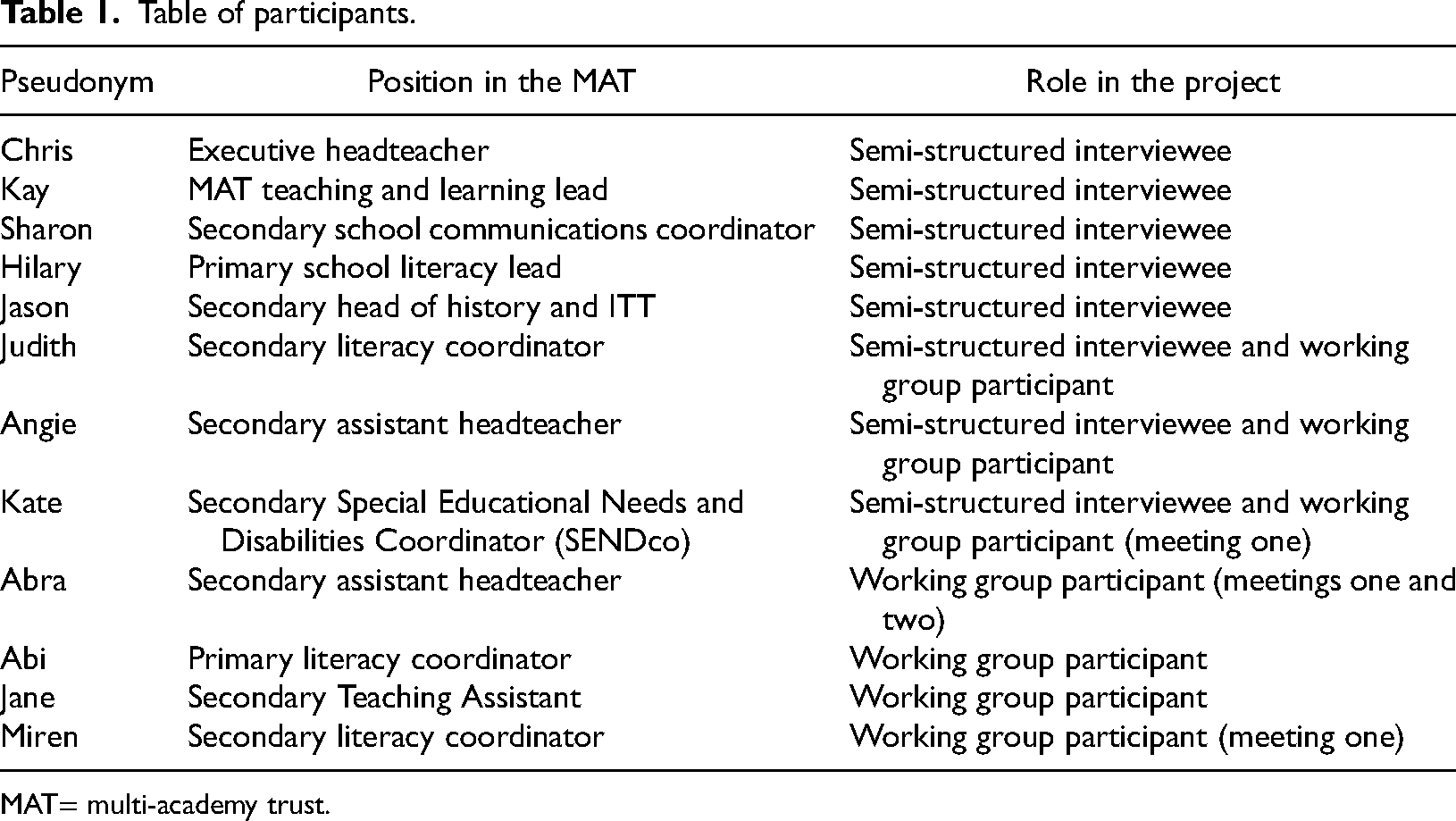
MAT= multi-academy trust.
Multi-Academy trusts
MATs are corporatised structures conceived by the Department for Education (DfE) to replace key organisational and developmental functions of local authorities in England. Comprising two or more academies, MATs are currently privileged in education policy as the primary site and producer of ‘system leadership’ (Courtney and McGinity, 2022). An academy is a state-funded independent school, and a MAT consists of two or more such schools, although the ‘multi’ in MAT is ‘a legal illusion’ (Courtney, 2015: 809) since constituent academies have no discrete legal status. Currently, over half of English pupils attend academies, while 80% of academies are in a MAT (gov.uk, 2023), with numbers set to grow. (Multi-)academisation operationalises the ‘neoliberal rationality’ (Kulz, 2021: 66) behind ‘hollowing out’ (Wilkins, 2017: 171) local government under the guise of granting education providers more autonomy over decision making (Glatter, 2011). This autonomy is largely illusory (Salokangas and Ainscow, 2018); MATs are often more prescriptive than local authorities. The number of academies and MATs has been expanded significantly under subsequent successive Conservative administrations (2015–current) and total multi-academisation was a key governmental policy objective (DfE, 2022). Despite the legislative failure of that policy, parastatal policy intermediary organisations such as the Confederation of School Trusts have adopted entrepreneurial and advocacy roles regarding multi-academisation (Gunter and Courtney, 2023).
Leadership in multi-academy trusts
In this section, we adumbrate how research literature on leadership in MATs broadly began with a focus on what is commonly labelled the Chief Executive Officer (CEO) role and has since started to explore what is identified as leadership across these multi-site organisations, predominantly using system leadership as a lens. We suggest that the original definition of system leadership—i.e. that happening across institutions (see e.g. Pont et al., 2008) means that rather than system leadership being a label to conceptualise some practices within a MAT, system leadership is defined or definable as any vaguely leaderful practice happening within a MAT (see e.g. Gibson, 2018; Simon et al., 2021). This produces definitional imprecision that is arguably politically useful and is a precursor to our argument that other practices, here, micro-political practices, may be misrecognised as system leadership.
Focussing on MAT CEOs
System leadership began as a proposed mechanism to improve schools that focused on the potential contributions of successful leaders working across multiple sites, and so was a key ingredient in the ‘self-improving system’ model. Such system leaders, working across schools, were first in line to become MAT CEOs, since they had demonstrated that they were committed to the success of all schools and their students, not just the leader's own, and [were] willing to act on that commitment by working with others so that the whole system benefits. (Hargreaves, 2011: 24)
Multi-academisation's powerful new actors—CEOs—oversee the MAT's executive functions and are accountable to corporate trust boards. They represent an evolution of the system leader, one that is most privileged in policy. They are policy entrepreneurs who enact the state's agenda for system-wide improvements (Courtney, 2017; Hughes, 2019, 2022; Hughes et al., 2020; Courtney and McGinity, 2022) owing to pressure to bring about school improvement in cost-effective ways while expanding their organisations (Baxter and Floyd, 2019; Greany and Higham, 2018; Simon et al., 2021; Wilkins, 2017). The price of failure incentivises MAT CEOs to control their organisations closely (Ehren and Godfrey, 2017), including through data metrics (Wilkins et al., 2020). They engender cultural standardisation through ‘vision work’ (see Courtney and Gunter, 2015), with larger MATs commonly having ‘concentrated power’ (Wilkins, 2017: 177) that results in homogenised curricula (Innes, 2021, 2022). Some even show a form of messianic leadership (Courtney and McGinity, 2021), predicated on personal charisma and followers’ faith.
Expanding system leadership beyond the MAT CEO
Once located in MATs, system leadership has spread from the MAT CEO's activities to encompass activities and relations by multiple persons of authority within a MAT. These relations may vary, from strictly regulated by the CEO to more collaborative. Greany and McGinity (2021) note that the beneficial standardisation of a ‘machine’-like approach (p.327) may prompt a lack of trust. They find that centralisation is not therefore universal; some CEOs allow either school autonomy or more subtly ‘aligned’ approaches (Greany and McGinity: 327). Crucially, initiative adoption is ‘voluntary’ (Greany and McGinity: 321), meaning that MAT ‘leaders’ must actively develop and influence policy enactments through power relations. A MAT CEO in Innes (2021: 345) reported that ‘our organisation is not a democracy… but that doesn’t mean that we don’t listen’: this speaks to the importance of intra-MAT influence as an operationalising mechanism. Constantinides (2021a) agrees, arguing that intra-MAT policymaking happens within a ‘complex ecology […] of micro-, meso-, macro-, exo- and chronosystems (p.688)’. Our reading leads us to suggest that system leadership has become the apparatus privileged in education policy and practice that consequently mediates understandings of these activities and ecologies of power. Through system leadership, intra-MAT influence is therefore not only articulated, but legitimated. We have suggested that system leadership has become normative in MATs: this has enabled a shift from understanding system leadership first as a possible mode of joint action within a multi-sited education institution such as a MAT; through positioning its use second as discursively compulsory in such institutions; to third, understanding any practice within such institutions as exemplifying a form of system leadership.
Micro-politics
We focus on what Ball (1987) termed careerist ‘strategies and ploys’ (p.168), in which school actors assert and protect their varied vested interests, including career advancement (pp.166–190). Personal reputations were deemed paramount, and Ball (1987) wrote of ‘getting the attention of superiors’ as a means of ‘getting on’ (pp. 169–170), which may create tension with colleagues. Moreover, ‘goal diversity’ among the staff under the headteacher's control was seen by Ball as being ‘allow[ed] for’ and ‘reproduced’ by the system of ‘sub-units’ (1987: 11) that operated within schools, for instance, through different subject and curriculum areas; houses; and year groups. Achinstein (2002) has similarly seen teacher ‘collaboration’ rather as a site of conflict, evidencing further the complex ‘multi-dimensional’ influences on micro-political power in schools (Malen, 1994).
We intend building on Blasé and Blasé's (2000) insight that micro-politics is central to policy enactment in education. We suggest that school actors are mostly engaged in what they see as purposeful activity when they invoke system leadership. However, we argue that in MATs, this activity is often micro-politically enacting localised policy. This makes micro-politics central to system leadership, which is our main argument.
The research project
Our analysis reports on data from the Literacy Policy Project, which is a case study investigating the micro-politics of literacy policy enactment in a MAT, anonymised here as Factum Education Trust. The MAT consists of five primaries, nine secondaries and one sixth-form college. The schools are diverse in their intake and achievement profiles. The research questions asked: what is the literacy policy of the MAT; how is literacy policy developed in the MAT; are micro-political strategies and ploys useful in understanding the development of literacy policy in the MAT? To answer these, semi-structured interviews with diverse post-holders across Factum were undertaken on: the existing literacy policy of their organisation; their role in creating literacy policy and the challenges in enacting literacy policy. Three unstructured observations were undertaken of a literacy policy working group that was devising a new trust-wide literacy policy. Twelve participants took part, with an overlap between observed and interviewed participants. Those who took part are presented here in the table of participants (Table 1):
Of the participants, Kay and Sharon both worked for the same school; as did Angie, Jason and Jane. Otherwise, the participants came from across the MAT. To move from data to analysis, transcriptions were highlighted and annotated to identify instances of what Ball (1987) might term micro-political ‘strategies and ploys’ (p.168), which we interplayed with the dominant policy and discursive framing of system leadership.
MAT practice as system leadership by middle leaders
Our data supports our argument that practice in a MAT by those constructed as ‘leaders’ largely happens within a system leadership discursive framing. For instance, interviews with primary school literacy coordinator, Hilary, and secondary school communications coordinator, Sharon, reveal the sharing of strategies across the MAT's schools leading to common approaches which, we argue, evidence system leadership.
Hilary
Hilary's transcript revealed that both intra-school and inter-school networks within the MAT were key in her decision making as a literacy coordinator. She describes collaborating with a ‘reading team’ consisting of three key post-holders in total. She reported that decisions on school literacy policy are taken ‘jointly’, but with policy ideas often ‘generated’ from ‘faculty network’ meetings involving other literacy coordinators or English leads from the MAT. She valued this network approach; her headteacher ‘trusted’ her to make decisions and that she had ‘autonomy’, but having the network and team meetings was ‘supportive’ and useful to her in justifying a new literacy initiative.
How such networks function was exemplified by Hilary's choosing a new synthetic phonics programme for her school. Her primary school had recently purchased a phonics scheme called ‘Little Wandle’, following the DfE reading review (DfE, 2021) which demanded consistency of phonics-teaching approaches. The Little Wandle package had been used elsewhere in the MAT, who had shared ‘which phonics scheme they’d picked and why’ in meetings, which directly informed her decision to adopt this package. Furthermore, Hilary had visited another school in the MAT to ‘see how they’re doing communication language in their early years setting’. In turn, Hilary's school received visitors from elsewhere in the MAT ‘looking at how we’ve run provision in early years’. This ‘cross-school support’ was seen as sometimes bringing in a ‘different perspective’ which also leads to borrowing literacy policy from other schools. Meeting other leads to ‘talk about what we’d seen that was working’ and ‘present’ and ‘give feedback’ on issues was seen by Hilary as being key in ‘the journey’ her school had travelled from Ofsted ‘special measures to good’. Hilary's perceptions here are that networking was taking place at school and MAT level, and that it had brought improvements.
Sharon
At secondary level, a similar picture emerged. Sharon discusses the influence of inter-school networks within the MAT in purchasing literacy interventions and packages to assess reading levels. Her school had used a programme, Accelerated Reader, which tested pupil reading, and matched reading levels to specific books. However, when doubts arose around cost and accuracy, she discovered through her senior leadership team that ‘loads of schools’ in the MAT used an alternative, the New Group Reading Test, which enabled a bulk purchase at a better cost, and so she proposed a move to that to her line manager which was followed through. Again echoing Hilary's account, Sharon spoke of operating in intra-school teams. In her case she worked jointly with ‘the inclusion team as well the TAs and SENCO and everything’ and that as line manager of the school librarian also, they would all work together ‘closely’ on literacy ‘interventions’ which would be rolled out across the school. This would be achieved, she said, by speaking with ‘middle leaders’, in this case heads of department, and ‘identifying where the reading and vocabulary and oracy are within their subject’ and ensuring that they ‘map those into their medium-term planning’. Like Hilary, Sharon's perceptions here are that sharing of perceived ‘best practice’ was occurring in the MAT in a way which was successful.
MAT practice as micro-politics by middle leaders
In this analysis, we examine more deeply exactly how the development of literacy initiatives normally occurs in the practices of middle leaders by using theories of micro-politics (Ball, 1987) to think about the data.
Judith
Data from a secondary school literacy coordinator, Judith, evidenced a high level of micro-political activity in the MAT. Like the other middle leaders interviewed, Hilary and Sharon, Judith placed an emphasis on teams in discussing her practice as a literacy lead. She described in her interview how she worked on reading initiatives with her school Pupil Premium Coordinator and a ‘Learning Lounge’ coordinator. In terms of a micro-political strategy, this banding together of educational professionals with shared interests can be considered an example of a ‘coalition’ (Bacharach and Lawler, 1980). Between the coalition of coordinators, they came up with initiatives which they ‘agree on 90, 95% of the time’. If these were small-scale and didn’t affect other curriculum areas or timetabling, therefore avoiding micro-political conflict, then they could ‘crack on’ with them.
Where Judith differed from Hilary and Sharon was in how she perceived that the autonomy of middle leaders responsible for literacy only exists up to a point, with data evidencing that the schools in the MAT remain extremely ‘hierarchic’ (Ball, 1987: 9). Judith lamented the fact that if there are ‘big changes’ proposed then she must go to her line manager, and she expressed frustration that decisions can take anything from ‘a few weeks’ to ‘the next academic year’. She described the process of agreeing policy change as a mixture of ‘informal’ then more ‘formal’ discussions, which is both the essence of micro-politics (Ball, 1987), and supports Constantinides (2021b) idea of a ‘complex ecology’ of activities in MATs and which is ‘fluid’ in the way described by Baxter and John (2021).
Judith also voiced dissatisfaction with the fact that sometimes not enough time is given to new initiatives to show impact, stating ‘it's quite difficult sometimes when it's your little baby that you want to nurture and cherish’ but there is ‘pressure’ to be able to show ‘impact’ quickly in order to keep initiatives running for any length of time, or with full commitment. Sharon also spoke about time as being in short supply for what she saw as the ‘big job’ of delivering literacy interventions in her school, but she expressed less frustration in this respect than Judith. The influence of time constraints also supports Constantinides (2021a) view of MAT policy making as being heavily time contingent and places a further restriction on how policy can be enacted.
Perhaps because of these conditions, there was evidence of micro-political conflict between middle leaders in Judith's transcript. In discussing her role as literacy coordinator, Judith's data evidenced conflict very strongly. Although she initially described literacy as a ‘school priority’, she quickly backtracked to say, ‘having said all of that, I don’t actually have a budget’. She then explained how this left her in the position of having to find money from ‘elsewhere’ such as the Pupil Premium fund or the Learning Lounge budget, but ‘sometimes their coordinators have other priorities’, evidencing ‘goal diversity’ (Ball, 1987: 8). She described, for example, having to ‘fight’ for a subscription to an online newspaper for young people popular among students, while the Learning Lounge has subscriptions to online encyclopaedias which she feels are not as well used.
Later on in the project, Judith joined the literacy working group meetings, arguably because she saw this as a rare opportunity to be heard in the MAT, and she used this opportunity to share, with some success, her favoured strategy of ‘disciplinary literacy’ which aims to engage subject leads and their pupils with the call to ‘write like…’ someone in a specific job role. Data from Judith's interview transcript suggests that typically, however, school middle leaders with responsibility for literacy can lack both the status and power to do all that they want to, and consequently are kept by the hierarchy focussed on micro-level initiatives. They are forced to band together as a strategy to overcome this, but this can, almost inevitably, result in compromises (Bacharach and Lawler, 1980) and disagreements over what to prioritise. Further, any initiatives they do formulate must quickly demonstrate measurable impact. Therefore, at middle leadership level, ‘strategies and ploys’ (Ball, 1987: 168) are aimed at tactically enacting the will of headteachers and trust leads, with few resources or time to embed more meaningful long-term strategies.
Data from Judith's transcript could be said to contrast markedly with Hilary's account in the previous analysis, as she appeared to have a relatively high level of status and power within her school. As demonstrated in the previous analysis, Hilary perceived herself as a key decision maker in how her school responded to a potential threat from Ofsted in how she went about deciding on a phonics package for the school. Hilary's transcript also evidenced micro-political activity, but she arguably experiences more success with this than Judith. For example on a curriculum re-write, she stated that her headteacher ‘came to me and said this is what I want you to do […] but I’ve brought in something a little bit better… and he's said great’. In this example, the headteacher remains the key ‘change agent’ (Ball, 1987: 30), with the middle leader steered, but granted licence to develop literacy policy. Hilary's seizing of the chance to offer improved solutions could be seen as acting micro-politically as she looks to increase her status with her head teacher based on her expertise in reading or literacy. This contrast between Hilary's seeming success in asserting her power with her headteacher, and Judith's more downbeat, reactive, testimony, suggests that micro-politics is a decisive feature in the MAT to how individuals perceive their roles and careers.
Chris and kay
Equally revealing is how micro-political activity by middle leaders is received by senior leaders within the MAT. Data from Chris, an executive headteacher at the time of interview but also previously a headteacher in the MAT, evidenced that senior leaders were aware of, and recognised micro-political strategizing by teachers and middle leaders. Recognition of micro-politics was apparent in his data when he said rhetorically to the interviewer, ‘you know how the staff room works’. He explained that some people will ‘want to get on as quickly as possible’, and that could sometimes lead to them being ‘forthright’ and looking to create new initiatives ‘because it's being seen’, rather that something ‘pure’ which he saw as being more in line with ‘Trust values’. The data from Chris revealed that this was tolerated to an extent, and that such activities would only be discouraged if they were ‘quite fanciful’ or ‘self-indulgent’. Micro-political activity by middle leaders is therefore ‘allowed’ in the MAT, but only up to a certain point, and it must be subtle to succeed. MAT teaching and learning lead Kay too spoke of autonomy being ‘rationed’ and ‘earned’, evidencing monitoring of micro-political activity being one of the job roles of senior leaders in the MAT.
Both Chris and Kay detailed that the MAT executive leadership team regularly held ‘strategic meetings’. These involve executive directors and executive headteachers; and MAT leads for ‘curriculum’, ‘assessment’ and ‘teaching and learning’ selected from school senior leaders forming a group of about twenty people who set policy agendas. ‘Curriculum’, ‘assessment’ and ‘teaching and learning’ are the key policy strands within the MAT. Both Chris and Kay expressed that the sharing of policy ideas relating to curriculum, assessment, or teaching and learning across schools was a central purpose of the strategic meetings. Kay described how an executive lead from one school might present on an initiative perceived as having been successful for them, which leads to it being rolled out across other schools. Chris, whose role involves supporting and mentoring four headteachers in the MAT, discussed a typical strategy to drive improvements; ‘sometimes what you have is some departments who run away with it, and do really great things. And it kind of embarrasses those that don’t. So, it kind of brings in a rising tide, lifts all ships’.
We assert that such approaches exemplify common understandings of system leadership, the push for continuous improvement from the ground up. Further, we also propose that system leadership is operationalised through the strategic meetings. However, as we suggest here, micro-politics is central to who succeeds within the MAT. This is further exemplified in our next analysis, which shows how two senior leaders operate micro-politically.
MAT practice as micro-politics by senior leaders
Abra
A key player in the project was assistant headteacher Abra who works at one of the higher performing schools in the trust, and who was referred to as having met with Sharon in the previous analysis. Understanding how Abra operates is, therefore, important to understanding system leadership, and micro-politics, in the field of the MAT. Abra was not interviewed individually, but joined the first two working group meetings. Prior commitments meant she was unable to attend the third meeting. Transcript data from these meetings demonstrated how Abra was able to use the networks aimed at operationalising system leadership in the MAT to act micro-politically.
Abra was keen to emphasise to the rest of the group how their oracy focus could essentially make the MAT ‘distinct’ from other MATs. Abra spoke of the fact that although the Ofsted framework had ‘reading everywhere’, in her school they had developed ‘lit-oracy’, which she now wanted to see used elsewhere. She expressed that the term was meant to convey a message that ‘oracy is at the heart of everything’. Creating almost a brand name complete with a tagline could be considered an example of GASing (Ball, 1987: 169–170), gaining the attention of superiors, by making something memorable, and positioning her strategy as central.
Oracy was positioned as being beneficial to children's reading and writing, yet how this occurs was never clearly articulated. Data reveals that the strategy was primarily promoted by the means of an acronym, SHAPE standing for: ‘speak in full sentences; hands away from your mouth; articulate, don’t mumble; project your voice; eye contact’. None of which pertains to the content or purpose of what is being spoken, and other researchers have written critically of oracy initiatives as being examples of ‘language policing’ (Cushing, 2019) and ‘disciplinary English’ (Cushing, 2021) arising from a prescriptive culture. The literacy strategy was therefore, despite being positioned as radical a retrogressive ‘New Right 2.0’ (Watson, 2021) pedagogy aimed at encouraging Standard English and behavioural compliance. In the meetings, the assembled teachers, some of who were English specialists acknowledged the need for different registers among their students. However, this did not lead to a questioning of the oracy strategy. Doubts appear to have been cast aside.
Abra evidenced deep thinking about the different audiences for the policy she had developed; and how to overcome, or sidestep, potential objections to it. She stated to the rest of the group about the oracy work within her school: ‘Mine is an interesting case, because I haven't had it ratified by governors because I feel like it's a working document’. She feared that once a policy is in the hands of governors, it would become a ‘static thing’, which she has then lost control over. Further, to succeed she knew that ‘to make it governor friendly […] the language will need to be less teacher-y’. Abra's solution was therefore to essentially circumnavigate her school governing board by gaining trust-wide support. Significantly, Abra recognised that getting her vision for literacy ‘signed off’ as part of the trust literacy policy at the ‘top level’ would ‘ensure that it happened in every school’. In her words she saw trust policy as being ‘like EU law’ with school policy ‘like UK law’, ‘subservient’ to it. She expressed a belief that having something enshrined by the trust would then make it ‘every headteachers business and they’ll make it everyone else's business’. Creating a recognisable strategy and being seen as ‘the oracy woman’ has strengthened Abra's position within the MAT. However, she also recognises her inability to purposefully enforce it with headteachers and governors alone. Therefore by joining the literacy working group, and seeking to influence the development of trust policy, she is further cementing her position through a ‘coalition’ (Bacharach and Lawler, 1980). Data from Abra's contribution to the working group meeting evidences that being able to operate micro-politically is key to succeeding in the MAT.
Angie
Recently appointed assistant headteacher Angie was both interviewed in the early stages of the project and attended all three of the working group meetings. In her interview, Angie, who works at one of the more disadvantaged schools in the trust, stated she was ‘brought in’ specifically for her experience in driving literacy improvements in a previous school. Literacy was, therefore, directly linked to her field position in the MAT. Data from her transcript evidenced that, like Abra, she very much sees literacy as micro-political vehicle, and she looks to use the networks in the MAT to advance her position.
Angie's strategy in her first term was to almost immediately exercise her field position by setting out to ‘baseline 100% of staff in under four weeks’ via ‘no-notice learning walks’, to be repeated throughout the year. Angie is systematic about how she seeks to demonstrate impact to her headteacher. She described adding data to a ‘tracker’ with different ‘strands’, one of which is ‘literacy’ to evidence ‘a trend of improvement’. Ball (1987) might have called this ‘GASing’ (pp. 169–170), as Angie, quite reasonably, looks to gain advantage, in the first instance, with her new headteacher.
Ball (1987) also recognised that such strategies can cause conflict with colleagues, and Angie's data supported this. She expressed frustration at ‘working with humans not robots’, lamenting the CPD time needed for teachers to effectively embed her strategies. In particular, she referenced challenges from the school SENDco over the tight timescales proposed for ‘data captures to measure impact’. Arguably this could be an indicator that not all staff believe in her methods and are possibly trying to subvert (Blasé and Bjork, 2010) the techniques she looks to implement, whether consciously or not (Blasé, 1991).
Angie's data evidenced that she is as every bit as skilled a micro-political strategist as Abra. Angie recognised that her learning walks could be seen as critical or combative. Therefore, to mitigate this she also subsequently invited 10 teachers from different departments to become ‘literacy champions’. In doing so, Angie too is actively building a ‘coalition’ (Bacharach and Lawler, 1980) of expert literacy practitioners, as designated by her.
Angie's micro-political strategies were shown to be successful. This was evidenced by Jason, a history teacher and head of ITT, who was unable to be interviewed individually due to time constraints but sat in on Angie's. He spoke of being part of Angie's team of literacy champions as a ‘rewarding initiative be part of’ and outlined his new role working to improve literacy teaching in other departments. Angie, therefore, cleverly used literacy directly as a tool for exercising her position in the school and was micro-political in working to show self-reported, measurable, positive impacts for the changes she has initiated. Her team of ‘literacy champions’ meant that, in her words, ‘no one can turn around and say no’.
Angie's expressed goal was for her school to be seen within the MAT as being successful with literacy. She exhibited strong belief in Ofsted inspection gradings, speaking of the schools ‘trajectory from good to outstanding’, and feelings of ‘rivalry’ with other schools within the MAT. In the working group meetings, Angie put forward her idea for ‘literacy champions’ to be used in all schools. Angie recognised that achieving perceived school improvement, with her literacy initiatives central, would offer the opportunity to ‘deliver training’ across the MAT. She is aware that she does not yet possess the capital within the organisation to do this, but literacy offers a vehicle for developing it, and quickly.
Conclusion
Hargreaves’ (2011) motivation for positioning system leadership as normative was to create what he called ‘healthy competition’, which he wrote “displaces the old cut-throat competition, under which one's own school got better at the expense of other schools. Is there a parallel here with Silicon Valley? Yes indeed, but in Silicon Valley the altruism of firms towards one another's success was a pragmatic move to boost the industry as a whole. The inter-school altruism motivated by distributed system leadership has a deeply moral base, and this difference is important.” (p. 25)
Footnotes
Declaration of conflicting interests
The author(s) declared no potential conflicts of interest with respect to the research, authorship, and/or publication of this article.
Funding
The author(s) received no financial support for the research, authorship, and/or publication of this article.
