




Abstract
The COVID 19 pandemic created new challenges for school leaders. They worked very long hours in difficult circumstances. Improvising and responding quickly to poorly timed central guidelines had an adverse effect on their health and wellbeing. Our mixed methods studies show that leaders’ pandemic work was largely directed to establishing new management routines as well as dealing with people. Henri Lefebvre's rhythmanalysis allows us to see that leaders managed their pre-, during and post-pandemic work by working ‘after hours’. The analysis suggests that tackling wellbeing and workload and developing more sustainable leadership careers requires a fundamental redesign of the ways in which leaders’ work is carried out.
Time has always been an issue for school leaders. Leaders’ professional associations argue that there's too little time to do required work (e.g. ASCL, 2023; NAHT, 2021). Leaders spend more time than they would like on school work. They don’t have enough time for educational leadership. They have less than desirable amounts of time to spend with their families. Working long hours is off-putting to potential applicants for the post. And working long hours means poorer wellbeing than is desirable. It is not surprising then that educational leadership scholars are often involved in time-focussed research (e.g. French and Daniels, 2007; Lavigne et al., 2016; Reid and Creed, 2023; Riley et al., 2021) or do research which raises questions about time (e.g. Cranston, 2007; Earley et al., 2002; Greany and Higham, 2018; Heffernan and Pierpoint, 2020; Skaalvik, 2020; Thomson, 2009; Thomson et al., 2003; Wang et al., 2021).
Current work on leaders’ time highlights the sheer quantity of work, its intensities and intensification (Creagh et al., 2023; Heffernan et al., 2022; Wang, 2021). Our paper seeks to add to the research on time by focusing on the importance of the rhythm of work. We draw on an empirical corpus which we began to amass in early 2021, immediately after the first period of lockdown in England. We examined the impact of the pandemic on leaders’ work, the time they spent on work, the kind of work they were doing, and the effects on their well-being and career intentions. We also bring a theoretical resource, Henri Lefebvre’s work on rhythmanalysis, to help explore our results.
Our paper is not presented in the usual sections – literatures, theory, methods, results and conclusion. Rather, we offer a sense-making narrative to explain how we came to see rhythm as important, while relating our work to the wider literature throughout. We begin by outlining our research and the set of time-related results that we sought to explain. We report our empirical data, presenting key themes about management and time. We conclude by discussing the salience of Lefebvre's notion of rhythm, eurythmia and arrythmia, arguing the continuities between pre-, during and post-pandemic work rhythms which suggest that leaders’ work is largely unsustainable.
The research: Leading during lockdown and beyond
Like many other researchers interested in school leaders and their work and wellbeing we were struck, at the beginning of the pandemic, by how much was expected of them, and the emotional and physical toll of crisis management (Beauchamp et al., 2021). We began a study which morphed into four iterative investigations (Full reports of the first three studies and the methods used are available on our website, https//schoolleadersworkandwellbeing.net). The first three projects were carried out in partnership with the two school leader unions in England, the National Association of Headteachers (NAHT) and the Association of School and College Leaders (ASCL) with whom we had existing relationships. Each project informed the design of the next, but data analysis and theorisation is ongoing. Here we draw only on the first two projects (see Figure 1). The third phase of the research, not reported here, focused on possible policy solutions (Greany et al., 2021; Greany et al., 2022; Greany et al., 2023), while the fourth has become a UK wide study of the sustainability of school leadership (https://sustainableschoolleadership.uk).
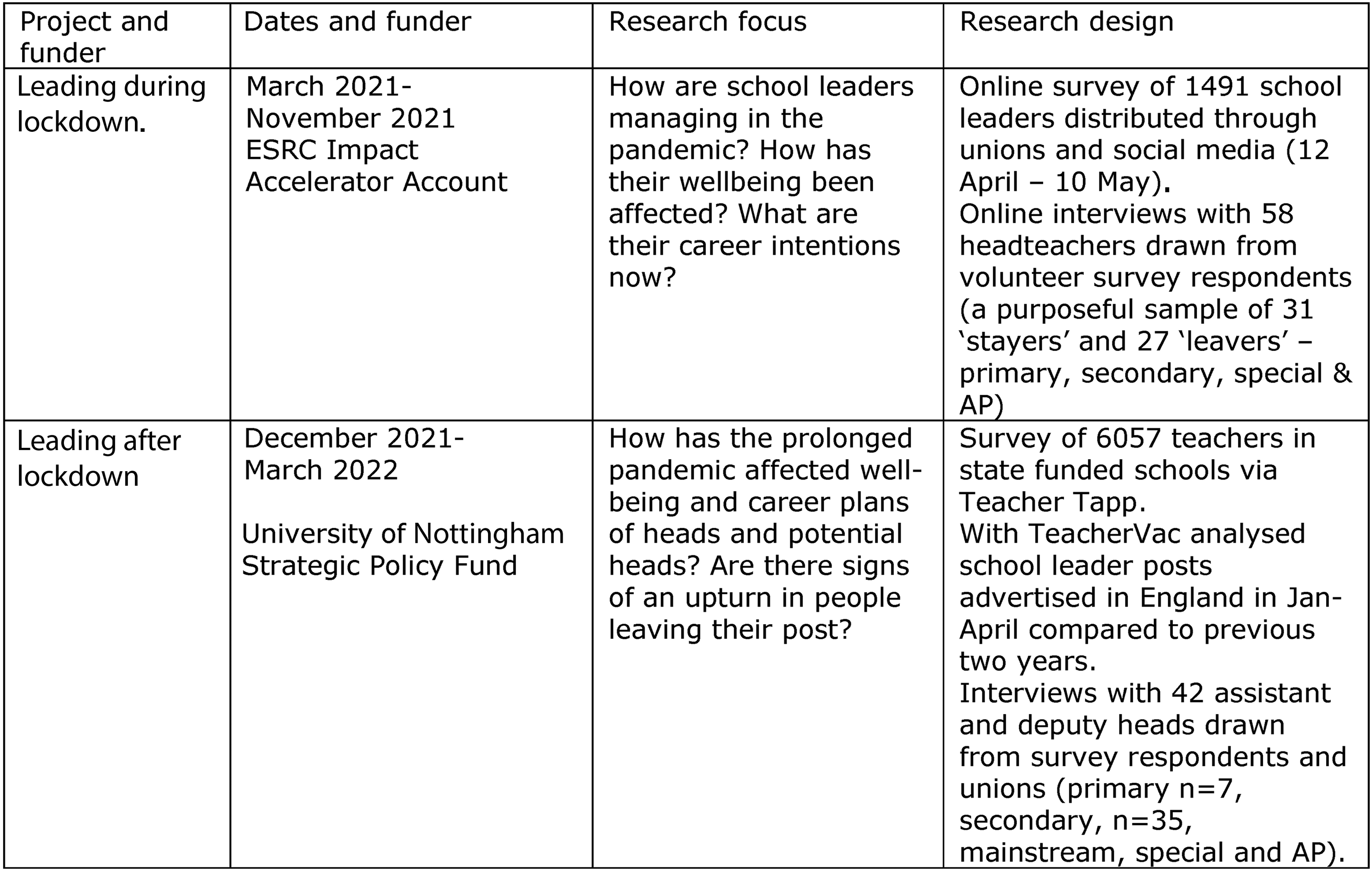
Research phases
The research followed a mixed methods approach (Plowright, 2011). We used surveys to establish patterns and semi-structured interviews which allowed for comparison as well as individual differences (King et al., 2018). The interviews were conducted online by three members of the research team. As we were dealing with potentially difficult personal-professional experiences, the research had enhanced ethical approval from the University of Nottingham Faculty of Social Science ethics committee. Full transcripts of each interview were thematised by two of the research team following the six stages outlined by Braun and Clarke (2021). Other team members were also engaged in re-reading transcripts to draw out further details about particular issues – the emotional intensity of the pandemic experience developed via transcript poems, (Thomson et al., 2023) and the question of systemic trust (Thomson et al., 2021).
We offer a reading of this data which focuses on the connections between wellbeing and work – its quantity, nature and intensity and patterning. Rather than results and discussion, we present our argument in three stages: (A) leaders’ work during the pandemic was achieved at considerable personal cost, (B) leaders’ pandemic work was largely about management and (C) drawing on Henri Lefebvre, the combination of intense overwork and negative wellbeing can be understood as arrythmia. We then consider the implications of this argument for understanding the work of leaders in the future.
Negative impacts of the pandemic on leaders’ wellbeing
Our first survey, conducted in spring 2021, had responses from 1,491 senior leaders in primary, secondary and special schools. We asked participants to rank the challenges during the first and second lockdown periods. Not surprisingly, participants reported major negative impacts on workload, health and wellbeing (Figure 2).
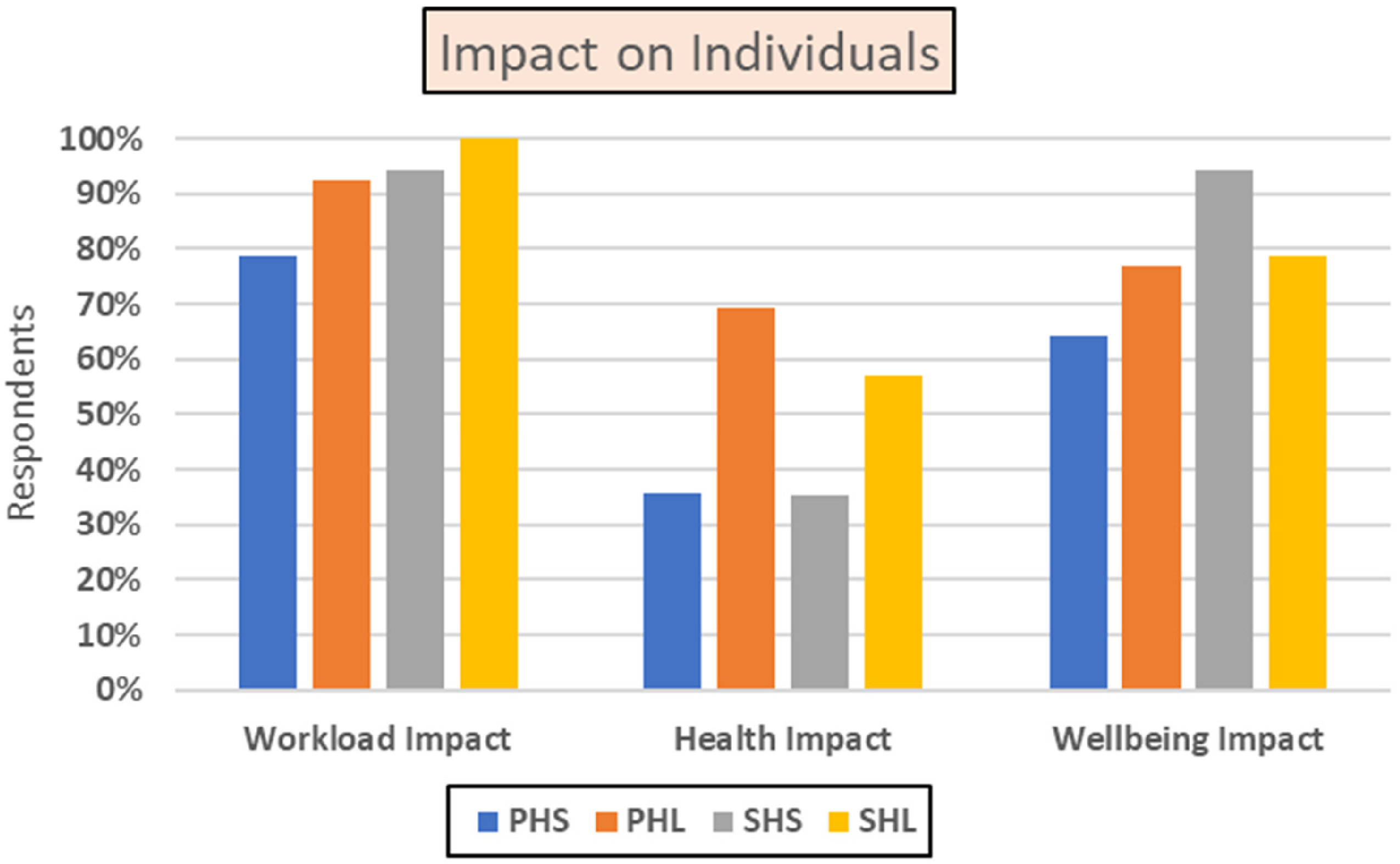
Major challenges of lockdown
The first survey showed that two out of five leaders were thinking of leaving the profession. By the time, we did the second survey (n = 6057 teachers and leaders, in early 2022) the figure had changed to one in three. Because the surveys also asked about career intentions, we were able to divide responses into primary and secondary head ‘leavers’ and ‘stayers’ (hence, in Figure 2, responses are differentiated between PHS - Primary Head Stayer, PHL - Primary Head Leaver etc.). The results suggest that secondary heads (SHS and SHL) felt more challenged by the workload during lockdowns whereas primary heads, particularly those planning to leave, may have felt a greater health impact. Those who reported the greatest negative impact on workload and health were a little more likely to consider leaving their post. The wellbeing responses perhaps also indicate that secondary heads who intended to stay in post were more likely to have concerns about their overall wellbeing.
The 101 interviews that we conducted with stayers and leavers from both phases (including both heads and deputy/assistant heads) provided more detail about the everyday work of leading during lockdown. Most interviewees were selected from respondents to the first survey, with a small number of deputy/assistant heads recruited directly, sampled to represent different school phases, types (academy / maintained) and Ofsted grades. Our interviewees reported working long hours, having no weekends and no holidays. The unknown and unpredictable nature of the crisis, combined with the very real health issues of students and staff in their care, added further to the pressure (c.f. Knight et al., 2023). Many leaders reported feeling out of their depth, despite sometimes finding the focus on care a welcome shift away from data and performance. At the same time, there was satisfaction in effectively managing the rapid switch to remote online learning and in responding to the welfare needs of their communities (c.f. Thornton, 2021). Nevertheless, many were considering leaving, and many of those who intended to stay queried how long they would be able to stay in the job (Figure 2). Interviews confirmed that decisions about whether to leave or stay were not fixed, and would thus be amenable to policy intervention at both local and central levels. (Hence our third research project, not reported here, looked at policy possibilities.)
There is little doubt that the pandemic equated to a prolonged disruption of schooling which is still far from over. School leaders bore the brunt of continued reorganisation (c.f. Da-as et al., 2023) and were unanimous in reporting that they spent many more hours working than pre-pandemic (see Figure 3). The work was intense and often described to us as ‘relentless’.
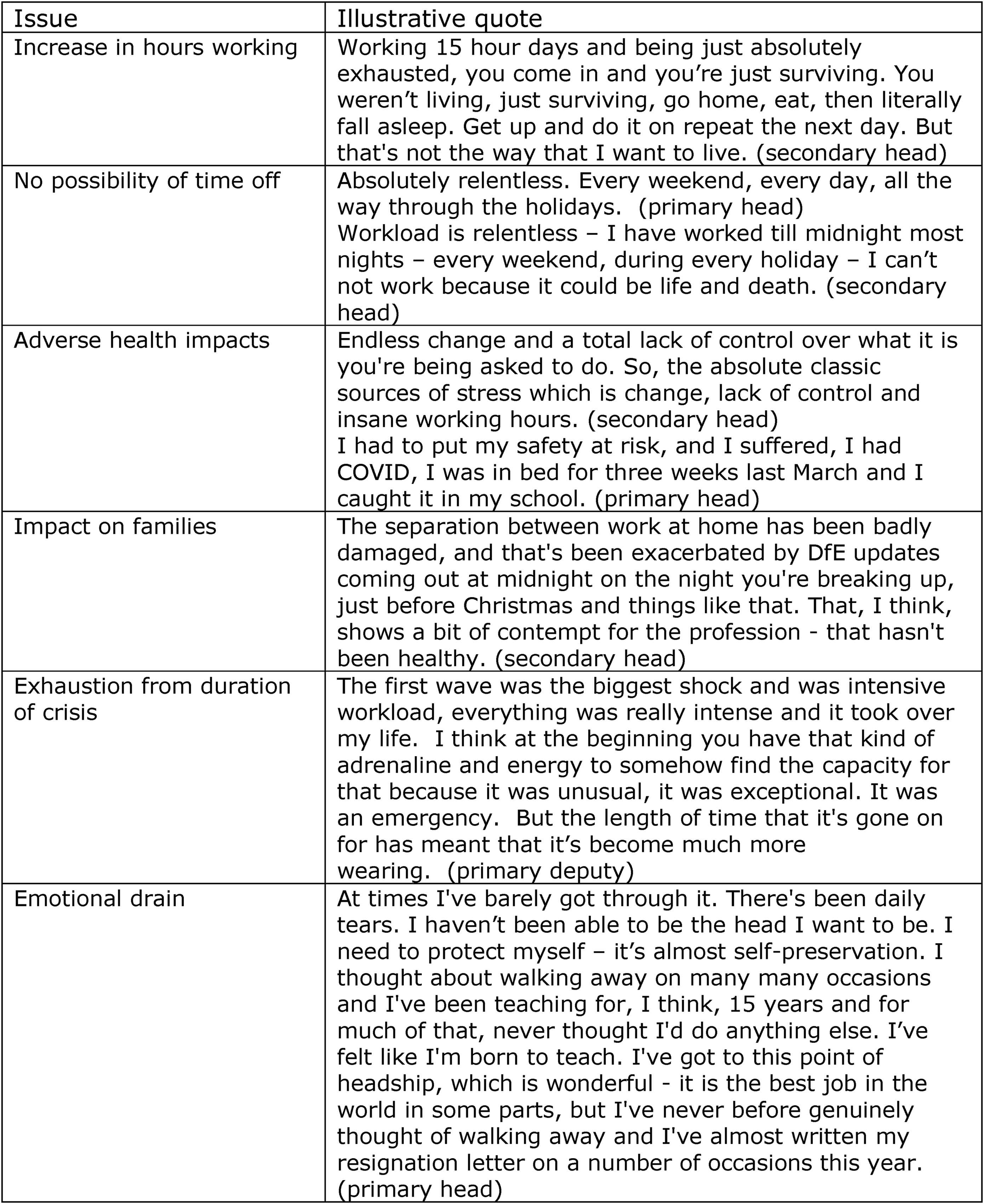
Lockdown leader impact
These adverse pandemic experiences came on top of decades of reports of leaders working long hours, difficulties in managing work-home-life balance, and less than optimal wellbeing (e.g. Earley et al., 2002). A recent English government report (Adams et al., 2023) used self-report diaries to show the extent of leaders' workload in one reference week in 2019. On average, school leaders worked more than teachers (56.8 compared to 48.7 with full-time leaders working on average 57.5 hours). However, four in 10 leaders reported working at least 60 hours a week, with secondary heads being more likely to work longer than their primary counterparts. The report also documents the reasons for these extended hours. Leaders most commonly reported spending too much of their time responding to government policy changes (68% reported this), while around half reported that they spend too much time on general administrative work (50% regarding administration within the school and 45% for administration with external bodies). (Adams et al., 2023, 14–5)
A quarter (25%) of teachers and leaders reported that they were considering leaving the state school sector in the next 12 months for reasons other than retirement. This was higher for teachers and leaders working in secondary settings (28%) and for non-ECT classroom teachers (26%). The most commonly cited reasons for considering leaving were high workload (92%), government initiatives or policy changes (76%), and other pressures relating to pupil outcomes or inspection (69%). (Adams et al., 2023: 14–5)
While the pandemic removed primary tests, all of the other issues listed in the DfE report remained and were intensified (Figure 4).
We asked ourselves what more we might say about time at and on work and wellbeing. We re-read our 101 interview transcripts looking specifically for time-related comments. The themes that we developed from this re-reading relate largely to questions of management.
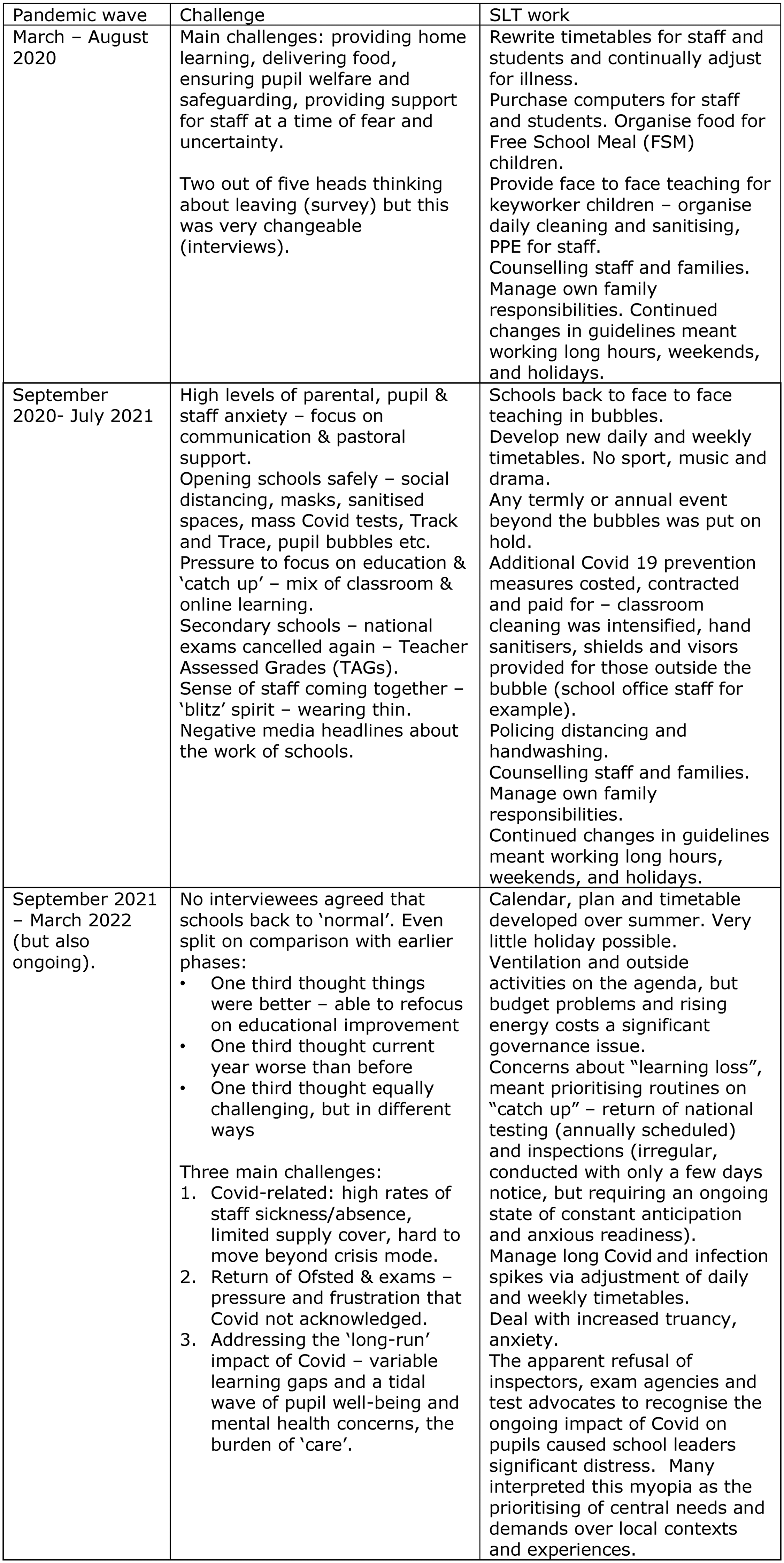
Three pandemic waves affecting management
The management work of leaders during lockdowns and beyond
Schools often refer to time-space organisation as planning. School planning is framed by a suite of central guidelines related to financial reporting and government payment schedules, term dates and the schedule of tests and exams. Planning creates routines, expected annual, termly, weekly and daily patterns that constitute ‘the grammar of schooling’ (Tyack and Tobin, 1994). Planning involves the management of bodies, space, time, social relations, actions and interactions, talk and texts. Planning creates rituals, and a sense of stability and security which can be reassuring, or stultifying, or both at the same time (Tyack and Cuban, 1995). We plan an academic year a year ahead. People get lead-in time to do it properly. And yet we're getting last minute vague and conflicting advice that goes against who we are - we are the sort of people who file and sort our highlighter pens by colour. (secondary deputy)
Because the pandemic disrupted schooling as usual, organisational matters took priority and became highly visible and crucial. We understood the work of school leaders as a protracted form of policy enactment, conducted in crisis conditions (Bradbury et al., 2022). Like other researchers we saw school leaders ‘surviving, navigating and adapting’ (Brown et al., 2023a). However, we also saw that during the pandemic school leaders’ work was dominated by management tasks. Leaders had little time to concentrate on school improvement, or what is usually thought of as leadership (c.f. Duff, 2021). Instead they were almost entirely concerned with managing. (c.f. Fonsén et al., 2023). I've not thought about teaching and learning for a long time. My focus has been trying to make sure I've got enough staff to cover classes whilst all the isolation rules are still in force. 23 staff off isolating out of 60. I'm now lunchtime supervisor! Everyone's doing different jobs. Supply staff are in short supply. (secondary head)
I'm used to doing 80% routine and 20% blue sky, new stuff. And for a long time it felt like that was switched. 20% was established and 80% was new and then it switched to being both. (primary head)
Furthermore, some of the management decisions leaders had to hurriedly make had no ‘right answers’.
Whatever you do, you've got the people who say it's not enough and the people who say it's too much and it's just an extra layer of complaints. (secondary deputy)
Guidelines often did not cover the most difficult decisions, such as when to send bubbles of children and staff home, a choice between disrupting learning for a majority of students and protecting them from potential illness (c.f. Sahlin et al., 2023). Unfamiliar management demands were high stakes.
I can cope with making decisions about attendance. I can cope with making decisions about curriculum, about behaviour because that's in my remit. I've trained for this, I can cope with making decisions about finance, about staffing. What I can't make decisions about is public health. (primary head)
Leaders’ concerns about their lack of knowledge suggest that, like teachers, leaders build reserves of understandings and repertoires of strategies which they use when they are in situations which demand rapid decisions and improvised responses. During moments of crisis they draw on what they know. However, during the pandemic prior knowledge was not an option (see Torrance et al., 2023). As Berglund et al. (2022) show, during the pandemic leaders often had to improvise (also Brown et al., 2023b). However, their improvised responses varied, with many of their actions being highly constrained and framed by externally determined policies. When and where leaders were able to be creative, the newly invented practices might well become more permanent features of their practice (Sahlberg, 2020). International research suggests for example that during the pandemic many schools were able to be innovative in their approach to home–school partnerships (Anderson and Weiner, 2023), approaches to economically disadvantaged families (Lee, 2022), networking (Rehm et al., 2021) and online learning (Martin et al., 2022), and these may become integrated into new leadership practices. However, much of what the leaders in our study were concerned with was related to new forms of pre-existing organisational structures – e.g. timetabling, budgeting, staffing, provision of food, maintenance and cleaning and provision of equipment.
Our research showed that the pandemic was not one undifferentiated period, but that school leaders experienced three waves, broadly mapping onto the academic calendar, each of which brought different management challenges. While leaders were in continued crisis management mode, the nature of the challenges and tasks changed significantly (see Figure 4).
The policy enactment literatures (e.g. Ball et al., 2011, 2012) demonstrate that central policy mandates produce both school practices and the time-space in which they are to be understood and implemented. During the pandemic, and across all three waves, leaders’ management was strongly framed by three key central actions:
Pace and timing of organisational demands were critical to how effectively leaders could manage
During the pandemic management challenges were exacerbated by the rapid spread of the virus as well as centrally directed decision-making pace – ‘the speed at which decisions had to be made about things we’d never done before’ (secondary deputy). The first two pandemic waves were a crisis situation in which last-minute advice became the norm (Fotheringham, 2022). The biggest challenge has been the last minute information and the last minute changes. For instance, I had written a full school timetable and we were told at the end of June, three weeks left in school, that there would be a whole new programme from September. (secondary deputy)
There was often too much advice coming in a short period of time, much of it in the form of amendments to advice just received, and decisions sometimes coming via media rather than direct to schools. Late decisions generally meant that the burden of planning fell solely on leaders, a matter of particular concern in primary schools where leaders’ work often combines the business management, school planning and educational leadership that bigger schools have the infrastructure to share out. Without exception all of the interviewees talked about the implications of last-minute advice for their work (c.f. Longmuir, 2023). We're still waiting for the guidance for September that is going to have to be actioned and put into play before we leave. If I want my admin staff to be doing all the paperwork that sits behind it… it's all going to come out when I've got no staff to do the work. (primary head)
People coming up with last minute information just really stresses us. I would have expected us by now to know what exam season next summer will look like so that we can be planning for it and supporting our young people who have had two years of disjointed education. The fact that is going to be revealed to us at some point in September I don’t think is good enough. (secondary deputy)
The use of the term “season” and the references to the usual timings of advice and leaders tasks highlights the importance of stable temporal patterns that constitute the school year.
Management expectations frequently changed, it was hard for leaders to set up any predictable routines
Interviewees repeatedly referred to the problem of rapidly changing advice which could mean planning virtually the same thing again and again; for example, there were moves between full face-to-face teaching and remote learning at very short notice. It was impossible to set up any regular pattern for the school because requirements kept changing. The beginning of the 2021 calendar year was a particularly sore point. Children have come back and then the very next day we are told to shut down. It is absolutely impossible to be running an institution, educating children, when there is this seeming inability to make decisions. (Primary head)
…being told to cover Easter break, then summer break and very confused messaging and just poor decision-making. We don't operate like that. Our school is very well run, and we can't operate with uncertainty. (primary head)
Nor could leaders accept centralised flipflopping particularly when it involved undoing decisions that had just been implemented.
They wouldn’t make decisions, we were left waiting, then had to implement things within 48 hours - PPE, putting all the signs up. I'd just bought all the two metre signs then they said it was one metre. (primary head)
Leaders contrasted their pandemic uncertainty with their more usual experiences, emphasising the importance of an organisation in which staff and students knew what they were doing, when and where.
Some central mandates were an almost impossible management ask
Managing time-space is subject to specific local delimitations. Schools with old buildings for example struggled to do what was expected. Large pupil numbers, small site. We didn't have enough rooms to be able to timetable the school with each of the bubbles having their own building and separate toilets. Transitioning back into school in the September of 2020 was difficult for a lot of staff to suddenly go from seeing no one to mixing with 900 students. And in a relatively old school, we've got very narrow corridors, we don't have a lot of teaching spaces around the school either, so trying to put in measures to make staff feel safe was more challenging in terms of the site. (secondary head)
Nationally set rules which don’t suit our context, for example, I didn’t actually think sending children home was the best way to keep our children safe, because they’ll be in each other's houses even more. At least in school I was able to get them to follow the rules and to keep apart. (primary head)
The micro-management employed by central government was seen as a lack of faith in the capacity of local school leaders.
It's hard to overstate how much harder they made an incredibly challenging experience by not trusting us and by being so over-directive and not allowing us to do what we could see needed to be done. (secondary head)
Leaders came to believe that the centre had no understanding or appreciation of their work or of what it meant to manage their organisations. Interviewees were almost unanimous in their view that if the DfE and government had understood schools and the work of teachers and leaders, their actions and words would have been more appreciative, their advice more timely, and their understanding of the appropriate locus of decision-making would have been different. School leaders’ sense of autonomy was entangled with their sense of efficacy, which meant being in control of how their school was organised.
Nevertheless, leaders did whatever it took to keep their schools going. And they did this by following the same pattern of work that they had used in non-pandemic times – working until the task in hand was completed. Christmas was insane. We had no holiday at all at Christmas, nothing. The plans changed four times over the holiday. The mass testing was utterly unreasonable. I mean, the idea that you were going to have it up and running, by Monday, the 4th of January, having been told two weeks before and the guidance only started really appearing on the 30th of December…. It was an absolute insult to the profession. (secondary head)
Once the main lockdowns ended and schools ‘reopened’ (of course, in practice, they had remained open for the children of key workers throughout), re-establishing pre-pandemic routines was a priority for leaders. They knew that regular lessons, lunch and break times were vital for students’ social and emotional wellbeing as well as for learning (Maag Merki et al., 2023). Leaders saw their post-lockdown tasks directed towards ‘always working’ – attending to ‘student behaviour, the lack of routine and getting back into that routine, and the combination of that, with staff absence and anxiety’ (primary head). Getting school back to predictable routines was vital, no matter how much work was involved, no matter how much workload it entailed. My school will always work because the teaching assistants, the admin staff, the support staff, the premises staff, the cleaners, the teachers, the middle leaders, to senior leaders and me, because we will not let it not work because we will not let the children not get 100% of what they need. (secondary head)
When I have spent an hour in front of the screen or I've been doing necessary paperwork, I will always make time at breaks and lunch times to go out and have a conversation with children. (secondary deputy)
Going out to speak with children reinstated a pre-pandemic pattern for this particular leader. Connecting regularly with pupils was a routine that they considered significant and wanted above all to re-establish. But this too came at a cost, as time spent away from the desk meant finding additional time later on to do the ‘necessary paperwork’.
Leader's arrhythmic work during lockdown and beyond – a preliminary discussion
Interviewees placed strong emphasis on re-establishing rhythms and routines following a period of ‘chaos’ for them, their staff and for children. One way to understand the tangle of pacing, predictable and unpredictable tasks, seasons, routines and organisational patterns, bodies and work and their impact on wellbeing is through the notion of rhythm. In order to conceptualise this, we begin by introducing the work of Henri Lefebvre on rhythm.
The idea of everyday life having rhythms is not new. It goes back as far as Plato, and features in diverse accounts of social life – from Plato to Rousseau, Husserl and Dewey, philosophers have discussed time and human life in relation to the importance of rhythms for a harmonious and good life (Adlhadeff-Jones, 2017). Rhythm features in diverse contemporary theories too – for example, explications of communities of practice (Wenger, 1998) often focus on developing regular practices which bring together members, cementing purpose and group identity (Wenger et al., 2002). A different example is found in the work of Deleuze and Guattari, who see rhythm as a vital power at the heart of lines of embodied experience, integral to affect and the individuation of the becomings that are accomplished in inter-assemblage relations (Deleuze and Guattari, 1987). Social science scholars across a range of disciplines have focused on rhythm-related issues e.g. ‘slow scholarship’ in ‘fast universities’ (Leibowitz and Bozalek, 2018), and some (e.g. Chen, 2017; Michon, 2005) have proposed rhythmanalysis as a distinctive epistemological-methodological research practice.
Time and rhythm have also been of interest to educational researchers. As Lyon puts it, a focus on time affords the opportunity to ‘explore the connections and influences between heterogeneous phenomena that may be simultaneously perceived or experienced as complementary, antagonistic and contradictory’ (Lyon, 2018: 3). We add causal to this list, as is the case in our data, where leaders assert a causal relationship between their wellbeing, career decision-making and organisational and social events in time/space.
We draw here on the idea of rhythmicity developed by Henri Lefebvre. Lefebvre (2004) argued that rhythm organised the everyday, (re)producing the social processes of life and labour. Rhythm was repetition – regular practices, events and interactions in a particular time/space that could be observed, heard and felt. But Lefebvre's notion of rhythm is not about universality of routines and practices, but rather about families of patterning – Lefebvre was interested in recognisable patterns that are not identical but able to be anticipated even if their exact form is not predictable. Lefebvre argues that No rhythm is without repetition in time and in space, without reprises, without returns, in short without measure [mesure]. But there is no identical absolute repetition, indefinitely. Whence the relation between repetition and difference. When it concerns the everyday, rites, ceremonies, fêtes, rules and laws, there is always something new and unforeseen that introduces itself into the repetitive: difference. (p. 6)
The antagonistic unity of relations between the cyclical and the linear sometimes give rise to compromises, sometimes to disturbances. … And it is their relation that enables or rather constitutes the measure of time (which is to say, of rhythms). (Lefebvre, 2004: 75)
In other words, while the experience of everyday life appears to be linear – one moment after another, one day following the next – it is also made up by a range of different cyclical patterns – routines. Chronological narratives, such as those told about the pandemic, are stories of linear experiences in which other time-space cyclic routines are enmeshed.
Lefebvre used rhythm not as a metaphor but as a concept which brought bodies, lived experience, relationships and organisational structures together as one. A common sense example can be found in ‘lunch time’. In English schools, lunch time is marked by a clock, siren or bell – it is an organisational routine which brings material (food), labour (cooks and servers), staff (lunch duty) and students together in a particular place each day. But lunch time is also embodied, bodies register hunger as the time approaches and if it is missed. Lunchtime is a bio-social-material event which is regular and routine – as a regular rhythm in the school day lunch time organises people, things, spaces, actions and interactions, texts and talk, experiences and affects.
Lefebvre argued that everyday life was comprised of multiple rhythms. The ideal everyday state is ‘eurhythmia’ where diverse rhythms are kept in ‘metastable equilibrium’ which in people equates to a condition of robust and sustainable health (Lefebvre, 2004: 20). Lefebvre argued that when rhythms work together people experience a sense of wellbeing and order. However, when rhythms are out of sync with each other, both the organisation and the people within it suffer from ‘arrythmia’. Lefebvre talks of a homologous relationship between the linearity of everyday life, an institution and the body. A disruption, or discordance as Lefebvre calls it, of any duration may lead to arrythmia, a ‘pathological state’ of ‘suffering’, of profound relational, visceral and affective distress (Lefebvre, 2004: 16). Arrythmia is haptic and visceral, Lefebvre argued. People experience arrythmia as tension, stress and feeling out of sorts. Just as an arrhythmic human heart can lead to serious illness, disruptions to the rhythms of work can create emotional responses such as fear and anxiety and, when prolonged, can lead to unhealthy bodies and a reduction in wellbeing.
Educational researchers have taken up the work of Lefebvre, looking at the general applicability of his theoretical approach (Middleton, 2016) as well as the particular benefits of rhythmanalysis when brought to inter alia: the embodied rhythms of ‘virtual’ learning (Leander and Hollett, 2017), the pedagogies of parenting (Hopwood, 2014) and the global inequities of education in the global South (c.f. Christie, 2013). Most pertinent to our paper however are non-education-based studies which examine the arrythmia caused by the pandemic – Lyon and Coleman (2023), for example, show that during the pandemic volunteer writers for the English Mass Observation archive foregrounded the importance of remaking routines when time is blurred, dissolved and merged. This is parallel to the reports made by school leaders of the importance of establishing recognisable patterns in the school day.
However, the work of Thorpe et al. (2023) speaks most strongly with our study. This New Zealand team examined the rhythms of women's work during the pandemic. They showed that the pandemic changed gendered working routines, with women shouldering much of the burden of home education and organising home working. This raised questions about the ongoing gendered home and work relations as, on examination, the ‘new’ pandemic arrangements were revealed as a variation and intensification of the ‘old’ pandemic ways of work/life. Thorpe and colleagues therefore claim that the pandemic shone new light and offered new perspectives on working patterns in both pre- and post-pandemic everyday life.
It is exactly this extension and intensification of pre-pandemic leader work that our rhythmanalysis highlights.
Towards a conclusion: how sustainable is arrythmic leadership work?
Our research attests to the extraordinary and new demands on school leaders made during the pandemic. However, we add to this body of work an analysis which demonstrates important continuities, in particular:
The management of time, space, people, resources and ‘the stuff’ (curriculum, pedagogy, assessment) are the foundation of schooling. Good management relies on the establishment of routines and predictable patterns which organise and underpin work, participation, actions and interactions and affects. School improvement relies on good management. The job of school leaders and their administrative team is to secure and sustain good management.
Our research demonstrates that the school leaders’ work was – but is always – both in and out of the school day. School time is more than when schools are open for teaching and meetings (Midha, 2021, 2023). When staff and students are in schools, leaders prioritise tasks that involve them (this is a well-established pattern, see Southworth, 1995; Wolcott, 1973). Administrative work is often left to times when leaders can work alone or in small management teams. This is very often ‘out of hours’ and generally includes working at home. (Teachers’ work also follows this pattern). During the pandemic, the organisational ‘out of hours’ demands were so great that there was often no time for even the accustomed brief holidays and weekends. This pattern of work is congruent with other professions – Nippert Eng's (1996) classic study of the home–work routines of laboratory staff showed stark differences between blue-collar technicians who worked regular hours and professional staff who worked until they had finished pressing tasks.
Leaders generally have a routine which includes both work at home and at school. As we reported earlier, the official data reports this as working 57.5 hours per week pre-pandemic on administrative tasks for the school and in response to government mandates. Our analysis, backed by existing government and union evidence (Adams et al., 2023; NAHT, 2021), suggests that pre-pandemic arrythmic work was the norm for a significant proportion of school leaders. But their in- and out-of-school extended hours routine was stretched and intensified during the pandemic – there was more to do, and much of it was new. Many more leaders experienced arrythmia, with as many as two in five thinking seriously about leaving.
Our paper brings Lefebvre's theorisation of rhythms together with the policy enactment literatures which holds that the extent and intensity of work in schools is profoundly shaped by external events, and by central mandates. The rhythmanalysis adds to policy enactment the understandings that sustaining the basic time/space organisation of schools depends on leaders’ work, but that time/space work is produced and reproduced as embodied routines. These leader work patterns can be eurythmic or arrythmic – more or less conducive to health and wellbeing as well as to smooth organisational functions.
We have argued that rather than see the pandemic as only making exceptional demands, there were also important continuities. Arrythmia as a feature of leaders’ work was consistent through pre-pandemic, pandemic and post-pandemic times, even though the actual tasks and time required changed. While there is more to be done to document the multiple rhythms and cycles of leadership work, there are fundamental questions to be asked about an education system that produces and depends on arrythmic work patterns in order to function. This systemic arrythmia is not simply the case for leaders, but also teachers.
Our analysis suggests that a fundamental examination of work in schools is required. Rather than relying of the removal of a few ‘red tape’ practices, supplying business managers who can only do some of what is necessary, or offering remedial programmes such as coaching and counselling, as necessary as these might be, it seems clear to us that more is needed. If a healthy state of eurhythmia is to be achieved, school leaders’ work, as well as that of other school staff, is well overdue for redesign. And this means attending to central demands as well as what happens on the ground.
Footnotes
Declaration of conflicting interests
The author(s) declared no potential conflicts of interest with respect to the research, authorship, and/or publication of this article.
Funding
The author(s) disclosed receipt of the following financial support for the research, authorship, and/or publication of this article: ESRC Impact Accelerator Account, and University of Nottingham Strategic Policy Fund.
