



Abstract
The present study aimed to investigate elementary school principals’ work from the ecological systems perspective and which elements of their work are experienced as demands or resources. Semi-structured interviews were conducted with 22 principals. Qualitative content analysis was used to analyse the data. The results show that the way principals experience their work is individual and influenced by several internal and external factors. Some of the most extensive demands appear to be related to interaction with different stakeholders in situations where principals have the role of mediator in solving conflicting situations. Challenges also seem to arise in dealing with elements or issues that principals cannot influence or have no control over. Principals’ current perception is influenced by their education, work and personal histories and future vision. The results also indicate that principals need in-service training concerning social interaction and human resource management, such as how to act in conflicting situations, interact with different personalities and get the entire school community to develop and work for common goals. In addition, our findings suggest that offering support to principals through, for example, mentoring programmes during their first years could reduce the pressures they face and help them concentrate more fully on relevant tasks.
Introduction
Principals juggle multiple responsibilities and work under increasingly stressful conditions (Darmody and Smyth, 2016; Drago-Severson et al., 2018; Elomaa et al., 2021). The way principals conduct their leadership influences students’ achievement, teachers’ well-being, teacher instructional practices and school organisational health (Liebowitz and Porter, 2019). In addition to managing all the work tasks, principals themselves need to be part of an ongoing process of learning and development if they are to meet the exacting demands placed on modern schooling and the needs of teachers and students (Gümüşt and Şükrü Bellibaş, 2020). Principals do not work in a vacuum: in addition to dealing with elements they cannot affect but which directly influence them (e.g. school context and publicity), interaction with different stakeholders on an everyday basis is an essential part of their work (Drago-Severson et al., 2018; Tintoré et al., 2020). Job characteristics such as job demands and resources affect employees’ health and well-being (Bakker and Demerouti, 2018). Moreover, employee well-being and organisational behaviour are functions involving factors positioned at various levels (i.e. organisation, team and individual levels), which influence each other within and over certain time periods (Bakker and Demerouti, 2018). According to Dadaczynski and colleagues (2020), increasing job demands and responsibilities can be regarded as a cause of the shortage of school principals and a possible reason for early retirement. Occupational stress is an inevitable part of school leadership (Burke et al., 2022) and, to some extent, a universal phenomenon as regardless of the cultural differences and diversity in the school system, the size of principals’ workloads and the lack of time to focus on teaching and learning are seen as two of the main causes of stress (Elomaa et al., 2021; Riley, 2020).
However, the research on how principals themselves perceive the resources and demands related to their work is limited and has concentrated more on the content of their work tasks or their role as leaders (e.g. Buonomo et al., 2020; Leithwood et al., 2020; Milley and Arnott, 2016) and less on their experiences as principals. Considering the high workload and rapid changes in principals’ work and the necessity that they receive the pest support possible to deal effectively with these factors, it is important to investigate principals’ own perceptions about their work and occupational well-being (Drago-Severson et al., 2018). The current study contributes to the existing literature by suggesting a framework which could be used to investigate principals’ work and leadership in a more personal manner. Therefore, in the current study, we aimed to shed light on principals’ insights into their work using the ecological systems theory (EST) of from Bronfenbrenner (1979, 1989) and to investigate whether they experience different elements of their work as demanding or resourceful by drawing upon the job demands-resources (JD-R) model.
Overview of principals’ practices
Principals face enormous implicit and explicit complexities in their work as they are required to deal with a variety of issues, such as distributing leadership, supporting everyone in their school community, adapting the Common Core and new evaluation systems and much more, all within accountability and sanction-driven context (Drago-Severson et al., 2018). Thus, managing multiple responsibilities and working under increasingly stressful conditions can result in lower levels of job satisfaction, increased occupational stress and burnout (Salmela-Aro et al., 2019) and have an impact on their occupational and overall well-being (Collie et al., 2020; Darmody and Smyth, 2016; Elomaa et al., 2021). Furthermore, being a principal can be a conflicting position, as despite experiencing significantly higher stress than the general population (Riley, 2015, 2017, 2020), some principals remain remarkably resilient while working in a turbulent environment and report high levels of job satisfaction (Darmody and Smyth, 2016; Hulpia and Devos, 2009). In addition to the wide variety of tasks included in their work description and external expectations placed on principals, numerous internal influencers and contextual factors affect the way principals perceive and carry out their work. Darmody and Smyth (2016) found job satisfaction and occupational stress to be related to a complex set of personal characteristics, working conditions and school context. The personal characteristics influencing principals’ work might be, for example, gender, age and length of service (Darmody and Smyth, 2016), health concerns (Elomaa et al., 2021) and internal dimensions of leadership (how a leader feels about the school, colleagues and themselves) (Drago-Severson et al., 2018). In addition, Leithwood and colleagues (2020) found that a set of cognitive (problem-solving expertise, domain-specific knowledge, systems thinking), social (perceiving emotions, managing emotions, acting in emotionally appropriate ways) and psychological (optimism, self-efficacy, resilience, proactivity) personal leadership resources can explain a high proportion of the variation in leadership effectiveness.
Clarke and O’Donoghue (2017) emphasised the importance of being sensitive to context while examining educational leadership. School context can be described through situated, material, professional and external dimensions (Braun et al., 2011) where ‘situated context’ is seen as a school's setting, its history and intake; ‘professional context’ includes values, teacher commitment and experience and policy management in school; ‘material context’ refers to stuffing budget for staff, buildings, available technology and surrounding infrastructure; and ‘external context’ concerns pressures and expectations as a result of the influence of broad local and national policies (Braun et al., 2011; Clarke and O’Donoghue, 2017). Correspondingly, in their review, Tamadoni et al. (2021) found the challenges related to the principal's role and actions to be linked to institutional and sociocultural contexts, different stakeholders and the responsibility to lead staff and teachers.
Theoretical background
To address the multidimensionality of principals’ work and to gain a deeper understanding of how principals perceive the different elements of their job and the complex sociocultural surroundings they work in, the present study, brought together two widely used theoretical models as a theoretical framework. First, Bronfenbrenner's (1979, 1989) ecological systems theory (EST) was used to describe principals’ perceptions of their work. This approach ascribes the active role to the developing person surrounded and influenced by multiple contexts in different sociocultural settings. EST emphasises reciprocal interaction between the active human organism and the persons, objects and symbols in its immediate environment, enabling us to describe principals’ work in its entirety. Second, principals’ experiences on different elements of their work are described based on the JD-R model (Demerouti et al., 2001; Schaufeli and Bakker, 2004). Compared with other theoretical models on work-related stress, such as Karasek’s (1979) job demands-control (JD-C) model and Siegrist’s (1996) effort reward imbalance (ERI) model, the JD-R model does not restrict itself to specific job demands or resources but rather assumes that any demand and resource may affect an employee's health and well-being (Schaufeli and Taris, 2014). Thus, the model has a wider scope and is more flexible. These two theoretical models have been used widely separately but the current study contributed to the existing research by bringing together the EST and JD-R models as the theoretical underpinning. Both theoretical models emphasise the relevance of interaction between a person and an environment and consider a person as an active agent in the environment who influences their own experience. Thus, they were considered as suitable for investigating principals’ perceptions of their work.
Bronfenbrenner’s EST
Current research draws on Bronfenbrenner's (1979, 1989) EST, proposing that the ecological environment is conceived as a nested arrangement of structures, each contained within the next. The conceptualisation of EST enables describing principals’ work through five systems (Bronfenbrenner, 1979) surrounding the person in the middle (individual level). First, the microsystem consists of the immediate relationships the principal has and everyday interactions among the school staff, students and parents. Second, the mesosystem comprises the interaction with and among different elements (Hujala, 2004) of their work. Third, the exosystem consists of elements with which the interaction is experienced as one-sided: superior, upper administrative level or resources, which is followed by the macrosystem including the overarching patterns and characteristics of a broader context in the society. Finally, the chronosystem consists of the changes happening over a person's lifespan that influence their experience at a particular point in time.
Principals’ work is connected and influenced by a variety of stakeholders and contexts (Pollock et al., 2015), which construct their work-related ecological system, depending on how the interaction is experienced by the principal. For example, they interact daily with their schools’ internal stakeholders, such as teachers, other staff members and students (see microlevel) (Prado Tuma and Spillane, 2019), in relation to human resource management and student affairs (Buonomo et al., 2020; Elomaa et al., 2021). Also, principals interact with external stakeholders, such as school districts, teacher unions, state educational agencies and students’ families as well as diverse community actors such as libraries and after-school programme providers (see meso and exo levels) (Prado Tuma and Spillane, 2019). In addition, principals’ work is influenced by interactions with upper-level policymakers and administrators as they function as a mediator of new policies and legislation that involve teachers (Tintoré et al., 2020).
Previously, EST has been used for conceptualising the contextual model of leadership in early childhood education (ECE) and defining the structural framework of the factors and actors related to leadership (Hujala, 2004; Nivala, 2002). The core of the contextual leadership model consists of the children, parents and guardians, childcare unit, local and state authorities and, finally, the whole society and its culture. In the present study, Bronfenbrenner's EST was used to address the complexity of principals’ work and investigate how principals see the different elements of their work.
Job demands and resources model
In the current study, our intention was to gain a deeper understanding of principals’ experiences in terms of their multifaceted job from the perspective of the JD-R model (Demerouti et al., 2001; Schaufeli and Bakker, 2004). The JD-R model proposes that high job demands lead to strain and health impairment, whereas high resources lead to increased motivation and higher productivity. In addition, the combination of high levels of resources and high demands increases the ‘motivational potential’ of the job and, hence, leads to work engagement (Schaufeli, 2015). According to Schaufeli and Taris (2014), job demands involve the physical, psychological, social or organisational aspects of the job that require sustained physical and/or psychological (i.e. cognitive or emotional) effort and are therefore associated with certain psychological and/or physiological costs. They noted that job demands can be, for example, cognitive and emotional demands, interpersonal conflicts, qualitative and quantitative workload, time pressure and work–home conflict. Job resources, in turn, are seen as those physical, psychological, social or organisational aspects of the job that reduce job demands and the associated physiological and psychological costs and are functional in achieving work goals and stimulating personal growth, learning and development (Schaufeli, 2015; Schaufeli and Bakker, 2004). Some examples of job resources are autonomy, knowledge, performance feedback, social support and trust in management (Schaufeli, 2015). In addition, Schaufeli and Taris (2014) added personal resources into the JD-R model, defined as the psychological characteristics or aspects of the self that are generally associated with resilience and refer to the ability to control and affect one's environment successfully. They also added that similarly to job resources, personal resources are functional in accomplishing work goals and stimulate personal growth and development.
Bakker and Demerouti (2018) noted that it is important to differentiate among different organisational levels (organisation, leader, team and individual) because the various stakeholders in an organisation influence each other. However, despite the growing awareness of the mounting pressure placed on principals, less is known about how school principals experience their work (cf. see Mahfouz, 2020; Niesche et al., 2021). Therefore, the current study aimed to investigate principals’ own perceptions of their experienced job demands and resources.
Aim of the current study
This study aimed to shed light on principals’ insights into their work from the ecological systems perspective and investigate which elements of their work are perceived as demands or resources by applying the JD-R model.
The more specific research questions were as follows:
How can principals’ work be described from the ecological systems perspective? Which elements of the system are perceived as demands and resources?
Methodology
Participants and procedure
The current study was part of a larger longitudinal project investigating teacher and student stress and interactions in the classroom (Authors omitted for reviewing purposes). The university's committee of ethics approved the study. Principals from 10 Finnish municipalities participated in this sub-study. The requests to conduct the interviews were sent to 137 principals in 10 Finnish municipalities participating in the larger project, resulting in a total of 22 principals (6 male, 16 female) who signed consent forms to participate in the study. The participants’ ages ranged from 37 to 65 years (M = 52.4, SD = 7.2). Work experience as a principal ranged from 1 to 29 years (M = 13, SD = 9, one was missing) and working in the current workplace ranged from 1 to 19 years (M = 7.7, SD = 5.9). Fourteen principals worked in elementary schools that were delivering primary education for children in grades 1–6, and eight principals worked in lower secondary schools with grades 1–9. School size ranged from 30 to 1030 students (M = 344, SD = 277.6), and the number of school staff ranged from 4 to 180 people (M = 40.6, SD = 39.8, one was missing). Thirteen participants reported leading one school, six were leading two, and two participants were leading three separate schools. One participant did not provide information about the number of units led.
Data were collected by conducting semi-structured interviews. Interviews concerned themes such as working environment, assessing one's own expertise, competence development, need for support, experience of stress and social support. Interview themes were developed in accordance with the scope of the larger project and in relation to earlier research results. In addition, pilot interviews were conducted with two elementary school principals who were not participating in the study and were selected because their demographics fitted with our sample. Pilot interviews were not included in the final sample. Testing the interview questions and structure ensured the suitability of the collected data to answer the research questions. There were no significant changes made in the interview structure. All interviews were conducted in person by four interviewers who were also involved in the preparation and planning process in September 2019. Interviews were audio recorded and transcribed verbatim, and the length of interviews varied from 44 to 84 min, resulting in 311 pages of transcribed text (Times New Roman, 12; line spacing 1.0). To gain familiarisation with the data to the greatest extent possible, the first author was present for all interviews, acting as an observer in the interviews she did not conduct.
In Finland, the obligation to make educational policy lies with the Ministry of Education and Culture, and the Finnish National Agency for Education is responsible for the implementation of the policy aims. Every school is supposed to have a principal in charge. However, one principal can be in charge of more than one school. Principals’ immediate superior is the municipality director of education, who is responsible for supervising their work. The national core curriculum of education (Finnish National Agency for Education [OPH], 2014) provides broad guidelines for local curriculum, which is developed by a local municipality and school steering group, taking into account local needs and context (Ministry of Education and Culture, 2008). Principals’ work description varies due to differences in organisational and educational context. In Finland, principals are required to have a master's degree and the pedagogical qualification, appropriate work experience and a certificate in educational administration or the equivalent (Paronen and Lappi, 2018).
Analysis strategy
The present study was conducted using inductive reasoning with theory-driven content analysis (Krippendorff, 2013; Patton, 2015). The participants were assigned random ID numbers from 1 to 22 to ensure confidentiality. Open coding was used to remain open to the data and label concepts and to define and develop themes (Patton, 2015). First, verbatim text units with relevant content that answered the research questions were identified from interview transcriptions. Second, existing literature was examined to determine the extent to which the current study's data supported existing conceptualisations, results and/or theories (Patton, 2015). Consequently, analysis concerning the principals’ experience involving their work-related ecological system was guided by EST. Correspondingly, principals’ self-reports were divided into five interacting levels (see Figure 1) as follows: (1) Microsystem – the circle closest to the principal, containing everyday interaction with different elements; (2) Mesosystem – describing interaction with and among multiple settings; (3) Exosystem – interaction experienced as one-sided, with elements principals cannot influence but have an indirect effect on their work; (4) Macrosystem – overarching elements that principals have no control over (e.g. social values and institutional values); and (5) Chronosystem – changes that occur over a person's lifespan which influence principals’ experience at a particular point in time.
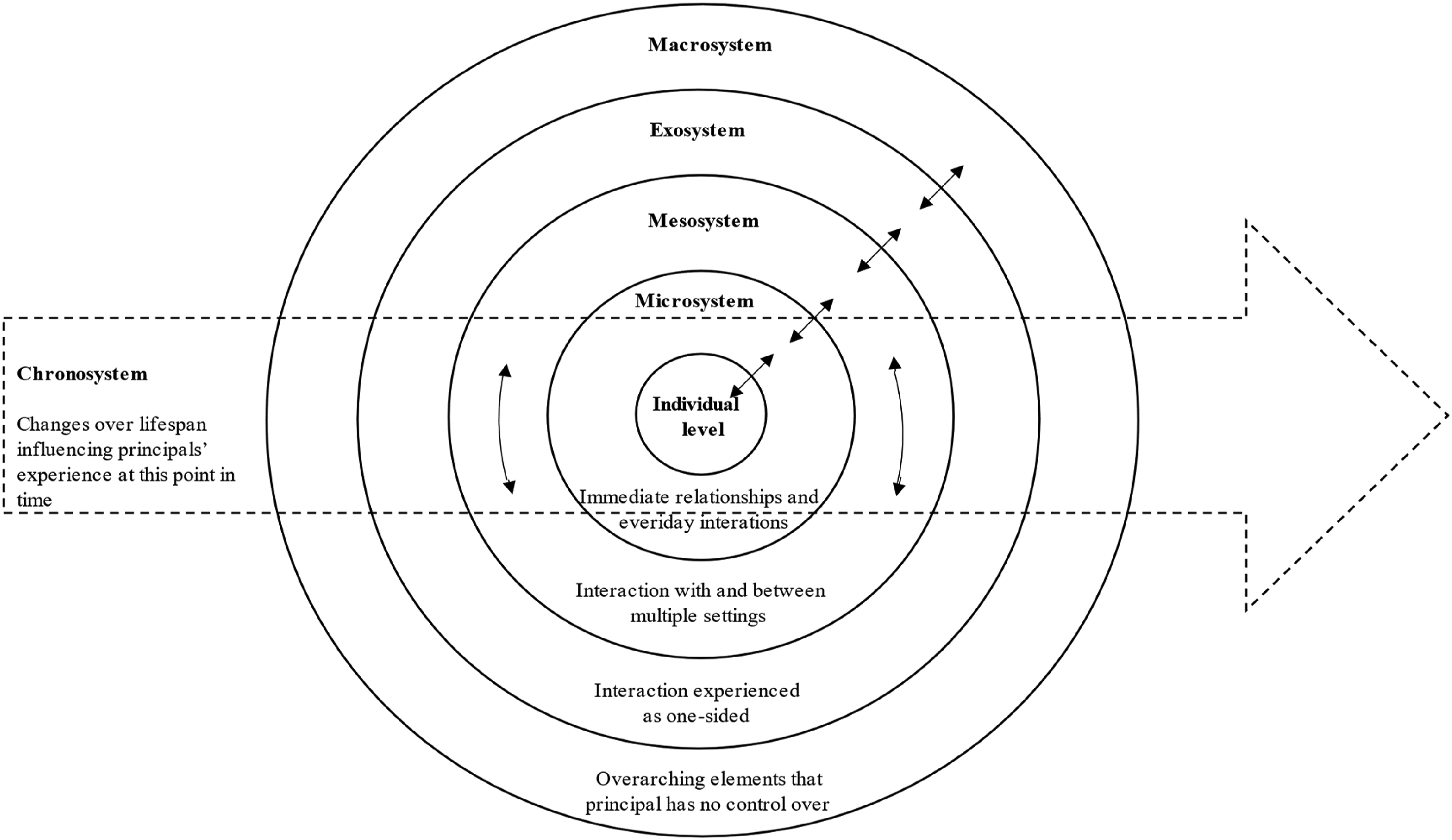
Theoretical approach to principals’ work-related ecological system (modified from Bronfenbrenner, 1979, 1989).
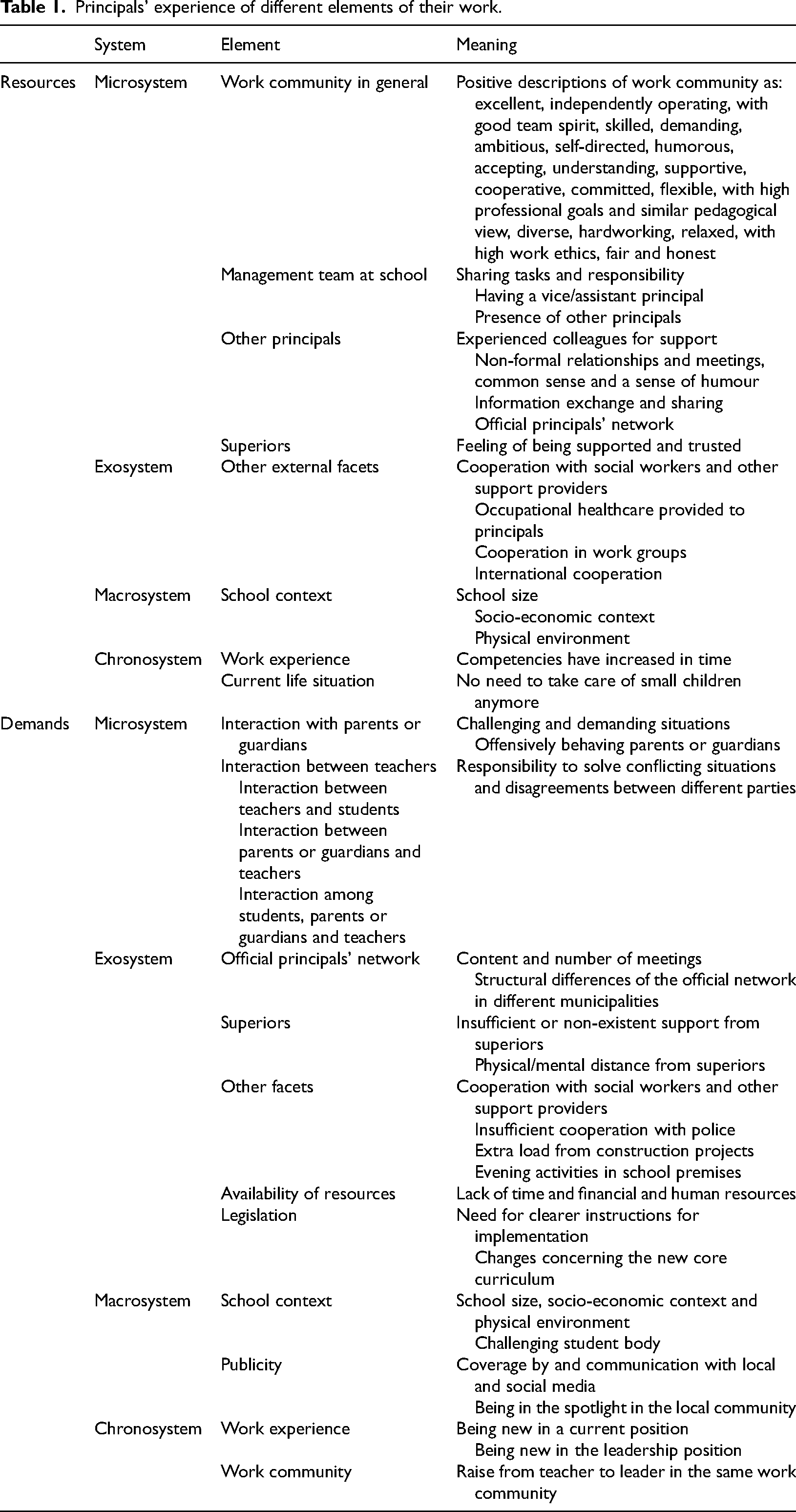
Analysis concerning how principals experience different elements of their work was guided by the JD-R model (Demerouti et al., 2001; Schaufeli and Bakker, 2004). Using theory-guided content analysis, principals’ descriptions of different elements of their work were divided into resources and demands (see Table 1 for examples of the analysis process).
Principals’ experience of different elements of their work.
In the third phase, intercoder reliability was calculated on two levels: first, it was checked per paragraph whether the same elements appeared, and second, if the elements were experienced as demands or resources. Initially, the first coder performed the coding of verbatim texts; then, the second coder was given the data and created categories. The second coder read 23% of the data (five interviews) and coded these independently based on the provided categories to ensure the reliability of the analysis. Intercoder reliability on the appearance of elements was 85%, and on the nature of experience, 94.5% (the remaining 5.5% were discussed and revised in cooperation with two coders). Finally, the remaining 15% of the codes on the appearance of elements were discussed and revised by the two coders in cooperation. This process was concluded with an agreement on whether those elements were experienced as demands or resources.
Results
Principals’ work-related ecosystem
The first aim was to determine how principals’ work can be described from the EST perspective. As a result, principals’ self-reported descriptions were divided into six theory-based main levels, which were divided into smaller elements based on the patterns emerging from the data (Patton, 2015): (a) The individual level; (b) Microsystem; (c) Mesosystem; (d) Exosystem; (e) Macrosystem; and (f) Chronosystem. Some elements could appear under two systems (e.g. superior under microsystem and ecosystem) due to principals’ descriptions of the experience (see Figure 2).
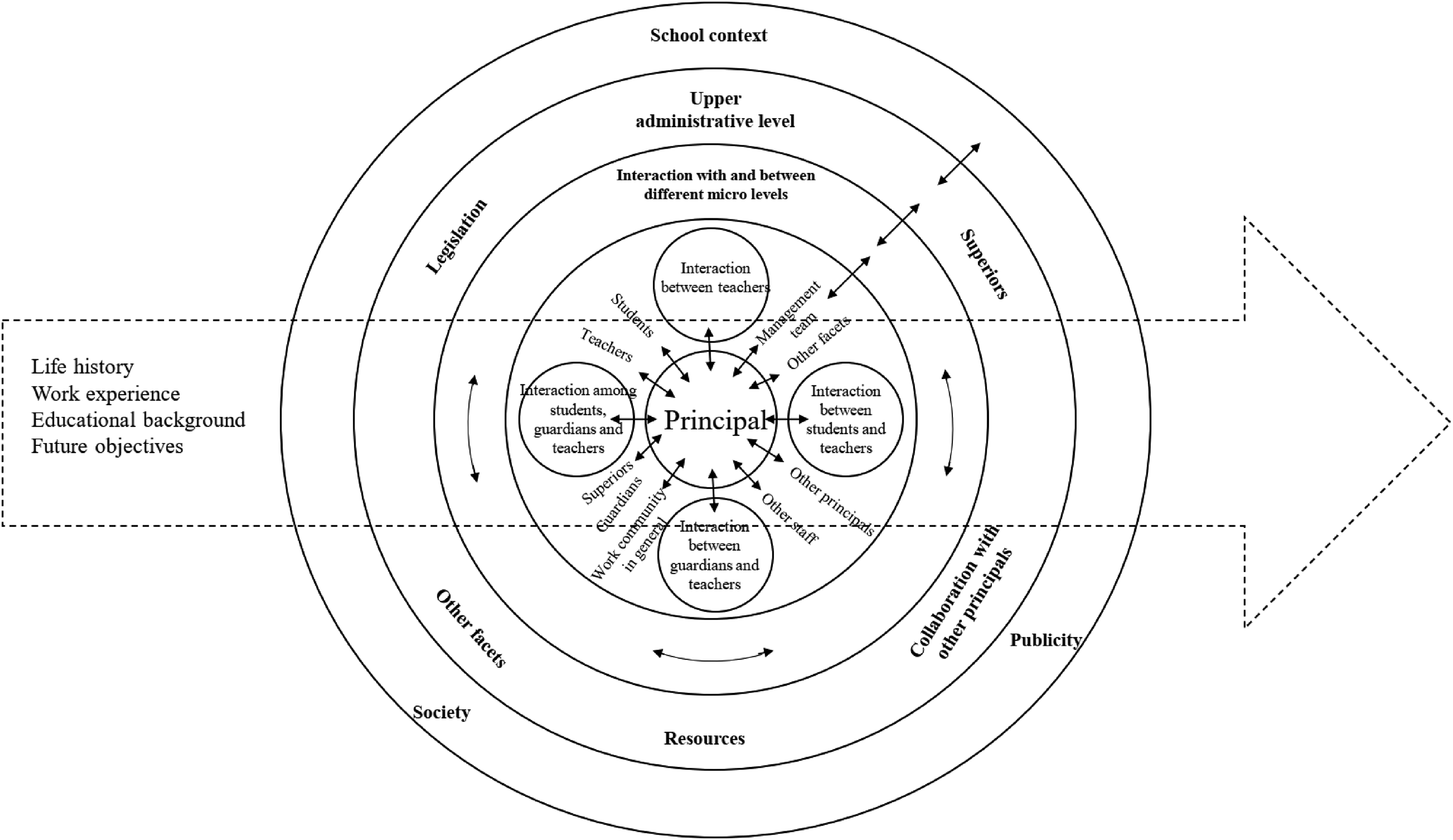
Principals’ perceptions of their work-related ecological system (modified from Bronfenbrenner, 1979, 1989).
The individual level
The results indicated that principals’ work was affected by several personal and internal influencers, such as personal beliefs and personality, absorption, feelings of adequacy/inadequacy, health and recovery from work. For example, P11 described personal traits that a principal should have: ‘You need to have guts, to make unpleasant or unpopular decisions and strongly stand behind those’. In addition, a feeling of adequacy/inadequacy was described by P2: ‘Now what is the hardest, what burdens me the most, is if I do something wrong. Or if I don't notice or understand something or don't recognise a problem, when I should have’. Principals also mentioned the importance of physical well-being, for example, when P19 pointed out: ‘You have to be physically fit. Someone can think that we are not doing physical work here, but you have to take care of yourself and then, if the physical condition is okay, so is the mental side’.
Microsystem
The microsystem consists of different elements among which everyday interaction takes place. Principals reported the work community in general, teachers, students, parents or guardians, superiors, other staff, other principals, other facets and the management team at school to be such elements. In addition to the work community in general (without further specification), participants reported having day-to-day interaction with teachers. For example, P2 mentioned that: ‘Teachers are doing good work in interacting with parents. That is the best support for me. They do their work with joy and professionalism. They are self-directed and constantly want to develop’. Even though principals noted that they highly value teachers working in their school, some of them felt that they do not have enough time to meet with them. As P15 pointed out: ‘I wish that I would have more time for teachers and students, that I would have more space for pedagogical leadership. Administrational tasks are taking too much energy and time. It would be nice to visit classrooms more often and give feedback to teachers.’
Students were characterised as the ones the schools are meant for, and taking care of their well-being was seen as an important task for principals. P8 stated that the small size of a school is beneficial for the reason that: ‘It is a good size school. It is still possible to know all the children. Of course, they have their own problems, but then again, compared to worries they wrestle in bigger schools…’. A principal from bigger schools added: ‘The children like to come to school. They behave well. They are happy because there are a lot of things to do here, and friends. They are getting along with teachers very well. We do not have many problems with students. I do understand that in the areas of weak socio-economic environment, students need a lot of support’. Principals also interact with students’ parents or guardians on an everyday basis and see them as an integral part of the school's functioning.
Furthermore, the management team at school can include other principals from the same school (depending on the school size, in larger schools, there can be separate principals responsible for different school levels) and vice principals as well as the school secretary, special education teachers, teachers and other staff. For example, P4 noted: ‘We have in our management team a deputy principal and the school secretary who are involved. With them, we are unravelling different issues there’. Superiors’ role in principals work is mainly to offer support and help when needed, as P22 explained: ‘I have a good cooperation with our director of education. It is one reason why I have energy to come to work every morning. That…I kind of have the city's support’.
According to the participants, other principals in the field are seen as the main channel for sharing experiences and having more experienced colleagues for support. We found that principals highly value non-formal discussions and meetings for exchanging information and experiences. However, the principals had varying views about whether official principals’ network meetings are taking place often enough or not.
In addition, principals described (1) interactions between teachers, (2) interactions between students and teachers, (3) interactions between parents or guardians and teachers and (4) interactions between students, parents or guardians and teachers where the student is actively present as important elements of the microsystem. For instance, P1 described one challenging situation: ‘[When] there is a conflict between the teacher and the student and then the parents come into the picture, if their communication with teachers becomes impossible, then I need to be there as a referee handling those things’. Furthermore, P20 described handling disagreements between teachers as part of their job: ‘What is stressful in a principals’ job are the contradictions between teachers. For example, when some bonuses are divided between teachers, then I negotiate with them…it causes conflicts between them’.
Mesosystem
Principals’ mesosystem involves interaction with and among different elements of their work. For example, P15 described this: ‘Sometimes, it feels like there are a lot of things to report and respond to quickly. There is a lot to remember. Especially when there are two buildings here…that everybody knows who organises what. Of course, the weekly meetings are taking a lot of energy and time’. Thus, the nature of the interaction is described more precisely under the systems the elements belong to.
Exosystem
Our results further indicate that an exosystem consists of interactions that are experienced as one-sided with elements principals cannot influence but have an indirect effect on their work, such as legislation, upper administrative level, superiors, official principals’ network, resources and communication and cooperation involving other facets such as social workers and other support providers, police and construction project-related cooperation. The principals expressed concern regarding legislation that required them to implement the new core curriculum in a limited time frame and guide teachers in that effort. As P18 reported: ‘Of course, a big deal is the new core curriculum which confuses teachers. If you take that literally…it is difficult. Teachers have so-called pedagogical freedom in the classroom. Naturally, there is a lot of simultaneous teaching and cooperation among teachers, and you can do your work in your own way, but if you check that [new core curriculum] too literally, there are many kinds of new things involved’.
The upper administrative level, referring to municipality-level educational services, was seen as the provider and regulator of information, financing and in-service training. Principals expressed a wish for more clarity from the upper administrative level and narrowing down their work description. In some cases, it seemed to the principals that the upper administrative level really did not know what was happening in the field. Superiors were placed under the exosystem in cases when a participant reported not having two-sided interaction with them, as P10 pointed out: ‘My superior is a service manager who is so far away from here, like from what we do here. It is hard to go and ask some small things, those seemingly insignificant…and I am not sure if I would get an answer’. Collaboration with other principals was placed under the ecosystem. In cases where principals experienced one-sided interactions, they mostly described the functioning of the official principals’ network. Also, limited time and financial and human resources were reported as influencing principals’ work. For instance, P7 stated: ‘When working in a small unit, you really do not get help needed for dealing with challenging students’. In addition, P8 acknowledged that: ‘Sometimes, I know that something could be done better, but there are not sufficient time and financial resources. It is frustrating when it is expected that issues should be taken care of, but there are no resources for that’. Some interviewees noted that communication and cooperation involving other facets consisted of construction project-related cooperation and collaboration with healthcare providers, police, psychological support providers and international cooperation.
Macrosystem
Our results indicate that the macrosystem consists of overarching elements that principals have no control over, such as school context, publicity and society. School context can be constructed of, for example, the size and location of the school, different characteristics of the student population (e.g. number of students with special needs), school buildings’ physical features (e.g. the number of different ones, the age and condition, construction projects), schools’ attractiveness to employees and the socio-economic environment. For example, P4 described it this way: ‘We have a lot of kids from challenging home conditions. We have here the whole imaginable spectrum of homes and children’, and P5 added when describing the factors affecting the daily working life: ‘That huge size of our school, that great number of people. The large number of human contacts.’ Furthermore, the public nature of principals’ work was described by P11 as a cause of stress: ‘Pressure starts when some incident happens to end up in social media. Then it starts to live its own life. Then it is not in your hands anymore. You cannot control it’, and P22 also noted this: ‘Well, I am a public person here. For example, everyone knows who that guy is in the shop, who lifts the box of beer into a shopping cart on Friday evening and so on.’ In addition, the interviewees stressed that society has an indirect influence on principals’ work through its attitudes and beliefs about education. For instance, P2 called attention to polarisation: ‘Those families who invest a lot in education and children's hobbies and do everything. They are open, positive, open for support …. Anything is possible for them. And then again, those who are not doing so well are not contributing at all…so the gap between those two groups is only getting bigger’.
Chronosystem
According to the principals’ reports, their work-related chronosystem includes life history, work experience, educational background and future vision, all of which influence the way they experience their work at any given point in time. For example, P16 acknowledged that how they ended up being a principal was the sum of many coincidences: ‘I was a class teacher before, but then, six years ago, I had an accident. I fell down the stairs and broke my leg. Then, after that, I was working as a teacher for two years, but then the pains got so bad that I had to quit and think about what I want to do when I grow up, and then there was an open principals’ position and not one of the teachers wanted to take it, and so I was asked’. Also, P2 described the changes that had happened over time: ‘Well, I have been doing this for almost ten years now. It has become easier in that sense that my skills have developed… through experience, doing, growing, aging and getting wiser, that happens through aging. You start to see the proportions of things more accurately. A sense of relativity is better than as a young principal when I could not necessarily distinguish what was more or less important and relevant’. The role of future vision was described by participants through future orientation in school functioning and also as more personal future plans. For example, P7 reported not having to deal with too much stress from work because of their approaching retirement.
Principals’ experience on different elements of their work
As a second aim, we investigated which elements of principals’ work are experienced as demands and resources. Our qualitative content analysis was guided by the JD-R model (Schaufeli and Taris, 2014) and divided into two theory-driven themes: (1) resources and (2) demands (See Table 1 for the content of developed themes, and the analysis process).
Resources
The work community in general was seen as a resource by principals. For example, P3 stated: ‘Like I said, we have here an autonomous and highly competent work community. And…it is good to come here, as it was in the very first days. I had been in more than sixty teachers’ lounges as a substitute teacher during my studies, and somehow there was exceptional atmosphere here, and I think that still is [the case]’. In addition, the management team at the respective schools was seen as ‘important support for the principal and the whole school community’, as noted by P12. Other principals were described as an important source of support in dealing with daily challenges, as P8 reported: ‘In the beginning, it was extremely helpful for me that there happened to be experienced principals from whom I could directly ask, ‘Hey what do you think about that’ or ‘Have you been in this kind of situation?’‘. Furthermore, having a non-formal relationship, for example, sharing the similar sense of humour, was described as a great source of recovery. Superiors, when placed on the micro level, were seen as a great resource, particularly if they created a feeling of being supported and having a trusting relationship with one's superiors. Principals also saw collaboration with other external facets as a resource, for example, cooperation with different support systems for students, occupational healthcare providers for principals themselves and local workgroups as well as opportunities for international cooperation. School context was seen as a supportive element in principals’ work, including the aspects of favourable school size, socio-economic context and physical environment. Furthermore, on the chrono level, work experience and current life situation were seen as resources, as described by P8: ‘The fact that I have enough experience, ability and knowledge to do that work helps me a lot’. P15 added, when describing the work situation and recovery from work: ‘I recover in silence…at home. There is just my wife and me, just two of us. Our children have moved out already, and there is no need to take care of them anymore. That helps.’
Demands
Superiors, the official principals’ network, other external facets and school context were noted by the interviewees as job demands. When described under the microsystem, superiors were seen as an important support for principals, but when placed under the exosystem, they were considered as demanding due to what the principals described as one-sided interactions resulting from insufficient or non-existing support and physical and/or mental distance. For example, P10 described the mental and physical distance from their superior: ‘My immediate superior is so far away from what we do here, there is a high threshold to go and ask some small things from him.’ The structure and functioning of the official principals’ network might be seen as demanding by principals because of the content and number of meetings and the size of municipality, meaning that in small municipalities, there are very few principals to network with, was noted by P14. When describing the interaction with other external facets, principals mentioned insufficient cooperation with social workers, psychological support providers for students and police. For example, P11 noted: ‘We have those really demanding student situations. Last year we did about twenty incidents reports due to violence. I think the biggest support would be to get help for those children. Now, that support from child psychiatry is not working. Also, those children's affairs do not progress because of parents hiding their own mental health and coping problems. There are not enough low-threshold services for families and no psychological and psychiatric support for those children. Those are the most demanding situations.’ In addition, they pointed out the extra workload resulting from construction projects and other external users of the school premises. P5 provided an example of the construction process of forming a new comprehensive school: ‘Construction process is taking a lot of time. There are two forms of construction, the physical construction and kind of building a culture of operating, in addition to normal human resource management, student work and work with parents. Then, youth work providers, library and preschool came also to our premises, so we need to adapt those actors here.’ In addition, P10 stated: ‘Last week, they started evening activities. It means that we rent our premises to sport clubs and others. And it brought its own stressing factor. There was a quite clear stress peak, because it happens after the working hours, and if there is a problem, for example, that the key does not work, they are in contact with me’.
Furthermore, publicity and the public nature of the principals’ role was seen as demanding because of coverage and communication with local and social media and being in the spotlight in the local community. For example, P16 described this: ‘In the morning, I am afraid to read that [Shortly] column from local newspaper because maybe there is something negative about our school. That fear that I have been careless and doing something that develops into a bigger problem. That constant fear coming with the responsibility, when something happens, I stand 100% behind my employees.’ Additionally, lack of time and financial and human resources influenced the principals’ work, as P20 pointed out: ‘Well, the constant shortage of money affects the most, because every single day we have to keep track of where the money goes. The Finnish schools are running on a rather tight budget, and we have, for example, a curriculum reform going on, which requires us to renew all the schoolbooks. Then, we should also invest in information technology’. As this participant underlined, changes concerning new legislation are demanding for principals, and in addition to financial resources, participants reported needing clearer instructions for implementing new legislation to provide sufficient support for teachers. Concerning the school context, principals found the size of school and troublesome socio-economic environment as demanding. For example, according to P5: ‘We are in such socio-economic environment that here are a lot of challenges. I do not mean only immigrants now, but there is a high level of unemployment, single parents…other social problems, and students’ disruptive behaviour is higher than average’. They also described poor physical environment as a demanding aspect of their work.
Interaction with parents or guardians was seen as demanding by many principals. However, this concerned mostly interaction in challenging situations, as described by P8: ‘Sometimes there are these challenging situations with guardians. So there have been situations where there is a debate about whether we should take this question into court or if are we capable to figure it out in another way. These are always exhausting situations’. Principals explained that solving problems among teachers, students and parents or guardians was one of the most demanding aspects of their work. Furthermore, work experience and starting in a principal's position in the same school where they worked previously as a teacher were seen as demands by principals. For example, P12 reported: ‘At the moment the most challenging is that I have started as a new principal here. Starting a school year is always demanding, but doing that as a principal for the first time is extra challenging. There is so much new, and you don't have routines yet. That is challenging.’ This was echoed by P8: ‘In the beginning it was hard, because it was the same work community…to jump from being a teacher buddy to be a supervisor. That change of role.’
Discussion
The present study contributes to filling the research gap concerning elementary school principals’ perceptions of their work by combining the EST and JD-R models. The first goal of the study was to describe principal's perceptions of their work from the perspective of EST The results indicate that, not surprisingly, principals indeed have to deal with multiple responsibilities in different contexts and interact with several stakeholders, which has also been noted by other researchers in the field (Darmody and Smyth, 2016; Drago-Severson et al., 2018; Elomaa et al., 2021; Tintoré et al., 2020). In line with the theoretical underpinning we applied, participants reported their work to be influenced by individual factors. On the micro level, their work consists of immediate relationships and everyday interactions with and among students, teachers, parents or guardians, the work community in general, the management team at the school, other principals and staff, superiors and other facets. In addition, one-sided interactions with resources, other principals, upper administrative level, superiors and legislation were involved on the exo level. Further, society, school context and publicity were seen as overarching elements that principals have no control over, but which have an indirect influence on their work. Moreover, on the chrono level, life history, work experience, educational background and future vision were noted to be elements that change over one's lifespan and influence the way principals perceive their work at various points in time (see Figure 2). Human development takes place through bidirectional interaction between the active, evolving, biopsychological human organism and the persons, objects and symbols in its immediate environment (Bronfenbrenner and Morris, 1998). In the current research, this pertains to the interaction with various elements, such as superiors, other principals and other facets appearing within different ecological systems and how there interactions are perceived by principals. It underlines the individual nature of principals’ perceptions which should be taken into account when planning support and pre- or in-service training for them (see also Drago-Severson et al., 2018; Elomaa et al., 2021; Mahfouz and Gordon, 2021).
The second goal was to investigate which elements of the work-related ecological system were perceived as demands and resources. We moved from the individual level through all ecological systems by describing how principals perceived different elements from the perspective of the JD-R model. In line with the theoretical basis we applied, on the individual level, principals' work is influenced by beliefs and personality, absorption, feelings of adequacy, health and recovery from work. According to Schaufeli and Taris (2014), the aforementioned internal influencers can be seen as personal resources moderating the relation between job characteristics and well-being, and they may buffer the negative effects of job demands on burnout and exacerbate the positive effects of job resources on engagement. Similarly, Leithwood et al. (2020) found that a small handful of personal traits, such as problem-solving expertise, managing emotions and optimism explains a high proportion of the variation in leadership effectiveness. Moreover, principals’ job satisfaction and work-related stress have been found to be related to personal characteristics by Darmody and Smyth (2016) and to internal pressures, such as health concerns and feeling of inadequacy, by Elomaa et al. (2021).
In terms of the microsystem, communication and collaboration with and among the work community in general, management team at the school, other principals and superiors were seen as job resources by principals and as factors that support achieving work goals and stimulating personal growth, learning and development (Schaufeli, 2015). Collegiality and collaboration have been found to lessen the decline in well-being; thus, it is especially important for principals to have internal and external collegial networks (Beausaert et al., 2021). Furthermore, principals interact on a daily basis with several stakeholders in different contexts (Pollock et al., 2015; Tamadoni et al., 2021). Our results suggest that when the interactions with supervisors and with other principals in the field were perceived as elements belonging to the microsystem (daily interaction), they could also be recognised as resources, showing the importance of support from superiors and other principals. This claim is supported by Elomaa et al. (2021) who found that principals highly value social support from colleagues, superiors and other principals in the field. By definition, job demands consume energy and may therefore eventually lead to exhaustion and related health problems (Schaufeli and Taris, 2014). Some of the most extensive demands for principals seem to be related to interaction with different stakeholders in situations where the principal has the role of mediator in solving conflicting situations, for example, among teachers, teachers and students and/or parents or guardians. The conflicts that end up on the principal's desk often involve strong emotions of different parties and can evolve into highly complicated and demanding situations.
The exosystem contained one-sided interactions with resources, other principals, upper administrative level, superior and legislations. From which cooperation with other principals, superior, availability of resources and legislations were reported as demands and cooperation with other facets was seen as both, demand and resource. Similarly, the importance of sufficient resources in regard to school leadership has been highlighted in earlier literature. For example, Leithwood et al. (2020) described allocating resources in support of the schools’ vision and goals as something successful leaders do. In addition, Tintoré and colleagues (2020) found the lack of resources and support from local authorities to be some of the challenges principals face. However, surprisingly, time and human resources were reported as more important than financial resources. The reason might be that in principals’ experience, schools are fairly well financed, but the problem is, especially in smaller municipalities, to find qualified staff. According to Collie et al. (2020), a staff shortage is often caused by issues beyond principals’ control such as budgetary constraints. Principals’ job demands and responsibilities seem to increase when the interactions with superiors, other principals and other external facets are not based on cooperation. The importance of professional support from colleagues and superiors has also been highlighted by Elomaa et al. (2021). Moreover, our results indicate that the demanding perception of other external facets is caused by insufficient cooperation with social workers, other support providers and police from whom principals need support mainly to manage challenging student affairs. Similarly, Prado Tuma and Spillaen (2019) found that principals struggle to make sense of external stakeholders’ demands that they perceive to conflict with their own understanding of the goals and values of the school. Furthermore, principals often need to deal with long and time-consuming construction-related issues they do not have training for, without any professional assistance, which takes time away from tasks they consider to be more relevant (Collie et al., 2020; Niesche et al., 2021).
In respect to the macrosystem, school context was seen by the study participants as both a resource and a demand, and they considered publicity to be a demanding aspect of their work. School context has been reported to be related to principals’ job satisfaction and occupational stress in terms of their personal characteristics and working conditions (Darmody and Smyth, 2016). Similarly, our results indicate that schools’ socio-economic context and physical environment have an influence on principals’ experience of their work. That influence can be positive (resources) if these factors are experienced as supportive, or it can be challenging depending on the student population and the socio-economic context as well if it involves large school units and an out-of-date or unsafe physical environment. In addition, as noted by Tintoré and colleagues (2020), increasing demands and expectations placed on principals by the families and the entire society are two of the main factors related to the complex nature of their job.
The results indicate that on the chrono level, principals’ current experience of their work is influenced by their educational background, work, personal history and future vision. For example, the choice of occupation can be related to changing a life situation or as a natural continuation of one's working life. Accumulating work experience has a positive impact on principals’ perceptions. Also, the conflicting social situations are perceived as less stressful by more experienced principals, according to our findings. Demands appear when being new in the position without previous experience and current guidance. That situation may affect the experience of elements of all ecological systems and can appear on an individual level as turnover thoughts or feelings of inadequacy (Drago-Severson et al., 2018) during the first years on the job. It may imply that offering support to principals through, for example, mentoring programmes (Dempster, 2008) during their first years could reduce the pressures and help them to become familiar with their role and recognise and concentrate on relevant tasks.
Using the EST and JD-R models as the theoretical basis of the current qualitative study gave us an opportunity to gain a comprehensive view of principals’ work and their personal perceptions on various essential elements. The importance of interaction between the person and the environment is strongly present in both the EST and JD-R models, where the person is seen as an active agent operating in immediate and more remote contexts. EST places importance on a person's agency in relation to their engagement with self-development (Sangrá et al., 2019), and the JD-R model regards a person as one who appraises the demands and resources influencing their well-being (Demerouti et al., 2001; Schaufeli & Bakker, 2004). The results of the current study indicate that contextual factors influence principals’ work as can be seen from the example of the appearance of the same elements in different ecological systems and the differences in individual perceptions on demands and resources. As also noted by Merҫon-Vargas et al. (2020), the bidirectional processes between humans and the environment which nurture human development vary considerably as a function of personal and contextual characteristics (see also Griffore and Phenice, 2016). However, despite evidence that principals’ occupational stress is caused by, to some extent, similar challenges (Elomaa et al., 2021; Riley, 2020), the role and relationship of and between contextual and individual factors of principals’ work should be further investigated (see also Tamadoni et al., 2021).
The study has some limitations that need to be taken into account. First, the sample size was rather small. Thus, further research is needed that would combine interviews with questionnaire data from a larger sample to gain more understanding of the principals’ job demands and resources. Second, how individual factors such as beliefs and personality, absorption, feelings of adequacy, health and recovery from work affect principals’ experience of their job and how contextual factors such as the number of units they lead and their socio-economic context influence principals’ perceptions should be investigated more deeply. Finally, the data were collected from Finland which might have an impact on the generalisability of the results. Different results might be reached in other cultural and educational systems.
Conclusions
Based on the results of the current research, we conclude that principals indeed deal with multiple responsibilities in different contexts and interact with several stakeholders in their work. Their perceptions of their work are highly individual and influenced by various internal and external factors and contexts within different ecological systems, which should be considered when planning training and support for them. Our results also indicate that a substantial number of challenges principals face are related to interpersonal relationships, suggesting that they would benefit from pre- and in-service training for managing conflicting situations with and among different stakeholders. Furthermore, leadership training for teachers, to better prepare them for accepting leadership tasks, might ease principals’ workload and occupational stress. However, there is a need for further research on the relationships and interactions of elements within and among ecological systems from the perspective of demands and resources to gain a deeper understanding of mechanisms influencing principals’ work which might be reached by using the theoretical underpinning we applied in the current study.
Footnotes
Declaration of conflicting interests
The authors declared no potential conflicts of interest with respect to the research, authorship, and/or publication of this article.
Funding
The authors disclosed receipt of the following financial support for the research, authorship, and/or publication of this article: This work was supported by the Academy of Finland, The Finnish Work Environment Fund (grant number 317610, 117142).
