



Abstract
This study presents findings from a qualitative case study where principals (n = 193), studying a national principal training programme, participated in a study exploring novice principals’ perceptions of how their leadership was impacted during the recent Covid-19 pandemic. A model classification of stressful situations related to coping strategies was used as the theoretical framework for the study and used in the content analysis with a deductive approach. In small groups, the principals used a specific conversation model and discussed their experiences of how their leadership had been affected during the pandemic. The findings showed that principals identified a lack of clarity and situations linked to the adaption to new rules required over time when staff and student absenteeism were consistent challenges. The majority of situations that the principals described can be linked to unclear but affectable situations, where they had to make uncomfortable decisions but also provide security and solutions. Principals mainly used problem-oriented stress management strategies by searching for information, analysing and finding new solutions.
Introduction
Principals’ work across the globe was fundamentally altered during the Covid-19 pandemic (Pollock, 2020). Daily, principals deal with minor crises, conflicts and frustration among pupils, parents or their own staff but the Covid-19 pandemic was very different and a more high-intensity and longer-lasting crisis, and most principals have limited experience in dealing with a long-spun and complex crisis (De Voto et al., 2023; Lien et al., 2022; Varela and Fedynich, 2020). Lien et al. (2022), focusing on the school principals’ experiences during a protracted crisis, emphasised that effective crisis management needs to include several managerial tasks such as transparent communication, distributed leadership, learning from an unfolding situation, and decision-making under uncertainty. The issue of trust also emerged as a crucial factor in the crisis of the Covid-19 pandemic (Lien et al., 2022).
Sweden pursued a more liberal policy than many other countries, during the Covid-19 pandemic, with a national strategy to keep large sectors of society open, and the Swedish educational system was no exception (Lindblad et al., 2021). The government recommended that upper secondary schools and universities organise classes through distance learning solutions using digital tools and recommended that preschools and compulsory schools remain open. The strategy and recommendations involved parents, pupils, staff members and principals following the government's recommendations (Lindblad et al., 2021).
During the pandemic, the ‘Swedish exceptionalism’ and national strategy was built on trust, which also affected the work of the principals (Ahlström et al., 2020). Persson et al. (2022) demonstrated how schools in Sweden were not well prepared to handle low-intensity crises and highlighted the importance of having functioning schools during a crisis, such as the Covid-19 pandemic. However, due to differences in the range and type of coping strategies adopted, and individual differences, principals, handled situations differently.
In this study, the model classification of stressful situations, by Enander et al. (1993), is employed to guide the understanding and interpretation of the study's content analysis. The purpose of the study reported in this paper is to explore novice principals’ coping strategies during Covid-19 in Sweden. Novice principals in this study are defined as newly appointed principals and deputy principals in Sweden who are undertaking the National School Leadership Training Programme that all newly appointed principals in Sweden follow. The research questions that frame the study are:
What situations affected Swedish novice principals’ leadership during the Covid-19 pandemic? What coping strategies were used by Swedish novice principals during the Covid-19 pandemic?
This paper starts with a short review of research on leading schools during the Covid-19 pandemic and then outlines the theoretical framework and the methodology. Then, it provides the results and analysis of the study and finishes with a discussion and conclusions.
Leading schools during the Covid-19 pandemic: literature review
Harris (2021) highlighted seven core themes for leadership during a pandemic: (1) the changing nature of leadership during the pandemic and the greater demands placed upon school leaders, (2) increased pressure felt by school leaders affecting their physical, emotional and mental well-being, (3) school leaders’ adaptive leadership, (4) school leaders’ personal characteristics and personal resilience, (5) unevenness in learning during the pandemic, (6) how school leaders have engaged education stakeholders such as families and communities, (7) and changing leadership practices. The first four of these themes are important for this paper and are addressed below.
Several studies have highlighted the changing nature of school leaders’ work during the pandemic with leadership characterised as leadership in times of uncertainty (Pollock, 2020) as well as work intensification with intense pressure to perform which led to a much-changed leadership function and role (Hauseman et al., 2020; Hylton-Fraser and Hylton 2021; Kafa and Pashiardis 2020). School leaders and educational stakeholders are coping with multiple emotional and managerial issues (Argyropoulou et al., 2021; Singer et al., 2023).
The evidence suggests that the pandemic has exacerbated principal burnout because of the added demands associated with school closures, reopening and social distancing protocols (DeMatthews et al., 2021). The evidence base also underlines how the increased pressure felt by school leaders has affected their physical, emotional and mental well-being (Girelli et al., 2020; Harris and Jones, 2020; Kavrayıcı and Kesim 2021). School leaders experienced tremendous stress during the pandemic (Stasel, 2020). Stress is also emphasised in Huber's (2021) study reported by school leaders in different countries, and Huber also noted that principals continued to manage their way through the crisis. A different story about leadership in times of crisis is presented in a recent Israeli study of Rima’a et al. (2023) which challenges the negative discourse surrounding the education system during times of crisis. The principals demonstrated proactive and empowering leadership practices, creating opportunities for renewal and development. They leveraged these opportunities to promote positive change.
There is also empirical evidence of the ways in which school leaders adapted their leadership practices. Fornaro et al. (2021) proposed that school leaders offer their colleagues four levels of support – academic, technological, operational and interpersonal. Pashiardis and Brauckmann-Sajkiewicz (2022) concluded that leadership qualities needed in times of ‘normality’ are more or less like those needed in times of uncertainty, but that school leaders need to learn to act faster with clearer and constant communication. Other evidence underlines how the emotional support expected of school leaders now goes far beyond the parameters of their leadership role (Dewes 2020; Talsera 2020; Thornton 2021). This can be related to a recent study in Australia (Watson and Singh 2022), reporting on the perceptions of educational leaders during the Covid-19 pandemic, where one important conclusion was that being emotionally intelligent was a key factor in being able to manage a crisis. Leading change is described by Fullan (2015) as an emotionally complex leadership skill.
The findings of a study from the United Kingdom (Beauchamp et al., 2021), focusing on school leadership and management during the pandemic, showed that the principals’ values, attitudes and moral imperatives evoked a strong sense of emotional leadership in all members of the school community and the need for communication, and a humane way of working was very evident in the principals’ thinking. Lien et al. (2022) concluded that leaders who provided psychosocial support and attended to the needs of staff and children with special needs fulfilled a crucial need during the pandemic. Oplatka and Crawford (2021) stated that emotional leadership with an emphasis on emotion management was essential in facilitating schools during the pandemic, in caring for teachers and students and for the leaders to handle their own emotional stress caused by the unexpected.
Recent studies demonstrated the personal characteristics that school leaders are exhibiting to cope with the huge challenges of the pandemic, such as personal resilience (Burwell and Terry, 2021) and how school leaders maintained a calm persona when managing difficult issues (Ng, 2021). Several studies emphasised the critical role of the school leader in bringing all stakeholders together for mutual support during the pandemic (Akinwumi and Itobore 2020; Gurr and Drysdale 2020; Hauseman et al., 2020; Stasel 2020).
International evidence about school leadership during the Covid-19 pandemic is still emerging, but it reinforces how the demands on school leaders remain unpredictable and relentless (Harris and Jones, 2022). The evidence tells us that the personal toll on school leaders has been significant, negatively affecting their well-being and mental health. The evidence also suggests that against the odds and often at personal cost, school leaders continue to put children first and remain totally committed to ensuring that every child succeeds.
Harris and Jones (2022) highlighted that school leaders have adapted their practices to meet the extreme challenges and unprecedented circumstances caused by the Covid-19 pandemic. However, there are still major challenges ahead for school leaders as this pandemic continues (Hauseman et al. 2020). Consequently, Harris and Jones (2022) state that increased support, resources and practical help are needed now, more than ever, for school leaders everywhere. This result is validated by Oplatka and Crawford (2021) who argue that policymakers and stakeholders should provide principals with tools to manage their emotions effectively.
Leading schools during the Covid-19 pandemic in Sweden
In Sweden, keeping schools open was an active strategy to meet the threats of the COVID-19 pandemic. Lindblad et al. (2021), focusing on the Swedish context, concluded that education is vital in the overarching strategy to deal with the pandemic in Sweden in terms of trust in people and governmentality. Ahlström et al. (2020) revealed how principals perceived and acted upon the consequences of Sweden's exceptionalism in keeping schools open during the pandemic. These results could be described as ‘business as (un)usual’ since the preschools and compulsory schools remained open. Ahlström et al. (2020) argued that some leadership practices must change, but the content and leadership abilities remain the same. They added that principals need support to lead, especially when a turbulent outside world creates anxiety, uncertainty and unequal prerequisites for pupils in the schools.
Styf and Arvidsson (2023) concluded that the crisis in most ECE centres led to pedagogical improvement in outdoor teaching and better skills and routines for using digital tools. However, they also acknowledged a higher workload and increased stress for the principals trying to keep things together. Next, the theoretical framework used in this study is presented.
Theoretical framework
Crisis management research forms the basis of the framework. A model by Enander et al. (1993) classifies a stressful situation depending on its clarity and how it is perceived as manageable or not. Coping strategies (Carver et al., 1989), as different ways to handle risky or stressful situations, are also used in this study.
Classification of stressful situations
In modern stress theory, the main thesis is that humans interpret reality based on sensory impressions but also based on their experiences and beliefs (Epel et al., 2018). People can interpret a situation totally differently, and act differently depending on one's interpretation. Figure 1 is a model presenting how to handle stressful situations based on two experience dimensions (Enander et al., 1993). The first dimension relates to the nature of the event and concerns the subjective degree of clarity or comprehensibility. The less comprehensible a situation is experienced, the more difficult it is to deal with it. Therefore, a new and unknown or diffusely threatening situation is often perceived as particularly dangerous. The second dimension has to do with the possibility of dealing with the situation and concerns the subjective degree of controllability or affectability. The experience of stress is reduced if the situation can be influenced.
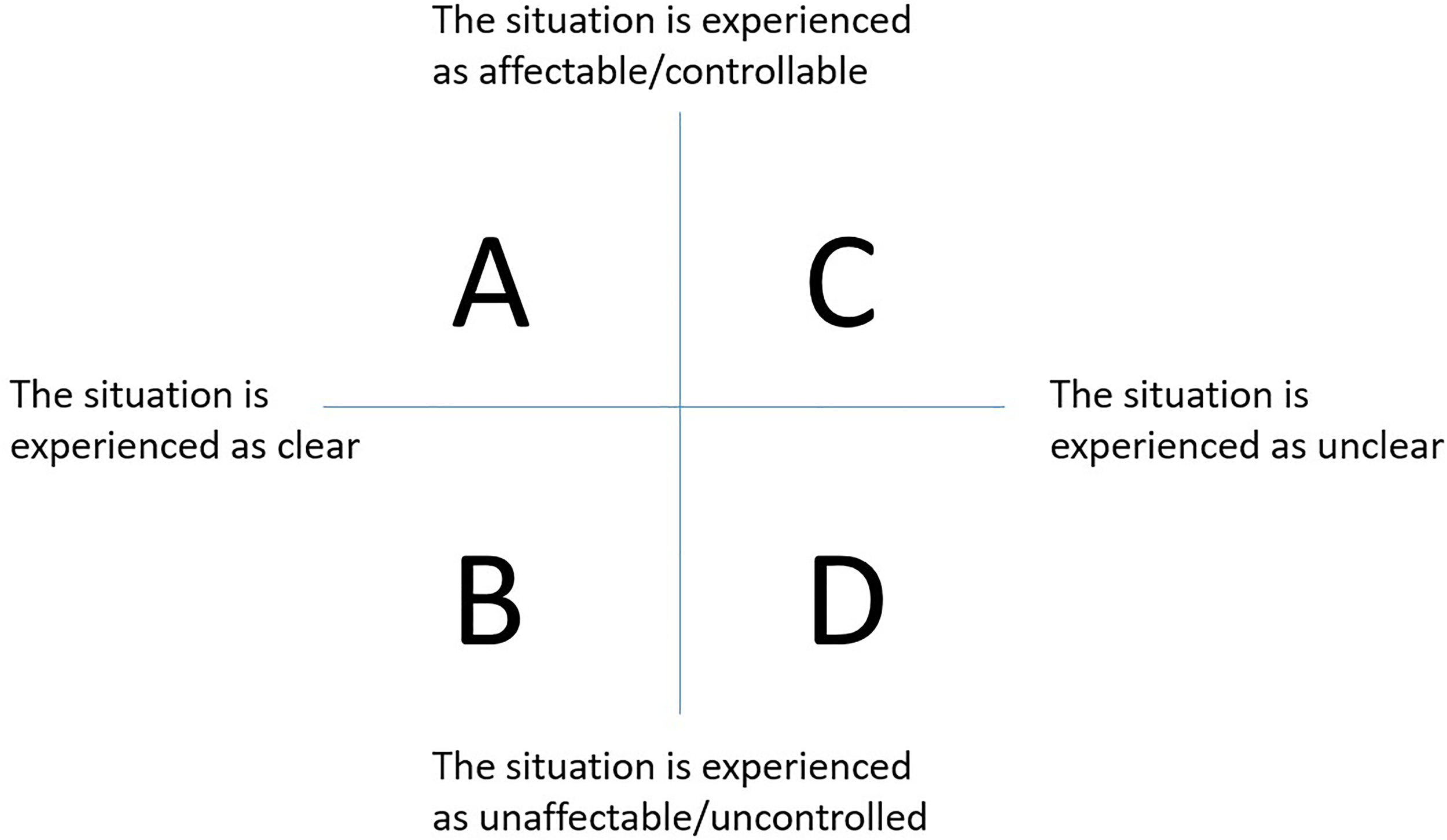
Model of key subjective dimensions to understand and explain individual reactions in disaster situations (Enander et al., 1993, readjusted model by authors).
In field A, clear and affectable/controllable situations, there are knowledge and possibilities to handle, manage or reduce the effects of the situations (Enander et al., 1993). In field B, in clear but unaffected/uncontrolled situations, one often needs to receive help or develop personal knowledge to handle the situation. Field C, unclear but affectable/controllable situations; here the threat can be interpreted as unclear and hard to understand, but one can affect the situation. The last field, field D, unclear and unaffected/uncontrolled situations, includes situations that one does not know if or how they can handle, even if they wanted to. The situation is interpreted as unclear and with experience of lack of opportunities to do anything.
Over time, the same situation can be classified in different fields. A situation can initially be placed in field D, but then be identified as affectable and clear and placed in B or A (Enander et al., 1993). Since it is one's own subjective interpretation that determines how the individual reacts in a certain situation, different reactions can be expected. What is unclear and diffuse for one person may be clear and easily interpreted for another. A more diffuse threat picture means greater scope for different perceptions of different actors. Situations interpreted differently by diverse individuals and groups have been a source of conflicts and distrust between different groupings. However, using different coping strategies can help to handle diverse situations.
Coping strategies
Carver et al. (1989) identified two main types of coping: problem-focused coping and emotion-focused coping. Problem-focused coping addresses how to solve or do something to alter the source and coping is aimed at decreasing or managing the emotional distress associated with the situation (Hershcovis et al., 2018). Problem-focused coping seems to dominate when people feel they can do something constructive to reduce stress and can involve different activities such as planning, taking direct action, seeking assistance and screening out other activities, but also confronting or expressing individual concerns or forcing oneself to wait before acting (Carver et al., 1989; Folkman and Moskowitz, 2004; Hershcovis et al., 2018).
However, when people feel the stressor is something that must be endured, emotion-focused coping is more often used and effective. Emotion-focused coping is instead aimed to handle emotions produced by stress (Hershcovis et al., 2018). This coping strategy involves activities that help individuals to distance themselves from the threat. Examples of such activities can be positive reinterpretations of events, seeking social support, but also different kinds of denial or getting busy with other things (Carver et al., 1989; Folkman and Moskowitz, 2004).
Whether a coping strategy is effective depends on the stressor. In general, problem-focused coping is better to use because this strategy is associated with lower stress levels and better mental health (Penley et al., 2002). However, if the stressor is uncontrollable and unable to change, an emotion-focused coping is more effective than a problem-focused approach (Hershcovis et al., 2018). People who tend to use emotion-focused coping strategies in uncontrollable situations may be more resilient to stress and enjoy greater overall wellness (Schoenmakers et al., 2015).
Method
In the study reported in this paper, a qualitative research method was employed with a purposive sampling method to include novice principals studying in the National School Leadership Training Programme at one university in Sweden. About 193 principals and deputy principals from preschool, primary, secondary and adult education participated on a voluntary basis. The purpose of the study was to explore novice principals’ coping strategies during the Covid-19 pandemic.
Data collection
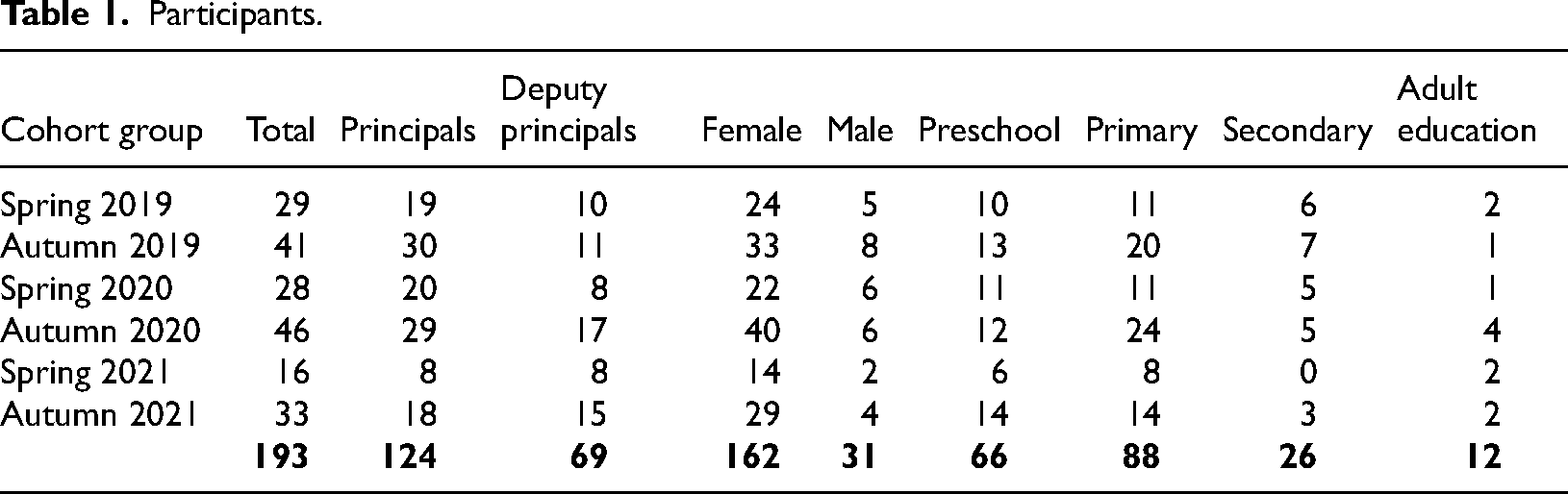
Data collection was carried out when the National School Leadership Training Programme was conducted, between November 2021 and February 2022. The informants consisted of the six cohort groups who studied in the programme during that time (see Table 1).
Participants.
The data collection was done during one session on the schedule labelled ‘peer mentoring’ where the principals normally choose a ‘wicked problem’ or ‘dilemma’ they want to discuss and get advice on from the other principals. These sessions are led by facilitators who lead the session and provide information and a chosen conversation model. This time a question was decided by the researchers and a structured conversation model was used as the data source to secure a deeper understanding of the object of knowledge (Cohen et al., 2018) and to grasp the informants’ perceptions of how the Covid-19 pandemic affected their leadership and how they made sense of it together.
Data collection was carried out digitally via Zoom, because of the Covid-19 pandemic. Twenty-five group discussions were conducted with a total of 193 participants (see Table 1). The discussion groups utilised were the study groups formed since the beginning of the education, each consisting of 5–8 participants. The discussions were recorded for most groups, but one group preferred to write notes from their discussions and send them via email. The group discussions lasted from 22 to 67 min (on average 48 min). The discussions were based on one question: How has the Covid-19 pandemic affected you as a leader and manager?
Data analysis
The qualitative analysis of the empirical data was undertaken with a deductive approach (Miles et al., 2014) using Enander et al.'s (1993) classification model of stressful situations related to coping strategies. The classification model (see Figure 1) is only a way of dividing situations related to clarity or comprehensibility and to the degree of controllability or affectability. This was helpful to figure out how the principals interpreted the new order during the pandemic. So after the transcription, the answers were compiled based on the four different fields (A–D), described earlier in Figure 1. The described situations were interpreted based on how the principals portrayed them.
The principals described situations from different phases during the pandemic and it has not been a clear timeline to follow. Some of the situations were from the beginning, others during the pandemic and others from the end. During the principals’ group discussions, they jumped in time, related to each other's situations but connected to their own examples and how they reacted or acted in the situations. Depending on how they communicated about the different situations and how they mentioned their actions, the situations were connected to fields A, B, C or D, related to the theoretical description of the fields.
After dividing the situations in the four fields (A–D in Figure 1), the situations in each field were compiled into different themes. For example, the theme of working conditions (field A, Figure 2) consisted of how the principals described situations connected to them and other people moving less at school or to a lack of ergonomic equipment at home. The other themes in field A were availability and new knowledge – risk analysis.
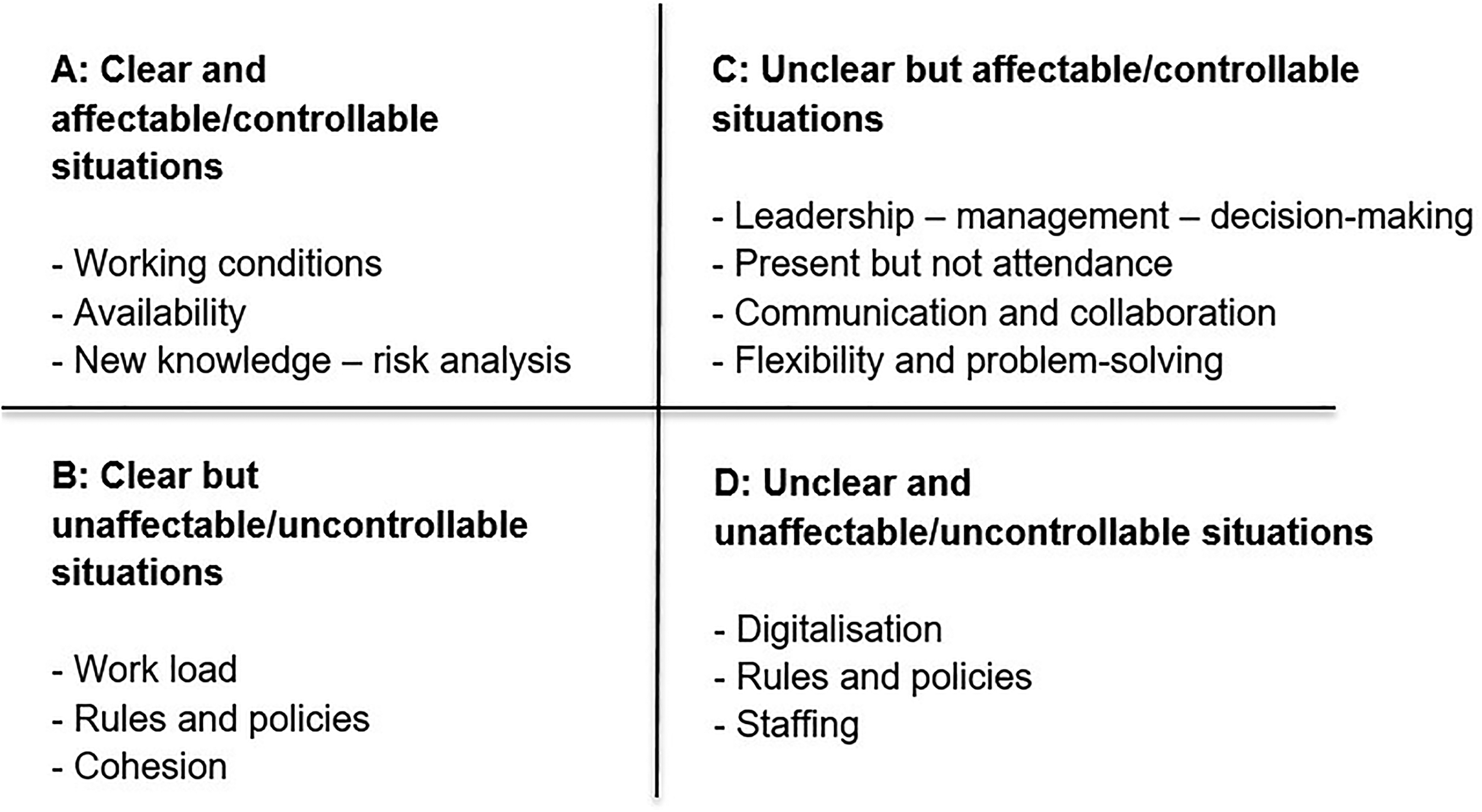
Findings categorised into unclear and unaffected/uncontrolled situations and unclear but affectable/controllable situations (based on the model by Enander et al., 1993).
In field B (Figure 2) the themes turned into workload, rules and policies and cohesion. Themes in Field C (Figure 2) emerged to leadership – management – decision-making, present but not attendance, communication and collaboration and flexibility and problem-solving. In the last field, Field D (Figure 2), the themes became digitalization, rules and policies and staffing. As seen, theme rules and policies occur both in Fields B and D. The difference between them is if the situation (connected to the rule or policy) described by the principals is interpreted clearly or unclear.
Subsequently, when situations were categorised into two dimensions, the theory of coping strategies (Carver et al., 1989) was used to identify how principals handled the situations. Based on the theoretical framework, we used problem-focused and emotional-focused coping strategies. The categorisation is based on how the principals described how they (tried to) solve the situation and their feelings related to the situation.
Ethical considerations
In carrying out the empirical study, the ethical rules and guidelines for research provided by the Swedish Research Council (Vetenskapsrådet [Research Council], 2017) were followed. Four demands were followed: information requirement, consent requirement, confidentiality requirement and use requirement. All respondents were promised their personal views and data would not be identifiable in written reports regarding the research. This means that the participants were informed about the aims of the research and their participation was voluntary with the possibility of withdrawing at any time without consequences.
It is important to be transparent about the researcher's role and status within the site (Cohen et al., 2018). The researcher can never be completely objective as they are always a part of the world being researched. In this study, the role of teachers in the program and researchers meant a relatively hierarchical but also a close role to the participants, where relationships were created during the program and the study period. Researchers should be aware of how they affect the research, but it's impossible to eliminate the researcher effect. Therefore, being a highly reflexive researcher is preferred (Cohen et al., 2018; Miles et al., 2014). In this study, the research team of four regularly discussed the ongoing work, findings and analysis (Cohen et al., 2018).
Findings
The findings of the qualitative and deductive content analysis are presented based on the theoretical model of classification of stressful situations related to coping strategies – and the presentation of the results follows that logic.
The findings demonstrated problems arising from the pandemic that created additional work and new tasks for the principals. Situations can be divided based on perceived clarity and perceived opportunity for influence in the current situation (see Figure 2). The situations described by the principals can generally be categorised into unclear and unaffected/uncontrolled situations and unclear but affectable/controllable situations (see Figure 2).
Clear and affectable/controllable situations
In field A, clear and controllable situations, the following three themes emerged: working conditions, availability and new knowledge, especially in conducting risk analyses. Principals mentioned that working conditions were affected according to the ergonomic environment at home and that people were sitting more. These situations are controllable but were new and necessary to manage and to remind employees to stand up, but also to think about the working conditions at home. There has been less stress, not having to move between different workplaces because you have worked from home, but the stress has also increased as everyday exercise becomes less. After a couple of months, I had problems with my back and it was not so strange when you have the wrong working posture at home, on the sofa, at the kitchen table, or in the armchair. The meetings have become more efficient, and you may not have to go back and forth in the same way. Before, you pretty much went back and forth … It also becomes a stress that you don't want to have. I made it a priority to be there. When my educators, teachers and other staff are supposed to be at work, then I feel like I can’t… I haven’t been able to be at home, working from home, when they’re there. So, I’ve been there… I think that has also created a calm at the school. We have done many risk analyses at the school. It has been good. But, at the same time, it has been tough work as a leader and a manager to do all these. We did not have any choice. But our working load increased a lot.
Clear but unaffectable/uncontrollable situations
Other situations have been clear but interpreted more as uncontrollable or unaffectable (see field B, in Figure 2). Three themes appeared in the analysis: workload, rules and policies and cohesion. Principals mentioned the increased workload and the need to be updated and informed which was not always easy. Information from different sources created confusion and source review has been important. Many have heard from someone who has heard from someone and so on that creates concern among staff and some pupils. I have been able to work with how to respond to concerns among staff, understanding how crises affect people in an incredible number of ways. Some are barely able to go to work. At the same time, we have had a big job at the school to work together as a team and as a group. There have been major divisions and scattered in many different directions… It has been a challenge to still work with the group dynamics even though we are not allowed to meet. There were a lot of different decisions and so it was unclear who … What was expected I should inform, what came from the municipality organiser level, and it could be that something had been sent out in the morning and then in the afternoon, something else came from the municipality organiser level that was not entirely in tune with what I already had sent. Yes, this is about being credible as a leader. Then I think I immediately ended up in a jumble of information flow. There were restrictions circulating from the Public Health Agency of Sweden. We received several directly during the day where they changed documents with different points about what to think about and not. But the administration arranged it so that all the information would come in one place to facilitate our work.
Unclear but affectable/controllable situations
In field C, unclear but controllable/affectable situations, four themes emerged: leadership – management – decision-making, present but not in attendance, communication and collaboration, flexibility and problem-solving. They were connected to the principal's leadership; how and when to decide things, admit that they did not know what to do, to be present but not attend activities. The majority of situations the principals described can be linked to this field. Many principals identified tasks they never thought they should handle as a principal. One principal expressed it like this: All these tasks that just came across you that you didn't really, well, that you never even imagined you would sit and do. That you would sit and fix small test kits, plan for school closures, trace infections… Yes, but that's right, I’m in charge of this business. yes, but then I’ll jump in there too then. You were a substitute teacher, you stood in the kitchen. You were kind of all over the place.
Another typical quotation from many principals was: ‘But you have become very solution-focused, good at making quick decisions, and thinking outside the box as much as possible.’ Another principal reflected: What are we doing with our time? We would have done wonders if we hadn’t talked about COVID 15 hours a week; but no, we would have just carried on as usual.
Communication was about handling new and unclear information to be conveyed to employees, pupils and caregivers. Communication was about how to prevent rumours when it was difficult to sense everyone's thoughts and feelings remotely. Communication has shifted its focus from planning and information about how work would be done on-site, from home, to how different groups would come back to work.
The collaboration with the municipality and the head of the school was challenged, and in some cases strengthened. As mentioned in field B, when guidelines from the municipality have not always been adapted to school activities, collaboration and communication have been affected and unclear. However, several principals mentioned that collaboration has increased, and they developed a higher understanding of each other's activities. Just this with the support from the municipality. From the administration. I have experienced that. Someone has held your back. I have always had the support of other principal colleagues and the head of activity.
Unclear and unaffectable/uncontrolled situations
In field D, unclear and uncontrollable situations is where most of the discussed situations from the principals occur. Three themes were identified: digitalisation, rules and staffing. Unclear and unaffected situations were raised by the majority of the principals, mainly linked to new rules related to over time; information, new information, counter-information, and beyond those different interpretations of the information. Several principals mentioned the hard work to make decisions with less information and never knowing if the information was accurate.
Examples linked to staffing and absenteeism, both student and staff absenteeism, have also been highlighted as consistent challenges that were unclear and difficult to influence. According to absenteeism, some principals declared the difficulty of knowing if, for example, the reason for pupils or staff being at home was about sick leave or just the desire to stay at home. Who should I call? The elderly I used to call was now in risk groups, pregnant people needed to be relocated, and substitutes were not allowed to be in different activities.
The principal, as leader, had to make uncomfortable decisions but also dared to admit that the principal does not know. One principal expressed it like this: ‘The leadership became so authoritarian right away: Now everyone gathers … Now let's do this… Now this is what matters…’
Even though the situations were unclear, the principal had to take the step of providing security and solutions, even if it meant lowering the level of ambition.
Coping strategies
The principals mainly used problem-focused coping strategies such as searching for information, analysing and finding new solutions. We have had a great shortage of staff and we are a school that never cancels classes. But we must change. So, we’ve never cancelled a lesson. And it also has its challenges. I’ve been a teacher of Spanish; I don’t know a word of Spanish and I was also a maths teacher.
Many situations were related to the activity of seeking support. The way of seeking support can relate to both problem-focused coping and emotion-focused coping depending on the reason why support was needed.
Other recurrent situations connected to emotion-focused coping strategies related to the principals’ emotional feelings and health. Some described the fear of getting sick themselves; who would take care of the organisation? Other descriptions included how they avoided different actions or situations; they worked from home even if they knew they were needed in the organisation or they did not visit different units, from fear of being sick or bringing covid to the unit. The following quote provides a telling example of a principal's emotional feelings during the pandemic: I think it's been scary sometimes; I’ve felt scared in certain moments when I’ve thought about what it would be like if someone became seriously ill at work. That it is a great responsibility to have a work environment responsibility during a pandemic.
Discussion
The purpose of this study was to explore novice principals’ coping strategies during the high-intensity and long-lasting crisis of Covid-19. The analysis of the principals’ experience and perceptions has been assisted by the theoretical perspective of classification of stressful situations (Enander et al., 1993) related to coping strategies. Some overall results are of importance to highlight for further discussion.
First, concerning what situations affected the Swedish novice principals’ leadership during the Covid-19 pandemic, the result demonstrated that even if situations were interpreted clearly or not clearly, the situations were affectable/controllable, and school leaders seemed to have used problem-focused coping strategies. This result can also be compared to situations interpreted as clear or not clear, and unaffected/uncontrolled situations, where school leaders seemed to have used emotion-focused coping strategies.
Second, the results in this study, regarding the principal's well-being and personal resilience confirm previous research (Harris, 2021) and how the principals used their coping strategies, how they felt and how they handled challenges during the pandemic. The results in this study present the same picture of Swedish school leaders as Persson et al. (2022) but the school leaders also described an intensive willingness and ability to handle the new everyday life that the pandemic came to be. Many school leaders discussed their hard work and the challenges of not getting sick but at the same time keeping up the motivation both to themselves, among the employees, but also towards students and parents. The actions of school leaders can be explained based on Burwell and Terry (2021); personal characteristics and personal resilience, and the focus on putting the children first (Harris and Jones, 2022). Hence, principals who provided psychosocial support to their organisations satisfied an essential need (Lien et al., 2022).
Third, most principals expressed the need for changes in their leadership and two main aspects were noted: to use more management and to be more patient, which can be understood as the need for adaptive leadership. This can be connected to the greater demands on school leaders’ adaptive leadership which was evident in Harris’s (2021) review of school leadership during a pandemic. The adaptive leadership can be connected to coping strategies. The situations, described by the principals, can mainly be interpreted as unclear situations. When these unclear situations were also interpreted as affectable/controllable principals mainly used problem-focused coping. Such strategies focus on, as it says, how to solve or how to do something to alter the source (Hershcovis et al., 2018).
Fourth, problem-focused coping reduces stress but in general only when situations or stressors are controllable and can be possible to change (Penley et al., 2002). Using emotion-focused coping in these situations may increase stress-related illness (Bafghi et al., 2018; Chiavarino et al., 2012). However, in unclear and unaffectable/uncontrollable situations the emotion-focused strategy should be used as Kelly et al. (2008) confirmed that such a coping strategy is more effective if the stressor or the situation is uncontrollable and unable/hard to change. In general, the principals in this study identified the stress but almost everyone described their different ways of handling the crisis, the feeling of dealing with the uncertainty, and how they have coped with it. This is connected to Rima’a et al. (2023), where the principals demonstrated proactive and empowering leadership practices, while Huber's (2021) and Stasel's (2020) studies more clearly show that principals have led but have had tremendous stress. Although several school leaders in this study highlighted the tiredness they have sometimes felt, they also reported feeling strength from having coped with it.
Fifth, regarding what coping strategies the Swedish novice principals used during the Covid-19 pandemic, the results showed that the principals mainly used problem-focused coping strategies but that both strategies could be useful, especially in the activity of seeking support. Collaboration was emphasised in the result as an important aspect of social support to others (e.g. teachers and students) and emotional support (Dewes 2020; Talsera 2020; Thornton 2021) to their own leadership. Emotional support is essential for the leaders to handle the situation and emotional distress. The emotional intelligence of a leader is also essential to manage a crisis (Fullan, 2015; Watson and Singh, 2022). Communication, the information, analysis of the situations and finding new solutions to new and old problems became important strategies as stated in the results. These findings are in line with Lien et al. (2022) who emphasised that communication in relation to the issue of trust becomes an effective tool for managing a crisis. These strategies co-depend on each other to endure and manage emotional distress in uncertain times when new rules and decisions must be made in a second. Several studies (e.g. Oplatka and Crawford, 2021; Watson and Singh, 2022) confirmed the need of emotional leadership to handle stress and be able to manage in crisis.
Conclusion
This study's main contribution is to highlight novice principals’ coping strategies during the Covid-19 pandemic in the Swedish context. In conclusion, the Covid-19 pandemic has led school leaders to develop their skills in various ways through new thinking and creative solutions due to the pandemic. Some of the new knowledge is as follows: increased communication and cooperation skills, increased their own ability to handle stress, professionalism in decision-making, and daring to set the level in the business as enough for now, but also their own flexibility and adaptability. The new knowledge and the increased capability to believe in themselves and their colleagues increased trust between principals and their different stakeholders.
In this study, it was elaborated that the principal coping strategies were based on adaptive leadership (Harris, 2021) as a way of handling situations that were rapidly changing and unclear. The uncertainty and stressful situations the principals experienced demanded adaptive leadership strategies and emotional management and leadership, as suggested by Oplatka and Crawford (2021). Adaptive emotional leadership and management are necessary for the principals to maintain resilience in handling stress and be flexible and adaptable in all situations during a high-intensity and long-lasting crisis such as the Covid-19 pandemic, where ‘enough for now’ is based on and reflects upon professional decisions rather than personal emotions of fear and stress. The improvement of leadership skills that the participants in the study expressed such as communication and collaboration to handle the crisis in an effective way is also in line with skills important in distributed forms of leadership (Lien et al., 2022). Since handling the crisis isn’t a single person's or principal's job it's a shared responsibility but digitally maintained (Harris and Jones, 2022).
Implications for practice, based on the results of this study, are that the effects of the pandemic are still present and that it is important to have increased support, resources and practical help for principals provided by municipalities administrative level (Harris and Jones, 2022; Oplatka and Crawford, 2021). The results of this study are also valuable for principal educators about how we conduct training for novice principals when it comes to leading in times of crisis. The findings of this study emphasise that emotionally intelligent leaders are better equipped to cope with the crises and challenges currently faced by school leaders. This underscores the significance of incorporating the human dimension of leadership into the preparation and development programs for novice principals.
This qualitative Swedish study can be seen as a contribution to novice principals’ experiences of leading schools during the Covid-19 pandemic in the field of educational leadership, where empirical research on school leadership in high-intensity and long-lasting crises still is under-researched (Harris and Jones, 2022; Oplatka and Crawford, 2021). More research should be focused on conducting a follow-up survey study after two years to the same principals and investigate what they continued to work on, what were their most important lessons and what they changed in their leadership practices based on their experiences of leading during the Covid-19 pandemic. Other studies of interest would be to further investigate the impact and importance of support and leadership structures during the Covid-19 pandemic in the total chain of command.
Footnotes
Declaration of conflicting interests
The authors declared no potential conflicts of interest with respect to the research, authorship, and/or publication of this article.
Funding
The authors received no financial support for the research, authorship, and/or publication of this article.
