




Abstract
This research investigated how K-12 school and district leaders in Georgia enacted leadership during the COVID-19 pandemic. Drawing on interviews with 11 educational leaders (10 of whom identified as African American), this study explored how proximity to policy and people shaped leaders’ actions and understandings of crisis leadership. Findings reveal that while all participants experienced the pandemic as an acute and ongoing emergency, their leadership diverged sharply by role. District leaders focused on maintaining system level legitimacy, policy coherence, and infrastructure stability, while school leaders engaged in the daily emotional and cultural labor of holding communities together through care and connection. Across contexts, crisis leadership emerged as a multifaceted practice requiring decisive action and deliberate attention to personal well-being. For Black leaders, the work was further shaped by the racialized dynamics of leading through dual pandemics. These findings position crisis leadership as an enduring practice shaped by leaders’ proximity to policy decisions and the people they serve as well as by the emotional relationships that define their work.
On 11 March 2020, The World Health Organization declared COVID-19 a global pandemic. Within weeks, schools in nearly 200 countries closed, sending 1.6 billion students and 200 million school employees home (UNESCO, 2020). As schools shifted abruptly to remote learning, educational leaders were tasked with sustaining instruction, engagement, and care under conditions of uncertainty. In the USA, these challenges were compounded by longstanding inequities in access to educational resources. Districts still plagued by the digital divide (Sanders and Scanlon, 2021) had to quickly devise solutions to provide equitable access to devices and internet, often with limited infrastructure and support. Leaders were also faced with ensuring the mental and physical well-being of students, staff, and teachers while managing the risks facing their own families. In Title I schools, especially, closures disrupted access to nutritional support, leaving many students without reliable meals. These challenges were most prominent in communities already marginalized by systemic inequalities where the public health crisis unfolded alongside an ongoing racial crisis, exacerbating disparities in access to technology, food security, and medical and mental health support (Reyes-Guerra et al., 2021).
K-12 school and district leaders stood at the forefront of these challenges, often forced to make quick, high-stakes decisions with limited access to information and resources. The pandemic intensified the educational inequities that already existed and K-12 leaders, especially those in traditionally underserved areas, were forced to make tough decisions that they knew would have lasting implications on educational inequity (De Voto and Superfine, 2023; Lochmiller, 2021). In addition to figuring out how to address logistical challenges like getting students a hotspot so they can participate in school or still providing breakfast and lunch to students at home, K-12 school and district leaders also bore the emotional toll of navigating grief, loss, and uncertainty in their educational communities while striving to maintain some semblance of certainty and stability during a very chaotic time (Wharton-Beck et al., 2024).
While crisis leadership literature underscores the need for rapid decision-making, prioritization of safety, and sense making under pressure (Boin et al., 2013; Smith and Riley, 2012), less is known about how these dynamics unfolded at different levels of educational leadership, particularly in the experience of African American leaders. This study draws on interviews with 11 school and district leaders in Georgia (10 of whom identity as African American 1 ) to examine how K-12 leadership was enacted during the pandemic. The main research question was: How did school and district leaders from the US south navigate leadership challenges during the COVID-19 pandemic? We highlight the contrasts between school-based and district-level leadership, the centrality of emotional labor, and the racialized dimensions of crisis leadership.
Crisis leadership in unprecedented times—Literature review
Educational leaders have historically been required to navigate crises including mass shootings, environmental disasters, and other disruptions that threaten organizational stability. The COVID-19 pandemic, however, represented an unprecedented global crisis, disrupting nearly every dimension of educational systems simultaneously (Longmuir, 2023). The literature on crisis leadership provides a foundational understanding of how leaders can effectively navigate their organizations through times of uncertainty, distress, and disruption. Crisis has been defined as an urgent situation requiring immediate and decisive organizational action, often characterized by ambiguity, limited warning, and significant threats to core operational goals (Elliott et al., 2005; Smith and Riley, 2012).
In educational settings, crises involve unexpected disruptions that affect multiple stakeholders and have potentially severe consequences for schools, districts, and communities (Grissom and Condon, 2021). School leadership is especially necessary during times of crisis to provide guidance, hope, and effective communication (Smith and Riley, 2012). Leaders must quickly assess complex situations, make high stakes decisions, and engage in self-reflection to guide future decisions (Stern, 2013).
Crisis leadership as constrained adaptability
A central theme across the literature is the importance of adaptive leadership in crisis contexts. Crises demand effective communication, emotional intelligence, empathy, optimism, flexibility, as well as the ability to reestablish a sense of normalcy after the crisis is over (Boin et al., 2013; Dirani et al., 2020; Fernandez and Shaw, 2020; Smith and Riley, 2012). These characteristics of crisis leadership are especially critical in unprecedented situations where there may be no playbook to follow or previous guidance to heed (Topper and Lagadec, 2013). During the COVID-19 pandemic, educational leaders were required to make decisions related to instructional delivery, public health, staffing, and student support with incomplete information and shifting guidance (Marshall et al., 2020; Thomson and Greany, 2025). Studies conducted in multiple contexts suggest that leaders developed adaptive practices out of necessity, often relying on experimentation and iterative decision-making to respond to rapidly changing conditions (Longmuir, 2023; Mutch, 2015). As an example, Mutch (2015) examined school leaders during the 2010/2011 earthquakes in New Zealand and found three factors that affect leaders during a crisis: dispositional (what behaviors leaders bring that stem from their personal values), relational (the way that leaders offer a unifying vision during a crisis), and situational (how leaders respond in a culturally appropriate manner with flexibility and timeliness). At the same time, leaders’ capacity to adapt is not unlimited. Adaptive leadership during crisis is shaped by organizational hierarchies, accountability structures and policy mandates that can constrain leaders’ discretion. International research highlights how school leaders across contexts must balance flexibility with compliance, often operating within tightly bounded policy environments even as crises demand rapid innovation (Striepe et al., 2023). While adaptive practices developed during the pandemic often became embedded in leaders’ ongoing approaches to leadership, these practices remained constrained by broader institutional and policy expectations (Reid, 2023; Sahlin et al., 2025). A survey of 66 Swedish principals leading during COVID-19 found that their adaptive practices developed during the pandemic in response to crisis eventually became a regular part of their leadership style (Sahlin et al., 2025). Similarly, Reid’s (2023) study with 15 US school principals found that most leaders believed that the changes they made to schooling practices during the pandemic will endure. This tension between adaptability and constraint underscores the importance of attending to leaders’ positionality within educational systems.
Crisis leadership as relational sensemaking
Crisis leadership literature also emphasizes communication and collaboration as central mechanisms by which leaders navigate uncertainty. Effective communication during crisis extends beyond the transmission of information to involve sensemaking (helping stakeholders interpret unfolding events, understand decisions, and maintain confidence in leadership) (Gigliotti, 2016; Smith and Riley, 2012). Leaders who communicate effectively can provide clarity in uncertain times, reduce stress and anxiety, and foster a sense of community conveying we are all in this together (Northouse, 2019).
During the COVID-19 pandemic, leaders frequently relied on collaborative networks to support decision-making, particularly in the absence of clear technical solutions or consistent policy guidance. The literature documents how principals and district leaders engaged in cross-school and cross-district collaboration, sharing information and strategies. In a crisis, no single leader will possess all the knowledge and/or skills needed to help the organization advance and thus it becomes essential to leverage collective expertise. This was especially apparent during the COVID-19 pandemic since leaders did not have access to solutions for public health concerns. Instead, they had to make public health decisions for their communities and engage in work like contract tracing (De Voto and Superfine, 2023; Lawton-Misra and Pretorius, 2021). This situation forced them to rely on each other for guidance and collaboration especially when local capacities were stretched thin and in situations where there was no district or state guidance available (De Voto and Superfine, 2023). Chatzipanagiotou and Katsarou (2023), in a systematic review of leaders during the pandemic, found that networking was a practice employed by many leaders who relied on collective wisdom across schools and districts, as well as nationally and globally, to help make the best decisions for their stakeholders. This collaborative approach aligns with the principles of distributed leadership which emphasize shared responsibility and the mobilization of collective expertise in complex systems (Harris, 2020). Rather than functioning as discrete competencies, communication and collaboration operated together as relational practices through which leaders navigated ambiguity, legitimacy, and accountability during crisis.
Crisis leadership as emotional and moral labor
A third dimension of crisis leadership involves the emotional and moral demands placed on leaders during periods of sustained disruption. Emotional intelligence has been identified as an important leadership capacity, enabling leaders to manage their own stress, respond empathetically to others, and maintain composure while under pressure (Goleman, 1995; Netolicky, 2020). Research suggests that emotionally attuned leadership can help stabilize organizations during crises by addressing fear, grief, and uncertainty among staff, students, and families (Boin et al., 2013; Fernandez and Shaw, 2020). However, treating emotional intelligence solely as an individual trait risks obscuring the labor involved in sustaining emotional and relational stability during crisis. Educational leaders, particularly those serving communities already facing structural disadvantage, are often required to absorb conflict, provide reassurance, and respond to intensified needs related to food insecurity, mental health, and access to resources (Jackson, 2024; McKinney de Royston et al., 2021). This emotional work is intertwined with moral decision-making, as leaders must weigh competing responsibilities to students, staff, families, and their own well-being. Conceptualizing crisis leadership as emotional and moral labor highlights how leadership demands extend beyond technical problem-solving to include care, ethical judgement, and relational accountability.
Gaps in the literature: Role, race, and crisis leadership
Taken together, the literature underscores that effective crisis leadership is multidimensional, requiring constrained adaptability, relational sensemaking, collaboration, and emotional labor. Yet, much of this scholarship treats educational leaders as a single analytic category, with limited attention regarding how leadership is shaped by social positioning and structural inequality. This omission is particularly consequential in the context of COVID-19 pandemic which unfolded alongside ongoing racial violence and heightened attention to systemic racism, often referred to as dual pandemics (Horton-Parker and Wambui Preston, 2021).
Crisis leadership literature has largely approached leadership contexts as race-neutral, despite evidence from educational leadership research that race matters as it shapes leaders’ experiences, legitimacy, and relational expectations. Scholarship on culturally responsive leadership demonstrates that African American educational leaders often navigate heightened scrutiny, constrained margins for error, and intensified relational demands as they work within historically racialized institutions (Gooden, 2012; Khalifa et al., 2016). These dynamics are likely to be amplified during crises, when uncertainty and public visibility intensify existing inequities and narrow leaders’ room for maneuver. Despite these insights, few studies have examined how Black educational leaders specifically navigate crisis contexts shaped by the convergence of public health and racial crises. This study addresses these gaps by examining the experiences of predominately Black school and district leaders during the COVID-19 pandemic, illuminating how proximity to policy, people, and politics shaped leadership practice during the dual pandemics.
Methods/methodology
We utilized a qualitative interview design (Siedman, 2019) to explore how school/district leaders navigated challenges brought on by the COVID-19 pandemic We sought to understand the perspectives and meaning-making strategies of leaders across varied contexts in Georgia (Esposito and Evans-Winters, 2021), highlighting common themes and important contrasts between school and district leadership. The design's phenomenological orientation aimed to illuminate the lived experiences of leaders as they navigated the uncertainty, stress, and inequities of the pandemic (Van Manen, 1990). The overarching research question for this Institutional Review Board (IRB) approved study was: How did school and district leaders from the US south navigate leadership challenges during the Covid-19 pandemic? Using snowball sampling, 11 educational leaders participated in this study, including principals, superintendents, and regional administrators. Ten of the participants identified as African American or Black, offering an important but often underrepresented perspective in the leadership literature. The high proportion of African American leaders in the sample reflects the researchers’ professional networks and institutional context at a minority-serving institution. Leaders represented a range of school contexts including three rural and five urban districts across the state of Georgia in the US. Their experiences spanned both district-level leadership focused on system wide decision-making, policy navigation, and resource allocation and school level leadership focused on daily instructional, cultural, and emotional challenges.
Interviews
Participants participated in a 1–2-hr semistructured interview (Roulston, 2010) via a secure, virtual web browser. Some participated in a follow up interview if the researchers needed clarification or had additional follow up questions. We were interested in how participants made meaning of their experiences (Seidman, 2013) as leaders during a challenging time. Interview topics included how leaders navigated instructional and management challenges during COVID-19. Interview questions are included in the appendix. The interviews were retrospective and occurred in late 2022 and early 2023.
Ethics
We strove to protect the identities of participants through an IRB granted waiver of written consent. We redacted names of people and places and assigned all research participants a pseudonym used on all documents.
Analysis
Analysis followed an iterative, thematic process (Braun and Clarke, 2006). First-cycle coding generated about 30–35 initial codes, many of which were further elaborated into subcodes, resulting in over 80. These codes described leadership practices, policy pressures, and emotional responses. To achieve intercoder reliability (Richards, 2009), both researchers initially coded three of the same interview transcripts using Saldana’s (2016) open coding techniques. We hand coded, reading line by line and writing down one-to-three-word phrases directly on the transcripts. After each interview was coded separately, the researchers sat together and developed consistent definitions of the codes. Coding was used to organize the data, but it was also used as a springboard for lengthy discussions between the researchers about their interpretations of the data.
Through constant comparison, related codes were collapsed into focused categories and synthesized into four overarching themes., In order to tease out themes, we memoed alone and then together discussed the larger groupings and ways to reorganize. In the spirit of thematic analysis, we looked for patterns and allowed the data to direct us (Braun and Clarke, 2021). Using the Block and File approach (Grbich, 2013), we sorted patterned data under the collapsed/reorganized codes which then became categories that were most repetitious in the data (Bernard and Ryan, 2010). This was a collaborative and iterative approach. Our themes emerged from the patterns we recognized, our understandings about crisis and racialized leadership practices, and the discussions we had about the data. Appendix B includes a chart of some codes, categories, and themes.
During analysis, we returned to the emotionality and weight of the interviews, feeling both defeated and elated that these leaders were able to unburden some of the trauma and struggle they experienced. In the end, both researchers thought the participants gave of themselves so much more than what we could give in return (Limes-Taylor Henderson and Esposito, 2019) and we are grateful for their participation in the study. Researcher 1 is a Latina higher education administrator who uses critical race frameworks to study identity in education. Researcher 2 is a Black woman scholar practitioner in educational leadership with professional proximity to the leaders interviewed, having worked alongside school and district leaders during the COVID-19 pandemic while also serving in higher education as a faculty member and leadership developer within policy environments that constrained equity-centered practice. Due to space constraints, we cannot offer a full explanation for how our subject positions shaped the study. However, both of us are empathetic leaders committed to leadership development and sustaining a pipeline of antiracist and culturally sustaining K-12 school and district leaders. These commitments likely made us open to bear witness to racialized struggles.
Participant description
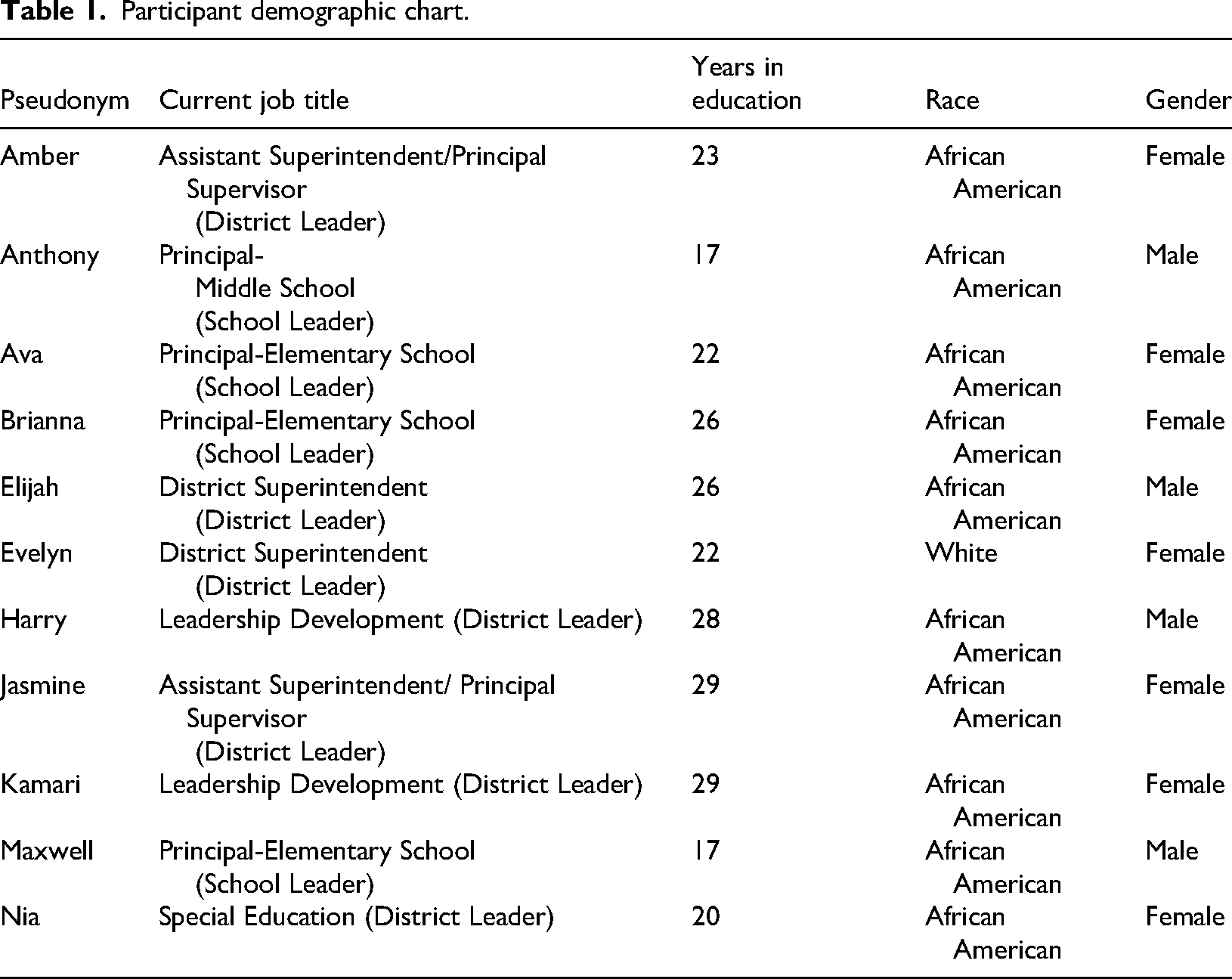
Of the 11 leaders who participated in our study, four were school principals while seven worked at the district level in various roles (including four superintendents). Given that the US K-12 leadership profession is predominantly white (according to the National Teacher and Principal Survey, in 2020–2021, 77% of K-12 leaders were white per Taie and Lewis, 2022), our sample is especially unique because 10 of our 11 leaders identify as African American and seven are female. Please see Table 1 for a demographic breakdown of participant characteristics.
Participant demographic chart.
Research context
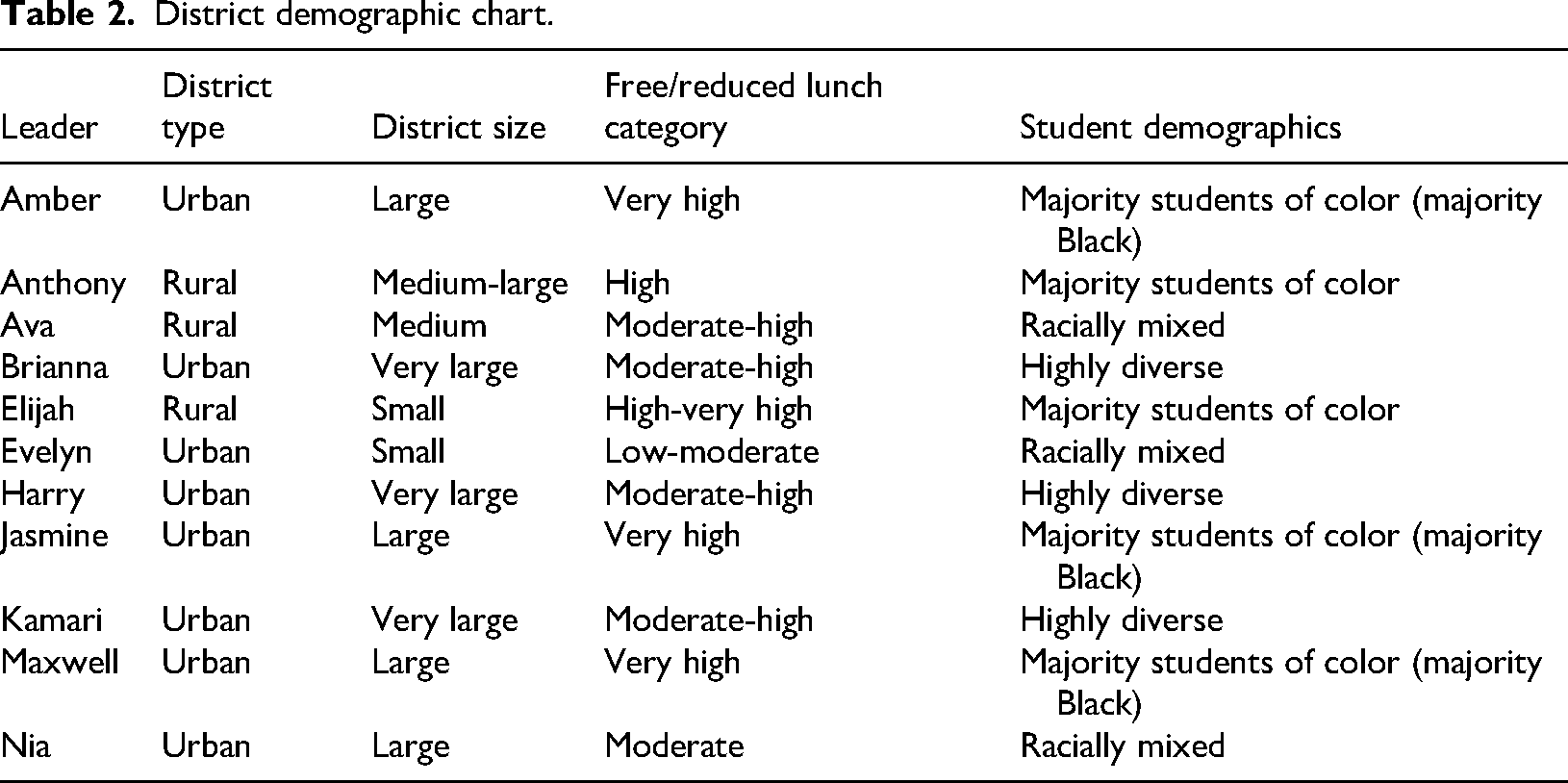
Participants were school and district leaders in the state of Georgia (USA) during the pandemic which began to take shape in Georgia in late February/early March of 2020. They represented various districts within or no more than 3 h away from the city of Atlanta. Districts were coded by size, economic status, and student demographic composition using publicly available Georgia Department of Education and National Center for Education Statistics data. District type was coded (using urban, suburban, rural) based on district geography, relationship to the city of Atlanta, and population density. District size was determined by total enrollment (small: >5000 students; medium: 5000–30,000 students; large: 30,000–100,000 students; very large: <100,000 students). Socioeconomic status was operationalized using free and reduced-price lunch (FRL) eligibility (low: >30% of students eligible for FRL; moderate: 30%–49%; high FRL: 50%–74%; and very high: 75% or more). Student demographics were coded based on racial and ethnic enrollment patterns (majority students of color (SOC) 2 : <50% SOC; racially mixed: two or more racial/ethnic groups comprise substantial proportions (25%–45%) of total enrollment but one group may still be numerically dominant; highly diverse: no single racial or ethnic group exceeds 50% of total enrollment (Table 2).
District demographic chart.
Limitations
This study is limited by its small, geographically bound sample of 11 educational leaders from a single US state and the uneven representation of roles (four school leaders and seven district leaders), which may limit comparison to other contexts. Additionally, the findings are based on retrospective accounts and are therefore subject to memory. While the predominance of Black leaders limits racial comparison, it enabled deeper examination of the racialized dimensions of crisis leadership.
Findings
The findings highlight four interrelated themes that illustrate how K-12 school and district leaders enacted crisis leadership during the COVID-19 pandemic (2020–2022), which President Biden declared to be over on September 18, 2022, during an interview on 60 Minutes (CBS News, 2022). These themes, arising from the participants’ stories, are compelling arguments about the ways school and district leaders navigated this unprecedented crisis:
Crisis leadership involves navigating politics, policy, and infrastructure. Crisis leadership requires holding communities together through care and culture. Crisis leadership requires prioritizing your own mental and physical health. Leading while Black during a crisis highlights the racialized dynamics of leadership.
While all leaders experienced the pandemic as an acute crisis, the nature of their work diverged sharply by role, with district leaders focused on system-level legitimacy and infrastructure, and school leaders engaged in the daily human labor of care, culture, and instructional recovery. We will discuss each theme separately below.
Crisis leadership involves navigating politics, policy, and infrastructure (district leaders)
District leaders’ accounts highlighted the political and structural dimensions of crisis leadership. They were responsible for keeping systems operational while under intense public scrutiny and shifting policy constraints. Participants who were district leaders described the early days of the pandemic as marked by rapid decision-making despite much uncertainty. Initially, district leaders worked hard to address basic issues of technology access and nutritional support, which seemed to be the pressing needs initially. Elijah, who served as District Superintendent in a poor rural district, discussed addressing initial food and technology needs: I was dropping off food as closely to the homes as we could trying to help them because the poverty in my area is so extreme…We did not have broad band internet access to meet the needs of all the students.
Nia, a Special Education District Leader from an urban district, discussed how her team best tried to meet the needs of special education children in the district during the pandemic. These students were used to having in-person support and that was impossible given the nationwide school shutdown. She shared: How do you implement support for students with special needs virtually? We had to think about and actively put into place [solutions] very, very, very quickly. It was a really, really, really difficult situation where no decision was the greatest or best. I want to be fair that this was new territory that we were covering and in the moment, decisions were being made with the best intentions. But, when we started to look back on the residual impact of some of those decisions, we realized what was wrong and instead of going back and correcting it, we sort of sat in the decision and held it. I did a lot of research. I would be up researching stuff that obviously wasn’t there but had to piece things together because we’ve never had to do anything in our lifetime [like we did] during a pandemic. So, it was new and novel.
In addition to having to make high-stakes decisions, district leaders also had to figure out how best to communicate their decisions to stakeholders.
Nia said: People just wanted to be communicated with. They wanted to know what was going on at every turn. And if there was a lack of that, that's kind of when things would go awry.” Jasmine, an Assistant Superintendent/principal supervisor of an urban district, noted that “it was tough…it was really emotionally and physically draining for all of us.
Because of the unprecedented nature of these challenges, there were real consequences to leaders’ decisions. As the death toll rose, leaders prioritized keeping communities safe. Harry, a district leader of leadership development in an urban district, discussed how at one point at the height of the virus he had to prioritize “safety over effectiveness” while also making sure that the district “created enough flexibility for schools to figure out what's best for them.” Student achievement and test scores became secondary as district leaders navigated this complicated terrain of managing the health and well-being of their school communities.
The COVID-19 pandemic was both a health and a political crisis. Because in the state of Georgia, school districts were able to decide for themselves if they would reopen to in-person learning, many leaders worked hard at figuring out what was in the best interest for most of the community. One of the challenges districts had to face is the pressure from some parents to open schools while others pressured the leadership to keep the schools virtual for safety reasons. Given the differential racial impacts of the pandemic, there was a lot at stake in deciding when it was safe for schools to reopen. Additionally, the pandemic became politicized with misinformation and disinformation circulating about who started it and why as well as whether vaccines were safe (Kerr et al., 2021). This extra layer created additional pressure for leaders as they were forced to navigate a political layer in responding to the crises. Harry (district leader of an urban district) noted that: Schools on the northside of town that are predominately white, all of the children are in person. And the parents are like, “We’re going to be in-person because we don’t think the virus is even real.” And on the southern end of the county, it's a ghost town because there are hardly any children, relatively speaking, in the building. And what do you do in terms of equity and in terms of trying to close the achievement gap when you got disproportionate children that are in person versus digital.
The two opposing schools of thought regarding the pandemic and the fear and anxiety tied to the crisis led to attacks on district leaders and smear campaigns. Black district leaders described heightened visibility and scrutiny where their authority and credibility were frequently challenged. Jasmine shared a story about what happened in her district, “you had groups of parents who bought billboards to disparage the superintendent, to say that not opening the schools was hurting kids.” Elijah, on the other hand, faced a smear campaign from a parent who did not believe the public health guidance and wanted the schools to remain closed. The parent posted pictures of Elijah on social media sites and “said violent horrible things that I did not care about the children. It was a really dark moment. And she may have taken it down but once it's out there, it's out there.” Elijah shared that he did not have a chance to defend himself because there was no time to fight the battle to clear his name given everything that was on the line.
In situations where information was limited and/or misinformation proliferated, district leaders had to rely on partnerships with well-known state and federal organizations to help lend credence to their decisions. These leaders not only had to make quick decisions based on the information they could access, but they had to be flexible that the decision might need to be altered based on new(er) information. Many of their decisions, as these leaders recall, were the best choices possible given the moment.
Crisis leadership requires holding communities together through care and culture (school leaders)
While district leaders navigated state and federal policies and made decisions in the best interest if their local contexts, school principals and other school-based leaders also experienced shifting priorities, an elementary school principal in a rural district, shared how her priorities shifted during the pandemic. She previously had to do some monitoring of children's health (i.e., immunizations, flu, strep), but during COVID-19: It was a mass monitoring. It was just your job being on steroids because that's what it felt like. Everything was a sense of urgency … But you still had to be an instructional leader…You were still being a human resources manager because you still had to find teachers.
School leaders became agile problem-solvers especially about public health, adapting to new roles or discovering that their existing roles had transformed entirely. Maxwell (elementary school principal) partnered with corporations to provide students access to internet access. He then had to figure out how long was developmentally appropriate for elementary students to sit in front of a screen. He had to try out different strategies and then pivot as necessary: What do caregivers have the capacity to monitor? So, first it was technology and devices, then it was scheduling. And then once we got all that figured out it was the instructional delivery model…the whole year was just solving one problem after another.
School leaders, in recognition of the emotional toll of the pandemic, changed how they led to be sure people were emotionally well. They narrated their leadership in intimate, human terms. For them, crisis leadership was about holding communities together when everything felt frayed. Brianna, principal of an elementary school in an urban district, shared that she had “always been an empathetic principal.” But, as the pandemic dragged on, she had to show even more empathy. During and postpandemic, before she decided about adding to teachers’ workload, she asked herself, “is this meeting necessary? Is this email necessary?” Attention to the socioemotional needs of her teachers is one way that Brianna illustrated she led with care.
Ava, principal of a rural school, also reflected on how the challenges of the pandemic changed her leadership style so that she led with more empathy: Seeing the gravity of what the pandemic did to some of our students and some of our adults just made us have to dig deeper into being counselors and more nurturing. It just became more exaggerated to make sure that every aspect was taken care of, making sure that people were literally safe and still trying to make sure they were getting the education they need.
Crisis leadership involves prioritizing your own mental and physical health (school and district leaders)
While emotional labor in leadership generally entails the ongoing regulation of affect to meet expectations, crisis-induced emotional labor occurs under conditions of intense uncertainty and heightened emotional demand. Given the crisis context of COVID-19, leaders had to manage not only their own emotional display but also the collective emotional climate, requiring more sustained regulation, adaptive strategies, and resource depletion than in everyday leadership work (Floman et al., 2024). Both district and school leaders had to learn to take care of themselves given all the extra stress and challenges they navigated during the pandemic. While experiences of burnout and trauma were shared across leadership roles, participants’ accounts revealed important differences in how strain was produced and managed at the district and school levels. Principal Maxwell shared with us that, “The emotional labor of school leaders has increased exponentially pre to post COVID.” He explained further that for his teachers and staff to be their best selves for the children, he had to be willing to allow them the space and opportunity to share their own struggles with him. This increased his emotional proximity to staff and students and meant he was engaging in constant crisis management without relief. Additionally, Maxwell was honest about the ways the pandemic challenges affected his emotional state. He shared that he thought about quitting his role as a principal, especially because the social and emotional needs in the school were getting more difficult to navigate. The emotional labor was impacting his ability to get work done. His supervisors provided him with more personnel which helped in his choice to stay. He said, “People have to feel safe, they have to feel psychologically safe in order to not bring big emotions to classrooms of children who come to teachers with big emotions.”
The leaders in this study not only understood that prioritizing the emotions of their constituents was important but also knew that prioritizing their own emotional health was necessary. As an example of emotional intelligence, leaders during the pandemic had to project a calm and confident demeanor, for stakeholders to trust them during an uncertain time (Williams and Liou, 2024).
While school leaders had to encourage space for students, faculty, and staff to express feelings of grief and anger, district leaders faced chronic visibility and isolation in their decision-making. This took a toll on their well-being so much so that they had to allow space to process their own emotions. Amber, an assistant superintendent/ principal supervisor, in an urban district, realized, “I need to keep my counselor for my own personal health. Because in some ways my cup is empty, and so I’m looking at ways to fill my own cup so that I can continue to work and support [myself].” This sentiment was also shared by Superintendent Elijah who discussed his evolution regarding mindfulness and taking care of his own emotions during the pandemic: One of the lessons I will take away from this is that I did not even realize how wrapped up I had gotten just in everyday life in school. When something like this happens, it causes you to stop and think. So, what I’ve tried to do is participate in some professional learning focusing on things like mindfulness, slowing down, taking time to reflect …But, now as I reflect, I understand the need to take care of myself because I can’t take care of people that I’m responsible for leading or I can’t even lead from a good headspace if I’m not okay.
Leading while black during a crisis highlights the racialized dynamics of leadership (school and district leaders)
The final theme examines the racialized dynamics of crisis leadership during the COVID-19 pandemic by analytically distinguishing between the structural conditions of leading in underresourced, predominately Black districts and the embodied experience of leading while Black. With 10 of the 11 participants identifying as African American, leaders described navigating what many referred to as two concurrent crises: the public health emergency of COVID-19 and the enduring realities of systemic racism. While several district leaders noted that serving predominantly Black districts sometimes fostered a sense of safety and protection, these districts were often shaped by longstanding racialized disinvestment, resulting in limited resources and constrained infrastructures that intensified the challenges of pandemic leadership. These racialized dynamics were shaped not only by leaders’ identities but also by their positional roles within school and district systems.
School leaders encountered these same structural inequities at the point of implementation, where resource scarcity translated into daily crisis management within their buildings. Maxwell was a school leader who shared the frustrations of developing a plan that could not be executed given the additional constraints of working parents and lack of resources his community faced. Without the resource of a school nurse on site, Ava described having to fill that role. She would do daily temperature checks and maintain health records to stop the spread of COVID-19.
In contrast, district leaders described navigating racialized disinvestment at scale, often absorbing political pressure while managing systemwide shortages across schools serving predominately Black communities. Nia described the challenge of leading in an urban district that was hit hard during the pandemic: I support an area, which is highly African American and English Language Learners. That's where the majority of the losses were in those communities and those kids lost a lot. They lost a lot of family members. That's where 16-year-olds were choosing to go to work as opposed to come into school.
In addition to figuring out how to make an instant switch from in-person to virtual learning, many African American district leaders who were leading in under resourced districts also had to figure out how to get food to hungry children as well as how to get internet and devices to them. The disparities between resourced and under resourced schools became even more prominent during the pandemic. As Nia stated, “the pandemic just exposed it.” It exposed how nationwide school districts can be racially and financially divided and separated. Jasmine, assistant superintendent of an urban district, shared that the pandemic made a bad situation worse: It was a huge challenge to us having access to the curriculum, having access to resources that children need. We were really behind the 8 ball and we’re just really behind and really trying to navigate and catch up.
Elijah, a rural superintendent, likened the issues his district faced to being at war. The pandemic was a challenge on top of the preexisting challenges of “healthcare issues, racial disparities, economic problems … every school district I ever worked in was in a wartime.” Elijah continued that, having worked in struggling and under resourced school districts previously, “I was conditioned to deal with a bad hand, so to speak.” His prior experiences as an African American leader navigating challenges enabled him to rise to the occasion of the COVID-19 crisis. In a similar way, assistant superintendent Jasmine, in discussing the challenges faced in her impoverished district alluded to the metaphor of war: “I feel like you should not have to fight. It's hard, that everyday shouldn’t be a fight.” Taken together, these invocations of war illuminate how crisis leadership in racially and economically marginalized districts was understood not as an exceptional disruption, but as a continuation of chronic struggle shaped by longstanding structural inequities. The war metaphor underscores how leaders, particularly Black leaders, framed their work as requiring endurance, resilience, and constant vigilance. This reflects both the normalization of crisis in underresourced contexts and the racialized expectation that Black leaders be perpetually prepared to “fight” for their communities.
Urban district leader, Kamari, referenced herself as a Black leader who had to confront that not only was her community suffering through a health pandemic: There was a racial pandemic that was also happening at the same time and that had a major impact on our school system as well. How do we support our students of color through what they witnessed on television with George Floyd, Breonna Taylor, and Ahmaud Arbery, specifically. It began to force us to examine our policies and practice that were perpetuating some of the outcomes that we thought we could just put off on, “That's just the community's problem. That's just the parents’ problem. That's just such and such” when, in fact, it was much greater than that.
These accounts demonstrate that “leading while Black” meant carrying communal burdens and reframing leadership as both professional and racialized work. Leaders also had to address inequities that extended past their student population into communities (Virella and Cobb, 2021). Crisis leadership literature rarely accounts for race, and these findings suggest it must. Additionally, although participants shared common experiences of racialized leadership during crisis, the ways these dynamics were navigated varied by role, with district and school leaders encountering distinct structural pressures and interpersonal expectations.
Implications/significance
Together, these four themes illustrate that crisis leadership during COVID-19 was differentiated by role yet interconnected. District leaders engaged in macrolevel work to secure legitimacy, shield schools from political fights, and navigate resource inequities. School leaders, by contrast, enacted microlevel leadership to sustain staff, reconstitute culture, and create hope (Virella, 2024). Across both roles, emotional labor and racialized legitimacy were central, underscoring that crisis leadership is neither role neutral nor race neutral. This study extends crisis leadership scholarship by demonstrating how the COVID-19 pandemic was experienced differently across levels of leadership and through racialized leadership identities.
Role differentiation and meaning making in crisis leadership
District leaders’ work was about sustaining the credibility and coherence of the system under hostile, polarized, and uncertain conditions. One of the participants likened her leadership during the pandemic to playing the violin as the Titanic sinks, a metaphor that illustrates what Boin et al. (2017) call the meaning making function of crisis leadership. Even as systems were destabilizing, district leaders were expected to project stability, rationality, and control. Elijah's reframing of broadband access as a civil rights issue highlights the moral and political dimension of district-level crisis leadership: leaders had to make inequities visible while advocating for resources that often lay beyond their immediate control. In this sense, district leaders’ crisis leadership was less about the daily life of schools and more about the defense of institutional legitimacy, negotiating policy mandates, and constructing infrastructures capable of sustaining schooling under unprecedented conditions.
In contrast, school level leaders emphasized the immediacy of human relationships. Their leadership was characterized by daily acts of care. From stabilizing traumatized students, addressing behavioral crises and absenteeism, supporting teacher well-being, and rebuilding school culture in different contexts, school leaders engaged in relational work. Their narratives about caretaking of their multiple stakeholders and absorbing the grief of their communities embodies what Boyatzis and McKee (2005) call “resonant leadership”—a practice of managing one's own and others’ emotions in ways that drive success. School leaders’ proximity to students, families, and teachers positioned them as the emotional front line of the crisis.
While both domains of leadership were essential to effective schooling during the pandemic, they demanded different skills and capacities. These differences have been undertheorized in the literature which frequently treats leaders as a single analytic category. This study suggests a first theoretical proposition: crisis leadership must be conceptualized as role-differentiated, with leadership demands shaped by proximity to policy, politics, and people. Future research should examine how crisis leadership competencies vary across organizational levels and how misalignment between role expectations and preparation contributes to leader strain and system breakdown.
Emotional labor as core leadership work
Across leadership roles, participants described emotional labor as central to their crisis work. Despite feeling immense pressure and uncertainty, leaders projected composure in the face of crisis, demonstrating the cost of such emotional labor and management (Hochschild, 2012). These findings reinforce that emotional labor is not peripheral to educational leadership but central to it, especially in a crisis. This leads to a second proposition for future research: Emotional labor should be theorized as a core mechanism of crisis leadership rather than an individual coping strategy, with attention to how emotional demands are distributed, supported, or ignored within leadership systems.
Racialized crisis leadership and dual pandemics
Finally, this study extends crisis leadership literature by centering the racialized dynamics of leadership. With 10 of the 11 participants identifying as African American, their stories illuminate how crisis leadership unfolded amid the dual pandemics of COVID-19 and systemic racism. Leaders described navigating professional responsibilities while simultaneously carrying personal and communal pain, racialized scrutiny, and heightened moral responsibility to Black communities disproportionately affected by the dual pandemics. For many, leading in predominately Black districts provided a sense of cultural safety, yet these districts were often underresourced, intensifying the demands of crisis leadership. This underscores the inseparability of race and leadership identity (Theoharis, 2007) and points to a third proposition: Crisis leadership scholarship must account for the ways race shapes both the burdens and the strategies of leaders, particularly in contexts of chronic underresourcing and racialized policy neglect. Future research should examine how Black leaders draw on culturally grounded leadership practices while simultaneously navigating racialized expectations of resilience, sacrifice, and composure.
Practical implications for policy and practice
These findings carry important implications for how districts prepare and support leaders for crisis. First, leadership preparation and professional development should explicitly differentiate between district-level and school-level crisis leadership. District leaders require preparation in political navigation, public meaning making, infrastructure design, and equity-focused policy advocacy while school leaders need sustained training in trauma-informed leadership, relational care, and collective healing.
Second, districts should institutionalize supports for emotional labor, including access to coaching, mental health resources, and peer support structures, rather than relying on leaders’ individual resilience. Emotional labor must be recognized, resourced, and shared.
Finally, systems must be intentionally designed to support Black leaders. This includes reducing racialized isolation in leadership roles, creating protected spaces for racial affinity and collective sensemaking, and ensuring that equity-oriented leadership is not penalized politically. Policies that normalize chronic crisis in Black communities must be interrogated, and crisis preparation must move beyond emergency response to address the structural conditions that make crisis perpetual.
Conclusion
This study extends crisis leadership theory along three critical dimensions: role differentiation, emotional labor, and racialized leadership. By demonstrating how crisis leadership is enacted differently across organizational levels and shaped by race, these findings offer a more layered and justice-oriented framework for understanding educational leadership in times of crisis and for reimagining how leaders are prepared, supported, and sustained.
Supplemental Material
sj-docx-1-ema-10.1177_17411432261430867 - Supplemental material for Crisis leadership in Georgia: Navigating policy, people, and dual pandemics in K-12 education
Supplemental material, sj-docx-1-ema-10.1177_17411432261430867 for Crisis leadership in Georgia: Navigating policy, people, and dual pandemics in K-12 education by Jennifer Esposito and Dionne V Cowan in Educational Management Administration & Leadership
Footnotes

Ethical consideration
This study was approved by the Georgia State University Institutional Review Board (approval no: H23139) on 19 September 2022. The study was approved for exempt informed consent. Participants provided verbal consent before the interview was recorded.
Funding
The authors received no financial support for the research, authorship, and/or publication of this article.
Declaration of conflicting interests
The authors declared no potential conflicts of interest with respect to the research, authorship, and/or publication of this article.
Data availability statement
Due to the terms of Institutional Review Board (IRB) approval and the confidentiality agreements established with participants, the data cannot be made publicly available. The consent process specified that only the principal investigators would have access to the data. Public sharing would therefore violate the ethical commitments made to participants and the conditions of IRB approval.
Supplemental material
Supplemental material for this article is available online.