



Abstract
A growing body of research has emphasised the importance of school leadership for quality improvement in schools, which reinforces the importance of school leaders’ continuous professional development in working life. However, less is known about the professional development of experienced principals. Against this background, the purpose of this study is to examine experienced school leaders’ sense-making of their professional learning in relation to their professional development. Drawing on sense-making theory, a qualitative case study design was adopted, and data consisted of semi-structured interviews, and course evaluations. Qualitative content analysis was performed using the Atlas 6.2 software tool. The findings showed that important sense-making for the principals related to the value of continuous professional learning and interactions with professional peers, and professional learning implications. This qualitative Swedish study can be seen as a contribution to experienced principals’ professional learning, as the professional development of experienced principals is under-researched.
Keywords
Introduction
Effective school leadership is highlighted by researchers, practitioners, and political representatives as essential if schools are to meet future requirements and fulfil their mission to enable all students the possibility to cultivate and achieve their educational goals and personal development (Huber and Muijs, 2010; Leithwood et al., 2017, 2008; OECD, 2013; Pont et al., 2008). There is growing insight into the importance of school leadership for the quality and development of schools, and it is widely recognised that leadership is second only to classroom teaching in its impact on student learning (Leithwood et al., 2020). This knowledge reinforces and highlights the importance of school leaders’ professional development. Bush (2018) argues that acquiring leadership skills should be a deliberate, rather than an incidental, process.
In accordance with a new and strengthened position of school leaders, professional training and professional development have been placed on the agenda, with the aim of professionalizing school leadership (Bøje and Frederiksen, 2019). Generally, most principal training activities and programmes have been focused on the needs of aspiring or newly appointed principals, leaving experienced principals without the support they need for professional development (Pashiardis and Brauckmann, 2009). There are various discussions about how to best train future and existing school leaders (Huber, 2010a, 2010b; Jensen, 2016). In a recent study, examining effective principal professional development, Boren et al. (2017) concluded that ‘principals must be continuous lifelong learners if they are to keep up with the demands of today's complex and ever-changing educational environment’ (p. 102).
In this paper, the focus is on experienced school leaders and their continuous professional learning in working life. An ‘experienced school leader’ is defined as a principal who has at least 5 years of experience in their current leadership position (Lazenby et al., 2020). To be a professional school leader requires an opportunity to reshape their competence through continuous professional learning (Young and Crow, 2017). Research in recent decades has shown a variety of ways to promote the professional development of school leaders around the world. However, less is known about the professional development of experienced principals than aspiring principals (Lazenby et al., 2020).
In Sweden, research has shown there is an absence of structured continuous professional learning for experienced school leaders, specifically collective learning with other school leaders (Hallerström, 2006). This is in line with a finding from another Swedish study (Forssten Seiser, 2017), where school leaders emphasised the importance of being a part of professional networks to enable professional development. The importance of arranging conditions for teachers’ continuous professional learning is often discussed, but rarely is the talk about the school leaders’ continuous professional learning. Studies have shown that school leaders often lack arenas, where they can meet and have exchanges on important issues and topics (Aas and Vavik, 2015). Oxensvärdh and Forssell (2016) highlight the importance of researching school leaders’ learning processes and argue for school leaders’ continuing professional learning after undergoing the national school leadership training programme. The need for continuous professional learning for school leaders is also expressed in Swedish government policy (e.g., SOU, 2017: 35, 2018: 17). In Swedish schools, one challenge is how school leaders can be strengthened in their professional roles.
In this paper, the focus is on the professional development of experienced school leaders and school leaders’ professional learning in a Swedish setting. The purpose of the study reported in this paper is to examine experienced school leaders’ sense-making of their professional learning and how it can be understood in terms of their professional development. The research question that frames the study is as follows: How do experienced school leaders make sense of their professional learning in relation to their leadership?
In this study, Weick's (1995) sense-making theory is employed to guide the understanding and interpretation of the study's content analysis. Sense-making is understood as the process by which experienced principals construct meanings regarding their professional learning. This paper starts with a review of research on the continuous professional development of school leaders and then outlines the theoretical framework and the methodology. It then provides the results and analysis of the conducted study and finishes with a discussion and conclusions.
Professional learning and professional development of school leaders
The focus of this paper is on professional development as school principals. It draws on the literature on ‘the education of leaders’ 1 and on ‘school leaders’ development.’ 2 , 3 The term ‘professional development of school principals’ is used as a collective term in this paper. The literature in the last two decades has revealed a variety of ways to foster the professional development of school leaders around the world (Huber, 2010a, 2010b; Jensen, 2016, 2020; Young and Crow, 2017). Several researchers underpin that the mid and late-career stages of the principalship remain under-researched and therefore in need of further investigation (e.g., Marks, 2012; Mulford et al., 2008; Oplatka, 2010; Pang, 2007).
Patterns of leadership preparation and development are highly variable across national contexts, ranging from prescriptive mandatory programmes, to ad hoc ‘on the job’ learning in many countries (Bush, 2018). In many countries, the development of school leaders is high on the agenda of politicians of different political wings. At the beginning of the new century, there seemed to be a broad international agreement about the need for school leaders to have the capacities required to improve teaching (Huber, 2010a, 2010b). However, it is apparent that several countries have engaged more deeply than others. While in some countries discussions of school leader development are mainly rhetoric, elsewhere real actions have been taken to provide important development opportunities for school leaders (Bush, 2018; Huber, 2010a, 2010b). Huber (2010a, 2010b) found there is a trend toward requiring participation in time-consuming programmes as a preparation for leadership responsibilities in schools. Huber also noted the trend of extending short courses into extensive programmes and distinguishing between different phases in school leaders’ careers when designing opportunities to learn.
Based on the existing body of literature on the professional development needs of school principals, Pashiardis and Brauckmann (2009) underpin the importance of the need to establish training provisions in relation to the different stages of leadership, i.e., new, and experienced principals. Experienced principals seem to need more training on instructional and strategic leadership skills, while inexperienced principals seem also need training on technical issues, such as financial management. As a result, differences related to the principals’ career stage must also be accounted for in any training schemes. Other important aspects that need to be included concern school improvement practices, strategic planning, and human resources and financial management. This is in line with Bush (2018), who suggests that a better approach to principals’ induction is to regard it as an ongoing process. Bush suggests that such a process might have six phases: Succession planning, leadership preparation, recruitment and selection, induction, mentoring, and in-service development. In-service development in terms of leadership learning as a career-long process (p. 69).
According to several researchers, (e.g., Bush and Glover, 2004; Pashiardis and Brauckmann, 2008), leadership development should consider the local contexts within which leaders operate. Professional development can then be provided by a wide array of sources, such as universities, professional associations, governmental agencies, and other organizations. Partnerships between various organisations may also enhance the training impact on school leaders. There's a close relationship between leadership and context, and Brauckmann et al. (2020) also argue that leadership development programmes should be guided by a deeper examination of contextual factors, combining theoretical perspectives and local contexts.
Lazenby et al. (2020) found four key findings where principals identified key areas central to their professional development: (a) Taking greater responsibility for sourcing their own professional development; (b) Knowing, with a capacity to visualise, what effective professional development would look like for them; (c) Believing participation in professional development extends beyond their employing authority and their immediate jurisdiction, and includes access to internationalised professional development opportunities as an essential component in their portfolio of professional learning activities; and (d) Highly valuing networking and interaction with their colleagues, which was seen to provide the most effective, beneficial and relevant form of professional learning (p. 6).
In a literature review about research on leadership development, Jensen (2016) stated that what we have learned about school leadership development from the 2000s is that the ways in which school leadership development is organized, vary regarding centralisation, decentralisation, professionalisation, politicisation, although in most countries the central government has a strong influence on the provision of leadership training. There is now more knowledge about aspects of the use of cohort models. The purposes of school leadership development have also expanded as well as the content, which in some countries is manifested through standards. A range of new pedagogies is identified in addition to previous pedagogies, including a variety of digital technologies (Ibid.).
Professional development of school leaders in Sweden
In Sweden, the school municipality organiser, or their equivalent in independent schools, is responsible for employing principals (Ärlestig et al., 2016). The National Principal Training Programme is currently hosted by seven universities at the request of The Swedish National Education Agency and is based on a national target document. This makes it possible to meet expectations from several levels and to create a common knowledge framework for all principals in Sweden (Brauckmann et al., 2020).
The current national programme is a 3-year mandatory programme, and every newly hired principal is expected to start the programme during their first year in office. The provision is also open to deputy principals and preschool principals. The programme consists of three courses: school law and governance, governing with objectives and results, and school leadership (Ärlestig et al., 2016). Swedish principals’ formal professional learning mainly consists of the mandatory principal programme. Recent evaluations showed that 97% of the participants have indicated that the programme is very good or good (e.g., Brauckmann et al., 2020). From an international perspective, the Swedish principal programme can be viewed as a context-sensitive leadership preparation programme, which combines theoretical perspectives and local context examples for principals’ professionalism (Brauckmann et al., 2020).
In addition, the National Agency for Education (2022) offers a portfolio of voluntary continuous professional development courses for experienced principals’ professional learning, mainly offered by the same universities that provide the principal programme. There are also some other professional development initiatives for principals that are beyond the scope of this paper. Next, the course and the Swedish context in this study are presented.
The Swedish case – A professional learning course for experienced principals
The background to this course is to be found in the Swedish Ordinance (2011: 183) on professional education and training for principals and other personnel with corresponding management functions in schools, preschools, and leisure centres, where it is regulated that a university that has the state as the national organizer and is covered by the Higher Education Act (1992: 1434) may organise commissioned training on behalf of the Swedish National Agency of Education. This applies to professional training for principals and continuing education for principals, which is the paper's focus.
According to the overarching target document for current continuous professional education (The Swedish National Agency of Education, 2016), it must support the principal in deepening and developing pedagogical leadership based on clearer requirements in the Education Act (2010:800) and new or revised curricula as well as based on research and proven experience (The Swedish National Agency of Education, 2016). The continuous professional education is focused on leadership and management issues so that the principals are given the conditions to develop their pedagogical leadership. Theoretical knowledge must be linked to the principals’ leadership role in practice and build on relevant parts of the professional training for principals. The course corresponds to 7.5 higher education credits at the advanced level and is carried out over a maximum of two semesters. After completing the course, the principal must have good knowledge and further developed competencies and abilities to exercise pedagogical leadership towards higher goal achievement.
Based on this background, the specific course one university provides is presented next through a description of the purpose, content, and working methods.
Purpose
The overall purpose of the course was for the participants to deepen their ability to lead the business based on the national curriculum, critically reflect on their own leadership, and reach a deeper understanding of different theoretical perspectives on school leadership, as well as develop and deepen their ability to organise and lead the business's development processes.
Content
The course contained four different themes: Principals’ management and leadership with a focus on problematising aspects of principals’ management and leadership in relation to the cross-pressure principals have in their mission with many demands from different actors; Principals, and quality assurance, where different methods for the development of quality assurance were used and discussed from a leadership perspective; Principals, school development, and culture where school development was problematised and the importance of school culture and different cultural analysis methods were discussed; Principal and students’ learning environments. The concept of leading the students’ learning environment was problematised. The course combined practice, policy, theory, and earlier research where the participants got to connect theoretical perspectives with practice using their own schools – local context – in different assignments. Research-based literature consisting of books and scientific articles, within educational leadership and school development, were linked to the course content.
Working forms
The course was offered to experienced principals who have completed the national school leadership training programme and had at least one year of experience after that. The course was at the master's level and was carried out during an academic year with four two-day residential stays and independent studies in between. The course was led and coordinated by a senior lecturer (Ph. D.) and several researchers and senior lecturers held lectures throughout the course. The working methods consisted of lectures, workshops, collaborative activities, structured reflections, peer mentoring, literature seminars, and individual and group-based tasks. The course was examined through an individual paper where the participants problematised one or more themes based on their own activities, analysed, and used previous research/course literature.
Theoretical framework
Weick's (1995) sense-making theory is used to grasp the school leaders’ construction of meaning about their leadership and professional learning. Sense-making is about the ‘making of sense’, where ‘sense’ refers to meaning and ‘making’ refers to the activity of constructing something (Weick, 1995). Here, it is understood as the process by which school leaders construct meanings regarding their leadership and professional learning in the context of participating in a course for experienced school leaders.
Weick (1995) argued that sense-making is ‘grounded in identity construction’ and occurs in the context of ‘ongoing’ projects, leading to behaviours that ‘enact’ the environment. Weick (1995), and Weick et al. (2005), define sense-making as a retrospective process that tends to arise when the current state of the world challenges the expected state, and by which people in organisations try to coordinate actions and enforce an order to understand themselves and their actions. To handle such a situation, people individually and collectively try to reduce complexity to construct new understandings and interpretations. Action is based on how people select information from the environment; make meaning of that information; act on those interpretations and, by doing so, develop culture, social structures, and routines over time (Coburn, 2005; Spillane et al., 2002; Weick, 1995). Sense-making is not a passive act of discovering reality but an active process in which actors enact their environment.
Method
In the study reported in this paper, a qualitative case-study design (Yin, 2014) was employed with a purposive sampling method to include leaders participating in a professional learning course for experienced leaders. To address the complexity of leaders’ professional learning, contextual depth is required, which a case study allows (Stake, 1995): ‘In qualitative case study, we seek greater understanding of the case, we want to appreciate the uniqueness and complexity, its embeddedness and interaction with its contexts’ (p. 16). The case in this study, ‘the quintan’ according to Stake (1995), is the leader's professional learning.
Data collection
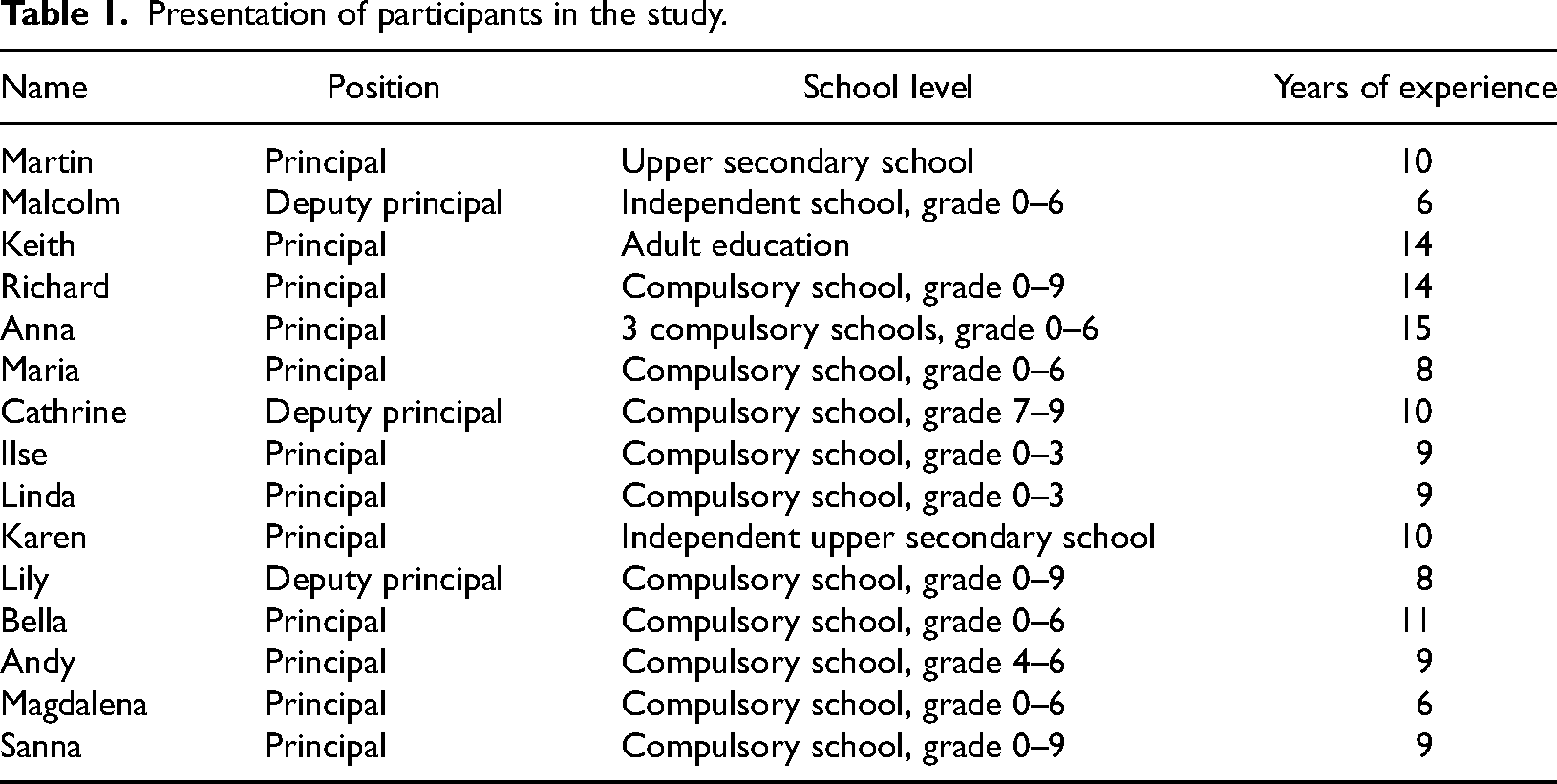
The professional development of school leaders was studied over a 1-year period in a group of participants from primary, and secondary schools, and adult education. The course was part of a national professional development programme for experienced school leaders provided by the National Agency of Education in Sweden. The participants are either principals or deputy principals, from primary and secondary schools, and adult education, in 13 municipalities in Sweden. They all have at least five years of experience being leaders in their current leadership position. Find more detailed information about the participants further down in this section (Table 1).
Presentation of participants in the study.
The study is based on empirical data collected during autumn 2019 and spring 2020, in the context of a professional learning course for experienced school leaders. The 20 participants who completed the course were asked if they wanted to participate and be the informants of the study. Semi-structured interviews were used as the data source for this case study to get a deeper understanding of the object of knowledge (Cohen et al., 2018) and to grasp the informants’ sense-making of their professional learning. In addition, the 20 answered end-of-course evaluations were also used as data for analysis in this study. The objectives of the course evaluation were to achieve knowledge about how the participants perceived the course and it touched on questions about course content, working methods, and activities, what worked well, what could be developed, and above all what lessons they take back to their activities in their role as principal.
The interviews were carried out digitally via Zoom, because of the then ongoing coronavirus disease 2019 (COVID-19) pandemic. Four group interviews were conducted with a total of 13 participants, plus two who participated by answering the questions in writing. The interviews lasted about 45 min and were recorded and transcribed verbatim. The interview questions focused on the principals’ previous professional learning and what it meant in the principal's role and in leadership, what this course specifically meant for them as principals and leadership development, whether participation in this course affected their (principal's) leadership practices and whether there are concrete examples to tell.
Participants
The participants of the study are presented more in detail next (Table 1), with fictitious names, current positions, school level, and years of experience as a principal.
Data analysis
Qualitative content analysis was used to analyse the collected data (Miles et al., 2014) and the empirical data has been analysed using the Atlas.ti 6.2 software and the process of analysing the focus group interviews were divided into three levels: Descriptive, thematic, and analytical. Being an ongoing process, the interpretative analysis aimed at developing knowledge about how to understand school leaders’ sensemaking of their leadership and professional learning by participating in a professional development course for experienced leaders and making sense of their own role in professional learning.
Limitations of the study
Inevitably, there were limitations that needed to be identified and recognised in this study. First, the small number of participants in this case study, and its specific social context, limited the generalisability of the findings. Second, the study's sample was not independently selected, and its findings were linked to national and local contexts, which was both a limitation and a strength. Third, the role of being both the teacher, the course coordinator, and the researcher meant a distinct ‘insider status’ for the author, which was important to have awareness about. How it was handled in this study is described in more detail in the next paragraph under ethical considerations. Despite these limitations, this study contributes in-depth information about the principals’ experiences and their construction of meaning of their professional learning and leadership development. Finally, although the sample was small and not representative, the findings provide useful insights into how Swedish principals understood and interpreted their professional learning and leadership development and the implications in their leadership practices.
Ethical considerations
In carrying out the empirical study, the ethical rules and guidelines for research provided by the Swedish Research Council (2017) were followed. Four demands were followed: information requirement, consent requirement, confidentiality requirement, and use requirement. All respondents were promised their personal views and data would not be identifiable in written reports regarding the research. This meant that the participants were informed about the aims of the research and their participation was voluntary with the possibility to withdraw at any time.
The researcher's role and status within the site are also important to make transparent. The researcher, as emphasised by Cohen et al. (2018), is always a part of the world being researched and can, therefore, never be completely objective. In this study, the role of being the responsible teacher/course coordinator and the researcher meant a relatively hierarchical but also a close role to the participants, where relationships were created during the course and the study period. Researchers bring their experiences to the research sites and should concede they are part of the research. Therefore, researchers should be aware of and try to understand how they affect the research. It is impossible to preclude the researcher effect, which occurs from the researcher being part of the world being researched. However, being aware of his or her influence as a highly reflexive researcher is preferred (Cohen et al., 2018; Miles et al., 2014). In this study, the ongoing work, the findings, and the analysis were discussed with research colleagues as critical friends to reduce the potential for bias (Cohen et al., 2018).
Findings
The findings elucidated three main themes of interest followed by subcategories. The themes and categories are presented in the text that follows, illustrated by quotations from the interviews with the principals and the course evaluation:
The value of continuous professional learning
˚The value of the professional learning context: Course format, time, formality ˚The need for continuous professional learning The importance of interactions with professional peers Professional learning supporting leadership development
˚Increased leadership confidence and professionalism ˚Sense-making of professional learning implications
The value of continuous professional learning
The value of the professional learning context: Course format, time, formality
The principals who were interviewed for this study had all been participants in a course for experienced principals organized by a university. The course focused on principal leadership and professional development. The principals constructed and negotiated the meaning of the value of the professional learning context in several ways and emphasised various factors that were important to their professional learning.
First, the principals emphasised the importance of the course format, which included residential stays and their own studies in between these meetings. One of the principals, Martin, expressed it in this way: Something happens when you get away for a few days. You disconnect from your everyday life and your job at home. And then you dig into the course together with others, get replenishment, and get to exchange experiences with other principals. I came home so happy and strengthened.
Ten of the other principals expressed similar reflections. Catherine, for example, highlighted both the importance and the strength of collegial learning to critically reflect and problematise course content, theoretical perspectives on leadership, and the connection to school practice.
Second, time emerged as a crucial factor for successful professional learning in the principals’ sense-making. They viewed time as a part of the course format with residential stays, but also as the course being conducted for an entire year. One of the principals, Malcolm, made sense of time as a crucial factor in professional learning critically looking back on his previous experiences: One reflection of mine is when you go on one-day courses, there is almost no possibility to build knowledge. But in this course, you get the opportunity to think and immerse yourself and reflect at a slower pace, and then it can be a consolidated knowledge that you can use.
Another principal, Lily, also made sense of the importance of time allocated to focus on professional learning as a principal: Regarding learning, to have the opportunity to go away and end up in a small bubble where you just are and get to think about pedagogical leadership and about your assignment as principal. I think that time is very difficult to achieve in everyday life.
Third, all the principals critically reflected and made sense of the benefits of participating in a formal course for professional learning. For example, Martin stated: Even though participation in the course was voluntary we were “forced” to read literature and write assignments within the framework of the course. It is a very positive compulsion, of course.
Another example, relating to time and formality, came from Anna, who critically made sense of how professional learning in the form of participating in a course supports prioritising time to reflect on one's leadership, which often otherwise gets overlooked in the day-to-day work as a principal. Based on the principals’ sense-making, it seems that the professional learning context can be seen as important in several ways for the principals’ professional learning.
The need for continuous professional learning
The importance of professional learning as a principal was evident in the analysis. Most principals made sense of how important professional learning was as a principal, for their own leadership development, and for leading school development. Anna expressed how professional learning gave her time to reflect on her leadership, such as through the course she participated in, which gave her the opportunity and focus she needed to drive school development. Richard emphasised the value of professional learning to develop his leadership: ‘Professional learning has been incredibly important. For leadership to develop and become good, you must work actively all the time.’
Several principals problematised the need for professional learning as a means of staying updated as responsible for a business and emphasised that professional learning must be both long-term and continuous. Linda critically made sense of it by saying: When professional learning is real and connected to where I am right now with a long process with literature and processing of literature and input from lectures and conversations. To get an effect on my actions, I need this longer perspective. I need professional learning continuously and I notice the difference when I don't have it. Then I lose pace and get stuck more easily in ruts and have a harder time seeing solutions. I get a lower effect on my leadership if I do not replenish myself.
Some principals made sense of and problematised the need for formal requirements for school leaders’ professional learning, including scope, regularity, and content, and compared it to teachers’ professional development. One of the principals, Keith, critically reflected on the national governance of principals’ professional development and the need for the universities to be involved in these processes: I think there should be requirements for school leaders’ professional learning. We talk about the need for our employees to constantly participate in professional learning and this applies to us as well. A connection to the university is needed. The National Agency for Education needs to point with its whole hand here. It's easy to only be an administrative principal.
Another principal, Maria, made sense of the everyday demands of being a principal where there are many practical things to be solved vs. the opportunities professional learning can provide: Having the opportunity to stop and see ‘where am I now as principal?’, to read and discuss the latest research with teachers and professional peers at a high theoretical level, is very useful. It also places certain demands on me as a principal to really think.
Based on the principals’ sense-making, the need for and importance of professional learning as a principal is evident.
The importance of interactions with professional peers
The analysis revealed how the principals who participated in the study highly valued the opportunities for professional learning and interactions with professional peers in the course they participated in. They perceived it as the most effective, beneficial, and relevant form of professional learning. One of the principals, Richard, made sense looking back to his previous experience of professional learning and stated that this course on an advanced level and the combination of theory and practice together with professional peers was rewarding: It was a boost to meet experienced colleagues and discuss school leadership issues at a slightly more advanced level than you can usually do. I think the combination of academia and practice is very fruitful. Not only because the school shall rest on a scientific basis, but also because through professional learning, as in this course, you get more perspectives and another depth of knowledge.
Another principal, Ilse made sense of professional learning with professional peers and emphasised the importance of dialogue: ‘It is in dialogue with others that you learn, and you need to get away from your everyday practice and look up to see new perspectives and these wise thoughts.’
All the principals also emphasised the opportunity and value of sharing their colleagues’ experiences. One example came from one principal, Bella, who stated that there was a lot of collective competence to take part in and learn from each other: You find depth in a different way than you did in the principal's program. It has been a few years and you got something to relate to, and so experienced study mates. I think that meant a lot.
Five principals also expressed how formal professional learning in teaching during the daytime turned into informal professional learning during coffee breaks, lunches, and dinners through conversations and exchanging experiences between the principals. For example, Lily made sense of how learning continued even in the evening: ‘The course and the bubble it entails, living away, the opportunity for joint dinner time. It breathes job at that time, so even in the evening there is development and learning.’
Based on the principals’ sense-making, it seems that a crucial part of the professional learning in the course was the opportunities provided in the form of interactions with professional peers when it comes to problematising and discussing course content such as different perspectives on leadership theories, research-based literature, and exchanging experiences from practice related to it. These interactions meant opportunities to gain new perspectives from other principals and to be both challenged and confirmed as a principal.
Professional learning supporting leadership development
As noted earlier, the principals emphasised the value of professional peers in the process of professional learning. The data showed that the principals made sense of how networking and interactions with professional peers supported their own leadership development. All principals referred to opportunities to interact and exchange experiences as valuable and important. Anna and Linda made sense of how the interactions and discussions with professional peers supported and strengthened their leadership development. Linda reflected on the exchange with other principals in the course and expressed that ‘… to get an image of each other's realities and that we have similar problems, where we can support each other moving on from there.’ Another principal, Richard, made sense of how networking and interactions with professional peers supported his leadership development through an increased broader understanding: Yes, there has been leadership development, for example by meeting principals from other parts of the country, which has led to a broader understanding, and it plays a big role in the leadership we must exercise together with both responsible organisers and colleagues.
All the principals emphasised how reading research-based literature, focusing on different leadership theories, gaining knowledge of new tools and models, and critically reflecting and problematising on their own and with others, supported their leadership development during the course.
Increased leadership confidence and professionalism
The analysis revealed that all interviewed principals made sense of how they felt more confident as leaders after completing the course. The analysis also showed how several principals connected their professional learning to the principal profession and a sense of increased professionalism in their sense-making of how the professional learning affected them in their principalship and in their leadership. One of the principals, Martin, reflected on how professional learning could be understood both as increased professionalism and strengthened professional confidence as a leader: I think that professional learning increases professionalism. Then you become more confident in your profession, and it strengthens you as a person. Professional learning also means a little higher status if you build on it with different courses.
Another principal, Malcolm, tried to find clues about how professional learning strengthened the profession and developed his leadership as a principal: That you get more education, strengthen the profession, and give a certain weight to both staff and parents and others to build up a competence that you can become confident in. So, yes … But I do not know exactly how professional learning has developed my leadership, but I think I will be more confident, I think.
Based on the principals’ sense-making, it seems that professional learning supports the principals’ leadership development, where increased professional confidence as a leader and enhanced professionalism are two essential aspects of principal leadership.
Sense-making of professional learning implications
The analysis clearly showed the principals made sense of the professional learning implications in their own leadership practices, both direct and indirect.
First, some principals reflected on the direct implications of professional learning in their own leadership practices. Six principals reflected and gave examples of how they had used analytical tools and models in their schools after participating in the course. Anna made sense of how she, during the course, received support in working with analysis and creating evaluation questions working with quality assurance in her school, using an approach presented in the course. Linda shared her experiences of working more with data analysis in her leadership practices after participating in the course: I have worked with the data for analysis we produce before analysis meetings with the staff so that we have both depth and breadth and height in them. It is something that I have taken with me from the course, and then participation. The staff now feel that they feel greater participation in our systematic quality work, and they know when they are involved.
Richard made sense of and problematised the possibilities of connecting practice and research while working and participating in a course from the university: In concrete terms, my deputy principal and I did a survey at the school as part of the course itself and used methods and tools from the course. I have taken that further and it is in the planning for the school very concretely. It is also an advantage to read your courses while working which enables this connection between practice – research.
Second, all principals made sense and expressed how their professional learning and leadership development was reflected in their leadership practices, but these were mainly indirect implications. Awareness and knowledge about the importance of working with processes were raised by several principals in different ways but also about knowledge on how to create participation in the school, getting every ‘on board’ from the beginning, creating preconditions for the staff, and ‘working more together’. Lily referred to ‘indirect leadership’ in how her own development was visible in her organisation: ‘There has been an indirect development of leadership through this course, but it also has to do with one's experience as a principal who has been tested and done different things over the years.’ Similarly, Anna gave both direct and indirect implications of her leadership development in her leadership practices: Yes, I have delegated more, and found that I think best together .. […] … I give myself time to read research and reflect on it in relation to my business. I have landed as principal and feel that the heart rate is lower, we do this together (principal and teacher).
Third, all the principals made sense of the impact of professional learning on their leadership. They gave examples of how feeling more confident in their role and position as a principal through dialogue and interactions with professional peers, reading research-based literature, problematising theory in relation to practice, and writing throughout the course. One principal, Ilse, problematised that she felt both more confident and confirmed as a leader: ‘I feel more confident in my leadership. I was both confirmed as a leader and got new thoughts and ideas during the course.’ Another principal, Andy, made sense of what professional learning meant in terms of leadership development: ‘Professional learning and training increase confidence and you feel more stable when you know a little more and can get new perspectives.’ Keith looked back and reflected on the importance of having a purpose based on the pupil's perspective. He now felt that he worked more from that perspective after participating in the course.
The principals made sense of their professional learning implications, but the implications seem to be both indirect and direct. The principals also found it easier to see the implications of various practical tools and models than how their professional and leadership development manifested itself in their leadership practices.
Discussion
The purpose of this study was to examine experienced school leaders’ sense-making of their professional learning and how it could be understood in terms of their professional development. The theoretical perspective of sense-making assisted the analysis of principals’ experience and sensemaking (Weick, 1995). This perspective supported the qualitative content analysis and enabled thorough descriptions of how the principals experienced and made sense of their professional learning. The study shows that the principals’ sense-making was related to (a) the value of professional learning, (b) the importance of interactions with professional peers, and (c) sense-making of how professional learning has contributed to leadership development and implications in their leadership practices. Some overall results are important to highlight for further discussion based on the research question that framed the study: How do experienced school leaders make sense of their professional learning in relation to their leadership development?
First, regarding how the school leaders made sense of their professional learning, a more surprising result was how the principals constructed and negotiated the meaning of the value of their own professional learning in the course. The principals emphasised the importance of the course format with residential stays and their own studies in between these meetings. Time also emerged as a crucial factor for successful professional learning in the principals’ sense-making, both in terms of time allocated to focus on professional learning as a principal and time seen as a part of the course format, and that the course was carried out during one whole year. The value of collegial learning and interactions with professional peers was also highlighted here. Finally, the principals made sense of the benefits of being a part of a formal course for their professional learning. This can be connected to Boren et al. (2017), who argue that principals can receive critical support from districts and universities if they harness collective knowledge and resources to provide professional development to principals at every career stage. Several researchers (e.g., Bush and Glover, 2004; Pashiardis and Brauckmann, 2008) have emphasised that leadership development should consider the local contexts within which leaders operate and that universities, as well as other professional associations and organisations, can provide professional development for principals.
Second, based on the principals’ sense-making, it appears that a very important part of professional learning from the course was the opportunity provided by interactions with professional peers discussing the course content and literature, as well as exchanging experiences from practice. It included opportunities to gain new perspectives from other principals and through that both be challenged and confirmed as principals. It was seen to provide the most effective, beneficial, and relevant form of professional learning. This finding can validate Brauckmann et al.'s (2020) study, paving the way for context-sensitive leadership development programmes, which combine theoretical perspectives and local contexts for principals’ professional leadership development. From a sense-making perspective (Weick, 1995), it can be understood as a collective construction and negotiation of meaning to understand themselves and their actions (Weick et al., 2005). This finding confirms the findings from an Australian study by Lazenby et al. (2020), that networking and interactions with colleagues were seen to provide the most favourable, and constructive form of professional learning. The importance of professional learning was also evident in the principals’ sense-making, where the principals problematised the need for professional learning in relation to their position as principals. This is like Boren et al.'s. (2017) conclusion that principals must be continuous lifelong learners if they are to keep up with the demands of their complex and ever-changing environment. The results of this study validate earlier studies about the importance of professional leadership development for principals (e.g., Boren et al., 2017; Bush, 2018; Huber, 2010a, 2010b; Lazenby et al., 2020; Pashiardis and Brauckmann, 2009). The principals also stated the importance of being updated, and that professional learning needs to be both long-term and ongoing and the principals made sense that there should be requirements for school leaders’ professional learning in terms of scope, regularity, and content. Taking greater responsibility for sourcing their own professional leadership development was also a key finding in Lazenby et al.'s (2020) study. As stated earlier (Brauckmann et al., 2020), the only mandatory training as a principal in Sweden is the national principal programme. Otherwise, it is up to the individual principal or the school organiser to be responsible for the principal's continuous professional leadership development.
Third, concerning how the principals’ made sense of their professional learning in terms of their leadership development, the analysis showed that all principals felt more confident as leaders after completing the course. The analysis also showed how several principals connected their professional learning to the principal profession and a sense of increased professionalism in their sense-making of how the professional learning and leadership development had affected them as principals.
Fourth, regarding how the principals understood the implications of their professional learning and leadership development in their leadership practices, it is evident that the principals made sense of professional learning implications in their leadership practices, but the implications seem to be both indirect and direct. It can be understood as the principals needing to reduce complexity to construct new understandings (Weick et al., 2005), where the principals also found it much easier to see the implications of various practical tools and models than how their professional and leadership development has manifested itself in their leadership practices. However, the principals gave several concrete examples and expressions of how networking and interactions with professional peers had supported their leadership development, such as exchanging experiences with other principals in structured forms, but all principals also underlined how reading and processing the research-based literature had supported their leadership development. All principals made sense of the impact of professional learning on their leadership and increased leadership confidence as a principal.
Conclusion
This study's main contribution is to highlight experienced principals’ sense-making of their professional learning in relation to their professional development. To conclude, based on the findings of this qualitative case study, the result indicates that principals’ networking and interactions with professional peers appear to provide the most effective, beneficial, and relevant form of professional learning for experienced principals. The combination of research- and practice-based learning and interactions with professional peers seem to be a way to challenge and confirm the principals as well as support collective construction and negotiating of meaning to strengthen their leadership development and actions. Overall, all principals perceived that they felt more confident as leaders after completing the course, and professional learning was connected to the principal profession and a sense of increased professionalism as principals. The principals sense-making of the implications in their own leadership practices seemed to be both direct and indirect, but the principals found it easier to see the implications of various tools and models than how their professional and leadership development was manifested in their leadership practices. To conclude, based on the principals’ sense-making, a context-sensitive course based on theoretical perspectives and local contexts with research-based literature and interactions with professional peers seem to provide strong support for principals’ professional leadership development.
In conclusion, the findings of this study show that principals need access to systematised, formal professional learning at all stages of their careers, not just qualifying pre-service or in-service principal training. These findings can be clearly linked to Bush's (2018) argument about professional development as a career-long process.
This qualitative Swedish study can be seen as a contribution to experienced principals’ professional learning in the field of educational leadership, where the professional development of experienced principals is under-researched (Lazenby et al., 2020; Marks, 2012; Mulford et al., 2008; Oplatka, 2010; Pang, 2007). More research should also be focused on a larger data set, preferably using mixed methods, to get more generalisable results, as well as a broader and deeper picture of experienced principals’ professional learning and professional development in Sweden.
Footnotes
Declaration of conflicting interests
The author(s) declared no potential conflicts of interest with respect to the research, authorship, and/or publication of this article.
Funding
The author(s) received no financial support for the research, authorship, and/or publication of this article.
