




Abstract
Drawing on empirical data from case study research exploring the working lives and practices of school business leaders in the English school system, this article explores the notion of professional development among this relatively under acknowledged cohort of the school workforce. I adopt the position that professional development must be understood as a multi-dimensional concept constituting both formal and informal processes. It is the latter of these two with which the article is concerned, to illuminate aspects of professional development among school business leaders in England that are often concealed within the everyday interactions and routines of working life and therefore potentially unrecognised and unappreciated as developmental. This article contributes to a burgeoning knowledge base surrounding what seems to be an under-acknowledged constituency of the school workforce, by highlighting the informal ways in which school business leaders enhance their professional development.
Introduction
Much of the field of professional development in the school sector is dominated by research into teachers (Avalos, 2011) and school leaders (Lumby et al., 2008). Much less research has been conducted into the demographic of the school workforce, broadly defined as support staff, who occupy a number of crucial roles within the school system. One such role, that of the school business leader, 1 has evolved into a prominent position in recent years as the school system in England has become more organisationally decentralised (Bush, 2016) and corporatised in nature (Courtney, 2015). School business leadership, the means by which schools are managed and led both financially and organisationally, is now a vital function for schools operating as small to medium sized business units, often with significant budgets, in a market-driven and competitive system (Mertkan, 2011). Yet within the field of professional development (and education more widely), school business leaders remain an under acknowledged and invisible group (Armstrong, 2018; Woods, 2014).
The point of departure for this article is to emphasise the importance of recognising, understanding and therefore valuing how all members of the school workforce engage in professional development. School business leaders play a central role in the school system but unlike their teacher and leader counterparts, there is very little discussion within the literatures about their professional experiences and trajectories. I focus specifically on an under-researched aspect of professional learning, namely that which occurs ‘on the job’ or what can be considered informal (Eraut, 2000). In doing so, I follow the position adopted by established writers in the field that to make sense of professional learning one must specify what it is that is being developed or enhanced (Evans, 2019) before identifying the circumstances in which it takes place (Eraut, 2000, 2004; Simons and Ruijters, 2004).
Drawing on empirical data from case study research exploring the working practices of 10 school business leaders, I argue that much of what constitutes professional development among this sample is implicit and concealed within the everyday routines, interactions and spontaneous incidents that make up much of their practice. Consequently, the means by which school business leaders in this study engage in professional learning goes unnoticed and is unrecognised as developmental. In analysing the data, conceptual work in this area of the field (Eraut, 2004, 2007; Evans, 2014, 2019) provides useful lenses through which to identify and interpret informal professional development among school business leaders within the workplace.
Bearing this in mind, the purposes of this article are twofold. First, it attempts to strengthen the academic discourse around school business leadership, specifically the occupants of the school business leader role and their workplace learning experience. Second, the article contributes to the field of professional development studies by speaking to Evans’ (2019) call for a prioritisation of research that focuses on implicit forms of professional learning.
Informal professional development
Broadly speaking, there is an established body of knowledge that professional development and learning transpires in a number of ways and is not limited to formal and predetermined processes and activities (Evans, 2019). Much of the thinking in this area is underpinned by situated cognition theory in which learning is conceptualised as a sociocultural rather than an individualised and decontextualised process of knowledge acquisition (Kirshner and Whitson, 1997). Within this sphere, terms including ‘situated’ learning (Lave and Wenger, 1991) and learning ‘in context’ (Rainbird et al., 2004) conceive of learning as embedded within the practicalities of everyday situations and experiences. The notion of communities of practice (Wenger, 1998) extends these ideas to recognise how individuals acquire knowledge and understanding through social interaction with others within a particular group or community (e.g. the workplace). Other authors have also drawn attention to collaborative activity as a powerful medium for professional learning and development (e.g. Edwards, 2017; Evans, 2014).
Michael Eraut’s research and conceptualisations of workplace learning (Eraut, 2000, 2004, 2007) have consistently attempted to encompass a more nuanced dialogue around, and understanding of, informal and implicit professional development. He regards informal learning as made up of three levels of intent (implicit, reactive and deliberate) whereby the level of intent depends on the extent to which an individual acknowledges and interacts with their acquisition of knowledge. At the implicit level the individual is barely conscious that they are learning whereas at the reactive level they are conscious of the learning that is taking place despite this process occurring ‘in action’. Deliberative learning while still informal involves defined foci and outcomes, which will include the assimilation of new knowledge (Eraut, 2004).
Building on Eraut’s work in this sphere, Evans (2019) takes a broader view, suggesting professional development cannot be fully explored without a clear definition and understanding of what it is that is being developed: Since I contend…that it is people’s professionalism, within my current ‘umbrella’ definition of professional development – I identify professionalism as comprising: what practitioners do; how they do it; what they know and understand; where and how they acquire their knowledge and understanding; what kinds of attitudes they hold; what codes of behaviour they adhere to; what purpose(s) they perform; what quality of service they provide; and, the level of consistency incorporated into the above list. (Evans, 2019: 5)
Research context
School business leadership is a relatively new area of the school system in England, albeit one that has evolved quite rapidly during (and in many ways because of) the structural reforms of the last decade or so (Wood, 2017). Over the last 30 years, from the 1988 Local Management of Schools initiative through to the current academies programme, the school system in England has become more managerially decentralised (Bush, 2016). During this period, a large proportion of schools have assumed greater autonomy over their financial and operational affairs, particularly those schools that have converted to academy status thus being removed from direct local authority management (Jones, 2016). It is against this backdrop that the school business leader role and the function it serves has emerged and risen to prominence. Yet while the role is universally recognised and widely appreciated within the school system (DfE, 2013), the academic community has thus far paid less heed to school business leaders, an oversight that is reflected in the paucity of empirical research into the role and demographic of the school workforce to which it belongs (Armstrong, 2018; Woods et al., 2012).
The data reported in this article are drawn from a small-scale research project, funded by the then National Association of School Business Management, (latterly the Institute for School Business Leadership). The study was designed to provide a snapshot of the role within the English school system. Utilising a case study design, the research aimed to explore the composition of the school business leader role and both the professional experiences and identities of the individuals that occupy this position.
It is important to acknowledge that the empirical evidence I draw upon here was not generated explicitly for the purposes of exploring informal professional development. However, in addressing the original aims of the primary research, to explore the working practices (professionalism) and professional narratives of school business leaders, the notion of informal learning and development was one that recurred within and between the participant testimonies. It was this that prompted my interest to pursue this issue separately. Moreover, I follow Evans (2019) in suggesting that the original rationale for the primary research may sometimes be of secondary importance, when the findings, ‘expose aspects of human psychology that are too fundamental to be influenced by time, place and circumstances’ (p. 7).
What follows is an abbreviated account of the methods employed in this research study. A more substantive discussion of the design and methods of this research project (including details on the characteristics of the participant sample) can be found in Armstrong (2018).
Methods
Study design
The research comprised a multiple case study design whereby each ‘case’ constituted an individual school business leader and their sphere of professional practice. A framework for case study research suggested by Stake (2000) was followed, in which data were generated on the nature of the school business leader role, the professional history and school context of each case. The inclusion of multiple cases enabled variation within the sample of participating school business leaders in relation to these factors, making for a richer dataset.
Sample
The participant sample was generated through a process of self-selection via an advertisement on the membership space of the NASBM website (accessible by the circa 2500 members). The advert asked for volunteers to participate in case study research exploring the professional histories and identities of school business managers. Out of an initial 40 respondents to the advert, a smaller number of individuals (n = 10) were selected on the basis of school type (maintained or academy), phase (secondary and primary) and context (rural, suburban, urban). The sample was necessarily small reflecting the (qualitative) case study design and the limited research resource and capacity. Nevertheless, the sample included school business leaders operating in the primary and secondary school sector and in both local authority maintained and academy schools situated in different contexts. The sample also encompassed three male and seven female school business leaders.
Data collection
Data were generated through a series of semi-structured interviews designed to explore participants’ career histories, current role and responsibilities and notions of professional identity. Consistent with the approach suggested by Eraut (2000, 2004) in his research into informal workplace learning, the interviews were informal, enabling participants to reflect on their professional narratives and talk about how they developed their working practices and the roles they currently occupy. Interviews were undertaken within the participants’ places of work and audio recorded. Each took approximately 45–60 minutes. All participants provided informed consent. These data were developed into short case study accounts that were shared with participants, affording them the opportunity to correct any misinterpretation and check these accounts accurately represented their professional history and current practice, thus helping to strengthen trustworthiness and credibility of the findings (Lincoln and Guba, 1985).
Data analysis
Original interview recordings were fully transcribed. These transcriptions were re-analysed thematically to identify and draw out issues relating to informal workplace learning. This was done through a process of multi-level coding (Miles and Huberman, 1994) informed by the conceptual framework developed by Evans (2011, 2014). This framework was then used as an analytical device to elicit high-level codes and sub-codes to (a) identify examples of informal workplace learning and the circumstances in which these occurred and (b) decipher the dimension of professionalism against which these examples most closely corresponded.
Findings
Below I present illustrative examples that indicate how, where and in what ways school business leaders are engaging in informal professional development and learning. These illustrative examples, in the form of excerpts from the interview data[1], are categorised according to the componential structure of professionalism proposed by Evans (2014) in Figure 1, which I will now outline briefly. [2] The names of the participants quoted have been anonymised. The behavioural component signifies physical activities that are potentially observable (i.e. they may or may not necessarily be observed by anyone, because one may perform them privately). This component encompasses four dimensions relating to processes (processual), procedures (procedural), output (productive) and skills (competential). The attitudinal component signifies the attitudes held by an individual encompassing three dimensions relating to their perceptions of others and themselves (perceptual), their values (evaluative) and their levels of motivation, morale and job satisfaction (motivational). The intellectual component signifies an individual’s knowledge and understanding and encompasses four dimensions relating to their knowledge foundation (epistemological), their reasoning and how this is applied to their work (rationalistic), what they know (comprehensive) and how they interpret and make sense of what they do (analytical).
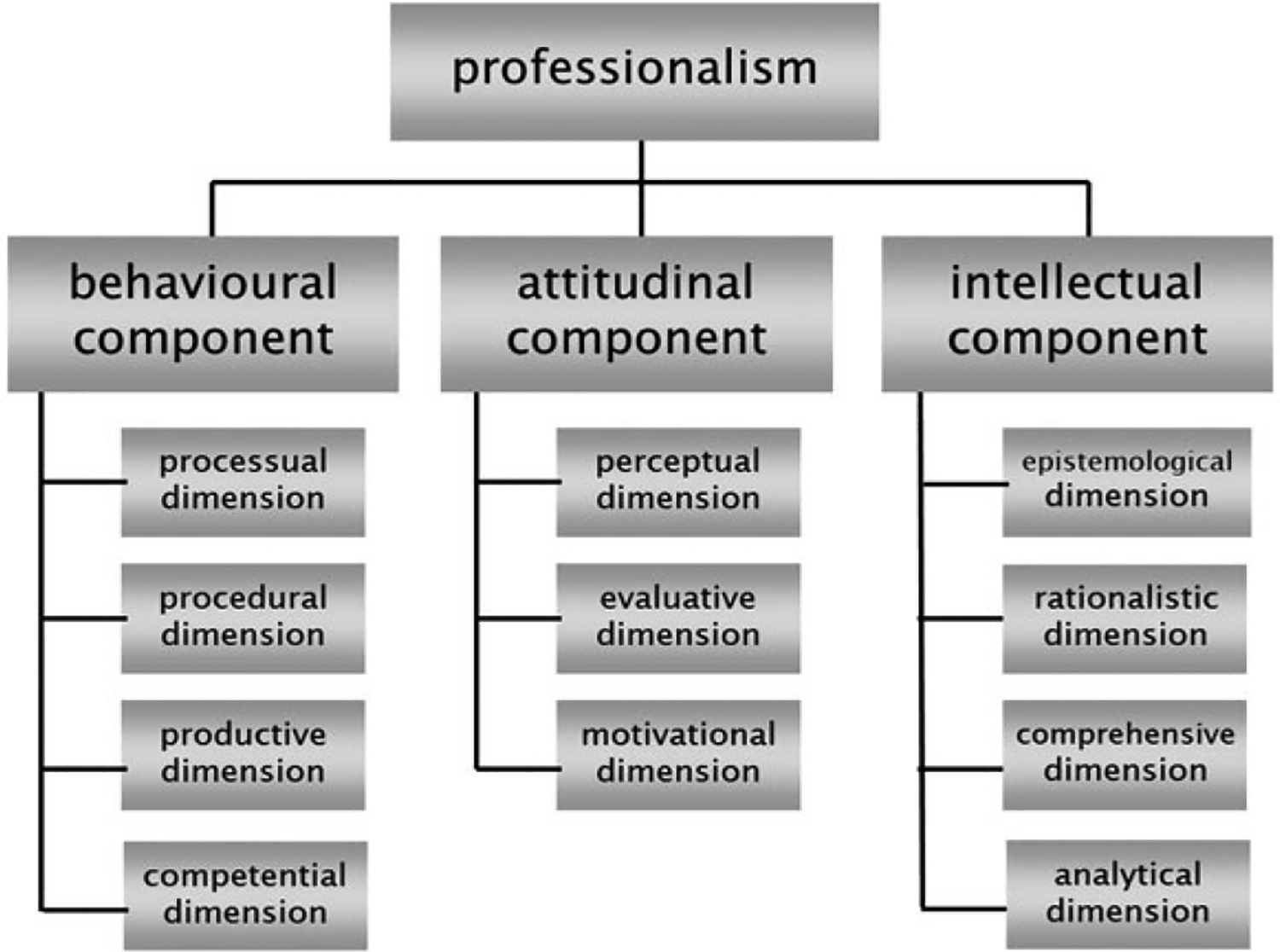
The componential structure of professionalism. Source: Evans (2014).
I have identified and labelled the themes and sub-themes to emerge from these data according to the components and dimensions in Figure 1. Evident from this is that multiple components and/or dimensions are at play concurrently, which is reflective of the multi-layered and complex nature of informal professional development (Eraut, 2007; Evans, 2011).
Attitudinal component
The notion of working learning or learning in situ is a recurring theme within the testimonies of the school business leaders who participated in this study. This is a role that, for many of these individuals, is boundaryless and constantly evolving. As such it requires a positive attitude towards workplace learning, as these participants explain: I think you’re always developing and you should always be learning, you know…you learn everything as you’re going along. (James) I’m still learning every day and…you never stop learning on the job. I have an acceptance of that and each day I always think ‘if I achieve that…’ ‘I’ve learnt to do that’. (Sophie)
Intellectual component
These data also reveal the intellectual aspect of informal professional development among school business leaders. I have highlighted above that workplace learning is a fundamental means of knowledge acquisition for school business leaders yet one might just as conceivably interpret the previous excerpts as representing the epistemological dimension of their professionalism.
Linked to this are the means by which participants’ make sense of particular facets of their role. For many of the participants in this study, enhancements to this aspect of their professionalism routinely occur within their everyday practice, without formal recognition. This participant describes expanding her knowledge of the teaching and learning agenda: I’ll attend the staff meetings when they’re talking about the curriculum. Now that’s not my area of expertise, but to have an understanding of the challenges that face them [teachers] helps me when I’m looking at the budget and we’re looking at different areas, it better informs me. (Jackie) I researched how people choose primary school places and found that 85% choose their child’s place based on what’s near to them, there’s still that old-fashioned view of walking your child to school…I was really interested in looking at that and subsequently ensuring that we stayed high profile in the community. (Diane)
Behavioural component
Connected to and very much interleaved with the two themes is the behavioural component of professionalism. This is also present within participant testimonies of their practice and manifested in the following examples: I think being aware of what’s needed and potentially how to find those things is one of the key things. You can’t be expected to know everything, but knowing how to find out things is probably one of the most useful things that you can have as well. (David) You can’t say that you don’t know something; if you don’t know something then you need to find the answer, that’s how I work. And that’s how I’ve got the knowledge in this job because it is “think on your feet” a lot of it and it’s convincing other people that they need to do that as well. (Laura)
A further dimension of the behavioural component is evidenced through the procedures established by the participants to address perceived gaps in their workplace knowledge: So there’s about 14 of us meet at least once a half term and just share ideas and best practice and we’ve got a list of contractors that we all use…things like that to make the job easier really. (Sophie) We might meet as business managers or I might go and see a deputy in another school about how we’ve used pupil premium and that’s the kind of relationships we might have…sometimes it is just the opportunity to go and speak to people with like-minded challenges. (Adam)
It is important to acknowledge that while the findings presented here reveal the difficulty in disentangling the different facets of professionalism that are being enhanced at any one time, such entanglement is somewhat magnified by the relative brevity of this discussion (necessitated by the restrictive word limit). A finer-grained analysis in which these excerpts could be split into a larger number of shorter segments would facilitate a more distinct separation and clearer sense of the various components of professionalism.
Discussion
In thinking about the kind of professional workplace development and learning that occurs informally, the school business leader provides an insightful focal point. As the findings from the cases presented in this article suggest, school business leaders are particularly pertinent in this respect because so much of what they know about their role is learned on the job and therefore typically falls into what Eraut (2007) would categorise as informal territory. The characteristics of school business leader working life, including the frantic and varied nature of the role, have been covered in more depth than can be provided here (see Armstrong, 2018; O’Sullivan et al., 2000; Woods, 2014). However, there are notable silences within these literatures surrounding the means by which school business leaders navigate and manage this unpredictability in ways that allow them to maintain professional growth and learning. This article can therefore be interpreted as a starting point of a more intricate discussion and debate in this area of the field.
Bearing this in mind, there are some notable observations from the data presented here regarding the nuances of workplace learning. The first is that informal learning in the workplace is both complex and multi-layered. Part of the reason for this may lie with the tacit nature of professional learning, much of which occurs implicitly wherein individuals are often unaware that learning is even taking place (Eraut, 2000). Consequently, this phenomenon is difficult for researchers to capture (Eraut, 2007) and typically relies on subjective (and somewhat crude) interpretation through labelling and categorisation (Evans, 2019). Nonetheless, abstract conceptual frameworks, such as the componential model I draw upon in this article, are helpful in illuminating and bringing meaning to complexity. For example, utilising Evans’ model as an interpretive lens has revealed the prevalence and multifaceted nature of informal learning among school business leaders in the workplace with much of the evidence presented representing an enhancement to more than one component or dimension of professionalism. I have written elsewhere of the plethora of school-based knowledge that school business leaders bring to bear upon their roles and the value this brings to the purposeful functioning of the school and wider system (see Armstrong, 2018). The findings presented in this article supplement this discussion by illuminating the informal means by which such knowledge is accumulated and maintained. Consequently, this affords a wider acknowledgement of professional learning among school business leaders above and beyond that which is formal. This is important, as Eraut (2004) explains from his own research in this area of the field: Most respondents still equate learning with formal education and training, and assume that working and learning are two quite separate activities that never overlap, whereas our findings have always demonstrated the opposite, i.e. that most workplace learning occurs on the job rather than off the job. (p. 249)
A second observation relates to the collaborative aspect of informal learning. A number of the participating school business leaders talk about routinely connecting with fellow professionals (both within and between schools) to observe practice, share knowledge and identify solutions to common challenges. I interpret this as informal learning through social practice which, using Evans’ model, can be categorised under both the behavioural and intellectual components of professionalism. It is what Edwards (2017), in her research into collaborative professional practice, refers to as relational expertise defined as ‘a capacity to work relationally with others on complex problems’ involving ‘the joint interpretation of the problem as well as the joint response’ and also ‘knowing how to know who can help’ (p. 8). Eraut (2007) also identifies relational activity as central to informal workplace learning in respect of the opportunities this creates for meeting, observing and working with individuals (with different expertise and skills) and also for forming critical and supportive friendships.
Conclusions
The research reported in this article was not explicitly designed for the purposes of identifying the various dimensions of professionalism among school business leaders. While acknowledging the limitations of such retrospective analysis, the article adds weight to a growing body of evidence that recognises informal learning as both a legitimate form of professional development (Coffield, 2000; Eraut, 2004, 2007; Evans, 2019) and one that is much more prevalent than the current knowledge base might suggest. A more nuanced understanding of informal learning and where and how it takes place could facilitate the design of approaches to formal learning that can supplement and align with that which takes place ‘on the job’, as Eraut (2007) observes: The majority of workers’ learning occurs in the workplace itself. Formal learning contributes most when it is both relevant and well-timed, but still needs further workplace learning before it can be used to best effect. (p. 419)
This article also breaks new ground in respect of school business leadership, an area of the wider field of education that remains underdeveloped and little understood. As the role continues to grow in prominence and profile (Armstrong, 2018; Wood, 2017) it is vital to continue to advance our understanding not only of its function within the school system (important as this is) but also of the individuals who occupy the role. Central to this is a clearer recognition of the circumstances in and the means by which school business leaders develop professionally so that such learning can be better understood and more actively facilitated. This might take the form of professional development programmes that include strands of activity that require evidence of workplace development and that support school business leaders in recognising where informal learning is taking place. Doing so would help raise awareness amongst this demographic and the wider education community of informal learning in the workplace and its importance to professional development.
Footnotes
Declaration of conflicting interests
The author(s) declared no potential conflicts of interest with respect to the research, authorship, and/or publication of this article.
Funding
The author(s) disclosed receipt of the following financial support for the research, authorship, and/or publication of this article: The research reported in this article was supported by funding from the National Association of School Business Management (NASBM).
