




Abstract
Blending principal education programmes and leadership practice has become a common feature in the education of school principals. However, the need for further research in how programme participants experience learning within an overall structure of a programme has been highlighted since the same programmes are experienced differently. This empirical study used a practice-based approach to explore how participation in the Swedish National Principal Training Programme intertwines with principals’ work in practice. A situated perspective was used, interviewing and observing principals in both their educational and their workplace practice. In addition, teachers were interviewed at their school. This study revealed processes of continuous learning, which connects practice to what was learned in the Principal Programme. These processes mend and bridge old practices with new practices and therefore facilitate change. The principal also becomes a broker, rendering legitimacy in practice. The analyses, however, also reveal processes of interrupted learning, which disconnects working in practice from the participation in the Principals’ Programme, leading to discontinuous processes and exits. Increasing consciousness of the value of working with bridging and brokering would support principals’ professional learning and function as a foundation for leadership development.
Keywords
Introduction
Building on understandings of principals’ professional learning, a movement in principal education has emerged that focuses on knowledge gained in practice as much as knowledge gained in formal education (e.g. Barnett et al., 2009; Walker, 2015). Thus, blending programme participation with engaging participants in leadership practice, with expectations of this coupling to be beneficial, has become a common feature (Dempster et al., 2011; Walker et al., 2013). However, participation in principal programmes that include practice does not guarantee that participants will adequately develop their skills and understandings as participants experience programmes differently (Darling-Hammond et al., 2010; Huber, 2013; Jerdborg, 2020). Accordingly, there is a need for further research in how programme participants experience their learning within an overall structure of a programme (Darling-Hammond et al., 2010; McCulla and Degenhardt, 2016).
Similarly, Vennebo and Aas (2020) emphasize the need for research that investigates how principals handle problematic situations and that principal programmes should include analytical and reflective training that address such problematic situations. However, school leadership is enacted within diverse social settings comprised of unstable contextual factors (Man-Biu Cheung and Walker, 2006). Consequently, school leaders need to understand the interplay between the surrounding community and school culture and leadership (Hallinger, 2011). Learning and development are viewed as progress along trajectories of participation and growth of identity from a situated perspective (Greeno, 1997). According to Wenger (1998), development of practices includes learning how to negotiate meaning and access practices embedded in historical and social contexts.
This study builds on findings from a recent study of principal participation in the Swedish National Principal Training Programme, a study that reveals how principals’ diverse orientations towards practice either enable or restrict the way they experience practice (Jerdborg, 2020). This study explores how participation in the Swedish National Principal Training Programme actually intertwines principals’ work. In Sweden, principals participate in education during their first three years working as principals, an arrangement intended to promote their professional growth. In addition, this arrangement means that this study could investigate how principals in Sweden interpret and make use of their formal education. Specifically, this study addresses two issues: (a) how new principals learning in practice can be described and how the learning relates to their participation in the programme; and (b) how this professional learning can be understood in relation to the role of a principal.
This study also tries out Wenger’s (1998) framework for the exploration.
Professional learning of principals in programmes and practice
Leadership development describes formal training as well as continuing development of principals (Moorosi and Bush, 2011). Darling-Hammond et al. (2010) state that school leaders who participate in development programmes are better prepared and more consistent in their use of fruitful practices, but Robinson et al. (2009) point out that strategic goals need to be translated into concrete routines to be practically applicable and create meaning in practice. Murphy (2020), illuminating complexities of the experiences of new principals, proposes a framework for reflection on how leadership preparation works.
Research on leadership preparation programmes reveal innovative use of instructional strategies, and relevant content, as well as cohort membership for improving leadership (Orr and Barber, 2006; Orr and Orphanos, 2011). Crawford and Cowie (2012) establish that participation in programmes grounds new leader identity and affords access to networks. However, Aas et al. (2016) show that principals’ learning becomes obstructed when they only use experiences from practice, ignoring other knowledge resources. McCulla and Degenhardt (2016) found that participants’ learning covers many individual areas and often ignores commonalities in developmental needs. However, as Perez et al. (2011) point out, new principals seem to better understand the complexity and contextual realities of their work if they have participated in internships.
Much research has emphasized the influence a principal has on the success of a school, but recent research has argued that the core of a principal’s knowledge has become more context-dependent (Hallinger, 2018). Therefore, professional learning in practice is of great importance. Hallinger and Heck (2010), highlighting school leadership as a highly responsive and contextualized relational process, emphasize that school leadership is reciprocal and contextualized as it relates to the specific schools’ improvement trajectory. Vennebo and Aas (2020) argue that principals need to see a local problem from a sociocultural and historical perspective rather than relying on first impressions. Jarl et al. (2017) show how successful schools are connected to continuing leadership practices, whereas unsuccessful schools experience discontinuous leadership practices. However, Brauckmann et al. (2020) question whether leadership actions are culturally or structurally determined, or whether contextual conditions work as facilitators or obstacles.
Overall, research has highlighted the lack of theoretical grounding for the investigation of principals’ education as well as the lack of relating educational efforts to the practical work of principals rather than to the leadership role as its project in policy (Dempster et al., 2011; Jensen, 2016). Thus, there is a need to enhance theory and to link education with the practice, which this study intends to do. This approach, however, requires exploring learning in practice as a complex social process.
Practice-based approaches
This study’s points of departure are practice-based approaches as they offer a way to understand social and organizational phenomena. Social action and meaning-making are embedded in social and material practices if viewed from a situated, a sociocultural or a pragmatist tradition. In a situated tradition, to know is both an attribute of groups and of individuals within such groups (Collins et al., 2001).
Former research within practice-based traditions shows that conflicts and power struggles occur within organizations when change is introduced. Hubbard et al. (2006) show that discontinuities represent learning opportunities, and Sannino (2010) identifies how working out conflicts fosters individual change, from being critical and disruptive to being constructive and agentive. Ashforth and Humphrey (1993) identify the emergence of tensions as newcomers experience conflicts in identity, and Engeström et al. (2007) demonstrate that bridging is important for learning as it spans gaps and breaks in time and social space. They show broken cycles of learning as well as how processes were mended by bridging actions.
This study uses a sociocultural – more specifically, Wenger’s (1998) – perspective and broad conceptual framework, to explore learning as a complex process of social participation. According to Wenger, multi-membership forces an alignment of perspectives. That is, identification as well as negotiability cannot be addressed independently of context. From this standpoint, learning is a process of social reconfiguration that has the power to transform practice. Learning also implies opportunities to change position by letting go of the old identity while shaping a new identity. Practice is produced through negotiations of meaning in open processes with the potential to include new elements. In addition, practice is a recovery process with the potential for continuing, rediscovering or reproducing the old in the new. The inclusion of new members can create opportunities for mutual engagement and awaken interest that translates into a renegotiation of the enterprise (Wenger, 1998).
Conceptual issues, however, can remain underdeveloped within Wenger’s framework (Handley et al., 2006; Roberts, 2006). Wenger argues that the theory should be used as a framework for empirical research while trying out its usefulness (Farnsworth et al., 2016), an approach the present study uses. Former research within this perspective explores shifts in participation through strengthened identities (Oppland-Cordell and Martin, 2015). Carlile (2004) shows that the constraints on newcomers are strongest when practices are threatened to be transformed. Thus, newcomers may choose to maintain marginal positions to avoid compromising the sense of self. Handley et al. (2006) argue that attempts to adapt will generate tensions within individuals and their communities. Thus, the site for the development of identities is not only within a community of practice but also in the spaces between communities.
According to Wenger (1998), participation is a constituent of identity, which does not easily change or cannot easily be turned on and off. Experiences and the world shape each other through a reciprocal relation where identity work can be understood through forms of belonging; that is, engagement, imagination and alignment. Additionally, reification, which refers to the process of giving form to an experience (i.e. its ‘thingness’), provides a point of focus for negotiating meaning (Wenger, 1998). According to Wenger, practice and identity can be captured in four dualities: local and global; participation and reification; emergent and designed; negotiability and identification.
This study assumes that the influence of education is mediated by the principals and their schools. Identity formation over the boundary between education and work constitutes the work of reconciliation. This study, in line with Wenger (1998), also views temporality of identity as neither merely individual nor simply linear; that is, a social form of temporality where the past and the future interact as the history of a community unfolds. According to Wenger, shared histories of learning, constituted by internal dynamics in which investments in practice can be a source of continuity and discontinuity, are the glue that holds a community together. Over time, histories create boundaries between those who have been participating and those who have not. However, communities also develop connections with the global (i.e. the world outside the community) and may organize their communication around reifications that cross boundaries (i.e. boundary objects). Providing connections between practices, using boundary objects, is the work of brokering. Systematic, planned and reflective colonization of time and space, including the production of artefacts, and the design of social processes such as organization or instruction is defined as design. The challenge of design’s realization is to include the emergence of practice (Wenger, 1998).
Method
This qualitative study focused on 14 principals participating in their final (third) year in the Swedish National Principal Training Programme (2018–2019). During this time, they were working as principals in compulsory school. The study explores how the principals, as newcomers, encounter a history of practice in a school (e.g. Wenger, 1998). That is, this study extends the analyses from the situationally and temporal to the historical, individual and collective histories. Thus, a specific time and series of events are the field of study (Des Chene, 1997).
The principals participated in the Principal Programme in three settings (i.e. universities). Information-oriented sampling was used, together with a practice perspective lens. A sampling frame was used to select principals; that is, coming as close as possible to representing the average compulsory school principal in Sweden concerning external factors.
Data were collected over 12 months, from September 2018 to September 2019. Since remembering may be connected to physical spaces, a situated perspective was used, interviewing and observing the principals both in their educational practice and in their working practice. An individual interview and a group interview were conducted where principals were enrolled in their programme, and a third interview was conducted as an individual interview at the principals’ workplace (school). Each semi-structured interview lasted for 60–100 minutes. In the schools, the principals were shadowed during a workday (i.e. observed in their work as it unfolded on a specific day). Observations were logged and notes were taken. In addition, teachers were interviewed at each school. All interviews were audio-recorded and transcribed verbatim. See Table 1 for an overview of observations and interviews.
Observations and interviews.
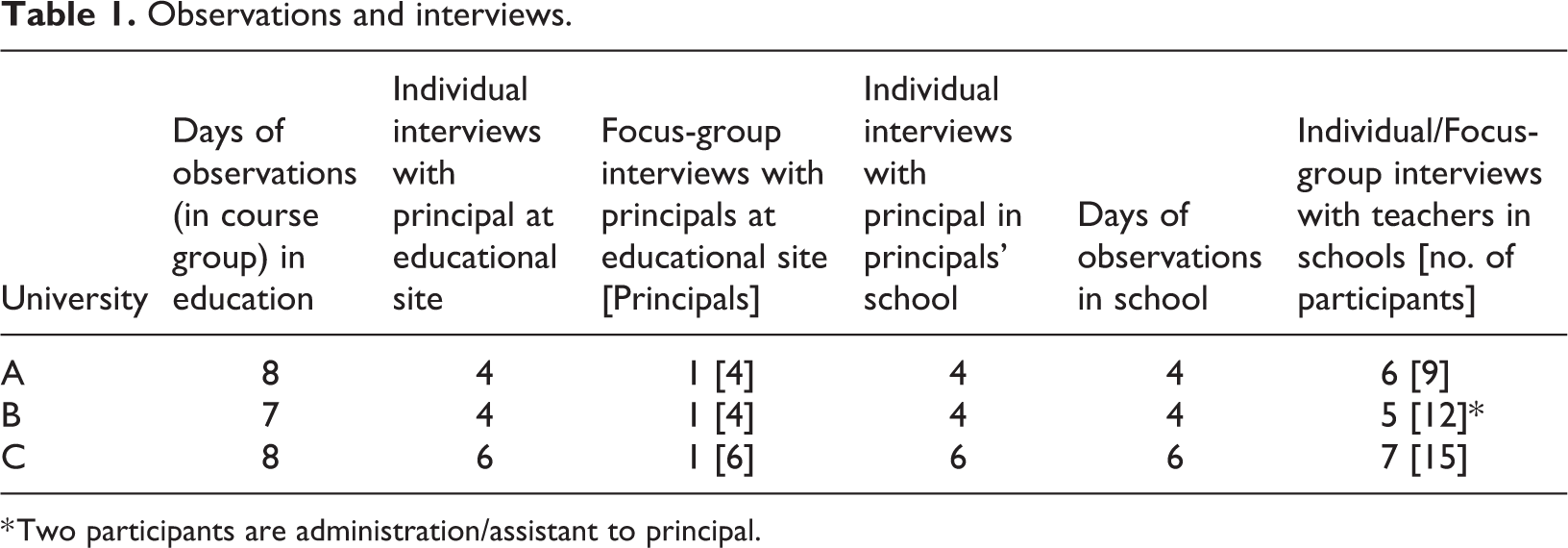
* Two participants are administration/assistant to principal.
Adopting a practice-based approach, the researcher takes a stand of viewing practice from a participants’ perspective, enabling grasping lived experiences, however, complemented by an analytical researcher perspective. The approach motivates a combination of methods. While interviewing is not equivalent to the practice itself, an experience is not directly observable but depend on reflection. Observing thus sheds light on the meaning of oral comments. Practice-based interviews meant using follow-up questions and asking for examples from practice. Focus groups helped participants’ remembering and reflecting. Different interview guides were used for the different interview sets (i.e. first interview, focus-group interview, follow-up interview and teachers’ interview).
Analyses
First, interviews were read several times. Second, case reports were written about the principals. These reports compiled and sorted information and expressions of the principals into a readable story starting with a retrospective view of working life and describing their education and work. The principals’ approach to and work in their organizations were traced by exploring the narrated memories and experiences of work and developing practices and using material artefacts as well as their educational participation and eventual connections. To grasp the principals’ practice, case reports for each school were also written. These reports thematized information about the school as well as expressions from interviews with teachers. The principals’ and the teachers’ stories were related, as well as the observations made in their educational and working practices.
Next, conflictual and developmental processes were inductively identified in the empirical data. These data related to the encounters between the principals’ perspectives and actions and their schools’ history and practices. In addition, the teachers’ stories touched on these encounters. Dualities were used as analytical concepts to further explore the dynamics between continuity and discontinuity as well as the tensions between local and global, participation and reification, emergent and designed, and negotiability and identification (cf. Wenger, 1998).
Local and global were used to view the intertwined relations between external information from the Principals Programme (global) and the situated (local) contextual prerequisites of practice. The principals’ movement between education and work is viewed as crossing a boundary. Participation and reification were used as complementary aspects and resources for negotiations of meaning. Since the emergence of practice constitutes a response to initiated design, these concepts were used to investigate aspects of communication and coordination. The concepts of identification and negotiability were used to view mutuality and shared action, and the dynamic of continuity and discontinuity were used to investigate the complex meeting of the encounter between the principal and school practices. Overall, the concept of reconfiguration was used to draw on identification and negotiability as structural issues defined within the actual contexts. Addressing the first research question, the described theoretical concepts were used. The following questions guided the analyses: How was the spanning of boundaries between education and practice approached? What kind of connections or disconnections are made between education and practice? When introducing or adjusting designs, what kind of communication takes place and how are actions coordinated? How were diverse perspectives approached, and what adjustments were made concerning context?
The concepts of boundary object and broker were introduced while analysing the changes of position. In this study, a boundary object refers to a concrete or abstract object that serves to coordinate perspectives of various constituencies (i.e. an object serves as a means to negotiate new meaning either within an individual or within a collective) (Wenger, 1998: 105). Here, the concept of broker refers to the work of making connections across communities and boundaries to enable coordination of actions and perspectives and open new possibilities for meaning-making (Wenger, 1998: 105).
The term ‘reconciliation’ is used to describe the process of identity formation working to maintain identity across the boundary between education and work. However, the concepts of forms of belonging – engagement, imagination and alignment within the dimensions of identification and negotiability – were used to trace individual changes in reconciliation processes (Wenger, 1998). In the identification dimension, these concepts were investigated by addressing how the respondents analytically completed the following sentence: ‘Before I engaged myself in […], I imagined principalship as […], and I aligned with […].’ These answers were compared to current identification: ‘Now I engage in […], imagine principalship as […], and I align with […].’ The negotiability dimension explored what eventually challenged and turned engagement and what eventually challenged and turned the former images of principalship.
However, using this rich conceptual framework involves balancing breadth, depth and rigour as intended or becoming sketchy, abstract and difficult to understand. The outcome of this balancing act becomes an empirical question for this study. Due to lack of space, quotations from interviews are selected based on what marks the processes clearly rather than emphasizing full representativeness of all participants. However, all participants went through processes of interrupted learning or processes leading to continuous learning or some of each.
Findings
In the following section the results are presented beginning with a brief introduction of the initial overall reconfiguration process, which were found to be an important starting point for all traced processes. Secondly, the initial process later revealed either a process of continuous learning or a process of interrupted learning, so these two processes are described. Thirdly, the work of reconciliation is accounted for.
Reconfiguration across the board
All of the principals are engaged in design issues: My job is to make sure that there are structures, that it is clear how things work, that you follow up, that you create routines, that there are clear divisions of responsibilities and that there are support structures to ensure that all this works in the best possible way. (Principal 6) We had no routine around violations. There was a routine from the local authorities, but we had not used it. Through the Principal Programme, I understood the seriousness of this. It gave me support to explain the law to the staff. (Principal 11)
Process of continuous learning
In continuing learning processes, adjusting design is handled reflectively. These processes are adjusted and tuned so that actions are modified to reflect context and therefore bring value to the organization. Processes of continuous learning render collective understanding and action. One principal describes relief after a process of working through and bridging experienced discontinuities: It struck me that when I started to work as principal it…felt like I was holding a jar to my mouth because I heard what I was saying but no one else seemed to. But that jar is actually gone! Now we handle things differently, and we think differently, based on what I have studied here (in the Principal Programme). (Principal 10) Distancing made me reflect on what is what.…So, what may have crystallized as demand for rules, actually turned out to be a bigger issue, which is about structures and the learning environment and one’s leadership. So, taking a step back and reflect (i.e. in the Principal Programme) brought insights that you might not have gained if you had been in the business as usual. (Principal 5) The most important thing I have learned since I started working as a principal is to differentiate between my own experience and theory. Before, I reacted with my stomach. That meant I could treat the staff in inappropriate ways. With the help of organization theory, I was able to do a different analysis than before…a calmer, more…what should I say, self-examining, without being personally critical. I was able to find help in the theories to improve my communication. (Principal 10) The self-examination that the theoretical review last year (in the Principal Programme) gave, it has given incredible imprint.…. There was a huge jump in confidence when the new Employee Survey came. (Principal 10)
These processes also contribute to the accumulation of shared histories of learning within organizations, and both principals and teachers, separately, name these processes spontaneously, building shared histories around them with a before and an after conceptualization. The work of principals becomes a work of bridging the old and the new practices. Therefore, this work shows potential for bridging discontinuities and healing old wounds; that is, collective understanding of the trajectory shapes meaning and encourages continuity: Now we are all co-workers. We are no longer staff, but we are now up-graded to become co-worker – that’s how I feel. Our principal has kept what was good from previous work. But at the same time, he has not avoided making changes here and there. (Teacher, School 11) Teacher 2: I think there will be a reorganization of the design of these meetings before the next semester. Teacher 1: And I think that the principal has probably seen that it may not be or have been great meetings. T2: The principal himself says that he does not see any point in those meetings. T1: And he is unpretentious in such things. He’s got no problem with making suitable changes. Interviewer: And then he makes changes? T1: Yes. T2: In consultation. T1: Yes, he came up with a proposal here, at the last meeting. This is what it could look like. What do you think? And, so he wanted our views. T2: We don’t think that seems like a good idea, we said. Well, he asked us, what do you think then?
Processes of interrupted learning
Turning to the other type of reconfiguration, namely the process of interrupted learning, managing adjustments is done by direct introduction of ready-made solutions in the form of organizational design. Both detecting a need and bringing a design are sometimes related to participation in the Principal Programme. One principal, who started as an assistant to a principal attending in the Principal Programme, was hesitative: It was tense to see the school’s change as the former principal participated in the Principal Programme. My interpretation is…that the school changed based on her attendance. I think she got quite a lot from there. She probably felt using it for change was necessary, or was in a great hurry to see development. So, she spun on, far faster than everyone else. (Principal 8) I can say, because I was in the management group then, with the previous principal, that when we had a management group meeting, she talked continuously for two hours. And just kind of ran her race: This is what we are going to do, such and such! (Teacher, School 11) It did not go well because this principal knew nothing about how our school had worked or how it was. That’s how I experienced it anyway. So, she came in and had a lot of ideas about how everything should be done.…And no one was satisfied! So, the first year was a bit shaky. (Teacher, School 7) When I started, they had a work of values, which they formed a long time ago…. Solid work. And they were dedicated to it. They were really proud. There was affinity about it. That was the first thing you noticed. And when I came in…I saw huge deficiencies in it. (Principal 11) There are quite a few issues the principal needs to handle because no one knows how it is supposed to work out. Those who have worked at this school for a long time, who knew how it usually worked out, all have resigned.…. Recruitment, it takes a lot of time…takes tremendous time. (Teachers, School 14) The former principal turned the ship in the wrong direction, so to say. I think no one accepts being led by someone they do not trust.…Since the former principal had lost her legitimacy within this school, we sat on start-ups in August with 20–25 new teachers, three years in a row. (Principal 8) I got critics after my first year that I was crappy at giving feedback. And that I was unstructured. I got that critique in the employee surveys. I also attended another education, besides the Principal Programme. They sent out questions to ten employees. There, criticism is very clear! Based on that, I have had recurring conversations with my boss and been given a development area for my personal development as a leader. (Principal 11) It is quite tough, really, to lead development. Because it’s really about how you view teachers’ learning. And how to get there. My basic philosophy is that everyone is capable. And now I have learned, or reflected on, if they want to! (Principal 12)
However, some principals described a retrospective understanding of how actions relating to the context led to the prevailing situation: It was a troublesome start because they (the employees) were not allowed to take part in developing the goals. They experienced that my goals came falling right out of the blue. They had always been involved in developing the goals before I came.…And I had never worked with developing the school’s goals out of quality work like that. I never reflected on the fact that the staff were supposed to be involved. I understand that now, in retrospect. (Principal 11) We were in a situation a few years ago, or a couple of years ago, when we were so afraid that the teachers would resign that we were over-accommodating. We agreed on most things. But they resigned anyway. (Principal 8)
The work of reconciliation – enabling change of position
The analyses show that the principals try to make educational practice and school practice coexist. Participation in the Principal Programme intertwines the processes, providing information that functions as a mirror and in some processes providing designs used by the principals as solutions. However, in processes of continuities, the Principal Programme tends to serve as the provider of thinking tools – that is, reifications – used by the principals to negotiate both individual and collective understandings through thought, speech or action, which stretch processes into learning processes. These tools push learning and collective meaning forward. In processes of discontinuities, the principals reject such tools and turn directly to practice: Several (in the training) have talked about different models.…Some of the models have felt as…it was almost like science to understand the model, and then it was just more work to use it than to solve it on your own. (Principal 6) I just thought, what do they want me to do with that cross model, and what does this help me in my practice, and how should I be able to implement it? (Principal 7) As I see it, I will not develop plans for every single thing I need to fix in my school. When I discover a bug, like if there is something in the Education Act that we do not fulfil.…Some things have to be fixed immediately. But…I think we’re a little too fast. (Principal 4) I have gone from being extremely operational to become an educational leader during these two and a half years.…Because I went to the Principal Programme…that’s how I came to understand why it works out the way it does, based on these theoretical models.…For me, the communication course was crucial to gain an understanding of the very insight into dealing with communication. How do I do? What am I not doing? And then get to see it in black and white. (Principal 10) She was sad about how the staff experienced her, but she did not take it. Nowadays she does, which has resulted in the staff gaining confidence in her.…The staff meeting at the start of the semester did a lot, even though it became a difficult situation right there. (Teacher working with Principal 10) I do not provide solutions directly at seated tables.…When you reflect on it, you usually find what you need to do. It can take a couple of days or a week sometimes. A lot of people are fast and immediately state how to deal with issues. If I deliver an immediate answer, then it will not be thought through. (Principal 8) I have thought a lot about whether I am an educational leader or not. I do not see myself as one of those fantastic principals who have their extreme pedagogical thinking and knows exactly what to do and where to go. (Former identification) (Principal 8) I valued the reading of the different perspectives (in the Principal Programme)…. And then, the fact that we have learned about creating meaning and participation, in the sense that the employees need to feel appreciated, and gets involved in what’s happening in the school. (Negotiability dimension: the challenging of, and turning, engagement) (Principal 8) I have realized now that I do quite a lot of pedagogical leading. How I work with the economy, how we work with initiatives. How we control different efforts. How we want the teachers to work in the collegial work and what it is we should invest in. To lead that work is to be an educational leader, I would say. (Current identification) (Principal 8)
Summary
The processes of reconfiguration and reconciliation are summarized in Table 2. The process of continuous learning bridges organizational ruptures, which include the power to transform practices through brokering global assets into the local economy of meaning. The principal, acting as a broker, helps negotiate meaning across boundaries, using reifications in form of boundary objects. However, using new designs involves openness to emergent needs and mutual adjustments in practice. By linking meanings to boundary objects, meanings become negotiable since they become distanced to identification. This process of working through bridges experiences of discontinuity and shapes continuity by negotiating new meaning into the shared history of learning, rendering learning and development.
Summary of reconfiguration and reconciliation.
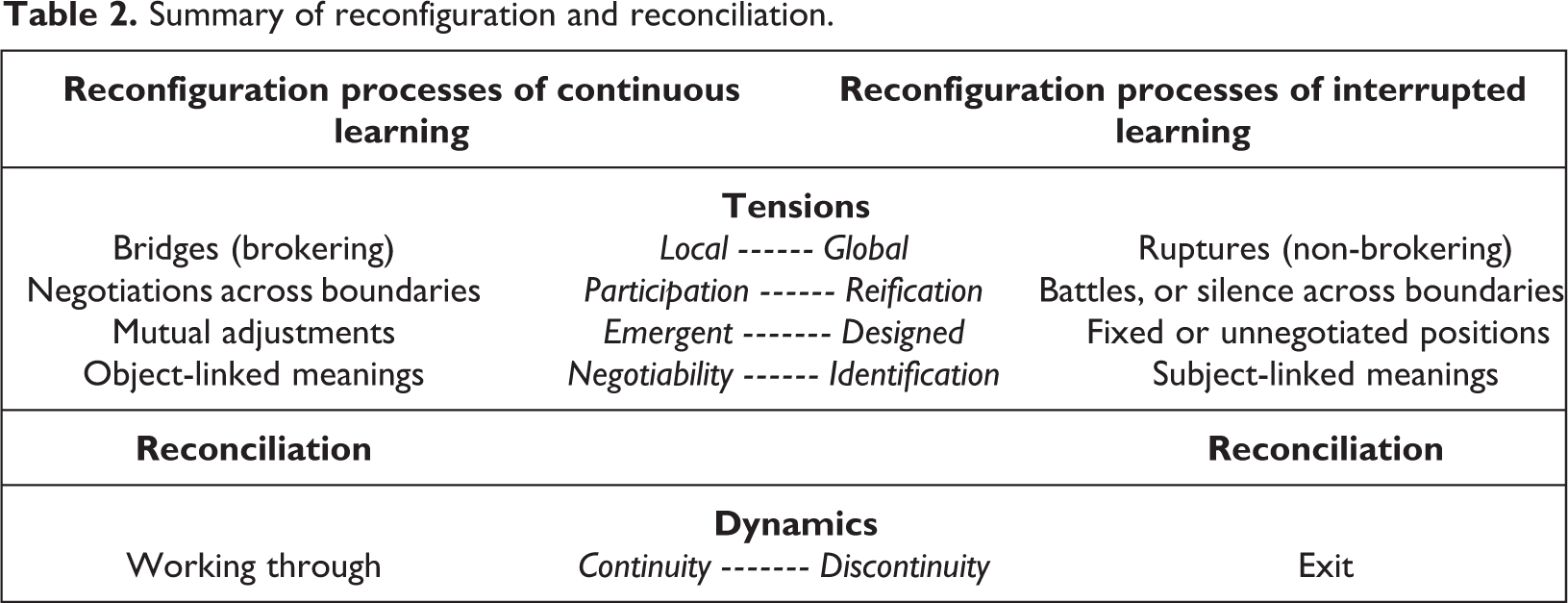
The process of interrupted learning shapes new ruptures since there is no brokering taking place when global assets are put into place in the local economy of meaning. The non-brokering principals do not participate in the negotiation of meaning across boundaries and reject reifications as well as the use of boundary objects. Introducing fixed designs is done without negotiations, which deny mutual adjustment. Since the meaning of designs also is linked to self, they become part of identification that makes them un-negotiable, leading to battles. This process does not render learning since it is interrupted by exits, which rupture continuity and shape discontinuity.
Discussion
This study shows that bridging can span gaps and breaks in time and social space important for learning, corroborating with Engeström et al.’s (2007) work. However, this study connects these findings to principals’ participation in education while working in practice, which expands the knowledge on the professional development of principals. The first research question of this study addresses how new principals’ learning in practice can be described, and how this learning relates to participation in the Swedish National Principal Training Programme. Two processes were found and described – continuous learning and interrupted learning. Continuous learning connects practice to what was learned in the Principal Programme. Introductions and adjustments of design in practice were communicated within schools, and actions were coordinated and adjusted out of what emerged in practice. Situated negotiations were used to work things through, and meanings were linked to boundary objects. Thus, shifts in position as well as mutual adjustments of identification were possible. These processes of working things through led to continuous processes, mending and bridging old practices with new practices and therefore facilitating change.
Interrupted learning, however, mainly disconnected working and practice from the participation in the Principal Programme. Local issues of practice and global issues from the programme were not negotiated and were experienced as ruptures in practice. The communication around needs for actions and introductions of design was insufficient and therefore actions were not coordinated. Situated negotiations did not take place, but meanings were linked to identity and therefore positions became fixed. These processes led to discontinuous processes and exits. These findings are corroborated by Hubbard et al. (2006) and Sannino (2010) in that occurring discontinuities represent learning opportunities when facing and working through struggles. This study’s findings agree with Murphy’s (2020) findings that leadership preparation and development are social practices situated in cultural contexts and with Vennebo and Aas’ (2020) finding that there is a need for strengthening principals’ skills to lead tension-laden change processes. However, this study adds the importance of promoting the linking of meanings to educational assets instead of linking to the self; that is, the principal’s self-identity.
The second research question of this study asked how this professional learning could be understood in relation to the role of a principal. The results show that this learning can be understood as a work of reconciliation; that is, the process of identity formation over the boundary between education and practice. This work leads either to successful resolutions or to struggles. The principals who engage in working themselves through describe this as work of exploring alternatives and envisioning possible futures as well as connecting several perspectives; that is, work of both imagination and alignment. Knowledge of the school’s history in combination with knowledge obtained from education provides the opportunity to negotiate meaning and use boundary objects. In this process, one’s position is also negotiated. By increasing engagement through negotiation, the principal becomes a broker, rendering legitimacy in practice.
This result, aligned with Hallinger and Heck’s (2010) findings, emphasizes that school leadership is reciprocal and contextualized – related to the specific school’s unique improvement trajectory. This study describes this process in detail and shows that as long as local contextual knowledge is not considered and engaged with through negotiations, there are poor conditions for a new principal to change positions and act as a legitimate leader. However, as long as no boundary objects or external knowledge are used to negotiate meaning, the principal will find it difficult to gain legitimacy for proposed changes or developments. That is, a principal’s role is at stake – taking the role of an engaged broker with a theoretical grounding and with professional tools and perspectives to understand and develop practice or taking a more marginalized role. Jarl et al. (2017) show that continuing leadership practices are connected to successful schools and discontinuous leadership practices are connected to unsuccessful schools.
This study proposes that shaping a continuous or discontinuous leadership practice might be a facet of the actual leadership practice and not only a prerequisite for school organizations, which is an important contribution to the field of school leadership for school improvement. However, this idea needs further exploration as this study has a few limitations that need to be considered. The precision of the sampling of participants, schools and educational contexts and what qualities they capture are difficult to fully assess. Future studies should examine how new principals encounter practice and how they gain capability and legitimacy to act as leaders.
This study also tried out the usefulness of Wenger’s (1998) broad conceptual framework which implied a need for specifying a large number of concepts. However, these concepts became relevant and enabled the creation of a deeper understanding of the complex topic of the entwining of Principal Programme participation and engagement in leadership practice in schools. As Murphy (2020) points out, structural reform involves social and cultural processes and processes of social learning and therefore identity becomes entwined in steering implementation efforts. As this study shows, this also applies to formal education, which implicates a need for including meta-reflection on identity formation in principal programmes to promote individual principals’ learning. This study contributes to the field of principal preparation and professional development by unpacking processes of social learning for principals. The resulting illumination may be useful for policymakers, employers, principal educators, practitioners and researchers by bringing deeper insights into how leadership preparation works and how it affects schools under different circumstances. This can be a basis for improving the design of the principal’s role in steering documents as well as for improving aspects of principals’ education in connection with practice.
Conclusion
This study contributes to the research on professional learning of principals by investigating how participation in the Swedish National Principal Training Programme intertwines with the work of new principals. Their learning builds on having access to theoretical thinking-tools to understand and rethink practice and reifications to use as boundary objects. This functions by distancing, reflective thinking, and questioning. However, this study shows that principals need contextual knowledge of the school to connect educational content.
The identified process of continuity not only helped to heal organizational ruptures but also to negotiate meaning, linking new actions to ongoing trajectories. In this process, the principals become brokers. The two processes are seamlessly interwoven. In brokering, principals use both local contextual knowledge and boundary objects in the form of global decontextualized knowledge. Linking the two paves the way for the principal to act as a legitimate leader in practice. However, when processes of continuity are broken, schools and principals become stuck in a landscape of discontinuities where issues remain unprocessed and where development is obstructed.
The results of this study show that principals need to engage in situated negotiations considering the school’s local context, which implicates that increasing consciousness of the value of working with bridging and brokering supports individual principals’ professional learning. Further, this knowledge can form a foundation for leadership development if used to develop principal programmes. However, further research is needed that examines how educational contents are contextualized in practice in diverse school contexts.
Using a practice-based approach enabled gaining a deeper understanding of the intertwining of Principal Programme participation and engagement in leadership practice in schools. This show that researching leadership learning involves studying specific practices and that a suitable theoretical framework is of great importance.
Footnotes
Declaration of conflicting interests
The author(s) declared no potential conflicts of interest with respect to the research, authorship and/or publication of this article.
Funding
The author(s) received no financial support for the research, authorship, and/or publication of this article.
