




Abstract
In recent years, partnerships between schools and non-system actors, that is, cross-sector alliances, have become increasingly important in education systems around the world, raising concerns and doubts regarding the influence of non-school actors in educational management and leadership. In these debates, trust is regarded as a key element for the success of cross-sector alliances. Although both trust and cross-sector alliances have been increasingly studied in education research in recent years, an investigation of the role of trust in such relationships is still missing. This article analyzes relational trust in cross-sector alliances in education in order to contribute to further theory building. To this end, it implements a qualitative design based on semi-standardized interviews with 21 individuals responsible for managing an illustrative cross-sector alliance. Interviews are analyzed with the help of an approach based on Grounded Theory. The analyses result in a five-dimensional theory of trust in cross-sector alliances, comprising (1) individual attitude, (2) time, (3) professional affiliation, (4) power, and (5) multiplexity. The theoretical approach developed in this article has practical implications for networked leadership and school principals’ work and training as it provides information regarding the skills and knowledge needed for managing cross-sector alliances.
Keywords
Introduction
Over recent decades, partnerships between schools and non-system actors, that is, cross-sector alliances (CSAs) such as charter schools, have increasingly emerged in education systems worldwide, fostering collaboration 1 between actors from formal education (e.g. schools) and non-formal education (e.g. administration, politics) (Eyal and Yarm, 2018; Yemini and Sagie, 2015). Education systems around the world are increasingly held accountable for improvements in education (DeStefano and Moore, 2010; Verger et al., 2020). They respond to these expectations by initiating and supporting networks of actors from different education sectors, that is, CSAs (Glazer et al., 2019; Lubienski and Perry, 2019). Even though social networks and trustful relationships beyond formal education have long been recognized as pivotal to the success of lifelong learning, we still know little about relational trust in CSAs.
This article seeks to unpack relational trust in CSAs in education and to further develop its theoretical foundation. Following Eyal and Yarm (2018) as well as Brinkerhoff (2002), we understand CSAs as strategic partnerships in which various actors collectively communicate, discuss, develop and re-shape ideas and, thus, “mutually adapt to synergistically form new structures and routines, while maintaining their respective organizational identities” (Eyal and Yarm, 2018: 649). As Townsend (2015) notes, such collaborations promote hybrid forms of leadership, arising from the quest for participation on the one hand, and the aspiration for inter-group, networked leadership on the other. This pursuit of both leadership and participation is combined with the general necessity for such interactions to develop trust between the actors involved (e.g. Cosner, 2009; Hatcher, 2014). In these alliances, the actors’ relational trust is constantly changing and is crucial for the success of such initiatives. Actors from different organizations and educational sectors work together to overcome current challenges in education systems, such as educational inequality or school dropout. For example, to support individual learning biographies through improvements in educational transitions or to encourage more children and adolescents with migrant background in schools and higher education (Feys and Devos, 2015). This gives them the space to address challenges in a more coordinated way through collaboration.
Trust is understood in this article as the willingness of an individual or collective actor to engage in a relationship and thereby be vulnerable to another actor (Chhuon et al., 2008). Relational trust (sometimes referred to as interpersonal trust) refers to a person's willingness to participate in a relationship that involves a certain risk or potential to become vulnerable to another person (Tschannen-Moran, 2001) and to assume risk “on the basis of the interaction and on the confidence that the latter party will possess benevolence, competence, integrity, openness, reliableness, and respect” (Daly, 2009: 175).
Several studies have shown that positive impact can be attained through fruitful collaboration among actors of different educational organizations (e.g. schools or universities) in a particular region by enabling collective problem-solving (e.g. Whiteford et al., 2017). Often, organizations lack the ability to single-handedly solve problems within the education system. However, the notion of CSAs is not devoid of political and academic criticism. Other scholars see beyond just advantages and doubt that networks have a positive impact on education. Some critics argue that networks in education are difficult to handle and time-consuming, and their practical benefits have so far only been empirically proven in a few very specific contexts (Forte and Flores, 2013; Reeves et al., 2017). Another potential risk associated with CSAs is the possibility that they could improve the position of members of elite groups only, thereby deepening social inequality and gaps (e.g. Duveneck, 2016). Scholars point out that the increasing involvement of “third sector” actors in many countries of the world lacks (democratic) legitimacy, especially in the case of influence exerted by economic non-governmental organizations (NGOs) or foundations (e.g. Feuerstein, 2001; Kolleck, 2017; Kolleck and Yemini, 2019; Verger, 2019). Other authors argue that the involvement of non-state actors benefits wealthier schools, while disadvantaged schools often go empty-handed (e.g., Feuerstein, 2001).
Yet, despite the growing presence of external agencies in many countries and contexts, there is still a dearth of research on establishing and managing CSAs (Eyal and Yarm, 2018). In the academic literature, there are numerous perspectives on trust that shed light on individual aspects of the phenomenon or discuss its general relevance in different contexts. For instance, Tschannen-Moran (2001), in their study on collaboration between school principals, teachers and parents, found that a trusting atmosphere positively effects participatory collaboration. However, although trust is considered as crucial for the success of educational networks, there is no widely accepted theory on trust in such networks that would allow us to derive empirically verifiable hypotheses. As Chhuon et al. (2008) note, contributing to a fine-grained theory of trust must recognize both relational and organizational levels. However, while authors such as Daly (2009) and Chhuon et al. (2008) provide a detailed theory on trust and its facets in relation to the level of schools or school districts, we still lack an adaption for CSAs. In this article, we seek to contribute to this dearth of research by considering relational trust concerning the actors involved in an illustrative CSA including individuals from different professional backgrounds in education. Thus, our aim is to take a first step towards the development of a theory of relational trust in CSAs.
Theoretical foundations of trust and state of research
Basic theoretical assumptions of relational trust
Since trust can be considered to reduce complexity by serving to bridge uncertainties and knowledge gaps (Luhmann, 2009), it is essential for educational reform, which is embedded in an interrelated set of mutual dependencies among all key actors: students, teachers, principals and administrators, and parents. These structural dependencies create feelings of vulnerability for the individuals involved.
The differential trust theory according to Schweer (1997) assumes that relational trust is composed of different conditions. On the one hand, decisive for the development of trust is each trusting person's individual tendency to trust, which provides information on the extent to which this person regards trust relationships as possible. Whether a person actually trusts is ultimately decided in concrete interactions with a counterpart. Kochanek (2005) found that although trust exists primarily between individuals with social similarities (e.g. religion, culture, etc.), this similarity alone cannot create trusting relationships. Rather, the continuous exchange is potentially more important for building trust. At the school level, the literature distinguishes different facets of relational trust (see e.g. Chhuon et al., 2008; Daly, 2009; Tschannen-Moran and Hoy, 1998). However, depending on the study and the author the facets of trust examined differ. For example, building upon Bryk and Schneider (2002) and Chhuon et al. (2008) apply eight facets of trust at the beginning of their study (risk, communication, benevolence, reliability, competence, integrity, openness, respect), of which four in particular prove to be relevant (openness, communication, risk, and integrity). Daly (2009), however, draws on the work of Bryk and Schneider (2002), Mishra (1996) as well as Tschannen-Moran and Hoy (2000) and assumes six facets from the beginning of his study (benevolence, competence, integrity, openness, reliableness, and respect). While these dimensions have so far been identified at the school level it needs to be tested whether they are also relevant in CSAs. Furthermore, previous studies indicate that influence and power play a central role in the formation of trust. “Trust building is possible only when one party is open to influence from another or when there is intervention from a third party with whom both sides are open to influence” (Chhuon et al., 2008: 269). Other studies indicate that in the context of CSAs the different facets of power may be important for relational trust (Kolleck, 2013): structural power (financial resources and privileged positions in the formal hierarchy), relational power (interpersonal relations and social networks), and discursive power (influence of norms, ideas, words, communication). Mining the facets of power may contribute to building a more finely grained theory of trust in CSAs.
Trust within CSAs and collaboration networks in education
Discussions related to the improvement of educational systems have drawn attention to the conditions inherent to educational reforms (Townsend, 2015). Specifically, authors have revealed a lack of relationships between schools and out-of-school organizations (Kolleck, 2016, 2017), caused by a paucity of exchange beyond institutional borders (Chhuon et al., 2008). However, the structures of most education systems seem to discourage social exchange and interaction across institutional borders more than they encourage it. Particularly at the management level, collaboration deficits are apparent in many countries (Vangrieken et al., 2015). In CSAs, these collaboration deficits are complicated by different organizational structures and logics. Even though formal educational institutions such as schools or universities have gained a considerable amount of autonomy in recent years, they are still embedded in hierarchical systems (Kochanek, 2005). From there, the leaders of these formal educational institutions have a central role in initiating or strengthening trusting relationships (Chhuon et al., 2008). However, while there are already many studies on collaboration in and between schools (Vangrieken et al., 2015), we still know little about the ways school principals, educational leaders, and educational administrators may foster trust as a capacity-building mechanism in CSAs.
In recent decades, educational researchers and practitioners have increasingly become aware of the essential role of trust in educational networks for the success of school development and educational reform (e.g. Daly and Finnigan, 2010; Duffy and Gallagher, 2017; Moolenaar et al., 2014; Chhuon et al., 2008). This notion is supported by research that shows that social networks in education may support schools to improve instructional program coherence and student achievements (Wells et al., 2015). Hence, while trust in CSAs has rarely been investigated, there are numerous studies on trust in schools, which provide guidance for the study of trust in CSAs (e.g. Gray et al., 2016; Lee et al., 2011; Liou and Daly, 2014; Tschannen-Moran, 2009). Other scholars (e.g. Hargreaves, 2007) found that trust contributes to the success of professional learning communities (PLCs), with trust in school leaders being especially relevant (Liou and Daly, 2014). Unlike CSAs, PLCs focus on collaborative learning within schools. In Germany, too, research on networks in education has focused primarily on school-based networks (e.g. Bremm, 2019; Duveneck, 2016; Berkemeyer et al., 2015). This contribution, in contrast, turns to partnerships between actors with different professional backgrounds (e.g. formal and non-formal education actors). At the same time, CSAs in Germany are affected by specific conditions different from other countries. In particular, the literature points out that CSAs face specific difficulties in the German education system because schools have long been understood as closed units and teaching as a private matter of teachers (e.g. Kolleck, 2016).
As a result of the growing evidence with respect to the positive effects of collaboration in educational settings (e.g. Chhuon et al., 2008), scholars and practitioners have developed different initiatives with the aim to improve educational equality and interactions between schools and out-of-school organizations through fostering CSAs (Kolleck, 2019). Many different concepts have evolved in recent years to describe forms of collaboration in education. Examples are the concept of “networked communities” (Bryk et al., 2011), “PLCs” (e.g. Stoll et al., 2006), or “school turnaround strategies” (e.g. Peurach and Neumerski, 2015) implemented collaboratively by various actors in the education field to support low-performing schools (e.g. Peurach and Neumerski, 2015). These concepts all foster collaborative actions, but are mostly focused on collaboration between teachers within schools. CSAs, in contrast, unite actors from formal and non-formal education as well as local leaders from various sectors (e.g. government, educational administration, third sector). These actors are faced with structural differences and do not have daily social exchanges. Hence, it is crucial to explore trust and its facets in CSAs. The present study seeks to unpack relational trust and to further develop its theoretical foundation. Specifically, an approach based on Grounded Theory (GT) is used to analyze the trust relationships in a CSA in Germany. This undertaking is innovative in two respects. First, relational trust in CSAs has hardly been studied systematically to date. Second, we still lack a theory on relational trust in CSAs. With this in mind, this article applies previous elaborations on relational trust in education to the case study of the CSA “RuhrFutur” in the German Ruhr area. It further develops an empirically founded theoretical sketch of relational trust in CSAs based on qualitative data gathered through 21 interviews and analyzed using an approach based on GT. More specifically, this article is guided by the following research question:
How can relational trust be characterized in CSAs?
Methodology
To find answers to the research question, we implemented an approach based on GT. The aim of the approach used was to develop a theory that is close to reality, thereby making it applicable to practice and thus reducing the theory-practice gap. All data were collected and analyzed according to the principle of theoretical saturation, which is achieved by collecting and analyzing data in parallel. According to this principle, the process of sampling is to be continued until the elaboration of theoretical concepts has reached a point of saturation and when additional analysis no longer contributes to the discovery of anything new about a concept or category (Charmaz and Thornberg, 2020). On the one hand, interviewees were selected in a targeted manner in accordance with selective sampling (Schatzman et al., 1973). Care was taken to ensure that at least one person from each type of organization in the CSA involved was interviewed. On the other hand, the number of people interviewed was not determined in advance. Rather, it was decided during the course of the research process whether further data were necessary from a theoretical point of view in order to understand the trust relationships in the CSA analyzed for this article.
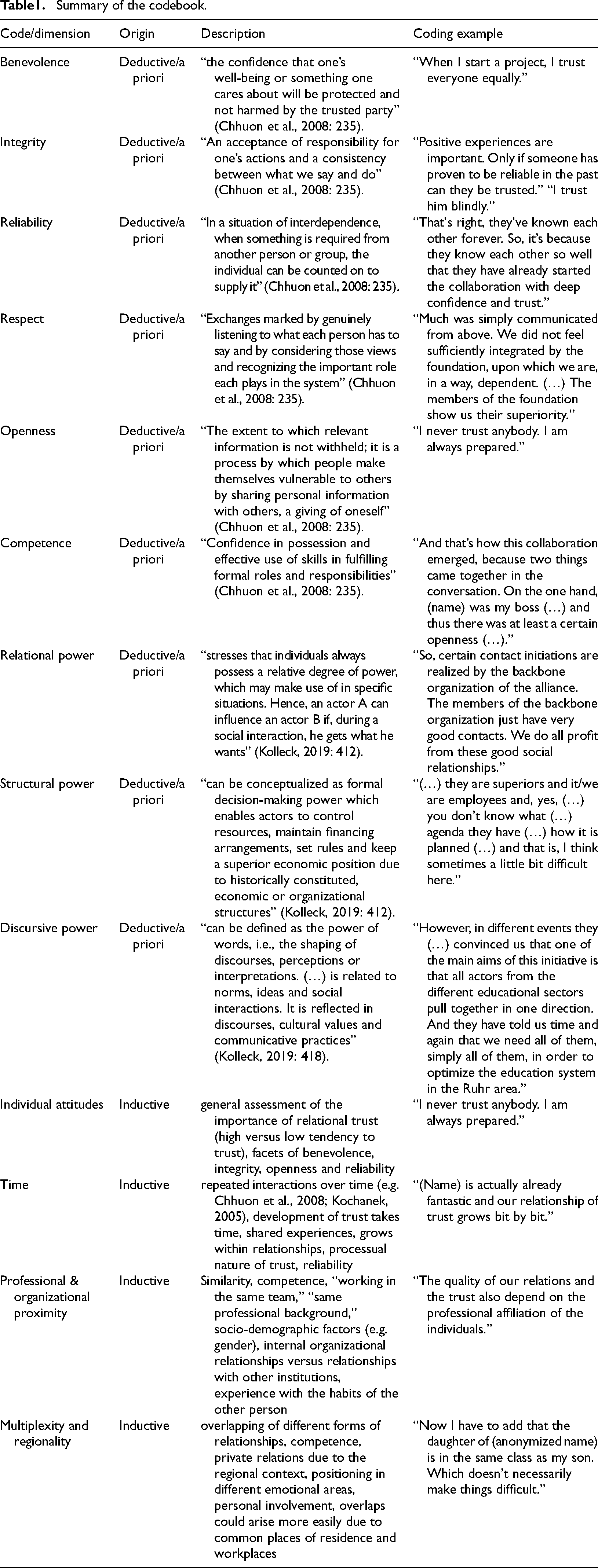
In terms of data analysis, both inductive and deductive approaches were applied. This allowed us both to apply concepts we already knew from the literature and be open to new insights into the data. The study was driven more by the data itself than by the conceptual framework. A team of two independent researchers first examined the patterns and themes and then related these to the existing theoretical literature with the aim to inductively tease out the relevant facets of trust. The deductive codes were based on six facets of the definition of relational trust (benevolence, competence, integrity, openness, reliability, and respect, see Daly, 2009) and the three facets of power (structural, relational, discursive, see Kolleck, 2019). The facets of “communication” and “risk” proposed by Chhuon et al. (2008) were not applied as deductive codes to the data material because, first, “communication” could not be clearly distinguished from “openness” in the data material and was also not part of Daly’s (2009) definition of relational trust and, second, risk was not interpreted as a facet of trust but rather as the basis for all of the other six facets he proposed in later studies (Daly, 2009). Since our aim was to contribute to theory-building, codes were more interpretive and less descriptive. Table 1 shows a summary of the codebook.
Summary of the codebook.
Study context
The study was focused on an illustrative regional education network in one of the poorest areas in Germany: The Ruhr area. This multi-professional network was established in 2014 with the aim to improve the regional education system by supporting educational equality and individual support and to decouple the success rate of students from their social background (e.g. through integrated language training). Leaders from different educational organizations—such as school principals, university presidents, heads of daycare centers, staff from education administration and policy, and senior executives from NGOs or foundations—were included in the CSA and accordingly participated in regular meetings and issue-specific networking activities. On the one hand, the CSA was facilitated by a regular exchange between RuhrFutur's partners. Partners were the organizations involved in RuhrFutur, that is, at least one leader per organization. On the other hand, further issue-specific initiatives and events were organized in which other actors in the region were involved.
Sampling and data collection
The interviews were conducted over 13 months using a semi-standardized interview guide. The interviewees were selected according to the principle of selective sampling (Schatzman et al., 1973) including key members of the network with a leading coordinating role in the CSA. In selecting interview subjects, attention was paid to variance in professional backgrounds. A total of 14 women, seven men, and representatives from the following areas were interviewed: universities, schools, primary education, municipal administration, state administration, and foundations. The interviews lasted about 80 min on average, were conducted in the interviewees’ workplaces, recorded, and then transcribed.
Interview guide
The interview guide used to conduct the interviews included (among other theoretical constructs not covered in this article) questions about the interviewees’ trust in their network partners. The questions built up successively from one about the general role of relational trust in the interviewees’ working context to the request that they name concrete relationships of trust within the network and describe the nature of these. The type and frequency of contact as well as the contents of exchanges were recorded in detail. While relational trust was not the only construct captured, it was the focus of the interviews and also accounted for the most time (taking up at least half of the length of the interviews). The individual facets of trust and power were not explored so as not to overly influence the interviewees. No explicit questions were asked about power and influence. As such, the interviews provided data material to investigate whether the facets of trust and power were mentioned. It could be argued that the facet “communication” mentioned by Chhuon et al. (2008) was included by measuring the type and frequency of contact as well as the content of the exchange. However, Chhuon et al. (2008) define “communication” differently and vaguely. In addition, “communication” is not part of Daly’s (2009) definition of relational trust and he ignored this facet in some of his later studies. Therefore, “communication,” in the form proposed by Chhuon et al. (2008), was no longer considered in the present study.
Analysis
The transcribed interviews were evaluated according to an approach based on GT as developed by Strauss and Corbin (2010) and with the help of the analysis software MAXQDA. In a first step, we coded the interviews openly, that is, the data were examined in small steps with regard to their core content. This process serves to identify individual phenomena and their properties. In relation to the research topic of relational trust in the multi-professional educational network, this coding process helped to distill the interviewees’ understanding of trust, allowing important themes and facets of trust to emerge.
In a second step, we applied the technique of axial coding. Accordingly, the findings from the first analysis step were reanalyzed by placing the individual phenomena in context. Here, the deductive codes (Table 1) were used to explore whether and how the facets of trust and power were reflected in the interviews. In addition, the situations in which the interviewees locate their trust relationships were ascertained. In this way, different codes were combined to construct more abstract concepts that we call dimensions that ultimately formed the basis of the theory presented in this article.
Following the rules of selective coding, in a third step, the data material was re-examined with the aim of integrating all the identified concepts into the theory of dimensions, resulting in different characteristics for each dimension.
To ensure impartiality towards the empirical object and thus to enable a theory-based predominantly on empirical data, we limited our preliminary review of the literature to a basic understanding of the phenomena of trust and CSAs. This last step served as a basis for comparison and sensitization to the subtleties of the knowledge gained, as suggested by GT (Strauss and Corbin, 2010).
Results
To decipher relational trust in educational CSAs, this section presents the results of the analyses according to the five identified dimensions of relational trust in CSAs and then relates these to each other as a means of theory development.
Individual attitudes
In the scope of the inductive analyses, individual attitudes turned out to be one fundamental dimension of the trust relationships in the educational network. The literature has already drawn attention to individual attitudes in relation to the facets of benevolence, integrity, openness, and reliability (e.g. Chhuon et al., 2008; Daly, 2009). In the present study, the data were reanalyzed according to these facets, and it was found that they emerged as recurring themes with reference to individual attitudes. Furthermore, inductive analyses showed that individual attitudes played a role primarily in relation to the general assessment of the importance of relational trust. Some individuals showed a high tendency to trust and regarded trust as a necessity for collaboration initiatives and work relations. Others focused their attention on distrust and thus demonstrated a low tendency to trust each other. Of course, gradations appeared between these two extremes. For the majority of respondents, however, trust in the professional context played an important role or was regarded as a basic prerequisite, as demonstrated in the following quotation: It's the basis for everything. (…) I would rate it even higher than professional collaboration (Interview 18).
While some interviewees did not automatically associate positive aspects with trust and showed a general skepticism about the risks of “blind trust” and “coterie,” others stressed that trust was a basic condition for successful collaboration in CSAs. In the case of RuhrFutur, some individuals were willing to trust their project partners from the outset. This means that they had already entered into an equivalent preliminary trust agreement with all members of the network before they could even share common experiences: “When I start a project, I trust everyone equally” (Interview 11). This points to the importance of the facets of benevolence and openness. Furthermore, interviewees stated that in the course of the collaboration, they determined whether their trust invested in others was justified and then adapted their degree of trust based on experience. As such, an equal distribution of trust across all participants was not described as being self-evident in the long run. In contrast to the above, the majority of the interviewees only placed trust in others after the relationships had been tested through relevant experiences in terms of the facets of integrity and reliability. These interviewees were not prepared to advance trust a priori. However, in addition to the four facets of trust mentioned above, the dimension of “time” played a decisive role here.
The importance of trust in the work context was relativized by those who considered it to be relevant but certainly not necessary. These interviewees did not encounter their network partners with a basic attitude of trust. The development of a relationship based on trust was not the aim and where it nevertheless arose, it did so on a relational rather than a business level, as highlighted in the following quotation: Between business partners (…), I can settle a business. Trusting, in contrast, is something for the interpersonal area (Interview 4).
At the opposite extreme to those for whom collaboration without trust was not possible, other interviewees described themselves as suspicious people who did not trust anyone: I never trust anybody. I am always prepared (Interview 21).
Thus, the interviews conducted for this study showed a wide range of basic attitudes towards trust in the work context, which consequently affected the relationships within the group.
Time
In addition to “individual attitude,” “time” also proved to be a central dimension, which was also significant in relation to each of the other dimensions. Although the relevance of time emerged inductively out of the data during the coding process, its relevance has already been suggested in the scientific literature, with previous studies arguing that repeated interactions over time were more important for relational trust than social similarity (e.g. Chhuon et al., 2008; Kochanek, 2005). The data for the present study indicates that trust grew within relationships, meaning that the development of trust took time. Expressions such as “there is not yet enough trust” or “trust has become stronger in the last year” pointed to the processual nature of trust. The following quote stresses that trust did not arise suddenly but rather grew gradually and therefore took time: (Name) is actually already fantastic and our relationship of trust grows bit by bit (Interview 21).
Trust was formed primarily in the CSA when relevant experiences were shared. Only based on these experiences could a participant judge whether to trust or not. Positive experiences thus increased the probability of growing relational trust
I have great confidence in the school inspectorate (…) because we have been working closely together for 15 years (Interview 2).
In the work context, a positive experience usually meant that the individual in question was known to be professionally and organizationally reliable, as Daly (2009) and Chhuon et al. (2008) have already shown.
That's right, they've known each other forever. So, it’s because they know each other so well that they have already started the collaboration with deep confidence and trust (Interview 1).
In some cases, the experience and resulting trust from earlier work settings have been at least partially transferred to the new setting, even though the tasks and roles of those involved have changed.
Professional and organizational proximity
Looking at the trust relationships dealt with in the interviews, it became clear that the professional and organizational affiliation of the people in each relationship was relevant.
This dimension was identified through inductive data analyses, although learnings in regard to this dimension could also be found in the literature. Kochanek (2005), for example, had already shown that social similarity and competence are important for building trust in schools. In the present study, however, it became clear that, in contrast to the school context, it is not so much the social as the formal proximity of colleagues that plays an important role.
It turned out that in the CSA context those who worked in the same team and had the same professional background were the most trusted. In particular, collaboration with personal assistants as well as with deputies was characterized by a special degree of trust and was described with terms such as “blindly” and “inner circle”: Yes, I trust him blindly. I can tell you that when I see him, he gives me the impression of being part of an inner circle (Interview 13).
Some of the interviewees did not make any distinction between themselves and their “inner circle.” They talked about the generic “we.” Only a few of these very trusting relationships in the inner circle were argumentatively justified by the interviewees, instead of being taken for granted as seen in formulations such as “natural”: (…) but of course also with (name), so these are the colleagues from my field of activity (Interview 8).
This distinguished internal organizational relationships from those with colleagues from other institutions. With the latter, trusting relationships may be seen as being subject to limitations. For example, inter-organizational relations required a thematic-technical reference as a focal point for collaboration. It is striking that in relation to trust, those non-organizational colleagues who were named were active in a topic or function-related area (e.g. school management). This was accompanied by descriptions of relationships in which the participants came from different contexts—a core idea of CSAs. However, individuals engaging in these relations faced the challenge of coping with the different customs of their counterparts. This could lead to irritation for those involved because they were used to other organizational procedures and ways of dealing with each other.
There's no trust (…) yet, and to be honest that surprised me (…) Hence, the trust in our alliance depends on where the person to be trusted comes from. It is not only the time we spend together, or the projects that we initiate or the success we see. The quality of our relations and the trust also depend on the professional affiliation of the individuals. (…) As for teachers, for example, it seems that they only trust each other, that they are not willing to build trust relationships beyond their field of activity. Perhaps this seems to be evident to you as a researcher, but I was a bit shocked (Interview 7).
In this quote, the interviewee expressed surprise about the formal behavior of their counterpart. The unfamiliar behavior of the other person increased the insecurity of the trusting person. Due to a lack of experience with the habits of the other person, the behavior was difficult to predict, which at a minimum slowed down the development of trust. This example also shows that the dimension of time as well as the facets of competence, respect, and openness played a decisive role in relation to professional and organizational proximity.
In addition, the interview data provide grounds on which to assume that socio-demographic features such as gender may also have had a confidence-building effect: (…) secondly, the constellation of four women brought in a special moment. That is to say, four women in (…) a similar frame of responsibility (Interview 8).
Accordingly, proximity does not have to be determined solely by professional or organizational factors, but can also be perceived on the basis of other socio-demographic factors.
Power
Another dimension that we were able to distill theoretically from the data was that of power relations. As described in the theory section, previous research has argued that depending on the relationship and individuals, power can have very different effects on trust and take different forms (e.g. Kolleck, 2019). On the basis of deductive analyses of the data, the three facets of power already mentioned in the literature proved to be particularly relevant: structural power, relational power, and discursive power (Kolleck, 2013).
The CSA analyzed for the present study had the unique situation that a funding unit (i.e. the funding foundation) provided financial resources under certain conditions. The financial basis served, on the one hand, to promote the network partners involved. On the other hand, it supported the establishment of the CSA and ensured its functioning. For relational trust relationships, this means that the employees of the funding foundation assigned to the network took on the role of superiors in the eyes of other participants in the association. As representatives of the funding institution, they were responsible for allocating funds and monitoring the use of these. As a result, the funding recipients became dependent on them and were obliged to report to them. The following quote shows how the funding institution was classified (as a superior) and that collaboration with it was experienced by others as unsettling due to a lack of transparency. The existing dependency inhibited trust in the “superiors”: (…) they are superiors and it/we are employees and, yes, (…) you don't know what (…) agenda they have (…) how it is planned (…) and that is, I think sometimes a little bit difficult here (Interview 10).
The office established as a “backbone organization” to support the initiation of the CSA was responsible for the organization and coordination of the network and administered the funds for the promotion of measures. This resulted in a strong structural position of power. Its initial attempts to revive the education network and win partners were met with distrust: “I must say at first I was very skeptical” (Interview 16).
It was only through time, the power of persuasion, and processes of legitimization (as part of discursive power) that active local people began to trust more in the office. Trust was also strengthened through the use of personal skills and resources (e.g. contacts; relational power) on the part of the office: So, certain contact initiations are realized by the backbone organization of the alliance. The members of the backbone organization just have very good contacts. We do all profit from these good social relationships (Interview 18).
Beyond the backbone organization, which by definition played a special role within the network, increased involvement of the participants and a more active and influential position in the alliance of individuals with different professional backgrounds also seemed to have a positive effect on trust: Sometimes, individuals had the impression that the backbone organization could become too strong and that it somehow tries to define the rules in our education system. However, in different events they (i.e., the staff of the backbone organization) convinced us that one of the main aims of this initiative is that all actors from the different educational sectors pull together in one direction. And they have told us time and again that we need all of them, simply all of them, in order to optimize the education system in the Ruhr area (Interview 2).
Multiplexity and regionality
While analyzing the five facets of trust, it became apparent that for the CSA under study, these can be supplemented by multiplexity as an additional dimension. Although this dimension was identified inductively, the term “multiplexity” is also used in network analysis and theory. It describes the overlapping of different forms of relationships (Verbrugge, 1979). Results of the present study show, however, that multiplexity in the CSA related to different professional frameworks in which the participants of the network had already met. Accordingly, the dimension of regionality played a crucial role in multiplexity. Such structures were not unusual, especially due to the project character of many initiatives and strong private relations due to the regional context of the CSA.
It became evident that overlapping of relationship levels contributed to a deepening of trust if two persons knew each other on both a professional and a personal level. This positioning in different emotional areas also entailed a personal involvement that depended on it. Interviewees often referred to such multiple connections: Now I have to add that the daughter of (anonymized name) is in the same class as my son. Which doesn't necessarily make things difficult (Interview 21).
In this quote, the connection at a personal level was assessed as positive for the employment relationship. The regionality of the network played a decisive role here. It seems that such overlaps could arise more easily due to common places of residence and workplaces. This also applied to the connections of some members of the group, as already noted in relation to the temporal dimension of trust. Some of the actors already knew each other from previous employment relationships. Such overlaps of relationships proved to be particularly relevant for the development of trust. This was because—as already explained in the previous chapter—experiences that served the development of trust had already been made. The existing trust thus facilitated entry into a new working relationship, as the following quote shows: And that's how this collaboration emerged, because two things came together in the conversation. On the one hand, (name) was my boss (…) and thus there was at least a certain openness (…) (Interview 11).
The quote further confirms the assumption made in the section on social proximity and competence: relations of trust with colleagues outside one's own organization were primarily with individuals who were active in a functionally related field or who were perceived as being particularly competent.
Theory development
The five dimensions of trust presented above were generated from the data with the aim to contribute to theory building. They served as central dimensions of trust in the CSA studied for this article. Each of the dimensions showed different characteristics that affect relational trust. In addition, the identified dimensions were not connected loosely but could be related in a structured way, as will be shown below.
As already indicated above, individual attitudes appeared to be a fundamental trust-building dimension. The study found three ideal-typical categories of people that reflected their basic willingness to trust their counterparts. The data revealed a category of people who attached great importance to trust and showed a high degree of willingness to enter into preliminary trusting relationships without prior experience. A second category referred to those who considered trust to be less relevant in a professional context. The third category included people with a negative attitude towards trust.
The “individual attitude” dimension was closely interwoven with the temporal dimension. In other words, individual attitudes could be traced back to a person's previous experiences. This was also shown by the fact that the “time” dimension was important in all other dimensions. The fundamental character of these dimensions has already been confirmed by existing theories or theoretical concepts on relational trust in general (Schweer, 1997) and in the school context (e.g. Chhuon et al., 2008).
We identified two further dimensions: “professional and organizational proximity” and “power.” They were specific to CSAs because they went beyond organizational boundaries in their consideration of relational trust and focused on the peculiarity of multi-organizational associations. With regard to “professional and organizational proximity,” four different categories were distinguished. Firstly, intra-organizational relationships were shown to be relevant, as these were seen by respondents as natural relationships of trust. Secondly, there was professional closeness, which went beyond organizational boundaries and built trust through professional and function-related similarities. The third category was marked by professional and organizational distance and thus was the main factor standing in the way of trust development. In this case, however, time could relativize the feeling of alienation through experience. This resulted in a subjectively perceived calculability of behavior that took away the feeling of insecurity from those who trust and promote the development of relational trust. Finally, socio-demographic factors such as gender were found to be influential with regard to perceptions of proximity.
Concerning power, the three facets of power (structural power, relational power, and discursive power) already found in the literature proved to be particularly relevant. While the relevance of power and influence for building relational trust has already been observed in the educational literature (e.g. Chhuon et al., 2008), it has not previously been identified as the main dimension. Moreover, the different facets of power have rarely been differentiated in the literature on CSAs (Kolleck, 2019).
The fifth and last dimension, “multiplexity,” could largely be regarded as a spatial dimension and therefore referred to the regionality of the educational network. Here, three characteristics could be distinguished. Firstly, the overlapping of private and professional relationships, which had a positive effect on trust within the network in the example presented above. Secondly, such an overlap was more likely in a regionally limited area than in supra-regional alliances. Respondents increasingly had a regional occupational biography, which means that they have spent much of their working life in one region. Thirdly, multiplexity seemed to be a social rather than a spatial phenomenon, which was supported through regional proximity. The parallelism of relations based on job-related and/or socio-demographic characteristics created favorable conditions for the development of trust.
Figure 1 illustrates the five dimensions of relational trust in CSAs. The upper bar presents an individual's general perceptions concerning relational trust in CSAs between the two poles of “Trust as an indispensable prerequisite” and “No trust,” with “Trust as supplementary” in the middle. The bottom bar refers to the facets of relational trust already identified in the literature and confirmed in our data: benevolence, competence, integrity, openness, reliability, and respect (Chhuon et al., 2008; Daly, 2009). The five dimensions of trust identified for this article are found in the middle of the figure.
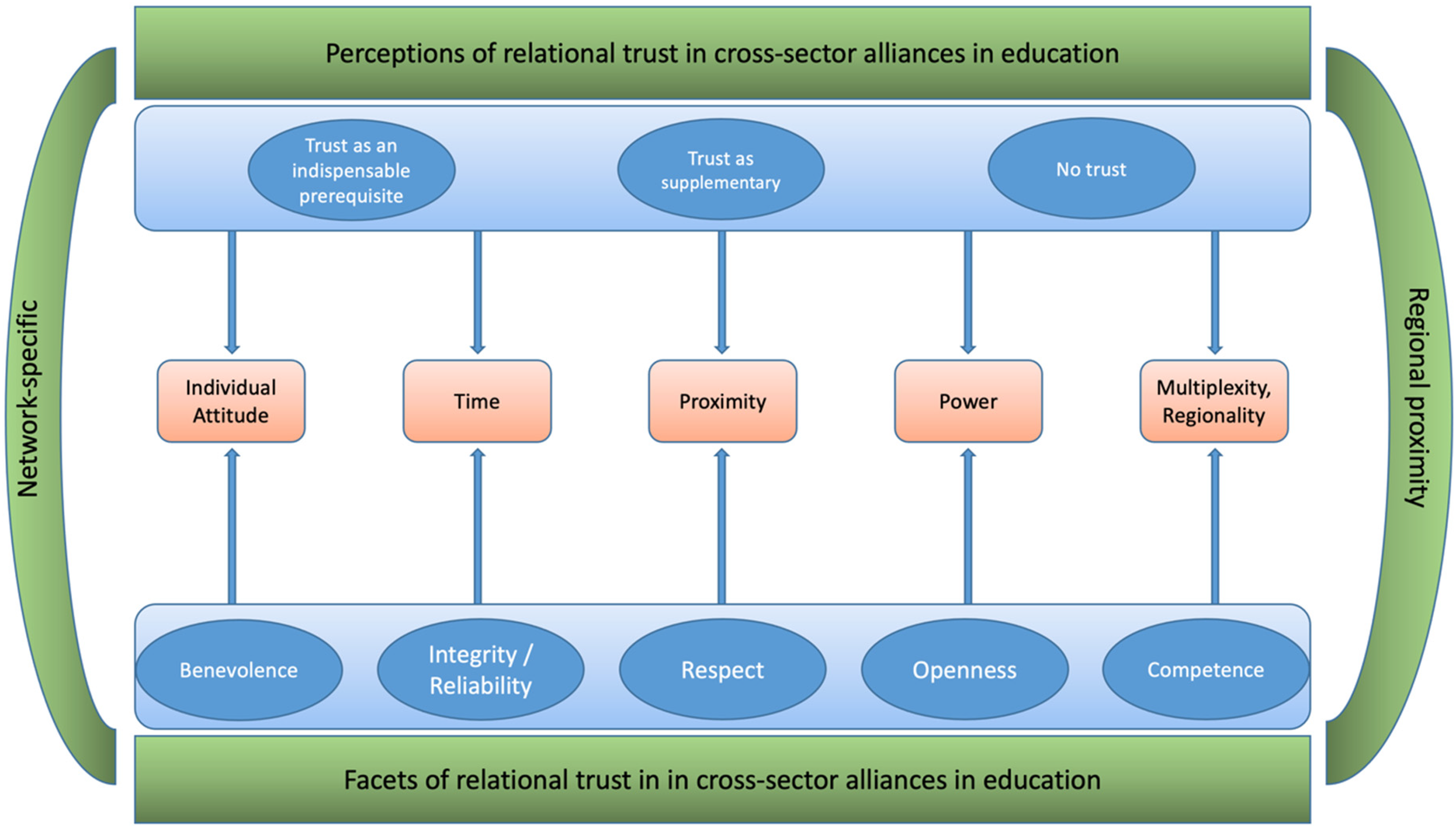
Dimensions of relational trust in cross-sector alliances (CSAs).
Integrity and reliability are presented in one box, as these facets are not defined in a clearly separable way and could not be distinguished from one another in the data for this study. In this study, each of the dimensions represented a space of experience relating to trust within the framework. In each of these spaces, the trust could be either promoted or its development hindered. None of the dimensions is to be understood as an independent space of experience but rather as an interrelated element working alongside other dimensions.
Discussion
In this article, we have analyzed relational trust in CSAs in education in order to develop an empirically founded theory. Interviews were analyzed with an approach based on GT and resulted in a five-dimensional theory of trust in CSAs in education: (1) individual attitude, (2) time, (3) professional and organizational proximity, (4) power, and (5) multiplexity. These dimensions represent an approximation to a better understanding of trust relationships in CSAs in education and can be regarded as a first theoretical sketch.
In providing this sketch, the article has argued that relational trust in educational CSAs is embodied in different dimensions. By using a specific empirical example, we have shown that depending on the five dimensions, different trust relationships arise. It became clear that basic assumptions about trust do not lose importance when transferred to a CSA. Rather, the study confirms basic theoretical assumptions of previous trust research and concretizes, expands, and systematizes these in a CSA-specific way.
The first dimension discussed in this paper was individual attitudes. The literature has already drawn attention to this dimension in relation to the facets of benevolence, integrity, openness, and reliability (e.g. Daly, 2009). The significant role of the second dimension “time” has also been demonstrated previously (e.g. Chhuon et al., 2008; Kochanek, 2005). However, while it has been argued that repeated interactions are more important for relational trust than social similarity, the data from the present study suggests that social proximity was more crucial for the CSA analyzed for this article than, for example, for teacher collaboration. One reason might be that exchange beyond institutional borders is more difficult to realize than within educational organizations such as schools (e.g. Kolleck, 2016).
The importance of the third dimension, that is, professional and organizational proximity, has already been shown in the literature on school-level relational trust, which has so far focused primarily on social similarity and competence (Kochanek, 2005). As for the present study, the professional level of the social relationship seemed to be particularly relevant due to the multi-professional nature of network members, highlighting the relevance of openness and respect between professionally similar persons. Another dimension that we were able to identify in the data was that of power. Three facets of power proved to be particularly relevant: structural power, relational power, and discursive power. Finally, it was argued that multiplexity should be added as the last dimension, also pointing out that multiplexity in the CSA analyzed for this article is mainly influenced by regionality.
Overall, however, it became apparent that the facets of trust examined in the scientific literature so far (e.g. Daly, 2009) are not clearly discernible in the data and are defined and understood quite differently depending on the individual. Such a different understanding of theoretical constructs, however, comes with challenges for quantitative surveys that have not been addressed adequately in previous academic literature.
Moreover, while the literature on relational trust in education usually assumes that trust always has positive connotations, our data revealed a different picture: trust was seen as an obstacle by some individuals from different areas of the education system. In particular, some of the interviewees showed general skepticism about relational trust, pointing to the risks of blind trust and cronyism.
Limitations
Although the findings of this article extend the literature on trust in education, the study has limitations that must be noted. First, the qualitative approach of this study and the selection of a specific case study implies that the results cannot be readily generalized. For example, one cannot conclude that individuals in CSAs or educational networks in other countries or cultural contexts have consistently similar perspectives.
Furthermore, the generated dimensions can only be understood as the first sketch of a theory of relational trust in educational networks. While many findings are consistent with previous research, subsequent qualitative, quantitative, or mixed-methods investigations that draw on both qualitative interview data and quantitative interviews or quantitative social network analyses would be a useful next step.
Despite the limitations mentioned above, the results of this study offer some important implications for practice as well as directions for future research.
Practical implications
As argued earlier in the article, studies of trust in schools already point to some implications for practice. In CSAs, however, trust is tied to different dimensions. Relationships across institutional boundaries face particular challenges to trust building due to the lower professional proximity and frequency of contact. Results of this study have practical implications for CSAs in general and for networked leadership and educational leaders’ work and training, since they provide information regarding the skills and knowledge needed for managing CSAs. In such alliances, trust relationships need to be built or, in other cases, repaired. Hence, the findings of this study may provide support for network leaders, school principals, and site administrators to empower staff to take risks and to involve further individuals within schools to allow teachers to take on a new role. For individuals involved in CSAs, it is important to learn how to maintain social relations beyond one's own organization that foster opportunities for flexible responses and supportive settings that produce and extend trust. In this regard, professional development on the trust dimensions for leaders in CSAs (recognizing their role as a bridge between different educational organizations) seems elementary. Educational leaders take an important role in the realization of CSAs, for example, through making time for regular interaction and the subsequent building of trust (Chhuon et al., 2008). Trust in CSAs could in turn have an impact on individual organizations. For a successful organization and implementation of reform initiatives, CSAs should adopt programs to enhance relational trust between their members, enabling educational leaders to systematically consider the dimensions affecting trust. As Townsend (2015) has already shown, CSAs have the potential to foster hybrid forms of leadership that emphasize both participation and cross-group, networked leadership. This speaks to the significance of applying or fostering policy instruments that build on trust rather than focus almost entirely on obedience.
Directions for further research
This exploratory study represents a first step in developing a theory of trust in CSAs on the basis of which hypotheses can be generated. This perspective is to be examined in further qualitative as well as quantitative studies with representative samples. In addition, by classifying these relationships according to the dimensions presented in this paper, social network analysis may be useful to allow for a targeted exploration of development opportunities for the network, considering the specifics of the respective trust dimensions. Given that even greater dissemination and expansion of educational networks is to be expected in the future, additional studies on the validity of the trust dimensions with larger samples are critical for making this first step.
Finally, further case studies of CSAs in different cultural contexts and countries may yield additional theoretical and empirical insights. They can offer a deeper understanding of the conditions that support success and provide a broader foundation for school principals, education administrators, district or network leaders, and policymakers to guide policy and action.
Footnotes
Acknowledgements
This study was funded by the German Research Foundation through the grants KO 4997/1-1, the Bundesministerium für Bildung und Forschung (grant no. NetKuB, KO 4997/4-1, A 16015) and the Mercator Foundation through the grant with the number A 16015. I would like to thank the anonymous reviewers whose comments have been extremely beneficial for improving this article. Moreover, I thank my teams at the Freie Universität Berlin and at the Universität Leipzig for their insightful feedback on an early draft of the paper.
Declaration of conflicting interests
The authors declared no potential conflicts of interest with respect to the research, authorship, and/or publication of this article.
Funding
This study was funded by the German Research Foundation through the grants KO 4997/1-1, the Bundesministerium für Bildung und Forschung (grant no. NetKuB, KO 4997/4-1, A 16015) and the Mercator Foundation through the grant with the number A 16015.

Supplemental material
Supplemental material for this article is available online.